Introduction
While it is recognized in the literature that on-site physicians reduce referrals to hospital from mass-gathering events, similar studies in the light of the development of non-physician advanced practitioner roles have not been undertaken.Reference Kemp 1 , Reference Grange, Baumann and Vaezazizi 2
Mass-gathering events are defined as pre-planned events where people gather at a specific location for a common purpose within a predetermined period of time.Reference Boyle, De Lorenzo and Garrison 3 , Reference Zeitz, Zeitz and Arbon 4 Such events have the potential to impact external health services provision significantly through the need for the medical care of emergent or on-going health issues of those attending the event. Depending on the local health care infrastructure, impact can occur at different levels of demand.Reference Zeitz, Zeitz and Arbon 4 Previous work has identified that the relative health risks vary considerably due to a number of factors that include age; the size, density, and mood of the crowd; whether attendees are seated or mobile; the availability of alcohol and drugs; and whether the event is contained within a boundary.Reference Endericks, McCloskey and Vincent 5 - Reference Zeitz, Schneider, Jarrett and Zeitz 7
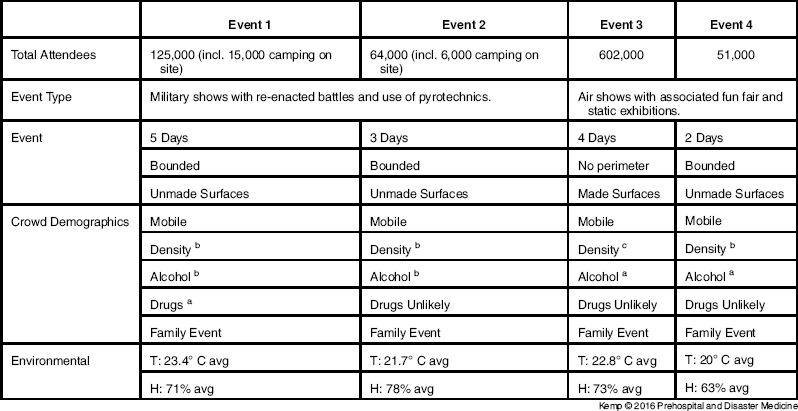
This study was conducted for the event medical services provided to four mass-gathering events during a single summer in the United Kingdom (UK). Table 1 describes the demographics of each of the events that included two military re-enactment shows, both with an on-site resident population, and two international air-shows.Reference Endericks, McCloskey and Vincent 5
The Demographics of the Four Events Described

a Minimal.
b Medium.
c Significant.
All the events within this study were attended by a single advanced nurse practitioner (ANP; the author), who is an independent prescriber and accredited prehospital care practitioner. He holds higher qualifications in this sphere as well as having over 25 years experience of event health care. Based at the main treatment center, the ANP would also attend peripheral first aid posts and respond to on-site emergencies. Advanced nurse practitioners work at a level well beyond the skills and competencies common to all registered nurses, have master’s level post-registration qualifications, and are usually independent prescribers.Reference Milsten, Maguire, Bissell and Seaman 8 , 9 Leaders in their clinical environment, ANPs are recognized as being able to work in complex and unpredictable work contexts providing:
Highly specialized theoretical and practical knowledge, some of which is at the forefront of knowledge in the work area, covering a range of procedures and underpinned by relevant broad-based knowledge, experience, and competence. 10
Paramedics at the events were ambulance-based and available for emergency calls as a rapid response and transport resource. Paramedics in the UK are registrant health care practitioners (HCPs) whose scope of practice is described by the Joint Royal Colleges Ambulance Liaison Committee (London, UK) Guidelines for Clinical Practice. 11 Their registration provides for the possession and administration of a limited range of drugs in accordance with nationally agreed clinical guidlines.Reference Brown, Cooke, Fisher, Hines and Smyth 12 , 13
The first aiders at the events were all British Red Cross (BRC; UK) volunteers trained to provide a range of medical interventions. Primarily, they were lay people who had undertaken training courses to prepare them for providing on-site first aid care at events. Some of the volunteers were trained to higher levels with a minority providing emergency ambulance cover in support of the professional ambulance services.
This paper reports on a prospective observational study investigating the impact of an ANP working alongside paramedics and first aiders (the event medical team) at mass-gathering events with regard to referral and ambulance transport rates to external health care resources.
Methodology
The study took place over four mass-gathering events for an accumulated period of 14 days. Ethics approval was sought and given from the University of Bedfordshire (Luton, UK) ethics committee. The BRC, as the event medical provider for all the events, granted permission for the study.
The research was conducted within the norms of the established operational protocol for the event medical team. This requires that a senior HCP must review any patient identified by the event medical team as requiring possible referral to external health services. Where there is serious trauma or illness, any HCP may make the decision to refer direct from scene. In the past, a doctor has undertaken the senior clinical role, but in recent years, this has been undertaken by an ANP.
At the start of each shift, as part of the normal duty briefing, the event medical team was informed that a research study was being undertaken. Participation was voluntary and was limited to answering a question when referring a patient to the ANP. All staff on duty at the four events within the study co-operated fully. With the exception of the senior managers for the event, other staff were blinded as to the purpose of the study so as to counter any unintentional bias being introduced.
All patients identified by the event medical team as requiring referral for assessment or treatment by external hospital or primary care services were referred to the ANP for review and were included in the study. This included three patients who required on-scene emergency care with immediate transport and who were treated by the ANP on-scene at the request of the BRC control team. There were no other emergency referrals direct from scene. The ANP was asked routinely to become involved in a range of patient contacts outside of those identified as requiring onward referral; this level of activity was not included in the study.
When referring a patient to the ANP, the event medical team member was asked: “What would you have done for this patient if the ANP was not available today?” If the answer provided suggested onward referral without being specific as to where, clarification was sought but with no prompting as to potential points of referral. In all other respects, the referral and review protocol remained unchanged from established practice, and as such, patient care was unaffected.
As per normal practice for all mass-gathering events, a robust on-site clinical governance system was put in place by the BRC. This was undertaken independently and blind to the research activity. All patient records (which alongside the clinician’s notes and recorded by BRC staff included details of the times patients presented, were seen, referred, reviewed, discharged, or transferred) were reviewed by one of two BRC governance officers. These were both senior registered nurses with emergency department (ED) backgrounds. This was undertaken on-site for all four events, and should any delays or concerns in care/referral have been identified as a result of the referral or study activities, they would have been flagged immediately to the duty managers. No concerns were forthcoming as a result of the review process or the study.
On a daily basis, the on-site duty manager for the event medical services reviewed all patients’ notes for those who would have been referred to an ED by the event medical team to identify those who would have been transported by ambulance. In undertaking this, they had only the initial referral information on which to base their decision so as not to be influenced by the clinical information from the ANP’s review. This individual was involved in all transport decisions for patients being referred as part of their normal role and so would have made these decisions if the event team referrals had been acted upon without review by the ANP.
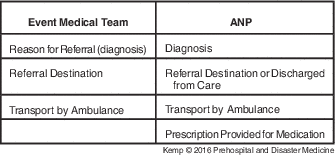
The author undertook all data entry (Table 2) into a Microsoft Excel spreadsheet, Version 14.4.2 (Microsoft Corporation; Redmond, Washington USA). All patient data were anonymized at point of collection.
Data Collected

Abbreviation: ANP, advanced nurse practitioner.
Statistical analysis was undertaken using a one-tailed Fisher’s Exact Test and a Phi analysis (SPSS, version 22.0; IBM Corp.; Armonk, New York USA). The one-tailed Fishers Exact Test was selected due to the size of the sample, which was categorical and generated a 2x2 contingency table. 14 - Reference Mehta and Nitin 16 The null hypothesis was that there was no difference between the proportion of referrals between the event medical team and the ANP. A P value of less than.05 was accepted as being significant. 14 Effect size was calculated using Phi analysis (φ) so as to understand the correlation coefficient between the two variables, thus demonstrating the size of any difference as defined by Cohen. 14 , 17
Cost savings within the local National Health Service (NHS; UK) to whom patients were being referred were calculated using data published by the Kings Fund (London, UK) and the NHS.Reference Cohen 18 , 19
Within the literature concerning the reporting of mass-gathering events, there is an emphasis on using common terminology and units of measure.Reference Endericks, McCloskey and Vincent 5 , 20 Terms currently defined are the patient presentation rate (PPR), the ambulance transport to hospital rate (TTHR), and the referral to hospital rate (RTHR) which includes patients referred to acute care services, which within this study include referral to an ED or minor injuries unit (MIU).Reference Endericks, McCloskey and Vincent 5 , 20
Patients are also referred to health care resources that are not hospital-based, for example, to a range of primary care services (PCS) such as community pharmacies, dental care, general practitioners, practice nurses, or walk-in clinics. These have not been reported routinely in the literature while having an impact on the health economy. For this reason, a further descriptor is used to provide measurement of all those referred to local health care resources (RTLHCR). The TTHR and RTHR are therefore subsets of the RTLHCR, and as such, the overall impact on all health care services, not just the acute services, can be described and analyzed. By common consensus, all rates are a measure per thousand attendees.Reference Endericks, McCloskey and Vincent 5 , 20 The calculation used was:
 $${{\it Number\,of\,Patients\,(for\,the\,subset\,to\,be\,calculated)} \over {\it The\,Total\,Number\,of\,Attendees}}{\times}\it 1,000$$
Results
There was a total (rounded) attendance of 842,000 attendees at the events with a PPR of 0.8 (n=652; 0.08%). Table 3 demonstrates the variance in RTLHCR, TTHR, and RTHR rates between the event medical team and the ANP for the study sample.
Rates of Referral to External Health Care Services (n = 652)

Abbreviations: ANP, advanced nurse practitioner; RTHR, refer to hospital rate; RTLHCR, refer to local health care rate; TTHR, ambulance transport to hospital rate.
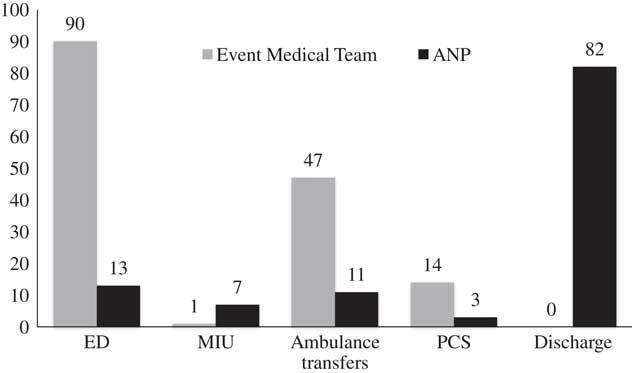
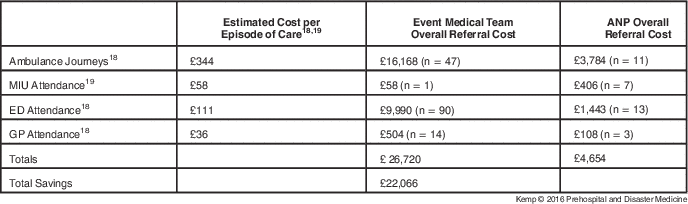
Statistical analysis of the RTLHCR (P<.001; φ=0.44), RTHR (P<.001; φ=0.43), and TTHR (P<.001; φ=0.42) demonstrates that the ANP had a statistically significant role in reducing referrals to all external health care resources as well as reducing the number of ambulance transfers, thus rejecting the null hypothesis for all three rates. Phi analysis revealed a medium-sized effect for all three sets of data (Figure 1). 17 The direct savings due to the involvement of the ANP can be estimated to be £22,066 (Table 4).Reference Cohen 18 , 19
The Practical Effect of an ANP being Available to Review, Treat, and Refer or Discharge Patients Who Would Otherwise All Have Been Referred by the Event Medical Team to Local Health Care Services. Abbreviations: ANP, advanced nurse practitioner; ED, emergency department; MIU, minor injuries unit; PCS, primary care services.

Estimated Savings Directly Attributable to Presence of the ANPReference Cohen 18 , 19

Abbreviations: ANP, advanced nurse practitioner; ED, emergency department; GP, general practitioner; MIU, minor injuries unit.
Discussion
Review of the literature reveals that there has been no previous investigation of the impact of care led by ANPs at mass-gathering events. Physician-led care at such events has been reported and demonstrates that their presence does reduce referral to hospital.Reference Kemp 1 , Reference Grange, Baumann and Vaezazizi 2 , 20 - Reference Sanders, Criss, Stecki and Meislin 22
This study demonstrates that the ANP’s ability to assess, diagnose, and provide appropriate treatments and advice removed the need for onward referral for many patients. This was noticeable with regard to muscular-skeletal injuries where the event medical team would have referred 25 (23.8%) patients to the ED as compared to the ANP who referred 11 (10.5%) in total, of which six (5.7%) were referred to a MIU and the remainder to the ED (5; 4.8%). This largely was due to the event medical team diagnosing sprains as possible fractures. Without review by the ANP, two patients presenting with acute back pain would have been referred to hospital by ambulance.
The event medical team would have referred 20 (19.0%) patients to the ED for wound closure whereas the ANP referred none being able to close wounds on site. A further 12 (11.4%) patients with pre-existing conditions would have been referred by the event medical team, seven (6.7%) to the ED, and five (4.8%) to PCS, whereas the ANP referred only one (0.06%) patient to PCS. The ability of the ANP to examine, to undertake differential diagnosis, and to prescribe assisted in reducing the onward referral burden in replacing forgotten medication and the prescribing of medication for minor conditions.
First aid consultations are highly effective and provide timely, appropriate care and advice, many without the need for onward referral. There are occasions when first aiders will over-refer for further assessment. This was noted in this study with regard to a range of minor illnesses including allergy, anxiety, and those feeling unwell due to the effects of heat as well as the injuries previously discussed. First aiders are trained to recognize and treat presenting signs and symptoms based on pattern recognition that includes limited physiological assessment.Reference Pakravan, West and Hodgkinson 23 Thereafter, first aiders are required to consider the appropriate referral pathway for anything but the most minor of presentations.Reference Pakravan, West and Hodgkinson 23
The care provided by paramedics brings the benefit of increased experience and insight with more serious illness and injury. Within mass-gathering events, the greater majority of presentations are for minor injury and illness for which the paramedic is less well prepared. While critical illness is rare, some patients use the on-site health care services rather than seeing their own doctor.Reference Mohun 24 , Reference Varon, Fromm, Chanin, Filbin and Vutpakdi 25 In this study, only three (0.5%) patients of the 652 seen suffered critical illness or injury (a cardiac arrest, an isolated head injury, and a cerebral vascular accident).
Further research is required to determine the ideal skill mix for event medical coverage at mass-gathering events. Within the UK, the regulatory focus largely concerns the response to acute illness and injury.Reference Leary, Greenwood, Hedley, Agnew, Thompson and Punshon 26 , 27 In reality, many presentations are for minor injuries or pre-existing conditions that have exacerbated due to unusual levels of exertion, the environmental conditions, or non-compliance with medication regimens as well as being the result of behavior influenced by other factors such as alcohol or due to minor injury.Reference Mohun 24 , Reference Varon, Fromm, Chanin, Filbin and Vutpakdi 25
Within this study, it was noted that referral for further assessment by the event medical team largely met the widely accepted criteria for their respective scopes of practice. 10 , 28 , Reference Arbon, Bridgewater and Smith 29 The event medical team was focused primarily on referring to the ED and not discriminating between the different options available locally. Of the 105 patients who would have been referred to external health resources by the event medical team in the absence of the ANP’s review, 91 (86.7%) would have been sent to acute care facilities, 90 (86.7%) of these to an ED, and one (0.1%) to a MIU. When considering the event teams referral diagnoses, 51 (56%) of these patients could have been referred to a MIU for assessment of possible minor fractures, wound closure, or eye injuries. A further 15 (16.5%) could have been referred to PCS for emergency prescriptions and other minor health care needs such as a urinary tract infection or for those with pre-existent wounds requiring a change of dressing. It is imperative that clinicians responsible for making referral decisions from mass-gathering events be aware of all local referral pathways and their capabilities.
Health care commissioners and emergency planners should understand the true value of event medical services to the local health economy. The model of care described provides significant admission avoidance going well beyond the regulatory requirements.Reference Kemp 1 , Reference Grange, Baumann and Vaezazizi 2 , Reference Leary, Greenwood, Hedley, Agnew, Thompson and Punshon 26 , 27 The NHS representatives on the safety advisory committees for mass-gathering events press for event medical providers to deliver admission avoidance yet provide no financial assistance to support this. Members of the public fail to recognize that the care received at mass gathering events is free at point of contact, private health care delivered as a contractual arrangement by the event organizer through an event medical provider.
Investigators in this area should adopt standardized reporting to include environmental and crowd considerations as defined by previous authors.Reference Endericks, McCloskey and Vincent 5 , 20 The RTLHCR should be incorporated within this standardized reporting approach so as to reflect the total impact of mass-gathering events on the external health infrastructure.
Limitations
The first aiders within this study are volunteers, many of whom are used to working alongside the ANP as part of a regional event team. This may introduce bias into their practice in that regularly working alongside the ANP provides a unique level of experience denied many first aiders. Because of this, some of the first aiders may be more confident and therefore less likely to refer patients than those with less practical experience.
The research question asked could provide many answers. While it is recognized that the answers given were authentic, the event medical team may have reconsidered the need for referral in the absence of an ANP as they continued to treat the patient potentially resulting in fewer referrals.
Conclusion
This study demonstrates that an appropriately trained and experienced ANP reduces the RTLHCR, RTHR, and TTHR at mass-gathering events. This reduces the impact on health care services external to the event serving the host community. It is important that the regulations and traditions encompassing medical arrangements at such events evolve to recognize the role and impact of ANPs at mass-gathering events.