Many speaker-pertinent characteristics can cue credibility, including how knowledgeable, accurate, reliable, and certain a speaker is perceived to be. In general, children are more likely to learn new words from speakers portrayed as knowledgeable, accurate, reliable, and certain than from speakers portrayed as ignorant, inaccurate, unreliable, and uncertain (Bergstra, De Mulder & Coopmans, Reference Bergstra, De Mulder and Coopmans2013; Birch, Vauthier & Bloom, Reference Birch, Vauthier and Bloom2008; Corriveau & Harris, Reference Corriveau and Harris2009b; Koenig & Harris, Reference Koenig and Harris2005; Sabbagh & Baldwin, Reference Sabbagh and Baldwin2001). Children's sensitivity to speaker characteristics develops early and matures relatively quickly during the preschool years. For instance, both younger and older preschoolers prefer to learn from a familiar informant or an informant most similar to them versus an unfamiliar informant (Corriveau & Harris, Reference Corriveau and Harris2009a; Kinzler, Corriveau & Harris, Reference Kinzler, Corriveau and Harris2011). Children are also aware of speaker credibility and use that information to guide their learning (Birch, Akmal & Frampton, Reference Birch, Akmal and Frampton2010; Koenig & Echols, Reference Koenig and Echols2003; Koenig & Harris, Reference Koenig and Harris2005; Sabbagh & Baldwin, Reference Sabbagh and Baldwin2001). For example, Sabbagh and Baldwin (Reference Sabbagh and Baldwin2001) showed that children were more successful when learning novel words from a speaker who verbally expressed certainty compared to a speaker who expressed uncertainty.
Not only are children able to identify a certain versus an uncertain speaker, children are also able to keep track of that information and use that information in later learning situations. For example, upon identification of a certain vs. an uncertain speaker, preschool children show preference for the certain speaker one week after certainty information about the speaker was provided (Birch et al., Reference Birch, Vauthier and Bloom2008; Corriveau & Harris, Reference Corriveau and Harris2009b). Birch et al. (Reference Birch, Vauthier and Bloom2008) tested 3 and 4-year-old children on their ability to keep track of speakers’ accuracy patterns when learning new words. Results revealed that children learned new words and new object functions from speakers who demonstrated certainty in the past but not from speakers who previously demonstrated uncertainty. Moreover, children can adjust their learning based on new information about the certainty or accuracy of their informant (Jaswal & Neely, Reference Jaswal and Neely2006; Pasquini, Corriveau, Koenig & Harris, Reference Pasquini, Corriveau, Koenig and Harris2007; Scofield & Behrend, Reference Scofield and Behrend2008). For instance, Jaswal and Neely (Reference Jaswal and Neely2006) found that when provided with a choice to learn new words from a child versus an adult, children consistently chose to learn new words from the adult. However, when provided with a choice to learn from a child with a history of being accurate versus an adult with a history of being inaccurate, children consistently chose to learn from the child. Additionally, children can extend their trust of an accurate speaker to other individuals associated with that speaker (Barth, Bhandari, Garcia, MacDonald & Chase, Reference Barth, Bhandari, Garcia, MacDonald and Chase2014).
Thus, there is ample evidence indicating that children are sensitive to speakers’ characteristics, and prioritize information provided by speakers they perceive as credible sources of knowledge over speakers they perceive as non-credible sources of knowledge. Prior research that has attempted to examine possible individual differences in children's sensitivity to speaker cues focused on age effects, finding that older children are more sensitive to such cues than younger children (Corriveau & Harris, Reference Corriveau and Harris2009a, Reference Corriveau and Harris2009b; Corriveau, Meints & Harris, Reference Corriveau, Meints and Harris2009; Ganea, Koenig & Millett, Reference Ganea, Koenig and Millett2011; Koenig & Harris, Reference Koenig and Harris2005). However, very little prior research exists regarding the possible variability in children's sensitivity to speaker cues that may be due to the linguistic and cultural environments that the children occupy. One exception is a recent study that has examined the impact of Socio-Economic Status (SES) on children's ability to learn novel words from speakers using complex versus simple syntax (Corriveau, Kurkul & Arunachalam, Reference Corriveau, Kurkul and Arunachalam2016). The findings were that children from low SES preferred to learn from an informant who used simple syntax, while their peers from higher SES preferred to learn from an informant who used more complex syntax. This study suggests that different environments may lead children to develop distinct cognitive strategies, leading children from different backgrounds to attend to speaker cues in distinct ways. Here, we ask a related question: is it possible that children who grow up in bilingual vs. monolingual environments also differ in how they perceive speaker cues?
All prior work that has examined children's sensitivity to speaker-related cues has focused exclusively on children from monolingual backgrounds. Monolingual children often have only limited experience with speakers who manifest variable levels of certainty that are not necessarily reflective of their credibility. It is possible that it is this experience that leads monolingual children to prioritize information from certain speakers. In contrast, bilingual children may have experience with speakers whose speech is characterized by verbal and non-verbal markers of uncertainty (such as higher use of pauses and slower speech rate), and who are nevertheless reliable sources of information. This is because bilingual children are likely to be exposed to non-native speakers of their language(s) (Fernald, Reference Fernald2006; Place & Hoff, Reference Place and Hoff2011), whose speech is often characterized by higher use of pauses and slower speech rate than native-speaker speech (Krahmer & Swerts, Reference Krahmer and Swerts2005). The hypothesis tested in the current study is that the experience with speakers who express uncertainty and who are nonetheless credible may lead bilingual children to weigh certainty cues differently than monolingual children.
While there is little prior work directly examining how bilingual vs. monolingual children respond to speaker cues during word learning, a few studies have tested how bilingual and monolingual children perceive speakers’ speech characteristics. For instance, Souza, Byers-Heinlein and Poulin-Dubois (Reference Souza, Byers-Heinlein and Poulin-Dubois2013) assessed monolingual and bilingual children's preferences for native-accent versus foreign-accent speakers. Children were asked to choose the speaker that they would most likely want to be friends with, and both monolingual and bilingual children were found to prefer the native-accented speaker. In a recent study, DeJesus, Hwang, Dautel and Kinzler (Reference DeJesus, Hwang, Dautel and Kinzler2017) extended these findings by assessing English–French and English–Korean bilingual children's social preference according to language and accent. Their study demonstrated that bilingual children did not have a social preference based on language, and were equally likely to befriend speakers of their two languages. However, bilingual children did show a strong social preference based on accent. That is, English–French bilinguals preferred to be friends with a native-accented English speaker compared to a non-native English speaker who spoke with a French accent, and English–Korean bilinguals followed the same pattern when confronted with a Korean-accented English speaker. Together, these two studies show that monolingual and bilingual children show a preference for native-accented speakers. However, while social preferences based on speaker identity may be similar in children from different language backgrounds, the degree to which speaker characteristics may influence learning outcomes may in fact fluctuate with children's experience. This hypothesis finds indirect support in studies documenting differences in the mechanisms and the particular strategies that underlie word learning by monolingual vs. bilingual children (e.g., Byers-Heinlein & Werker, Reference Byers‐Heinlein and Werker2009; Davidson, Jergovic, Imami & Theodos, Reference Davidson, Jergovic, Imami and Theodos1997; Davidson & Tell, Reference Davidson and Tell2005; Houston-Price, Caloghiris & Raviglione, Reference Houston‐Price, Caloghiris and Raviglione2010; Healey & Skarabela, Reference Healey and Skarabela2008; Jaswal & Hansen, Reference Jaswal and Hansen2006).
Studies that have explored how monolingual vs. bilingual children approach word learning suggest that bilingual children make use of somewhat different strategies when learning new words than monolingual children (Brojde, Ahmed & Colunga, Reference Brojde, Ahmed and Colunga2012; Davidson, Jergovic, Imami & Theodos, Reference Davidson, Jergovic, Imami and Theodos1997; Davidson & Tell, Reference Davidson and Tell2005; Diesendruck, Reference Diesendruck2005; Fennell, Byers-Heinlein & Werker, Reference Fennell, Byers‐Heinlein and Werker2007; Byers-Heinlein & Werker, Reference Byers‐Heinlein and Werker2009; Rosenblum & Pinker, Reference Rosenblum and Pinker1983). For instance, bilingual children appear to adhere less to rules of mutual exclusivity – an assumption that each object corresponds only to a single label (Markman & Wachtel, Reference Markman and Wachtel1988) – than monolingual children, and are more willing to accept more than one name for a single object (Davidson et al., Reference Davidson, Jergovic, Imami and Theodos1997; Davidson & Tell, Reference Davidson and Tell2005; Merriman & Kutlesic, Reference Merriman and Kutlesic1993). Such findings have been hypothesized to be rooted in differences between bilingual and monolingual linguistic environments, and bilingual children's earlier need to accept more than one name for a single object (e.g., Davidson & Tell, Reference Davidson and Tell2005).
Furthermore, there is a body of research that indicates differences between how bilingual and monolingual children interpret social and referential cues during communicative exchanges. In a series of studies, Yow and Markman (Reference Yow and Markman2011a; Reference Yow and Markman2011b) demonstrated that bilingual children were more sensitive than monolingual children when interpreting paralinguistic (tone of voice) and non-verbal (gaze direction) cues to infer the speaker's communicative intent. Similarly, Fan, Liberman, Keysar and Kinzler (Reference Fan, Liberman, Keysar and Kinzler2015) found that children exposed to multiple languages outperformed monolingual children on a social communication task requiring perspective taking to interpret the speaker's intended meaning. More specific to word learning, Yow and Markman (Reference Yow and Markman2015) found that bilingual children outperformed monolingual children on a novel object identification task that required them to understand speakers’ referential intent, and Brojde et al. (Reference Brojde, Ahmed and Colunga2012) found that bilingual children appeared to attend to pragmatic cues, eye gaze in particular, more so than their monolingual peers when learning novel words. These findings have been posited to be rooted in bilingual children's heightened need to attend to their communication partners because, in the bilingual environment, the communication partners may speak different languages.
Current study
The present study was designed to examine speaker certainty effects in word learning by monolingual English-speaking and Spanish–English bilingual children. The logic of positing that bilingual children may respond differently to speaker certainty cues than monolingual children was that bilingual children's linguistic environment (vs. monolingual children's linguistic environment) is characterized not only by the presence of two languages, but also by an increased likelihood that the input in the two languages will be delivered by non-native speakers. Such a hypothesis is supported by broad population statistics which indicate that more than half (53%) of Hispanic children in the U.S. have at least one parent who does not speak English very well (Murphey, Guzman & Torres, Reference Murphey, Guzman and Torres2014). These children are therefore very likely to hear non-native English input on a regular basis, although the proportion of Hispanic children who encounter non-native speakers is likely to be even higher, with the exposure to non-native speakers in the family, the community, and the schools. Non-native speakers may be less confident in their language use, utilizing more qualifying terms, pauses, and slower speech rate – all indexes of a less certain speaker (Krahmer & Swerts, Reference Krahmer and Swerts2005). We hypothesized that because of bilingual children's likely experience with less confident speakers, bilingual children may be more willing to accept speaker uncertainty during word learning than monolingual children.
To test this hypothesis, we recruited monolingual English-speaking and Spanish–English bilingual children. We designed a word-learning task, where children were taught novel words by a certain and an uncertain speaker, and then had to retrieve the novel words in a confrontation-testing format. Therefore, unlike prior studies that have focused on speaker certainty cues, we tested children's actual learning of the novel words, rather than their speaker preference.
The bilingual children in our study were all simultaneous bilingual children who acquired English and Spanish at or prior to 3 years of age. Nevertheless, there was significant variability in bilingual-experience characteristics within our bilingual sample, enabling us to examine how different bilingual-experience variables may impact children's word-learning from a certain vs. an uncertain speaker. Of particular interest were the effects of bilingual children's language proficiency, language exposure, and primary caregivers’ English language proficiency. Because we hypothesized that bilingual children's language experience would impact their word-learning performance, we expected that children with more non-native exposure would be more willing to learn from an uncertain speaker.
Method
Participants
A total of 30 English monolingual children and 51 Spanish–English bilingual children between the ages of 5 to 9 participated. However, upon completion of testing, the monolingual group only included seven children who were 8 years old or older. Therefore, we excluded 23 children ages 8 and older across both groups, and focused our analyses only on the children between 5 to 7 years of age. The 5-to-7 age range closely resembles the ages of children in prior work focusing on speaker certainty.
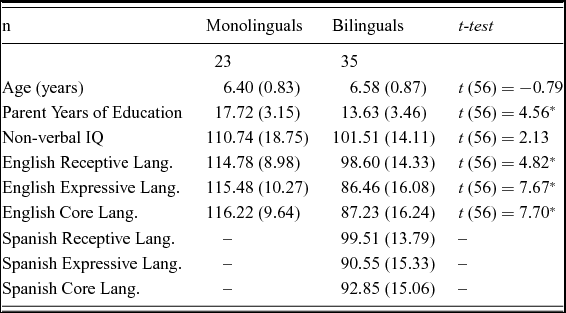
In total, 58 children were included in the present paper; of those, 23 were monolingual (M Age = 6.40, SD = 0.82, Range: 5.00-7.67; 12 males) and 35 were bilingual (M Age = 6.58, SD = 0.87; Range: 5.08-7.83; 20 males). All children were recruited from the Madison Metropolitan school district in Madison, WI. Parents provided information regarding children's developmental and educational history and completed the Language Experience and Proficiency Questionnaire (LEAP-Q; Marian, Blumenfeld & Kaushanskaya, Reference Marian, Blumenfeld and Kaushanskaya2007) about their own language background. All children were typically-developing and passed a bilateral hearing screening. For all children, socioeconomic status (SES) was indexed by the primary caregivers’ total number of years of education (MMonolinguals = 17.72, SD = 3.15; MBilinguals = 13.63, SD = 3.46). Monolingual children had parents with significantly higher level of education compared to the bilingual children (see Table 1).
Participant Characteristics

* To account for multiple comparisons, p-value was divided by number of comparisons, yielding a criterion for significance of p < 0.01.
The monolingual children were born in the U.S. and were exposed only to English in the home since birth. The majority of the monolingual children were Caucasian (14 children), 1 child was identified as African American, and 8 children were identified as multiracial. The monolingual children were not exposed to any other languages besides English. The bilingual children learned Spanish from birth (M Months = 1.09, SD = 4.29) and learned English at an average age of 11 months (M Months = 11.09, SD = 15.91). The majority of the bilingual children (30) were born in the U.S., one child was born in Spain, and the birthplace of four participants was undisclosed. Bilingual children were exposed to English 44.08% (SD = 16.84) of the time and to Spanish 55.84% (SD = 16.81) of the time, in a typical week, based on parent report. The majority of the bilingual children were Hispanic (28 children), 1 child was identified as Caucasian, 1 child was identified as African American, and 5 children were identified as multiracial.
Materials
Standardized measures
The Visual Matrices subtest of the Kaufman Brief Intelligence Test (KBIT-2, Kaufman, Reference Kaufman2004) indexed children's nonverbal intelligence. The Clinical Evaluation of Language Fundamentals-Fourth Edition (CELF-4, Semel, Wiig & Secord, Reference Semel, Wiig and Secord2003) indexed children's English language skills. The Clinical Evaluation of Language Fundamentals-Fourth Edition, Spanish (CELF-4 Spanish, Wiig, Semel & Secord, Reference Wiig, Semel and Secord2006) indexed bilingual children's Spanish language skills. These measures revealed significant differences in English language abilities between bilingual and monolingual children (see Table 1). In addition, the bilingual children were balanced in their language knowledge as demonstrated by their scores on the English and Spanish standardized language assessment measures (CELF-4 English M Core-Language = 87.23, SD = 16.24; CELF-4 Spanish M Core-Language = 92.85, SD = 15.06; t (33) = −1.48, p = .14). Table 1 includes demographic and standardized assessment data for the two groups.
Word-learning task
Fourteen novel words, following English phonological rules were selected from Gupta et al.’s (Gupta, Lipinski, Abbs, Lin, Aktunc, Ludden, Martin & Newman, Reference Gupta, Lipinski, Abbs, Lin, Aktunc, Ludden, Martin and Newman2004) database, and paired with pictures of highly familiar concrete nouns selected from the International Picture Naming Database (Székely et al., Reference Szekely, Jacobsen, D'Amico, Devescovi, Andonova, Herron, Lu, Pechmann, Pléh, Wicha, Federmeier, Gerdjikova, Gutierrez, Hung, Hsu, Iyer, Kohnert, Mehotcheva, Orozco-Figueroa, Tzeng, Tzeng, Arévalo, Vargha, Butler, Buffington and Bates2004). The word-picture pairs were split into two lists of seven and across the two lists, the novel words were matched on length, stress patterns, neighborhood density, and phonotactic probability. See Table 2 for a full list of the novel words. Children learned one list of words in the certain condition, and one list in the uncertain condition. The auditory stimuli were recorded by two different female native speakers of English from the Midwest. All the stimuli were recorded in a soundproof booth at a 20 kHz sampling rate and were normalized to 70dB amplitude using Praat (Boersma & Weenink, Reference Boersma and Weenink2014).
Word-Learning Stimuli

Note. Versions D and H were excluded due to a programming error. The novel words and picture pairs within each version were presented in random order.
Children were told that they would learn words from a new language. In the certain condition, the female speaker introduced herself by saying the following, “Hi, my name is Sarah. Today, I am going to teach you some new words. These words are from a language I learned as a baby. I know this language very well. Please listen carefully and try to remember these new words.” She taught the new words in a confident voice, with no pauses or disfluencies. In the uncertain condition, a different female speaker introduced herself by saying the following, “Hi, my name is Jenny. Today, I am going to teach you some new words. These words are from a language I started learning two weeks ago. I do not yet know this language very well. Please listen carefully and try to remember these new words.” She hesitated as she taught the words, and her speech included fillers (e.g., umm, ah) and pauses. All cues to speaker certainty were auditory in nature, and the children never saw the faces of the speakers.
The pairings of novel words and pictures were counterbalanced across lists. Furthermore, speaker identity was counterbalanced across children, such that for half of the children, speaker 1 was certain, and for half of the children, speaker 2 was certain. The two word lists were taught during two different sessions, with order of condition counterbalanced across participants. The task included an exposure phase and a testing phase, both presented in English. In the exposure phase, children learned to associate the novel words with their paired objects. A novel word was presented twice, and the picture stayed on the computer for the duration of the audio frame. The audio frame in the certain condition was 6 seconds long and 8 seconds long in the uncertain condition. This difference was due to the pauses/hesitations in the uncertain condition; however, the length of the novel words was the same in both conditions. In the testing phase, children were required to recognize correct word-object parings. Each novel word was paired once with a correct picture, and once with an incorrect picture, for a total of 14 trials; trial order was randomized for each child. The testing phase included only the pictures and the words that the children had encountered in the exposure phase. The child pressed one button if the pairing was correct, and a different button if the pairing was incorrect. The testing phase was presented immediately following the learning phase.
Coding and analyses
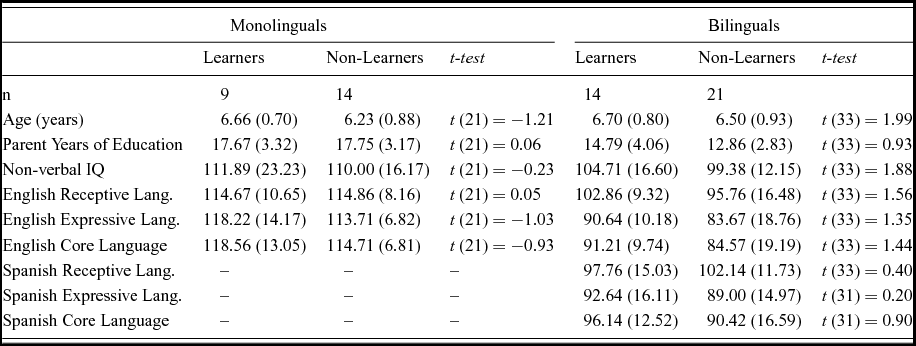
Given the large number of children who performed below chance in the certain condition (the condition expected to be easier for the children), the data were analyzed in two steps: first, analyses were conducted for all children and then analyses were conducted only for children who performed above chance in the certain-speaker condition (classified as learners). To identify learners, accuracy data in the certain-speaker condition were coded in terms of sensitivity scores (A’), as outlined by Stanislaw and Todorov (Reference Stanislaw and Todorov1999). A hit rate and a false alarm rate were calculated for each condition. A hit was defined as a child indicating the novel word matched the picture when this was indeed the case. A false alarm was defined as a child indicating the novel word was the name of the picture they saw, when in fact the picture and the word mismatched. Sensitivity scores range between 0 and 1, where 1 indicates perfect sensitivity. A sensitivity score of .5 and below indicates performance at chance. Children were designated as learners if their sensitivity scores in the certain condition exceeded an A’ score of .50 and non-learners if their sensitivity scores in the certain condition were an A’ of .50 and below. This demarcation resulted in 9 learners and 14 non-learners in the monolingual group and 14 learners and 21 non-learners in the bilingual group (see Table 3).
Demographic and Standardized Assessment Information for Learners vs. Non-Learners

Logistic mixed effect models were constructed in R, version 3.3.1 (R Core Team, 2015) using the lme4 package (Bates, Maechler, Bolker & Walker, Reference Bates, Maechler, Bolker and Walker2015) to analyze the accuracy data: first for all the children, and then for children identified as learners. Contrast coding was used for the dichotomous predictor variables for ease of interpretation. Trials in the certain condition were coded as 0.5 and trials in the uncertain condition were coded as −0.5. Contrast coding was also used for group, with monolinguals coded as −0.5 and bilinguals coded as 0.5. The effect of group and certainty on accuracy were considered first. Age, SES, and English language skills were entered into the model as covariates because all three variables have been reported to impact word learning (Bion, Borovsky & Fernald, Reference Bion, Borovsky and Fernald2013; Lee & Burkam, Reference Lee and Burkam2002; Nash & Donaldson, Reference Nash and Donaldson2005; Nelson, Welsh, Vance Trup & Greenberg, Reference Nelson, Welsh, Vance Trup and Greenberg2011). All three variables were centered for ease of interpretation. The model included random certainty-by-participant intercept and random slope. Raw parameter estimates from the logistic mixed effect regression models and the odds ratio to quantify effect size of significant effects are reported.
Results
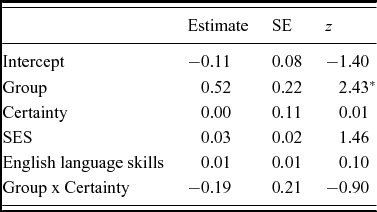
For the participant sample as a whole, the analyses revealed only a significant effect of group (b = 0.52, SE = 0.22, χ2(1) = 5.89, p = .01), such that bilingual children outperformed monolingual children on the word-learning task. The effect of certainty was not significant (b = 0.001, SE = 0.11, χ2(1) = 0.000, p = .99), and neither was the interaction between group and certainty (b = −0.19, SE = 0.21, χ2(1) = 0.81, p = .37). See Table 4 for the full model.
Logistic Mixed-Effects Model for the Whole Group

Note. Monolinguals were coded as the reference group. * p < 0.05.
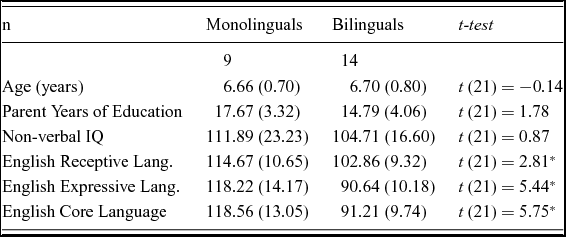
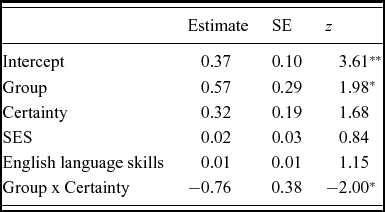
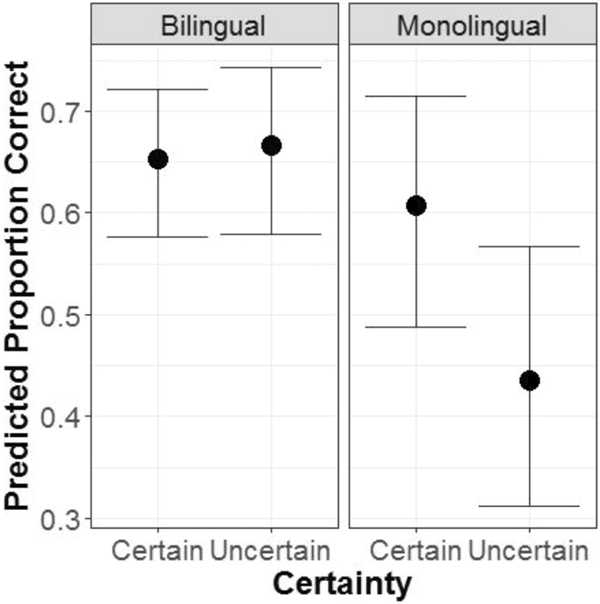
When only learners were considered (See Table 5 for group differences), the analyses revealed a significant effect of group (b = 0.57, SE = 0.29, χ2(1) = 3.91, p = .04) such that bilingual children outperformed monolingual children across both conditions. The results also revealed a significant interaction between group and certainty (b = − 0.76, SE = 0.38, χ2(1) = 4.01, p = .04). The effect of certainty was not significant (b = 0.32, SE = 0.19, χ2(1) = 2.81, p = .09). See Table 6 for the full model. The significant group by certainty interaction led us to assess the effect of certainty separately in monolinguals and bilinguals. For monolingual children, the effect of certainty was significant (b = 0.69, SE = 0.26, χ2(1) = 7.06, p = .007) with children performing significantly better in the certain condition compared to the uncertain condition (p = 0.007). However, for bilingual children, the effect of certainty was not significant (b = −0.09, SE = 0.27, χ2(1) = 0.11, p = .74).
Demographic and Standardized Assessment Information for Monolingual and Bilingual Learners

* To account for multiple comparisons, p-value was divided by number of comparisons, yielding a criterion for significance of p < 0.01.
Logistic Mixed-Effects Model for the Learners Only

*p < .05; **p < .01
Predicted proportion correct for monolingual and bilingual learners adjusting for age, English language skills, and SES. Error bars represent 1 standard error.

When only non-learners were considered, the analyses did not reveal any significant results. The effect of group was not significant (b = 0.19, SE = 0.23, χ2(1) = 0.68, p = .41), the effect of certainty was not significant (b = −0.20, SE = 0.14, χ2(1) = 1.93, p = .16), and the interaction between group and certainty was not significant (b = 0.16, SE = 0.29, χ2(1) = 0.32, p = .57).
Bilingual variables
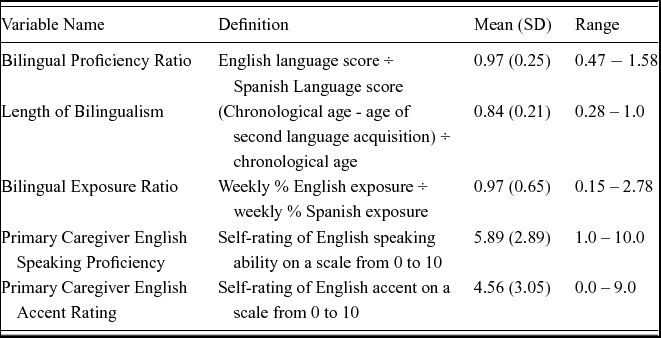
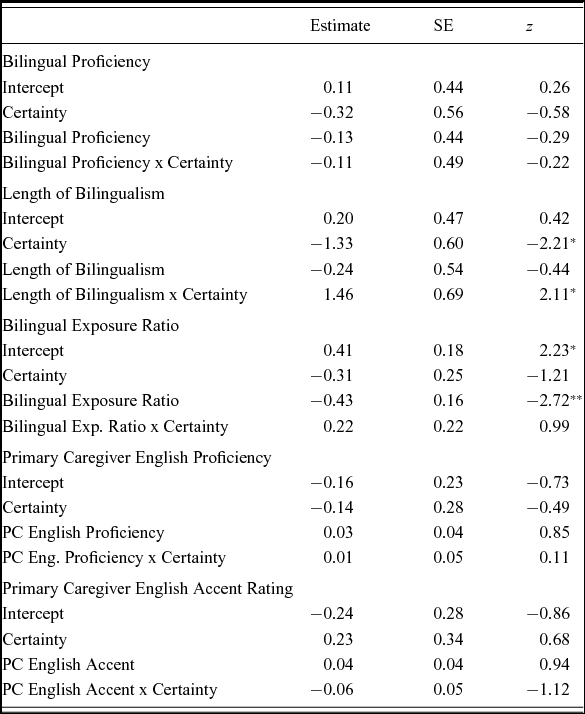
Five variables were created to assess different aspects of the bilingual environment and their impact on word learning from a certain vs. a non-certain speaker. The five variables were: bilingual proficiency ratio, length of bilingualism, bilingual exposure ratio, primary caregiver English proficiency, and primary caregiver English accent rating. Refer to Table 7 for a full description of the bilingual variables. Five different models were constructed, one for each bilingual variable. The models were run on the whole bilingual sample. Each model included word learning accuracy as the outcome variable and certainty by the bilingual variable interaction. Each model also always included certainty by participant random intercept and random slope as predictor variables. See Table 8 for the results of each model. For four of the five bilingual variables (bilingual proficiency ratio, bilingual exposure ration, primary caregiver English accent rating, and primary caregiver English speaking proficiency rating), analyses revealed non-significant interactions between bilingual experience and certainty. However, for length of bilingualism, results revealed a significant interaction between certainty and length of bilingualism (b = 1.46, SE = 0.69, χ2(1) = 4.47 p = .03). To unpack this interaction, children were divided into two groups: those children who have been bilingual for almost their whole life (more than 80% of their life; n = 25) and children who have been bilingual for 80% or less of their life (n = 10). The groups were divided in this manner because the mean length of bilingualism was 0.84 with the majority of children being bilingual most of their life. Follow-up analyses revealed a significant effect of certainty (b = −0.60, SE = 0.26, χ2(1) = 5.38, p = .02) for children who have been bilingual for 80% or less of their life. Children who have been bilingual for 80% or less of their life performed better in the uncertain condition (M = 0.56, SD = 0.20) compared to the certain condition (M = 0.43, SD = 0.16). However, the effect of certainty was not significant (b = 0.10, SE = 0.17, χ2(1) = 0.33, p = .56) for children who have been bilingual for more than 80% of their life.
Definitions of Bilingual Variables

Bilingual Variables: Logistic Mixed-Effects Model for the Bilingual Sample

*p < .05; **p < .01
Discussion
Consistent with prior research (Bergstra et al., Reference Bergstra, De Mulder and Coopmans2013; Sabbagh & Baldwin, Reference Sabbagh and Baldwin2001), monolingual children in the present study were more likely to learn from a certain speaker than from an uncertain speaker, although the results were true only for the monolingual children who performed above chance in the certain-speaker condition. The new finding was that bilingual children were more willing to accept uncertainty when learning novel words than monolingual children. However, once again, this was only true for the bilingual children who performed above chance in the certain-speaker condition. It is clear then that our findings related to the effects of bilingualism are only relevant to the children who were sensitive to the cues we implemented to index speaker certainty.
In studies indicating bilingual advantages for processing social-pragmatic cues, differences between bilingual and monolingual linguistic environments have been implicated. Similarly, differences in bilingual vs. monolingual linguistic environments are likely at the root of the differences in word learning in the present study. Bilingual children are likely to experience more diversity in their linguistic input than monolingual children. They are exposed not only to multiple languages, but also to speakers who may be characterized by a wider range of language abilities including non-native speakers (Fernald, Reference Fernald2006; Place & Hoff, Reference Place and Hoff2011; Unsworth, Reference Unsworth, Nicoladis and Montanari2016). Non-native speakers may demonstrate verbal and non-verbal uncertainty (e.g., non-native speakers tend to be less fluent than native speakers; e.g., Krahmer & Swerts, Reference Krahmer and Swerts2005) that does not reliably cue credibility. Consequently, bilingual children may be more likely than monolingual children to experience situations where uncertain speakers are nonetheless reliable sources of new knowledge. Although we do not have data regarding children's exposure to non-native speakers, we do have evidence that bilingual children in the present study experienced more exposure to non-native input than monolingual children. Parents of the bilingual children classified as learners rated their non-native English accent on average as 4.83 (SD = 3.08) on the LEAP-Q indicating some to moderate accent. In contrast, parents of the monolingual children classified as learners rated their non-native English accent on average as 0.00 (SD = 0.00) indicating they were native English speakers. Parents with limited English ability may use Spanish only when communicating with their children; however, about 35% of the bilingual sample is exposed to mainly English (or at least 50% English) in the home on a daily basis. We only have data on the primary caregiver English input and English language ratings, but it is likely that the children may be receiving non-native English input from other individuals in their environment. Thus, we argue that the bilingual children in the present study were more accepting of the uncertain speaker and were more willing to treat novel words produced by the uncertain speaker as reliable information because of their experience with uncertain non-native speakers.
Our findings also revealed that the bilingual children who have been bilingual for a shorter period of time were impacted by certainty cues, while the effect of certainty was not significant for bilingual children who have been bilingual for most of their life. Strikingly, the bilingual children who have been bilingual for a shorter period of time performed better in the uncertain condition. This effect appears to be linked to children's exposure to non-native speakers. The primary caregivers of these children rated their accent in English as 6 indicating a moderate accent. Conversely, the primary caregivers of children who have been bilingual for most of their life rated their accent in English as 2.37 indicating a very light accent. These data provide strong, albeit indirect, evidence that the children who have been bilingual for 80% or less of their life were more likely to be exposed to non-native English input in the home. As a result, these children may have become more tolerant of uncertainty in the speech and in fact learned better from an uncertain speaker who exhibited the non-native speech characteristics. However, in future studies, it will be important to capture children's experience with non-native input in a more explicit manner, and to consider the effect of this experience on word learning performance a priori.
There are several aspects of the findings that bear scrutiny when interpreting the results. First, over half of the children in each group did not perform above chance on the word learning task in the certain condition. We were unable to determine what distinguished the children who learned in the certain condition vs. children who did not, although we administered a wide array of language and cognitive measures to the children. The overall low rate of learning is likely due to the difficulty level of the task where children learned seven novel words within a short period of time while similar studies required children to learn only two to three novel words (Koenig & Harris, Reference Koenig and Harris2005; Sabbagh & Baldwin, Reference Sabbagh and Baldwin2001). The high rate of non-learners may also be due to the fact that the word learning task was not interactive. Future studies examining speaker certainty cues in the context of bilingualism would do well to emulate prior monolingual experiments in which children saw, or interacted with the speakers (e.g., Bergstra et al., Reference Bergstra, De Mulder and Coopmans2013; Corriveau & Harris, Reference Corriveau and Harris2009a, Reference Corriveau and Harris2009b; Koenig & Harris, Reference Koenig and Harris2005).
Second, while young monolingual children have been shown to differentiate speakers based on the speaker cues we implemented here (e.g., Bergstra et al., Reference Bergstra, De Mulder and Coopmans2013; Sabbagh & Baldwin, Reference Sabbagh and Baldwin2001), we did not obtain direct data regarding bilingual children's ability to differentiate a certain from an uncertain speaker. Therefore, future work should explicitly assess whether bilingual children are sensitive to the pragmatic and acoustic cues to speaker certainty. Third, the cues used in the present study may have cued multiple aspects of speaker identity. That is, although previous studies have successfully used the cues presented in our study to cue certainty (e.g., Bergstra et al., Reference Bergstra, De Mulder and Coopmans2013; Sabbagh & Baldwin, Reference Sabbagh and Baldwin2001), we cannot be assured that these cues were communicating certainty, competency, or both. Nevertheless, we can be assured that these cues communicated differences in speaker characteristics, and bilingualism appeared to influence how these speaker characteristics were perceived. Fourth, future studies should assess whether bilingual children attend more closely to the uncertain speaker than monolingual children, perhaps as the result of showing more empathy to the uncertain speaker. Such a possibility is in line with work indicating that bilingual children are particularly finely tuned to the perspective of others (Bassetti, Reference Bassetti2007; Fan et al., Reference Fan, Liberman, Keysar and Kinzler2015; Yow & Markman, Reference Yow and Markman2015). Fifth, the bilingual children in the present study outperformed the monolingual children on the word-learning task, consistent with prior work suggesting bilingual word-learning advantages (Kaushanskaya, Gross & Buac, Reference Kaushanskaya, Gross and Buac2014; Kaushanskaya & Marian, Reference Kaushanskaya and Marian2009; Kalashnikova & Mattock, Reference Kalashnikova and Mattock2014). However, our statistical models accounted for the effects of SES as well as language, thus compensating for the fact that the bilingual children were characterized by lower SES and lower English language skills than the monolingual children. In this, our sample of bilingual children is representative of the Spanish–English bilingual child population in the U.S. (Camarota, Reference Camarota2012; Hoff, Core, Place, Rumiche, Señor & Parra, Reference Hoff, Core, Place, Rumiche, Señor and Parra2012; Vagh, Pan & Mancilla-Martinez, Reference Vagh, Pan and Mancilla‐Martinez2009). It is important to note that the effect of SES was not significant in our models when controlling for other variables (i.e., English language skills). Nevertheless, future work should attempt to separately assess the effect of SES and language ability, and compare monolingual and bilingual children from high SES and monolingual and bilingual children from lower SES on their sensitivity to speaker cues. Such a comparison would be particularly worthwhile, as SES appears to influence children's ability to attend to speaker cues when learning novel words (Corriveau et al., Reference Corriveau, Kurkul and Arunachalam2016). Finally, it would also be important to examine the effects of speaker certainty in younger as well as in older children than the children targeted by the present study. This would illuminate the developmental progression of speaker certainty effects, and might be crucial in delineating the role that bilingualism plays in this development.
In conclusion, although it is possible that differences other than the linguistic environment (e.g., cultural, social, family-dynamics-related, etc.) may contribute to the patterns of word-learning performance observed here, the findings of the current study indicate that bilingual and monolingual children weight speaker characteristics differently. Unlike monolingual children, bilingual children do not appear to prioritize information from certain speakers over information from uncertain speakers. It remains to be seen whether these differences between bilingual and monolingual children's treatment of speaker uncertainty may have cascading, long-term repercussions for children's linguistic and cognitive growth.