Sometime in the sixteenth century, on the banks of the Nile, at the edges of the future Kingdom of Bunyoro in today's Uganda, traditions claim that a foreigner called Rukidi calmly seized a nameless mother's child and threw it into the river. Rukidi did this to compensate his brother for the loss of his child, who had been caught up in the sacrificial violence required to pass over bodies of water patrolled by the spirits of such localities. Both deaths helped Rukidi and his followers enter and dominate Bunyoro. But they found Bunyoro a collapsed world beset by the aftermath of famine. Anxious to have a story about what had happened there, Rukidi questioned senior mediums at an ancient shrine important to the healing networks that had previously organized political life. The mediums were reluctant to talk, and offered precious few words about the recent indignities. Rukidi and his entourage took advantage of the openings offered by the reticent mediums to reconfigure what had been destroyed by inviting remaining nodes of authority into a project of sovereign renewal. Some accepted, some negotiated, some refused. His relations to the ruined networks of Bunyoro clearly drawn, Rukidi established a new sovereignty that differed radically from what had come before. A fire no longer burned at the shrine where the mediums worked, their having failed to rekindle the natality and virility extinguished by famine. So, Rukidi covered the cold hearth with a mound of termite earth on which he, and all the kings who followed him, would stand during their accession rites. That act announced a profound, affective shift in political ritual. From Rukidi's time forward, kings like him would watch silently as mediums worked. Whereas their ancestors had been healers and politicians all at once, Rukidi and his heirs became politicians only.Footnote 1
When Rukidi lived is uncertain, but traditions agree that his Biito dynasty emerged in a world beset by famine, that he was a stranger in that world, and that he developed a new arrangement of politics and ritual that changed the balance of power in the region.Footnote 2 “Three prolonged dry episodes” broke up the otherwise moist and cool climate that prevailed during a highland east African expression of the “Little Ice Age” (ca. 1270 to 1870). The second began in the second half of the sixteenth century and lasted until the end of the seventeenth.Footnote 3 Rukidi's new dynasty probably took shape then, seeking to close down a period in which the effectiveness of the public healing networks that pursued collective well-being was called into question.Footnote 4 But the climatic oscillations that strained and sometimes broke local systems of agricultural abundance did not possess “inherent causal logics” that produced the historical outcome of a new Biito dynasty.Footnote 5
Historians of radical social change involving widespread violence, like Rukidi's new sovereignty, warn against letting crises over-determine outcomes.Footnote 6 Although the precise nature of a crisis may be unclear, its aftermaths remain fertile ground for studying the interplay of power politics and affective life. Developing meanings for a crisis—making sense of it—helps initiate an aftermath.Footnote 7 The focus on aftermaths not only grounds the historical weight of violence; the aftermath is often the only temporal setting in which violence is represented. The sources available to scholars of violence may focus on violent events, but they take shape in, and are fundamentally interested in creating aftermaths for those violent events.Footnote 8 These qualities of the aftermath as a time of coming to terms with the moral implications of loss and survival mean that narratives about the often-violent founding of new political forms address emotional themes of suffering as well as the pursuit of legitimation.
Paul Connerton argues that by attending to a spirit of mourning in historical narratives, like that about Rukidi, we sharpen our understandings that any quest to legitimate a contemporary arrangement of power guides the production of the narrative in the aftermath of trauma.Footnote 9 People forget, choose silence or are silenced, and orient their bodies in ways that generate a particular awareness of a painful past and shape narratives about that past. For example, people subjected to enslavement, historians and literary critics have long told us, might choose not to recall their degrading experiences, or they might find in their memories of enslavement sources for respectability in a social context unfriendly to a slave past.Footnote 10 To be sure, slaves struggled in ways that “subverted and contested those ideologies” that judged them, but stories of those struggles contain voids, chosen or otherwise.Footnote 11 Whatever else these voids hold, they hold the soil of reinvention and self-fashioning as well as the weight of inequality and power politics. In Rukidi's story, such orientations to aftermaths reveal that violence upended sovereignty's claims to its legitimate use and produced burdens of loss that exceeded the capacity of conventional ritual practice to manage.
Legitimation and mourning shape historical narratives about reconfiguring sovereignty in the aftermaths of its violence because they deftly inflect the problem of accountability.Footnote 12 In the Nyoro histories we will shortly encounter, struggles over accountability marked the newly pluralistic world in which public healing faced a dismal bottom line that forced it to reckon with the arrogant rule of a stranger-king. Rukidi's traditions draw offers of renewal from a web of silence; silencing, forgetting, and remembering the radical change in sovereignty that followed a pronounced famine. Saying little about that time framed “public understanding … of eternal themes of loss, mourning, sacrifice and redemption,” as the quiet between notes in a piece of music gives them life.Footnote 13 In these intervals, people found latitude to conduct the work of mourning and redemption. In an aftermath of dislocation, people could “suspend or truncate open conflict over” its meanings, deflecting questions about accountability with silence.Footnote 14 Mourning and legitimation run through historical narratives, initiating an aftermath to structural violence, and generating the major claim of this essay: that loss and worry shape narratives of transformed sovereign authority, reviving it in the aftermaths of structural violence. Mourning lends emotional depth and counterpoint to matters of bureaucracy, economy, gender, and so forth, in crafting satisfying accounts of transformation and accountability in political life.
By far the most common approach to such dynastic traditions understands them to charter an existing social order.Footnote 15 Whether traditions credit that order with the aura of antiquity or strengthen it by excluding social elements discordant with the new orchestrations of power, they are exercises in legitimation. Stories about Rukidi simultaneously summoned the ennobling antiquity of public healing and entertained discomforting resistance to his domination. Mourning the emotional complexities of loss and suffering brought on by structural and sovereign violence suffused the spirit of legitimation in these traditions, enlisting support for a reconfigured political world by capturing the “intimate contradiction between the unifying claims of legitimacy and the divisive implications of accountability.”Footnote 16 Rukidi's stories use emotional language, terse encounters, and ritual innovations with strong affective charges, in the medium of historical narrative, to initiate a radically new approach to politics. In order to explore the ways in which traditions about domination in historical contexts of violent aftermaths can be read in the light of these mixtures, and not solely in terms of legitimation, emotion as a category of historical analysis beckons.
EMOTION, ORAL TRADITIONS, AND NYORO HISTORY
William Reddy's concept of an “emotive” lends intentional affective life a cultural and historical specificity. Emotives are speech acts that attempt to generate the affect they represent. When they succeed, Reddy thinks of them as “managerial.” When they fail, Reddy calls them “exploratory” efforts to generate emotion, which lead to results other than those the speaker intended. Intentional and managerial emotives reflect the “emotional regime” in which a person lives, and not the embodied results of unintended emotional response.Footnote 17 Barbara Rosenwein has drawn on Reddy's ideas to write about early medieval Europe's plural “emotional communities” or “groups in which people adhere to the same norms of emotional expression and value—or devalue—the same or related emotions.”Footnote 18 For Reddy and Rosenwein, the logics of composing emotional communities turn on “perception and appraisal” of “weal or woe” prompted by the internal stirrings of speech and gesture, image and text.Footnote 19
In Europe, emotive work is assisted by literate productions in fascinatingly complex ways, but it unfolds differently in oral worlds, where speaking and listening receive their powerful charges through the movement and the projection of bodies in the varied settings of performance.Footnote 20 The cognitive and the phenomenological together compose emotional communities with or without the effects of literacy.Footnote 21 The emotive work of speech, event, and bodily orientation appears regularly in literate Nyoro traditions. Their durable bundling fostered reuse by performers who enlisted the assistance of audiences to adjust their meanings. Speech activated the affect latent in movement not least because, in oral worlds, only the physical movement of lips, tongue, and teeth bring speech into existence. Event, bodily comportment, and ritual change elicited emotional reorientations to power.
Rukidi modeled emotives in his participation in emotionally charged events. He performed sacrifices behind a mask of silent calm, his still body receptive to an audience's emotional projections. Like Frazer's beneficent scapegoat king, Rukidi's impassive face sought his people's hopes and fears, with the aim of fostering their allegiance.Footnote 22 Second, in refurbishing the old shrine, he covered its cold hearth with earth from termite mounds. This drew the audience's attention away from independent mediums, and the networks that came together around shrines, and toward the mediums working for Rukidi. Lastly, when Rukidi built the new mounds inside his own capital he enclosed mediumship within a royal precinct, placing its affective charges under the surveillance of a king who was not a healer.
Rukidi's traditions deployed affective language, told of emotional events, and depicted bodily displays of emotions that respected silent, calm self-control in the service of a radical change in ritual practice. They also contained silences—imposed or chosen—in which burdens of loss could be mourned. These emotional regimes and the emotional communities they glossed legitimized particular relations to political power in part through a spirit of mourning. In order for Rukidi to regain his calm and rule, traditions argued that political power and public healing had to be separated from each other and from the recent history of ruin in which Rukidi's new subjects implicated them. The subjects enlisted through this emotional regime were not autonomous individuals. Instead, the social event created by performing traditions worked with larger categories in which members of an audience might recognize themselves: by generation (adult), by gender (mother), by occupation (herder, trader), by categories of personal history (the medium, the childless adult), or by geographical home (the stranger). These were the political communities for whom a sovereign sought, in part through affective power, to wield a monopoly of force.
In the 1890s, Bunyoro experienced defeat at the hands of 14,100 Ganda and 680 Sudanese and Swahili forces allied with imperial British interests represented by eight Europeans.Footnote 23 Nyoro intellectuals responded by writing histories that promoted an expansive imperial past for Bunyoro in dramatic contrast to the devastating loss of sovereignty made especially painful by the ascendancy of their longtime regional rivals, the kingdom of Buganda.Footnote 24 In 1894, as the military campaign raged, five of the kingdom's counties were annexed or “lost” to the adjacent kingdoms of Toro and Buganda, setting off a fierce struggle for their return, while Nyoro historians worked.Footnote 25 As that struggle unfolded, Ganda civil servants administered the “Lost Counties.” Dulling the pain of defeat, the loss of land, and the galling dominance of Ganda civil servants in colonial Bunyoro, literate royal Nyoro tried, yet again, to restart Nyoro domination by initiating an aftermath to catastrophic violence. They applied the balm of a long history in part by lengthening the list of Nyoro kings. Between the 1860s and 1880s, the two sitting Nyoro kings and their competitors, embroiled in protracted battles over succession shaped by the presence of slave-raiding Egyptians and Sudanese, listed seven or eight rulers.Footnote 26 But the Nyoro historians whose work this essay engages reported far more. Academic historians, querying these discrepancies, found that the Nyoro writers took into account the length and contents of king lists from Buganda when crafting theirs for Bunyoro.Footnote 27 Understanding their histories as compilations reveals their authors' astuteness in highlighting lists of kings to British missionaries and officials who might value the antiquity of such authority.
The entanglements of traditions with the imperial contexts shaping their literary formation do not sever them from the broader interests of Nyoro audiences. Close readings of traditions—in both their Nyoro vernacular and English translations—reveal that claims of continuity between an earlier past and a Biito era, and the number of Biito kings, are but two of the many themes they take up.Footnote 28 They were no more important to the taletellers and their audiences than were charting the limits of early Biito political power, addressing uncertainties over new and old affective ritual, and sculpting a forgetting of the recent past. In the immediate aftermath of imperial violence in Bunyoro, these traditions began to appear in print, by African authors who held important positions at the royal court, in the colonial civil service, or at the mission station.Footnote 29 Profoundly influenced by life in these settings, their syntheses mixed oral and written material.
It is challenging to sift durable sequences of terse, verbal imagery—including representations or invocations of emotion—from the narrative elements shaped by issues of great moment in the twentieth century.Footnote 30 To do so one must keep in mind formal and performative aspects of these traditions. Formal movements of figures express symbolic messages. According to historian Renee Tantala, movements on a vertical axis, between the surface of the earth, where people lived, and underground, where spirits resided, reflected the labor and politics of mediumship.Footnote 31 The Cwezi figures, from the time before the Biito, often moved in this fashion, between the two worlds. But figures in the traditions about the establishment of the Biito dynasty moved horizontally, on the surface of the earth. They moved where audiences lived. The contrast between the two kinds of spatial movement evoked a profound change in the emotional communities composed by the Biito. They promoted a new scale of political alliance, rather than older public healing networks, as the best way to initiate the aftermaths of famine's social collapse.
Secondly, specialists (bahanuuzi, “counselors,” and bafumu, “diviner-doctors”) with knowledge of dynastic, lineage, and family histories performed stories about dynastic events, accompanied by music and dance. They worked at homesteads, shrines, or chiefly enclosures, or at the Biito court.Footnote 32 Many of the episodes analyzed in this essay were reenacted at the outset of a reign, when a new king had to “sleep two nights to the east of the Nile, and then march into the country along the road which his ancestors are said to have taken.”Footnote 33 Perhaps for this reason, the published versions are broadly similar regarding people's names, the names of the places they visited, the things they wore or carried and their hair styles, as well as the basic sequence of events said to have occurred—the “core images” of traditions.Footnote 34 The core images reflect moral and aesthetic inclinations that “contributed to continuity in transmission” because their dense imagery elicited audiences' memories of or knowledge about those places, figures, and their work.Footnote 35 The sequences of events served as memory codes for the performers and prompted audience members to choose, depending on their past experiences, the “historical memory” proffered them by the performers as if it were their own memory.Footnote 36 These memory codes were “techniques for connecting the verbal imagery of traditions with the visual imagery of life experience.”Footnote 37 The cognitive and emotional medium for that connection was the body.
The drama of speech comes through in vernacular versions that convey the back and forth of conversation. Bikunya, Karubanga, and Nyakatura represent the rhythms of formal conversational exchanges with stock phrasings such as so and so “asked, saying…” or “replied, saying….” The metrical patterns created in this manner mark these passages as mnemonics, designed to facilitate memory work. They were rhythmic compliments to the movements of the mouth, hands, arms, legs, and feet, in the acts of speaking, singing, and dancing that constituted a performance and implicated an audience.Footnote 38 Images entail the eye, but in making and watching the performance of a tradition it is the body's movements that evoke and sustain the image. Movement and visualization sustain one another in transmitting messages in traditions because they create the opportunity to engage those messages as somehow congruent with one's own experiences. Scholars have combed these core visual images—but not the openings to emotion revealed in their content through the conversational rhythms of particular episodes—to show the ways in which “tellers of tradition recollect and re-present their stories” by using “verbal imagery” to evoke scenes from the ordinary experience of audience members.Footnote 39
The verbal imagery that worked in this manner reflects a mutual influence of performer and audience that unfolded over many generations in a long process of emotive and ideological reinterpretation of the material.Footnote 40 The verbal images in the stories are not the memories of a teller or of an audience member; they are invitations to take possession of their content by evoking figures, scenes, and events familiar to audiences. The metrical patterns of song and speech, the patterned movement of musical accompaniment, and the rhythmic structure of dance movements all enlisted audience participation in the performance of recollection.Footnote 41 Traditions draw on a repertoire of episodes to craft an argument influenced by contemporary historical factors, to be sure, but the success of the argument relies, in large measure, on the durability of the repertoire's communicative heft.
The first dramatic events to bring emotives to life involved the sacrifices Rukidi and his entourage performed in order to cross bodies of water and enter Bunyoro. Sacrifices focused the political drama of passing from an area of strong networks into a new region of political weakness. In audiences' minds, sacrifice brought up images from any number of settings. For those who had encountered or accompanied itinerant public healers, traders, or smiths, the specific challenges of fording rivers would come to mind. Like a bereaved mother (see below), mediums might utter curses in the course of their possession experience.Footnote 42 Audience members who had witnessed a possession ritual might recognize the mother as a medium, articulating the loss at hand. The next process involved narrating what had happened in Bunyoro before Rukidi arrived. Once across the challenging waters, Rukidi and his entourage sought stories about the past of their new home in order to connect their domination to indigenous sources of authority, and reanimate a claim to durability. Traditions accomplished this by incorporating histories of old and new clans into the larger story and by repeating refusals to provide information. They frankly claimed that Rukidi's domination turned on limited but strong new political alliances and not only on public healing's defense of prosperity. Incorporating clan histories, refusals to speak in anything but banal generalizations, and the proprieties of gift-exchange, sampled the rhetorical skill and social comportment required in arguing a case at a court, or attending a public healing event. Audience members who had witnessed that sort of interplay of verbal power with bodily orientation would have had their memories of it animated by these episodes. The traditions portray Rukidi's emotional vulnerabilities in this process with unflattering realism, announcing limits to his domination even as he reconfigured royal relations to older affective ritual.
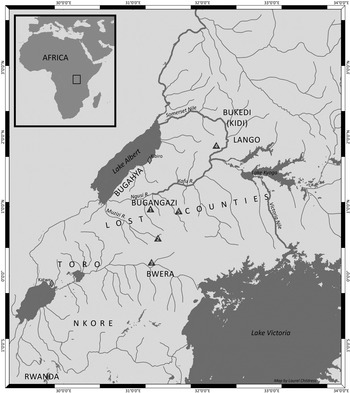
Capitalizing on the close links between cognition, kinaesthetics, and emotion, Rukidi brought the bodily practice of public healing into his new capital but declined to participate in it directly, preferring to watch. Tradition takes up this moment of ritual transformation with pithy drama. Rukidi covered the cold hearth in the shrine of Wamara, a last Cwezi figure of authority, with a mound of termite earth and then built a new capital in a new location (see map). Covering the old fireplace and building a new capital carried affective charges amplified by the losses and dislocations that audiences had been invited to ponder in weighing explanations of why Wamara's hearth had gone cold. For audience members familiar with the ephemeral qualities of beseeching and possession at public healing rallies, their memories of those actions could not have presented a starker contrast to the stern new order that sought to bury such work under Rukidi's new termite mound.
As people confronted a ruined world in which life must go on, the traditions used affective prompts to ask them to take a chance on an outsider's political skills—as a king who was not a healer—in restarting social reproduction. Some people refused, proving that a single sovereignty did not dominate everyone; others accepted, proving sovereignty did not grow only from a genealogy of indigenous, local sources. Still others pointed to the failures of the past, proving that sovereignty's claim to monopolize legitimate force was not durable.Footnote 43 The idea that sovereignty stumbled through these evident failures captured the everyday experiences of people in the 1550s, the 1890s, and the 1930s, because they knew that sovereigns arrogantly seized power and wielded it. People knew that monarchs were not really exempt from the consequences of their violence, even if the victims bore the bulk of the burdens of mourning the consequences. Yet, in key ways, the life of sovereign political power lay in the performance of stories about its creation. Those stories deployed affective figures of truth—motherhood, sacrifice, elderhood, clanship, and so forth—to revive sovereignty by applying people's emotions to that project, a project that enlisted support and applied political influence in closing down violent ruptures.
ANTECEDENTS
The sixteenth-century drought and famine transformed older networks built around the creative arts of a spirit-mediumship that delivered the forms of wealth that kept social life in motion.Footnote 44 Called “public healing networks” by scholars, they met the needs of their communities by linking shrine sites, different ecological zones for food and medicines, and artisanal activities. Their wealth attracted luxuries from far outside the region and nourished local production of ivory, iron, barkcloth, fish, and food. When a network failed to deliver social reproduction and security, other public healers emerged as its social critics.Footnote 45 They invented new spiritual figures that appealed to a broader array of people, or reconfigured existing ones, so that they could travel to new territories. During this long period, political leaders and public healers in Bunyoro had been the same individuals.Footnote 46
In the older public healing networks, Cwezi hunter-mediums searched for people to possess, conquer, and raid.Footnote 47 They organized this violence to secure virility and natality for their followers, but it raised questions about the moral terms on which public healing worked, which led some people to relocate.Footnote 48 Numerous large-scale settlements had dotted the region since the turn of the second millennium. In the sixteenth century, people added earthworks to many of the settlements, and in the course of the seventeenth their number shrank to a handful of centers of public healing, Mubende, Kasunga, and Masaka Hills chief among them (see map).Footnote 49 Rukidi and his entourage were drawn into this land of former wealth fragmented by a political violence designed to meet the challenges to reproduction occasioned, in part, by reduced rainfall in the sixteenth century.
When Rukidi's traditions created categories for public healing and sovereign political power, they defined what had been a latent division in the Cwezi period. But they were the first to reconfigure political life by drawing prominent public healers inside a new capital to serve the interests of a king who was not a public healer. Enormous scholarly attention has been paid to this “moment” in the region's history, when the outlines of a political domination free from the threats to its stability posed by ritual or judicial failure seem to have first emerged. Christopher Wrigley argues that increased scales of economic life meant that community norms of face-to-face contact in which little kings managed ritual, economic, and legal affairs for villagers gave way to kings, unseen by many, whom the many nonetheless imagined as their own.Footnote 50 These larger kingdoms were composed of multiple clans. Kodesh refines Wrigley's model by thinking more expansively about those clans, renaming them “networks of knowledge” and, in the process, revealing that membership in a political community need not be restricted by the face-to-face requirements of participation in ritual. Kodesh focuses on the health concerns, economic aspirations, and conflict that drew people to form clans, which helps us see clans as shifting alliances of dispersed healers, traders, and warriors, and ordinary farmers and herders.Footnote 51 He reformulates the struggles between clans and kings over authority and the control of wealth.
Scholars tend to find the origins of dynastic rule in kings struggling with clans in order to rule over larger territories.Footnote 52 In Rwanda, Jan Vansina argues that the ritual entanglements trapping kings in the life of the court came after kings had grown into powerful raiders. Vansina finds that noble lineages in eighteenth-century Rwanda saw in ritual a means to tie down their monarchs at court and restrict their ability to maneuver politically away from the center.Footnote 53 Each of these approaches to monarchy explains something valuable about a particular case. But they do not account for contexts of collapse, and the burdens of loss they entailed, in chartering kingship. In Bunyoro, that charter mourned catastrophic loss, deflected the accountability of those whose actions allowed them to survive, and legitimated a transformed kingship promising renewed prosperity, by figuring its founding king in motion from calm strength through vulnerable negotiations over alliance and onward to the calm strength fostered by the new arrangements these scholars have worked to explain.
The emotional cycle presented in these traditions created public moments for people to weigh past violence, before setting some burdens down and recasting others as valued traces of the past. Domination, like nationhood, required its subjects to share things in common, especially things they had forgotten.Footnote 54 But getting the past wrong together was difficult. Traditions about Rukidi cast the losses people suffered in the violent collapse of the mid-sixteenth century in silence and banality. In effect, they offered audiences a choice between forgetting about or reflecting on whatever losses they had borne. In the context of colonial rule, and the particular indignities of imperial defeat suffered in Bunyoro, this approach to loss that traditions about Rukidi took left much business unfinished.Footnote 55 The divide between public healing and political power became a durable engine of later expansions and contractions of political scale. That divide came into existence during Rukidi's time and the “moment” of its creation involved both mourning and legitimation that may be tracked in variants of tradition.
THE EMOTIONAL BURDENS OF SACRIFICE AND THE OLD ORDER
We pick up the story with Rukidi and his networks, freshly arrived from northerly areas, standing on the right bank of the powerful Nile, facing Bunyoro (see map). The passage across the water required a sacrifice that expressed a sovereign's special relationship to violence and met the obligation to offer something to the patron spirit of the local public healing network. It required, among other things, a child's life. The significance of that sacrificed life emerges from a comparison of different versions of the story.
The British explorer John Hanning Speke reported a conversation he had in September 1862, in which Kijwiga, a representative of the Nyoro king Kamurasi, told him that their ancestors had come from “beyond Kidi.”Footnote 56 In 1879, Emin Pasha wrote, “People with a white skin came from the far north-east, and crossed the river (Somerset Nile).”Footnote 57 Gaetano Casati's version, collected from king Kabaleega in 1886–1887, resembles Emin Pasha's account. Lukedi (Rukidi) is said to have come from “beyond Lango” and to have “established himself in Uganda.” Casati mentions that the founding dynast was “[a]n expert huntsman” whose “fame spread” and that “the queen was seized with a desire” to see him. She “did not hesitate” (for his sake) “to poison her husband.” After marrying, they produced “two sons, to whom … he gave … the kingdoms of Uganda and Unyoro.”Footnote 58 Ten years on, the colonial official George Wilson expanded on this bare-bones narrative. He reported that Lukedi crossed to Chope “ostensibly to hunt,” but visited the compound of the local (Siita) clan leader and found that famine had driven the men away to hunt. Wilson's version depicted Lukedi as a healer—he “cured the invalid” post-parturient mother, a “young Mukedi woman” of the senior house, won over the rest of the women, and secured “the royal drum, that was in their keeping.” Lukedi then “assumed such an attitude” with the returned Siita men that they accepted him.Footnote 59 The Anglican missionary Arthur B. Fisher reported, “Lukedi was a great hunter of supernatural powers,” feared by all, who “crossed the river, coming south into a stranger's country.” There he and Kilemera produced a son, Lukedi Lwamgalaki.Footnote 60 These glosses on “Lukedi,” depicting him as a foreign spirit searching for women to possess, likely emerged in the context of a public healing shrine.Footnote 61
Rivers, Places, and Regions mentioned in the text. The Hills: 1) Kasunga, 2) Mubende, 3) Masaka, 4) Kanyadwoli, 5) Epyemi or Haburu. The Lost Counties are, from west to east, Mwenge, Buyaga, Bugangazi, Rugonjo, Buruli, Bugerere. Map by Laurel Childress.

Statements about the dynastic founder having had two sons who inherited Uganda and Unyoro from him would seem to refer to Kato Kimera and the time of Mpuga Rukidi. This detail supports the idea that, at least until the 1870s and perhaps into the early twentieth century, traditions about Rukidi referred to a period of at least two generations. The first Rukidi hunts and possesses women, behaving like a spirit medium building a network. The second Rukidi shares out political legacies, behaving like a king who is not a healer. The idea that the Biito dynasty was established during a single lifetime first appeared in the published record in the last years of conquest, courtesy of royals from the kingdom of Toro, less than two generations after their secession from Bunyoro.Footnote 62 Although it took root and was repeated by all subsequently published versions of the founding of the kingdom, the new version retained a longer time frame through the device of Rukidi's accumulating names. First came Mpuga Rukidi, the two-toned healer-medium. Some authors added the name Isingoma, meaning, literally, “the father of the drum” and “the eldest of male twins.” Omukama Winyi, the first titled (“winyi”) king of Bunyoro, came last. Each of the generation-names, added to or replacing an earlier name, marked the passage into a new identity.
The first transition had to do with sacrifice. Daudi Kasagama, king of Toro, claims that Lukedi had to make an offering in order to cross the body of water separating his home from his future kingdom.Footnote 63 In Kasagama's version, Lukedi faced an unnamed lake to cross with “a goat and a fowl and a child, who was decked out with numerous beads on his neck, arms, and legs.” Kasagama evoked an enigmatic “they” who “put a crown of nine beads on his [the child's] head, and a large band of nine beads on either leg. They then threw him into the lake as an offering to the gods” before Lukedi “crossed the lake into the country of Kanyadwoli.”Footnote 64 Fisher said only a child was given to the river, and the diviner-doctor Nyakoka acted alone. However, Nyakatura reported diviner-doctors named a basket of things that the river required of “the Babiito”: “a baby, money, beads, and a cow.”Footnote 65 Bikunya recounts a parable about a child lost to its clan as part of the dedicated offering required for Rukidi to cross the second of the two large bodies of water.Footnote 66 Each of these accounts uses sacrifice to replay the obligation to make offerings to territorial spirits resident in particular features of the landscape, such as fords. Sacrifices activated the loyalties, hierarchies, and prosperity of Biito networks. The episode raised questions for the audience about the future promised by the newcomers' sacrificial violence.
The child to be sacrificed was chosen by a diviner-doctor named Nyakoka, not Rukidi.Footnote 67 “The Biito” responded collectively with a compensatory logic that evoked the justice of a legal decision in a tort. In Nyakatura's version, responsibility for the child's sacrifice blends idioms of fertility and natality: “It happened, however, that as the beads were being thrown into the lake as part of the sacrifice, Nyarwa's baby, who was starting to walk, swallowed one of them.”Footnote 68 “The Biito” decided to kill the child of Rukidi's elder brother, Nyarwa, in order to recover this bead, intended for the water spirit, which the child had inadvertently swallowed.Footnote 69 Their decision alienated Nyarwa, and asserted that the value of exchange and adornment, embodied in beads, exceeded the value of children, brotherhood, and motherhood.
In order to compensate his brother's loss, Rukidi threw a woman's child into the Nile. Dispossessed of her child, the woman cursed them. Her loss, and Rukidi's resolve, embodied the arrogance of royal power and the arbitrariness of justice. Her curse refused silence in the aftermath of a sovereign's violence, and evoked the curses routinely made by mediums in the throes of possession. She said: “Lost people you have killed your child, so you kill mine, therefore wherever you go now to settle down you will kill one another.”Footnote 70 She glossed the moral burdens of sovereign violence by recalling that its arrogant use of force generated fertility and natality only for the men closest to it, and only by taking fertility and natality from women. We need not credit her sentences with having survived intact across the centuries in order to appreciate that her child's death raised the specter of vengeance as an effect of domination. Her curse questioned the ability of domination to still the turbulence of vengeance, but it did not erode Rukidi's resolve to proceed. Cursing the future king, the mother spoke as a public healer, a social critic of the arrogant violence of the new arrangement under construction.
Nyakatura completed his history of Nyoro kings late in the 1930s, as the struggle continued for the return to Bunyoro of the counties lost to Buganda in the 1890s. He may have chosen to flesh out the mother-medium's threatening prediction, in part, because it would resonate with a wide audience of ordinary people by invoking a long-standing but fragile commitment to contentious political debate. We are told that the diviner, Nyakoka, answered the paralyzing effect that her curse had on Rukidi's entourage. The drama of power politics between two competing networks is clear. The medium mother's local network was being swallowed by Nyakoka's more expansive network, led by Rukidi. She did not mourn her loss by keeping quiet.
Nyakatura's choice of words reveals as much about the emotives he used to manage a liminal moment in Bunyoro's political struggle to regain the Lost Counties, as it does about Rukidi's effort to dominate generated by the repercussions of killing a child. Nyakatura glosses Nyarwa's emotional state with a phrase: “akabihirwa muno” (he was given very many bad things). The passive construction underscored Nyarwa's weakness, and perhaps resonated with literate Nyoro audiences powerless to reverse the circumstances of Imperial defeat. Nyakatura has the mother-medium use emotives he glossed in Nyoro with the phrase “akaija narama bingi muno” (and she came and swore out very many things). The stunned silence into which Rukidi's Biito followers fell after her curse is described in Nyoro as “bagwamu akahuno” (they fell into silence).Footnote 71 Nyakoka, the diviner-doctor, then delivered a brief speech designed to shake them loose from the spell of the mother's sentence. He exhorted them not to have certain emotions: “Tibatina, kandi tibatuntura, kandi tibahuniriza,” or “Don't fear, don't worry, don't be struck utterly dumb by this.”Footnote 72 The healer's emotives, not the elder brother's, evoked affective dimensions of power to close down a moment of crisis.
Nyakatura used a simple verb root, -rama, to describe the mother-medium's emotional state. The oldest English glosses we have for the term mean “to cry out for mercy, plead; speak magic words, say an incantation; swear after making blood-brotherhood.”Footnote 73 Bikunya used the same verb in a phrase describing Rukidi's crossing bodies of water.Footnote 74 The glosses share a common ground of meaning with the English notion of the vow or the oath, a conditional promise with a moral core of accountability that puts social ties into motion. The mother-medium's curse offered audiences the idea that Rukidi's domination generated unique emotional costs for women.
Nyakatura expressed the emotional state of “the Biito” with the phrase “bagwamu akahuno.” The verb, kugwa (“to fall”) is modified by the locative suffix, -mu (“inside, into”), emphasizing the encompassing quality of this silence (akahuno). The term “tibahuniriza” is a negative causative prepositional of the intransitive verb kuhùúna (“to be silent, speechless”). But the other verb stems -tina and -tuntura appear for the first time in these passages. The first term's most widespread field of meaning is “fear.” Throughout the region, and not just in the Nyoro language, people have long used this stem to signify “honor.”Footnote 75 They drew on concrete physical qualities of fear as a metaphor for the abstract qualities of honor. The second term, -tuntura, is also intransitive. The Anglican Church Missionary Society missionary and linguist, Harry Maddox, glossed it as “to be troubled.”Footnote 76 Silence helped them remain witnesses to sacrificial violence but, at least in Nyakatura's version, it exposed them to the future promised by the medium-mother's weighty words. Overwhelmed with emotion, Rukidi's entourage grew passive, a dangerous swerving from the task of domination.
Echoing older Cwezi figures, Nyakoka dispersed the “despondency and fear” that had “come upon” Rukidi's supporters by commanding them “not to fear and worry about an enraged woman's words but to continue their journey.”Footnote 77 At risk was nothing less than the scope of Biito domination. On the border between home and a strange land, Biito domination was provisional, with a dismissively patriarchal core to its justice. While the journey into the new land unfolded, Nyakoka implored, there was no room for angst about the threats to natality and motherhood issued by this local mother-medium.
Safely across the Nile, Rukidi faced a flooding Kafu River (see map) that took the lives of a few men who foolishly tested the strength of the rushing waters without having offered anything to the spirit of the ford. Faced with a second harrowing passage, Rukidi assumed the burden of deciding a sacrifice: “Mpuga (Rukidi) chose out a little girl, also two black beads and two black fowls, and threw them into the swollen stream.”Footnote 78 This had the desired effect; ferrymen appeared with canoes to carry everyone across the Kafu River.Footnote 79 Rukidi's sacrificial act allowed his entire entourage to move deeper into Bunyoro to rule. Between the Nile and the Kafu, the traditions argue, Rukidi had freed himself from the bonds of reciprocity and competition shaped by idioms of kinship. He faced no resistance from local mediums because he replaced them. He named the ferrymen founders of a new clan responsible for using sacrifice to keep the ford from becoming rough.Footnote 80
Rukidi's sacrificial violence served the particular interests of Biito men. Rukidi decided the sacrifice and then authorized a new local clan network to carry on. His following was a mobile group of Biito men and it was the villages and settlements of a particular territory served by the spirit of a particular ford. These aspects of the story evoke scenes from court ritual bombast, in which local networks subordinate themselves to a royal center. The spirit of mourning enunciated by the mother-medium clashed with the claim that the legitimacy of Rukidi's Biito domination rested on his absorbing the burdens of sacrifice.
Rukidi displayed no emotional response to the scorching social criticism of a mother-medium bereft of a child. While other figures were cast into silence or driven to exhortation, Rukidi acted, offering audiences an ambiguous figure. Could they see in him a leader who would act for their benefit, not his own, in return for their exempting him from the consequences of deciding to kill a child? Or, could they see in his resolve an arrogant leader who presented his own family's need for justice as a metonym for theirs, in return for accepting his domination? In either case, the stories claim, in moments of crisis a leader should stand behind a mask of calm, away from the perturbations of emotion. That was the admirable behavior of a person on the path to power. It fell to Nyakoka to shake his crestfallen followers free from the mother's paralyzing curse. Rukidi shouldered the burdens of spite and vengeance created by the sacrifice and enunciated by the mother. He behaved like a sovereign in full control, extending his clan networks from between the two Niles southward into Bunyoro.
Rukidi and his other supporters from Bukedi claimed responsibility for reviving virility and natality. Sacrificed children measured the costs of domination in terms of natality. Beads and cattle, important currencies in the social payments of marriage, evoked the contingencies of virility. Restoring the flow of these currencies promised to renew prosperity at the ambiguous cost of domination. Emblematic of a leader's admirable behavior and a mark of his domination, Rukidi sought to still the strife of loss by taking responsibility for it through the act of sacrifice. The mother-medium refused silence with her curse, warning of the tragedy of retribution. Delivered at a scene of sacrifice, she sustained a practice of social criticism associated with public healing's deep roots in the region.Footnote 81 Her curse promised that the dense trauma of loss visited by famine exceeded the capacities of sacrificial ritual to disperse. In the context of struggling with the colonial state for the return of the Lost Counties,Footnote 82 the specifics of her sentences warned that fractiousness and recrimination promised continued weakness.
The mother's words shattered the chosen silence of Rukidi's followers, and opened up a debate about accountability in his new form of rule. As Rukidi gathered a history of what happened before his arrival, others' decisions to keep quiet revealed limits to his rule. We will see that some responded to his querying, proud of having conserved the regalia of past figures of authority and anxious to pass them along in remaking a durable sovereignty. Others kept their mouths closed, in silent testimony to the limits of domination. Still others struggled for words as they weighed their fidelity to what had collapsed against allegiance to the statecraft Rukidi and his entourage promised. These moments in the story put a spirit of mourning into statements about standing and privilege in political accountability, about “who has the right to speak about the violent past.”Footnote 83 The partialities of such speech—what one teller included reveals something about what another left out in answering Rukidi's questions about the past—drew a map for Rukidi of remembering and forgetting what had happened in particular communities before his time. They also revealed Rukidi's ability to forge political progress, transforming the curse of endless vengeance into the promise that political pluralism would renew social reproduction. The twenty-five years of famine and disease that had afflicted Bunyoro after Kabaleega had been captured in April of 1899Footnote 84 echoed the collapsed social void into which Rukidi's domination flowed in the distant past, and lent an urgent poignancy to vernacular histories of Rukidi's advent.
Rukidi's calm sought to assuage doubts over the future. But, his reserve hid the anxieties of a stranger in a strange land. Rukidi and Nyakoka tried to convince people they could deliver on the promise of renewed natality and virility in the course of the careful negotiations they undertook with the heirs of the departed figure of Wamara, the last “King of the Cwezi.” At this point in the stories, some versions rename Rukidi as Isingoma Mpuga to mark the new challenges he faced in confronting Bunyoro's historical burdens.Footnote 85 After succeeding, Isingoma Mpuga Rukidi regained his calm and assumed a third personality, as Omukama Isingoma Mpuga Rukidi Winyi I Okali Rubagira, king of Bunyoro. Before that person and the Biito could realize their promises of prosperity in the wake of the hard equation of violence and healing, they had to work on braiding the spirit of mourning generated by a failed past with the spirit of legitimating the promise of domination: renewed social reproduction. That project proved stressful, and the stress showed.
MOURNING, LEGITIMATION, AND THE NEW ORDER
Once across the rivers, Mpuga Rukidi, a few diviners, and their entourage traveled widely. Nyakoka is the only healer all the earliest variants mention. As Mpuga Rukidi and his networks moved across Bunyoro to Wamara's “capital,” at Masaka Hill in Bwera, their itinerary marked core zones of future Biito domination. An itinerary does not appear in every source and where a source does recount it the details sometimes differ. But all sources that describe the journey mention the locations discussed below. The itinerary collapsed into the course of one life a journey that no doubt took several generations to accomplish, perhaps the better part of the century after 1550. Yet, that Rukidi received two additional names tells us, as it did audiences in the past, that he lived more than one life. With his established northerly networks, Mpuga Rukidi began what the vernacular sources call his journey of “overcoming.” Overcoming (obusinge in Nyoro) existing nodes of power preceded the challenge of incorporating (kulema) these fragments and establishing the new domination or “milking” (obukama) of and by the Biito in Bunyoro.
Tradition describes the “overcoming” as a series of attempts to separate older leaders into three categories. Leaders reluctant to accept domination refused to relinquish the regalia under their control. Leaders interested in setting the terms of their subordination, in order to be part of the new order (kulema), paid tribute to Mpuga Rukidi. Leaders who accepted Mpuga Rukidi's domination handed over their regalia. As a result, the state of domination was graded by degrees. Sorting out the independent people from the tributary people from the full supporters delimited Mpuga Rukidi's sovereign standing. Tradition underscores the stressful character of this work, revealing limits in the new domination. Rukidi's emotional vulnerability is given prominence in the traditions, perhaps to pay respect to older networks by putting the contingencies of his domination on display.
When they arrived in Mubende (see map), Mpuga Rukidi's people interviewed leading figures there, and negotiated the moral terms on which their ruined networks would fold their sovereignty into his. They negotiated over historical knowledge held by the influential women mediums, Iremera and Bunono, who managed the Cwezi figure Wamara's ruined shrine, and by Kasoira, the leader of another ruined public healing network. Mpuga Rukidi then used an intermediary, Kabahita, to negotiate with Mubimba, in Bugangazi county, for the drums, spears, crowns, and other regalia that the departing Cwezi had entrusted to him. Bargaining over the past led Mpuga Rukidi to a coherent body of regalia, which he used to incorporate (kulema) his followers by distributing it to them during the installation ceremonies marking his kingship (obukama).Footnote 86 Emotives and emotional regimes were important in this process. He silenced talk of the pain and humiliation of loss that connected his entourage to what had happened. He displayed his anxieties about past leaders returning. And, he accepted a bare history from the public healers whose sparse details respectfully allowed some scope for mourning.
Mpuga's interview of Kasoira exemplifies this. Fisher reported an exchange between Mpuga Rukidi and Kasoira designed to alleviate Mpuga's fear of a plot against him. Asked by Mpuga where the kings of the country have gone, Kasoira says that they abdicated, which implied that rebellion had driven them away.Footnote 87 But Kasoira also says that Nyakoka “saw other reasons” for the former kings' flight. Mpuga Rukidi warned Kasoira not to make Nyakoka remember that past.Footnote 88
Mentioning Nyakoka reminded audiences of his roles earlier in the region's history, during the time just before Mpuga Rukidi. In an episode referring to the last days of the Cwezi, Wamara had requested that the visiting Nyakoka locate the entrails of his sacrificed calf. Nyakoka found them in the animal's skull and hooves, and interpreted their odd location as presaging the Cwezi's imminent departure. When Kasoira mentioned Nyakoka, it reminded Mpuga that the contingencies of ritual—such as those that had required Wamara to sacrifice his calf—could fray relations between diviner and king because interpreting the meaning of such a sacrifice opened up the sovereign's rule to public criticism. Incendiary tensions lay in histories of relations between ritual and politics.
Mpuga Rukidi responded to Kasoira's pointed reminder of these complexities by inviting him to compose a new narrative, without Nyakoka's testimony, that explained Wamara's departure. Mpuga Rukidi promised Kasoira a reward for a story that left his entourage untouched by the failures of the past. He wanted tobacco, so Mpuga Rukidi filled a pipe, lit it, and gave it to him.Footnote 89 By preparing Kasoira's pipe and handing it to him to smoke, Mpuga Rukidi behaved like a subordinate. Imposing silence about the past exacted a high price in standing. But, Mpuga Rukidi's subordination also paid respect to public healing networks that persisted through the devastating famine. By assuming a position of deference, he evoked a complex mixture of mourning and legitimation in the aftermath of collapse. The new sovereign's subordination to older forms was a condition for mourning the indignities of their failure, and deflected their accountability. But, it was also a clear attempt by Mpuga Rukidi to legitimate his unfolding domination by joining it to past forms like Kasoira's public healing.
Mpuga Rukidi promised Kasoira still richer rewards in return for a story of the Cwezi departure to his liking. Declining them, Kasoira's final version pushed a timeless moral imagination. He told Mpuga Rukidi that Kantu, “the spirit of evil,” had led the Cwezi astray.Footnote 90 This bland history of failure freed Kasoira and Mpuga Rukidi from the burdens of rebellion that naming names might have invited. As a result, Mpuga Rukidi turned from narrating the past to narrating the future. He pushed Kasoira to foretell the return of the Cwezi.Footnote 91 Fearful of the future, Kasoira's banal history of kings losing the respect of their subjects only heightened Mpuga Rukidi's anxieties.Footnote 92
In the moment of uncertainty about a possible Cwezi return, Nyakoka suggested to Rukidi that he approach alternative sources. They visited the mediums Bunono and Iremera who managed Wamara's shrine. Mpuga Rukidi's prying questions made the women nervous—“each looked to the other to reply.” “You tell him,” they said to each other.Footnote 93 Pained silences anticipated Bunono's halting answers (“at last Bunono jerked out”) in which she repeated what Kasoira had said. She said that “Kantu and contempt” had sent the old leaders away and she promised that the Cwezi would not return for a long time.Footnote 94 The women's ritual knowledge of proper court etiquette, rather than their explanations of the consequences of misrule, and their promises not to bring back Cwezi spirits through possession, eventually induced the reluctant Mpuga Rukidi to “beat the drum” and rule.Footnote 95 In many versions, Bunono suggests that a visit to the Siita, “guardians of the drums,” will produce the drum Mpuga Rukidi needs to strike in order to complete his accession.Footnote 96 All three figures—Bunono, Iremera, and Kasoira—were keys to “overcoming” because they possessed ritual knowledge, the regalia of rule, and intelligence about its ruined networks.Footnote 97 But their terse responses to Mpuga Rukidi's interrogations suggested they preferred their independence. The patterned call and response of the encounters, and their silence before responding, opened a space for audiences to reflect on the weight of the losses their independence sought to recover.Footnote 98
Mpuga Rukidi's interviews had not yet produced substantive results. The narrative he could construct about the past was suitably vague, and allowed each of his constituencies to find themselves represented without shame and with respect for their suffering in the famine. But Mpuga Rukidi desired some hard facts to legitimate his domination in local terms. As Kasoira and Bunono had told him, these hard facts were the drums held by representatives of the Siita clan network. To find them, Mpuga Rukidi sent his messenger Kabahita to a hill called Mujungu, where the messenger met one Mulimba, or Mubimba.Footnote 99 Kabahita cut to the chase, saying that he had been sent to Mujungu to collect the drums left in the care of Mubimba by the departing Cwezi.
His words fell on deaf ears. Mubimba, the caretaker of the drums, was depressed and withdrawn. He refused hospitality to the visitor—a serious rebuff. His wife had just given birth but a famine over the land meant neither mother nor child had food to eat. Kabahita returned to Mpuga Rukidi, told him of the famine afflicting Mujungu, and Mpuga Rukidi sent food to relieve the suffering. Mubimba's depression lifted and he relinquished Nyalebe, the smaller of the two drums that Mpuga Rukidi desired. He brought the larger one, Kajumba, to Masaka Hill, Wamara's shrine in Bwera (see map). Fisher says Kajumba “rolled itself” to Mpuga Rukidi.Footnote 100
In this episode, the Siita clan withheld a portion of their loyalties from Mpuga Rukidi. Mubimba's depression reflected a diminished capacity of his clan to feed children and support women's achievement of motherhood in a time of famine. Mpuga Rukidi's gift of food showed that he was up to the task. But something made the Siita refrain from fully relinquishing the independence represented by the drums that the last generation of Cwezi figures had left in their care. Mubimba brought Nyalebe, the lesser of the two tokens of that power, to Mpuga Rukidi and showed his happiness to do so. The larger drum he simply returned to its original home at Wamara's shrine. Mpuga Rukidi accepted the compromise because it brought an important material result: the historical weight of a drum of rule.
The labor of “overcoming” produced the forgetting at the heart of the vague testimony of older public healers. Many chose to remain silent regarding loss and culpability. When Kasoira tried to link Rukidi's entourage to the disasters of the past by raising Nyakoka's name, he was silenced. Chosen or imposed, these silences allowed the concreteness of regalia to receive new life in Mpuga Rukidi's capital. Regalia and a new capital initiated an aftermath to the catastrophic violence of before.
Mpuga Rukidi is said to have “covered with earth until it stood out like an anthill” the “royal Bachwezi fireplace” that stood in front of his palace and, thereafter, stood in front of every Biito king's palace.Footnote 101 Mounds and public healing had long been joined in the wider region.Footnote 102 Termite hills grow to over 4 meters high, conducting movement from below ground, where spirits reside, to above ground, where people live. The white ants or termites that inhabit the earthen passages can move under and on top of the ground. When they grow wings, toward the end of the agricultural year, they move above the ground. Termites eat the earth with which they make their orderly hill-cities, lending it medicinal qualities widely known in Africa and elsewhere. Persons suffering from iron deficiency, like pregnant women and post-parturient mothers, often eat this earth to give them strength.Footnote 103 The hills and their denizens index the work of mediums in bringing spirits and people together through possession. When Mpuga Rukidi converted the cold hearth of the ruined Cwezi into an anthill, he metonymically joined his future to their past in an idiom of public healing. Unlike the mounds at prominent Cwezi shrines, this one stood within the new palace precincts, under the watchful eye of kings who were not healers.Footnote 104
In a stroke, the traditions brought a critical technology for gaining access to spirits into the domain of royal ritual. Specialists in spirit possession, who Mpuga Rukidi's historians represented literally as working in front of the king, operated these technologies of access. As we saw, many versions refer to the younger Rukidi or Lukedi as an accomplished hunter, blending the figure of the medium with the figure of a provider of material wealth.Footnote 105 Having converted a fireplace into an anthill, the older Mpuga Rukidi could be installed in his capital and the historians could complete their transformation of him from a stranger into a king who dominates others. Later kings were not represented as mediums or priests of shrines, but shrines continued to operate beyond the royal gaze, as Kodesh puts it. Kings now watched while healers worked. When kings stood on the anthill as part of their accession ceremonial, they momentarily embodied the affect of the possessed healer, but theirs was an emotionless gaze. When they beat a drum of rule, they used an instrument that invited a shrine's patron spirit to possess a medium but theirs was a different rhythm.
The signs of past power embodied in drums, stools, spears, copper bangles, beads, and crowns gave weight to words about the past.Footnote 106 The durability of regalia was a counterpoint or a prompt to the vagaries of historical narrative. Representing his clan's patron Cwezi figure (see note 97), Kasoira offered Mpuga Rukidi a narrative that mixed evil and rebellion to explain the departure of the Cwezi. Kasoira avowed that followers could desert or drive away a failed leader. He joined the moral failings of unnamed public healers to the collective suffering and action of followers to mourn the fictions of claims to moral authority—claims that Mpuga Rukidi made when he invested in a regalia he would possess as a ruler who was not a healer. But the medium's vague history also legitimated the sharp rebukes of social rebellion in a time of structural violence. Rukidi's interviews performed a forgetting of the shortcomings of particular leaders. This forgetting fostered a kind of mourning that sustained leadership's claims to renew power in the aftermaths of famine or conquest. Controlling regalia was always a question of domination or competition, but the materiality of regalia evoked ambiguous feelings.
Mpuga Rukidi rested the promise of renewal after mourning, in part, on his having restored Wamara Mucwezi's shrine. Traditions tied Mpuga Rukidi and Wamara Mucwezi together, legitimizing Rukidi's reconfiguring of the older authorities into a new network. That new network, embodied in the figures of Nyakoka and Karongo, was aligned along a north-south axis that created conduits for investments in life at court. Those investments took the form of increased labor dedicated to salt production.Footnote 107 The northern axis drew people to the rich salt gardens of Kibiro (see map), well within the sphere of Nyakoka the healer's clan network, where the salt they produced moved through the center of Bunyoro. The southern axis, well within the sphere of Iremera's and Bunono's clan networks, drew into Bunyoro's exchange networks cattle from Nkore and salt from Katwe, 200 kilometers south of Kibiro.Footnote 108 Nyoro people saw Rukidi as a stranger, but they knew he was a well-connected one.
The journey from overcoming, through ordering, to ruling, transformed Mpuga Rukidi from an outsider who resembled a public healer to a new kind of sovereign through an agglutinative process. In front of his public, and by their participation in his installation, he ceased being Isingoma Mpuga Rukidi, or Mpuga Labongo Rukidi, and became Winyi Mpuga Okali. The common term is telling. Mpuga's two-toned identity kept the relations with public healing alive for debate. It also marked him as a strange person. As the figure Winyi Mpuga Okali, he refused Nyakoka's request to share power, and instead offered the doctor the lands of Isaza, the last of the ancient Tembuzi figures, present in a time before the Cwezi. However, Nyakoka wanted a dual kingship and rejected that offer. In the end, Nyakoka “was given” Bugahya by Winyi the king.Footnote 109 The bargaining assumed a formal distinction between diviners and kings in the new kingdom. But, it also implied a royal vision of a new future in which kings ruled diviner-doctors. Court traditions argued to audiences that Biito kings, beginning with Winyi Mpuga Okali, replaced the unstable compound of public healing and political leadership with the prerogatives of sovereign power to act. By subordinating diviners, they ended a time of crisis. As king in his capital, Winyi's masked affect revived domination in a ruined land.
At first, as Mpuga Rukidi, his emotives explored the potentialities of domination from a position of political weakness: a stranger in a strange land. His networks of support were largely outsiders to Nyoro history. That weakness exposed Mpuga Rukidi's inner state to the manipulation by many of those with whom he sought to build alliances. Several among them—Bunono and Iremera, at Wamara's shrine, and Mubimba—used it to refuse Mpuga Rukidi's offers of alliance. Winyi's limited success was clear. Not all polities—represented by their figureheads in the traditions—joined his new sovereignty.Footnote 110 Some, like the mother-medium, refused the serenity of his countenance. They retained the right to see through, to critique, to remember, to curse. The realities of their independence lay behind the new king's emotionless mask. The amazing thing is that even though these dynastic traditions were compiled in a time of dire loss of the sovereignty of Winyi's descendants, they highlight that fact.
Mpuga Rukidi's emotional vulnerabilities revised a history of that unstable compound, and revealed the limits to his overcoming its existing legacies and composing a following in support of a new sovereignty. Once the parties to these histories had agreed on what to forget—a process of chosen and imposed silence in which the losses of a recent, catastrophic past were mourned—then audiences could assess the degrees of support that Winyi (or any other new king) had won from his following, and they could see him having tried to displace (not replace) public healers. That is when the emotionless gaze of rule descended again over the anxious countenance of Winyi Mpuga Rukidi, inviting audiences to be confident that his domination would restart social reproduction.
His face again closed, Winyi I built a capital that was not a shrine.Footnote 111 That act opened a period, beyond the scope of this essay, of mobile surveillance, intelligence gathering, and local renegotiation of the terms of incorporation.Footnote 112 Capitals and royals moved over the countryside together. Shrine centers stayed put while networks of public healers traveled. Those movements drew webs of power over the land, their centers never coinciding. The disjunctive patterns reflected shifting tensions between the evanescent social criticism of public healing and the stabilities that statecraft claimed to produce through the violence of domination. Those patterns were shot through with burdens of loss.
CONCLUSIONS: AFTERMATHS OF VIOLENCE, EMOTION, AND POLITICAL IMPROVISATION
The drama of establishing the Biito dynasty in Bunyoro explained that pushing the losses of the past away from the political costs of rule promised renewal. At the borders of Bunyoro, the figure of Rukidi was burdened by the tensions of sacrificial ritual. Shouldering them, he paid the costs of rule and entered a new domain. Once in Bunyoro, that dignified calm turned into the anxious worry of an outsider. Collecting a scarce history—both silent and silenced—of indigenous authority in the ruined land of Bunyoro, he constituted his political dominance, the prerequisite for his return to calm. His fluctuating emotional state marked a three-stage process that bound mourning and legitimacy tightly together. He began by overcoming traumatized public healing networks. Next, he reassembled them under a new center. Finally, he ruled over the new whole as a sovereign who was not a healer.
The logic driving the sequence of episodes in the Nyoro example studied here should be comprehensible and familiar to readers. In many ways, it is susceptible to analysis that privileges a quest for legitimation. But the stories' frank foregrounding of the risks and affective strains of sovereign renewal, between moments of confident reserve, stand out. In the aftermaths of violent collapse, the forthright expression of the affective dimensions of their contingent, transformative renewals shows that legitimate force exacts an emotional cost that redistributes political energies across seemingly distinct categories of authority. Despite claims that sovereign violence pushes politics away from other forms of authority,Footnote 113 the specifics of that relationship are historically contingent, in part, on managing the spirit of mourning. A mixture of silence, forgetting, and decorum displayed by the Nyoro figures guided, sometimes arrogantly, a process of renewal that divided politics from other forms of authority in order to restart social life.
This essay has argued that violent collapse generated a pervasive uncertainty in which some people developed and promoted a new mode of political domination. Alliances crafted by leaders who were not healers entered a statecraft that had hitherto worked through networks of people who were both political leaders and public healers. The new domination generated a new body of historical knowledge that turned on affective appeals and new ritual forms to foster selective forgetting of the indignities and failures brought by famine, in the spirit of mourning. Surprisingly, the tasks of legitimation that such stories should be expected to accomplish, in the course of reviving sovereignty, do not impose silences around Rukidi's outsider standing, his fluctuating affective self control, or the limited quality of his domination. Indeed, Rukidi's standing as the founder of a new dynasty of kings is legitimated in these stories by a frank presentation of the costs of violence—structural, sacrificial, and military—borne by ordinary people. Indignity and failure, keeping quiet and being stifled, expressed by variations in narrative content and emphasis, impose on these stories a rhythm about a new domination. After Rukidi, the country of Bunyoro sustained a dual imaginary of mobile royal capitals and fixed public healing shrines. After Rukidi, historical memory contained (marked off from other elements of the past) a variety of unfinished business between public healing networks and royal nodes of authority.
A spirit of mourning, as much as a spirit of legitimation, shaped what people did with catastrophe when they began to address it in historical narrative or affective ritual, or both. What was recalled and what was left out about the past depended in large measure on how the societies whose stories took shape in that aftermath tried to improvise solutions to conundrums of sovereign violence.