Introduction
The natural environment’s increasing degradation has long attracted intense interest from scholars, governments, firms, and society in general. However, emphasis has recently been placed on the importance of implementing effective measures to help alleviate this worrying situation (Jin, Lei, & Wu, Reference Jin, Lei and Wu2023; Ripple, Wolf, Newsome, Barnard, & Moomaw, Reference Ripple, Wolf, Newsome, Barnard and Moomaw2020), which is in line with the United Nations 2030 Agenda. Corporate environmental policies (CEPs) are the first stage for firms to ensure environmentally sustainable business development (Tilt, Reference Tilt2001) and reflect their position on proactive environmental protection measures beyond regulatory compliance (Murillo-Luna, Garcés-Ayerbe, & Rivera-Torres, Reference Murillo-Luna, Garcés-Ayerbe and Rivera-Torres2011; Ramus & Montiel, Reference Ramus and Montiel2005).
Proactive environmental strategies pay off in terms of social reputation, customer preferences, and the generation of organizational capabilities (Aragón-Correa & Rubio-López, Reference Aragón-Correa and Rubio-López2007). Good reputation positively affects financial performance (Roberts & Dowling, Reference Roberts and Dowling2002), and the enhanced corporate reputation resulting from a company’s environmental engagement is a critical resource that is difficult to imitate because of its intangible and social nature. Additionally, a good track record of environmental performance and reputation leads to less exposure to reputational losses associated with scandals or rumors of environmental violations (Zou, Zeng, Zeng, & Shi, Reference Zou, Zeng, Zeng and Shi2015). Thus, environmental proactivity and investments mitigate the risk of negative judgments or sanctions for firms and prevent financial distress (Gangi, Daniele, & Varrone, Reference Gangi, Daniele and Varrone2020).
The benefits of proactive environmental strategies have also been questioned, and there may be a strategic interest in minimizing environmental investments derived from reactive environmental strategies (Baah, Opoku-Agyeman, Acquah, Issau, & Moro Abdoulaye, Reference Baah, Opoku-Agyeman, Acquah, Issau and Moro Abdoulaye2021). Competitive intensity may condition the final impact on economic results (Chan, Lai, & Kim, Reference Chan, Lai and Kim2022), and the growing interest in the natural environment among stakeholders may be overestimated because of social bias and because their interests do not necessarily imply a willingness to act (Aragón-Correa & Rubio-López, Reference Aragón-Correa and Rubio-López2007).
Despite the potential impact of environmental proactivity on financial performance and the global call for more sustainable business practices (e.g., Johannes et al., Reference van der Waal Johannes, Thijssens and Maas2021), the research on the underlying drivers that motivate firms to implement environmental policies (e.g., Díaz-Tautiva et al., Reference Díaz-Tautiva, Huaman and Ponce-Oliva2024; Qin, Xu, Wang, & Škare, Reference Qin, Xu, Wang and Škare2022) and why they change their practices to become more environmentally responsible (Dummett, Reference Dummett2006) is limited. This study addresses this gap by examining the influence of the country-, industry-, and firm-level determinants of CEP adoption. Thus, our research aims to understand the multifaceted factors that encourage firms to move beyond regulatory compliance and engage in proactive environmental practices. By exploring these determinants using institutional and stakeholder theories, we sought to provide a comprehensive and holistic understanding of the motivations behind CEPs.
While institutional theory has traditionally been used to explain corporate behavior regarding the natural environment (Baldini, Maso, Liberatore, Mazzi, & Terzani, Reference Baldini, Maso, Liberatore, Mazzi and Terzani2018; Banerjee, Gupta, & McIver, Reference Banerjee, Gupta and McIver2019; Boura, Tsouknidis, & Lioukas, Reference Boura, Tsouknidis and Lioukas2020; Gallego-Álvarez, & Pucheta-Martínez, Reference Gallego-Álvarez and Pucheta-Martínez2020; Rosati & Faria, Reference Rosati and Faria2019; Uyar, Karaman, & Kilic, Reference Uyar, Karaman and Kilic2021), it is generally argued (without abandoning this theory’s arguments) that firms tend to adopt diverse sets of environmental practices, as they perceive similar pressures differently due to extant contingency factors (Delmas & Toffel, Reference Delmas and Toffel2008). Thus, depending on the organization’s context, CEP may vary when the firm seeks acceptance and legitimacy (Tatoglu, Bayraktar, & Arda, Reference Tatoglu, Bayraktar and Arda2015). We incorporated this contextual component into the analysis by considering country-level determinants that have received little attention in the study of environmentally sustainable practices (Banerjee et al., Reference Banerjee, Gupta and McIver2019). Additionally, previous studies have analyzed the separate effects of such determinants on corporate social and environmental practices and disclosure (e.g., Baldini et al., Reference Baldini, Maso, Liberatore, Mazzi and Terzani2018; Banerjee et al., Reference Banerjee, Gupta and McIver2019; Boura et al., Reference Boura, Tsouknidis and Lioukas2020; Hartmann & Uhlenbruck, Reference Hartmann and Uhlenbruck2015; Rosati & Faria, Reference Rosati and Faria2019), but given the existence of possible interconnections among some of these determinants (AlBassam, Reference AlBassam2013; Banerjee et al., Reference Banerjee, Gupta and McIver2019; Obydenkova & Salahodjaev, Reference Obydenkova and Salahodjaev2017), we considered them simultaneously by developing aggregated variables. At the industry level, we consider the effect of being in industries that are environmentally sensitive (Jaggi, Allini, Macchioni, & Zagaria, Reference Jaggi, Allini, Macchioni and Zagaria2018), as well as any pressure from industry peers (Nadeem, Gyapong, & Ahmed, Reference Nadeem, Gyapong and Ahmed2020).
Finally, regarding firm-level determinants, stakeholders play an important role in influencing corporate environmental responsibility (Hu, Wu, & Ying, Reference Hu, Wu and Ying2022) and, as some authors point out (Green & Hunton-Clarke, Reference Green and Hunton-Clarke2003; Onkila, Reference Onkila2011; Roome & Wijen, Reference Roome and Wijen2006; Tatoglu et al., Reference Tatoglu, Bayraktar and Arda2015), it is important to consider the effect on the firm’s environmental management of interaction with stakeholders. Consequently, we included the company’s policies regarding its stakeholders in our analysis. This variable has received limited attention in previous studies (Kassinis & Vafeas, Reference Kassinis and Vafeas2006). Additionally, Ludwig and Sassen (Reference Ludwig and Sassen2022) conduct a systematic review to determine the internal corporate governance mechanisms driving corporate sustainability. Among these mechanisms, the board of directors has been discussed the most in the literature. Board diversity is the most frequently examined board factor and is positively correlated with social and environmental reporting and performance. Board gender diversity is related to these topics and has been proven to promote sustainable environmental initiatives (Muhammad & Migliori, Reference Muhammad and Migliori2023). Board independence is the second most discussed category and prevents the board’s interest from concentrating solely on financial growth (Ludwig & Sassen, Reference Ludwig and Sassen2022).
Our analysis of the potential influence of country-, industry-, and firm-level determinants on CEP is applied to a worldwide sample of listed companies, excluding those in developing countries that belonged to the main Stock Index of their respective countries from 2013 to 2016, according to the EIRIS database.
The remainder of this paper is organized as follows. In the next section, we review the relevant literature on country-, industry-, and firm-level determinants of CEP and propose our research hypotheses. The ‘Sample, variables, and methodology’ section introduces the main variables of our empirical model, provides sample statistics for the key variables, and describes our empirical methodology. The results are presented and discussed in the ‘Results’ and ‘Discussion’ sections, respectively. Finally, in the ‘Conclusions’ section, we draw our main conclusions, implications, and limitations and provide suggestions for future research.
Literature framework and hypotheses development
The following subsections offer a review of the factors that may affect CEP at different levels (country, industry, and firm) to provide a more holistic, complete, and realistic picture of such determinants.
Country-level determinants of CEP
According to institutional theory, the institutional context of a country drives firm behavior, as companies adopt practices that are considered legitimate by other actors in the same context and conform to institutional and market pressures (Scott, Reference Scott1987). Thus, corporate social performance differs significantly depending on the impact of national institutions (Ioannou & Serafeim, Reference Ioannou and Serafeim2012; Matten & Moon, Reference Matten and Moon2008). Specifically, institutional theory has been widely used to explain corporate behavior in relation to a firm’s natural environment (Baldini et al., Reference Baldini, Maso, Liberatore, Mazzi and Terzani2018; Banerjee et al., Reference Banerjee, Gupta and McIver2019; Boura et al., Reference Boura, Tsouknidis and Lioukas2020; Gallego-Álvarez & Pucheta-Martínez, Reference Gallego-Álvarez and Pucheta-Martínez2020; Rosati & Faria, Reference Rosati and Faria2019; Uyar et al., Reference Uyar, Karaman and Kilic2021). However, country-level determinants have received limited consideration when explaining environmentally sustainable practices (Banerjee et al., Reference Banerjee, Gupta and McIver2019), and it is necessary to check for any specific contingency factors that may condition how the pressure felt to conduct such practices is perceived (Delmas & Toffel, Reference Delmas and Toffel2008). The following are a series of factors that may affect CEP based on related literature on corporate social and environmental practices or disclosure (e.g., Banerjee et al., Reference Banerjee, Gupta and McIver2019; Boura et al., Reference Boura, Tsouknidis and Lioukas2020; Rosati & Faria, Reference Rosati and Faria2019): environmental determinants; economic determinants (economic growth and employment rate); technological determinants (total/government expenditure on R&D, total patents, and patents in environment-related technologies); social determinants (human development and media freedom); and political and legal determinants (democracy index, quality of regulation, rule of law, and perceived levels of corruption).
Regarding environmental determinants, public expectations are shaped by the overall environmental performance of a country in terms of climate change or global warming. These expectations will determine the general acceptance or rejection of corporate practices in relation to these issues. Thus, the image, legitimacy, and financial performance of a company will suffer the consequences of irresponsible behavior if it is in a better-preserved and sustainable environment (Basu & Palazzo, Reference Basu and Palazzo2008). Additionally, Obydenkova and Salahodjaev (Reference Obydenkova and Salahodjaev2017) state that lobbying to weaken environmental policies and avoid compliance with environmental regulations is most likely in polluted countries.
Economic growth and employment rates appeared to be the most relevant economic factors in our analysis. Although it might seem reasonable to believe that economic growth comes with more intense use of natural resources and higher pollution, this approach is too simplistic. The environmental Kuznets curve hypothesis postulates an inverted U-shaped association between environmental degradation and per capita income (Cavlovic, Baker, Berrens, & Gawande, Reference Cavlovic, Baker, Berrens and Gawande2000; Dinda, Reference Dinda2004). Thus, environmental quality deteriorates in the early stages of economic development when progressing from a clean agrarian economy to a polluting industrial economy but improves in the later stages when moving toward a clean service economy. Simultaneously, industrialized countries may be able to reduce their energy requirements by importing manufactured goods from industrializing countries. Furthermore, once a certain level of income is achieved, people with a higher income have a higher preference for environmental quality (Dinda, Reference Dinda2004), are better informed, and impose demands on firms to improve environmental practices (Banerjee et al., Reference Banerjee, Gupta and McIver2019). Considering the high level of development of the countries included in our analysis, we expected a positive relationship between economic development and CEP.
Firms are aware of the value of human capital; therefore, in an economy with a high employment rate (and, therefore, few potential workers available), they compete more aggressively to acquire and retain the talent they need to grow (Gardner, Reference Gardner2002). Related literature on corporate social responsibility (CSR) reports a positive association between organizations’ engagement in social and environmental responsibilities and employer attractiveness (Albinger & Freeman, Reference Albinger and Freeman2000; Greening & Turban, Reference Greening and Turban2000; Jones, Willness, & Madey, Reference Jones, Willness and Madey2014). Prospective employees may perceive an organization’s care and concern for secondary stakeholders, such as the environment, as a signal of the treatment they would receive; they may also be more attracted to prestigious organizations known for their environmental responsibility, believing that employment with them would enhance their individual self-esteem (Chaudhary, Reference Chaudhary2019). Thus, companies can seek legitimacy by showing a commitment to environmental protection to attract scarce talent who are unemployed. Currently, the most talented people seem to prefer working for companies with good track records in environmental management (Johannsdottir, Olafsson, & Davidsdottir, Reference Johannsdottir, Olafsson and Davidsdottir2014; Story, Castanheira & Hartig, Reference Story, Castanheira and Hartig2016). Based on these arguments, the employment level of a country may be expected to positively affect CEP, as it will be easier to meet the claims of prospective employees.
Focusing on technological determinants, innovation plays a dynamic and critical role in solving environmental and social issues (Halkos & Skouloudis, Reference Halkos and Skouloudis2018; Wang, Umar, Akram, & Caglar, Reference Wang, Umar, Akram and Caglar2021). Countries with high innovation levels are expected to be at the forefront of technological races, including the production of sustainable technologies (Costantini, Crespi, Marin, & Paglialunga, Reference Costantini, Crespi, Marin and Paglialunga2017; Rosati & Faria, Reference Rosati and Faria2019). Therefore, companies located in a context in which innovation is more advanced and generalized are expected to have a more intensive CEP, allowing them to take up this potential.
Human development and media freedom were particularly relevant social factors. When comparing the actual situation of one society with that of others, human development is an essential determinant, and its relationship with environmental management allows for considering aspects beyond the economy (Liu, Brown, & Casazza, Reference Liu, Brown and Casazza2017). For instance, a well-educated population demands more information on environmental issues and better performance (Gallego-Alvarez, Vicente-Galindo, Galindo-Villardón, & Rodríguez-Rosa, Reference Gallego-Alvarez, Vicente-Galindo, Galindo-Villardón and Rodríguez-Rosa2014; Lai & Chen, Reference Lai and Chen2020). Therefore, the level of human development in a country is expected to be positively related to CEP. Additionally, as the media reflect the general sentiments and values of society, companies must pay close attention to them (Nikolaeva & Bicho, Reference Nikolaeva and Bicho2011). The media monitors and reports on firm behavior; therefore, non-sustainable practices may be publicly exposed. Thus, to earn environmental legitimacy, the media shape companies’ performance with respect to the natural environment (Bansal & Clelland, Reference Bansal and Clelland2004). Consequently, firms located in countries with greater press freedom are expected to have higher levels of CEP (Hartmann & Uhlenbruck, Reference Hartmann and Uhlenbruck2015).
Finally, the political and legal factors considered in the analysis are the democracy index, quality of regulation, rule of law, and perceived levels of corruption. In democratic societies, the likelihood of the emergence of nongovernmental organizations and social movements is greater than in non-democracies. Such independent organizations influence corporate behavior (Campbell, Reference Campbell2007), as they may express the community’s voice, activate customers, or encourage legislators to act in favor of more responsible and sustainable business practices (Yang & Rivers, Reference Yang and Rivers2009). Furthermore, in democratic states, societies are more aware of environmental issues (Obydenkova & Salahodjaev, Reference Obydenkova and Salahodjaev2017). This may positively affect CEP. It is also important to highlight that corporations are more likely to act in socially responsible ways if strong and well-enforced regulations are in place to protect stakeholder interests (Campbell, Reference Campbell2006). We now discuss institutional development and institutional quality, which raise expectations regarding the level and quality of CSR actions in general and the standards for environmental indicators in particular (Banerjee et al., Reference Banerjee, Gupta and McIver2019). The existence of regulations is important for behavior but is insufficient to ensure proper engagement; the efficiency of a country’s law enforcement capability determines the actual compliance of firms (Boura et al., Reference Boura, Tsouknidis and Lioukas2020). Moreover, in countries with high levels of corruption, companies will be less willing to engage in responsible activities, as penalties or negative sanctions are more avoidable, and there will be less benefit from gaining legitimacy (Uyar et al., Reference Uyar, Karaman and Kilic2021). Based on these arguments, companies domiciled in jurisdictions with strong governance systems (good quality of law and greater rule of law), and less corruption can be expected to have a higher CEP.
Nevertheless, it is necessary to consider that the above country-level variables may be inter-connected; for example: (a) carbon emissions may be due to the country’s economic growth (Dinda, Reference Dinda2004) and/or its technological and institutional development (Banerjee et al., Reference Banerjee, Gupta and McIver2019); (b) investment in scientific research and environmental enforcement are less likely in poorer countries (Banerjee et al., Reference Banerjee, Gupta and McIver2019); (c) press freedom affects civil society’s ability to mobilize public support against corruption, so the press may have an independent anticorruption impact (Themudo, Reference Themudo2013); (d) economic growth is considered an important component of human development (AlBassam, Reference AlBassam2013); and (e) democracy is associated with a lower level of corruption and countries with a predominant, strong market economy (Obydenkova & Salahodjaev, Reference Obydenkova and Salahodjaev2017). Considering the potential interactions among some of the variables at the country level and their need to be considered simultaneously, we propose a hypothesis regarding their general impact on CEP and leave the exploration of the main components and direction of their relationship with CEP for the empirical analyses.
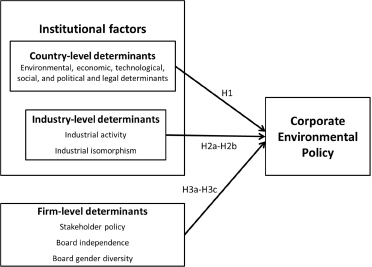
Hypothesis 1: CEP is affected by country-level determinants.
Industry-level determinants of CEP
We now move to a more specific context defined by the sector of activity (i.e., industrial activity and industrial isomorphism).
First, within the stakeholder theory framework, Groening and Kanuri (Reference Groening and Kanuri2013) state that firms provide protection for various stakeholder groups and enforce societal norms. As not all industries are equally regulated, firms must comply with different demands and degrees of government oversight. These differences may result in interindustry differences in environmentally sustainable practices (Banerjee et al., Reference Banerjee, Gupta and McIver2019). Firms in highly polluting industries are more likely to be concerned about regulations because regulators may consider it necessary to issue stringent mandatory rules against pollution (Jaggi et al., Reference Jaggi, Allini, Macchioni and Zagaria2018). Particularly, firms in carbon-intensive industries are likely to be under more scrutiny (Stanny & Ely, Reference Stanny and Ely2008) and take proactive actions, such as voluntary disclosure of greenhouse gas practices (Elsayih, Datt, & Hamid, Reference Elsayih, Datt and Hamid2021; Luo, Lan, & Tang, Reference Luo, Lan and Tang2012). Second, we consider mimetic isomorphism within the framework of the institutional theory. Firms’ focus on environmental and social issues may result from pressure from industry peers (Nadeem et al., Reference Nadeem, Gyapong and Ahmed2020). Social expectations are shaped by the development of quality environmental practices in a specific industry; therefore, companies in the same industry are forced to behave similarly to retain their competitiveness and avoid being perceived as a business at risk (Banerjee et al., Reference Banerjee, Gupta and McIver2019). For instance, greater awareness and stronger adoption of mitigation and adaptation strategies in relation to climate change may arise from the need to emulate first movers in the market (Daddi, Bleischwitz, Todaro, Gusmerotti, & De Giacomo, Reference Daddi, Bleischwitz, Todaro, Gusmerotti and De Giacomo2020).
Therefore, we propose a second hypothesis, which can be divided into two sub-hypotheses:
Hypothesis 2: CEP is affected by industry-level determinants.
Hypothesis 2a: CEP is positively affected by the industry’s environmental sensitivity.
Hypothesis 2b: CEP is positively affected by the CEP of companies in the same industry.
Firm-level determinants of CEP
In this last level of analysis, we link CEP to the relationship established by a company with its stakeholders in general and shareholders in particular (a key internal group for the financing of businesses) through a good corporate governance design.
Stakeholder theory is one of the primary theories used to explain why organizations engage in environmental activities (Tang & Tang, Reference Tang and Tang2018), and the relationship between stakeholder pressures and environmental performance requires further examination (Kassinis & Vafeas, Reference Kassinis and Vafeas2006). Every firm has unique relational contracts with external and internal stakeholders that can lead to diverse environmental positions for consumers and other stakeholders (Boura et al., Reference Boura, Tsouknidis and Lioukas2020). Within this relational context, it is essential to create models for stakeholder participation and engagement in environmental issues (Saeed et al., Reference Saeed, Afsar, Hafeez, Khan, Tahir and Afridi2019; Yong, Yusliza, Ramayah & Seles, Reference Yong, Yusliza, Ramayah and Seles2022) so that companies can meet stakeholder demands (Onkila, Reference Onkila2011) and contribute to a corporation’s long-term success by avoiding or resolving conflicts (Green & Hunton-Clarke, Reference Green and Hunton-Clarke2003). This is the only way to reduce shareholder risk (Gantchev, Giannetti, & Li, Reference Gantchev, Giannetti and Li2022; Henriques & Sadorsky, Reference Henriques and Sadorsky1996), retain highly qualified employees who prefer proactive environmental management (Reinhardt, Reference Reinhardt1999), access green consumers, and avoid boycotts (Newton, Tsarenko, Ferraro, & Sands, Reference Newton, Tsarenko, Ferraro and Sands2015), while not losing suppliers who protect their own reputations (Henriques & Sadorsky, Reference Henriques and Sadorsky1999). Stakeholder dialogue is a necessary starting point in this process, as corporations appreciate the concerns of stakeholders better (including their environmental concerns, preferences, and demands) when communication goes beyond managers and when managers subsequently act in more socially responsible ways (Campbell, Reference Campbell2006; Quiles-Soler, Martínez-Sala, & Monserrat-Gauchi, Reference Quiles-Soler, Martínez-Sala and Monserrat-Gauchi2023). Additionally, firms communicate their current practices, indicating what can be expected from their future environmental actions (Martín-de Castro, Amores-Salvadó, & Navas-López, Reference Martín-de Castro, Amores-Salvadó and Navas-López2016). This finding suggests important linkages between the greening of corporate strategies and environmental stakeholder management (Buysse & Verbeke, Reference Buysse and Verbeke2003; De la Torre-ruiz, Ferrón-Vílchez, Aguilera-Caracuel, & Martín-Rojas, Reference De la Torre-ruiz, Ferrón-Vílchez, Aguilera-Caracuel, Martín-Rojas, Kuei and Madu2012). It thus seems only natural that environmentally concerned companies would want to establish a closer relationship with their stakeholders to achieve more sustainable environmental development (Busch, Hamprecth & Waddock, Reference Busch, Hamprecth and Waddock2018; Madsen & Ulhøi, Reference Madsen and Ulhøi2001).
From the agency theory perspective, the main function of the board of directors is to monitor managers on behalf of shareholders. Therefore, board composition and director attributes significantly affect the quality and effectiveness of the corporations’ governance practices. According to the resource dependence theory, companies operate in an open system and depend on the external environment to exchange and acquire the resources they need to survive. In this framework, board composition may help bring valuable expertise and capabilities on board, aid in strategy formulation, and help connect the firm with stakeholders. Boards are of great importance with respect to sustainability issues and when determining a firm’s environmental performance, considering that not all board members have the same capabilities and networks and that the board’s social capital can contribute to the firm’s functional performance in certain contexts (Ortiz-de-Mandojana & Aragon-Correa, Reference Ortiz-de-Mandojana and Aragon-Correa2015). Moreover, in relation to corporate sustainability, the board of directors, as an internal corporate governance mechanism, is the most frequently discussed topic in the literature (Ludwig & Sassen, Reference Ludwig and Sassen2022). Thus, we focus on two main board issues that have been considered especially important for corporate governance in general and, particularly, for corporate social and environmental practices (Ludwig & Sassen, Reference Ludwig and Sassen2022; Muhammad & Migliori, Reference Muhammad and Migliori2023; Nguyen & Thanh, Reference Nguyen and Thanh2022; Pandey, Andres & Kumar, Reference Pandey, Andres and Kumar2023): board independence and board gender diversity.
Commitment to social and environmental sustainability usually requires substantial long-term capital investment, which may be rejected by internal directors who are more preoccupied with short-term economic goals (Johnson & Greening, Reference Johnson and Greening1999; Liao, Luo, & Tang, Reference Liao, Luo and Tang2015). Conversely, independent boards are more likely to realize the potential of environmental opportunities to generate value for shareholders in the long run through cost savings, reduced environmental litigation, improved environmental image, and new market opportunities (De Villiers, Naiker, & van Staden, Reference De Villiers, Naiker and van Staden2011; Haque, Reference Haque2017; Kassinis & Vafeas, Reference Kassinis and Vafeas2002; Liao et al., Reference Liao, Luo and Tang2015). Independent directors also bring unique skills, competencies, and networks to the firm that attract critical resources, leading to improved corporate social performance and new environmental opportunities (Fabrizi, Mallin, & Michelon, Reference Fabrizi, Mallin and Michelon2014; O’Neill, Saunders, & McCarthy, Reference O’Neill, Saunders and McCarthy1989). They are also more likely to be sensitive to social demands (Ibrahim & Angelidis, Reference Ibrahim and Angelidis1995) as they are more responsive than insiders to stakeholder pressures related to sustainability, which, in turn, enhances their reputation and improves their chances of continuing on the board (Post, Rahman, & McQuillen, Reference Post, Rahman and McQuillen2015).
A solid body of research on the effects of board gender diversity on environmental performance has been built up over the last ten years (Cordeiro, Profumo, & Tutore, Reference Cordeiro, Profumo and Tutore2020; Muhammad & Migliori, Reference Muhammad and Migliori2023; Nuber & Velte, Reference Nuber and Velte2021; Orazalin & Baydauletov, Reference Orazalin and Baydauletov2020). First, the position toward environment-related decisions, investments, and opportunities will be more favorable for female decision-makers, as women are more long-term-oriented than men (Silverman, Reference Silverman2003), contribute more information about innovative environmental practices (Glass, Cook, & Ingersoll, Reference Glass, Cook and Ingersoll2016; Zhang, Qin, & Zhang, Reference Zhang, Qin and Zhang2023), and are more sensitive to the risks inherent in a lack of environmental engagement (Bord & O’Connor, Reference Bord and O’Connor1997; Glass et al., Reference Glass, Cook and Ingersoll2016). Second, women directors are less concerned with economic performance and are more philanthropically driven (Gangi, Daniele, D’Angelo, Varrone, & Coscia, Reference Gangi, Daniele, D’Angelo, Varrone and Coscia2023; Ibrahim & Angelidis, Reference Ibrahim and Angelidis1994), showing greater concern for stakeholders than shareholders (Biswas, Mansi, & Pandey, Reference Biswas, Mansi and Pandey2018; Nadeem et al., Reference Nadeem, Gyapong and Ahmed2020; Nuber & Velte, Reference Nuber and Velte2021) and higher CSR reporting quality (Cabeza-García, Fernández-Gago, & Nieto, Reference Cabeza-García, Fernández-Gago and Nieto2018). Consequently, when women assume powerful positions, their decisions are likely to be affected by environmental, ethical, and caring values (Post et al., Reference Post, Rahman and McQuillen2015). In this sense, women express greater environmental concerns than their male counterparts (Braun, Reference Braun2010) and have a more protective attitude toward the environment (Wehrmeyer & McNeil, Reference Wehrmeyer and McNeil2000). Thus, the presence of women on boards contributes to promoting proactive environmental strategies (Elmagrhi, Ntim, Elamer, & Zhang, Reference Elmagrhi, Ntim, Elamer and Zhang2019; Orazalin & Mahmood, Reference Orazalin and Mahmood2021; Xie, Nozawa & Managi, Reference Xie, Nozawa and Managi2020).
In view of the above arguments, we propose the last hypothesis, which is broken down into three sub-hypotheses:
Hypothesis 3: CEP is affected by firm-level determinants.
Hypothesis 3a: CEP is positively affected by good stakeholder policy.
Hypothesis 3b: CEP is positively affected by board independence.
Hypothesis 3c: CEP is positively affected by board gender diversity.
Figure 1 summarizes the main hypotheses proposed at the three levels of the analyzed determinants.
Model and hypotheses.

Sample, variables, and methodology
Sample
The initial database provided by Vigeo Eiris comprises a panel of listed companies worldwide (excluding developing countries) belonging to the respective countries’ main stock indexes. We used data from 2013 to 2016. Vigeo Eiris, an organization specializing in the assessment of CSR principally for investors’ use, was recently integrated into Moody’s ESG division. Current CSR-related studies use this database in their empirical analyses (Amor-Esteban, Galindo-Villardón, García-Sánchez, & David, Reference Amor-Esteban, Galindo-Villardón, García-Sánchez and David2019; Brammer, Brooks, & Pavelin, Reference Brammer, Brooks and Pavelin2006; Cassely, Revelli, Ben Larbi, & Lacroux, Reference Cassely, Revelli, Ben Larbi and Lacroux2020; Fabrizi et al., Reference Fabrizi, Mallin and Michelon2014; Khediri, Reference Khediri2021; Laguir, Stekelorum, Laguir, & Staglianò, Reference Laguir, Stekelorum, Laguir and Staglianò2021). Our period of analysis ends in 2016 because several factors that occurred around 2015–2016 might have had an impact at the country, industry, and firm levels from 2016 onwards, changing the conditions under which the study was conducted. First, the Paris Agreement on Climate Change is considered the first universal, legally binding global climate deal (UNFCC, 2015). Second, the establishment of the 17 SDGs by the General Assembly of the United Nations as a future global sustainable development framework addressed new challenges and objectives regarding environmental issues that had not been considered within the previous framework, that is, the Millennium Development Goals (European Environment Agency, 2017; United Nations, 2016). Finally, the development of the EU’s Circular Economy Action Plan, a comprehensive body of legislative and non-legislative actions aimed at facilitating the transition of the EU economy from a linear to a more circular and sustainable model, encouraged countries, industries, and companies to propose more environmentally friendly strategies (Ellen MacArthur Foundation, 2020). The analysis would have been biased if any of these significant events occurred during the study period, as this would have made the comparison of the influence of contextual factors and drivers on the corresponding CEPs less reliable.
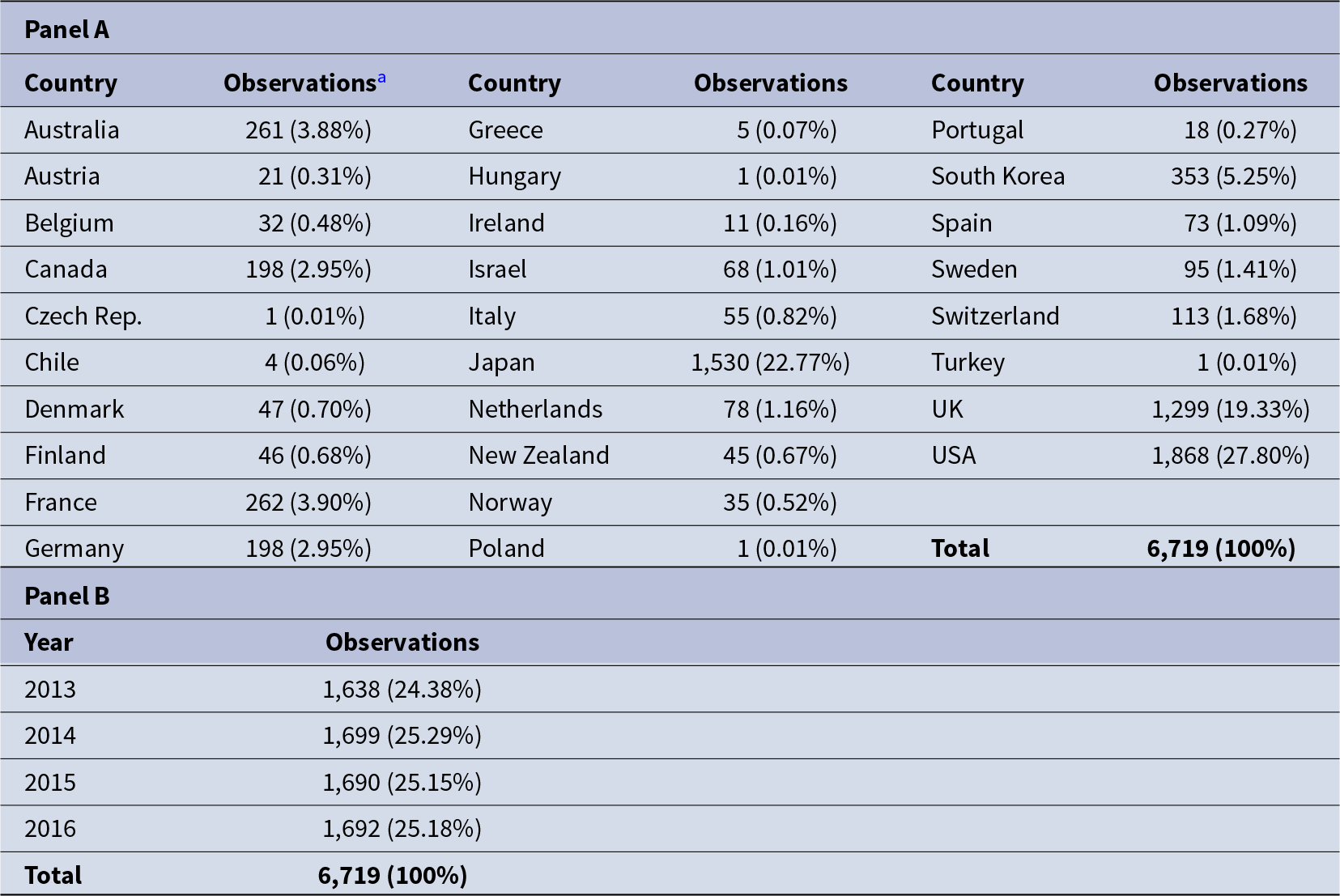
As some companies entered and others exited the stock market during the study period, the database comprised an unbalanced panel that included 3,435 companies and 11,415 firm-year observations. Financial companies were omitted because of their characteristics, such as their specificity from an accounting perspective, or because of the regulation or structure of these markets (2,455 observations). Additionally, owing to missing values in the variables employed, the initial database was reduced to a sample of 6,719 firm-year observations (2,047 firms) (see Table 1, Panel A).
Sample composition by country and year

a The percentage of the country (or year) over the total is shown in brackets.
Table 1 presents the sample composition by year and country. The sample comprises firms from 28 countries (Table 1, Panel A), while firm observations are evenly distributed across the study period (Table 1, Panel B). By geographic area or continent, the countries in the sample belong to Europe (35.60%), North America (30.70%), Asia (29.05%), Oceania (4.55%), and South America (0.06%). Although the number of firm observations from South America is low, and no companies from Africa are included in the sample, it must be noted that these geographic areas represented only 2.3% and 0.74%, respectively, of the total observations in the initial population.
Several databases and sources were required to construct a complete database. CEP, firm sector, stakeholder policy, information about independent non-executive and women directors, firm size, market capitalization, and energy-related turnover were obtained from the Vigeo Eiris database. Additionally, information about the variables at the country level was obtained from several sources such as the OECD, United Nations, Freedom House, Transparency International, Economist Intelligence Unit, and Worldwide Governance Indicators provided by the World Bank.
Variables
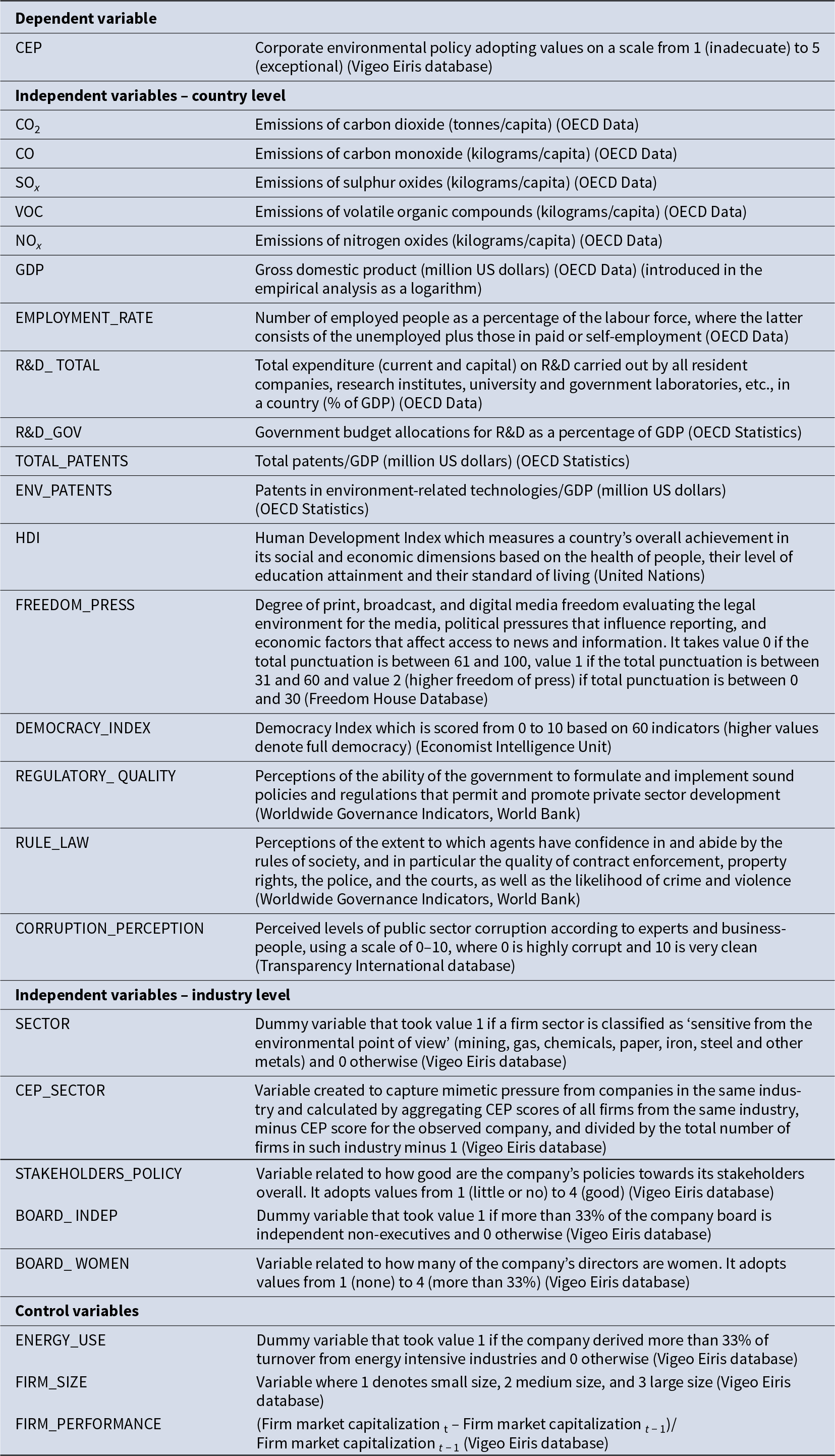
As observed in Table 2, for each firm in each year, we considered CEP (the dependent variable) according to the definition provided by Vigeo Eiris. This variable has been used in previous studies on environmental and stakeholder management and CSR (Amor-Esteban et al., Reference Amor-Esteban, Galindo-Villardón, García-Sánchez and David2019; Dam & Scholtens, Reference Dam and Scholtens2012; López-González, Martínez-Ferrero, & García-Meca, Reference López-González, Martínez-Ferrero and García-Meca2019). Following the Vigeo Eiris methodology, CEP can be determined by companies’ statements, as published in their annual reports, environmental reports, brochures, leaflets, websites, or any other publicly available literature, and by their environmental commitment, as reflected in the signing of declarations, charters, etc., or membership in organizations, forums, or industry sector initiatives, through which the company publicly expresses its intention to adhere to certain environmental principles or commitments.
Variables description

The independent variables are grouped into three levels of analysis: country, industry, and firm. We used 17 country-level determinants. Following previous studies (Banerjee et al., Reference Banerjee, Gupta and McIver2019; Bilbao-Osorio et al., Reference Bilbao-Osorio, Blanke, Campanella, Crotti, Drzeniek-Hanouz, Serin, Schwab and Sala-i-martín2013), the environmental sustainability of a country was measured by CO2 emissions per capita, to which we added other gases (CO, SOx, VOC, and NOx) to capture the air quality more precisely. The log of gross domestic product (GDP) was used as a sign of economic growth (Banerjee et al., Reference Banerjee, Gupta and McIver2019; Obydenkova & Salahodjaev, Reference Obydenkova and Salahodjaev2017; Wang et al., Reference Wang, Umar, Akram and Caglar2021) and the extent to which available labor resources were being used (EMPLOYMENT_RATE) as an estimation of the range of options and consequent bargaining power for prospective employees. General innovation must be distinguished from green innovation or environmentally related research, development, and technologies. Nevertheless, when constructing green growth indicators, the focus must be on both aspects (OECD, 2011). Therefore, our model considered the effort made by a country to improve its level of innovation (R&D_GOV) (Wang et al., Reference Wang, Umar, Akram and Caglar2021), as well as the general (TOTAL_PATENTS) and specific results of the environment-related technologies of that effort (ENV_PATENTS) (Costantini et al., Reference Costantini, Crespi, Marin and Paglialunga2017; Liang, Wen, & Zhu, Reference Liang, Wen and Zhu2023). As an indicator of a country’s human development, we employed the Human Development Index (HDI) developed by the United Nations Development Program, which focuses on three dimensions: living standards, health, and education (Lai & Chen, Reference Lai and Chen2020; Rosati & Faria, Reference Rosati and Faria2019). The ability of journalists to report freely on matters of public interest was measured by the indicator given by the Freedom House (FREEDOM_PRESS) (Hartmann & Uhlenbruck, Reference Hartmann and Uhlenbruck2015). We proxied democracy using the Economist Intelligence Unit Democracy Index (DEMOCRACY_INDEX), which is based on five categories: electoral processes and pluralism, civil liberties, government functioning, political participation, and political culture (De Miguel & Martínez-Dordella, Reference De Miguel and Martínez-Dordella2014). Finally, to capture differences in institutional quality, we used the indicators REGULATORY_QUALITY and RULE_LAW provided by the World Bank’s Governance (Banerjee et al., Reference Banerjee, Gupta and McIver2019) and the CORRUPTION_PERCEPTION index by Transparency International (Anderson, Reference Anderson2015; Morse, Reference Morse2006).
For the second level of analysis (industry-level determinants), two variables were considered: the industry’s environmental sensitivity (SECTOR), measured by a dummy variable (De Villiers et al., Reference De Villiers, Naiker and van Staden2011; Reverte, Reference Reverte2009), and the strength of the mimetic pressure on firms (CEP_SECTOR), captured by the overall CEP level of the industrial sector for each company, excluding its own CEP score (Banerjee et al., Reference Banerjee, Gupta and McIver2019). The third level of analysis (firm-level determinants) comprises three variables. As in the case of CEP, we turned to Vigeo Eiris for the overall quality of a company’s policies toward its stakeholders (STAKEHOLDERS_POLICY) (Amor-Esteban et al., Reference Amor-Esteban, Galindo-Villardón, García-Sánchez and David2019) and board composition in terms of independence (BOARD_INDEP) (Boudt, Cornelissen, & Croux, Reference Boudt, Cornelissen and Croux2013) and gender diversity (BOARD_WOMEN) (García-Martínez, Guijarro, & Poyatos, Reference García-Martínez, Guijarro and Poyatos2019).
Finally, we selected control variables to assess firm characteristics, such as the turnover of energy-intensive industries (ENERGY_USE), size (FIRM_SIZE), and performance (FIRM_PERFORMANCE).
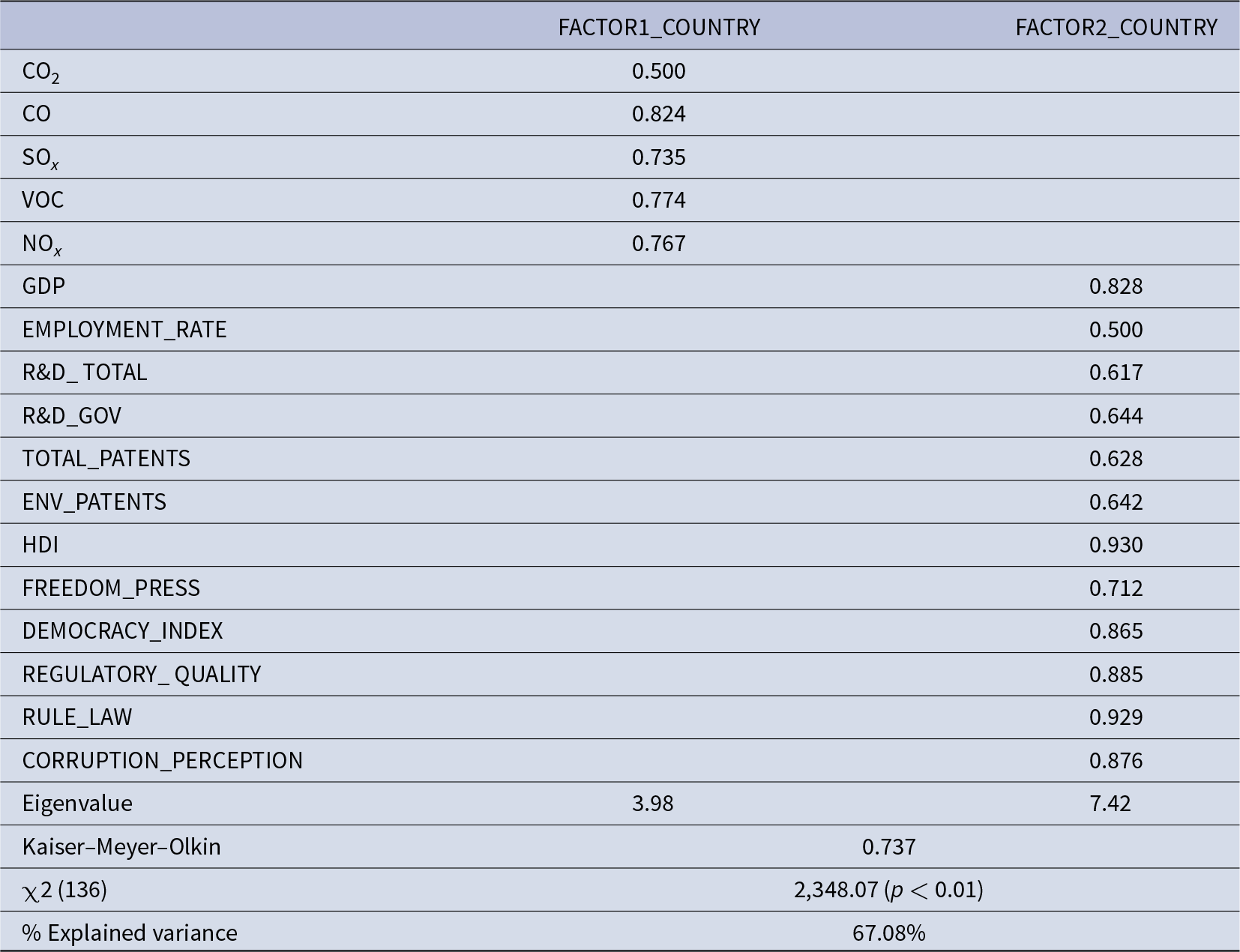
As explained previously, several country-level variables are interconnected. Drawing on this notion, we conducted a factor analysis on the 17 variables and obtained a two-factor structure (Table 3): FACTOR1_COUNTRY, comprising the variables used to capture air quality at the country level, and FACTOR2_COUNTRY, including economic, technological, social, political, and legal determinants. According to their standardized Cronbach’s alpha coefficients, both factors can be considered reliable (0.872 for FACTOR1_COUNTRY and 0.936 for FACTOR2_COUNTRY).
Country-level factors

Methodology
The econometric model used to test the hypotheses was determined by the fact that the dependent variable, CEP, is an ordinal qualitative variable that takes values from 1 to 5. The use of a panel data methodology, such as an ordered probit model with random effects (Wooldridge, Reference Wooldridge2002),Footnote 1 was ruled out because of the distribution of the dependent variable. STATA encountered a discontinuous region, and the improvement could not be computed. We eventually opted for ordered probit models clustered at the firm level, controlling for possible endogeneity in the proposed model using explanatory and control variables lagged by one yearFootnote 2 (Janowic, Piaskowska, & Trojanowski, Reference Janowic, Piaskowska and Trojanowski2004). We corrected the estimations for heteroscedasticity problems using the robust option of the STATA software, which implies the estimation of standard robust errors. We also repeated the estimations by employing an ordered random-effects logit instead of an ordered probit model; the results did not vary significantly.
More specifically, the proposed model is as follows:
 \begin{equation*}CEP_i=\alpha_0+\beta X_{it-1}+\sum_{2013}^{2016}D_t+\varepsilon_i\end{equation*}
where i refers to the firm, t indicates time, X refersto the explanatory and control variables,  $\sum\limits_{t = 2013}^{2016} {{D_t}} $ is a set of dummy time variables covering any non-variant time effect of the firm not included in the regression, and
 ${\varepsilon _i}$ is the error term.
Results
Descriptive statistics and correlation analysis
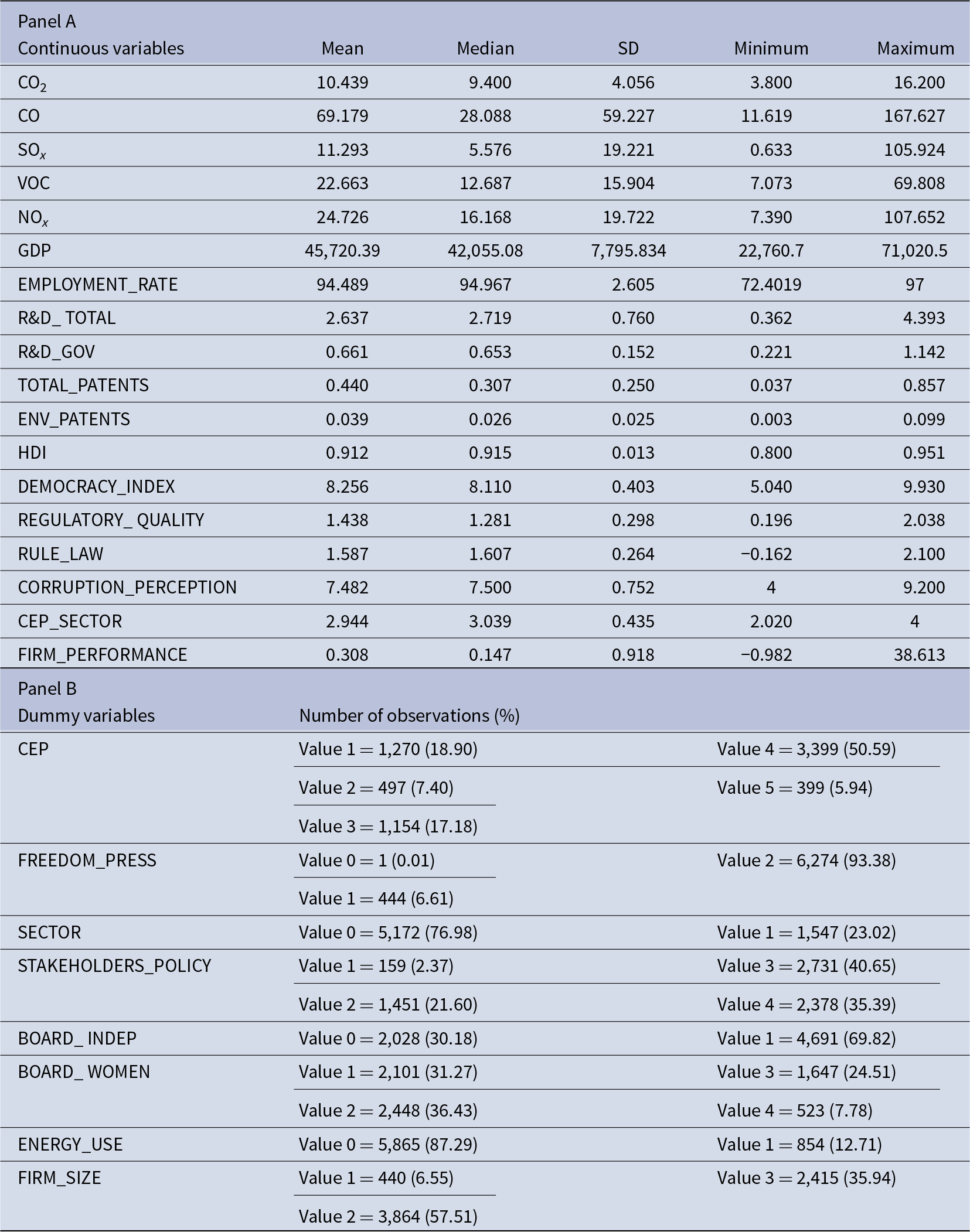
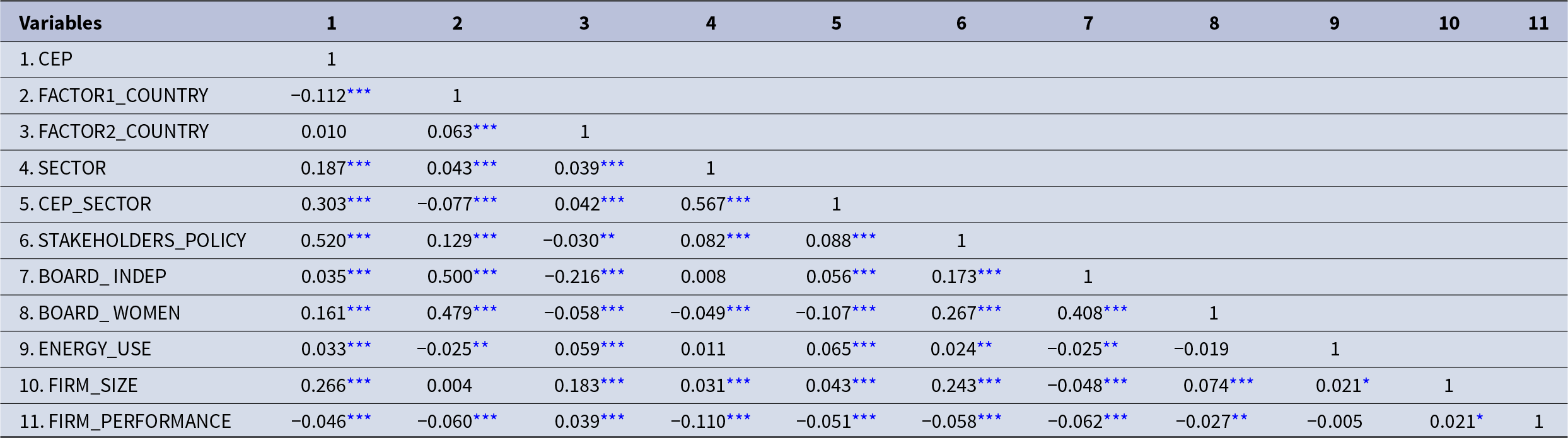
Table 4 presents descriptive information for all the variables, and Table 5 lists the correlation coefficients of the variables used in the panel data estimations. Once the non-normality of the explanatory and control continuous variables was confirmed, and considering that Pearson’s correlation coefficient did not function adequately for discrete variables, as it was very sensitive to violations of normality assumptions, Spearman’s rank correlations were calculated. Although some of the variables were significantly correlated, analysis of the variance inflation factors revealed no evidence of multicollinearity, as they all remained under 5 (Hair, Black, Babin, & Anderson, Reference Hair, Black, Babin and Anderson2010).
Descriptive statistics

* n = 6,719 except in CO variable (n = 6,714), VOC variable (n = 6,651), R&D_total variable (n = 6,482) and R&D_gov variable (n = 6,662).
Correlation matrix

* p < 0.10; **p < 0.05; ***p < 0.01.
n = 6,719.
Regression analysis
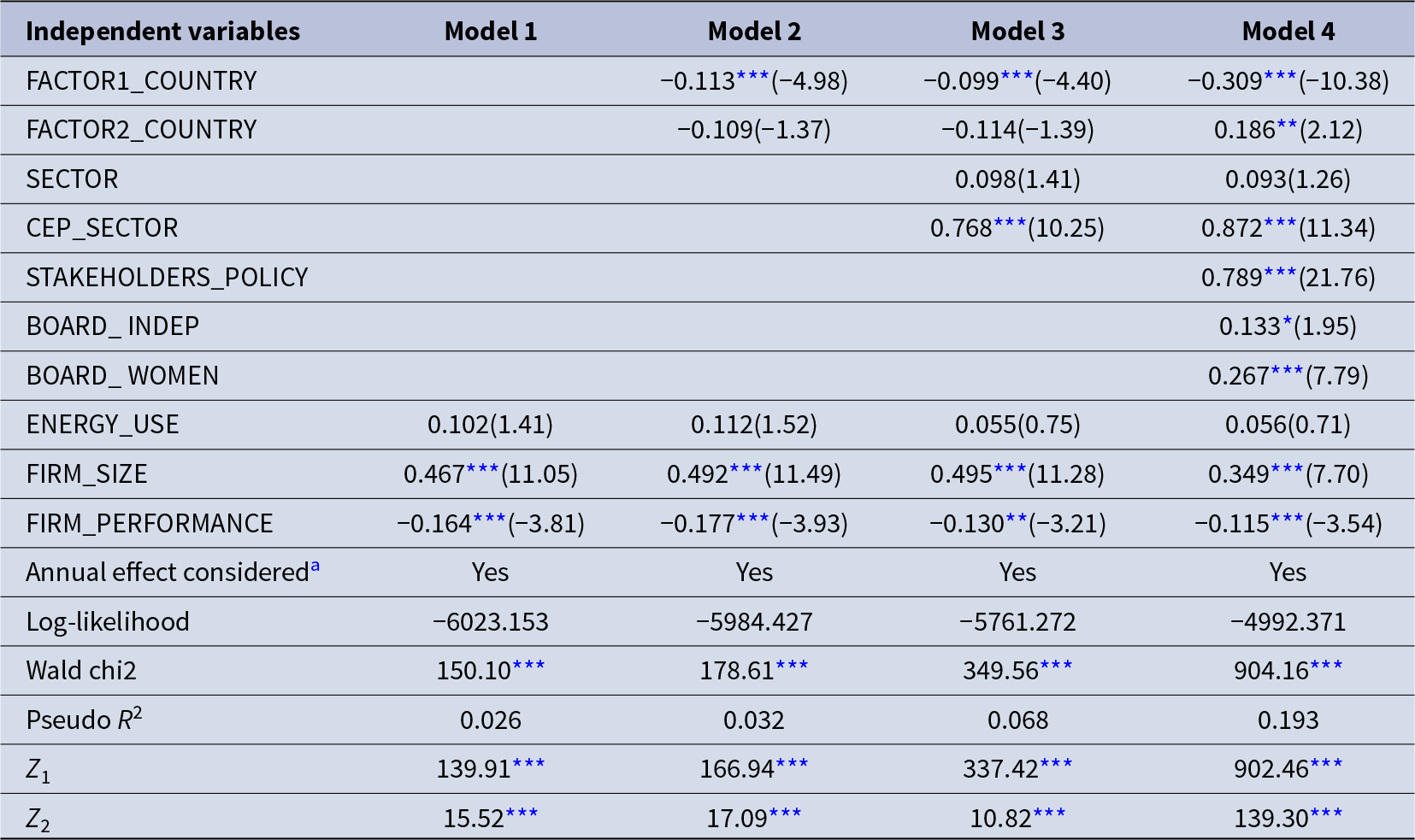
As we considered lagged values for the endogenous variables, and due to some missing values for the variables in particular cases, we eventually worked with a sample of 4,752 observations for our estimations. Table 6 reports the ordered probit results for the dependent variable (CEP) in relation to the country-, industry-, and firm-level variables related to the stakeholders and board of directors.
Ordered probit results

* p < 0.10; **p < 0.05; ***p < 0.01.
Z value between brackets.
Dependent variable is a qualitative dummy that takes value 1–5 depending on the firm commitment to corporate environmental policy (CEP).
Number of observations = 4,752; Number of firms = 1,765.
Z 1 is a Wald test for the reported coefficients of the explanatory and control variables, asymptotically distributed as  ${\chi _2}$ under the null of no relationship for all the explanatory and control variables. Z 2 is a Wald test for the reported coefficients of the dummy annual variables, asymptotically distributed as
 ${\chi _2}$ under the null of no relationship for all the dummy annual variables.
a Dummy related to 2014 year turns out to be significant.
Table 6 For Model 1, only the three control variables are included; Model 2 adds the proxy variables for country-level determinants (FACTOR1_COUNTRY, FACTOR2_COUNTRY); Model 3 also incorporates the proxy for industry-level determinants (SECTOR, CEP_SECTOR); and the final extended model, Model 4, includes the firm-level variables as well (STAKEHOLDERS_POLICY, BOARD_INDEP, BOARD_WOMEN).
Focusing on Model 4 (where all variables are considered simultaneously), our estimations show that for country-level variables, the factor related to the environmental context (FACTOR1_COUNTRY) negatively affects CEP (p < 0.01). Therefore, the higher the emissions of air gases in a country, the lower the CEP value. Additionally, the factors related to other determinants at this analysis level (FACTOR2_COUNTRY) also have a positive and significant influence on CEP (p < 0.05). Thus, the results appear to support Hypothesis 1.
However, contrary to Hypothesis 2a, the effect of SECTOR was not significant. We found no support for the claim that firms in the environmentally sensitive sector are more committed to environmental policies.Footnote 3 As suggested by Hypothesis 2b, our results support the notion that CEP_SECTOR significantly affects CEP. Thus, given the results obtained for the two sub-hypotheses, we can only partially confirm Hypothesis 2.
Our results also support that a firm’s policy toward its stakeholders (STAKEHOLDERS_POLICY) positively affects CEP (at the 1% level). This provides evidence to accept Hypothesis 3a. Regarding the corporate governance variables, in line with Hypothesis 3b, the results showed that board independence (BOARD_INDEP) is important in explaining CEP (p = 0.051). Similarly, board gender diversity (BOARD_WOMEN) seems to positively affect CEP (p < 0.01), thus supporting Hypothesis 3c. The evidence obtained for the three sub-hypotheses confirms Hypothesis 3.
Finally, regarding the control variables, firm size and performance affect CEP in a positive or negative way, respectively (p < 0.01 for most models).
Discussion
Our research falls within the literature on environmental management and draws on institutional and stakeholder theories, which are key theoretical frameworks in this field (Tatoglu et al., Reference Tatoglu, Bayraktar and Arda2015). Our results can be examined from the perspective of these theoretical approaches and are consistent with the findings of previous empirical studies.
Drawing on the basic notions of institutional theory that country- and industry-level factors are relevant for explaining corporate actions and decisions, our results confirm that this is true for environmental management to the extent that a company’s CEP is affected by country-level determinants (Hypothesis 1) and the CEP of companies in the same industry (Hypothesis 2b). Regarding country-level variables, our joint approach reinforces efforts to integrate ‘old’ and ‘new’ institutional perspectives (Delmas & Toffel, Reference Delmas and Toffel2008). Thus, we considered two types of country-level variables that operate simultaneously: institutional pressures and contingency factors in organizations’ external environments that may condition their receptivity to institutional pressures (Hoffman, Reference Hoffman2001). At the industry level, our results emphasize the influence of mimetic pressures that cause isomorphism because corporations tend to model their conduct in line with that of other organizations (Dimaggio & Powell, Reference Dimaggio and Powell1983) to minimize ambiguity and ensure legitimacy. Industry peers are considered among the main drivers of this type of isomorphism because they share similar challenges and uncertainties and tend to be structurally equivalent, fostering herd behavior (Amor-Esteban et al., Reference Amor-Esteban, Galindo-Villardón, García-Sánchez and David2019).
From an empirical perspective, the significant effect of our national level of greenhouse gas emissions on CEP is consistent with the findings of Obydenkova and Salahodjaev (Reference Obydenkova and Salahodjaev2017) in that firms located in more polluted environments are more willing to give in to pressure to weaker environmental policies and, consequently, are less likely to implement CEPs. This means that the need for legitimization is lower in places with high levels of pollution, and the consequences for firms that are not proactive in this respect are less serious. Moreover, the significant positive relationship between the variables included in the other factors (level of development in economic, technological, social, political, and legal terms) and firms’ policies on environmental issues aligns with previous studies (AlBassam, Reference AlBassam2013; Banerjee et al., Reference Banerjee, Gupta and McIver2019; Obydenkova & Salahodjaev, Reference Obydenkova and Salahodjaev2017; Themudo, Reference Themudo2013). Finally, the positive and significant effect of industry peers’ CEP on a particular company’s CEP is consistent with previous studies, which state that, generally, mimetic isomorphism can significantly influence the corporate disclosure of environmental issues. As a result of pressure from industry peers, firms might behave in a more sustainable manner by complying with social expectations and, consequently, retain their competitive advantage (Banerjee et al., Reference Banerjee, Gupta and McIver2019; Daddi et al., Reference Daddi, Bleischwitz, Todaro, Gusmerotti and De Giacomo2020; Nadeem et al., Reference Nadeem, Gyapong and Ahmed2020).
In the science mapping of stakeholder research conducted by Mahajan, Lim, Sareen, Kumar and Panwar (Reference Mahajan, Lim, Sareen, Kumar and Panwar2023), environmental issues were identified as a promising avenue for future work, and this study can thus be framed in the largest cluster of works presented by them. They argue that companies must multitask and concurrently satisfy stakeholder demands to maintain their legitimacy due to increasing stakeholder pressure from both shareholders and non-shareholders (Mahajan et al., Reference Mahajan, Lim, Sareen, Kumar and Panwar2023). Following Goyal’s (Reference Goyal2022) concerns, such a consideration of shareholders as a separate group from other stakeholders may be one of the reasons for the slow adoption of the ‘stakeholder lens’ within mainstream literature in strategic management and organization studies. This study focuses on companies’ policies toward all their stakeholders, including shareholders, and because of the importance of the latter group, we have additionally considered some key characteristics of one of the main corporate governance mechanisms that try to protect shareholders’ wealth, the board of directors. Our results reveal that better stakeholder policies (Hypothesis 3a), more independent boards (Hypothesis 3b), and gender-diverse boards (Hypothesis 3c) positively influence CEP. From a theoretical perspective, these results share the same logic; that is, stakeholders may have answers to difficult questions continuously faced by companies and are required to be part of the strategic decision-making process (Goyal, Reference Goyal2022). Thus, as identified by Horisch, Freeman and Schaltegger (Reference Horisch, Freeman and Schaltegger2014) regarding environmental issues, having a good stakeholder policy and insights from individuals with a variety of reasoning and perspectives may empower stakeholders to act as intermediaries for nature and sustainable development.
From an empirical perspective, the observed positive effect of a good stakeholder policy on CEP is consistent with Boura et al. (Reference Boura, Tsouknidis and Lioukas2020), who found that a firm’s pro-social orientation positively affects the scale of environmental disclosure. They also align with Madsen and Ulhøi (Reference Madsen and Ulhøi2001) and Buysse and Verbeke (Reference Buysse and Verbeke2003), who state that more proactive environmental strategies are associated with a deeper and broader consideration of stakeholders. Therefore, environmental leadership is associated with actively managing the norms and expectations of various stakeholders rather than simply complying with regulations. Moreover, the positive influence of board independence on CEP is consistent with the results of previous studies such as those by a) Benjamin, Mansi and Pandey (Reference Benjamin, Mansi and Pandey2020), which suggests a positive relationship between board independence and environmental and social outcomes; b) Post et al. (Reference Post, Rahman and McQuillen2015), which states that the presence of independent directors increases the likelihood of forming sustainability-themed alliances contributing to corporate environmental performance; and c) Liao et al. (Reference Liao, Luo and Tang2015), which concludes that firms with a higher percentage of independent directors on their boards tend to be ecologically transparent and exhibit a capacity to adopt a long-term performance perspective by balancing both financial and environmental accountability. Finally, our results align with those of previous studies that established a positive relationship between the presence of women on the board of directors and CEP. These studies state that women have a more proactive attitude toward the environment (Wehrmeyer & McNeil, Reference Wehrmeyer and McNeil2000) and show greater concern about the risk inherent in a lack of environmental engagement (Bord & O’Connor, Reference Bord and O’Connor1997; Glass et al., Reference Glass, Cook and Ingersoll2016), which makes them more likely to promote proactive environmental strategies (Xie et al., Reference Xie, Nozawa and Managi2020) and provide the board with information about innovative environmental practices (Glass et al., Reference Glass, Cook and Ingersoll2016).
Finally, we discuss the positive and significant effects of firm size and performance as key control variables. Our results align with previous studies that suggest that firm size is an important determinant of firm environmental actions (Banerjee et al., Reference Banerjee, Gupta and McIver2019) because large companies are both more politically visible and more exposed to social pressures for environmental performance (Gallego-Álvarez & Pucheta-Martínez, Reference Gallego-Álvarez and Pucheta-Martínez2020). Moreover, large companies tend to have more resources to devote to environmental practices (Boura et al., Reference Boura, Tsouknidis and Lioukas2020). Additionally, although some previous studies state that firms with higher levels of performance display higher levels of environmental practices (Banerjee et al., Reference Banerjee, Gupta and McIver2019; Boura et al., Reference Boura, Tsouknidis and Lioukas2020; De Villiers et al., Reference De Villiers, Naiker and van Staden2011), our results do not support this. Our findings are more in line with the ‘managerial opportunism’ argument proposed by Preston and O’Bannon (Reference Preston and O´Bannon1997), suggesting that financial performance may have a negative effect on social performance. This means that when financial performance is strong, managers may attempt to ‘cash in’ by reducing social expenditures to take advantage of the opportunity to increase their own short-term private gains. A similar reasoning can be applied to the relationship between firm performance and CEP.
Conclusions
Recently, the increasing degradation of the natural environment and greater pressure exerted by governments and society have led companies to develop more proactive approaches to environmental management. It appears that it is no longer sufficient for firms to merely report their activities related to environmental issues. Therefore, it is imperative for them to develop and implement their own CEP. Consequently, an in-depth analysis is required to gain a better understanding of the factors that may influence CEP and their relevance (Dummett, Reference Dummett2006). This study addresses the call for research using a holistic approach by jointly analyzing country-, industry-, and firm-level determinants. This type of approach is needed because all these factors may operate simultaneously; therefore, the omission of any of them could represent a misspecification of a research model aimed at understanding the antecedents of CEP.
For country-level factors, considering the potential interactions among some of the variables, we conducted a factor analysis prior to the ordered probit analysis. Moreover, for firm-level determinants, in addition to the board-related variables that have traditionally been considered (independence and gender diversity), we introduced another factor, namely, companies’ policies toward their stakeholders. This novel variable was included because of the relevant relationship between stakeholder management and the greening of corporate strategies (Buysse & Verbeke, Reference Buysse and Verbeke2003; De la Torre-ruiz et al., Reference De la Torre-ruiz, Ferrón-Vílchez, Aguilera-Caracuel, Martín-Rojas, Kuei and Madu2012), which implies that companies that are more involved in sustainable environmental development will be more willing to interact actively with their stakeholders (Busch et al., Reference Busch, Hamprecth and Waddock2018; Madsen & Ulhøi, Reference Madsen and Ulhøi2001).
According to our results, the aforementioned variable levels seem relevant in explaining CEP. Regarding the institutional variables, the results emphasize that CEP is affected by both the environmental context of the country and other country characteristics considered together, as well as by the pressure exerted by industry peers. Regarding firm-level variables, we observed that companies with better policies toward their stakeholders and higher levels of board independence and gender diversity tended to develop better environmental policies.
Implications
These findings lead to some relevant implications.
Theoretical implications
As previously stated, this study contributes significantly to the theoretical understanding of CEPs by examining the multifaceted factors that motivate firms to adopt proactive environmental practices. By applying institutional and stakeholder theories, we provide a comprehensive and holistic perspective on the determinants of CEPs at the country, industry, and firm levels. By integrating these diverse determinants, our study bridges gaps in the literature and offers a nuanced understanding of the complex motivations behind corporate environmental engagement.
Policy implications
First, there seems to be a dangerous closed loop; that is, the more pollution there is, the fewer environmental policies are implemented by companies. This resulted in an increase in pollution levels. Thus, in more polluting countries, governments must be vigilant in intervening with measures such as environmental regulation and encourage firms to take proactive action to break this closed loop. Second, our results show that companies tend to be more proactive in terms of the quality and implementation of their environmental policies if competitors in the same industry are proactive. This highlights the relevance of the differing competition factors within industries and the importance of business associations and governmental bodies giving visibility to the proactive environmental behavior of business leaders who may inspire others to contribute to a more sustainable economy.
Managerial implications
Due to the link between stakeholders and environmental policies, we suggest that companies that proactively seek to improve their environmental commitment address their stakeholders directly and ask them about their expectations. Paying attention to their suggestions and requests may help improve CEP and increase mutual trust. Finally, based on our results, firms must be aware of the importance of independent directors and gender diversity on boards if they want to develop proactive environmental policies.
Limitations and future research
Despite its contributions, this study has some limitations. First, it only considers large firms, that is, companies belonging to the main Stock Index of each developed country included in the sample. Therefore, it would be interesting to analyze whether the variables included in our study have the same effect if the sample also includes small and medium enterprises and other geographical areas, such as developing countries. Second, the study period ends before recent events, such as the Green Deal, the EU’s New Circular Economy Action Plan, and the UN’s Medium-Term Strategies, to avoid altering the relationship observed between the selected determinants and the corresponding environmental policy of a company. Future studies should explore the extent to which environmental milestones influence CEP.
Additionally, several suggestions for further research are proposed. First, regarding country-level determinants of CEP, apart from environmental factors, several economic, technological, social, and political-legal variables may impact CEP. Although the relevant variables were included in this category, they are not specifically related to environmental issues. This could be the next step in extending our research model, for example, by considering the enforcement of environmental laws as a political-legal factor and by including environmental grants or funding for firms as economic determinants. Second, at the industry level, although we found evidence of the general influence of mimetic isomorphism on CEP within a specific sector, it might be interesting to study whether other types of isomorphism occur. Finally, for firm-level variables, several studies have noted the effects of board gender diversity on environmental performance. Our study considered only the percentage of women on the board, and further research could also include the critical mass and/or power of women directors, for example, in terms of their position (e.g., Chairman, CEO, etc.) or tenure within the company. Moreover, apart from gender diversity, other sources of diversity such as cultural background, race, and education might be relevant in explaining companies’ environmental commitment.
Competing interests
The authors declare ‘none’.
Acknowledgments
The authors gratefully acknowledge funding received from the Ministry of Science and Innovation (MCIN/AEI /10.13039/501,100,011,033/) and by the European Regional Development Fund (ERDF) A way of doing Europe under grant PID2022-137379NB-I00.
Beatriz Jiménez-Parra is a lecturer of strategic management at University of León (Spain). She obtained her PhD from the University of Extremadura (Spain). Her research interests include circular economy and sustainable business strategies.
Roberto Fernández-Gago is a senior lecturer of business ethics at University of León (Spain). He holds a PhD in Business Sciences and his main line of research is corporate social responsibility.
José-Luis Godos-Díez earned his PhD degree at University of León (Spain) where he lectures on strategic management. His current research interests focus on corporate social responsibility, stakeholder theory and business ethics.
Laura Cabeza-García is a full professor of strategic management at University of León (Spain). She obtained her PhD from the University of Oviedo (Spain). Her research interests include corporate governance and corporate social responsibility.