Should American public school children be taught about evolution? And should they learn that neo-Darwinist theories of evolution alone can explain the origins and development of all species on earth? Polls since 1981 consistently show that the majority of Americans believe the answers should be a qualified yes to the first question and no to the second.Footnote 1 Indeed, a 2005 poll conducted by the Pew Forum on Religion and Public Life reports that 38 percent of Americans would prefer teaching creationism instead of evolution.Footnote 2 The public's ambivalence toward modern evolutionary biology appears to be reflected in classrooms across the country. Many American public school students, according to the National Academy of Sciences, “receive little or no exposure to the most important concept in modern biology,” and in one well-respected grading of state curriculum standards “six states rate an unsatisfactory D and 13 an F or worse, their standards being essentially useless for purposes of teaching evolution.”Footnote 3
In this article, we will show that the very wide variation in states' biology curricula can only be understood by accounting for three crucial processes that are usually studied in isolation from one another: the powerful role of public opinion in morality politics; the efforts of organized science to create professional boundaries that exclude popular participation in technical policy making; and the role of the courts in narrowing the policy space for states in a federal system. As state and local school boards implement reforms that were spurred by No Child Left Behind and begin to test middle and high school students in the sciences the place of evolution in these state standards—the focus and dependent variable of this research—takes on added policy resonance.Footnote 4 More generally, we believe that this three-part process is applicable to a range of other contemporary policy disputes.
Evolution's place in the public schools is embedded in broader cultural conflicts in American politics. Like other morality issues, evolution is salient to ordinary citizens and elicits strong opinions even in the absence of detailed policy knowledge. In addition, the alignment of groups and parties concerning evolution resembles those found with same-sex marriage, abortion, and other contemporary issues. To the extent that evolution is similar to other morality policies, we would expect to see a high correlation between pro-evolution public opinion and the rigor of state biology curricula.Footnote 5 This would be a satisfying outcome for those who see a virtue in policies reflecting public opinion, and consistent with a long tradition of empirical research in American state politics that finds such policy-opinion congruence.Footnote 6
However, treating evolution's place in America's classrooms like these other morality issues misses an important feature: The battle over evolution not only has symbolic meaning for members of the mass public, it also has important implications for the prestige, power, and autonomy of science as a social institution. The major legal battles over evolution—Tennessee v. Scopes (1925), McClean v. Arkansas (1982), Kitzmiller v. Dover (2005)—and recent debates within the Kansas Board of Education have centered on the very question of what is science and what is outside of science. So, while the public is clearly opposed to an “evolution only” approach to the biology curriculum, prominent scientists and their professional associations have engaged in extensive “boundary work” to buffer policies at the state and local level from public opinion and organized groups.Footnote 7 This work involves aggressive “public science” efforts to persuade federal judges, juries, and the public that those who practice creation science or advance the theory of intelligent design are not scientists at all.Footnote 8 In these legal battles scientists have been largely successful, but their victories, we argue here, may be somewhat hollow. In the U.S. federal system, success in the federal courts often only engenders continued and heightened conflict in the states, the venue for the most critical decisions on most social, moral issues, and education issues.Footnote 9 While scientists may fight to keep policymaking restricted to experts with the appropriate knowledge, many state-level morality battles hinge on the preferences of the median voter, as policies align with state public opinion to the extent allowed by court decisions.Footnote 10
We examine whether this is the case with state policies toward teaching evolution. Federal courts have clearly restricted the range within which states and school boards can legislate. At the same time, we can think of few policy areas in which the preferences of the public are so at odds with the preferences of established experts. Further, the high salience of evolution among fundamentalist Christians keeps the issue high on the political agenda. If scientists are not successful in developing professional boundaries, we can expect heightened politicization as state boards of education respond to public opinion and religious activists within the state. If scientists are successful, however, state policies toward science instruction will be buffered and reflect instead the overall capacity of the state to create rigorous and scientifically valid standards.
Absent politics and buffered from public opinion, expertise will dominate and educational bureaucracies that are well funded and enjoy public confidence will write the most rigorous science standards. Failure to insulate curricula from politics will be reflected by diminished impacts of professional capacity in the state government and an increased role for public opinion. We assess this buffering by comparing the politics of two types of existing state education curricular standards: those written specifically to guide school districts in their teaching of evolution, and those written to guide school districts more generally in their teaching of scientific topics other than biological evolution. Using a new data set of state public opinion toward evolution we directly test the relative influence public opinion and educational bureaucracies in explaining cross-state variation in different components of state science standards.
Professional Boundary Work and the Monopolization of Expertise
To scientists, alternative approaches to evolution like Intelligent Design or creationism are a “hoax” at best and “faith” at worst;Footnote 11 in either case, the scientific establishment has argued that neither has any place in a science curriculum.Footnote 12 The National Academy of Sciences calls evolution “the central concept of biology” and few scientists would disagree with the geneticist Theodosius Dobzhansky whose influential essay is titled “Nothing in Biology Makes Sense Except in the Light of Evolution.”Footnote 13 Three respected national organizations have provided model content standards: The National Research Council's 1996 National Science Education Standards (NSES), the National Science Teachers Association's (NSTA) 1992 Scope, Sequence, and Coordination project, and the American Association for the Advancement of Science Project's 1989 Science for All Americans. These all “provide evidence that evolution has attained its status as a unifying theme in science.”Footnote 14 Were scientists to dictate the high school biology curriculum it would cover evolution as these organizations recommend: as a powerful theory accepted by all in the scientific community, essential to understanding biology and other scientific fields, and as an illustration for the role theory plays in the scientific enterprise.Footnote 15
But scientists do not dictate the curriculum. Rather, their national organizations most commonly develop model standards and course resources to guide state governments who develop curriculum standards, examinations, and authorize textbooks (in cases where these decisions are not made locally).Footnote 16 Christian fundamentalism has been science's main contestant in these efforts to assert cultural and political authorityFootnote 17 and to monopolize control over the market for this specialized knowledge about the origins of life.Footnote 18 Scientists, therefore, have taken public and prominent roles in a variety of state and federal trials concerning how evolution is to be taught in which they pursue “the market for knowledge by demarcating their profession and its distinctive commodities from competitive producers.”Footnote 19
American courts have been a key venue for this “boundary work.” Both the 1925 Tennessee v. Scopes “monkey trial” and the U.S. District Court's McLean v. Arkansas (1981) have been analyzed by sociologists as instances where scientists sought and gained affirmation of their expertise and authority.Footnote 20 In each trial, scientists asserted their authority over scientific knowledge, while arguing that creationism or creation-science was religiously based and in violation of the Constitution's Establishment Clause (which forbids government establishment of religion). McLean, for example, ruled on an Arkansas statute requiring the side-by-side teaching of evolution and creation-science. The Court accepted a distinction between religion and the religious-neutrality of science, dismissing arguments that evolution itself is a secular religion and therefore also subject to exclusion by the Establishment Clause. Through this trial “science emerged as a game that not just anyone can play. Only credentialed scientists can decide the validity of a scientific theory or method.”Footnote 21
But while Gieryn and his colleagues argue that McLean “successfully excluded creationists as pseudo-scientists,” they also predicted that the decision would not “insure that evolution will actually be taught” and “may have the opposite effect.”Footnote 22 Amy Binder has gone even further, arguing that every victory in the courts or elsewhere results in creationism “coming back, like a wounded soldier with even more fight in him.”Footnote 23 Indeed, state surveys of high school biology teachers show that many teachers are unable to teach evolution, unwilling to do so, or inclined to include intelligent design (ID) as a reasonable alternative to evolution.Footnote 24 A recent national survey of high school biology teachers also finds wide variation in the amount of time teachers devote to evolution, with some avoiding human evolution altogether, others offering positive portrayals of creationism and intelligent design, and others devoting only a cursory number of hours to evolution over the course of an academic year.Footnote 25 Further, evolution remains under attack by some local school boards. In 2004, for example, the Dover, Pennsylvania school board voted to require its ninth-grade science teachers to read a statement questioning the validity of evolutionary theory and offering students the opportunity to pursue ID as an alternative.Footnote 26
The Dover policy, too, was challenged in Federal Court. Like earlier cases, Kitzmiller v. Dover featured scientific and academic testimony on the meaning of science and control over its practice.Footnote 27 The ruling of Judge John E. Jones III found the board's policy in violation of the Establishment Clause. Intelligent Design, Jones wrote, “cannot uncouple itself from its creationist, and thus religious, antecedents,” and “negative attacks on evolution have been refuted by the scientific community.”Footnote 28Kitzmiller, therefore, followed the precedent of other cases where scientists win “boundary disputes that result in the loss of authority and resources by competing non-scientific intellectual activities.”Footnote 29
Scientists satisfy important professional goals through victories in cases like McLean and Kitzmiller. They make gains in the rhetorical realm of public science “where scientists present ‘rhetoric, argument, and polemic’ [designed] to provide the public or influential sectors thereof that science is worthy of receiving attention, encouragement and financing.”Footnote 30 But scientists are, we contend, less successful in their more immediate goal of bounding the evolution curriculum so that it is not shaped instead by religious competitors or public opinion. The reasons are rooted in political behavior and institutions. The evidence can be found by testing hypotheses generated by models of two types of state standards policymaking: a technical policymaking model consistent with successful boundary work and a morality policymaking model consistent with more permeable boundaries that permit public opinion to play a major role. We turn to this shortly.
Anti-evolutionism
Creationism and anti-evolutionism have particular and special resonance in the world views of fundamentalist and the more traditionalist evangelical Christians who, as a political force, are persistent and motivated. Michael Ruse writes that Darwin's On the Origin of Species “was one of the most significant and controversial works of the age—of any age—most particularly because the book was seen to challenge long-held views about religion, specifically the Christian religion and its claims about creation and about the nature of God, of humans, and of our relationship to God.”Footnote 31 Michael Lienesch argues that anti-evolutionism was central to fundamentalism's early identity and especially important in the political social movement that it would become.Footnote 32 Indeed, the 1925 Scopes trial was a national spectacle because of the importance of the evolution issue to the early formation of fundamentalism as a religious movement.Footnote 33
The historical roots of anti-evolutionism lie primarily in the fundamentalist movement that consolidated in the early twentieth century. Although the roots of fundamentalism had existed earlier, its codification in the publication of the twelve volume The Fundamentals occurred between 1910 and 1915.Footnote 34 This was followed by the founding of the “World Christian Fundamentals Association” which, in 1925, helped arrange for William Jennings Bryan to join the team of lawyers that prosecuted John Thomas Scopes. By this time, there was a clear split among North American evangelicals between “modernists” and fundamentalists.Footnote 35
Like many popular movements, the ideology of anti-evolutionism is difficult to summarize in a few simple statements. However, three themes have played important roles in anti-evolutionary thought. Biblical literalism and, in particular, a literal reading of the six days of creation as described in Genesis has been one enduring theme.Footnote 36 Ruse has also argued that pre-millennial eschatology has also served as a foundational element in anti-evolutionary thought.Footnote 37 Finally, traditionalism—and specifically the concern that evolutionary biology erodes Christian faith—has played a major role in anti-evolutionary rhetoric since the early twentieth century.Footnote 38 Although the roots of anti-evolutionism can be traced to the early stages of the fundamentalist movement, anti-evolutionism is more diffuse today. This is reflected in the fact that the terms “conservative Protestant,” “evangelical,” and “fundamentalist” are often used interchangeably in discussions of contemporary politics (including by several authors we cite). Nevertheless, the movement remains linked to the tenets of Biblical literalism and a traditionalist orientation, often with a commitment to pre-millennialism.
In a sense, anti-evolutionism has been around as an organized social movement with a distinct identity since the early 1920s.Footnote 39 Many decades later, schools continue be seen as a source of immense danger with evolution one of many threats confronting fundamentalists and their children.Footnote 40 Yet, instruction in evolution was and continues to be perceived as a particular peril that reinforces “tension with a secular society that evangelicals perceive as antithetical to their values.”Footnote 41 Campbell contends that “this group might consider itself threatened” because of this tension.Footnote 42 While Campbell's analysis is restricted to how evangelical voting patterns reflect this sense of threat, it is not hard to see how state and school district support of evolution would mobilize and antagonize evangelicals who “have self awareness as a socially and politically relevant group”.Footnote 43 And the fact that scientists and others are intent on decisively beating the creationist movement at every opportunity—rather than compromising with themFootnote 44—can only reinforce this sense of persecution felt by contemporary religious conservatives.Footnote 45
The State Policymaking Venue
The political behavior of anti-evolutionists makes it difficult for scientists to completely bound the science curriculum from public opinion. Public opinion is clear in its direction, but it is evolution's long-term importance to fundamentalism and its role in the fundamentalist movement that keeps the issue alive and gives intensity and motivation to opponents. Yet it is only because of certain institutional features of American politics that scientists are unable to turn court victories into control over policymaking.
Decisions by federal courts, unwavering in their support of science, actually keep the issue alive. Somewhat ironically, repeated judicial losses lead creationism itself to evolve: young-earth theories, creation-science, and especially intelligent design can be understood as modifications in response to changes in the legal environment.Footnote 46 This phenomenon is not an uncommon consequence of our federal design. In essence, a Court decision “erects a barrier that blocks a return to [policy-opinion] congruence” because it may reset policy in a way that lacks public support.Footnote 47 This leads to increased activity in the states as activists try to find ways to work within new court-imposed parameters. We have seen this in number contemporary historical battles, such as over abortion and the death penalty.
Sociologists have devoted the most attention to scientists' boundary efforts, comparing these issues to others in which producers build professional monopolies.Footnote 48 We contend that these analyses provide only a limited view of boundary work and its success or failure in maintaining expert control over policymaking. This is because these analyses ignore both the intensity of anti-evolution forces and the strong pull toward policy responsiveness for morality policies in the states.
The Politics of State Curriculum Standards
While nearly all states have established local school districts with significant financial and curricular discretion, education remains a state-level responsibility. Critical decisions about what to teach are made by state school boards. In nearly every state, these boards establish curriculum content standards, which codify what it is that the state believes students should learn in a certain class. These standards allow states to promote curricular coherence across districts and in many cases are accompanied by state-wide exams, (which were mandated by No Child Left Behind for reading and mathematics). The content of these standards is an important test of scientists' ability to buffer the science curriculum from anti-evolution forces and a public that is open to teaching “both sides” in the debate.
Developed by the legislature, school board, and education department, considerable time and effort goes into the writing and periodic revising of content standards in each state. They are enacted with the expectation that they will influence what is taught in the state's classrooms. They can drive decisions within school districts about which textbooks to adopt as well as drive textbook publishers' decisions of what to include, thereby giving the standards of states with centralized text book decisions influence beyond its borders. And while standards will not dictate what is covered in a specific class, they can structure district-wide and individual teacher curricular decisions.Footnote 49 Instructors can appeal to them when teaching subjects, like evolution, likely to engender negative parental or community response.
Standards' importance is, ironically, illustrated by the statement read to Dover science students that the court would find unconstitutional. The Dover school board was clearly determined to introduce ID into the classroom, but as the statement acknowledged, as a “standards-driven district” they were obligated to teach to state standards on evolution. Their promotion of the alternative ID text Of Pandas and People was their best effort to negate this particular part of the standards. In many states, including Pennsylvania, standards encourage a solid, coherent approach to evolution, integrating genetic evidence with biology and geology, and which offer school districts model programs, resources, and lesson plans. Had Pennsylvania's biology standards been less detailed about evolution, the Dover school board may well have taken far more dramatic action in support of Intelligent Design. But the standards in other states are written in a way that seriously undercuts the solid teaching of evolution.
Evolution as a Technical Issue
Many policies are decided and enacted with little public awareness and little attention by policymakers to public opinion. The federal government, for example, sets standards for obtaining a pilot's license and professional pilots and well-organized amateurs basically dominate the process.Footnote 50 If scientists are successful in drawing boundaries, the standards governing teaching of evolution in the public schools would be largely a technical issue in which the public is largely unaware of arguments favoring a policy, defers to experts, and where discussions in all likelihood never come to the attention of most citizens.
This is not to suggest that states would not differ in choices they make about how to present evolution. Yet, with secure and impermeable boundaries, state science standards would follow an apolitical technical policy-making model in which interstate variation would be due to differences in pedagogical philosophy and the overall capacity of the state to assemble the appropriate expertise to develop standards. As noted, the NSES, NSTA, and the American Association for the Advancement of Science have set benchmarks for states to meet as they establish their own curricular standards across all of the sciences. But states need to have the infrastructure and capacity to turn these into detailed curriculum standards and teaching resources. This capacity would include a highly professionalized and relatively large education department, financial resources, and public support for public education. A state with less overall capacity is likely to write less rigorous standards.
Evolution as Morality Policy Constrained by the Courts
To read the opinions issued in McLean v. Arkansas and Dover v. Kitzmiller is to read strongly-worded denunciations of creationist efforts to advance their agenda through curricular policy. Yet these decisive court cases may be best viewed as only narrowing the arena within which morality politics is waged. The actual policy outcomes are determined by a politicized process where public opinion and social groups have greater influence. This has been the case with other policies classified as morality policies where “the debate over basic values is exciting and meaningful, and so can grab citizen attention.”Footnote 51 For example, where different states would have settled upon different approaches to abortion, including some outright bans on the practice, Roe v. Wade (1973) essentially required all states to allow abortion until the third trimester. This decision, sharply at odds with the median opinion in many states, kept the issue alive and prolife activists often focused on narrow provisions (waiting periods, parental consent, etc.), as states struggled to bring policy outcomes more in line with their public's preferences.
State Education Policy-Making Models
State bureaucracies are most important to policymaking when the policy in question is complex and technical.Footnote 52 These bureaucracies differ systematically across states, with wealthier and more urbanized states tending to support more professional bureaucracies.Footnote 53 States with greater bureaucratic capacity, usually measured in terms of financial resources and staff expertise, generally formulate different policies than states with less bureaucratic capacity.Footnote 54
If scientists are successful in their boundary work, the writing of state standards would reflect this technical policy-making model: standards will not be influenced by public opinion pertaining to the teaching of evolution, although we do expect states with higher levels of support for public education generally to support the infrastructure needed to develop more rigorous and thorough standards. But most variation among states will result from differences in their capacity to more closely align their general science standards with the expectations of groups like the NSTA, NSES, and NRC. This model is illustrated in figure 1a, where the solid arrows reflect hypothesized effects and the dashed arrow reflects an expectation of no effect of public opinion on policy.
Technical Policy-Making Model (dashed lines indicate an expectation of no direct effect).

If boundaries, however, are porous, we expect vigorous morality politics within the policy space permitted by the courts, as illustrated in figure 1b. As with other issues broadly identified as morality policies, we anticipate that state standards will be determined by the competition of groups that have strongly held values. Values will be directly reflected in public opinion, which in turn is a function of the relative preponderance of moral traditionalists and modernists in the state population. Previous studies on morality politics in the policy-making process have focused on the legislative arena.Footnote 55 Here we extend this to the administrative policy-making process.
Court-constrained Morality Politics Model (dashed lines indicate an expectation of no direct effect).

We assess scientists' efforts to buffer the science curriculum by comparing the politics of general science standards governing the teaching of chemistry, physical science, earth science, and biology (excluding evolution), and those pertaining to the teaching of evolution in particular. We expect that the policy-making process for general science standards will conform to the technical model while evolution content standards will conform to the constrained morality politics model. Specifically, where public opinion is highly opposed to the teaching of evolution, these portions of the state standards will be cursory, vague, or hint at creationist ideas regardless of the professional capacity of the state department of education.
Dependent Variables: State Curriculum Standards
To test these models, we require measures of the rigor of state science standards and we rely on two sets of published ratings to do so.
General Science Standards
For assessments of general science standards we rely on the rankings reported in a Fordham Institute report published in 2005. For this report, state science standards were evaluated on seven criteria by a team of six raters.Footnote 56 Each state could get a score ranging from zero to one hundred with an actual range of 13 to 67. One of the seven criteria was the treatment of evolution and we subtract the evolution score to get an index reflecting science standards in general. Since this is an arbitrary metric, we standardize this measure to have a mean of zero and standard deviation of one.
Evolution Standards
To measure state evolution standards, we rely on published curriculum ratings made by Lawrence Lerner, who has written or contributed to several curriculum evaluation projects supported by the Fordham Institute. We utilize data from his ratings of state biology standards in 1999.Footnote 57 These have been widely cited in the press and policy sectors and his summary measure has been used in Gibson's analysis of state evolution standards.Footnote 58 Lerner had five content rankings and three that are more semantic. The content areas were biological evolution, human evolution, geological evolution, cosmology, and connections among the historical sciences. Lerner also noted the frequency and appropriate usage of the word “evolution,” the presence (and the extent of) “creationist jargon” (e.g., use of “theory” in the colloquial, rather than scientific sense), and whether the state requires a disclaimer statement of some kind (only Alabama at the time of the data coding). To assess the validity of these codes, we compared them to an independent set of ratings made by science education scholars Gerald Skoog and Kimberly Bilica.Footnote 59 Skoog and Bilica's goal was to evaluate each state's document for “the inclusion of salient concepts or topics deemed central to understanding evolution.”Footnote 60 Their criteria were adapted from the National Research Council's National Science Education Standards.Footnote 61 Factor analysis suggested that individual ratings by Skoog and Bilica loaded on the same factor as the eight scores made by Lerner. When we created a scale combining ratings from the two different sources, it had slightly lower reliability so we utilize the simpler Lerner scale. However, multivariate results using a scale that combines the Lerner and Skoog/Bilica ratings are essentially identical to those reported below (and are available upon request). The Lerner raw score has been converted to a standardized measure with mean of zero and standard deviation of one.
The two dependent variables are virtually independent, with a non-significant correlation of 0.21. This provides the first suggestion that the state-level determinants of the two types of content standards are likely to be quite different.
Estimating State Public Opinion
There have been many surveys on the question of evolution generally, and its role in the schools in particular. We expect that this opinion at the state level will affect state standards toward evolution so long as boundaries are porous. In the Appendix, we provide details on how we use polls from a variety of survey organizations to develop these state estimates. Put simply, we combine information from polls to generate state samples of sufficient size to give us confidence that we are capturing opinion on the basic dimension of whether people have a favorable opinion towards the teaching of evolution.
To do this, we used data from three years of the General Social Survey, two years of the University of North Carolina's Southern Focus survey, a Pew Center survey, a CBS News poll, and a Harris poll. These polls allowed us to develop nine different estimates of public opinion for each state. These were estimated using Bayesian hierarchical models that produce more reliable estimates of small states than is possible by traditional methods of aggregation.Footnote 62 These nine estimates were then factor analyzed and a scale based on the first principal component is our measure of state opinion. The resulting scale has an estimated reliability of 0.86. Full details on the scale construction and assessments of reliability and validity can be found in the paper's Appendix.
Our evolution opinion scale is standardized with a mean of zero, a standard deviation of one. To illustrate the range of scores, the states most hostile to evolution are Alabama at −1.6 and Tennessee at −1.2; with New York (+2.5) and Massachusetts (+2.1) as most supportive.
State Education Agency Capacity
All states have executive branch departments of education that implement policies made either by the state legislature or by the state board of education. Like all state agencies, these vary in terms of their capacity and design.Footnote 63 If the technical policy-making model holds, we expect states with greatest administrative capacity to write science standards most in line with the model curricula and benchmarks developed by national organizations.
To measure state administrative capacity we combine two indicators about state education departments into a composite scale. The first reflects funding and is the 1998 administrative budget for education per student. This ranges from under $20/student in Texas and Ohio to over $200/student in Connecticut and Alaska (mean = $62/student). The second component is the ratio of students to full-time administrative education staff which ranges from over 3,000 in Indiana, Texas, Washington, and Ohio to under 600 in Alaska and Missouri (mean = 1,598). The two components are highly correlated and the two item scale has a reliability (Cronbach's alpha) of 0.76.
Measuring the state religious composition
There is considerable debate about the best way to classify denominations for the purposes of statistical analysis. As Woodberry and Smith have observed, “defining conservative Protestantism is difficult because conservative Protestants (CPs) belong to such a jumble of different denominations and movements, and they do not agree on any one label or set of beliefs.”Footnote 64 Our interest is in measuring the social bases of anti-evolutionism in the general public.
As we noted earlier, scholars have identified the roots of anti-evolutionism in both fundamentalism and pre-millennialism. Although these are distinct ideas in religious thought, there is substantial overlap within U.S. Protestant denominations. To measure these strands empirically, we use a classification scheme that allows us to calculate the percentage of the adult population who are participants in churches that belong to denominations characterized by fundamentalism, pre-millennial eschatology, and traditionalism. The coding scheme was developed by Steensland and his colleagues to create a simple but historically and theologically valid taxonomy of Protestant denominations.Footnote 65 In this classification scheme, white U.S. Protestant denominations that are traditionalist, fundamentalist, or pre-millennial are termed “Evangelical” by Steensland.
We use this category to estimate of the proportion of all adults in the state who are participants in churches that have anti-evolutionist tendencies. This was constructed using state-level data file from the Religious Congregations and Membership Study. The data were collected by the Association of Statisticians of American Religious Bodies and distributed by the Glenmary Institute.Footnote 66 These data are based on a census of religious bodies and reported as a proportion of the adult population in the state. Because many predominantly African American denominations did not participate at rates comparable to those of other churches, the variable may be best interpreted as reflecting the predominance of white fundamentalism Protestants in the state.Footnote 67
The Steensland classification has been demonstrated to be marginally more useful than competing classification schemes in the analysis of individual behaviors.Footnote 68 To assess the validity of the measure, we also analyzed data from the General Social Survey and examined the association of the classification scheme with individual beliefs about Biblical inerrancy, which is central to Christian opposition to evolution.Footnote 69 Looking only at white respondents who attend religious services more than once a year, we find that 61 percent of those in Steensland's “Evangelical” category said that “the Bible is the actual word of God and is to be taken literally, word for word.” This is in contrast to only 25 percent of those classified as “Mainline.” Overall, we feel that our measure is a valid indicator of the religious culture in each state. Consistent with this assessment of construct validity and to maintain consistency with our terminology, we refer to this in our analyses as a measure of fundamentalism.
Additional Independent Variables
Our notion of state policymaking capacity extends beyond the state bureaucracy. It includes as well state affluence, so we use a measure of per capita Gross State Product. We also include a measure of public support for public education. We expect that this, too, is a component of state capacity; where state administrators enjoy a general climate of support for public education there should be greater support for their work. Berkman and Plutzer found that school districts spend more on public education when there is greater support for public education spending, and we use their measure to capture this support.Footnote 70
Testing the Technical and Morality Policymaking Models
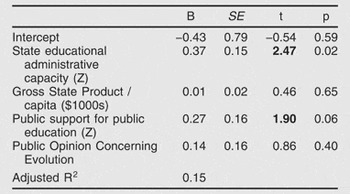
We begin with a model of state general science curricula. Here we are predicting the expert-rated rigor in state content standards for the sciences generally, with component scores for evolution removed from the index. We hypothesized that these would reflect state capacity rather than values-driven or ideological preferences. The model estimates are reported in table 1.
What explains the rigor and quality of state science standards?

Dependent variable is rigor of state science standards, excluding evolution (N = 48 - excluded are IA, HI and DC). Bold entries significant in expected direction at 0.05 level.
To assess the effects of different dimensions of state capacity, we include three measures: an indicator of state affluence (Gross State Product per capita), state education administrative capacity (an index of both administrative spending and administrate staff), and public support for the public schools (Berkman and Plutzer's measure of support for school spending). To see if there is a spillover effect from anti-evolution opinion, we include as well our measure of opinion regarding human origins to this model. The results show that states with greater support for public education and greater capacity in the bureaucracies charged with developing standards tend to have the most rigorous science curricula. But values-driven opinion does not have any influence on the standards. The process of drafting these standards does seem to be insulated from cultural politics and consistent with deference to scientific expertise and the technical policy-making model.
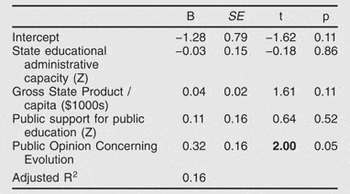
We now turn to an analysis of state content standards concerning evolution in particular. Table 2 again includes our three measures of general capacity, per capita Gross State Product, and public opinion specifically about evolution. The difference between tables 1 and 2 is striking. The evolution opinion measure is a significant and positive predictor of state policy.Footnote 71 In contrast, the detail and rigor of the evolution sections of state science standards are not influenced by any of the more general measures of administrative capacity. The zero order correlation of evolution opinion and and evolution content standards is a healthy 0.39, suggesting modest responsiveness to public opinion and the inability of organized science to exclude politics from the process of defining what is appropriate material to include in biology and life science curricula. Within the space provided by federal court decisions, politics does seem to play a substantial role in the curriculum development process.
What explains the rigor and quality of state evolution standards?

Dependent variable is rigor of state evolution standards (N = 48 - excluded are IA, HI and DC). Bold entries significant in expected direction at 0.05 level
What Determines Public Opinion?
Scientists' efforts to establish their authorityFootnote 72 and boundaries around the science curriculumFootnote 73 have been in response to challenges from religious movements.Footnote 74 Since the early 1920s fundamentalist Christians have been at the forefront of efforts to limit the teaching of evolution in public schools. In contrast, vigorous support for evolution has come from well-educated, affluent citizens in the scientific, educational, and legal professions. While the analysis above confirms our expectations that the general science curriculum is bounded from politics in a way that evolution is not, it does not necessarily show how religious fundamentalists influence state policy over how evolution ultimately is presented in American classrooms.
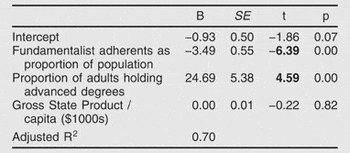
We can gain a more complete picture of how religious fundamentalists and more secular forces influence the unbounded evolution curriculm by looking at the sources of the public opinion concerning evolution. In table 3, we model state public opinion as a consequence of state income (per capita GSP), the size of the fundamentalist Protestant population, and the size of the well-educated population (those holding a degree beyond the Bachelor's level).
What explains state-level public opinion concerning evolution?

Dependent variable is public opinion concerning evolution (N = 50 - DC is excluded). Bold entries significant in expected direction at 0.05 level
The model estimates suggest that state affluence is relatively unimportant. In contrast, the proportion of fundamentalists and of well educated citizens combine to explain 70 percent of state variation in public opinion, with each having rather large effects. A one standard deviation increase in either demographic index results in roughly a one half standard deviation increase in public opinion.
Discussion
Science as a social institution strives to maintain control over the definition of science, and how it is taught and regarded in society. Based on our results, it appears that scientists have succeeded in shielding most science curricula from popular control. Policymaking is dominated by experts within state bureaucracies, as we expect in a highly technical area. But in the area where control is really contested—the teaching of evolutionary biology—scientists have been less successful despite their repeated victory in the courts. State evolution standards are influenced by public opinion, which is itself strongly related to the number of fundamentalists and the number of advanced-degree holders in the state. The results from the three reported regression models, along with others explaining support for public schools and educational capacity, can be summarized in a path diagram. Figure 2 does this and reports standardized coefficients. The figure clearly shows how different policymaking models apply to each component of state science standards.
Path diagram summarizing all statistically significant regression slopes (standardized coefficients).

Overall, there is a degree of responsiveness with the states whose citizens are most skeptical of evolution having the weakest standards. Responsiveness is not absolute, however. Court decisions give states only a limited range of policy options within which they can bring policy into congruence with state opinion. States, therefore, are free to give only cursory attention to natural selection and the genetic- and geological-based evidence for evolution, and they do so in those states where public opinion is most opposed to evolution. They are not free, at the present time, to mandate balanced treatment for creationism or intelligent design. If they were able to do so, the range of state policies would certainly be much wider, and the opinion/policy correlation substantially higher.
In showing the strong impact of religious conservatives and secular science, we provide one more example of how religiously-based conflict is coming to dominate American politics.Footnote 75 The implications extend to regulations of stem cell research, abstinence-only sex education, and other issues that explicitly place science squarely in conflict with religion. As the physicist Leonard Susskind writes, “there is more at stake than biology textbooks … A well-respected scientific community can be a major inconvenience if one is trying to ignore global warning, or build unworkable missile-defense systems, or construct multibillion-dollar lasers in the unlikely hope of initiating practicable nuclear fusion.”Footnote 76
Appendix
Polls concerning evolution have asked two basic types of questions. The majority have asked Americans about their beliefs about the origins of life. Typically, respondents are given two or three alternatives from which to choose and most polls use variations on a question first used by Gallup in 1982.
Which of the following statements comes closest to your views on the origin and development of human beings? (1) Human beings have developed over millions of years from less advanced forms of life, but God guided this process. (2) Human beings have developed over millions of years from less advanced forms of life, but God had no part in this process. (3) God created human beings pretty much in their present form at one time within the last 10,000 years or so.
We employed questions with identical or nearly identical wording from the following polls that also contained the state of residence of each respondent:
• Southern Focus 1997
• Southern Focus 1998
• General Social Surveys from 1993, 1994, and 2000
• Pew Center 2005
• CBS-New York Times 2004
There were several other high quality data sources with this question but which did not contain geo-codes that would allow us to code for state of residence.Footnote 77 Because our policy output concerns the teaching of Darwin's theory of natural selection versus all alternatives, we dichotomized these measures in order to calculate the percentage of the public believing in natural selection unguided by God.
The second type of common question concerns the appropriateness of teaching Darwin's theory of evolution or its less scientific alternatives. Again, there are several variations in question wording. The single-question approach is typified by the 1998 Southern Focus poll that asked respondents,
Public schools now teach the scientific theory of evolution, which explains how life developed on Earth. Would you favor or oppose requiring public schools to also teach the Biblical version of how life on Earth was created by God?
In these surveys we simply calculated the percentage opposed to “also teaching” some alternative to natural selection.
Several survey organizations instead employed a two-question sequences asking respondents if they would endorse teaching of creationism instead of evolution and a second question asking if they would endorse creationism along with evolution. In these cases, we calculated the percentage of the public opposing both alternatives to the status quo. Whether we used a single question or pair, we obtained estimates of support for teaching only Darwin's theory of evolution from four polls or series:
• Harris Poll 2005
• Southern Focus 1998
• Pew Center 2005
• CBS-New York Times 2004
Hierarchical Bayes Estimates for States from Each Poll
The sample sizes from these polls ranged from 500 (CBS) to 3,673 (GSS) and in almost every data source one or more states had no respondents and a handful of other states had very small samples. Bayesian hierarchical models are ideal for extracting relevant information from small samples without either losing cases entirely or accepting estimates that are known to have enormous confidence intervals. We performed hierarchical logistic regression on each of nine dependent variables from these six surveys to get Empirical Bayes estimates for the proportion of each state endorsing the strong, pro-evolution alternative. The Empirical Bayes (EB) estimates are essentially weighted averages between the sample proportion for the state and the proportion for the entire sample, with state samples receiving greater weights as their sample size increases. Estimates for small states are “shrunken” towards the national mean, eliminating outliers but retaining information from the small number of interviews completed. This approach, or variations of it, have been used successfully by Gelman and Little Reference Gelman and Little1997; Park, Gelman, and Bafumi Reference Park, Gelman, Bafumi and Cohen2006; and Berkman and Plutzer Reference Berkman and Plutzer2005, ch. 3 and corresponding appendices.
This produced nine different state rankings all using different question wordings, based on surveys fielded in different years, by different polling organizations. The correlations among these nine measures are reported in table A1.
Table A1: Correlation of state rankings from different evolution poll questions

The table shows that the nine indicators from six different sources are all positively correlated with one another (the average correlation is .46). If combined into a scale using unit weights, the scale would have a reliability (Cronbach's alpha) of .86.
Of course, the questions tap two distinct sentiments as it is not necessary to believe in Darwin's theory of natural selection to agree that it should be taught in science classes. Conversely, many who believe in Darwin's theory may endorse “teaching all sides” of the debate. At the individual level both types of “inconsistent” answers are common. But our goal is to rank states in terms of their public opinion so we want to determine if a single dimension fits the data well or whether dimensions representing “belief” and “teach” better characterize the measures. We therefore conducted an exploratory factor analysis.
The first factor extracted (using principal axis factor methods) had an eigenvalue of 4.2, explaining 47 percent of the variance. One additional factor emerged with an eigenvalue of 1.3 but this appears to be a methods factor with the two 1998 Southern Focus Poll measures (one about teaching and the other about beliefs) having high loadings (.88 and .78) and the single 1997 Southern Focus measure having the only other loading over .4 (.44). We believe that this is due to the oversampling of southern states and different resulting pattern of higher correlations based on greater variance among smaller southern states and relative smaller variance among smaller non-southern states. Even so, the correlation matrix above shows that all three Southern Focus rankings are highly correlated with the other measures. The combination of the marginality of this factor and the very high reliability estimate leads us to conclude that the use of all nine state rankings is appropriate to measure each state's overall support for or hostility toward Darwin's theory of natural selection. We constructed our final opinion scale by generating a factor score, which is standardized with a mean of zero, a standard deviation of one, and a range from roughly −2 (hostile towards evolution) to +2 (supportive of evolution).
U.S. Court Cases Cited
Edwards v. Aguillard, 482 US 578 1987.
Epperson v. Arkansas, 393 US 97 1968.
Kitzmiller v. Dover. Tammy Kitzmiller, et al. v. Dover Area School District, et al. Memorandum Opinion: File December 20, 2005. Case 4:04-cv-02688-JEJ 1–139
McClean v. Arkansas, 529 F. Supp. 1255 (E.D. Ark. 1982).