
I. INTRODUCTION
High damping capacity, high impact resistance, high strength to weight ratio, low density, good castability, and recyclability make magnesium alloys attractive and promising materials. Reference Mordike and Ebert1–Reference Ali, Qiu, Jiang, Pan and Zhang3 Therefore, magnesium alloys are in high demand, particularly, in the automotive industry as this sector is working to improve the fuel efficiency through weight reduction. Reference Kulekci4
A fine grain size generally leads to improved mechanical properties and structural uniformity of magnesium alloys. Reference Kawasaki and Langdon5–Reference Zhang, Chen, Zhang, Wang and Wang10 Obtaining a fine grain size in the as-cast condition is important not only for in-service performance but also for the following operations such as extrusion. Reference Pourbahari, Mirzadeh and Emamy6,Reference St John, Qian, Eason, Cao and Hildebrand7 As a result, several methods were applied for grain refinement of magnesium alloys during casting. Reference Ali, Qiu, Jiang, Pan and Zhang3,Reference St John, Qian, Eason, Cao and Hildebrand7,Reference Vinotha, Raghukandan, Pillai and Pai11 However, understanding the stability of these alloys at elevated temperatures and controlling the grain growth are of vital importance for maintaining their good mechanical properties. Reference Miao, Hu, Wang and Wang12–Reference Silva, Kula, Mishra and Niewczas19
Grain growth can occur in two general forms: normal and abnormal. In normal grain coarsening, the central mechanism is the loss of the smallest grains, while maintaining a nearly constant grain size distribution. In abnormal grain coarsening (secondary recrystallization), a few grains grow uninhibitedly into a pinned grain structure. The pinning occurs usually by particles or by a high frequency of low angles, and thus low mobility, boundaries. As a result, a bimodal grain size distribution develops. However, eventually these large grains impinge, and normal grain growth may then resume. Reference Humphreys and Hatherly20–Reference Ko, Cha, Srolovitz and Hwang30
Recently, the modification of the Mg–2Al–1Zn alloy by Gd Reference Wang, Du, Liu, Wang and Li31 and Mg–8Al–0.5Zn alloy by La and Gd Reference Bu, Yang, Guan, Qiu, Zhang, Zheng, Cui, Sun, Tang, Sun, Liu and Meng32 has been studied. Moreover, the Mg–Gd–Al–Zn alloy system was systematically studied by the present authors, Reference Pourbahari, Mirzadeh and Emamy6,Reference Pourbahari, Emamy and Mirzadeh33 which showed better mechanical properties compared with AZ (Mg–Al–Zn) and GZ (Mg–Gd–Zn) series of alloys. It was demonstrated that magnificent grain refinement in Mg–Gd–Al–Zn alloys can be achieved by the formation of the Al2Gd intermetallic phase in the as-cast Mg–3Gd–3Al–1Zn alloy. Reference Pourbahari, Emamy and Mirzadeh33 Moreover, other intermetallic phases such as (Mg,Al)3Gd effectively refined the recrystallized grain size and enhanced the mechanical properties of the Mg–4.8Gd–1.2Al–1Zn alloy after the extrusion process. Reference Pourbahari, Mirzadeh and Emamy6 These two alloys contain high volume fractions of intermetallic phases, and their effect during exposure at high temperatures should be evaluated for this new alloy system.
The present work aims to deal with this subject. The grain growth behavior of the AZ61 alloy (Mg–6Al–1Zn) will also be considered for elucidating the importance of Gd–Al intermetallics. It should be noted that the grain growth behavior of AZ31 Reference Miao, Hu, Wang and Wang12–Reference Young, Askari, Hovanski, Heiden and Field15 and GZ31 Reference Roostaei, Shirdel, Parsa, Mahmudi and Mirzadeh16 alloys has been studied before, but the grain growth behavior of the Mg–Gd–Al–Zn system containing new intermetallic phases has not been studied so far.
II. EXPERIMENTAL DETAILS
A. Casting and extrusion
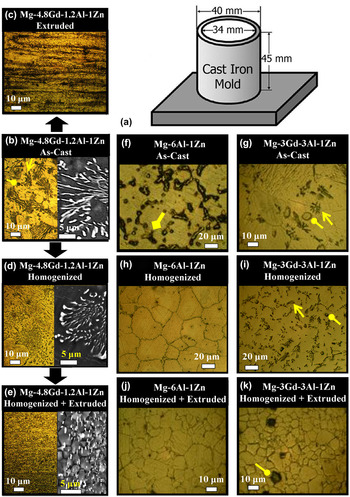
Commercially pure Mg along with Mg–50Al, Mg–50Zn, and Mg–10Gd master alloys was used to prepare Mg–4.8Gd–1.2Al–1Zn, Mg–3Gd–3Al–1Zn, and Mg–6Al–1Zn alloys (all values are expressed in wt%). The charge materials were first placed at the top of the furnace near the crucible entrance for preheating, which drives off moisture from the charge material for a safer, more efficient operation. Afterward, melting under protective gas atmosphere (CO2 + 5% SF6) and casting in a cylindrical mold [Fig. 1(a)] were used to prepare the as-cast alloys. The mold was preheated to 373 K (100 °C). After casting, the homogenization heat treatment was performed at 673 K (400 °C) for 14 h followed by furnace cooling to room temperature. Subsequently, the cast alloys were machined to a diameter of 30 mm and extruded with an extrusion ratio of 12:1 at 658 K (385 °C) followed by air cooling. The final diameter of the extruded materials was 8.7 mm.
Casting and preprocessing of alloys: (a) schematic representation of the casting mold, (b) as-cast Mg–4.8Gd–1.2Al–1Zn alloy, (c) extruded Mg–4.8Gd–1.2Al–1Zn alloy, (d) homogenized Mg–4.8Gd–1.2Al–1Zn alloy, (e) homogenized and extruded Mg–4.8Gd–1.2Al–1Zn alloy, (f) as-cast Mg–6Al–1Zn alloy, (g) as-cast Mg–3Gd–3Al–1Zn alloy, (h) homogenized Mg–6Al–1Zn alloy, (i) homogenized Mg–3Gd–3Al–1Zn alloy, (j) homogenized and extruded Mg–6Al–1Zn alloy, and (k) homogenized and extruded Mg–3Gd–3Al–1Zn alloy. The open, oval, and diamond arrows, respectively, denote to (Mg,Al)3Gd, Al2Gd, and Mg17Al12 phases. The presence of the nonequilibrium eutectic Mg17Al12 phase in the as-cast Mg–6Al–1Zn alloy is evident.

B. Grain growth experiments
The extruded alloys were subjected to annealing at temperatures between 473 K (200 °C) and 773 K (500 °C) for soaking times of 15, 30, 60, 120, and 240 min. Then, the samples were air cooled. Since the shape change of the deformed grains can be better evaluated along the straining direction, Reference Yu, Zhang, Sun, Luo, Zhang, Pan and Xu8,Reference Zhang, Chen, Zhang, Wang and Wang10 the extruded materials were cut parallel to the extrusion direction to make it possible to follow the microstructural evolutions. For the selected deformation conditions of hot extrusion, these types of observations are required to identify whether or not the microstructure becomes fully or partially recrystallized. Subsequently, the extruded alloys were selected for grain growth experiments due to their appropriate and equiaxed microstructures. By the way, their grain sizes were small, and this is important for obtaining a high grain growth rate, which makes it possible to evaluate the effects of intermetallics on grain growth. It should be noted that the calculations and the presentation of micrographs were based on annealing temperatures of 473 K (200 °C) and 673 K (400 °C) for the sake of brevity. These temperatures can be considered as high (0.5T m) and very high (0.75T m) temperatures for these alloys, which makes it possible to discuss the effect of annealing temperature on grain growth kinetics.
C. Characterization
The specimens were then ground and polished according to the standard metallographic procedure and etched by a solution consisting of 1 g picric acid + 2.5 mL acetic acid + 2.5 mL distilled water + 17 mL ethyl alcohol to reveal the microstructures by an optical microscope and a Vega Tescan scanning electron microscope (TESCAN Brno, s.r.o., Brno, Czech Republic). Phase identification was performed by X-ray diffraction (XRD) technique using a PHILIPS diffractometer (PHILIPS, Eindhoven, the Netherlands) with Cu Kα radiation and X’Pert HighScore Plus software (PANalytical B.V., Almelo, the Netherlands), where the 2θ angles between 20 and 90°, a step size of 0.02°, and a scan rate of 3°/min were used. The determination of the grain size was based on the standard lineal intercept method. 34 Several images from each sample were used for these analyses, and the standard deviations from the average values were below 3 µm.
III. RESULTS AND DISCUSSION
A. Pre-processing
The optical micrograph of the as-cast Mg–4.8Gd–1.2Al–1Zn alloy is shown in Fig. 1(b), which consists of high amounts of a lamellar phase and small round particles in the α-Mg matrix. As demonstrated elsewhere, Reference Pourbahari, Mirzadeh and Emamy6 the former and the latter were characterized as (Mg,Al)3Gd and Al2Gd phases, respectively. The microstructure after extrusion without prior homogenization is shown in Fig. 1(c), which exhibits a partially recrystallized microstructure containing pancaked grains for the selected extrusion conditions. However, after extrusion following prior homogenization, the obtained microstructure is fully recrystallized, and there is a fine dispersion of fractured intermetallics [Fig. 1(e)]. In fact, during homogenization, the intermetallics with a lamellar morphology started to spheroidize [Fig. 1(d)].
The optical micrographs of the as-cast Mg–3Gd–3Al–1Zn and Mg–6Al–1Zn alloys are also shown in Fig. 1. The comparison of Figs. 1(b) and 1(g) reveals that the amount of the (Mg,Al)3Gd phase is lower in the Mg–3Gd–3Al–1Zn alloy compared with the Mg–4.8Gd–1.2Al–1Zn alloy (5.7 versus 12.7 volume percent), but it has a slightly higher amount of the Al2Gd compound (2.6 versus 2.3 volume percent). Moreover, Fig. 1(f) demonstrates that the Mg–6Al–1Zn alloy just contains the Mg17Al12 phase in the form of grain boundary eutectic (where the eutectic constituent occupied around 12 volume percent of the microstructure), and the other two alloys do not show this phase.
The results of Figs. 1(c) and 1(e) showed the importance of homogenization treatment for improving the final extruded microstructure. Therefore, as indicated in Sec. II, the other two alloys were also homogenized before extrusion as shown in Fig. 1. After homogenization, the spheroidization of the intermetallics for the Mg–3Gd–3Al–1Zn alloy and the vanishing of the eutectic constituent for the Mg–6Al–1Zn alloy can be identified. Briefly, after extrusion, the average grain size of Mg–4.8Gd–1.2Al–1Zn, Mg–3Gd–3Al–1Zn, and Mg–6Al–1Zn alloys was determined as 2.4, 10.1, and 13.4 µm, respectively.
B. Grain growth
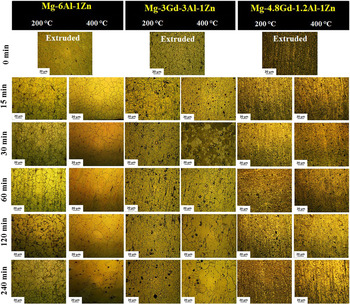
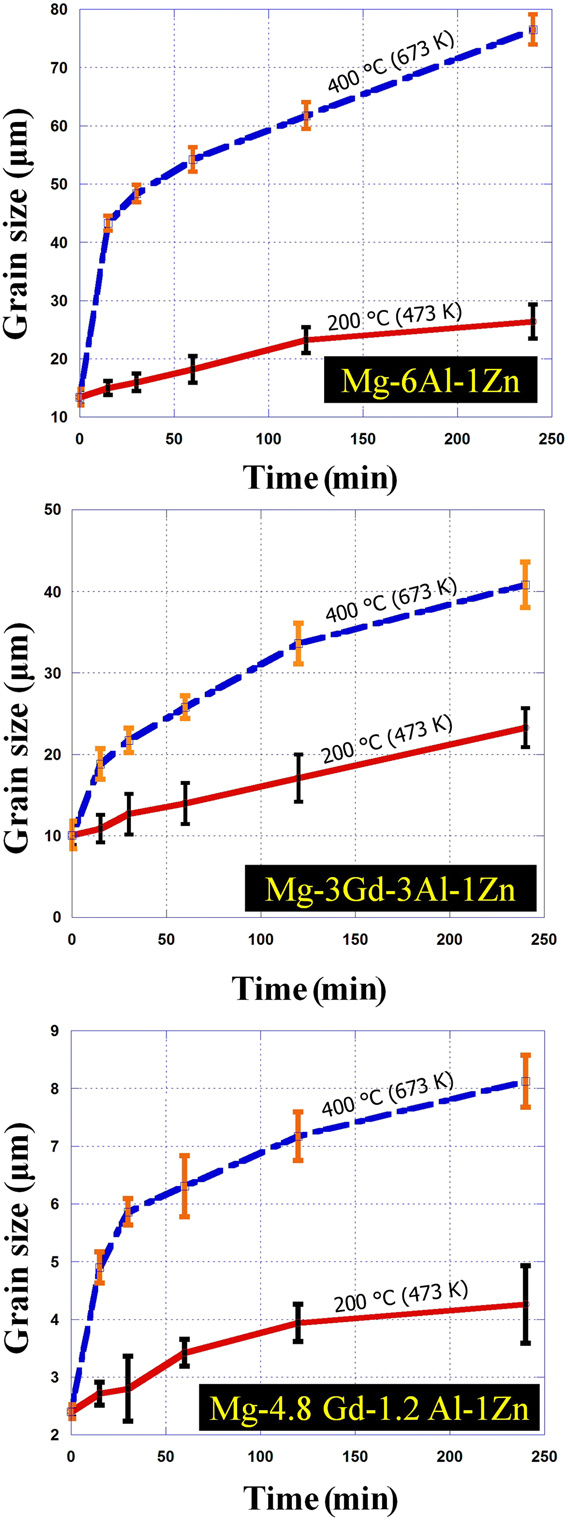
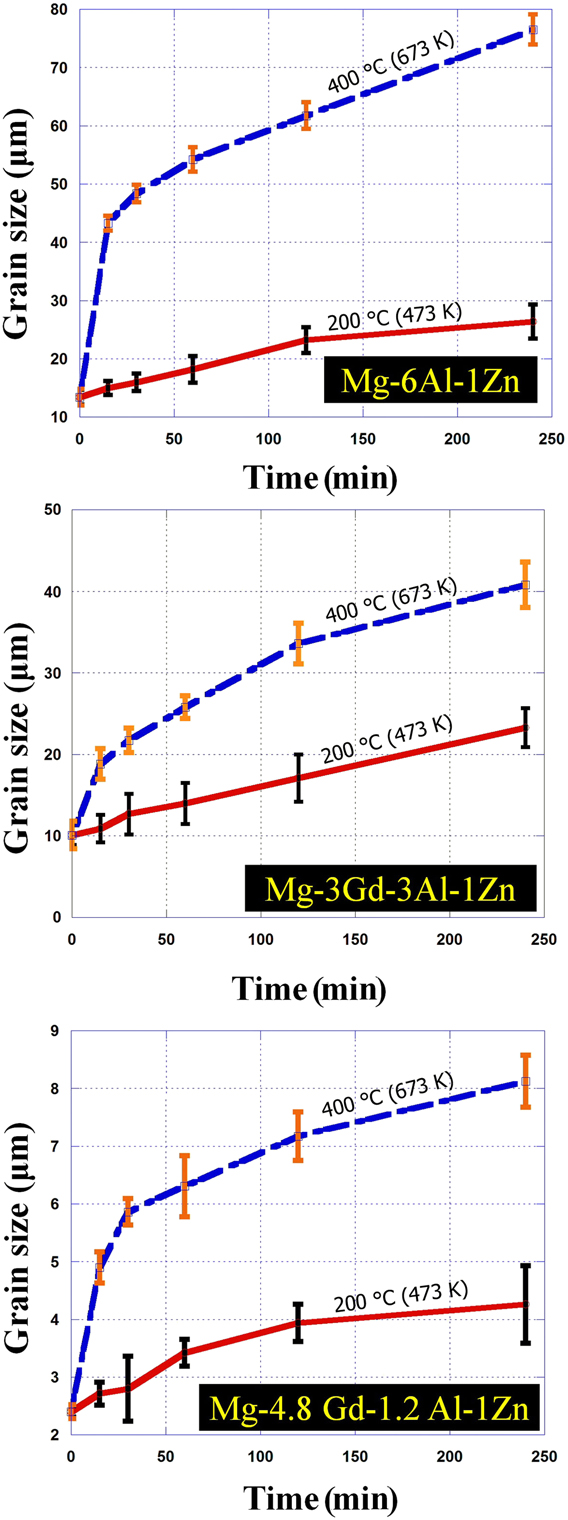
The microstructural evolutions of the extruded alloys exposed at 473 K (200 °C) and 673 K (400 °C) for various soaking times are shown in Fig. 2. A summary of grain growth results is also shown in Fig. 3. Based on these figures, it can be deduced that the grain growth process is enhanced with increasing the soaking time and soaking temperature, which is an expected result. However, while the kinetics of grain growth is very fast for the Mg–6Al–1Zn alloy, it is much slower for the Gd-containing alloys especially at a higher temperature of 673 K (400 °C). These findings will be discussed in the next section.
Microstructural evolutions during exposure at temperatures of 473 K (200 °C) and 673 K (400 °C) for various soaking times.

Grain growth curves during exposure at temperatures of 473 K (200 °C) and 673 K (400 °C) for various soaking times.
C. The effect of intermetallics
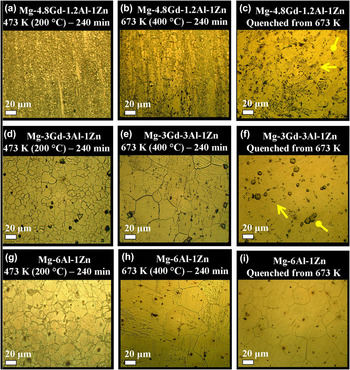
The microstructural evolutions of the experimental materials exposed at high temperatures for 240 min are shown in Fig. 4. It can be seen that at a temperature of 473 K (200 °C), the average grain size of all considered materials becomes double compared with the extruded grain size, and hence, this temperature should be considered as a high temperature. In fact, the liquidus temperature of Mg–4.8Gd–1.2Al–1Zn, Mg–3Gd–3Al–1Zn, and Mg–6Al–1Zn alloys was, respectively, determined as ∼910 K (637 °C), 908 K (635 °C), and 890 K (617 °C) from the continuous cooling curves (determined by inserting a thermocouple in the middle of the mold attached to a data acquisition system). Reference Pourbahari, Emamy and Mirzadeh33 Therefore, at 473 K (200 °C), the homologous temperature (T/T m) for these alloys is ∼0.5.
Microstructural evolutions at elevated temperatures: (a) Mg–4.8Gd–1.2Al–1Zn alloy at 473 K (200 °C) for 240 min, (b) Mg–4.8Gd–1.2Al–1Zn alloy at 673 K (400 °C) for 240 min, (c) Mg–4.8Gd–1.2Al–1Zn quenched from 673 K (400 °C), (d) Mg–3Gd–3Al–1Zn alloy at 473 K (200 °C) for 240 min, (e) Mg–3Gd–3Al–1Zn alloy at 673 K (400 °C) for 240 min, (f) Mg–3Gd–3Al–1Zn quenched from 673 K (400 °C), (g) Mg–6Al–1Zn alloy at 473 K (200 °C) for 240 min, (h) Mg–6Al–1Zn alloy at 673 K (400 °C) for 240 min, and (i) Mg–6Al–1Zn quenched from 673 K (400 °C).

By increasing the annealing temperature from 473 K (200 °C) to 673 K (400 °C), the ratios of the average grain size divided by the extruded grain size for Mg–4.8Gd–1.2Al–1Zn, Mg–3Gd–3Al–1Zn, and Mg–6Al–1Zn alloys were respectively ∼3.3, 4, and 5.7. It can be seen that, contrary to the case of 473 K (200 °C), the rate of grain coarsening becomes very different at 673 K (400 °C), where the homologous temperature is ∼0.75. While the Mg–4.8Gd–1.2Al–1Zn alloy has a much smaller extruded grain size, the grain growth is not faster, which might be related to the presence of the fine and widely distributed intermetallic (Mg,Al)3Gd phase in the extruded microstructure as shown in Fig. 1(e). This is not the case for the Mg–3Gd–3Al–1Zn alloy, where the extruded microstructure [Fig. 1(k)] shows that the grain boundaries are not effectively pinned by the main intermetallic phase (Al2Gd). The grain coarsening situation is more severe for the Mg–6Al–1Zn alloy because no intermetallic phases are present at 673 K (400 °C).
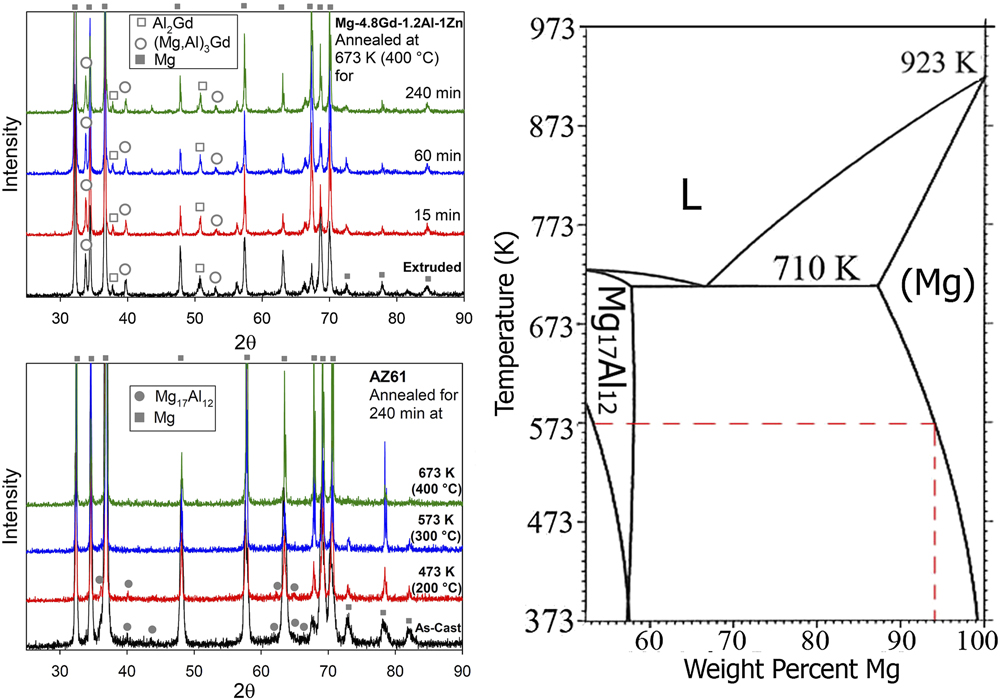
For investigating the presence of intermetallics in these alloys at temperature of 673 K (400 °C), the as-cast samples were soaked at 673 K (400 °C) for 240 min and then water quenched to preserve the high temperature microstructure. The results are shown in Figs. 4(c), 4(f), and 4(i). It can be seen that the Al2Gd and (Mg,Al)3Gd phases in the Mg–4.8Gd–1.2Al–1Zn and Mg–3Gd–3Al–1Zn alloys remained, but the Mg17Al12 phase has been dissolved in the matrix for the Mg–6Al–1Zn alloy. For providing further evidence, the XRD patterns of Mg–4.8Gd–1.2Al–1Zn and Mg–6Al–1Zn alloys are shown in Fig. 5.
XRD patterns taken from the Mg–4.8Gd–1.2Al–1Zn and Mg–6Al–1Zn alloys along with the part of the Al–Mg phase diagram. The diffraction angles for the Mg17Al12 phase were determined from Refs. Reference Feng and Ma35 and Reference Yan, Hu, Yu, Jia and Jiang36.
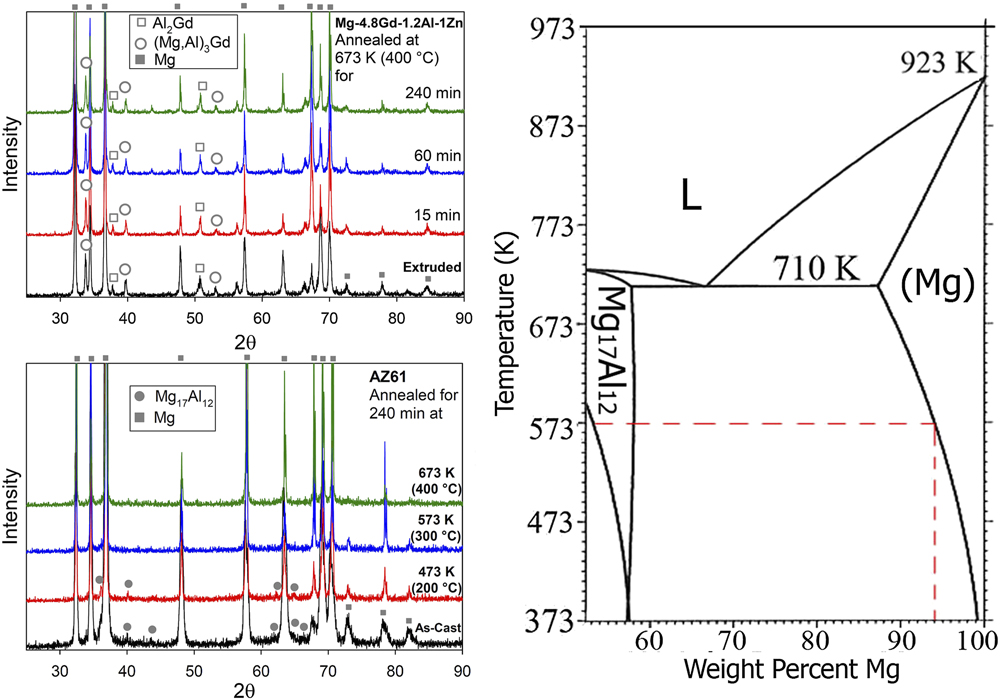
The patterns shown in Fig. 5 for the Mg–4.8Gd–1.2Al–1Zn alloy are similar to each other after annealing for different soaking times at a high temperature of 673 K (400 °C). The presence of Gd–Al intermetallics at high temperatures were also confirmed by Wang et al. Reference Wang, Du, Liu, Wang and Li31 However, the peaks of the Mg17Al12 phase Reference Feng and Ma35,Reference Yan, Hu, Yu, Jia and Jiang36 disappear in the XRD patterns of the Mg–6Al–1Zn alloy at temperatures higher than 573 K (300 °C) as shown in Fig. 5. The binary phase diagram of Mg–Al is also shown in Fig. 5, which depicts that for the composition of Mg–6 wt% Al, the solvus temperature is ∼573 K (300 °C). These results are in agreement with the observed trends.
D. Grain growth kinetics
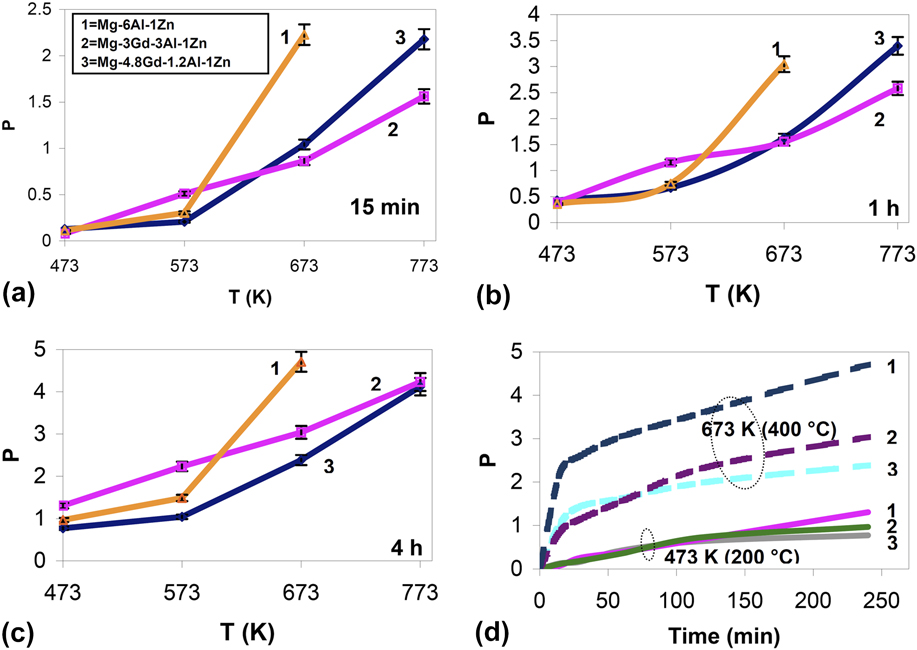
For evaluating the grain coarsening behavior, the grain growth parameter was defined as P = (D − D 0)/D 0, where D is the average grain size after soaking for a time of t and D 0 is the initial grain size. The results are shown in Fig. 6. It can be seen that P increases by increasing the time and temperature of annealing as expected. For a low annealing time of 15 min [Fig. 6(a)], P for the Mg–4.8Gd–1.2Al–1Zn alloy is higher than that of the Mg–3Gd–3Al–1Zn alloy at high annealing temperatures. This can be related to the fact that this alloy has a much smaller initial grain size (2.4 µm versus 10.1 µm). However, by increasing the annealing time to 1 h [Fig. 6(b)] and then to 4 h [Fig. 6(c)], P for the Mg–4.8Gd–1.2Al–1Zn alloy becomes lower than that of the Mg–3Gd–3Al–1Zn alloy due to the better pinning effects of intermetallics in Mg–4.8Gd–1.2Al–1Zn alloy as discussed before. The figure also shows that the Mg–6Al–1Zn alloy cannot preserve its stability against grain growth at high temperatures.
The evolution of the grain growth parameter during grain coarsening: (a) soaking for 15 min, (b) soaking for 1 h, (c) soaking for 4 h, and (d) the comparison of two soaking temperatures.
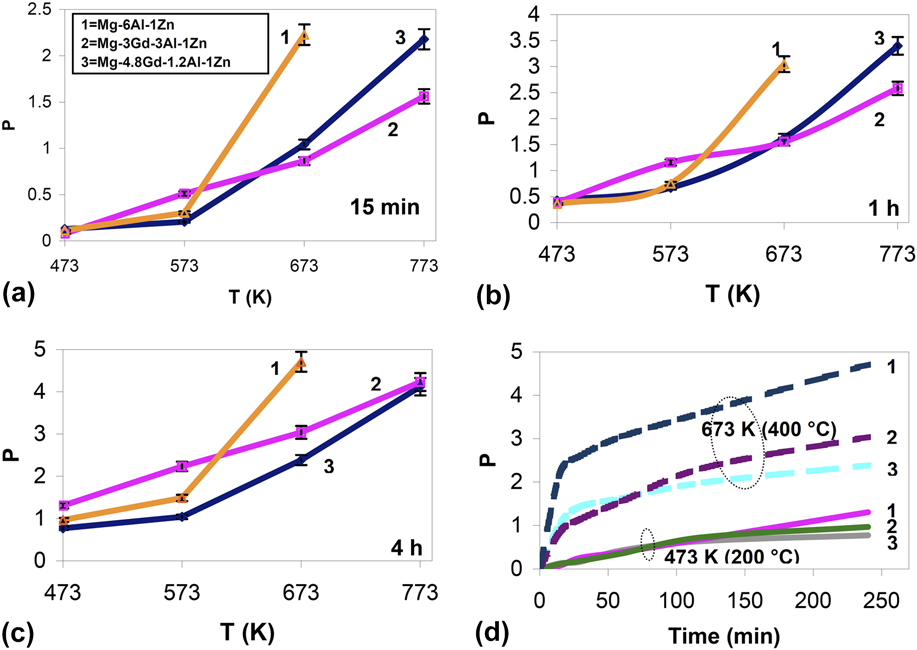
Figure 6(d) reveals that the difference between the studied alloys at a temperature of 473 K (200 °C) is not high except for long annealing times. Conversely, the difference between Gd-containing alloys and the Gd-free alloy becomes considerable at 673 K (400 °C). Therefore, it can be concluded that the simultaneous presence of Al and rare earth Gd is helpful for increasing thermal stability of the magnesium alloys. Moreover, it was observed that the Mg–6Al–1Zn alloy starts to disintegrate by melting at a temperature of 773 K (500 °C), while the other alloys remained solid. This can be related to the increase of the solidus temperature by the addition of Gd. In fact, the solidus temperature of Mg–4.8Gd–1.2Al–1Zn, Mg–3Gd–3Al–1Zn, and Mg–6Al–1Zn alloys was, respectively, determined as ∼858 K (585 °C), 826 K (553 °C), and 709 K (436 °C) from the continuous cooling curves. Reference Pourbahari, Emamy and Mirzadeh33 It can be seen that the solidus temperature of the Mg–6Al–1Zn alloy is lower than 773 K (500 °C).
The kinetics of grain growth were also studied based on the famous parabolic grain growth law expressed as
 ${D^n} - D_0^n = Kt$
, where K = K
0 exp(−Q
GG/RT), Q
GG is the apparent activation energy for grain growth, and n is the grain growth exponent.
Reference Miao, Hu, Wang and Wang12–Reference Bhattacharyya, Agnew and Muralidharan14,Reference Naghizadeh and Mirzadeh25
For obtaining n, the usual practice is neglecting D
0 because both D and D
0 have been raised to the power of n. Then by taking natural logarithm from both sides of D
n
= Kt, the value of n can be determined from graphs of ln t versus ln D. This method was applied in the present work to find n
natural as shown in Table I. Moreover, the nonlinear regression based on
 ${D^n} - D_0^n = Kt$
was also applied to find n
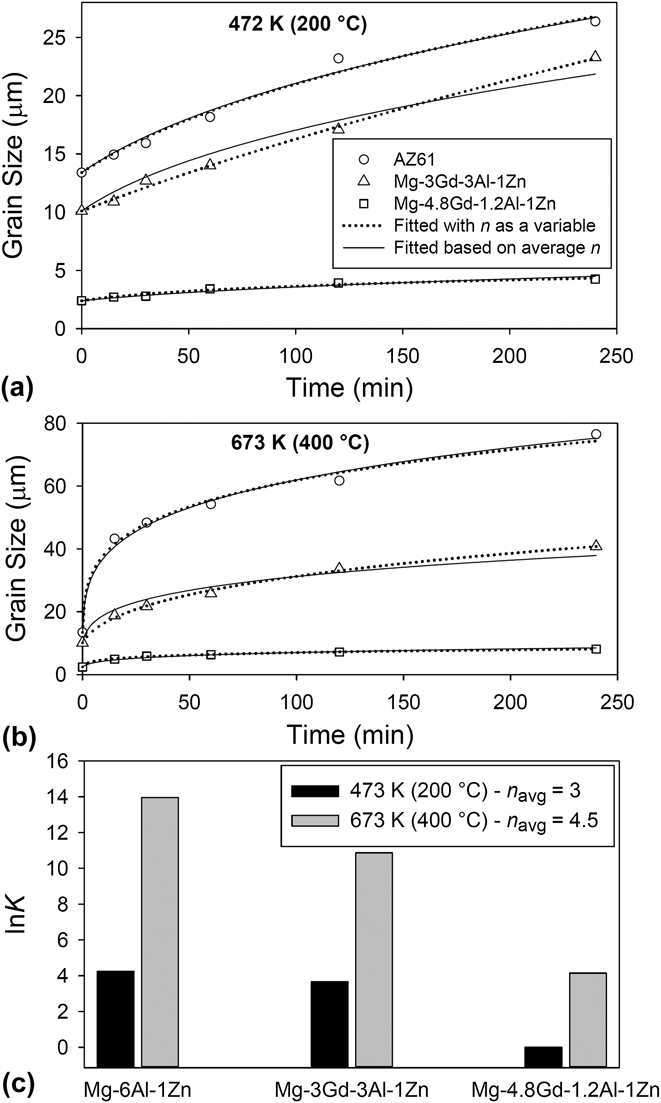
fitting, [see Figs. 7(a) and 7(b)] and the results are also reported in Table I.
The grain growth exponents determined in the present work.

Evaluating the grain coarsening behavior based on the parabolic grain growth law: (a) at soaking temperature of 473 K (200 °C), (b) at soaking temperature of 673 K (400 °C), and (c) summarizing K values.

The obtained values of n are generally higher than the usual value of 2 for pure metals. This behavior is common for different materials especially Mg alloys Reference Miao, Hu, Wang and Wang12–Reference Bhattacharyya, Agnew and Muralidharan14 due to different factors that can affect the grain growth behavior in solid solution alloys and alloys containing a dispersion of the second phase. Reference Humphreys and Hatherly20 Table I also demonstrates that neglecting D 0 might significantly affect the grain growth exponents at the temperatures where the grain size after grain growth is near the initial grain size. However, at high annealing temperatures and times, this difference becomes negligible.
Since the n values are different, it is not possible to compare the kinetics of grain growth of these alloys based on the obtained values of K. To solve this problem, the average value of n at each temperature was taken into account as also demonstrated by Naghizadeh and Mirzadeh Reference Naghizadeh and Mirzadeh25 and Bhattacharyya et al. Reference Bhattacharyya, Agnew and Muralidharan14 Based on the results presented in Table I, the average value of n at 473 K (200 °C) and 673 K (400 °C) can be determined as ∼3 and 4.5, respectively. By consideration of these values, the values of K were determined, and ln K values are shown in Fig. 7(c). It can be seen that not only the K values of the Mg–4.8Gd–1.2Al–1Zn alloy are lower but also the difference between the K values at 473 K (200 °C) and 673 K (400 °C) is much smaller. Conversely, for the Mg–6Al–1Zn alloy, the difference between the K values at 473 K (200 °C) and 673 K (400 °C) is very large, which is related to the enhanced mobility of grain boundaries at a temperature of 673 K (400 °C) (due to the increased temperature) and the absence of pinning particles.
E. Abnormal grain growth
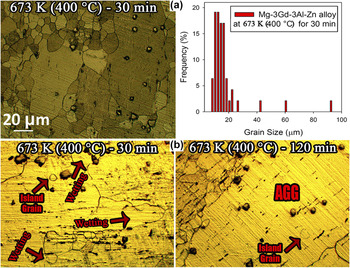
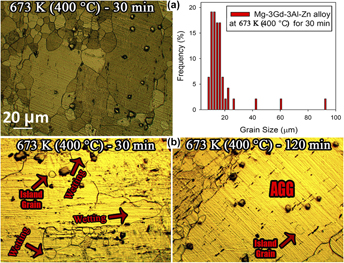
For the applied range of annealing temperatures and times studied in the present work, the signs of abnormal grain coarsening behavior were seen in the Mg–3Gd–3Al–1Zn alloy at 673 K (400 °C). Optical micrographs of this alloy are shown in Fig. 8. It can be seen that in Fig. 8(a), abnormally grown grains are present along with much smaller ones, and the presence of intermetallic particles inside the abnormal grains is evident. The histogram of grain size distribution also confirms that there are distinct grain size ranges at medium and large ranges besides the main distribution at small grain sizes.
Abnormal grain growth: (a) an optical micrograph showing abnormally grown grains in the Mg–3Gd–3Al–1Zn alloy along with the corresponding grain size distribution histogram and (b) demonstration of wetting and formation of island grains.

Figure 8(b) shows the optical micrographs taken from some abnormal grains. It can be seen that the abnormal grains grow by penetrating into grain boundaries of smaller grains, with complete analogy to the well-known concept of wetting by a liquid phase along the grain boundary. In this way, island and peninsular grains can be formed based on the solid-state wetting mechanism. Reference Ko, Cha, Srolovitz and Hwang30,Reference Hwang37,Reference Rollett, Srolovitz and Anderson38 The presence of island grains in the microstructures shown in Fig. 8(b) is evident. Therefore, it can be deduced that the solid-state wetting mechanism might be responsible for the occurrence of AGG in this alloy, and hence, the present work provides preliminary evidences for the occurrence of this mechanism in magnesium alloys for the first time.
IV. CONCLUSIONS
The behavior of Mg–Gd–Al–Zn magnesium alloys at elevated temperatures was studied to elucidate the effect of intermetallic compounds on thermal stability and grain growth behavior. The following conclusions can be drawn from this work:
-
(1) During preprocessing of the Mg–4.8Gd–1.2Al–1Zn alloy, it was found that the microstructure after extrusion without prior homogenization was a partially recrystallized microstructure containing pancaked grains. However, after extrusion following prior homogenization, the obtained microstructure became fully recrystallized, and there was a fine dispersion of fractured intermetallics.
-
(2) The presence of the fine and widely distributed intermetallic (Mg,Al)3Gd phase in the extruded microstructure of the Mg–4.8Gd–1.2Al–1Zn alloy was found to be quite effective in inhibiting grain growth at elevated temperatures. This is not the case for the Mg–3Gd–3Al–1Zn alloy, where the extruded microstructure shows that the grain boundaries are not effectively pinned by the main intermetallic phase (Al2Gd). The grain coarsening situation was found to be more severe for the Mg–6Al–1Zn alloy because no intermetallic phases were present to pin the grain boundaries at high temperatures. The simultaneous presence of Al and rare-earth Gd was found to be helpful in increasing the solidus temperature, and in this way, it further contributes to increasing thermal stability of the magnesium alloys.
-
(3) The parabolic grain growth kinetics based on
 ${D^n} - D_0^n = Kt$
were also studied, and it was found that not only the K values of the Mg–4.8Gd–1.2Al–1Zn alloy are lower but also the difference between K values at 473 K (200 °C) and 673 K (400 °C) is much smaller due to the pinning effect of intermetallics. Conversely, for the Mg–6Al–1Zn alloy, the difference between K values at 473 K (200 °C) and 673 K (400 °C) is very large, which is related to the enhanced mobility of grain boundaries at a temperature of 673 K (400 °C) due to increased temperature and the absence of the pinning effect of intermetallics.
-
(4) The signs of abnormal coarsening behavior were seen in the Mg–3Gd–3Al–1Zn alloy at 673 K (400 °C). It was found that the abnormal grains grow by penetrating into grain boundaries of smaller grains, and in this way, island grains were formed inside large abnormal grains. As a result, the present work provides evidence for the occurrence of the solid-state wetting mechanism in magnesium alloys.