INTRODUCTION
Twaite shad, Alosa fallax (Lacépède, 1803), is an anadromous clupeid species occurring along the coasts and in the rivers of Europe, from southern Norway to the eastern Mediterranean Sea (Lopez et al., Reference Lopez, Gazquez, Olmo-Vidal, Aprahamian and Gispert2007). The status of this species in the IUCN Red List is ‘least concern’ (IUCN, 2010) and it is classified as a focal species under the EU Habitats Directive (Volk et al., Reference Volk, Bekkevold and Loeschke2007).
Twaite shad are strongly migratory and are widely distributed in the Aegean Sea, but rare in the Marmara and Black Seas. They are primarily a marine pelagic species, but also penetrate a short distance up rivers, while some populations are landlocked in lakes (Whitehead, Reference Whitehead, Whitehead, Bauchot, Hureu, Nielsen and Tortonose1986). However, this species is mostly anadromous, entering river mouths in March (Italy) or early June (northern European rivers) to spawn in or above the tidal reaches; eggs are demersal and widely scattered among sand or gravel on the river bed, and adults probably return to sea not long after spawning (Whitehead, Reference Whitehead, Whitehead, Bauchot, Hureu, Nielsen and Tortonose1986). In the River Elbe, A. fallax spawns in tidal fresh water where the eggs are maintained in the water column, by the current (Hass, Reference Hass1968; Thiel et al., Reference Thiel, Sepúlveda, Oesmann, Kirchhofer and Hefti1996). The eggs of the twaite shad have, on an average, diameters of 3.85 mm and may be whirled up to a height of 9.5 m above the bottom by current. The spawning period of the twaite shad stock of the Elbe usually lasts from the beginning of May to the middle of June (Hass, Reference Hass1968). Golani et al. (Reference Golani, Öztürk and Başusta2006) reported that they spawn in spring and their juveniles return to sea at 14 cm.
Alosa fallax is predominantly ichthyophagous (Taverny & Elie, Reference Taverny and Elie2001); their adults feed on crustaceans (i.e. euphosiids, mysids and isopods) and small fish. When young they feed mainly on invertebrates, especially estuarine zooplankton, as well as the fry of sardines, herrings, sprats, anchovies and gobies (Whitehead, Reference Whitehead, Whitehead, Bauchot, Hureu, Nielsen and Tortonose1986; Assis et al., Reference Assis, Almeida, Moreira, Costa and Costa1992; Maitland & Hotton-Ellis, Reference Maitland and Hotton-Ellis2003; Golani et al., Reference Golani, Öztürk and Başusta2006; Froese & Pauly, Reference Froese and Pauly2008).
Adult twaite shad schools appear from the end of October to early January in Izmir Bay (Aegean Sea), where they are caught by gill nets and/or purse-seines at depths of <50 m. In Turkey, they are of minor commercial importance and are usually sold at a low price in fish markets.
In spite of the fact that the world-wide distribution patterns and some ecological aspects (including diet composition) of Alosa fallax species have been described (Whitehead, Reference Whitehead, Whitehead, Bauchot, Hureu, Nielsen and Tortonose1986; Assis et al., Reference Assis, Almeida, Moreira, Costa and Costa1992; Gerkens & Thiel, Reference Gerkens and Thiel2001; Oesmann & Thiel, Reference Oesmann and Thiel2001; Taverny & Elie, Reference Taverny and Elie2001; Aprahamian et al., Reference Aprahamian, Bagliniere, Sabatie, Alexandrino, Thiel and Aprahamian2003; Doherty et al., Reference Doherty, O'Maoileidigh and McCarthy2004; Maitland & Lyle, Reference Maitland and Lyle2005; Golani et al., Reference Golani, Öztürk and Başusta2006; Froese & Pauly, Reference Froese and Pauly2008; Lochet et al., Reference Lochet, Boutry and Rochard2009), there is a gap in the knowledge about the ecology of Mediterranean twaite shads. The marine diet of A. fallax nilotica has been reported by Canestrini (Reference Canestrini1885), Zompolas (Reference Zompolas1939) and Morovic (Reference Morovic1959). During the winter months fish feed on the sea bottom at depths of 160 m, on fish (Cepola rubescens, Gobius spp., Brachyochirus pellucidus, Smaris vulgaris, S. alcedo, Boops boops, Trisopterus capelanus and Mullus barbatus) and Crustacea: Decapoda (Leander spp. and Penaeus spp.) and Mysidacea (Gastrosaccus normani and Anhialina agilis) (Morovic, Reference Morovic1959). During the summer months fish feed close to the surface on Sprattus sprattus, Sardina pilchardus, Engraulis encrasicholus and Atherina spp. (Canestrini, Reference Canestrini1885; Morovic, Reference Morovic1959).
Zompolas (Reference Zompolas1939) reported similar findings for Alosa fallax from both the east and west coasts of Italy and therefore the samples were likely to have contained both A. fallax rhodanensis and A. fallax nilotica. The diet was found to consist mainly of fish (E. encrasicholus, S. pilchardus, C. rubescens and Aphia meridionalis), Crustacea: Decapoda (Leander xiphias, Crangon spinosus and Pasiphae norvegica), Mysidacea (Mysis oculata) and Ampipoda (Gammarus pulex, G. rhipidiophorus, G. duebeni, Sextonia longirostris and Hyperoche kroyeri). The fish were also found to have consumed Uniramia larvae (Chironomidae) and algae. Those fish which were about to enter fresh water for spawning were not found to be feeding actively.
The aim of this study is to examine the diet of adult twaite shad, caught in Izmir Bay (Aegean Sea), with a qualitative and quantitative determination of their prey.
MATERIALS AND METHODS
Twaite shad specimens were sampled from commercial purse seiners and trammel netters in Izmir Bay during November and December 2007, at depths shallower than 50 m. The stretched mesh sizes of the trammel nets and purse seines were 64 mm and 14 mm, respectively. This migratory species leaves the bay at the end of December, and we could not collect fish samples for monthly/seasonal analyses due to their short residence time in the area.
Total and fork lengths to the nearest cm and body weight to the nearest g were recorded for fresh fish. Stomachs were removed immediately from all fish and preserved in 4% formaldehyde for later analysis. In the laboratory, prey were identified to the lowest possible taxonomic level, counted and weighed to the nearest 0.1 g for fish after removal of surface water using blotting paper. Small prey were counted under the microscope and weighed to the nearest 0.0001 g. The total length of whole prey fish (primarily Engraulis encrasicolus) were also measured to the nearest cm for expressing the prey–predator length relationship.
The importance of the different prey types was evaluated calculating the frequency of occurrence (%F = number of stomachs containing prey i/total number of stomachs containing prey × 100), percentage abundance (%N = number of prey i/total number of prey × 100), percentage weight (%W = weight of prey i/total weight of all prey × 100) and the index of stomach fullness (SFI = total stomach contents weight/total fish weight × 100) (Hyslop, Reference Hyslop1980). Tests of significance for SFI between males and females were performed using the Student's t-test (at the 5% probability level). The index of relative importance (IRI) combines the above three quantities into a single numerical index: IRI = (F% × (W% + N%)) and was used to assess the importance of various food items in the diet (Caragitsou & Papaconstantinou, Reference Caragitsou and Papaconstantinou1988).
RESULTS AND DISCUSSION
Tweny-eight (13.5%) of the 208 adult twaite shad that were examined (fork length-range: 23–39 cm; mean: 30.3 cm ± 0.2) had empty stomachs. The analyses of stomach contents led to the identification of 287 prey items (252 fish and 35 crustaceans) belonging to 14 taxa. Nematode parasites in some stomachs were not considered prey items and were excluded from the analyses.
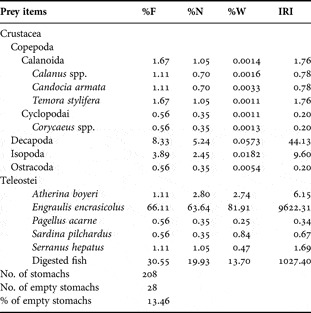
The results of the stomach content analysis revealed that twaite shad feed mostly on fish, especially anchovy, Engraulis encrasicolus. Anchovy was the most frequent (%F = 66.1), abundant prey (%N = 63.6), had the highest percentage by weight (%W = 81.9), and the highest index of relative importance (IRI = 9622.3). Other fish species identified were Atherina boyeri, Pagellus acarne, Sardina pilchardus and Serranus hepatus (Table 1). Decapoda, Isopoda, Ostracoda and Copepoda represented by Calanoida and Cyclopodia were recorded occasionally showing low values for all indices. Among the Crustacea, the most important prey was Decapoda (IRI = 44.1).
Percentage frequency of occurrence (%F), percentage abundance (%N), percentage by weight (%W) and index of relative importance (IRI) for prey types of Alosa fallax.

According to the SFI, male, female and both sexes of twaite shad were calculated as 1.3 ± 0.1, 0.9 ± 0.1 and 1.1 ± 0.1, respectively. There was no statistical difference between males and females (P > 0.05).
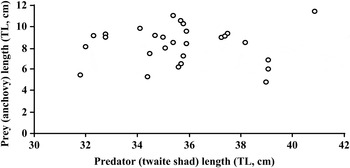
The relationship between twaite shad length (total length (TL)-range: 31.8–40.9; mean: 35.7 cm ± 0.4) and anchovy length (TL-range: 4.8–11.4 cm; mean: 8.3 cm ± 0.3) was TLprey = –7.8341 + 0.0134 TLpredator; R2 = 0.0003 (P < 0.05). This result shows that there is no correlation between the TLprey and TLpredator relationship (Figure 1). Taverny (Reference Taverny1991) reported that prey size, in particular that of Engraulis encrasicolus, increased with the size of A. fallax and this could be explained by the equation TLprey = 0.1788 TLpredator+ 10.4611 (N = 61; r2 = 0.25; P < 0.001). Our result may have been caused by low sample size (N = 28) and the availability of only larger individuals (>31 cm).
Predator length–anchovy prey length relationship (N = 28).

Previous feeding studies for Alosa fallax in other areas also reported that twaite shads are mainly ichthyophagous and that they feed on small fish and some crustaceans (Whitehead, Reference Whitehead, Whitehead, Bauchot, Hureu, Nielsen and Tortonose1986; Assis et al., Reference Assis, Almeida, Moreira, Costa and Costa1992; Oesmann & Thiel, Reference Oesmann and Thiel2001; Doherty et al., Reference Doherty, O'Maoileidigh and McCarthy2004; Maitland & Lyle, Reference Maitland and Lyle2005; Golani et al., Reference Golani, Öztürk and Başusta2006). However, the main diet of twaite shad may vary depending on the abundance of available food in their habitat. Assis et al. (Reference Assis, Almeida, Moreira, Costa and Costa1992) identified that the twaite shad diet in the Tagus Estuary (Portugal) was dominated by the fish S. pilchardus, E. encrasicolus, Pomatoschistus minutus, P. microps and A. boyeri. Oesmann & Thiel (Reference Oesmann and Thiel2001) reported that juvenile twaite shads fed on fish (Sprattus sprattus, Osmerus aperlanus and Pomatoschistus sp.) and mysids, malacostracas, cladocerans, copepods, insects, unidentified eggs, plants and detritus in the Elbe Estuary, Germany. In the Gulf of Gascogne, adult twaite shad fed preferentially on anchovy (E. encrasicolus) year around and euphausids were only secondary prey (Taverny & Elie, Reference Taverny and Elie2001). In British waters, adults feed to an appreciable extent on other fish, especially the young of some members of the clupeid family, such as sprat and herring (Maitland & Hotton-Ellis, Reference Maitland and Hotton-Ellis2003). While they mainly fed on small sprats, Sprattus sprattus and marine mysids, they also include Praunus neglectus in their diet in Ireland (Doherty et al., Reference Doherty, O'Maoileidigh and McCarthy2004). In the Solway, Scotland, the food of twaite shad included primarily unidentified fish (some were small clupeids) and secondarily Malacostraca, while Copepoda were relatively unimportant in the diet (Maitland & Lyle, Reference Maitland and Lyle2005).
In conclusion, this study showed that in the Aegean Sea Alosa fallax is a predator of small pelagic fish (E. encrasicolus, A. boyeri and S. pilchardus), and some crustaceans. Benthopelagic P. acarne and demersal S. hepatus were recorded for the first time in the diet of twaite shad. However, there is need for further seasonal feeding habit studies of both adult and juvenile twaite shad.
ACKNOWLEDGEMENTS
We thank F. Juanes from the Department of Natural Resources Conservation, University of Massachusetts and L. Kell from the International Commission for the Conservation of Atlantic Tunas for improving the English text. We also thank two anonymous referees for their insightful comments which led to a much improved manuscript.