Success relates to achieving a position in a social hierarchy, to taking someone's place, or some other desired outcome. Prestige, however, is a favourable impression made on others who must confer it back to the subject. Prestige must be constantly made and remade. Success does not necessarily entail prestige, for prestige must be achieved and ascribed; it involves a distinct form of social exchange. In this article, I explore success and prestige in a context which at first sight appears meritocratic, an ‘art world’ founded on notions of talent where positions of power and privilege are reproduced in part through an economy of exchange. That symbolic economies operate in spheres of cultural production is nothing new, and much excellent research in this area builds on the work of Pierre Bourdieu.Footnote 1 But what interests me here is how success and prestige appear to operate in a specific context, the British new music network, based on the viewpoints of a specific group – young composers – and the broader implications for unpacking the making of prestige.
‘New music’ and ‘contemporary music’ are terms often used to describe a subgenre of European-derived classical music mostly created after 1945.Footnote 2 New music has been institutionalized in many urban centres worldwide, globalized, as Yara El-Ghadban remarks, ‘in the context of colonial power’, creating an international network of performers and composers.Footnote 3 My focus here is one local assemblage of this global phenomenon centred on London, and specifically a group of young composers promoted by the British Music Information Centre (BMIC) as ‘New Voices’ (NV), with whom I conducted fieldwork in 2004.Footnote 4 Many of these composers teach composition in universities and music conservatoires. They form a significant part of the UK new music network and interact with, but are less well known than, the few established British new music composers who have been served by critical studies.Footnote 5 It is striking how little attention has been paid to lesser-known composers, particularly given the cultural turn in musicology in recent years. This may be, as Howard Becker insightfully proposed in his treatise on the collective nature of artistic production, because ‘art worlds deal with the contradiction between thinking only a few worth caring about and actually paying attention to many more by distinguishing between great artists, however that is defined and whatever words are used to express it, and those who are competent’.Footnote 6 It is also striking that the vulnerability involved in claiming to be an artist or a composer – and, with it, the danger of being judged as an incompetent fraud – has also received scant scholarly attention.
Most of the sixteen NV composers I interviewed preferred not to name the music they wrote or subject themselves to stylistic or generic categorization. They were in the privileged position of being able to define the music they write simply as ‘music’, without a qualifier (Philip Bohlman analyses the hegemony of this Germanic notion of music).Footnote 7 Additionally, all these sixteen NV composers had in common the belief that they were ‘individual’. Stylistic classification was subsumed by personhood, by being individual. This notion resonates with Charles Wilson's analysis of established composer György Ligeti,Footnote 8 Pierre Bourdieu's ‘fields of cultural production’,Footnote 9 and Georgina Born's evaluation of avant-garde composition (where the aim was to create music that was unclassifiable, or some form of anti-art, that was nevertheless considered art).Footnote 10 Most NV composers believed that they create or strive to create ‘art’, and that they were individual artists.
Such individuality was enacted within a specific notion of individualism which emerged in Europe and, according to Nigel Rapport, involves ‘the social actor as ostentatiously and conventionally “distinct”, sovereign and autonomous, and as this giving onto his dignity and social value’.Footnote 11 Whereas individuals might be defined as discrete human beings, aware (of being aware) of their own and others' embodiment and of the world, this individualism is a historically and culturally specific conceptualization whereby the individual is both independent and has a moral responsibility as a potentially respectable human being. The independence or distinctiveness of the individual, in this latter sense, is manifested by the idea that he or she has a unique personality, that is, a series of distinguishing qualities (as Marcel Mauss explored back in 1938).Footnote 12 Moreover, personality may be quantified within individualism, as Jean La Fontaine proposes: some people and things have more personality, and others have less.Footnote 13 In this ethnographic example from the UK new music network, the idea of composers being individual within a context of individualism is critical to understanding how prestige operates, and how it is maintained, lost, or never quite achieved. NV composers ascribed prestige to those who demonstrated a distinct musical personality, but also suggested that personality had to be tempered in terms of both composition processes and social interactions.
In what follows, I argue that in the UK new music network the uniqueness of individual composers, their musical and social personalities, are created via Foucauldian disciplinary processes and practices of exchange.Footnote 14 Exchange is key to creating social relations, to what Bourdieu refers to as ‘social capital’, to achieving recognition and success, and acquiring prestige.Footnote 15 I begin by providing some background to the UK new music network and the BMIC, introducing its NV scheme, and examining the nexus of relationships within which NV composers position themselves and their music: ‘the establishment’ with its ‘mainstream music’, the intersecting networks where NV composers tend to locate themselves, and the resonances with Mauss's classic work on gift exchange and ethnographic studies of Melanesian big-men.Footnote 16 I go on to analyse ideas about effort, talent, genius, the social construction of the musical self, how composers are entangled in webs regulated by Foucauldian disciplinary techniques,Footnote 17 and notions of being ‘outsiders’. Finally, I explore the concept of ‘interesting’ music, and how NV composers create and exchange personalities.
Backgrounds: London and the BMIC
London is an internationally renowned centre for classical music. In addition to numerous smaller ensembles, the city boasts five large orchestras affiliated to concert venues: the London Symphony and BBC Symphony orchestras at the Barbican Centre, the Royal Philharmonic at Cadogan Hall, and the Philharmonia and London Philharmonic at the Royal Festival Hall, part of the Southbank Centre. Also resident at the Southbank Centre, a large complex of art venues, is an ensemble specializing in new music, the London Sinfonietta. London is home to two opera houses, various smaller venues, and several conservatoires and university music departments. Given the many performance opportunities, there is a large pool of professional musicians and a significant number who specialize in new music.Footnote 18 Also based in the city is the British Broadcasting Corporation (BBC), which has five orchestras throughout the country, hosts London's prestigious annual BBC Promenade concerts (the Proms), and is the biggest commissioner of new music in the UK. Notable music publishers such as Boosey & Hawkes, Chester Music, and Faber Music are based in London, while Peters Edition and Schott have active London promotional offices. In 2004, when the fieldwork relating to this study was conducted, there were also two influential organizations promoting new music: the Society for the Promotion of New Music (SPNM) and the British Music Information Centre (BMIC). In 2008 these organizations merged with the Sonic Arts Network and the Contemporary Music Network to form a new body, Sound and Music.
Primarily funded by Arts Council England, a national agency that distributes UK lottery and government arts funding, the BMIC was a non-profit-making organization promoting new music by composers from or living in Britain. It acted primarily as a repository of scores, recordings, and biographical information (particularly post-1960 material), but additionally hosted a concert series (which also toured) and a website. In 1999 the BMIC set up the New Voices Scheme, with the aim of promoting and distributing the works of young British composers unsupported by commercial publishers and record companies.Footnote 19 Most NV composers already had some kind of profile before joining the scheme, such as occasional commissions and performances with major ensembles. The first participants were selected by BMIC staff who claimed to seek stylistic, social, and geographical diversity, so as to adhere to funders' requirements of diversification and widening participation. However, despite claims to diversity, most of these NV composers were white, middle-class men, as are most participants in the new music scene (a subject that deserves further attention). From 2000, existing NV composers participated in nominating their future colleagues, such that by 2004 NV composers numbered thirty-four.Footnote 20 There was no specific locus for NV composers, some of whom had never met each other. Although the BMIC provided an umbrella, grouping them together and raising their profile with its institutional backing, there was no requirement that these composers physically meet in the BMIC offices or elsewhere, and some composers lived abroad. However, many NV composers were closely connected: they attended each other's performances and regularly met at other new music concerts in London.
In addition to London's centrality in the UK new music network, four further aspects are worth rehearsing here briefly, aspects that relate to new music more globally, as Paul Griffiths and Susan McClary (among others) have documented.Footnote 21 First, unlike for more popular genres, audiences for the majority of new music performances have been small for decades. Second, most new music is reliant on public funds for the support of performances and the employment of its practitioners. Many composers, and to a lesser extent performers, work in universities and conservatoires, although the most successful composers teach little, if at all. Third, these educational institutions are crucial to the transmission of this music. And fourth, at the turn of the millennium just a few dozen composers in the UK had publishers; the majority did not.
Publishers create high-quality performance materials, manage composers' royalties, and theoretically promote them to commissioners. With technological shifts, composers, especially those who do not regularly write orchestral music, have been able increasingly to perform these tasks themselves. However, crucially, publishers legitimate composers. Given that publishers are commercial enterprises, they must earn money from composers, either via royalties or by being able to legitimate other parts of their businesses by the calibre of composers that they promote. Publishers therefore usually opt for composers with already established reputations. Several NV composers told me that, although publishers promote a range of new music styles, the majority of published composers write a form of new music they described as ‘mainstream music’. Specifying the attributes used to categorize a composer as ‘mainstream’ is a precarious task. Arnold Whittall proposes that ‘more mainstream music […] retains the desire to control and shape a directed musical line, or to propose as a fundamental factor a concept of stability – such as the harmonic series – which the music will then challenge, and enrich, but not destroy’.Footnote 22 Mainstream composers, Whittall continues, embrace a tension between an unwillingness to completely reject the past and a desire to be avant-garde.Footnote 23 For many NV composers, mainstream music is epitomized by the ‘house composers’ of Faber Music, a publisher founded in 1965 with the financial support of Benjamin Britten.Footnote 24 Since the 1980s, however, Faber and other London publishing houses have taken on only a handful of additional composers, despite the ever-rising numbers of those composing and being performed.
According to one BMIC employee, it was against this backdrop that the BMIC set up its NV scheme for unpublished composers – in order to represent an ‘important generation of composers’. Evident here was the rhetoric of a lost generation unable to access the opportunities that were their due, a theme that also emerged in many of my interviews with NV composers. A more senior composer I interviewed commented: ‘one of the strange features of the NV process was that the BMIC operation closely imitated the standard London music publishing model, but with neither the resources for promotion nor the commercial imperative for success. […] It was a paradox in that it offered a badge of publisher-like corporate quality to composers who were nonetheless “outside” commercial publishability.’ The notions of inside and outside occurred frequently in my interviews, as did the idea that there was a single musical ‘establishment’ (rather than many), a hub of economic and political power in the new music network that included many Faber composers, ensemble directors, festival promoters, broadcasters, and publishers. Most NV composers were not prime movers in the establishment, although they were linked to it. However, many had strong views on how establishment success was achieved. Their perspectives on the constraints on success within the British music establishment brought immediately to mind Mauss's The Gift and Melanesian pig exchange. These offer a framework for thinking about power dynamics via exchange relationships.
Big-men and exchange
Mauss famously argued that gift exchange creates an obligation, a demand for reciprocity, thereby creating social relations.Footnote 25 In the 1960s, Melanesian life-cycle events often included gift exchanges, primary instruments in the competition for power. The main objects exchanged were pigs and shell valuables, and reputation was gained by having prestigious exchange relationships. Andrew Strathern describes how some Melanesian political leaders (big-men) established and maintained power via artful generosity which, by creating demands for reciprocity, converted beneficiaries into debtors.Footnote 26 They competed for prestige by using large-scale exchange rather than a more direct, balanced exchange: a pig for a pig. Powers of oratory also played a part in creating big-men's dominance.
Several NV composers told me that relationships within the establishment are partly created and mediated by commissions, particularly orchestral commissions. Like Melanesian big-men, some establishment composers were described as operating large-scale exchange networks requiring the allegiance of other composers to create the goods to be exchanged (commissions and performances), which occasionally included their own works. For example, one sought-after new music instrumentalist told me that ‘the forty-something substrata [of composers] invite each other to do performances as they manage festivals nationally and internationally. They are a self-perpetuating clique. If you haven't got anything to offer, you can't do it.’ The suggestion here is that establishment composers commission each other to write pieces, that festival commissions are carefully exchanged, and that reciprocity is required. Composers have to have something to offer in order to participate in exchange cliques. This view was also put forward by several NV composers I interviewed, and chimes with Becker's work on dance-band musicians in Chicago, where cliques of older musicians dominated the allocation of work.Footnote 27
A senior British new music composer offered a more tempered view, however: ‘I think it's less conspiratorial than this. There really aren't that many festivals run by composers; they tend not to be very good at it. […] And the same paranoia exists among published composers, some of whom suspect their publishers of neglecting them in favour of other composers!’ It is thought-provoking to consider notions of cliques and establishment exchanges in terms of paranoia. Building on Richard Hofstadter's 1964 essay ‘The Paranoid Style in American Politics’,Footnote 28 George E. Marcus outlines three elements of the paranoid style: first, the imaginative leaps encountered in relating stories, whether or not facts are correct; second, the cohesiveness with which the ‘real world’ appears, and the lack of space for ambiguity and error; and finally, a sense of collective persecution, often combined with a righteousness.Footnote 29 These elements were evident, with distinct intensities, in some of the discourses of NV composers and new music performers. This may seem an extreme analysis of London's new music network, but this is a context in which paranoia and some forms of exchange coexist. For even if some composers are not involved in exchanging commissions, ensembles specializing in new music performance, such as the London Sinfonietta, have often been cliquish and excluded women, as musicologist David C. H. Wright explores.Footnote 30 And although the big-man analogy only works up to a point, there is further mileage to be gained from the concept of reciprocal exchange. For example, another layer in the negotiation of exchanges, in the construction of prestige that I want to consider here, relates to the individual composer and to the circulation of notions of effort, genius, talent, and composers' self-presentation, to which I now turn.
Carthorses, hummingbirds, and muffins
One NV composer employed an allegory relating to the amount of effort a composer appears to expend in composition and self-promotion:
There are carthorses, hummingbirds, and muffins. Carthorses are seen as those who work hard. They are the movers in the establishment: the working establishment figure who is the establishment, so he's permitted to cultivate an image of power. Horses stay at home working; they work hard, but they have an element of tragedy. Hummingbirds are perceived as dancing like a bird. They are light and have an ease like Mozart. Birds are idolized and revered, yet they are schmoozers, dancing from flower to flower, scary and fickle, grabbing what they need from people then moving on. Birds enjoy and thrive on others. Muffins sit there like a biscuit or a muffin on a plate and it happens anyway. Muffins don't seem to work: it just happens and it's brilliant. They have a healthy distaste of the wider world. They're just static. Muffins are off doing their own thing. They just appear and are gone. They are the nice ones.
In this allegory, prestige is derived from effortlessness, from miraculously creating ‘good’ pieces, while the laborious efforts of the carthorses are somehow tragic. There are resonances with Bruno Nettl's description of widespread beliefs about Mozart and Beethoven as composers: Beethoven tends to be represented as the tortured, ‘human’ genius, whose ‘achievement requires enormous effort’, while Mozart's genius is of the ‘divine’, effortless kind.Footnote 31 But our allegory is slightly different. It implies that no effort should be spent either in composing or in working the exchange mechanisms of the establishment. Only establishment composers may work hard, and their reward is gaining status in the establishment rather than prestige for the music they create. Indeed, some of the composers described to me as carthorses were key political movers in the UK music network.
Hummingbirds and muffins were different from carthorses: hummingbirds and muffins had the quality of effortlessness that this NV composer respected. But while hummingbirds ‘have an ease like Mozart’, they carry the stigma of being ‘schmoozers’. In Bourdieu's terminology, hummingbirds employ ‘social capital’ gained from relationships with significant others.Footnote 32 Moreover, hummingbirds ‘grab what they need from people then move on’. Rather than building up empires, they engage in quick exchanges, moving on once they have what they need. Meanwhile, muffins are so brilliant that they need to make no effort whatsoever either to create pieces or to forge social relations. Muffins require no social capital, do not have to engage in exchanges (so it seems), defy convention by ‘doing their own thing’, and are ‘nice’ into the bargain.
But who can afford to be a muffin, to promote an air of brilliant disinterestedness? Class, gender, and other classifications are also factors in determining who can afford to make no effort in asserting their individuality, in promoting themselves as an artist. Beverley Skeggs proposes that in Europe ‘gender and other categorizations, such as race and class, have been “structured out” of the historically embedded epistemological pedigree of “the individual”’.Footnote 33 It is white middle- and upper-class men who more automatically qualify for this distinction. But age also has a part to play with regard to composers. A position of individual brilliance and disinterestedness is much easier to assume once composers are older and have reputations, once they have economic stability and promoters who will act as their carthorses. Paradoxically, as Wilson suggests, composers tend not to be averse to publicity, marketing, and promotion, even while often disparaging economic gain.Footnote 34 One euphemistic form this takes, Wilson proposes, is the interview, a form distinct from written text, in which composers ‘can plausibly appear passive and reticent, or reluctant and disengaged’,Footnote 35 rather like muffins.
Geniuses and talentless lunatics
Hovering over the above allegory are notions of genius, of a natural talent or ability, which confers enormous prestige (a subject that both Henry Kingsbury and Stephen Cottrell explore in depth).Footnote 36 Rather than being innate, in the way that several NV composers implied, genius might be understood in terms of Bourdieu's well-known analysis of symbolic economies. Bourdieu's ‘cultural capital’, ability acquired very young, confers the confidence of ‘possessing cultural legitimacy, and the ease which is the touchstone of excellence’.Footnote 37 This ease might be read as effortlessness, the stuff of muffins and hummingbirds, of talent and genius. Bourdieu contrasts cultural capital with economic capital. While the latter can enable access to education, he argues that ‘all institutionalized learning presupposes a degree of rationalization, which leaves its mark on the relationship to the good consumed’.Footnote 38 One NV composer hinted that education tarnished artistry. He commented that education ‘knocks out the honesty, [resulting in you] not being brave enough to write your own music’. He thereby contrasted educational learning with individuality, with being ‘true to the self’. But, like many other NV composers, this composer lectures in composition in a university. Some of these composer-lecturers had more investment than others in passing on their knowledge, both skill-based and intuitive, to their students. Not all believed in the miraculous nature of composition.
The NV composer who had told me the hummingbird story continued by saying that genius was something the establishment stood for, but something the establishment could not produce. Moreover, he suggested: ‘one person's genius can be another person's talentless lunatic!’ Not only is genius and greatness relative, but there is also a precariousness in claiming to be a composer, with an attendant risk of being judged as a talentless lunatic, a self-deceiving fraud, or a tragic carthorse. This vulnerability and fragility is rarely discussed in scholarship, and the implications have even greater significance when considered in the context of maintaining credibility over time. A hierarchy of super-humanness was suggested in NV composers' descriptions. The terms ‘genius’ and ‘great’ were bestowed on those who consistently produced ‘good’ pieces: generally older, more experienced composers. Although achievable, therefore, genius and greatness were qualities usually ascribed by others, although I encountered one instance of a NV composer attributing these labels to himself. Referring to himself as a genius, with the implicit requirement of consistent, successful production, was a particularly perilous act, and occurred at the end of a long, rather lively evening. This composer did not advertise this belief about himself, aware that he might be accused of self-delusion and egocentrism. He also told me that he thought that only half of his output worked. There was some space for less ‘good’ pieces in a composer's œuvre. Nevertheless, the stakes are high for composers of all levels if they are perceived to fail to produce good pieces, or fail to persuade others that they are worthy of respect.
However, genius was something that was generally construed as a belief, and some NV composers did not believe in genius. For example, one NV composer told me:
It just makes me shudder all that grandiosity, the cult of the genius and all that. It's really quite cringe making. I like [John] Cage's or [Joseph] Beuys's idea that we can all be artists or all have the potential to be artists, or we can all be musicians. That seems a lot more interesting in a way. That's not to say that there aren't great artists. I think John Cage is a great artist, he has all the attributes, not least because of the way he lived his life. I think that's important. It really was a way of life for him, and on one level that's really important that you talk the talk, make the work, but then live the life that your work says. Like everything that his work says or stands for, he lived his life like that too. And I think that's real integrity. He didn't compromise that at all. There was no compromise.
Here the ‘grandiosity’ of the notion of the genius is rejected in favour of a more egalitarian concept, which affords everyone artistic potential. Yet according to this composer there are still great artists, and an individualism is maintained whereby some individuals (artists) are greater than others. And this is especially marked by lifestyle, chiming with the moral value inherent in individualism, and the opportunities it affords particularly to white middle- and upper-class men. John Cage is portrayed as an exemplary ‘great artist’ because composing was a way of life for him: his art and life were one, and there was ‘no compromise’. Many NV composers expressed a commitment to a philosophy, a way of life, relating it to a need to create. When asked why they wrote music, two NV composers replied: ‘Why do you breathe?’ Life, personhood, and art were united by a notion several composers spoke of: ‘being true to the self’. But, as pointed out above, you must also ‘talk the talk’: a composer's personality is constructed and composed through words and lifestyle, as well as through music.
Talking the talk and panoptic self-regulation
As with the big-men who required powers of oratory to succeed, ‘talking the talk’ was key for composers in gaining prestige; however, this went beyond mere persuasion. For example, one arena in which relationships within the new music network are made and maintained through speech is at concerts. One form of exchange practised by both composers and performers is that of going to each other's concerts. The make-up of an audience can confer prestige on composers and performers, particularly when more powerful musicians are present. And post-concert interchanges are also significant for maintaining social relations. For example, I observed hierarchies of prestige being reinforced when more senior composers publicly gave less experienced composers appropriate tips after performances. One NV composer explained to me how criticism and ‘ego massages’ contributed to the prestige of a composer and of a piece, and how such exchanges are reciprocated. Moreover, inappropriate comments diminished prestige. Opinions were carefully managed, delivered, and exchanged. But they were also carefully regulated, both by others and by composers themselves.
As I observed several composers ‘talking the talk’, it became clear that denigration and praise (and their exchange) were important in composers' self-presentations. There was a lot of front- and back-staging in post-concert banter.Footnote 39 Composers would rarely tell their peers that they did not like their music, but often said so behind their backs. Critiques aligned composers with certain aesthetics and played a part in creating allegiances. One NV composer told me that reputation was created by ‘being critical, even of iconic figures such as Berio and Xenakis. You carve out your place by being critical of others. […] [Composer X] gets respect because he's nice and he's critical.’ Displaying expert knowledge about the new music canon, and critiquing it, has the potential to bestow prestige on a critic, and inversely the critiqued since they are worthy of mention. Yet it is also in these types of encounters that a form of Foucauldian disciplinary power regulates performances.
Individualization underlies disciplinary power, Foucault proposes. In exchanges of denigration and praise, in promoting appearances of effortlessness, and in advocating certain lifestyles, composers are entwined in webs of Foucauldian ‘panoptic techniques’.Footnote 40 Foucault's well-known concept of panopticism draws on Jeremy Bentham's panopticon prison architecture, in which a central tower overlooks inward looking, individual cells in which actors are constantly visible and audible to a supervisor.Footnote 41 Since inmates cannot tell if a supervisor is actually in the tower, they behave as if constantly observed and become self-regulating, that is, disciplined. In Bentham's design, inmates are partitioned, individualized, and invisible to each other. They are thus unable to collude or create a ‘counter-power’.Footnote 42 The webs of panoptic self-regulation in which composers are entangled, I propose, serve to maintain the musical and social status quo. Moreover, these disciplining techniques reinforce hierarchies of individuals, since they contribute to allowing notions of genius, personality, and individuality to appear natural. And, as Wilson has suggested, increased numbers of composers claiming to be individual has had a threefold effect: first, collective power and collective values are spurned; second, publishers and other institutions are bestowed greater authority to mark a composer as distinct from another, to reinforce their individuality; and third, when individuality becomes so highly prized, composers become increasingly disposable as one individual may be replaced by another.Footnote 43 Additionally, the hints at paranoia, discussed above, are further fuelled by this individualization. Although several NV composers expressed resentment about the establishment exchange network, about the disjuncture between the realities that pervade the new music network and the ideal that talent will be recognized and prevail, many remained largely unaware that they perpetuated power relations in terms of Foucauldian disciplinary techniques.Footnote 44 Like it or not, they were intimately entwined in reproducing the musical establishment, whether they aspired to participate in it, react against it, or both.
Outsiders
Many NV composers claimed to inhabit an alternative sphere of prestige that was ‘outside’ the establishment, a sphere where ‘interesting’ music was created and performed. There are resonances between NV composers' notions of being outside with those of Chicago's dance-band musicians analysed by Becker back in 1963.Footnote 45 Becker analyses how dance-band musicians conceived of themselves as outsiders, as gifted, free spirits who were distinct from the non-musicians they considered conventional and ‘square’.Footnote 46 Musicians' purported unconventionality was understood in relation both to music and to a way of life, chiming with the notions put forward by NV composers. There were, however, differences, since for NV composers, the distinction between insider and outsider related to participants in the new music network, while all of Becker's dance-band musicians were outsiders, even though some focused on jazz while others played commercial music. Becker explores the tensions created by the professional demands on dance-band musicians between gaining prestige from adhering to artistic standards (such as improvising jazz to the best of their ability) on the one hand, and economic success from commercial work (such as pleasing non-musician audiences who requested polkas and other dance genres) on the other. While those musicians who stuck to jazz retained their artistic integrity and the respect of other musicians, they were doomed to economic failure, for compromise was required to achieve success and the vital sponsorship of the cliques of older men controlling the distribution of work. So, for both dance-band musicians and NV composers, tensions between prestige and success had to be resolved; however, the public funding and university employment of many new music composers meant that commerciality was not such a key factor in determining their success (as McClary observes in her article ‘Terminal Prestige’).Footnote 47
NV composers mostly alluded to a model of a core establishment with factions at the periphery. Many NV composers positioned themselves at some distance from the core. To some extent it was safe for NV composers to claim that they wanted to be at the boundaries, especially those who already had half a foot in the establishment network. Moreover, composers' outsider narratives were a means of maintaining their sense of dignity by distancing themselves from the network in which they were not key players.
A senior composer pointed out that ‘a lot of NV composers want to be successful in the mainstream of British music, which they equate with a steady flow of orchestral and opera commissions, but they are doomed to failure because these are quite conservative institutions who prefer to work with the safety net of a commercial publisher behind the composers they commission’. Yet despite this negative outlook, he continued that ‘the most successful composers – at least economically – have tended to be quite radical in at least some phase of their career’. Likewise a NV composer told me that some composers' positions change over time in relation to the establishment. He exemplified this with internationally renowned British composer Harrison Birtwistle, who was considered an outsider when he was younger but has since become one of ‘the figures the establishment holds up as being what it stands for’. Both the establishment and the outside must be constantly reproduced, and some outsiders eventually become part of the establishment (something that chimes with both Becker's musicians and Bourdieu's analysis of writers' shifting positions in the nineteenth-century French literary field).Footnote 48 Like Becker's commercial musicians, the creation of establishment composers is to some extent dependent upon there being sufficient outsiders who might at some stage be incorporated. And indeed, since 2004, when I conducted this ethnography, a very small number of NV composers have been taken on by commercial publishers.
As we have seen, the provision of employment for composers in universities and conservatoires is vital to supporting the self-perpetuation of both establishment and outsider composers, since it is here that incomes are provided and knowledge transmitted to new generations. And, as Raymond Williams proposed, ‘privileged institutions – not only universities but academies, national cultural institutions, public cultural systems – can be seen as indispensable instruments of production of the ideas and practices of an authoritative order, and often have to be seen as such even when, as an internal condition of their long-term authority, they include minority elements of dissent or opposition’.Footnote 49 These privileged institutions maintain their authority by constantly innovating, creating anew their legitimacy.Footnote 50 So if the networks in which the establishment and the NV composers interact are mutually dependent, what distinguishes music of the minority element, music that is outside? As might be expected, this music requires certain ascribed qualities, and NV composers constantly spoke of music needing to be ‘interesting’ to acquire prestige. Moreover, it needed a personality, achieved by balancing sameness and difference. So what makes music interesting? And how does interesting music relate to power?
Interesting music and personality
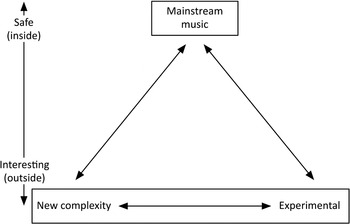
One NV composer told me that he writes ‘experimental music’, and suggested that establishment composers have to create ‘safe’ mainstream music in order to protect their positions. He commented that ‘the interesting music in Britain today is outside of that, where you've got more freedom to do your own thing’. He drew a diagram to explain (
Figure 1). His model reveals a notion of prestige that relates to being an outsider, to creating what is perceived as interesting music, as opposed to the safe mainstream music of the successful musical establishment. Like other NV composers, he referred to two subgenres of new music – new complexity and experimental music – which he placed on a continuum in his diagram. He told me that both new complexity and experimental music were interesting, and that both were in tension with the establishment and its safe music. However, despite the positioning in his diagram, he proposed that mainstream composers were somewhere in between the safe and the interesting extremes, chiming with Whittall's suggestion that British new music composers neither completely spurn the past nor completely embrace the avant-garde. That said, the purportedly more mainstream composers I spoke to also considered their own music to be interesting. In other words, all new music composers seemed to consider their music interesting. Several NV composers concurred with the diagram in
Figure 1, their attitudes revealing the shift away from the idea, prevalent for the last few decades, that more ‘difficult’, virtuosic music was better or more ‘interesting’ than other kinds of music.Footnote 51 By the beginning of the twenty-first century, style was, for these composers, transcended by being ‘interesting’.
Figure 1

According to these interviewees, there was a strong correlation between ‘interesting’ music and personality. As I mentioned in the introduction, ideas of personality relate to the distinctiveness of the individual and quantification, that is, to having more or less personality. In addition to the management of exchanges and effort, being individual and having personality are critical for understanding how prestige operates. So what makes music ‘interesting’? To exemplify, a NV composer talked to me about a drone (a continuous sound):
A literal drone would be someone pressing down a key on an organ for X number of seconds, then taking it off. Another way of expressing or realizing or visiting that somehow would be: OK, what are the colours inside that drone? And then on top of that, what sort of energy do those colours have? Are they stopping and starting, and if so at what kind of speed, you know, periodicities? And is there some kind of harmonic sense to this drone, or is it a single pitch, or is it …? What kind of activity is there inside it? Is there rhythmicization, or is there …? D'you see what I mean? That's making the drone have some other life rather than being shorthand. Or having a life and identity of its own, i.e. a whole personality, rather than just a bit of shorthand that's some small part of some other personality or bigger personality. It's about fleshing.
There is a distinction here between an ‘interesting’ drone that contains life, energy, colours, and activity which animates it, and a ‘shorthand’ version of a drone created by pressing a key on an organ. Moreover, personality, life, and identity have to be there for music to be ‘interesting’. The use of anthropomorphic terminology here is striking, a terminology that was frequently employed by other NV composers. This composer went on to tell me that a piece of music has ‘sets of personalities or a group of personalities, a kind of multiplicity’; personality might be located inside a drone, or a drone might be part of a larger group of personalities in a piece of music, this being a question of scale.
As well as sounds, NV composers also ascribed personality to pieces and performers.Footnote 52 One NV composer defined personality as ‘some identifiable quality in the music which you can attribute and say: “this is by so and so”’. He continued: ‘a lot of composers you hear could be by anyone, whereas the kind of people I'm talking about are fairly distinctive, and it could only be by them. […] It's some sort of individual music personality that interests me, regardless of what the actual language of the music is.’ Here, some composers have personality, while others do not, and language – or style – is less important than personality. Composers have to create a sameness so that their personality (or distinctiveness) is identifiable, a sameness that must operate at least at the level of a single work. Identifying difference and innovation is a question of scale. However, only once sameness is recognized by others who are considered capable of such recognition will a composer be defined as individual, and eligible to join the group of composers with personality. In other words, to be a conventional member of the new music collectivity, composers must create sufficient sameness to be identifiably different, that is, individual. Yet some NV composers complained that certain well-known composers kept re-writing the same piece.Footnote 53 Sufficient sameness had to be achieved to create a personality, yet within that sameness a certain amount of difference was also required. So how do sameness and difference relate to the innovation and novelty for which this sphere of cultural production is renowned?
Novelty, individuality, and structure
Several NV composers confirmed that creating sameness was not inconsistent with creating novelty. One NV composer told me that ‘newness is important, but you have to make music new and interesting for yourself, new and interesting from what you've done before’. Another went further, stating that ‘no one bothers with being ground-breaking any more’. It was as if being identified as individual, as having musical personality, had eclipsed novelty, alongside beauty and economic success, as aims. NV composers quantified personality: some composers were said to have more, others less. And most concurred that too much personality could be detrimental. One NV composer told me, ‘in music, individuality is an aim, but you must avoid self-consciousness at all cost’, while another proposed that ‘it's good if the personality of the creator is quite submerged, so it's individual but not subjective’. It was as if conscious agency had to be suspended to allow space for the transcendent, intuitive self to emerge. And to some extent, these composers were rejecting a notion of the expressive self in favour of a plurality of selves. They implied that the self-conscious, subjective self had to be discarded to allow an expression of the creator's individuality, an individuality articulated as some kind of ‘other self’, which transcended, or could even be equated with, personality.
However, one NV composer commented: ‘I do think we fetishize the individual a bit these days.’ I discussed with her the idea that individualism might obscure the sociality of authorship and the collective cooperation involved in the production of art (as explored by Becker, among others).Footnote 54 But this was not her concern. Instead, she wanted to criticize the obsession with individuality that she felt prevailed in the new music scene. Although she denied that gender played a part in music-making processes, it is unsurprising that such a comment came from one of the few women I interviewed, given that, as Skeggs has argued, in the history of European individualism women have had to struggle to be considered eligible agents.Footnote 55
This composer continued: ‘you can only recognize individuality as successful – rather than mad or sad or failure – if that individuality manifests itself within a framework that we can relate to.’ For her, this framework consisted of structuring principles. But how does this individuality – this way of being individual enacted in a context of individualism – manifest itself within a musical structure? She proposed:
Tarty pieces that have got nice timbres in them get on my nerves, whereas a piece that's got horrible timbres and is well structured, I'll forgive it quite a lot. And also I'll experience the timbres differently because of the structure, but I won't experience the structure of a piece differently because of the timbres. So I think structure's very important, but I also think lots of people have a very simplistic view of structure. They want structure to be thrust up their noses, and I like more open structures that are more ambiguous.
This composer considered structure to be key: ‘good’ music had to be structured, but not overly so. Another NV composer defined structure as contrast. And the majority of these composers drew on mathematics to create their structures and logics (number series such as the Fibonacci series, magic squares, and so forth),Footnote 56 and sometimes based their pieces on the literary and visual arts (sculpture, paintings, architectural drawings, geometric patterns, photographs, conceptual art). Many of them employed architectural terminology, as witnessed by the comment ‘once you've set down the main foundations, then what goes in between takes on a life of its own sometimes, and becomes quite intuitive’. These composers implied that structure was a force enabling the intuitive self to create music. Continuing her discussion of individualism and structure, the above composer suggested that composition is an ‘articulation of the self through a skill learned that's not about the self’. For her, self and skill were distinct: they had to serve and allow space for each other. But they also had to interact, as she continued: ‘so there are culturally recognizable practices, and then there is the self, and I think the unity of those two is a bit like a marriage: it's a highly erotic, sensual, and intellectual unity; it's a real meeting of mind and body – of those two things – that produces really fantastic art’.
So far, we have seen that the successful linkage of skill, individuality, and personality, with differences of scale and degrees of interaction, contributes to the potential for achieving prestige. It is pertinent here to turn to Nigel Rapport and Joanna Overing's analysis of individual imagination. Paralleling NV composers' descriptions of their intuitive selves, imagination, for Rapport and Overing, is something that comes into the world as ‘an ideally “gratuitous” act, gratuitous inasmuch as it is seemingly uncalled for in terms of existent reality’.Footnote 57 As a gratuitous act, imagination emerges from nowhere and is free from worldly moral and exchange demands. As one NV composer commented in relation to the composition process: ‘there has to be a slight uncanniness, something slightly supernatural perhaps, something slightly not of this world.’ Rapport and Overing continue that there is a constant tension between (individual) imagination and (collective) convention: the imagination of the past creates the conventional; the conventional requires constant reinstatement – in the form of institutionalization, for example – in order to remain static; and the imagination of the present attempts to modify present convention, to reshape it, potentially creating conventions of the future; and so the cycle continues. However, the tension is not just between convention, structure, and imagination, as these can also give rise to each other, or so some NV composers suggested. For example, one NV composer told me: ‘it's about through logics […] so it's like sussing the genetic code of something, then going on to generate more material using the same set of rules. Again there's a very instinctive thing, it's about just sticking with the feeling of it feeling right.’ So structure, rules, and logics of composition were also ‘subject to creative interpretation’, an interpretation that this composer portrayed as instinctive.
Performances and audiences
To complete the picture of the characteristics that make pieces of music eligible for bestowals of prestige, let us return to performance and audience reception as a crucial stage of validation. We come back to the concept that compositions have to be recognized as capable of ascriptions of prestige, mediocrity, or failure, usually during performance. Compositions are mostly performed by others in front of an audience (either live or via broadcast), and for most NV composers the success of a piece was dependent on the performance. One NV composer stated:
I feel good about the recent thing I did with [Ensemble] Exposé because it was so very well performed: it enabled me to feel good about what I'd done. And other things I know perhaps were pretty good, but were badly performed … it kind of scars a piece in my mind, in my memory. I can't ever feel good about it, because it's been damaged somehow on its transition into the world.
Again anthropomorphic terminology is employed, as though compositions were living creatures going out into the world. Yet while the way a piece was performed, the performers' responses, and peer response were valued, reviews, according to another NV composer, were not considered so crucial to the success, to the ‘life’ of a piece. ‘A really good review will make you feel good about the piece’, he stated, ‘but a really bad one doesn't make you feel you want to kill the piece. It only works the one way.’ Moreover, programming was considered by many, but not all, NV composers to be crucial to the success of a piece. At worst, I was told, ‘pieces in programmes can destroy each other and come off very badly’. But what about the audiences that are so key to legitimating public funding for this music?
The composers, performers, promoters, and audience members I spoke to had very different opinions concerning the importance of audience response to the success of a piece, and therefore to the prestige of a composer. Several NV composers suggested that they were writing for themselves, communicating their ‘humanity’, their individuality back to themselves, and to ‘an audience that might be listeners like yourself’. Such notions implied a hermeticism in their faction of the new music scene. They also reinforced the idea that Foucauldian disciplinary modalities, including self-monitoring, regulate this scene, at least in part. Other NV composers were more concerned to communicate with broader audiences, as one of them exemplified when he said: ‘What's the point of writing music? Part of the point is to give some kind of pleasure and stimulation to other people, so if people say they've got that, it's very gratifying.’ This is quite a different perspective from that berated by McClary in the context of the 1980s USA, where ‘socially grounded signification’ was posited as an enemy of the avant-garde.Footnote 58 Yet audience responses remain just one element in this matrix of achievement and ascription of prestige, an element entangled in networks of power, in notions of individuality and ‘interesting’ music.
Conclusion
In this article I have explored how a group of young composers construe ideas of success and prestige in a context that appears meritocratic but is governed by hierarchical structures. NV composers depicted a music establishment dominated by published, mainstream composers whose opportunities and successes were based on exchange networks that were increasingly difficult for outsiders to access. Such ideas of exclusion were also shared by some, more established composers, and, as we saw, paranoid-style imaginaries coexisted with notions of cliquish exchange. Many NV composers described the establishment as both something to aspire towards and something to shun. This ambivalence resonated with the tensions faced by the dance-band musicians documented by Becker in his study of ‘outsiders’ in 1950s Chicago.Footnote 59 These dance-band musicians faced a choice between, on the one hand, maintaining artistic standards and gaining respect from their peers for playing jazz and, on the other hand, building an economically successful career by performing less stimulating commercial music. However, at the turn of the millennium, British new music composers were not forced to make such a choice. They could sustain a tension between being ‘inside’ and ‘outside’ the establishment, since many were employed by universities and were thus not economically dependent upon establishment success. Universities gain kudos from engaging establishment figures, and often also employ lesser-known composers who consider themselves ‘outsiders’. The majority of NV composers positioned themselves ‘outside’ the establishment, in an alternative and intersecting sphere of exchange where less funding and support was available for commissions and performances. Echoing work by Williams, Bourdieu, and Born,Footnote 60 I argued that the music establishment and the ‘outside’ sphere in which most NV composers positioned themselves were mutually dependent: the institutionally supported ‘outside’ legitimated the establishment, and some past outsiders had become establishment figures.
I went on to explore how most NV composers ascribed prestige to composers whose music they considered ‘interesting’, a quality that eclipsed novelty as an aim. Individuality, enacted within a context of individualism, emerged as key to assessments of whether music was interesting. This individuality had to be tempered, structured, and embedded in the social norms of this and related (usually visual) spheres of artistic production. Likewise, composers' personalities and lifestyles participated in creating interesting music. Some NV composers attached a stigma to those who appeared to work too hard, even where they had achieved success in the establishment. Instead, they ascribed prestige to disinterested behaviour and to composers who consistently produced ‘good’ music effortlessly, and did not appear to engage in the exchange mechanisms of the establishment. As we saw, such ideas chimed with myths about Mozart, Bourdieu's notions of ‘cultural capital’,Footnote 61 and the qualities afforded by European individualism.Footnote 62 Some NV composers believed that they or others were geniuses, while others preferred the idea that there were ‘great artists’. In both cases, individualism was maintained and valued. I argued that notions of effortlessness, talent, and genius, together with individuality, extra-musical performances, lifestyle, and self-presentation contributed to ascriptions of prestige. And interesting music, and the prestige that surrounded it, fed back into composers' personalities and creative processes; into social aesthetics and aesthetic education; and into the social relations in this part of the new music scene. Contrary to meritocratic ideals that musical talent will succeed, composers had to understand some of the logics of power that traverse the new music network, and persuade others that they had an individual musical personality in order to succeed. Yet composers were vulnerable to criticism, particularly if they failed to produce ‘good’ music. The power of this system is that failure is lived as something ascribable to individual talent, but this sphere of artistic production is based as much on the opinions of a small number of people (composers' peers, performers, and the movers in the establishment), as on public recognition of achievement. It is at the intersection of ‘interesting’ music and social relations that a more comprehensive understanding of prestige was located. For it was here that Foucauldian ‘panoptic modalities of power’Footnote 63 regulate practice, as we saw with exchanges of praise and critique, the championing of certain lifestyles, aesthetics, and rationales for creating artworks, the individualizing of composers via the promotion of specific concepts of sameness and difference, and the naturalizing of notions of talent. It would be insightful to consider parallels with other spheres in which creativity, talent, and performance are valued, such as other art worlds and academia, and this case study is thus an invitation to be reflexive about the workings of such arenas.