1 Introduction
There are two main ways of expressing comparison to a higher degree in English adjectives. One is to precede the adjectival base with more, e.g. more lazy, and the other is to suffix -er to the base, e.g. lazier (Quirk et al. Reference Quirk, Greenbaum, Leech and Svartvik1985: 458; Biber et al. Reference Biber, Johansson, Leech, Conrad and Finegan1999: 522; Palmer, Huddleston & Pullum Reference Palmer, Huddleston and Pullum2002: 1582–1588; González-Díaz Reference González-Díaz2008: 15). Comparative alternation refers to the alternation between more and -er. This paper shows how in addition to the morphological structure of the base adjective, the lexical spread of more constructions is important for the occurrences of more in a group of adjectives that I call the
 $y$
-adjectives. The
 $y$
-adjectives comprise adjectives that end in an orthographic
 ${<}\text{y}>$
and an /i/ sound, e.g. tidy, silly, uneasy, worthy and giddy.
In the scholarship on comparative alternation, there exists an extensive tradition of focusing on factors associated with the base adjectives as predictors of comparative forms. Factors considered typically include: the syntactic distribution of the base adjectives;Footnote
[2]
the length of these bases (measured in terms of segments or of syllables); the morphological structure of these bases; their final orthographic, phonological and phonetic forms; and other phonological features that specify the bases such as the presence/absence of final stress. Works focusing on one or more of these factors stretch back to Johnson Reference Johnson1755, Nesfield Reference Nesfield1898, Smith Reference Smith1916, Kruisinga Reference Kruisinga1932 and Jespersen Reference Jespersen1949, and – by the time we get to Quirk et al. Reference Quirk, Greenbaum, Leech and Svartvik1985 and later Palmer et al. Reference Palmer, Huddleston and Pullum2002, Mondorf Reference Mondorf, Rohdenburg and Mondorf2003, Reference Mondorf2009 and Hilpert Reference Hilpert2008 – the number of factors considered has increased considerably. In pronouncing that the comparative form used is very much ‘lexically-determined’, Palmer et al. (Reference Palmer, Huddleston and Pullum2002: 1583) have taken base-associated considerations further than others. This is because a lexical determination account constitutes in effect a claim that a highly-specified configuration of phonetic, phonological and orthographic material realising a base adjective biases the adjective either towards more or -er. While not denying the value of the traditional factors considered in accounts of comparative alternation, this article proposes that factors related to the more and -er constructions themselves may be just as important for understanding comparative alternation in
 $y$
-adjectives.
The theoretical impetus for this proposal stems from several observations. One is the lack of clarity on whether a factor does indeed predict the comparatives of
 $y$
-adjectives. As I will show, even if this lack of clarity as it occurs at one level of understanding may be resolved at another level, we will still reach a point where we need to explain why
 $y$
-adjectives remain divided between comparatives in more and in -er. Traditional base-associated factors might offer some insights, although in
 $y$
-adjectives, the comparative form predicted may not often match that used. On the other hand, studies on the predictors of comparatives with specific reference to
 $y$
-adjectives seem to focus more on why these adjectives tend towards -er rather than why they might also be found with more. For example, while Mondorf (Reference Mondorf2009: 167) refers to how
 $y$
-adjectives are biased towards -er because the nucleus of the final ‘prosodically light syllable’ in these adjectives facilitates a fusion with -er, there is no simultaneous speculation as to why
 $y$
-adjectives might also go with more despite these prosodic circumstances. In short, we are in a position where we need more than the available base-associated accounts to explain the alternation between more and -er in
 $y$
-adjectives.
This leaves us with a couple of options. We could either find ways of improving the explanatory power of existing base-associated accounts or we could supplement our understanding of comparative alternation in
 $y$
-adjectives by considering factors beyond base-associated ones. The latter option seems reasonable because even in the face of one of the most specified base-associated accounts, i.e. lexical determination (Palmer et al. Reference Palmer, Huddleston and Pullum2002: 1583), we still find individual
 $y$
-adjectives divided between more and -er. Heavy and worthy, for example, are each attested with both more and -er in the British National Corpus (BNC; Davies Reference Davies2004–). Although this kind of alternation might not be exclusive to
 $y$
-adjectives,
 $y$
-adjectives seem relatively prone to it.
 $Y$
-adjectives make up more than a third of the 247 adjectives alternating between more and -er identified from the BNC for study in Hilpert 2008.
One way in which we might think of comparative alternation in
 $y$
-adjectives in terms independent of the base adjective is to direct our attention instead towards the more and -er constructions. We might consider these constructions as a point of departure for examining how they get applied to
 $y$
-adjectives. Studies on the extent to which a functional or grammatical pattern applies are not new and have been associated with the notion of productivity – see Bybee (Reference Bybee2007a: 14) and Stewart (Reference Stewart2016: 62). In studies of English plural and past tense formations, frequency factors pertaining to the grammatical patterns for these formations have been found to predict the extent that the patterns get applied. It is appropriate therefore to attempt an understanding of comparative alternation in
 $y$
-adjectives with respect to observations of the frequencies of more and -er patterns. Indeed, the findings reported in this article show the pairing of
 $y$
-adjectives with more to be related to the frequency of more constructions of disyllabic adjectives that are not
 $y$
-ones, for example, handsome and noble. These findings are in addition to indications that more pairings may be predicted by the morphological structure of
 $y$
-adjectives. The conclusion reached in this article is that if we want a relatively more coherent understanding of the comparatives of
 $y$
-adjectives, we cannot keep the comparatives of other items out of the picture.
2 Adding Focus to the picture of comparative alternation in Y -adjectives
2.1 The fuzziness of the length rule
Although not all
 $y$
-adjectives are disyllabic, the fact that most are is what makes it hard to systematically account for their comparative forms. Being neither as short as monosyllabic adjectives nor as long as trisyllabic ones, it is relatively more challenging to predict the comparatives of disyllabic
 $y$
-adjectives with the general principle that monosyllabic adjectives go with -er and adjectives of three syllables or more go with more (Jespersen Reference Jespersen1949: 347; Schibsbye Reference Schibsbye1965: 134; Zandvoort Reference Zandvoort1977: 188; Quirk et al. Reference Quirk, Greenbaum, Leech and Svartvik1985: 461–462; Palmer et al. Reference Palmer, Huddleston and Pullum2002: 1583–1584; Carter & McCarthy Reference Carter and McCarthy2006: 439). Even trisyllabic
 $y$
-adjectives such as those prefixed with un-, e.g. untidy, may be attested with -er (Quirk et al. Reference Quirk, Greenbaum, Leech and Svartvik1985: 462), forming part of the group that ‘violate(s) the generalization that polysyllabic adjectives prefer periphrastic expression of degree’ (Bauer, Lieber & Plag Reference Bauer, Lieber and Plag2013: 186).
2.2 The fuzziness of the stress rule
The difficulty of predicting the comparatives of
 $y$
-adjectives from the length of the respective base adjective may prompt a turn towards other base-associated accounts to improve our predictive capacities. Following the view that ‘adjectives ending in weak-stressed -er, -ow, -
 $y$
, -le, preceded by a non-syllabic sound’ predicts comparative -er (Kruisinga Reference Kruisinga1932: 63), we might say that most disyllabic
 $y$
-adjectives would form the comparative with -er. Indeed, this position aligns with Quirk et al.’s (Reference Quirk, Greenbaum, Leech and Svartvik1985: 462) observation that an unstressed vowel in the final syllable of a disyllabic conditions -er. However, despite noting that
 $y$
-adjectives ‘normally take -er’, the general rule in Jespersen (Reference Jespersen1949: 351) for the pairing of polysyllabic adjectives with -er is the presence rather than absence of final syllabic stress.
Thus, while Kruisinga, Quirk et al. and Jespersen may all agree that
 $y$
-adjectives ought to go with -er, they may not all agree on whether this -er is predicted by a [±stress] feature of the final syllable. In Jespersen’s view, the
 $y$
-adjectives take -er even without the final syllabic stress that supposedly prompts an -er bias. The lack of a clear sense of how important a final syllabic [±stress] feature is for the comparatives of
 $y$
-adjectives is reflected in Sweet (Reference Sweet1900: 326), who is of the view that while disyllabic adjectives with stress on the second, i.e. final, syllable take the -er form, the same goes for ‘many disyllabic adjectives with the stress in the first syllable’.
2.3 The fuzziness of the diachronic expectation
We may note that Sweet’s 1900 work was published at the end of the 19th century, Kruisinga’s Reference Kruisinga1932 work in the early half of the 20th century, Jespersen’s 1949 work towards the middle of the 20th century, and Quirk et al.’s Reference Quirk, Greenbaum, Leech and Svartvik1985 work towards the end of the 20th century – even as identical descriptions of the comparative in Quirk et al. (Reference Quirk, Greenbaum, Leech and Svartvik1985) appear in their 1972 work (Quirk et al. Reference Quirk, Greenbaum, Leech and Svartvik1972). Each of these works might no doubt be based on data collected earlier than when the relevant work was published. Even then, given their non-diachronic nature and the stretch of time between each published work, it is not beyond reason to suggest that Sweet’s work would have been based on data earlier than that of Quirk et al. (Reference Quirk, Greenbaum, Leech and Svartvik1972). Rather than generate ambiguity therefore as to whether the syllabic stress factor is important for the comparatives of
 $y$
-adjectives, the works above may together indicate a gradual stabilisation of its importance with time. Support for this possibility is found in Kytö & Romaine (Reference Kytö and Romaine1997: 344). Drawing on data in a stretch of time that extends further back than the data Sweet would have drawn on and that is more recent than the data Quirk et al. would have used, Kytö & Romaine show that between the periods of Late Middle English and post-19th-century Modern English, there is a decline in more constructions of the disyllabic members of what I refer to as
 $y$
-adjectives.Footnote
[3]
.
The diachronic perspective in Kytö & Romaine could help dispel uncertainties raised in Section 2.2 about the explanatory power of the stress criterion. Observations that do not clearly suggest the absence of final syllabic stress to prompt an -er bias, e.g. those that underlie Sweet Reference Sweet1900, could have been more widespread in earlier times, when any regularisation towards -er is still relatively weak. As this regularisation strengthens with time, however, observations associating -er with the absence of final syllabic stress, e.g. those that underlie Quirk et al. Reference Quirk, Greenbaum, Leech and Svartvik1985, might have increased, including in the
 $y$
-adjectives, since all such adjectives do not have final syllabic stress.
While it may reasonably explain incoherence related to final syllabic stress as a predictor of -er in
 $y$
-adjectives, the diachronic perspective introduces another level of complexity, specifically, with respect to the view that ‘the general tendency over the recorded history of English has been for syntactic comparison to expand at the expense of morphological comparison’ (Denison Reference Denison and Romaine1998: 128) – see also Barber (Reference Barber1964: 131; Reference Barber1997: 146–147) and Brook (Reference Brook1973: 180).
 $Y$
-adjectives clearly run contrary to this tendency, if they are regularising towards -er instead of more. There are two ways of thinking about this discrepancy. We could take the
 $y$
-adjectives as an anomaly of which explanations have to be sought. This would direct the investigative focus towards what it is that biases
 $y$
-adjectives towards -er. We could, on the other hand, take the
 $y$
-adjectives as a potential site of conflict between resistance and adherence to the kind of general tendency towards syntactic comparison. If so, we would be just as interested in what keeps
 $y$
-adjectives with more.
Grounds for the latter interest are found in Kytö & Romaine (Reference Kytö and Romaine1997: 344). While disyllabic adjectives ending in -ous and -ful are found in this work to occur with more 100 per cent of the time in every studied period between Early Modern English and post-19th-century Modern English, we do not see a 100 per cent departure away from more in the
 $y$
-adjectives in any of those periods. There remains a percentage of
 $y$
-adjectives paired with more at every period of observation despite a general decline in these pairings over time. This suggests some restraint on the shift of
 $y$
-adjectives away from more, which also means that
 $y$
-adjectives are not entirely anomalous to any general tendency towards syntactic comparisons. It is prudent therefore to take an interest not only in what motivates occurrences of
 $y$
-adjectives with -er, but in what keeps these adjectives paired with more. Any more and -er biases in
 $y$
-adjectives can be thought of from a number of perspectives, and it is an introduction of these perspectives to which I now turn.
3 Potential sources of bias towards a particular comparative in Y -adjectives
Posited predictors of comparative alternation are often associated with the base adjective. This is the case, for example, with the multiple variables considered in Hilpert (Reference Hilpert2008: 403). In predicting the comparatives of
 $y$
-adjectives, in other words, there is a strong precedent to consider factors tied to the
 $y$
-adjective itself. Further, since we have yet to reach a stage where
 $y$
-adjectives are relatively unanimous in occurring with a specific comparative form, for any set of base-associated predictors, we are likely to find
 $y$
-adjective comparative constructions that are inconsistent with what is predicted. Any theoretical precedent focusing on the base adjective as a means of explaining the comparative form found with a
 $y$
-adjective should not therefore preclude considerations not contingent upon this base.
3.1 Base-associated perspectives
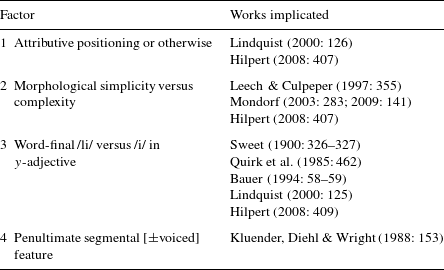
Table 1 lists the base-associated factors which I consider for my study of comparative alternation in
 $y$
-adjectives, together with the works implicated in this consideration.
Factors considered for comparative alternation in
 $y$
-adjectives.

Factors 1–3 in Table 1 have previously been proposed in the scholarship as predictors of comparative forms. Additionally, I have included one factor (Factor 4) not proposed before, but which, as I later explain, may potentially offer a new way of thinking about the comparatives of
 $y$
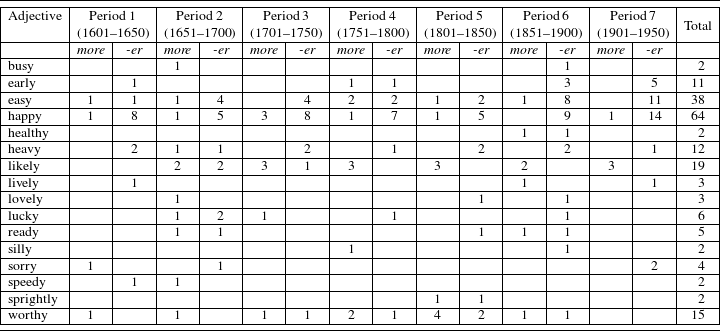
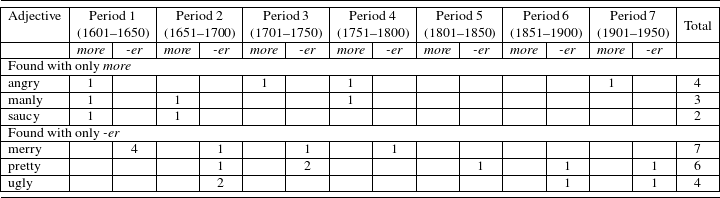
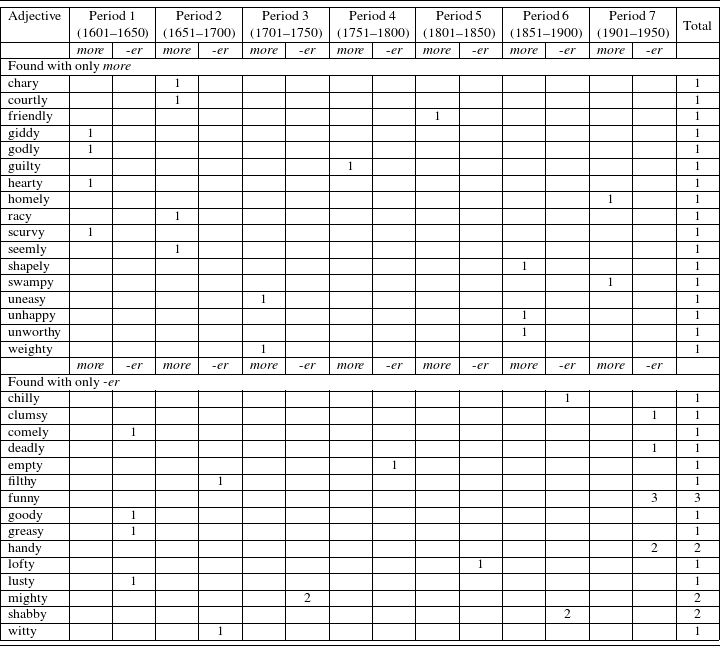
-adjectives. It would have been ideal to consider for the current study all relevant base-associated factors previously documented. However, the small sample of 253 comparative
 $y$
-adjective tokens in my study (see Tables 2–4 below for breakdown of counts) constrains the number of factors I can consider without risking statistically artefactual findings. I have theorised (in Section 2.3 above) that a diachronic perspective can offer some explanatory power where base-associated predictions of the comparatives of
 $y$
-adjectives are weakened. Given this, the factors from the literature I have chosen to consider, i.e. Factors 1–3, are those where the prediction of the comparative form found for
 $y$
-adjectives remains inconsistent across works, but where there remains a potential for a resolution of the inconsistences from a diachronic standpoint. I will now explain how this is so.
3.1.1 Factor 1: Attributive positioning or otherwise
Several studies exist on syntactic positioning as a predictor of comparative form.Footnote
[4]
The general stance is that -er is conditioned by attribution, and more, by other syntactic environments. This stance finds support in Hilpert (Reference Hilpert2008: 407), who investigated data that included
 $y$
-adjectives. Unlike Hilpert, however, Lindquist (Reference Lindquist and Kirk2000: 126) finds comparative -er ‘rather evenly spread between the attributive and predicative positions’. One may note that Lindquist’s data cover a shorter time frame than Hilpert’sFootnote
[5]
and are based only on the subset of
 $y$
-adjectives in word-final /li/. The question is prompted therefore of whether syntactic positioning is unimportant for the comparatives of
 $y$
-adjectives or has an importance that would only emerge in data covering a relatively more extensive time frame and that includes
 $y$
-adjectives beyond the word-final /li/
subset.
3.1.2 Factor 2: Morphological simplicity versus complexity
The motivation for investigating whether morphological contrast matters for the comparative forms of
 $y$
-adjectives stems from the position that this has not been thoroughly investigated on diachronic data. There are indications from the scholarship that morphological complexity creates a bias for more, and morphological simplicity, a bias for -er (Leech & Culpeper Reference Leech and Culpeper1997: 355; Mondorf Reference Mondorf, Rohdenburg and Mondorf2003: 283; Hilpert Reference Hilpert2008: 407).Footnote
[6]
Mondorf (Reference Mondorf2009: 141) notes, nonetheless, ‘the lower use of more’ in diachronic data with five
 $y$
-adjectives that she deemed morphologically complex (happy, heavy, lucky, ready and worthy). She claims that the high frequency of these adjectives has made them cognitively well-entrenched, reducing their cognitive complexity, hence promoting an -er bias. A conclusion drawn from a small number of five
 $y$
-adjectives raises questions on generalisability, however, and since these five are in the first instance defined as morphologically complex, they have not technically provided a context in Mondorf to examine the role of morphological contrast as a predictor of the comparatives of
 $y$
-adjectives. In diachronic data therefore, a study of this role remains justified.
3.1.3 Factor 3: Word-final /li/ versus /i/
The scholarship on comparative alternation includes a claim that
 $y$
-adjectives ending in a word-final /li/ prompts a more bias, and
 $y$
-adjectives ending in just /i/, an -er bias (Quirk et al. Reference Quirk, Greenbaum, Leech and Svartvik1985: 462; Bauer Reference Bauer1994: 58–59; Lindquist Reference Lindquist and Kirk2000: 125; Hilpert Reference Hilpert2008: 409).Footnote
[7]
One caveat here is that it remains incoherent with Sweet’s (Reference Sweet1900: 326–327) claim that adjectives with a word-final /li/ are increasingly found with -er. It may be prudent to suggest that Sweet’s analysis, made in 1900, is likely to have been based on data around that time if not earlier. Bauer’s analysis, associating a word-final /li/ with more rather than -er, is based on data between 1900 and 1989. Hilpert’s (Reference Hilpert2008) analysis, similar to Bauer’s (Reference Bauer1994), is based on the BNC, covering periods between the 1980s and early 1990s. Finally, Lindquist’s analysis, similar also to Bauer’s, is based on data dated to the year 1995. Taken together therefore, the data considered in Sweet, Bauer, Lindquist and Hilpert could be estimated to cover the stretch of a century. If observations from this stretch of time remain insufficient to disambiguate any effect the word-final /li/ versus just /i/ contrast has on the comparatives of
 $y$
-adjectives, it is possible that with data from longer stretches of time, the ambiguity could be resolved. The way is paved therefore for studying the relevant effect in data that stretches far more than the span of a century, which, as noted later in Section 4.1, is the case with the data for my study.
3.1.4 Factor 4: Penultimate segmental [±voiced] feature
Despite there not being any prior work on this, the [±voiced] feature of the penultimate segment of base adjectives might be of interest for an account of comparative alternation in
 $y$
-adjectives. This proposal is grounded in the claim that ‘voiced consonants tend to be preceded by longer vowels than voiceless consonants’ (Kluender, Diehl & Wright Reference Kluender, Diehl and Wright1988: 153).Footnote
[8]
We might therefore expect
 $y$
-adjectives with a [+voiced] penultimate segment, e.g. lazy with a penultimate /z/, to have a longer vowel in the penultimate syllable than
 $y$
-adjectives with a [–voiced] penultimate segment, e.g. lacy with a penultimate /s/. Since all
 $y$
-adjectives are consistent in having an unstressed final syllable, this analysis prompts the question of whether for
 $y$
-adjectives, it is the vowel length of the penultimate syllable measured by the [±voiced] feature of the penultimate segments of
 $y$
-adjectives (rather than length measured by the number of syllables) that can predict comparative forms. Drawing on the conventional notion that shorter adjectives go with -er, and longer ones, with more, the speculation here is for a more bias in
 $y$
-adjectives with a relatively longer vowel in its penultimate syllable (stimulated by a [+voiced] penultimate segment in the adjective). On the other hand, the speculation is for an -er bias in
 $y$
-adjectives with a relatively shorter vowel in its penultimate syllable (stimulated by a [–voiced] penultimate segment in the adjective).
3.2 Perspectives associated with comparative constructions
All the factors proposed above to shed light on the comparative forms of
 $y$
-adjectives are linked to the
 $y$
-adjectives themselves. It remains a question as to whether comparative alternation in
 $y$
-adjectives might also be related to the distribution and frequency of more and -er constructions. In including the ratio of the positives of degree forms of adjectives to their comparatives as a potential predictor of comparative forms, Hilpert (Reference Hilpert2008: 397) is in part drawing on the frequencies of more and -er constructions to aid our understanding of comparative alternation. Likewise, Mondorf’s (Reference Mondorf2009: 41) observation that base adjectives with a high number of comparatives are not often found with more is based on an expectation that the frequency with which the comparative of an adjective is found has some bearing on the receptiveness of that adjective towards comparative more. The time seems ripe therefore to consider whether comparative more and -er constructions themselves might play any part in an account of the comparatives of
 $y$
-adjectives. Outside of the purview of comparative alternation, there is evidence suggesting that the spread of a grammatical pattern across lexical types can affect its extent of application. Since more and -er constructions are variant ways of expressing the grammatical function of the English comparative, the spread of these constructions across lexical types might influence their application on
 $y$
-adjectives. These speculations are derived for the most part from Marchman & Bates Reference Marchman and Bates1994 and Bybee & Newman Reference Bybee and Newman2007.
Bybee & Newman are interested in English plural noun formation. What they found in particular is that lexical arbitrariness can determine whether a morphological process gets favoured as default. It is suggested in their work that English plural formation by affixation may appear easier to learn than English plural formation by stem-internal modification because the former is less lexically arbitrary. A conclusion reached therefore is that the more widespread across lexical types a means of plural formation is, which entails that it is high in type frequency, the more likely it will be chosen to express the plural on novel nouns (Bybee & Newman Reference Bybee and Newman2007: 163). A comparable principle is reflected in Marchman & Bates (Reference Marchman and Bates1994: 360), who found children to overregularise the past -ed to verbs with an irregular past only after they have acquired a critical number of 60–70 verb types. What is observable from Marchman & Bates’s (Reference Marchman and Bates1994: 354) data is that the 60–70 verb mark in the children’s vocabulary store seems also to be the point where the number of verb types in that store that take the regular past begins to exceed, at an increasing rate, the number of verb types that take the irregular past. This suggests that the means of past formation adopted as default by children in the form of its overregularised use is also the means with a relatively larger spread across lexical types.
Marchman & Bates Reference Marchman and Bates1994 and Bybee & Newman Reference Bybee and Newman2007 present us with an alternative avenue for thinking about comparative alternation in
 $y$
-adjectives. That is, we may consider whether the comparative forms found with
 $y$
-adjectives can be related to the type frequency (or the extent of lexical spread) of more and -er constructions. If in Bybee & Newman, it is the lexical spread of a means of plural formation that influences its application, we may hypothesise that the pairing of
 $y$
-adjectives with more is related to the type count of comparative more constructions. Likewise, the pairing of
 $y$
-adjectives with -er might be related to the type count of comparative -er constructions. While there is no reason to expect a comparative pattern to be generalised from
 $y$
-adjective types any less than from other item types, the empirical issue of non-independent sampling arises if we consider the application of a comparative pattern on
 $y$
-adjectives in terms of its lexical spread across
 $y$
-adjective types. Excluding the
 $y$
-adjectives, the items whose type counts of comparatives we may consider to aid an understanding of more and -er occurrences with
 $y$
-adjectives include: (i) monosyllabic adjectives (referred to henceforth as FAT adjectives), (ii) adjectives with three or more syllables (BEAUTIFUL adjectives), and (iii) disyllabic adjectives that are not
 $y$
-adjectives (HANDSOME adjectives).Footnote
[9]
There is a general tendency for FAT adjectives to go with -er. The only exception perhaps is with the adjective fun, although funner is common in some English dialects (Callister Reference Callister1998), and is also expected to show increased usage with time (Lighter Reference Lighter2006). In his observation of FAT adjectives that alternate between more and -er, Hilpert (Reference Hilpert2008: 413) finds the number of more occurrences with these adjectives to be considerably smaller than the number of -er occurrences, and in both the Lancaster–Oslo/Bergen Corpus (LOB) and the BNC. The numbers are 1502 -er occurrences to 16 more occurrences in the LOB, and 8 more occurrences to 1213 -er occurrences in the BNC. These observations suggest that if comparatives of
 $y$
-adjectives are related to type counts of -er, the source of this relation may be the FAT adjectives. Likewise, with the wealth of literature claiming a bias for more in adjectives of three or more syllables,Footnote
[10]
if comparatives of
 $y$
-adjectives are related to type counts of more, the source of this relation may be the BEAUTIFUL adjectives.
The more constructions of HANDSOME adjectives may also matter for our understanding of occurrences of more with
 $y$
-adjectives. There is a rather extensive range of HANDSOME adjectives documented to be more-biased. HANDSOME adjectives ending in -ous and -ful, for example, are noted to occur with more since Early Modern English (Kytö & Romaine Reference Kytö and Romaine1997: 344). HANDSOME adjectives that end in a heavy consonant group (or consonant cluster), e.g. abrupt, correct and distinct, are noted to take more (Sweet Reference Sweet1900: 326; Mondorf Reference Mondorf, Rohdenburg and Mondorf2003: 282). Complementing this, HANDSOME adjectives ending in /-pt/ and /-kt/ are reported in Rohr (Reference Rohr1929: 18, cited in Mondorf Reference Mondorf, Rohdenburg and Mondorf2003: 283) to become -er-resistant ‘during the 18th century’. The bias for more extends to HANDSOME adjectives that end in the suffix -ish, e.g. girlish (Mondorf Reference Mondorf, Rohdenburg and Mondorf2003: 259). Since ‘[p]articiple forms that are adjectives regularly only take periphrastic forms’ (Quirk et al. Reference Quirk, Greenbaum, Leech and Svartvik1985: 462), HANDSOME forms that are participles, e.g. convinced, including those akin to Latin participles, e.g. ancient and frequent, also occur with more. Whether these examples are more-biased because of their participle status or heavy consonant ending (in this case, homorganic) remains a point for further study.
As it investigates whether type counts of more and -er may matter for comparative alternation in
 $y$
-adjectives, this article aims to also examine whether these type counts can complement base-associated predictors of comparative alternation. The value is recognised therefore of observing whether corpus-based type counts of more and -er are related to occurrences of these comparative forms with subsets of
 $y$
-adjectives specified by the base-associated factors introduced as worthy of study in Section 3.1.
4 An empirical dimension to our perspectives
4.1 Description of data
A diachronic corpus study was undertaken to investigate whether the perspectives laid out in Sections 3.1 and 3.2 were useful for an account of comparative alternation in
 $y$
-adjectives. The historical nature of the study reflects my goal to draw insights on the factors that, over extended periods of time, have divided
 $y$
-adjectives between more and -er. The data, collated specifically for this study, comprised British English (BrE) comedy excerpts spanning from the 17th to the 20th century. I have used plays rather than prose because the nature of plays as written to be spoken makes them relatively closer to speech; in the context of historical data, this is significant because recordings of actual speech are unavailable for the early periods of the present study. Further, my reason for focusing on speech-like data draws on the observation that written language is the primary source for most studies on comparative alternation (D’Arcy Reference D’Arcy2014: 219). A study based on speech-like sources would therefore expand the scope of empirical base used in the relevant scholarship.
Since I was unable to obtain sufficient data prior to the 17th century, I was unable to include comedy excerpts from before the 17th century in my dataset. The inclusion in my dataset of only stage comedies, instead of both comedies and tragedies, is to control for any variation in the comparatives of
 $y$
-adjectives that might be related to different style levels of what could be classed as the same genre. Since I am not testing for variation in style levels within a genre as a predictor of comparative forms, it is best that I control for it in data sampling. The choice of comedies over tragedies stems from an observation that comedies seem relatively more authentic of the everyday realities of language users. As Leggatt (Reference Leggatt1998: 5) notes, comedies tend to focus ‘on the social level of life’ around such institutions as family and marriage, so that a study of it ‘needs to include an awareness of the particular society in which it operates’.
Each of the seven corpora in my study constituted a 50-year time spanFootnote [11] and represented one of seven periods of English use: 1601–1650 (Period 1), 1651–1700 (Period 2), 1701–1750 (Period 3), 1751–1800 (Period 4), 1801–1850 (Period 5), 1851–1900 (Period 6), and 1901–1950 (Period 7). The size of each corpus was approximately 288,000 words. Excerpts were obtained from Literature Online (LION; Proquest 1996–2013) and Internet Archive (see N.A. 1996). Excerpts excluded items that were not speech-like in a manner similar to the bulk of dialogues in a stage play, e.g. setting descriptions and character names before conversational turns. Parts of turns spoken in verse were excluded because the comparative constructions (if any) found in them might be found with particular comparative forms for no other reason but to adhere to the prosodic constraints of the lines in verse. The inclusion of verse in my corpora might therefore confound the findings generated to address my factors of interest.
An exploratory scan of the data sources for my corpora compilation showed that I would have comedies of at least six playwrights available for building the corpus corresponding to each 50-year period. This assurance was not sustained, however, if I increased the number of playwrights beyond six. To ensure therefore as balanced a dataset as possible, where no one corpus contained works of more or less playwrights than another, excerpts from six (rather than any other number of) playwrights went into each of my seven corpora. For a similar reason, the size of excerpts obtained from each playwright was set at approximately 48,000 words, making the size of each corpus approximately 288,000 words. I was sure, after the exclusion of non-speech-like items, that I could obtain for each corpus at least 48,000 words from the works of each of six playwrights. If I had set the number of words assignable to each playwright beyond an approximate number of 48,000, I had no guarantee that each corpus would be balanced in the quantity of words contributed by each playwright.
When my full dataset was obtained, I generated concordance lines (or lines of text) containing more and -er constructions for each period of data in AntConc (version 3.2.4w; Anthony Reference Anthony2011). I then categorised the lines of data from the concordance for each period into more constructions and separately, -er constructions, of
 $y$
-adjectives, FAT adjectives, HANDSOME adjectives, and BEAUTIFUL adjectives.
Counts of comparative
 $y$
-adjective tokens (for y-adjectives found with both more and -er across multiple periods).

Counts of comparative
 $y$
-adjective tokens (for
 $y$
-adjectives found with only more or only -er across multiple periods).

Counts of comparative
 $y$
-adjective tokens (for
 $y$
-adjectives found with only more or only -er in a single period).

4.2 Data coding for base-associated perspectives
A total of 253 tokens of comparative
 $y$
-adjective constructions were found in the corpora. Tables 2–4 document the
 $y$
-adjectives found in the comparative. The spelling for the adjectives in Tables 2–4 has been standardised to current norms. Numerical values in the tables reflect token counts of more and -er constructions for each
 $y$
-adjective in each period of study in my corpora. For example, happy (see Table 2) has one comparative token with more and eight with -er in Period 1. Merry (see Table 3) does not have any comparative token with more in any period. It is always found with -er (four tokens in Period 1, and one token each in Periods 2, 3 and 4).
Comparative more constructions of
 $y$
-adjectives in the corpora total 80 tokens while comparative -er constructions of
 $y$
-adjectives total 173 tokens. As the -er tokens outweigh the more ones by more than half, we might be tempted to conclude that a word-final /i/ in
 $y$
-adjectives is a strong predictor of comparative -er – a conclusion reached in Kytö & Romaine Reference Kytö and Romaine1997 and more recently, in Cheung & Zhang Reference Cheung and Zhang2016. However, evidence for prevalent alternation between more and -er in
 $y$
-adjectives in need of explanation remains. For example, of the 22
 $y$
-adjectives found in the comparative across multiple periods, six are found only with more or only with -er (see Table 3) while 16 are found with both more and -er (see Table 2). In this group of 22
 $y$
-adjectives therefore, alternation between more and -er seems more common than non-alternation. For the remaining
 $y$
-adjectives that have their comparative tokens found only with more or with -er in only one period (see Table 4), 17 are found with more, and 15, with -er. Although the adjectives just mentioned do not individually indicate the presence of comparative alternation, between them, they do not all occur with the same comparative form. Together with the
 $y$
-adjectives in Tables 2 and 3, these adjectives provide evidence that a word-final /i/ is not necessarily a sufficient predictor of comparative -er, so that there are indeed grounds to pursue in this dataset an explanation for comparative alternation in
 $y$
-adjectives.
To further this pursuit, the
 $y$
-adjective tokens found in comparative more and/or -er constructions were coded for the following:
∙ syntax – whether they occurred in attribution or non-attribution
∙ morphology – whether they were morphologically complex or simpleFootnote [12]
∙ plusminus/li/ – whether they had a word-final /li/ or otherwise
∙ penultvoice – whether their penultimate segment was [+voiced] or [–voiced]Footnote [13]
∙ period – the period of the corpus where they were found, 1 being the earliest 50-year period in the dataset, and 7 being the latest 50-year period
∙ item – a coding for the
 $y$
-adjective lexeme in a comparative construction
∙ form – whether the
$y$
-adjective in a comparative construction was paired with more or -er


The first four factors above – syntax, morphology, plusminus/li/ and penultvoice – were introduced in Section 3.1 as worthy of study for an account of comparative alternation in
 $y$
-adjectives from base-associated perspectives. These factors, together with period, constitute the independent variables (IVs) for the statistical models that will be reported shortly. In these models, form is taken as the dependent variable (DV) expected to be predicted by syntax, morphology, plusminus/li/, penultvoice and period. The way in which the DV is coded means that a higher model estimate indicates a stronger preference for more. Although period was not introduced in Section 3.1 as potentially important for comparative alternation in
 $y$
-adjectives, its inclusion in the analysis is grounded in an expectation, arising from Quirk et al. (Reference Quirk, Greenbaum, Leech and Svartvik1985) and Kytö & Romaine (Reference Kytö and Romaine1997) taken together (see Section 2.3 above), for a shift in
 $y$
-adjectives towards -er with time. The inclusion of item in the analysis, specifically as a random effect, is to allow any fluctuation between more and -er to be predicted by differences in the lexical forms of
 $y$
-adjectives. This allowance follows from Palmer et al.’s (Reference Palmer, Huddleston and Pullum2002: 1583) view that the alternation between more and -er ‘is very much lexically determined’.
While the coding for syntax, plusminus/li/ and penultvoice is quite straightforward, the coding for morphology requires further mention. In general, if the
 $y$
-adjective contains a morphological base with a meaning transparently related to the
 $y$
-adjective, e.g. worth in worthy, the
 $y$
-adjective was deemed complex. Otherwise, the
 $y$
-adjective was deemed simple. The proposal that a word’s decomposability might be indicated by the ratio of a base’s frequency to its derivative (Hay Reference Hay2001: 1066) suggests that I could have used a similar principle to determine the morphological complexity of
 $y$
-adjectives. That is, by assessing whether a morphological base has a frequency exceeding that of its derived
 $y$
-adjective and if so, to deem the derivation complex. I did not adopt this method of coding for complexity, however, because if it resulted in the exclusion of
 $y$
-adjectives containing a morphological base from the complex group, I would have little recourse, given precisely the presence of the morphological base, to justify the status of these adjectives as simple. It would be difficult to treat these adjectives as morphologically no different from
 $y$
-adjectives such as silly, where no morphological base could at all be identified (neither diachronically nor synchronically) and which therefore would, by all counts, be morphologically simple.
A coding for morphological complexity contingent upon the presence of a morphological base with a meaning transparently related to the
 $y$
-adjective holds even if some segmental features of the base vary depending on whether the base occurs in the
 $y$
-adjective or as a standalone form. For example, although the last segment of the noun worth, i.e. a [–voiced] [
 $\unicode[STIX]{x1D703}$
], becomes a [+voiced] [ð] in the derivative worthy, this does not prevent worth from being cued as a base transparently related to worthy, and hence, the determination of worthy as complex. As a rule of thumb, the extent of allomorphy I permit for the complex status of a
 $y$
-adjective to hold depends on how easily accessible is the standalone form of the base within the adjective. While a variation between just one phonetic segment [
 $\unicode[STIX]{x1D703}$
] versus [ð] does not pose much of an obstacle for accessing the meaning of worth in worthy, it is considerably more difficult to propose, for example, that busy is derived from business and that busy is consequently a complex form. Business differs from busy, and also from the sequence of bus in busy, not just in the specifics of a single phonetic segment. The differences extend to the number of phonetic segments found, and additionally, it is debatable that business (in the commonly-held sense of a commercial transaction) has a meaning transparently related to busy.
In some cases, a morphological base with a meaning transparently associated with the relevant
 $y$
-adjective can be easily identified earlier, but not later, in the seven periods of my study (see Section 4.1 above). In these cases, based on information from the OED Online (n.d.), variant coding of morphology was applied depending on which period in my data the
 $y$
-adjective was found. An example is ugly, which the OED Online describes as comprising ug + ly, where ug is a verb with definitions such as ‘[t]o inspire or affect with dread, loathing, or disgust’, ‘[t]o feel dread or apprehension, disgust or loathing’ and ‘[t]o abhor, loathe, detest’. The OED’s last documentation of ug in the 1800s does not suggest of course a complete cessation of ug use in the post-1800s. Nonetheless, given the caveat raised above of deciding on the complexity (or otherwise) of an adjective using base-to-derivative ratios, which, in this case, would be realised as a problem of using the ratio of ug to ugly to determine the extent of ug use after the 1800s, information from the OED seems a reasonable means to assess whether ug is as accessible in more recent periods as in earlier ones. This information suggests circumstantially a reduced use of ug after the 1800s, so that it might not be widespread enough for people to detect ug easily from ugly in later periods. Tokens of ugly from the comparatives in the first six periods of my data (from the beginning of the 17th century to the end of the 19th century) were therefore coded as complex while tokens of ugly from the comparatives in my last data period (from the beginning to the middle of the 20th century) were coded as simple.
4.3 Base-associated perspectives: Report and discussion of findings
To investigate the extent to which base-associated perspectives might aid an account of comparative alternation in
 $y$
-adjectives, a series of mixed-effects models (MEMs) were fitted on the comparative
 $y$
-adjective tokens from my corpus data using the glmer function from the lme4 library (version 1.1-9; Bates et al. Reference Bates, Maechler, Bolker, Walker, Christensen, Singmann, Dai, Grothendieck and Green2015) in R (version 3.1.3; R Core Team 2014). The goal was to arrive at a model that best described comparative alternation in
 $y$
-adjectives in my data, in terms of the base-associated factors and the factor of period.
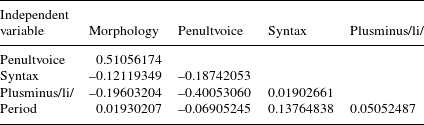
Prior to fitting any model (or MEM), a correlation matrix of the potential predictors of comparative forms (or IVs) considered in the current study was generated in R; as noted before, these IVs were syntax, morphology, plusminus/li/, penultvoice and period. The correlation matrix is presented in Table 5.Footnote [14]
Correlation matrix of all independent variables (IVs) proposed for inclusion in mixed-effects models (MEMs).

Table 5 does not show any pair of IVs to be highly correlated. That is, regardless of the ± sign, there is no value in the table that is
 ${>}$
0.7.Footnote
[15]
This means that the risk is reduced of having one IV as a predictor of another; the presence of this risk would interfere with an MEM’s accuracy in indicating the effect of each IV on the test variable. The values in Table 5 show that at least in the first MEM fitted on my data, none of the IVs considered have to be excluded as a potential predictor of the comparative form found.
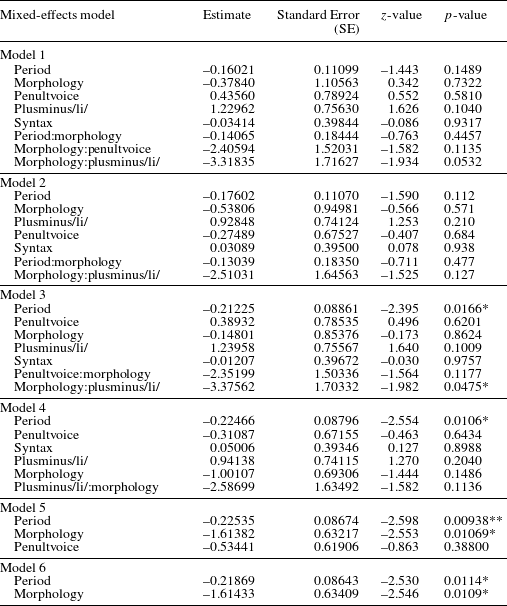
Effects of factors considered on the comparative forms of
 $y$
-adjectives indicated from six mixed-effects models; Model 6 was accepted as best fit for the corpus data.

*
 $p<.05$
, **
 $p<.01$
Note: Factors separated by a colon signal the two-way interactions considered in a specified model, e.g. period:morphology signals the consideration of a two-way interaction between period and morphology in predicting the comparative form found.
The first MEM fitted (Model 1) therefore included all of syntax, morphology, plusminus/li/, penultvoice and period as potential predictors, and additionally, incorporated two-way interactions of morphology with each of period, penultvoice and plusminus/li/. The consideration of an interaction between period and morphology is motivated by the fact that what is deemed morphologically complex in the earlier periods of my study may be deemed morphologically simple in the later ones, e.g. the case of ugly described in Section 4.2 above. An effect of morphology in predicting the comparatives of
 $y$
-adjectives might therefore be escalated/reduced by an effect of period (or vice versa). The consideration of the interaction between morphology and plusminus/li/ stems from an overlap in some
 $y$
-adjectives between a word-final /li/ and morphological complexity, e.g. in lovely (love+ly), so that plusminus/li/ might escalate/reduce an effect of morphology (or vice versa) on the comparative forms found. The consideration of the interaction between penultvoice and morphology is motivated by the observation that additional morphological material in complex
 $y$
-adjectives that extend leftwards beyond the word-final position usually do not extend beyond the penultimate position. In lovely, for example, the beginning of the additional morphological material, /l/ in /li/, does not extend into the word beyond the penultimate position. Features of the penultimate segment considered, in this case, its [±voiced] feature, might therefore escalate/reduce an effect of morphology (or vice versa) on the comparative forms found.
As indicated in Table 6, from the column of
 $p$
-values, the only effect in Model 1 found to approach significance in predicting the comparatives of
 $y$
-adjectives is the two-way interaction between morphology and plusminus/li/ (estimate
 $=$
–3.318, SE
 $=$
1.716,
 $z=-1.934$
,
 $p=.053$
). Each of the other two-way interactions implicating morphology were therefore dropped in turn with the other kept in Models 2 and 3, to determine whether with model simplification, some significant predictors of the comparative forms of
 $y$
-adjectives might emerge. As shown in Table 6, no significant effect emerged in Model 2, while in Model 3, the interaction between morphology and plusminus/li/ is significant (estimate
 $=$
–3.376, SE
 $=$
1.703,
 $z=-1.982$
,
 $p<.05$
), together with the simple effect of period (estimate
 $=$
–0.212, SE
 $=$
0.089,
 $z=-2.395$
,
 $p<.05$
). Since the interaction between morphology and period, and between morphology and penultvoice, are both not significant, respectively in Models 2 and 3, these two interactions were dropped as predictors in Model 4, to check whether further model simplification better describes the data. Like Model 3, the simple effect of period is found to be significant in Model 4 (estimate
 $=$
–0.225, SE
 $=$
0.088,
 $z=-2.554$
,
 $p<.05$
). A comparison between Models 3 and 4 using the anova (analysis of variance) function in the lme4 library (version 1.1-9; Bates et al. Reference Bates, Maechler, Bolker, Walker, Christensen, Singmann, Dai, Grothendieck and Green2015) in R (version 3.1.3; R Core Team 2014) does not show the two models to differ (chi-squared
 $=$
2.680, df
 $=$
1,
 $p>.05$
), justifying the retention of the simpler model with fewer predictors, in this case, Model 4, for further investigation.
A caveat with Model 4, however, were the collinearities found for plusminus/li/ with each of penultvoice and morphology, where collinearities indicate a model’s difficulty in teasing apart the effect of one factor from another in predicting, in this case, the comparative forms of
 $y$
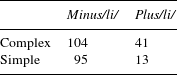
-adjectives. The collinearity between plusminus/li/ and penultvoice can be accounted for since /l/ is [+voiced], which means that none of the items coded with a final /li/ would have a [–voiced] penultimate segment. The collinearity between plusminus/li/ and morphology can also be explained since in the cross-tabulation in Table 7, more than half of the tokens with a final /li/ are complex (41 tokens) while less than half of them are simple (13 tokens).
Cross-tabulation of token counts between morphology and plusminus/li/.

With these collinearities explainable, plusminus/li/ was removed as a predictor in Model 5, together with the removal of syntax, since in Models 1–4, syntax is not even marginally significant, its
 $p$
-value consistently approaching 1.0. Model 5 shows period (estimate
 $=$
–0.225, SE
 $=$
0.087,
 $z=-2.598$
,
 $p<.01$
) and morphology (estimate
 $=$
–1.614, SE
 $=$
0.632,
 $z=-2.553$
,
 $p<.05$
) to be significant predictors, but not penultvoice. Using the anova function in R, a comparison between Model 6 (simplified with the removal of penultvoice as a predictor) and Model 5 does not show the two to differ significantly (chi-squared
 $=$
0.752, df
 $=$
1,
 $p>.05$
). Model 6, being simpler, was therefore accepted over Model 5 as the model that best describes the corpus data.
As indicated in Table 6, Model 6 shows period and morphology to be significant predictors of the comparative forms of
 $y$
-adjectives. Period and morphology are found to influence these comparative forms independently of each other; note that in Model 6, a simple effect each of period and morphology is observed, and not an interaction effect between them. The finding for morphology is the effect of a change from morphological complexity to simplicity on the comparative more form. The finding for period is the effect of every unit increase in period on the more form. The negative estimate for morphology (estimate
 $=$
–1.614, SE
 $=$
0.634,
 $z=-2.546$
,
 $p<.05$
) indicates that morphological simplicity reduces the likelihood that
 $y$
-adjectives are found with more. The negative estimate for period (estimate
 $=$
–0.219, SE
 $=$
0.086,
 $z=-2.530$
,
 $p<.05$
) indicates that passage of time also reduces the likelihood that
 $y$
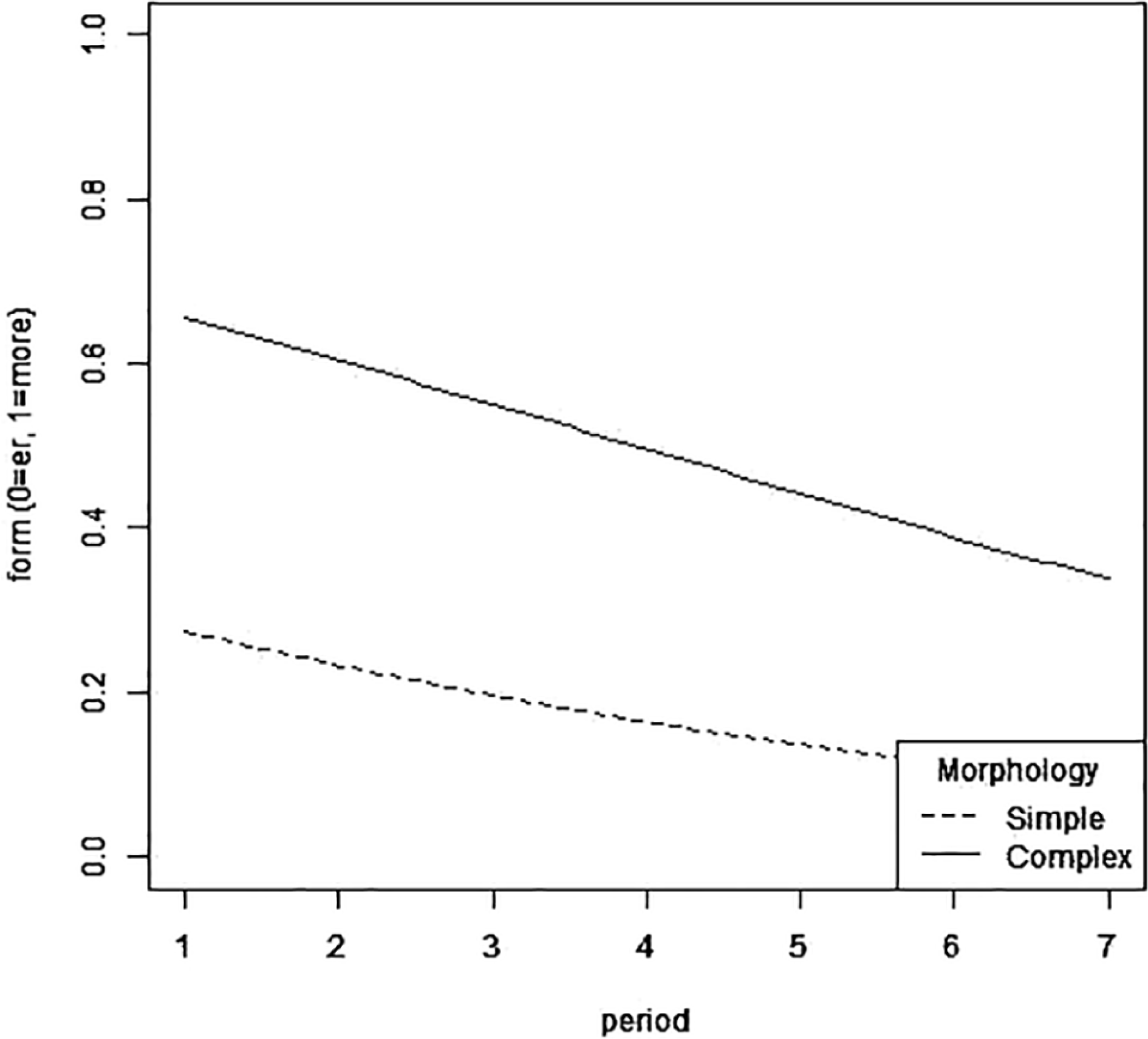
-adjectives are found with more. Figure 1 plots these indications with reference to values obtained from Model 6.
Graph of model that best describes the corpus data.

In Figure 1, values closer to 1.0 on the y-axis indicate a tendency towards more and values closer to 0.0, a tendency towards -er. Since the solid line lies closer to 1.0 than the broken line, we can conclude that complex
 $y$
-adjectives tend towards more and simple
 $y$
-adjectives, towards -er. With a shift from Period 1 towards Period 7, we can also see a general tendency towards -er away from more for both the simple and complex groups. These observations are, to some extent, reflected in the raw data. Table 8 shows more tokens of complex
 $y$
-adjectives paired with more than simple
 $y$
-adjectives paired with more in every period of study.
Raw counts of (morphologically) complex and simple
 $y$
-adjectives paired with more in each period.

Although Table 9 does not show a consistent decline in the raw counts of
 $y$
-adjectives paired with more from the earlier periods to the later ones, the ratio of
 $y$
-adjectives found with more to those found with -er in Period 7 (0.16) is lower than that in Period 1 (0.5).Footnote
[16]
That is, where the raw count of more+
 $y$
-adjective is less than that of
 $y$
-adjective+er, it is lesser in Period 7 than in Period 1. This is aligned with the conclusion from Model 6 of a bias away from more for the
 $y$
-adjectives with time.
Raw counts of
 $y$
-adjectives paired with more and -er in each period.

Of the four base-associated factors studied (syntax, morphology, plusminus/li/ and penultvoice), only morphology has emerged as a significant predictor of the comparative forms of
 $y$
-adjectives. In response therefore to my uncertainties raised in Section 3.1 as to whether syntax and plusminus/li/ are important for comparative alternation in
 $y$
-adjectives with diachronic data covering longer time stretches, the answer seems to be a negative for now, but more on this later with respect to syntax. The factor of penultvoice also does not seem to influence the comparatives of
 $y$
-adjectives, but again, more on this later. What the findings show is that even in the context of diachronic data, the factor of morphological structure remains important for the comparative forms of
 $y$
-adjectives. Since the effect of morphology is found independently of period, this indicates that while the passage of time pushes
 $y$
-adjectives in general away from more, it might not affect any retention of
 $y$
-adjectives with more where the
 $y$
-adjectives are morphologically complex.
4.4 Frequency counts for perspectives associated with more and -er
To further our understanding of comparative alternation in
 $y$
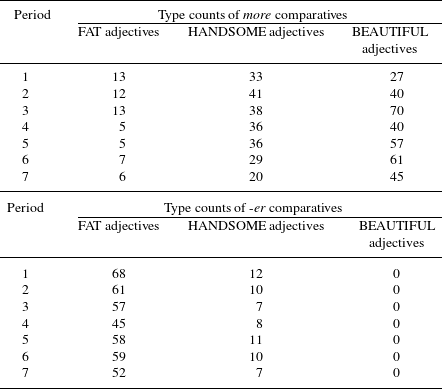
-adjectives, type counts of comparative more and -er constructions obtained from the corpus data for the FAT, HANDSOME and BEAUTIFUL adjectives were correlated with token counts of more and -er constructions for
 $y$
-adjectives. The relevant counts were computed separately for each period of study. Using the IBM SPSS Statistics (version 20) package (IBM Corporation 2011), a series of correlations between the type and token counts were then generated from seven data points corresponding to the seven time periods in the corpus data. These correlations are taken to indicate whether the more and -er comparatives of
 $y$
-adjectives may be related to the more and -er comparatives of other categories of items.
The use of type counts of the comparatives from other categories as input for the correlations is motivated by Marchman & Bates Reference Marchman and Bates1994 and Bybee & Newman Reference Bybee and Newman2007. As noted in Section 3.2, these studies provide the impetus for investigating whether the application of comparatives more and -er on
 $y$
-adjectives may be related to the type count of each pattern of comparative formation. On the other hand, token counts of the comparatives of
 $y$
-adjectives were used as input to the correlations because these counts provide a relatively more comprehensive picture of the incidences of more and -er with
 $y$
-adjectives. While token counts can show how occurrences of more and -er for each
 $y$
-adjective type differ between periods, type counts only indicate whether more and/or -er has been attested with a
 $y$
-adjective type in a given period.
4.5 Perspectives associated with more and -er: Report and discussion of findings
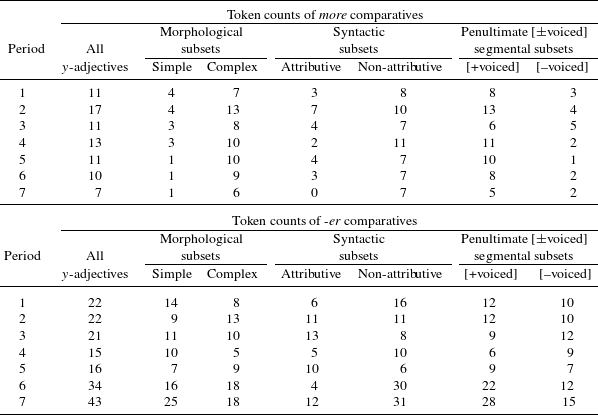
In this section, I report the correlations obtained between type counts of comparatives found with the FAT, HANDSOME and BEAUTIFUL groups of adjectives (see Table 10) and token counts of comparatives found with all
 $y$
-adjectives, and
 $y$
-adjectives as assigned into subsets on the basis of their morphology, their syntactic positioning and the [±voiced] feature of their penultimate segments (see Table 11).Footnote
[17]
With incidences of tied ranks in the input values, where tied ranks refer to identical values in two or more data points of a variable, e.g. the two values of 10 in the token more counts of complex
 $y$
-adjectives (see Table 11), Kendall’s tau-b (
 $\text{T}_{\text{B}}$
) measure of correlation coefficients were generated; see Brown (Reference Brown2011: 11).
Input (type counts) for correlations.

Note: The following mnemonics apply in the table above: FAT adjectives – for monosyllabic adjectives, HANDSOME adjectives – for disyllabic adjectives that are not
 $y$
-adjectives, and BEAUTIFUL adjectives – for adjectives of three or more syllables.
Input (token counts) for correlations.

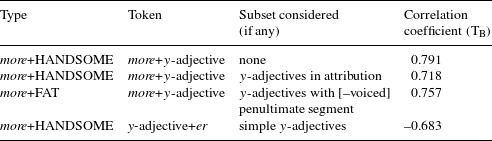
A significant positive correlation is found between the more forms of HANDSOME adjectives and the more forms of
 $y$
-adjectives (
 $\text{T}_{\text{B}}=0.791$
,
 $p<.05$
). This means that higher or lower token counts of more from
 $y$
-adjectives correspond to higher or lower type counts, respectively, of more from the HANDSOME group. No further significant correlation is found between the more forms of
 $y$
-adjectives and the more forms of other categories of adjectives. No significant correlation is also found between the -er forms of
 $y$
-adjectives and the -er forms of any of the FAT, BEAUTIFUL and HANDSOME categories of adjectives. In the assignment of comparative
 $y$
-adjective tokens into various subsets, two significant correlations are obtained: a positive correlation between the more constructions of HANDSOME adjectives and those of
 $y$
-adjectives in attribution (
 $\text{T}_{\text{B}}=0.718$
,
 $p<.05$
), and a positive correlation between the more constructions of FAT adjectives and those of
 $y$
-adjectives with a [–voiced] penultimate segment (
 $\text{T}_{\text{B}}=0.757$
,
 $p<.05$
).
In addition to sets of comparatives implicating the same comparative form, sets of comparatives implicating the alternate comparative form were correlated, e.g. type counts of the more comparatives of HANDSOME adjectives were correlated with token counts of the -er comparatives of (subsets of)
 $y$
-adjectives. These correlations entertain the possibilities of (i) having the lexical spread of more overwhelm any effect the spread of -er has on the pairing of
 $y$
-adjectives with -er, and/or (ii) having the lexical spread of -er overwhelm any effect the spread of more has on the pairing of
 $y$
-adjectives with more. In these correlations, the only significant coefficient found is between the more constructions of HANDSOME adjectives and the -er constructions of simple
 $y$
-adjectives, and the relationship is negative (
 $\text{T}_{\text{B}}=-0.683$
,
 $p<.05$
).
Significant correlations between token counts of (subsets of) comparative
 $y$
-adjective constructions and type counts of the comparatives of other items.

Table 12 summarises all four of the significant correlations obtained, showing that of these four, three implicate the HANDSOME set, and one the FAT set. The significant correlation between the more forms of the HANDSOME adjectives and those of
 $y$
-adjectives, obtained even without considering specified subsets of the
 $y$
-adjectives, is important. It suggests that the more constructions of HANDSOME adjectives should not be kept out of the picture for an understanding of how
 $y$
-adjectives come to be paired with more. The two significant correlations implicating the HANDSOME group suggest further that the more constructions of this group can inform comparative alternation in
 $y$
-adjectives from base-associated perspectives. The positive correlation between counts of more from the HANDSOME group and those from
 $y$
-adjectives in attribution permits a proposal that any anticipated bias for -er in
 $y$
-adjectives in attribution might be suppressed by increased type counts of more+HANDSOME. These increased type counts might also suppress any anticipated bias for -er in simple
 $y$
-adjectives, given the negative correlation between counts of -er from simple
 $y$
-adjectives and counts of more from the HANDSOME group. Returning to the question posed of what keeps
 $y$
-adjectives with more (see Section 2.3), one answer therefore might be the more comparatives of HANDSOME adjectives. Table 12 indicates that these comparatives could be directly keeping
 $y$
-adjectives paired with more, and also indirectly, by reducing any motivation for
 $y$
-adjectives to occur with -er on the grounds of attributive positioning or morphological simplicity.
The potential for understanding the more constructions of
 $y$
-adjectives in terms of those of other English adjectives is indicated in one other correlation in Table 12 – that which implicates the more constructions of FAT adjectives. The factor of the [±voiced] penultimate segment of
 $y$
-adjectives was proposed in Section 3.1.4 as a potential predictor of the comparative forms of these adjectives because it differentiates the pre-comparative base adjectives in terms of some measure of vowel length. This prompts the speculation that
 $y$
-adjectives with a (surface) [–voiced] penultimate segment are less biased towards more than towards -er. In view of this, the positive correlation that implicates the FAT adjectives is interesting. It suggests that any expectation of an -er bias in
 $y$
-adjectives with a [–voiced] penultimate segment could be neutralised in the context of an increased lexical spread of more across the FAT adjectives. The more comparatives of FAT adjectives might therefore keep
 $y$
-adjectives with more.
5 General discussion
A key question at the heart of this article is what keeps
 $y$
-adjectives with more despite observations in Kytö & Romaine Reference Kytö and Romaine1997, Mondorf Reference Mondorf2009 and, to some extent, Bauer Reference Bauer1994, of a seeming regularisation of these adjectives towards -er. The corpus findings suggest that to understand any motivation for more in
 $y$
-adjectives, both base-associated perspectives and perspectives that draw on the more and -er constructions themselves are important. The corpus findings show that while the morphology of
 $y$
-adjectives can account for the pairing of these adjectives with more, more constructions from the HANDSOME and FAT adjectives can also have some bearing on this account. It is worthy of note moreover that the base-associated factors suspected to predict the comparative forms of
 $y$
-adjectives, but which are not found initially to do so (in the MEM analysis), are nonetheless implicated in the correlations that contribute towards an understanding of comparative alternation in
 $y$
-adjectives. For example, although the syntactic positioning of
 $y$
-adjectives is not found to be a predictor in Model 6 (see Table 6), a significant correlation in Table 12 implicates
 $y$
-adjectives in syntactic attribution. Similarly, a correlation implicating
 $y$
-adjectives with a [–voiced] penultimate segment is noted in Table 12 although the [±voiced] feature of penultimate segments is not found as a predictor in Model 6. In other words, I am finding factors like syntax and penultvoice to aid our understanding of the comparatives of
 $y$
-adjectives only in a context that also considers the comparatives of other English items. This observation is important because it suggests that comparative alternation in
 $y$
-adjectives from base-associated perspectives may in some cases only make sense with reference to perspectives that also take into account the comparatives of other English adjectives.
The question remains as to whether it is the more constructions of these other items that matter rather than the -er ones, since none of the significant correlations in Table 12 implicates the -er forms of adjectives that are not
 $y$
-adjectives. Two points are worth noting in this regard. First, even if the lexical spread of -er does not have as strong a bearing as more on the comparatives of
 $y$
-adjectives, the introduction of perspectives associated with the comparative constructions themselves remains of value. Without it, an account of more pairings with
 $y$
-adjectives would implicate only the morphology of these adjectives. We would never have a means of studying how these pairings might also be related to the comparatives of other categories of adjectives. A second point worth noting is that there might not be sufficient evidence yet to conclude that lexical spreads of -er constructions do not have any bearing on the comparatives of
 $y$
-adjectives. It might be that these lexical spreads are simply not large enough in my corpus data for any such bearing to emerge. This is not the same as saying affirmatively that the -er forms of other adjectives are unhelpful in aiding our understanding of comparative alternation in
 $y$
-adjectives.
If we now contextualise my findings within the dynamics of a seeming conflict in
 $y$
-adjectives between more and -er, we might suggest that participants in these dynamics would include both the base adjectives themselves and the comparatives of other English items. Specifically, there are grounds to propose that comparatives of the HANDSOME and FAT adjectives, together with the morphology of
 $y$
-adjectives, could well be the configuration of factors needed to understand just why
 $y$
-adjectives seem constantly divided between -er regularisation and adherence to the general trend in English comparisons of more expansion.
6 Conclusion
The tendency to account for comparative alternation using factors associated with the base adjectives is understandable. After all, it is the base adjective in a specific more or -er construction that participates directly in realising the form of that whole construction. This article does not deny the value of base-associated accounts for comparative alternation. What it hopes to have demonstrated is that for
 $y$
-adjectives, it may help to supplement these accounts with considerations of the lexical spread of comparative constructions. This paper suggests that the lexical spread of more constructions in some categories of English items might just be that something else we need in order to predict more effectively the pairing of more and -er with
 $y$
-adjectives.