Introduction
Interest in microbes and their fermentation end products has been apparent for many centuries, if not millennia. There is evidence of cheese-making dating back to 6000 BC (Ross et al., Reference ROSS, MORGAN and HILL2002). The concept of encouraging certain microorganisms to partially oxidise carbohydrates in a foodstuff to yield compounds (e.g. organic acids) that are inhibitory to other undesirable microorganisms is, therefore, historic, even if the understanding of this process was not fully appreciated until more recently, particularly following the development of pasteurisation. Additionally, products of microbial fermentation (e.g. acetic and propionic acid) may be used to suppress the growth of undesirable microorganisms and thus prevent or slow food spoilage (e.g. in condiments and bakery products) (Kwon and Ricke, Reference KWON and RICKE1998), whilst organic acids, such as acetic and lactic acid sprays are used to decontaminate red meat carcasses (Theron and Rykers Lues, Reference THERON and RYKERS LUES2011). This knowledge has led to the use of organic acids as an effective means of reducing or controlling microbial contamination of feed, or feed raw materials, and a growing interest in their role in the gastrointestinal (GI) environment.
Organic acids
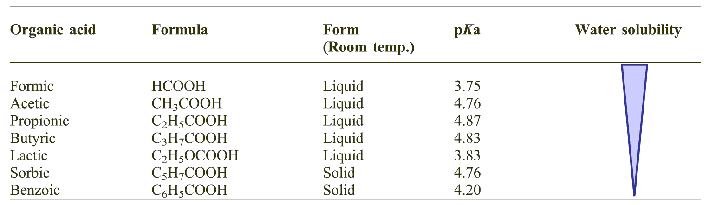
Organic acids (often referred to as volatile fatty acids, fatty acids, carboxylic acids or weak acids) are naturally-occurring, carbon containing (hence organic) compounds with acidic properties. Carboxylic acids (containing at least one carboxyl group (-COOH), which confers the acidity) are the most common organic acids and the monocarboxylic acids (which contain only one carboxyl group and include the short-chain fatty acids (SCFAs) (less than 6 carbon atoms)), tend to be of greater interest. The main monocarboxylic acids of interest are given in Table 1.
Organic acids and their characteristics.
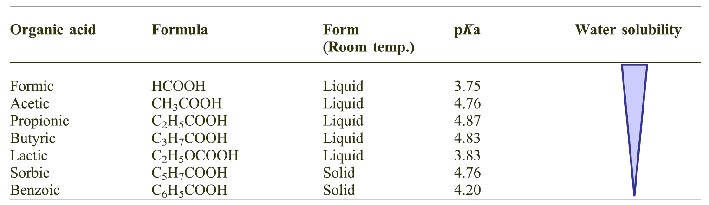
The lower molecular weight organic acids are liquids at room temperature and soluble in water. The pKa value defines the pH at which half the acid is dissociated, which is an important aspect for their antimicrobial effect. The two basic forms of organic acids are pure or buffered acid. The buffered organic acids include calcium and sodium salts (e.g. calcium propionate), which are less corrosive and safer to handle. Specific properties of individual organic acids, e.g. form, size, structure, pKa, concentration, degree of saturation and solubility, affect their characteristics both in-vitro and in-vivo.
Interest in the use of organic acids for farmed animals has increased as a result of two key factors; the desire to reduce enteropathogens from food animals, particularly foodborne pathogens (e.g. Salmonella) and the decreasing global acceptance of using antibiotics as growth promoters (AGPs), particularly since the European Union ban in 2006. AGP removal invariably leads to reduced animal performance and increased disease and welfare problems.
Acid stress and microorganisms
In order to successfully traverse or inhabit the GI tract, microorganisms must survive extreme acid stress provided by the very low pH of the stomach environment. It is thought that the differing infective doses of oral pathogens are determined by their individual ability to survive this extreme stress (Kanjee and Houry, Reference KANJEE and HOURY2013). The cytoplasmic or internal pH (pHin) of most microorganisms is near neutral (pH 7) and they will strive to maintain this pH as it represents the most appropriate conditions for their metabolic apparatus (e.g. enzymes). Some microorganisms, e.g. alkalophiles or acidophiles may have higher (pH 8-9) or lower (pH 6-7) pHin, respectively, whilst the ability and rigidity of individual microorganisms to maintain pHin varies (Booth, Reference BOOTH1985). Microorganisms primarily attempt to maintain pHin by minimising membrane permeability to hydrogen and other ions, buffering the cytoplasm and ion pumping mechanisms. Although the cost to microbial growth has not been clarified, ion pumping is energetically expensive. However, most microorganisms can maintain pHin with a relative degree of success and it has been reported that, in many organisms, the pHin only varies by one tenth of the change in external pH (pHex) (Booth, Reference BOOTH1985).
Organic acids in the intestine
Organic acids are a natural component of the GI environment, arising from microbial fermentation of dietary substrates and endogenous secretions. As the composition and density of the intestinal microbiota changes with age, GI tract location and dietary components, then the concentration of fermentation products (e.g. SCFAs) varies accordingly (Rehman et al., Reference REHMAN, VAHJEN, AWAD and ZENTEK2007). In broiler chickens, typical total SCFA concentrations have been reported to be in the range of 2-12 and 40-100 µmol/g digesta in the small intestine and caeca, respectively, (Rehman et al., Reference REHMAN, VAHJEN, AWAD and ZENTEK2007). Given the recognised beneficial effects of organic acids, their concentrations within the intestine are often seen as indicators of gut health status.
Organic acids and microorganisms
Dietary components in the GI tract provide fermentable substrates, resulting in increasing concentrations of SCFAs as anaerobic microbial density increases along the intestine. Clearly, microorganisms, to varying degrees, regulate cytoplasmic pH and thus can ameliorate the effects of a degree of acid stress. It has been well documented that organic acids have antimicrobial effects. As outlined, an organic acid's pKa value defines the pH at which half the acid is dissociated. It is the undissociated, uncharged, lipophilic portion of the acid that is believed to diffuse freely across the microbial cell membrane. At a pH higher than the organic acid's pKa value, more of the acid will be in the dissociated state. Thus, once in the more neutral (higher) pH of the cell cytoplasm (i.e. higher pH than the acidic parts of the intestine), the acid dissociates. The resulting H+ ion acidifies the cytoplasm, stressing the pH regulatory mechanisms of the cell, whilst the anion portion accumulates in the cell. Both disrupt microbial cell physiology and metabolism through denaturing and causing oxidative damage to proteins/enzymes, increased energy expenditure, osmotic stress and compromising membrane integrity/function, all of which inhibit growth and/or lead to cell death (Theron and Rykers Lues, Reference THERON and RYKERS LUES2011). Table 2 provides minimum inhibitory concentration (MIC) values/ranges for four organic acids against 54 porcine Salmonella enterica serovar typhimurium strains at three different pHs (4, 5 and 6) (Boyen et al., Reference BOYEN, HAESEBROUCK, VANPARYS, VOLF, MAHU, VAN IMMERSEEL, RYCHLIK, DEWULF, DUCATELLE and PASMANS2008).
MIC values/ranges (mM) for formic, acetic, propionic and butyric acid at pH 4, 5 and 6 for 54 porcine Salmonella typhimurium strains (adapted from Boyen et al., Reference BOYEN, HAESEBROUCK, VANPARYS, VOLF, MAHU, VAN IMMERSEEL, RYCHLIK, DEWULF, DUCATELLE and PASMANS2008).

It is clear that as pH increases, the MIC values/ranges increase (showing a greater concentration of the acid is required for inhibition). This would support the hypothesis that at a higher pH, more of the acid is dissociated and less able to penetrate the microbial cell membrane. Thus, within the GI tract, a given concentration of an organic acid is likely to have a greater antimicrobial effect in the lower pH regions than in the higher pH ones, and this is an important consideration for organic acid application and product development.
Organic acids and bacterial virulence
In bacteria, SCFAs have the potential to regulate virulence gene expression. In Salmonella spp. there are indications that the ability of individual acids to achieve this may be different, and both butyric and propionic acid may be particularly effective (Sun and O'Riordan, Reference SUN and O'RIORDAN2013). Pre-treatment of Salmonella enterica serovar enteritidis with butyrate reduces invasion of avian/chicken intestinal and caecal epithelial cells (Van Immerseel et al., Reference VAN IMMERSEEL, DE BUCK, DE SMET, PASMANS, HAESEBROUCK and DUCATELLE2004). For enterohaemorrhagic Escherichia coli (EHEC), it has been reported that EHEC were reduced following incubation of bovine colonic tissues with SCFA, although butyrate has been demonstrated to promote bacterial adherence, possibly via interaction with the leucine-responsive regulatory protein ligand-binding domain (Nakanishi et al., Reference NAKANISHI, TASHIRO, KUHARA, HAYASHI, SUGIMOTO and TOBE2009). Further studies in this area are clearly necessary. Acid tolerance response (ATR) can be induced in Listeria monocytogenes by prior exposure to acid, which enhances survival to subsequent acid stress. The ATR results from cellular adaptations, in response to decreased intracellular pH, which reduce the intracellular level of protons and has also been implicated in promoting L. monocytogenes virulence. However, high levels of butyrate inhibit virulence factor production in L. monocytogenes, thus indicating a protective effect against L. monocytogenes infection by using SCFA (Sun and O'Riordan, Reference SUN and O'RIORDAN2013). For Campylobacter jejuni, SCFA appear to be more involved in protecting host cells against infection rather than affecting the bacteria's virulence gene expression (Van Deun et al., Reference VAN DEUN, PASMANS, VAN IMMERSEEL, DUCATELLE and HAESEBROUCK2008).
In-vivo efficacy
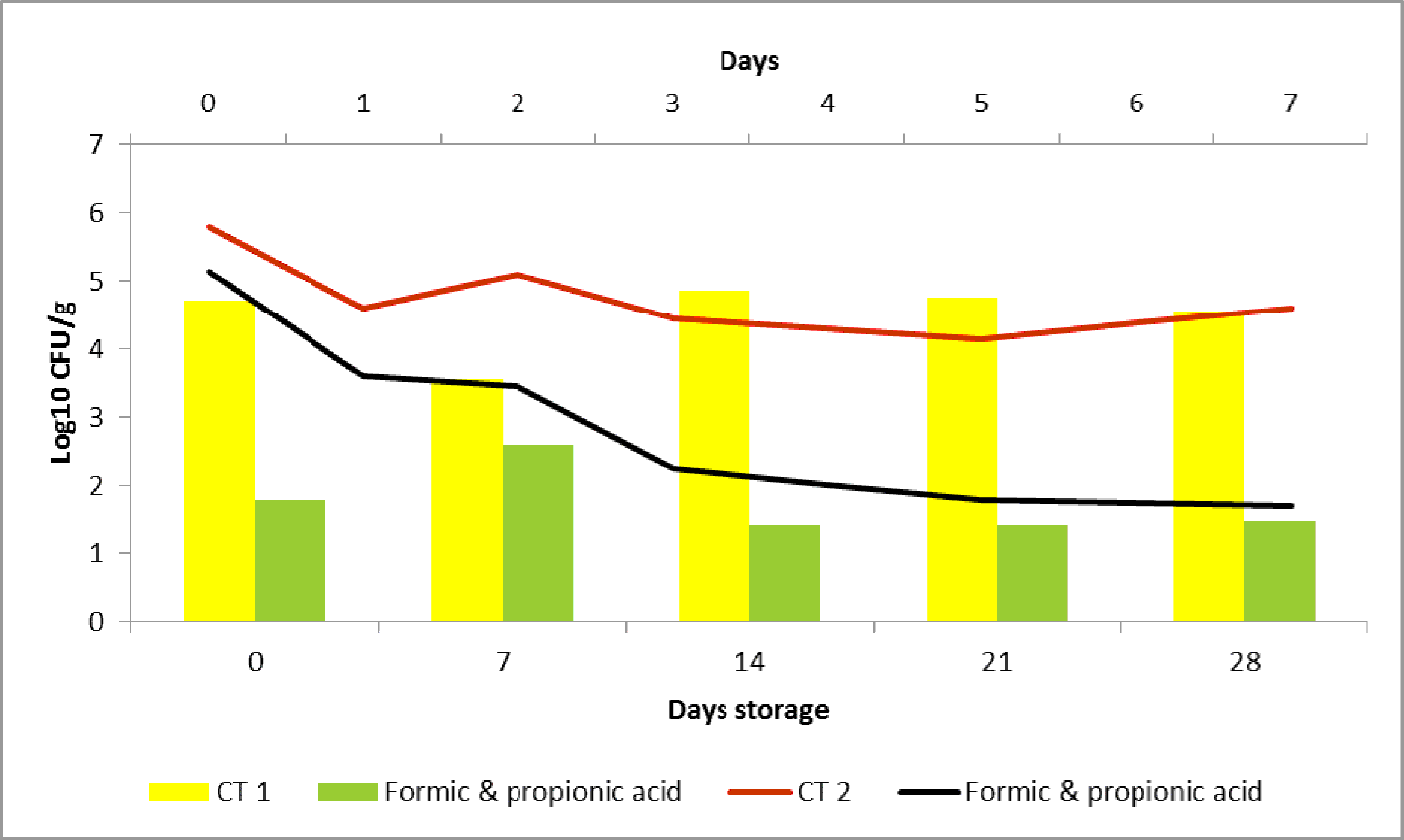
With all this in mind, the attraction of incorporating organic acids into the diets of farmed animals is clear. In the 1960s, there were concerns about Salmonella contamination of animal by-product meals (e.g. meat and bone) and cross-contamination to mixed feeds. Khan and Katamay (Reference KHAN and KATAMAY1969) reported that low molecular weight volatile fatty acids were particularly bacteriostatic or bactericidal against Salmonella spp. Hinton (Reference HINTON1988) demonstrated that giving chickens feed that had been artificially contaminated with Salmonella spp. resulted in intestinal colonisation and excretion of the bacteria. Subsequently, Iba and Berchieri (Reference IBA and BERCHIERI1995) reported that a mixture of formic and propionic acid added to feed inoculated with strains of either S. enteritidis, typhimurium or agona reduced the numbers of Salmonella in the caeca by approximately seven Log10 units. Moreover, the formic and propionic acid mixture had a strong bactericidal effect up to 28 days post feed manufacture, when artificially contaminated with a strain of S. typhimurium (Figure 1).
Log10 CFU of Salmonella per gram (or per 100 g - bar chart) of feed without (control (CT 1 and 2)) or with a formic and propionic acid mixture and contaminated with Salmonella typhimurium on days 0, 7, 14, 21 and 28 following storage (bar chart) or analysed daily for 7 days following contamination on day 0 (line graph) (reproduced from Iba and Berchieri, Reference IBA and BERCHIERI1995).

In a Salmonella challenge study, Al-Tarazi and Alshawabkeh (Reference AL-TARAZI and ALSHAWABKEH2003) reported that mixtures of formic and propionic acid (0.5 -1.5% of each) added to layer chick diets had an inhibitory effect on Salmonella enterica serovar pullorum. At three days of age, the chicks were challenged with 4.7x10⁴ CFU/ml of a S. pullorum isolate that had been selected for its antibiotic resistance to novobiocin and nalidixic acid. The chicks were fed the acid supplemented feeds from day three onwards. Over a 21 day challenge period, combinations of formic and propionic acid reduced the pH of the crop and caecal contents, and the frequency of S. pullorum recovery in these sites. Mortality was 0 and 58% in the unchallenged and challenged control groups respectively, and was reduced compared to the challenged control group by the addition of formic and propionic acid combinations to the feed. Conversely, in earlier work by Thompson and Hinton (Reference THOMPSON and HINTON1997), the addition of combinations of formic (0.43 or 0.86%) and propionic (0.12 or 0.25%) acids to laying hen feed did not affect the pH of various sites in the intestinal tract, including the crop and caeca, but did increase the concentration of both formic and propionic acid in the crop, with increased concentration of undissociated molecules. The hens in the study of Thompson and Hinton were one year old and were fed the diets for one week. Therefore, the differences between studies could be due to the challenge, age of the bird, concentrations of acids or duration of feeding, although feeding regime, dietary ingredients and thus buffering capacity would also be important factors. However, the increase in the concentration of undissociated acid molecules with organic acid supplementation, without a shift in pH, could be significant given the apparent importance of these molecules in terms of the antimicrobial effect of organic acids.
Similar work in turkeys has shown that organic acids (a combination of acetic, formic and vegetable fatty acids), when fed continuously throughout the bird's life at 0.2% in the diet, but not if administered for only five days before slaughter via drinking water (0.15% dose rate), can reduce caecal S. enteritidis numbers by 1.8 Log10 CFU/g following oral inoculation with two 108 CFU doses of S. enteritidis in the three days prior slaughter (Milbradt, 2014a). There was no effect of the organic acids on caecal pH, but the butyric acid concentration in the caecal contents was higher when the organic acids were fed continuously. These data would suggest that, in turkeys, longer-term provision of organic acids are necessary for S. enteritidis control and the effect was mediated through butyric acid, and was not a pH effect. Whilst the effect of butyric acid on Salmonella virulence gene expression and caecal epithelial cell invasion has already been mentioned, the fact that benefit was only seen with longer-term administration could indicate that the butyric acid, in this instance, contributed more to host cell protection from invasion rather than having a direct effect on the organism.
In further work with turkeys, Giannenas et al. (Reference GIANNENAS, PAPANEOPHYTOU, TSALIE, PAPPAS, TRIANTAFILLOU, TONTIS and KONTOPIDIS2014a) reported that although benzoic acid in feed at both 0.03 and 0.1% reduced caecal pH and coliforms and increased lactic acid bacteria, birds on the lower inclusion level outperformed those receiving the higher inclusion, as well as the control birds, through to 56 days of age. Additionally, when applying a near identical trial design to broiler chickens, Giannenas et al. (Reference GIANNENAS, PAPANEOPHYTOU, TSALIE, TRIANTAFILLOU, TONTIS and KONTOPIDIS2014b) observed similar responses with the group receiving the lower benzoic acid inclusion performing better than the higher inclusion, even though any caecal pH reductions were nearly identical for the two inclusion rates. Whilst the specific organic acid, dietary concentration and form may all affect the potential to detectably alter digesta pH at a particular GI tract site, it is clear, contrary to popular belief, that measurable differences (i.e. a reduction) in pH do not determine the efficacy of organic acids.
The antimicrobial activity of organic acids is clear, which enable them to modulate the GI microbiota. As discussed previously, microorganisms have various strategies to cope with acid stress and organic acids, including membrane impermeability to hydrogen ions, proton pumps and cytoplasm buffering. It has been reported that normal pHin, and tolerances of shifts in this parameter, varies between different microbes (Booth, Reference BOOTH1985). The historic use of fermentation for preservation via the selective growth of some bacteria at the expense of others is, in itself, clear proof of this differing susceptibility to organic acids. Research by Nava et al. (Reference NAVA, ATTENE-RAMOS, GASKINS and RICHARDS2009) utilised PCR-based approaches to demonstrate changes in the ileal microbiota of broiler chickens in response to organic acid supplementation. It was reported that a formic and propionic acid-based blend, added to the drinking water at 0.0525%, resulted in much greater numbers of lactobacilli in the lumen of the ileum. Indeed, recent work has confirmed that differing concentrations and combinations of formic and propionic acids, and their salts, on different silica-based carriers reduced caecal E. coli by up to 1.8 Log10 CFU/g contents and increased lactobacilli by up to 2.0 Log10 CFU/g contents in broilers orally challenged with a subclinical dose of E. coli K88 (Khodambashi Emami et al., Reference KHODAMBASHI EMAMI, GRAYSTONE and BROOM2015). These observations are consistent with the MIC values for formic acid against strains of E. coli and lactobacilli (Nakai and Siebert, Reference NAKAI and SIEBERT2003). E. coli growth was inhibited at a formic acid concentration of less than 1/10th of that required to inhibit the lactobacilli (Table 3).
MIC values (g/l) for formic acid for E. coli and two Lactobacillus species (Nakai and Siebert, Reference NAKAI and SIEBERT2003).

Reducing the numbers of more acid-susceptible bacteria enables the more acid-tolerant bacteria to proliferate. Significant reductions in pH at GI sites with organic acid supplementation is likely to be a function of these shifts in the microbial profile and their fermentation products (e.g. more bacteria producing lactic acid), rather than from the organic acid supplemented feed per se, given that, as will be discussed later, typical organic acid product inclusions appear insufficient to significantly lower feed pH, although feed buffering capacity may be reduced. Another interesting aspect of the Nava et al. (Reference NAVA, ATTENE-RAMOS, GASKINS and RICHARDS2009) work was the fact that organic acid supplementation resulted in more homogenous microbial communities within the supplemented group, which may be perceived as desirable for health and performance. Moreover, a negative relationship between propionic, acetic and butyric acids and the numbers of Enterobacteriacea spp. in the caeca have been reported (Nava et al., Reference NAVA, ATTENE-RAMOS, GASKINS and RICHARDS2009). It is clear that the differential antimicrobial activity of organic acids against different microbes would endorse their use with typical probiotic organisms, as the acids can reduce enteropathogens, whilst supporting the proliferation of the probiotic organisms and other ‘beneficial’, acid-tolerant bacteria in the GI tract.
Acidification of drinking water
Poultry drinking water is a potential source of microorganisms and infection, particularly in the warmth of the rearing shed or in warmer climates, which are more conducive to microbial proliferation. Formic acid supplementation of the drinking water at 0.1 or 0.15% for laying hens improved production, egg parameters (weight, grading, shell quality) and immunity under climatic heat stress conditions (Abbas et al., Reference ABBAS, KHAN and REHMAN2013). It can be assumed that microbial control of the water and/or direct effects in the GI tract resulted in better gut health, with positive effects on immunity and performance.
Acids and intestinal morphology
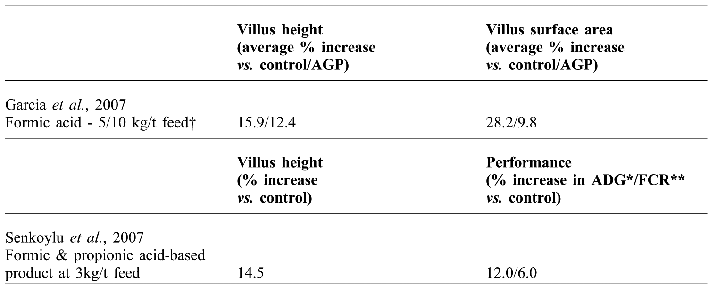
Organic acids are known to have positive effects on intestinal morphology and butyric acid is a preferred energy substrate for colonocytes. Small intestine villus height is important as it determines the functional maturity of enterocytes arriving at the villus tip. With shorter villi, enterocytes reach the villus apex earlier, when their enzyme secretory capacity is less developed, leading to reduced digestive and absorptive efficiency. In work by Garcia et al. (Reference GARCIA, CATALA´-GREGORI, HERNANDEZ, MEGIAS and MADRID2007) jejunal villus height was shown to be greater in broilers fed formic acid at 0.5 and 1.0% of feed (1273 and 1250 µm, respectively) than in either the control group (1088 µm) or an antibiotic (avilamycin) supplemented group (1122 µm) at 42 days of age. This resulted in a numerically larger villus surface area for better nutrient absorption in formic acid fed birds compared to the control or antibiotic group. Moreover, the combination of a formic and propionic acid-based product supplemented at 0.3% of the diet of broiler chickens improved villus height and enhanced growth and efficiency of feed utilisation (Senkoylu et al., Reference SENKOYLU, SAMLI, KANTER and AGMA2007). Table 4 summarises the percentage improvements observed with organic acid supplementation of broilers from the work of Garcia et al. (Reference GARCIA, CATALA´-GREGORI, HERNANDEZ, MEGIAS and MADRID2007) and Senkoylu et al. (Reference SENKOYLU, SAMLI, KANTER and AGMA2007). Some gastrointestinal microorganisms, notably pathogens, are associated with damage to the intestinal epithelium and reduced villus height, which reduces the digestive and absorptive surface area of the intestine, decreases utilisation of dietary substrates and potentially culminating in poor growth performance and wetter faecal material.
Improvements in broiler intestinal morphology and performance with organic acids.
†There were no significant differences between the two formic acid inclusions. Hence, the percentage increases shown are the average of the two inclusions; ADG* = average daily gain; FCR** = feed conversion ratio.
Effects on other body systems
Of course, improving intestinal health can impact other, perhaps less obvious, systems within the body. Of particular interest are the effects on the immune system. Given the intestinal microbiota's proximity to and interaction with the gut-associated lymphoid tissue (GALT) it would, perhaps, not be surprising if organic acid-induced changes to the microbiota influenced intestinal/mucosal immune responses. However, various researchers report effects on systemic immune responsiveness. Khodambashi Emami et al. (Reference KHODAMBASHI EMAMI, ZAFARI NAEINI and RUIZ-FERIA2013) showed that organic acid addition (0.2% in feed) to an apparently phosphorus sufficient diet, changed components of the primary and secondary humoral immune response to intravenous injection of broilers with sheep red blood cells, notably increasing the secondary IgG titre. Ghasemi et al. (Reference GHASEMI, AKHAVAN-SALAMAT, HAJKHODADADI and KHALTABADI-FARAHANI2014) reported that an organic acid blend at 0.4% of the diet increased primary antibody titres to both infectious bursal disease virus and infectious bronchitis virus following vaccination. More recently, various blends of formic and propionic acids, on silica-based carriers, have been shown to enhance systemic cellular immune response in broilers (Anpario, unpublished data). These findings support the role for organic acid supplementation in improving resistance to pathogens (including viral), vaccine response/protection and general health, beyond just the intestine. Further work is required to understand the precise mechanisms involved.
Reproductive function may be affected by organic acid supplementation. Araujo et al. (Reference ARAUJO, ARAUJO, SA, COCKSHOTT, GRAYSTONE and BROOM2015) reported that providing broiler breeder hens, from 25 weeks of age, with a commercial organic acid product, based on the combination of formic and propionic acids, and their salts, at 0.2% of the diet improved fertility at 35 and 45 weeks age. Given that ascending infections of the oviduct from the cloaca are well accepted (De Buck et al., Reference DE BUCK, VAN IMMERSEEL, HAESEBROUCK and DUCATELLE2004), it is not unreasonable to suggest that a more favourable intestinal microbiota can directly impact on reproductive tract health and function. Moreover, organic acid supplementation has been demonstrated to improve immune responses and nutrient digestibility (Khodambashi Emami et al., Reference KHODAMBASHI EMAMI, ZAFARI NAEINI and RUIZ-FERIA2013), both of which could enhance reproductive health and/or function. It is interesting to note from the work of Araujo et al. (Reference ARAUJO, ARAUJO, SA, COCKSHOTT, GRAYSTONE and BROOM2015) that chicks from the supplemented hens grew faster and more efficiently than progeny from non-supplemented hens. Further work is required to better understand the improved performance of non-supplemented progeny from supplemented parent birds. However, hypotheses would include chick conception and development in a more favourable microbial environment, as hatching eggs can be infected with microorganisms at any stage during development, including penetration of the shell (De Reu et al., Reference DE REU, GRIJSPEERDT, MESSENS, HEYNDRICKX, UYTTENDAELE, DEBEVERE and HERMAN2006), and improved deposition of nutrients and/or antibodies in the egg for embryo development, both of which could permanently impact progeny gene expression (a concept referred to as foetal programming). Bacterial endotoxins are known to influence foetal programming (Fisher et al., Reference FISHER, OR'RACHID, QUINTON, ALZAHOL, BOERM, MCBRIDE and KARROW2014).
Variable responses to organic acid supplementation of feed and drinking water
Inevitably, feed or water supplementation does not always provide the anticipated outcome and there can be numerous reasons for this. Even products that, historically, are considered to perform consistently do not always elicit the expected response, even when they have done so previously on the same production site (Broom et al., Reference BROOM, MILLER, KERR and KNAPP2006). With regards to organic acid supplementation, the literature contains examples where there has been no effect or even negative performance responses to organic acids (Józefiak et al., Reference JÓZEFIAK, KACZMAREK and RUTKOWSKI2010; Milbradt et al., Reference MILBRADT, OKAMOTO, RODRIGUES, GARCIA, SANFELICE, CENTENARO and ANDREATTI FILHO2014b). What is particularly interesting about these studies is that there were still positive effects/indicators within the dataset as a whole (e.g. increased favourable bacteria, decreased detrimental bacteria, etc.), which has not translated to performance improvement. Of course, the specific experimental, or production, site circumstances will strongly influence the response to the particular organic acids, concentrations and/or forms. Where the organic acid is considered not to have had the expected efficacy, the experimental design, organic acid characteristics etc., should be reviewed before premature conclusions are formed. Organic acids, like all additives, need scope in which to be effective.
Commercial products
Pure organic acids are volatile, leading to losses even before the animal has consumed the supplemented feed or water. Once ingested, ‘free’ organic acids may be rapidly absorbed or metabolised (Hume et al., Reference HUME, CORRIER, WAYNE IVIE and DELOACH1993). Thus, the form of organic acid will determine if, or where, it will be effective. Buffered salts of, and/or ‘protected’ (e.g. fat-coated or the glyceride(s) of) organic acids tend to be less corrosive and odourless but have no free acidity and are not considered to be effective at controlling microorganisms in high dry matter feed. These forms seem to help to get more of the organic acid into the animal and further along the GI tract, thus enabling in-vivo activity, once they become dissociated or released from the ‘protection’ (e.g. lipase action on fat coating or glyceride). Hence, some commercially available organic acid-based products tend to be a combination of free acids and salts or ‘protected’ acids to promote activity in both the feed and animal. With regards to ‘protected’ acids, of particular note is the monoglyceride forms (i.e. one organic acid molecule bound to a glycerol molecule), which may be particularly antimicrobial (Isaacs, Reference ISAACS2011). Another development has been the concept of loading porous, silica-based carriers with the organic acid (or mixture). The carrier is considered to act like a sponge and, due to being indigestible, can carry and release the acid(s) within the GI tract. Moreover, the acid containing/releasing carrier particles may provide a favourable microenvironment for the growth and proliferation of more acid-tolerant bacteria, whose metabolic activity would contribute to the pool of organic acids in the intestine (Hyden, personal communication).
Organic acid-based supplements for diets are often referred to as ‘feed acidifiers’. Whilst it is reported that the addition of organic acids to feed reduces its pH, this is typically achieved with levels considerably higher than those used commercially for promotion of health and performance. Additionally, where pH changes are reported, it could be arguable whether some of these shifts are really of biological significance. Clearly, the potential for, and degree of feed pH reduction is dependent on the acid, its concentration, inclusion rate and form. It has been reported that a compound feed has a pH of around 6-7, with around 50-55 ml of 0.1 M HCl required to acidify 10 g of feed (e.g. in a standard turkey poult feed) dispersed in 100 ml distilled water to pH 4 (Giannenas et al., Reference GIANNENAS, PAPANEOPHYTOU, TSALIE, PAPPAS, TRIANTAFILLOU, TONTIS and KONTOPIDIS2014a). Similarly, it has been calculated that to reduce a typical complete feed to pH 3 would require 25 litres of 1 M HCl per tonne (Hyden and Philips, Reference HYDEN and PHILIPS2003). Moreover, complete feeds tend to be well buffered (i.e. resist pH changes) and specific ingredients (e.g. calcium carbonate) can significantly increase the buffering capacity of the feed. The values reported using a strong acid indicate how difficult it would seem to be to significantly shift the pH of feed with a weak acid, such as an organic acid. Whilst there may be some effects on feed buffering capacity, the typical inclusion rates of <1% for commercial, organic acid-based products to achieve improved performance, would appear to be somewhat below the level required to appreciably ‘acidify’ the feed and so, in many cases, the term feed ‘acidifier’ may be misleading.
Future work
Whilst this review has considered organic acids in the generic sense, it has outlined differences between acids and forms that should always be borne in mind when considering their effective application for poultry. For example, a liquid organic acid provided via feed, is unlikely to elicit the same effects as the equivalent salt or ‘protected’ (e.g. fat-coated or a glyceride) form. Greater appreciation of these aspects by some researchers would aid organic acid application in the industry. In some cases, researchers need to more specifically characterise the organic acid product used in their work and avoid making generic statements in relation to the benefit, or otherwise, of organic acids when, typically, using only one type or product. Future work with organic acids in poultry should focus on better understanding the in vivo benefits of a particular acid or form, and optimising their application in the mainstream species, as well as less typical species. This, along with improved methods of delivering the selected organic acids to the target site for activity, will enhance the efficacy and consistency of products available to the industry.
Conclusions
It is clear from the data that organic acids have a very important role to play in improving the intestinal health of poultry, particularly in a post-AGP era. Additionally, concern over the use of formaldehyde in the poultry industry is leading to an ever increasing, or renewed, interest in organic acids, not least because of their established and expanding range of in-vivo benefits. Organic acids have a proven antimicrobial effect and, whether through controlling microorganisms in feed, drinking water or directly in the GI tract, are able to reduce microbial challenge in the gut. This, combined with potentially aiding acidification of (particularly the proximal part of) the GI tract (for better protein digestion) and enhanced gut morphology leads to improved utilisation of nutrients, which will result in better and/or more efficient growth. Moreover, organic acids can enhance the benefit derived from other additives, such as probiotics or enzymes (Khodambashi Emami et al., Reference KHODAMBASHI EMAMI, ZAFARI NAEINI and RUIZ-FERIA2013).