Introduction
Childhood asthma is highly prevalent worldwide. The burden of asthma on the physical and emotional wellbeing of the child is well documented in the literature, especially the effects on their daily quality of life and the burden on their parents/guardians, such as lost work days (Lenney, Reference Lenney1997; Mutius, Reference Mutius2000; Woolcock, Bastiampilli, Marks, & Keena, Reference Woolcock, Bastiampilli, Marks and Keena2001). The concern doesn't only include the physical burden on children, such as severity of asthma-related daytime and night-time symptoms, but also extends to include social and emotional impairments. An important factor affecting quality of life of children with asthma is the influence of peer groups in terms of acceptance and rejection (Asano, Sugiura, Miura, Torii, & Ishiguro, Reference Asano, Sugiura, Miura, Torii and Ishiguro2006). Peer relations are considered to provide a basic foundation for developing adequate social skills which, in turn, promotes healthy self-concept (Bukowski & Hoza, Reference Bukowski, Hoza, Bemdt and Ladd1989). Therefore, an important issue to consider in managing asthma is the attitudes of peers towards children with asthma. It can be difficult for a child with asthma to spend their time in a class with peers who do not understand their situation and physical limitations (Brook & Kishon, Reference Brook and Kishon1993).
A literature search was conducted to locate studies that measured healthy children's attitudes towards peers with asthma. Although a few studies investigated adolescents’ attitudes towards peers with asthma, there is a disappointing lack of studies devoted to younger children. The studies available varied in terms of the target population (children, adolescents and adults) and the approaches that have been used to measure attitudes (i.e., how asthma was conceptualised). While many of these studies have measured attitudes of children with asthma towards their illness and treatment regimen (Grant et al., Reference Grant, Turner-Roan, Daugherty, Li, Eckenfels, Baier and Weiss1999; Jackson et al., Reference Jackson, Stensland, Todd, Lullo, Mazan and Masood2006; Wigal et al., Reference Wigal, Stout, Brandon, Winder, McConnaughy, Creer and Kotses1993), only three studies measured adolescents’ attitudes towards peers with asthma (Brook & Kishon, Reference Brook and Kishon1993; Gibson, Henry, Vimpani, & Halliday, Reference Gibson, Henry, Vimpani and Halliday1995; Shaw, Marshak, Dyjack, & Neish, Reference Shaw, Marshak, Dyjack and Neish2005). The literature indicates that children evaluate mentally disabled persons more negatively than physically disabled persons (Gottlieb & Gottlieb, Reference Gottlieb and Gottlieb1977; Parish, Ohlsen, & Parish, Reference Parish, Ohlsen and Parish1978; Willey & McCandless, Reference Willey and McCandless1973). Many studies measured attitudes of school-aged children towards peers with disability, such as handicapped children or children with intellectual disability (Hazzard & Baker, Reference Hazzard and Baker1982; Longoria & Marini, Reference Longoria and Marini2006; Townsend, Wilton, & Vakilirad, Reference Townsend, Wilton and Vakilirad1993). These studies have shown that negative attitudes can have an unfavourable impact on the psychological wellbeing of children (Link & Phelan, Reference Link and Phelan2001). However, given that the negative attitudes of adults emerge in childhood, research into children's understanding and development of attitudes towards their peers with asthma is important.
Purpose of the Study
The purpose of this study was twofold: (1) to develop an instrument to measure attitudes of school-aged children towards peers with asthma; and (2) to explore and assess factors affecting peers’ attitudes towards children with asthma in primary schools.
Methods
Measures
Demographics (age, gender, family history of asthma, and if they knew a person with asthma), attitudes and asthma knowledge were measured by self-report. Because no instrument could be located that was suitable for measuring attitudes of school-aged children towards their peers with asthma, a new scale was developed based on the literature. The development process involved constructing the scale by generating a list of items on the basis of reviewing existing attitude measures; confirming the content validity of the scale by an expert panel; and confirming the user friendliness of the scale by testing it with three primary school children. Studies that investigated attitudes of adolescents toward their peers with asthma provided sufficient background for this study and were used as a basis for constructing the scale. The first study by Brook and Kishon (Reference Brook and Kishon1993) asked participants to rate 10 attitude items, using a scale of 1 (very wrong) to 6 (very right). The second study, reported by Gibson et al. (Reference Gibson, Henry, Vimpani and Halliday1995), developed a 15-item self-report questionnaire to assess two attitudinal domains: tolerance towards asthmatics, and locus of control. Gibson et al.'s scale was used in a third study by Shaw et al. (Reference Shaw, Marshak, Dyjack and Neish2005). Each item was rated by the adolescents on a six-point Likert scale of 1 (strongly disagree) to 6 (strongly agree). Both scales were reviewed and relevant items were retained; the list included four items from Brook and Kishen's attitude scale, and six items from Gibson et al.'s tolerance towards asthmatics subscale. Other items were excluded because they measured other domains, such as asthma knowledge or attitudes toward asthma itself, or because of overlapping items between the scales. Selected items were reviewed by two school nurses expert in childhood asthma, who had regular contact with asthmatic children. Experts provided careful attention to the instrument's wording so that it would suit primary school children. The 10-item scale was pre-tested with three children in the presence of their teachers and the researchers, who took notes and reworded the items as appropriate for 9- to 12-year-old children. To reduce the possibility of a response bias, four items were positively worded (e.g., ‘I am happy to be the friend of a child with asthma’) and six items were negatively worded (e.g., ‘I do not like sitting next to a child with asthma’). Children are asked to respond to each item using a Yes/No format, with a score of 1 assigned to a Yes response and 0 to a No response. After reverse scoring negative items, scores are summed to provide a total attitude score, with higher scores indicating a more positive attitude towards children with asthma. Children's asthma knowledge was assessed using the Asthma Knowledge Test for Children (AKTC) developed by Al-Motlaq and Sellick (Reference Al-Motlaq and Sellick2010) specifically for primary school children. The AKTC consists of 22 true/false items and one item that asks the child to list three symptoms of asthma.
Sample and Procedure
Approval to conduct the study was obtained from Monash University Ethics Committee. In addition, approval was obtained from the Department of Education and Early Childhood Development and the Regional Director of Education in Victoria. A convenience sample of children without asthma aged 9–12 years was recruited into the study from 16 primary schools in the Gippsland region of Victoria, Australia. The only exclusion criterion considered was children with developmental disability. Schools were visited and briefed on the study and were asked to distribute invitation letters, including consent forms, to parents of children without asthma in grades 4, 5 and, 6. Letters constituted plain language statements featuring the aims of the study and the voluntary nature of participation in the study, with no expected risk. Parents were asked to give permission for their child to do both an asthma knowledge test (Al-Motlaq & Sellick, Reference Al-Motlaq and Sellick2010) and the Peers Attitude towards Children with Asthma (PACA) scale as a class activity, and to supervise their child in signing or marking the consent form in agreement. School teachers distributed the tests to the children in their classes, and the completed tests were collated and forwarded to the researchers, using a reply-paid envelop provided to schools. Teachers were asked to help children with reading and completing the tests, and to comment on any difficulties or significant issues on the tests. Responses were coded and entered into SPSS 17.0 software for analyses (SPSS Inc., 2008). Descriptive statistics were used to illustrate sample characteristics and explore children's attitude scores. Inferential statistics (Mann–Whitney and Kruskal–Wallis tests) were used to examine factors affecting children's attitude scores. A p value of .05 or less was considered significant.
Results
Sample Characteristics
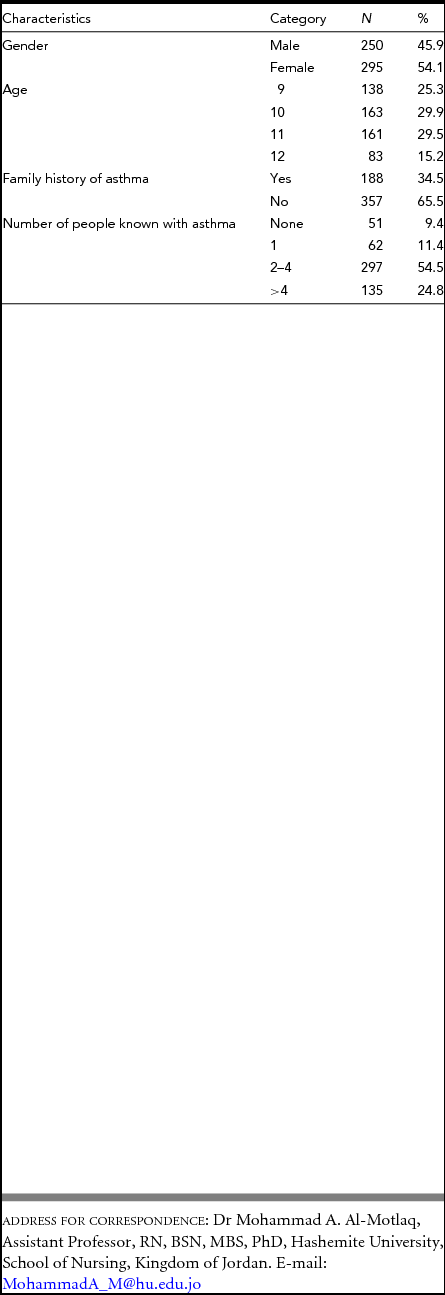
A total of 545 children without asthma participated in the study. Table 1 presents a summary of the sample characteristics. The sample included 250 boys (45.9 per cent) and 295 girls, aged between 9 and 12 years. About one-third (34.5 per cent) of children in the sample had a family history of asthma, and over 90% of them knew at least one person with asthma.
Sample characteristics (N = 545).

Attitudes towards Children with Asthma
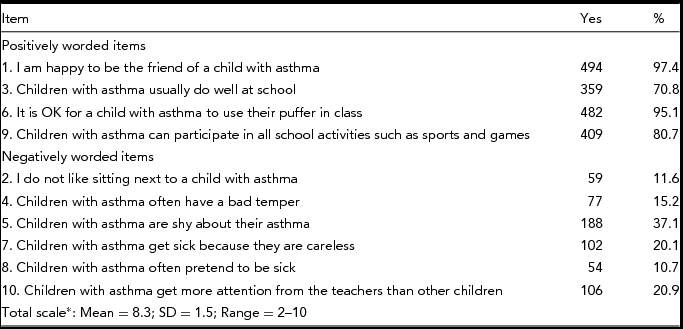
A total of 507 children without asthma completed the PACA scale. Table 2 presents the percentage of children who have agreed on each item and total scale scores. The percentage of Yes responses to positively worded items ranged from 70.8 per cent for item 3 (‘Children with asthma usually do well at school’) to 97.4 per cent for item 1 (‘I am happy to be the friend of a child with asthma’). Percentage of Yes responses for negatively worded items ranged from 10.7 per cent for item 8 (‘Children with asthma often pretend to be sick’) to 37.1 per cent for item 5 (‘Children with asthma are shy about their asthma’). The mean score on the full attitude scale, after correcting for negatively worded items, was 8.3 (SD = 1.5), ranging from 2 to 10. The scale has a Kuder Richardson 21 (KR-21) internal consistency reliability of 0.42.
Attitudes towards children with asthma (N = 507).
*After reverse scoring negatively worded items.
In an attempt to make their point in answering the items of the scale, some children didn't only choose an option (Yes or No) in agreement or disagreement with each statement, but also provided written comments. For example, an 11-year-old girl who disagreed with item 2 (‘I do not like sitting next to a child with asthma’) has provided the comment ‘I do like’. Another example was the answer of a 10-year-old boy who agreed with item 1 (‘I am happy to be the friend of a child with asthma’) and stated ‘I don't mind’. An important point to note was the choice of the two options or writing ‘either’ on the sheet in agreement with both responses for item 3 (‘Children with asthma usually do well at school’). To score this item, choosing both answers was considered a positive attitude and these children were given one point; and children who chose to disagree with the item were given no points, because it was considered a negative attitude towards the asthmatic child.
Factors Affecting Attitudes of Children towards Peers with Asthma
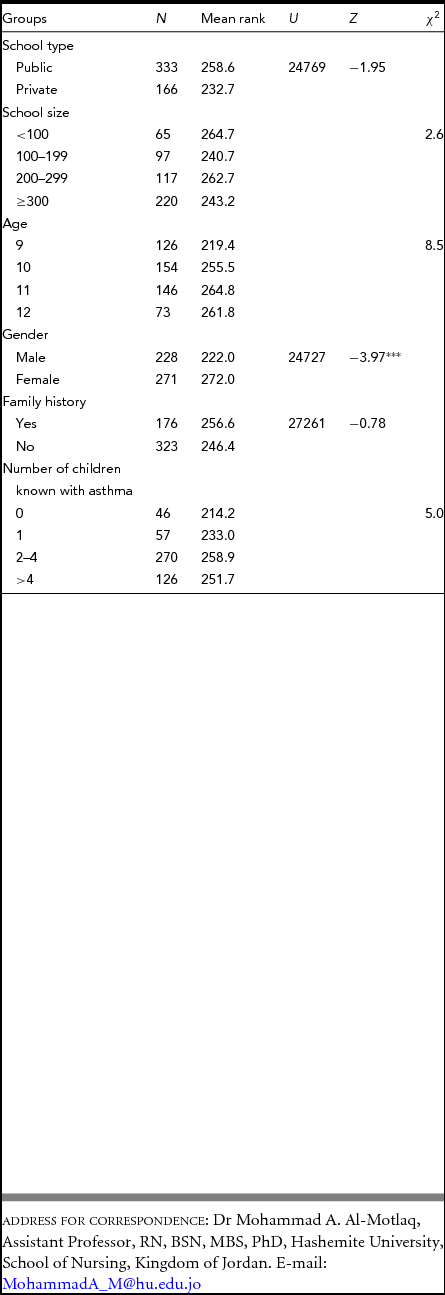
A series of comparative analyses were conducted to identify factors influencing attitudes of children without asthma towards peers with asthma. The total attitude score was examined in relation to the child's gender, age, family history of asthma, number of people they knew with asthma, and both school type and size. Because the distribution of the attitude scores didn't meet the assumption of a normal distribution, non-parametric tests were used to analyse group differences in mean ranks: Mann–Whitney U-test for two-group comparisons and the Kruskal–Wallis test when there were three or more groups. Table 3 presents the results of the comparative analyses. Because several tests were conducted on the same variable, Bonferroni adjustment was made to alpha value (p < .001). Results revealed that gender was the only factor that had affected the attitudes of children without asthma, with girls recording a more positive attitude towards children with asthma than boys. No statistically significant differences were found for school type and size, age, family history of asthma, or the number of children they knew with asthma.
Factors influencing attitude scores (N = 499).
***p < .001
Knowledge of asthma scores was correlated with the total attitudes scores to test associations between the two variables. The non-parametric Spearman's rho correlation coefficient was used because preliminary analyses suggested a violation of the assumptions of parametric tests. There was a small positive correlation between the two variables, R = .23, n = 499, p < .0001, with higher levels of asthma knowledge associated with more positive attitudes towards children with asthma.
Discussion
It is well documented that attitudes of healthy children towards children with a physical disability can influence the psychosocial impact of the illness and hence the child's quality of life (Longoria & Marini, Reference Longoria and Marini2006; Townsend et al., Reference Townsend, Wilton and Vakilirad1993). This has also been shown to be the case for adolescents without asthma towards their peers with asthma (Brook & Kishon, Reference Brook and Kishon1993; Gibson et al., Reference Gibson, Henry, Vimpani and Halliday1995). As far as the authors are concerned, no study could be located that investigated children's attitudes toward peers with asthma in primary schools. Therefore, this paper provides a foundation for investigating the topic. Peers and their attitudes towards children with asthma contribute to the support system for managing children's asthma conditions. Attitudes can be defined as the personal beliefs and feelings towards a child with asthma, which can be positive or negative. Given the lack of a suitable instrument, existing literature provided sufficient background for the development of an attitude scale for the sake of the current study. The new instrument provided a practical child-friendly measure of attitudes towards children with asthma. Generally, the attitudes of children without asthma in the current study were positive. Responses to individual items indicated their willingness to have a child with asthma as a friend, tolerance of the asthmatic child's need to use a puffer in class, and that having asthma does not affect the ability to participate in all school activities. These results compare favourably with findings from Gibson et al.'s (1995) study, which reported high tolerance towards adolescents with asthma.
Comparative analyses identified gender as the only factor affecting attitudes of non-asthmatic children, with girls scoring higher than boys. Rosenbaum, Armstrong and King (Reference Rosenbaum, Armstrong and King1988) also reported female gender to be a significant determinant of children's attitudes towards peers with disabilities. It could be that girls are more sensitive and caring towards peers with a disability or a chronic illness such as asthma. No significant effects were found for type of school (public, private), school size, age of the child, family history of asthma, or number of children they knew with asthma. More contact with people with asthma was expected to produce greater awareness of the illness, and hence greater tolerance towards children with asthma. That's why most studies of attitudes towards children with disability focus on direct contact as an effective way to improve attitudes towards disabled children. An explanation for the lack of a difference in the current study between children who had greater contact and those with less contact might be the highly positive attitude score for the total sample. Health-related policies, such as child-friendly communities and anti-discrimination campaigns, might explain the highly positive attitude of children in the current sample. It is also important to remember that children with a disability often look physically different, while children with asthma usually don’t. The study also found a positive relationship between children's asthma knowledge and their attitudes toward children with asthma. Brook and Kishon's (1993) study of high school students also found a significant positive correlation between attitudes and asthma knowledge. As knowledge of asthma and attitudes towards the disease are considered important predictors of self-management behaviour (Tzeng, Chin, & Chen, Reference Tzeng, Chin and Chen2004), peer attitudes towards children with asthma are considered a major factor for their social inclusion and acceptance in the school community. Providing children with constructive information through different programmes would pave the way for more positive attitudes.
Authors of a number of studies have referred to the role of experience in changing attitudes towards children with an illness. As children mature, their understanding of illness evolves and becomes similar to that of adults (Campbell, Reference Campbell1975). Therefore, involving children without asthma in programmes that are designed to reduce negative attitudes is highly encouraged. However, attitude-changing programmes need to consider more than simply exposing healthy children to others with asthma. The focus should extend to improving other related factors, such as children's knowledge of asthma, hence their attitudes. As more than 20 per cent of children in the sample thought children with asthma are getting more attention from teachers, school staff also need to consider this finding and review the level of attention they give to asthmatic children, while at the same time adjustments need to be made so that all school activities and excursions are suitable for all children. Therefore, it is essential for contemporary school-based asthma management programmes to include interventions targeting non-asthmatic children, with the aim of enhancing their understanding of the illness and improving their attitudes towards their peers with asthma. Another recommendation from the study is to apply further refinement and testing of the developed tool, to produce a more valid and reliable instrument for future research with primary school children.
Conclusions
Findings from this study suggest that children without asthma in primary schools possessed a highly positive attitude towards their peers with asthma. Two factors affected the attitude scores: first, being a female; and, second, having a higher knowledge of asthma. This study also developed an attitude scale that measures the degree of tolerance of healthy children towards children with asthma.
Acknowledgement
The authors wish to acknowledge the support received from the Monash University Postgraduate Publication Award scheme in the writing up of this article.