Introduction
It is predicted that by the 2030s, tobacco smoking will be the cause of 10 million deaths worldwide per year (Jha, Ranson, Nguyen & Yach, Reference Jha, Ranson, Nguyen and Yach2002; Welte, Konig & Leidl, Reference Welte, Konig and Leidl2000), predominantly among those who smoke cigarettes (Doll, Peto, Boreham & Sutherland, Reference Doll, Peto, Boreham and Sutherland2004). Cigarette smoking is the greatest cause of preventable mortality and morbidity in the developed world (Peto et al., Reference Peto, Lopez, Boreham, Thun, Heath and Doll1996; Quinn et al., Reference Quinn, Hollis, Smith, Rigotti, Solberg, Hu and Stevens2009). In the US alone, from 1997 to 2001 smoking has caused approximately 438,000 deaths each year (US Department of Health and Human Services [DHHS], 2006). Indeed, a staggering 20% of all deaths each year in the US can be attributed to smoking; more than all other drug abuse, suicide, crime, AIDS, and car accidents combined (McGinnis & Foege, Reference McGinnis and Foege1999). Unacceptably large smoking-related death tolls have also been reported in the UK (Quinn et al., Reference Quinn, Hollis, Smith, Rigotti, Solberg, Hu and Stevens2009; Sutherland, Reference Sutherland2002), while in Australia, smoking is reported to be responsible for 15,000 deaths annually (Begg, Vos, Barker, Stanley & Lopez, Reference Begg, Vos, Barker, Stanley and Lopez2008; Collins & Lapsley, Reference Collins and Lapsley2008). Quitting dramatically reduces an individual's risk of smoking-related illness (Lightwood & Glantz, Reference Lightwood and Glantz1997; Fagerstrom, Reference Fagerstrom2002).
Based on the impressive efficacy results seen in the initial sponsor-funded clinical trials (Jorenby et al., Reference Jorenby, Hays, Rigotti, Azoulay, Watsky, Williams and Reeves2006; Oncken et al., Reference Oncken, Gonzales, Nides, Rennard, Watsky, Billing and Reeves2006; Gonzales et al., Reference Gonzales, Rennard, Nides, Oncken, Azoulay, Billing and Reeves2006), the launch of varenicline in 2006 was heralded as a major breakthrough in the treatment of tobacco dependence. Subsequent studies, in both clinical (e.g., Rennard et al., Reference Rennard, Hughes, Cinciripini, Kralikova, Raupach, Arteaga and Russ2011; Nides et al., Reference Nides, Oncken, Gonzales, Rennard, Watsky, Anziano and Reeves2006; Aubin et al., Reference Aubin, Bobak, Britton, Oncken, Billing, Gong and Reeves2008) and real-world settings (e.g., Boudrez, Gratziou, Messig & Metcalfe, Reference Boudrez, Gratziou, Messig and Metcalfe2011; Heydari, Talischi, Tafti & Masjedi, Reference Heydari, Talischi, Tafti and Masjedi2012; Jimenez et al., Reference Jimenez, Ramos, Cicero, Mayayo, Cristobal and Lopez2012), have confirmed the drug's efficacy at aiding cessation. Enthusiasm for the drug, however, has been somewhat dampened by concerns about its safety: specifically, since its launch, varenicline has been associated with a number of serious adverse psychological experiences. Of particular concern have been reports that varenicline may exacerbate pre-existing psychiatric illness, and lead to depressed mood, agitation and suicidal ideation (Moore & Furberg, Reference Moore and Furberg2009; Ramon & Bruguera, Reference Ramon and Bruguera2009; c.f., Williams et al., Reference Williams, Anthenelli, Morris, Treadow, Thompson, Yunis and George2012). While clinical studies have so far failed to prove a conclusive causal link, regulatory bodies such as the US Food and Drug Administration (FDA) have nevertheless responded cautiously, adding a series of warnings to the product's packaging, including a so called ‘black box’ warning of potential serious adverse events associated with the drug (FDA, 2011). Regulatory bodies in other jurisdictions, such as the Therapeutic Goods Agency (TGA) in Australia, have followed suit by releasing recommendations for healthcare professionals dealing with patients prescribed varenicline (TGA 2008; 2010).
Regulators’ fears have been somewhat allayed by the status of varenicline as a prescription-only medication: having physicians as ‘gatekeepers’ allows for vetting of patients prior to use, and for close monitoring during treatment. However, there are reasons to query the support offered by healthcare professionals to smokers wishing to quit. Based on a study of US nicotine patch and nicotine gum users, Shiffman and colleagues (Reference Shiffman, Ferguson and Hellebusch2007) found that only approximately half of patients reported that their prescribing physician had told them about potential side-effects of the medications and less than a quarter reported having a follow-up conversation with their physician regarding their quit attempt. Similar findings were reported by Solberg and colleagues (Reference Solberg, Asche, Boyle, Boucher and Pronk2005) whose study on physician assistance provided to bupropion and nicotine replacement therapy (NRT) prescription holders found that, beyond advice on how to use the medication, very low levels of smoking cessation support was given. Less than half of the respondents reported that their physician had encouraged them to set a quit date, and less than a quarter had been asked to have any type of follow-up.
These findings demonstrate that healthcare professionals do not always provide guidance to patients on the use of smoking cessation pharmacotherapy, nor monitor its use. The purpose of this current study was to examine the care provided by physicians and pharmacists to varenicline users under real-world conditions. Specifically, our objective was to assess the level of care provided to patients who had obtained a prescription for varenicline and had thus engaged with a healthcare provider who, given the drug's status as prescription-only, are presumed to be aware of its potential serious side-effects. To this end, patients’ knowledge of potential side-effects of varenicline use was also assessed.
Method
Participants and Recruitment
Thirteen pharmacies across Tasmania (Australia) used their computerised dispensing systems to identify patients who met the study's criteria, namely having filled an initial prescription for varenicline within the previous six months. [The purpose of this time frame was to attempt to minimise recall errors.] Eligible participants were mailed a letter describing the study, a copy of the study questionnaire (described below), and a postage paid envelop in which to return the completed survey.
In total, 546 patients were identified via pharmacy records and mailed the study questionnaire. Of the 546 invitations sent, 32 (6%) letters were returned due to an incorrect address, leaving 514 letters that were assumed delivered to potential respondents. From this denominator, we received 141 completed surveys, giving a response rate of 27% (ranged from 16% to 57% across participating pharmacies).
Gender was well-balanced (55% female) in the final sample. Almost all participants identified as Caucasian (98%) and the mean age was 48.3 years (SD = 14.1). The majority of participants reported being in a relationship, with 40% reporting being married and 16% living with a partner. Approximately one-in-five (19%) participants had a university education and almost half (49%) of participants reported a household income of less than $30 000 per annum. Participants reported smoking their first cigarette around the age of 15 years (m = 14.6, SD = 4.0) and were, prior to their quit attempt, smoking an average 30 days per month (SD = 1.9). Only one participant reported smoking only ‘somedays’ rather than ‘everyday’. Participants reported smoking an average of 22 cigarettes per day (CPD; SD = 9.7) prior to starting treatment and most (94%) reported smoking their first cigarette of the day within an hour of waking, suggestive of a high level of dependence (Heatherton, Kozlowski, Frecker & Fagerstrom, Reference Heatherton, Kozlowski, Frecker and Fagerstrom1991). The vast majority (92%) reported having made at least one attempt to quit smoking in the past. After varenicline, NRT methods (66.7% of sample had tried this technique) and ‘cold turkey’ or no assistance (also 66.7%) were the most commonly used smoking cessation techniques.
Procedures and Measures
The questionnaire consisted of two sections; the first section included general questions about patients’ demographic information and their smoking history. In this section participants were also asked whether their smoking patterns had changed since they had taken varenicline and whether they had made an attempt to stop smoking. [Throughout the questionnaire, varenicline's trade name, Champix, was also included because participants were likely to be more familiar with this terminology.] Participants were also asked to comment on the smoking product(s) and method(s) they had tried in previous quit attempts by selecting from a 17-option check-list. The options in the list were cold turkey, gradual reduction, medication aids (including NRT, bupropion and varenicline), herbal/alternative cessation methods (including hypnosis, acupuncture, and herbal methods), switching to chewing tobacco, using electronic cigarettes, and cessation counselling (Shiffman et al., Reference Shiffman, Ferguson, Rohay and Gitchell2008).
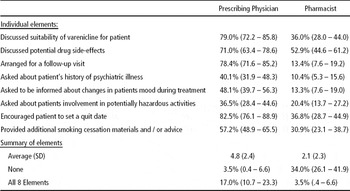
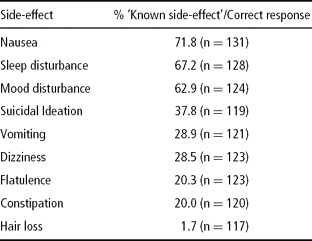
The second section of the questionnaire related to varenicline and participants’ use of varenicline; specifically, the extent of support and assistance provided by the patients’ prescribing physician and pharmacist. A list of eight items (see Table 1) was generated based on the TGA-approved prescribing instructions for varenicline. Participants were asked to indicated ‘yes’, ‘no’ or ‘cannot remember’ to whether their physician had addressed the topic with them when prescribing varenicline. A parallel set of items asked about the participants’ interaction with their pharmacist when filling their prescription for varenicline. Finally, participants were shown a list of supposed medication-induced complaints and asked to indicate whether the item was a known potential side-effect of varenicline use (Table 2; response options – e.g., nausea, hair loss, suicidal ideation). Ethics approval was granted from the Human Research Ethics Committee (Tasmania) Network.
Patients’ Self-reported Care Provided by Prescribing Physician and Pharmacist

Notes: Entries are valid percentages or means with associated 95% confidence intervals.
Results
Table 1 summarises patient-reported care provided by the prescribing physician and pharmacist. More than half of the participants had obtained a prescription by asking, rather than being suggested by, their physician about using varenicline.
Varied Standard of Care Provided by Healthcare Providers
Patients commonly reported that their physician discussed potential side-effects of using varenicline (69.5%), but less than half reported that they specifically discussed psychiatric illness (39%) or asked to be told if they experienced changes in their mood during treatment (46.1%). Similarly, only approximately a third of participants indicated that their physician had spoken to them about being involved in potentially hazardous activities whilst using the drug (e.g., using heavy machinery). Only 17% of participants indicated having each of these eight elements discussed by their physician, and 3.5% reported having none of these elements explained.
Consultation from patients’ pharmacists on the eight elements was considerably lower: over a third of participants indicated that their pharmacists had not discussed any of the eight probed elements with them; only 3.5% reported that their pharmacist had discussed all eight elements with them. Potential side-effects were the only topic that more than half of patients reported discussing with their pharmacist. Less than 10% of participants reported their pharmacist asking them about their psychiatric illness and only 12.8% of their pharmacists asked to be informed about changes in their patient's mood during treatment.
Varenicline Knowledge
Patients’ knowledge of the potential side-effects of varenicline was variable. While only 2% were aware that hair loss was a side-effect of varenicline use, 72% were aware that nausea was. Although almost two thirds of participants reported that mood disturbance was a potential side-effect, less than a half reported to know that suicidal ideation has been associated with varenicline use (see Table 2).
Known Potential Side-effects of Varenicline

Reported Use
Since filling a prescription, 95% (n = 140) had decided to use varenicline as part of a quit attempt. Of the seven participants who reported not having commenced varenicline, one had decided to attempt to quit without using varenicline, two had decided not to quit, and four gave other reasons including ‘felt ill’, ‘travelling overseas’, and due to ‘medical reason’. Only one participant attributed potential side-effects as their reason for deciding not to use varenicline.
While almost all participants had used their prescribed varenicline as part of a quit attempt, only 28.8% (n = 132) were using varenicline in a quit attempt at the time the survey was completed. For participants who were no longer using varenicline, only 14.9% (n = 83) had taken varenicline for the recommended 12 weeks. As recommended by the manufacturer, 78.9% of participants had taken varenicline one (15.6%) to two (46.9%) weeks or more (16.4%) prior to quitting.
Discussion
The data presented offer an important insight into the real-world care provided by physicians and pharmacist to patients using varenicline to quit smoking. Although deemed an effective smoking cessation aid, reports of serious adverse events have resulted in health warnings being included on the product's packaging. The results from this study suggests that, despite the increased warnings, prescribing clinicians and pharmacists often fail to discuss these potential side-effects with their patients prior to use, at least not explicitly, or to monitor their progress during their quit attempt.
Consistent with previous findings of NRT and physician counselling (Shiffman et al., Reference Shiffman, Ferguson and Hellebusch2007; Solberg et al., Reference Solberg, Asche, Boyle, Boucher and Pronk2005), the present study found that while most patients discussed varenicline use with a healthcare provider prior to use, many did not receive the level of support that physicians and pharmacists are assumed to provide. The data suggested that less than a fifth of participants received information and support incorporating all eight elements recommended by the manufacturer's guidelines (Pfizer, 2011). Although most physicians had discussed potential side-effects of varenicline, less than half had specifically asked their patient if they had a history of psychiatric illness, or asked to be told if the patient started experiencing changes to their mood whilst using varenicline. This finding is particularly concerning since the mandated introduction of product warning labels was a result of concerns that using varenicline could exacerbate pre-existing psychiatric illnesses, and lead to depressed mood, agitation and suicidal ideation (Moore & Furberg, Reference Moore and Furberg2009; Ramon & Bruguera, Reference Ramon and Bruguera2009).
One important purpose of these warnings is to encourage healthcare providers prescribing the medication to adequately inform patients of the potential side-effects and other important information, and to monitor patients closely during the medication trial (FDA, 2008). The present findings however, suggest that the prescribing behaviour of physicians usually does not meet the standards set out in the prescribing standards, even when a medication is labelled with a ‘black box’ warning. Since it has also been suggested that patients actually tend to over-report the level of smoking cessation support provided by physicians (Ward & Sanson-Fisher, Reference Ward and Sanson-Fisher1996), real-world care provided to varenicline users by physicians may be even lower than reported in this study.
Participant reports of the information provided to them by their pharmacists in relation to varenicline use were particularly problematic. More than a third of participants suggested that their pharmacist had discussed none of the eight care elements outlined in Table 1, while only 3.5% of patients suggested that their pharmacists had discussed all eight elements. Since pharmacists are generally more accessible (i.e., no appointments are needed) and may interact more regularly with their patients compared to physicians (due to smoking cessation medication being mainly available from pharmacies; Prokhorov et al., Reference Prokhorov, Hudmon, Marani, Foxhall, Ford, Luca and Gritz2010; Dent, Harris & Noonan, Reference Dent, Harris and Noonan2009; Martinez, Knapp & Kottke, Reference Martinez, Knapp and Kottke1993), the fact that less than 10% had asked their patients about pre-existing psychiatric illness and only 13% had asked to be informed of atypical behaviour or mood while using varenicline, is cause for serious concern. It must be acknowledged however, that it may be the case in smaller local community pharmacies that the pharmacist might be so familiar with their clients that they did not need to discuss all elements in question; a conjecture that could be explored in future studies. Alternatively, pharmacists may view this type of monitoring as the domain of the prescribing physician. Additional work is needed to determine the reason for the seemingly passive approach of healthcare providers to their patients using varenicline.
The present study's findings that in most cases participants’ physician and pharmacist do not provide the level of care expected of them when discussing the prescription-only smoking cessation aid varenicline to their patients, may reflect the limited time these physicians and pharmacists have with their clients. Recognition that patient recall of physician advice is strongly associated with visit duration (Flocke & Strange, 2004) reinforces the importance of clinicians using patient consultation time to ensure patients are well informed of the side-effects of varenicline use, that the basic smoking cessation counselling is provided, and that follow-up appointments are made. Implications of this study may include the need to explore ways to condense the varenicline use advice to its most salient points.
There are several limitations to this preliminary study of varenicline prescription users and smoking cessation support provided by their healthcare providers. Perhaps the most restricting limitation for the current study's results is the self-report nature of the data. While a positive report bias may exist, participants’ outcome could also have acted to bias their reports of their physician's care (e.g., perhaps smokers who failed their cessation attempt may have been more likely to report that their physician did not provide support, to reduce any feelings of personal failure). Future studies should consider recording and using transcript data of physician/patient consultations rather than relying on self-reported patient accounts (e.g., Parkin & Skinner, Reference Parkin and Skinner2003). This would also overcome the possibility of recall errors influencing the study findings.
Conclusion
Although varenicline has been shown in clinical and real-life trials to be an effective smoking cessation aid, other studies have suggested it may exacerbate pre-existing psychiatric illnesses in patients and lead to depressed mood, agitation and suicidal ideation. This study demonstrates that the information and support provided to varenicline users by their prescribing physician and pharmacists is often lacking. Whilst this may reflect time constraints typical of patient-physician consultations, further research is needed to determine why patients are not being provided with the basic recommended advice and care.
Acknowledgements
The authors would like to acknowledge Ms Azizah Vonna and Dr Christian Narkowicz for their assistance with data collection and preparing this manuscript.
Financial Support
This study was funded by the University of Tasmania, School of Pharmacy. Dr Ferguson is supported by a research fellowship from Cancer Council Tasmania (Australia).
Conflict of Interest
Through his work at Pinney Associates, Dr Ferguson serves as a consultant to GlaxoSmithKline Consumer Healthcare (GSKCH), makers of nicotine replacement products for smoking cessation. However, neither GSKCH or Pinney Associates had any role in the current study or the resulting manuscript. Dr Frandsen has no conflicts of interest to declare.
Ethical Standards
The authors assert that all procedures contributing to this work comply with the ethical standards of the relevant national and institutional committees on human experimentation and with the Helsinki Declaration of 1975, as revised in 2008.