1 Introduction
Reputedly phonetically balanced texts (see below for a definition of this term) have long been used to elicit examples of different languages and dialects (Deterding Reference Deterding2006), and are part of speech materials used in voice evaluation protocols (Baken & Orkiloff Reference Baken and Orkiloff2000). Two long passages (over 300 words), ‘The Story of Arthur the Rat’ normally considered appropriate for British English and adapted by Abercrombie (Reference Abercrombie1964) from an original text by Sweet (Reference Sweet1895) (see MacMahon Reference MacMahon1991 for further details), and ‘The Rainbow Passage’ (Fairbanks Reference Fairbanks1960: 127) for American English, are widely used. Both have been used in the recording of speaker databases (Markham & Hazan Reference Markham and Hazan2002: 4). ‘The Rainbow Passage’ is widely used for the clinical measurement of voice (Baken & Orkiloff Reference Baken and Orkiloff2000: 172) in English-speaking clients. Reading materials are also used to assess the severity of fluency disorders (Riley Reference Riley2009: 11; Guitar Reference Guitar2014: 146) based on a sample that is representative of the patient's stuttering, which usually corresponds to texts with 150–300 syllables and around 150 words. The texts vary according to the age group, assessment tool and clinical research protocols. ‘The Story of Arthur the Rat’ has been used to record children who stutter (Howell, Sackin & Glenn Reference Howell, Sackin and Glenn1997).
As part of the illustrations of the International Phonetic Alphabet (IPA), a short text (‘The North Wind and the Sun’ passage from a fable by Aesop) has been used over the last 100 years for the transcription of a recorded passage. The NWS text has been proven to be a valuable basis for recording and comparing languages and language varieties (Deterding Reference Deterding2006). This short passage with only around 100 words (e.g. 113 words in English, 112 words in French and 108 words in German) has been used to describe a large variety of languages.
Portuguese is a Romance language spoken all over the world by 244 million people in nine countries as one of their official languages (Angola, Brazil, Cape Verde, China/Macau, Guinea Bissau, Mozambique, Portugal, São Tomé and Príncipe, and East Timor). Only two varieties, European Portuguese (EP) and Brazilian Portuguese (BP), are represented among the illustrations of the IPA (Cruz-Ferreira Reference Cruz-Ferreira1999 and P. Barbosa & Albano Reference Barbosa and Albano2004, respectively), but these account for most (213 million) of the Portuguese speakers worldwide. The Portuguese version of the NWS passage, included in both illustrations, has 98 words and 196 syllables (these numbers were determined using an electronic tool that allows the automatic extraction of frequency of phonological objects in Portuguese based on written text). This is the only standard Portuguese short passage for phonetic research, which has also been proposed as the standard text for voice assessment (Jesus et al. Reference Jesus, Barney, Couto, Vilarinho and Correia2009a, Reference Jesus, Barney, Santos, Caetano, Jorge and Coutob).
However, both Brazilian and Portuguese linguists and speech and hearing scientists have typically used purpose-built texts. Brazilian clinicians have developed passages to analyse specific voice characteristics (Behlau Reference Behlau2001: 107, 134), and Portuguese speech and language therapists have used their own translations of texts such as ‘The Story of Arthur the Rat’ (Guimarães Reference Guimarães2007: 261). None of the texts (including the NWS passage) has been analysed to determine if they are phonetically balanced in Portuguese. There has been a recent attempt (Mendes et al. Reference Mendes, Costa, Martins, Fernandes, Vicente and Freitas2012) to build a specific text for voice assessment, but the frequency data used (Oliveira, Viana & Trancoso Reference Oliveira, Viana and Trancoso1992, Viana et al. Reference Viana, Trancoso, Silva, Marques, Andrade and Oliveira1994) is outdated (collected during the 1980s; see Segura Reference Segura, Raposo, do Nascimento, da Mota, Segura, Mendes, Vicente and Veloso2013 for an updated account on dialectal variation) and the Mendes et al. (Reference Mendes, Costa, Martins, Fernandes, Vicente and Freitas2012) paper includes no phonetic transcription of the text.
A phonetically balanced text (Gibbon, Moore & Winski Reference Gibbon, Moore and Winski1997) covers all phones in the target language, uses a frequency as close as possible to the natural language, contains examples relevant to all phonotactic rules (i.e. the distribution of vowels and consonants in the language), includes the smallest possible number of words and employs only words in current use.
This paper aims to determine if the NWS text is phonetically balanced for EP and BP on the basis of two alternative transcriptions (those presented by Cruz-Ferreira Reference Cruz-Ferreira1999 and P. Barbosa & Albano Reference Barbosa and Albano2004) resulting from algorithms (F. Barbosa et al. Reference Barbosa, Pinto, Resende, Gonçalves, Monserrat, Rosa, Mamede, Baptista, Trancoso and Nunes2003, Martins, Vigário & Frota Reference Martins, Vigário and Frota2013) developed for grapheme–phone transcription in the two varieties of Portuguese (EP and BP). These algorithms (based on standard EP and São Paulo BP varieties) are the same as those used to collect the frequency data (Cirigliano et al. Reference Cirigliano, Monteiro, Barbosa, Resende, Couto and Moraes2005, Frota et al. Reference Frota, Vigário, Martins and Cruz2013), which is central to determining if a text is phonetically balanced. The purpose of the NWS passage is to provide a balanced distribution of all the phonemes in a text that illustrates the phonemes of a language in as wide a range of environments as possible.
1.1 Brazilian Portuguese (BP) and European Portuguese (EP)
In this section we present a brief description of EP and BP phonotactics, so that the readers can have an overview of the most striking differences between the two varieties and can have an overall idea of how these are covered by the NWS versions transcribed in Section 3.1 below. We do not intend to present an exhaustive description of the phonetics of these two Portuguese varieties, depending, rather, on the accuracy of the published accounts. Readers are recommended to consult references cited along the text (Cruz-Ferreira Reference Cruz-Ferreira1999, Mateus & Andrade Reference Mateus and Andrade2000, P. Barbosa & Albano Reference Barbosa and Albano2004, Vigário, Freitas & Frota Reference Vigário, Freitas and Frota2006).
According to P. Barbosa & Albano's (Reference Barbosa and Albano2004) Illustration of the IPA, BP has eleven oral vowels, five nasal vowels, two offglides, six stops, two affricates, three nasal consonants, one tap, seven fricatives and two lateral approximants.
The BP stops /t/ and /d/ are produced as affricates [ʧ] and [ʤ] before [i] and [ɪ], as in tia ‘aunt’ and dia ‘day’ (Mateus & Andrade Reference Mateus and Andrade2000: 17), and also before the nasal vowel [ĩ], as in tinta ‘ink’ and pudim ‘pudding’. The palatal nasal /ɲ/ is frequently reduced to a nasalised palatal approximant. The realisation of the alveolar tap /ɾ/ varies from region to region in Brazil, from a velar fricative (usually voiced [ɣ] between voiced sounds and voiceless [x] in other positions) to a glottal fricative (usually in weak prosodic positions, in casual speech), i.e. /ɾ/ is produced as a tap intervocalically (as in ouro ‘gold’), otherwise as a fricative (reduced word-finally). The velar and the glottal fricative have a higher frequency of production from Rio de Janeiro northwards (Callou, Moraes & Leite Reference Callou, Moraes and Leite1996), and /ɾ/ is always realised as a tap in intervocalic position and presents a high frequency of production from São Paulo southwards (Callou et al. Reference Callou, Moraes and Leite1996).
BP uses seven vowels in stressed position /i
e ɛ a ɔ o
u/ and five nasalised allophones [ĩ

 õ ũ] in stressed position before the archiphoneme /N/ and before heterosyllabic nasal consonants, as cinto ‘belt’ and santo ‘saint’ (P. Barbosa & Albano Reference Barbosa and Albano2004: 229). The unstressed vowels in BP are /i/ and /u/ (high vowels), /e/ and /o/ (mid vowels) and /a/ (low vowel). The unstressed vowel [ɐ] occurs only in word-final position (Mateus & Andrade Reference Mateus and Andrade2000). The vowels /e/ and /ɛ/ are often produced as [e] in pre-stressed position and as [i] in post-stressed position. Vowels /ɔ/ and /o/ are often produced as [o] in pre-stressed position and as [u] in post-stressed position (Mateus & Andrade Reference Mateus and Andrade2000).
In post-stressed position, the variety of São Paulo contrasts four vowels [ɪ
 ɐ ʊ]. The combination of stressed oral vowels with the offglides [
 ] and [
 ] generates a large variety of diphthongs. Nasalised diphthongs derive from the combination of [
 õ ũ] with the offglide [
 ] or [
 ]. Supplementary diphthongs can be formed following [k] with the onglide [
] or emerge from yodisation of vowels (with an exception for [i]) followed by the archiphoneme /S/, as in the words arroz ‘rice’ and mas ‘but’ (P. Barbosa & Albano Reference Barbosa and Albano2004: 230).
Given the work of Cruz-Ferreira (Reference Cruz-Ferreira1999), Mateus & Andrade (Reference Mateus and Andrade2000) and Vigário et al. (Reference Vigário, Freitas and Frota2006), the sound inventory of European Portuguese (EP) has nine oral vowels, five nasal vowels, two glides, six stops, three nasal consonants, one trill, one tap, eight fricatives and two laterals. The uvular trill /ʀ/ can be produced in some variants of EP as a uvular fricative [χ ʁ]. [ʀ] is produced in word-initial position, in syllable-initial position proceeded by a syllable-final consonant or followed by a nasal vowel. In word-final or syllable-final position, or when the rhotic and the preceding consonant belongs to the same syllable, [ɾ] occurs.
With the exception of /ɲ/, /ɾ/ and /ʎ/, all the other phonemes can occur in word-initial position. Phonologically only /ɫ/, /ɾ/ and /ʃ/ can occur in word-final position. Phonetically, any consonant can occur in final position in EP, due to deletion of unstressed vowels (Mateus & Andrade Reference Mateus and Andrade2000).
Syllable-final EP and BP fricatives are voiced when the following consonant is voiced and voiceless when followed by silence or a voiceless consonant (Mateus & Andrade Reference Mateus and Andrade2000). EP /b/ (bilabial), /d/ (dental) and /ɡ/ (velar) voiced stops may be produced as their homorganic fricatives in intervocalic position (P. Barbosa & Albano Reference Barbosa and Albano2004: 228).
The EP stressed vowel system includes /i e ɛ a ɔ o u/. The vowel [ɐ], an allophone resulting from raising /a/ (Vigário et al. Reference Vigário, Freitas and Frota2006: 179), can be produced as a stressed vowel in three types of contexts: before a palatal consonant, before a palatal glide or before a nasal consonant. The vowels [i ɨ ɐ u] constitute the unstressed vowel system. The stressed vowels /e/ and /ɛ/ are produced as [ɨ] in pre- and post-stressed position. Vowel [ɨ] is frequently deleted in colloquial speech, as well as the word-final unstressed [u] (less frequent than [ɨ] deletion). The vowels /ɔ/ and /o/ are produced as [u] in unstressed positions (Mateus & Andrade Reference Mateus and Andrade2000).
The five nasal vowels /ĩ
ũ õ/ are similar in the two varieties of Portuguese (BP and EP). The glides /j/ and /w/ can be combined with oral and nasal vowels to form oral diphthongs and nasal diphthongs, respectively.
1.2 Portuguese illustrations of the IPA
All illustrations of the IPA (IPA 1999) include a transcription of the fable ‘The North Wind and the Sun’ written by Aesop. The illustration of BP (P. Barbosa & Albano Reference Barbosa and Albano2004) is based on the recordings of a 21-year-old female from São Paulo, which is the most populous region of Brazil. The illustration of EP (Cruz-Ferreira Reference Cruz-Ferreira1999) is based on a recording of a female native speaker from Lisbon.
2 Method
2.1 Phonetic transcription
The proposed transcriptions could be classified as phonemic since they ‘require the phonological patterns or “system” of a language to be known before they can be made’ (IPA 1999: 28). Transcriptions do not inherently contain details about the phonetic realisation of the phonemes (IPA 1999), but will do so covertly since positional variants are recognised.
A new phonetic transcription for BP of the NWS was developed using the grapheme–phone transcription algorithm for BP proposed by F. Barbosa et al. (Reference Barbosa, Pinto, Resende, Gonçalves, Monserrat, Rosa, Mamede, Baptista, Trancoso and Nunes2003) and tested in a randomly selected part of the CETENFolha database (Linguateca 2002, Cirigliano et al. Reference Cirigliano, Monteiro, Barbosa, Resende, Couto and Moraes2005). The frequency of phonemes available for BP (Cirigliano et al. Reference Cirigliano, Monteiro, Barbosa, Resende, Couto and Moraes2005: 114) was computed using this algorithm (F. Barbosa et al. Reference Barbosa, Pinto, Resende, Gonçalves, Monserrat, Rosa, Mamede, Baptista, Trancoso and Nunes2003), so the proposed transcription of NWS, based on these rules, allows users to compare the frequency of phonemes in NWS and the frequency of phonemes in CETENFolha.
The phonetic transcription proposed for EP was developed using FreP 3.2.02, which is an electronic tool that allows the automatic extraction of frequency of phonological objects in EP based on written text (Martins et al. Reference Martins, Vigário and Frota2013). The frequency of segments for EP was computed from the database FrePOP (Frota et al. Reference Frota, Vigário, Martins and Cruz2013), which includes frequency information of phonological objects in different corpora. This was used to compare the NWS phoneme frequency and the phoneme frequency in the lexicon.
CETENFolha (Linguateca 2002) and FrePOP (Frota et al. Reference Frota, Vigário, Martins and Cruz2013) are the most recent and largest databases with phoneme frequency information for BP and EP (CETENFolha – more than 24 million words from written language; FrePOP – more than 3.5 million words from written and spoken language).
2.2 Statistical analysis
Pearson's chi-squared goodness of fit test was used to assess the differences between the number of phonemes and their distribution in the NWS and the number of phonemes in CETENFolha and FrePOP databases (α = 0.05).
The null hypotheses for the chi-squared tests were:
-
(i) There is no significant difference between the number of phonemes in the NWS and the number of phonemes in CETENFolha database (for BP)
-
(ii) There is no significant difference between the number of phonemes in the NWS and the number of phonemes in FrePOP database (for EP).
It was expected that for both the EP and the BP texts there were differences between the distribution of phonemes in the text and the languages (BP and EP). In order to analyse which phonemes were causing the major differences (as revealed by Pearson's chi-squared test statistic) a modified Bland–Altman (Bland & Almatan Reference Bland and Altman1986) analysis was performed. This Bland–Altman analysis includes a visual method for assessing agreement between two samples. In the present situation we wish to assess agreement between two sets of frequencies, one of which is the population distribution. Under the null hypothesis that the sample was driven from the population distribution of frequencies, Pearson's test statistic with Yate's continuity correction (Σ k i = 1(|Oi − Ei | − 0.5)2/Ei ) has, asymptotically, a chi-squared distribution with k–1 df. For moderately large or large values of k this means that each term of the sum is approximately chi-squared with one df. In the present case we have k > 30 throughout. Thus we may plot each term (|Oi − Ei | − 0.5)2/Ei together with a line representing the 0.95 quantile of a chi-squared distribution with one df. If the sample frequencies are indeed driven from the population frequencies then we expect to see 95% of the points falling below this limit. The points falling above this limit will be causing the major differences in the test statistic and may reflect a significant difference between the observed frequency and the population frequency.
3 Results
3.1 Phonetic transcription
The Portuguese orthographic version of the NWS passage used in this paper is that previously published in Cruz-Ferreira (Reference Cruz-Ferreira1999: 130) and P. Barbosa & Albano (Reference Barbosa and Albano2004: 231):
-
O vento norte e o sol discutiam qual dos dois era o mais forte, quando sucedeu passar um viajante envolto numa capa. Ao vê-lo, põem-se de acordo em como aquele que primeiro conseguisse obrigar o viajante a tirar a capa seria considerado o mais forte. O vento norte começou a soprar com muita fúria, mas quanto mais soprava, mais o viajante se aconchegava à sua capa, até que o vento norte desistiu. O sol brilhou então com todo o esplendor, e imediatamente o viajante tirou a capa. O vento norte teve assim de reconhecer a superioridade do sol.
The proposed BP transcription, resulting from the use of a grapheme–phone transcription algorithm proposed by F. Barbosa et al. (Reference Barbosa, Pinto, Resende, Gonçalves, Monserrat, Rosa, Mamede, Baptista, Trancoso and Nunes2003) is as follows:
-
[u ˈv
 tu ˈnɔxʧi
i
u ˈsɔw ʤiskuˈʧi
w
kuˈaw
duz ˈdoiz ˈɛɾɐ u ˈmajs ˈfɔɾʧi ˈku
du
suseˈdeu
paˈsaɾ ˈũ viaˈʒ
ʧi ĩˈvowtu ˈnũmɐ ˈkapɐ au ˈvelu ˈpõ
si ʤi
aˈkoɣdu
ˈkõmu
aˈkeli
ki
pɾiˈmejɾu
kõseˈgisi
obɾiˈgaɾ u
viaˈʒ
ʧi
a ʧiˈɾaɾ a ˈkapɐ seˈɾiɐ kõsideˈɾadu
u ˈmajs ˈfɔɾʧi
u ˈv
tu ˈnɔxʧi
kõmeˈso
a
soˈpɾaɾ kõ ˈmujtɐ ˈfuɾiɐ mas ˈku
tu ˈmajs
soˈpɾavɐ ˈmajz
u
viaˈʒ
ʧi
si
akõʃeˈgavɐ a ˈsuɐ ˈkapɐ aˈtɛ ki
u ˈv
tu ˈnɔxʧi ʤizizˈʧiu
u ˈsɔw
bɾiˈʎo
ˈt
w
kõ ˈtodu
u
espl
ˈdoɾ i
imeʤiataˈm
ʧi
u
viaˈʒ
ʧi ʧiˈro
a ˈkapɐ u ˈv
tu ˈnɔxʧi ˈtevi
aˈsĩ ʤi ɣekuɲeˈseɾ a
supeɾioɾiˈdaʤi
du ˈsɔw]
The proposed EP transcription, resulting from the use of FreP 3.2.02 (Martins et al. Reference Martins, Vigário and Frota2013) is as follows:
-
[u ˈv
tu ˈnɔɾtɨ i
u ˈsɔɫ diʃkuˈti
ˈkuaɫ duʃ ˈdojʃ ˈɛɾɐ u ˈmajʃ ˈfɔɾtɨ ˈku
du
susɨˈdew
pɐˈsaɾ ˈũ viɐˈʒ
tɨ
ˈvoɫtu ˈnumɐ ˈkapɐ aw ˈvelu ˈpõ
j
sɨ dɨ ɐˈkoɾdu
ˈkomu ɐˈkelɨ kɨ pɾiˈmɐjɾu
kõsɨˈgisɨ obɾiˈgaɾ u
viɐˈʒ
tɨ ɐ tiˈɾaɾ ɐ ˈkapɐ sɨˈɾiɐ kõsidɨˈɾadu
u ˈmajʃ ˈfɔɾtɨ u ˈv
tu ˈnɔɾtɨ kumɨˈso ɐ suˈpɾaɾ kõ ˈmũ
tɐ ˈfuɾjɐ maʃ ˈkw
tu ˈmajʃ suˈpɾavɐ ˈmajʃ u
viɐˈʒ
tɨ sɨ akõʃɨˈgavɐ a ˈsuɐ ˈkapɐ aˈtɛ kɨ u ˈv
tu ˈnɔɾtɨ dɨziʃˈtiw
u ˈsɔɫ bɾiˈʎo
ˈt
kõ ˈtodu
u ʃpl
ˈdoɾ i
imediatɐˈm
tɨ u
viaˈʒ
tɨ tiˈro ɐ ˈkapɐ u ˈv
tu ˈnɔɾtɨ ˈtevɨ ɐˈsĩ dɨ Rekuɲɨˈseɾ ɐ supɨɾiuɾiˈdadɨ du ˈsɔɫ]
3.2 Comparison between frequency of phonemes in the NWS (BP and EP) and frequency in CETENFolha and FrePOP databases
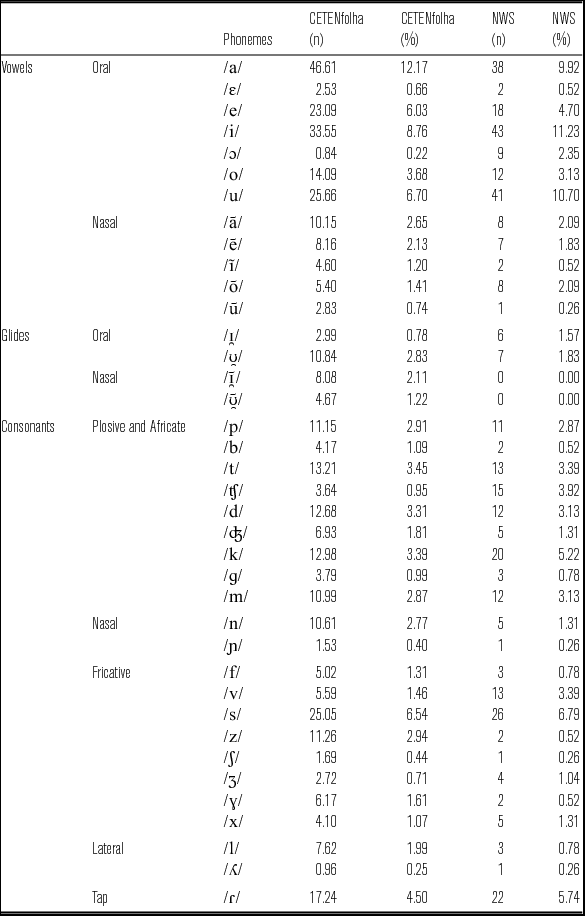
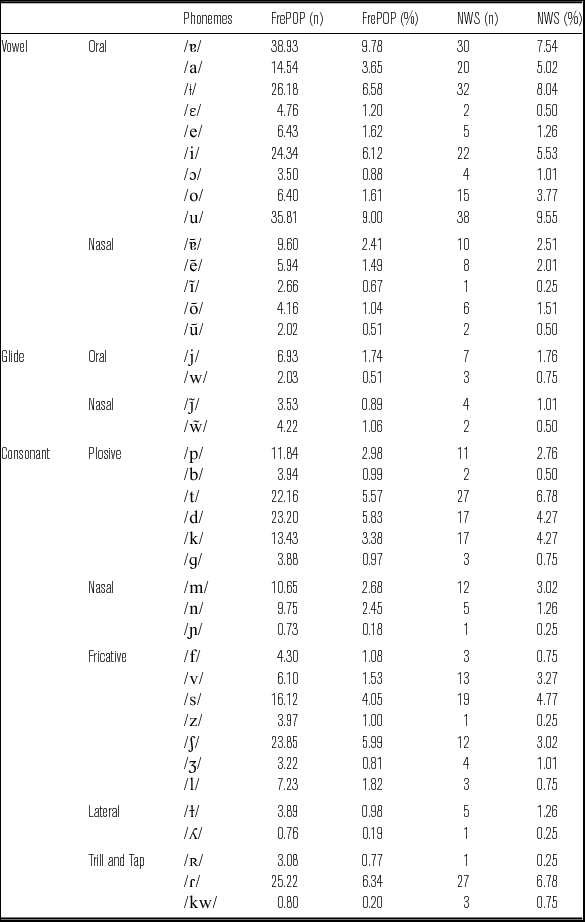
The frequency of phonemes in the databases and the frequency of phonemes in the above NWS transcriptions are presented in Tables 1 and 2 below.
Brazilian Portuguese (BP) phonemes frequency.

Note: Absolute values (n) were calculated to determine the chi-squared values; absolute values (n) for CETENfolha were calculated as CETENfolha (n) = CETENfolha (%) × 383 (total number of segments in the BP NWS).
European Portuguese (EP) phonemes frequency.

Note: Absolute values (n) were calculated to determine the chi-squared values; absolute values (n) for FrePOP were calculated as FrePOP (n) = FrePOP (%) × 398 (total number of segments in the EP NWS). FrePOP counts the /kw/ clusters separately from the /k/ and /w/ frequency calculations, so results for this sequence of phonemes are presented at the end of the table.
3.3 Statistical analysis
For BP, the observed value of Pearson's test statistic was χ2 = 80.28, df = 29, p < .001. For EP, the observed value of Pearson's test statistic was χ2 = 39.08, df = 30, p = .12.
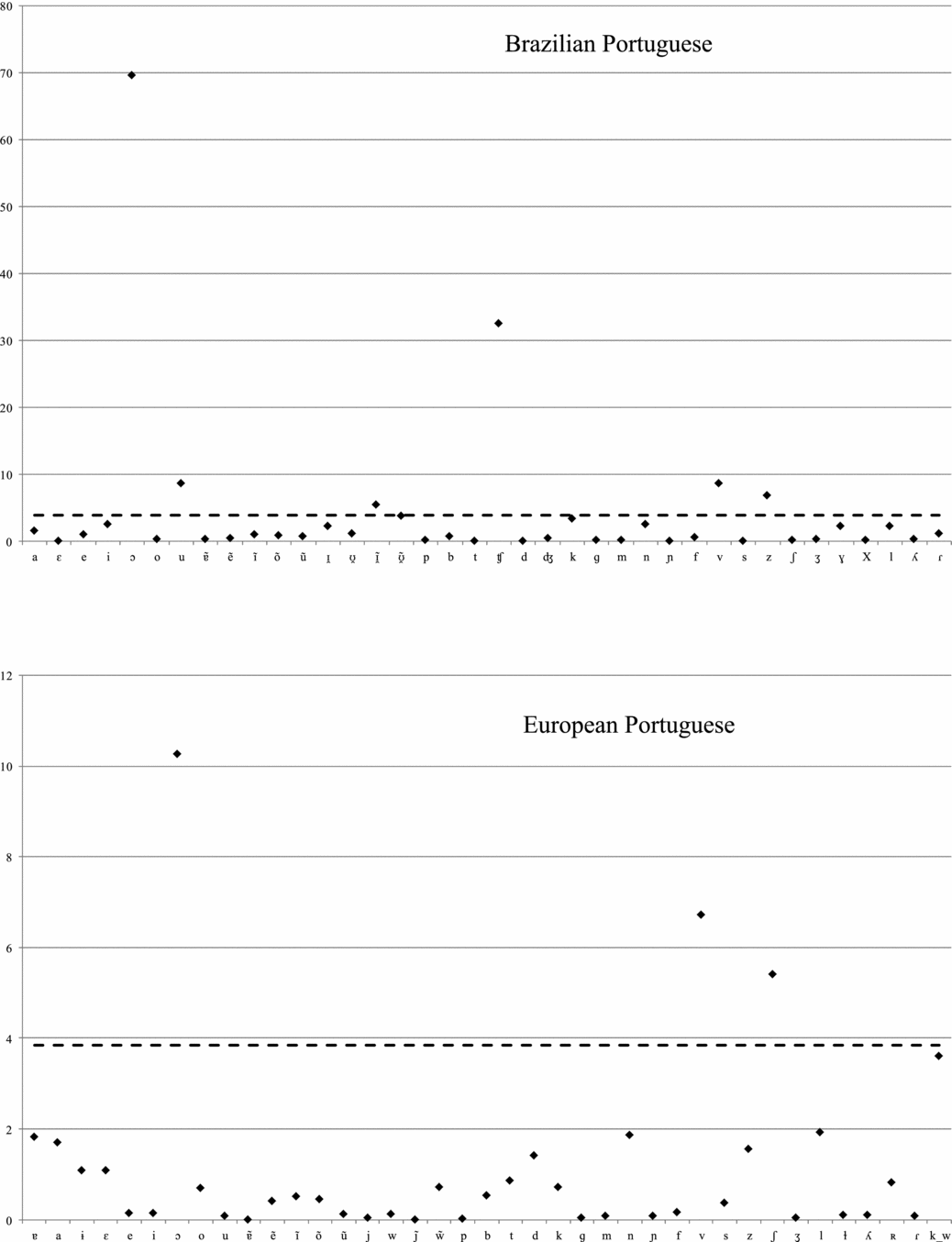
Results from the Bland–Altman analysis shown in Figure 1 revealed that the BP phonemes /ɔ u
ʧ v/ (over-represented) and /z/ (under-represented) were in disagreement with the CETENFolha distribution, and that for EP, /ɔ v/ (over-represented) and /ʃ/ (under-represented) were not in agreement with the FrePOP distribution database. The vowel /ɔ/ is over-represented because the words norte ‘north’, sol ‘sun’ and forte ‘strong’ are repeated in the text. The nasal glides are present in the EP text but absent from the BP text because of the realisation of the words discutiam ‘discussed’, põem-se ‘they stand’, em ‘in’, muita ‘a lot’ and então ‘then’.
Bland–Altman analysis of phoneme frequencies in Brazilian Portuguese (top) and European Portuguese (bottom). The values shown on the y axis result from plotting each (Oi – Ei )2/Ei term. The 0.95 quantile of a chi-squared distribution with one df is shown as a dashed horizontal line. The points above this limit reflect a significant difference between the observed frequency and the population frequency.

4 Discussion and conclusions
The proposed BP and EP transcriptions present all the phonemes of each variety of the Portuguese language, with the exception of /
 / and /
 / for BP (see Tables 1 and 2). The transcriptions cover all phonotactic rules of BP and EP.
A first visual inspection of Table 1 and Table 2 revealed that the relative frequency of phonemes in BP and EP transcriptions were quite similar to CETENFolha and FrePOP databases. However, Pearson's chi-squared test results showed that there was a significant difference between the number of phonemes in the NWS (for BP transcription) and the CETENFolha distribution database. Based on the results of the chi-square tests, it can be said that NWS transcription for BP is not phonetically balanced, because the frequency of phonemes is not similar to the frequency of phonemes in the lexicon.
Nevertheless, when the phonemes of NWS (for the BP transcription) were grouped as oral vowels, nasal vowels, oral glides, plosives, nasal consonants, fricatives and liquids, the null hypothesis of the chi-squared test in (i) above (i.e. there is no significant difference between the number of phonemes in the NWS and the number of phonemes in CETENFolha database) was not rejected by the statistical test. Therefore, the NWS passage could be considered phonetically balanced for BP only in terms of manner of articulation.
Finally, for EP, the chi-squared values lead to the non-rejection of the null hypothesis in (ii) above, i.e. there was no significant difference between the number of phonemes in the NWS (EP transcription) and FrePOP database. Therefore, the NWS passage is a phonetically balanced text for EP.
A phonetically balanced text should meet a number of requirements: cover all phonemes and all phonotactic rules in the target language, and be balanced in frequency.
The BP transcription covers all phonotactic rules, but does not present all phonemes. The text cannot be considered phonetically balanced for this variety of Portuguese due to the differences between the distribution of phonemes in the NWS text and in CETENFolha database. However, the BP passage presents a balanced distribution when the phonemes are grouped by manner of articulation.
Regarding the EP version of the NWS passage, it covers all phonemes and all phonotactic rules in EP, and is balanced in frequency. Therefore, it can be considered as a phonetically balanced text for EP. It is proposed as a standard text for phonetic research in EP and for clinical assessment of patients with fluency or voice disorders. It can be used over a broad age range since it is included in one of the textbooks (for children aged between seven and eight years) recommended by the Portuguese National Reading Plan (Ler+) http://www.planonacionaldeleitura.gov.pt This eliminates the need for individual age-appropriate texts (the NWS passage can be used by children and adults alike), and promotes the widespread use in Portuguese phonetic research and clinical practice of a standard text that is phonetically well-grounded and has been the basis of the IPA Illustrations of a wide range of languages.
Further research should focus on the analysis of potential limitations of the NWS passage for descriptive acoustic research of different Portuguese varieties and regional accents.
Acknowledgements
The authors would like to thank Plínio Barbosa for previous advice on CETENFolha and Fernando Martins for providing a copy of FreP 3.2.02. The authors would also like to thank Adrian Simpson and three anonymous reviewers for comments on an earlier draft of this paper. This work was partially funded by National Funds through FCT – Foundation for Science and Technology, in the context of the project PEst-OE/EEI/UI0127/2014.