Introduction
Broomrapes (Orobanche and Phelipanche spp.) are weedy root parasites that attack dicotyledonous crops and depend entirely on their hosts for all nutritional requirements. These root parasites develop a haustorium, which penetrates host root tissues and serves as a bridge that connects them to the host vascular system, thus facilitating the uptake of water, nutrients, and assimilates (Joel Reference Joel2015). About 170 broomrape species are known worldwide (Schneeweiss Reference Schneeweiss, Joel, Gressel and Musselman2013), 7 of which are noxious weeds of agricultural crops, causing severe yield losses and quality reduction (Parker Reference Parker, Joel, Gressel and Musselman2013).
Nodding broomrape (Orobanche cernua Loefl.) parasitizes members of the Asteraceae in their native habitats, but as a weed in agricultural fields, it typically attacks solanaceous crops, mainly tomato (Solanum lycopersicum L.), potato (Solanum tuberosum L.), and tobacco (Nicotiana tabacum L.) (Joel et al. Reference Joel, Hershenhorn, Eizenberg, Aly, Ejeta, Rich, Ransom, Sauerborn and Rubiales2007). Sunflower broomrape (Orobanche cumana Wallr.) is a specific parasite of sunflower (Helianthus annuus L.) and a major threat to the sunflower industry worldwide. Heavily infested sunflower fields may not give any yield at all (Parker and Riches Reference Parker and Riches1993). In the past, O. cumana was regarded a subspecies of O. cernua. Indeed, the two species are closely related (Manen et al. Reference Manen, Habashi, Habashi, Park and Schneeweiss2004; Schneeweiss et al. Reference Schneeweiss, Colwell, Park, Jang and Stuessy2004), but morphological, chemical, and phenological characteristics indicate that they are separate species (Pujadas and Velasco Reference Pujadas and Velasco2000). The ability to distinguish O. cumana from O. cernua is of agricultural importance, particularly for farmers who know that their fields are infested with broomrape and wish to grow crops that are not susceptible to the parasite.
Despite the apparently clear distinctions in host specificity for O. cumana and O. cernua, host specificity of broomrapes may vary. Data regarding intraspecific changes in the host specificity of Orobanche species have recently accumulated, describing attacks on new hosts and extending the distribution areas of the parasites (reviewed by Dor et al. Reference Dor, Eizenberg, Joel, Smirnov, Achdari and Hershenhorn2014). The intrapopulation variability may change through seed inputs from other populations (Román Reference Román, Joel, Gressel and Musselman2013), contributing to host-range expansion. Low intrapopulation variability of O. cumana in Europe was described 30 yr ago (Gagne et al. Reference Gagne, Roeckel-Drevet, Grezes-Besset, Shindrova, Ivanov, Grand-Ravel, Vear, Tourvieille de Labrouhe, Charmet and Nicolas1998), but some broomrapes have been recently reported to differ in their virulence toward certain crop cultivars (Péres-Vich et al. Reference Péres-Vich, Velasco, Rich, Ejeta, Joel, Gressel and Musselman2013). The best known examples of this are O. cumana races expressing virulence toward a series of resistant sunflower cultivars (Fernández-Martínes et al. Reference Fernández-Martínes, Domíngues, Péres-Vich and Velasco2008).
Host-induced selection is one of the most important selective forces in parasitic weeds and may lead to changes in host specificity (Román Reference Román, Joel, Gressel and Musselman2013). Differences in the chemical composition of host root exudates are important selection factors in the evolution of parasitic weeds (Román Reference Román, Joel, Gressel and Musselman2013; Thorogood et al. Reference Thorogood, Rumsey, Harris and Hiscock2009a, Reference Thorogood, Rumsey, Harris and Hiscock2009b). Most germination stimulants belong to a small class of carotenoid-derived compounds named strigolactones (SLs) (Bouwmeester et al. Reference Bouwmeester, Roux, Lopez-Raez and Bécard2007; Xie et al. Reference Xie, Yoneyama and Yoneyama2010; Yoneyama et al. Reference Yoneyama, Ruyter-Spira, Bouwmeester, Joel, Gressel and Musselman2013). More than 15 different SLs have been structurally characterized. The SLs are plant hormones that are common components of plant root exudates. The composition and relative ratio of individual SLs in root exudates differ among plant species and even among cultivars or ecotypes within the same species. Host selection by root-parasitic plants may be related to these qualitative and quantitative differences (Awad et al. Reference Awad, Sato, Kusumoto, Kamioka, Takeuchi and Yoneyama2006; Ruyter-Spira et al. Reference Ruyter-Spira, Al-Babili, Van der Krol and Bouwmeester2013).
O. cumana differs from most other weedy broomrapes in its limited germination response to SLs and its specific responsiveness to some host-derived guaianolide sesquiterpene lactones (STLs) such as dehydrocostus lactone (DCL) (Joel et al. Reference Joel, Chaudhuri, Plakhine, Ziadna and Steffens2011; Raup and Spring Reference Raup and Spring2013). O. cumana is therefore a highly specialized species, responding mostly to sunflower root exudates, which typically include STLs. Some O. cumana germination has been reported to be elicited by exudates of non-hosts such as cereals, legumes, rapeseed (Brassica napus L.), and cotton (Gossypium hirsutum L.) (Fernández-Aparicio Reference Fernández-Aparicio, Flores and Rubiales2009, Reference Fernández-Aparicio, Yoneyama and Rubiales2011; Ye et al. Reference Ye, Chen, McErlean, Zhang, Yu and Ma2017; Zhang et al. Reference Zhang, Ma, Wang, Ye and Shui2013), but the actual germination stimulants in their exudates are not known.
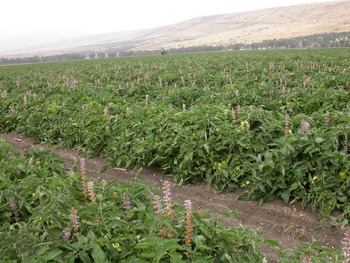
In the summer of 2013, several tomato fields in the Hula Valley (upper Galilee) in Israel were heavily infested with an unusual broomrape (Figure 1). Based on its concurrence on tomato, it was initially identified by the farmers as O. cernua, but morphologically, it resembled the locally known O. cumana. The parasite infested an extended area of about 80 ha. The direct connection between the parasites and the tomato roots was verified by digging up the plants and washing their root systems under tap water.
Tomato field heavily infested with CUCE in the Hula Valley (Upper Galilee) in Israel (2013).

In an attempt to characterize the nature of the new broomrape, which was temporarily named CUCE, we studied its morphology and host range and examined the response of its seeds to various relevant germination stimulants, while comparing it with O. cumana and O. cernua. In addition, the possibility of the new population being a hybrid between O. cumana and O. cernua was examined using simple sequence repeat (SSR) analysis.
Materials and Methods
Plant Material
Orobanche cumana seeds were harvested in 2012 (seed lot 61140) from plants grown in a commercial sunflower field (var. DY3) located near Alonim (32.719°N, 35.145°E), Israel. Orobanche cernua seeds were harvested in a tomato field in Neot Golan (32.787°N, 35.692°E), Israel in 1994 (seed lot 2294/12). O. cernua has gradually disappeared from the agricultural fields in Israel and is found only rarely today. For experimental purposes, our seed stock is frequently replenished by growing the parasite on tomato in the greenhouse. The mature flowering stalks were left to dry for 2 mo at 23 to 35 C. The seeds were then separated and kept in the dark at 4 C until use.
Seeds of the new Orobanche (CUCE) were harvested in 2013 from plants parasitizing processing tomato in the Hula Valley (33.078°N, 35.599°E), Israel (seed lot 62144). Sunflower had been grown in this field as a major crop for many years in rotation with various other crops, occasionally including tomato. When sunflower was no longer productive due to high O. cumana infestation levels, it was replaced with tomato. Tomato was chosen by the farmers as an alternative major crop because it was known as a non-host of O. cumana, despite the fact that a few O. cumana plants had already been recorded there on tomato since 2004 over an area of about 2 ha.
Young tomato plants (M-82) were obtained from Hishtil (Kfar Yedidia, Israel). Sunflower (DY3) seeds were supplied by Shaar Haamakim Seeds (Shaar Haamakim, Israel), and tobacco seeds were obtained from Radi Aly, Newe Ya’ar Research Center, Israel. The chosen tomato and tobacco varieties are known to be highly susceptible to O. cernua, and the DY3 sunflower cultivar is susceptible to O. cumana and commonly used as the susceptible standard in our sunflower resistance studies.
Genomic DNA Extraction and SSR Analysis
Seeds of O. cumana (61140), O. cernua (2294/12) and field-collected seeds of CUCE (CUCE 1), as well as CUCE seeds collected from flowering shoots grown during the pot experiment (CUCE 2, CUCE 3, and CUCE 4) were used for comparison of CUCE with O. cumana and O. cernua by SSR DNA analysis.
Genomic DNA was extracted using a cetyltrimethylammonium bromide–based extraction method (Murray and Thompson Reference Murray and Thompson1980) from approximately 50 mg of 24-h-conditioned seeds taken from each seed lot. The quality and concentration of the genomic DNA was checked using a nanodrop spectrophotometer (Thermo Scientific Nanodrop One-C, Thermo Fisher Scientific, Grand Island, NY, USA) and gel electrophoresis.
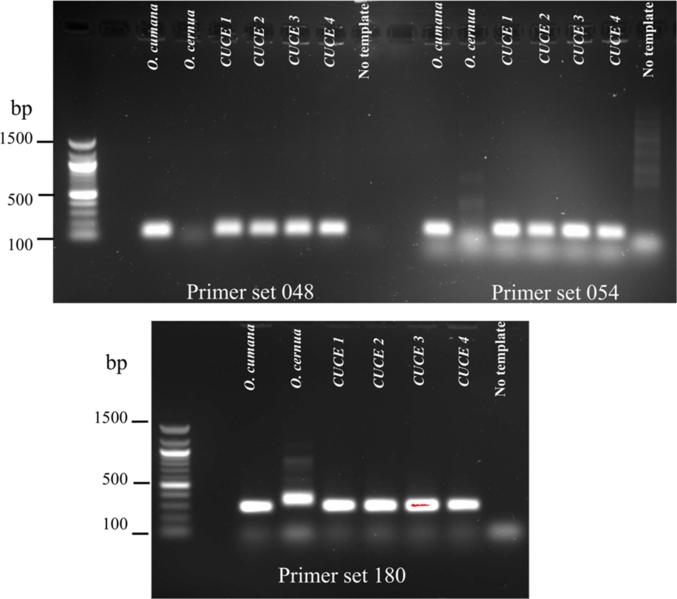
To clarify whether CUCE is O. cumana, O. cernua, or a hybrid of these two species, we used three SSR primer sets described as species specific by Pineda-Martos et al. (Reference Pineda-Martos, Velasco, Fernández-Escobar, Fernández-Martínez and Pérez-Vich2013). Two of the primer sets (Cuma-048 and Cuma-054) amplify SSR regions in O. cumana but not in O. cernua, and one primer set (Cuma-180) differentially amplifies regions in O. cumana and O. cernua. The primer sequences and the expected product sizes are listed in Table 1. The SSR regions were amplified using iProof High-Fidelity DNA Polymerase (BioRad no. 172530, Hercules, CA, USA) and the resulting PCR products were run on a 2% agarose gel at 50 V for 3 h.
Primer sequences and expected product sizes for Orobanche cumana and Orobanche cernua.

Polyethylene Bag (PEB) Experiments
The ability of the seeds of the three broomrapes to germinate near tomato or sunflower roots and the ability of the resulting seedlings to connect to the roots of the two hosts were tested in transparent PEB experiments (Dor et al. Reference Dor, Evidente, Amalfitano, Agrelli and Hershenhorn2007; Linke et al. Reference Linke, Joel, Kroschel and Kroschel2001). Briefly, dry disinfected seeds were dispersed on Whatman GF/A glass microfiber filter sheets at a uniform density of ca. 70 seed cm−2 (about 1,000 seeds per bag). Then 6-wk-old tomato plants or 2-wk-old sunflower seedlings were planted in each PEB, with their root systems carefully spread over the filter paper (Dor et al. Reference Dor, Evidente, Amalfitano, Agrelli and Hershenhorn2007). The plants in the PEBs were fed with half-strength Hoagland solution (Hoagland and Arnon Reference Hoagland and Arnon1950) and kept in a growth chamber at 25 C under a 16/8 h day/night regime. One month later, the percentage of broomrape seed germination and the number of living and abortive broomrape tubercles were counted on host roots under the microscope. Each treatment included five replicates, and the experiment was repeated twice.
Greenhouse Experiments
These experiments tested the ability of CUCE to parasitize sunflower (the common host of O. cumana), as well as tomato and tobacco (the common hosts of O. cernua), and its host preference was compared with those of O. cumana and O. cernua. All greenhouse experiments were conducted in 2-L pots (Tefen Nachsholim, Israel) with medium-heavy clay loam soil containing, on a dry-weight basis, 55% clay, 23% silt, 20% sand, and 2% organic matter at pH 7.1. One plant was planted in each pot. The soil for each treatment was artificially contaminated with seeds of one of the three broomrapes at a concentration of 20 ppm (20 mg seed kg−1 soil) and fertilized at a concentration of 6 g L−1 using Osmocote® (Scotts Miracle-Gro, Marysville, OH). The pot contents were mixed to homogeneity in a cement mixer for 10 min. Pots containing seeds of each broomrape were respectively planted with sunflower, tomato, or tobacco. The pots were placed in a net house and drip irrigated as needed. Each treatment included five replicates, and the experiment was repeated twice. Native temperature and light conditions were used.
Germination Assays
The Orobanche seed-germination bioassay was conducted according to Dor et al. (Reference Dor, Evidente, Amalfitano, Agrelli and Hershenhorn2007). Briefly, disinfected seeds of the three broomrapes were distributed uniformly on wet GF/A glass microfiber filter paper disks at a density of 50 seeds per disk and kept in 5-cm petri dishes. After preconditioning at 25C for 5 d, 250 µl of a germination stimulant was added at concentrations of 10−5 M to 10−12 M. The stimulants used in this experiment were: synthetic SL GR24, orobanchol, an SL secreted by tomato and tobacco roots; 2′-epiorobanchol and 5-deoxystrigol, produced by tobacco; and DCL, an STL produced by sunflower roots (Joel et al. Reference Joel, Chaudhuri, Plakhine, Ziadna and Steffens2011; Yoneyama et al. Reference Yoneyama, Ruyter-Spira, Bouwmeester, Joel, Gressel and Musselman2013). The SLs were kindly provided by Koichi Yoneyama and Xionan Xie from the Center for Bioscience Research and Education, Utsunomiya University, Japan. DCL was supplied by Sigma. The synthetic stimulant GR24, which was used as a standard, was supplied by B. Zwanenburg, Radboud University Nijmegen, Netherlands. The petri dishes were kept in incubator at 25 C, and the germination rates were counted at 7 d after the addition of the respective stimulants. Dose–response curves were plotted, and the GD50 values (stimulant concentration causing 50% of the maximal value of seed germination) were calculated.
Statistical Analysis
The results were subjected to ANOVA by means of JMP Software v. 5.0 (SAS Institute, Cary, NC). Data of the PEB and pot experiments were compared by LSD on the basis of the Tukey-Kramer honestly significant difference test (P < 0.05) and by standard errors of the mean (SEMs). Nonlinear regressions, using Sigma-Plot v. 11.01 (SPSS, Chicago, IL), were computed for the seeds’ responses to the various germination stimulants. All experiments were conducted twice, and results were compared using Fisher’s t-test. The data were combined based on homogeneity of the variances.
Results and Discussion
Morphological Characterization
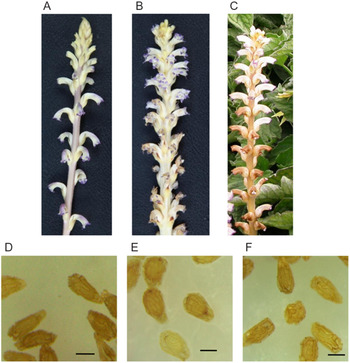
O. cumana plants (Figure 2A) are 40- to 80-cm tall and are characterized by lax inflorescence, sharply recurved corollas, and similar corolla lobes. O. cernua grows underneath the tomato canopy and is 20- to 40-cm tall, with a dense inflorescence. The corolla is bent and horizontally directed (Figure 2B). CUCE plants (Figure 2C) have an unbranched stem, 40- to 80-cm tall, which usually rises in the field above the tomato canopy. The flowering portion of the stem resembles that of O. cumana, is 15- to 30-cm long, about 3 cm in diameter, and relatively lax. The corollas vary in color from white to violet, are sharply recurved, and open to five 2-mm-long violet lobes.
Morphological aspects of CUCE, Orobanche cumana, and Orobanche cernua. Flowering shoot of O. cumana (A), O. cernua (B), and CUCE (C). Seeds of O. cumana (D), O. cernua (E), and CUCE (F). Scale bars: 200 µm.

The seeds of O. cumana are elongate, with elongated and densely pitted testa (Figure 2D). O. cernua seeds are pear-shaped to roundish with short testa (Figure 2E). CUCE seeds resemble O. cumana seeds in that they are elongate, about 0.3-mm long, with elongated and densely pitted testa (Figure 2F).
SSR Analysis
All CUCE DNA samples produced only the specific O. cumana PCR products (Figure 3). When primers 048 and 054 were used, specific bands for O. cumana were obtained between 100 and 200 bp, consistent with the 127-bp and 135-bp bands expected for this species (Table 1), but no bands were amplified from O. cernua template DNA. When primer set 180 was used, both the O. cumana sample and all samples of CUCE showed only one band, around 300 bp, whereas the O. cernua sample produced higher molecular weight bands (400 to 450 bp) as expected for this species.
Gel run of PCR products of genomic DNA extracted from germinating seeds of Orobanche cumana, Orobanche cernua, and CUCE. CUCE 1, seeds collected in a tomato field; CUCE2, CUCE3 and CUCE4, seeds collected from three flowering shoots, which developed in the pot experiment.

Study of Host Range
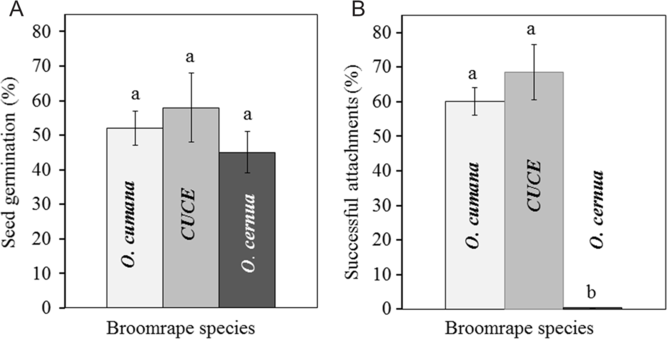
In the PEB system, the sunflower roots induced germination of all three broomrapes, resulting in similar germination rates (Figure 4A); 60% of the O. cumana seedlings and 69% of the CUCE seedlings established healthy attachments on sunflower roots and developed into tubercles (Figure 4B). In contrast, despite 45% germination of O. cernua around the sunflower roots, nearly all O. cernua seedlings that attached to the sunflower roots and all young tubercles died within a short time (Figure 4A and B).
Broomrape seed germination in the sunflower rhizosphere (A), and percentage of live broomrapes (seedlings and tubercles) attached to sunflower roots (B) in the polyethylene bag system. Data were compared by LSD on the basis of the Tukey-Kramer honestly significant difference test. Different lowercase letters indicate significant differences. (A) P-values: CUCE–Orobanche cernua = 0.0902; Orobanche cumana–O. cernua = 0.3261; CUCE–O. cumana = 0.4287. (B) P-values: CUCE–O. cernua < 0.0001; O. cumana–O. cernua < 0.0001; CUCE–O. cumana = 0.3379. Vertical lines indicate SEM. The experiment was conducted twice; results were compared by Fisher’s t-test, and data were combined due to homogeneity of variances.

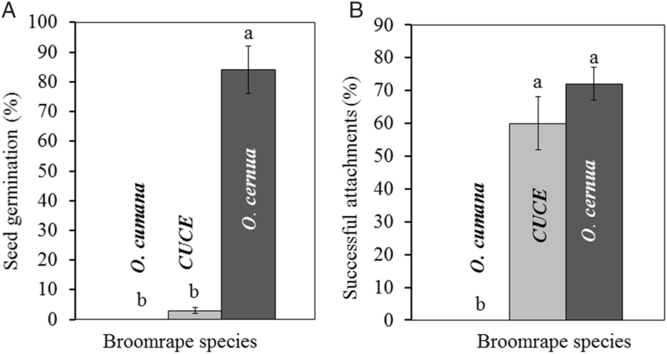
Tomato roots induced 84% O. cernua seed germination (Figure 5A). Most of the seedlings connected successfully to the tomato roots and developed healthy tubercles (Figure 5B). Whereas no germinated seeds of O. cumana were observed in the tomato rhizosphere, 3% of the CUCE seeds did germinate around tomato roots, with most of the resultant seedlings attaching to the roots and successfully developing into healthy tubercles (Figure 5A and B).
Broomrape seed germination in the tomato rhizosphere (A), and percentage of live broomrapes (seedlings and tubercles) attached to the tomato roots (B) in the polyethylene bag system. Data were compared by LSD on the basis of the Tukey-Kramer honestly significant difference test. Different lowercase letters indicate significant differences. (A) P-values: CUCE–Orobanche cernua < 0.0001; Orobanche cumana–O. cernua < 0.0001; CUCE–O. cumana = 0.8350. (B) P-values: CUCE–O. cernua = 0.3416; O. cumana–O. cernua < 0.0001; CUCE-O. cumana < 0.0001. Vertical lines indicate SEM. The experiment was conducted twice; results were compared by Fisher’s t-test, and data were combined due to homogeneity of variances.

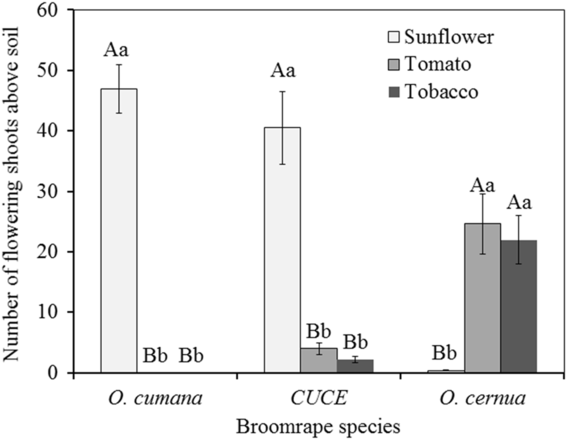
The results of the pot experiments were similar to those obtained in the PEB experiments. Both O. cumana and CUCE successfully parasitized sunflower and developed healthy flowering shoots, whereas no O. cernua shoots developed on this host in the pots (Figure 6).
Development of mature Orobanche cumana, Orobanche cernua, and CUCE plants in pots with sunflower (producing DCL) and tomato and tobacco (producing SLs) as hosts. Data were compared by LSD on the basis of the Tukey-Kramer honestly significant difference test. Different lowercase letters indicate significant differences in the number of flowering shoots between various hosts for the same Orobanche species. P-values for O. cumana: sunflower–tobacco and sunflower–tomato < 0.0001; tomato–tobacco = 0.9999. P values for CUCE: sunflower–tobacco and sunflower–tomato < 0.0001; tomato–tobacco = 0.4818. Different uppercase letters indicate significant differences in the number of flowering shoots attached to the same crop between Orobanche species. P-values for tomato: CUCE–O. cernua = 0.0008; O. cumana–O. cernua = 0.0002; CUCE–O. cumana = 0.6058. P-values for tobacco: CUCE–O. cernua < 0.0001; O. cumana–O. cernua < 0.0001; CUCE–O. cumana = 0.0901. P-values for sunflower: CUCE–O. cernua < 0.0001; O. cumana–O. cernua < 0.0001; CUCE–O. cumana = 0.0979.Vertical lines indicate SEM. The experiment was conducted twice; results were compared by Fisher’s t-test, and data were combined due to homogeneity of variances.

Orobanche cernua developed many flowering shoots in the pots with tomato. Whereas no O. cumana shoots developed on tomato, a few shoots of CUCE did develop on all tomato plants (Figure 6).
The results with tobacco were similar to those with tomato (Figure 6).
The Effect of Germination Stimulants in Vitro
O. cernua germination was observed at low GR24 concentrations, with a GD50 of about 10−9 M. The seeds of both O. cumana and CUCE responded to GR24 stimulation only at concentrations higher than 10−9 M. The germination rates of O. cumana and CUCE seeds increased similarly with GR24 concentration, except for the maximal germination rates, which were 80% for O. cumana and only 55% for CUCE (Figure 7A).
Effect of germination stimulants on Orobanche cumana, Orobanche cernua, and CUCE germination. (A) GR24, (B) orobanchol, (C) 2′-epiorobanchol, (D) 5-deoxystrigol, and (E) dehydrocostus lactone (DCL). Data were computed by nonlinear regressions using Sigma-Plot v. 11.01, y =  $${a \over {1 + {{\left( {{x \over {{x_0}}}} \right)}^b}}}$$. (A) For O. cumana: a = 81; b = 0.21; x0 = −8.3; P < 0.0001; R2 = 0.99. For CUCE: a = 58; b = 0.21; x0 = −8.5; P < 0.0001; R2 = 0.99. For O. cernua: a = 88; b = 0.43; x0 = −8.9; P < 0.0001; R2 = 0.99. (B) For O. cumana: a = 57; b = 0.33; x0 = −7.1; P < 0.0001; R2 = 0.99. For CUCE: a = 43; b = 0.57; x0 = −8.1; P = 0.0007; R2 = 0.92. For O. cernua: a = 89; b = 0.29; x0 = −10.8; P < 0.0001; R2 = 0.99. (C) For O. cumana: a = 57; b = 0.74; x0 = −7.3; P = 0.0004; R2 = 0.97. For CUCE: a = 47; b = 0.33; x0 = −9.1; P < 0.0001; R2 = 0.97. For O. cernua: a = 93; b = 0.30; x0 = −9.8; P < 0.0001; R2 = 0.99. (D) For O. cumana: a = 71; b = 0.31; x0 = −7.7; P < 0.0001; R2 = 0.99. For CUCE: a = 55; b = 0.68; x0 = −8.1; P = 0.0001; R2 = 0.96. For O. cernua: a = 84; b = 0.45; x0 = −9.5; P = 0.0004; R2 = 0.99. (E) For O. cumana: a = 69; b = 0.46; x0 = −9.9; P < 0.0001; R2 = 0.97. For CUCE: a = 39; b = 0.78; x0 = −9.6; P < 0.0001; R2 = 0.99.

Orobanchol, the main SL produced by tomato roots, was highly effective at stimulating the germination of O. cernua seeds, with a GD50 of 10−11 M (Figure 7B). This stimulant was less effective on O. cumana seeds, which germinated only at orobanchol concentrations higher than 10−9 M and had a GD50 of 10−7 M. The GD50 of CUCE was 10−8 M, though some CUCE seed germination was observed at 10−11 M.
Orobanche cernua was also the broomrape most sensitive to 2′-epiorobanchol, an SL known to be produced by its host tobacco, with a GD50 of 10−10 M. Orobanche cumana seeds were less responsive to this SL, with a GD50 of 10−7 M, whereas CUCE demonstrated an intermediate position between O. cernua and O. cumana, having a GD50 of 10−9 M (Figure 7C).
5-Deoxystrigol is produced by many crops, including tobacco, a common host for O. cernua. Indeed, it stimulated O. cernua seed germination at very low concentrations (10−12 to 10−11 M), with GD50 values between 10−9 M and 10−10 M (Figure 7D). In contrast, both O. cumana and CUCE seeds were less sensitive to this SL, with GD50 values higher than 10−8 M. Nonetheless, some CUCE seeds were able to germinate at 10−11 M, whereas O. cumana seeds responded only to 10−9 M and higher concentrations.
Whereas O. cernua seeds did not respond at all to DCL, both O. cumana and CUCE seeds were highly responsive to this germination stimulant. Some germination was observed at concentrations as low as 10−10 and 10−11 M, with GD50 values of 10−10 M for O. cumana and 10−9.6 M for CUCE (Figure 7E).
Host range and host preference have been used to differentiate broomrape races and populations (Parker Reference Parker, Joel, Gressel and Musselman2013; Román Reference Román, Joel, Gressel and Musselman2013). Nonetheless, infestation by parasitic weeds depends on their ability to successfully perform a series of developmental and metabolic steps during their interaction with a host (Joel Reference Joel2000). The first step in this interaction is the perception of suitable germination signals, which are released from host roots and enable the seeds to recognize the nearby presence of a root to which they can connect. Spontaneous germination, that is, germination without perception of such signals, may lead to parasite death (Plakhine et al. Reference Plakhine, Tadmor, Ziadne and Joel2012). Poor induction of parasite seed germination has been previously reported as the basis for the pre-attachment resistance to parasitic weeds, found (or developed) in several crops, for example, sorghum [Sorghum bicolor (L.) Moench ssp. bicolor] legumes and tomato (Dor et al. Reference Dor, Yoneyama, Wininger, Kapulnik, Yoneyama, Koltai, Xie and Hershenhorn2011; Ejeta Reference Ejeta2007; Fernández-Aparicio et al. Reference Fernández-Aparicio, Pérez-de-Luque, Prats and Rubiales2008; Péres-Vich et al. Reference Péres-Vich, Velasco, Rich, Ejeta, Joel, Gressel and Musselman2013; Rubiales et al. Reference Rubiales, Fernández-Aparicio, Pérez-de-Luque, Castillejo, Prats, Sillero, Rispaila and Fondevillac2009).
While differences in host preference of weedy root parasites often correlate with the quality and quantity of the SLs exuded by plant roots that serve as germination stimulants (Ejeta Reference Ejeta2007; Fernández-Aparicio et al. Reference Fernández-Aparicio, Yoneyama and Rubiales2011), the difference in host preference between O. cumana and O. cernua is based in part on their respective responses to two different groups of chemicals. O. cernua germinates in response to SLs (orobanchol, 2′-epiorobanchol and 5-deoxystrigol), and O. cumana germinates in response to STLs (DCL) (Joel et al. Reference Joel, Chaudhuri, Plakhine, Ziadna and Steffens2011; Plakhine et al. Reference Plakhine, Tadmor, Ziadne and Joel2012; Raup and Spring Reference Raup and Spring2013). This study analyzed the germination and infestation abilities of the new broomrape, CUCE, which combines two ostensibly contradictory characteristics: by the morphology of its flowering stems, seeds, and testa it closely resembles O. cumana (Joel Reference Joel1987), but by its ability to parasitize tomato and tobacco it resembles O. cernua.
The ability of this new broomrape to parasitize tomato was confirmed experimentally in both pot and PEB experiments (Figures 4–6). When tomato plants were challenged with CUCE seeds, only a relatively small proportion of the seeds germinated, but almost all of the resulting seedlings successfully parasitized the tomato plants and developed into healthy tubercles and mature flowering shoots. In contrast, when sunflower was challenged with O. cernua, the seeds did germinate around sunflower roots, but all seedlings and young tubercles died soon after connecting to the host root, and not one mature O. cernua plant emerged. It may be concluded that the ability of the examined weedy O. cernua to establish parasitic relations with sunflower is blocked by sunflower root tissues after attachment, rather than at the germination stage.
Our experiments with pure stimulants reconfirmed the high affinity of O. cumana seeds to DCL. The O. cumana seeds reacted to low DCL concentrations (GD50 = 10−10 M), consistent with previous reports (Joel et al. Reference Joel, Chaudhuri, Plakhine, Ziadna and Steffens2011). On the other hand, the in vitro germination response of O. cumana seeds to tomato and tobacco SLs (orobanchol, 2′-epiorobanchol and 5-deoxystrigol) occurred only at much higher concentrations, with GD50 values of close to 10−7 M. In a previous study, we collected root exudates of tomato grown in 10-L pots containing sand and found that the concentration of orobanchol collected over 1 wk was about 10−12 M (Dor et al. Reference Dor, Yoneyama, Wininger, Kapulnik, Yoneyama, Koltai, Xie and Hershenhorn2011). It is likely that SL concentrations in the field are similar, or even lower due to soil factors such as adsorption by organic matter and clay, microbial activity, and chemical interaction with soil microelements. Therefore, tomato root exudates, although containing some SLs, probably do not stimulate the germination of O. cumana seeds.
O. cernua seeds were highly reactive to the SLs exuded by its hosts, tomato and tobacco. The most active stimulant was orobanchol, then 2′-epiorobanchol and 5-deoxystrigol (Figure 7).
The seeds of O. cumana and CUCE were similarly responsive to the sunflower stimulant DCL. On the other hand, CUCE seeds were less responsive to SLs than O. cernua seeds. While the GD50 values for O. cumana and CUCE with orobanchol were similar (10−7 M and 10−8 M, respectively), a small percentage of CUCE seeds germinated at 10−11 M, indicating that some of them can respond to the tomato rhizosphere stimulants. This is consistent with the low germination percentage of CUCE around tomato roots in both the PEB and pot experiments.
The relatively low germination rates of CUCE, as indicated in vitro, do not seem to result from seed age, because CUCE seeds were harvested 1 yr after the O. cumana seeds and in the same year as the O. cernua seeds. Many other factors may influence the germination rates of harvested seeds. In the field, germination rates vary under different moisture and temperature conditions and with the amounts and types of germinating stimulants that are released by potential host plants (Murdoch and Kebreab Reference Murdoch, Kebreab, Joel, Gressel and Musselman2013). But under standard laboratory conditions, all seed lots are stored and tested under standard controlled conditions, and therefore, the low germination rates of CUCE can only be explained by the basic viability rates of the seeds produced by this parasite.
Previous studies demonstrated that artificially pregerminated O. cumana seeds successfully parasitize tomato roots, reaching maturity and producing seeds (Joel Reference Joel1988; Plakhine et al. Reference Plakhine, Tadmor, Ziadne and Joel2012). This indicated that the only obstacle to O. cumana infesting tomato is its inability to germinate in response to the natural germination stimulants that are released by that plant. Once this obstacle is removed, either artificially or by a genetic change, O. cumana should be able to successfully parasitize tomato. Therefore, the major difference between CUCE and O. cumana is in their response to tomato germination stimulants, which provide CUCE with the ability to detect and infest tomato, albeit at low percentages.
The possibility that the new population is a hybrid between O. cumana and O. cernua was not supported by molecular analysis. Species-specific SSR markers produced the same banding patterns for all CUCE samples, which were identical to the patterns for O. cumana. None of the bands were similar to those from O. cernua, thus aligning with the morphological observations (Figure 2) indicating that CUCE is similar to O. cumana.
Differences in the response of O. cumana populations in Israel to sunflower root exudates have been shown by Joel et al. (Reference Joel, Chaudhuri, Plakhine, Ziadna and Steffens2011), and a new virulent race of O. cumana has also been reported in this country (Eizenberg et al. Reference Eizenberg, Plakhine, Landa, Joel and Hershenhorn2004), suggesting a polymorphic nature for O. cumana. Genetically distant gene pools of O. cumana, derived from separate introduction events, are known in almost all sunflower-growing countries (Calderón-González et al. Reference Calderón-González, Pouilly, Muños, Grand, Coque, Velasco and Pérez-Vich2019; Fernández-Martínes et al. Reference Fernández-Martínes, Domíngues, Péres-Vich and Velasco2008; Martín-Sanz et al. Reference Martín-Sanz, Malek, Fernández-Martínez, Pérez-Vich and Velasco2016; Molinero-Ruiz et al. Reference Molinero-Ruiz, García-Carneros, Collado-Romero, Raranciuc, Domínguez and Melero-Vara2014; Pineda-Martos et al. Reference Pineda-Martos, Velasco, Fernández-Escobar, Fernández-Martínez and Pérez-Vich2013; Román Reference Román, Joel, Gressel and Musselman2013). Increased virulence of O. cumana, due to changes in seed responsiveness to stimulants, may result from admixtures of O. cumana populations (Martín-Sanz et al. Reference Martín-Sanz, Malek, Fernández-Martínez, Pérez-Vich and Velasco2016; Román Reference Román, Joel, Gressel and Musselman2013). This species is partially allogamous (Rodríguez-Ojeda et al. Reference Rodríguez-Ojeda, Fernández-Martínez, Velasco and Pérez-Vich2013), and therefore, the coexistence of various different gene pools within the same field may lead to genetic recombination, which is expected to contribute to the evolution of new races (Pineda-Martos et al. Reference Pineda-Martos, Velasco, Fernández-Escobar, Fernández-Martínez and Pérez-Vich2013).
The difference in seed responsiveness to stimulants may be due to a mutation in a structural gene or controlling element, alternative splicing, or epigenetic methylation (Bruce and Gressel Reference Bruce, Gressel, Joel, Gressel and Musselman2013; Conn et al. Reference Conn, Neumann, Yoshida, Whittington, Westwood, Shirasu, Bond, Dyer and Nelson2015; Joel et al. Reference Joel, Chaudhuri, Plakhine, Ziadna and Steffens2011). A single O. cumana plant that carries such a genetic change or genetic recombination is sufficient for the development of a seedbank of similar plants that are able to parasitize tomato, because a single Orobanche plant produces copious amounts of miniscule seeds. Significant O. cumana seedbanks increase the probability of new races evolving, including those able to germinate around tomato roots once tomato is frequently grown in the field. Indeed, during the 10-yr period between 2004 and 2013, CUCE infestation expanded from 2 ha to 80 ha.
A shift in parasite host range has been demonstrated for Orobanche foetida Poir. (Román et al. Reference Román, Satovic, Alfaro, Moreno, Kharrat, Pérez-de-Luque and Rubiales2007), though no reference was made to changes in response to germination stimulants. Thorogood and Hiscock (Reference Thorogood and Hiscock2010a, Reference Thorogood and Hiscock2010b) showed that hellroot (Orobanche minor Sm.) comprises genetically defined races that are physiologically adapted to specific hosts and proposed that differences in signal perception and responsiveness by the parasite, as well as qualitative differences in signal production by the host, may lead to changes in host specificity. However, again, no specific change in stimulant perception was documented.
The CUCE seeds used in our experiments were produced by plants growing on tomato in the field. The low percentage of seeds responsive to tomato root exudates suggests that CUCE is heterozygous for this trait. One should therefore anticipate an increase in germination rates on tomato following further selection by this host.
The response to specific germination stimulants is the first step in Orobanche development (Fernández-Aparicio et al. Reference Fernández-Aparicio, Yoneyama and Rubiales2011). Therefore, it has a crucial role in determining the parasite’s ability to successfully parasitize a host. This also explains the importance of the selective reaction to stimulants in determining host specificity. Our results demonstrate that even a low proportion of CUCE seeds that succeed in overcoming this first developmental “checkpoint” by responding to the chemical signals of a new host (tomato) allows the development of this new broomrape in the field. We also demonstrate that there is no incompatibility between the new broomrape and its new hosts, tomato and tobacco. The PEB and pot experiments showed CUCE’s ability to germinate and parasitize sunflower, tomato, and tobacco, albeit to different degrees, and to complete its life cycle by setting viable seeds with similar germination characteristics on these three hosts.
Growth of sunflower as a major crop in the field for decades facilitated the development of a rich O. cumana seedbank. CUCE is a new race of O. cumana that developed as a result of growing tomato in rotation with sunflower on a rich O. cumana seedbank. CUCE was identified as a new race of O. cumana based on it resemblance to O. cumana in the major morphological characteristics of its reproductive system. This was confirmed by SSR analysis, demonstrating molecular identity to O. cumana rather than to the closely related tomato parasite, O. cernua. CUCE was shown to readily parasitize sunflower, whereas only a small proportion of the CUCE seed population parasitized tomato; these seeds respond to root exudates of both tomato and sunflower, while most only respond to the sunflower exudates.
The occurrence of this new race of O. cumana, which is able to parasitize both sunflower and tomato, is not only novel, but also a significant development in agriculture, because to date, only Phelipanche species, and no Orobanche species, have been reported to parasitize these two important agricultural crops in the field. Being a noxious parasitic weed, O. cumana poses a potential threat to the tomato industry, in addition to its known impact on the sunflower industry. The occurrence of this new race of O. cumana, capable of parasitizing tomato in the field, should be regarded as an alarming indication of similar broomrape races potentially developing in other sunflower-growing countries where solanaceous crops are grown in rotation with sunflower and should be taken in consideration in crop rotation.
CUCE is a new race of O. cumana, which is able to parasitize tomato in addition to sunflower due to its ability to germinate in response to stimuli by SLs in addition to STLs. The correlation between the extended host preference and the seed reaction to germination stimulants emphasizes the role of different groups of germination stimulants in determining the host range of Orobanche and identifies the response to germinating stimulants as a moving force of Orobanche evolution.
Acknowledgments
We thank Koichi Yoneyama and Xionan Xie from the Center for Bioscience Research and Education, Utsunomiya University, Japan, for providing us with the strigolactones. No conflicts of interest have been declared. This research received no specific grant from any funding agency or the commercial or not-for-profit sectors.