I. INTRODUCTION
As a kind of new materials with important potential applications, the carbon nanotubes (CNTs) and grapheme nanoplatelets (GNPs) have been arousing more and more research interest after they were found by Dr. Iijima,Reference Iijima1 since they possess attractive properties, such as thermodynamics and mechanical properties. At present, the CNTs and GNPs have been considered as the ideal reinforcement of composites.Reference Paramsothy, Hasan, Srikanth and Gupta2–Reference Kumar, Singh and Singh4 Researchers have successfully prepared the polymer composites reinforced with CNTs and GNPs, respectively, which possess excellent mechanical properties. However, compared to the polymer composites, the metal matrix composites reinforced with CNTs or GNPs are limited by the stronger tendency to reunite, which is difficult to overcome by traditional preparation methods (such as ball milling method). Therefore, recently scholars have been trying to achieve uniform dispersion of CNTs or GNPs in metal matrix composites by some new methods,Reference Wang, Li, Fan, Pang, Chen and Zhang5–Reference Tjong11 such as the powder metallurgy method, liquid ultrasonic with solid stirring method, and ball milling with a synchronous rolling method.
At present, CNTs or GNPs as the reinforcement are relatively widely used to develop high-performance copper, aluminum, and magnesium matrix composites through different preparation technologies.Reference Chen, Konishi, Fehrenbacher, Ma, Xu, Choi, Xu, Pfefferkorn and Li12–Reference Li, Wang, Liu and Wu14 However, very few reports actually looked into the collaborative reinforcement on the magnesium matrix composites by CNTs and GNPs. The key reason is that the chemical property of magnesium is active, and magnesium matrix composites reinforced with both CNTs and GNPs simultaneously are difficult to prepare successfully due to easy oxidation in the process of mixing and casting.Reference Wu, Yan, Wang, Murr, Han, Zhang and Zhang15,Reference Wang, Xu, Wu, Chen, Peng, Jin, Xin, Zhang, Liu, Chen, Chen, Deng and Wang16 In this study, the AZ31 matrix composites are fabricated based on vacuum hot-pressing sintering and hot extrusion, the uniform dispersion of CNTs and GNPs in the matrix is achieved, and finally the high-performance AZ31 matrix composites collaboratively reinforced with CNTs and GNPs are successfully fabricated.
II. EXPERIMENTAL PROCEDURES
A. Materials
The Mg, Al, and Zn powders with particle sizes from 0.075 to 0.15 mm and a purity of 99.95% are used as the raw materials for AZ31 matrix. The used GNPs have an average thickness of <7 nm, a flake diameter of 30–40 μm, an average layer number of less than 10. The used CNTs have an average length of 8 μm and an average diameter of 10–30 nm.
B. Processing
1. Nickel plating
GNPs and CNTs were cleaned with ultrasonic treatment, and then they underwent the acidification treatment, sensitization, and activation in sequence. Details of the above experiments are detailed in our previous work.Reference Wu, Wu, Hou, Zhang and Zhang17
2. Preparation of composite powder
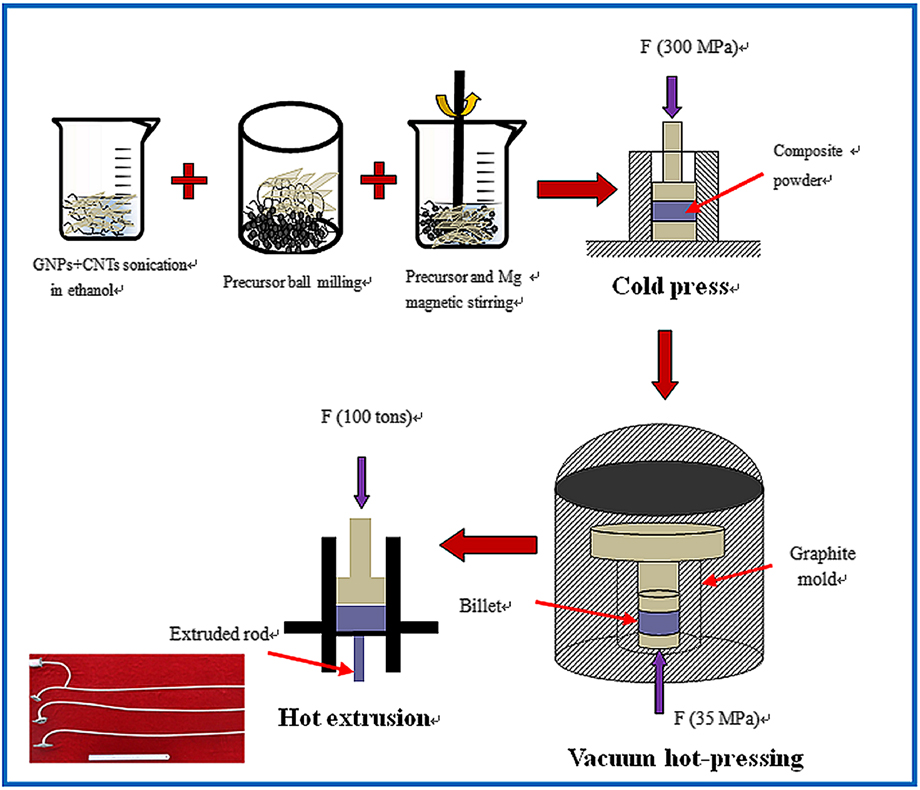
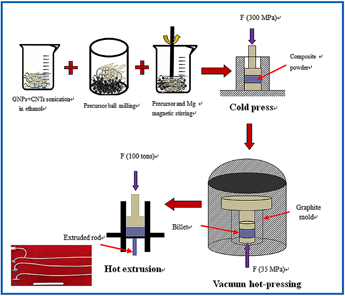
The electroless nickel-plated CNTs and GNPs were mixed with powders of Al and Zn in a certain proportion, using a low-energy ball mill. The mixture, named as precursor, was then combined with powder of Mg under ultrasonic dispersion and mechanical stirring orderly, to obtain the uniform composite powder. Finally, the composite powder was obtained as the raw material of cold pressing and vacuum hot-pressing sintering by vacuum filtration and vacuum drying.
3. Vacuum hot-pressing sintering
The powder of Mg–3 wt% Al–1 wt% Zn–1 wt% (xCNTs + yGNPs, x:y = 1:1, 1:2, 1:3) was put in a stainless steel die and pressed under a hydraulic pressure of 300 MPa and stay for 3 min, to obtain a preform with dimensions of Ø30 × 10 mm. The preform was sintered in vacuum hot-pressing sintering furnace (ZT-40-20Y), and heated at room temperature. When the sintering temperature reached 350 °C, pressure was applied, and the pressure reached 30 MPa as the sintering temperature reached 600 °C; then, the state of 600 °C and 35 MPa was kept for 100 min.
4. Hot extrusion
The sintered preform was put in a extruded die and preheated at 400 °C for 1 h together. Then, the preform was extruded at a temperature of 400 °C under a hydraulic press to obtain the cylindrical rods. The extrusion ratio and ram speed were set at 14:1 and 10mm/s, respectively. The whole procedure is illustrated in flow diagram in Fig. 1.
Preparation process flow diagram of CNTs + GNPs/AZ31 composites.

C. Microstructure characterization
Optical microscopy (OM), scanning electron microscopy (SEM), and transmission electron microscopy (TEM) were used for microstructure observation. The TEM specimens for AZ31 and its composites were treated using the argon ion thinning technique. A small amount of CNTs and GNPs was sonicated in anhydrous ethanol for 1 h, and a drop of the CNTs and GNPs suspension was then placed on a copper grid and allowed to air-dry before TEM observation. The OM and SEM samples were successively ground with 100–4000 grit papers, polished using Al2O3 powders, and then etched using a 4% solution of HNO3 in ethanol for 10 s. X-ray diffraction (XRD) was used to analyze the phases of Mg–3 wt% Al–1 wt% Zn–1 wt% (xCNTs + yGNPs)(x:y = 1:1, 1:2, 1:3), using a DX-2700B diffractometer with Cu Kα radiation at 40 KV and 30 mA and a scan rate of 0.02°/s in a 2θ range of 10–90°
D. Density measurements
Five samples were made from each extruded sample of AZ31 and its composite and polished carefully. Analytical balance with an accuracy of 0.1 mg was used to measure the density. At first, samples were weighed in air and later were immersed in ethyl alcohol to calculate the density using Archimedes’ principle. Theoretical densities were calculated using the rule of mixtures by taking theoretical density of 2.1 g/cm3 for CNTs and 1.06 g/cm3 for GNPs.Reference Rafiee, Rafiee, Wang, Song, Yu and Koratkar18
E. Mechanical property testing
Microhardness was measured by microhardness tester, and the specimen was ground with 1000–4000 grit papers and polished with Al2O3 powders. The hardness data were obtained from the average value of five values at different positions.
The compressive properties were tested under an initial strain rate of 5 mm/min with the dimensions of Ø8 × 15 mm. The tensile properties were tested with an initial strain rate of 0.8 × 10⁻³ s−1 with the dimensions of Ø5 × 20 mm; details of the specimen are shown in our previous work.Reference Wu, Wu, Hou, Zhang, Sun and Zhang19
III. RESULTS AND DISCUSSION
A. Microstructure characterization
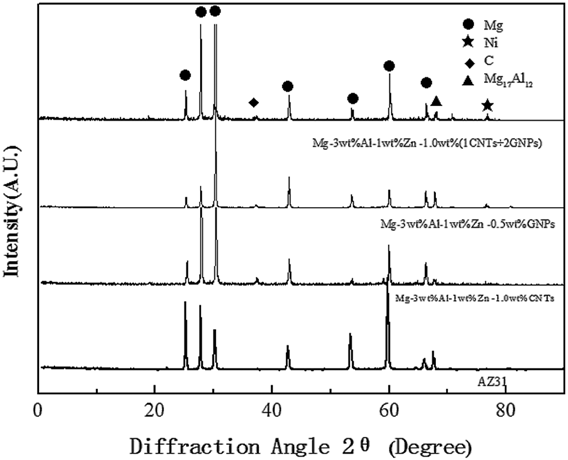
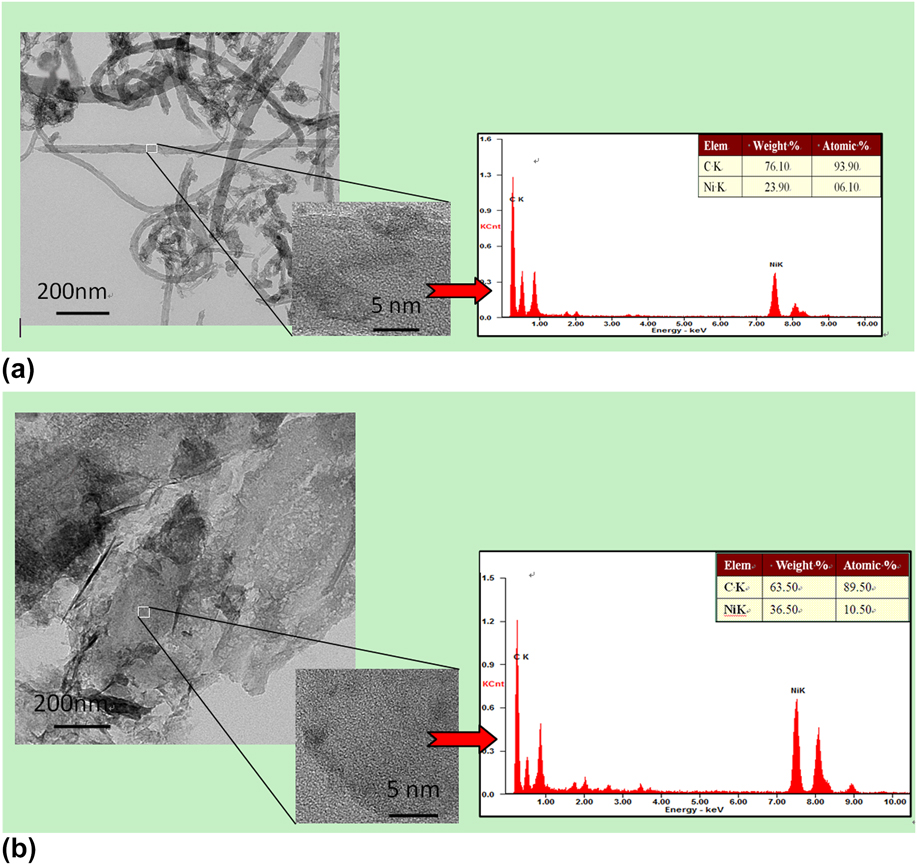
XRD patterns of AZ31 and its composites are shown in Fig. 2. It can be seen that Mg, Mg2Ni, and Mg17Al12 phases are present in all the specimens. C phase is detected in the composites due to addition of CNTs and GNPs. Mg2Ni phase is present in the specimens, and it can be inferred that the Mg2Ni arises due to the reaction between the Ni coating and the magnesium matrix.Reference Hou, Wu, Wang, Zhang, Zhang, Dong and Sun20 The micrographs and EDS of CNTs and GNPs after nickel plating are shown in Fig. 3, showing that a uniform coating was obtained. In addition, no other phases are detected in any of the composites, indicating that the CNTs and GNPs did not react with the Mg or Al in the sintering process.
XRD results of AZ31 and its composites.

TEM micrographs and EDS results of CNTs and GNPs after nickel plating: (a) CNTs; (b) GNPs.

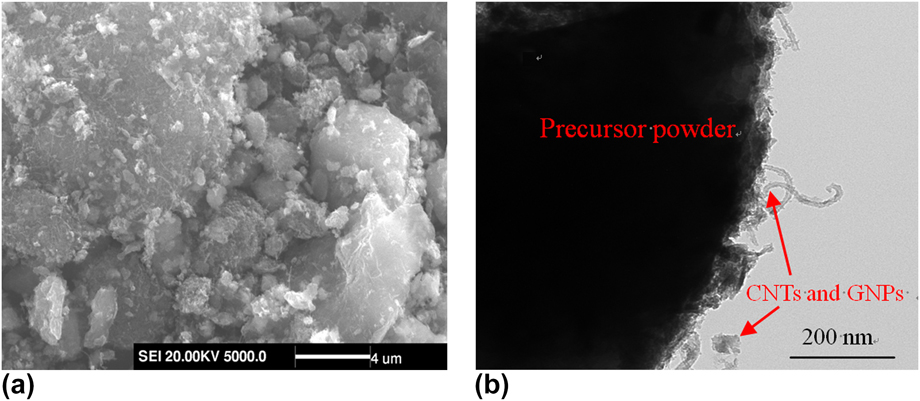
The mixture powder without Mg is named precursor, it consists of the CNTs, GNPs, Al, Zn, and Mn in a certain proportion according to composition of AZ31, and it was mixed by using the low-energy ball mill. Figure 4 shows the micrographs of composite precursor. It is clear that most of the CNTs and GNPs attach on the surface of Al and Zn powders, some single GNPs scatter around them, and especially some CNTs stretch out. This characteristic is favorable for uniform distribution of magnesium powders in precursor for the next mixing process.
Micrograph of composite precursor: (a) SEM image; (b) TEM image.

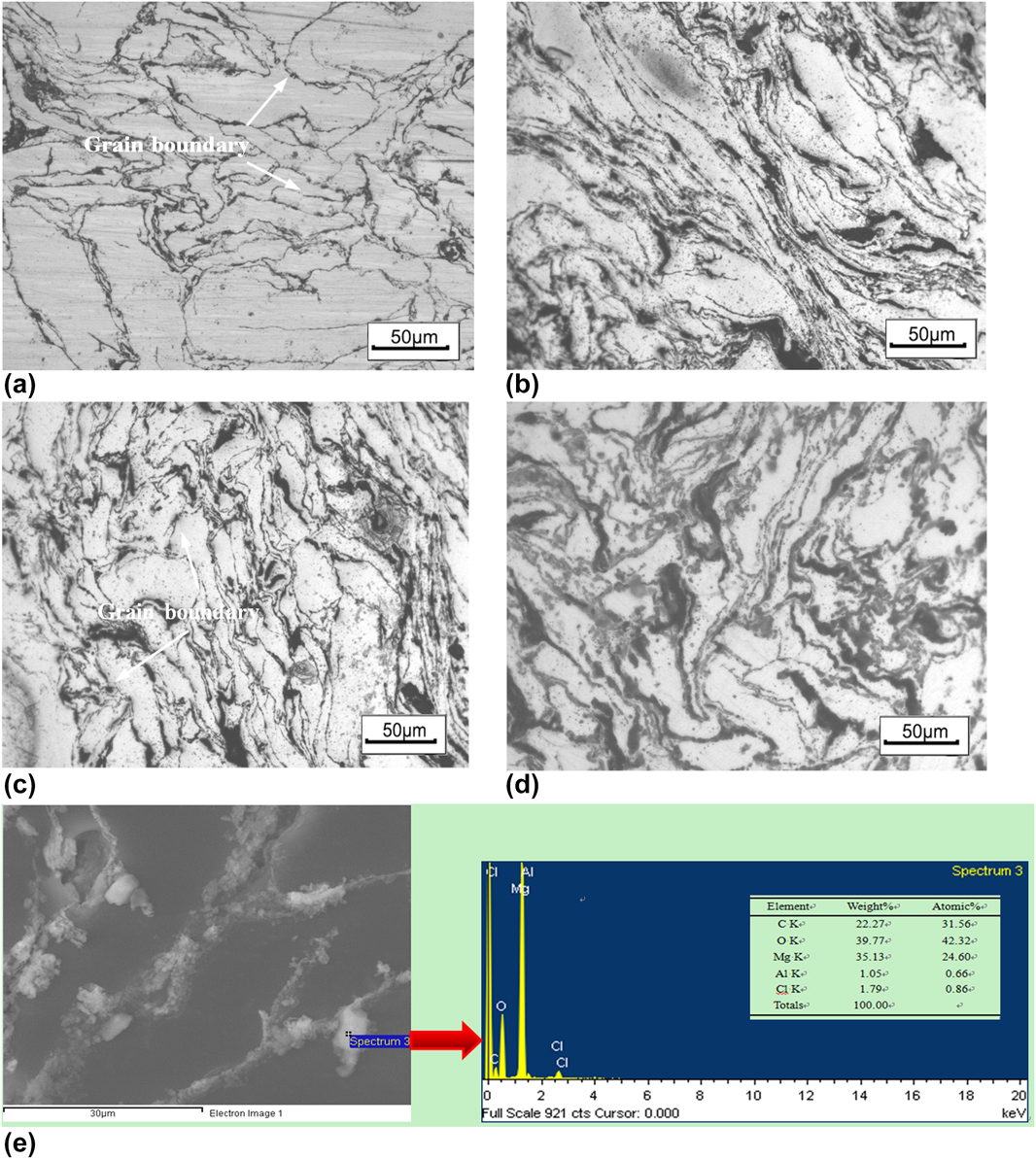
The OM images of AZ31 and Mg–3 wt% Al–1 wt% Zn–1 wt% (xCNTs + yGNPs)(x:y = 1:1, 1:2,1:3) are shown in Fig. 5. It is clear that the initial particle boundaries were observed between Mg particles as shown in Fig. 5(a). It can be seen that the grain size of the α-Mg matrix becomes smaller with the increase in reinforcement content. This indicates that the grain size of Mg–3 wt% Al–1 wt% Zn–1 wt% (xCNTs + yGNPs) composites greatly depends on the reinforcement contents. On the one hand, CNTs and GNPS can provide heterogeneous nucleation sites and improve the nucleation rate. On the other, CNTs and GNPs distributed at the grain boundaries can hinder grain growth. In addition to the α-Mg matrix, other phases can be observed at the grain boundary, which could be CNTs and GNPs as shown in EDS results in Fig. 5(e).
Optical microstructure and EDS results of investigated AZ31 and Mg–3 wt% Al–1 wt% Zn–1 wt% (xCNTs + yGNPs): (a) AZ31; (b) x:y = 1:1; (c) x:y = 1:2; (d) x:y = 1:3; (e) EDS results of AZ31 composite.

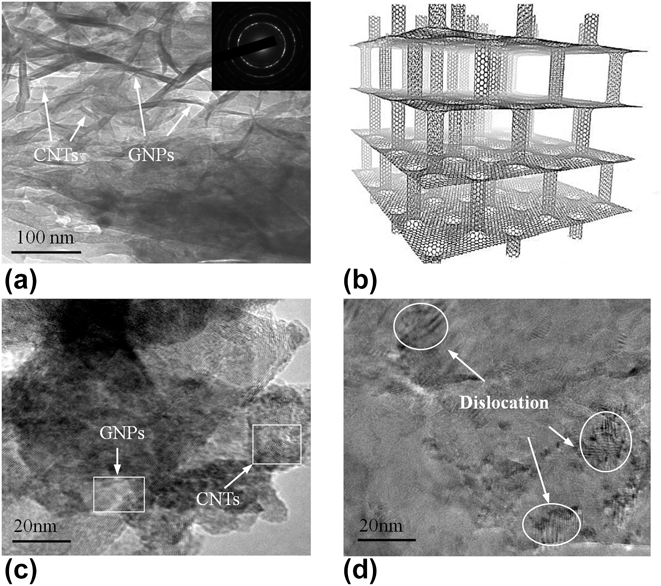
TEM images of the Mg–3 wt% Al–1 wt% Zn–1 wt% (xCNTs + yGNPs)(x:y = 1:2) composites are shown in Fig. 6. In Fig. 6(a), it could be found that CNTs and GNPs are evenly distributed, which are confirmed to have a face-centered cubic structure by selected area electron diffraction (SAED) pattern shown in Fig. 6(a). It is also clear that, the CNTs insert between GNPs layers, to form a three-dimensional structure filled up with the matrix; the corresponding schematic image of the structure is shown in Fig. 6(b). Figure 6(c) shows a high-resolution TEM image of the interface among the CNTs, GNPs, and matrix in the composites. It can be seen that the interface among the CNTs, GNPs, and Mg matrix is clean, which demonstrates that good interfacial bonding among the CNTs, GNPs, and matrix is achieved in the composites. A higher-magnification TEM image in Fig. 6(d) shows a large number of dislocations stacked at the grain boundary.Reference Deng, Wang, Wang, Shi, Hu and Wu21 It can be explained that the CNTs and GNPs pinning at the grain boundary hinders the movement of dislocations. CNTs and GNPs can restrain the dislocation glide, thereby increasing the strength of the composite.Reference Kang and Chan22
TEM micrographs of Mg–3 wt% Al–1 wt% Zn–1.0 wt% (xCNTs + yGNPs)(x:y = 1:2): (a) three-dimensional structure formed by CNTs and GNPs; (b) ideal three-dimensional structure of CNTs and GNPs; (c) HRTEM image of the interface among reinforcements and Mg matrix; (d) HRTEM image of microstructure of Mg–3 wt% Al–1 wt% Zn–1.0 wt% (1CNTs + 2GNPs) composite.

B. Density analysis
Theoretical and experimental densities of AZ31 and its composites are listed in Table I. It is found that the relative density values are about 98%; thus, denser composites reinforced with nickel-plated CNTs and GNPs can be obtained by using vacuum hot-pressing and hot extrusion method. It is clear from the theoretical calculations that density of AZ31 increases with the addition of CNTs and GNPs. Measured experimental densities of AZ31 and its composites are slightly lower than the theoretical densities. The result shows that AZ31 magnesium matrix composite simultaneously containing CNTs and GNPs has the highest density. The CNTs are helpful in the dispersion of GNPs in the composite. With the increase in CNTs, the dispersion of GNPs became better, because the CNTs can intertwine and embed GNPs, which can promote the dispersion of GNPs. In addition, at a high sintering temperature, diffusion of atoms is easier, which leads to better sinterability of composites.Reference Rashad, Pan, Tang, Lu, Hussain, She, Guo and Mao23
Theoretical and experimental densities of AZ31 and its composites.

C. Mechanical properties
1. Microhardness
The average hardness values of AZ31 and Mg–3 wt% Al–1 wt% Zn–1 wt% (xCNTs + yGNPs)(x:y = 1:1, 1:2, 1:3) are 72.4 ± 2.0, 92.3 ± 1.8, 97.2 ± 1.6, and 95.5 ± 1.5, respectively, as listed in Table II. It is clear that when the proportion of CNTs to GNPs is 1:2, the hardness of the composite is the largest. This can be attributed to the presence of GNPs with two-dimensional structure, which is beneficial to improving the hardness of the composite. However, when the GNP content is 0.75 wt%, there was a reduction of ∼1.7% in hardness in the composite with CNTs and GNPs (1:3). The reason may be that the small amount (0.25 wt%) of CNTs leads to the agglomeration of GNPs, because the function of CNTs entanglement and intercalating was limited.
Microhardness of composites with different proportion of reinforcement.

2. Compression behavior
Compressive properties of AZ31 and its composites are listed in Table III. AZ31 reinforced with CNTs and GNPs can improve both compressive yield strength (CYS) and ultimate compressive strength (UCS) by 0.2%. When the CNTs and GNPs addition ratio is 1:2, the highest increment can be obtained. In addition, the process of nickel plating can further improve the compressive properties, because it can improve the interface binding between reinforcements and magnesium matrix, as shown in Fig. 6(a).
Compressive properties of AZ31 and its composites at room temperature.

3. Tensile behavior
Tensile properties of AZ31 and its composites are listed in Table IV. The AZ31 alloy exhibits 0.2% yield strength (0.2% YS) of 149 MPa and ultimate tensile strength (UTS) of 248 MPa and failure strain (FS) of 15.24%. Addition of CNTs and GNPs to AZ31 leads to an increase in both 0.2% YS and UTS. Addition of 0.33% CNTs and 0.67% GNPs to AZ31 exhibits the highest tensile properties, and the maximum improvements achieved in 0.2% YS and UTS are 22.98% and 22.82% compared with AZ31. Compared with the addition of 0.67% GNPs, addition of 0.5% and 0.75% GNPs resulted in a decrease in the FS of 9.63% and 24%, respectively, which may be caused by GNPs clustering and its sheet structure.
Tensile properties of composites with different proportion of reinforcement at room temperature.

Addition of CNTs and GNPs leads to a reduction in stress load forced on the matrix and the deformation of the matrix is restricted. Besides, the inclusion of CNTs and GNPs leads to grain refinement and an increase in the dislocation density.Reference Wu, Wu, Hou, Zhang and Zhang17
D. Strengthening mechanism
The above experimental results show that the hot extrusion assisted by vacuum hot pressing is an effective process for fabricating Mg-alloy-based composites reinforced with CNTs and GNPs. The enhanced mechanical properties of Mg–3 wt% Al–1 wt% Zn–1 wt% (xCNTs + yGNPs)(x:y = 1:2) composites are derived from the strengthening mechanisms including grain boundaries strengthening, Orowan strengthening, and load transfer strengthening.
1. Grain strengthening mechanism
According to the Hall–Petchequation,Reference Sanaty-Zadeh24 σy of a given alloy is proportional to  ${d^{ - {1 \over 2}}}$.
 $${\sigma _{\rm{y}}} = {\sigma _0} + k{d^{ - {1 \over 2}}}\quad ,$$
where d is the average grain size, σ0 is the material constant, and k is the Hall–Petch coefficient. In this work, the increase in YS caused by grain refinement in Mg–3 wt% Al–1 wt% Zn–1 wt% (xCNTs + yGNPs)(x:y = 1:2) composite can be estimated as follows:
 $$\Delta {\sigma _{{\rm{Hall}} - {\rm{Petch}}}} = k\left( {d_{\rm{c}}^{ - {1 \over 2}} - d_{\rm{m}}^{ - {1 \over 2}}} \right)\quad ,$$
where d c and d m are the average grain size of the composites and the raw AZ31, respectively, and k = 130 MPa μm1/2 Ref. Reference Zhang and Chen25; the grain size of AZ31 and Mg–3 wt% Al–1 wt% Zn–1 wt% (1CNTs + 2GNPs) reaches 35 and 13 μm as shown in Figs. 5(a) and 5(c), which can contribute to the increase in the yield strength. The increased YS is 15.6 MPa by calculation for Mg–3 wt% Al–1 wt% Zn–1 wt% (xCNTs + yGNPs)(x:y = 1:2) composites.
2. Orowan mechanism
The contribution of the Orowan strengthening (σOrowan) mechanism mainly comes from well-dispersed nanoparticles, which can be calculated by the following equationReference Rashad, Pan, asife and Tang26:
 $$\Delta {\sigma _{{\rm{Orowan}}}} = 0.8{G_{\rm{m}}}bM\sqrt {{{2{V_{{\rm{CNT}}}}} \over {\pi {d^2}}}} + {{0.8{G_{\rm{m}}}bM\ln \left( {{{{d_{\rm{p}}}} \over b}} \right)} \over {2\pi \left( {\lambda - {d_{\rm{p}}}} \right)\sqrt {\left( {1 - {V_{{\rm{GNP}}}}} \right)} }}\quad ,$$
where G m, b, V CNT, V GNP, and d p are the shear modulus of the matrix (1.3 × 10⁴ MPa for AZ31), the Burgers vector (3.21 × 10⁻¹⁰ m for Mg),Reference Rashad, Pan, asife and Tang26 the volume fraction of CNTs and GNPs, and the average size of the GNPs (23 μm), respectively, and λ is the average center distance between adjacent graphene  $\left( {\lambda = {1 \over {2{d_{\rm{p}}}{{\left( {{{3\pi } / {2{V_{{\rm{GNP}}}}}}} \right)}^{{1 \!\left/{\vphantom{1 2}}\right.2}}}}}} \right)$. The theoretical σOrowan is 22.1 MPa. Dislocation migration is hindered by uniformly dispersed reinforcement, resulting in the formation of dislocation pile up around the CNTs and GNPs during the compressive and tensile process at room temperature, which also enhances the strength of the composites.
3. Load transfer mechanism
When the CNTs and GNPs form a three-dimensional reinforced structure and bond well with the matrix in composite, as shown in Fig. 6(a), they may share much higher extend load compared with AZ31 matrix. The efficient load can be transferred from AZ31 matrix to the reinforcements during the compressive and tensile process, which can result in an increase in yield strength, which can be estimated using Eq. (4).Reference Luster, Thumann and Baumann27–Reference Choi, Kwon, Lee and Baea29
 $$\Delta {\sigma _{{\rm{LT}}}} = {{{V_{{\rm{GNP}}}} \times {\sigma _{\rm{m}}}} \over 2} + {V_{{\rm{CNT}}}} \times {\sigma _{{\rm{CNT}}}}\left( {{l \over {2{l_{\rm{c}}}}}} \right)\quad ,$$
where σm and σCNT are the yield strength of the matrix (248 MPa) and CNT (30 GPa), V GNP and V CNT are the volume fraction of the GNPs and CNTs, respectively, and l c is the critical length, which is calculated by the following equationReference Liu, Xiao, Wang and Ma30:
 $${l_{\rm{c}}} = {\sigma _{{\rm{CNT}}}} \cdot {{{d_{\rm{c}}}} / {{\sigma _{\rm{m}}}\quad ,}}$$
where d c is the average diameter of the CNTs (25 nm). The calculated l c is about 5.48 μm. For the Mg–3 wt% Al–1 wt% Zn–1 wt% (xCNTs + yGNPs)(x:y =1:2) composite, the calculated ΔσLT is 15.14 MPa. The theoretical increase in the yield strength of Mg–3 wt% Al–1 wt% Zn–1 wt% (xCNTs + yGNPs)(x:y =1:2) composite is the sum of ΔσHall–Petch, ΔσOrowan, and ΔσLT, which has a 10% increase compared with the experimental value. It is maybe because the above equations are based on the hypothesis that the reinforcements could completely uniformly disperse; another possible reason is that a part of GNPs are not aligned along the tensile or compression direction (out of plane),Reference Rashad, Pan, Tang, Lu, Hussain, She, Guo and Mao23 leading to the great reduction in the strengthening effect.
IV. CONCLUSION
(1) CNTs and GNPs coated by nickel with the electroless plating can be uniformly dispersed in metal powders after sonication and magnetic stirring.
(2) Mg–3 wt% Al–1 wt% Zn–1 wt% (xCNTs + yGNPs)(x:y = 1:2) exhibits promising mechanical properties. The microhardness shows a 34.3% improvement compared with Mg–3 wt% Al–1 wt% Zn, yield strength increases by 22.82%, compressive strength and tensile strength are enhanced by 21.7% and 22.98%, respectively, and the elongation increases by 53.87%.
(3) The enhanced mechanical properties of Mg–3 wt% Al–1 wt% Zn–1 wt% (xCNTs + yGNPs) composites can be attributed to obvious grain boundaries strengthening, Orowan strengthening, and load transfer strengthening, and the error between experimental and theoretical values is 10%.
ACKNOWLEDGMENTS
This paper was supported by National Natural Science Foundation (51671063, 51771060, 51871068), Key Laboratory of Lightweight and High Strength Structural Materials of Jiangxi Province (No. 20171BCD40003), Research Fund for the Doctoral Program of Higher Education (20132304110006), Heilongjiang Province Natural Science Foundation (ZD2017010), the Fundamental Research Funds for the Central Universities (HEUCFM171007), Harbin City Application Technology Research and Development Project (2015AE4AE005, 2015RQXXJ001, and 2016AB2AG013), Science and Technology Innovation Project (No. 009-031-001), and the Natural Science Foundation of Heilongjiang Province—China (No. QC2017003).