The Viennese premiere of Giuseppe Verdi’s Ernani (30 May 1844) was awaited with a mixture of curiosity, excitement and impatience. Verdi had enjoyed a major breakthrough in Vienna the previous year with Nabucco, which he himself had successfully conducted.Footnote 1 His latest opera to date, Ernani, was the first new work to be presented during the Italian opera season of the Kärntnertortheater, the Court opera house, and it was preceded by its own fame after a triumphal first performance in Venice less than three months earlier. In Vienna its popular success was no less striking. Yet, as far as Verdi’s music was concerned, local critics did not share the reaction of the audience.Footnote 2 Their judgements differed in severity, though they agreed that Ernani was wanting: its harmonic language was deemed poorly nuanced, the melodies predictable, the instrumentation noisy and mostly uninteresting, and the dramatic situations characterised by superficial and repetitive effects.Footnote 3 Only the editor of Der Wanderer, Ferdinand von Seyfried, gave Verdi’s new opera some credit, but only after an unexpected preamble: ‘Admittedly, I found this matter politically contrived, but when I think about it in tranquillity, I become genuinely aware that Verdi deserves every bit of encouragement.’Footnote 4 Within the body of Viennese criticism on the opera such an overt reference to politics is unique: what exactly might Seyfried have found ‘politically contrived’ about the whole Ernani affair?
In this article I wish to take a cue from his words and examine the ways in which Verdi’s opera, its first production in Vienna and its local reception all participated in a set of interconnected discourses relevant to political and ideological anxieties of the time. Starting from a discussion of a recurrent disjunction between the local reception of the opera as a whole and of its Act III finale, I place Ernani within a constellation of cultural processes that powerfully resonated with official strategies of imperial representation. In particular, I consider ways in which the opera echoes official narratives of the Habsburg Empire, and trace its Viennese reception in peculiar facets of the local culture of monumentality. Building upon Alexander Rehding’s work on music and monumentality, on recent studies on commemoration as a performative act and on scholarship on history and memory, I argue that the opera, and specifically its Act III finale, chimed with memorial practices that fulfilled a crucial ideological aim: the projection of the Habsburg dynasty as the source of the unity of the Austrian Empire and its peoples.
In discussing the Viennese reception of Ernani in these terms, of course, one should not overlook other prominent historical processes. There is little doubt that the elevation of Verdi as one of the national heroes of Italian unification ultimately set him apart from the supranational aspirations of the Habsburg Empire. Notoriously, in musicological literature Ernani is often ascribed to the canon of Risorgimento opera – works that stirred Italian national feelings and contributed to the cultural construction of a unified Italy.Footnote 5 Yet the ideological stances behind these diverging trajectories were still in flux at the time of the premiere of Ernani at the Kärntnertortheater. The aim of this article is thus to provide a contribution to what, paraphrasing the expression coined by historians Michael Werner and Bénédicte Zimmermann, one might call the ‘entangled history’ of Italy and Austria: one in which geographical and cultural divisions were reinscribed and mitigated within multidirectional cultural processes that also inform the genesis of Ernani and its reception. The notion of ‘entangled history’ (a translation of the original French expression histoire croisée) refers to a form of enquiry that investigates how cultural meaning is produced by, and understood through, the interconnection between communities marked by geographical, social, linguistic, religious or political differences. The emphasis on ‘interconnection’ here is crucial, since it highlights the difference between histoire croisée on the one hand and comparative history and cultural transfer on the other: although histoire croisée draws on perspectives from both of them, it considers communities neither as self-contained entities (as in traditional national or comparative histories) nor as the opposite poles of unidirectional processes (as in studies of cultural transfer). Instead, historical processes generate meaning as communities function as imagined interlocutors in a mutually fruitful cultural dialogue.Footnote 6 Jani Marjanen has further expanded on this idea by discussing communities in terms of ‘communicative spaces’ that both allow the circulation of ‘travelling concepts’ and determine their shift in meaning.Footnote 7 These ideas provide a frame for examining how mobility affected the fluctuating political understanding of Verdi’s opera, as a sort of ‘traveling concept’. As we shall see, the Viennese vicissitudes of Ernani were very much entangled with the opera’s early history in Italy: pointing out this entanglement also sheds some light on the extent to which the histories of Italian opera and Viennese musical life at large were themselves entangled.
Ernani and ‘the Latest Italian Fashion’ in Vienna
One of the most successful of Verdi’s early works, Ernani has often enjoyed what Fabrizio Della Seta has called ‘the dubious privilege of standing as the classic example of Verdi’s brash, impassioned vein, in which he was more concerned with discharging a tumult of surging passions in a burst of splendid melodies than with exploring the depths of the human heart’.Footnote 8 This ‘dubious privilege’ accompanied the opera’s dissemination outside Italy. Just as Ernani became a regular presence in the repertory of opera houses around the world, contributing more than Nabucco to Verdi’s international reputation, critics regularly attributed the opera’s long-standing hold on the audience to its catchy tunes and the powerful effect of its choral pieces and ensembles.Footnote 9 Vienna was no exception to this trend: Ernani was performed forty-five times before the 1848 revolution and another 146 times between 1848 and 1870.Footnote 10 Three new productions were mounted before World War I, even though the opera began to fade after the turn of the century.Footnote 11 And, just as elsewhere, the sheer melodiousness of Verdi’s music provoked attraction and resistance, popular acclaim and critical reproach. Nowhere but in the Habsburg capital, however, were critics so consistent in condemning the opera as a whole while unconditionally praising one of its parts: the Act III finale.
In Vienna, Ernani was regularly held up as the most recent instance of the hackneyed operatic fare coming from south of the Alps, the product of a promising but careless composer less interested in the polish and ‘depth’ of his work than in entertaining his audience. Even the relatively benevolent Seyfried supported this view:
The score of Ernani is modelled upon the latest Italian fashion … So it appears to me as an opera that can be very successful in Italy; in Vienna too, when performed well, it can certainly meet with a favourable outcome – but all the same as a regrettably ephemeral, unpolished and hastily put together work of a young man who could accomplish something much more ambitious.Footnote 12
Like his colleagues, Seyfried approached Ernani through a set of well-established binaries – score and performance, permanence and ephemerality, depth and superficiality, essence and effect – which, in different ways, addressed a much-debated conundrum at the time: the tension between aesthetic contemplation of a musical composition as a ‘work’ and its realisation in performance.
German-speaking critics regularly adopted rhetorical tropes grounded on these binaries to resist the pervasiveness of Italian opera.Footnote 13 Reactions to Ernani indicate that Viennese reviewers also participated in these tendencies. Despite its large German-speaking population, however, the city was the capital of a multi-ethnic and multilingual empire, at the crossroad of different geographical and cultural areas of a realm that included significant portions of the Italian peninsula. Opera, which had long been instrumental to Habsburg cultural policies, was one of the battlegrounds on which national tensions manifested themselves more vehemently.Footnote 14 But because local operatic debates seriously undermined the ideological foundations of Habsburg multinational empire, they developed along somewhat different lines from other German-speaking areas. Given Vienna’s status as imperial capital, the predominance of one national operatic tradition over the other became collateral to the question of whether local operatic life should display the multinational nature of the realm as a whole or the predominantly German constituency of the city’s population. One of the bones of contention was the regular presence of an Italian opera season at Kärntnertortheater: its supporters embraced it as an important contribution to the multinational nature of Viennese musical culture, while its detractors criticised it as detrimental to the full blossoming of a vernacular tradition.Footnote 15
The fact that Seyfried experienced the Viennese premiere of Ernani as a ‘politically contrived’ matter is a reminder of how contentious the production of a new Italian opera could be. Ernani was in a particularly difficult position. Due to its recent opening in Venice, the opera was not scheduled until two-thirds of the way through the three-month Italian opera season, but the two impresarios of the Kärntnertortheater, Carlo Balocchino and Bartolomeo Merelli, kept it as the first new title of the season. Its delayed performance was regularly criticised in the press as a sign of the incipient decline of Italian opera, and even political authorities regarded this deferral unfavourably.Footnote 16 A report by the president of the state police, Count Joseph von Sedlnitzky, informed that, almost two weeks before the Ernani premiere, the emperor had already insisted on revising the terms of the contract with the impresarios of the Kärntnertortheater, requiring them to produce a new opera within the first ten days of each Italian season.Footnote 17
In the face of these critical responses, the Viennese reception of the opera’s Act III finale opens up a discursive space that complicates conceptual binaries and calls for a different approach to the political resonance of Verdi’s work. Set in the imperial crypt in Aachen, in this number Don Carlo, king of Spain and grandson of the Habsburg Emperor Maximilian I, accepts the crown of the Holy Roman Empire as Charles V. Inspired by Elvira’s plea and by the presence of Charlemagne’s funeral monument, Carlo forgives the conspirators who have just made an attempt on his life, an act of clemency that results in the solemn closing ensemble celebrating the new emperor. Seyfried describes this number as ‘the highlight of the opera’ (‘der Glanzpunkt der Oper’), one which testifies distinctively to Verdi’s ability (‘[hier] sprach sich Verdi’s Befähigung am deutlichsten aus’) and carries the audience to fanaticism (‘[es] versetzt das Publicum in fanatischen Jubel’). Like him, and despite their general hostility towards the rest of Ernani, all Viennese critics reserved particular praise for this piece. In his otherwise scathing review, Heinrich Adami, the critic of the Allgemeine Theater-Zeitung, set aside his vitriol and wrote:
The splendid third-act finale shows that Verdi knows how to write beautifully, to be inventive, and to achieve a great effect with rather simple means – a piece that does great honour to his talent as a composer. Its effect was also so decisive and complete during the present performance that an encore was vehemently called for. There are few pieces in newer Italian opera that will find a place next to this beautiful finale.Footnote 18
Two other venomous articles, by Moritz Saphir and Carl Kunt respectively, make similar concessions to Verdi, either describing the finale as ‘finely realised’ (‘hübsch ausgeführt’) or recognising that it ‘belongs … to the best of this opera’ (‘gehört ... zu dem Besten dieser Oper’).Footnote 19 What is more, this critical divide between the entire opera and its parts transcended the chronological boundaries of its early Viennese reception, and can be traced as late as Eduard Hanslick’s Die moderne Oper (1875).Footnote 20
For all these authors, the Act III finale reconciled the dimension of creation with that of performance: it was at once the product of a talented creative mind and the catalyst of the audience’s enthusiastic reaction – it appealed to the intellect as well as to the senses. But the consistency of these patterns of reception also points out that the opera intersected with other kinds of ideological anxieties. The tension between the hostility towards the whole of the opera and the admiration for one of its numbers suggests that, not unlike early Viennese productions of operas by Rossini and Donizetti, Ernani created discomfort because it resisted unequivocal aesthetic categories as well as ideological divides.Footnote 21 I propose that a productive way to discuss how the Act III finale functioned as a merger of different kinds of political and aesthetic oppositions is to approach it as a musical monument. Permanence and transformation both inform the notion of monumentality, a notion that, according to Alexander Rehding, ‘avails itself of the appearance of ahistorical transcendence … but is rather subject to historical change’.Footnote 22 More to the point, for Rehding a musical monument is both ‘an object of seduction and ideological distrust’, and ‘an object of commemoration that is capable of linking the present with a perpetual past’.Footnote 23 These definitions cast a different light on the rhetoric of Viennese critics; indeed, the number of Ernani that aroused such fanatical reactions in Vienna, seducing spectators and critics alike, also celebrates the coronation of a Habsburg emperor central to nineteenth-century official narratives of the Habsburg Empire. In order to illustrate how the opera’s Act III finale functioned as an object of commemoration, we therefore first need to discuss its connections to Austrian historiography and Habsburg memorial strategies.
Austrian historiography and the operatic Carlo Quinto
The Habsburg Empire was a unique political body in nineteenth-century Europe. A by-product of the Austrian military campaigns against Napoleon, it encompassed no fewer than eleven ethnicities different in culture, language, customs and administrative bonds to the central government. The endurance of such a multinational entity over the course of a century that had experienced the growth, spread and radicalisation of national ideals contributed enormously to its perception as a relic of the ancien régime. Yet the Habsburg Empire was very much a child of its time, if one whose legitimacy was often challenged.Footnote 24
Napoleon’s coronation as Emperor of the French in 1804 and his takeover of most of the German states had posed a serious threat to the Habsburgs. Not only was he undermining their supremacy in central Europe, but he was also in a position to be elected Holy Roman Emperor and to exert considerable influence over the Habsburg hereditary lands (i.e. the lands over which the Habsburgs exerted dynastic sovereignty).Footnote 25 These circumstances led Emperor Francis II to assume the newly created dynastic title of Emperor of Austria, the state comprising these lands, as Francis I. This investiture also took place in 1804 but it created a number of new issues: Francis’s new dynastic title was ‘a flagrant breach of Imperial law’, produced a political and institutional fracture between the hereditary lands and the other states of the Holy Roman Empire – one that in the long run proved impossible to bridge – and dealt a fatal blow to the Holy Roman Empire itself, which was eventually dissolved in 1806.Footnote 26
Because the new empire had such precarious foundations, the construction and legitimisation of its identity became a pressing issue. Since the empire could not rely on any form of homogeneity (whether territorial, linguistic or ethnic), an intense propaganda campaign portrayed the Habsburg dynasty itself as the unifying element and the most powerful catalyst of a sense of belonging to an imperial and supranational ‘imagined community’.Footnote 27 Thus originated what Claudio Magris has named the ‘Habsburg myth’: the belief that loyalty to the emperor conferred peace and security to all ethnic groups within the imperial borders.Footnote 28 This myth was engineered top-down by the Viennese political élite through cultural strategies promoting ‘the dynasty, its tradition, its history, and the history that was common to all of the people living under the sceptre of the Habsburgs’.Footnote 29 Such strategies, in the words of Pieter Judson, were characterised by ‘remarkable creativity and flexibility in practice while rhetorically maintaining that the power of [the] empire remained unchanged’.Footnote 30 Of the many ‘creative’ ways in which the Habsburg myth came into being, two are of particular importance for present purposes: the support of official historiography and the enactment of memorial practices grounded in these historical narratives.
Since its inception, the new empire was placed within narratives firmly grounded in the glorious history of the Holy Roman Empire, and the continuity of Habsburg sovereignty portrayed as an essential connection between the two. This idealisation of imperial continuity, however, was nothing new, looming large over the past of the recently defunct Holy Roman Empire: following the medieval idea of translatio imperii, the Holy Roman Empire was traditionally understood as a historical extension of the ancient Roman Empire.Footnote 31 One of the earliest and most influential adaptations of this historiographical tradition came from Friedrich Schlegel (1772–1829). In 1809, Schlegel was appointed imperial Court secretary and worked closely with the Austrian ministers Johann Philipp Stadion and Prince Clemens von Metternich. The following year he delivered a series of lectures in modern history at the University of Vienna, which stemmed from his involvement in the Court’s cultural policies. Published in 1811 with the title Über die neuere Geschichte (‘On the Newer History’), Schlegel’s lectures proposed an approach to European history grounded in the development and consolidation of Habsburg imperial power – an approach which was to inform the historiography of Austria as a Gesamtstaat, a collective, multinational state.Footnote 32
Charles V is a pivotal figure in Schlegel’s account. His reign is discussed as the first systematic attempt to create a European political system based on the idea of imperial supremacy, and as a model for resolving the conflicts of the present times:
The ruling influence over Europe … enjoyed by a federative state, free as to its representative system – a state which is itself a union of confederate states and nations, like Austria under Charles the Fifth – will in like manner be … bound by public law, based on justice … naturally disposed to peace, and where personal motives do not interpose, in itself conducive to freedom.Footnote 33
Unsurprisingly, when a few years later Austria emerged victoriously from the wars against Napoleon, these very principles (legitimacy, diplomacy and balance of powers) became the guidelines of the geo-political restructuring of Europe at the Congress of Vienna. With the multinational Habsburg Empire as a guarantor for this new order, Schlegel’s lectures became foundational to official imperial narratives, and his glorification of Charles V a paradigm in nineteenth-century Austrian culture.Footnote 34 By the time of the Viennese premiere of Verdi’s Ernani, Charles V was regularly portrayed as a heroic figure whose visionary ideas overtook the emperor’s historical achievements and failures. His name ‘triumphed over centuries’ (to paraphrase the expression ‘vincitor de’ secoli’ from Piave’s libretto), not so much because of his deeds, but because of the principles that inspired them – and that now fostered his memory.
This politicised reading of Charles V seems to be in evidence during the genesis of Verdi’s opera. Originally written for Venice, at the time under Habsburg rulership, Ernani underwent the scrutiny of Austrian censorship. As emerges from several archival documents, one of the most pressing preoccupations of both Piave and the president of the Teatro La Fenice, Count Mocenigo, was to anticipate possible censorial objections to the portrayal of Carlo in the first two acts, and the conspiracy against him – a Habsburg ruler – in the third. As Mocenigo submitted the prose draft of Piave’s libretto (the so-called selva) to the director of police in Venice, he presented it in such a manner as to align it with Habsburg ideology:
The only difficulty to overcome was to undertake the part of D. Carlo in such a way that it would not violate political decorum [riguardo] but would retain much of its vigour and interest … The poet completely solved the issue by omitting both the wardrobe and the duel scenes, by justifying Carlo’s appearance in Elvira’s rooms, and by beautifully enhancing the courage and clemency of this sovereign in the third and fourth part ... The spectator cannot but feel respect and admiration rising in his heart.Footnote 35
Mocenigo’s intercession proved effective, as the director of the police approved the draft of the libretto with a few recommendations:
[I]n Scene II of Part III, when the conspirators appear, the action must be as short as possible, and the swords must not be unsheathed. In addition, the Emperor’s act of mercy toward the conspirators when he appears among them in Scene III must be made to appear great and generous. It is also necessary that, during the scene between the Emperor and Ernani, the poet use expressions suitable and proper between a subject and his King.Footnote 36
The director had good reasons to be cautious about the conspiracy scene: as is well known, at its core lies the chorus ‘Si ridesti il Leon di Castiglia’, which was to become one of the musical emblems of the Risorgimento. At the time, however, the chorus was not deemed threatening enough to prevent its performance.Footnote 37
Piave and Mocenigo’s preventative modifications of Hugo’s text and the indications of the censorship pushed the opera, and especially the characterisation of Don Carlo, towards the value system promoted by the Habsburg Court. In Hugo’s original, Carlo is portrayed as libertine and corrupting. In the wardrobe scene, he first bribes Doña Sol’s maid in order to have access to her room, and then hides himself in her cabinet, from where he listens to her dialogue with Hernani; finally, still incognito, he declares his willingness to share Doña Sol’s favours with his rival. All these passages did not make it into the opera’s libretto. Similarly, when in Hugo’s drama Silva discovers Don Carlos and Hernani with Doña Sol and challenges them to a duel, the libretto omits the section where he flagrantly mistreats his insignia of the Order of the Golden Fleece – an order that in the nineteenth century was still under Habsburg protection.Footnote 38
All the modifications discussed in the exchange between Mocenigo and the Venice director of the police sanitised the play from anything that could have offended the ruling dynasty. More importantly, they both emphasised that the character of Carlo was intended to catalyse lofty and edifying feelings in the spectators. Such deliberate focus on the end effects of the revisions brings us back to one of the elements that, in Rehding’s terms, was at the core of monumental culture: the convergence of seduction and ideology. As these documents suggest, not only did the working out of the operatic Carlo involve a rewriting of Hugo’s play according to established representations of the historical figure of Charles V, but it was also meant to perform similar cultural work to other projects through which the Habsburgs pursued their agenda: the erection of dynastic monuments and memorial buildings.
Monuments, history, memory
Monuments played a strategic role within an ideological agenda that relied so heavily upon the telling and retelling of history. In 1808, the Habsburg Court backed the publication of the first Austrian patriotic journal, the Vaterländische Blätter für den österreichischen Kaiserstaat, which ran until 1814, and whose explicit mission was to create a shared sense of belonging to the imperial community by looking upon the many peoples of the empire as collective repositories of knowledge to be put in dialogue with one another.Footnote 39 To this end, one column of the journal was dedicated to ‘materials on old and new patriotic history, and in particular information on remarkable historical monuments’.Footnote 40 The juxtaposition of history and monuments reveals the strategic role of the latter as a re-enactment of great historical events: monuments celebrate historical events and figures extending their memory up to the present. They are instances of what historian Pierre Nora has called ‘memory sites’ (lieux de mémoire), ‘any significant entity, whether material or non-material in nature, which by dint of human will or the work of time has become a symbolic element of the memorial heritage of any community’.Footnote 41 But, as this definition suggests, monuments and history are ambiguously intertwined. History serves as a subject of monuments, but monuments also shape the ways in which history is narrated, generating memories under the sway of both ‘human will’ and ‘the work of time’. Allan Megill has in this light drawn an important ontological distinction between history and memory. While the former is a ‘critical and reflective’ endeavour that needs verification, memory is ‘an image of the past constructed by a subjectivity in the present’.Footnote 42 Megill illustrates the problematic relationship between memory and the past through the so-called ‘aesthesis of history’, the attribution of aesthetic value to objects understood as relics of earlier ages (whether or not they actually are): these objects deputise for the past in the present even though some of them might speak about a fictionalised past.Footnote 43 Monuments erected to the memory of past rulers are fitting examples. Rather than epitomising the outlived artistic heritage of the past, they provide an outlook on the past from the viewpoint of the present.
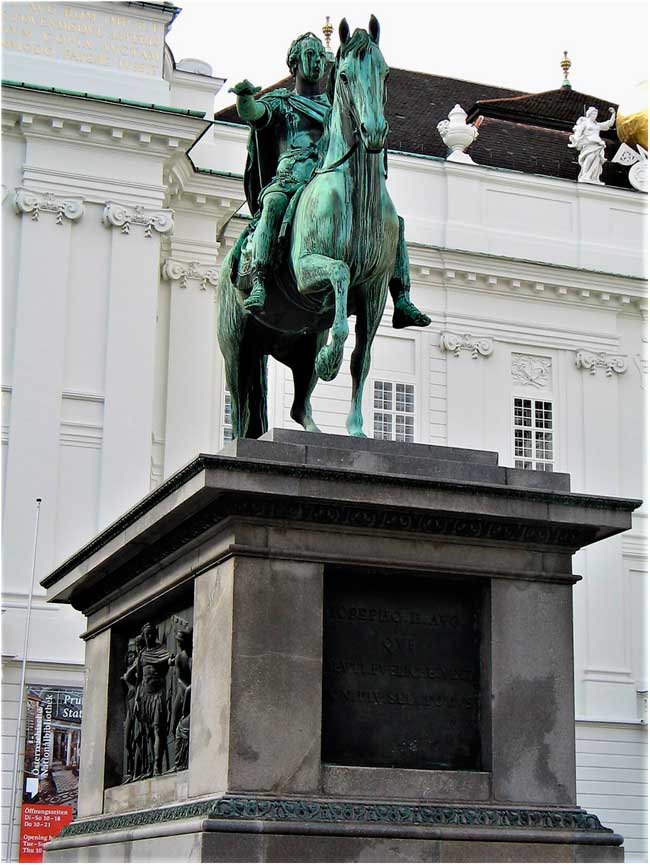
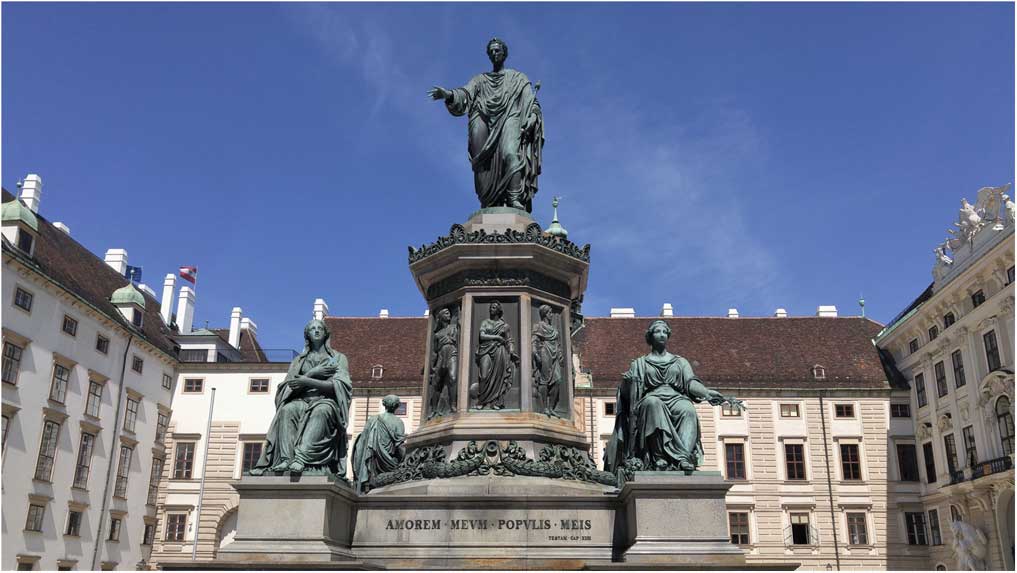
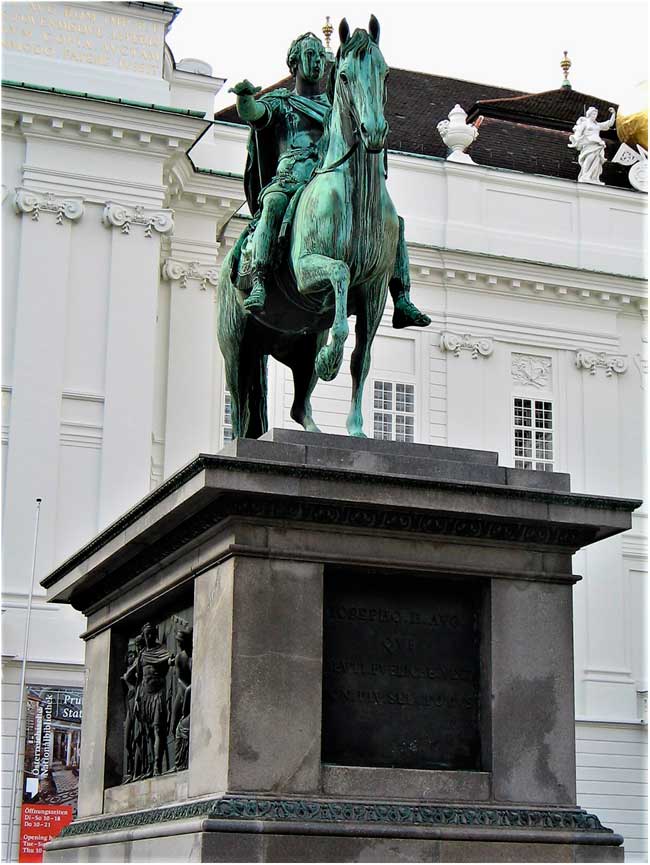
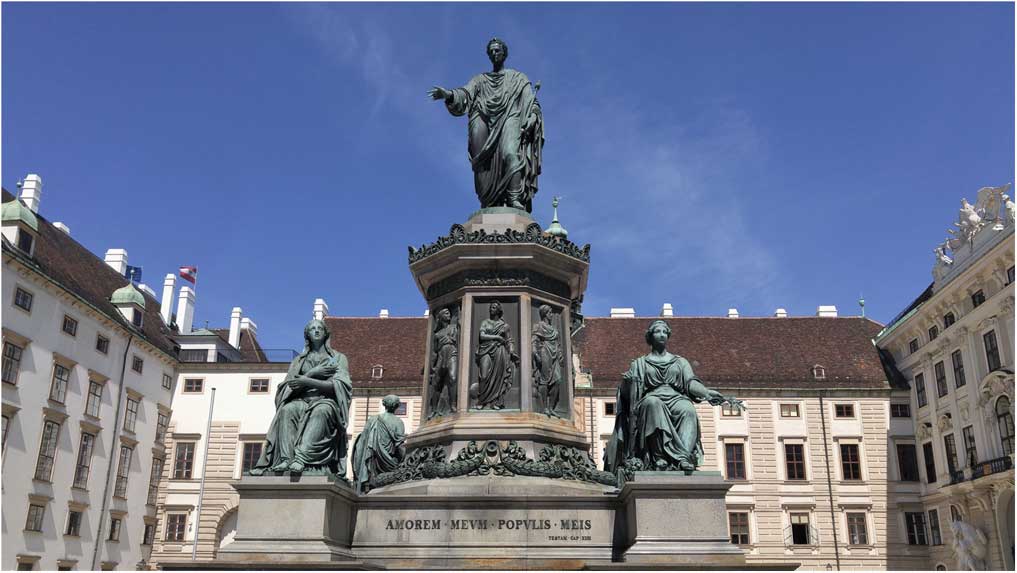
Megill thus provides a useful frame for understanding early nineteenth-century Viennese monumental culture in the context of Habsburg ideology. Up to the mid-century the installation of new monuments far outpaced the preservation of old ones.Footnote 44 While gratifying the aesthetic taste of a population severely tried by years of war,Footnote 45 they served the needs of a dynasty in search of political legitimation. Because the new Austrian Empire had little history to dwell on, it was the past of its centuries-old dynasty that monuments aestheticised, memorialised, glorified and reimagined for the sake of the present. Just as with Schlegel’s history, they forged the dynastic identity of the new Austrian Empire out of historical figures, symbols and images of the Holy Roman Empire.Footnote 46 As he was invested as Austrian emperor, Francis I commissioned an imposing equestrian statue of Joseph II, which was placed in 1807 in what is today Josefsplatz (Fig. 1).Footnote 47 The monument’s neoclassical iconography, with the former ruler dressed in a tunic, not only endows Joseph’s figure with a heroic dimension emphasising his authority as Holy Roman Emperor, but also shows that the translatio imperii, the ideal and idealised continuity between the ancient Roman Empire and the Holy Roman Empire, was far from being extinguished. Rather, it became crucial within the process of legitimisation of Francis’s own dynastic empire: Pompeo Marchesi’s statue of Francis (Fig. 2) combines the emperor’s figure in ancient garments with an inscription from his testament (Amorem meum populis meis, ‘My love to my peoples’), which underscores his by-then canonic image as a caring founding father of a multinational state.Footnote 48
(colour online) Franz Anton Zauner, equestrian statue of Joseph II. Vienna, Josefplatz (1807). Photo by the author.
(colour online) Pompeo Marchesi, monument of Francis I. Vienna, Hofburg, innerer Burghof (1846). Photo by the author.
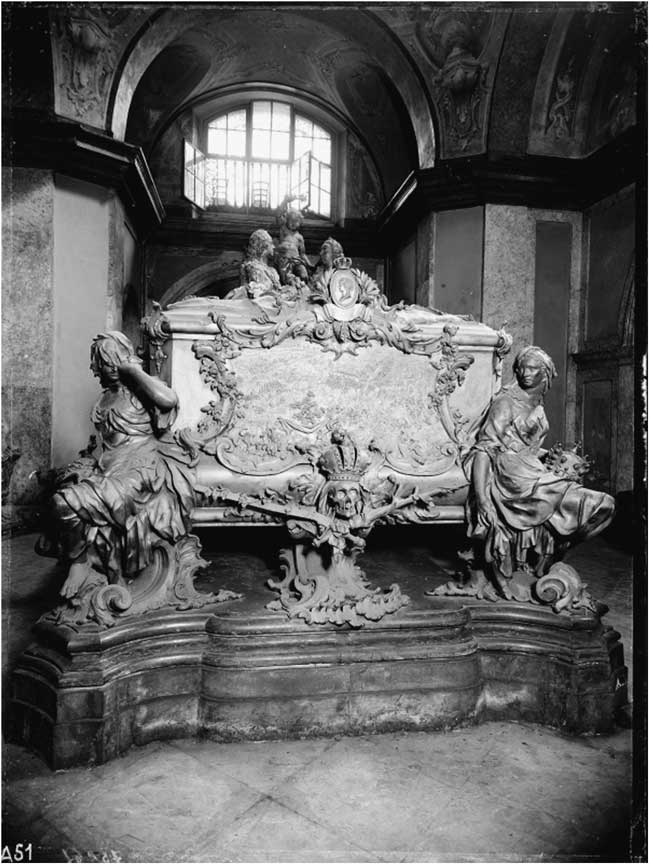
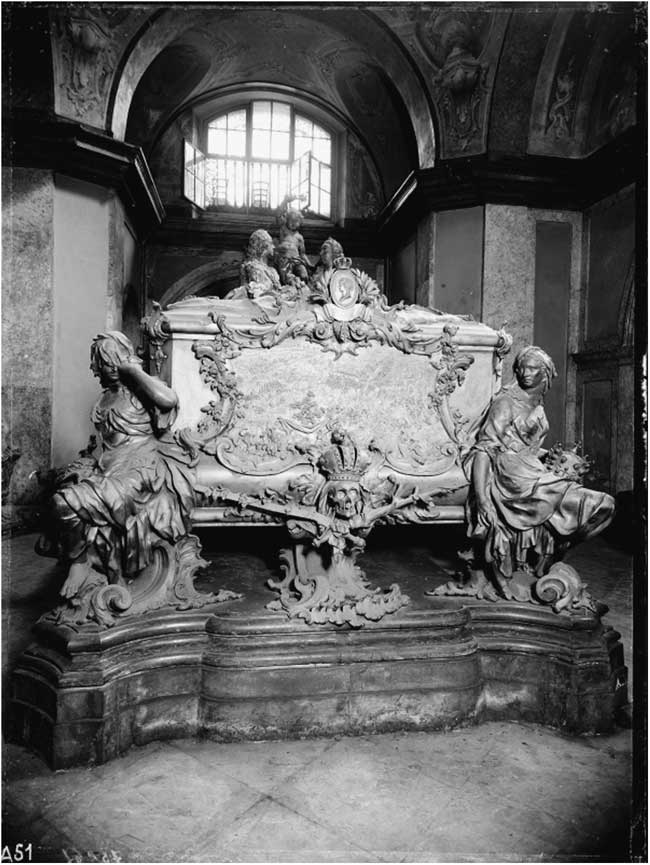
One of the most ambitious works to foster the memory of the Habsburg dynasty was undertaken between the 1820s and the 1840s: the enlargement and renovation of the Imperial Crypt in the Capuchin Church. The burial site of the Habsburg family since the seventeenth century, the crypt had been enriched with a number of monumental sarcophagi, most notably that of Empress Maria Theresia and her husband (Fig. 3). By the nineteenth century, however, it had become too small to accommodate new tombs. Plans were made for a new burial site in the Augustinian Church, but the idea of dynastic continuity eventually prevailed, and a new chamber was added to the old crypt in 1824. Two larger additions followed between 1840 and 1842: a new vault for Francis’s son, Emperor Ferdinand; and the so-called Tuscany vault, which hosts the sarcophagi of members of the family lines ruling over Tuscany and the Duchy of Modena.Footnote 49 As these additions show, logistics were not the only preoccupation behind the renovation of the building; at least as important was the effort to preserve the symbolic function of the crypt as a physical ‘memory site’ of the unity of a dynasty whose power stretched beyond the borders of the empire itself through the family’s cadet branches. The memorial function of the crypt was revived through the highly ritualised ceremony of entombment of members of the Habsburg family – a practice that was maintained, albeit with some hesitation, until very recent times.Footnote 50
Balthasar Ferdinand Moll, sarcophagus of Empress Maria Theresia and Emperor Franz of Lothringer. Digital Collection of the Austrian National Library, Vienna. Reproduced by permission.
As Ann Rigney has remarked, funeral processions, just as the inaugural ceremonies of monuments, reveal that memory sites ‘work as sites only as long as they have power to mobilise people into investing in them’.Footnote 51 It is through processual practices, combined with the idea of remembrance ‘as a form of social action’, that static commemorative artefacts perform their function as memory sites; more specifically (and glossing the French sociologist Henry Lefebvre), the perception and cultural meaning of the crypt as a memorial space was produced through social performative acts in the form of commemorative rituals.Footnote 52 As discussed earlier, Viennese critics understood the Act III finale of Ernani along similar lines, both as an object of aesthetic contemplation and as a performative event whose political meaning was socially produced. Yet there is more to this analogy that is worth pursuing: the finale is set in an imperial crypt featuring a towering funeral monument, offering a reflection on the nature of imperial power, and closing with the celebration of a Holy Roman emperor. With this in mind, let us return to the Viennese premiere of Verdi’s opera and consider its Act III.
Giuseppe Brioschi’s mise en scène
When the two impresarios of the Kärntnertortheater, Merelli and Balocchino, informed Verdi of their intention to stage Ernani in Vienna, they invited him to supervise the production and conduct the first few performances. Unwilling to commit himself without knowing the cast in advance, the composer declined. He nonetheless sent detailed staging and performance instructions both to Leo Hertz, the house stage director, and to Gaetano Donizetti, at the time court composer in Vienna, who had volunteered to supervise the musical preparation of the singers.Footnote 53 Some of Verdi’s requests were not fulfilled, particularly those discouraging alterations or cuts to the score. Yet the local press unanimously reported the positive outcome of the performance, and several critics acknowledged the merits of the staging.Footnote 54
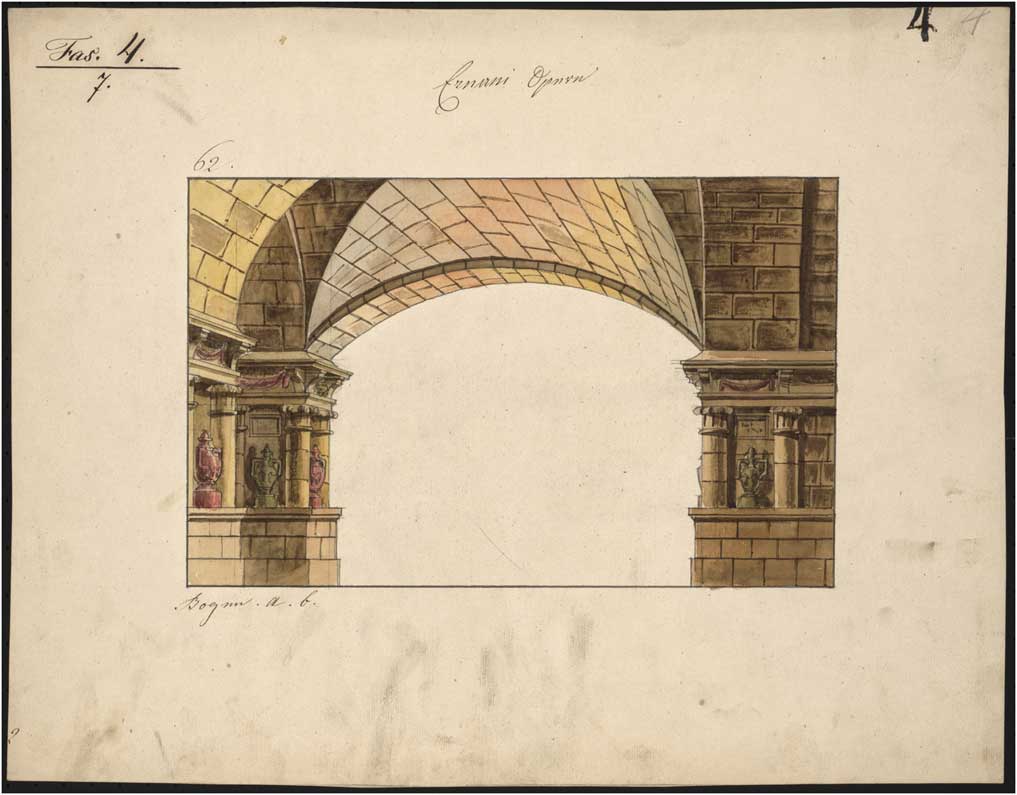
Although little material from Giuseppe Brioschi’s scenery for the Vienna premiere has survived, a sketch of the front- and mid-stage settings for Act III presents some noteworthy details (Fig. 4).Footnote 55 Brioschi’s omission of Gothic arches under the vaulted ceiling of the imperial crypt in Aachen departs from the iconography popular in Italy for the same scene, as shown in contemporary settings by Giuseppe Bertoja (the set designer of the 1846 Venice revival of Ernani) and Romolo Liverani, one of the most prolific artists of the time and the author of one of the earliest complete sketches for the opera.Footnote 56
(colour online) Giuseppe Brioschi, sketch for the sets of Giuseppe Verdi’s Ernani, Act III (Vienna, Theatermuseum, HOpÜ 4848. Th). Reproduced by permission.
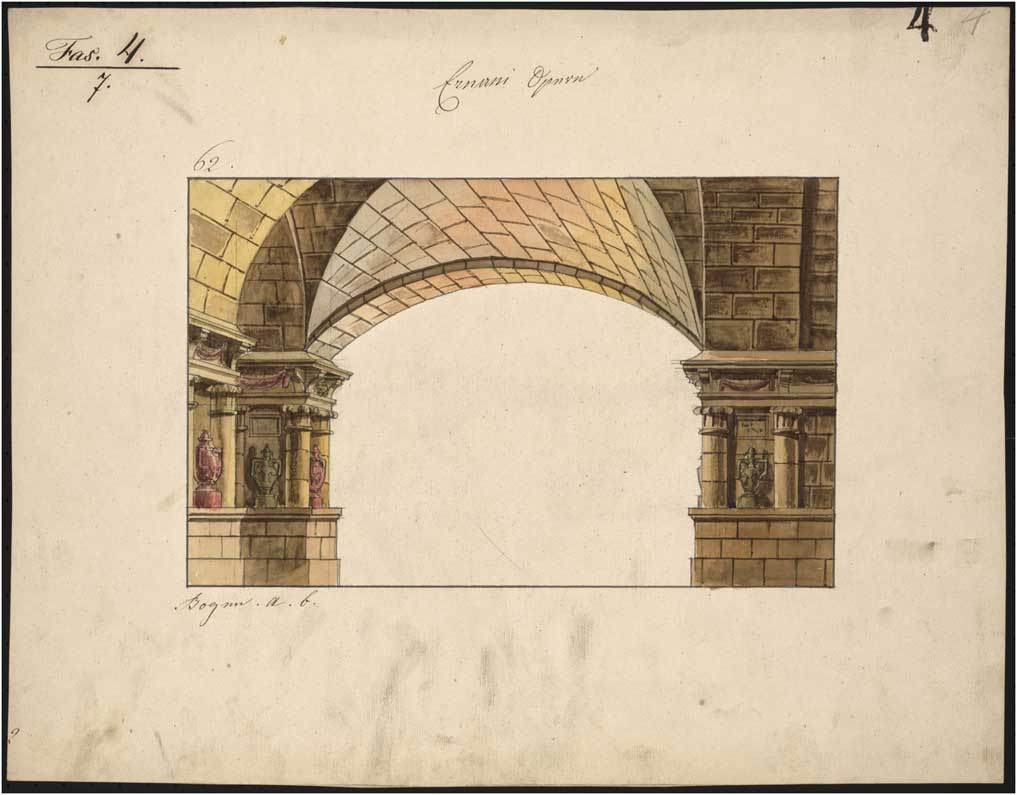
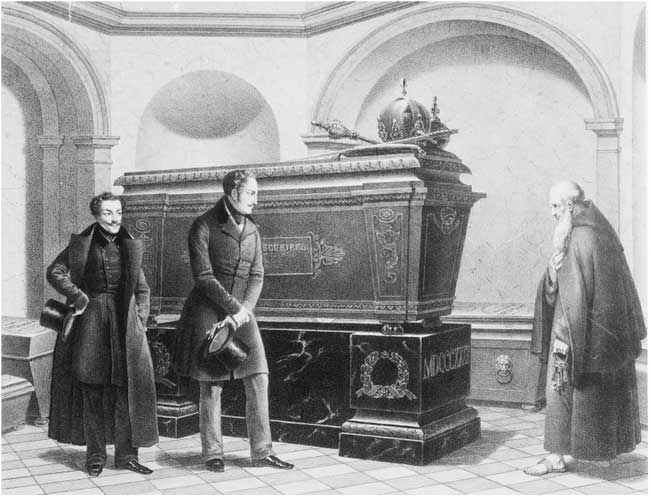
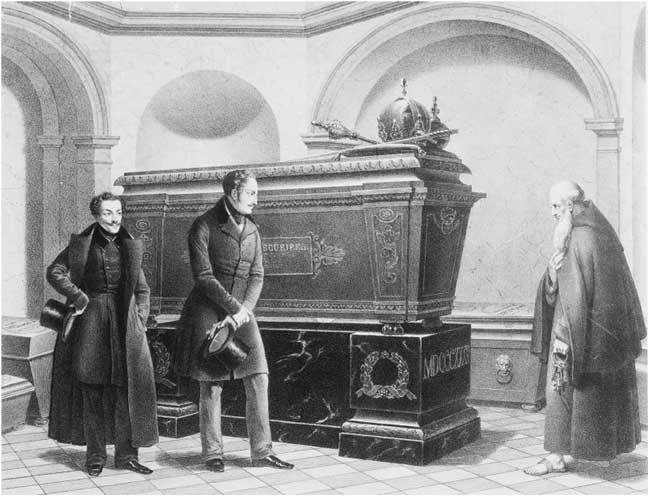
As Mercedes Viale Ferrero has pointed out, Verdi and his librettist, Francesco Maria Piave, systematically eliminated all references to architectural details, which abound in Hugo’s Hernani (1830). It is certainly possible that Brioschi had relied on Hugo’s original stage directions to prepare his sketches (‘great vaults of Lombard architecture’),Footnote 57 while his colleagues working south of the Alps had not. But in so doing his vision of the Aachen imperial crypt resembled a much more familiar sight: the recently renovated and expanded crypt in the Vienna Capuchin Church, which shares with Brioschi’s sketch such architectural details as low vaulted ceilings and round arches (Fig. 5). In an opera house heavily backed by the Court and regularly attended by the highest ranks of Viennese aristocracy, it seems unlikely that the architectural structures, images and historical figures of this mise en scène lost their strong ideological implications.
‘Zar Nikolaus I. von Russland in Begleitung des Prinzen Liechtenstein am Sarkophag des Kaisers Franz II. in der Kapuzinergruft.’ Lithography by Leopold Fischer (1835). Digital Collection of the Austrian National Library, Vienna. Reproduced by permission.
The action on stage further reinforces the connection between Brioschi’s staging and the imperial crypt in Vienna. As mentioned previously, Act III of Ernani revolves around the character of Don Carlo, king of Spain, and culminates with his coronation as Holy Roman emperor as Charles V. In his analysis of this act, Fabrizio Della Seta argues that its dramaturgy can be articulated into two distinct moments: (1) an introspective reflection that results in what he calls ‘[Carlo’s] decision to “go down in history”’; (2) a process that forces him to confront history (the conspiracy in which Ernani and Silva take part) in order to fulfil his decision: ‘Carlo is faced with the choice between two contradictory value systems (for one may also go down in history as a tyrant), and it is the dominant figure of Charlemagne, also evoked in the stage setting, that guides him, for the imperial ideal cannot be worthily embodied unless in an act of clemency.’Footnote 58 Two important musical correlates reinforce the tension between the historically contingent and the durable: one is a rhythmic tension between march-like dotted figurations and triplets; the other is the large-scale tonal plan of the act, built around three tonal areas (F, A flat, B) forming a tritone: ‘a maximum degree of conflict in the action’ is thus ‘articulat[ed] by means of the harshest of tonal relations’.Footnote 59 While for Della Seta the main dramatic course ‘takes place in Carlo’s soul and leads to his full assumption of the imperial role’, which he contrasts to ‘simple factual occurrences that … represent the “perceptual” aspect’ of the action,Footnote 60 the Act III finale of Ernani integrates these two dramatic levels, reminding us of an important concern under discussion here: the necessity that imperial virtue is not only embodied but also recognised, thus resulting from both inner and outer processes.
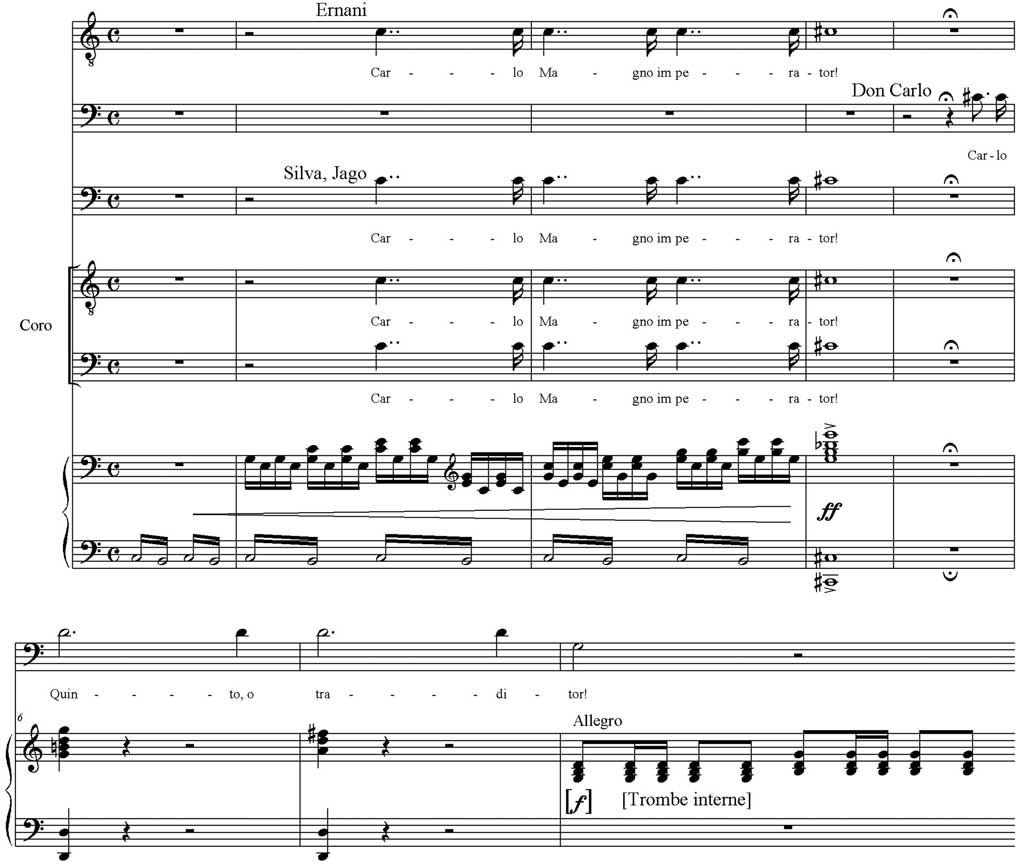
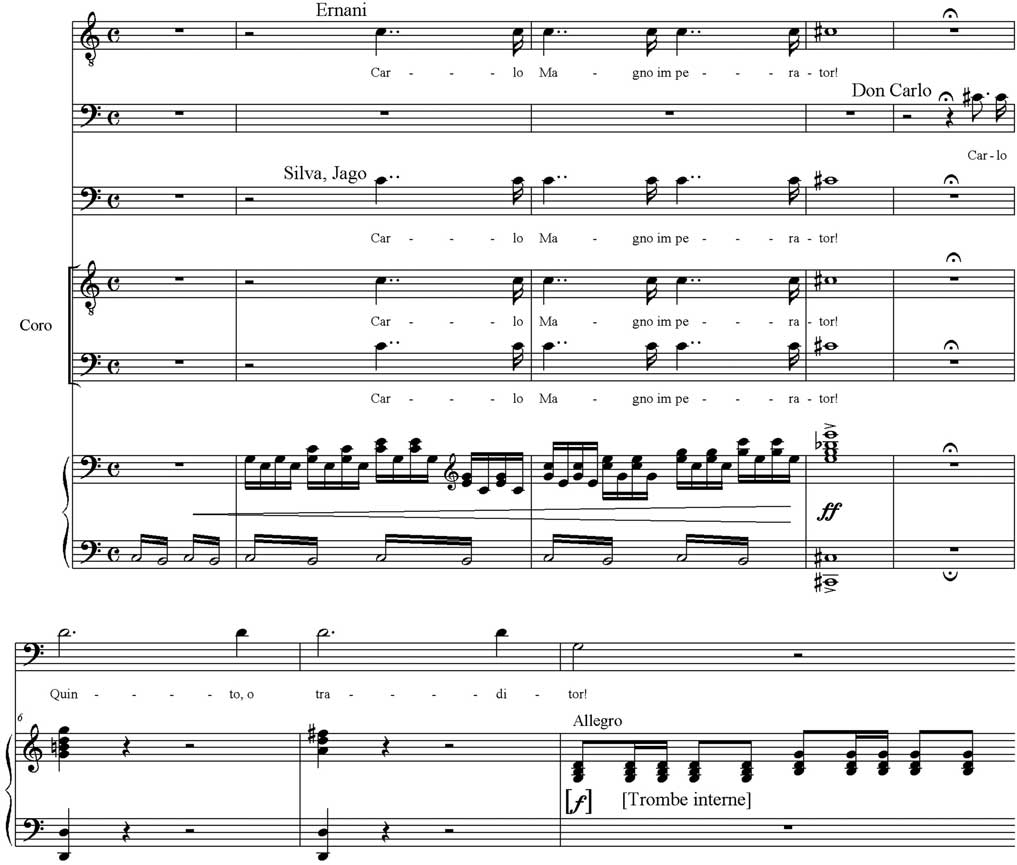
The finale opens with one of the most conspicuous ‘factual occurrences’ of this act: Carlo’s appearance by Charlemagne’s tomb. Three cannon shots announce Carlo’s election as the new Holy Roman emperor. Puzzlement and surprise overcome the Spanish conspirators gathered in the crypt for an assassination attempt. When he shows himself before the statue of Charlemagne their consternation reaches a peak. Their cry at the vision Emperor Charlemagne (‘Carlo Magno imperator’) leads to a diminished 7th chord, which resolves to a cadential 6/4 leading to G major as soon as Carlo reveals himself as Emperor Charles V (see Ex. 1). The rhetorical force of the juxtaposition of the two names is highlighted by the chromatic ascent of the vocal lines and by the bare accompaniment of Carlo’s revelation – two crucial gestures within the operatic semiotics of ritual.Footnote 61 And indeed, as soon as the perfect cadence concludes this passage, a backstage fanfare introduces the solemn procession of electors, pages, noblemen and women bringing onstage the symbols of imperial power – the crown, the sceptre and other regalia. In an earlier draft of the selva, Piave had planned a scene change at this point; yet, faithful to his constant preaching for dramatic succinctness, Verdi insisted that the coronation scene take place in the crypt in Aachen and eliminated the scene change.Footnote 62 This choice invigorates the symbolic meaning of the scene: it combines the representation of the coronation of a Habsburg emperor with the commemoration of the founder of the Holy Roman Empire – a fictionalised conjunction of history and memory that provides a cornerstone for its construction as a musical monument.
Giuseppe Verdi, Ernani, Act III, N. 12 Finale Terzo, bb. 7–14.
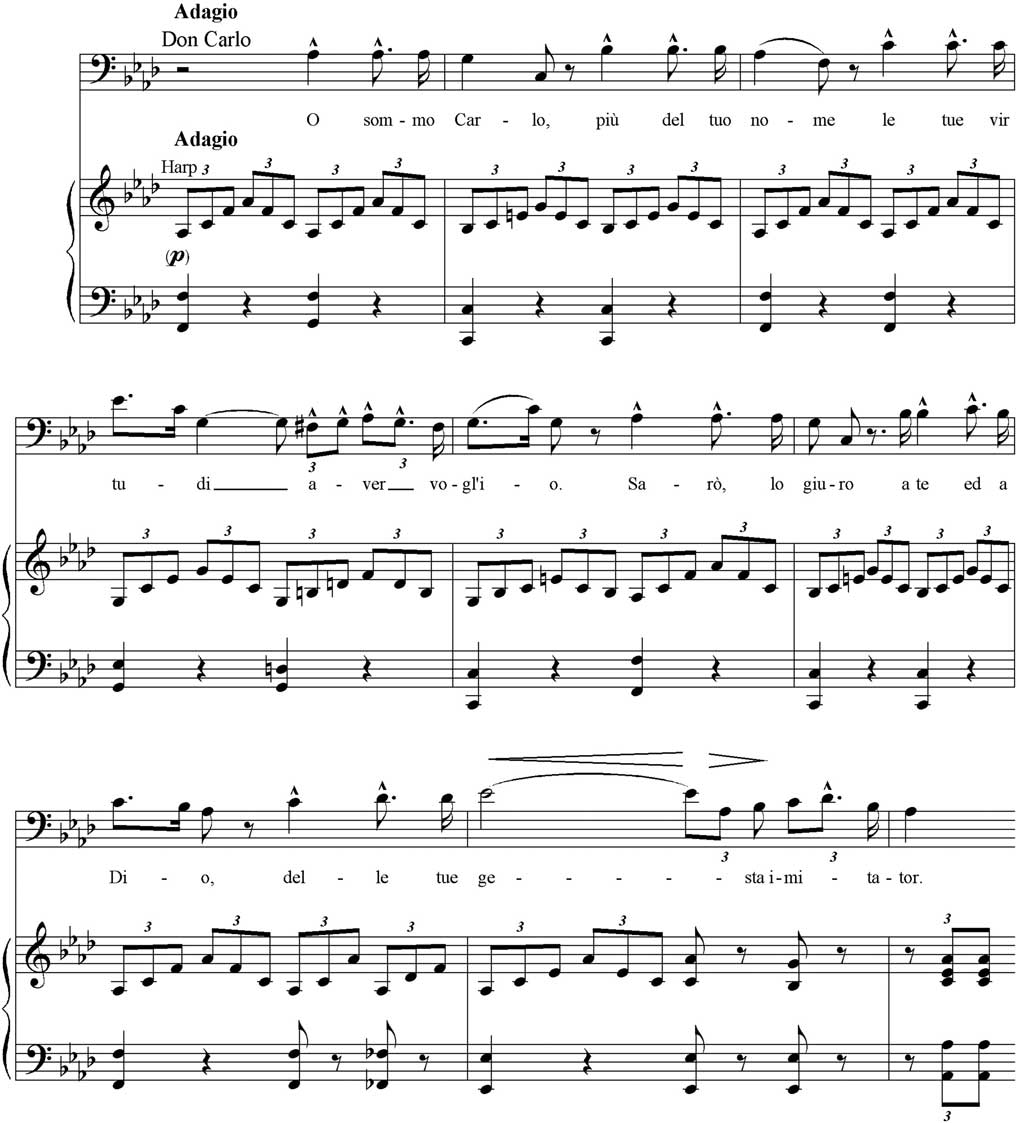
This is not, however, the only passage in which the names of Charlemagne and Charles V are juxtaposed. A few moments later, struck by Elvira’s words reminding him of the primacy of clemency among imperial virtues, Carlo invokes Charlemagne by pledging that he will be worthy not only of his name but also of his virtues (see Ex. 2).
Giuseppe Verdi, Ernani, Act III, N. 12 Finale Terzo, bb. 100–8.
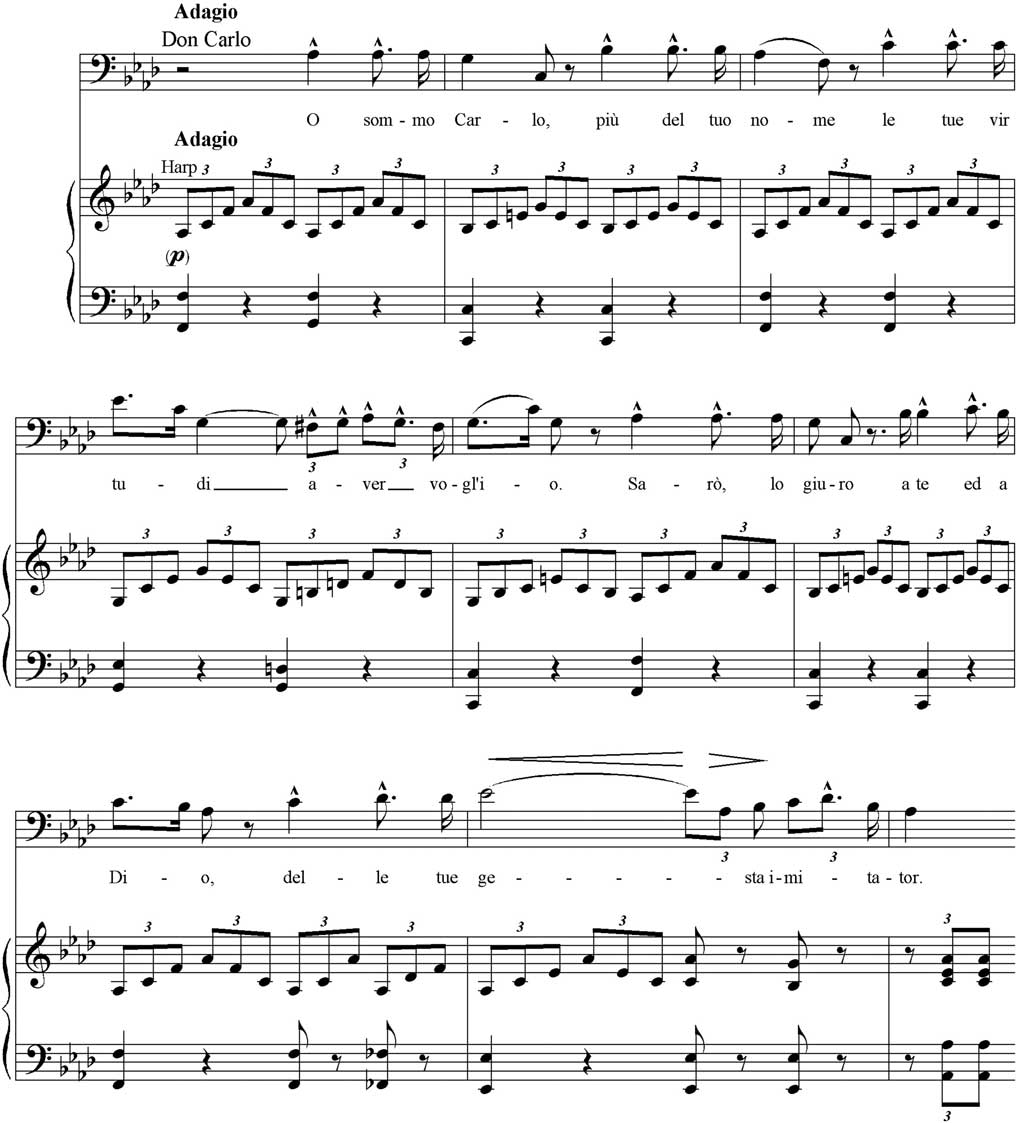
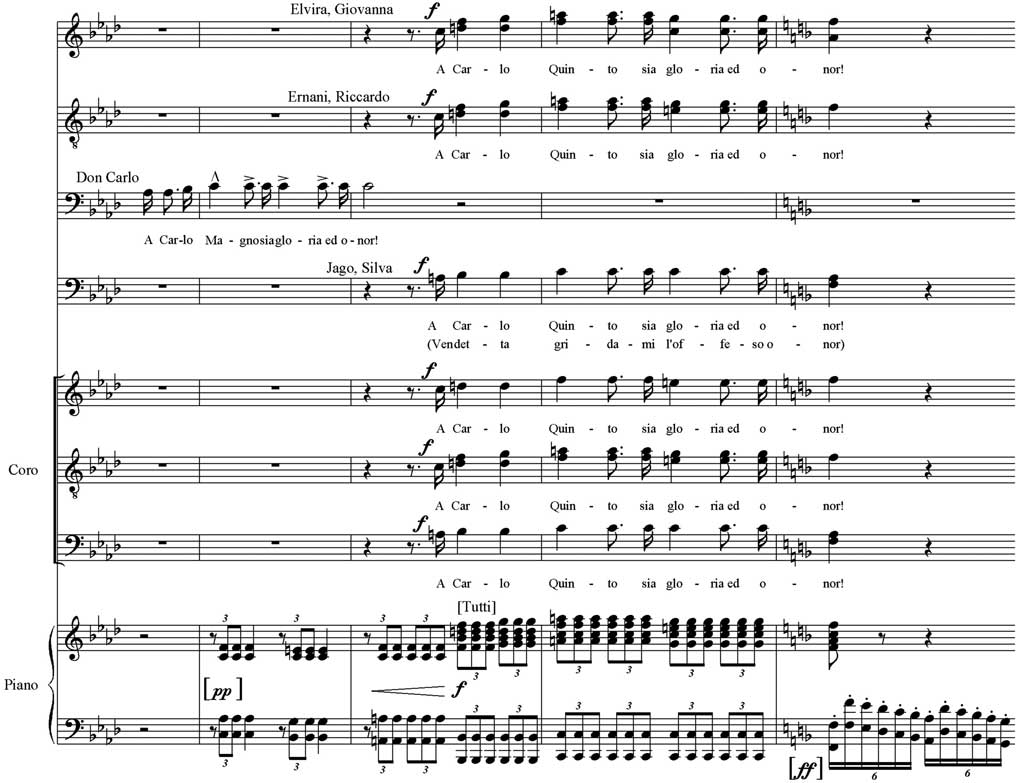
At the end of this eight-bar period – whose harp accompaniment offers a sonic halo for the supernatural attributes associated with the imperial title – Carlo decides to forgive the conspirators and, like a paternal figure, blesses the union between Elvira and Ernani. As he accomplishes his first deeds as an emperor, he calls for a glorification of Charlemagne, but this time the other characters reply with praise for Charles V, expressed in a change from F minor to a luminous F major (Ex. 3).
Giuseppe Verdi, Ernani, Act III, N. 12 Finale Terzo, bb. 112–16.
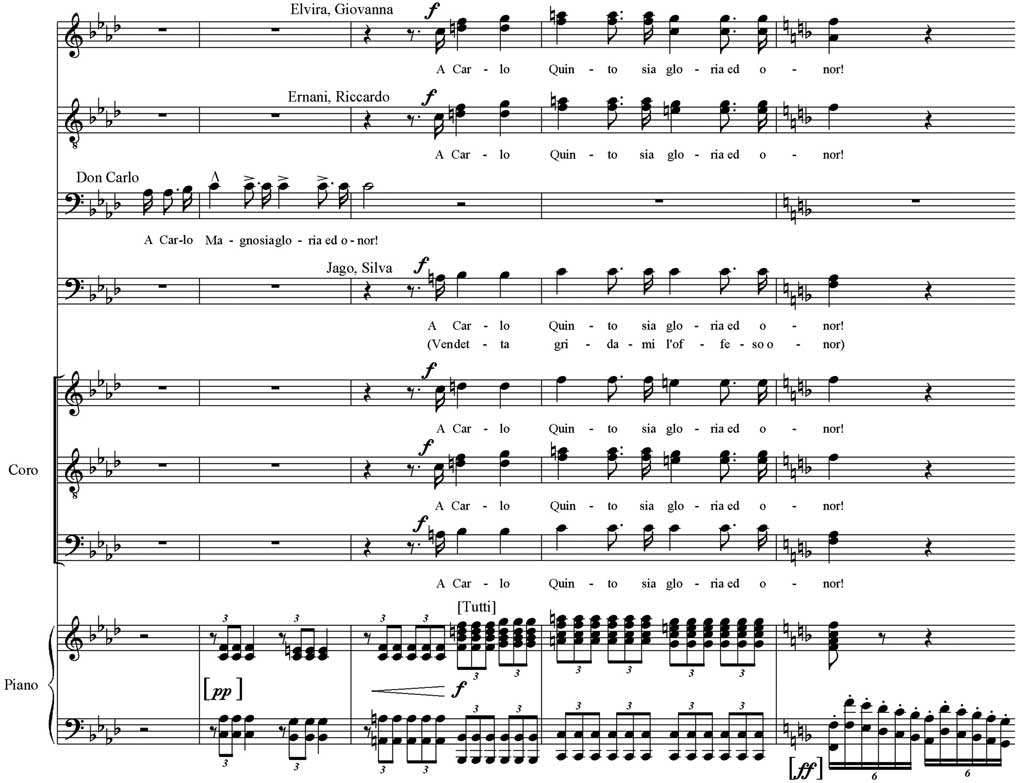
This last juxtaposition creates a dramatic chiasmus with the first: in the former instance, Carlo had to impose his imperial presence by means of his individual voice; now, his newly acquired status is sanctioned by the collective voice of the bystanders. It is through their voices that, in the grandiose conclusion of the finale, Charles V’s musical monument is erected and unveiled to the audience. This dramatic structure further blurs the distinction between Charlemagne and Charles V as historical personae, favouring an idealised merger of their identities (just as when the conspirators had mistaken Carlo for Charlemagne) and of their presence onstage. The conclusion of the finale with a frozen and majestic tableau vivant, rather than a tumultuous, action-propelling stretta, further enhances the static, monumental quality of the piece and contributes to its celebratory nature. Of course, the dramatic action continues after Act III with the tragic outcome of Elvira’s and Ernani’s love story; but as far as Carlo is concerned, the opera ends in grand solemnity with the scene of his coronation in front of Charlemagne’s funeral monument.
Seyfried had some reasonable ground to argue that politics influenced his experience of Ernani. While one may legitimately wonder to what extent the Act III finale contributed to this perception, it seems incontestable that no other part of the opera stages the Habsburg ideals of dynastic continuity as powerfully as this: Charles V, the embodiment of the modern imperial ideal, emerges here as the connecting figure between the Habsburg dynasty – to which he belongs – and the founding father of the Holy Roman Empire, Charlemagne. The celebratory conclusion of the piece, moreover, reconciles both the many tensions emerging from the opera’s dramatic structure and those surrounding its performance at the Kärntnertortheater, allowing the space of operatic performance to function like other strategic urban spaces of representation of imperial power. What is more, this celebratory flavour also enables us to connect the story of the opera I discussed thus far with Italian political appropriations of Ernani during the 1840s.
Ernani across boundaries
The conspiracy chorus, ‘Si ridesti il Leon di Castiglia’, has frequently been regarded as the point of contact between Ernani and nineteenth-century Italian politics. David Kimbell describes it as ‘a disguised Risorgimento ode’ that could be transformed ‘into an Italian patriotic hymn, exalted and belligerent enough for Giuseppe Mameli to be proud of’.Footnote 63 But while the chorus was indeed looked upon suspiciously by censors throughout the 1840s, its most overt use as a national hymn occurred in Naples in 1848 to celebrate the local sovereign, Ferdinand Bourbon, who had somewhat unwillingly conceded what was to be a short-lived constitution and was now hailed as one of the viable promoters of Italian unification.Footnote 64 More frequently, however, it fell upon the closing section of the Act III finale of Ernani to be turned into a tribute in the honour of Italian sovereigns, with their names replacing that of Carlo. This is how, for instance, the piece was performed to celebrate the new Pope Pius IX (a sympathiser, at first, with the Italian national cause) in Bologna, Rome and in other cities of the Papal States between 1846 and 1847; it was also used this way in Naples as yet another tribute to Ferdinand’s brief constitutional regime.Footnote 65
This dissemination of the finale suggests that even politically liberal readings of Ernani were less subversive than its traditional interpretation as a Risorgimento opera might lead us to think, at least for the first few years after its premiere. Rather than taking the incendiary ‘Si ridesti il Leon di Castiglia’ as the cornerstone of the act, the transformation of the finale into a celebratory piece in the Papal States and in Naples invites us to consider the magnanimity of the sovereign as its central pole of interest – whether as the newly crowned emperor of the plot, a recently elected pope, or a king whose political pedigree could hardly claim any liberal inclination prior to 1848.
As the piece intertwined the histories of as diverse political and cultural contexts as the Habsburg Empire, the Papal States and the Kingdom of the Two Sicilies, the limitations of imposing a unidirectional political reading, informed by the national rhetoric of the Risorgimento, become apparent – although this was certainly one possible manifestation of a plethora of potential interpretations. Just as the triumphal Act III Finale of Ernani served in Bologna, Rome or Naples as a vehicle for the glorification of different sovereigns of pre-Unification states, in Vienna it could easily become an operatic counterpart to the monuments erected in memory of more recent Habsburg rulers. These cultural processes – well-documented south of the Alps but more vaguely suggested in Vienna – testify to the limitations of rigidly compartmented national histories. Instead, approaching the cross-border circulation of the Act III finale from the perspective of histoire croisée sheds a different light on how the cultural meaning of the piece was constructed across boundaries and not despite them, and invites us to reconsider some other established historiographical assumptions: we might underline the fact that in Vienna Italian opera was more than an invasive weed in the land of German music,Footnote 66 and in a similar vein Ernani can hardly be reduced to an instance of Verdi’s early endorsement of Risorgimento ideals.Footnote 67 This is not to deny the existence of national divides, and even less of ideological tensions generated by them; yet important as they were to understand the histories of Italy and Austria, they provide only a portion of the picture. As significant were the cross-cultural relationships promoted by Habsburg imperial policies. Opera, then, provides an important contribution to a more nuanced and less polarised understanding of the administrative, political and cultural bonds between Vienna and the Italian territories of the empire.
Ernani participated in a dialogue between different ‘communicative spaces’ within and outside the empire and offered the possibility of an imaginary, socially produced space where collective memorial practices could cement the identity of the imperial community. The opera’s adaptability to fluctuating political circumstances reinforces, rather than interferes with, the reading of the finale as a musical monument; indeed, the coexistence of its apparent ‘ahistorical transcendence’ and participation to ‘historical change’ aptly exemplifies Rehding’s formulation of monumentality. Recognising, as Rehding does, that the conceptual tensions between stability and process, fixity and fluidity, and aesthetics and history are an inherent feature of monumentality (musical and non-musical), also helps explain why the Viennese debate on Italian opera was crucial in constructing the cultural meaning of the opera’s Act III finale: its recognised aesthetic qualities were decisive for the piece to work as a musical monument, favouring the repeated collective investment in the memorial dynamics set in motion one performance after another.Footnote 68 If the finale of Ernani can be read as a monument to the memory of Charles V, it is both because in Vienna its cultural meaning was performed through subtle manipulations of history and because its function as a commemorative practice was carried out as a social endeavour through well-attended musical events over the course of many seasons. Although Charles V was never celebrated in a major monument in Vienna, the enduring success of Verdi’s opera during the nineteenth century provided a monument of a different sort, one which also let the Viennese foster the memory of an emperor whose inspiring force made his name ‘triumph over the centuries’. Not surprisingly, perhaps, the fading of Ernani in the city coincided with the onset of the process that would later contribute to traumatic events for the collective memory of Europe – the twilight of the Habsburg dynasty.