


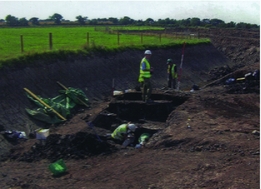
‘You cannot step twice into the same river’. With these words, the ancient Greek philosopher Heraclitus provides a metaphor for change, and for cultural change in particular. Cultures are in a ceaseless state of flux, and archaeology documents these changes; it is what makes archaeology such a magnificent subject to study. Rivers, too, are a classic theme in archaeology, an intrinsic unit of land-use study.
The first book reviewed here is Twice-crossed river, the weighty third volume in the ‘The Archaeology of the Lower Ouse Valley’ series by the Cambridge Archaeological Unit (CAU). As with the previous volumes, it is published as a McDonald Institute Monograph (whose front covers are notable by their consistent dryness), and, like its predecessors, this is a monograph with huge ambition. It covers 17 years of fieldwork, instigated by PPG16 in advance of the gradual extension of an aggregates quarry, and presents a vast amount of data from a number of sites. The title of the volume is inspired by Heraclitus’ aphorism noted above; the river in question is the Great Ouse, a river that once sluggishly ‘oozed’ along. The sites are concentrated along a 5km stretch of the Lower Ouse just above Earith, an area known as ‘The Narrows’, which is dotted with round barrows and dense prehistoric activity. Geological ridges flank the main Ouse palaeochannel and would have provided access through the landscape, as well as a platform from which to exploit riverine and marshland resources. In this landscape, the river and these low ridges “structured both its usage and, also, this book” (p. 1). The river is indeed braided through this monograph, and the ridges—and the archaeological evidence recorded on them—structure each chapter.
Godwin Ridge is the highest point in this landscape at only 3m OD and would have afforded wide views and easy access to water. It would have been an obvious place for settlement activity, and the recorded sequence takes us from Mesolithic flint scatters to Grooved Ware- and Beaker-attributed pits, through to the construction of a major enclosure system in the middle and late Bronze Age. More remarkable is the evidence from excavations on the O'Connell Ridge and Low Grounds Terrace-Island, offering significant insights into the region's Bronze Age settlement and mortuary traditions. Six round barrows, including three bowl barrows and two classic pond barrows, preceded by a Beaker-attributed inhumation cemetery, were excavated on what would have been low-lying damp ground.
These excavations represent the first investigation to modern standards of an upstanding Collared Urn-period barrow group. British archaeology rarely allows the full excavation of extant barrows, or indeed of ‘Wessex-type’ pond barrows, and this project was therefore an astonishingly rare opportunity to do just this. Such an endeavour, of course, demands high-quality work and, as the author puts it, “extras” (p. 302), including an intensive dating programme (published in more detail in Garrow et al. Reference Garrow, Meadows, Evans and Tabor2014), as well as experimental work on pyres. The excavation revealed multiple phases of construction and use, permitting an extraordinary level of understanding. In particular, the results make clear that the distinctions between different types of barrows are fluid—typologies are plainly not useful, and designated ‘types’ flow into one another. They are not a readily classifiable type of architecture, but rather develop through different forms at different times; there is a “sense of typological overlap—if not outright confusion” (p. 459). We can learn much from these excavations, not least that high-precision dating is essential, as Garrow's barrows on ‘The Narrows’ show.
The findings on Marlow Ridge, another landscape palimpsest, chart a sequence similar to that of Godwin's Ridge. But, in addition, here there is a small Iron Age ‘ritual’ complex, formed of (amongst other things) dismembered horse remains on the riverside and a roundhouse higher up on top of the ridge, mooted as some manner of shrine. It is certainly difficult to see the ridge as sustaining ‘normal’ occupation given the limited extent of available dry land, but nevertheless, this could just as easily be “the abode of a fisherman and his family” (p. 553), or indeed a ferryman/woman to bring people out to the ridge.
Twice-crossed river documents the ebb and flow of the Lower Ouse's prehistoric settlement sequence. It is a big, complicated book with equally big (and complicated) aims, offering more than the sum of its parts. It thinks ambitiously on subjects such as the nature of culture change, even if, at the final count, the evidence for such was not always forthcoming. There are few firm answers but lots of new questions. There is also a degree of honesty in the writing that is not normally found in technical monographs. As one can imagine, with a complex project such as this, many people have been involved—44 specialist contributors are listed on the inside cover alone and many more in the acknowledgements. One thought, however, that (twice-)crossed this reviewer's mind, is what has happened to some of the other voices of the project: the supervisors and site directors, or the authors of the grey literature reports. The names of specialists are attributed to their own work, and site directors are identified in the acknowledgements (and Tabor and Vander Linden are listed as ‘with’ on the front cover authorship), but it is not completely clear who contributed what to the site interpretations. Have voices been written out of, or absorbed into, Evans's writing? Nonetheless, this is a book of a very high standard.
CAU excavations, such as this one or indeed the recent excavations at Must Farm near Whittlesey, have brought the prehistory of Cambridgeshire firmly into wider accounts of British prehistory. Its Holocene sequence has, however, long been studied. The neighbouring county of Suffolk, conversely, has seen comparably little Holocene environmental work. The next monograph under review attempts to re-dress this imbalance. Down by the river describes the results of eight years of research focused on the palaeoenvironmental and archaeological record preserved within Suffolk's river valleys. The book is formed of a series of loosely related sites investigated by the authors at different times and under dissimilar conditions, and funded through a variety of means, from the Aggregates Levy Sustainability Fund to the Historic Environment Enabling Programme, and undertaken by various commercial archaeological projects across the county.
Work for the Suffolk River Valleys Project has clearly demonstrated the presence of in situ wet-preserved Holocene deposits in selected river valleys, and has resulted in new perspectives on methodological approaches to the radiocarbon dating of floodplain deposits. Various further palaeoenvironmental and geoarchaeological investigations in Suffolk as part of archaeological mitigation associated with commercial developments has provided additional evidence for Holocene environmental change and human impact. The varying level of analytical detail from commercial projects restricts comprehensive conclusions regarding landscape evolution; these projects, however, show the untapped research potential of the river valleys in Suffolk and provide hypotheses concerning the timing, pattern and process of fluvial development, human activity and landscape change during the Holocene.
Also reported in this monograph is work initially undertaken during flood alleviation measures by the Environment Agency, which identified three Iron Age timber alignments (a monument type previously unknown in Suffolk), on the floodplain of the lower Waveney Valley at Beccles, at Barsham and a further one at Geldeston (just over the border in Norfolk). A two-year programme of hydrological monitoring followed. The full extent of the alignments was not established, but they clearly extended across the width of the River Waveney floodplain. How does one begin to interpret these timber alignments? Did they delineate routeways to, from and across the river, and act as territorial markers associated with river travel? The authors discuss a number of interpretations, which include a combined landing/crossing/ferry point, allowing the movement of people and goods overland north and south, while also marking the start and end of journeys by river and sea to the west and east respectively. The last chapter usefully sets out research questions for future palaeoenvironmental and archaeological study of the Suffolk river valleys. The implications for future management and preservation in situ are also well assessed, and a management plan is outlined.
The results and conclusions of Down by the river are diverse, having been undertaken over a wide area, under differing circumstances and funded in assorted ways. They range from site-specific data regarding patterns and processes of Holocene environmental change and human activity to methodological developments and protocols (such as radiocarbon dating of alluvial deposits and geophysical prospection of wet-preserved organic archaeology). This, to me, is one of the strengths of the monograph, showing how common themes can be drawn out of commercial investigations and linked with research projects. This surely is the future of archaeology. Similarly, Twice-crossed river embodies the CAU's ethos of incorporating research into its commercial fieldwork. The authors of both monographs are to be congratulated for this integrated approach. The other welcome combination in both these volumes is that of the palaeoenvironmental work and archaeology. This is, of course, the only way to understand wetland sites.
As Down by the river highlights, much of the east of England is aggregate-rich, low-lying and experiencing population growth; the landscape and the archaeology of the area is therefore under pressure from a variety of directions—quarrying, agriculture, infrastructure development and climate change. While these issues affect much of the UK, they are felt particularly acutely in eastern England. Both of these monographs contribute much to archaeology's wider goal of understanding and protecting the fragile and threatened records preserved within these valleys.
Rivers flow and waters change, just as time flows and cultures change. These changing rivers and changing cultures have been evidenced and reflected upon in both of these books. Having dipped a foot in these rivers, it is clear that much has changed within the cultures of archaeology too: changes in techniques and technologies, in interpretations and areas of focus, and not least changes to the movers and shakers of archaeology, who are no longer predominantly to be found in academia but beyond, particularly in commercial archaeology. As Richard Bradley writes in his Foreword to Twice-crossed river: “prehistoric archaeology cannot be the same again” (p. xix).


