

Introduction
Submarine caves and cavities constitute considerable volume and surface areas of coral reefs (Garrett et al. Reference Garrett, Smith, Wilson and Patriquin1971; Jackson et al. Reference Jackson, Goreau and Hartman1971; Ginsburg Reference Ginsburg1983; Logan et al. Reference Logan, Mathers and Thomas1984). These caves and cavities are often considered as an important cryptic habitat or refuge. Especially, submarine caves are known to harbor various invertebrates, either relict, living fossil species and/or endemic taxa adapted to the cave environment, including coralline sponges, mollusks, and ostracods (Jackson et al. Reference Jackson, Goreau and Hartman1971; Hayami and Kase Reference Hayami and Kase1992; Kase and Hayami Reference Kase and Hayami1992; Taylor and Palmer Reference Taylor and Palmer1994; Tabuki and Hanai 1999; Kano and Kase Reference Kano and Kase2008; Chiu et al. Reference Chiu, Yasuhara, Iwatani, Kitamura and Fujita2016). The presence of these relict and endemic taxa may be due to reduced biotic interactions such as competition and predation in this dark and oligotrophic environment. Also, the effects of climate change outside may be buffered in this semi-isolated environment. Many submarine caves have thousands of years of history and formed during the periods of the Holocene transgression and the subsequent sea-level highstand after the last glacial maximum. In many submarine caves, fine, muddy sediments were deposited after the caves’ formation (Kitamura et al. Reference Kitamura, Hiramoto, Kase, Yamamoto, Amemiya and Ohashi2007a, Reference Kitamura, Yamamoto, Kase, Ohashi, Hiramoto, Fukusawa, Watanabe, Irino, Kojitani, Shimamura and Kawakami2007b; Yamamoto et al. Reference Yamamoto, Kitamura, Ohmori, Morishima, Toyofuku and Ohashi2009a; van Hengstum et al. Reference van Hengstum, Scott, Gröcke and Charette2011; van Hengstum and Scott Reference van Hengstum and Scott2012). These sediments are often characterized by continuous sedimentation and minimum disturbance, because a submarine cave is (1) an enclosed environment sheltered from physical disturbance and erosion by, for example, tidal currents or wave action; and (2) an oligotrophic environment with reduced biological activities, and therefore minimum bioturbation. Thus, Holocene submarine-cave sediments can act as ideal paleoecological archives that allow us to elucidate long-term history of this unique ecosystem.
Daidokutsu Cave is one such submarine cave in Okinawa, Japan (Yamamoto et al. Reference Yamamoto, Kitamura, Ohmori, Morishima, Toyofuku and Ohashi2009a). The cave floor is covered with soft sediment, providing an excellent and continuous sediment core record for the last 7 Kyr (Kitamura et al. Reference Kitamura, Hiramoto, Kase, Yamamoto, Amemiya and Ohashi2007a; Omori et al. Reference Omori, Kitamura, Fujita, Honda and Yamamoto2010). Holocene fossil records are available for wide variety of metazoan and protozoan groups, including crustacean ostracods (this study); protozoan, larger benthic foraminiferans (Omori et al. Reference Omori, Kitamura, Fujita, Honda and Yamamoto2010); and molluscan bivalves (Kitamura et al. Reference Kitamura, Hiramoto, Kase, Yamamoto, Amemiya and Ohashi2007a; Ubukata et al. Reference Ubukata, Kitamura, Hiramoto and Kase2009; Yamamoto et al. Reference Yamamoto, Kitamura, Ohmori, Morishima, Toyofuku and Ohashi2009a). Thus, Daidokutsu Cave provides a unique opportunity to investigate an ecosystem-scale response of cave fauna to environmental and climate changes throughout most of the Holocene.
Regional Setting
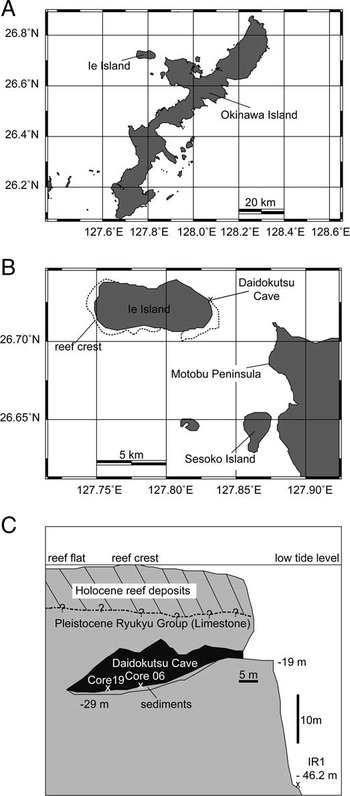
Daidokutsu Cave is a submarine limestone cave on the east coast of Ie Island, Okinawa, Japan (26.72°N, 127.83°E; Fig. 1A,B). It has been completely submerged for at least the last 8 Kyr (Yamamoto et al. Reference Yamamoto, Kitamura, Ohmori, Morishima, Toyofuku and Ohashi2009a; Omori et al. Reference Omori, Kitamura, Fujita, Honda and Yamamoto2010). The cave entrance lies at 19 m below sea level, and the floor of the interior deepens to 29 m below sea level (Fig. 1C) (Omori et al. Reference Omori, Kitamura, Fujita, Honda and Yamamoto2010). This 40-m-long cave is known for its dark and oligotrophic environment (Omori et al. Reference Omori, Kitamura, Fujita, Honda and Yamamoto2010). The salinity (34.3, seasonal variation range unknown) and temperature (annual mean of ~24°C, with a seasonal variation range of 20–29°C) in the cave are similar to conditions outside at a similar water depth (i.e., 30 m) (salinity: ~35, with a seasonal variation range of 34.5–35.0; temperature: ~24°C, with a seasonal variation range of 20–29°C) (Yamamoto et al. Reference Yamamoto, Sakai and Kitamura2009b; Kitamura et al. Reference Kitamura, Kobayashi, Tamaki, Yamamoto, Irino, Miyairi and Yokoyama2013; Chiu et al. Reference Chiu, Yasuhara, Iwatani, Kitamura and Fujita2016).
Location of sampling sites: A and B, location of Daidokutsu Cave; C, simplified cross section of Daidokutsu cave showing the position of core 06, core 19, and the surface-sediment sample IR1. A and B are from Chiu et al. (Reference Chiu, Yasuhara, Iwatani, Kitamura and Fujita2016); C is from Omori et al. (Reference Omori, Kitamura, Fujita, Honda and Yamamoto2010).

Materials and Methods
We examined cores 06 (148 cm long) and 19 (233 cm long) (Fig. 1), which are 5-cm-diameter sediment cores obtained from Daidokutsu Cave (Yamamoto et al. Reference Yamamoto, Kitamura, Ohmori, Morishima, Toyofuku and Ohashi2009a). Site 06 is closer to the cave entrance, and site 19 was farther inside the cave (Fig. 1C). The cores were sliced into 1 cm sections. We examined 37 samples from core 06 and 62 samples from core 19 for ostracod analysis (~2 dry g sediment per sample on average). We also used a surface-sediment sample collected outside the cave at a water depth of 46.2 m (IR1; Fig. 1C) to compare the ostracod faunal assemblages inside and outside the cave. The core and surface samples were wet-sieved using a 63 μm sieve, dried, and then dry-sieved using a 150 μm sieve. Ostracods were picked from the >150 μm size fraction of the residue and were identified to the species level. Taxonomic identifications were mainly based on Maddocks (Reference Maddocks1969), Tabuki et al. (Reference Tabuki, Nakano and Nohara1987), Ruan and Hao (Reference Ruan and Hao1988), Tabuki and Hanai (Reference Tabuki and Hanai1994, 1999), and Hou and Gou (Reference Hou and Gou2007). A single ostracod valve was counted as one specimen (i.e., one articulated carapace as two specimens). Larger benthic foraminiferal and bivalve data are from published sources (Yamamoto et al. Reference Yamamoto, Kitamura, Ohmori, Morishima, Toyofuku and Ohashi2009a; Omori et al. Reference Omori, Kitamura, Fujita, Honda and Yamamoto2010). The age models are based on radiocarbon dates and are from Kitamura et al. (Reference Kitamura, Kobayashi, Tamaki, Yamamoto, Irino, Miyairi and Yokoyama2013) for core 19 and Kitamura et al. (Reference Kitamura, Hiramoto, Kase, Yamamoto, Amemiya and Ohashi2007a) for core 06.
We performed nonmetric multidimensional scaling (NMDS) to explore the major differences and changes in faunal composition (Murray Reference Murray2000; Yasuhara et al. Reference Yasuhara, Hunt, Cronin, Hokanishi, Kawahata, Tsujimoto and Ishitake2012b, Reference Yasuhara, Okahashi, Cronin, Rasmussen and Hunt2014) for ostracods, larger benthic foraminiferans, and bivalves. We interpreted the first NMDS axis (NMDS1) as capturing a primary signal of variation in faunal composition through time. The NMDS was conducted based on Bray-Curtis distances calculated from square-root-transformed relative species abundance for the samples with ≥50 specimens; this was done separately for ostracods, foraminiferans, and bivalves. Rare species that have fewer than 10 specimens in total were excluded from the NMDS. Species diversity was calculated as rarefaction E(S n ), which is the number of species when the sample size is n specimens (n = 200 for ostracods; n = 50 for foraminiferans and bivalves each). We used the statistical programming environment R (R Development Core Team 2016) with the ‘vegan’ package (Oksanen et al. Reference Oksanen, Blanchet, Kindt, Legendre, Minchin, O’Hara, Simpson, Solymos, Stevens and Wagner2016) for the NMDS and rarefaction analyses. The data are deposited in Dryad (doi:10.5061/dryad.88t58).
Results and Discussion
Ostracod Assemblage
At least 150 and 54 ostracod species were identified from the sediment cores (06 and 19) and the sample IR1, respectively. All samples include >200 ostracod specimens. Abundant taxa include Neonesidea spp. (11 species; 19.8 % of total ostracod specimens in these two cores), Pontocypris sp. 1 (13.1 %), Xestoleberis spp. (6 species; 10.3 %), Polycope spp. (7 species; 8.77 %), Paranesidea spp. (7 species; 5.50 %), Tabukicypris decoris (4.66 %), Cytherella spp. (≥2 species; 4.65 %), Paradoxostomatid spp. (≥3 species; 4.05 %), Loxoconcha cf. japonica (3.69 %), and Kasella ryukyuensis (1.82 %).
Spatial Gradient in Ostracod Assemblages
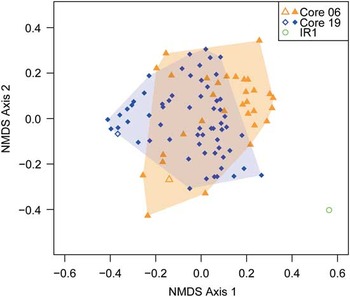
There is a gradient in ostracod species richness and faunal composition from the outside to the inside of the cave. The ostracod species richness E(S 200) was 50.9 in the sample IR1 (outside the cave), 42.2 in the core 06 top surface layer (relatively close to the cave entrance), and 34.3 in the core 19 top surface layer (farther inside the cave); thus, species richness decreases the farther you progress into the cave. In the NMDS plot (Fig. 2), the faunal compositions of two cave cores largely overlap but are distinct from the faunal composition of the IR1 sample. In addition, the sample IR1, core 06 top surface layer, and core 19 top surface layer show progressive change in both NMDS1 and NMDS2 from outside to inside the cave (Fig. 2). Thus, the exterior and interior of the cave are characterized by higher and lower diversity, respectively, and have faunas with distinct compositions. Core 06, which is close to the cave entrance, shows intermediate diversity and faunal composition.
Ordination (NMDS) of ostracod relative-abundance data inside and outside Okinawa Daidokutsu Cave. Open symbols indicate top surface layer, whereas solid symbols indicate samples from other layers in the cores. The samples in cores 06 and 19 are connected by polygons. The high overlap of these two polygons indicates the great similarity of the faunal composition of these cores.

Temporal Change in Ostracod Assemblage
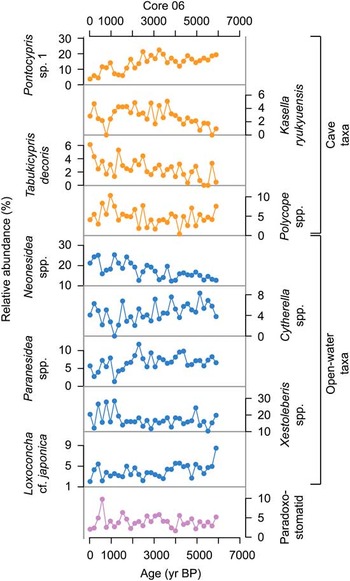
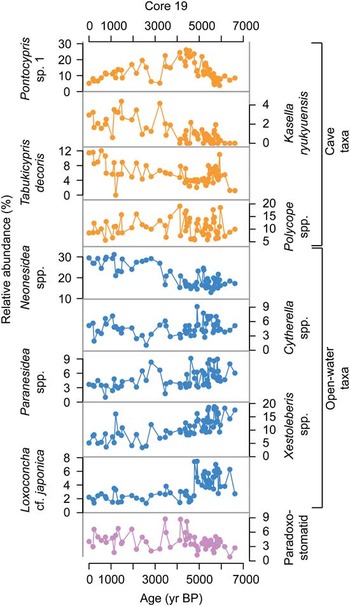
Figures 3 and 4 show temporal changes in relative abundances of major ostracod taxa in cores 06 and 19 over the past ~7 Kyr. Tabukicypris decoris (=Pontocypris sp. of Tabuki and Hanai [1999]; Ryoichi Tabuki personal communication 2016) and Kasella ryukyuensis are cave-endemic species (Tabuki and Hanai 1999; Chiu et al. Reference Chiu, Yasuhara, Iwatani, Kitamura and Fujita2016). They show a continuous increasing trend in relative abundance for the past 7 Kyr. Polycope also shows a similar trend, at least in core 06, and represents ~6.4 % of the total fauna in the present-day cave (in the uppermost samples of the cores). Polycope rarely shows such high abundance in typical shallow-marine environments. In fact, Polycope is much less abundant in the surface-sediment IR1 (3% in IR1). Because Polycope is known to be the most dominant taxon in Bermudan submarine caves (Maddocks and Iliffe Reference Maddocks and Iliffe1986), it is likely that the Polycope species in the present study are cave-adapted species.
Changes in relative abundance (%) of the 10 dominant taxa in core 06. Cave taxa: Kasella ryukyuensis, Tabukicypris decoris, Polycope spp., and Pontocypris sp. 1. Open-water taxa: Neonesidea spp., Cytherella spp., Paranesidea spp., Xestoleberis spp., and Loxoconcha cf. japonica. Other taxa: Paradoxostomatid. See main text for discussion of their habitats.

Changes in relative abundance (%) of the 10 dominant taxa in core 19. Cave taxa: Kasella ryukyuensis, Tabukicypris decoris, Polycope spp., and Pontocypris sp. 1. Open-water taxa: Neonesidea spp., Cytherella spp., Paranesidea spp., Xestoleberis spp., and Loxoconcha cf. japonica. Other taxa: Paradoxostomatid. See main text for the discussion of their habitats.

Pontocypris sp. 1 (=Propontocypris sp. A of Tabuki and Hanai [1999]; Ryoichi Tabuki personal communication 2016) was one of the most abundant species in these two cores, but was absent from the surface sample IR1. Living specimens were found in Daidokutsu Cave by Tabuki and Hanai (1999). Thus, this species also seems to be a cave species. In contrast to the other cave taxa mentioned earlier, the relative abundance of this species decreases upward in both core 06 and core 19.
The open-water taxa Cytherella, Paranesidea, Neonesidea, Xestoleberis, and Loxoconcha cf. japonica are known to populate the shallow-marine, open-reef environments in this region (Tabuki and Nohara Reference Tabuki and Nohara1990; Tabuki and Hanai 1999) and tend to show a gradual decrease in relative abundance for the past 7 Kyr in the cores studied, with the exception of Neonesidea. There are many undescribed Neonesidea species found in the cores (Supplementary Table 1), and this different trend in the occurrence of Neonesidea compared with other “open-water taxa” may indicate that many of the undescribed Neonesidea species in the cores are cave-adapted species. The continuous increase of cave taxa and decrease of non-cave taxa probably reflect gradual isolation of the cave and its ecosystem due to the development of a coral reef over the Pleistocene limestone cave ceiling (Fig. 1) that made the cave more enclosed (i.e., narrowed the cave entrance and/or made the cave ceiling more complete, perhaps by expanding the ceiling and/or filling in cavities) during the periods of the Holocene transgression and subsequent sea-level highstand (Kitamura et al. Reference Kitamura, Hiramoto, Kase, Yamamoto, Amemiya and Ohashi2007a; Yamamoto et al. Reference Yamamoto, Kitamura, Ohmori, Morishima, Toyofuku and Ohashi2009a; Omori et al. Reference Omori, Kitamura, Fujita, Honda and Yamamoto2010) and led to a long-term decline in exchange with the open ocean and reduced light and food availability in the cave ecosystem (Omori et al. Reference Omori, Kitamura, Fujita, Honda and Yamamoto2010). The gradual decrease of red debris (sand-sized brown grains mainly composed of silicon, aluminum, and iron), which is considered to be derived from a terrestrial red soil layer widely distributed across Ie Island (Yamamoto et al. Reference Yamamoto, Kitamura, Ohmori, Morishima, Toyofuku and Ohashi2009a), and of photosensitive algal symbiont–bearing foraminiferans (Omori et al. Reference Omori, Kitamura, Fujita, Honda and Yamamoto2010) in the cores studied indicates isolation and increasing darkness (i.e., reduction in the sunlight reaching the interior of the cave), respectively, consistent with our interpretation. Pontocypris sp. 1, a cave species showing an inconsistent trend with other cave taxa, might have preferred a semi-enclosed cave environment during the mid-Holocene (i.e., a comparatively more open environment than the present-day Daidokutsu Cave).
Temporal Changes of the Cave Community
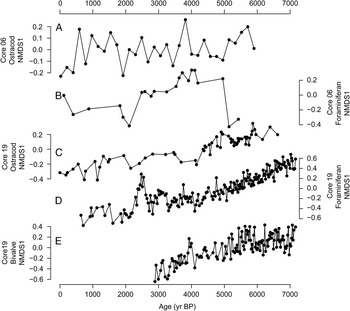
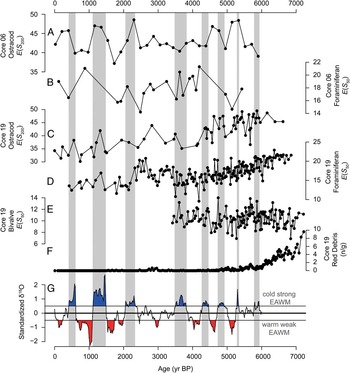
Comparing our ostracod results with the published foraminiferal and bivalve data allows us to build a community-scale reconstruction of the past cave ecosystem. The NMDS1 of all studied groups (ostracods, foraminiferans, and bivalves) for both core 06 and core 19 shows consistent gradual decrease (note that we did not use or plot the bivalve data from core 06 because low abundance made it insufficient for multivariable analyses) (Fig. 5), indicating gradual faunal change throughout the past 7 Kyr. The ostracod NMDS1 shows negative correlation with relative abundance of typical cave ostracod species Kasella ryukyuensis (core 06 R 2=0.005021; core 19 R 2=0.4131) and Tabukicypris decoris (core 06 R 2=0.1671; core 19 R 2=0.235). Foraminiferans and bivalves show a similar trend of gradual decrease of open-water taxa (or taxa living near the entrance of the cave), and inner-cave taxa of bivalves show a trend of gradual increase similar to the cave ostracod taxa (Kitamura et al. Reference Kitamura, Hiramoto, Kase, Yamamoto, Amemiya and Ohashi2007a; Yamamoto et al. Reference Yamamoto, Kitamura, Ohmori, Morishima, Toyofuku and Ohashi2009a; Omori et al. Reference Omori, Kitamura, Fujita, Honda and Yamamoto2010). Foraminiferans in core 06 show a noisier trend but, except for the two bottommost samples (~5500–5000 yr BP), they still show a similar trend of gradual, overall decrease of NMDS1 (Fig. 5). This community-scale reconstruction suggests the general process by which present-day ecosystems in limestone submarine caves were gradually formed in response to progressive isolation caused by coral reef development during the periods of the Holocene transgression and subsequent sea-level highstand, which filled in the cavities of cave ceilings and/or narrowed cave entrances (Kitamura et al. Reference Kitamura, Hiramoto, Kase, Yamamoto, Amemiya and Ohashi2007a; Yamamoto et al. Reference Yamamoto, Kitamura, Ohmori, Morishima, Toyofuku and Ohashi2009a; Omori et al. Reference Omori, Kitamura, Fujita, Honda and Yamamoto2010). In addition, species diversity shows a similar gradual decrease, especially in ostracods and foraminiferans in core 19 (Fig. 6). It makes sense that the inner part of the cave (i.e., core 19) had a stronger isolation effect compared with core 06, which is comparatively closer to the cave entrance.
Changes in faunal composition of Daidokutsu Cave (NMDS1) for the last 7 Kyr. A, Core 06 ostracod faunal composition NMDS1. B, Core 06 foraminiferal faunal composition NMDS1. C, Core 19 ostracod faunal composition NMDS1. D, Core 19 foraminiferal faunal composition NMDS1. E, Core 19 bivalve faunal composition NMDS1.

Species diversity of ostracods, foraminiferans, and bivalves in cores 06 and 19 in Daidokutsu Cave for the last 7 Kyr. A, Core 06 ostracod species diversity E(S 200). B, Core 06 foraminiferal species diversity E(S 50). C, Core 19 ostracod species diversity E(S 200). D, Core 19 foraminiferal species diversity E(S 50). E, Core 19 bivalve species diversity E(S 50). F, Abundance of debris from the red soil layer in core 19 (Yamamoto et al. Reference Yamamoto, Kitamura, Ohmori, Morishima, Toyofuku and Ohashi2009a). G, The standardized δ18O record from core SK-2 (Sagawa et al. Reference Sagawa, Kuwae, Tsuruoka, Nakamura, Ikehara and Murayama2014), indicating East Asian winter monsoon (EAWM) variability. Gray bars indicate strong EAWM (i.e., cold) periods in core SK-2 in northeastern Japan (Sagawa et al. Reference Sagawa, Kuwae, Tsuruoka, Nakamura, Ikehara and Murayama2014).

Possible Climatic Impact on the Daidokutsu Cave Ecosystem
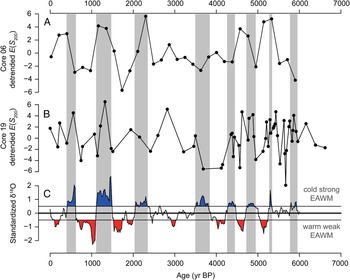
Ostracod species diversity shows centennial- to millennial-scale variability, which seems to show a certain similarity to Holocene East Asian winter monsoon (EAWM) variability (Fig. 6). Upon removal of the long-term linear trend, the peaks in detrended ostracod diversity, at least partially, correspond to the strong EAWM periods (Fig. 7; Sagawa et al. Reference Sagawa, Kuwae, Tsuruoka, Nakamura, Ikehara and Murayama2014). For example, the EAWM peaks of ~5300, ~4900–4700, ~2400–2000, ~1500–1100, and ~600–400 yr BP correspond well to the detrended ostracod diversity peaks in core 06. As for core 19, the detrended ostracod diversity peaks correspond to the EAWM peaks of ~6000–5800, ~5300, ~4900–4700, ~4500–4300, ~1500–1100, and ~600–400 yr BP. Larger benthic foraminiferal and bivalve species diversities do not show clear similarity with the EAWM variability, perhaps because their sample sizes are low or because ostracods are more sensitive to climate changes (Yasuhara and Cronin Reference Yasuhara, Cronin, deMenocal, Okahashi and Linsley2008; Yasuhara et al. Reference Yasuhara, Cronin, deMenocal, Okahashi and Linsley2008, Reference Yasuhara, Okahashi, Cronin, Rasmussen and Hunt2014). Larger benthic foraminiferans may be more sensitive to light availability (Omori et al. Reference Omori, Kitamura, Fujita, Honda and Yamamoto2010) rather than climate changes. The similarity between ostracod diversity and EAWM suggests that a submarine-cave ecosystem is not immune to the effects of rapidly changing climate. Higher sediment (i.e., nutrient) input from outside the cave into this oligotrophic ecosystem due to stronger coastal water influence during stronger winter monsoon periods may have led to a higher ostracod diversity, since the cave is located at the northeastern side of the island, which is influenced by northeast winds in winter. Given similarities between deep-sea and submarine-cave environments such as no light and limited food, the submarine-cave ecosystems may share deep-sea ecosystems’ sensitivity to relatively small-magnitude climate and environmental changes (Rogers Reference Rogers2015; Yasuhara and Danovaro Reference Yasuhara and Danovaro2016). As is well demonstrated in the present study, paleoecology enables community-scale reconstruction of long-term biotic response to local, regional, and global changes beyond the timescales of biological monitoring (Yasuhara et al. Reference Yasuhara, Hunt, Breitburg, Tsujimoto and Katsuki2012a, Reference Yasuhara, Hunt, Cronin, Hokanishi, Kawahata, Tsujimoto and Ishitakeb, Reference Yasuhara, Tittensor, Hillebrand and Worm2017; Kidwell Reference Kidwell2015; Moffitt et al. Reference Moffitt, Hill, Roopnarine and Kennett2015).
Detrended ostracod diversity E(S 200) in cores 06 and 19 compared with standardized δ18O record from core SK-2 (Sagawa et al. Reference Sagawa, Kuwae, Tsuruoka, Nakamura, Ikehara and Murayama2014). A, Core 06 ostracod detrended species diversity E(S 200). B, Core 19 ostracod detrended species diversity E(S 200). The ostracod diversity E(S 200) in the cores was detrended by subtracting the linear trend from the E(S 200) of each core using the resid function in the statistical programming environment R (R Development Core Team 2016), so as to facilitate the comparison of short-term variability in species diversity with paleoclimatic records. C, The standardized δ18O record from core SK-2 (Sagawa et al. Reference Sagawa, Kuwae, Tsuruoka, Nakamura, Ikehara and Murayama2014), indicating EAWM variability. Gray bars indicate strong EAWM periods in core SK-2 (Sagawa et al. Reference Sagawa, Kuwae, Tsuruoka, Nakamura, Ikehara and Murayama2014).

Acknowledgments
We thank Laura Wong and Maria Lo for continuous support; Thomas M. Cronin, Ryoichi Tabuki, and Hayato Tanaka for discussion; Carlos Jaramillo and Sara Marcus and Mary S. Curioli for editing; and three anonymous reviewers for helpful comments. This work was supported by the General Research Fund of the Research Grants Council of Hong Kong (project code: HKU 17303115), the Early Career Scheme of the Research Grants Council of Hong Kong (project code: HKU 709413P), and the Seed Funding Programme for Basic Research of the University of Hong Kong (project codes: 201111159140, 201411159017) (to M.Y.); and by the International Research Hub Project for Climate Change and Coral Reef/Island Dynamics of University of the Ryukyus (to K.F.).
Supplementary Material
Data available from the Dryad Digital Repository: http://dx.doi.org/10.5061/dryad.88t58