

I. Introduction
Numerous studies show that excessive alcohol consumption creates significant negative social costs (Chaloupka et al., Reference Chaloupka, Saffer and Grossman1993, Reference Chaloupka, Grossman and Saffer2002; Cook, Reference Cook2007; Giesbrecht et al., Reference Giesbrecht, Greenfield, Anglin and Johnson2004). In 2006, the societal costs of excessive alcohol consumption in the United States reached $224 billion, which amounts to $2 per drink or $746 per person (Bouchery et al., Reference Bouchery, Harwood, Sacks, Simon and Brewer2011). These costs include alcohol-related productivity losses, health-care expenses, violence, and motor vehicle collisions. Heavy alcohol consumption is also the single most important determinant of male mortality (McKee et al., Reference McKee, Shkolnikov and Leon2001; Shkolnikov et al., Reference Shkolnikov, McKee and Leon2001).
Economists, psychologists, and sociologists have made significant progress in uncovering the determinants of alcohol consumption in the hope of reducing the societal costs associated with this substance abuse. Although consumer tastes and preferences play a large role in determining consumption patterns, the economics discipline lacks a unifying theory on how these preferences come about (Michael and Becker, Reference Michael and Becker1973). In their analysis of consumer behavior, economists typically regard preferences as given (exogenous), although some progress has been made in explaining how preferences arise (Bell, Reference Bell2002; Binmore, Reference Binmore1998, Reference Binmore2005, Reference Binmore2007; Bowles, Reference Bowles1998; Dietrich and List, Reference Dietrich and List2012; Hartley, Reference Hartley1985; North, Reference North1996; Yang and Allenby, Reference Yang and Allenby2003). Several studies in political science have also examined the origins of preference formation and concluded that political beliefs can capture a wide variety of individual preferences and social attitudes (Dickson, Reference Dickson2006; Green et al., Reference Green, Palmquist and Schickler2002; Verba and Orren, Reference Verba and Orren1985; Wildavsky, Reference Wildavsky1987).
More importantly, much of the recent progress in understanding the role of tastes and preferences in alcohol consumption has been made by sociologists and psychologists. Several studies in psychology find that personality traits, beliefs, and intelligence may determine the propensity of individuals to consume more alcohol, tobacco, and illegal drugs (Eidelman et al., Reference Eidelman, Crandall, Goodman and Blanchar2012; Hodson and Busseri, Reference Hodson and Busseri2012; Kanazawa and Hellberg, Reference Kanazawa and Hellberg2010; Shim and Maggs, Reference Shim and Maggs2005). Furthermore, political ideology can capture differences in personal values, norms, and views on the role of government in society, all of which could have testable implications for alcohol consumption (Caprara et al., Reference Caprara, Barbaranelli and Zimbardo1999; Jost et al., Reference Jost, Frederico and Napier2009; Napier and Jost, Reference Napier and Jost2008). Recent findings in sociology link pro-communist beliefs to unhealthy behaviors such as excessive alcohol consumption (Cockerham, Reference Cockerham2005; Cockerham et al., Reference Cockerham, Snead and DeWaal2002, Reference Cockerham, Hinote, Cockerham and Abbott2006; Franco et al., Reference Franco, Alvarez-Dardet and Ruiz2004; Smith, Reference Smith2004).
Drawing from this interdisciplinary literature, we contend that political views can affect the demand for alcohol either through the preference or the behavioral channel. We test this hypothesis by estimating the demand for each type of alcohol (beer, wine, and spirits) using a longitudinal panel of fifty U.S. states. To the best of our knowledge, this study is the first to estimate the associative effect of political ideology on alcohol consumption in the United States. Our measure of political views is the widely used citizen ideology index developed by Berry et al. (Reference Berry, Ringquist, Fording and Hanson1998, Reference Berry, Ringquist, Fording, Hanson and Klarner2010). This time-variant index measures the average location of the active electorate in each state on a liberal–conservative continuum that ranges from 0 to 100 (higher values represent more liberal views). Holding everything else constant, our findings suggest that when a state becomes more liberal politically, its population consumes more beer and spirits per capita, but possibly less wine per capita.
The rest of our paper is organized as follows. In the next section, we summarize the literature on personality traits, self-construal, and alcohol consumption. In the subsequent two sections, we describe our data and empirical results, respectively, followed by the conclusion.
II. Literature Review
In this section, we survey the relevant interdisciplinary literature on ideology, values, and personality traits in relation to alcohol consumption, followed by a review of the latest empirical studies in economics on the determinants of alcohol consumption.
A. Political Beliefs and Alcohol Consumption
Cockerham et al. (Reference Cockerham, Snead and DeWaal2002) claim that very little research has been done on the relationship between political ideology and health behavior. Most research on health outcomes examines individual factors and neglects collective characteristics such as political ideology (Cockerham, Reference Cockerham2005; Frohlich et al., Reference Frohlich, Corin and Potvin2001). Several sociological studies suggest that ideological beliefs can establish a particular set of acceptable behaviors, including health-related decisions such as alcohol consumption (Cockerham et al., Reference Cockerham, Snead and DeWaal2002; Franco et al., Reference Franco, Alvarez-Dardet and Ruiz2004; Smith, Reference Smith2004). Cockerham (Reference Cockerham1999), Dmitrieva (Reference Dmitrieva and Cockerham2005), and Shkolnikov and Meslé (Reference Shkolnikov, Meslé and DeVanzo1996) argue that societies with high levels of patronage can foster state dependency and discourage individual desire for healthy behavior. According to Shkolnikov and Meslé (Reference Shkolnikov, Meslé and DeVanzo1996), the emphasis of state interests over personal needs in the Soviet Union taught people to de-emphasize individual health concerns because the government (society) would take care of them if they fell ill.
Cockerham et al. (Reference Cockerham, Snead and DeWaal2002) found that Russian pro-socialists had significantly worse health practices than anti-socialists. In particular, Cockerham et al. found that pro-socialists were significantly more likely than anti-socialists to drink alcohol frequently. They attribute the detrimental health practices of the pro-socialists to the ideology of state socialism, in which the state assumed responsibility for individual health care. In a follow-up study, Cockerham et al. (Reference Cockerham, Hinote, Cockerham and Abbott2006) survey a representative national sample of the adult population in Belarus, Russia, and Ukraine. They find that respondents with anti-communist views have healthier lifestyles and rate their health better than respondents with pro-communist views.
Cockerham (Reference Cockerham2005) proposes that collectivities, which are basically kinship, work, religious, or political groups, can influence individual health lifestyles. Religion, for example, has been linked to healthier lifestyles by discouraging alcohol and tobacco consumption while encouraging exercise and personal hygiene (Brown et al., Reference Brown, Parks, Zimmerman and Phillips2001). Shkolnikov and Nemstov (Reference Shkolnikov, Nemstov, Bobadilla, Costello and Mitchell1997) blame the suppression of religion by the communists for heavy vodka consumption on any day of the week rather than only on Sundays and Russian Orthodox holidays.
These sociological arguments are akin to pervasive moral hazards observed by economists in insurance, labor, and financial markets, in which individuals can choose to behave irresponsibly by shifting the cost of their behavior onto others (Arrow, Reference Arrow1963; Baker, Reference Baker1996; Gruber, Reference Gruber2007; Meyer, Reference Meyer1990; Newhouse and the Insurance Experiment Group, Reference Newhouse1993; Peltzman, Reference Peltzman1975). It could be argued that moral hazard can also manifest itself in terms of higher substance abuse due to state involvement in the provision of health care and welfare. Verba and Orren (Reference Verba and Orren1985) show that blame for poverty in the United States splits along ideological lines: Liberals tend to blame society, and conservatives tend to blame the individual. Therefore, the espoused political ideology can represent the prevailing social attitudes toward various social behaviors (Dickson, Reference Dickson2006; Green et al., Reference Green, Palmquist and Schickler2002; Verba and Orren, Reference Verba and Orren1985; Wildavsky, Reference Wildavsky1987). If the prevailing ideology or culture allows individuals to shift the cost of their behavior onto society, more people might engage in irresponsible behaviors such as excessive alcohol consumption.
B. Personal Values, Self-Construal, and Alcohol Consumption
A growing number of studies in psychology find a link between personality traits, personal values, and political orientation (Graham et al., Reference Graham, Haidt and Nosek2009). The right-wing orientation in the United States and other democratic countries has been associated with a higher degree of subjective well-being (Napier and Jost, Reference Napier and Jost2008) and in Italy with a higher degree of conscientiousness (Caprara et al., Reference Caprara, Barbaranelli and Zimbardo1999). Several studies find a strong link between personality traits and people's political views (Caprara et al., Reference Caprara, Barbaranelli and Zimbardo1999; Jost et al., Reference Jost, Frederico and Napier2009; Mooney, Reference Mooney2012; Napier and Jost, Reference Napier and Jost2008). Mooney (Reference Mooney2012) believes that people who crave novelty are more likely to have liberal political views. Personality traits such as openness to new experiences and fastidiousness can act as predictors of political views and decisions to consume goods like alcohol and drugs. Kanazawa and Hellberg (Reference Kanazawa and Hellberg2010) find that more intelligent children are more likely than their less intelligent counterparts to consume more alcohol, tobacco, and illegal drugs in adulthood. Similarly, Hodson and Busseri (Reference Hodson and Busseri2012) find that lower cognitive ability in childhood is associated with the endorsement of right-wing ideologies such as racism and homophobia in adulthood. A thought-provoking study by Eidelman et al. (Reference Eidelman, Crandall, Goodman and Blanchar2012) finds that alcoholic intoxication makes individuals more likely to agree with conservative views. However, this particular finding might suffer from a reverse-causality problem.
Personal values also seem to affect individual alcohol consumption decisions. Shim and Maggs (Reference Shim and Maggs2005) develop a behavioral-hierarchical decision model, which shows that personal values are a good predictor of college students' intentions to drink alcohol. Personal values and cultural norms fall under the category of self-construal, a term used to describe how an individual views himself in relation to society, from rather individualist to more collectivist attitudes. A recent study by Zhang and Shrum (Reference Zhang and Shrum2009) finds that more individualist cultures tend to consume more beer per capita. Using the individualism-collectivism indexes developed by Hosfstede (Reference Hofstede1984) and Vandello and Cohen (Reference Vandello and Cohen1999), Zhang and Shrum (Reference Zhang and Shrum2009) estimate the effect of self-construal on per-capita beer consumption across multiple countries as well as U.S. states. Controlling for temperature, income, and “masculinity,” they find that individualism is positively correlated with teen and adult alcohol consumption. However, Zhang and Shrum's estimates might suffer from significant omitted-variable bias because their model is a single cross-section of U.S. states and it is missing several key economic and demographic variables, such as prices of related goods, unemployment, age, gender, race, and religion.
Conway et al. (Reference Conway, Sexton and Tweed2006) find that Vandello and Cohen's individualism-collectivism index is positively correlated with the Legal Restriction Index (LRI) developed by Savageau and Loftus (Reference Savageau and Loftus1997), which means that states with a more collective self-construal generally have heavier government regulation. This positive correlation between collectivism and government regulation reaffirms Triandis and Gelfand's (Reference Triandis and Gelfand1998) conjecture that more collectivist states are more reliant on government regulation in restricting undesirable behaviors.
Self-construal has also been linked to impulsive hedonic consumption (i.e., consumption of goods for pure pleasure on an impulse). Impulsive consumption is generally unplanned and occurs when the desire to consume overcomes the ability to self-regulate. Alcohol is widely considered a hedonic product (consumed for pure pleasure) that is highly related to impulsiveness (Granö et al., Reference Granö, Virtanen, Vahtera, Elovainio and Kivimäki2004; Grau and Ortet, Reference Grau and Ortet1999). Impulsiveness has also been considered a trait that decreases one's ability to self-regulate hedonic desires (Ramanathan and Menon, Reference Ramanathan and Menon2006). This connection between impulsiveness and the lack of self-regulation might explain high levels of personal debt (Vohs and Faber, Reference Vohs and Faber2007) and alcohol consumption (Zhang and Shrum, Reference Zhang and Shrum2009) in the United States. In a seminal paper on self-construal, Hosfstede (Reference Hofstede1984) shows that quality of life is affected by national-level cultural patterns. Using Hofstede's individualism rankings, Kacen and Lee (Reference Kacen and Lee2002) find a positive correlation between culture and impulsive consumption in several countries.
C. Economic Models of Alcohol Consumption
Alcohol consumption is a heavily researched topic in economics. In this section, we summarize some of the latest empirical papers on alcohol consumption. For the U.S. market, many empirical papers assume a uniform supply of alcohol across states but varying demand levels. Therefore, most studies focus on estimating the determinants or shifters of alcohol demand. In the context of demand theory, political ideology can be viewed as a proxy for some consumer preferences, which is a shifter of demand.
Economists have previously constructed panel estimates for alcohol demand at the state level. Freeman (Reference Freeman2000) estimates a fixed-effects model of beer consumption using state-level panel data for the 1961–1995 period, primarily ascertaining that income and state excise taxes have little effect on alcohol consumption. In a more recent study and somewhat contrary to Freeman (Reference Freeman2000), Freeman (Reference Freeman2011) estimates a model of alcohol consumption for the 1970–2007 period, finding beer to be a normal good and its consumption to be pro-cyclical and very responsive to state age distribution. Nelson (Reference Nelson2003) estimates a panel-data model for 45 states for the years 1982–1997 and finds that restrictive state laws for one type of alcoholic beverages force consumers to substitute other alcoholic beverages. He also finds that a state monopoly on the sale of spirits increases the consumption of wine but reduces overall alcohol consumption per capita.
Looking at alcohol demand estimates for other countries, Ogwang and Cho (Reference Ogwang and Cho2009) estimate beverage-specific demand models with fixed effects for Canadian provinces for the years 1981–2004. Ogwang and Cho find that increasing beer and spirits taxes does not shift alcohol consumption toward wine. They also find that income is an important determinant of wine and beer consumption, but not spirits, while unemployment is an important determinant of beer consumption only. Ramful and Zhao (Reference Ramful and Zhao2006) examine the socioeconomic and demographic factors of Australian alcohol consumption using surveys from 1991 to 2001. Ramful and Zhao find that all types of alcohol have negative price elasticities and that young people consume more spirits due to the availability of premixed drinks.
Colen and Swinnen (Reference Colen and Swinnen2011) analyze beer consumption in 104 countries over the period 1970–2005, using average per-capita beer consumption and beer consumption as a share of all alcohol consumption as their dependent variables. Colen and Swinnen find that beer consumption increases with income but at a decreasing rate. They also conclude that globalization has caused beer drinking countries to consume less beer and more wines and spirits. However, wine and spirit drinking countries do not seem to drink more beer as a share of total alcohol consumption.
Fogarty (Reference Fogarty2010) reviews the empirical literature on alcohol consumption and concludes that elasticity estimates for alcohol demand vary widely depending on estimation technique, frequency of data collected, and period used. Fogarty also observes that alcohol demand appears to be income elastic, but the degree of elasticity has been falling since the mid-1960s, and consumers tend to respond with inventory behavior versus substitution behavior.
Ruhm et al. (Reference Ruhm, Jones, Kerr, Greenfield, Terza, Pandian and McGeary2011) estimate the price elasticity of demand for beer using alcohol price and tax data. They find substantial variations in price elasticities across different measurements used, but note that tax elasticity estimates appear more stable than those based on alcohol price data.
III. Data
As in many recent studies on alcohol consumption, we use panel data to estimate the effect of political ideology on the per-capita consumption of beer, wine, and spirits. Our dataset is a longitudinal panel of all U.S. states from 1952 to 2010. The choice of U.S. cross-sectional, time-series data is motivated by its quality and the need to control for unobserved heterogeneity (i.e., unobserved or omitted variables that are correlated with the regressors in the model). The cross-sectional or pooled ordinary least squares (OLS) estimates might be erroneous in the presence of unobserved heterogeneity, which we attempt to control for with a fixed-effects estimator.
The U.S. state–level alcohol data are available for slightly different time spans for each type of alcohol, giving us different sample sizes for beer, wine, and spirits. Like Freeman (Reference Freeman2011), we use alcohol shipments to states in gallons per capita as the dependent variable. Alcohol shipments are highly collinear with alcohol consumption, but available for more years than consumption data.
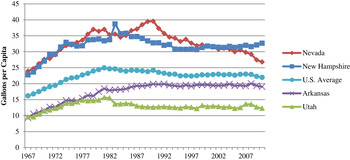
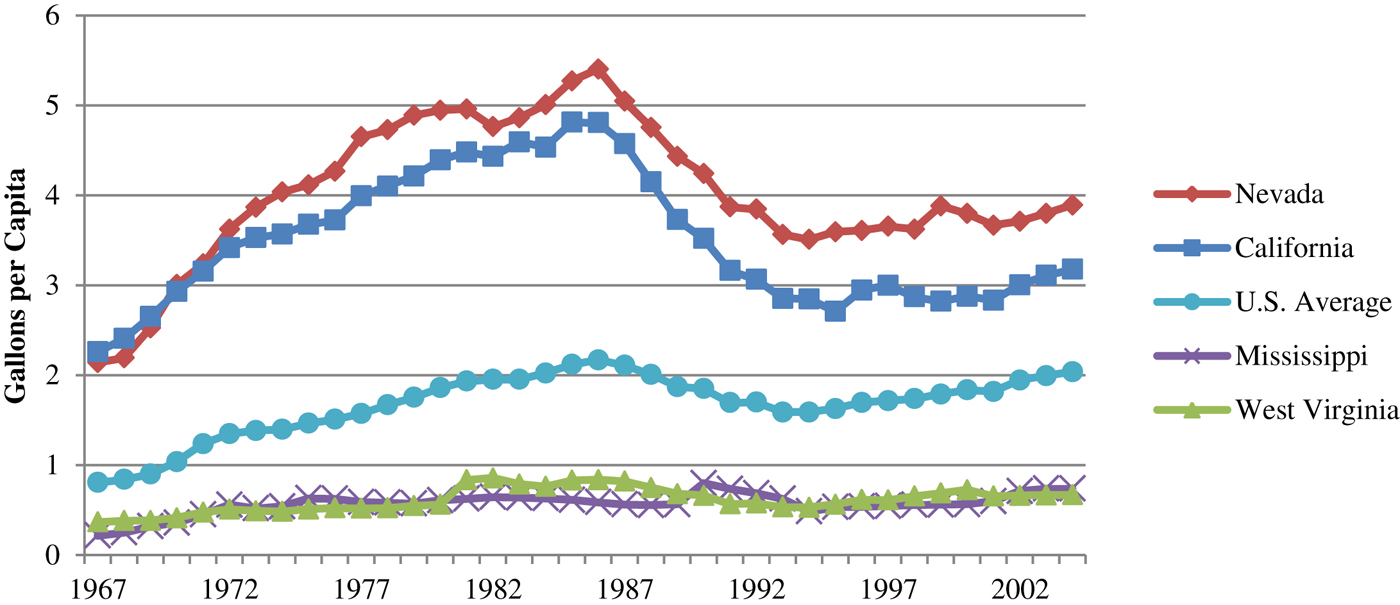
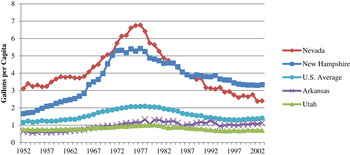
Figures 1 to 3 show the trends in beer, wine, and spirits consumption, respectively, for the highest- and lowest-consuming states as well as the U.S. average. These figures reveal that the U.S. average per-capita consumption of alcohol, especially wine and spirits, rises over time from the late 1960s until its peak in the mid-1980s and then falls. Per-capita alcohol consumption between states varies widely. Nevada (the highest-consuming state) periodically consumes over three times more alcohol per capita than Utah (the lowest-consuming state). Such a large difference in alcohol consumption can be attributed, in part, to Nevada's entertainment industry (specifically in Las Vegas) and Utah's large and socially conservative Mormon population. The benefit of using a fixed-effect estimator is the ability to control for precisely these kinds of unobserved differences (heterogeneity) among observation units.
Lowest and Highest Beer-Consuming States, 1967–2010

Lowest and Highest Wine-Consuming States, 1960–2008
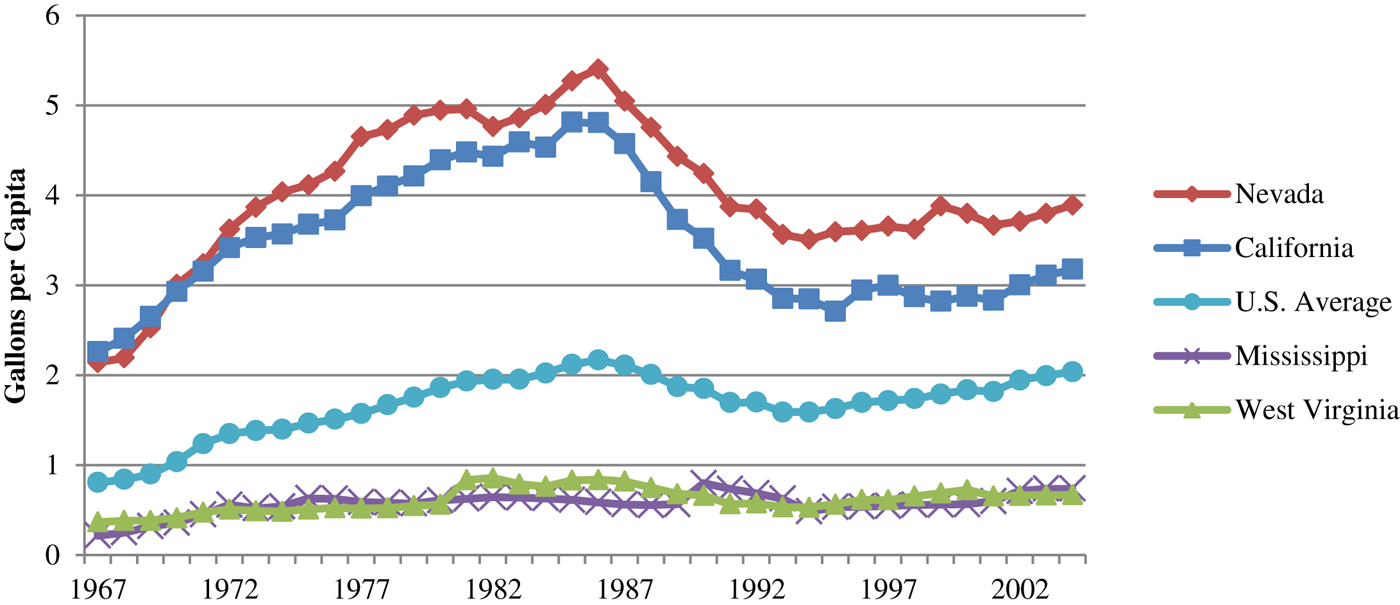
Lowest and Highest Spirits-Consuming States, 1952–2003

Following common practice in the reviewed economic literature, we estimate the effect of political beliefs and their underlying preferences on alcohol demand using a panel-data model with fixed effects. To do so, we need a time-variant measure of each state's political ideology. We use the preeminent political ideology index developed by Berry et al. (Reference Berry, Ringquist, Fording and Hanson1998, Reference Berry, Ringquist, Fording, Hanson and Klarner2010). This index is available on an annual, state-by-state basis and shows the state population's leanings on a liberal–conservative scale that ranges from 0 to 100 (higher numbers indicate more liberal views). Berry et al. (Reference Berry, Ringquist, Fording, Hanson and Klarner2010) offer three competing measures of state ideology: citizen ideology, state government ideology, and adjusted state government ideology. The first two measures rely on the ideological orientations of members of Congress based on the interest-group ratings compiled by the Americans for Democratic Action (ADA) and the AFL-CIO Committee on Political Education (COPE). The citizen ideology measure infers the ideological position of the electorate from the distribution of votes in congressional races and ADA/COPE scores for members of Congress, while the state government ideology is set equal to the mean ideological position of that party's congressional delegation, also based on ADA/COPE scores. In constructing the third measure, Berry et al. (Reference Berry, Ringquist, Fording, Hanson and Klarner2010) substitute Poole's (Reference Poole1998) first-dimension NOMINATE common space coordinates for ADA and COPE scores. After analyzing all three measures, Berry et al. (Reference Berry, Ringquist, Fording, Hanson and Klarner2010) recommend that researchers use the original citizen ideology index for measuring state population's political views.
Following their advice, we use the citizen ideology indicator. For our purposes, citizen ideology is a pertinent measure of a state population's ideology and, by extension, consumer preferences for alcohol given that the ideology of elected officials can depart from to ideological shirking (Kalt and Zupan, Reference Kalt and Zupan1984; Kau and Rubin, Reference Kau and Rubin1979; Washington, Reference Washington2008; Yakovlev, Reference Yakovlev2007, Reference Yakovlev2011). Berry et al. (Reference Berry, Ringquist, Fording and Hanson1998) construct their citizen ideology indicator from voting records for the federal and state representatives using this formula:
 $$ideology = (incsupp*incideo) + (chalsupp*chalideo).$$
where incsupp and chalsupp represent the proportion of the electorate that supports the incumbent candidate and the challenger, respectively, and variables incideo and chalideo represent the ideology score of the incumbent and the challenger, respectively.
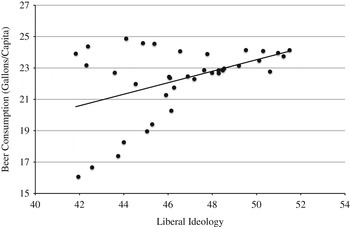
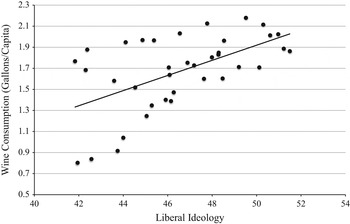
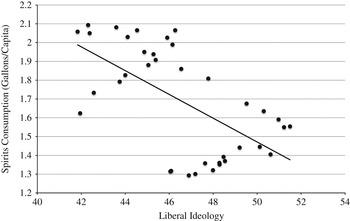
The scatter plots shown in Figure 4, 5, and 6 suggest that average U.S. beer and wine consumption rises and spirits consumption falls as states become more liberal over time. However, these time-series relationships might be misleading because they ignore various compounding factors (including unobserved heterogeneity).
Average State Beer Consumption and Liberal Ideology (1967–2003)

Average State Wine Consumption and Liberal Ideology (1967–2003)

Average State Spirits Consumption and Liberal Ideology (1967–2003)

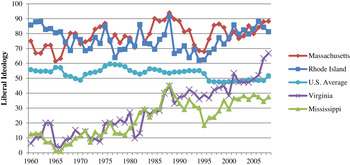
We also notice that the Berry et al. citizen ideology index exhibits rather high time-series volatility in each state, not unlike the stock market indexes (see Figure 7). However, because ideology and culture are rather slow to change, the ideology measure developed by Berry et al. might be prone to overstating the annual changes in constituents' political views. To reduce this volatility, we use a five-year moving average of the citizen ideology indicator in our empirical analysis.
Citizen Ideology in Most Conservative and Most Liberal States, 1960–2008

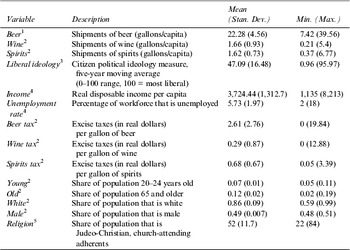
According to economic theory and the existing empirical studies, the following variables should be among significant determinants of alcohol consumption: excise taxes (used as a proxy for alcohol prices by Chaloupka et al., Reference Chaloupka, Saffer and Grossman1993; Freeman, Reference Freeman2000; Markowitz et al., Reference Markowitz, Kaestner and Grossman2005; Ruhm, Reference Ruhm1996), income, unemployment rate, religion, age, gender, and race (Freeman, Reference Freeman2000, Reference Freeman2011; Kerr et al., Reference Kerr, Greenfield, Bond, Ye and Rehm2004). Our religion variable measures the percentage of Judeo-Christian adherents in the state population. Because this variable is available in 10-year intervals only, we fill in the missing values using linear interpolation. All our monetary variables are converted to constant dollars. The variance inflation test shows no sign of multicollinearity among the control variables. Variable definitions, summary statistics, and data sources are shown in Table 1.
Variable Definitions, Summary Statistics, and Sources

Data Sources:
1. Brewers' Almanac.
2. Ponicki (2009).
3. Berry et al., (Reference Berry, Ringquist, Fording, Hanson and Klarner2010).
4. U.S. Bureau of Labor Statistics (2010). Local Area Unemployment Statistics. Retrieved October, 2011, from http://www.bls.gov/lau.
5. The Association of Religion Data Archives (2011). Data Archive, U.S. Church Membership Data, State-Level Data. Retrieved October, 2011, from http://www.thearda.com/Archive/ChState.asp.
To strengthen our argument for estimating a panel-data model with fixed effects, we run several tests that support the chosen approach. The Breusch-Pagan Lagrange Multiplier (LM) tests indicate that pooled alcohol demand models exhibit strong unobserved heterogeneity, making pooled and cross-sectional OLS estimates inconsistent. The Hausman random effect tests for beer, wine, and spirits consumption indicate that the fixed-effects model is preferred over the random-effects model. The modified Wald test for group-wise heteroskedasticity, the Wooldridge test for autocorrelation in panel data, and the Pesaran test for cross-sectional independence reveal, respectively, the presence of heteroskedasticity, first-order autocorrelation, and contemporaneous correlation in the error term.
In the presence of these anomalies in the error term, panel-data models are commonly estimated via feasible generalized least squares (FGLS) or OLS with panel-corrected standard errors (PCSE) and the inclusion of random or fixed effects to control for unobserved heterogeneity. Beck and Katz (Reference Beck and Katz1995) argue that PCSE outperforms FGLS when sample size is finite or when time (T) dimension is less than cross-sectional (N) dimension. Therefore, our alcohol demand models are estimated via OLS-PCSE with state and year fixed effects.
IV. Empirical Model and Estimates
Following previous research (Coate & Grossman, Reference Coate and Grossman1988; Farrell et al., Reference Farrell, Manning and Finch2003; Freeman, Reference Freeman2000, Reference Freeman2011; Kenkel, Reference Kenkel1996; Manning et al., Reference Manning, Blumberg and Moulton1995; Nelson, Reference Nelson2003; Ogwang and Cho, Reference Ogwang and Cho2009), we estimate the following translog demand model with two-way fixed effects for each type of alcohol:
 $${\rm ln}(Y_{it} ) = \alpha + \sum\limits_{\,j - 1}^{11} {\beta _j {\rm ln}(X_{it}^j ) + h_i + v_t + \varepsilon _{it}.} $$
where Y it is alcohol consumption per capita (either beer, wine, or spirits), α is a constant, X it is a matrix of, at most, 11 independent variables (including political ideology), h i are state fixed effects (dummies), v t are year fixed effects (dummies), and ε it is the disturbance. Economic theory and previous empirical studies suggest including the following control variables (i.e. demand shifters) in X it: income, unemployment rate, beverage price, prices of complements and substitutes (proxied by state excise taxes), age, race, gender, and religion. In economic theory, changes in consumer preferences can shift the demand for a given good. The reviewed studies indicate that political ideology can capture some of the consumer preferences for alcohol and act as a demand shifter. The model in equation (2) also includes fixed effects to control for unobserved heterogeneity. State fixed effects control for unobserved or difficult to measure time-invariant, state-specific characteristics such as laws, climate, and geography. However, year fixed effects control for unobserved factors that may affect all states in a given time period.
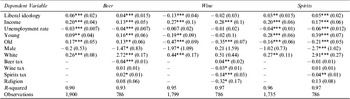
In Table 2, we present the OLS-PCSE regression estimates for beer, wine, and spirits. Because the models are estimated in the translog form, the coefficient estimates can be viewed as elasticities. The first regression model for each type of alcohol in Table 2 maximizes the available number of observations by using a parsimonious set of control variables that have no missing values. The three parsimonious models indicate that a rise in liberal ideology is associated with a rise in beer and spirits consumption per capita and a decline in wine consumption per capita. However, after all control variables are included in the regression model, the coefficient estimate for ideology in the wine regression loses its statistical significance and decreases in magnitude, but remains negative. The coefficient estimates for ideology in the beer and wine regressions, however, remain positive and statistically significant even after the inclusion of all control variables.
Impact of Political Ideology on U.S. Alcohol Consumption

Notes: All variables are in natural logarithms (i.e., the reported coefficients are elasticities). Dependent variable is measured in gallons per capita. Liberal ideology variable: higher values imply more liberal political views. Panel-corrected standard errors are in parentheses; ***, **, and * significant at the 1%, 5%, and 10% levels, respectively. All models include state and year fixed effects (constant and fixed effects coefficients are not reported). The sample may include as many as 50 states from as early as 1952 to as late as 2010, depending on the type of alcohol and control variables used.
Although liberal ideology has a statistically significant positive relationship with the consumption of beer and spirits, its quantitative impact on alcohol consumption is rather small (elasticity estimates range from 0.02 to −0.13). Rather low elasticity estimates are also observed for many control variables in the model. Perhaps the constant elasticity assumption forces the model to understate the true effect of ideology and other variables on alcohol consumption. It is important to note here that many other empirical studies with the translog model specification also obtain low elasticity estimates. To give the reader an idea of the estimated impact of ideology, we offer the following calculation. Consider the liberal ideology elasticity from the first beer demand model, for example. Our estimates suggest that if citizen ideology were to rise by one standard deviation (from the average of 47 to 61), we could expect beer consumption to rise, on average, by approximately 1.8 gallons per capita per annum, holding everything else constant. In our sample, this would be equivalent to Michigan's population becoming as liberal as Vermont (moving from 57 to 71 in citizen ideology score) and increasing its consumption of beer from 22.2 to Vermont's high level of 24.1 gallons per capita. Although this impact is quantitatively small, it should not be surprising given that alcohol demand tends to be rather inelastic.
The models with a full set of controls in Table 2 indicate that income per capita has a significant and positive effect on the consumption of all three types of alcohol, while the unemployment rate has a significant and negative effect on the consumption of beer and spirits but no significant effect on wine. The coefficient estimates for the unemployment rate and income indicate that the demand for alcohol is pro-cyclical and that alcohol is a normal good, which is consistent with Freeman's (Reference Freeman2011) findings. The percentage of the population that is young generally has a significant and positive effect on beer and spirits consumption, while the percentage of the population that is elderly has a significant and positive effect on beer consumption and significant and negative effect on wine and spirits consumption. The percentage of the population that is male, while significant, has a negative effect on alcohol consumption. The percentage of the population that is white generally has a significant and positive effect on alcohol consumption. Beer tax (i.e., beer price proxy) has a significant and negative effect on beer consumption, as predicted by the law of demand, and significant and positive effect on wine consumption, suggesting that beer and wine are substitutes. Wine tax (i.e., wine price proxy) has a significant and negative effect on wine consumption, as predicted by the law of demand. Similarly, spirits tax (i.e., spirits price proxy) has a significant and positive effect on beer consumption, suggesting that beer and spirits are substitutes. Spirits tax also has a significant and negative effect on wine and spirits consumption, suggesting that wine and spirits are complementary goods. Religion appears to be statistically significant (at the 10% level) only in the wine consumption model, where it has a negative coefficient.
As a robustness check, we estimate the relationship between political ideology and alcohol consumption measured in gallons of ethanol per capita for each type of alcohol and in total. As expected, beer, spirits, and total alcohol consumption in gallons of ethanol per capita increases with liberal ideology, while wine consumption falls. Because these estimates are qualitatively similar to those shown in Table 2, we do not report them in order to conserve space. In our auxiliary regressions (results available from the authors upon request), we also attempt to control for state alcohol regulations by constructing an ordinal variable based on the data from the National Alcohol Beverage Control Board (NABCB). However, this variable is rather time invariant given that state laws do not change much over time, forcing it to drop out of all but the most parsimonious model specifications (due to being perfectly collinear with the state fixed effects). In model specifications where it does not drop out, it does not qualitatively alter our ideology estimates. For these reasons, we do not include the alcohol control variable in the main models.
As an additional robustness check, we estimate the model in equation (2) via OLS with Driscoll and Kraay (Reference Driscoll and Kraay1998) robust standard errors. The Driscoll and Kraay nonparametric covariance matrix estimator produces heteroskedasticity-consistent standard errors that are also robust to general forms of spatial and temporal dependence. The Driscoll and Kraay estimator produces generally larger elasticity coefficients, but otherwise, it yields qualitatively similar estimates (results available from the authors upon request).
V. Conclusion
In this study, we show that liberal ideology has a statistically significant positive association with the consumption of alcohol in the United States even after controlling for economic, demographic, and geographic differences across states. Holding everything else constant, we find that as states become more liberal over time, they experience higher consumption of beer and spirits per capita. In contrast, we find that as states become more liberal over time, they might consume less wine per capita, but this result is not robust to the inclusion of additional control variables.
Our findings are relatively consistent with the recent sociological studies showing that people with more socialist views tend to engage in more unhealthy behaviors such as excessive drinking (Cockerham, Reference Cockerham1999, Reference Cockerham2005; Cockerham et al., Reference Cockerham, Snead and DeWaal2002, Reference Cockerham, Hinote, Cockerham and Abbott2006; Dmitrieva, Reference Dmitrieva and Cockerham2005; Shkolnikov and Meslé, Reference Shkolnikov, Meslé and DeVanzo1996). This sociological argument is similar to the theory of moral hazard in economics, which postulates that people may behave irresponsibly when they do not fully bear the cost of their behavior. This moral hazard argument might be responsible for some of our findings, considering that more liberal states tend to advocate for a stronger role for government in health care and social welfare.
Additional research is needed, however, to further ascertain a causal relationship between alcohol consumption and political views. Future work should establish whether the observed alcohol-ideology nexus stems from ideology as a proxy for consumer preference or from the moral hazard effect. The relationship between other unhealthy behaviors and political beliefs should also be explored in future scholarly work.