1. Introduction
Seventy years after its creation, the ICJ remains a central venue for the settlement of international disputes, despite the emergence of regional courts in past decades and the existence of other dispute settlement mechanisms.Footnote 1 Although extensive commentary exists on the role, achievements and composition of the Court, relatively little is known about the factors driving selection of the men and women who decide the World Court's cases. With the upcoming election of judges to the Court in 2017, and in light of the Court's seventieth anniversary, we consider it timely to examine these factors.
The study of international judicial appointments faces a number of conceptual, theoretical, and empirical difficulties, not least of which is the fact that nomination and selection processes are often ‘shrouded in mystery’.Footnote 2 A number of studies have begun to provide insights into the underlying politics and process of the selection of international judicial candidates,Footnote 3 but with respect to the ICJ, little analysis exists of why states elect certain candidates and not others.Footnote 4 The conventional wisdom is that most ICJ judges are qualified experts in international law selected through an intensely political appointment process. Supporters of the ICJ argue that the Court ‘plays the leading role in legitimating the [international legal] system by resolving its disputes in a principled manner’,Footnote 5 while detractors criticize it for politically motivated judgments and weak mechanisms to induce state compliance.Footnote 6 There is mixed evidence that once on the bench, ICJ judges decide cases along lines of nationality or other similar factors rather than deciding cases impartially.Footnote 7 That ICJ judges decide cases along certain political or judicial lines, however, does not reveal whether they were elected because governments expected them to behave in this way. In other words, very little is known about the factors shaping government voting decisions when it comes to ICJ elections.
This article attempts to add to our understanding of ICJ elections by assessing the relative influence of three factors on states’ vote choices for ICJ candidates: (i) a candidate's probability of independence or sensitivity to political considerations; (ii) a candidate's qualifications, particularly their level of expertise, education and personal reputation; and (iii) the role of interstate politics. Drawing from a new dataset of candidates nominated for election to the World Court between 1949 and 2010, we demonstrate that electing states base their initial vote choices largely on the same set of factors within each of the bodies that elect ICJ judges: the UN General Assembly and Security Council. In particular, professional experiences signaling a probability of independence or insensitivity to political considerations reduce a candidate's expected vote share.Footnote 8 A candidate's level of expertise, education and personal reputation, on the other hand, do not appear to make a considerable difference to his or her expected vote share. Finally, the amount of support a candidate receives during the nomination stage is strongly correlated with vote share. This suggests that considerable screening occurs prior to nomination, and that the number of nominations serves either as a signaling deviceFootnote 9 or to activate socialization mechanisms,Footnote 10 thus facilitating co-ordination of vote choice.
The following section briefly describes the complex process of nomination and election to the ICJ. Section 3 develops possible government motivations for vote choice in order to identify professional experiences states may look for when evaluating ICJ candidates. It also develops hypotheses for the influence of interstate politics on states’ vote choices and examines data on candidates in ICJ elections held between 1949 and 2010. The fourth section employs a multivariate analysis to examine the relationship between candidate characteristics, interstate political dynamics, and a candidate's expected vote share. Finally, Section 5 will draw some conclusions.
2. Nomination and election to the ICJFootnote 11
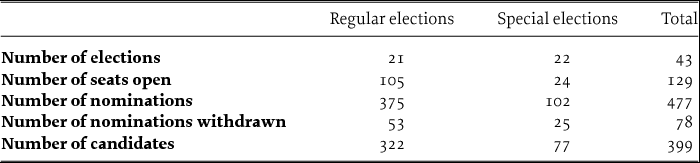
The ICJ is composed of 15 judges, each elected for one nine-year term and eligible for re-election.Footnote 12 Elections are staggered, with five judges elected during triennial ‘regular elections’. Between 1949 and 2010Footnote 13 21 regular elections have been held. If a judge resigns or passes away during his or her term, a ‘special election’ is held soon thereafter to elect a replacement judge.Footnote 14 Between 1949 and 2010, 22 special elections have been held. In total, then, 43 separate elections have been held for seats on the ICJ.
The ICJ Statute provides some guidance as to the characteristics and qualifications a person must possess in order to be elected as judge to the Court. Article 2 provides that the judges shall: (i) be independent; (ii) have a ‘high moral character’; and (iii) ‘possess the qualifications required in their respective countries for appointment to the highests judicial offices’ or be ‘jurisconsults of recognised competence in international law’.Footnote 15 As for the Court's composition, the Statute posits that it may not include more than one national of the same state (Art. 3) and that states should ensure that it represents ‘the main forms of civilization and the principal legal systems of the world’ (Art. 9). In practice this has translated into the distribution of seats across the ‘UN Regional Groups’.Footnote 16 Although no country is entitled to a seat on the ICJ, the Court has always included nationals of the five permanent members of the UN Security Council, a practice referred to as the ‘P5 Convention’.Footnote 17
The selection of ICJ judges occurs through a two-stage nomination and election process. All parties to the ICJ Statute are eligible to nominate candidates, though these nominations are not made by the government itself. Rather, nominations are made by national groups of the Permanent Court of Arbitration. A national group consists of four jurists designated by a state to serve as members of an arbitral tribunal under the Hague Conventions of 1899 and 1907. Each national group can nominate up to four ICJ candidates (though they do not always choose to do so and many do not make any nominations). No more than two of each group's nominees can be of the same nationality as that national group. More than one group can nominate the same candidate, and successful candidates often have multiple nominations.
Nomination by national groups is designed to ensure non-politicization of the screening process, or at least formal removal from direct government control. National groups are supposed to operate independently of home governments and consult widely in reaching their nomination choices, including consultations with the highest courts of justice, the legal faculties and schools of law, and national and international academies devoted to the study of law.Footnote 18 Anecdotal evidence suggests that while political considerations often do play a significant role in this process, the degree to which home governments influence nominations by national groups varies widely across states.Footnote 19 For example, the US national group often independently advances its own candidates. For the 1979 ICJ elections, the US national group nominated one American candidate (Richard R. Baxter) despite the fact that the Carter Administration supported the nomination of another (Arthur Goldberg).Footnote 20 States arrange their domestic process of suggesting candidates for nomination in various ways as well, ranging from a structured and formal process to a highly informal one. In many cases, the decision is made within the executive branch, usually by senior civil servants who identify and propose candidates through political networks, interviews and background checks.Footnote 21
During the second stage, the UN General Assembly and Security Council hold simultaneous but separate secret ballotsFootnote 22 to elect judges from the list of nominees.Footnote 23 In order to be elected, a candidate must receive an absolute majority of votes within each body, and both organs must elect the same candidates. After each voting round, any candidates who have received the required majority are removed from the ballot, and voting continues for the remaining seats until all five are filled. This often makes it necessary for each body to hold a number of voting rounds, sometimes spanning more than one meeting or day. Anecdotal evidence suggests that elections are often preceded by negotiations, campaigning and vote-trading, and that these factors, as well as regional group endorsement, play a key role in electoral outcomes.Footnote 24
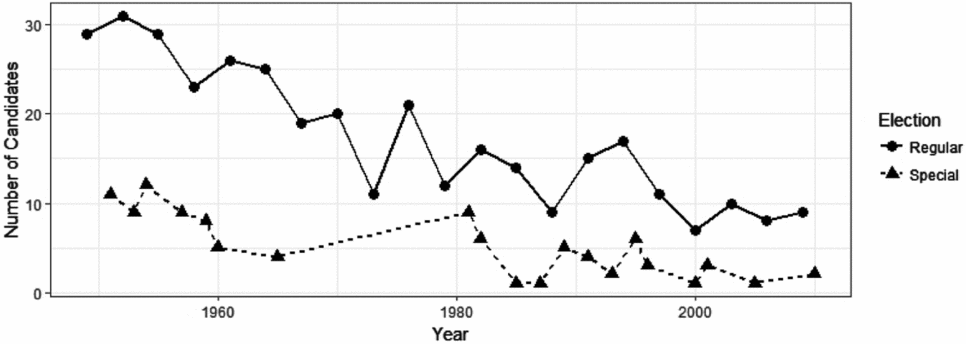
The total number of candidates nominated for both regular and special elections has decreased considerably since the ICJ's inception (see Figure 1). This suggests a decline in the competitiveness of elections over time, or at the very least increased screening prior to official nomination by national groups. Considering the political capital and material resources needed to run an election campaign, a decrease in the number of candidates may also be due to greater co-ordination within the various sub-regional or regional groups to agree on candidates most likely to win.Footnote 25 Despite increased screening and co-ordination, a number (14%) of those candidates nominated have withdrawn their candidacy prior to the election: either the nominating national group(s) or the candidate will notify the UN Secretary General that she does not wish to be considered and his or her name is removed from the ballot (see Table 1). For the 375 nominations made for regular elections, 53 nominations have been withdrawn, with states eventually voting on 322 candidates. For the 477 nominations made overall, there have been 288 separate individual candidates. The same individual – either when unsuccessful or when up for re-election – is often nominated a number of times, with 172 individuals (59.7%) nominated only once. One candidate – Ahmad Matine-Daftary, a former Prime Minister of Iran – was nominated eight separate times, though never elected.
Candidates for ICJ elections, 1949–2010

Nominations for ICJ Elections

3. What drives international judicial appointments?
A growing body of scholarship has begun to explore the underlying logic of granting to international judicial bodies the authority to interpret international agreements, resolve legal disputes, or enforce international rules. A number of scholars draw from a principal-agent approach to argue that states (principals) grant powers and authority to international courts and tribunals (agents). States tailor the level of discretion afforded to agents according to their objectives, and thus create formally independent courts subject to various structural and political constraints and pressures.Footnote 26 The principal-agent approach helps us understand the political environment within which international judicial actors must operate and draws attention to the numerous ways in which states can establish mechanisms to ensure that decisions of these bodies do not stray too far from states’ preferences over time. One such mechanism is the screening and selection of judges. In particular, the principal-agent approach suggests that states will attempt to use their power of judicial appointment to select judges they believe hold international legal preferences that align with their own.
In contrast, others argue that international courts are better understood as trustees rather than agents, and that these trustees are relatively removed from direct member-state control.Footnote 27 States have the ability to influence courts, but this influence does not stem from use of these formal mechanisms of control, such as election of judges, reducing a court's budget, changing the court's mandate, or threatening to withdraw from its jurisdiction. Instead, states seek to influence judicial bodies through rhetorical politics – attempts to persuade judges through legal reasoning – or legitimacy politics – attempts to influence public perception of a court's legitimacy.Footnote 28 According to the trusteeship approach, states do not select international judges based on alignment of political or policy preferences but rather on the basis of expertise and personal reputation alone.
Whether international courts are viewed as agents or trustees, part of why states have been increasingly willing to grant independence and authority to international or regional courts is that governments believe they have the ability to influence broader legal outcomes or even individual decisions. The appointment of international judges constitutes one formal way in which states might think they can influence a court, and one of the core principal-agent hypotheses is that governments do in fact attempt to use their powers of judicial appointment to this end.
The question of what drives government selection of candidates is a separate one from whether they can, or attempt, to use appointment as a mechanism of control. States may prefer to elect candidates they believe to be susceptible to political influence, candidates likely to act more independently, or candidates who will increase the institutional legitimacy of the court through their expertise. As Voeten has argued, governments ‘are neither simply picking the best qualified candidate nor are they singularly obsessed with limiting sovereignty costs, although both motivations are sometimes important’.Footnote 29 In the context of the ICJ, it is difficult for states to know a priori whether they will ever be a party to a dispute before the Court or on which side of a dispute they may fall. At the time of election, then, states do not know whether a selected judge will end up hearing a case in which they will be a party. States may or may not care about influencing outcomes in cases in which they are not a disputing party, but due to uncertainty about future disputes that may arise, most governments do care about who is elected to the World Court. For these reasons, governments on average probably look for a ‘sound’ or mainstream judge that will facilitate dispute resolution more generally.
For the ICJ in particular, it is near impossible to systematically measure individual state vote preferences, as elections are held by secret ballot. While the nominating national groups may provide some indication of state motivations, not all national groups nominate candidates or they nominate more than one candidate. Additionally, as discussed above, the extent to which national group nominations represent home government interests or preferences is not firmly established and varies across states. Instead of seeking to ascertain state motivations directly, then, in this section we outline a number of potential motivations for vote choice in order to derive expectations about the characteristics governments look for within ICJ candidates.Footnote 30 While different and sometimes competing motivations might lead a government to base its candidate choice on the same characteristic(s), we can still say something about which characteristics are more likely to lead the UN membership to support a nominee. This section also considers the role of interstate politics in the election process and its influence on the vote choices of individual states.
3.1. Candidate characteristics
Electing states have a certain amount of information about each candidate. At a bare minimum, all governments have access to each candidate's curriculum vitae (CV), made public at the time of nomination. Career and educational experience, and lists of publications provide clear information about particular characteristics of a candidate's background that may provide rough indicators to governments of candidates’ qualifications and likely policy positions. Moreover, the candidates themselves typically prepare their own CVs,Footnote 31 and indicate the aspects of their professional background to which they would like to draw electing states’ attention. It is an open question whether career background actually predicts subsequent judicial behaviour, though correlation has been found within some international courts.Footnote 32 Regardless, we assume that governments use professional background and other candidate characteristics as rough proxies for how judges are likely to behave if elected, even if they then supplement this public information with interviews or private inquiries.
In terms of qualifications of candidates, they have almost exclusively fallen under the second prong of Article 2 of the ICJ Statute: ‘recognized competence in international law’ rather than ‘qualifications required in their respective countries for appointment to the highest judicial offices’.Footnote 33 Typically, ICJ candidates have possessed one (and often more than one) of the following types of professional experience: academia; legal advisors to governments or international organizations; diplomatic experience in some capacity, sometimes including high political office in their national states; and membership within the International Law Commission.
3.1.1. Political interests: Selecting dependent candidates
Political interests and sovereignty concerns may motivate electing states to focus on three different, albeit related, candidate characteristics: independence, political sensitivity and judicial activism.
First, states may select candidates they believe will act more or less independently. Under a principal-agent view of courts, governments may be concerned that the ICJ will interfere with their national sovereignty in unacceptable ways or they may simply desire a dependent court.Footnote 34 On the other hand, governments may be concerned about maximizing the credibility of commitments they have made within agreements subject to the ICJ's jurisdiction.Footnote 35 Agreeing to submit disputes to the ICJ only makes their treaty commitments more credible if the ICJ is independent from government pressure. This would lead governments to look for candidates less likely to be susceptible to outside (state) pressure.
Second, under a trusteeship view of courts, states may want ICJ judges who will best effectuate the court's purpose: resolving interstate disputes in order to increase international peace and security. If this were the case, governments would select candidates with the requisite skills or expertise to address politically sensitive disagreements. They would avoid candidates likely to issue decisions without regard to the international political context and select candidates they believe possess political sophistication or sensitivity.
Third, states may want to elect judges they expect will reach decisions aligned with their own political interests, regardless of whether they believe the judge will act independently of political pressures or considerations. They will thus look for candidates with preferences similar to their own, in terms of judicial philosophy or views on public international law. In the context of the World Trade Organization (WTO), some studies have found that member states actively seek information about Appellate Body candidates’ views on issues of interest to them, including a candidate's view on expansive judicial decision-making.Footnote 36 In the context of the ICJ, governments particularly concerned about the Court interfering with state sovereignty would look for candidates likely to resist judicial activism. These candidates might be expected to demonstrate greater respect for the intent of state parties. Sovereignty concerns may thus drive states to seek out candidates likely to adopt a limited view on the role of the international judge and to eschew judicial lawmaking, such as those that tend to adhere to ‘enlightened’ positivism.Footnote 37 In contrast, governments that prefer more active enforcement will select candidates likely to be more expansive in their interpretations of public international law.Footnote 38 Governments that prefer more expansive interpretations of public international law will look for candidates likely to employ more naturalist interpretative philosophies, willing to take into consideration general principles of international law, equity, or issues not raised within state party pleadings, and to adopt a more activist judicial role.Footnote 39
In sum, states motivated primarily by sovereignty concerns will look for less activist, more politically savvy, or less politically independent candidates. States who prefer expansive interpretations of international law or seek to increase the credibility of international legal commitments will look for more activist or politically independent candidates. One way in which governments can identify a candidate's likely degree of independence, political sophistication, or judicial activism is by looking to their professional background.
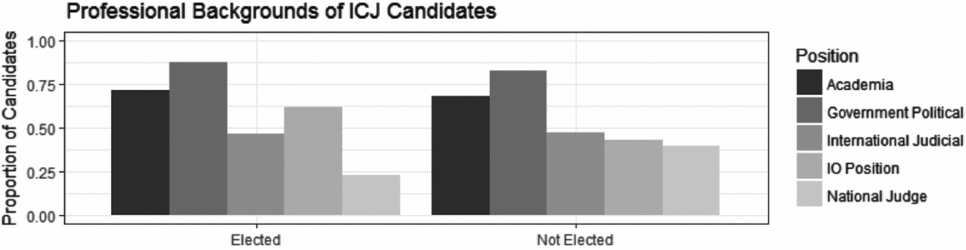
First, holding prior political positions within national governments could signal to states that a candidate may potentially defer to concerns about state sovereignty in interpreting international law. Having previous diplomatic experience in national governments also increases the probability that a candidate will be able to navigate and facilitate the resolution of politically sensitive disputes.Footnote 40 Voeten found that among judges at the European Court of Human Rights, former diplomats and government bureaucrats were less activist and more deferential to state concerns than former academics or those in private practice.Footnote 41 There is some evidence that states look for this type of experience in ICJ candidates as well. Out of the total candidates nominated in the period under review, 82.3 per cent had at some point held a political position within national government.Footnote 42 Only sixteen of the 129 judges eventually elected (12.4%) had never held a government political position (see Figure 2).
Professional backgrounds of ICJ Candidates. Source: Authors’ database, coded from candidates’ CVs, published by the UN Secretary-General. Data included candidates for regular and special elections. For regular elections, there were 105 elected candidates and 211 candidates not elected; for special elections, 24 candidates were elected and 53 not elected

Second, we might expect former national judges to be less susceptible to political pressures and more likely to decide cases in an independent manner on the basis of legal considerations alone. National judges, particularly from democratic states with a strong rule of law, typically hold strong norms of judicial independence from the political process. This does not necessarily imply, however, that former national judges will necessarily adopt a more activist role. While candidates accustomed to judicial independence may be more activist at the national level, this may not transfer to their role at an international court.Footnote 43 Moreover, it does not seem that national judicial experience is a characteristic that states typically look for within ICJ candidates. Only 165 candidates in total (35.2%), 30 of which were eventually elected (23.3%), had at some point acted as a judge within their home country (see Figure 2).
Third, candidates with prior international judicial experience or experience working as a bureaucrat within an international organization (IO) could be expected to be less susceptible to political pressures, as they may be accustomed to norms of independence vis-à-vis states.Footnote 44 While international bureaucrats or arbitrators may be more aware of the need for sensitivity in managing an IO-state relationship, their prior experience may have trained them to promote expansive understandings of international law in order to further strengthen the position of international institutions vis-à-vis member states.Footnote 45 Half of all ICJ candidates and 62 per cent of those elected held some prior position within an international organization bureaucracy,Footnote 46 while 46.9 per cent of all candidates and 46.5 per cent of those elected were former arbitrators or judges on another international or regional court (see Figure 2).Footnote 47
Finally, candidates with predominantly academic backgrounds may be expected to be less susceptible to political pressures, given the strong professional norm within many regions of academic independence from politics. We suspect that academia signals independence more than judicial activism, on which legal academics have considerably differing views. In general, 69.7 per cent of all candidates and 71.3 per cent of those elected possessed professional experience within academia, suggesting that this is one type of experience states typically seek within candidates.Footnote 48
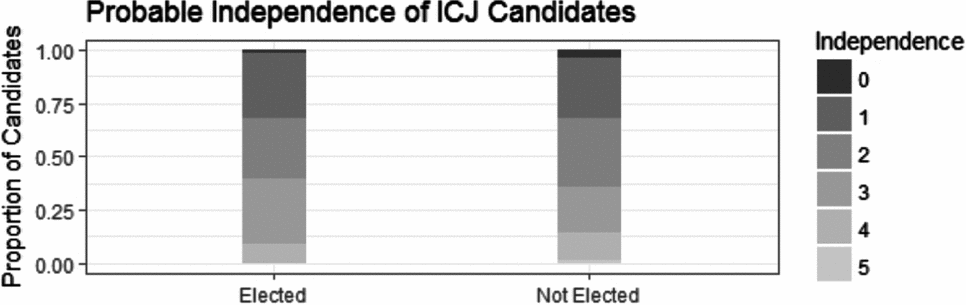
To capture a candidate's likelihood of deference to state concerns or political sensitivity, we created an index of candidates’ Probability of Independence based on all prior professional experiences. This index assumes that experience within a government political position on average signals less independence and greater political savvy, while experience as a national judge, IO official, international judge, or academic on average signals greater independence and less political sophistication. It ranges from 0 to 5 and is constructed by summing the four independence-prone positions and negatively weighting this score by one if the candidate ever held a national political position.Footnote 49 For example, a candidate who has only ever worked within a political position for their government receives a score of zero; a candidate who has worked at some point in all four independence-prone positions and has never worked for their government receives a score of 5. Most candidates receive a score between 1 and 3 (see Figure 3), suggesting that states tend to prefer candidates who fall on the lower end of this spectrum (less independence and/or greater political savvy).
Probable Independence of ICJ Candidates. Probable independence scale – ranging from 0 to 5 – constructed by summing the four independence-prone positions (national judge, IO position, international judge and academia) and then negatively weighting this score by one if the candidate ever held a government political position.

3.1.2. Legitimacy concerns: Selecting candidates with expertise
States could also be concerned about the perceived legitimacy of the Court as a whole and want to ensure that it can carry out its mandate in an effective manner. If such concerns motivate governments, as the trusteeship approach argues, they will select candidates based on their qualifications as experts in international law and their personal reputation.Footnote 50 Governments who want the most qualified and competent candidates will place greater relative weight on a candidate's degree of expertise.
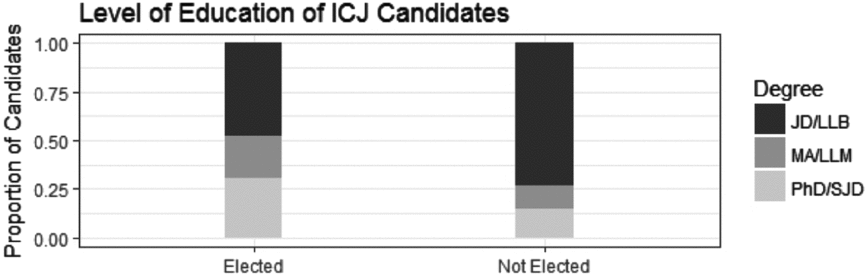
A candidate's level of education serves as an initial rough proxy for expertise: the higher the degree level, the greater a candidate's legal education, arguably a form of expertise. In fact, over half of elected candidates hold either a PhD/SJD or MA/LLM (see Figure 4). While this has changed significantly in recent years, degrees from the United States, the United Kingdom, or Western European institutions have traditionally signaled that a candidate has been subject to legal professionalization recognized globally as prestigious, thereby increasing governments’ views on a candidate's level of expertise. There is not strong evidence, however, that this is what states have typically looked for within candidates.Footnote 51 Finally, a candidate's number of publications on international law topics may also be taken into consideration. The average number of publications listed by elected candidates is higher than that listed by unelected candidates, even though the percentage of candidates with academic experience is roughly the same for both groups.Footnote 52
Level of Education Obtained by ICJ Candidates. Source: Authors’ database, coded from candidates’ CVs, published by the UN Secretary General

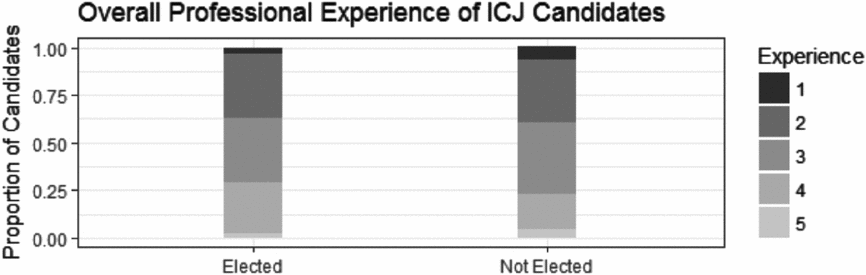
Perhaps states interested in highly qualified candidates look for individuals with varied professional experiences as an indicator of expertise, as opposed to former careers in one profession only. Prior positions in different fields could be perceived as exposing a candidate to diverse perspectives on, and aspects of, international law, thereby increasing the quality or scope of their expertise. To capture this, we created an index of candidates’ Overall Professional Experience, based on the number of positions they have held as: government political official, national judge, IO civil servant, international judge, and in academia (see Figure 5). Candidates who have held only one position by the time of the election receive a score of one, while those who have held all positions at some point receive a score of five. Most candidates nominated have held at least two or three such positions, but overall professional experience does not differ noticeably between those candidates elected and those not (see Figure 3).
Overall Professional Experience of ICJ Candidates. Professional experience – ranging from 1 to 5 – is based on the number of positions a candidate has held out of: government political official; national judge; IO bureaucrat; international judicial experience; and academia

3.2. Interstate politics
While the process of selecting international judges is certainly politicized, the features of this process may decrease the ability of individual states to influence judicial appointment in any observable way. This is because judges are elected by multiple principals (UN member states) with often divergent preferences or motivations and who face problems co-ordinating their vote choices.Footnote 53 Co-ordination across states certainly occurs to some degree prior to the actual election. While we do not discount the role of interstate negotiation, informal agreements, and vote trading, it is difficult to directly measure these largely opaque factors in any meaningful way. The number of voting rounds held within the UN General Assembly and Security Council before a given candidate is elected provides some indication of the success of these informal processes, but does not indicate whether they took place or with what intensity for which candidates. Still, the number of voting rounds provides a rough measure of the extent to which states are able to co-ordinate the choice of candidates prior to the election, as it varies across candidates within elections, as well as between elections.Footnote 54
The number of voting rounds held within each body has varied considerably from one regular election to the next. Understandably, fewer voting rounds are held for special elections, for which there are typically fewer nominees (eleven special elections had only one candidate on the ballot for one seat). For candidate lists with fewer nominees, states may have successfully co-ordinated their preferences prior to election, engaged in more extensive vote trading, or perhaps their preferences simply converged prior to the election. Out of the 129 candidates elected, 84 (65.12%) were selected after one round of voting in the Security Council and 91 (70.54%) after one round of voting in the General Assembly. For other candidate lists, however, states either had strongly divergent candidate preferences or were unsuccessful at prior co-ordination. The two bodies have disagreed on eight candidates subsequently elected and seven candidates not subsequently elected.
The number of nominating national groups also provides some indication of the extent to which states are able to co-ordinate candidate preferences prior to election. Even though national groups do not always represent the interests of their home government, they have consulted with various government bodies prior to nominations. Perhaps more directly, for governments unsure of their vote choices or who did not independently screen candidates, the number of nominating national groups signals the candidates that enjoy greater support from various national groups (whether or not states interpret this as signalling government support). As such, the number of nominating national groups aids in state co-ordination of preferences prior to the election. National group nominations could also facilitate state-to-state influence between the time of nomination and election. That is, a state that is uncertain on how to vote might imitate how it expects other states to vote – either the majority of states or those with whom it identifies – based on the number and identity of nominating national groups.Footnote 55
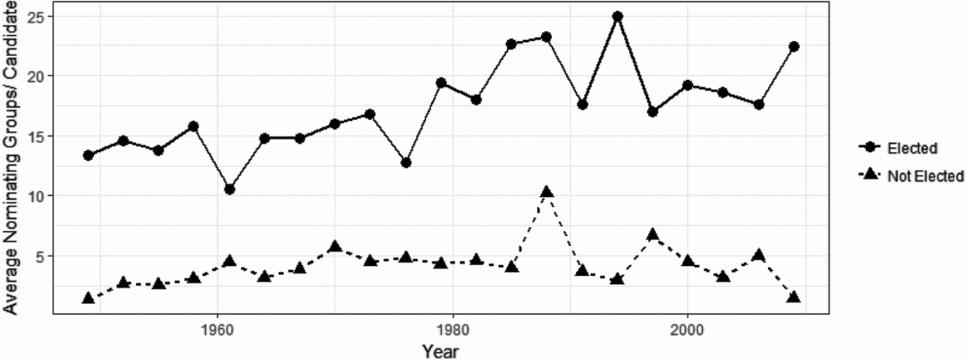
Evidence suggests that national group nominations play an important role in the election process (see Figure 6). Candidates have been elected after being nominated by anywhere between one and 53 national groups, while the range for unelected candidates is one to 47. More telling is that elected candidates on average receive 17.02 national group nominations for regular elections and 15.67 nominations for special elections. In contrast, unelected candidates receive an average of 3.7 nominations for regular elections and 3.02 nominations for special elections.
National Groups Nominations per ICJ Candidate. Source: Authors’ database, coded from lists of candidates compiled by the UN Secretary General and submitted to the UN General Assembly and Security Council prior to each election. Includes national group nominations submitted after the deadline for nomination submissions. For regular elections, elected candidate mean = 17.02; unelected candidate mean = 3.7. For special elections, elected candidate mean = 15.67; unelected candidate mean = 3.02

Perhaps the number of national groups supporting a candidate is less important than (or even itself determined by) the preferences of powerful states for election outcomes. In the context of the WTO, for example, Elsig and Pollack find that the more economically powerful states have a disproportionate influence over the appointment of Appellate Body members.Footnote 56 Similarly, the P5 convention for ICJ elections virtually ensures the permanent members of the Security Council a seat on the court.Footnote 57 Unsurprisingly, the majority of candidates who are nationals of permanent Security Council members are elected.Footnote 58 The number of national groups from permanent Security Council member states that support a particular candidate also signals the extent to which these relatively more influential states support the election of a candidate.Footnote 59 It seems likely that this plays an important role in the election process, as elected candidates on average receive 2.07 P5 nominations for regular elections and 2.67 P5 nominations for special elections. In contrast, unelected candidates receive an average of 0.24 P5 nominations for regular elections and 0.24 nominations for special elections.
4. State support for ICJ candidates
This section assesses the relative influence of these three sets of factors – sensitivity to political considerations, expertise, and interstate politics – on state support for nominated candidates to the Court. We collected data on each candidate's vote share in each UN electing body (General Assembly and Security Council) to provide a measure of state support. Vote share refers to the proportion of votes received by each candidate within each election out of the total possible votes (the total number of states that actually voted within either the General Assembly or the Security Council). This measure captures the level of state support for particular nominees in a given election relative to the maximum votes they could have received. We rely on the vote share received by each candidate during the initial voting round, despite the fact that every election has required more than one round. State vote choice during the first round more accurately reveals preferences, as ‘later rounds are more strategic, with representatives generally shifting votes away from candidates with a poor showing on the first ballot’.Footnote 60 Finally, we focus on vote shares within regular elections only, as we suspect the underlying politics of special elections differs from that of regular elections, given that they are held to fill unexpectedly vacant seats.
To evaluate the relationship between professional backgrounds indicating political sensitivity and vote share, we include the Probability of Independence index described above (INDEP). If states are motivated by sovereignty concerns, a candidate's expected vote share should decrease as their Probability of Independence increases.Footnote 61 Yet even if states can make reasonable inferences from the professional background of candidates, judges can be strategic in the information they reveal prior to election.Footnote 62 This should make actual behaviour on the ICJ relatively more important to states when voting and may give some incumbent candidates an advantage. To control for this, we include a dummy variable for whether a candidate is up for re-election (REELECT).Footnote 63 Finally, under a trusteeship view of courts, candidates’ relative qualifications and level of expertise – rather than, or in addition to, their professional background – should shape vote choice. To evaluate this expectation, we include a measure of the highest educational degree attained (EDUC).Footnote 64
As discussed above, evidence suggests that national group nominations may signal a candidate's level of support by certain countries (or their level of ‘popularity’ among national groups, at the very least). To evaluate the extent to which this is associated with greater state support during the election, we include a candidate's number of national group nominations (NOMS). We also include a separate measure of the number of nominations from P5 national groups (P5NOMS), as these groups’ nominations may hold greater weight if power politics plays a role in vote choice.
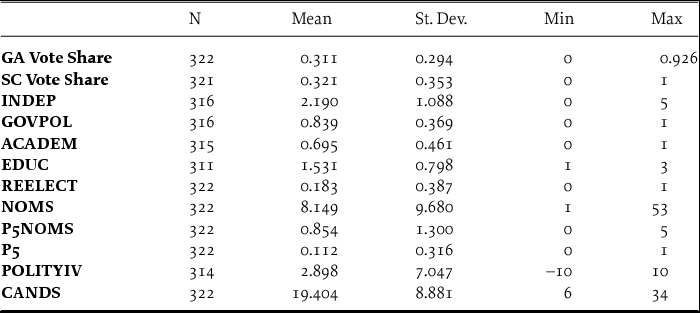
Given the existence of the P5-Convention, we control for whether a candidate is a national of a permanent member of the Security Council. We also include a control for the number of candidates appearing on the ballot (CANDS), as this likely affects the probability of casting a vote for any given one. Finally, we control for a candidate's home country's level of democracy by including its lagged Polity IV score (POLITYIV), as candidates from countries with a strong rule of law might be expected to have internalized norms of judicial independence more than candidates from authoritarian states. Table 2 presents summary statistics for all variables included within the analysis.
Summary statistics

We assess the relationship between candidates’ vote shares and these factors by estimating Ordinary Least Squares (OLS) regression models with election fixed effects for each voting body (General Assembly and Security Council).
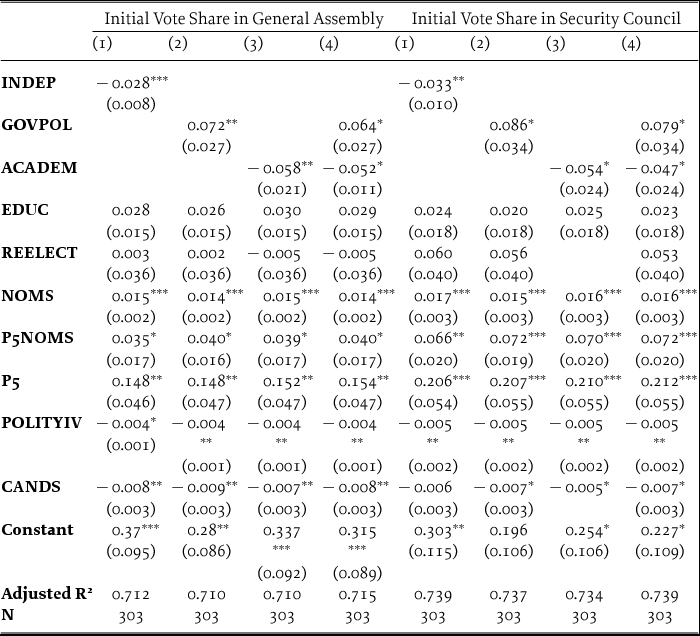
Table 3 reports linear regression coefficients for initial vote share in regular elections, with results for General Assembly and Security Council vote rounds respectively. Model 1 includes the Probability of Independence index (INDEP). Within both UN bodies, findings suggest that states typically prefer candidates with a lower probability of independence. The substantive effect is relatively moderate but significant. Every one-unit increase in a candidate's independence score (INDEP) corresponds with around a 0.03 reduction in expected vote share within each body, or 3.83 votes in the General Assembly and 0.46 votes in the Security Council.Footnote 65
Initial vote share in General Assembly and Security Council

Linear regression with candidate as unit of observation. Dependent variable is number of votes obtained relative to total number of voting states within General Assembly and Security Council. Election fixed effects included within all models. Bootstrapped standard errors in parentheses.
Note:*p < 0.05,** p < 0.01,*** p < 0.001
Model 2 replaces INDEP with a dummy variable for prior government experience (GOVPOL), Model 3 replaces it with a dummy for experience within academia (ACADEM), and Model 4 replaces it with both GOVPOL and ACADEM. Model 2 demonstrates that candidates who have held a political position within their home governments are relatively more popular than those who have not (corresponding to 9.84 votes in the General Assembly and 1.21 votes in the Security Council), although this substantive effect is reduced slightly when controlling for experience within academia (Model 4). Interestingly, even though a large number of candidates elected to the ICJ have prior academic experience, such a background actually makes candidates slightly less popular in terms of expected vote share (corresponding to 7.93 less votes in the General Assembly and 0.76 less votes in the Security Council) (Model 3). On the other hand, a candidate's level of expertise (EDUC) is only marginally influential and not significant. Judges up for reelection (REELECT) are also not significantly more or less popular than those who are not.
5. Conclusion
Overall, our analysis suggests that electing states in the aggregate base their vote choices largely on the same set of factors within the General Assembly and Security Council, and that initial vote choice is driven primarily by a candidate's support from national groups and their professional background. In particular, professional experiences that signal a greater likelihood of independence or lower levels of political sensitivity reduce a candidate's popularity within the initial round of voting. On the other hand, greater national group support is associated with a significantly higher expected vote share. To be sure, national group support could proxy for a number of different underlying factors and influence vote choice through multiple mechanisms. It could act as a signal to states that did not themselves screen or nominate candidates, thereby increasing the ability of states to co-ordinate candidate preferences prior to the election. It could also proxy political understandings based on region or some other group identity. Finally, it could indicate the operation of state-to-state influence between the time of nomination and election, in that some electing states might simply mimic how they expect others to vote.
The evidence and analysis presented here is far from conclusive and represents only a first cut at disentangling the multiple motivations and factors involved in the nomination and election of judges to the ICJ. While it suggests that states look for certain professional background characteristics when deciding on their vote choices, many motivations may be driving a focus on these characteristics and they require further examination. The mechanism through which national group support influences expected vote share is still very much unspecified, although we have suggested a number of different ways in which this influence could operate. Finally, the fact that states select candidates based on particular characteristics does not necessarily mean that these characteristics influence subsequent judicial behaviour in the direction expected by states. Further research is required to assess whether these characteristics indeed predict independent or activist judicial behaviour.