Introduction
An understanding of child psychopathology and resilience requires attention to the nested and interconnected systems and contexts that shape children’s experiences and health outcomes. The phrase “multisystem integration” refers to an approach within child development research that recognizes children as embedded within multiple contexts and systems that interact in an ongoing and dynamic way. This perspective emphasizes intersecting experiences that shape a child’s life and their adaptation to their environment (Boon et al., Reference Boon, Cottrell, King, Stevenson and Millar2012), and has been described within the latest wave of resilience theory (Masten, Reference Masten2014). From an equity lens, an approach that can appreciate nested experiences in relation to child development, including resilience, is essential for ensuring that the focus is not limited to within-individual characteristics and intervention opportunities (Suslovic & Lett, Reference Suslovic and Lett2023). Rather, as Masten has described, research is needed that focuses on the “interactions of systems” that shape children’s lives, which can include the interconnected systemic, structural, and social influences on children’s health, and inequities across groups, shaped by historical and contemporary practices and social policies (Masten, Reference Masten2007, Reference Masten2014). This theoretical framework encourages scholars to consider intersecting experiences and may inform community-based interventions or policy-level measures that could be adopted to promote child development (Laurence & Sehdev, Reference Laurence and Sehdevn.d.; Slopen et al., Reference Slopen, Cosgrove, Acevedo-Garcia, Hatzenbuehler, Shonkoff and Noelke2023; Vanderbilt-Adriance & Shaw, Reference Vanderbilt-Adriance and Shaw2008). In the present study, we draw on this framework to examine the interaction between positive features of neighborhood context and experiences of racial or ethnic discrimination in relation to children’s mental health outcomes. Within, we use the phrase “racialized groups” to refer to racial and ethnic subgroups of children, consistent with leading scholars of racism and health (Javadi et al., Reference Javadi, Murchland, Rushovich, Wright, Shchetinina, Siefkas, Todd, Gitelman, Hall, Wynne, Zewge-Abubaker and Krieger2023), as it emphasizes that race and ethnicity are social constructs used to categorize people based on societal perceptions and power dynamics structures, rather than biological or genetic categories.
Past research has shown how a child’s physical and social, residential context can either be protective or harmful against negative health outcomes (Breedvelt et al., Reference Breedvelt, Tiemeier, Sharples, Galea, Niedzwiedz, Elliott and Bockting2022; Christian et al., Reference Christian, Zubrick, Foster, Giles-Corti, Bull, Wood, Knuiman, Brinkman, Houghton and Boruff2015; Daniels et al., Reference Daniels, Schinasi, Auchincloss, Forrest and Diez Roux2021; Hibbert & Tulve, Reference Hibbert and Tulve2019; Minh et al., Reference Minh, Muhajarine, Janus, Brownell and Guhn2017). One such element in a child’s social environment is community social capital, defined as the strength of networks, connection, trustworthiness, and relationships within a community (Duh-Leong et al., Reference Duh-Leong, Dreyer, Huang, Katzow, Gross, Fierman, Tomopoulos, Di Caprio and Yin2021; Morgan et al., Reference Morgan, Svedberg, Nyholm and Nygren2021). For example, Mori and coauthors analyzed social capital and quality of life among school-age children and found that adolescents with higher perceptions of being safe within one’s school and neighborhood had lower levels of depression (Mori et al., Reference Mori, Takahashi, Adachi, Shinkawa, Hirota, Nishimura and Nakamura2022). In a study assessing the influence of social capital on health among Taiwanese adolescents, community-level social capital (i.e., aggregated reports from individuals in the same neighborhood) was associated with baseline self-rated health and positive change in self-rated health (Nieuwenhuis, Reference Nieuwenhuis2020), whereas individual report of social capital was only associated with baseline self-rated health. Other research, both among children and adults, has grappled with and is refining how social capital is conceptualized (e.g., the influence of subjectivity) and measured (e.g., individual vs. aggregated reports). Taken together, although methodological questions remain, social capital is a promising measure for understanding the influence of social environment on child development that requires additional research (Carrillo-Álvarez et al., Reference Carrillo-Álvarez, Kawachi and Riera-Romaní2019; Enfield & Nathaniel, Reference Enfield and Nathaniel2013).
Another potential protective element is a child’s built environment, referring to the buildings, physical community, and access to resources within a neighborhood. Studies show that positively built environment (e.g., high access to resources, clean neighborhood, and access to green spaces) is associated with better mental health among children and adolescents, while children with less access to recreational activities and other neighborhood resources display higher levels of mental health concerns (Li et al., Reference Li, Fu, Leigh and Humphrey2021; Molnar et al., Reference Molnar, Cerda, Roberts and Buka2008; Opara et al., Reference Opara, Thorpe and Lardier2022).
While elevated levels of social capital or neighborhood resources may promote mental health, interpersonal interactions – positive or negative – are essential to consider as well. One factor that may influence the relationship between a child’s mental health and their social and built environment is experiences with racism and exclusion (Trent et al., Reference Trent, Dooley, Dougé, Cavanaugh, Lacroix, Fanburg, Rahmandar, Hornberger, Schneider, Yen, Chilton, Green, Dilley, Gutierrez, Duffee, Keane, Krugman, McKelvey and Wallace2019). Children experience racism across multiple levels (e.g., individual, interpersonal, institutional) and can experience negative consequences following these experiences via mental, physical, and emotional health symptoms (Iruka et al., Reference Iruka, Gardner-Neblett, Telfer, Ibekwe-Okafor, Curenton, Sims, Sansbury and Neblett2022). Across childhood, children experience racism directly through interpersonal relationships and indirectly through their caregivers’ experiences (Berry et al., Reference Berry, Londoño Tobón and Njoroge2021; Heard-Garris et al., Reference Heard-Garris, Cale, Camaj, Hamati and Dominguez2018). Several reviews have summarized research on racism and child outcomes and concluded that racism was associated with a diverse range of mental and physical health outcomes among children (Mahabir et al., Reference Mahabir, O’Campo, Lofters, Shankardass, Salmon and Muntaner2021; Nethery et al., Reference Nethery, Chen, Krieger, Waterman, Peterson, Waller and Coull2022; Pachter & Coll, Reference Pachter and Coll2009; Paradies et al., Reference Paradies, Ben, Denson, Elias, Priest, Pieterse, Gupta, Kelaher, Gee and Hills2015; Pasco et al., Reference Pasco, White and Seaton2021; Priest et al., Reference Priest, Paradies, Trenerry, Truong, Karlsen and Kelly2013). Understanding whether racism moderates the protective or harmful features of the larger social context is an important direction within research to advance understanding of childhood resilience.
Existing research suggests that positive features of neighborhood context, including social cohesion or collective efficacy, decrease the risk of children’s internalizing and externalizing behaviors (White et al., Reference White, Witherspoon, Wei, Zhao, Pasco, Maereg, Browning, Furr‐Holden, Leech, Leventhal, Matthews, Roy, Sugie and Winkler2021); however, this association was not consistently observed among Black or Latino adolescents (White et al., Reference White, Witherspoon, Wei, Zhao, Pasco, Maereg, Browning, Furr‐Holden, Leech, Leventhal, Matthews, Roy, Sugie and Winkler2021; Witherspoon et al., Reference Witherspoon, White, Nair, Maereg and Wei2023). Thus, variation in the association between neighborhood contexts, like social cohesion, and children’s externalizing/internalizing behaviors by race or ethnicity is inconsistent and requires further research. Scholars content that improving the living conditions of families through remediating physical structures, creating economic opportunity, and increasing resource availability within their neighborhood could be beneficial in addressing racial disparities (Bailey et al., Reference Bailey, Krieger, Agénor, Graves, Linos and Bassett2017; Williams & Cooper, Reference Williams and Cooper2019), yet this is hard to evaluate. There is limited research to assess the interacting influences of these social experiences on children’s mental health. Understanding interactions between protective features of the environment and experiences of interpersonal racism can advance a multisystem approach to childhood resilience. Understanding interactions between protective features of the environment and experiences of interpersonal racism can advance a multisystem approach to childhood resilience.
Purpose of the present study
In this study, we examined whether a child’s community social capital and built environment (specifically, neighborhood resources) were associated with children’s internalizing and externalizing problems and whether this association was moderated by experiences of racial/ethnic discrimination. We hypothesized that (a) children who reside in contexts with high levels of social capital and in highly resourced communities will display lower rates of internalized and externalized mental health problems among children, and (b) these associations will be attenuated by experiences of racial/ethnic discrimination. We further hypothesize that these patterns of associations will be consistent across developmental stages, in light of prior studies documenting that both neighborhood context and discrimination matter for health across stages of childhood (Khanlou & Wray, Reference Khanlou and Wray2014; Masten et al., Reference Masten, Lucke, Nelson and Stallworthy2021). The results of the proposed analyses have the potential to inform research and practice related to child psychopathology and resilience, and policy measures and public health approaches to intervention.
Methods
Participants
We used data from the National Survey of Children’s Health (NSCH), a nationally representative study of children from birth to age 17 years living in a noninstitutional setting in the 50 states and the District of Columbia. The data were collected from 2016 to 2021 with a complex sampling design (Ghandour et al., Reference Ghandour, Jones, Lebrun-Harris, Minnaert, Blumberg, Fields, Bethell and Kogan2018). For each year, selected households received web or paper questionnaires asking parents and guardians about one of their children in a household, who were randomly selected within the household. The survey contains information related to child characteristics reported by parents/guardians, as well as survey weights based on demographic characteristics and a child’s probability of selection since some children are over-sampled (Ghandour et al., Reference Ghandour, Jones, Lebrun-Harris, Minnaert, Blumberg, Fields, Bethell and Kogan2018). The NSCH collected caregiver reports on a total of 225,443 children ages 0–17 between 2016 and 2021; we restricted our analysis to reports on 194,051 children aged 3–17 years old. We excluded respondents with missing data (n = 11,676) on variables required for this analysis. Accordingly, our total analytical sample included reports on 182,375 children ages 3–17.
Neighborhood context
Community social capital and neighborhood resources were assessed via caregiver report. Community social capital was measured using four Likert-items: 1) people in this neighborhood help each other out, 2) we watch out for each other’s children in this neighborhood, 3) this child is safe in our neighborhood, 4) when we encounter difficulties, we know where to go for help in our community. The response options for each ranged from definitely disagree (1) to definitely agree (4). We took the average of each response and categorized the score into tertiles (Kim et al., Reference Kim, Chen, Kawachi and VanderWeele2020).
Features of the built environment were assessed using a five-item inventory of community characteristics: sidewalk or walking paths, park or playground, recreation center, library or bookmobile, and litter or garbage. The response option for each item was binary (yes/no) and we coded those who have each feature as one, except litter or garbage, which was reverse coded. We added up the number of positive features of the environment and created an overall measure of built environment, ranging from zero to five, and categorized it into tertiles (Burdette & Whitaker, Reference Burdette and Whitaker2005).
Unfair treatment due to racialized group
Our effect moderator, experiences of racial/ethnic discrimination, was assessed using a single item asking the respondent to report on the child’s experience of unfair treatment due to their racial or ethnic status. Caregivers were asked to report with a binary option (yes/no) with the following item: “to the best of your knowledge, has your child ever been treated or judged unfairly because of his or her race or ethnic group.”
Internalizing or externalizing behavior problems
The study outcomes included caregiver report of children’s anxiety problems, depression, and behavior problems. We identified children as having a current condition if the caregiver reported “yes” in response to items asking whether a doctor, other health care provider, or educator had ever told them their child had this problem (i.e., “Has a doctor or other health care provider EVER told you that child has depression/anxiety/behavioral problems?), and if the caregiver subsequently endorsed a question asking if the child has the condition currently (i.e., “Does child CURRENTLY have the condition?”).
Covariates
Consistent with other studies (Dahal et al., Reference Dahal, Swahn and Hayat2018; Lee & Liechty, Reference Lee and Liechty2015; Solmi et al., Reference Solmi, Colman, Weeks, Lewis and Kirkbride2017), we included several covariates in our models, including child and household characteristics that could confound the associations of interest. Child characteristics included age, gender, and racialized group (i.e., non-Hispanic White, non-Hispanic Black, Hispanic or Latino, non-Hispanic Others), with racialized group conceptualized as a social construct. Household characteristics included household income level based on the federal poverty level and highest educational attainment in the household (i.e., less than high school, high school, some college or associate degree, college degree or higher). In addition, we adjusted for year of assessment (2016–2021).
Data analysis
We used logistic regression models to examine the associations between each neighborhood environment variable (i.e., social capital and neighborhood resources) and odds of children’s mental health, adjusted for the child’s sex, age, racialized group, household income level, and highest educational attainment in the household. In addition, we adjusted for survey year to account for any potential impacts of the pandemic on children’s mental health or interaction with health professionals for mental health concerns, and any implications of the COVID-19 pandemic for caregiver reports of the neighborhood context.
Next, we tested interaction terms between the neighborhood context variables and racial/ethnic discrimination to estimate whether the association differed by the child’s experiences of racial/ethnic discrimination, and then conducted stratified analyses. Last, we examined whether these associations differed based on the child’s developmental stage (i.e., 14 years old and less vs. older). We selected 14 years old as the cutoff, given that developmental changes in psychopathology from childhood to adolescence, and that the transition to high school and greater independence within neighborhood contexts typically occurs by age 14.
To examine potential effect of moderation by developmental stage, we conducted the following analyses. First, we included interaction terms and further stratified the analysis by age. Next, we examined whether the association between neighborhood environment and mental health was moderated by both developmental stage and experiences of racial/ethnic discrimination status by including three ways of interaction and further stratifying the analyses.
We conducted two sensitivity analyses: 1) an analysis with continuous exposure variables to examine if our results were robust to alternative operationalizations of these variables, and 2) an analysis using the racialized group as the effect moderator in the place of racial discrimination to enhance confidence in our conclusions about the role of discriminatory treatment specifically. We used R version 3.6.0 for all the analysis. To account for the complex survey design, we used R’s Survey package, and the sampling weight was applied in all analyses.
Results
Preliminary analysis
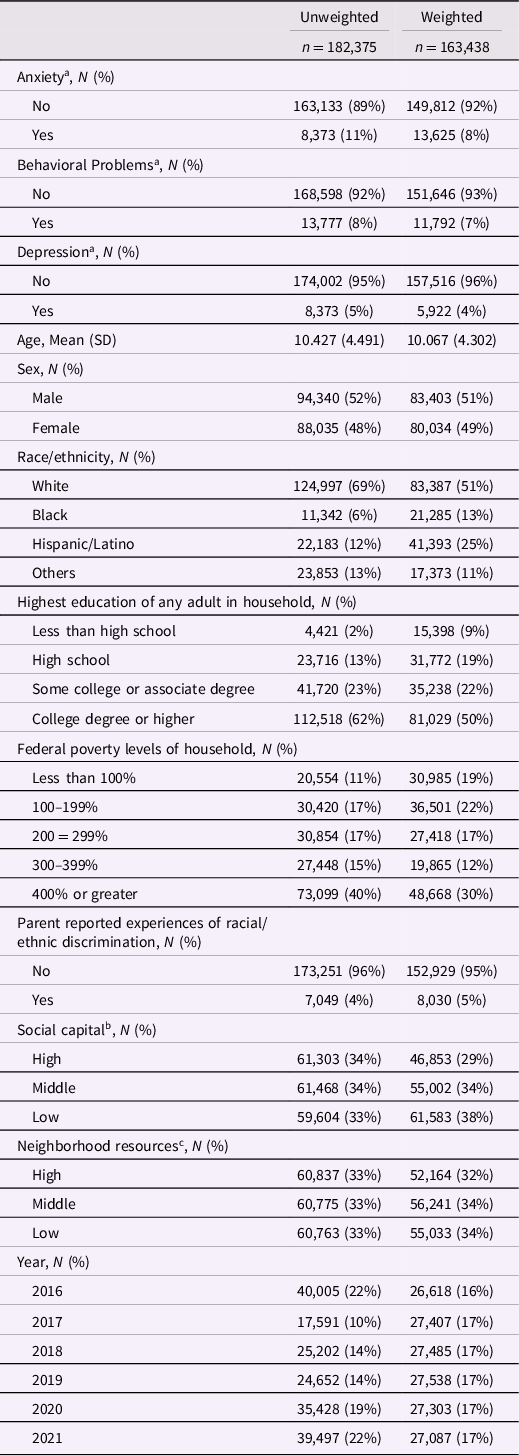
Of our sample, slightly over half (51%) were male, and the mean age of participants was 10 years old (SD = 4.3). Just over half (51%) of the sample was non-Hispanic White, 13% was non-Hispanic Black, 25% was Hispanic/Latino, and 11% were classified non-Hispanic Others, which includes American Indian, Alaskan Natives, Asian, or those whose caregivers reported the child as belonging to multiple racial groups. Approximately 5% of caregivers reported that their child had experienced unfair treatment due to their racial/ethnic status. Considering internalizing and externalizing problems, 5% of children had depression, 10% had anxiety problems, and 9% had behavioral problems (Table 1).
Characteristics of children in the analytical sample aged 3–17 years, National Survey of National Survey of Children’s Health (n = 182,375; 2016–2021)

a Children’s mental health conditions (i.e., anxiety, behavioral problems, depression) were reported by caregivers who were asked whether they were ever told by doctors or other professionals that their child had a mental health condition, and if yes, whether their children currently has the condition.
b Social capital was assessed using four items with four response options for each item. We created mean scores and categorized into tertiles. We also display the associations using the continuous score.
c An inventory of neighborhood resources was created using five items and categorized into tertiles. We also display the associations using the continuous score.
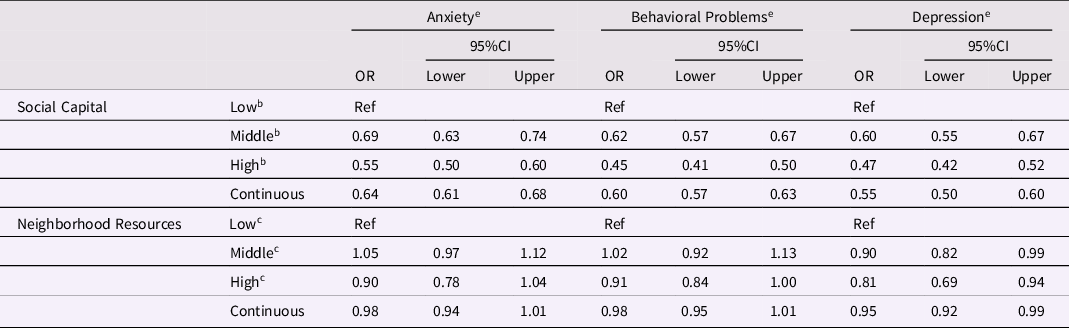
Table 2 shows our results of cross-sectional analyses examining the association between social capital, the number of neighborhood resources, and externalizing and internalizing problems. We found evidence that higher social capital was associated with lower odds of current externalizing and internalizing problems. For example, compared to living in an area with the lowest levels of social capital, children in communities classified as having moderate social capital had lower odds of depression (OR = 0.60, 95% CI = 0.55, 0.67), anxiety problems (OR = 0.69, 95% CI = 0.63, 0.74), and behavioral problems (OR = 0.62, 95% CI = 0.57, 0.67). These associations were stronger for children living in communities with highest levels of social capital compared to those in communities with lower levels of social capital for depression (OR = 0.47, 95% CI = 0.42, 0.52), anxiety (OR = 0.55, 95% CI = 0.50, 0.60), and behavioral problems (OR = 0.45, 95% CI = 0.41, 0.50). In contrast, we did not find strong evidence of associations between neighborhood resources and current anxiety problems, or behavior problems, except that higher neighborhood resources were associated with lower odds of depression (Middle level: OR = 0.90, 95% CI = 0.82, 0.99; high levels: OR = 0.81, 95% CI = 0.69, 0.94) (Table 2).
Associations between neighborhood environment and children’s mental health a , National Survey of Children’s Health (n = 182,375; 2016–2021)
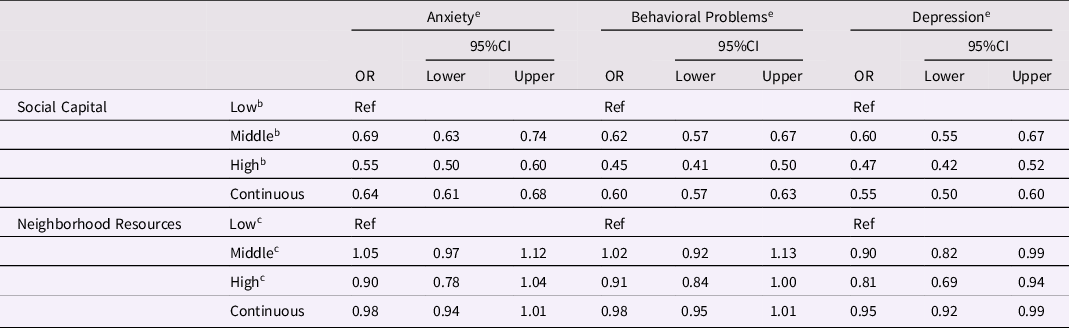
OR; Odds Ratio, CI; Confidence Interval, Ref; Reference.
a We used logistic regression adjusting for children’s age, sex, race/ethnicity, experiences of racial/ethnic discrimination reported by caregivers, household poverty level, and highest caregiver educational attainment.
b Social capital was assessed using four items with four response options for each item. We created mean scores and categorized into tertiles. We also display the associations using the continuous score.
c An inventory of neighborhood resources was created using five items and categorized into tertiles. We also display the associations using the continuous score.
e Children’s mental health conditions (i.e., anxiety, behavioral problems, depression) were reported by caregivers who were asked whether they were ever told by doctors or other professionals that their child had a mental health condition, and if yes, whether their children currently has the condition.
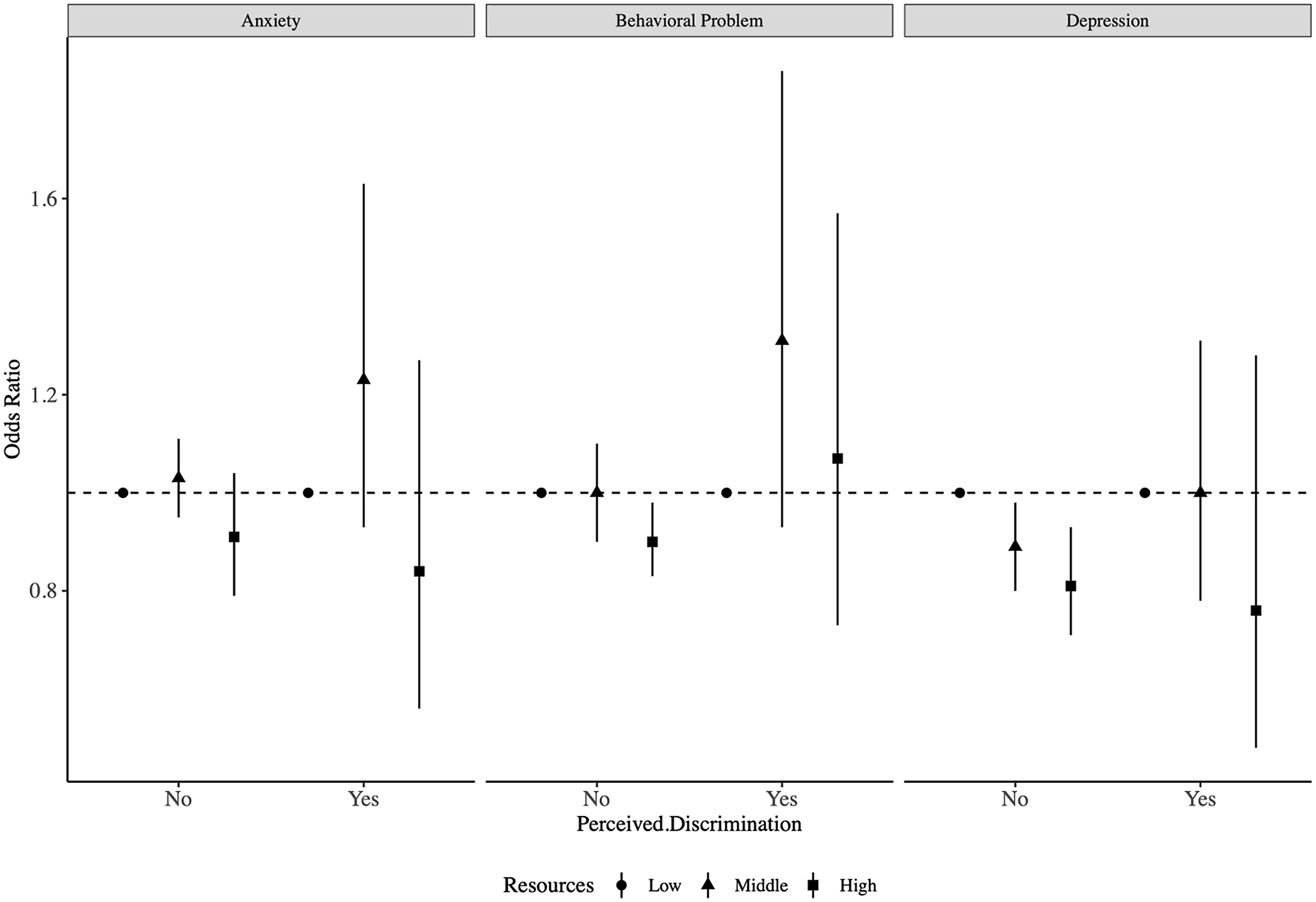
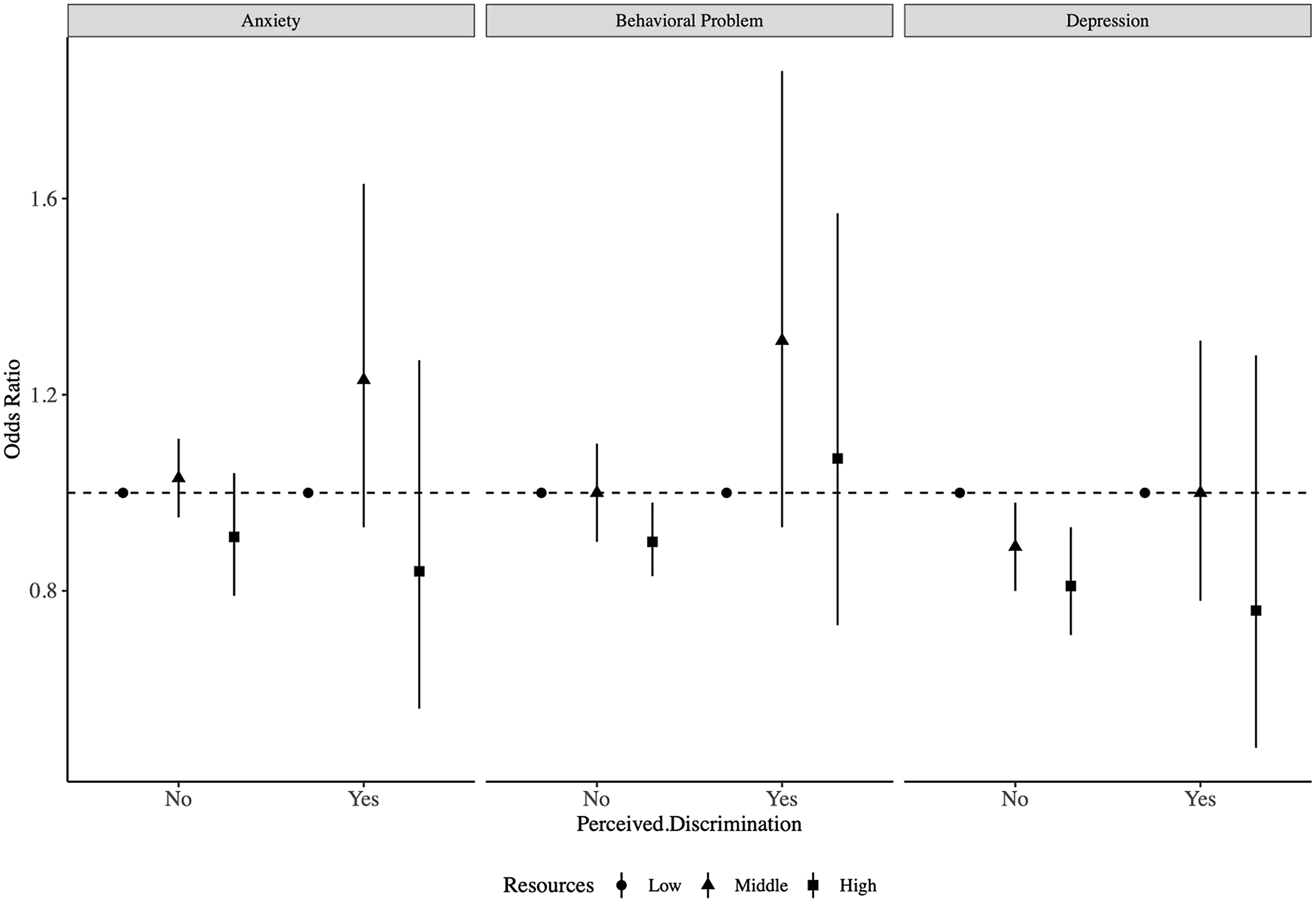
Figures 1 and 2 display the results of our stratified analysis by experiences of racial/ethnic discrimination status (for corresponding values, see Supplementary Table 1). Among caregivers who reported that their child had experienced racial/ethnic discrimination, there was no strong evidence for an association between living in an area with higher social capital odds of depression (OR = 1.41, 95% CI = 0.78, 2.56), anxiety (OR = 1.21, 95% CI = 0.74, 1.98), or behavioral problems (OR = 0.81 95% CI = 0.51, 1.29), compared to living in a community with lower social capital. In contrast, among children without caregiver-reported experiences of discrimination, living in the area with higher social capital was associated with lower odds of depression (OR = 0.41, 95% CI = 0.36, 0.47), anxiety (OR = 0.53, 95% CI = 0.49, 0.57), or behavioral problem (OR = 0.45, 95% CI = 0.42, 0.49). This pattern of associations was not consistent for neighborhood resources, except an association for depression among those who did not experience racial discrimination (high: OR = 0.81, 95% CI = 0.71, 0.93).
Associations between social capital and mental health problems, stratified by experiences of racial/ethnic discrimination, National Survey of Children’s Health (n = 182,375; 2016–2021). Social capital was assessed using four items with four response options for each item. We calculated means and categorized into tertiles. We used logistic regression adjusting for children’s age, sex, race/ethnicity, household poverty level, and caregiver educational attainment. Children’s mental health conditions (i.e., depression, anxiety, and behavioral problems) were reported by caregivers who were asked whether they were ever told by doctors or other professionals that their child has the condition and, if yes, whether their child currently has the condition. P-value for interactions were follows: anxiety: middle = 0.490, high = 0.0001; behavior problem: middle = 0.121, high = 0.019; depression: middle = 0.057, high = 0.002.

Associations between neighborhood resources and mental health problems, stratified by experiences of racial/ethnic discrimination, National Survey of Children’s Health (n = 182,375; 2016–2021). The neighborhood resources inventory was created using five items, and categorized into tertiles. We used logistic regression adjusting for children’s age, sex, race/ethnicity, household poverty level, and caregiver educational attainment. Children’s mental health conditions (i.e., depression, anxiety, and behavioral problems) were reported by caregivers who were asked whether they were ever told by doctors or other professionals that their child had a condition, and if yes, whether their child currently has the condition. P-values for interaction were as follows: anxiety: middle = 0.077, high = 0.912; behavior problem: middle = 0.152, high = 0.381; depression: middle = 0.221, high = 0.85.
Finally, as shown in Supplementary Tables 2 and 3, the patterns of associations between neighborhood characteristics, racial/ethnic discrimination, and children’s internalizing and externalizing behaviors are similar across developmental stages; that is, in analyses separating children<14 years compared to those older than 14 years, the results are comparable to the pooled sample. For example, higher social capital was associated with lower depression for both children less than and older than 14 years old (<14: OR = 0.55, 95% CI = 0.42, 0.71; ≥14: OR = 0.43, 95% CI = 0.37, 0.50). The magnitudes of associations were slightly stronger for children 14 years or older across outcomes. Considering neighborhood recourses, higher social capital was associated with lower depression among children less than 14 years old (OR = 0.73, 95% CI = 0.56, 0.94); however, we did not find strong evidence for differential associations based on age for other outcomes.
Sensitivity analysis
We conducted two sensitivity analyses. First, in an analysis that used continuous variables for social capital and neighborhood resources, we observed similar trends to those observed in models that used categorical exposure variables. For instance, a 1-unit increase in social capital score was associated with lower odds of depression, anxiety, or behavioral problems (Table 2). Second, we used racialized group status as an effect moderator instead of caregiver-reported experiences of racial/ethnic discrimination to test whether our findings can specifically be attributed to discrimination. This analysis was conducted based on the assumption that children from minoritized racial or ethnic groups, who are more likely to encounter discrimination, might have experienced unfair treatment owing to their racialized group status. The results showed that the magnitude of association between levels of social capital or neighborhood resources differs by racialized group, with the estimated associations between neighborhood resources and the mental health outcomes among Hispanic/Latino not displaying the same protective association. For Black and White children and children classified into the “Other” group, we observed consistent associations between higher social capital or more neighborhood resources and lower odds of mental health, although the confidence intervals were large for some groups, possibly due to sample size (Supplemental Figures 1 and 2).
Discussion
This study assessed the impact of elements of a child’s social and built environment on children’s mental health and whether this association is moderated by experiences of racial/ethnic discrimination. Our findings are three-fold. First, there was a dose-response relationship between social capital and odds of mental health disorders, as higher social capital was associated with lower odds of depression, anxiety, and behavioral problems. This suggests that the more social capital one has can be more protective against depression, anxiety, and behavioral problems. Notably, we found a significant relationship between the number of neighborhood resources and a lower odds of depression, but not anxiety or behavior problems. Second, racial/ethnic discrimination was identified as an effect moderator of the associations between community social capital and children’s mental health. Specifically, among those who reported no experiences of racial/ethnic discrimination, higher levels of social capital were associated with a lower likelihood of depression, anxiety, or behavioral problems (i.e., expressing a dose-response relationship between social capital and lower odds of all three mental health outcomes). Conversely, among those who experienced discrimination, the dose-response relationship was not evident. Middle levels of social capital were associated with a lower risk of depression, anxiety, and behavioral problems, but the magnitude of effects was smaller compared to those without experiences of discrimination. Third, the patterns of associations were evident across all children’s age categories, suggesting that the benefits of social capital, and moderation by racial/ethnic discrimination, are consistent across developmental stages.
Our results showing an inverse association between social capital and children’s behavior problems align with prior research (Breedvelt et al., Reference Breedvelt, Tiemeier, Sharples, Galea, Niedzwiedz, Elliott and Bockting2022). Communities with higher social capital may provide support via both physical and psychological mechanisms. Some scholars use the phrase community resilience to refer to communities that promote the safety, protection, and well-being of residents and their ability to thrive despite risk factors. Community resilience is comprised of various elements, including higher social capital, social networks (Longhi et al., Reference Longhi, Brown and Fromm Reed2021), and collective efficacy (King et al., Reference King, Zori, Collins, Lewis, Hack, Dixon and Hart2022), and may positively impact multiple outcomes for children. For instance, children living in communities with high resilience experience less violence or childhood adversities (i.e., bullying) as neighbors may be more likely to supervise or intervene when necessary (King et al., Reference King, Zori, Collins, Lewis, Hack, Dixon and Hart2022; Longhi et al., Reference Longhi, Brown and Fromm Reed2021). Moreover, the community’s protection during stressful times could act as emotional and physical social support, mitigating psychological responses to stressors (Kawachi & Berkman, Reference Kawachi and Berkman2001). The knowledge that they can receive protection from the community might instill confidence in children and contribute to their emotional stability.
Additionally, children can benefit from a cohesive community by having increased opportunities to encounter multiple adult role models, learn positive emotions from these adults, or find safe spaces beyond their school or home (Fujiwara et al., Reference Fujiwara, Doi, Isumi and Ochi2020). Furthermore, parents may experience lower stress by living in highly cohesive communities, which can lower the risk of excessive parenting behaviors and child abuse (Fujiwara et al., Reference Fujiwara, Yamaoka and Kawachi2016) by providing better social networks or social support. Collectively, these factors could contribute to improved mental health conditions in children, emphasizing the importance of promoting community resilience.
While numerous studies have demonstrated that the number of neighborhood resources affects children’s health, including school absenteeism (Opara et al., Reference Opara, Thorpe and Lardier2022), mortality (Slopen et al., Reference Slopen, Cosgrove, Acevedo-Garcia, Hatzenbuehler, Shonkoff and Noelke2023), physical health (i.e., self-rated health, pain), well-being (i.e., positive/negative emotion, life satisfaction), and mental health (i.e., depression, self-rated mental health, aggression) (Li et al., Reference Li, Fu, Leigh and Humphrey2021; Molnar et al., Reference Molnar, Cerda, Roberts and Buka2008), our findings on the association between neighborhood resources and children’s behavior were less clear. Specifically, we found an association between neighborhood resources and children’s depression, but not anxiety or behavior problems. Our findings may differ from prior studies given that our measure of neighborhood resources only includes five resources, including sidewalks or walking paths, parks or playgrounds, recreation centers, libraries or bookmobiles, and lack of litter or garbage. In contrast, other studies included a larger variety of additional resources (i.e., the number of educational facilities or healthcare facilities) (Lou et al., Reference Lou, Giorgi, Liu, Eichstaedt and Curtis2023) or used validated objective assessments of children’s neighborhoods, such as the Child Opportunity Index. Together with the prior evidence, the neighborhood measures in NSCH data may not capture the complex landscape of the built environment, which includes access, availability, and quality of resources (Shen, Reference Shen2022). Despite this limitation, our findings highlight the importance of considering neighborhood social context, not only the presence of resources, within research on children’s mental health.
Our findings indicate that the protective benefit of social capital varies according to experiences of racial/ethnic discrimination, and in sensitivity analyses, self-identified racial/ethnic status. Individuals with no experiences of racial/ethnic discrimination and non-Hispanic White children displayed the largest protective association with higher social support, while those with experiences of racial/ethnic discrimination and Black and Hispanic/Latino children did not display this same association. This pattern of findings emphasizes how resilience viewed through a multilevel framework can point to potential interventions that consider dynamic and connected interpersonal and structural factors. Future research on interventions to increase social capital should also consider how communities may reduce children’s experiences of unfair treatment due to race and ethnicity, as well.
Our study has limitations that are important to consider. First, we used cross-sectional data, meaning that our findings are descriptive and we cannot infer causality or establish temporal ordering between our exposure and outcome variables. Second, our analyses to examine differences in associations by experiences of discrimination may be limited due to the use of caregiver-report of discrimination. Caregivers reported their perception of children’s experiences of racial/ethnic discrimination, which may differ from children’s actual experiences, particularly as children age. That said, given that individuals belonging to minoritized racial and ethnic groups experience more discrimination, we conducted a sensitivity analysis using racialized group status to assess the robustness of our results. We found that higher social capital was protective for all racialized groups; however, those who may have more racial discrimination in the U.S., i.e., Black and Hispanic/Latino children, displayed less pronounced protective associations between social capital and behavioral problems benefit compared to white children. Third, our outcomes of current depression, anxiety, and behavioral problems also may have been misclassified, as caregivers were asked to report if their child was ever diagnosed with these conditions. By using parent report of diagnosis rather than youth reports of symptoms, we expect that the associations may be biased toward the null, given that misclassification of mental health concerns is likely. Furthermore, our reliance on binary outcome indicators likely fails to capture those children who have some behavioral symptoms but the symptoms are not serious enough to receive diagnosis or to seek help from a health care professional. As described by Holbrook and colleagues, it is important for the field to use evidence from multiple data sources and sampling strategies, as each data and sampling method has its own strengths and limitations. Future studies using alternative data sources or sampling methods, including medical claim data or community-based data, are important (Holbrook et al., Reference Holbrook, Bitsko, Danielson and Visser2017). Fourth, there is a possibility of shared method bias as all our reports rely on parental reports. This may induce a bias in our results. However, we conducted a sensitivity analysis using child race/ethnicity status, given the fact that certain racial/ethnic groups are more likely to experience discrimination. Fifth, we used a single item to assess internalizing and externalizing problems. Further, the survey only assessed the history of diagnosis by health professionals; thus, we could not consider behavioral symptoms as continuous measures. Sixth, all parental reports, including internalizing/externalizing problems, social capital, neighborhood resources, or racial discrimination experiences, may have been influenced by the increased stress parents faced during the pandemic. We attempted to control for this effect by adjusting for the year; however, we lacked information on parental stress or any specific events related to the pandemic that they might have experienced. This lack of information could have potentially influenced our results.
Last, our study may have been underpowered as the number of people who reported experiences of racial/ethnic discrimination was small. However, our point estimate suggests differences in the association from the comparison group, even if the confidence intervals are wide. Nonetheless, our study has strengths, as to our knowledge, it is among the first to consider experiences of racial/ethnic discrimination as an effect moderator in the association between social capital and mental health among children.
To overcome our study limitations and advance our understanding of community resilience and resources that enhance children’s well-being, future studies could improve three points. First, conducting longitudinal studies that use gold-standard outcome assessments could provide a more solid foundation for assessing causal relationships. Research that allows for causal inference is needed to inform potential interventions or policy recommendations. Second, to reflect the reality of children’s experiences, it is crucial to use children’s reports and validated questionnaires to assess perceived discrimination (Priest et al., Reference Priest, Paradies, Trenerry, Truong, Karlsen and Kelly2013; Williams et al., Reference Williams, Yu, Jackson and Anderson1997). In our study, information on children’s experiences of racial discrimination was gathered solely through parental reports, which may not fully capture all the experiences of the children. Last, discrimination is a multifaceted issue and can occur based on a variety of personal traits, including but not limited to race or ethnicity. For instance, children can experience unfair treatment due to gender identity and immigration status, which have implications for mental health among children (Olson et al., Reference Olson, Durwood, DeMeules and McLaughlin2016). Therefore, we recommend that future research consider discriminatory experiences broadly, extending these findings to racism specifically.
Further, our study points to several features of the NSCH, or other large surveys, that could advance opportunities to study neighborhood social capital, neighborhood resources, experiences of discrimination, and children’s mental health. First, to reflect the true mental health conditions of children more accurately, it would be beneficial to use validated symptom scales such as the Child Behavior Checklist (Achenbach & Rescorla, Reference Achenbach and Rescorla2000). Second, survey responses from the children themselves, particularly older children, would be beneficial. For instance, it can be challenging for parents to report on a child’s experiences of discrimination, particularly as children get older. Last, there has been growing interest in the associations between objective measures of neighborhood environment and health (Acevedo-Garcia et al., Reference Acevedo-Garcia, Noelke, McArdle, Sofer, Hardy, Weiner, Baek, Huntington, Huber and Reece2020; Slopen et al., Reference Slopen, Cosgrove, Acevedo-Garcia, Hatzenbuehler, Shonkoff and Noelke2023), in addition to subjective reports such as those used in the current survey. Linking census-level neighborhood data, including composite measures like the Community Opportunity Index (Acevedo-Garcia et al., Reference Acevedo-Garcia, Noelke, McArdle, Sofer, Hardy, Weiner, Baek, Huntington, Huber and Reece2020) or Area Deprivation Index (Rehkopf & Phillips, Reference Rehkopf and Phillips2023), could be beneficial.
In conclusion, our results suggest that utilizing a multilevel approach in resilience research is beneficial in shedding light on various pathways that can impact a child’s development. It also provides support for potential policy measures, interventions, and future research that builds upon a multisystem framework related to child psychopathology and resilience. Multilevel approaches allow one to account for the diverse, complex environments that children develop and must adapt to. Assessing social influences on child development concurrently, such as social capital and interpersonal discrimination, can highlight why a particular community may have a different response to an intervention, or the best approach to take for a specific community context. By integrating social influences across multiple levels, this study shows the promise of multisystem integration in understanding and addressing the factors that influence childhood psychopathology and resilience.
Supplementary material
The supplementary material for this article can be found at https://doi.org/10.1017/S0954579423001025.
Acknowledgements
We are extremely grateful to all NSCH participants for the use of our data. Support for this research was also provided by the CZI/Silicon Valley Community Foundation to the Center on the Developing Child at Harvard University, the W. K. Kellogg Foundation, and the Harvard Education and Research Center training grant (T42 OH008416). Lastly, we thank Nolan Kavanagh, MD, for his support.
Competing interests
The authors declare none.
Funding statement
Support for this research was also provided by the CZI/Silicon Valley Community Foundation to the Center on the Developing Child at Harvard University, the W. K. Kellogg Foundation, and the Harvard Education and Research Center training grant (T42 OH008416).