Nomenclature
1. Novel: A characteristic of an entity that is “new” or “original” (Howard et al., Reference Howard, Culley and Dekoninck2008).
2. System: A group of devices, artificial objects, organs (in the biological domain), or an organization forming a network especially for distributing something or serving a common purpose (Merriam-Webster, 2004).
3. Analogy: A correspondence or resemblance between a pair, in which one is created by inspiring from the other (Merriam-Webster, 2004).
4. Analogous system or stimulus: A system that has a correspondence with a purpose: for example, engineering design problem or with another system. Usually, an analogous system performs the same function or same behavior or resembles the same structure as another system or as intended in a design problem (Qian and Gero, Reference Qian and Gero1996).
5. Understanding: To grasp the meaning of a concept or a set of concepts described using different modes of explanation, with or without a motive of applying the concept in a situation. In this paper, “understanding” is mainly used in the context where concepts of an analogous system are extracted, understood, and applied in a design problem.
Introduction
Developing creative products is a longstanding objective of engineering designers. A creative design output is characterized by its “novelty” and “value”, where “value” is considered as “usefulness” in engineering design (Howard et al., Reference Howard, Culley and Dekoninck2008, p. 181; Sarkar and Chakrabarti, Reference Sarkar and Chakrabarti2015, p. 17). Analogical design or design-by-analogy is one of the idea-generation techniques used in the conceptual design stage, where information from existing systems (source) from several domains (including biological) is transferred to the engineering design problems (target). In this regard, it is considered that biological domain has the potential to be a rich source of analogies that are novel and useful (Chiu and Shu, Reference Chiu and Shu2007, p. 45).
Most often, leveraging the full insight of biological systems while solving engineering design problems occur by chance. First, in these situations, the source (biological) and the target (engineering design problem) are “distantly related” or “unrelated” with respect to (w.r.t.), conceptual distance; that is, biological and engineering domains do not share a common vocabulary (Chiu and Shu, Reference Chiu and Shu2007). Therefore, engineering designers find it hard to access biological systems. Second, it is unclear, how biological systems could be represented so that engineering designers would understand and utilize the biological analogies to solve engineering design problems (Yargin and Crilly, Reference Yargin and Crilly2015).
Engineering designers use the existing commercial knowledge bases such as Wikipedia, How Stuff Works, Ask Nature that provide marginal explanations of biological systems, which are known for their complexity in structure, function, and behavior (Cheong et al., Reference Cheong, Hallihan and Shu2014). In biological systems, several functions occur in sequence or at the same time, also at different system levels (often in different components). In addition, it is difficult for engineering designers to comprehend the vocabulary in the biological domain (Vattam et al., Reference Vattam, Helms and Goel2010). Therefore, current methods for representing: for example, using text and images, are not sufficient for engineering designers to understand.
We developed a web-based tool called Idea-Inspire 4.0 (Chakrabarti et al., Reference Chakrabarti, Siddharth, Dinakar, Panda, Palegar and Keshwani2017) as a support for analogical design. The tool is a searchable knowledge base (“Searching analogous systems” section) of several biological systems and supports the explanation of each system using a multi-modal representation (“Representing analogous systems” section): that is, function models, text, images, etc. The purpose of the research presented in this paper is to evaluate the efficacy of the multi-modal representation in solving engineering design problems. Experimental studies in engineering design usually evaluate the final outcome of the design process; that is, the solutions to design problems. However, in analogical design, it is necessary to evaluate the understanding of the analogous system, which is required for applying the concepts to engineering design problems.
Our experimental study is divided into two parts. First, in “Controlled experiment on understanding” section, we evaluate the “analysis” and “synthesis” levels of understanding of a biological system. Second, in “Controlled experiment on problem-solving” section, we evaluate the “novelty” and “requirement-satisfaction” of solutions to an engineering design problem, when a biological system is provided as a stimulus. In both the experiments, the biological system is provided using two modes of representation: (1) the multi-modal representation in Idea-Inspire 4.0; (2) a text-image representation. This is to test the effectiveness of the multi-modal representation used in Idea-Inspire 4.0 against a text-image representation as a benchmark.
Related work
In analogical design, it is necessary to search for analogous systems and understand them well for application in engineering design problems. For searching an analogous system, a well-structured, dynamic, searchable database is required as some existing databases are reviewed in “Searching for analogous systems” section. For understanding an analogous system, it is necessary that the analogous system is represented using a suitable representation scheme. In “Representations of analogous systems” section, we review some representations proposed thus far.
Searching for analogous systems
The detail up to which an engineering design problem statement is defined, influences the extent to which, the engineering designers are able to search for analogous systems in the biological domain. If an engineering design problem is well defined, it is easy to identify keywords to search in the biological domain (Gonçalves et al., Reference Gonçalves, Cardoso and Badke-Schaub2016, p. 24/31). However, in order to search for systems in the biological domain, it is necessary to be aware of certain biological keywords that are equivalent to keywords that are extracted from the engineering design problem. Chiu and Shu (Reference Chiu and Shu2007, p. 52) use a WordNet-based identification of biological keywords that are equivalent to the functional basis (Stone and Wood, Reference Stone and Wood2000), which is a set of vocabulary to define basic functions (verbs) and flows (nouns).
In absence of such biological keywords, Yargin and Crilly (Reference Yargin and Crilly2015, p. 207) suggest that engineering designers could browse through indexed databases of biological systems. Idea-Inspire (Chakrabarti et al., Reference Chakrabarti, Sarkar, Leelavathamma and Nataraju2005) is a searchable database comprising over 1200 systems, structured using SAPPhIRE model, whose constructs: States, Actions, Parts, Phenomena, Inputs, oRgans, and Effects represent functioning at different levels of abstraction. DANE is a non-searchable database of biological systems indexed using functions. Wiltgen et al. (Reference Wiltgen, Vattam, Helms, Goel and Yen2011) report an interview post-deployment of DANE in a classroom environment that shows that DANE was useful for browsing systems; however, the users were less interested in manually populating its database.
Murphy et al. (Reference Murphy, Fu, Otto, Yang, Jensen and Wood2014) indexed the US patent database of about 65,000 patents using 1700 functions. Fu et al. (Reference Fu, Murphy, Yang, Otto, Jensen and Wood2015) observed that using this searchable database improved the novelty of designs by 5%. There are other structured databases, such as PAnDA (Verhaegen et al., Reference Verhaegen, Peeters, Vandevenne, Dewulf and Duflou2011), NIST repository (Fenves, Reference Fenves2001), UMR repository (Bohm et al., Reference Bohm, Stone and Szykman2005), etc., that are built mainly for the purpose of storing product knowledge in the engineering domain.
Representations of analogous systems
Vattam et al. (Reference Vattam, Helms and Goel2010) in their qualitative study on analogical design found that engineering designers “directly” transferred (i.e., copied) “mechanisms” (structure or behavior) into the engineering design problems. In practical cases, analogies are modified and combined to form what Goel et al. (Reference Goel, Vattam, Wiltgen and Helms2012, p. 884, Table A1) refer to as “compound” analogies. Such activities require an in-depth understanding of the analogous system, which in turn depends on how well it is represented.
In the context of representing analogues, Yargin and Crilly (Reference Yargin and Crilly2015, p. 205) quote, “(analogical design) tool developers must make decisions about what entities to describe, how to group them, what representations to use, how to abstract from examples, how to exemplify these abstractions, and so on”. Sarkar and Chakrabarti (Reference Sarkar and Chakrabarti2008) reported that the use of images and videos had a positive effect on the number of ideas generated, compared with text-only representations. Conversely, Ware (Reference Ware2010) stated that textual representation was helpful in discovering the abstract relationships within a biological system.
Linsey et al. (Reference Linsey, Clauss, Kurtoglu, Murphy, Wood and Markman2011) found that the use of text and images was helpful in generating novel designs as opposed to the cases where only text or only images were provided. Linsey et al. (Reference Linsey, Wood and Markman2008) observed that the use of generalized or abstract linguistic representations seemed to mitigate fixation and generate more novel ideas. Yargin and Crilly (Reference Yargin and Crilly2015, p. 205) echoed this observation and stated that the use of function models could also provide more abstract descriptions.
Nagel et al.’s (Reference Nagel, Midha, Tinsley, Stone, McAdams and Shu2008) case study on four biological–artificial system pairs showed that the use of functional basis (Stone and Wood, Reference Stone and Wood2000) was helpful in drawing similarity between source and target pairs. Mak and Shu (Reference Mak and Shu2008) found that modeling biological systems as flows of sub-functions had a positive impact on the number of ideas. Gonçalves et al. (Reference Gonçalves, Cardoso and Badke-Schaub2016, p. 16/31) verified their earlier study (Gonçalves et al., Reference Gonçalves, Cardoso and Badke-Schaub2012) by observing that engineering designers chose “closely related” rather than “unrelated” images w.r.t., the engineering design problems.
Gonçalves et al. (Reference Gonçalves, Cardoso and Badke-Schaub2016, p. 5/31) concluded, “some information can only be processed in words, while other information is better communicated via images, or even within a combination of both”. Helms et al. (Reference Helms, Vattam, Goel and Yen2011) compared the understanding capability in different modes of representation: text, text and image, text, and SBF model; they concluded (2011, p. 5) that no individual representation could be labeled as the “best”; however, a combination of all such modes should be preferred.
Major findings from the literature
1. In analogical design, it is important to be aware of certain keywords that represent the functional requirements extracted from the engineering design problem.
2. Since the source (biological system) and the target (engineering design problem) domains do not necessarily share a common vocabulary, it is essential to include a bridge database, which would be helpful to map significant keywords across these domains.
3. No single mode of representation has been found to be best suited for describing analogous systems. Helms et al. (Reference Helms, Vattam, Goel and Yen2011) concluded from their study that a combination of different modes should be preferred.
4. Except for the work of Helms et al. (Reference Helms, Vattam, Goel and Yen2011), the level of understanding has not been evaluated by any researchers in analogical design. Instead, they evaluate the final design outcomes.
Idea-Inspire 4.0: an overview
Idea-Inspire 4.0 (Chakrabarti et al., Reference Chakrabarti, Siddharth, Dinakar, Panda, Palegar and Keshwani2017) is a web-based, analogical design tool. It is a searchable and expandable knowledge base of biological (and engineered) systems. In this section, we describe how biological systems are retrieved and represented in Idea-Inspire 4.0.
Searching analogous systems
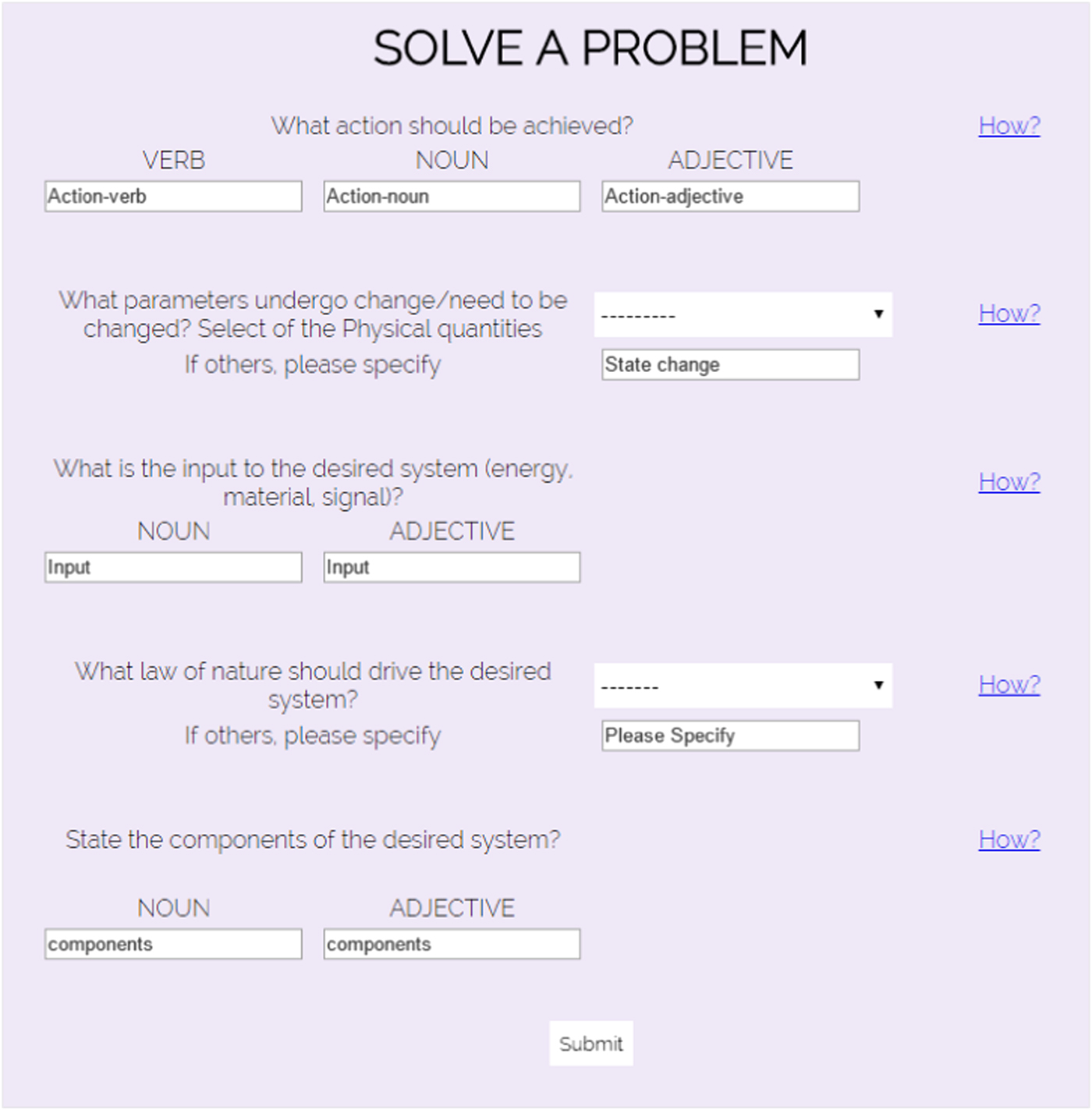
The search method (Fig. 1) takes a combination of keywords that together represent the set of requirements extracted from the engineering design problem. These search boxes, as shown in Figure 1, represent the requirements at different levels of abstraction. For instance, the top-level search boxes mean the highest level (Actions) functional requirement and lowest level ones (Parts) are specific component-level requirements. These search keywords together form a query that is executed on the Idea-Inspire 4.0 database. In order to illustrate the search method, we use the following problem statement as an example.
“Design a surveillance robot that can climb steep terrains and walls. The purpose of such devices is to keep watch of places in which movement is restricted. The device must take in wireless signal input from external sources. The device should act according to changes in external conditions such as pressure, temperature etc.”
Problem-based search method in Idea-Inspire 4.0.

The above example is simplified and entered as search keywords as follows. Note that, in Figure 1, the user has the option to enter any one, or all of these requirements in the search method; it depends on the detail of the problem statement intended for search. In the example above, the statement is sufficiently detailed that all fields could be entered at once.
1. What action should be achieved? – This field refers to “What the system is ultimately intended to do?” as in the example, climbing steep terrains and walls (bold words are directly taken from the problem). Upon breaking apart the problem statement, “climb” is the verb, “terrains and walls” are the nouns, and “steep” is the adjective that can be used for the search.
2. What parameters undergo change/need to be changed? – This field refers to “What changes need to be observed?” In this example, “position” is the state variable that must change during the course of the functioning of the robot. The state variable can be selected drop-down or entered as text.
3. What is the input to the desired system? – This refers to “What material or energy or information needs to enter the system?” in order to activate its functioning, for example, wireless (adjective) signal (noun) in this case.
4. What law of nature should drive the desired system? – This refers to “Which causal relations (physical laws) are needed to drive the system?” It could be selected from the drop-down (only one), or manually entered (multiple) in the text box. Here, we simply enter pressure and temperature to account for all the relations that include these state variables.
5. State the components of the desired system? – In this field, the user must enter “What components are required to be present in the system?”: for example, “arms” or “limbs” as nouns, and “pneumatic” as an adjective.
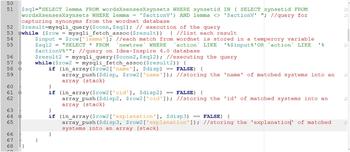
The code snippet for retrieving the search results is shown in Figure 2. The input for this code is a search keyword entered in one of the text boxes shown in Figure 1. Initially, the user may not be aware of the exact keyword to search. Hence, the program searches for related words of the keyword provided from a lexical database called WordNet (Miller, Reference Miller1995). This database contains a huge list of words that are linked to one another based on similarity. For example, “crying” and “weeping” are connected together because these have the same meaning; “table” and “chair” are connected together as these are frequently used together. Likewise, we capture all related words that match with the search keyword.
The code snippet for retrieving a database entry.

The query ($sql in the code) is executed on the WordNet database. The query first captures the IDs (type = integer) of all words (termed as lemma) since the links among words are stored only using their IDs; the query then identifies the corresponding words (type = string). The output ($result in the code) of this query is stored as an array of all related words, stored using a variable called $input. The list of words stored in this array is automatically sorted according to their similarity w.r.t., the search keyword. The similarity between any two words is the relative distance between them in the WordNet hierarchy (Croft et al., Reference Croft, Coupland, Shell and Brown2013), which is automatically considered when the database is queried.
Now, the original search keyword and the list of related words ($input) are matched against all entries in the Idea-Inspire 4.0 database using the query $sql2. The output ($result2) of this query is a list of systems retrieved from the Idea-Inspire 4.0 database. These retrieved systems are then stored in an array before displaying them in the search results. The code snippet shown in Figure 2 only represents how the WordNet database is linked with the search on the Idea-Inspire database.
Including WordNet as a search widener is the novel aspect of the 4.0 version w.r.t., Chakrabarti et al. (Reference Chakrabarti, Sarkar, Leelavathamma and Nataraju2005), where only the original search keywords were matched with the database and sorted according to Action (V) – Action (V), States – States matches, etc. [2005, p. 122, “How well the solution ‘satisfied’ the problem (testing H2)” section]. These rules are also used in the 4.0 version as well but not discussed in this paper. The results are displayed in Idea-Inspire 4.0 (Fig. 3) using the system name and a short description. The purpose of the description is to provide an overview of the system before exploring it in depth (Lepionka, Reference Lepionka2008).
Retrieving systems using problem-based search in Idea-Inspire 4.0.

Representing analogous systems
In this section, we explain how the top-most search result, “climbing of a mudskipper” (see Fig. 3) is represented in Idea-Inspire 4.0. The reader shall refer to Figure 4 for the explanation provided in this section.
Representation of a system in Idea-Inspire 4.0.

Functional decomposition model
The description of “climbing of a mudskipper” starts with a functional decomposition model (Fig. 4 – top left), indicating its sub-systems and relationships among them. Two kinds of relationships exist in this model – hierarchical ( ) and causal (
 ) as indicated by links in the diagram. Two yellow (
 ) links originate from the main system – “climbing of a mudskipper” to immediate sub-systems – “pelvic fins” and “pectoral fins”. These are two different organs that function independently within different system boundaries, indicating the structural hierarchy.
The functioning of the first sub-system – “pelvic fins” is divided into “protractor ischii” and “retractor ischii” using yellow ( ) links that indicate the functional hierarchy; in this case, only the processes occurring within “pelvic fins” get divided, not the system boundary. One cannot decompose a system strictly using system boundaries (e.g., motor to the rotor, switch, and stator) or using processes (e.g., different steps of a diesel cycle). Instead, a combination of both approaches shall be preferred. Therefore, we do not differentiate structural and functional hierarchy in terms of the color code (
 ).
There is also a green ( ) link from “protractor ischii” to “retractor ischii” that indicates that these two sub-functions occur in sequence. These causal connections are similar to the connections among sub-functions (Mak and Shu, Reference Mak and Shu2008; Stone and Wood, Reference Stone and Wood2000) that constitute material, energy, and signal flow. The hierarchy (
 ) is developed as an integration of several system decomposition methods (Umeda et al., Reference Umeda, Takeda, Tomiyama and Yoshikawa1990; Pimmler and Eppinger, Reference Pimmler and Eppinger1994; Ulrich, Reference Ulrich1995; Browning, Reference Browning2001).
Textual explanation
The description of the system is followed by a textual explanation (Fig. 4 – top right). Taking into account the observations of Linsey et al. (Reference Linsey, Wood and Markman2008), we have structured the textual explanations using a uniform, general template as described below.
1. Initially, the explanation gives an introduction to the system, as the example starts with habitats and unique characteristics of mudskipper.
2. Following the introduction, a phrase tells “what the system does” in an abstract manner (Actions).
3. Next, a phrase “the system consists of…” lists all components of the system (Parts).
4. The following phrase “these parts need to have…” mentions state variables, properties, and conditions (oRgans) that are derived from the previous phrase (Parts).
5. The following phrase “the external adhering causes…” indicate the introduction of external material or energy or information (Input) from outside the system boundary that triggers the functioning of the system.
6. Next phrase, “This causes…” explains what Phenomena occur due to the introduction of Inputs.
7. The following phrase “This change…” denotes the instantaneous values of state variables (States).
8. The last phrase “The principle governing…” points to the laws (Effects) that govern the Phenomena.
The above template uses CNL – Controlled Natural Language (Huijsen, Reference Huijsen1998; Kuhn, Reference Kuhn2014) that is a subset of natural language whose grammar and vocabulary have been restricted in a systematic way in order to reduce both ambiguity and complexity of full natural language. CNLs are generally easier for humans to understand and easier for a computer to process (Schwitter, Reference Schwitter2010). They focus on lexical ambiguities, simple sentence constructions, and pragmatic issues. They restrict the grammar and make use of only 850 root words and 18 verbs: put, take, give, get, come, go, make, keep, let, do, be, seem, have, may, will, say, see, and send (Huijsen, Reference Huijsen1998; Kuhn, Reference Kuhn2014).
SAPPhIRE model
The textual explanation of each (sub-)system is supported by a SAPPhIRE model (Fig. 4 – mid-right) whose constructs are explained as follows.
1. Parts are components and interfaces that constitute the system and its environment; for example, “pelvic fins” and “pectoral fins”. This system appeared in search results because the word “fins” in Parts is related to “limbs” that was entered as search keyword #5 in “Searching analogous systems” section.
2. Derived from Parts are oRgans that are state variables, properties, and conditions that together describe the initial state of the system; for example, the abilities of the “fins” to create a temporary vacuum cup that can withstand its own weight. Since oRgans are usually unknown, we did not provide a search element for this construct in “Searching analogous systems” section.
3. Input is a physical quantity in the form of material, energy, or information, which enters the system boundary; for example, the “force” generated by adhering substance against the wall. There was no match at this construct because keyword #3 was “wireless signal”.
4. Phenomena describe the processes that are initiated by the Inputs. The description provided by Phenomena is augmented by States and Effects placed on either side. Since this construct merely connects States and Effects, we did not include a separate search element in “Searching analogous systems” section.
5. Phenomena create a change in state variables or properties of the system known as States. In this case, there is an overall “position” change, which directly matches with our search keyword #2 – “position”.
6. Phenomena are governed by physical laws (termed here as Effects) that are activated by both Input and oRgans; for example, vacuum and lever effects due to which the fish holds onto the surface. There is a match between the search keyword #4 – “pressure” with “vacuum” in Effects since these two words are related.
7. Finally, States are interpreted as Actions, which are abstract descriptions of the system; in some cases describes the purpose of the system. In this case, the Action is termed as “climbing” that exactly matches the search keyword #1 – “climb”.
The above-explained constructs describe the functioning at seven levels of abstraction: that is, Actions – highly abstract, least detailed, and Parts – least abstract, most detailed. In so far, SAPPhIRE model was not tested for its support for understanding, and the potential of that in aiding generation of novel designs. Even though Sarkar et al. (Reference Sarkar, Phaneendra and Chakrabarti2008) observed that the use of Idea-Inspire (Chakrabarti et al., Reference Chakrabarti, Sarkar, Leelavathamma and Nataraju2005) increased the number of ideas trifold, it cannot necessarily be attributed to the use of SAPPhIRE model. We have included this model as part of the representation so that the user realizes as to which entity of the system had a match with his/her query and increases the chances of understanding the system more in depth (more in “Controlled experiment on understanding” section).
Digital support
In order to further support the explanation, there is an audio (mid-left), an image (bottom-left), and a video (bottom-right). The videos and images are open-source materials and the audios are made using a text-to-speech software called Natural Reader (2017). It explains the overall system, its sub-systems and the links among them, and reads out the textual explanations for the sub-systems.
Summary
Altogether, the representation of a system in Idea-Inspire 4.0 consists of a functional decomposition model, text, SAPPhIRE model, and a digital support. The link embedded in the heading of each (sub-)system in the text (Fig. 4 – top-right) supports the user to navigate another representation page, where its (sub-)system is also represented using the same format. Two biology students with 4 years of domain knowledge have populated 60 systems. The study of Kindt et al. (Reference Kindt, Goldsby, Osborne and Kuby2007) was used by them to gather important biological systems, in addition to the older database (Chakrabarti et al., Reference Chakrabarti, Sarkar, Leelavathamma and Nataraju2005). Along with them, the first author of this paper has populated 83 engineered systems making a total count of 143.
Research questions
In most experiments on analogical design, a design problem was given as an input, and designers were asked to develop a principle solution as an output (see the notation below). An analogous system is given as a catalyst in this process. The problem-solving process is not a single step. According to Pahl and Beitz (Reference Pahl and Beitz2007), it requires the extraction of requirements, finding solutions for individual requirements, evaluating the individual solutions against their corresponding requirements, and combining them to form the principle solution, before the principle solution can be assessed. The principle solution is the final outcome of the conceptual design stage (Pahl and Beitz, Reference Pahl and Beitz2007). Most often, researchers have evaluated the final design outcome for novelty, number of ideas, etc. However, there are intermediate steps that are elaborated below.
 $${\rm Design\; }\,{\rm Problem}\mathop \to \limits^{\matrix{ {{\rm Analogous}\,{\rm \; System}} \cr {\left( {{\rm catalyst}} \right)} \cr } } {\rm Principle \;Solution}{\rm .}$$
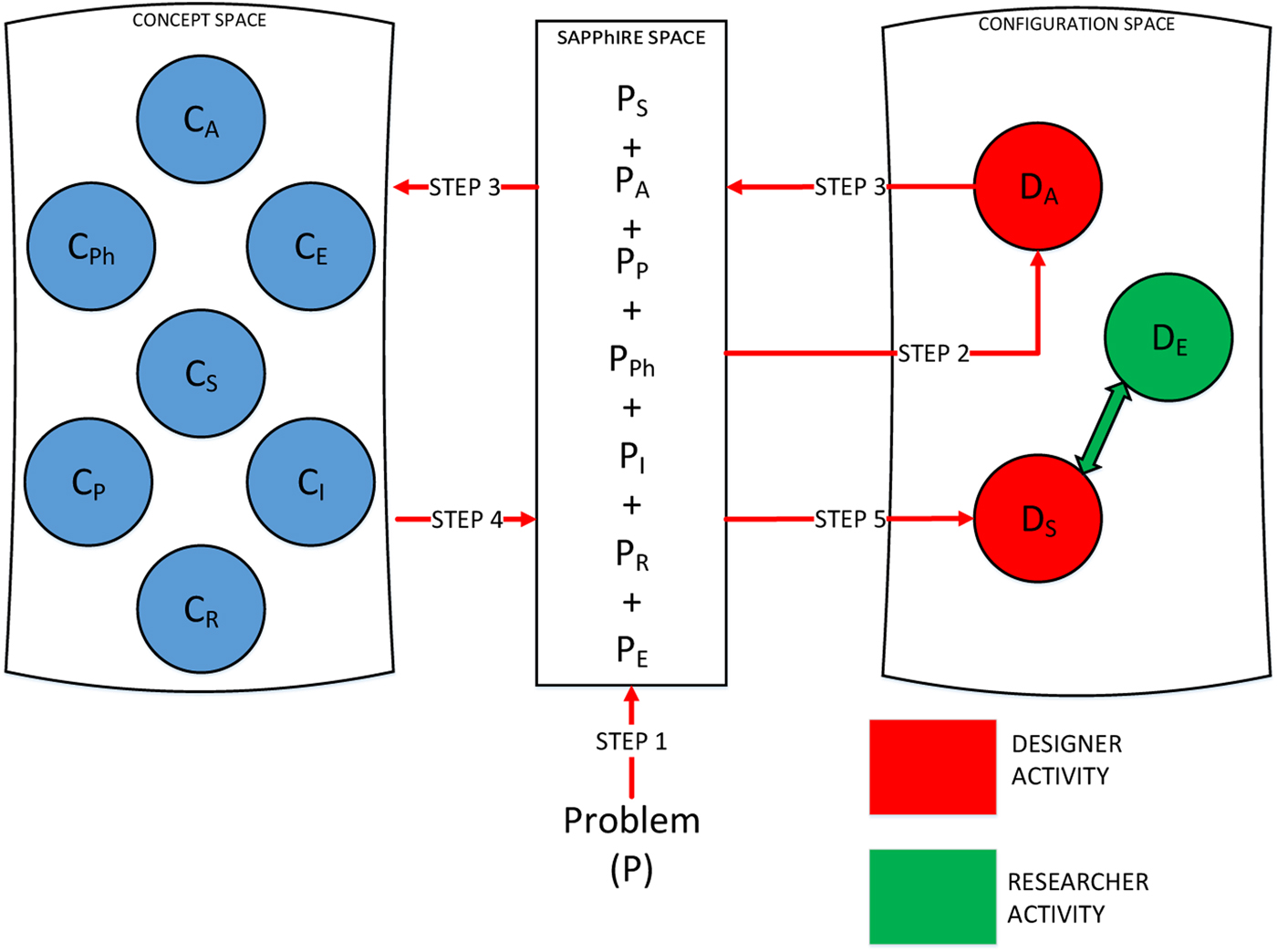
The analogical design process, proposed in this paper (see Fig. 5), combines the thought process model (Fig. 6) for design proposed by Jansson and Smith (Reference Jansson and Smith1991) with the steps for conceptual design proposed by Pahl and Beitz (Reference Pahl and Beitz2007); this is to provide a systematic structure to the analogical design process which primarily takes place in conceptual design. According to Jansson and Smith (Reference Jansson and Smith1991), the concept space (see Fig. 6) includes ideas, abstractions, and lowest level functions that could be directly used to build systems without simplifications. The configuration space, also shown in Figure 6, includes systems that are combinations of a number of concepts. For example, a bicycle is a configuration, which is a combination of many concepts including weight balance, rolling friction, lever rotation, static friction, etc. The abbreviation D is used to symbolize the (D) designs that belong to the configuration space which can be formed using (C) concepts. D A and D S are, respectively, the analogous system and solution to an engineering design problem.
The analogical design process developed using the thought process model (Fig. 6).

The thought process model of the design (Jansson and Smith, Reference Jansson and Smith1991).

Jansson and Smith (Reference Jansson and Smith1991, p. 4, Fig. 1) propose that the transfer of analogies from D A to D S requires the extraction of concepts from the concept space that form D A in the configuration space. For instance, a pick and place robot was designed by drawing inspiration from a chameleon's tongue to grab objects in a non-destructive manner (Engine, Reference Engine2015). Here, the concept of adhesiveness is where the source – analogue (tongue) and target – problem (pick) match. The process (D A→C; C→D S) shown in Figure 6 is further elaborated below (see Fig. 5).
Step 1: The problem (P) is cast into SAPPhIRE constructs (P S + P A + P P…) that correspond to the requirements at different levels of abstraction and could directly be used as search elements in Idea-Inspire 4.0. For instance, a need for pick and place robot (P) could be divided into functional requirements such as hold, pick, move – P A, change position – P S, using links – P P, etc.
Step 2: The requirements (P S + P A + P P…) are plugged in as search elements in Idea-Inspire 4.0 to find analogous systems (see “Searching analogous systems” section).
Step 3: The analogous system (D A), for example, the chameleon is studied carefully to find what it does (C A), what changes it goes through (C S and C E), what it is made of (C P), etc. The set of concepts (C S + C A + C P…) could be directly borrowed from the SAPPhIRE model.
Step 4: The analogous system (D A): for example, the chameleon is examined as to how it holds (P A) a prey (object), forming a map from P A to C A. This map is verified by an adhesive material (C P) used by chameleon to hold an object (P A). Likewise, the concepts (C S + C A + C P…) of an analogous system (D A) are evaluated against the requirements (P S + P A + P P…).
Step 5: For different requirements in P A: for example, hold, pick, move, it is necessary to identify separate analogous systems (D A) and combine their individual concepts (C S + C A + C P…) to develop the principle solution.
Among the steps above, 1 and 2 rely on problem decomposition and retrieval of analogies; steps 3–5 rely on the representation of analogous systems. The aim of this research is to evaluate the representation used in Idea-Inspire 4.0 against a conventional text-image representation as a benchmark. Hence, we ask the following research questions w.r.t., steps 3–5.
Research question 1 (R1): How well are the engineering designers able to extract concepts from a biological–analogous system?
Hypothesis 1 (H1 – analysis, extraction of concepts): An engineering designer would be able to extract the concepts from D A better using Idea-Inspire 4.0 than using a text-image explanation. The rationale behind this proposition is that since the concepts embedded in an analogous system (D A) are categorized into (C S + C A + C P…) and explicitly shown as SAPPhIRE models in Idea-Inspire 4.0 (Fig. 4), extracting concepts would be a simple task, compared with the case where these concepts must be manually identified in text-image representation.
Research question 2 (R2): How well are the engineering designers able to apply each concept to satisfy each requirement?
Hypothesis 2 (H2): The level of requirement-satisfaction for a principle solution (D S) would be higher using Idea-Inspire 4.0 analogue compared with that of using a text-image analogue. The argument behind this is the following. Since the SAPPhIRE models enable the extraction of concepts (C S + C A + C P…) from D A (according to H1), it also enables mapping these concepts to requirements (P S + P A + P P…) as the search algorithm in Idea-Inspire 4.0 matches the requirements and the analogous system only through SAPPhIRE models.
Research question 3 (R3): How well are the engineering designers able to combine the concepts to build a solution?
Hypothesis 3 (H3 – synthesis, combining concepts): Combining two different concepts is easier when they are extracted from Idea-Inspire 4.0 than using a text-image explanation. Combining two concepts (basic function) typically depends upon how well their input–output (I/O) relationship is defined (Pahl and Beitz, Reference Pahl and Beitz2007; Stone and Wood, Reference Stone and Wood2000). The explicitly defined relationship between States (outputs)  $\mathop \to \limits^{{\rm interpreted\;} \,{\rm a}s} $ Inputs (Chakrabarti et al., Reference Chakrabarti, Sarkar, Leelavathamma and Nataraju2005, p. 117), it is argued, would facilitate the combination of concepts better.
Research question 4 (R4): How novel is the solution produced in the analogical design process?
Hypothesis 4 (H4): The novelty of design solutions produced using Idea-Inspire analogue will be higher than those produced using text-image analogue. The rationale is as follows. Introducing a biological system as a support for an engineering design problem by in itself improves the chances of attaining a novel solution (Sarkar et al., Reference Sarkar, Phaneendra and Chakrabarti2008; Cheong et al., Reference Cheong, Hallihan and Shu2014), since far-domain (e.g., biology) analogies are more likely to be novel compared with near-domain (e.g., engineering) analogies (Keshwani and Chakrabarti, Reference Keshwani and Chakrabarti2016). However, the main challenge for engineering designers is to understand and utilize biological systems as stimuli. Since Idea-Inspire 4.0 helps in extracting concepts (H1) from D A, map them to requirements (H2), and efficiently combine them (H3), the solution (D S) will contain more concepts from D A. Therefore, the novelty of D S should be higher.
Controlled experiment on understanding
Testing approach
The hypothesis H1 refers to how well the concepts are extracted from an analogous system and H3 refers to how well these concepts are combined to build a solution. Hence, H1 and H3 point toward the “analysis” and “synthesis” levels of understanding (Anderson et al., Reference Anderson, Krathwohl and Bloom2001). In order to test these, we provided designers with a biological system using two modes of representation: mode 1 – text-image; mode 2 – Idea-Inspire 4.0 (Fig. 4). We asked them to perform the following tasks. Tasks 1 and 2 correspond to extraction (analysis) and combination (synthesis) of concepts, respectively.
Task 1: List the following as learnt from the given system
(a) Motion characteristics
(b) Net changes observed
(c) Laws governing
(d) Components involved
(e) Initiating factors
Task 2: Design an analogous system using the given system as stimulus.
Experimental design
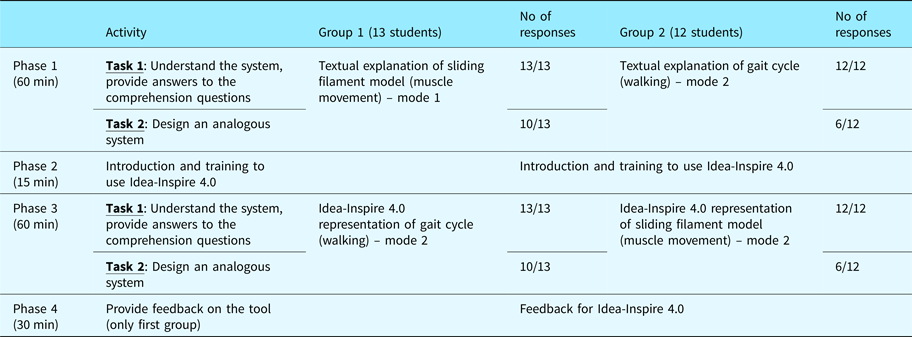
We invited 25 students enrolled in a design thinking course as a part of the Masters in Design (M. Des) program. All participants were enrolled at the same time; none had prior university-level knowledge in biology and hence represent our target audience; that is, engineering designers. For this experiment, it is necessary to provide a biological system using two modes: Idea-Inspire 4.0 and text-images. Providing the same biological system consecutively using two modes would lead to a learning influence, and hence, another system is required. Therefore, we used two systems each represented in two modes and designed a factorial experiment as shown in Table 1.
The design of a 2 × 2 factorial experiment

The biological systems were “sliding filament model” (muscle movement) and “gait cycle” (walking mechanism). An elementary-level textbook on biomechanics (Ethier and Simmons, Reference Ethier and Simmons2007) was used to model these systems. For mode 1, we provide the images and text similar to that of the textbook (Appendix I). Since they have a similar level of knowledge and experience, they were arbitrarily divided into two groups – 13 and 12 (Table 1).
Phase 1: The groups were given a text-image explanation – mode 1 of one system each. They were placed in the classroom where the course is taught.
Phase 2: A demo of Idea-Inspire 4.0 was given along with an introduction to the SAPPhIRE model. In addition, an example of the SAPPhIRE model was provided for the next phase.
Phase 3: The systems were interchanged and provided using Idea-Inspire 4.0 – mode 2 as links. They were placed in different rooms, similar to an online examination, in order to avoid interactions.
Phase 4: A feedback session was conducted on further improvement of the tool.
The participants were prohibited from using the internet since the experiment would be diluted. The access to Idea-Inspire 4.0 was provided using the web address to the local server, which can be reached using local networks. The experiment was carried out continuously for 2 h 45 min. The “tiredness” factor is not significant as the participants are used to long design exercises at the same time of their course.
Results
Extracting concepts from the system (testing H1 – analysis)
The biological systems are presented to the participants in two modes. Tasks 1a–1e involves extraction of concepts from these biological systems at different levels of abstractions. These concepts are readily available as SAPPhIRE models; for example, 1e – initiating factors relate to Inputs. However, using text-image explanation, it is necessary to carefully read through the text, understand, and deliver the responses for 1a–e. Using the information present in the SAPPhIRE models as a benchmark, the first author of this paper scored all the responses on a scale of 1–10.
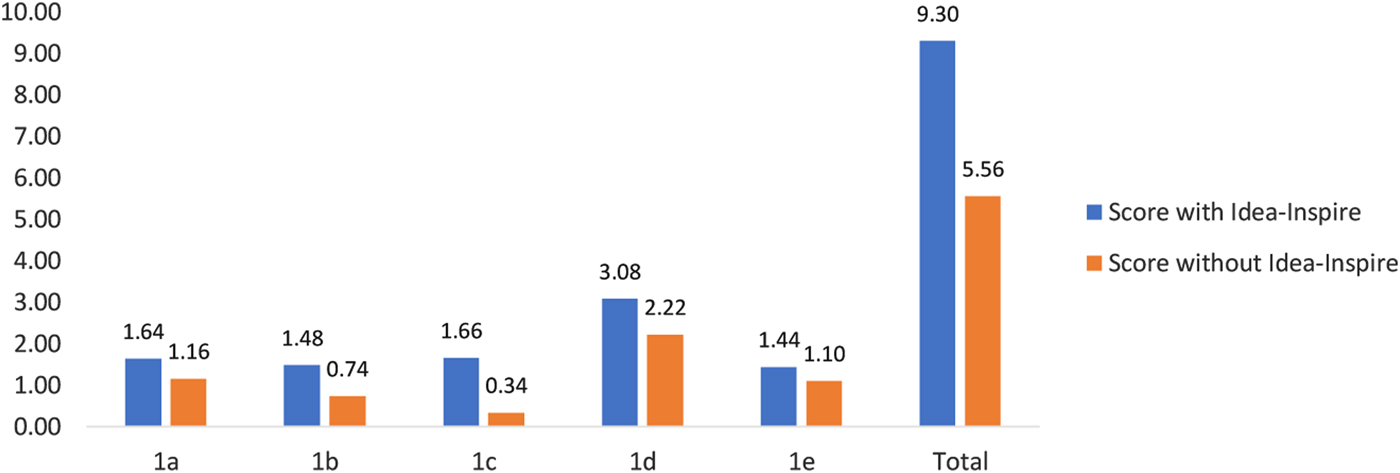
We received 25 responses each from phase 1 (text-image) and phase 2 (Idea-Inspire 4.0). For each task (1a–1e), each phase (1 or 2), the scores (1–10) were averaged across all 25 participants. In Figure 7, we compare these average scores between phases 1 and 2. On an average, Idea-Inspire 4.0 increased the score by 40.21%. According to the unpaired t-test, these results are statistically significant (n = 25, p-right-tailed <0.05, 95% confidence) and verifies the hypothesis H1. These results suggest that Idea-Inspire 4.0 improves the “analysis” level of understanding in comparison to text-image explanation.
Comparison of individual scores (tasks 1a–1e) and total scores for task 1 – experiment 1.

Using concepts to build another system (testing H3 – synthesis)
Task 2 involves building a new system using the concepts extracted from tasks 1a to 1e. The response for task 2 is a system D S built using concepts borrowed from an analogous system. Here, we measure the following: (1) number of concepts from D A; (2) percentage of a number of concepts in D S that are taken from D A. Let us see the systems (Fig. 8) built using “gait cycle”. First, a “channel cutter” (yacht) uses sand and dead weight on two ends of a fulcrum for weight balance. The fulcrum is analogous to “pelvis”; the oscillating weights are analogous to the movement of hip joints. Likewise, the similar concepts are identified and numbered.
An analogous system built using “gait cycle”.

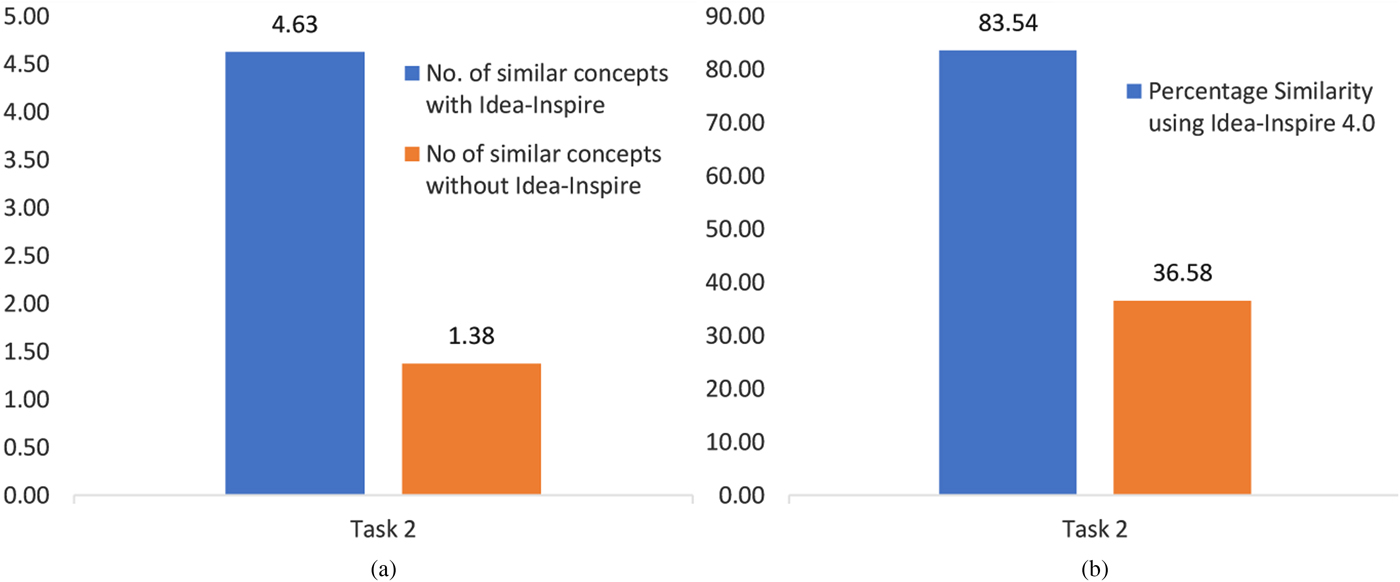
Only 16 participants responded for task 2 in both phases; others responded only in one phase or did not respond at all. We counted the number of concepts borrowed from the analogous system in these responses, averaged over 16 participants, and compared between phases 1 and 2 (Fig. 9a). The average number of concepts borrowed in phase 2 (=4.63) is 70% more than phase 1 (=1.38); verified H3 using unpaired t-test (n = 16, p-right-tailed <0.01, 99% confidence).
Comparison of (a) number of similar concepts and (b) similarity ratios for task 2 – experiment 1.

Let us consider two responses each with three and 12 concepts, respectively. Let us assume, out of these responses, two (67%) and four (33%) concepts were borrowed from the analogous system provided. The latter shows, even though more concepts were borrowed from the analogue, it is still underutilized and overshadowed by the prior knowledge. Therefore, in order to test the actual utility of the analogue, we also measure “similarity ratio” as a significant indicator of biological transfer in the synthesis process.
 $${\rm Similarity}\,{\rm ratio} = \displaystyle{{{\rm No\; }\,{\rm of}\,{\rm concepts\; }\,{\rm taken}\,{\rm from\; }\,D_{\rm A}} \over {{\rm Total}\,{\rm \; no}\,{\rm of}\,{\rm concepts}\,{\rm in}\,D_{\rm S}}}.$$
In Eq. (1) (also refer Fig. 5), we divide the number of concepts borrowed from the analogous system (D A) upon the total number of concepts in the response (D S). The similarity ratio (Fig. 9b) in phase 2 (Idea-Inspire 4.0) was found to be 83.54% as opposed to 36.58% in phase 1 (text-image), verified H3 using unpaired t-test (n = 16, p-right-tailed <0.01, 99% confidence). This result indicated a significant increase in the transfer of analogues when Idea-Inspire 4.0 is used (verified H3).
Controlled experiment on problem-solving
Testing approach
Recalling the steps explained in “Research questions” section, solving an engineering design problem (P) using an analogous system (D A) requires the following steps: (1) problem decomposition; (2) search for D A; (3) extracting concepts from D A; (4) mapping against requirements; (5) combine to form D S. The extent to which the extracted concepts are mapped against the requirements reflects how well the principle solution (D S) satisfies the problem (P). Hence, we measure the requirement-satisfaction of the D S. Additionally, we also measure the novelty of D S as novelty is another major indicator of creativity.
Experiment design
We divided 12 designers into two groups, six in each. Each group had two bachelors-level, two master's-level, and two doctoral-level students in design. Both groups were given a problem statement – “Design a surveillance…” (see “Searching analogous systems” section). We gave the example shown in “Representing analogous systems” section – “climbing of a mudskipper” as an analogue for both the groups, but in two different modes of representation: (1) text-image as a print out (Appendix II); (2) Idea-Inspire 4.0 using a laboratory computer (Fig. 4). This system was chosen because it was the top-most result (most relevant) in Idea-Inspire 4.0 search method (Fig. 3). The subjects were placed in a controlled laboratory environment where no internet was provided and no time limit was imposed.
Results
The responses (Fig. 10) were evaluated for requirement-satisfaction and novelty.
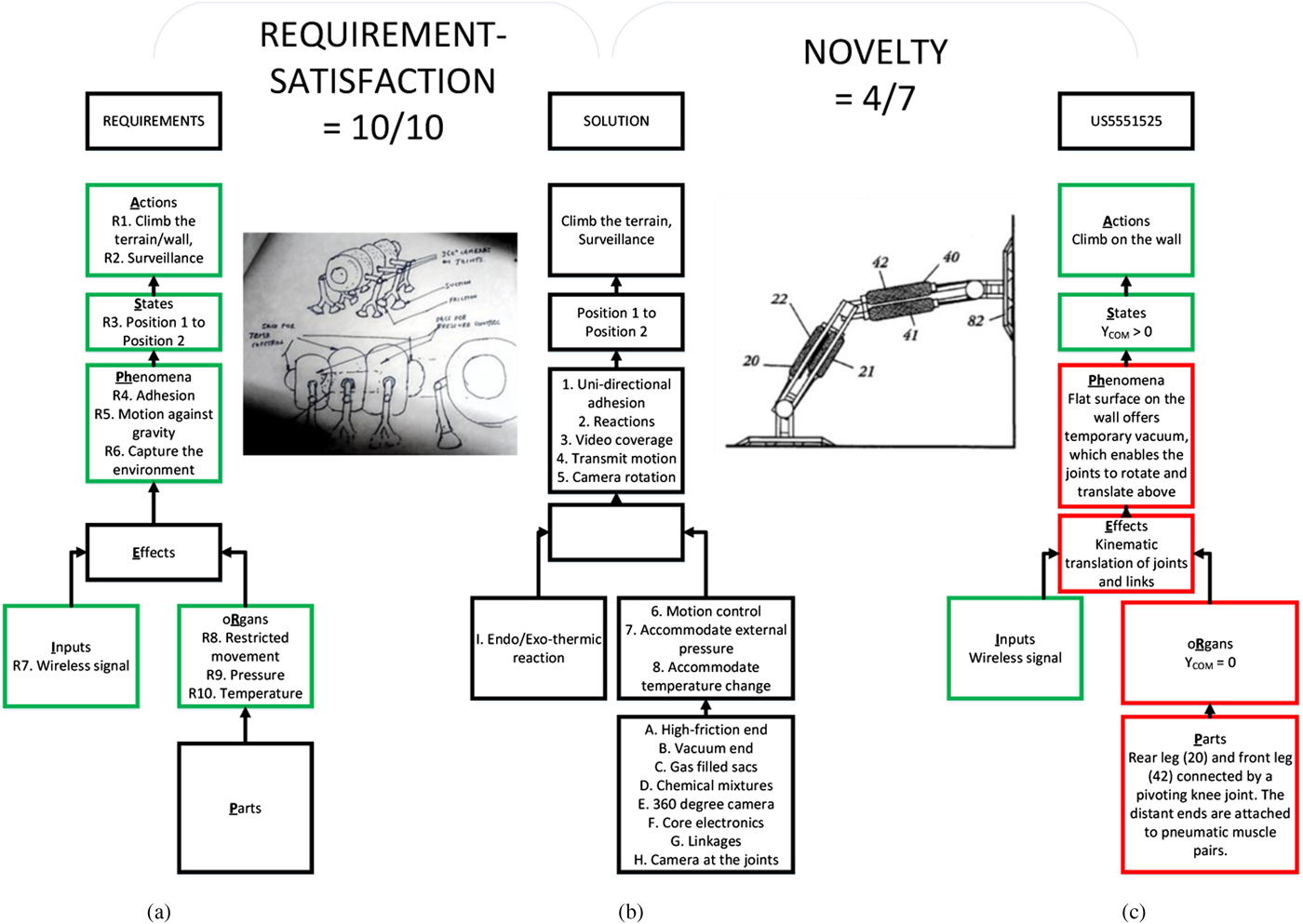
1. First, we cast the problem (P) into a SAPPhIRE model (see Fig. 11) that are different search elements used in Idea-Inspire 4.0 (see “Searching analogous systems” section). They are also the requirements extracted from the problem.
2. Second, we model the principle solution (D S) using SAPPhIRE, so that P and the D S could be compared with the measure requirement-satisfaction (Fig. 11).
3. Third, we model several existing systems (D E) into SAPPhIRE (one is shown in Fig. 11) so that D S and D E could be compared (see Fig. 5) with the measure novelty (Fig. 11).
Sample responses for the problem-solving experiment.

Comparing (a) requirements (P), (b) solution (D S), (c) existing solution (D E).

How well the solution “satisfied” the problem (testing H2)
For evaluating the requirement-satisfaction, we compare the problem and a solution in SAPPhIRE space (Fig. 11). We received a total of 12 solutions (D S) out of which, six were developed using Idea-Inspire 4.0 analogue and the rest using text-image analogue. All of these solutions were cast into the SAPPhIRE model as shown in Figure 11b. The SAPPhIRE model for the problem (P) as shown in Figure 11a is the same for all comparisons. While comparing, we match the corresponding SAPPhIRE constructs of P and D S.
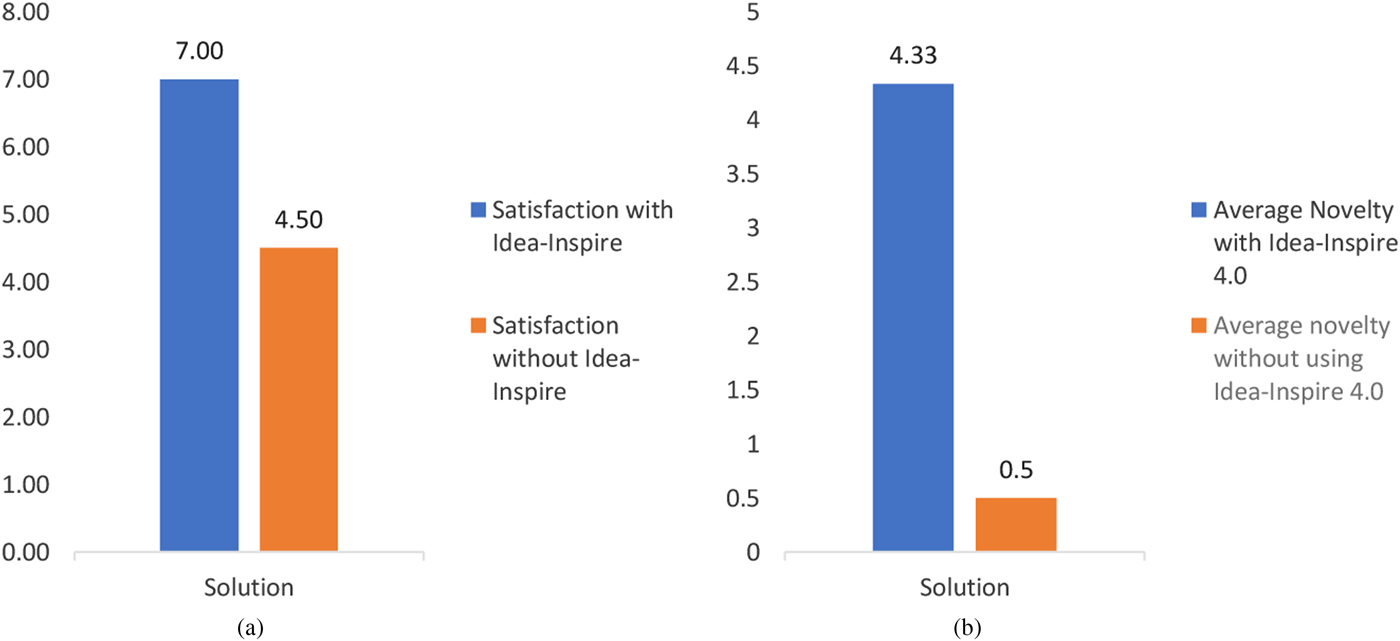
There are ten requirements present in different constructs, each carrying an arbitrarily assigned value of 1. The comparison shown in Figure 11 corresponds to the solution shown in Figure 10f. According to Figure 12a, the average satisfaction for Idea-Inspire 4.0 group is 7.0 as opposed to 4.5 for the text-image group. This difference is significant w.r.t., Mann–Whitney U test (U = 3, p < 0.05, 95% confidence), which is used for low data points (n = 6). Additionally, we also checked the significance using unpaired t-test (n = 6, p < 0.05, 95% confidence).
Comparing average (a) satisfaction and (b) novelty for solutions.

How “novel” the solutions were (testing H4)
There are several methods for measuring novelty. First of all, a novel solution to a problem is “new” or “original” w.r.t., to a person or a set of existing solutions. Broadly, there are two kinds of novelty: “personal” novelty and “historic” novelty (Boden, Reference Boden1998). In personal novelty, the solution is compared only with the ideas generated within the group or a design session (Shah et al., Reference Shah, Smith and Vargas-Hernandez2003), to find how “unusual” the solution is. Sarkar and Chakrabarti (Reference Sarkar and Chakrabarti2011) argue that this approach does not necessarily represent historical novelty since a solution being “new” within a group does not necessarily mean it is historically new. Sarkar and Chakrabarti (Reference Sarkar and Chakrabarti2011) proposed a “historic” novelty assessment method that requires the following.
1. A collection of existing systems (D E – Fig. 5) that could solve the problem (P).
2. The SAPPhIRE models of each system (D E) collected.
3. The SAPPhIRE model of each solution (D S).
To collect these systems, we gave the problem statement (P – same as the one in “Searching analogous systems” section) as a Google form to four PhD students in engineering design; asked them to search for existing patents in https://patents.google.com/ and provide a minimum of five results. Out of these four, two had no industrial design experience and two had 5 years of experience. Each person took 10 min to identify a total of 21 patents. Interestingly, there was no overlap among the patents identified; this justified the use of multiple people, who used a different set of keywords to search and had a different perspective on the problem, to enable greater comprehensiveness in the search for existing solutions.
The comparison between a solution (s) and a patent (p) is carried out as shown in Figure 11, where a solution shown in Figure 10f is compared with US5551525 (Pack et al., Reference Pack, Iskarous and Kawamura1996). The comparison of a single s–p pair starts at the Actions level, then States, Inputs…Parts. At the Actions level, both the solution and the patent perform the same operation: that is, climbing. Similarly, both change their positions at the States level. The difference is seen at the Phenomena level, where solution (s) uses adhesion while the patent (p) uses vacuum effect to hold onto the wall surface.
We stop at the abstraction level at which the difference is observed first and assign the score according to Eq. 2(a). The difference in Actions level carries the highest novelty value of 7 and carries the least at Parts level value of 1. If the solution and patent are found similar at all levels, a score = 0 is given. Here, there is no objective way of saying what is different and what is similar, as two sentences are unlikely to be exactly the same or different; Sarkar and Chakrabarti (Reference Sarkar and Chakrabarti2011) do not hint about this.
The above similarities and differences were manually assessed. For instance, the States-level comparison between {position change} and {Y CoM>0} was found to be similar because Y CoM denotes the “position” of center of mass (CoM). A person with no background in coordinate geometry or kinematics would say that these two are different. Therefore, the assessment requires, expectedly, people with the appropriate background to make these interpretations. So is the novelty assessment literature, which requires substantial improvement; more issues are discussed in “Issues with novelty measurement” section.
 $${\rm Novelty}\,{\rm of}\,{\rm a}\,{\rm single}\,s{\rm - }p{\rm \; }\,{\rm pair} = \left\{ {\matrix{ {0\; \; \; \; \; \; \; \; \; \; \; \; \; \;} \cr {1\; \; \; \; \; \; \; \; \; \; \; \; \; \; } \cr {2\; \; \; \; \; \; \; \; \; \; \; \; \; \; } \cr {3\; \; \; \; \; \; \; \; \; \; \; \; \; \; } \cr {4\; \; \; \; \; \; \; \; \; \; \; \; \; \; } \cr {5\; \; \; \; \; \; \; \; \; \; \; \; \; \; } \cr {6\; \; \; \; \; \; \; \; \; \; \; \; \; \; } \cr {7\; \; \; \; \; \; \; \; \; \; \; \; \; } \cr } \left\vert {\matrix{ {{\rm No}\,{\rm different}} \cr {{\bf P}{\rm arts\; }\,{\rm level}} \cr {{\rm o}{\bf R}{\rm gans\; }\,{\rm level}} \cr {{\bf E}{\rm ffects}\,{\rm level}} \cr {{\bf Ph}{\rm enomena\; }\,{\rm level}} \cr {{\bf I}{\rm nputs}\,{\rm level}} \cr {{\bf S}{\rm tates}\,{\rm level}} \cr {{\bf A} {\rm ctions}\,{\rm level}} \cr } } \right.} \right\},$$
Average novelty of a group
 $$= {{\mathop \sum \nolimits_{i = 1}^M {\rm Min}\left\{ {N\left( {s_ip_1} \right),\; N\left( {s_ip_2} \right),N\left( {s_ip_3} \right) \ldots N\left( {s_ip_M} \right)} \right\}} \over M}\; .$$
The average novelty of a group of participants is calculated using Eq. 2(b), where N denotes the novelty of a single solution–patent (s − p) pair and M denotes the size of the group. In the analysis, we compare two sets: solutions {s 1, s 2… s N=6} and patents{p 1, p 2… p N=21}. We find the minimum (Min) of these scores across all patents (p 1≤i≤21) to find the novelty of a solution ( $s_{i = i_1}$). In order to obtain the novelty of a group (M) of size M = 6 solutions, we add these minima and divide by the size of the group [Eq. 2(b)].
According to Figure 12b, the average novelty of the Idea-Inspire 4.0 group (=4.33) is significantly higher than the text-image group (=0.5). These results are significant according to the unpaired t-test with 99% confidence (p-value = 0.000683<0.01). In addition, we verified these differences using Mann–Whitney U test, which showed that U-value is 1.5 (<5) and the results are significant at p = 0.01046 (<0.05) with 95% confidence (tested H4).
Addressing the research questions
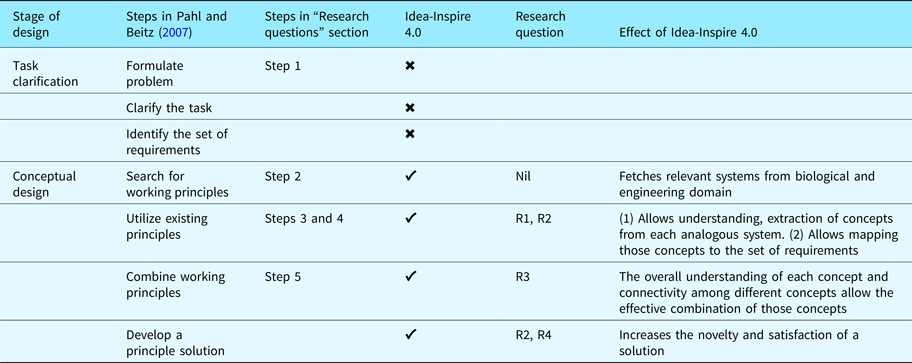
Table 2 is used to show the specific points of alignment between the proposed model for analogical design (Fig. 5, Section Research questions) and the conceptual design steps of Pahl and Beitz; the table also shows where Idea-Inspire 4.0 is used to support the steps. The research questions, formulated in “Research questions” section, primarily ask the effect of Idea-Inspire 4.0 on some of these steps (see Table 2). The experimental results have provided the corresponding answers to these questions, as discussed below.
Pahl and Beitz design model and inclusion of Idea-Inspire 4.0 at different steps

How well are the engineering designers able to extract concepts from a biological–analogous system?
This was tested in “Experimental design” section by asking the designers to provide answers for tasks 1a–1e. The scores obtained for Idea-Inspire 4.0 were 40.21% better than those for the text-image group. The difference between the two modes of representation is the following: decomposition model, video, audio, and SAPPhIRE model. The first three elements only provide the overview of the system. However, as mentioned in “Results” section, the SAPPhIRE model provides these concepts that can be readily used for answering tasks 1a–1e. Hence, SAPPhIRE model could have been the potential reason for the increase in scores. Besides, these results support Helms et al. (Reference Helms, Vattam, Goel and Yen2011), who preferred a combination of different modes of representation.
How well are the engineering designers able to apply each concept to satisfy each requirement?
The solutions (Fig. 10) presented for the problem in “Experiment design” section suggest that Idea-Inspire 4.0 group had 35.7% more satisfaction than that of the text-image group. Using the search method in Idea-Inspire 4.0 indirectly forces the designer to extract requirements from the problem. The presence of SAPPhIRE model helps the designer to map these requirements to the analogous system since the search algorithm finds a match only based on the SAPPhIRE constructs. For instance, Figure 10f, a solution developed using Idea-Inspire 4.0 analogues, uses sacs with chemical substances for temperature control and others with expansion mechanism for pressure control. These requirements were specified in the problem statement, but it seems only Idea-Inspire 4.0 group used them effectively. The text-image group, on the other hand, neither got a chance to enlist the requirements nor to verify them using analogous systems. Besides, these results support the observations of Gonçalves et al. (Reference Gonçalves, Cardoso and Badke-Schaub2016, Reference Gonçalves, Cardoso and Badke-Schaub2012), which emphasize the need for problem definition in analogical design.
How well are the engineering designers able to combine the concepts to build a solution?
This was tested by asking the designers to build a new system using the concepts taken from a given biological system (task 2 – “Experimental design” section). It was observed that using Idea-Inspire 4.0, around 70% more concepts with 83.5% similarity ratio were drawn from the given system to build another system. Combining concepts require the knowledge of inputs and outputs that are present in Idea-Inspire 4.0 as a decomposition model. The connections in this model are described using States and Inputs of the SAPPhIRE model. Such information is absent in the text-image group, which allows inferring that the presence of function models improves the synthesis of new systems.
How novel is the solution produced in the analogical design process?
The solutions (Fig. 10) to the problem in “Experiment design” section were examined for novelty using Sarkar and Chakrabarti (Reference Sarkar and Chakrabarti2011). The novelty in the Idea-Inspire 4.0 group was 88.45% more than the text-image group. Figure 10 indicates that the solutions from the Idea-Inspire 4.0 group were novel at least at the Phenomena level. The solutions in Figure 10b,d,f were produced using Idea-Inspire 4.0 analogues. Figure 10b combines propeller and suction-cup mechanism that is novel at the States level (=6). Earlier studies have already shown that biological analogues always improve the novelty. However, the utility of such analogues was the challenge. By testing H1 (extraction) and H3 (combination) in this research, we have already shown that Idea-Inspire 4.0 improves the utility of analogous systems.
For instance, Figure 10f uses an aerofoil whose weight balance is achieved by altering the weights in fluid bags. This example shows how well the designers have used the concepts in “climbing of a mudskipper” and developed a solution using engineering technologies. Whereas, the text-image group merely produced designs out of the prior knowledge (also verifies H3), which were less novel. For instance, the text-image group (Figs. 10a,c,e) has simply replicated a vehicle design (prior knowledge), which amounts to a maximum of Parts-level novelty = 1. Moreover, the utility of the biological analogue – “climbing of a mudskipper” was also poor, as seen in the solutions.
The overall inference of these experimental observations is that providing a biological analogues is not enough; it must be represented appropriately so that it is understood and utilized to an extent where engineering designers are able to extract the concepts (H1), mapping them to the requirements (H2), combine them well to build a solution, which includes more biological concepts (H3). If so, the solution built would certainly be more novel (H4), since it has more biological concepts. Our study also verifies the conclusions of Helms et al. (Reference Helms, Vattam, Goel and Yen2011), who preferred a combination of all modes: that is, such as images, videos, audios, generalized text, and function models for an effective utilization of biological analogues.
Discussion, summary, and conclusions
Support for understanding
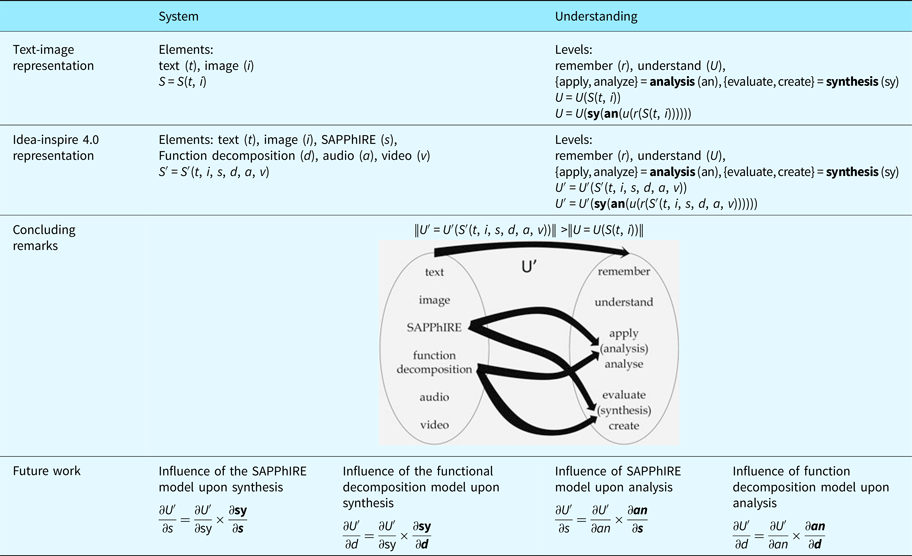
The experimental results suggest that understanding a system is necessary for its application in design problems. Specifically, our study shows that increasing the modes of explanation improves the level of understanding. This allows inferring that the level of understanding is proportional to the information offered, which in turn is dependent on different modes of explanation. We formulate this broad finding using mathematical expressions in Table 3 that clearly indicate different modes explanation that impacts different levels of understanding.
Summary of the experimental results on understanding

Table 3 introduces two functions U – understanding and s – system. We propose that understanding of a system U(S) is dependent on the information available. If information is available as a text (t) and an image (i), understanding could be represented as U(S(t, i)). Idea-Inspire 4.0 uses four other elements: SAPPhIRE (s), decomposition (d), audio (a), video (v) add up to the detail of representing a system (S′); as a consequence, understanding becomes U′(S′(t, i, s, d, a, v)). Our broad finding of this research is that U′ >U.
According to Bloom's Taxonomy (Anderson et al., Reference Anderson, Krathwohl and Bloom2001), there are multiple levels of understanding: remember (r), understand (U), analysis (an), and synthesis (sy). We propose that understanding U is a nested function U(sy(an(u(r(S))))) – of all these levels. We designed the tasks 1 and 2 in the experiment on understanding (“Testing approach” section) such that we test analysis (an) and synthesis (sy) levels, respectively. Our broad finding U′>U does not account for “which element” influenced “which level” of understanding. These individual relations, denoted by partial derivatives ((∂sy)/(∂s), ((∂sy)/(∂d)), ((∂an)/(∂s)), ((∂an)/(∂d)) are yet to be found; by putting this forward, we expect that it would help future researchers set objectives for their analogical design and cognitive studies.
Requirements of Yargin and Crilly
Yargin and Crilly (Reference Yargin and Crilly2015) proposed some requirements that an analogical design tool must support; it is worthwhile checking these for Idea-Inspire 4.0. They are broadly classified as “information content” and “interactive capabilities”. We only consider the former, since the latter requires interaction tests to be conducted. Regarding information, there are six sub-requirements: abstraction, exemplification, mode of representation, open-endedness, concision, and multiplicity (Reference Yargin and Crilly2015, pp. 205, 206).
According to them, abstraction could be achieved by the inclusion of function models like SAPPhIRE. In order to exemplify the design process, examples of analogical transfer must be provided, which we do not. We clearly use multiple modes of representation in which, functional decomposition model, video, and audio provide open-ended explanations; however, textual explanation and SAPPhIRE model are meant to be concise since they provide a breadth for an explanation. As mentioned earlier, Idea-Inspire 4.0 has 143 systems (60 biological + 83 engineered) that provide some diversity (multiplicity) in the content.
Issues with novelty measurement
The experimental results reported in “How ‘novel’ the solutions were (testing H4)” section rely upon a novelty measure proposed by Sarkar and Chakrabarti (Reference Sarkar and Chakrabarti2011), which seems to be currently the only empirically validated measure proposed in the literature. However, there are a number of practical difficulties in implementing this method. First, 21 patents do not necessarily represent the entire product space and no approach is currently available that could potentially guide as to how we can gather the entire product space; this issue, incidentally was mentioned by Sarkar and Chakrabarti (Reference Sarkar and Chakrabarti2011). Second, for comparing 21 patents and 12 solutions, the effort involved in making the associated SAPPhIRE models are unlikely to scale for larger cases. The third issue is that, there are some cases in which, (1) the solution is a sub-system in a patent, and (2) sub-systems present in different patents are combined to make a solution, for example, a speaker and a monitor are not novel individually, but a speaker embedded in a monitor could be novel. These are potential areas of improvement for novelty assessment methods for their scalability of application in both academic and industrial cases.
Scope of improvement
The foremost limitation of this research is the number of participants in the experiment. The second limitation is that while designers seemed to struggle to identify appropriate stimuli, for their problems, this is not currently supported by the search method in Idea-Inspire 4.0. This, interestingly, is a common issue with most searchable knowledge bases such as Wikipedia, Ask Nature, etc. The issue takes particular importance in the fact that problem-finding and problem-solving are coupled since only with multiple search iterations and analyses of search results, problems become concrete (Chakrabarti, Reference Chakrabarti2005). The third issue is that the effort in developing Idea-Inspire 4.0 database is time-consuming and slow. Keshwani and Chakrabarti (Reference Keshwani and Chakrabarti2017) have initiated their efforts in developing an approach for automated population of the Idea-Inspire 4.0 database.
In spite of these limitations, this experimental study has provided a number of indications that Idea-Inspire 4.0 could significantly improve the analogical transfer of concepts from the biological domain to engineering domains. More importantly, it supports the enhancement of the understanding of a biological system so that information on the system is better utilized in the design process. In view of actual impact in industry and society, being able to increase the size of the database significantly would allow Idea-Inspire 4.0 to overcome a number of limitations that current knowledge bases have and be better suited for both academic and industrial applications, and possibly better support future education.
Acknowledgements
The authors thank the Master in Design 2015–2017 batch of the Centre for Product Design and Manufacturing, Indian Institute of Science for participating in the first round of the study. The authors also thank 12 participants who took part in the second round of the study. The authors also thank the four participants who fetched patents for assessment for novelty in the second round of the study. The authors also thank Prof Nathan Crilly for sharing fruitful points that were useful for their studies. The authors thank Ms Neha Palegar and Ms Madhuri Dinakar for their help in modeling biological systems for our experimental study.
Gait cycle – a physical analysis of walking
Walking is the most vital activity for any person; it is the most convenient way to travel short distances. The style and pace of walking differ from person to person. In general, walking is governed by a set of laws when the body is considered as a physical system. The bipedal gait cycle starts when one foot makes contact with the ground while the other foot is about to leave the ground. The cycle is recorded as a sequence of postures until the initial posture is repeated. The gait cycle consists of a swing phase and a stance phase, which combined in action accomplish the three requirements of walking: balance, weight bearing, and forward propulsion. As shown in Figure A1, the stance phase for the right foot (the leg with dashed lines) begins when the heel strikes the ground at an inclination from the ground. Simultaneously, the left foot tends to leave the ground. At mid-stance posture, the right foot completely rests on the ground. Until the mid-stance, the body is in the same position. However, during the transition from mid-stance to toe off, the forward propulsion of the body is observed as the left foot is swung forward. The left foot strikes the ground as the right foot is about to leave the ground. Gradually, the stance phase for the right foot ends as the left toe leaves the ground. During the swing phase, the toe leaves the ground from rest and comes to rest again when the heel strikes the ground. (continued…)
The sequential postures recorded during the gait cycle.

Appendix II
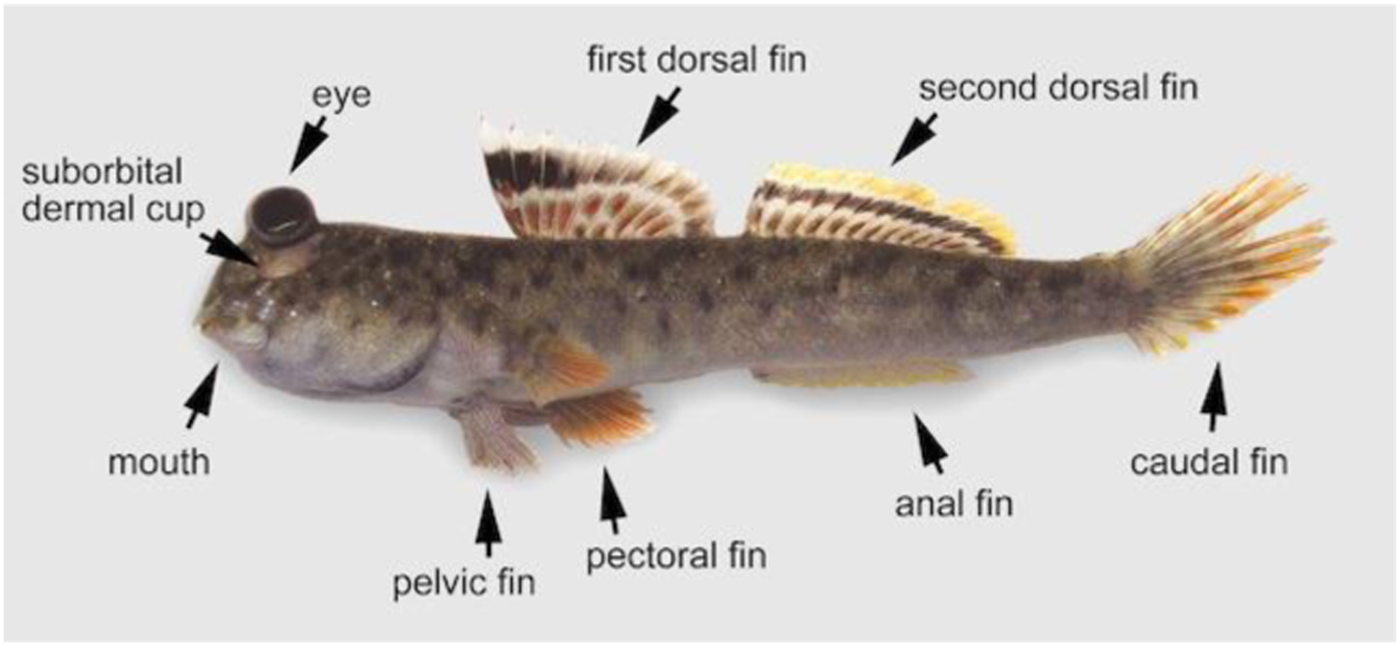
Mudskippers (Fig. A2) are amphibious fishes. They belong to the sub-family Oxudercinae and family Gobidae. Mudskippers being complete amphibious fishes have developed a unique set of adaptations that allow them to survive out of the water. Mudskippers display four kinds of motion – crutching, skimming, skipping, and climbing. Crutching locomotion is a slow movement observed on land wherein the pectorals are used as crutches. The pectorals are stretched forward and then downward to hit the ground. At the end of the pectoral stroke, the weight of the fish is transferred to the fused pelvis. These fins lift the fish's body off the ground and wing forward. Skipping is a mode of locomotion wherein a propulsive force is generated by the tail, which is initially bent to one side and then a quick straightening with the stiff ventral caudal rays pressing against the surface. Meanwhile, the fused pelvic fins raise the head off the ground. (continued…)
Labeled diagram of a mudskipper.

L Siddharth is a researcher at the Centre for Product Design and Manufacturing, Indian Institute of Science. He was awarded Bachelor of Technology (B. Tech) Degree in Mechanical Engineering from the Indian Institute of Technology Ropar. He leads several projects that span over broad research areas such as engineering changes, failure analysis, function modeling, systems theory, novelty assessment, behavioral modeling of manufacturing systems, LCA, etc. He has been the sole researcher and end-to-end developer of three design support tools: Idea-Inspire 4.0 (analogical design), CRIS4P (knowledge base of past failures), and Vatram (change propagation).
Amaresh Chakrabarti is a Senior Professor and current Chairman for the Centre for Product Design and Manufacturing, Indian Institute of Science (IISc), Bangalore. He has BE (Mechanical Engineering, IIEST Shibpur), ME (Mechanical Design, IISc), and PhD (Engineering Design, University of Cambridge, UK). He led for 10 years the Design Synthesis group at the EPSRC CoE Engg Design Centre at the University of Cambridge. His interests are in synthesis, creativity, sustainability, and informatics. He published 13 books, over 290 peer-reviewed articles, and has ten patents granted/pending. He co-authored DRM, a methodology used widely as a framework for design research.