Clinical Implications
• Dysfunction of the dopamine system is thought play an important role in the development and pathophysiology of schizophrenia and bipolar mania.
• All clinically effective antipsychotics are known to act on the dopaminergic system and induce region-specific changes in dopamine receptor levels.
• Cariprazine, a potent dopamine D3 and D2 receptor partial agonist with preferential binding for the D3 receptor, was evaluated for its long-term effects on dopamine receptor levels in rat forebrain regions.
• Similar to other atypical antipsychotics, cariprazine upregulated dopamine D2 and D4 receptor levels, but unlike other atypical antipsychotics, cariprazine also upregulated dopamine D3 receptor levels.
• Cariprazine showed unique effects on dopamine receptor levels that may provide improved clinical benefits in the treatment of schizophrenia and bipolar mania.
Introduction
Dysregulation of dopaminergic neurotransmission plays a central role in the etiology and pathophysiology of both schizophrenia and bipolar mania.Reference Baldessarini and Tarazi1, Reference Beaulieu and Gainetdinov2 There are several dopamine (DA) receptor subtypes (D1–D5) that are differentially expressed in various brain regions, and current evidence suggests that each subtype may modulate various physiological functions, including cognitive and executive functions, locomotor activity, mood, and reward behaviors.Reference Beaulieu and Gainetdinov2, Reference Baldessarini and Tarazi3 Although blockade of D2 receptors is a common property of clinically effective typical and atypical antipsychotics, most antipsychotics, and especially the atypical agents, also show various levels of affinity for other receptors, both dopaminergic and non-dopaminergic. The receptor signature of each antipsychotic drug contributes to its efficacy, safety, and tolerability.Reference Caccia4, Reference Mailman and Murthy5
The pharmacological, molecular, and behavioral profiles of atypical antipsychotic drugs have been extensively studied.Reference Arnt and Skarsfeldt6–Reference Waddington and Casey8 Prolonged treatment with atypical antipsychotics produces region-specific and dose-dependent changes in the levels of various DA receptor subtypes,Reference Tarazi, Moran-Gates, Wong, Henry and Shahid9, Reference Tarazi, Zhang and Baldessarini10 as well as other neurotransmitter receptors, including serotonin and glutamate.Reference Tarazi, Baldessarini, Kula and Zhang11–Reference Tarazi, Zhang and Baldessarini15 Such changes may trigger a cascade of intracellular events that ultimately lead to the therapeutic effects or adverse events associated with antipsychotic drug treatment.Reference Lieberman, Bymaster and Meltzer16
Cariprazine is an orally active and potent dopamine D3 and D2 receptor partial agonist, with preferential binding for the D3 receptorReference Kiss, Horváth and Némethy17; it is currently in development for the treatment of schizophrenia, bipolar mania, and bipolar depression, and as adjunctive treatment to antidepressant drugs for major depressive disorders. Clinical trials showed that in patients with acute schizophrenia, cariprazine treatment (1.5–4.5 mg/day) was associated with significantly greater improvement compared with placebo on the Positive and Negative Syndrome Scale (PANSS) total score.Reference Bose, Li and Migliore18, Reference Citrome19 In bipolar mania trials, significant improvement over placebo on the Young Mania Rating Scale (YMRS) total score was observed for cariprazine 3–12 mg/day.Reference Citrome20–Reference Starace, Bose and Wang22 In addition, the drug had a favorable safety profile, with minimal metabolic, hormonal, and cardiovascular adverse events.Reference Citrome19, Reference Citrome20, Reference Cutler, Bose and Durgam23
The pharmacological profile of cariprazine appears to be distinct from other atypical antipsychotic agents. It shows higher in vitro affinity at D3 receptors and greater selectivity for D3 versus D2 receptors compared with other atypical antipsychotics. Cariprazine shows almost 10-fold higher in vitro affinity for the D3 versus D2 receptor. In vivo, it exhibits balanced occupancy of the D3 and D2 receptors at antipsychotic-like effective dosesReference Gyertyán, Kiss and Sághy24, Reference Kiss, Horti and Bobok25; conversely, other atypical antipsychotics display high D2 occupancy and relatively low occupancy at D3 receptors in vivo.Reference Kiss, Horti and Bobok25 Additionally, cariprazine is metabolized by CYP3A4 (and to a lesser extent by CYP2D6) into 2 major metabolites, dimethyl cariprazine and didesmethyl cariprazine,Reference Kirschner, Gémesi and Vastag26 which show similar receptor affinity profiles and pharmacological activity as the parent drug (data on file). Accumulating evidence suggests that the D3 receptor is involved in regulating cognitive functions and mood behaviors,Reference Beaulieu and Gainetdinov2, Reference Gross and Drescher27–Reference Laszy, Laszlovszky and Gyertyán29 and cariprazine's balanced engagement of both the D3 and D2 receptor pathways may potentially translate into improved clinical benefits that are typically not observed with other antipsychotics, including improvements in executive and cognitive deficits, negative symptoms, and mood disturbances in patients with psychiatric disorders.Reference Salimi, Jarskog and Lieberman30
The long-term effects of cariprazine on DA receptor subtypes in the mammalian forebrain remains to be evaluated. In this study, we applied quantitative in vitro receptor autoradiography to assess the long-term effects of cariprazine on D1, D2, D3, and D4 receptors in the rat brain and compared the findings with previously reported effects of representative typical (fluphenazine) and atypical (olanzapine, risperidone, and asenapine) antipsychotic drugs.Reference Tarazi, Zhang and Baldessarini10 Our working hypothesis was that cariprazine would induce regionally selective changes in specific DA receptor levels that would more closely resemble the profile of atypical than typical antipsychotics.
Methods
Materials
The radiochemicals [3H]R(+)-7-chloro-8-hydroxy-3-methyl-1-phenyl-2,3,4,5-tetrahydro-1H-3-benzazepine (SCH-23390, 81 Ci/mmol) and R,S(±)-[N-methyl-3H]nemonapride (86 Ci/mmol) were obtained from New England Nuclear–PerkinElmer Inc. (Boston, MA, USA). Tritium autoradiography standards and [2,3-3H]R(+)-7-hydroxy-N,N-di-n-propyl-2-amino-1,2,3,4-tetrahydronaphthalene (7-OH-DPAT; 116 Ci/mmol) were obtained from Amersham (Arlington Heights, IL, USA). [3H]-(+)-4-propyl-9-hydroxynaphthoxazine (PHNO; 64 Ci/mmol) was obtained from Moravek Biochemicals (Brea, CA, USA). Kodak Biomax MR film was purchased from Thermo Fisher Scientific (Waltham, MA, USA). D-19 photographic developer and fixative were obtained from Eastman-Kodak (Rochester, NY, USA).
Cariprazine was donated by Forest Laboratories Inc. (New York, NY, USA). 1,3-Ditolylguanidine (DTG), cis-flupenthixol-di-HCl, cis-eticlopride-HCl, ketanserin tartrate, pindolol, and S(–)-sulpiride were obtained from Sigma–Research Biochemicals International (Natick, MA, USA). Cation hydrochlorides, guanosine-5′-triphosphate sodium (GTP), and tris-(hydroxymethyl)-aminomethane-HCl (Tris) were obtained from Sigma Chemicals (St. Louis, MO, USA).
Animals
Male Sprague-Dawley rats (Charles River Laboratories, Wilmington, MA, USA), initially weighing 200–225 g, were maintained under controlled artificial daylight (7:00 am–7:00 pm), temperature, and humidity, with free access to standard food and tap water in a U.S. Department of Agriculture (USDA)-inspected, veterinarian-supervised, small-animal research facility of the Mailman Research Center, with approval by the Institutional Animal Care and Use Committee (IACUC) of McLean Hospital.
Treatment and tissue preparation
For 28 days, 4 groups of rats (8–10 animals per group) received a daily intraperitoneal (IP) injection of vehicle control (saline, 1 ml/kg) or active treatment (cariprazine at doses of 0.06, 0.20, or 0.60 mg/kg). The selected doses were active in different behavioral paradigms.Reference Gyertyán, Kiss and Sághy24 No gross effects on motor behaviors or significant changes in body weight were observed after repeated treatment with the different doses of cariprazine compared with vehicle-treated animals.
At the end of the treatment period, rats were decapitated, and their brains were quickly removed, frozen in chilled isopentane, and stored at –80 °C. Brain regions assessed included the medial prefrontal cerebral cortex (mPFC), dorsolateral frontal cortex (DFC) (3.2–4.2 mm anterior to bregma), nucleus accumbens (NAc), islands of Calleja (ICj) and olfactory tubercle (OT) (1.7–2.2 mm anterior to bregma), caudate putamen (CPu) (0.7–1.2 mm anterior to bregma), hippocampus (HIPP), and entorhinal cortex (0.2–0.7 mm anterior to bregma).Reference Paxinos and Watson31 The selected extrapyramidal, limbic, and cortical regions of interest mediate the cognitive, emotional, and motor behaviors that are typically disturbed in patients with schizophrenia and other psychotic disorders.Reference Baldessarini and Tarazi1
Dopamine receptor autoradiography and image analysis
Coronal sections (10 μm) of these samples were cut in a cryostat at –20 °C, mounted on gelatin-coated microscope slides, and stored at –80 °C. To minimize experimental variability, brain sections from all vehicle- and drug-treated animals used for a given receptor subtype assay were evaluated at the same time. We have previously shown that this preincubation step is effective in minimizing the effects of endogenous ligands and potential interference of residual drugs.Reference Florijn, Tarazi and Creese32
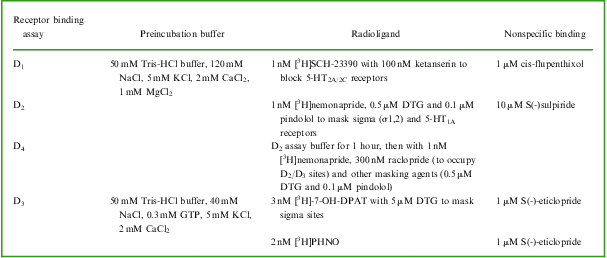
Details of DA receptor autoradiographyReference Tarazi, Zhang and Baldessarini10, Reference Tarazi, Kula and Baldessarini33 and image analysis proceduresReference Tarazi, Zhang and Baldessarini10, Reference Tarazi, Baldessarini, Kula and Zhang11, Reference Tarazi, Zhang and Baldessarini15 were published previously. Briefly, for all binding assays, brain sections were air-thawed at room temperature (RT) and incubated for 60 min in a washing Tris-HCl buffer (RT, pH 7.4) (Table 1), in order to remove endogenous DA and residual drugs that may interfere with receptor binding. Given the high affinity of cariprazine for D3 receptors, assays for this receptor subtype were conducted using 2 different radioligands (Table 1). Following preincubation in the washing buffer, slides were incubated in buffer at RT for 1 hour with DA receptor subtype-specific radioligands and agents that block their binding to other known receptor types, in the presence of a competitive agent used to determine nonspecific binding (Table 1). Slides were washed twice for 5 minutes (D1, D2, D4 receptors) or 3 minutes (D3 receptors) in ice-cold washing buffer, dipped in ice-cold water, and left to dry at RT. Finally, radiolabeled slides and calibrated [3H] standards were exposed to Hyperfilm for 4 weeks (D1, D2, D4) or 6 weeks (D3) at 4 °C.
Receptor binding assay experiment conditions
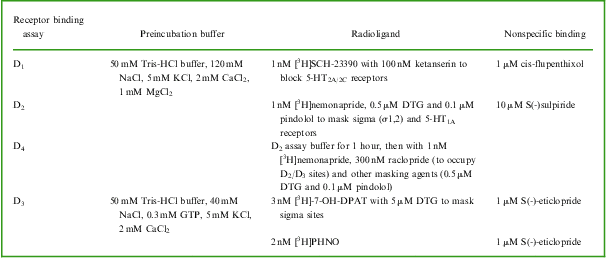
Biomax MR films were developed and fixed in Kodak D-19 for 5 min at RT; images were quantified using MCID image analyzer and MCID-M4 software Imaging Research (St. Catharines, Ontario, Canada). A calibration curve was generated from [3H]-microscale standards that were exposed along with tissue sections. Regions of interest were outlined, and their optical density was measured with the left and right sides of 2 contiguous sections representing total binding and matching samples representing nonspecific binding. Four determinations were averaged for each subject-sample. Optical density of sampled regions was measured and the amount of ligand bound was calculated as nCi/mg tissue. Mean values of nonspecific binding in each region were subtracted from the corresponding mean total binding to determine specific radioligand binding expressed as fmol bound/mg tissue.
Statistical analysis
DA receptor binding data were analyzed first for overall effects of drug versus vehicle for all receptor types and brain regions using multiple regression modeling methods. Density measures were logarithmically transformed to achieve more Gaussian-like distributions before regression modeling. Since individual brain specimens provided receptor-binding data for several brain regions, resulting in incomplete independence across observations, we used robust standard error estimates to adjust for this clustering effect. This estimation method permits relaxation of the assumption of independence of all observations and requires only that the observations be independent across specimens.Reference Greene34 Estimates of interaction effects were employed for post hoc tests of drug effects for specific receptors and brain regions, with adjustment of P values obtained from the regression analyses estimating these multiple comparisons by the standard method of Sidák.Reference Winer, Brown and Michels35 Data are presented as means ± standard error of the mean (SEM). Comparisons were considered significant at P < .05 (2-tailed test).
Results
Dopamine receptor distribution
Samples obtained from vehicle-treated animals indicate that baseline levels of D1 and D2 receptors were the highest in the medial and lateral CPu, and NAc (Figures 1 and 2), whereas brain regions with the highest levels of D3 receptor binding were the OT, ICj, and the shell of the NAc (Figure 3). D4 receptors accounted for 50%–60% of total D2 receptors in MPC and DFC, and 23%–28% of total D2 receptors in CPu and NAc (Figures 2 and 4), which is in agreement with the reported distribution of D4 receptors in different rat forebrain regions.Reference Tarazi, Kula and Baldessarini33
Effects of chronic exposure (28 days) of cariprazine on D1 receptors. Data are mean ± SEM and expressed in fmol/mg tissue (N = 8/group). CP-M = medial caudate putamen; CP-L = lateral caudate putamen; DFC = dorsolateral frontal cortex; EC = entorhinal cortex; HIPP = hippocampus; MPC = medial prefrontal cortex; NAc = nucleus accumbens.

Effects of chronic exposure (28 days) of cariprazine on D2 receptors. Data are mean ± SEM and expressed in fmol/mg tissue (N = 8/group). *P < .05 versus control. CP-M = medial caudate putamen; CP-L = lateral caudate putamen; DFC = dorsolateral frontal cortex; EC = entorhinal cortex; HIPP = hippocampus; MPC = medial prefrontal cortex; NAc = nucleus accumbens.
Effects of chronic exposure (28 days) of cariprazine on D3 receptors. Data are mean ± SEM and expressed in fmol/mg tissue (N = 8/group). *P < .05 versus control. CP-M = medial caudate putamen; CP-L = lateral caudate putamen; DFC = dorsolateral frontal cortex; EC = entorhinal cortex; HIPP = hippocampus; MPC = medial prefrontal cortex; NAc = nucleus accumbens. (A) [3H]7-OH-DPAT binding; (B) [3H]PHNO binding.
Effects of chronic exposure (28 days) of cariprazine on D4 receptors. Data are mean ± SEM and expressed in fmol/mg tissue (N = 8/group). *P < .05 versus control. CP-M = medial caudate putamen; CP-L = lateral caudate putamen; DFC = dorsolateral frontal cortex; EC = entorhinal cortex; HIPP = hippocampus; MPC = medial prefrontal cortex; NAc = nucleus accumbens.
D1 receptor binding
Repeated treatment (28 days) with different doses of cariprazine did not induce any significant changes in specific [3H]SCH-23390 binding to D1 receptors in all brain regions examined, relative to vehicle-treated animals (Figure 1).
D2 receptor binding
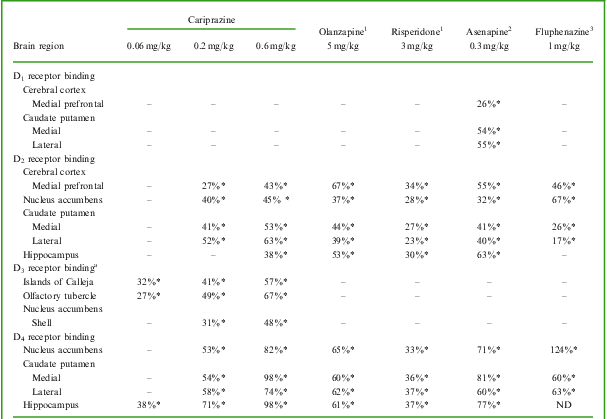
Repeated treatment with higher doses of cariprazine (0.2 and 0.6 mg/kg) significantly and dose-dependently increased D2 receptor binding in MPC (27% and 43%, respectively), NAc (40% and 45%, respectively), medial CPu (41% and 53%, respectively), and lateral CPu (52% and 63%, respectively) over the values observed in controls (Figure 2). In addition, the highest dose of cariprazine (0.6 mg/kg) significantly increased D2 receptor binding in hippocampus by 38% (Figure 2). The lowest dose of cariprazine (0.06 mg/kg) had no significant effect on D2 binding in any brain regions examined, although an increase in D2 binding was observed in MPC, NAc, and medial and lateral CPu that did not reach statistical significance (Figure 2).
D3 receptor binding
Two radioligands were used to quantify the long-term effects of cariprazine on D3 receptors in rat forebrain regions: [3H]7-OH-DPAT and [3H]PHNO. Quantification of D3 receptors using [3H]7-OH-DPAT revealed that the 3 doses of cariprazine significantly and dose-dependently increased D3 receptor binding in OT (27%, 49%, and 67%, respectively) and ICj (32%, 41%, and 57%, respectively), compared with the vehicle. In addition, the higher doses of cariprazine (0.2 and 0.6 mg/kg) increased labeling of [3H]7-OH-DPAT in the NAc shell by 31% and 48%, respectively (Figure 3A).
Binding assays with [3H]PHNO revealed additional changes in D3 receptor levels, especially in the NAc. Compared with vehicle-treated animals, all 3 cariprazine doses significantly and dose-dependently increased D3 receptor binding in the shell of NAc (29%, 50%, and 72%, respectively); the highest dose was shown to significantly increase D3 receptor levels in the core of NAc by 34% (Figure 3B)—an effect that was not observed using [3H]7-OH-DPAT (Figure 3A). The corresponding increases in D3 receptor binding in OT (43%, 62%, and 74%) and ICj (43%, 61%, and 76%) were also dose-dependent and significantly greater than vehicle, and the effect was greater than that observed using [3H]7-OH-DPAT (Figure 3B). There were no changes in D3 receptor levels in lobules 9 and 10 of the cerebellum after repeated treatment with the 3 doses of cariprazine, regardless of the labeling agent (Figures 3A and 3B).
D4 receptor binding
Repeated treatment with the 3 doses of cariprazine dose-dependently increased selective [3H]nemonapride binding to D4 receptors in hippocampus (by 38%, 71%, and 98%, respectively; P < .05) (Table 2). In addition, the higher doses of cariprazine (0.2 and 0.6 mg/kg) induced significant increases in D4 receptor levels in the NAc (53% and 82%, respectively), medial CPu (54% and 98%, respectively), and lateral CPu (58% and 74%, respectively) (Figure 4). In spite of the relatively high D4 receptor levels in MPC and DFC, repeated treatment with the 3 doses of cariprazine did not alter their abundance in those regions (Figure 4).
Comparison with typical and atypical antipsychotics
aData come from [3H]7-OH-DPAT binding experiments. 1Reference 10, 2Reference 9, 3Reference 37.
*P < .05 versus respective control, –: not significantly different from respective control.
ND indicates not determined.
Discussion
Effects of cariprazine on D1 receptors
Repeated treatment with cariprazine did not alter the levels of D1 receptors in any forebrain regions examined. Cariprazine has negligible affinity for D1 receptors,Reference Kiss, Horváth and Némethy17 and it is possible that cariprazine did not occupy the D1 receptors to the extent that is required to induce receptor upregulation. These findings suggest that D1 receptors are less likely to contribute to the therapeutic benefits of cariprazine in the treatment of schizophrenia or bipolar mania.
Lack of adaptive changes in D1 receptors with cariprazine is in agreement with the effects of other typical and atypical antipsychotics, including haloperidol, fluphenzaine, clozapine, olanzapine, and risperidone, which also failed to alter the abundance of D1 receptors in rat forebrain regions (Table 2).Reference Tarazi, Zhang and Baldessarini10, Reference Tarazi, Florijn and Creese36, Reference Tarazi, Yeghiayan, Baldessarini, Kula and Neumeyer37 Among the newer antipsychotics, only asenapine significantly increased D1 receptor binding in the NAc and CPu, as a result of direct receptor blockade.Reference Tarazi, Moran-Gates, Wong, Henry and Shahid9 However, clinical trials with selective D1 receptor antagonists in schizophrenia have yielded no support for the hypothesis that D1 receptor blockade exerts antipsychotic activity,Reference de Beaurepaire, Labelle, Naber, Jones and Barnes38 which further supports the view that D1 receptors are not major mediators of antipsychotic activity. Nevertheless, the pharmacological potential of D1 receptor antagonists in the treatment of schizophrenia and bipolar mania needs to be further investigated, since understanding of the physiology of the most abundant cerebral DA receptors remains remarkably limited.Reference Baldessarini and Tarazi3
Effects of cariprazine on D2 receptors
Long-term administration of higher doses of cariprazine (0.2 and 0.6 mg/kg) increased D2 receptor binding in mPFC (Figure 2); the high affinity of cariprazine for rat D2 receptors (pKi = 8.0)Reference Kiss, Horváth and Némethy17 suggests that cariprazine-induced increases in cortical D2 receptors may result from direct receptor blockade. This view is consistent with previous results that have demonstrated D2 receptor upregulation in the mPFC after repeated treatment with typical and atypical antipsychotics, including fluphenazine, clozapine, olanzapine, risperidone, and asenapine (Table 2).Reference Tarazi, Moran-Gates, Wong, Henry and Shahid9, Reference Tarazi, Zhang and Baldessarini10, Reference Tarazi, Yeghiayan, Baldessarini, Kula and Neumeyer37 Our findings further support the importance of D2 receptors in the mPFC as a common mediator of the antipsychotic effects of typical and atypical antipsychotics.
Prolonged treatment with the higher dose of cariprazine also increased D2 receptor binding in the hippocampus (Figure 2). This has been previously observed with atypical, but not typical, antipsychotics,Reference Tarazi, Moran-Gates, Wong, Henry and Shahid9, Reference Tarazi, Zhang and Baldessarini10, Reference Tarazi, Yeghiayan, Baldessarini, Kula and Neumeyer37 and may explain some of the differences in the mode of action between the 2 classes of antipsychotic drugs. For example, increases in hippocampal D2 receptors induced by cariprazine and other atypical antipsychotics may alter hippocampal-induced firing of DA neurons in ventral tegmental areaReference Lodge and Grace39 and subsequently reduce DA hyperactivity, which could result in improvements in psychotic symptoms and disturbed emotional behaviors in patients with schizophrenia.Reference Krieckhaus, Donahoe and Morgan40
Higher doses of cariprazine (0.06 and 0.2 mg/kg) also increased D2 receptor binding in medial and lateral CPu and NAc (Figure 2). Upregulation of striatal D2 receptors can contribute to the development of extrapyramidal side effects (EPS) via alteration of neurotransmission in the basal ganglia-thalamocortical circuitry.Reference Albin, Young and Penney41 Other atypical antipsychotic drugs (eg, olanzapine, risperidone, and asenapine) also induce increases in striatal D2 receptors in a dose-dependent manner.Reference Tarazi, Moran-Gates, Wong, Henry and Shahid9, Reference Tarazi, Zhang and Baldessarini10 Such increases in striatal D2 receptors may account for the higher incidence of akathisia (9% vs 5%) and extrapyramidal disorder (12% vs 5%) in cariprazine-treated, compared with placebo-treated patients, in clinical trials.Reference Citrome19, Reference Citrome20 Imaging studies using selective D2 receptor radioligands are still needed to assess the long-term effects of cariprazine on concentrations of striatal D2 receptors in patients with schizophrenia.
Interestingly, at the doses tested in this study, cariprazine did not cause catalepsy in rats—an animal model predictive of potential clinical EPS liability.Reference Gyertyán, Kiss and Sághy24 In fact, the cataleptic effects of cariprazine occur at doses 100-fold greater than doses that are effective in attenuating conditioned avoidance response—an animal model predictive of antipsychotic activity.Reference Gyertyán, Kiss and Sághy24 It is possible that the D2 receptor partial agonist activity of cariprazine is more potent in rats than in humans and exerted more protective effects against D2 receptor antagonism induced-catalepsy.Reference Kleven, Barret-Grevoz, Bruins Slot and Newman-Tancredi42 In addition, the 5-HT1A receptor partial agonist activity of cariprazine may have further contributed to the absence of catalepsy in rats at doses that displayed antipsychotic activity.Reference Kleven, Barret-Grevoz, Bruins Slot and Newman-Tancredi42, Reference Bardin, Kleven, Barret-Grevoz, Depoortere and Newman-Tancredi43
Effects of cariprazine on D3 receptors
Cariprazine displays potent affinity for D3 receptors, as determined by in vitro assays using cells expressing either recombinant human (pKi = 10.1) or rat (pKi = 9.2) D3 receptors.Reference Kiss, Horváth and Némethy17 In this study, repeated administration of cariprazine resulted in a dose-dependent increase in D3 receptor-specific binding in OT, ICj, and the shell of NAc, using both [3H]7-OH-DPAT (Figure 3A) and [3H]PHNO (Figure 3B). Assays using [3H]PHNO demonstrated a stronger binding signal overall relative to [3H]7-OH-DPAT and additionally showed significant increase in D3 receptor levels in the NAc core (Figure 3B). The differences in regional effects and the magnitude of labeling between the two D3 receptor preferring radioligands may reflect binding affinity or pharmacokinetic differences between the two radioligands.
Cariprazine-induced changes in D3 receptors in forebrain regions, where D3 receptors are highly expressed, appear to be unique to this novel antipsychotic candidate. This effect was not observed with other antipsychotics, typical or atypical (including haloperidol, flupehenazine, clozapine, olanzapine, risperidone, and asenapine), in any of the brain regions examined (Table 2).Reference Tarazi, Moran-Gates, Wong, Henry and Shahid9, Reference Tarazi, Zhang and Baldessarini10, Reference Tarazi, Florijn and Creese36, Reference Tarazi, Yeghiayan, Baldessarini, Kula and Neumeyer37 It has been proposed that high-affinity of endogenous DA at D3 receptors may limit the ability of other antipsychotic agents to occupy D3 receptors to the level required to trigger receptor upregulation.Reference Zhang, Weiss, Tarazi, Kula and Baldessarini44 Other antipsychotics tested, including aripiprazole, clozapine, haloperidol, olanzapine, quetiapine, risperidone, and ziprasidone, showed relatively low in vitro affinity at rat dopamine D3 receptors (Ki = 9–329 nM) and corresponding low occupancy of D3 receptors in vivo (< 60% maximum occupancy). In contrast, cariprazine showed higher D3 affinity (Ki < 4.0 nM) in vitro, and following acute administration, showed very high D3 receptor occupancy (> 99% maximum occupancy) in vivo.Reference Kiss, Horti and Bobok25 With its potent D3 receptor affinity and considerable D3 receptor occupancy,Reference Gyertyán, Kiss and Sághy24, Reference Kiss, Horti and Bobok45 cariprazine is able to sufficiently occupy D3 receptors even at low doses to induce significant D3 receptor upregulation independent of the radioligand used to label D3 receptors. This effect may be mediated through actions of brain-derived neurotrophic factor (BDNF), a neurotrophic factor that has been shown to control the development and expression of D3 receptors.Reference Sokoloff, Guillin, Diaz, Carroll and Griffon46 However, further studies are needed to examine the potential role of BDNF in cariprazine-induced upregulation of D3 receptors. The absence of D3 receptors changes in the cerebellum may reflect differential regional responses to repeated cariprazine treatment.
Dopamine receptor upregulation is typically observed with DA receptor antagonists; however, despite its D3 receptor partial agonist activity in vitro, cariprazine increased the levels of D3 receptors, which may suggest it is acting as an antagonist at D3 receptors in vivo. Cariprazine-induced changes at D3 receptors may normalize disturbances in D3 receptor-mediated neurotransmission in patients with schizophrenia and bipolar mania, and in particular may improve mood, cognitive, and executive functions, which are typically disturbed in these disorders.Reference Baldessarini and Tarazi1, Reference Salimi, Jarskog and Lieberman30, Reference Dias, Balanza-Martinez and Soeiro-de-Souza47, Reference Harvey, Wingo, Burdick and Baldessarini48 Accumulating evidence suggests that the D3 receptor plays a role in the regulation of mood behaviors and cognitive functions.Reference Beaulieu and Gainetdinov2, Reference Cho, Zheng and Kim28 Two D3 receptor-preferring antagonists, S33138 and RG-15, have demonstrated cognition-enhancing effects,Reference Gyertyán, Sághy and Laszy49, Reference Millan, Loiseau and Dekeyne50 and lack of functional D3 receptors has been shown to have procognitive-,Reference Micale, Cristino and Tamburella51 antidepressant-,Reference Millan, Loiseau and Dekeyne50 and anxiolytic-likeReference Micale, Cristino and Tamburella51 effects in animal models. Taken together, these data suggest that cariprazine, via its unique actions at D3 receptors, may provide therapeutic benefits in the treatment of mood symptoms and cognitive deficits in patients with schizophrenia and bipolar disorder.
Effects of cariprazine on D4 receptors
Repeated administration of cariprazine (0.2 and 0.6 mg/kg) significantly increased D4 receptor binding in the NAc and CPu. This is in agreement with other studies that reported increased D4 receptor binding in the NAc and CPu following treatment with antipsychotics (Table 2).Reference Tarazi, Moran-Gates, Wong, Henry and Shahid9, Reference Tarazi, Zhang and Baldessarini10, Reference Florijn, Tarazi and Creese32, Reference Tarazi, Florijn and Creese36, Reference Tarazi, Yeghiayan, Baldessarini, Kula and Neumeyer37 Antipsychotic-induced upregulation of striatolimbic D4 receptors may be a common mechanism that mediates the actions of both typical and atypical antipsychotics, including cariprazine. Despite the failure of selective D4-receptor agents to improve psychotic symptoms in patients with schizophrenia,Reference Corrigan, Gallen, Bonura and Merchant52, Reference Kramer, Last, Getson and Reines53 it is possible that modulation of striatolimbic D4 receptors in synchrony with other neurotransmitter receptors enhances the therapeutic efficacy of cariprazine.
In this study, long-term treatment with the 3 doses of cariprazine also increased D4 receptor binding in the hippocampus. This is in agreement with the effects of other atypical antipsychotic drugs, including olanzapine, risperidone, and asenapine, which all increase D4 receptor binding in this brain region.Reference Tarazi, Moran-Gates, Wong, Henry and Shahid9, Reference Tarazi, Zhang and Baldessarini10 Hippocampal D4 receptors, therefore, may constitute common targets that mediate the molecular actions of cariprazine and other atypical antipsychotics, acting together with hippocampal D2 receptors to improve impaired emotional behavior that is commonly associated with psychosis.Reference Beaulieu and Gainetdinov2
Conclusions
In this study, long-term administration of cariprazine was shown to induce regional and dose-dependent upregulation of D2 and D4 receptor subtypes similar to other atypical antipsychotics. Additionally, cariprazine was unique in upregulating D3 receptors, which has not been seen with other typical or atypical antipsychotic agents. This distinct pharmacological profile of cariprazine may confer additional clinical benefits on cognitive impairment and mood disturbances associated with schizophrenia and bipolar disorder.
Disclosures
Y. K. Choi has no conflicts of interest to disclose. N. Adham is an employee of Forest Research Institute. B. Kiss and I. Gyertyán are employees of Gedeon Richter Plc. F. I. Tarazi received research grants from Novartis, Forest Laboratories, Inc., H. Lundbeck A/S, and Shire plc.