1. Introduction
The empirical focus of this paper is a special morphophonological pattern which encodes aspectual information within a certain class of Russian verbs. Derived imperfective aspect (DI), which turns a perfective verb into an imperfective one, typically takes the form of a suffix -iv- or -v-, as in (1c) below. In the paradigm of interest, DI appears to be expressed as a different form of the root, rather than as a suffix, as seen in (2c). In (1) and (2), and in (28) below, the question mark indicates an unspecified gloss.Footnote [2]

This pattern is interesting because the difference between the perfective (2b) and derived imperfective (2c) forms, at least on the surface, appears to be signaled by the vocalic melody, i.e. by the presence or absence of a vowel in the root. The question marks associated with the verbal inflection in the gloss line are placeholders for an analysis which is elaborated in Section 3 below.
The aim of this paper is to argue for a particular view of the as-yet unanalyzed pattern in (2) and to provide a fitting analysis in theoretical terms broadly compatible with Distributed Morphology (DM). I argue that the special pattern in the root of (2c) is part of a more general phonological process – the familiar pattern of vowel–zero alternations found in Russian (yer alternations) – that is triggered by morphosyntactic features on a functional head in the clausal spine (Asp) in the context of a certain set of roots. Any analysis of such a pattern must address two sets of questions. The first set of questions concerns the choice of DI allomorph in forms like (2c): since the canonical suffix does not appear, what is the exponent of DI, if any, in such forms? A formal analysis will need to specify how the DI features in (2c) are realized differently, and furthermore, how their environment can determine their form. The second set of questions concerns the form of the root in examples like (2c): the primary difference between the perfective form in (2b) and the DI form in (2c) is, at least on the surface, the shape of the root. What is the mechanism that changes the shape of the root when DI features are present, and why does this happen only in a subset of Russian roots?
Viewed from this perspective, this pattern is significant for the theoretical questions it raises about morphophonology and its interaction with morphosyntactic structure. A first question concerns locality: What are the conditions on how local one morpheme must be to another in order to trigger contextual allomorphy? How much information will the mechanism that makes the choice of allomorph have, when that choice is made? Many theories invoke some form of structural adjacency (Siegel Reference Siegel and Stein1978; Allen Reference Allen1979; Embick Reference Embick2003, Reference Embick2010; Bobaljik Reference Bobaljik2012), sometimes in combination with linear adjacency (Embick Reference Embick2010). The consequent prediction is that a morpheme  $m_{1}$ not sufficiently local to another (
 $m_{2}$) should never condition allomorphy on
 $m_{2}$. Whether this prediction is in fact borne out is a matter of some controversy: when apparent counter-examples to the generalization have emerged – for example in Itelmen (Bobaljik Reference Bobaljik, Grohmann and Struijke2000) and Itzaj Maya (Radkevich Reference Radkevich2011) – they have sometimes been subject to heavy scrutiny and re-analysis (Bobaljik Reference Bobaljik2012, Bonet & Harbour Reference Bonet and Harbour2012, Butler Reference Butler2012).Footnote [3] The empirical question is of particular theoretical importance, because competing theories of contextual allomorphy – DM (Embick Reference Embick2010), Monostratal Optimality Theory (McCarthy & Prince Reference McCarthy, Prince, Booij and van Marle1993a, Reference McCarthy and Princeb), Stratal Optimality Theory (P. Kiparsky Reference Kiparsky2000) – make differing predictions about whether an allomorph may ever be chosen on the basis of global (i.e. non-local) considerations. Theories that subscribe to inside-out cyclic structure-building predict that the choice should be based only on local information (i.e. looking too many morphemes away should not be an option), by some definition of locality.Footnote [4]
Depending on the status of the currently underspecified glosses in (1) and (2), it is possible to construe examples like (2c) as instances of just the kind of non-local interaction which theories with structural and/or linear adjacency restrictions for allomorphic interaction would prohibit. A prominent view is that the vowel preceding the DI suffix in forms like (1c) is the instantiation of a verbalizingv head, and the DI suffix is housed in an Asp head just above it (Svenonius Reference Svenonius2004a, Reference Svenoniusb). In forms like (2c), the DI suffix must not have an affixal realization in the context of certain roots. The core question concerns the unglossed -a- vowel in (2): Is it also an instantiation of v? If this is the case, then the allomorphic sensitivity of the aspectual head hosting the DI suffix to the identity of particular roots in examples like (2c) would have to extend – both structurally and in terms of linear order – past the v head hosting this vowel and its phonological exponent. If this were the right view of the data, these cases would provide a valuable and new type of counter-example to the claimed adjacency restrictions on allomorphy.
I argue, however, that further investigation of these patterns obviates the need for reference to non-adjacency in allomorphy. I provide an alternative analysis of the patterns in (1) and (2), in which the -a- vowel in both (1c) and (2c) is a theme vowel associated with the functional head Asp, following previous work in which theme vowels are associated with specific functional heads (Oltra-Massuet Reference Oltra-Massuet1999, Embick & Halle Reference Embick, Halle, Geerts, von Ginneken and Jacobs2005, Oltra-Massuet & Arregi Reference Oltra-Massuet and Arregi2005). Contrary to previous proposals (Svenonius Reference Svenonius2004b), I claim that this vowel is not the realization of v, and in some cases actually co-occurs with true realizations of v. The lack of appearance of a traditional DI allomorph in examples like (2c) is, then, the result of contextual allomorphy between Asp and the root which are in fact adjacent. Investigating such apparent counter-examples is key to a better understanding of what kind of locality condition should be invoked in theories of contextual allomorphy. To the extent that putatively non-local instances of contextual allomorphy can be re-analyzed as local, theories that impose strict locality conditions on allomorphic interactions are vindicated.
A second theoretical question concerns how best to account for phonological processes that are non-concatenative, and triggered by morphosyntactic features. In a realizational theory like DM, such interactions have traditionally been dealt with through the application of readjustment rules: phonological rules that apply in a listed set of (possibly unrelated) morphosyntactic environments. These rules apply after the matching of morphosyntactic features to their corresponding phonological exponents (Vocabulary Insertion, in DM), and they have often been the source of concern for their potential unrestrictedness and ability to weaken the predictive power of a theory like DM (Siddiqi Reference Siddiqi2006, Reference Siddiqi2009; Bye & Svenonius Reference Bye and Svenonius2012; Haugen & Siddiqi Reference Haugen and Siddiqi2013). To the extent that morphophonological analyses can eventually do away with readjustment rules, or at least significantly limit their power, the benefit to a theory like DM is quite apparent: it would become both more restrictive and, consequently, more convincing.
In line with recent proposals by Bye & Svenonius (Reference Bye and Svenonius2012), the solution presented in the present case study aims to demonstrate that a significant amount of the processes that readjustment rules were meant to handle can in fact be handled by regular phonology.Footnote [5] I develop a different approach to a phenomenon that would otherwise call for readjustment rules by leveraging the tools already made available by DM – namely, Vocabulary Insertion (VI) – in combination with the idea that the exponents inserted at VI may be not just phonological segments, but also pieces of abstract phonology. This idea capitalizes on proposals in which the exponent of a morphosyntactic feature can be pieces of the autosegmental representation: syllables, morae, feet, etc., rather than phonological segments alone (Lieber Reference Lieber1987; Akinlabi Reference Akinlabi1996, Reference Akinlabi, van Oostendorp, Ewen and Hume2011; Wolf Reference Wolf, Bateman, O’Keefe, Reilly and Werle2006; Bermúdez-Otero Reference Bermúdez-Otero2012; Bye & Svenonius Reference Bye and Svenonius2012). In the Russian cases of interest here, the claim is that one possible exponent of the derived imperfective morpheme is actually a mora which, once inserted, has the expected effects on the phonological shape of the root, given what we know about the phonology of the language. The roots of these forms contain a yer: these are vowels which were first posited by Rubach (Reference Rubach1986) and Yearley (Reference Yearley, Beckman, Dickey and Urbanczyk1995) to lack a timing slot, or to lack association with a mora. Supplying an extra mora via VI as the exponent of DI features has the expected effect of ensuring that the root yer vowel is realized, even though there is no phonotactic motivation for this realization. This provides an alternative way to model a morphosyntactically triggered phonological process, without invoking readjustment rules.
Taken together, these arguments lead to an analysis in which the allomorphic relation between the aspectual head (Asp) and the root aligns with previous theorizing about the role of locality in allomorphy. The analysis of the second part of the relevant pattern, in which the root takes on a different shape as a result of the presence of DI features, obviates the need for reference to readjustment rules. I demonstrate that it can be modeled instead as a morphosyntactically triggered phonological process, provided that the theory of exponence allows both segments and other kinds of phonological material (i.e. a mora) to act as exponents of morphosyntactic features. Looking ahead, the analysis presented here will ultimately describe three core verbal patterns: the one represented in (1c), with its potentially different realizations, and the perfective (2b) and imperfective (2c) patterns associated with the special class of verbs that are the main target of the account. Presupposing the proposals just above, in (3)–(5) below I present a condensed diagram of the syntactic structures associated with all three patterns under the analysis to be defended here, as well as their phonological exponents. Roots and prefixes containing yers are marked with a Y in their underlying representations.


The remainder of the paper is structured as follows. Section 2 describes the relevant pattern in detail, examining the varieties of DI suffixation and focusing in on the specific and unusual pattern illustrated in (2), by way of comparison of the DI forms with their corresponding prefixed perfective forms. It also presents a prominent analysis of these forms, which I will ultimately reject in favor of an alternative. Section 2.3 provides an account in terms of the prominent and well-articulated model of allomorphic interactions presented in Embick (Reference Embick2010). On this view, the pattern of interest is captured via a combination of inwardly-sensitive contextual allomorphy of the exponent of Asp to the root, in conjunction with the application of morphosyntactically triggered readjustment rules which yield the vocalic pattern in the root. This exploration yields two interesting challenges. First, depending on how the vowels surrounding the DI suffix are analyzed, the contextual allomorphy that must be invoked may appear to be non-local, contradicting Embick’s (Reference Embick2010) model (along with many others). Section 3 argues instead for the view represented above, namely that the relevant interaction is a local one. This argument is based on an analysis of the -a- vowel that appears in all three forms above as a theme vowel projected from the Asp head (thereby eliminating it as a potential intervener). Second, an approach along the lines of Embick (Reference Embick2010) necessitates the use of readjustment rules; apart from any theoretical objections, I point out that this approach also faces certain empirical difficulties, resulting in a loss of generalization. Section 4 develops an alternative account in which the grammatically triggered process is integrated into the general phonology of Russian. The account makes crucial use of the idea that realization of morphosyntactic features need not always be segmental: if exponents can be pieces of phonological representations, then the need for readjustment rules in such cases is obviated. Section 5 concludes.
2. The pattern and its initial implications
The description that follows relies on a particular analysis of the Russian verbal complex, following work by Svenonius (Reference Svenonius2004a, Reference Svenoniusb) and extensions thereof (Gribanova Reference Gribanova2010, Reference Gribanova2013b). The glosses used in examples in this section correspondingly presuppose that analysis. The approach I will argue for and adopt in Section 3 differs somewhat from what is initially outlined here, in Section 2. There are strong reasons to start with this initial description, however: it captures many of the relevant observations accurately, and represents one of the few existing attempts to connect a morphophonological parse of the Russian verbal complex to a morphosyntactic structure using a contemporary analytical vocabulary. Further, while much attention has been paid to the morphosyntax of Slavic prefixes, this is one of very few discussions of the morphosyntax and morphophonology of the interaction of DI suffixes with stem-final inflection.
The verb forms we will be investigating consist minimally of five parts, as illustrated in (6b), from left to right: these include a lexical prefix (LP), the root, a pre-inflection suffix (usually just a vowel, null in certain forms), a DI suffix (when it is a suffix), and inflectional information (gender, person, number).

Lexical prefixes are perfectivizing, non-compositional prefixes which are not separable from the root.Footnote [6] Every LP that has a consonant-final variant also has a vowel-final variant in which the vowel is a yer – a lexically specified vowel which alternates in certain contexts with zero (e.g., [pod-] ${\sim}$[podo-]).
The status of the (often vocalic) pre-inflection suffix and its interaction with the DI suffix will be a major subject of discussion later, in Section 3, but deserves some mention here as well. Because this question is under debate, I will use the term ‘pre-inflection vowel/suffix’ as a neutral term of reference. These suffixes reflect conjugation class, and are usually taken to be verbalizers, in the sense that their presence in canonical (non-DI) verb forms is generally necessary. Importantly, on the view of Svenonius (Reference Svenonius2004b) the pre-inflection vowel is an instantiation of v, as reflected in the above glosses. One piece of evidence for this claim comes from the observation that LP–root combinations appear not just in verbal forms, but also in nominal and adjectival forms; in the latter two cases, the verbalizing suffix is not present,Footnote [7] with other endings instead signaling information about category type.
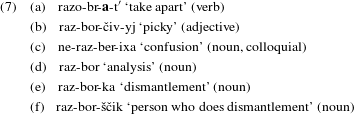
As proposed in Svenonius (Reference Svenonius2004b), it is possible to understand the null exponent of the pre-inflection vowel in (6b) as the result of a regressive vowel hiatus resolution rule that deletes the first vowel in morphologically derived sequences of vowels (Jakobson Reference Jakobson1948).
It follows from this view that the -a- vowel in forms like (6a) is an instantiation of v. It also follows that the allomorphs of the DI suffix, when it has a suffixal exponent, are at least -va- or -i/yva-. Both of these claims differ from the position I will ultimately defend (and which was laid out in the introduction); see Section 3 for a defense of the revised view. Depending on the analysis, DI also has other realizations (Halle Reference Halle1963, Flier Reference Flier and Worth1972, Coats Reference Coats and Koubourlis1974, Feinberg Reference Feinberg1990, Matushansky Reference Matushansky2009); this matter, and the matter of DI’s interaction with the rest of Russian verbal morphophonology, is a complicated one, and the focus of this paper is rather more narrow. Proceeding from the assumption that the different realizations of DI correspond to the same syntactic structure, I attempt to connect the morphosyntax of the verbal complex described and defended in the next section to the morphophonology of the special pattern in which, rather than the suffixation shown in (6b), DI features are realized as grammatically triggered yer realization in the verb root.
2.1 Morphosyntax
The choice of syntactic structure for the Russian verbal complex is an especially important one for the purposes of this discussion. Any syntactic structure will make predictions about which morphemes are expected to be hierarchically and linearly adjacent, and therefore it is important that the structure in question be well-motivated on independent grounds. Here, I adopt the structure defended in Gribanova (Reference Gribanova2010, Reference Gribanova2013b), which has its roots in the work of Svenonius (Reference Svenonius2004a).Footnote [8] On this view, the parts of the verb are distributed across syntactic space, and unified via head movement to a position just below T (recall that the aspectual prefixes are not separable from the complex), as shown in (8) and (9).

The structures above arise from a constellation of assumptions about morphosyntactic structure, broadly, and Russian verbal syntax, more narrowly. At the broader level, these include the idea that morphosyntactic structure is syntactically composed,Footnote [9] and that roots must be categorized by functional heads – in the case above, v (Arad Reference Arad2003, Marantz e.g. Reference Marantz and Choe2007). More narrowly, the claims here are that the parts of the Russian verb move to an Asp projection just below T (‘short verb movement’) (Bailyn Reference Bailyn1995a, Reference Bailynb), and that at least one variety of perfectivizing aspectual prefixes, LP, are merged low, while the DI suffix is merged high, in an Asp head above v.
In brief, evidence for the claim that the verb is composed via head movement comes from the observation that the morphophonological and morphosyntactic unification of the verb must feed further head movement in Russian, for yes–no question formation, as illustrated in (10a) (King Reference King1995, Franks & King Reference Franks and King2000), or focus movement of the verb, as in (10b).Footnote [10]Footnote [11]

There is also evidence for the hierarchical positions of these morphemes with respect to each other. As demonstrated in (7) above and repeated for convenience in (11) below, the LP and root appear together across categories and appear to be combined prior to the categorization of the complex.

If the LP–root complex is to be a verb, it typically must appear with the pre-inflection suffix (v, in this analysis) in the large majority of cases. Derived imperfectivization can apply to verbal stems only, suggesting that DI is merged above or simultaneously with v in the syntax; nominalizations which include DI are always eventive, shown in (12). Words with asterisks indicate non-eventive (and therefore impossible) meanings.

Finally, DI can only attach to perfectivized, lexically prefixed verbsFootnote [12], as in (13), indicating that DI must be merged high in the structure, above the LP–root complex at least. The superscript I and P in (13) indicate imperfective and perfective, respectively.

With this brief justification of the syntactic structure of Russian in place, we can move to focussing more directly on the phonological process involved in examples like (2c).
2.2 Phonology
The main phonological puzzle to be addressed in this paper involves a particular sub-pattern of derived imperfectivization that involves changes to the root rather than suffixation. This is shown in (14), where we temporarily adopt the parse of the verbal complex just presented in Section 2.1. (Compare (14) with (2) above.)

To understand what is unusual about this pattern, it is necessary to situate it within the broader context of Russian phonology. An initial observation is that the root of the verb slat  $^{\prime }$ ‘send’ in the perfective is lacking a vocalic nucleus, as seen in (14b) above, whereas there is a vowel in the nucleus of the root in the DI form, as in (14c). Such vowel–zero alternations are common throughout the grammar of Russian, and are the synchronic reflex of a Common Slavic historical process in which short vowels ŭ and ĭ (yers) were systematically dropped in weak positions, in accordance with Havlík’s Law (V. Kiparsky Reference Kiparsky1979). The synchronic pattern is understood to be the result of the non-vocalization, in certain contexts, of vowels o and e in the underlying phonemic representation.Footnote [13] Investigations of this broader pattern in generative phonology have reliably established that it cannot be the result of epenthesis (Pesetsky Reference Pesetsky1979, Bethin Reference Bethin1992, Yearley Reference Yearley, Beckman, Dickey and Urbanczyk1995). In the verb forms of interest to us, there are yers both prefix-finally and root-internally. Following Yearley (Reference Yearley, Beckman, Dickey and Urbanczyk1995), I will claim that there is a yer present in an underlying form just in case there is a morphologically and semantically related form in which the yer is vocalized (see the ‘cross-check’ column in the tables that follow). Where I must specify that there is a yer in an underlying representation, I use Y (signifying under-specified vowel quality), O and E to distinguish yers from full, non-alternating o and e.
An important observation about Russian yer realization is that is it partly phonotactically motivated, but not entirely. It is largley predictable on the basis of constraints on optimal syllable structure (Szpyra Reference Szpyra1992, Yearley Reference Yearley, Beckman, Dickey and Urbanczyk1995) and constraints on sonority (Rubach Reference Rubach2000, Matushansky Reference Matushansky2002, Katz Reference Katz2006). However, there are also environments in which the realization of a yer seems motivated entirely by the alternating pattern imposed by Havlík’s Law, rather than by any visible phonological constraints. This mixed picture is especially salient for the forms under consideration here, because they involve sequences of yers in morphologically complex (prefixed) forms. Analyses that attempt to attribute Russian yer behavior exclusively to optimizing phonological constraints famously have difficulty accounting for prefixal yer behavior (Yearley Reference Yearley, Beckman, Dickey and Urbanczyk1995, Gouskova Reference Gouskova2012). In what follows, we will consider first the yer patterns in prefixed perfective forms; the DI pattern becomes more clear when contrasted with the perfective pattern. To maximize clarity, the phonetic representations in brackets abstract away from processes which are irrelevant to the current study.
2.2.1 The perfective pattern
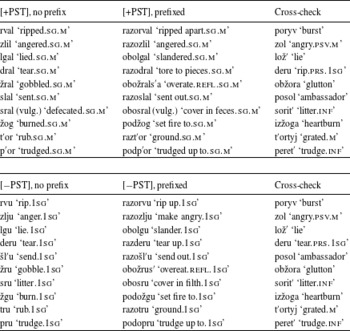
Each prefix’s perfective form in Table 1 below is composed of a root and a prefix, both of which have underlying yers. For example, the verb razorvat  $^{\prime }$ ‘to rip apart’ contains a prefix-final yer, which is vocalized as -o-, and a root-internal yer, which is not vocalized in this form but which appears in morphologically related forms (e.g., poryv ‘burst’).
Yer behavior: inflected stems with and without prefixes.

There are two important descriptive generalizations one can make about the prefixed perfective variants of verbs with yer-containing roots. First, the inflected stem is always realized identically, whether it has a prefix attached to it or not, shown in (15).

This suggests that, for the purposes of the mechanism governing yer realization, the inflected stem is a unit to the exclusion of the prefix (Pesetsky Reference Pesetsky1979). Whether or not the root yer is realized in the inflected stem seems to be governed by syllable structure and sonority considerations (Yearley Reference Yearley, Beckman, Dickey and Urbanczyk1995). For example, in the perfective forms podžog ‘burn’ (pst, sg, m) and rast ′or ‘ground up’ (pst, sg, m), the root yer is realized in order to ensure that the root has a vocalic nucleus of some kind.
A second set of generalizations concerns the prefixal yer, which is realized for one of two reasons. First, it is sometimes realized for what look like phonotactic reasons: it resolves bad sonority contours or impossible syllable shapes which we know to be unacceptable in the language. For example, word-initial fricative geminate sequences are avoided in Russian if they are followed immediately by a consonant (Rubach Reference Rubach2000, Matushansky Reference Matushansky2002). This is demonstrated in (16), first with yer-containing prepositions (homophonous with prefixes), and then with yer-containing LP.

There is a second motivation, though, which is not reducible to phonological output constraints: the prefix yer is sometimes realized just if the root yer has been deleted, as in (17).

What substantiates the claim that prefixal yer realization in (17) is not driven by any obvious phonological well-formedness constraints? A possible phonological motivator for the realization of the prefixal yer in forms like [podo॑pru], [podo॑žgu], and [razo॑slal] in (17b) is a putative drive to optimize foot structure or prosodic contour. The issue with this reasoning is that it is possible to find (near) minimal pairs for some of the relevant prefixed verbs in which the root vowel is a full vowel rather than a yer. If the underlying motivation here were a drive to optimize prosodic contour, we would expect the prefix yer to behave the same way, regardless of whether the root contains a full vowel or a yer vowel. But this expectation is not borne out: whether the verb root contains a yer seems to matter for determining the behavior of the prefix yer, as demonstrated in the forms in (18).

Verbs forms like brit  $^{\prime }$ ‘shave’ exhibit no yer alternation – there is no morphologically related form with this root which would realize an additional vowel. The behavior of the prefix when it is attached to verbs with yer-less roots is consistent: there is never prefixal yer realization in these cases, as demonstrated by analogous forms in (19).

This evidence demonstrates that, apart from phonotactic considerations, prefixal yer realization is also conditioned by whether the root contains a yer. This seems to be a synchronic reflex of Havlík’s Law, in which the fate of a yer is determined by whether there are other yers in its vicinity, conditioned by cyclic domains (Lightner Reference Lightner1972, Pesetsky Reference Pesetsky1979). This dual motivation for Russian yer realization in verbal complexes is important, since any phonological account will have to deal with both the phonologically optimizing pattern and the alternating pattern.
As will become clear in the following section, the DI pattern is also consistent with the alternating yer pattern found in perfective forms, in the sense that each form contains two yers, and only one of them is vocalized. In the DI pattern, though, the alternation goes the other way: yer realization in the root means that the prefix yer is never realized.
2.2.2 The derived imperfective pattern
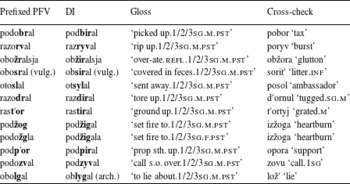
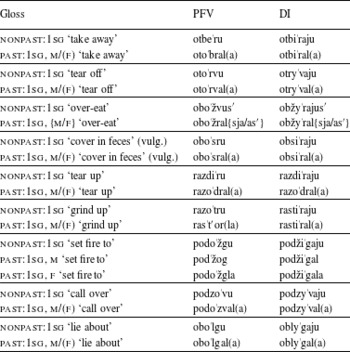
The DI form of these verbs differs from the perfective paradigm primarily in its vocalic pattern: where perfective forms vocalize a prefix yer, the DI forms of the same verbs realize a putative root yer, shown in Table 2 below.Footnote [14]
What is clear about this putative root yer realization is that it has no phonological motivation – we know from taking stock of the perfective paradigm that forms without root yer realization are possible and attested. Putative yer realization in the DI forms seems rather to be a direct reflex of morphosyntactic features. Developing an account of this pattern is the topic of Section 4.
Irregular derived imperfective paradigm.

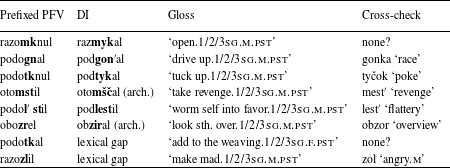
For completeness, I also list in Table 3 a series of verb forms which appear to follow a somewhat similar pattern and which are often assumed to contain root yers (Yearley Reference Yearley, Beckman, Dickey and Urbanczyk1995), but where some part of the pattern is obscured by additional morphological complexity or anomaly. For example, several of the perfective forms in Table 3 do not have DI counterparts at all. Other forms (e.g., razomknut  $^{\prime }$ ‘open’) involve an additional semelfactive suffix -nu- in the perfective, which is absent in the DI form.
Irregular derived imperfective paradigm: irregular alternations.
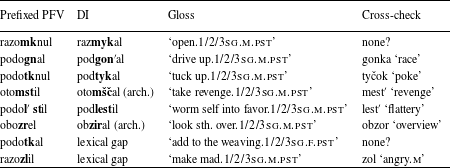
I list these here in part because, to the extent the items in Tables 2 and 3 are a unified class, it may be of interest to note that the DI forms of these verbs almost never involve the regular form of DI suffix. An exception is the archaic DI form obzirat  $^{\prime }$ ‘to look something over’, whose more contemporary and productive version is actually obozrevat
 $^{\prime }$, which uses the standard DI suffix.Footnote [15] Nevertheless, almost all of the forms in Table 3 involve some kind of change to the root, often similar to the kind found in Table 2. This brings us quite close, although perhaps not all the way, to being able to make the generalization that yer-containing verbal roots are of the kind that undergo a special form of derived imperfectivization.
Returning now to the main pattern in Table 2, I have been using the word ‘putative’ to refer to the root yer realization in these forms, because the quality of the realized vowel is not entirely expected: yers are realized as [o] and [e], but the vowels at issue are [i] and [y]. There are several pieces of evidence, though, that the relevant vowels are yers despite their unusual quality. First, they are realized in forms we know independently to contain yers (see the ‘cross-check’ column). Second, we know that they alternate with zero because they are often not realized in related perfective forms; when they are realized in perfective forms (like podžog ‘set fire’ (pst.sg.m), rast ′or ‘ground’ (pst.sg.m), etc.), they are realized, as expected, as -o-. It would seem that the unusual vowel quality in the DI forms is directly linked to the morphosyntactic DI features which trigger the yer realization in the first place. Finally, the vowel quality in DI forms can be understood as part of a class of more general vowel mutation processes applying to certain aspectual pairs, and extending beyond this paradigm to forms lacking yers. The pattern in (20), going from left to right, involves the imperfective stem, which is then perfectivized via the addition of a prefix, and then imperfectivized again via the addition of a DI suffix. The first line of each example provides a broad phonetic transcription, while the second is the transliteration of the orthographic form. The third line provides a gloss that is in accordance with the initial parses we have established for such verbs. What these forms demonstrate is that the addition of the more canonical DI suffix may change the quality of a root’s vowel.Footnote [16]

I will not attempt to account for such processes here, noting only that they appear to be fairly common in perfective/DI alternations, and that it should therefore come as no surprise that the quality of the yer vowels in the forms that concern us is also unusual. Furthermore, the alternations in (20) and Table 2 are linked historically: both are derived from Proto-Indo-European ablaut, in which vowel lengthening (leading to the vowel quality changes of synchronic forms) and vowel deletion are both involved (Vlasto Reference Vlasto1986).Footnote [17]
The question of whether the root vowels in the DI forms of Table 2 are actually yers is an important one, because the answer ultimately determines how we view such alternations and their consequent analysis. There are in principle two ways of understanding the pattern in Table 2: as outward sensitive root suppletion, or as inward-sensitive allomorphy of Asp to the identity of the root. I discuss each possibility in turn, arguing that the latter view is the more attractive.
On the former view, we stipulate that there are two forms of the root: to take an example, for razobrat  $^{\prime }$ ‘take apart’ (inf), the forms are -br- (perfective) and -bir- (DI). The choice of form would be determined by features on Asp, which, according to the morphosyntactic structure in (9) above, is merged above the root. On this approach, the two forms are the result of outward-looking root suppletion: on an inside-out view of structure-building, the choice of suppletive root form will need to be made with reference to hierarchically higher Asp features. Parsing the data this way allows us to keep the generalization that yers are only ever realized as [o] or [e] – the unusual quality of the DI root’s vowel is a separate issue, and is listed, along with a root that contains no vowel at all. But it also risks a loss of generalization, in taking the two forms to be suppletive: the consonants in all these forms are always the same, and the vocalic melody is systematic in the way that it differs between perfective and DI forms. This view also misses the generalization that the observed alternation only ever occurs in forms we independently know to contain alternating vowels (i.e. yers).
I will argue instead for the latter view, in which the two surface forms of the root (-br- and -bir-, to take our previous example) are derived from the same yer-containing underlying representation (/bYr/, where Y is a yer). Asp is inwardly sensitive to the identity of the root, and when the features of Asp are DI, Asp’s exponent will be special (i.e. not a concatenative suffix), in a sense to be elaborated in later sections. In addition to this, there must be some way of making Asp’s DI features trigger the realization of the root yer – the mechanism responsible for this is the subject of Sections 2.3 and 4. This approach captures the similarity between the two forms of the root, since they arise from the same underlying form, and it explains why this alternation is only ever found in forms with roots that we know independently to contain yers. It leaves unexplained the unusual vowel quality of the root vowel, but this seems to be part of a more wide-ranging process which would require an independent analysis in any case.
Having determined what is involved in the alternation in Table 2, as well as the morphosyntax of the verbal complex, we will move now to considering whether the inward-sensitive allomorphy of Asp to the root is necessarily non-local, as an initial look at the structure in (9) above, repeated in (22), would suggest.
2.3 Contextual allomorphy and readjustment
We have thus far established a working hypothesis about the morphosyntactic structure that underlies the DI pattern, shown in (8) and (9) above, repeated here as (21) and (22).

Assuming these structures, the DI pattern at issue would be the result of two components of DM. A first component is VI, which in DM is the mechanism by which morphosyntactic features are realized phonologically, bottom up and cyclically. In this case, the exponent of DI in the context of a certain list of roots (roughly, the yer-containing ones) will need to be null, as opposed to the overt suffix that appears in the canonical case. VI will consequently need to have access to the identity of these roots at the point of its application. A second component, presented in (23) below, involves a readjustment rule which changes the form of certain roots (the yer-containing ones) when Asp bears DI features.

Importantly, both mechanisms are governed by locality restrictions on their application, although these are not identical. Locality domains are partially defined by the category-defining heads in such structures. These heads are considered to be phase-defining, and will trigger spell-out to the interfaces, as well as phonological and morphosyntactic opacity. In Embick (Reference Embick2010), the merger of a phase-defining head (x) in (24) induces spell-out of everything contained in some phase (y) that x commands.Footnote [18]

As evident from (25) and (26), both VI and readjustment are constrained by phases, in that once some part of the structure has been spelled out, its morphosyntactic and phonological information is not accessible to higher domains to make reference to. As far as this restriction is concerned, both VI and readjustment can apply to our structure in (22): there is only one putative phase-head involved here (v), and the spell-out mechanism employed here will allow higher material (Asp) to make reference to lower material (the root), so long as there is not a second phase-head intervening between them. Thus, readjustment will apply successfully, because it is constrained only by phases.
As (25) indicates, contextual allomorphy is more restricted than readjustment, because it is accomplished in this approach via VI, which is constrained not just by phases but also by a special notion of adjacency. In the general case, Embick’s (2010) theory requires structural adjacency between the morpheme undergoing allomorphy and its trigger; just in case there is intervening material, contextual allomorphy is possible only if that intervening material has no phonological realization (‘pruning’). Comparing this with the tree in (22), what emerges is that contextual allomorphy of Asp to the root should be impossible: there is a structural intervener, v, which is also realized phonologically (-a-).

There are at least two conclusions that can be drawn from this: it may be that this particular notion of locality (and many others, too) is simply incorrect, and that the locality conditions governing contextual allomorphy should be relaxed. If so, that would put this Russian finding in a small class with other morphological case studies that appear to require non-local interactions (Bobaljik Reference Bobaljik, Grohmann and Struijke2000, Radkevich Reference Radkevich2011, Merchant, to appear). Alternatively, it may be the case that the non-locality in question is only superficial: once we attain a better understanding of the morphological structure of the Russian verb, the necessary interaction may actually emerge as local. The next section will argue in favor of the latter view.
3. The contextual allomorphy is local
Whether the allomorphy between DI and the root can be considered local is largely a matter of the structural status and location of the pre-inflection vowel in verbs like (28).

Recapitulating the non-locality problem from the previous section, if -a- in both the perfective and DI forms of the same verb is an exponent of v, then the parse will be as in (29).

If this is the correct parse, it appears as though Asp must, in the DI form (29a), exhibit sensitivity to a subset of roots across this pre-inflection vowel, violating locality constraints on allomorphy that reference linear and structural adjacency. The alternative view of this interaction to be pursued here is, by contrast, in complete accord with such theories. The proposal is that the vowel -a- in the above forms is the sister of the functional head Asp (Oltra-Massuet Reference Oltra-Massuet1999, Oltra-Massuet & Arregi Reference Oltra-Massuet and Arregi2005), rather than being an exponent of v itself. The -a- vowel may also be associated with perfective forms sometimes, which obscures the picture. However, once a broad enough set of facts is considered, what emerges is that -a- is most often associated with imperfective forms, and is therefore best considered a theme vowel associated with the Asp head that bears imperfective features. Furthermore, the pre-inflection vowel often co-occurs with an overt realization of v, suggesting that they are distinct. If this is correct, the proposed parse of the forms in (28) would be as in (30), and the interaction between the root and DI would be linearly adjacent.

Crucially, the Asp head in such structures is realized as a floating mora (30a), which ensures the realization of the yer vowel in the root; Section 4 fleshes out this proposal. Under this revised view, the structures involved would be similar to the ones originally proposed in Section 2, but with some important amendments. The crucial observation is that v is most often null in such forms, though not in all forms, as we will see shortly. And the crucial amendment is that functional heads such as Asp may project a sister in the post-syntax that represents a theme vowel associated with that particular head (Oltra-Massuet Reference Oltra-Massuet1999, Embick & Halle Reference Embick, Halle, Geerts, von Ginneken and Jacobs2005, Oltra-Massuet & Arregi Reference Oltra-Massuet and Arregi2005). Following Embick & Halle (Reference Embick, Halle, Geerts, von Ginneken and Jacobs2005), I take the pre-inflection vowel to be the exponent of a TH (‘Theme’) node that is projected in the post-syntax, but not present in the syntax itself. The projection of these dissociated nodes in the post-syntax is conditioned by morphosyntactic features and structural configurations associated with particular functional heads; (32) and the other representations that follow are, then, the result of not just syntactic but also post-syntactic operations, at least insofar as they include the post-syntactically projected TH node.

In this section, we concern ourselves with defending the claim that the pre-inflection -a- vowel is, in fact, a theme vowel (TH) that is associated with the Asp head, and is distinct from the verbalizer (v). This analysis is still consistent with the data presented in Section 2. For example, the fact that the pre-inflection vowel appears only in verbal or de-verbal forms (7) is consistent with its being associated with the projection of Asp, since Asp is also attached only to verbal and de-verbal forms.
Three pieces of evidence in support of this parse come from considering these examples in the context of derived imperfectivization more broadly.Footnote [19] First, this view has positive analytical consequences for the more canonical cases of DI suffixation. Recall the parse we began with in Section 2 for cases like (6) above, in which overt DI suffixation is attested, as in (33).

The alternative proposal put forth here yields the re-analysis of these forms shown in (34).

There are two significant differences on this alternative parse. First, by contrast with the proposal in Section 2 – in which the pre-inflection vowel was taken to be a realization of v – we now take the pre-inflection vowel to be a theme vowel that is associated with either a null (34a) or an overt (34b) realization of the features on the Asp head. A consequence of this revised view is that the posited allomorphs of the DI suffix are also distinct from the original proposal: if the pre-inflection vowel is taken to be a theme vowel, then it is not part of the DI suffix. Therefore, the suffixal realizations of DI on this new view should be -i/yv- or -v-.
An advantage of this approach is that it allows us to capture observations about DI forms in which all of the posited components of the verbal complex are non-null. In many forms with a DI suffix, the pre-inflection vowel (TH, on the revised view) co-occurs with an overt realization of verbalizing morphology (-ov- and -e- in (35) and (36) below), which I take to be the genuine exponent of v.


The pattern involving -ov- forms is particularly telling: this suffix is associated with the formation of new and loan words and is for this reason extremely productive.Footnote [20] On the former view (37), we would have been forced to posit that the theme suffix was -ova-. Consequently, we would also have been forced to stipulate that the final segment of the theme suffix is deleted just in case it is followed by the DI suffix in forms like (37); this is, in essence, the conclusion reached by Svenonius (Reference Svenonius2004b).

I propose that a more natural and consistent picture emerges if we take up the alternative parse proposed in this section. On that view, represented in (35c), the verbalizing suffix is -ov-, and the appearance of -a- after -yv- is expected, as -a- is taken to be a theme vowel whose appearance is conditioned by the features of Asp (whether Asp is realized phonologically, or not). On this new proposal, then, the representation of a form like (35c), repeated in (38), is as in (39).

A second piece of evidence that the pre-inflection vowel is a theme vowel associated with aspectual features is that alternations in the pre-inflection vowel sometimes reflect the aspectual interpretation of certain verbs. In most cases, either a prefix or a perfective (semelfactive) suffix must be added to the verb in order to perfectivize it. There is a subset of verb stems, however, which can be perfectivized just via a change in the pre-inflection vowel, shown in (40).

It is important to note that in such cases, the -a- vowel shows up systematically in imperfective forms, rather than perfective ones. Thus, independent of how we choose to analyze the DI pattern at issue, we will need some way to model the fact that the pre-inflection vowel is associated in these forms with changes in aspectual information.
A final piece of evidence comes from the contrasting behavior of perfective and imperfective forms involving a pre-inflection vowel that is realized as -a-: in a subset of cases, the difference between a perfective and a DI form is just in whether or not the pre-inflection -a- vowel bears stress (note that the TH bears stress also in the imperfective forms in (40)). This is shown in (41).

This evidence suggests that stress-bearing -a- in particular is associated with DI features: it is sometimes the sole exponent of DI inside the verbal complex, when DI itself is null. In fact, stress-bearing -a- in particular seems to be most frequently associated with imperfective forms in the absence of overt DI suffixation.
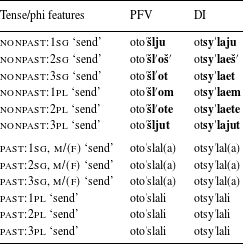
In the forms of most interest to us here, where DI aspect is reflected via the realization of a root vowel, it is instructive to point out that stress-bearing -a- appears throughout the inflectional paradigm in imperfective forms only, but not in perfective forms. We have so far been comparing perfective and DI forms in the past tense only, but it is worth considering their past and non-past forms. It is a well-known fact that Russian non-past forms are interpreted as present or future, depending on aspect: perfective aspect yields future tense interpretations, while imperfective aspect yields present tense interpretations. Past forms, on the other hand, have both perfective and imperfective counterparts. Considering all the forms yields a matrix like the one in Table 4. Note, crucially, that the non-past forms of the stem are different in the perfective and DI paradigms (distinctions are in bold).Footnote [21]
Past/non-past crossed with perfective/derived imperfective forms: ‘send’.
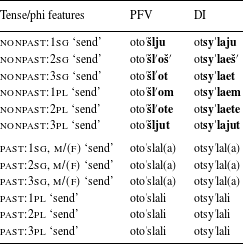
What we can conclude from the differences between DI and perfective forms of the non-past is that the conjugation instructions for the stem are actually different in DI and perfective forms. This is true not just for the forms in Table 4, but for every other attested case of the sub-pattern that is the primary concern of this paper (i.e. every case in Table 2). I provide an abbreviated matrix of these verbs in Table 5, showing only the first person form of the perfective and DI forms. All have distinct endings in the perfective and DI paradigms of the non-past.
Past/non-past crossed with perfective/derived imperfective forms.

Taken together, what these forms demonstrate is that the stressed -a- vowel is most regularly associated with the DI form of these verbs, rather than the perfective form, throughout the inflectional paradigm. This difference is obscured in the past tense forms, but emerges when we consider the entire paradigm, including non-past forms.
To review, this section has presented several pieces of evidence in support of the idea that the pre-inflection vowel in DI verb forms is actually a theme vowel associated with the functional head Asp, rather than the realization of v, as previous analysts (e.g., Svenonius Reference Svenonius2004b) had proposed. Following this line of thinking, we arrive at the analyses in (42), (43), and (44) for the verb forms discussed in this section.


Returning now to the broader analytical picture, the interaction we set out to account for is an instance of inward-sensitive allomorphy of the Asp head to the root: Asp must have no segmental realization in the context of a list of (yer-containing) roots. An important consequence of the analysis presented in this section is that the contextual allomorphy between DI and the root in the verbs of interest to us (44) becomes local, because the interaction is actually between the root and Asp, which are adjacent linearly, though not structurally. This is predicted to be permissible in a theory like that of Embick (Reference Embick2010), wherein allomorphy is accomplished through VI, which can be conditioned by linear adjacency of one morpheme to another.
The next task is to establish a clear picture of the mechanism by which the vocalic melody of the root of perfective (43) and DI (44) forms comes to differ as a result of aspectual information. This is captured in the trees above via the insertion of a mora, instead of an overt suffix, as the exponent of the DI Asp head in (44), and is the subject of the next section.
4. A phonological alternative to readjustment
The view we have adopted of the central pattern of interest in this paper, shown in (45c), involves, first, a special realization of DI in the context of a list of roots (the topic of Section 3), and second, exceptional yer realization triggered in this same list of roots by DI features on Asp.

We are now in a position to talk about the second component of the pattern, in which the vocalic melody of the root is the reflex of derived imperfective features. Section 2.3 above described a standard DM way of operationalizing this process, involving the use of readjustment rules. As discussed in the introduction, there is good theoretical reason to be concerned about the existence of such rules in the system, and also to question how they should interact with the rest of the theoretical apparatus. In the broadest and original view (Chomsky & Halle Reference Chomsky and Halle1968), readjustment rules apply to the output of word-formation processes to take care of any arbitrary or seemingly irregular and morpheme- or environment-specific processes, and they apply before phonological rules, which suggests that they should be understood as distinct from the phonology proper. In more recent and narrow terms (Embick & Halle Reference Embick, Halle, Geerts, von Ginneken and Jacobs2005), readjustment rules are understood as the application of a phonological process, triggered by morphosyntactic features, in listed environments. Here, too, it is not always entirely clear how these rules should interact with the rest of the phonology of a given language.
A primary empirical difficulty with applying the readjustment rule in (23) above, repeated in (46), to account for the grammatically triggered yer realization in cases like (45c) above is that it is not clear how this rule should interact with the rest of Russian phonology.

What the rule in (46) fails to capture is that the process of yer realization is prevalent throughout the phonology of Russian, and that root yer realization in (45c) interacts just as expected with the rest of yer phonology. Recall from Section 2 that in addition to phonotactically motivated yer realization, there is an alternating yer realization pattern throughout the phonology of Russian which emerges from close investigation of yer realization in perfective verbs: a prefix yer is realized only if the root yer has been deleted. The DI verbs which follow the pattern in (45c) likewise conform to this observation, resulting in a sort of mirror image of the perfective forms: their root yer is realized as the reflex of morphosyntactic features, and, following the alternating pattern, their prefix yer is therefore not realized. The motivation for yer realization in (45c) is grammatical, rather than phonological; but in every other respect, the phonology treats the vowel realized in the root of (45c) as a yer. To the extent possible, then, it is desirable that the formalization of this pattern should treat the yer realization in the root of (45c) as part of the regular phonology of the language, rather than via a special rule whose interaction with the rest of the phonological system is not entirely clear.
What follows is an attempt to formalize a treatment of the exceptional root yer realization in examples like (45c) without appealing to readjustment rules. I have argued that what is special about cases like (45c) is not the phonological process involved (which behaves as expected, phonologically) but rather its motivation, which is morphosyntactic rather than phonological. This generalization can be captured by combining a specific way of formalizing yer vocalization (Yearley Reference Yearley, Beckman, Dickey and Urbanczyk1995) with the idea that VI can insert not just segments, but also other kinds of phonological representations as exponents of morphosyntactic features.
The core idea behind this approach is that VI should be empowered to match morphosyntactic features not just with (strings of) segments (e.g., affixes), but also with phonological representations of other kinds. The idea is particularly attractive in application to the yers, because well-established phonological analyses have for some time been treating yers as vowels which have segmental content but are not associated with a mora (Yearley Reference Yearley, Beckman, Dickey and Urbanczyk1995) or, in autosegmental terms, a timing slot in the metrical grid (Rubach Reference Rubach1986, Kenstowicz & Rubach Reference Kenstowicz and Rubach1987) in the underlying representation. If the relevant roots lack a mora in their underlying representations, but the relevant VI entry for DI features contains a floating mora, the most natural way for this mora to be realized is by realization of an already present but otherwise mora-less root vowel. The relevant VI entry for cases of exceptional yer realization, then, would be as in (47).

The reference made to the identity of the root in the process of VI of AspDI is of a linearly adjacent nature, for the reasons enumerated in Section 3. Once the exponent of DI is established through VI, it is the job of the phonological component to determine how this floating mora behaves and how it is realized. I will assume, following Haugen (Reference Haugen2008), that the output of VI becomes the input to an Optimality Theory (OT) evaluation.Footnote [22]
To flesh out this account, we will adopt and extend Yearley’s (Reference Yearley, Beckman, Dickey and Urbanczyk1995) Optimality Theoretic account of yer realization. This is not the only existing OT account (e.g., Gouskova Reference Gouskova2012), and it is not without its deficits. For example, it presents potential problems for Richness of the Base, since according to this tenet, it should be possible in principle for any vowel to be specified as mora-less in the input; it is difficult to understand, on this theory, why only certain vowels (mostly [o] and [e]) alternate (Gouskova Reference Gouskova2012). Despite this difficulty, analyses of this type have the best chance of accounting for the irregular DI pattern under discussion here.Footnote [23]
On this approach, underlyingly mora-less vowels are not realized in the surface form unless their realization resolves an otherwise unparsable cluster. Correspondingly, constraints can be invoked to regulate when these vowels are assigned moras (i.e. realized) in an output structure. The understanding of ‘unparsable’ is of course different for every language. In Russian, parsable syllables in output forms emerge as the result of a number of highly ranked constraints which dictate such specifics as the preferred type of syllable onset or coda, the preferred sonority contour, etc. Some of the constraints relevant to modeling this interaction are shown in (48).

In morphologically simple(r) cases, the ranking of these constraints, as in (49), yields the correct outputs.


In (49), the yer in the nominative form is realized to avoid the alternative, a complex coda cluster (which Russian disprefers). In the genitive form of the same word, there is no risk of creating a complex coda, so the yer is not realized, thus avoiding a needless violation of Dep- ${\it\mu}$. Apart from constraints like *cc, there must also be constraints that enforce the requirement that the Russian syllable have one and only one syllable peak (Katz Reference Katz2006), as in (50).

Nothing more needs to be said in order to account for the behavior of yers in un-prefixed, inflected verbs. To rule out a candidate like *[žg] in (51), all that is necessary is that we take ssc to rule out syllables that have a sonority plateau (e.g., two obstruents with no peak).Footnote [24]


Applying this approach to the cases of interest to us – starting with perfective verbs with yer-containing roots, and moving to the DI forms – requires some extensions of this basic scheme. I will assume that the input to an OT evaluation is a representation that contains the necessary phonological exponents, and that the building of prosodic structure is the job of the constraint ranking. This is especially important for the forms of interest to us, because of the well-known observation that verbal complexes involving LP also involve a bracketing paradox, shown in (52) (e.g., Pesetsky Reference Pesetsky1979, Matushansky Reference Matushansky2002). The morphosyntax in (22) puts LP low and internal to the rest of the verbal complex (for reasons defended in Svenonius Reference Svenonius2004a, Gribanova Reference Gribanova2013b), but for the purposes of phonology they are treated as external to the inflected stem; see Matushansky (Reference Matushansky2002), Gribanova (Reference Gribanova2009), Blumenfeld (Reference Blumenfeld and Makarova2012) for the full range of phonological evidence.

However this paradox is to be resolved, it is important that the phonological representation put the prefix outside the rest of the complex. For the purposes of simplicity, I will assume here that this is accomplished by a prosodic restructuring of the morphosyntactic structure, similar in spirit to the proposal of Matushansky (Reference Matushansky2002). Doing this in OT will require, first, prosodic structures which can be recursive (Ito & Mester Reference Ito, Mester, Miyamoto and Ochi2007), for example a  ${\it\omega}_{\text{MAX}}$ embedding a
 ${\it\omega}_{\text{MIN}}$. It will also require a highly ranked Align(Root, L,
 ${\it\omega}_{\text{MIN}}$ L) constraint in (53), whose function is to ensure that the word’s root is left-aligned with a prosodic word.Footnote [25]

Al(R L,  ${\it\omega}_{\text{MIN}}$ L) will be vacuously satisfied if morphosyntactic and phonological bracketing align, as in the case of prefix-less words, prepositions with hosts, and high-attaching prefixes (see Svenonius Reference Svenonius2004b, Gribanova Reference Gribanova2013b); in the cases of mis-alignment, Al(R L,
 ${\it\omega}_{\text{MIN}}$ L) will enforce the required phonological bracketing, as shown in (54).

Recall that, in both perfective and DI forms of this type, the prefix yer’s behavior is conditioned by the behavior of the root yer (e.g., the alternating pattern). To model this, we will need to relativize Dep- ${\it\mu}$ to
 ${\it\omega}_{\text{MIN}}$ and
 ${\it\omega}_{\text{MAX}}$, reflecting the differing behavior of the root and prefix yers, shown in (55).

Ranking Dep- ${\it\mu}_{{\it\omega}_{\text{min}}}$ above Dep-
 ${\it\mu}_{{\it\omega}_{\text{max}}}$ will ensure that realizing the root yer is more costly than realizing realizing the prefix yer; this essentially enforces the default perfective pattern, in which the root yer is only realized in order to satisfy constraints on optimal syllable structure or sonority.
The discussion in Section 2 above demonstrated that prefix yers are sometimes realized not to optimize prosodic structure, but simply as a reflex of Havlík’s Law. This pattern will need to be specially enforced, by a constraint developed for similar Polish cases by Jarosz (Reference Jarosz2006: 189), shown in (56).

A highly ranked Max-v2 prevents deletion of both yers, in cases where that does not already yield a markedness violation. Taken together, these constraints, ranked as in (57), will yield the basic pattern of yer realization and deletion in the perfective forms of interest to us.Footnote [26] The brackets associated with the output candidates should be taken as a shorthand for the recursive prosodic structure illustrated in (54), where the outer brackets mark  ${\it\omega}_{\text{MAX}}$ and the inner brackets mark
 ${\it\omega}_{\text{MIN}}$.


This ranking reflects a preference for yers to be deleted in the root over the deletion of yers in the prefix. It will similarly deal with cases in (58) and (59), in which yers must be realized in the root for phonological reasons.


The crucial losers in (59) are (c) and (d) of the masculine form, and (b) and (c) of the feminine form. Both sets must be ruled out by ssc, which should militate against the bad clusters. For (b) and (c) to be ruled out, the sequence [rl] must be excluded, perhaps by working a ban on this kind of plateau into the ssc.
This ranking will also account for the cases in (60), in which there are yers only in the prefix, but not in the root.


Having captured the behavior of yers in perfective forms, we now move to the core cases of interest to us, grammatically triggered yer realization in the root. The core mechanism exploited here is the insertion, at VI, of a floating mora as the theme vowel associated with Asp. The analysis must ensure that the floating mora docks within some local domain ( ${\it\omega}_{\text{MIN}}$), so that yer realization in the prefix is not possible as a reflex of DI features. One way to accomplish this would be via a constraint like gap
 $\ll$x (Wolf Reference Wolf, Bateman, O’Keefe, Reilly and Werle2006), where x in this case would be
 ${\it\omega}_{\text{MIN}}$, shown in (61).

If there are going to be two exponents of a single morpheme – in our case, -a- and the floating mora that is inserted along with it – and those exponents are going to be non-contiguous, then gap $\ll$
 ${\it\omega}_{\text{MIN}}$ enforces that they be realized in the same prosodic domain (
 ${\it\omega}_{\text{MIN}}$). This constraint will ensure that the most optimal way to realize the mora will be to realize the root yer, as in (62).Footnote [27]

A word is in order here about how gap $\ll$
 ${\it\omega}_{\text{MIN}}$ should be interpreted in the context of the overall proposal, wherein the TH position is both projected and exponed post-syntactically. What I assume is that
 ${\it\alpha}$ and
 ${\it\beta}$ in (61) are in fact exponents of the same morpheme, Asp: one of these is the exponent of Asp itself (the mora), and one of them is the exponent of the TH node associated with Asp. Since TH positions are generally taken to be post-syntactically projected, it is important that this process take place before or at VI, so that both the mora and the TH vowel are present in the input to the phonological evaluation. There is nothing surprising about this, since dissociated morphemes must generally be subject to VI and will therefore be projected before this point in the post-syntax (see Embick Reference Embick1997 for discussion).
Returning now to the main point, putting a floating mora in the input to the phonology allows us to capture the non-concatenative nature of the observed interaction; if the interaction is actually a phonological one, this is expected. Further, the hope is that phonological analyses of this type can be used to account for a large portion of phenomena that have traditionally been the territory of readjustment rules in DM accounts.
5. Conclusion
This paper set out with the goal of accounting for a non-concatenative morphological process in a certain subset of Russian verbs. In the most neutral terms possible, what is involved here is a change in the vocalic melody of the verb, triggered by purely morphosyntactic features, namely the derived imperfective. I have argued for a concrete view of this pattern which resolves two major questions about its nature. First, by way of what mechanism should the form of the root itself change in response to derived imperfectivization? Second, DI is usually expressed as a suffix, but this suffix is not present in verbs with yer-containing roots; can we characterize this allomorphy in a way that is consistent with the locality constraints imposed by prominent theories of allomorphy?
In addressing the first question, I argued that the alternation in roots – most often between a vowel-less form and a form with a vocalic nucleus – is part of a more general phonological process (yer alternations), and is special only in that the yer vocalization is the reflex of a morphosyntactic trigger (DI), rather than being phonologically motivated. The typical DM approach to a process like this would involve positing a readjustment rule, which I have argued is undesirable both for empirical and theoretical reasons. I have offered an alternative analysis that mirrors this perspective, letting the phonological component treat the vocalic pattern as a yer alternation. To trigger this special yer realization, our model must allow exponents of morphosyntactic features to be not just segments (the simpler case), but also pieces of autosegmental representations – in this case, an additional mora.
In addressing the second question, I first considered a prominent analysis of the Russian verbal complex (Svenonius Reference Svenonius2004b), a consequence of which is that the allomorphic interaction between the DI features hosted by Asp and the root would have to be non-adjacent. I then demonstrated that re-analysis of the pre-inflection vowel of the derived imperfective forms – as a theme vowel projected from the Asp head – has positive consequences for the overall analysis of derived imperfective suffixation. It also renders the relevant allomorphic interaction linearly adjacent. A consequence of this view is that the contextual allomorphy of DI to the root need not be defined as a non-local process; this, in turn, vindicates theories which take locality to be a precondition for contextual allomorphy (Siegel Reference Siegel and Stein1978; Allen Reference Allen1979; Embick Reference Embick2003, Reference Embick2010; Bobaljik Reference Bobaljik2012).
Insofar as this approach is on the right track, it weighs in on two important theoretical questions. First, it addresses the question of locality in contextual allomorphy, arguing that this generalization is not threatened by the data presented in this paper (though it appears that it may be, on first impression). Second, it addresses the question of readjustment rules, arguing that non-concatenative effects in DM may be analyzed without recourse to such rules. To make these arguments, it was necessary to make an important change to the theory of DM. As mentioned above, we must allow VI to be more liberal in terms of the kind of exponents a morphosyntactic terminal may correspond with.
By way of concluding, it is worth examining where DM stands with respect to the broader landscape of morphological theories in dealing with non-concatenative morphological processes of the type under investigation here. Morpheme-based theories have traditionally had difficulty accounting for certain types of non-concatenative processes, and this deficit has been used as empirical and theoretical support for the need for process-based approaches (Anderson Reference Anderson1992). Item-and-process morphological approaches, though, have (at least in principle) difficulty in constraining the possible range of processes, and therefore the possible range of morphological operations in natural language (Anderson Reference Anderson1992). What I propose here, in line with Bye & Svenonius (Reference Bye and Svenonius2012), is that morpheme-based theories like DM can do a better job of capturing such processes if they leverage the tools provided by the phonological module, aided by the idea that VI can insert phonological representations, as well as segments. This approach aims to strike a balance between empirical coverage – accounting for cases of non-concatenative morphology – and restrictiveness. What the approach predicts is that the phonology of a given language will assimilate VI-inserted phonological representations (morae, feet, tones, etc.) in a manner that is completely consistent with how the phonology would treat them if they were not inserted as the exponents of morphosyntactic information. This treats the relevant processes in arguably a more theoretically constrained way than item-and-process theories would. The case study presented here is meant to be an example of just this kind of interaction.