Introduction
Parasite ecology investigates the complex web of factors that affect various levels of biological organisation (Poulin Reference Poulin2007). The structure of parasite communities is determined by a complex interplay of biotic factors (intrinsic to the host, such as body weight and sex) and abiotic factors (extrinsic and environmentally driven, such as habitat and climate) (Aho Reference Aho, Esch, Bush and Aho1990; Cardoso et al Reference Cardoso, Costa-Neto, Braga, Weksler, Simões, Maldonado, Luque and Gentile2020). Among host attributes, body mass has been identified as a primary predictor of variation in parasite richness among different host taxa (Cirino et al Reference Cirino, Costa-Neto, Cardoso, Maldonado and Gentile2025; Dallas et al Reference Dallas, Holian and Foster2020; Kamiya et al Reference Kamiya, O’Dwyer, Nakagawa and Poulin2014). For vertebrates, host sex is also a relevant factor; higher infection rates in male hosts than in female hosts represent a common pattern (Zuk and McKean Reference Zuk and McKean1996). This sex-biased parasitism is potentially linked not only to behavioural traits, such as increased exploratory behaviour and larger home ranges (Rossin and Malizia Reference Rossin and Malizia2002), but also to physiological mechanisms, including the immunosuppressive effects of steroid hormones (e.g., testosterone) associated with secondary sexual characteristics and reproductive stress (Zuk and McKean Reference Zuk and McKean1996).
Conversely, environmental characteristics, particularly habitat heterogeneity, act as crucial ecological filters, where spatial variability in environmental conditions creates different niches or opportunities for hosts and their parasites, influencing their interactions and distribution (Brian and Aldridge Reference Brian and Aldridge2023; Simões et al Reference Simões, Gentile, Rademaker, D’Andrea, Herrera, Freitas, Lanfredi and Maldonado2010). Habitat conditions regulate the survival, development, and transmission of free-living parasite stages, especially for geohelminths (Anderson Reference Anderson2000). The Brazilian Caatinga biome, characterised by semiarid conditions and water stress, imposes a strong environmental barrier that limits the establishment of certain parasites (Simões et al Reference Simões, Garcia, Costa-Neto, Santos, Faro and Maldonado2017). However, this biome is not homogeneous; rather, it constitutes a complex landscape mosaic (Gomes et al Reference Gomes, Medeiros and Albuquerque2010) that can be partitioned into distinct phytophysiognomies, such as open shrubland (Carrasco) and seasonal deciduous forest (Mata Seca).
Although the genus Thrichomys Trouessart, 1880 is widely distributed, knowledge regarding its helminth fauna varies considerably across species and biomes. The caviomorph rodent Thrichomys laurentius Thomas, 1904 (Echimyidae) is endemic to the Caatinga (Abreu et al Reference Abreu, Casali, Garbino, Loss, Moras, Nascimento, Oliveira, Pavan, Percequillo and Nascimento2025; Pessôa et al Reference Pessôa, Tavares, Neves, Silva, Patton, Pardiñas and D’Elía2015), making it an ideal indicator species to evaluate the influence of environmental heterogeneity on parasite communities, as it inhabits distinct phytophysiognomies within the semiarid region (Carvalhães et al Reference Carvalhães, Santos, Novaes, Finotti and Cerqueira2015). In the Caatinga, previous taxonomic and ecological surveys of this host (e.g., Durette-Desset and Tchéprakoff Reference Durette-Desset and Tchéprakoff1969; Lent and Freitas Reference Lent and Freitas1938; Quentin Reference Quentin1969; Rêgo Reference Rêgo1967; Simões et al Reference Simões, Garcia, Costa-Neto, Santos, Faro and Maldonado2017) recorded a richness of only four nematode species, compared with congeneric hosts in mesic biomes, such as T. fosteri (syn. T. pachyurus) in the Pantanal, which harbours up to 12 species (Simões et al Reference Simões, Gentile, Rademaker, D’Andrea, Herrera, Freitas, Lanfredi and Maldonado2010): Heligmostrongylus almeidai (Durette-Desset and Tchéprakoff, Reference Durette-Desset and Tchéprakoff1969), Paraheligmonella interrogans (Lent and Freitas, Reference Lent and Freitas1938) Durette-Desset, Reference Durette-Desset1971 (originally reported under the synonymous names Heligmostrongylus tcheprakovae and Heligmostrongylus interrogans, respectively), Stilestrongylus freitasi Durette-Desset, Reference Durette-Desset1968, and Helminthoxys freitasi Quentin, Reference Quentin1969, suggesting that semiarid conditions may act as a restrictive environmental filter for the survival and establishment of free-living parasite stages, thereby limiting the overall helminth species richness (Simões et al Reference Simões, Garcia, Costa-Neto, Santos, Faro and Maldonado2017). However, it remains unexplored how the type of environment in the Caatinga, specifically the contrast between xeric shrublands (Carrasco) and humid forest enclaves (Mata Seca), influences the structuring of these communities in T. laurentius.
To address this knowledge gap, the objectives of this study were to (1) characterise and compare the helminth community structure of T. laurentius between the Mata Seca and Carrasco phytophysiognomies; (2) evaluate the influence of habitat type and host attributes (sex and body weight) on infracommunity diversity; and (3) calculate the beta diversity of parasites among infracommunities. We hypothesised that the Mata Seca would favour higher parasite diversity and infection rates than the Carrasco environment because its higher moisture retention allows it to function as a mesic refuge for the development of free-living infective stages of geohelminths.
Material and methods
Study area
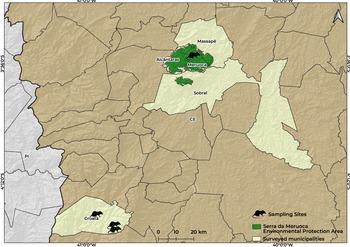
The study encompassed two areas in the Caatinga biome in the state of Ceará, north-eastern Brazil, representing the contrasting phytophysiognomies of Carrasco (municipality of Croatá: 4°25′27.80″S, 40°51′36.12″W) and Mata Seca (municipality of Meruoca: 3°33′41.49″S, 40°27′20.14″W) (Figure 1). While both areas are geographically close, they present distinct local climates due to orographic variations, alongside differences in soil properties and vegetation structure. The Mata Seca (Tropical Pluvial Subdeciduous Forest) is a high-altitude orographic enclave (brejo de altitude) that intercepts humid air masses, resulting in a tropical climate with a distinct dry season (Aw according to the Köppen-Geiger classification; Alvares et al Reference Alvares, Stape, Sentelhas, de Moraes Gonçalves and Sparovek2013). This area acts as a mesic refuge with greater water retention due to moisture-retaining soils with a higher clay fraction, featuring a more complex forest structure with taller, more voluminous tree species and a higher richness of trees and shrubs (Lima et al Reference Lima, Sampaio, Rodal and Araújo2011). In contrast, the Carrasco represents the typical hot semi-arid climate of the biome (BSh; Alvares et al Reference Alvares, Stape, Sentelhas, de Moraes Gonçalves and Sparovek2013), characterised by a dense xerophytic shrubland growing predominantly on deep sandy soils, dominated by thin-stemmed, small-sized woody vegetation with multiple stems that form an intricate tangle of branches (Araújo et al Reference Araújo, Sampaio, Figueiredo, Rodal and Fernandes1998). Because of this vegetation structure and its sandy soil, the Carrasco imposes a more severe aridity filter due to low moisture retention (Gomes et al Reference Gomes, Medeiros and Albuquerque2010). Thus, these two areas represent distinct environmental filters driven by local climatic and edaphic features that may differentially modulate the composition of helminth communities. The rodent Thrichomys laurentius was captured in high abundance and with helminth infection in both contrasting vegetation types, providing a robust basis for testing our hypotheses.
Map of the study area in the state of Ceará, north-eastern Brazil. The inset highlights the state location within Brazil. The main map displays the collection municipalities (light beige) and the Environmental Protection Area (APA) Serra da Meruoca (green). Black rodent silhouettes indicate the specific capture sites of Thrichomys laurentius in the two contrasting phytogeographic subunits: Mata Seca (Meruoca) and Carrasco (Croatá municipality). (Map created by Ana Julia Dias).
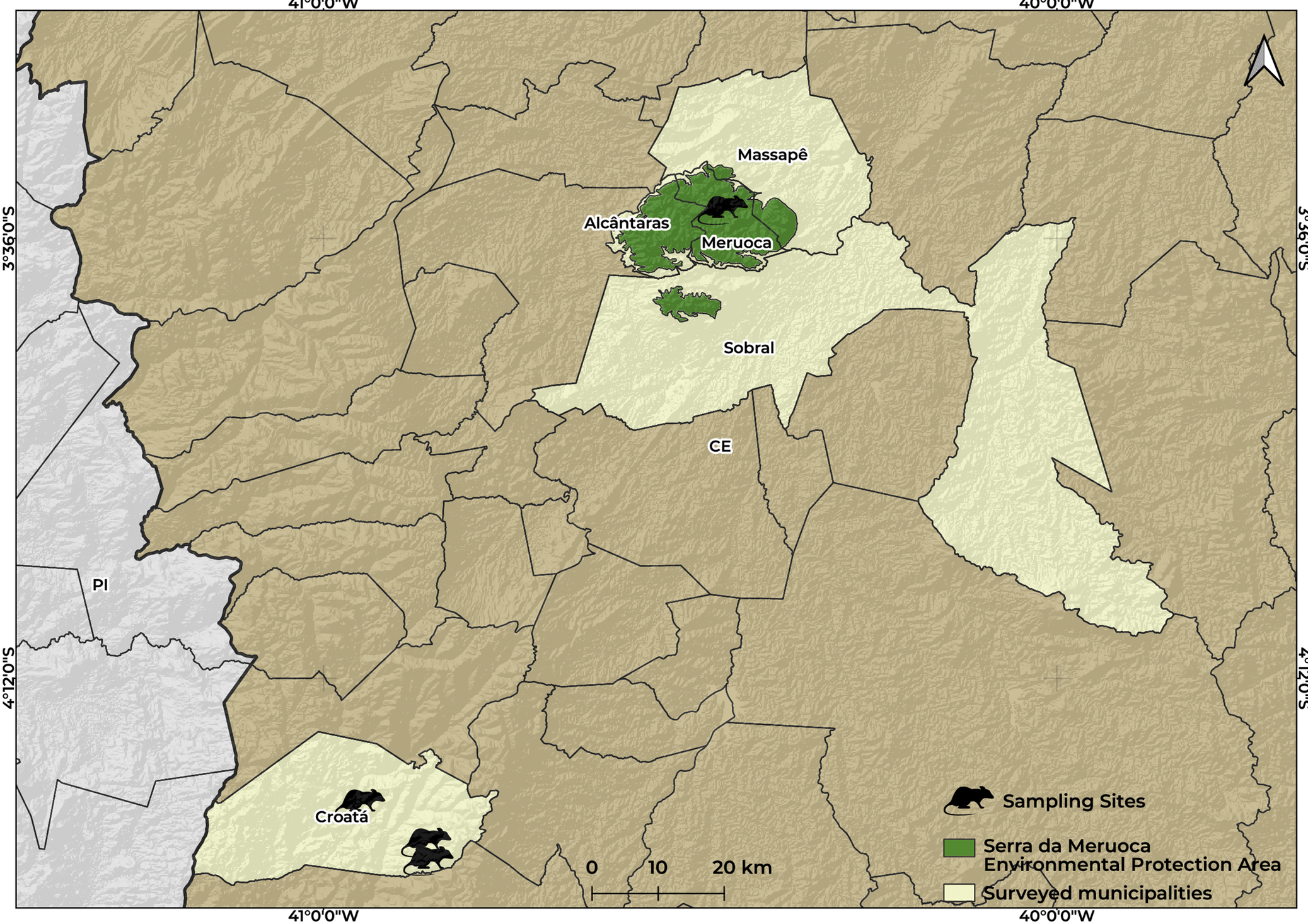
Figure 1 Long description
A map of the state of Ceará in Northeastern Brazil, with an inset showing its location within the country. The map highlights two collection municipalities in light beige: Croatá, representing the Carrasco phytophysiognomy, and Meruoca, which includes the green-shaded Environmental Protection Area (APA) Serra da Meruoca, representing the Mata Seca. Black rodent silhouettes pinpoint the exact capture sites within these two contrasting areas .
Host collection and examination
Rodents were captured using Sherman® (7.62 × 9.53 × 30.48 cm) and Tomahawk® (45 × 16 × 16 cm) live traps. The traps were deployed on the ground, in the understorey, or tied to tree branches. The bait consisted of a mixture of peanut butter, banana, oats, and bacon or sardines in soybean oil. Sampling was conducted systematically along linear transects during campaigns of five consecutive nights in both phytophysiognomies. The total trapping effort was 300 trap-nights in the Carrasco and 200 trap-nights in the Mata Seca.
The captured Thrichomys laurentius specimens were transported to a field laboratory, where bionomic data (sex, body mass, external measurements, and reproductive condition) were recorded. Taxonomic identification of host specimens based on morphology and karyotypes (diploid and fundamental chromosome numbers) (Bonvicino et al Reference Bonvicino, Oliveira and D’Andrea2008) was complemented by molecular sequencing when necessary.
All field procedures, including biosafety techniques (Lemos and D’Andrea Reference Lemos and D’Andrea2014), strictly followed the standards for capture, handling, and care approved by the Ethics Committee on Animal Use of the Oswaldo Cruz Foundation (CEUA, licences LW-39/14 and L-018/2022) and were authorised by the Brazilian Institute for Biodiversity Conservation (ICMBio/SISBIO, licence 13373-1). Animals were euthanised for biological sample collection and helminth recovery following the guidelines of the American Society of Mammalogists (Sikes and Gannon Reference Sikes and Gannon2011; Sikes 2016) and Brazilian ethical standards (CFMV Resolution no. 1000; Brasil 2012). Because immediate parasite recovery was not feasible under field conditions, the digestive system (stomach, small intestine, and large intestine) was removed and immediately stored in 70% ethanol, which served to simultaneously preserve the organs and the helminths in situ for subsequent helminthological analysis. Host voucher specimens were preserved by taxidermy and deposited in the mammal collection at LABPMR/IOC-Fiocruz, Rio de Janeiro, Brazil.
Parasite collection and identification
In the laboratory, helminths were recovered by thoroughly examining the previously ethanol-preserved viscera (stomach, small intestine, large intestine, lungs, and liver) and the thoracic and abdominal cavities of the host specimens. Organs were separated into Petri dishes and dissected under a stereomicroscope to facilitate the recovery and quantification of all helminth specimens. The recovered parasites were washed twice in a 0.85% saline solution to remove tissue debris and subsequently preserved in 70% ethanol. This fixation and storage method was chosen because it successfully preserves both the morphological integrity and the DNA of the specimens for integrative analyses.
For morphological analysis, nematodes were cleared in Amann’s lactophenol and examined as temporary mounts. Cestodes, conversely, were stained with Langeron’s hydrochloric carmine, dehydrated through an ascending ethanol series, cleared in eugenol, and permanently mounted in Entellan® (modified from Amato et al Reference Amato, Boeger and Amato1991). Morphological identification was performed using light microscopy, based on established taxonomic keys and pertinent literature (Anderson et al Reference Anderson, Chabaud and Willmott2009; Khalil et al Reference Khalil, Jones and Bray1994; Rêgo Reference Rêgo1967; Vicente et al Reference Vicente, Rodrigues, Gomes and Pinto1997). Representative voucher specimens of the identified helminth species were deposited at the Helminthological Collection of the Oswaldo Cruz Institute (CHIOC/FIOCRUZ), Rio de Janeiro, Brazil.
Data analysis
Parasitological parameters, including prevalence, mean abundance, and mean intensity, were calculated for each helminth species following Bush et al (Reference Bush, Lafferty, Lotz and Shostak1997). To classify the structural importance of species within the community, the importance index (I) (Thul et al Reference Thul, Forrester and Abercrombie1985) was applied, categorising species as dominant (I ≥ 1.0), co-dominant (0.01 ≤ I < 1.0), or subordinate (0 < I < 0.01).
Species diversity for each infracommunity was quantified using Hill numbers (Hill Reference Hill1973), which provide complementary measures of diversity: species richness (q = 0), Shannon diversity (q = 1), and Simpson diversity (q = 2). These indices were calculated separately for each host to evaluate how diversity varies at the infracommunity level. Furthermore, sample-size-based rarefaction and extrapolation curves were constructed using these diversity measures to assess sampling sufficiency and compare diversity levels between the two phytophysiognomies. These curves were calculated at the component community level (i.e., the set of infracommunities from each area) based on host incidence data, with individual examined hosts as the sampling units, with 95% confidence intervals were calculated using 500 bootstrap replications to assess the statistical significance of the differences between the Carrasco and Mata Seca areas. To assess the influence of biotic (host sex, body weight, and body size) and abiotic (phytogeographic subunit: Carrasco or Mata Seca) predictors on diversity indices, we performed a generalised linear model (GLM) analysis following a Gaussian distribution. Prior to fitting the GLM, collinearity among the host predictor variables (body weight, body size, and sex) was assessed. Correlations between quantitative variables were evaluated using Pearson’s correlation test. Associations between categorical variables were assessed using chi-square tests, while associations between categorical and continuous variables were tested using Student’s t-tests. Highly correlated variables were excluded to prevent redundancy. Following this screening procedure, the global GLM was fitted to include only the least correlated variables alongside the phytogeographic subunit. The selection of the most parsimonious models was based on the corrected Akaike Information Criterion (AICc), with models presenting ΔAICc ≤ 2 considered plausible (Lukacs et al Reference Lukacs, Thompson, Kendall, Gould, Doherty, Burnham and Anderson2007). To quantify dissimilarity in species composition among infracommunities, we used total beta diversity (βsor), which is a composition-based metric derived from Sørensen dissimilarity (Baselga Reference Baselga2010). This measure captures differences in community composition based on species presence and absence. The additive decomposition proposed by Baselga (Reference Baselga2010) partitions total dissimilarity into two components: spatial turnover (βsim), which reflects species replacement along the environmental gradient, and nestedness (βnes), which represents the hierarchical loss or gain of species.
We also investigated the effect of the environment (phytogeographic subunit) on parasite infracommunity composition using a permutational multivariate analysis of variance (PERMANOVA). This analysis was conducted with a Sørensen dissimilarity matrix derived from species composition and performed using 999 permutations. Differences between the Mata Seca and Carrasco infracommunities were visualised using non-metric multidimensional scaling (NMDS).
All statistical analyses were conducted in R software version 4.5.2 (R Core Team 2025), adopting a significance level of 5%. Generalised linear models, collinearity diagnostics, Pearson correlations, chi-square tests, Student’s t-tests, PERMANOVA, and NMDS were performed using functions from the ‘vegan’ package (Oksanen et al Reference Oksanen, Blanchet, Friendly, Kindt, Legendre, McGlinn, Minchin, O’Hara, Simpson, Solymos, Stevens, Szoecs and Wagner2025). Model selection based on AICc was conducted with the ‘MuMIn’ package (Bartoń Reference Bartoń2024). Hill numbers (q = 0, 1, 2) and rarefaction and extrapolation curves were computed using the ‘iNEXT’ package (Hsieh et al Reference Hsieh, Ma and Chao2024). Total beta diversity based on Sørensen dissimilarity and its additive partition into turnover and nestedness components were calculated using the ‘betapart’ package (Baselga et al Reference Baselga, Orme, Villéger, De Bortoli, Leprieur, Logez and Henriques-Silva2023).
Results
Morphological remarks
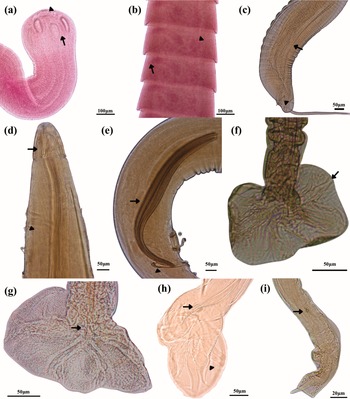
A brief differential diagnosis of the recovered specimens based on key morphological features was crucial for identifying the species found (Figure 2). Specifically, to differentiate the closely related sympatric species Heligmostrongylus almeidai Durette-Desset & Tchéprakoff, Reference Durette-Desset and Tchéprakoff1969 (CHIOC 39866 and 39869) and H. crucifer, the recovered specimens were assigned to H. almeidai due to the presence of minute rays 9, a dorsal ray that divides at mid-length, a characteristic blunt or rounded posterior extremity in females with the vulva situated very close to the anus, and a spicule length/body length ratio of approximately 19%. These features distinguish them from H. crucifer, which possesses long, developed rays 9 crossing rays 8, extremities of rays 6 extending beyond those of rays 8, and a spicule length/body ratio of about 11%. Furthermore, Paraheligmonella interrogans (Lent & Freitas, Reference Lent and Freitas1938) Durette-Desset, Reference Durette-Desset1971 (CHIOC 39867) and Stilestrongylus freitasi Durette-Desset, Reference Durette-Desset1968 (CHIOC 39871) were identified based on their distinct bursal symmetries and spicule dimensions. While P. interrogans features a subsymmetrical bursa with rays 9 and 10 merged and has females with an acute, conical tail, S. freitasi is characterised by an asymmetrical caudal bursa (type 2-2-1) with a hypertrophied left lobe, and a synlophe with more than 24 continuous cuticular ridges at mid-body. The oxyurid Helminthoxys freitasi Quentin, Reference Quentin1969 (CHIOC 39874) was distinguished by its cuticular lateral alae and the presence of two ventral mamelons in males, while Aspidodera raillieti Travassos, Reference Travassos1913 (CHIOC 39872) was recognised by its cephalic hood with longitudinal cordons that anastomose, forming loops over three lips, and a circular pre-cloacal sucker with robust margins in males. Finally, the cestode Raillietina sp. (CHIOC 39868 and 39870) was characterised by its rostellum armed with a double row of hammer-shaped hooks, muscular suckers armed with minute spinules, unilateral genital pores, and gravid proglottids containing parenchymatous egg capsules with a reduced number of eggs (3–4 per capsule).
Morphological features of the helminths recovered from the caviomorph rodent Thrichomys laurentius in the Caatinga biome, Brazil. (a–b) Raillietina sp.: (a) Scolex showing the suckers armed with minute spinules (arrow) and the armed rostellum (arrowhead); (b) Mature proglottids showing the cirrus sac (arrow) and the testes on the aporal side (arrowhead). (c) Helminthoxys freitasi (male): posterior region showing the single long spicule (arrow) and the gubernaculum (arrowhead). (d–e) Aspidodera raillieti: (d) Anterior extremity highlighting the cuticular dilatations forming the cephalic cordons (arrow) and the excretory pore (arrowhead); (e) Male posterior region showing the robust spicule (arrow), gubernaculum (arrowhead), and the pre-cloacal sucker (asterisk). (f) Heligmostrongylus almeidai (male): posterior region showing the copulatory bursa with symmetrical lateral rays (arrow). (g) Paraheligmonella interrogans (male): posterior region showing the copulatory bursa, spicules, and the prominent genital cone (arrow). (h) Stilestrongylus freitasi (male): posterior region showing the gubernaculum (arrow) and the asymmetrical bursa with a hypertrophied lateral ray (arrowhead). (i) Stilestrongylus sp. (female): posterior region showing the vulva opening and the evident muscular ovejector (arrow).
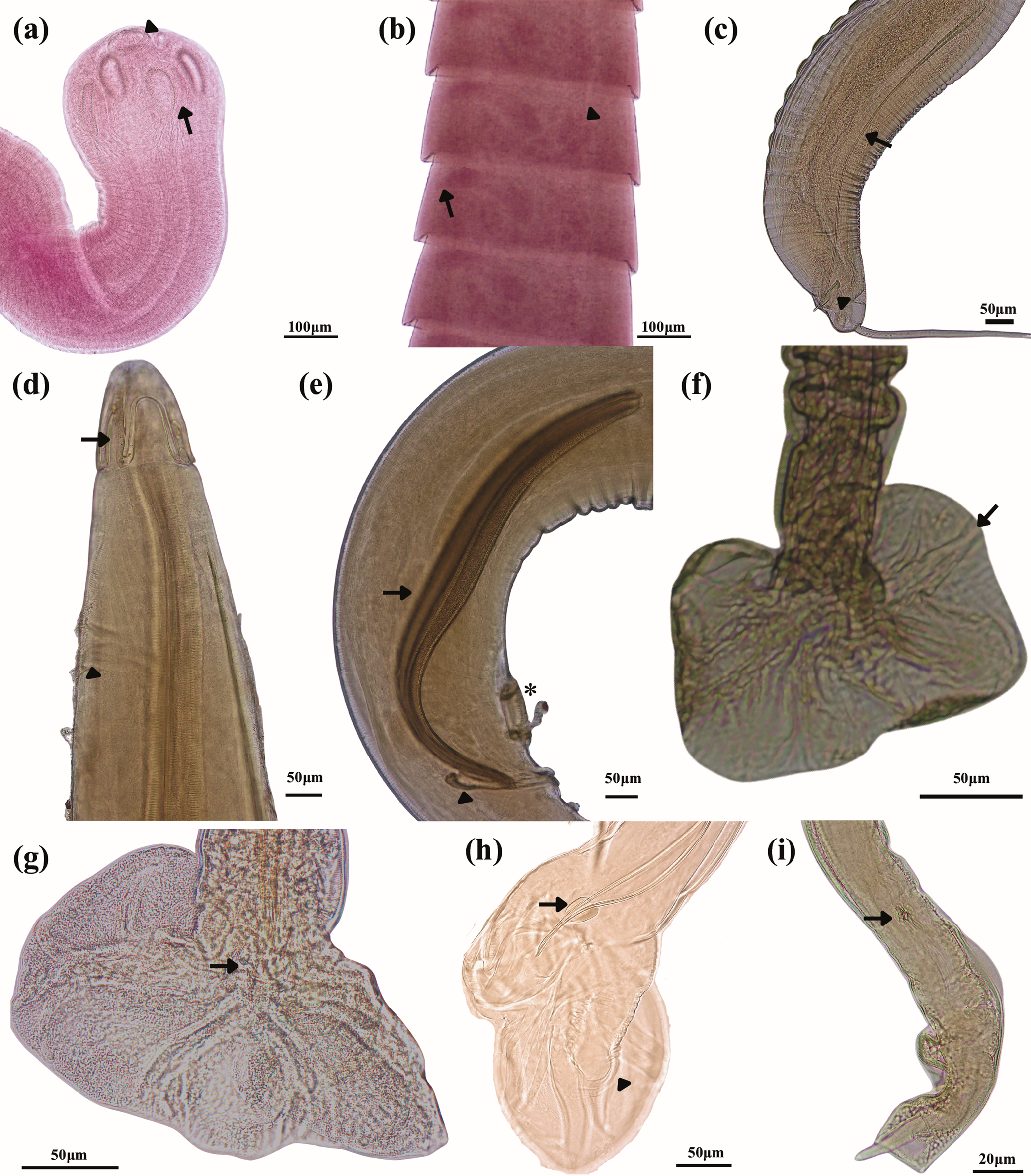
Figure 2 Long description
A composite light microscopy image showing multiple morphological details of the helminth species. It includes features such as the cephalic dilation, asymmetrical bursa, gubernaculum, and spicules of the male Heligmonellidae, as well as the cervical alae and oxyuriform esophagus of the female Syphacia and Helminthoxys species. Parts are labeled with lowercase letters in parentheses from (a) onwards.
Helminth community composition and infracommunities
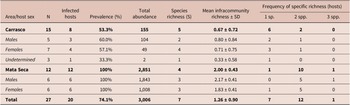
A total of 27 Thrichomys laurentius specimens were analysed, including 15 captured in the Carrasco area (5 males, 7 females, and 3 unsexed) and 12 in the Mata Seca (6 males and 6 females). The total helminth fauna comprised seven species: the nematodes Heligmostrongylus almeidai, Paraheligmonella interrogans, Stilestrongylus freitasi, Stilestrongylus sp., Helminthoxys freitasi, and Aspidodera raillieti, alongside the cestode Raillietina sp.
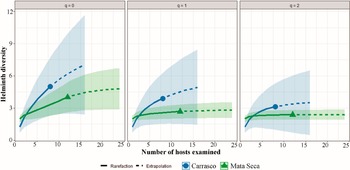
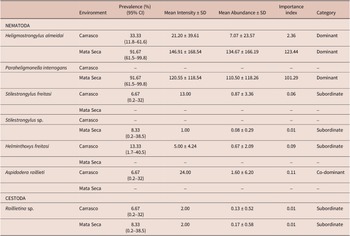
The rarefaction and extrapolation curves for parasite species did not indicate sampling sufficiency for species richness (q = 0) in either phytogeographic subunit, although the Mata Seca came closer to stabilisation than the Carrasco (Figure 3). However, both areas can be considered sufficiently sampled when analysing Shannon diversity and Simpson dominance (Figure 3). Mata Seca and Carrasco shared H. almeidai and Raillietina sp. The species H. freitasi, A. raillieti, and S. freitasi occurred exclusively in Carrasco, whereas P. interrogans and Stilestrongylus sp. were restricted to Mata Seca (Table 1). The variation in species richness across hosts is evidenced by the frequency distribution of hosts harbouring 1, 2, 3, or more species in each area, which highlights the dissimilarity in parasite composition (Table 2).
Sample-size-based rarefaction (solid lines) and extrapolation (dashed lines) curves of helminth diversity at the component community level (i.e., set of infracommunities), based on host incidence data, with individually examined hosts representing the sampling units in the Carrasco and Mata Seca phytophysiognomies. The curves indicate species richness (q = 0), Shannon’s exponential diversity (q = 1), and Simpson’s inverse diversity of Hill numbers. The shaded areas around the lines correspond to the 95% confidence intervals.
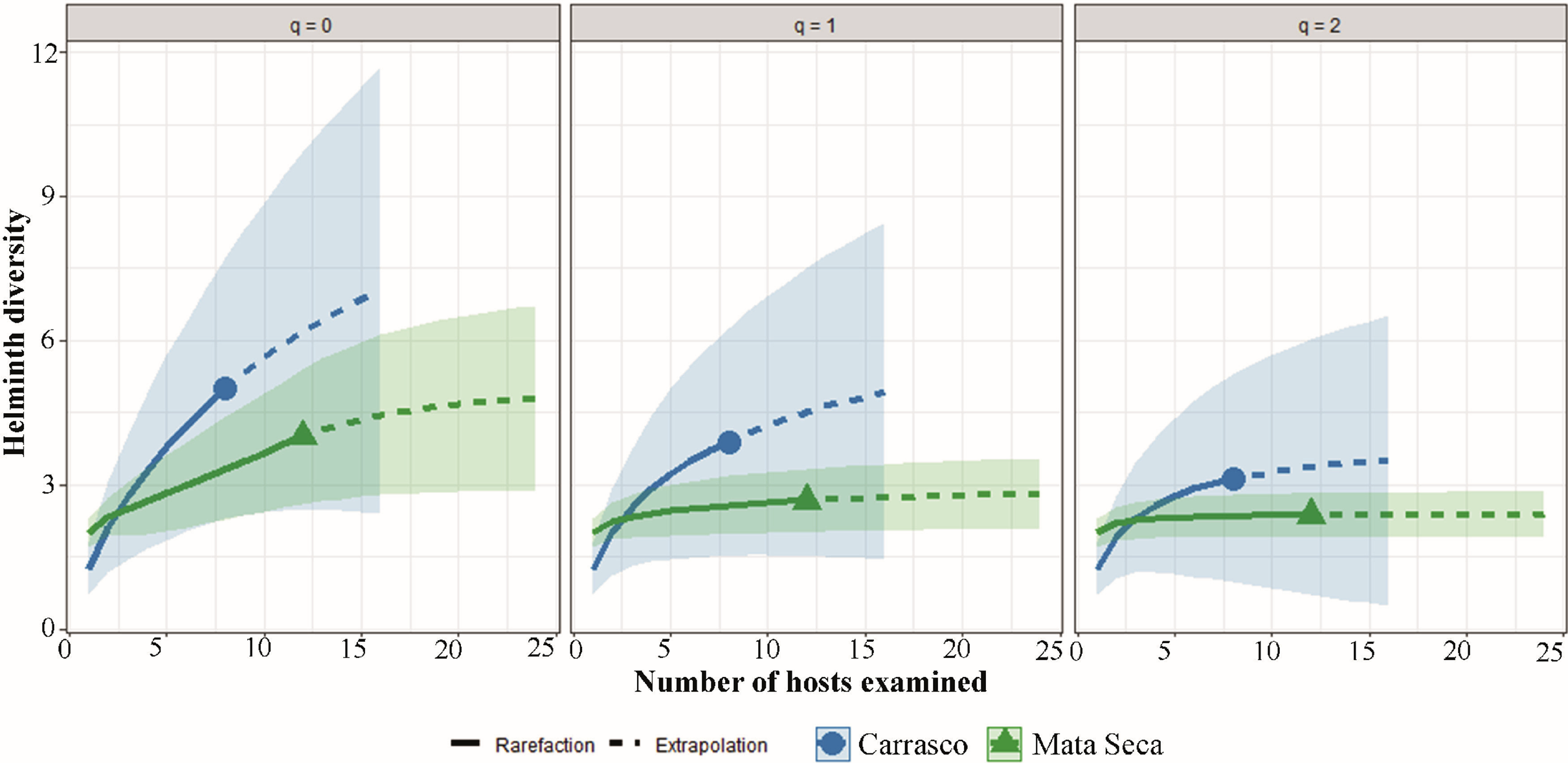
Figure 3 Long description
A line graph showing rarefaction (solid lines) and extrapolation (dashed lines) curves for helminth species diversity. The x-axis represents the number of sampled hosts, and the y-axis represents the Hill numbers. The curve for the Carrasco environment stabilizes, indicating adequate sampling, whereas the species richness curve (q=0) for Mata Seca continues to rise without reaching a clear asymptote, suggesting undetected rare species.
Prevalence (P), mean intensity (MI), mean abundance (MA), and importance index of the helminth species of Thrichomys laurentius in the Carrasco and Mata Seca phytophysiognomies in the Caatinga, Brazil
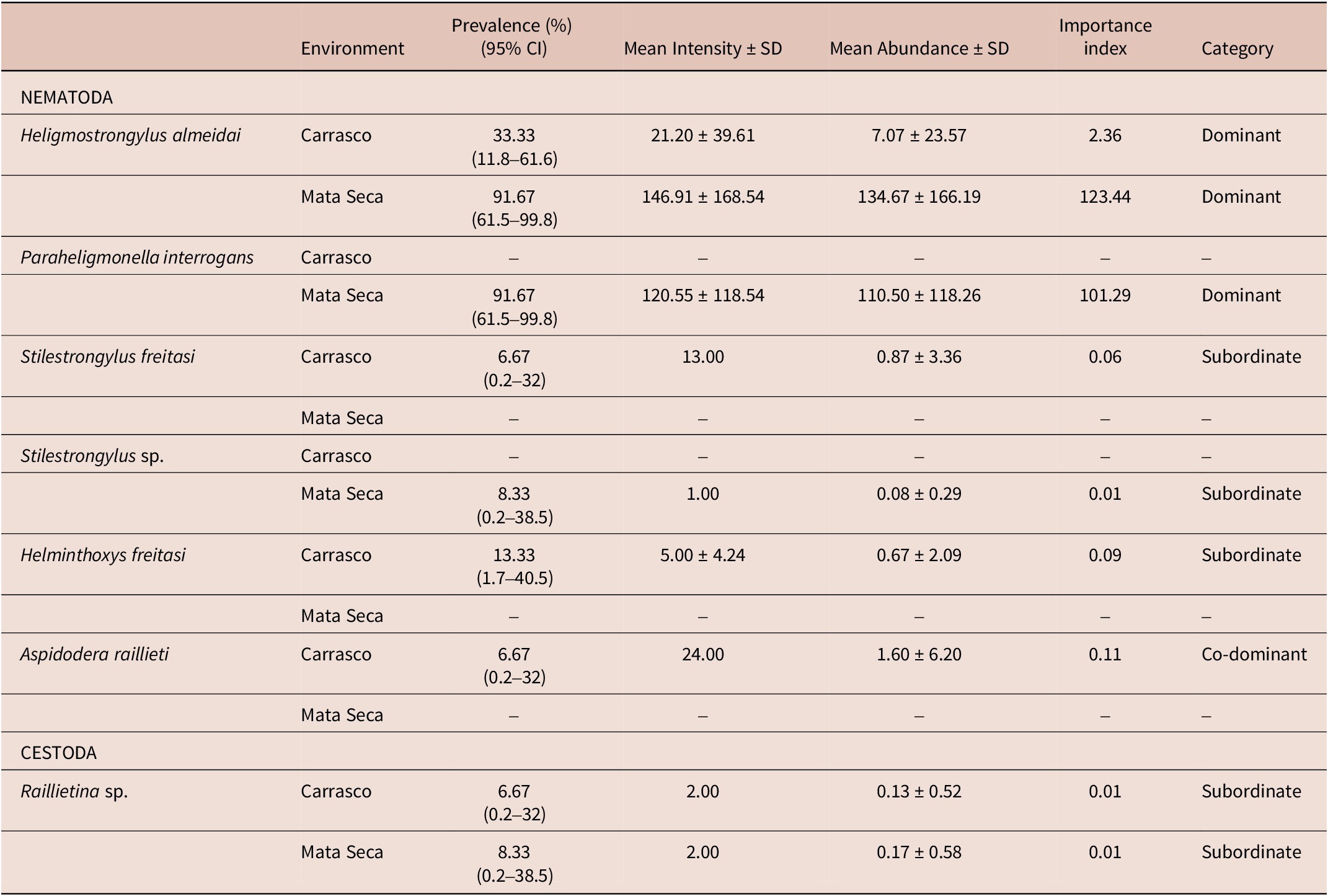
Table 1. Long description
A table presenting detailed parasitological parameters (prevalence with 95% confidence intervals, mean intensity, mean abundance, importance index, and category) for each of the seven helminth species recovered from Thrichomys laurentius (Heligmostrongylus almeidai, Paraheligmonella interrogans, Stilestrongylus freitasi, Stilestrongylus sp., Helminthoxys freitasi, Aspidodera raillieti, and Raillietina sp.). The data is stratified by the Carrasco and Mata Seca environments to highlight the local structural differences.
Descriptive parasitological parameters of helminth infracommunities of Thrichomys laurentius discriminated by host sex from the Caatinga biome (Carrasco and Mata Seca phytophysiognomies), Brazil
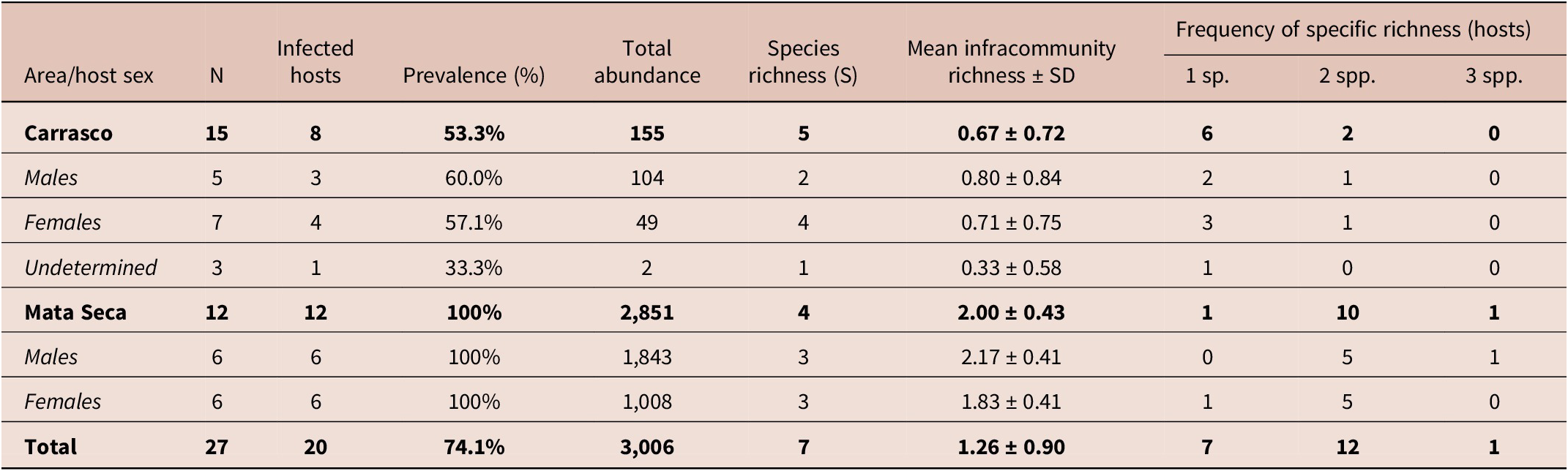
Table 2. Long description
A table summarizing the overall infection parameters of the helminth community in the rodent Thrichomys laurentius across two phytophysiognomies. It displays the number of hosts examined, number of infected hosts, total prevalence percentage, total helminth abundance, and species richness for the Carrasco (N=15) and Mata Seca (N=12) areas, further subdivided by host sex (males, females, and undetermined).
Descriptive infection parameters
A total of 3,006 helminth specimens were recovered. However, a contrast in both infection parameters, prevalence and abundance, was observed between the two areas: in the Mata Seca, all hosts (100%, 12/12) were infected, with a high total abundance of 2,851 helminths (mean abundance = 237.58), whereas in the Carrasco, only 53% (8/15) were infected, with a comparatively lower total abundance of 155 helminths (mean abundance = 10.33) (Table 2).
The community was numerically dominated by nematodes. The highest mean intensity of infection was recorded for H. almeidai in the Mata Seca (MI = 146.91 ± 168.54). To systematically address the influence of host sex on parasitism, all basic descriptive parameters discriminated by male and female hosts are detailed in Table 2. Concerning the application of the importance index, Heligmostrongylus almeidai was the only species classified as ‘dominant’ in the Carrasco (I = 2.35), whereas in the Mata Seca, both H. almeidai (I = 123.44) and P. interrogans (I = 101.29) reached this category (Table 1).
Influence of host characteristics and phytogeographic subunit on parasite diversity
Regarding sexual dimorphism, no statistically significant differences were found in the biometric measurements between sexes. Mean body size did not differ between females (202.7) and males (200.0) (Welch’s t-test, p = 0.85). Similarly, body weight showed no significant difference between females (mean = 242.2) and males (mean = 224.8) (Welch’s t-test, p = 0.66).
Only host body size and body weight were highly correlated (r = 0.9429; df = 17; p < 0.001). Thus, our adjusted global models in the GLM analysis included host sex (male/female), body weight, and phytogeographic subunit (Carrasco or Mata Seca) as predictors.
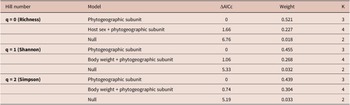
Across all Hill numbers (species richness (q = 0), Shannon diversity (q = 1), and Simpson diversity (q = 2)), the GLM analysis identified the phytogeographic subunit (Mata Seca) as the most influential predictor of helminth diversity per host, showing a positive effect (Table 3). Furthermore, models combining habitat type with either host body weight or host sex also received substantial support (Table 3). In these cases, a positive influence of male hosts on helminth species richness and of host body weight on Shannon and Simpson diversities was observed.
Generalised linear model (GLM) selection results for the Hill numbers of helminth infracommunities (q = 0, 1, 2). Predictor variables included host weight, sex, and phytogeographic subunit
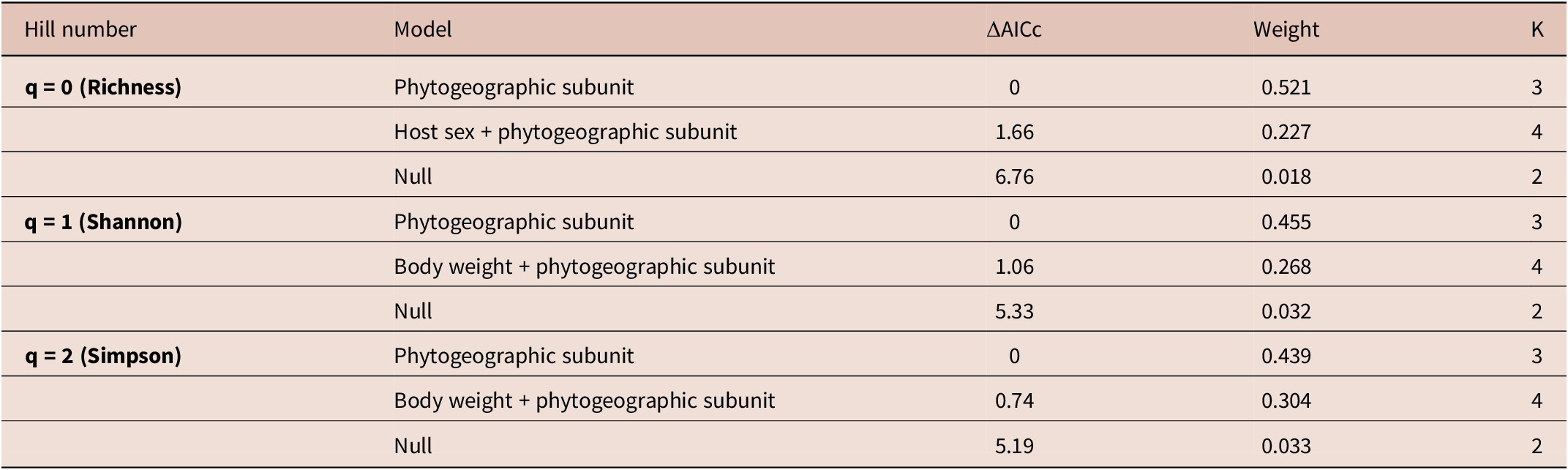
Table 3. Long description
A table presenting the Generalized Linear Model (GLM) selection results for Hill numbers (q = 0, 1, 2). It compares models using predictor variables including Host weight, Sex, and Phytogeographic sub-unit. For example, for species richness (q = 0), the best-supported model (delta AICc = 0) is the one using Phytogeographic sub-unit as the sole predictor, carrying an Akaike weight of 0.521. Other candidate models with substantial support, including those combining Sex and Phytogeographic sub-unit, are also listed with their respective delta AICc, Akaike weights, and parameter counts.
Note: ΔAICc = the difference between the corrected Akaike Information Criterion (AICc) of each model and that of the best-supported model; weight, Akaike weights (representing the probability that a given model is the best among the candidate set); K, number of parameters in the model. Except for the Null model, only models with substantial support (ΔAICc ≤ 2) are shown.
The total beta diversity among infracommunities (βsor) was high, reaching 0.84, which indicates a strong dissimilarity in parasite composition among individual hosts. This variation was primarily driven by the species replacement component (spatial turnover, βsim), which contributed 0.77, a value considerably higher than the nestedness component (βnes), which contributed 0.07.
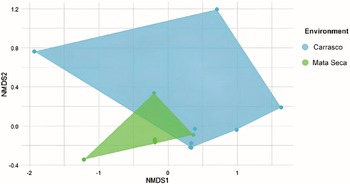
Furthermore, the PERMANOVA confirmed that the phytogeographic subunit (environment) had a significant effect on the helminth community structure (PERMANOVA: R² = 0.26; F = 6.25; p = 0.001). The Non-metric multidimensional scaling (NMDS, stress = 0.007) demonstrated a clear visual separation of the infracommunities between the two habitats (Figure 4).
Non-metric multidimensional scaling (NMDS) based on Sørensen dissimilarity calculated from presence–absence data of helminth infracommunities of Thrichomys laurentius. The ordination illustrates the compositional separation between hosts from Carrasco and Mata Seca environments.
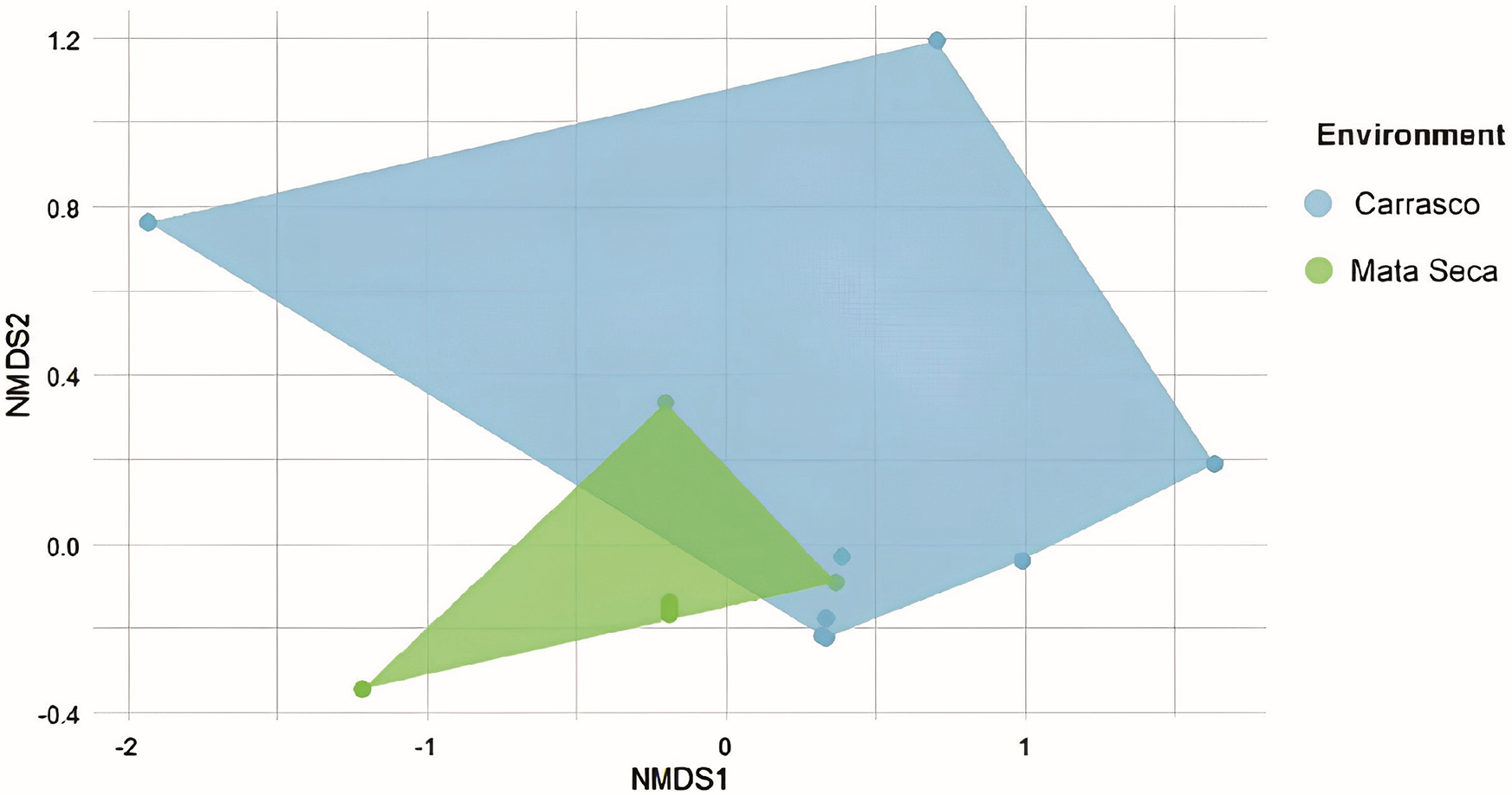
Figure 4 Long description
A Non-metric Multidimensional Scaling (NMDS) scatter plot based on Sørensen dissimilarity. The plot displays two distinct polygons representing the helminth communities of Thrichomys laurentius. The blue polygon represents hosts from the Carrasco environment, and the green polygon represents hosts from the Mata Seca environment. The two polygons have very little overlap, illustrating a clear compositional separation between the parasite communities of the two phytophysiognomies.
Discussion
The total helminth fauna diagnosed in this study for the rodent Thrichomys laurentius consisted of seven species, representing a relatively low taxonomic richness. This pattern becomes evident when compared with infection records in congeneric taxa from seasonally flooded biomes, such as T. fosteri (syn. T. pachyurus) in the Pantanal, where a community comprising 12 species has been documented (Simões et al Reference Simões, Gentile, Rademaker, D’Andrea, Herrera, Freitas, Lanfredi and Maldonado2010). This community configuration, frequently driven by low species richness and high dominance of specific taxa, such as the superdominance of the nematodes Heligmostrongylus almeidai and Paraheligmonella interrogans observed in the present study, aligns with patterns previously reported for other Caatinga vertebrates, including reptiles (Araujo-Filho et al Reference Araujo-Filho, Ribeiro, Brito, Teles, Sousa, Avila and Almeida2014, Reference Araujo-Filho, Teixeira, Teles, Rocha, Almeida, Mesquita and Lacerda2020) and amphibians (Sampaio et al Reference Sampaio, Teixeira, Do Nascimento, Ribeiro, Almeida and Brito2022).
The parasite composition observed herein appears to reflect both host specificity and potential sharing dynamics with the sympatric mastofauna in the Caatinga. Species of the family Heligmonellidae, represented by H. almeidai and P. interrogans, were predominant, which is congruent with previous findings for T. laurentius in the same biome (Simões et al Reference Simões, Garcia, Costa-Neto, Santos, Faro and Maldonado2017). Conversely, the occurrence of Stilestrongylus freitasi in T. laurentius, at a low prevalence, suggests a probable sharing with the rodent Necromys lasiurus, which has been frequently reported as the typical host for this helminth in the Caatinga and Cerrado biomes (Costa et al Reference Costa, Cardoso, Costa-Neto, Maldonado and Gentile2019; Simões et al Reference Simões, Garcia, Costa-Neto, Santos, Faro and Maldonado2017). Similarly, the occurrence of A. raillieti, exclusively in the Carrasco in this study, but not in the same host specimens harbouring S. freitasi, represents the first record of this nematode in T. laurentius. Historically, A. raillieti has been reported parasitising didelphid marsupials, such as Didelphis spp. and Philander spp. (Santos et al Reference Santos, Lent and Gomes1990; Travassos Reference Travassos1913). Both infections may be explained by ecological factors. The sharing of microhabitats, particularly shelters in rocky outcrops (lajedos) characteristic of the semiarid region, may facilitate ecological spillover and cross-transmission among distinct lineages of sympatric mammals (Simões et al Reference Simões, Garcia, Costa-Neto, Santos, Faro and Maldonado2017). Furthermore, the recovery of gravid females of both S. freitasi and A. raillieti suggests that these parasites are capable of reproducing successfully once the ecological barrier to host encounter has been overcome.
The recovery of a single specimen of Stilestrongylus sp. from the 12 examined hosts in the Mata Seca, together with the low prevalence of S. freitasi in the Carrasco (infecting a single T. laurentius individual), is consistent with accidental parasitism. Species of the genus Stilestrongylus are typical core parasites of sigmodontine rodents (Boullosa et al Reference Boullosa, Simões, Andrade-Silva, Gentile and Maldonado2019; Digiani and Durette-Desset Reference Digiani and Durette-Desset2003), and its fortuitous occurrence in an echimyid host reinforces the dynamics of occasional ecological spillover among the local small mammal fauna. In contrast, the occurrence of the nematode H. freitasi in T. laurentius is expected, as this oxyurid exhibits a strong evolutionary association with echimyid rodents in xeric environments, being originally described from this same host species in the Caatinga (Quentin Reference Quentin1969; Vicente et al Reference Vicente, Rodrigues, Gomes and Pinto1997).
Additionally, the ecological dynamics of indirect-cycle parasites provide alternative insights into environmental constraints. The presence of the cestode Raillietina sp., detected at a low prevalence in both the Mata Seca and the Carrasco, suggests that the requisite arthropod intermediate hosts (such as beetles or other small insects) are sufficiently resilient or abundant in both phytophysiognomies to support transmission (Khalil et al Reference Khalil, Jones and Bray1994). Although Thrichomys laurentius is traditionally categorised as a frugivorous and herbivorous rodent, feeding primarily on leaves, shoots, and wild fruits (Abreu et al Reference Abreu, Casali, Garbino, Loss, Moras, Nascimento, Oliveira, Pavan, Percequillo and Nascimento2025; Paglia et al Reference Paglia, Fonseca, Rylands, Herrmann, Aguiar, Chiarello, Leite, Costa, Siciliano, Kierulff, Mendes, Mittermeier and Patton2012; Reis et al Reference Reis, Peracchi, Pedro and Lima2006), infection with Raillietina sp. provides evidence that arthropods are also ingested. This ingestion may occur accidentally during the foraging of plant matter, or through an opportunistic insectivorous behaviour, as the active search and high consumption of arthropods have been previously documented for its congener, Thrichomys apereoides (Lessa and Costa Reference Lessa and Costa2009). Thus, this dietary plasticity, whether active or accidental, reinforces the trophic link between host foraging behaviour and parasite transmission in semiarid environments.
The high dissimilarity in parasite composition among individual hosts is primarily driven by species replacement (turnover) rather than species loss (nestedness). This dominance of turnover implies that differences between parasitic infracommunities do not occur merely through the exclusion or progressive loss of parasite species in harsher environments. Instead, it demonstrates that a possible spatial variation in environmental conditions among hosts may have favoured the establishment of different parasite species in each infracommunity. The mesic conditions of the Mata Seca favoured infracommunities co-dominated by the geohelminths H. almeidai and P. interrogans, whereas the more restrictive xeric environment of the Carrasco selected for distinct infracommunities characterised by the exclusive establishment of A. raillieti, H. freitasi, and S. freitasi. Furthermore, considering the differences in helminth community structure between Mata Seca and Carrasco, as indicated by the PERMANOVA results, parasite turnover appears to be associated with habitat differences. These contrasting phytophysiognomies may promote shifts in parasite community composition, whereby species less tolerant of arid conditions, such as trichostrongylids whose free-living stages require adequate soil moisture, oxygen availability, and suitable temperatures to survive and complete their development (Gyeltshen et al Reference Gyeltshen, Kahn and Laurenson2022), may be replaced by taxa that are either more resistant to desiccation or transmitted through distinct local trophic pathways, such as oxyurids, whose development to the third larval stage occurs within the egg. Although microclimatic and edaphic variables were not directly measured in the present study, the distinct structural composition of these habitats acts as different ecological barriers (Marques Reference AML2024).
This influence of local environmental filters on species replacement (Holmes and Price Reference Holmes, Price, Anderson and Kikkawa1986; Poulin et al Reference Poulin, Krasnov and Mouillot2011) aligns with patterns previously reported for Neotropical rodents. Studies in the Cerrado and Atlantic Forest have demonstrated that habitat heterogeneity and land use are major drivers of helminth species replacement, as different parasite lineages exhibit varying tolerances to external environmental filters (Cardoso et al Reference Cardoso, Costa-Neto, Braga, Weksler, Simões, Maldonado, Luque and Gentile2020; Costa et al Reference Costa, Cardoso, Costa-Neto, Maldonado and Gentile2019; Reference Costa, Cardoso, Costa-Neto, Alvarez, Maldonado and Gentile2022). Furthermore, within the Caatinga biome itself, this pattern of environmentally driven species substitution has been corroborated by studies on the endoparasite communities of reptiles and amphibians, demonstrating that microhabitat use and local ecological factors are primary determinants of parasite composition in the semiarid region (Brito et al Reference Brito, Corso, Almeida, Ferreira, Almeida, Anjos, Mesquita and Vasconcellos2014; Sampaio et al Reference Sampaio, Teixeira, Do Nascimento, Ribeiro, Almeida and Brito2022).
Additionally, the GLM results indicated that the phytogeographic subunit was the primary and strongest predictor for all diversity measures at the infracommunity level, including species richness and the Shannon and Simpson indices. Specifically, the analysis demonstrated that the Mata Seca positively influenced these metrics per host. Studies evaluating these specific phytophysiognomies demonstrate that the Mata Seca possesses soils with a higher clay fraction, conferring greater water retention capacity compared with the deep, highly permeable sandy soils of the Carrasco (Araújo et al Reference Araújo, Costa, Lima, Vasconcelos, Girão, Sobrinho, Bruno, Souza, Nunes, Figueiredo, Lima-Verde and Loiola2011; Lima et al Reference Lima, Sampaio, Rodal and Araújo2011; Marques Reference AML2024). Therefore, it is plausible to hypothesise that these previously documented conditions, such as higher soil moisture and denser canopy cover, buffer the extreme semiarid climate, providing a more suitable environment for the survival, development, and accumulation of free-living infective stages of geohelminths (Cardoso et al Reference Cardoso, Simões, Luque, Maldonado and Gentile2016; Pietrock and Marcogliese Reference Pietrock and Marcogliese2003; Simões et al Reference Simões, Gentile, Rademaker, D’Andrea, Herrera, Freitas, Lanfredi and Maldonado2010). Consequently, this presumed environmental suitability may have contributed to the high proportion of animals infected with parasites in this area (Table 2), resulting in significantly more diverse infracommunities than those found under the restrictive aridity of the Carrasco. Indeed, the lack of an asymptote for species richness (q = 0) in the rarefaction and extrapolation curves observed for Carrasco suggests that, despite the superdominance of H. almeidai, rare or subordinate helminth species might still exist in this mesic enclave, requiring a greater sampling effort for complete detection. Therefore, future eco-epidemiological studies should focus on directly measuring these local microenvironmental and edaphic variables to further elucidate how they favour these parasite transmission dynamics in the semiarid region.
In addition to the influence of the phytogeographic subunit, intrinsic host traits exerted secondary effects on parasite diversity. A tendency was observed for male hosts to exhibit greater helminth species richness (Table 2). Host-intrinsic traits are widely recognised as primary determinants of parasite species distribution and abundance (Kamiya et al Reference Kamiya, O’Dwyer, Nakagawa and Poulin2014; Poulin Reference Poulin2007). This sexual parasitic dimorphism is a well-documented pattern in wild mammals and is frequently associated with both ecological and physiological differences between sexes (Poulin Reference Poulin1996; Zuk and McKean Reference Zuk and McKean1996). Ecologically, the more exploratory behaviour of males and their larger home ranges increase their contact rates with various infective stages distributed across different microhabitats (Rossin and Malizia Reference Rossin and Malizia2002; Simões et al Reference Simões, Maldonado, Olifiers, Garcia, Bertolino and Luque2014). Physiologically, the immunosuppressive effects of androgens, such as testosterone, may render males more susceptible to the establishment of new parasite species, thereby increasing overall infracommunity richness.
Furthermore, host body weight emerged as a positive predictor for both the Shannon and Simpson diversity indices. As documented in the literature (Behnke et al Reference Behnke, Lewis, Mohd Zain and Gilbert1999), this effect may reflect the positive correlation between body weight and age in wild rodents, with heavier individuals presumably being older and therefore having experienced longer cumulative exposure to infective stages in the environment. This extended period of exposure provides greater opportunities for the gradual accumulation of parasite species throughout the host’s lifespan (Behnke et al Reference Behnke, Lewis, Mohd Zain and Gilbert1999). The positive relationship between body mass and parasitism appears to be a consistent ecological pattern for vertebrates in the Caatinga biome, having also been reported for reptiles (Araujo-Filho et al Reference Araujo-Filho, Brito, Lima, Pereira, Mesquita, Albuquerque and Almeida2017), thus reinforcing the role of host morphometric traits in structuring complex and equitable infracommunities. Moreover, it is worth noting that host body size (which was positively correlated with host body weight in the present study) is identified as an important factor positively influencing total parasite biomass and diversity across different taxa, including mammalian hosts (Poulin Reference Poulin2026).
Therefore, we conclude that environmental differences were important predictors of parasite structure and diversity, with the Mata Seca environment favouring greater parasite diversity and infection rates than the Carrasco environment. Furthermore, the influence of host characteristics indicates that individual differences can favour a high parasite diversity and species richness per host, driving variations in the structure of infracommunities, even within the same type of environment.
Acknowledgements
We would like to thank the staff from the Laboratório de Biologia e Parasitologia de Mamíferos Silvestres Reservatórios (LABPMR) of the Instituto Oswaldo Cruz (IOC/Fiocruz) for their support in collecting the material, and Ana Júlia Dias for creating the map.
Financial support
This work was supported by the Coordenação de Aperfeiçoamento de Pessoal de Nível Superior, Brazil (CAPES) (B.O.T.F., Finance Code 001); the Fundação Carlos Chagas Filho de Amparo à Pesquisa do Estado do Rio de Janeiro (FAPERJ) (R.O.S., grant number E-26/204.599/2024), (T.S.C., grant number E-26/204.420/2021); and the Conselho Nacional de Desenvolvimento Científico e Tecnológico, Brazil (CNPq) (P.S.D., grant number 315677/2021-0), (A.M.J., grant number 315844/2023-0), and (T.S.C., grant number: 153619/2025-2).
Competing interests
The authors declare none.
Ethical standard
All field procedures strictly followed the standards for the capture, handling, and care of animals approved by the Ethics Committee on Animal Use (CEUA) of the Oswaldo Cruz Foundation (licences LW-39/14 and L-018/2022) and were authorised by the Chico Mendes Institute for Biodiversity Conservation (ICMBio/SISBIO) (Licence number 13373-1).