Disaster medicine and policy has historically lacked a robust evidence base. The United Nations Office for Disaster Risk Reduction (UNISDR) Science and Technology Conference in January 2016Reference Aitsi-Selmi, Murray and Wannous 1 addressed the need for scientifically informed disaster risk reduction (DRR) strategies with a variety of stakeholders to improve practice. This article aims to summarize Myanmar’s DRR policy, critique it’s design and implementation and generate discussion regarding the application of evaluation frameworks in disaster medicine.
Background
Disaster Risk in Myanmar
Myanmar is a country emerging from international isolation. Under military rule since gaining independence in 1948, the government was widely criticized and faced international sanctions until 2012. 2 Subsequently, development was stunted and resulted in 1 in 4 of the country’s citizens living in poverty, 3 with the 2012 “Human Development Index” ranking Myanmar 150th out of 187 countries. 4
The largest mainland country in South-East Asia, Myanmar has an estimated population of 53 million people, consisting of 135 recognized “ethnic groups.” The country has one of the lowest population densities in the region, with 70% of its population living in rural areas including the large river deltas and costal plains.
Myanmar’s topography and climate expose its population to a spectrum of extreme natural events. The low-lying delta and coastal plains are at high risk of flooding and damage from tsunamis or cyclones, and 3 major fault lines running through the country present a constant threat of seismic events. 2 Combined with under-developed infrastructure and public services, disaster risk is substantial. Furthermore, this risk is increasing due to epidemiological and climatological trends observed in Myanmar and other developing countries, including population growth, 5 urbanization, 6 deforestation,Reference Zhao, Peng and Jiang 7 and climate change. 6
The increasing impact of natural events was demonstrated by “Cyclone Nargis” in 2008, which claimed 130,000 lives and severely affected 1.5 million people.Reference Webster 8 The unprecedented damage prompted criticism of the government’s preparedness initiatives and response capacity,Reference Webster 8 as well as triggering a drive towards developing robust DRR policy.Reference Perry and Winkleman 9
DRR in Myanmar
Following the Indian Ocean tsunami (2004), the “Hyogo Framework for Action” (HFA) was implemented across the world. 10 Its successor, The “Sendai Framework,” 11 emphasized the need to prioritize risk reduction, health resilience, and robust evidence to inform policy. 11 Collaborative efforts through the Association for South-East Asian Nations (ASEAN) have supported the implementation of global DRR recommendations in Myanmar and the region, 12 , 13 including the ASEAN Agreement on Disaster Management and Emergency Response (AADMER). 14
After the devastation of Cyclone Nargis, the United Nations, ASEAN and Myanmar’s government formed the “Tri-partite Core Group” to conduct the “Post-Nargis Joint Needs Assessment” 15 and the “Recovery and Preparedness Plan,” a 3-year strategy for recovery. 16 The strategy was aligned with global goals and proposed the need for “comprehensive” DRR policy, endorsing wide community involvement. 16 The DRR Working Group was established 2008 17 and “Myanmar’s Action Plan on Disaster Risk Reduction” (MAPDRR) was published in 2012. 13
Myanmar’s “Triple Transition”
Myanmar is said to be going through a “Triple Transition.” 18 The general election in 2015 saw victory for the democratic opposition to the military government,Reference Singh 19 economic reform towards a more market-based economy and a peace process aiming to end decades of conflict. 18 While this presents challenges to DRR prioritization, great opportunities exist to engage with communities and build DRR into economic and development plans. In light of this; what factors contributing to disaster risk does MAPDRR prioritize? Are there areas that require further development? And how can the efficacy of initiatives be evaluated?
MAPDRR
MAPDRR reviewed existing DRR efforts, identified areas for improvement and made recommendations in accordance with HFA 10 and AADMER 14 commitments. Contribution from relevant stakeholders was encouraged, with input from United Nations Development Programme (UNDP), United Nations Office for the Co-ordination of Humanitarian Affairs, Myanmar Red Cross Society and ASEAN. 13 65 projects were proposed, designated “High” or “Medium” priority and organized under 7 key components:
(i) Policy, Institutional Arrangements, and Development
(ii) Hazard Vulnerability and Risk Assessments
(iii) Multi-hazard Early Warning Systems
(iv) Preparedness and Response Programmes at State, Regional, and Local levels
(v) Mainstreaming of DRR into Development
(vi) Community-based DRR and Preparedness
(vii) Public Awareness, Education, and Training
Authors acknowledged the need for external collaboration to ensure projects were sufficiently implemented. 13 DRR-WG secured substantial investment from UNDP 20 and collaborated with several INGOs. 21 Furthermore, the relationship between DRR and attainment of other health goals was highlighted and recommendations made to work in partnership with national programmes focused on the attainment of the “National Adaptation Plan of Action (NAPA) on climate change” 22 and the “National Sustainable Development Strategy.” 13
Developing and Evaluating DRR Policy
Using Disaster Frameworks to Develop Policy
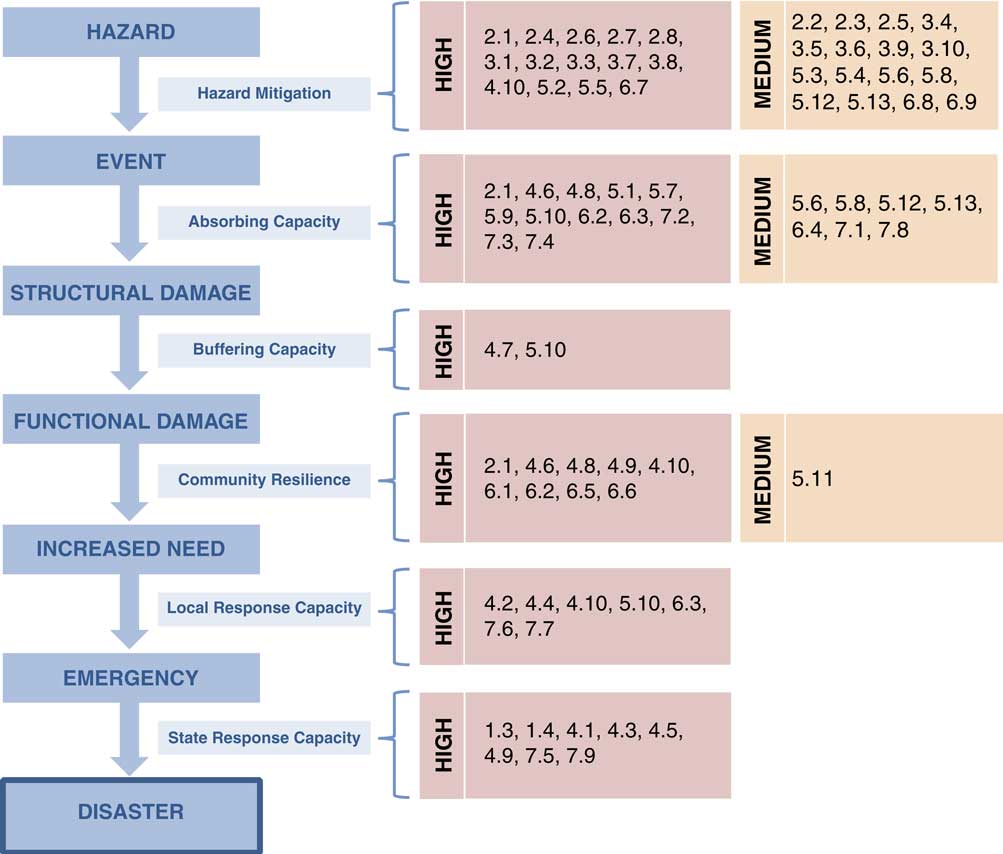
The drive to promote evidence-based DRR policy has seen a move away from the “Disaster Management Cycle,”Reference Neal 23 towards more detailed models. The World Association for Disaster and Emergency Medicine (WADEM) recently published a “Conceptual Framework,” proposing several stages between the identification of a “hazard” and development of a “disaster.”Reference Birnbaum, Daily, O’Rourke and Loretti 24 , 25 Clearly defined transition points between each stage of development help stakeholders isolate areas of risk, and as such, identify targets for DRR interventions.
By representing the initiatives proposed in MAPDRR through the “Conceptual Framework,” the specific risks to be targeted can be identified (Figure 1).
Myanmar’s Action Plan for Disaster Risk Reduction (MAPDRR) Proposed Projects Mapped to World Association for Disaster and Emergency Medicine (WADEM) “Conceptual Framework” for Disaster Development. Of the 65 projects proposed in MAPDRR, 41 were denoted as “High” priority and 24 as “Medium” priority. Combined, the projects address every transition point in the WADEM framework (some individual projects address multiple transition points and therefore have been represented in the figure multiple times). Most projects focus on “hazard mitigation” and “absorbing capacity”, including regional risk assessments for specific hazards. Adapted from Birnbaum et al.Reference Birnbaum, Daily, O’Rourke and Loretti 24

The projects proposed in MAPDRR address all transition points in the “Conceptual Framework,” from “hazard mitigation” to “state response capacity.”Reference Birnbaum, Daily, O’Rourke and Loretti 24 While ambitious and wide-ranging, in light of unmet rural health needs, 2 evidence of poor health education and promotion, 2 as well as significant disaster risk in rural communities, 13 greater emphasis could have been placed on the need for community-based preparedness projects. Furthermore, desired outcomes were vague and there remained limited evidence to guide specific interventions.
Progress and Pitfalls in Implementing MAPDRR
The DRR-WG launched a “Situation Analysis,” 26 in 2013, in order to review progress towards MAPDRR. While achievements were made in national policy, with the development of the “Disaster Management Law,” 27 community-focused policies and local education strategy remained poorly developed and there continued to be no standardized method for mass communication. In addition, despite initial recommendations, the disconnect between DRR and wider national policy persisted. Myanmar’s “Framework for Economic and Social Reforms” (FESR) 28 did not address the importance of urbanization and the role of DRR in development, nor Myanmar’s NAPA for Climate Change 22 specify DRR considerations.
Weaknesses highlighted in the “Situation Analysis” prompted the DRR-WG to develop a “Strategic Framework and Plan (2014–18),” 29 with 6 clear objectives, including:
1. policy and legal DRR framework (including climate change adaptation);
2. increase capacity for local project implementation;
3. community access to DRR frameworks.
Estimated to require 2.8 million USD to deliver, the strategy also emphasized the need for improved evaluation of projects, with commitment to record all activities and strive towards a means of objective assessment. 29 Since then, Myanmar’s Information Management Unit has made key documents and meeting minutes publically available 30 and substantial investment from DRR-WG supported climate change adaptation and DRR projects in the country’s dry zone following the El Nino phenomenon in 2015. 31 Projects engaged stakeholders at multiple-levels, including focus on local dissemination of climate hazard information. 31
A formalized review of MAPDRR followed in April 2016, 32 involving over 80 stakeholders, with UNDP conducting a quantitative assessment of MAPDRR projects. The review found 98 projects had been commissioned (51 completed projects and 47 projects ongoing), addressing all 7 specified components.
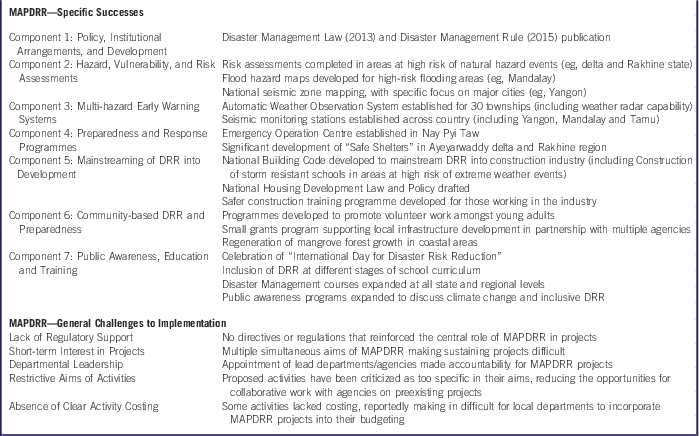
Despite the wide prevalence of projects and changes made following the “Situation Analysis” in 2013, 26 evidence from large research surveys demonstrated gaps in community DRR awareness, local communication plans and DRR education throughout the country. 33 - 35 In addition, previously identified weaknesses of MAPDRR persist, with repeated focus on the lack of evaluation and co-ordination between agencies (see Table 1).
Summary of Successes and Challenges of Myanmar’s Action Plan for Disaster Risk Reduction (MAPDRR) Implementation.

Abbreviation: DRR, disaster risk reduction.
Adapted from Myanmar DRR Working Group. 32
Evaluating DRR Initiatives
With natural disasters generating record levels of economic damage, 36 it is critical that the most effective DRR initiatives are identified. The lack of robust evidence and evaluation makes this challenging. International efforts have been made to develop evaluation tools, such as “Catastrophe Risk Models,”Reference Michel-Kerjan 37 use of a “Risk Management Index”Reference Carreno, Cardona and Barbat 38 and disseminated guidance on how developing organizations can best utilize available tools. 39 While local efforts have been made to appraise DRR projects in Myanmar, such as the “Inclusive Toolkit” 40 for use by DRR workers in communities, an accepted system for standardized monitoring and evaluation remains in its infancy. Until these challenges are overcome, stakeholders will not be able to determine the efficacy of different projects and hence prioritize investment.
Conclusion
This article provides an example of how disaster frameworks can be used to guide DRR policy. With Myanmar at persisting risk from a wide-range of natural disasters, the ambitious initiatives proposed in MAPDRR were highly relevant and applicable. While the country has made significant progress since 2008, implementation of recommendations has proved inconsistent and questions remain regarding methods to evaluate projects.
Collaboration among multiple stakeholders will be key in the delivery of sustainable DRR projects, as will continued engagement of the Burmese people in national policy and development. Great opportunities exist to further DRR throughout the country; however, developing community resilience and preparedness will be paramount.
Acknowledgments
None.