Introduction
Conduct disorder (CD), a child onset psychiatric disorder characterized by repeated violations of the rights of others or age-appropriate social norms, is among the most commonly treated childhood psychiatric conditions (Robins, Reference Robins1991; Shivram et al. Reference Shivram, Bankart, Meltzer, Ford, Vostanis and Goodman2009) and among the most serious in its life course implications. Children with CD are at high risk for early initiation of substance use (Zeitlin, Reference Zeitlin1999) and high school drop-out (Breslau et al. Reference Breslau, Miller, Joanie Chung and Schweitzer2011) compared to their non-CD peers. Adults with a history of CD are more likely than adults without a history of CD to be jailed, unemployed and divorced and are at high risk for psychiatric disorders, a broad range of physical disorders and premature mortality (Laub & Vaillant, Reference Laub and Vaillant2000; Kim-Cohen et al. Reference Kim-Cohen, Caspi, Moffitt, Harrington, Milne and Poulton2003; Fergusson et al. Reference Fergusson, Horwood and Ridder2005; Copeland et al. Reference Copeland, Miller-Johnson, Keeler, Angold and Costello2007; Goldstein et al. Reference Goldstein, Compton, Pulay, Ruan, Pickering, Stinson and Grant2007, Reference Goldstein, Dawson, Chou, Ruan, Saha, Pickering, Stinson and Grant2008; Loeber et al. Reference Loeber, Burke and Pardini2009).
According to DSM-IV, a diagnosis of CD requires at least three out of a list of 15 symptoms within a 12-month period and those symptoms must cause significant functional impairment. With regard to symptom criteria, this definition is polythetic, i.e. the criteria can be satisfied by multiple non-overlapping configurations of symptoms (Needham, Reference Needham1975). In addition, each of the 15 symptoms makes an equivalent contribution towards the diagnostic threshold, regardless of the specific configuration of symptoms. While there is no reason in principle to reject polythetic definitions of disorder (Sokal, Reference Sokal1974), the existence of non-overlapping symptom profiles within a single category suggests the possibility of meaningful subtypes of the disorder, which may differ with regard to risk factors, outcomes and treatment response (Krueger & Bezdjian, Reference Krueger and Bezdjian2009). In a study of twins, Eaves and colleagues found evidence of etiological heterogeneity across four latent classes of CD symptoms, but that study was based on eight polychotomous items that were not directly linked to the DSM criteria (Eaves et al. Reference Eaves, Silberg, Hewitt, Rutter, Meyer, Neale and Pickles1993). The DSM-IV recognizes subtypes of CD based on age at onset, i.e. childhood versus adolescent onset CD (Lahey et al. Reference Lahey, Loeber, Quay, Applegate, Shaffer, Waldman, Hart, Mcburnett, Frick, Jensen, Dulcan, Canino and Bird1998; Goldstein et al. Reference Goldstein, Grant, Ruan, Smith and Saha2006), but no distinctions are currently made between symptom profiles.
Several proposals for distinguishing clinical subtypes of CD based on symptom profiles have been made. Behavior genetic researchers have found evidence for a distinction among CD cases based on the presence or absence of aggressive symptoms (Eley et al. Reference Eley, Lichtenstein and Moffitt2003). A recent meta-analysis of twin and adoption studies supports the suggestion that aggressive and non-aggressive types of CD are etiologically dissimilar; CD cases with aggressive symptoms have higher heritability than cases without aggressive symptoms (Burt, Reference Burt2009). One recent study suggests that the distinction between the behavioral traits of aggressivity and rule breaking may be preferable to the distinction between childhood and adolescent onset as a basis for subclassifying CD cases (Burt & Hopwood, Reference Burt and Hopwood2010). There is also evidence that aggressive CD is more strongly associated with anti-social personality disorder (ASPD) in adulthood than non-aggressive CD (Moffitt, Reference Moffitt1993). Other distinctions have been suggested between symptoms that are overt versus covert (Loeber & Schmaling, Reference Loeber and Schmaling1985; Tackett et al. Reference Tackett, Krueger, Sawyer and Graetz2003) or destructive versus non-destructive (Frick et al. Reference Frick, Lahey, Loeber, Tannenbaum, Vanhorn, Christ, Hart and Hanson1993), between socialized versus unsocialized subtypes and between subtypes with versus without callous-unemotional traits (Frick & Ellis, Reference Frick and Ellis1999).
Large population surveys provide a valuable source of information on patterns of co-occurrence of CD symptoms that can be used empirically to identify symptom profiles that might be considered distinct subtypes of CD (Robins & Guze, Reference Robins and Guze1970; Robins, Reference Robins2004). A recent examination of retrospectively reported CD symptoms in a US national sample of adults aged 18–44 years found evidence for five subtypes, characterized respectively by rule violations, deceit/theft, aggression, severe covert behavior and pervasive CD symptoms (Nock et al. Reference Nock, Kazdin, Hiripi and Kessler2006). Each subtype was associated with higher risk for other types of psychiatric disorder, with stronger associations found for subtypes with higher symptom counts. Those findings are in need of replication and extension to additional life course outcomes. The goal of this study is to develop subtypes of CD symptoms in a separate representative sample of the US adult population (age 18–44 years) and investigate potential variation in their association with parental behavior problems and their prognostic implications. We examine a range of adverse life course outcomes of CD, including subsequent onset of psychiatric disorders and anti-social behaviors, adolescent life events (e.g. early childbirth or high school drop-out) and life events in the 12 months prior to the interview (e.g. divorce or job loss).
Method
Sample
The National Epidemiological Survey of Alcohol and Related Conditions (NESARC) is based on a nationally representative sample of the adult (⩾18 years) household population of all 50 US states (Grant et al. Reference Grant, Kaplan, Shepard and Moore2003b). Face-to-face interviews were conducted in respondents' homes with a fully structured diagnostic instrument loaded on a personal computer. Fieldwork was conducted by the US Bureau of the Census for the National Institute of Alcohol Abuse and Alcoholism. The response rate was 81%. Informed consent procedures were approved by the US Census Bureau and the US Office of Management and Budget. The sample design and weighting methodology are described in detail elsewhere (Grant et al. Reference Grant, Kaplan, Shepard and Moore2003b). The NESARC sample includes 43093 respondents. Analysis was conducted on the subsample of 21489 respondents who were age <45 years at the time of the interview to minimize the impact of age-associated failures of recall.
Assessments
Conduct disorder
Interviews were administered by non-clinician interviewers using either the English or Spanish versions of the Alcohol Use Disorder and Associated Disabilities Interview Schedule—DSM-IV version (AUDADIS) (Grant et al. Reference Grant, Dawson, Stinson, Chou, Kay and Pickering2003a). All respondents completed an assessment of 14 of the 15 CD symptoms – breaking and entering was not assessed. Respondents were asked whether each endorsed symptom occurred before they were 15 years old. Separate items assessed impairment, onset of symptoms prior to age 10 and temporal clustering of symptoms. A test–retest study of the AUDADIS did not assess the validity of the CD diagnosis, due to zero prevalence of CD without ASPD in the retest sample. Test–retest reliability of the anti-social personality diagnosis was good (κ=0.67) (Grant et al. Reference Grant, Dawson, Stinson, Chou, Kay and Pickering2003a).
To meet DSM-IV criteria for CD, symptoms must occur within a 12-month period (temporal clustering) and the cluster of symptoms must have caused clinically significant functional impairment. To assess temporal clustering, respondents were asked whether at least three symptoms occurring prior to age 15 occurred at the same time or within a 12-month period. Impairment was assessed by a question asking whether this cluster of symptoms caused problems with family or friends, at school or with the law.
Psychiatric and substance use disorders
DSM-IV criteria for five anxiety disorders (panic disorder, agoraphobia, social phobia, specific phobia and generalized anxiety disorder), three mood disorders (major depression, dysthymia and bipolar disorder) and four substance-use disorders (abuse and dependence for alcohol and illegal drugs) were assessed. Test–retest reliability was fair for lifetime diagnoses of anxiety disorders (κ=0.42–0.48) and slightly better for dysthymia (κ=0.58) and major depression (κ=0.65). Test–retest reliability was slightly higher for alcohol disorder (0.70) and drug disorder (0.66). Due to low prevalence, reliability for bipolar disorder could not be examined (Grant et al. Reference Grant, Dawson, Stinson, Chou, Kay and Pickering2003a). Since CD symptoms were assessed for age ⩽15, psychiatric and substance use disorders were only considered potential outcomes in this study if onset was after age 15 years.
Anti-social behaviors
Five symptoms of ASPD – impulsivity, deceitfulness, disregard for the rights of others, unlawful behavior and aggressivity – were defined using items not included in the definition of CD symptoms. In order to establish the temporal precedence of CD symptoms, ASPD symptoms were only coded as present if their first occurrence was after age 15 years.
Adolescent life events
Respondents were asked the age they first married, the age at which their first child was born, their educational attainment and the age at which they completed their highest level of education. Three adolescent outcomes were defined using these items: (1) marriage prior to age 18; (2) childbirth prior to age 19; (3) failure to complete high school by age 18.
Past-year life events
Information on life events in the 12 months preceding the interview was used to define two past-year adverse life events: (1) serious financial or employment problem (being fired or laid off, having a serious financial crisis or declaring personal bankruptcy); (2) serious interpersonal problem (ending a marriage or serious romantic relationship).
Parental behavior problems
Respondents were asked whether their father or mother ever had behavior problems, characterized by the following definition: ‘By behavior problems I mean being cruel to people or animals, fighting or destroying property, trouble keeping a job or paying bills, being impulsive, reckless or not planning ahead, lying or conning people or getting arrested. These people also do not seem to care if they hurt others and often have problems at an early age, such as truancy, staying out all night or running away’. In this study, parental behavior problems were counted as present if the respondent reported either parent as having had behavior problems.
Analysis
Analyses were conducted on the 14 CD symptoms assessed in the AUDADIS. DSM-IV criteria were applied to estimate the population prevalence of CD. Subtypes of CD symptom configurations were developed using latent class analysis (LCA) with Mplus software. LCA assumes that the covariation between the observed CD symptoms is due to existence of two or more underlying (unobserved) classes (or groups) of individuals and that the CD symptoms are independent from one another within each class. The forced sex item was not included in the LCA due to low prevalence. The model can be used to estimate the probability that each individual in the sample belongs to each class given their symptom configuration. Individuals can be sorted into classes on the basis of these probabilities.
Associations of the CD symptom classes identified by the LCA with parental, psychiatric and life course correlates were estimated in logistic regression models with statistical adjustment for age and sex. Additional adjustment for educational attainment was included in models for past-year life events. Differences in risk across the classes imply prognostic differences across CD subtypes. Logistic regression analyses were conducted using the sudaan statistical analysis software packages to adjust statistical inferences for the complex survey design. Statistical significance was assessed at the p=0.05 level.
Results
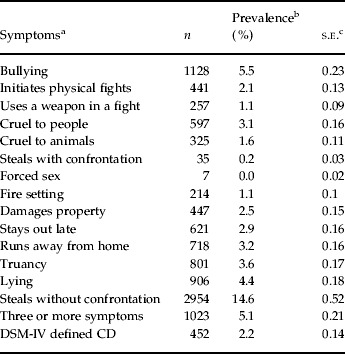
The 14 CD symptoms range in prevalence from 0.04% (forced sex) to 14.58% (stealing without confrontation) (Table 1).
Conduct disorder symptoms in the NESARC, prevalence, item difficulties and discriminations

NESARC, National Epidemiological Survey of Alcohol and Related Conditions; CD, conduct disorder.
a Symptoms were counted as present if they occurred prior to age 15.
b Prevalence estimates are weighted to account for the sampling design.
c Design-adjusted s.e.
LCA models assuming two to six classes were estimated and compared with regard to fit using the Bayes and Akaike Information Criteria (BIC and AIC) (Hens et al. Reference Hens, Aerts and Molenberghs2006; Nylund et al. Reference Nylund, Asparouhov and Muthen2007). These indices assess model fit while correcting for the total number of model parameters. Among the LCA models, fit was best for the five-class model according to the BIC and for the six-class model according to the AIC. The five-class model was selected for presentation in this report for parsimony and interpretability and because simulation studies suggest the BIC performs better than the AIC for determining the number of latent classes (Nylund et al. Reference Nylund, Asparouhov and Muthen2007). All of the latent class models with four or more classes fit better than the best fitting dimensional [item response theory (IRT)] model. (Complete information on the fit indices for IRT and latent class models are presented in Supplementary Table 1.)
The entropy, a measure of the utility of the LCA results for classifying respondents into classes, was 0.88. Methodological studies support use of LCA results to examine associations between class membership and variables not included in the model when entropy exceeds 0.80 (Clark & Muthen, Reference Clark and Muthen2009). The certainty of the classification is demonstrated in the probability of assignment of individuals to specific classes; 95% of the sample was assigned to a class based on a probability of class memberships of ⩾0.72. The certainty of the classification can also be gauged by the difference between the first and second highest class membership probabilities. A large difference indicates that the class to which a person is assigned is much preferable than the next best choice, while a small difference indicates roughly equal probability of membership in both classes. The difference in probability of class membership between the most and second most likely class was ⩾0.5 for 95% of respondents.
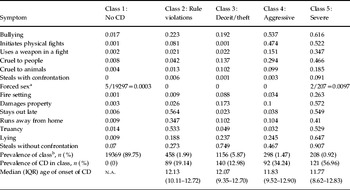
The prevalence of the 14 symptoms across the five classes derived from the LCA is shown in Table 2. Class 1 is characterized by very low prevalence of all symptoms and is labeled ‘No-CD’. Class 5, on the other hand, is characterized by relatively high prevalence of all the symptoms. This class has the highest prevalence for all but two of the symptoms (stays out late and truancy). For those two exceptions it has the second highest prevalence. Classes 2–4 have relatively high prevalence of distinct sets of symptoms. Class 2 is characterized by symptoms in the DSM-IV ‘rule violations’ group: staying out late; running away from home; truancy. Class 3 is characterized by symptoms in the ‘deceit/theft’ subgroup of the DSM-IV: stealing without confrontation; (moderately) lying. Note that breaking and entering, one of the symptoms in this group in the DSM-IV, was not assessed in this survey. Class 4, ‘aggression’, is characterized by DSM-IV aggression symptoms: bullying; starting fights; using a weapon in a fight; cruelty to people. Class 4 is also characterized by moderately high prevalence relative to classes 2 and 3 of cruelty to animals, lying and stealing without confrontation.
Latent class model for conduct disorder (CD) symptoms with five classes

IQR, Interquartile range.
a Forced sex had very low prevalence and was not used to estimate the latent class analysis model. Table shows the prevalence of forced sex among people classified into each class according to responses on the remaining symptoms.
b Prevalence based on classification by posterior probability of class membership.
The ‘No-CD’ class includes about 90% of the population, none of whom met criteria for CD. The prevalence of the other four classes ranges from 0.97 (severe) to 5.39 (deceit/theft). The prevalence of CD is high in all four of these classes, but ranges widely among them from 13.33% in the deceit/theft class to 66.39% in the severe class. The median age of onset of CD is similar across classes 2–4.
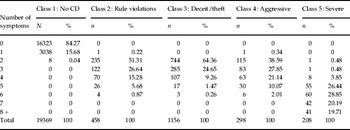
Nearly all (99.9%) respondents in class 1 endorsed zero or one CD symptom (Table 3). There is substantial overlap in symptom count across classes 2–4, with a large majority endorsing between two and four symptoms. For classes 2 and 3, >50% endorsed only two symptoms, below the diagnostic threshold as specified by the DSM-IV. Close to 40% of people in class 4 endorsed only two symptoms. By contrast, only one person in class 5 endorsed two symptoms and the vast majority endorsed five or more (95%).
Number of conduct disorder (CD) symptoms across five classes identified in latent class analysis

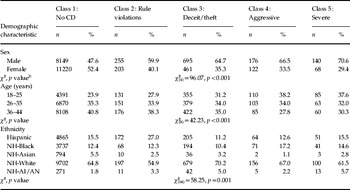
Membership in the five LCA classes is associated with sex, age and race-ethnicity (Table 4). Men make up less than half of the No-CD class (47.6%) but between 59.9% and 70.6% of classes 2–5. People in the No-CD class are older than those in classes 2–5. People in classes 2–5 are more likely to be American Indian than people in the No-CD class.
Demographic characteristics of five conduct disorder (CD) classesFootnote a

NH, Non-Hispanic; AI, American Indian; AN, Alaska Native.
a Respondents classified according to their posterior probability of class membership.
b χ2 test reported for association between demographic characteristic and class membership.
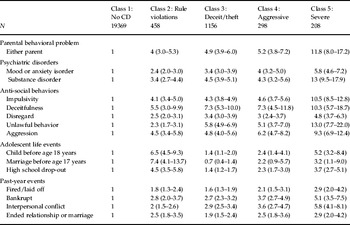
Associations of class membership with parental behavior problems, subsequent onset of psychiatric disorders and anti-social behaviors, adolescent life events and past-year life events are presented in Table 5. Three important patterns appear in the table. First, there is a strong consistent pattern of positive association between membership in any of the CD classes (classes 2–5) and all of the correlates examined. Only one of the odds ratios (ORs) is <1 and all but two are statistically significant. Second, for a majority of the outcomes, the magnitude of elevated risk associated with membership in one of the CDs relative to the No-CD class is similar across the three intermediate classes (classes 2–4) and highest in the severe class (class 5). For instance, the ORs relating class membership with parental behavior problems range from 4.0 [95% confidence intervals (CI) 3.0–5.3] to 5.2 (95% CI 3.8–7.2) across the three intermediate classes while the OR associated with the severe class is 11.8 (95% CI 8.0–17.2).
Associations of latent CD symptom class with parental behavioral problems, onset of psychiatric disorder and anti-social behaviors after age 15, adolescent (age 16–18) life events and past-year life events

CD, Conduct disorder.
Latent classes estimated on the basis of reported symptoms at age 15 or earlier. Respondents assigned to the latent class according to posterior probability of class membership. Odds ratios were estimated in binary logistic regression models with latent class as a categorical predictor and statistical control for age and sex. Models for past-year events also included statistical control for educational attainment.
Third, there is an important exception to the above pattern. With regard to adolescent life events, the ORs associated with the rule violations class are larger than either of the intermediate classes, indicating that there is a distinctive relationship between this class and this domain of events. For instance, with regard to high school drop-out, the OR associated with the rule violations class is 4.5 (95% CI 3.5–5.8) while those associated with the deceit/theft and aggressive classes are 1.4 (95% CI 1.2–1.7) and 2.3 (95% CI 1.7–3.0) respectively. Although risk for most of the outcomes assessed here is lower for the rule violations class than any of the other CD classes, for the adolescent life events risk among this group is on par with risk among the most severe class.
Statistically significant interactions were found between sex and CD symptom profile in models predicting impulsivity [χ2(4)=13.28, p=0.01], aggressivity [χ2(4)=35.87, p<0.001] and high school drop-out [χ2(4)=12.41, p=0.015]. Associations with these outcomes were statistically significant and in the same direction for both men and women, but the associations were somewhat stronger for women (detailed results available on request).
Discussion
The model described here, which assumes latent classes, provides a perspective on the co-occurrence of CD symptoms in the general population, which is complementary to the more common dimensional approach. The categorical approach is particularly important for addressing the epidemiological implications of diagnostic classifications, which are of necessity categorical in nature (Kessler, Reference Kessler2002). The best fitting LCA model was one with five partially ordered classes: one class with zero or very few symptoms; three intermediate classes characterized by high prevalence of distinct sets of symptoms; one severe class characterized by multiple symptoms drawn from all three intermediate classes.
The implications of these findings for the subclassification of CD are mixed. On the one hand, the results support the definition of distinct subtypes, particularly at relatively low levels of severity, where individuals with the same number of symptoms may fall into one of three classes. Distinctions between these classes are important in identifying patterns of co-occurring behavior and in predicting later outcomes, particularly with regard to adolescent outcomes, which shape the entire adult life course, such as high school drop-out and early childbearing. The importance of distinguishing between classes at a relatively low level of severity should not be minimized since the majority of cases that met DSM-IV criteria for CD in this study, 73%, fell into one of these categories. On the other hand, the symptoms that characterize distinct classes at relatively low levels of severity are all elevated among cases at a high level of severity. In addition, all of the CD classes are associated with significant elevations in parental behavior problems and nearly all of the psychiatric and life course events examined in this study. Together, these results suggest that the current polythetic definition of the disorder may be an appropriate model for this disorder.
The LCA results confirm key findings of Nock and colleagues in their analysis of the National Comorbidity Survey Replication, a different national sample of adults in the same age range as this study, who were assessed using the World Mental Health Version of the Composite International Diagnostic Interview (Kessler & Merikangas, Reference Kessler and Merikangas2004; Nock et al. Reference Nock, Kazdin, Hiripi and Kessler2006). Although that study reported a six-class LCA solution, in contrast with the five-class solution reported here, the classes were similarly defined, partially with regard to the distinct symptom configuration and partially with regard to overall symptom severity. In addition, the three intermediate classes identified in this study, classes 2–4, correspond closely in content to the three intermediate classes reported by Nock and colleagues, suggesting that at relatively low levels of severity these symptoms cluster in a similar way in both studies. The difference between the five-class model reported here and the six-class model reported by Nock and colleagues hinges on the inclusion of a distinct class of ‘severe covert’ CD, characterized by high prevalence of most symptoms with the exception of overt interpersonal aggression. The identification of similar latent classes despite differences in question wording, questionnaire structure, survey auspices and samples is a strong indication that these classes are robust with regard to methodological variations.
Two implications of the three intermediate classes identified in the LCA should be emphasized. First, the distinct profiles of symptoms among people with relatively low numbers of symptoms suggests that it is improper and perhaps hazardous to infer a pervasive context-independent pattern of impulsive or disruptive behavior for children on the basis of two or three CD symptoms, as the current definition of CD appears to imply. Expectations of misbehavior may be damaging to children whose problematic behaviors may remain limited to a narrow range of behaviors throughout childhood and early adolescence.
Second, the existence of heterogeneity in CD suggests that further examination of heterogeneity in etiology across subtypes might be beneficial. Existing studies suggest that CD that includes aggressive behavior may be more highly heritable, with a stronger contribution from genetic factors, than CD that does not include aggressive behavior (Eley et al. Reference Eley, Lichtenstein and Moffitt2003; Monuteaux et al. Reference Monuteaux, Blacker, Biederman, Buka and Morgan2005). The LCA findings suggest that additional distinctions should be examined between aggressive behavior in the context of other CD symptoms (i.e. the severe class) versus aggressive behavior occurring in isolation (the aggressive class). For instance, it is possible that aggressive behavior in the context of other CD symptoms, as in the severe class, is driven by selection into social contexts in which aggressive or violent behavior is more common, e.g. social networks in which rule-breaking is normative. Differences in the correlates of the aggressive versus severe classes are unlikely to be identified in studies using purely dimensional assessments.
It is important to emphasize that the statistical model used in this study assumes the existence of latent classes, within which there is no residual correlation among items. While this model performed better statistically in this dataset than models that assume underlying dimensional factors, this does not imply that the LCA model is superior in all respects. In particular, the latent class model used here is limited in its ability to address variation in severity within or across classes, which is implied by the existence of a diagnostic threshold that incorporates information on symptom count, symptom clustering and impairment. Dimensional models, such as those reported by Gelhorn et al. (Reference Gelhorn, Hartman, Sakai, Mikulich-Gilbertson, Stallings, Young, Rhee, Corley, Hewitt, Hopfer and Crowley2009), address variation in severity more directly, but are limited in distinguishing subtypes. Future research is needed on more complex models that incorporate both categorical and dimensional components and can be applied to population data on CD symptoms.
These results add to existing evidence suggesting that the symptoms by which CD is currently defined tend to co-occur in a limited number of patterns, which are partially ordered with regard to symptom count and strength of association with a broad range of adverse psychiatric and social outcomes. Consistent identification of subtypes among people with relatively low levels of symptoms suggests the potential value of further delineating subtypes of CD. However, strong associations of all CD subtypes with psychiatric co-morbidity and adverse life events and the existence of a severe class incorporating symptoms characteristic of all three intermediate classes suggest the value of including these diverse cases within a common diagnostic entity.
Note
Supplementary material accompanies this paper on the Journal's website (http://journals.cambridge.org/psm).
Declaration of Interest
None.