Peter J. Katzenstein and Lucia A. Seybert's edited volume Protean Power: Exploring the Uncertain and Unexpected in World Politics is an important and pathbreaking work, which may ultimately take its place alongside Katzenstein's The Culture of National Security as a seminal contribution to international theory.Footnote 1 The book's novelty is to reconsider the meaning of power in an uncertain world. The International Relations (IR) mainstream understands power as ‘control power’ – mastery over people, over territory, over the calibration of risk, and, ultimately, over international outcomes. Katzenstein and Seybert argue that the field needs also to recognize the existence of ‘protean power’, which they define as ‘the effect of actors’ improvised and innovative responses to an incalculable environment or their experience of the world as equally uncertain…. From the perspective of those amassing control capabilities, the effects of protean power in settings of uncertainty enhance the unpredictable and result in frustration’.Footnote 2 In short, control power disciplines, but protean power disrupts.
In the volume's preface, Katzenstein and Seybert state that they were motivated to organize their collective project because the IR field has been persistently ‘blind-sided by the unexpected’ such as the end of the Cold War, 9/11, the 2007–08 global financial crisis, and the Arab Spring.Footnote 3 The 2020 novel coronavirus pandemic is another case in point. The field's failure to live up to its ambition to be a predictive science is a problem, but far more problematic is its tendency to minimize that failure, whether by claiming that standard IR theories actually can explain this or that momentous event and its consequences in retrospect, or that those theories should not be judged on their inability to explain any single case. Refusing to countenance such evasions, Katzenstein and Seybert want the IR field to recognize its obligation to embark on the systematic study of the unexpected and unpredictable in world politics. Their point is not to indulge in the fantasy of making human affairs entirely predictable, but instead to better appreciate how different actors may behave in profoundly uncertain situations, and how their behavioral interactions can unintentionally bring about a vast and open-ended array of sociopolitical outcomes. What Katzenstein and Seybert dub ‘protean power’ is precisely these nonlinear and unanticipated, yet sometimes massive, effects of different actors' behaviors under conditions of uncertainty.
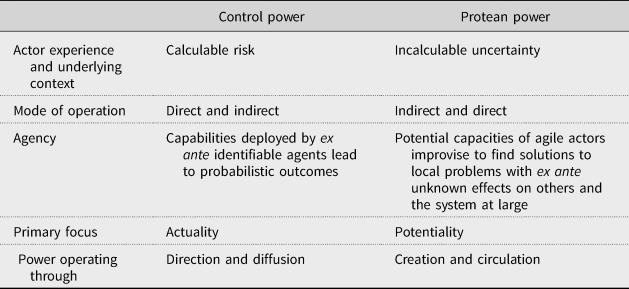
What Katzenstein and Seybert mean to achieve with the concept of protean power is not to revolutionize our definition of power in general, but instead to carve out room for an analytically distinct type of power than standard control power. Depending on the situation, protean power may operate to a greater or lesser extent, and it may interact with standard control power to a greater or lesser degree. Katzenstein and Seybert's theoretical analysis of these two types of power, control power and protean power, builds on a number of political theorists including Foucault, Clausewitz, and especially Machiavelli. The volume they have put together with a sterling team of chapter authors shows that both control power and protean power are very real phenomena, which in different issue-areas and institutional contexts may be ‘interactive, entangled, competitive, complementary, parallel, [and/or] nested’.Footnote 4 Table 1 recapitulates Katzenstein and Seybert's basic comparison of the two types of power.
Control power and protean power – basic comparison

From Seybert and Katzenstein (Reference Seybert, Katzenstein, Katzenstein and Seybert2018, 10).
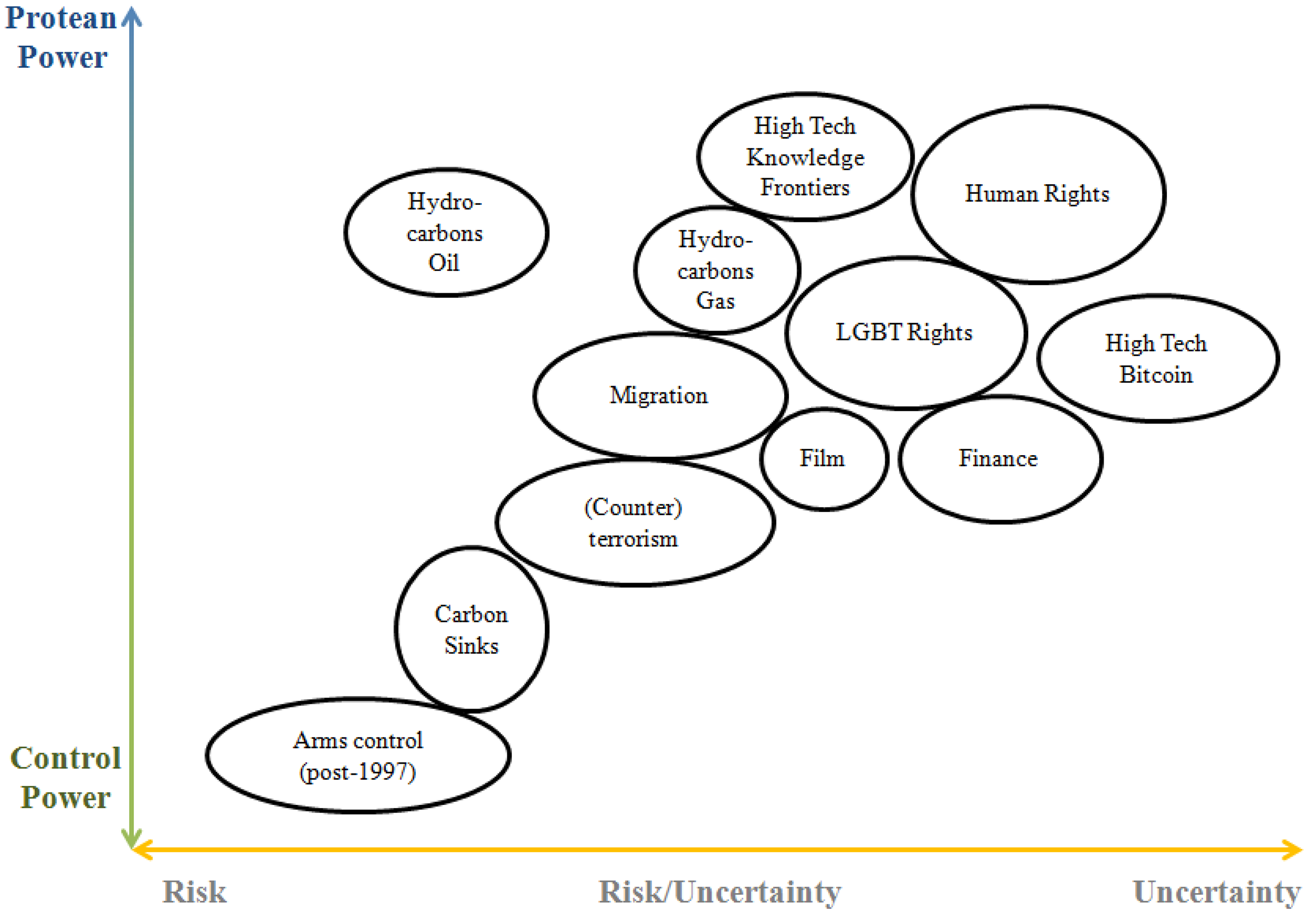
The 10 empirical chapters in the volume discuss the contexts and interactions of these two types of power in a gratifyingly wide array of issue-areas. The important empirical contributions to this collective work include Christian Reus-Smit on human rights, Phillip M. Ayoub on LGBT rights, Noelle K. Brigden and Peter Andreas on migration, Rawi Abdelal on hydrocarbons, Erin Lockwood and Stephen C. Nelson on finance, Barak Mendelsohn on terrorism, Stephen C. Nelson (with Seybert and Katzenstein) on film, Jennifer L. Erickson on arms control, and Jessica F. Green on greenhouse gas emissions. In addition, Seybert and Katzenstein contribute their own empirical chapter on high-tech industries and Bitcoin. Figure 1, which is taken from Chapter 2 of the volume, shows the empirical chapters' findings in terms of the degree of correlation between (a) the relative significance of risk vs. uncertainty and (b) the relative weight of control power vs. protean power.
Examples of control and protean power in a risky and uncertain world (from Katzenstein and Seybert Reference Katzenstein, Seybert, Katzenstein and Seybert2018b, 55).

Table 1 and Figure 1 both make clear that Katzenstein and Seybert's differentiation between control and protean power rests on the definitional distinction between ‘risk’ and ‘uncertainty’. Mainstream IR theory's focus on control power stems naturally from its assumption that the uncertainty of the world can be treated as nothing more than calculable risk. In a domain characterized by risk, actors define their interests in terms of power – which is to say, control power. More control power means less risk, and less risk opens the door to steadier gains. What is missing from this mainstream IR picture is the profound ‘Knightian’ uncertainty – unknown unknowns – that can envelop international politics and thwart states' best-laid plans. Katzenstein and Seybert point out that uncertainty cannot be boiled down to mere risk, and therefore also that people and states often make far more dangerous bets than they realize.Footnote 5 For instance, as Ann Hironaka has demonstrated in her book Tokens of Power, great powers tend to enter wars confidently, only to discover that their pre-war perception of their relative power was simplistic, their war plans were foolish, and their expected range of potential war outcomes was ridiculously narrow.Footnote 6 Like Hironaka, Katzenstein and Seybert and their colleagues contend that the IR discipline's tendency to equate power with control power – and uncertainty with risk – produces an overly narrow picture of international politics as a rules-based chess match that ignores the real world's capacity to surprise.
It is not hard to explain the IR discipline's resistance to accepting the vast and irreducible uncertainty that envelops much of world politics. In addition to its Newtonian scientific aspirations, mainstream IR has generally sought to hew closely to the rules of international political discourse as laid down by the great powers; and as Barak Mendelsohn puts it in his contribution to the volume, the state's ‘legitimacy strongly depends on its ability to demonstrate control, predictability, and accountability. No wonder it prefers to view the world through the lens of risk’.Footnote 7 But in the long run, the legitimacy of our discipline as a truth-seeking scientific endeavor will depend on whether we can break free from our habit of ‘seeing like a state’.Footnote 8
In this International Theory symposium, a number of highly accomplished scholars offer constructive but hard-hitting critiques of Protean Power from different vantage points in IR, political science, and economics. In addition to this introduction, the symposium includes contributions from Emanuel Adler, George DeMartino and Ilene Grabel, Stefano Guzzini, Benoît Pelopidas, and Michael Zürn; Katzenstein then offers an essay in reply. (Sadly, Protean Power's co-editor Lucia Seybert recently passed away.) In order to ensure some unity in our diversity, I gave the contributors a common set of questions as a starting point, based loosely on John Gerring's (Reference Gerring1999) rules for good concept formation:
(1) Does the basic idea of ‘protean power’ intuitively resonate with you? Does IR need this neologism? Why or why not?
(2) How clear and coherent are the book's definition and elaboration of the concept of ‘protean power’? What gray areas remain? How might you suggest they could be clarified?
(3) How useful do you think the concept of ‘protean power’ can be as a means of discovering new empirical questions and answers in specific IR issue-areas? In your answer to this question, please engage with some of the claims made in the empirical chapters in the book, as well as any ideas that may emerge out of your own research.
My own answers to the questions that I posed to the contributors may be sketched as follows. I think that the notion of protean power has the potential to take the IR field in some highly productive new directions. However, I also think that the Katzenstein and Seybert volume has neither sufficiently differentiated the key concept from existing concepts, nor precisely fastened on what it can give us empirically that others don't. These are urgent tasks if their ambitions for protean power to remake the IR field are to be realized. I believe that accomplishing such tasks will be difficult but feasible, and here I highlight one promising line of research toward that ultimate goal.
I start by noting one of the puzzling aspects of the Protean Power volume: its lack of serious engagement with the rational choice literature. The volume generally dismisses the rational choice perspective as part of the overall church of control power whose hegemony needs to be shattered. Katzenstein and Seybert explicitly target rationalist IR theories of deterrence and bargaining models of war, and also rationalist IPE theories of ‘open economy politics’ as oversimplified pictures of a risk-only world.Footnote 9 Much of the volume's theoretical and empirical discussion then focuses on the many unexpected macro-level effects of micro-level decisions, which can ultimately undermine state attempts to exercise control power. For instance, the excellent chapter by Noelle K. Brigden and Peter Andreas explains how the ever-greater control power that the USA has deployed along its southern border to prevent migration ended up spawning the growth of technologically advanced smuggling gangs who are not just good at evading the US Border Patrol but are also wreaking havoc within Mexico, thus ultimately producing even more migrants to the USA.Footnote 10 Many other chapters highlight similar paradoxes.
These empirical points are very well taken, but actually their core idea seems to me hardly distinguishable from much of the rational choice project in political science. Kenneth Arrow (not cited in the book's bibliography),Footnote 11 Robert Bates (not cited),Footnote 12 Russell Hardin (not cited),Footnote 13 Mancur Olson (not cited),Footnote 14 William Riker (not cited),Footnote 15 and others have persistently hammered on the basic theme that the sources of macro-level irrationality can be found in micro-level rationality. Any one of them would instinctively agree with what Seybert, Katzenstein and Stephen C. Nelson write in the book's chapter on Hollywood and its global competitors: ‘What our account employing the concept of protean power captures is that seemingly stable systems can be reconfigured quickly through decentralized innovative moves’.Footnote 16 Then they would have developed a formal model.
I do not want to imply that we can do without the protean power concept simply because we already have rational choice concepts such as cycling preferences, free rider problems, tipping games, heresthetics, and so on. But if the protean power concept is to make the seminal contribution to the field that the book's authors want it to make, then we need to clearly focus on what it offers that is different from what we already have.
In my view, the need for a clearer differentiation of the protean power concept from the rational choice literature should push us to problematize the volume's assumption that protean power is ‘the results of actions of agile actors who are coping with…uncertainty’.Footnote 17 Assertions that ‘agile actors’ are the major generators of protean power effects are shot through the entire volume, and the phrase ‘agile actors’ gets its own line in the Index. Katzenstein and Seybert even formally define the concept of protean power as emanating from the ‘agency’ of ‘agile actors’ who ‘improvise to find solutions to local problems with ex ante unknown effects on others and the system at large’.Footnote 18 The definition is clear, but the focus on agile actors seems quite compatible with standard rational choice principles.
Although the contributors to the volume portray agility as the key link of reciprocal causation between actors and radical uncertainty, I contend that rigidity is the more likely response by human beings to the experience of radical uncertainty, and furthermore that actor rigidity is at least as likely as agility to generate protean power effects.Footnote 19 After all, the word ‘agility’ suggests sensitivity to costs and opportunities, which in turn suggests conformity to structures or to actors with control power. The connection between agility and conformity is why neo-liberal social engineers are so eager to create ‘flexible’ workforces. By contrast, the word ‘rigidity’ suggests insensitivity to costs and opportunities. Individual actors' rigidity can be due to their moral principles, prideful self-assertion, socialization and habituation, mental illness, and so on. Where it does not come from is the rationality of homo economicus.Footnote 20 Think Martin Luther: ‘Here I stand, I can do no other’. Such insensitivity to costs and opportunities poses a major challenge – often an unintended one – to those who wield control power. Usually the established hierarchy quickly and easily beats back the challenge. But sometimes it becomes totally confounded, as occurred in Europe after Luther took his stand: an ideal-typical case of protean power.
An IR example of the affinities between rigid actors and protean power can be found in European politics during the first half of the 20th century. Participants in military battles had always experienced high levels of risk, but it was only with the development of industrial warfare during the 19th century that the battlefield became a place of radical uncertainty. In 1858 Karl Marx saw the future, asking, ‘Is Achilles possible with powder and lead?’Footnote 21 The future fully arrived with World War I. Neither agility, nor skill, nor martial valor was of any use to those poor souls who suffered continual artillery barrages while fixed in place in the mud of Verdun. The reasons for individual soldiers' death or survival were simply absurd. That is what radical uncertainty looks like.
If the soldier did make it back home, he arrived as a dramatically different person than the one who had left. The radical uncertainty of the battlefield may have ended in 1918, but the enduring psychological trauma from that experience deeply affected veterans' subsequent political behavior. Most German veterans' groups became rigidly militarist, treating even domestic politics as merely another battlefield in the never-ending war. George Mosse has described the ‘brutalization of German politics’ in the 1920s, including waves of paramilitary assassinations of left-wing politicians: ‘The 324 political assassinations committed by the political Right between 1919 and 1923 (as against twenty-two committed by the extreme Left) were, for the most part, executed by former soldiers at the command of their one-time officers – by actual or former troops of the Free Corps or members of rightist paramilitary organizations (most were members of both) – and defended in patriotic language borrowed from the war’.Footnote 22 According to Mosse, the brutalization of German politics after World War I paved the way for the horrors of World War II, which was launched by a rigidly ideological dictator who himself had been deeply marked by the trauma of the World War I battlefield. German politics in the interwar period thus offers us a major example of protean power that can be attributed to key actors' rigidity more than their agility.
The protean effects of wartime trauma-induced psychological rigidity come into even greater focus when we contrast the case of interwar Germany with that of France. Unlike their German counterparts, most French World War I veterans' groups turned pacifist – but they were just as rigidly pacifist as the Germans were rigidly militarist. The French veterans' turn toward pacifism was unpredictable, but Antoine Prost makes it understandable by pointing to the combination of wartime trauma and the ideational heritage of French republicanism. Prost writes, ‘For the veterans, in fact, the citizen had no more right to resign himself to the possibility of war than the doctor to that of death, and their deliberate blind pacifism might be compared to certain forms of desperate treatment’.Footnote 23 The veterans' traumatized psychology factored heavily in their tragic progress from celebrating Aristide Briand for his peace overtures in the 1920s, to supporting the appeasement policies of the 1930s, to ultimately welcoming the defeatist Vichy regime in 1940. Indeed, despite Vichy's non-republican institutions, the veterans generally felt that its policies ‘matched their aspirations’, because the guns were silent.Footnote 24
The phenomenon of rigid actors unleashing protean power effects is not just to be found among the mass public; it is also visible at the highest reaches of states. For example, take the case of leaders' decisions to arm their states with nuclear weapons. As I have argued elsewhere, the decision to go for nuclear weapons is a classic case of a ‘big decision’ that carries potentially revolutionary consequences on every level of politics and policy, including military strategy, diplomacy, economics, domestic politics, and ethical commitments.Footnote 25 Most leaders shy away from making such ‘big decisions’, because they prefer to remain in the shallows of risk rather than plunging themselves and their countries into the deep end of uncertainty: ‘It is this high degree of general uncertainty that makes it so hard for most state leaders, even relatively risk-acceptant ones, to make a definitive decision to acquire nuclear weapons. For if you cannot calculate the risks involved, you cannot determine if you are willing to accept them’.Footnote 26 Yet, despite the fundamentally unpredictable effects of the decision to go nuclear, some leaders have thrown caution to the wind and committed their states to build the bomb.
How could some leaders ignore the radical uncertainty that is inherent to nuclear proliferation, and that keeps most other leaders in a wait-and-see mode? In the cases that I studied, the key was the leader's national identity conception of oppositional nationalism – a deeply-held vision of the nation as both naturally at odds with a particular external other, and naturally equal if not superior to it. According to circumstantial and eyewitness evidence, leaders with such a national identity conception experienced an emotional cocktail of fear and pride when interacting with the external other, which impelled them to take the plunge into nuclear weapons. That emotional combination of fear and pride also made them cocksure that their decision was right and necessary, without needing expert analyses and cost estimates. In short, the leaders who chose to go nuclear were a picture of psychological rigidity.
For example, shortly after coming to power in 1998 the Hindu nationalist Indian Prime Minister Atal Behari Vajpayee brushed aside his advisors' desires to study the likely political and economic effects of a nuclear test explosion and simply ordered them to proceed: ‘No need for much thought. We just have to do it’.Footnote 27 Actually, Vajpayee had similarly ordered a nuclear test immediately upon becoming prime minister for the first time in 1996. But at that time the scientists were unable to get everything ready before his coalition government fell in only 16 days, after which his successor, the less rigid H.D. Deve Gowda, quickly shelved the order.Footnote 28 In 1998, Vajpayee's parliamentary backing was more stable, and therefore he was able to get his ‘big bomb now’.Footnote 29 Then, confounding his expectations, the Indian nuclear tests ended up producing such severe diplomatic isolation for India that Pakistan became emboldened not only to test nuclear weapons itself for the first time about 3 weeks later, but also to try to bite off a piece of disputed Kashmir during the following year; a clear example of the workings of protean power.Footnote 30
Subsequent research by other scholars has reinforced my confidence in the finding that states ruled by psychologically rigid oppositional nationalist leaders are much more likely to seek nuclear weapons, with all their protean power consequences. For instance, Matthew Fuhrmann and Michael C. Horowitz's quantitative empirical analyses turned up a remarkable correlation linking a state's pursuit of nuclear weapons to its top political offices being held by people who previously were members of armed rebel groups.Footnote 31 Fuhrmann and Horowitz find that having a top state leader with rebel experience increases the probability of nuclear weapons pursuit by over 400%, after controlling for the standard structural variables. The effects of rebel experience are much larger than those recorded by standard interstate security and economic indicators. A plausible mechanism linking many leaders' rebel experiences with their nuclear decision-making tendencies could be the very same wartime trauma-induced psychological rigidity that I already discussed with respect to the veterans of World War I. Another plausible mechanism is that these people's psychological rigidity was what caused them to join the armed rebel group in the first place.
In summary, the concept of protean power can make a much bigger difference to the IR research agenda if we recognize that protean power effects are at least as likely to be produced by the actions of rigid actors as agile ones. Ironically, it is the people who exude the greatest certitude who may be most likely to expand the realm of the uncertain and unexpected in world politics. There are rigid actors in our midst who take actions that are perhaps predictable if we know the actors well, but otherwise seem foolhardy or even unimaginable. Moreover, whether or not a rigid actor's action could be anticipated in advance, the effects of that action are much harder to predict, let alone the concatenation of effects of multiple rigid actors' actions. The heightened climate of uncertainty then doubles back and produces even more rigid actors.
Having offered my take on Katzenstein and Seybert's highly stimulating volume, I now turn to the welcome task of introducing the further contributions to this symposium, by seven brilliant colleagues who hail from a diverse set of perspectives. Although I cannot do justice here to the complex and learned arguments they make, I do hope to whet the reader's appetite by briefly mentioning what I think are some of their especially insightful points.
First, Emanuel Adler argues that the Protean Power volume does not go far enough to undermine the mainstream IR focus on control power, which needs to be reconceptualized as a special case of protean power. He writes, ‘The social world is a world of physical and social propensities and thus a world of different degrees, grades, and intensities of protean power’.Footnote 32
Second, George DeMartino and Ilene Grabel offer a perspective from the discipline of economics, which shares IR's tendency to privilege risk over uncertainty and control power over protean power. According to DeMartino and Grabel, economists as well as IR scholars need to realize that ‘the extension of knowledge in service of control power, whether that knowledge is derived axiomatically or empirically, can create the conditions for the eruption of crises of control in which uncertainty rears its head and protean power exerts its force’.Footnote 33
Third, Stefano Guzzini interprets the volume's agenda in terms of three linked points: an ontology of open processes, an explanatory theory informed by non-efficient causality, and a practical political lesson in the dangers of hubris. In terms of the linkage from ontology to explanation, Guzzini worries that the volume crams uncertainty and protean power into a cause-and-effect framework, thus undermining its more ambitious goal of redefining political order in terms of open processes. In terms of practical politics, Guzzini warns that a focus on uncertainty, far from promoting caution and modesty about what control power can accomplish, could instead promote a ‘heightened sense of the worst-case scenario which makes even the US, which trumps anyone else in military terms, feel insecure…. And, in this endless quest, the only answer is more (control power) of the same’.Footnote 34
Fourth, Benoît Pelopidas sees the concept of protean power as opening the door to a serious discussion of the unknowability of the future, which should call into question the scientific conceit of mainstream IR. But he also contends that the volume's specific definition of protean power is insufficiently open to the full range of possible futures. It ‘suffers from a survivability bias’ that assumes humanity's ‘resilience’, and therefore obscures the looming nuclear and climate dangers to humanity's survival as completely as mainstream IR approaches have done.Footnote 35
Fifth, Michael Zürn suggests that the concept of protean power as deployed in this volume is simultaneously too expansive and too narrow. Too expansive, in that the volume denies the common sense understanding of power as a relationship that at least probabilistically favors one set of actors over others. Too narrow, in that the volume tries to limit the play of protean power to the specific context of radical uncertainty, whereas actors sometimes spawn revolutionary social innovations precisely because they calculate that they are otherwise sure to lose.Footnote 36
The final essay is by Peter Katzenstein, who offers a spirited and constructive response to many of these critiques and suggestions.
Dear reader, please continue on to read the fascinating essays in this IT symposium!
Acknowledgements
The anonymous reviewers, Rieko Kage, Peter Katzenstein, and John Mueller provided great feedback on an earlier version of this paper.