The following vignette illustrates common, well-known, real problems that exist clinically and scientifically for classification, for understanding etiological mechanisms underlying internalizing psychopathology, and for evidence-based assessment and intervention:
Aaliyah is a 16-year-old girl who has always considered herself to be a “worrier.” When she was younger, Aaliyah used to worry about anything that was “new,” like starting preschool or flying on a plane by herself. Now, she feels like she worries about almost everything, such as maintaining her starting position on the varsity softball team, getting good grades in school, and keeping the peace between friends that always seem to be in the midst of some sort of “drama.” Aaliyah recently broke up with her boyfriend, who graduated high school and is moving out of state for college. Aaliyah initially thought that being single would give her more time to focus on the four Advanced Placement classes she is taking in her junior year; however, she has been feeling sadder about the breakup than she had anticipated, and it is difficult for her to concentrate on her homework and softball practice. When she finally lays her head on the pillow at 2:00 a.m., it is hard for her to sleep because of the worries racing through her head and her pounding headaches. As a result, her grades have been slipping, and her coach just benched her for the upcoming regional tournament, which has caused Aaliyah even more stress and worry. Lately, she spends a lot of time in her room by herself, and skips dinner with her family so that she can rest, and often feels fatigued.
Overview
One of the most well-established phenomena to emerge from decades of research based on current psychiatric classifications (e.g., International Classification of Diseases [ICD] or DSM systems) is the abounding existence of comorbidity, or the co-occurrence of psychiatric diagnoses or symptoms at levels beyond chance and greater than expected prevalences in the general population. Why comorbidity is so ubiquitous, and the potential reasons and mechanisms that may underlie such strong co-occurrence, have been long-standing questions in psychiatric epidemiology and developmental psychopathology (e.g., Angold, Costello, & Erkanli, Reference Angold, Costello and Erkanli1999; Caron & Rutter, Reference Caron and Rutter1991).
This paper tackles this vexing problem with a focus on comorbidities among internalizing symptoms and disorders (for some other reviews of this literature see Barlow, Sauer-Zavala, Carl, Bullis, & Ellard, Reference Barlow, Sauer-Zavala, Carl, Bullis and Ellard2014; Cummings, Caporino, & Kendall, Reference Cummings, Caporino and Kendall2014; Garber & Weersing, Reference Garber and Weersing2010; Seligman & Ollendick, Reference Seligman and Ollendick1998). We seek to address the conundrum of comorbidity by advocating for a latent dimensional structural model of psychopathology. We illustrate how different exemplar risk mechanisms and vulnerabilities across multiple levels of analysis may underlie continuities and discontinuities associated with different aspects of internalizing symptoms across different strata in the latent structural model. While we adopt a developmental perspective across the life span, our review of evidence focuses predominantly on data collected among children and adolescents.
First, we briefly review the present state of knowledge for the evidence of comorbidity among internalizing symptoms and disorders, based on extant psychiatric classification systems (e.g., ICD and DSM) that have dominated the majority of the research for more than the past three decades. In particular, we consider concurrent comorbidities and developmental sequential comorbidities over time among DSM-defined internalizing disorders. Then, we introduce and review more recently proposed and empirically supported latent dimensional models of psychopathology that can help to explain the observed co-occurrence among internalizing symptoms. These latent structural models provide an alternative explanation that offers promise for a breakthrough in understanding reasons and mechanisms for the known comorbidity among internalizing problems (see Beauchaine, Reference Beauchaine2014; Beauchaine & McNulty, Reference Beauchaine and McNulty2013, for illustrations of this approach profitably applied to externalizing problems).
Second, we use these dimensional structural models of psychopathology, integrated with and embedded within a multiple levels of analysis approach, to provide a conceptual heuristic model that illustrates how some exemplar risk mechanisms and vulnerabilities can account for continuities and discontinuities in internalizing co-occurrence across development, especially among children and adolescents. We articulate how various risk factors and mechanisms predict different dimensions and levels of the latent structural model that organizes psychopathology: from the latent general psychopathology factor (e.g., the p factor; Caspi et al., Reference Caspi, Houts, Belsky, Goldman-Mellor, Harrington and Israel2014) to a unique dimensional internalizing latent factor, and finally to symptom-specific syndrome dimensions that characterize unique variance and capture distinct aspects of emotional symptoms and problems. We illustrate how these particular exemplar risk mechanisms that are commonly studied as vulnerabilities to internalizing problems of anxiety and depression, including executive function (EF), biased information processing of emotion, cognitive vulnerabilities, negative and positive affectivity (NA and PA) aspects of temperament, autonomic dysregulation, and stressful life events, connect to the different levels of the dimensional structural model of psychopathology.
Vulnerabilities and risk factors, as instantiated across multiple levels of analysis, can operate as mechanisms of both continuity and discontinuity, depending on which level of the psychopathology structure they connect to, and thus can be used to profitably explain the co-occurrence of internalizing problems more powerfully and parsimoniously than the standard, traditional categorical psychiatric disorder approach. Finally, we end with future directions, including questions and implications of this novel conceptual model.
The central thesis of this paper is that progress can be made by using latent, dimensional structural models that organize the psychopathology side as well as the vulnerability and risk factor side at different levels of analysis and by joining these latent levels of risk mechanisms and psychopathology outcomes together. We advocate that such models have the potential to solve, at least to a large degree, the long-standing problems of comorbidity among discrete psychiatric disorders, as traditionally conceptualized and assessed via psychiatric categorical nosologies (e.g., DSM and ICD), as well as the inability to detect simple, precise linkages between unique risk processes and specific psychiatric disorders. We acknowledge and caution that this is a relatively novel approach and perspective, and considerable future empirical work will be needed to test the core tenets of this proposal. In support of our central thesis, we provide examples of recent empirical research, including research being presently conducted in our laboratories along with informed explanations rationally inferred from other published data. In summary, these findings illustrate how new insights and understanding can be achieved when the proper, optimal structural models are used to organize both psychopathology and risks across multiple levels and when these risk and psychopathology models are systematically and thoughtfully connected together.
Evidence for Internalizing Comorbidity: DSM-Defined and Assessed Psychiatric Disorders
We review patterns of diagnostic co-occurrence among commonly studied internalizing disorders as assessed in large-scale epidemiological studies of children and adolescents. These include DSM-defined anxiety and mood disorders, including separation anxiety disorder, specific phobia, social anxiety disorder, generalized anxiety disorder (GAD), panic disorder, posttraumatic stress disorder (PTSD), and major depressive disorder/dysthymia. These are typically assessed via structured or semistructured psychiatric diagnostic interviews that yield reliable, categorical psychiatric diagnoses consonant with DSM's nosology.
Concurrent comorbidity
In a classic meta-analytic review, Angold et al. (Reference Angold, Costello and Erkanli1999) demonstrated substantial, significant co-occurrence between pairs of single psychiatric disorder classes, including between depression and anxiety disorders (median odds ratio = 8.2). This and other reviews (e.g., Avenevoli, Stolar, Li, Dierker, & Ries Merikangas, Reference Avenevoli, Stolar, Li, Dierker and Ries Merikangas2001; Garber & Weersing, Reference Garber and Weersing2010; Yorbik, Birmaher, Axelson, Williamson, & Ryan, Reference Yorbik, Birmaher, Axelson, Williamson and Ryan2004) estimate that 15%–75% of depressed youth carry a comorbid anxiety diagnosis, whereas around 10%–15% of diagnosed anxiety disordered youth receive a comorbid depressive disorder diagnosis over their life span. Other population-based epidemiological studies have similarly documented considerable concurrent comorbidity between pairwise internalizing disorders (Kessler et al., Reference Kessler, Avenevoli, McLaughlin, Green, Lakoma and Petukhova2012; Merikangas et al., Reference Merikangas, He, Burstein, Swanson, Avenevoli and Cui2010).
These prevalence and comorbidity rates largely mirror those results obtained from large-scale adult (e.g., Kessler, Chiu, Demler, & Walters, Reference Kessler, Chiu, Demler and Walters2005) and, to a lesser extent, preschool (Wichstrøm et al., Reference Wichstrøm, Berg Nielsen, Angold, Egger, Solheim and Sveen2012) epidemiological samples. The National Comorbidity Study—Replication of individuals ages 15–55 similarly showed strong comorbidity among internalizing disorders (Kessler et al., Reference Kessler, Chiu, Demler and Walters2005). Among preschoolers interviewed with a psychiatric diagnostic instrument, the results likewise showed strong co-occurrence, but there were important differences in the patterning of comorbidity, such that anxiety disorders only weakly overlapped with most other disorders (Wichstrøm et al., Reference Wichstrøm, Berg Nielsen, Angold, Egger, Solheim and Sveen2012). Overall, then, these data suggest that high levels of concurrent internalizing comorbidity exist across the life span, at least starting in childhood through adolescence and adulthood, while less co-occurrence with anxiety is found earlier in the life span. Reasons for the differential degree of comorbidity by development are unclear, although the lower prevalence of emotional disorders (3.3%) among preschoolers relative to that seen in adolescence (14.3% any mood disorder; 31.9% any anxiety disorder; Merikangas et al., Reference Merikangas, He, Burstein, Swanson, Avenevoli and Cui2010) likely constitutes an important possibility.
Developmental sequential comorbidity
It is important to examine both within- and between-individual associations between anxiety and depression across development. While concurrent comorbidity patterns can be informative, especially age-related patterns, inferring temporal precedence and potential developmental pathways underlying patterns of internalizing comorbidity from cross-sectional data is difficult. It is important to understand for whom symptoms change, and also when they are expected to change and why.
Longitudinal studies using repeated measures of anxiety symptom and diagnosis measures have shown that certain anxiety disorders tend to precede and predict other later anxiety disorders. While strict homotypic continuity (same anxiety disorder being stable over prospective follow-up) is moderate at best, often there is broad homotypic continuity (an earlier anxiety disorder predicts later onset of a different anxiety disorder; Beesdo, Knappe, & Pine, Reference Beesdo, Knappe and Pine2009). Of the DSM-defined anxiety disorders, separation anxiety and some simple phobias tend to have the earliest modal age of onset in childhood, and then decrease in adolescence. This is followed by an increase in social anxiety and GAD (or overanxious disorder, based on early versions of DSM III and III-R, from some studies) in early to middle adolescence, and then an elevation for panic disorder later in adolescence (Beesdo et al., Reference Beesdo, Knappe and Pine2009; Costello, Egger, Copeland, Erkanli, & Angold, Reference Costello, Egger, Copeland, Erkanli, Angold, Silverman and Field2011).
Of the longitudinal studies that have measured both depression and anxiety symptom or diagnosis, the results have traditionally been interpreted as showing that anxiety precedes depression symptoms, because the majority of data is generally consistent with this pattern (Costello, Mustillo, Erkanli, Keeler, & Angold, Reference Costello, Mustillo, Erkanli, Keeler and Angold2003; Merikangas et al., Reference Merikangas, Zhang, Avenevoli, Acharyya, Neuenschwander and Angst2003; Pine, Cohen, Gurley, Brook, & Ma, Reference Pine, Cohen, Gurley, Brook and Ma1998; Wittchen, Kessler, Pfister, Höfler, & Lieb, Reference Wittchen, Kessler, Pfister, Höfler and Lieb2000). Helping to establish this predominant heterotypic continuity view (i.e., underlying process at the latent level stays the same, although the manifest symptom expression may appear differently), DSM-based disorders that have been grouped at a latent level as characterized by fear (e.g., specific phobias, social phobia, or panic disorder) predicted later DSM disorders that have distress as a latent core (separation anxiety, PTSD, depression, or GAD; Kessler et al., Reference Kessler, Avenevoli, McLaughlin, Green, Lakoma and Petukhova2012). Social phobia predicted subsequent onset of secondary depression (Beesdo et al., Reference Beesdo, Bittner, Pine, Stein, Höfler and Lieb2007). Girls showed more concurrent and sequential comorbidity, especially among internalizing disorders (Costello et al., Reference Costello, Mustillo, Erkanli, Keeler and Angold2003).
However, this simple linear directional interpretation may be questioned based on other data suggesting a more nuanced picture and different temporal pathways between anxiety and depression (e.g., Cummings et al., Reference Cummings, Caporino and Kendall2014). For instance, beginning in adolescence some major large-scale, longitudinal studies have found that a depressive disorder predicts future onset of anxiety disorders (Fergusson & Woodward, Reference Fergusson and Woodward2002; Kim-Cohen et al., Reference Kim-Cohen, Caspi, Moffitt, Harrington, Milne and Poulton2003), and especially future onset of GAD (Moffitt et al., Reference Moffitt, Harrington, Caspi, Kim-Cohen, Goldberg and Gregory2007; Pine et al., Reference Pine, Cohen, Gurley, Brook and Ma1998). Still other research casts doubt on the heterotypic continuity pattern of anxiety preceding later depression. In a sample of all girls, depressive symptoms largely predicted depressive symptoms over time, while some additional prediction was provided by separation anxiety in early childhood and social and general anxiety in early adolescence (Keenan, Feng, Hipwell, & Klostermann, Reference Keenan, Feng, Hipwell and Klostermann2009). In a mixed-gender sample, early anxiety predicted later depression only for boys, whereas prior substance use was associated with greater depression among girls (Gallerani, Garber, & Martin, Reference Gallerani, Garber and Martin2010). Other studies investigating latent trajectories have shown bidirectional associations between anxiety and depression symptom trajectories during adolescence: adolescents with increasing symptoms of anxiety tend to exhibit increasing symptoms of depression across time, and vice versa (Hale, Raaijmakers, Muris, Van Hoof, & Meeus, Reference Hale, Raaijmakers, Muris, Van Hoof and Meeus2009; Leadbeater, Thompson, & Gruppuso, Reference Leadbeater, Thompson and Gruppuso2012; McLaughlin & King, Reference McLaughlin and King2015).
A recent review (Cummings et al., Reference Cummings, Caporino and Kendall2014) suggested that there may be three pathways that best characterize the comorbidity between anxiety and depression. Pathway 1 accounts for youth with a predisposition to anxiety and manifestation of anxiety (primarily social anxiety or separation anxiety) preceding later comorbid depression. Pathway 2 delineates individuals with shared risk to both anxiety (predominantly GAD) and depression and who exhibit both simultaneously. Pathway 3 describes the relatively smaller group with depression vulnerability with subsequent co-occurrence of anxiety (mostly social anxiety) after depression.
Indirect, or epiphenomenal, comorbidity
These comorbidity findings are all predominantly based on simple co-occurrence patterns as determined by analyzing pairwise associations between common internalizing disorders (e.g., depressive disorder with social anxiety disorder). However, there may be indirect comorbidity patterns (sometimes called “epiphenomenal” comorbidity), such that the overlap among more than just two disorders could be a function of an association of fewer disorders. For example, depression, social anxiety, attention-deficit/hyperactivity disorder (ADHD), and oppositional defiant disorder (ODD) are all co-occurring disorders; but perhaps this comorbidity could be accounted for more simply given the overlap among all these disorders and their shared use of irritability as a core symptom, such that once ODD is controlled for, the significant comorbidity among the other disorders is attenuated or disappears entirely. Examining comorbidity patterns from three epidemiological samples of children and adolescents, Copeland, Shanahan, Erknli, Costello, and Angold (Reference Copeland, Shanahan, Erkanli, Costello and Angold2013) replicated the oft-demonstrated simple bivariate-level comorbidity patterns found when examining pairwise associations among all disorders. Of interest, though, this ubiquitous comorbidity (i.e., all disorders significantly covary with all other disorders to varying degrees) was substantially explained by indirect comorbidity. The typically obtained simple bivariate comorbidity patterns found across internalizing and externalizing disorders (e.g., conduct disorder, ODD, and ADHD) were no longer significantly and systematically obtained after controlling for indirect comorbidity. Specifically, only ODD showed direct comorbidity with internalizing, distress disorders. Moreover, GAD and depressive disorders overlapped so strongly that they were collapsed into a single distress disorder grouping, as has been suggested previously (e.g., Watson, Reference Watson2005) and shown in some prior studies (e.g., Kessler et al., Reference Kessler, Avenevoli, McLaughlin, Green, Lakoma and Petukhova2012; Krueger & Markon, Reference Krueger and Markon2006; Lahey et al., Reference Lahey, Applegate, Waldman, Loft, Hankin and Rick2004). Internalizing disorders of GAD, depression, social anxiety, and separation anxiety still significantly overlapped, but to a lesser degree after adjusting for pairwise comorbidity among all common disorders.
These results, based on indirect comorbidity patterns, suggest some interesting and important conclusions. First, the rampant comorbidity observed among all common psychiatric disorders may be better organized in a simpler structural manner, as we discuss next. In particular, Copeland et al.’s (Reference Copeland, Shanahan, Erkanli, Costello and Angold2013) findings highlight that internalizing disorders still demonstrate significant co-occurrence, even after controlling for all disorder overlap, although these internalizing disorders mostly do not covary with traditional externalizing disorders, with the exception of ODD. This suggests that there may be some general psychopathology component that is common to and cuts across multiple forms of traditionally defined categorical psychiatric disorders and psychopathology. Second, Copeland et al. (Reference Copeland, Shanahan, Erkanli, Costello and Angold2013) emphasize that “the number of such comorbid subgroups that merit study is more limited than that of all possible combinations” (p. 6). In other words, the field does not need more of the same research demonstrating simple bivariate patterns of comorbidity between single psychiatric disorders. Instead, an alternative approach, ideally based on a simpler structure with a more limited number of symptom groupings, could prove useful to elucidate reasons underlying internalizing comorbidity.
These indirect, or epiphenomenal, comorbidity findings provide an important insight. In this paper, we build on this and, as such, advocate focusing on fewer, simpler latent symptom dimensions across different levels of organization that can account for internalizing co-occurrence. Understanding mechanisms of internalizing comorbidity may not be as overwhelming, confusing, and difficult as trying to explain all pairwise patterns of individual DSM-based disorder comorbidities. By focusing on a simpler, more limited set of patterns across different levels of analysis, we believe the pattern that organizes internalizing comorbidity can be clarified and thus better elucidate which mechanisms predict different aspects across the different levels of internalizing pathology.
Concerns about categorical psychiatric classification and implications for comorbidity
The majority of all of this research documenting comorbidity is grounded in the use of, and reliance on, existing psychiatric nosologies and classification approaches, especially the categorical diagnoses, based on expert opinion, as instantiated via modern DSM systems since 1980. It is important to note that there are significant assumptions and concerns that underlie the persistent use and acceptance of a categorically based diagnostic approach (e.g., Berenbaum, Reference Berenbaum2013; Kendell & Jablensky, Reference Kendell and Jablensky2003; Kendler, Reference Kendler2012; Lilienfeld, Smith, & Watts, Reference Lilienfeld, Smith, Watts, Craighead, Miklowitz and Craighead2013; Rutter, Reference Rutter2013; Uher & Rutter, Reference Uher and Rutter2012; Widiger & Clark, Reference Widiger and Clark2000) that has produced and undergirded this knowledge underlying psychiatric epidemiology and potential mechanisms that may account for comorbidity (Carragher, Krueger, Eaton, & Slade, Reference Carragher, Krueger, Eaton and Slade2015).
Decades have been spent searching for disease-specific risk factors and mechanisms that would uniquely predict particular psychiatric disorders; however, for the most part, this quixotic search for a one-to-one correspondence of causal risk mechanism to specific disorder has not succeeded (Kapur, Phillips, & Insel, Reference Kapur, Phillips and Insel2012; Rutter, Reference Rutter2013; Uher & Rutter, Reference Uher and Rutter2012). The overwhelming preponderance of data failing to find exact associations to specific psychiatric disorders suggests that this paradigm of seeking simple, precise links with psychiatric disease-specific pathology is problematic and is not an optimal approach to advance knowledge on classification, assessment, risk, and intervention. Emphasizing this viewpoint, Uher and Rutter (Reference Uher and Rutter2012) reviewed the validity of and scientific foundation for present top-down psychiatric classifications, and they concluded: “Most published psychiatric research is predicated on the validity of classification… . [The lack of validity] is the most important reason why most published research is uninformative. We propose that to achieve a breakthrough, psychiatric research must discard the false assumptions that current classification is valid… . Instead of disease-specific investigations … shedding assumed knowledge is the way forward” (p. 601).
Comorbidity review conclusion
In summary, there is considerable comorbidity between anxiety and depression, especially concurrently. The degree and pattern of comorbidity varies considerably, in large part because there is substantial heterogeneity in DSM-defined anxiety and depression disorders. The developmental sequential comorbidity literature has predominantly addressed and found that early anxiety precedes later depression, although there is variability in the temporal patterning over development. The challenging problem of ubiquitous comorbidity among internalizing problems, as just reviewed, can be clarified, studied more simply and parsimoniously, and new knowledge generated, by considering and taking advantage of newer alternative approaches to the categorical diagnostic approach. In this paper, we adapt these newer approaches and build upon their foundational knowledge to articulate a novel heuristic conceptual model to studying mechanisms that contribute to co-occurrence among internalizing problems.
Latent Dimensional Structural Models of Psychopathology
As an alternative, building off the pioneering work by Achenbach and Edelbrock (Reference Achenbach and Edelbrock1978), who demonstrated dimensional factors of latent internalizing and externalizing problems, the field increasingly has examined and found evidence for dimensional structural models to organize psychopathology at a latent level across different tiers (e.g., Blanco et al., Reference Blanco, Wall, He, Krueger, Olfson and Jin2015; Caspi et al., Reference Caspi, Houts, Belsky, Goldman-Mellor, Harrington and Israel2014; Eaton et al., Reference Eaton, Krueger, Markon, Keyes, Skodol and Wall2013; Kessler, Petukhova, & Zaslavsky, Reference Kessler, Petukhova and Zaslavsky2011; Krueger, Reference Krueger1999; Lahey et al., Reference Lahey, Applegate, Waldman, Loft, Hankin and Rick2004, Reference Lahey, Rathouz, van Hulle, Urbano, Krueger and Applegate2007, Reference Lahey, Applegate, Hakes, Zald, Hariri and Rathouz2012; Tackett et al., Reference Tackett, Lahey, van Hulle, Waldman, Krueger and Rathouz2013).
In addition, although less extensively and explicitly studied to date, it is likely that many risk factors and mechanisms also overlap and can also be structured into latent organizational dimensions. Accordingly, parallel structural models of psychopathology and risk mechanisms can be linked together to better understand processes that underlie and predict systematically organized internalizing distress symptoms across different levels of these risk and psychopathology hierarchies.
Internalizing and externalizing latent dimensional models
When symptoms from common, major psychiatric disorders, including anxiety, mood, behavior, and substance use disorders, are analyzed free of DSM-based hierarchical rules, the associations are best modeled by two correlated, latent dimensional predispositions that characterize internalizing (i.e., anxiety and mood symptoms and syndromes) and externalizing (behavioral and substance problems) factors. Achenbach originally demonstrated this using bottom-up, psychometric approaches, especially exploratory factor analyses using emotional and behavioral symptom items from his parent- and child-report measures (e.g., Achenbach & Rescorla, Reference Achenbach and Rescorla2001). Krueger (Reference Krueger1999) was the first to apply dimensional factor analytic approaches to epidemiological psychiatric symptom disorder data from adults and document a similar two-factor latent structure of mental disorders consistent with Achenbach's original formulation. Since then, many other factor analytic studies have replicated this fundamental two-latent factor structure using large-scale epidemiological samples from adolescent and adult participants from multiple countries and cultures, often with symptom data ascertained via psychiatric diagnostic interview measures (Beesdo et al., Reference Beesdo, Knappe and Pine2009; Kendler, Prescott, Myers, & Neale, Reference Kendler, Prescott, Myers and Neale2003; Kessler et al., Reference Kessler, Avenevoli, McLaughlin, Green, Lakoma and Petukhova2012; Kessler, Ormel, et al., Reference Kessler, Ormel, Petukhova, McLaughlin, Green and Russo2011; Krueger, Chentsova-Dutton, Markon, Goldberg, & Ormel, Reference Krueger, Chentsova-Dutton, Markon, Goldberg and Ormel2003; Lahey et al., Reference Lahey, Applegate, Waldman, Loft, Hankin and Rick2004, Reference Lahey, Rathouz, van Hulle, Urbano, Krueger and Applegate2007; Slade & Watson, Reference Slade and Watson2006; Vollebergh et al., Reference Vollebergh, Iedema, Bijl, de Graaf, Smit and Ormel2001; see reviews by Carragher et al., Reference Carragher, Krueger, Eaton and Slade2015; Krueger & Eaton, Reference Krueger and Eaton2015; Krueger & Markon, Reference Krueger and Markon2006). Overall, then, two latent, dimensional factors have consistently been found to organize and represent the structure of psychopathology more accurately than the categorical psychiatric single disorder nosology.
Additional studies have investigated specific questions regarding the structure and validity of the latent internalizing dimension. These show that the latent internalizing liability is stable over time (Eaton, Krueger, & Oltmanns, Reference Eaton, Krueger and Oltmanns2011; Fergusson, Horwood, & Boden, Reference Fergusson, Horwood and Boden2006; Vollebergh et al., Reference Vollebergh, Iedema, Bijl, de Graaf, Smit and Ormel2001), largely heritable (Kendler, Prescott, et al., Reference Kendler, Hettema, Butera, Gardner and Prescott2003; Kendler, Petukhova, et al., 2011; Lahey, Van Hulle, Singh, Waldman, & Rathouz, Reference Lahey, Van Hulle, Singh, Waldman and Rathouz2011; Waszczuk, Zavos, Gregory, & Eley, Reference Waszczuk, Zavos, Gregory and Eley2015), and best conceptualized as a dimension when formally compared to alternative models (Eaton et al., Reference Eaton, Krueger, Markon, Keyes, Skodol and Wall2013). Still, there are outstanding questions about the optimal structure of the internalizing disorders. A key unresolved issue is whether a single internalizing liability is sufficient to organize the emotional symptoms (e.g., Eaton et al., Reference Eaton, Krueger and Oltmanns2011; Fergusson et al., Reference Fergusson, Horwood and Boden2006; Kessler, Hettema, Butera, Gardner, & Prescott, Reference Kessler, Ormel, Petukhova, McLaughlin, Green and Russo2011; Krueger, Caspi, Moffitt, & Silva, Reference Krueger, Caspi, Moffitt and Silva1998; Wïttchen et al., Reference Wïttchen, Beesdo Baum, Gloster, Höfler, Klotsche and Lieb2009) or whether a two-dimensional conceptualization of fear (social phobia, specific phobia, and panic disorder) and distress (depression, GAD, PTSD, and separation anxiety) is subsumed under the higher order broad internalizing dimension (e.g., Eaton et al., Reference Eaton, Krueger, Markon, Keyes, Skodol and Wall2013; Lahey et al., Reference Lahey, Applegate, Waldman, Loft, Hankin and Rick2004, Reference Lahey, Rathouz, van Hulle, Urbano, Krueger and Applegate2007; Slade & Watson, Reference Slade and Watson2006; Vollebergh et al., Reference Vollebergh, Iedema, Bijl, de Graaf, Smit and Ormel2001).
Bifactor models: General psychopathology and unique internalizing problems
While considerable evidence supports the utility and validity of the structural approach with two correlated latent internalizing and externalizing factors, more recent investigations have demonstrated the existence of a general psychopathology factor alongside the specific internalizing and externalizing latent dimensions, based on bifactor modeling. Bifactor models, such as those extensively used in other areas of psychology (e.g., intelligence: Carroll, Reference Carroll1993; EF: Miyake & Friedman, Reference Miyake and Friedman2012; and temperament: Snyder, Gulley, et al., Reference Gulley, Hankin and Young2015), have recently been applied to understand the latent structure of psychopathology. Simply, bifactor models seek to provide an optimal, evidence-based structure of the underlying phenomena by organizing the variance from individual manifest items into a general, common latent factor as well as particular unique latent factors. For example, bifactor models of intelligence capture the covariance that is common across all intelligence measured items via a single general latent factor (i.e., g) while also allowing unique latent factors (e.g., fluid and crystallized intelligence, and processing speed) to organize remaining specific variance that covaries among particular intelligence items after accounting for the general variance that is shared across all items.
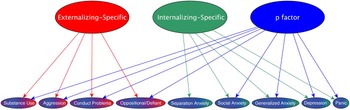
Using a bifactor modeling approach, Caspi et al. (Reference Caspi, Houts, Belsky, Goldman-Mellor, Harrington and Israel2014) demonstrated that common diagnoses of psychopathology across adulthood, including mood disorders, anxiety disorders, behavioral and substance use problems, and thought disorders, could be best explained and structured by a general psychopathology latent factor alongside unique internalizing and externalizing latent factors (illustrated in Figure 1). They dubbed this general psychopathology liability component the “p factor,” and we retain and use this terminology. This structural solution has been obtained reliably in studies that have used bifactor modeling and confirmed the existence of a general psychopathology factor as well as specific variance characterized by both an internalizing and externalizing latent dimension (Caspi et al., Reference Caspi, Houts, Belsky, Goldman-Mellor, Harrington and Israel2014; Laceulle, Vollebergh, & Ormel, Reference Laceulle, Vollebergh and Ormel2015; Lahey et al., Reference Lahey, Applegate, Hakes, Zald, Hariri and Rathouz2012; Patalay et al., Reference Patalay, Fonagy, Deighton, Belsky, Vostanis and Wolpert2015; Snyder, Young, & Hankin, Reference Snyder, Young and Hankinin press). Thus, the p factor captures, in a single latent variable, the heterotypic continuity and co-occurrence that is common across all measured psychopathology symptoms. After statistically accounting for the shared variance that is common across all psychopathology symptoms via the p factor, unique covariance that remains among these psychopathology symptoms can then also be captured and organized by additional unique latent factors, specifically, the latent internalizing and externalizing liability dimensions. Finally, whatever remaining variance in the psychopathology symptoms that has not been accounted for by the p factor and unique internalizing or externalizing latent factors can be represented and explained by symptom-specific variance that characterizes that particular emotional or behavioral syndrome (e.g., unique depressive symptoms, and social anxiety problems).
(Color online) Simplified schematic example of a p factor model (e.g., Caspi et al., Reference Caspi, Houts, Belsky, Goldman-Mellor, Harrington and Israel2014). Different forms of internalizing and externalizing psychopathology load onto (i.e., are considered to be caused by), both their specific internalizing and externalizing factors, as well as the p factor, which captures what is common across all forms of psychopathology in the model.

Because bifactor modeling approaches, such as Caspi's p factor model, are relatively new in understanding and classifying psychopathology, we explicitly note that the general psychopathology p factor, as well as the unique factors of latent internalizing and externalizing dimensions and any remaining syndrome-specific variance, are all latent constructs (Cronbach & Meehl, Reference Cronbach and Meehl1955). We also explicitly highlight that all psychiatric disorders, including all of those that are defined by categorical nosologies such as the DSM-5, are also latent theoretical constructs (Skinner, Reference Skinner1981). As such, neither the latent dimensions from bifactor models (e.g., p factor or internalizing liability) nor any DSM-defined psychiatric disorder are “real” entities in nature (Kendell, Reference Kendell1975). Rather, both the latent variables from bifactor models and the DSM psychiatric disorders are equally reasonable and parallel logical kinds as latent theoretical constructs, which are defined via construct validation approaches and associations in their nomological networks (Cronbach & Meehl, Reference Cronbach and Meehl1955).
Stability of latent dimensional liabilities: Homotypic and heterotypic continuity
A key issue of inquiry related to comorbidity concerns stability, particularly whether prediction over time conforms best to homotypic or heterotypic continuity, and the degree of cross psychiatric diagnosis prediction. Significantly, the available longitudinal evidence is consistent with homotypic continuity when examined using latent liabilities, whereas prediction over time with DSM diagnoses shows more of a heterotypic continuity pattern. In a longitudinal investigation of the p factor and unique latent internalizing and externalizing liabilities, strong homotypic stability over time was obtained; the p factor and specific internalizing and externalizing liabilities each predicted their own respective symptom dimensions 18 months later, and there was little crossover prediction among a general community sample of children and adolescents (Snyder et al., Reference Hankin, Snyder and Gulleyin press). More specific to the internalizing liabilities, the available evidence suggests that the two-factor latent internalizing predisposition factors of fear and distress mostly demonstrated homotypic continuity over time, although these factors continued to be correlated (Eaton et al., Reference Eaton, Krueger, Markon, Keyes, Skodol and Wall2013). Moreover, there appears to be little specific DSM-disorder variance remaining that accounts for continuity and stability of internalizing problems after modeling the stability of internalizing problems via these two-latent factors (Eaton et al., Reference Eaton, Krueger, Markon, Keyes, Skodol and Wall2013). Similarly, the temporal associations between comorbid internalizing disorders, as ascertained and considered as specific DSM-defined disorders, among adults was found to be explained best by a latent internalizing factor, although this latent factor did not explain all of the comorbid disorders (Kessler, Ormel, et al., Reference Kessler, Petukhova and Zaslavsky2011). In children and adolescents, the latent internalizing dimension exhibited moderately strong estimates of homotypic continuity (Mezquita et al., Reference Mezquita, Ibáñez, Villa, Fañanás, Moya-Higueras and Ortet2015; Nobile et al., Reference Nobile, Colombo, Bellina, Molteni, Simone and Nardocci2013).
Summary
Returning to the vignette we introduced at the start of this paper, Aaliyah with multiple comorbid internalizing problems, which are behaviorally and emotionally exhibited differently across development, illustrates how broad latent liability dimensions (e.g., the p factor for explaining the general covariance across all symptoms, and the internalizing latent factor accounting for heterotypic continuity explaining remaining unique internalizing symptom covariance) can manifest and be observed differentially across key developmental periods, likely as particular age-typical environmental events tend to trigger particular manifestations of how the latent internalizing dimension will be expressed symptomatically.
While many studies have now established a reliably obtained structural model of psychopathology at a latent level, certainly with respect to latent internalizing and externalizing liability dimensions, and with emerging evidence also suggesting that there is a broad latent general factor that organizes the broad co-occurrence across psychopathologies (i.e., the p factor), the research to date has largely focused on investigating and establishing the optimal organizational latent structure of psychopathology. However, considerably less research has examined two other core questions: (a) what predicts these latent dimensional liabilities across levels and (b) how can these structural models, often studied simply at one point in time without regard to developmental patterns of continuity and change, explain known developmental patterns of when particular symptoms tend to onset and why there might be sequential comorbidity? The heuristic conceptual model that we introduce next is intended to begin to address these questions and provide a deeper understanding of mechanisms of continuity and discontinuity observed with internalizing comorbidities.
Heuristic Conceptual Model
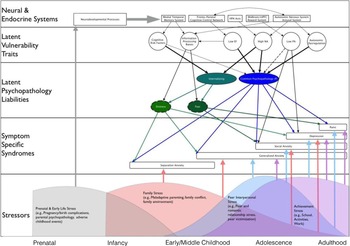
In the following sections we outline a working model aimed at accounting for the comorbidity, continuity, and discontinuity of internalizing psychopathology across development (Figure 2). This approach uses multiple units of analysis to understand how risk traits (at the neural/endocrine and cognitive/affective levels) interact with environmental stressors to confer risk for broad latent psychopathology dimensions (comorbidity and continuity) or specific symptom manifestations (specificity and discontinuity). Figure 2 depict five units of analysis: neural and endocrine systems implicated in internalizing psychopathology; latent vulnerability traits, which are fairly stable individual differences in cognitive and affective vulnerabilities; latent psychopathology liabilities, which are broad psychopathology liability dimensions that span disorders; symptom specific syndromes, which are specific constellations of internalizing symptoms that systematically and characteristically group together as part of a coherent pattern; and stressors, from different domains and types of events, transpiring across the life span that may trigger symptom specific syndrome manifestations at particular points during development.
(Color online) Heuristic conceptual model using multiple units of analysis to understand how risk traits interact with environmental stressors to confer risk for broad latent psychopathology dimensions (comorbidity and continuity) or specific symptom manifestations (specificity and discontinuity). This model is intended to be illustrative of some important risk pathways and not exhaustive in terms of either risk factors or pathways. Strength of the lines are roughly indicative of effect sizes based on existing literature. Dashed lines indicate areas where there is less existing evidence. (a) The top sections depict four units of analysis: neural and endocrine systems implicated in internalizing psychopathology; latent vulnerability traits, which are fairly stable individual differences in cognitive and affective vulnerabilities (these risk factors have their own latent structures, not shown here for simplicity; see Figure 3 for an example); latent psychopathology liabilities, which are broad psychopathology liability dimensions that span disorders (latent internalizing psychopathology is divided into fear and distress subfactors in some models as shown here, but these subfactors are not included in all models and have not been studied for many risk factors); and symptom specific syndromes, which are specific constellations of internalizing symptoms that systematically and characteristically group together as part of a coherent pattern. These risk factors are likely to interact; only a few such posited interactions are shown here for simplicity. (b) The bottom section depicts stressors, from different domains and types of events, transpiring across the life span that may trigger symptom-specific syndrome manifestations at particular points during development. Prenatal and early life stressors have enduring effects across development via neurodevelopmental processes (depicted with thick arrow at top). Family, peer interpersonal and achievement stressors change in frequency and salience across development, as illustrated with the stress curves at the bottom (which are not meant to represent exact time frames). Note especially the accumulation of multiple types of stressors in adolescence, which is posited to contribute to increasing rates and levels of internalizing psychopathology during that developmental period.

We emphasize that the model depicted in Figure 2 is a conceptual, heuristic working model intended to highlight our main point that different vulnerabilities and environmental risk factors and mechanisms likely predict different levels of the dimensional structural model (e.g., p factor, internalizing latent factor, and unique specific symptom syndrome level) and that these associations can likely clarify some of the lingering conundrums observed with comorbidities among internalizing problems. This model is not meant to be either final or comprehensive. We do not include all potential risk factors and mechanisms; rather, we include and review some specific risk influences to illustrate our main points. In Figure 2 and in the remainder of this paper, we focus on some of the known and hypothesized risk mechanisms and pathways that have shown promise in explaining the continuity and discontinuity of internalizing disorders. The model is not final in that we expect it to evolve and expand as research progresses. For example, the model could be expanded both horizontally (e.g., via additional neural and endocrine systems, other latent vulnerability mechanisms, and environmental risk factors) and vertically (additional levels of analysis, e.g., genetic or sociocultural). Because our model is explicitly one with multiple levels of analysis, although we do not articulate and describe in detail every potential level conceivable in this paper, we note here that genetic influences are likely to confer vulnerability across levels. In particular, we would expect shared genetic factors to relate to the broad latent liabilities of p factor and the internalizing dimension, whereas specific environmental risks would likely associate with manifestations of symptom-specific syndromes (e.g., Lahey et al., Reference Lahey, Van Hulle, Singh, Waldman and Rathouz2011; Waszczuk et al., Reference Waszczuk, Zavos, Gregory and Eley2015).
Any successful model of internalizing psychopathology ultimately needs to explain (among other things) two core phenomena. First, comorbidity between internalizing disorders is quite high. This strongly suggests the existence of common (i.e., transdiagnostic) risks for internalizing psychopathology (e.g., Barlow et al., Reference Barlow, Sauer-Zavala, Carl, Bullis and Ellard2014; Hankin & Abramson, Reference Hankin and Abramson2001; Nolen-Hoeksema & Watkins, Reference Nolen-Hoeksema and Watkins2011). Second, as we reviewed above regarding developmental sequential comorbidity, some individuals nonetheless exhibit different manifest forms of internalizing psychopathology over the course of development (e.g., separation anxiety symptoms are more common during earlier childhood versus panic disorder symptoms more typically onsetting during young adulthood), and individuals with one form of internalizing psychopathology do not inevitably develop other forms. This strongly suggests the existence of specific vulnerabilities and environmental risks, which come online at different points of development and likely drive the developmental progression of particular manifestations of symptoms and syndromes.
Untangling these common and specific risk pathways requires moving beyond considering links between unique risk factors and specific individual disorders or symptom dimensions. Rather, both specific symptomatic syndromes and broad latent psychopathology dimensions must be considered simultaneously in order to determine which risk pathways are transdiagnostic (and thus potential sources of comorbidity and continuity) and which are specific (and thus potential sources of developmental discontinuities and individual differences in manifestations of internalizing psychopathology).
Toward this end, our conceptual heuristic model is based on a modern latent dimensional structural model of psychopathology. We incorporate the recent bifactor (i.e., p factor) model of psychopathology (Caspi et al., Reference Caspi, Houts, Belsky, Goldman-Mellor, Harrington and Israel2014; Laceulle et al., Reference Laceulle, Vollebergh and Ormel2015; Lahey et al., Reference Lahey, Applegate, Hakes, Zald, Hariri and Rathouz2012; Tackett et al., Reference Tackett, Lahey, van Hulle, Waldman, Krueger and Rathouz2013). Because the focus of the current paper is on internalizing psychopathology, we focus on only the common psychopathology (p factor) component, the latent internalizing-specific liability, and unique symptom-specific syndromes (e.g., depression, social anxiety, and separation anxiety). A similar approach has recently been applied to understanding externalizing psychopathology (e.g., Beauchaine & McNulty, Reference Beauchaine and McNulty2013).
We alert the reader that many of the ideas and the core notions espoused in this working conceptual model are hypothesized, and admittedly speculative. The extant research has not been studied and organized in the manner we advocate and encourage herein: that risk factors and processes (ideally, these should also be organized in a coherent latent dimensional structure) should be connected to the proper, optimal, evidence-based latent structure that best organizes internalizing psychopathologies. At the same time, our speculations on the connections between risk factors and mechanisms with various levels of the latent structure of psychopathology are informed by and grounded in the existing research, which we review in the following sections.
Because such latent dimensional models of psychopathology have only recently gained prominence, direct evidence linking particular risk factors and mechanisms to these latent psychopathology factors (the p factor, unique latent internalizing factor, and specific manifestation of symptoms) is still quite scarce. Rather, the vast majority of research has used outcome measures based on existing nosological systems, such as at the level of single DSM-specified disorders, individual symptom dimensions (e.g., depressive symptoms, general anxiety symptoms, or specific social anxiety symptoms), latent psychopathology constructs (e.g., fear vs. distress dimensions; Watson, Reference Watson2005), or the broad internalizing syndrome originally identified by Achenbach. However, taken collectively, existing evidence that has been collected using existing internalizing outcomes, whether at the level of disorder, dimensional symptom, theoretical construct, or broad internalizing dimension, can provide indirect, suggestive evidence to relate risk pathways to latent psychopathology factors at differing levels of the structural model. When available, we provide direct evidence from preliminary analyses and relevant data collected from our labs.
It is important to note that although these are parsimonious explanations derived from our conceptual model, and thus good starting hypotheses, they are not the only possible explanations. For example, it could be the case that a risk factor is separately linked to different forms of psychopathology via different mediating mechanisms, or that what appears to be a single vulnerability at one level of analysis (e.g., a self-report measure of a latent risk trait) is actually revealed at a different level of analysis (e.g., neural systems) to be multiple separate risk processes with links to different forms of psychopathology.
Exemplar Risk Mechanisms of Continuity and Discontinuity Connecting to Different Levels of the Latent Structural Model of Psychopathology
In the following sections we illustrate six examples of risk mechanisms and marshal relevant evidence that can help account for comorbidities, continuities, and discontinuities in internalizing psychopathology. As shown in Figure 2, we highlight the following risk factors and processes: EF, biased information processing of emotion, cognitive risks, PA temperament, NA temperament, and arousal mechanisms from the autonomic nervous system (ANS). In particular, we focus on how these six exemplar risk factors and mechanisms connect to different facets of the latent structural model of psychopathology. In each of the following sections, we briefly define the risk, provide what is known about the structure of the risk, and then review evidence linking the risk to the various latent dimensions of psychopathology (i.e., p factor and unique internalizing liability) and specific symptomatic syndromes. First, we review studies that have investigated the risk in relation to specific DSM-based internalizing diagnoses. The vast majority of research has used DSM-based diagnostic categories or dimensional symptom measures, so we use this available evidence base to infer how each risk may relate to the latent liabilities and specific symptom syndromes. Second, we draw attention to more direct evidence of associations between the risk and latent liabilities to psychopathology when such data are available. Based on these two empirical sources, we draw conclusions on how that risk connects to the latent psychopathology liabilities and specific symptom syndromes, as postulated in our model.
EF risk pathways
EF consists of higher level cognitive processes that control and regulate lower level cognitive processes (e.g., perception and motor responses) to guide behavior toward a goal, especially in nonroutine situations (e.g., Banich, Reference Banich2009; Miyake & Friedman, Reference Miyake and Friedman2012). EF relies heavily on the prefrontal cortex (PFC), although EF tasks also recruit broader neural networks, including posterior cortical and subcortical areas, and connectivity between these regions (e.g., for review, see Niendam et al., Reference Niendam, Laird, Ray, Dean, Glahn and Carter2012). Past research has used both EF tasks and questionnaires to assess self-reports or other (e.g., parent and teacher) report of behaviors putatively related to EF (e.g., effortful control temperament). Although questionnaire and task-based measures are generally weakly to moderately associated (e.g., Zhou, Chen, & Main, Reference Zhou, Chen and Main2012), we base our review of evidence from studies drawing across these two common measurement modalities that cognitive control deficits are associated with internalizing psychopathology.
A key contention of our model is that it is essential to have an optimal, evidence-based structure for both risk and psychopathology in order to better understand linkages between them. Like psychopathology, EF has been best characterized via bifactor models as consisting of separable but related processes, with both unique and shared individual differences, genetic influences, and neural substrates (e.g., for review, see Miyake & Friedman, Reference Miyake and Friedman2012). In such structural bifactor models of EF, each EF ability (e.g., shifting between tasks, inhibiting task-inappropriate responses, and updating the contents of working memory) can be decomposed into what is unique to that particular ability and what is common across all EFs, posited to be the ability to actively maintain task goals and use this information to provide top-down support for task-relevant responses (Friedman et al., Reference Friedman, Miyake, Young, DeFries, Corley and Hewitt2008; Miyake & Friedman, Reference Miyake and Friedman2012). This structural approach to characterizing EF points to common EF as the primary component of EF predicting psychopathology (e.g., poor common EF is associated with an externalizing psychopathology factor; Young et al., Reference Young, Friedman, Miyake, Willcutt, Corley and Haberstick2009).
There is strong evidence that EF deficits (as assessed by both task performance and questionnaire measures) are associated with most forms of psychopathology, including internalizing psychopathology (e.g., for reviews, see Hankin, Snyder, & Gulley, Reference Hankin, Snyder and Gulley2016; Snyder, Miyake, & Hankin, Reference Snyder, Miyake and Hankin2015). Although there is as yet little direct evidence testing links between different latent EF components and latent psychopathology dimensions, existing research suggests the possibility that broad, transdiagnostic impairments in EF might be explained by a link between the common psychopathology factor (i.e., p factor) and common EF (see Beauchaine & Thayer, Reference Beauchaine and Thayer2015). The vast majority of previous research has been at the level of individual EF tasks in conjunction with individual DSM categorical diagnoses or symptom dimensions. Based on such data demonstrating a pattern of EF impairments across both internalizing and externalizing disorders, we infer that poor EF may be associated with the p factor.
Specifically, low self- and parent-reported EF is associated with both higher internalizing and externalizing symptoms (e.g., Muris, Meesters, & Blijlevens, Reference Muris, Meesters and Blijlevens2007; Nigg, Reference Nigg2006; Oldehinkel, Hartman, Ferdinand, Verhulst, & Ormel, Reference Oldehinkel, Hartman, Ferdinand, Verhulst and Ormel2007; Vasey et al., Reference Vasey, Harbaugh, Lonigan, Phillips, Hankin and Willem2013). Likewise, most DSM disorders, including depression, anxiety, bipolar disorder, schizophrenia, and ADHD, are associated with deficits in EF tasks, consistent with broad, and transdiagnostic, impairment in EF (for reviews, see Hankin et al., Reference Snyder, Miyake and Hankin2016; Snyder, Miyake, et al., Reference Snyder, Gulley, Bijttebier, Hartman, Oldehinkel and Mezulis2015). Focusing on internalizing psychopathology, individuals with major depressive disorder (MDD) are significantly impaired across multiple aspects of EF, with similar small to medium effect sizes (Rock, Roiser, Riedel, & Blackwell, Reference Rock, Roiser, Riedel and Blackwell2013; Snyder, Reference Snyder2013). There has been little research on EF in anxiety disorders; however, research in nonclinical samples suggests that trait anxiety, and especially anxious apprehension (worry), is associated with impairments in EF, especially inhibiting competing responses (Bishop, Reference Bishop2008; Eysenck & Derakshan, Reference Eysenck and Derakshan2011; Snyder et al., Reference Snyder, Hutchison, Nyhus, Curran, Banich and O'Reilly2010, Reference Snyder, Kaiser, Whisman, Turner, Guild and Munakata2014). In addition, extensive neuroimaging evidence indicates that individuals with many forms of psychopathology have structural and functional abnormalities in brain networks involved across multiple components of EF (Bora, Fornito, Pantelis, & Yucel, Reference Bora, Fornito, Pantelis and Yucel2012; Cortese et al., Reference Cortese, Kelly, Chabernaud, Proal, Di Martino and Milham2012; Menzies et al., Reference Menzies, Chamberlain, Laird, Thelen, Sahakian and Bullmore2008; Minzenberg, Laird, Thelen, Carter, & Glahn, Reference Minzenberg, Laird, Thelen, Carter and Glahn2009; Patel, Spreng, Shin, & Girard, Reference Patel, Spreng, Shin and Girard2012; Yu et al., Reference Yu, Cheung, Leung, Li, Chua and McAlonan2010). In sum, both internalizing and other forms of psychopathology are broadly associated with deficits in PFC, EF task performance, and self- (or other-) reported EF. These data suggest that EF deficits, especially the unitary component of EF (i.e., common EF), may be a transdiagnostic risk factor for psychopathology (e.g., Goschke, Reference Goschke2014) and directly relate to the p factor (Beauchaine & Thayer, Reference Beauchaine and Thayer2015).
Consistent with these inferred conclusions from data collected with specific DSM disorders, preliminary evidence shows that the p factor is associated with poorer performance on cognitive tasks, including EF tasks, indicators of poor cerebrovascular functioning, and self-reported cognitive and self-control problems, assessed as early as 3 years of age (Caspi et al., Reference Caspi, Houts, Belsky, Goldman-Mellor, Harrington and Israel2014). In addition, preliminary evidence indicates that a common self-reported EF factor in adolescents, and parent-reported EF factor in children, are strongly related to the p factor (Snyder, Davis, Young, & Hankin, Reference Snyder, Davis, Young and Hankin2015). These findings suggest that common EF may be a general liability factor for psychopathology. However, this hypothesis has not yet been decisively tested.
It is also possible that individuals with psychopathology have impairments in specific aspects of EF in addition to deficits in common EF. The specific EF deficits could be associated with either common psychopathology (p factor) or more specific aspects of psychopathology (e.g., unique latent internalizing or individual symptom specific syndromes). For example, anxious apprehension (i.e., worry) is associated with difficulty selecting one response from among many possible responses (e.g., when choosing a word to complete a sentence). In contrast, depression is associated with better performance on such selection tasks (Snyder et al., Reference Snyder, Kaiser, Whisman, Turner, Guild and Munakata2014), but impaired ability to select a response in the face of competition from a strong but task-inappropriate alternative (e.g., Snyder, Reference Snyder2013). Examining links between both common and specific aspects of EF and psychopathology has the potential to accelerate progress in understanding how EF impairments may contribute to both comorbidity across disorders and heterogeneity within disorders (e.g., anhedonia vs. broad negative affect in depression, anxious arousal vs. anxious apprehension in anxiety disorders, etc.).
In conclusion, a latent structure model of EF shows there is a common factor underlying most EF measures alongside unique EF components. When this structural model of EF is connected to a latent structural model of psychopathology, the general, common EF factor appears to confer risk to psychopathology broadly (i.e., p factor) based on initial direct evidence and reasonable inferences from other DSM-based specific disorder research with EF measures. As such, available evidence suggests EF may serve as a mechanism of continuity underlying internalizing comorbidity, although future research may reveal that the unique EF processes (e.g., updating or selection) may also partly contribute specific risk as mechanisms of discontinuity.
Information processing risk pathways
Information processing theories of psychopathology posit that negative biases act as filters for stimuli in the environment, affecting the way an individual perceives, evaluates, attends to, and remembers emotionally salient information (Gotlib & Joormann, Reference Gotlib and Joormann2010). These negative biases are associated with the onset, maintenance, and recurrence of internalizing problems, including depression and anxiety disorders. Attention is one type of information processing that exerts a relatively early impact on an unfolding emotional response. Attentional processing of emotion is supported by subcortical (e.g., amygdala) and cortical (e.g., PFC) brain regions, as well as regions that mediate their interaction (e.g., anterior cingulate cortex; De Raedt, Koster, & Joormann, Reference De Raedt, Koster and Joormann2010). There are two key ways in which attention supports the processing of emotion. First, attention facilitates the selection of appropriate and relevant emotional information for further processing, and second, it aids disengagement from inappropriate and irrelevant emotional information (Gross, Reference Gross2002).
A structural model of attentional biases has not been formally tested, so it is unclear which aspects of attentional biases confer risk for internalizing psychopathology overall, versus specific depression and anxiety disorders. Recent work suggests that deficits in EF may underlie biases in attention (e.g., Silton et al., Reference Silton, Heller, Engels, Towers, Spielberg and Edgar2011), such that EF systems are unable to effectively direct attention in the presence of salient negative emotional information. For example, activity in the left dorsolateral PFC and dorsal anterior cingulate cortex, two key brain regions implicated in EF, are altered in depression and anxiety disorders (Silton et al., Reference Silton, Heller, Engels, Towers, Spielberg and Edgar2011). Without sufficient attentional control, individuals engage in elaborative processing of negative stimuli, thus contributing to sustained negative affect, and ultimately, internalizing psychopathology.
The preponderance of evidence to date has examined links between attentional biases and specific forms of internalizing psychopathology using cross-sectional, case-control designs comparing participants with DSM-defined depression and anxiety disorders, with very few studies incorporating comorbid diagnostic groups (see Hankin, Gibb, Abela, & Flory, Reference Hankin, Gibb, Abela and Flory2010, for an exception). It is therefore challenging to discern how the selection of and subsequent disengagement from emotional information explains comorbidity and specificity among internalizing disorders. We argue that existing findings may be better conceptualized using structural models of internalizing psychopathology that consider biases in attention along the fear (e.g., phobias, social phobia, and panic disorder) and distress (e.g., separation anxiety, PTSD, depression, and GAD) dimensions.
When studied from a DSM-specific disorder perspective, depression has been characterized by biased attention toward mood-congruent stimuli (e.g., sadness) and away from positive stimuli (e.g., happiness; for reviews, see Disner, Beck, Beevers, & Haigh, Reference Disner, Beck, Beevers and Haigh2011; Peckham, McHugh, & Otto, Reference Peckham, McHugh and Otto2010). More specifically, attentional bias in depression is primarily indexed by increased maintenance of attention or difficulty disengaging attention from negative emotional information. Biased attention in anxiety disorders, in contrast, has yielded a more mixed picture. Some studies have found that anxiety is characterized by biased attention initially toward threat (e.g., Bar-Haim, Lamy, Pergamin, Bakermans-Kranenburg, & van IJzendoorn, Reference Bar-Haim, Lamy, Pergamin, Bakermans-Kranenburg and van IJzendoorn2007; Hankin et al., Reference Hankin, Gibb, Abela and Flory2010), whereas other studies have found biased attention away from threat (e.g., Monk et al., Reference Monk, Nelson, Mcclure, Mogg, Bradley and Leibenluft2006; Pine et al., Reference Pine, Mogg, Bradley, Montgomery, Monk and Mcclure2005). There are several explanations for these mixed findings, such as variation in threat-exposure durations during experiments; shorter durations may capture early vigilance toward threat, whereas longer durations may identify later-stage avoidance of threat (Shechner et al., Reference Shechner, Britton, Pérez-Edgar, Bar-Haim, Ernst and Fox2011). Another explanation involves sample characteristics, namely, the inclusion of heterogeneous anxiety disorders in many of these studies.
More recent studies have begun to examine attention bias along the latent dimensions of fear and distress disorders, an internalizing structure that might better clarify patterns of biases in attention compared to DSM-defined depression and various, heterogeneous anxiety disorders. These studies have found that youth with a principal distress disorder demonstrated biased attention toward facial displays of threat, whereas youth with a principal fear disorder exhibited biased attention away from facial displays of threat (Salum et al., Reference Salum, Mogg, Bradley, Gadelha, Pan and Tamanaha2012; Waters, Bradley, & Mogg, Reference Waters, Bradley and Mogg2014). Incorporating MDD and dysthymia into the dimension of distress yields an overall framework for understanding associations among unique patterns of attentional bias and specific forms of internalizing psychopathology. More specifically, attentional bias toward negative emotional information, including facial displays of sadness and threat, may be more strongly associated with distress disorders (GAD, MDD, and dysthymia). Attentional bias away from negative emotional information, in contrast, may be associated with fear disorders such as specific phobia, social phobia, and separation anxiety disorder.
In conclusion, although a latent structure model of attentional bias has not been formally tested, existing evidence points to plausible ways to conceptualize this vulnerability and associations with latent structures of internalizing psychopathology. It may be the case that internalizing psychopathology, broadly speaking, is characterized by deficits in attentional control, which leads to overall difficulties allocating attention in the context of emotion. Specific forms of internalizing problems, as classified along distress and fear dimensions, may be uniquely characterized by specific patterns of attentional bias, such that attention toward emotion occurs in distress disorders and attention away from emotion occurs in fear disorders.
Cognitive risk pathways
Cognitive risk models of psychopathology hypothesize that individuals who have certain negative patterns of thinking are at increased risk to develop psychopathology (Riskind & Alloy, Reference Riskind and Alloy2006), particularly in response to stress. Some key cognitive risks from several widely studied cognitive theories of psychopathology include dysfunctional attitudes (Beck, Reference Beck1976), negative inferential style (Abramson, Metalsky, & Alloy, Reference Abramson, Metalsky and Alloy1989), self-criticism (Blatt, Reference Blatt1974), dependency (Blatt, Reference Blatt1974), and rumination (Nolen-Hoeksema & Morrow, Reference Nolen-Hoeksema and Morrow1991). Though these cognitive risks were originally posited to explain the development and maintenance of depression in adults, they have been extended to other forms of psychopathology and to children and adolescents (e.g., for reviews, see Abela & Hankin, Reference Abela and Hankin2008; Gibb & Coles, Reference Gibb, Coles, Hankin and Abela2005; Hankin et al., Reference Snyder, Miyake and Hankin2016; Riskind & Alloy, Reference Riskind and Alloy2006).
Research investigating the latent structure of these cognitive risks has revealed mixed results, with evidence for a single latent risk construct (Garber, Weiss, & Shanley, Reference Garber, Weiss and Shanley1993; Hong & Cheung, Reference Hong and Cheung2014) as well as other work showing distinct, albeit correlated latent risks (e.g., Adams, Abela, & Hankin, Reference Adams, Abela and Hankin2007; Gotlib, Lewinsohn, Seeley, Rohde, & Redner, Reference Gotlib, Lewinsohn, Seeley, Rohde and Redner1993; Hankin, Lakdawalla, Carter, Abela, & Adams, Reference Hankin, Lakdawalla, Carter, Abela and Adams2007; Joiner & Rudd, Reference Joiner and Rudd1996). These findings could be reconciled with a bifactor model, which allows for the representation of both shared and unique variance across cognitive risks, and could offer a more accurate, parsimonious way to organize these constructs. We recently evaluated such a bifactor model of cognitive risk and found evidence for a factor structure that includes both common and unique aspects of cognitive vulnerability (Schweizer, Snyder, Young, & Hankin, Reference Schweizer, Snyder, Young and Hankin2015). Specifically, in two separate community samples of youth, we found a common cognitive risk factor, which captured shared variance across dysfunctional attitudes, negative inferential style, self-criticism, dependency, and rumination. We also found specific risk factors, which reflect unique covariance across constructs not accounted for by the common factor (Schweizer et al., Reference Schweizer, Snyder, Young and Hankin2015). Associations between this replicated factor structure of cognitive risks and latent dimensional models of psychopathology can be examined, which offers a new avenue to uncover mechanisms that contribute to comorbidity as well as specificity of individual internalizing symptoms.
Though no published work has directly investigated the relationship between dimensional bifactor models of cognitive risk and psychopathology (i.e., p factor model), inferences based on the extant literature suggest that the common cognitive risk factor would be moderately associated with the specific internalizing dimension of psychopathology and weakly linked to the general psychopathology factor (i.e., p factor). In particular, considerable evidence supports a robust relationship between cognitive risks and internalizing DSM disorders (e.g., depression, anxiety, PTSD, and eating pathology), and some studies suggest that particular cognitive risks also contribute to substance use, externalizing problems, and/or thought disorders (for review, see Hankin et al., Reference Snyder, Miyake and Hankin2016).
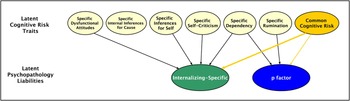
Consistent with this, preliminary findings (Schweizer et al., Reference Schweizer, Snyder, Young and Hankin2015; see Figure 3) provide the first direct, empirical support for the idea that the common cognitive risk factor is particularly important for internalizing symptoms, but also relates to the p factor. Specifically, the common cognitive risk factor was moderately associated with the internalizing specific dimension of psychopathology, suggesting that common cognitive risk operates as a transdiagnostic risk factor that helps to account for comorbidity among internalizing disorders. The common cognitive risk factor also weakly related to the p factor, which is in line with prior evidence showing that multiple cognitive risks are also significantly related, although less so, with externalizing (e.g., Leadbeater, Kuperminc, Blatt, & Hertzog, Reference Leadbeater, Kuperminc, Blatt and Hertzog1999) and psychotic (e.g., Horan et al., Reference Horan, Rassovsky, Kern, Lee, Wynn and Green2010) symptoms and disorders. Unique latent aspects of cognitive risk were also associated with the latent structural psychopathology model in ways that parallel prior findings and in a manner that clarifies and provides new insight into the associations between cognitive risks and comorbid internalizing psychopathology. For instance, the unique rumination factor was positively related to the p factor, consistent with suggestions that rumination is a transdiagnostic risk process (Aldao, Nolen-Hoeksema, & Schweizer, Reference Aldao, Nolen-Hoeksema and Schweizer2010; Hankin et al., Reference Snyder, Miyake and Hankin2016; Nolen-Hoeksema & Watkins, Reference Nolen-Hoeksema and Watkins2011) and that a general negative pattern of repetitive thinking exists across a range of psychopathology, but can manifest itself differently depending on the content that is the focus of attention (e.g., sadness in depression, cognitions about future threat in generalized anxiety, and anger in aggression; Hankin et al., Reference Snyder, Miyake and Hankin2016; Nolen-Hoeksema & Watkins, Reference Nolen-Hoeksema and Watkins2011).
(Color online) The relationship between latent bifactor models of cognitive risk and psychopathology. Preliminary findings showed a novel structure of cognitive risks including a general factor (common cognitive risk) as well as specific aspects of cognitive risk, not accounted for by the common factor. The common cognitive risk factor captures the shared variance across dysfunctional attitudes, negative inferential style, self-criticism, dependency, and rumination, whereas the specific cognitive risk factors represent unique variance captured by that construct. This is one example demonstrating that when bifactor dimensional models of risk and psychopathology are connected together, novel and potentially clearer patterns are revealed for risk factors and processes that underlie comorbidity within internalizing spectra as well as across psychopathology more broadly. It is also possible that specific aspects of risk could relate to unique behavioral syndromes and thus also help to explain discontinuity in psychopathology (although not depicted here).

These novel findings support organizing both risk factors and psychopathology via evidence-based latent structural models. This approach can clarify prior inconsistent results and reveal new knowledge about the processes underlying mechanisms of continuity and discontinuity with respect to comorbidity in psychopathology. A reasonable inference and conclusion from the current corpus of research, predominated by studies associating multiple separate cognitive risks with DSM-based single disorders or dimensional symptom measure, is that a latent common cognitive risk may exist that serves to contribute risk specifically to internalizing psychopathology alongside broad psychopathology. Taking a latent structural approach that connects both risk and psychopathology models together provided the first evidence for this idea. Beyond these novel connections at the latent factor level, future research may also unearth links between unique cognitive risk factors and certain specific symptom syndromes.
PA temperament pathways
The temperament dimension of PA (trait PA) can be broadly defined as individual differences in the propensity to experience positive emotions (Stanton & Watson, Reference Stanton and Watson2014). PA correlates strongly with extraversion from the five-factor model of personality, and structurally, PA has been classified as a lower order aspect of extraversion (e.g., Hermes, Hagemann, Naumann, & Walter, Reference Hermes, Hagemann, Naumann and Walter2011; Naragon-Gainey, Watson, & Markon, Reference Naragon-Gainey, Watson and Markon2009). In addition, the behavioral activation or approach system (BAS) from Gray's reinforcement sensitivity theory has some overlap with the temperamental aspect of PA (Gray, Reference Gray1987). BAS reflects the motivational system of approach or reward. Another structural division in PA that has been suggested is high-arousal versus low-arousal facets of PA (Watson, Stasik, Ellickson-Larew, & Stanton, Reference Watson, Stasik, Ellickson-Larew and Stanton2015).
Different aspects of PA involve multiple overlapping brain networks neurally. First, the reward circuit involves dopaminergic neurons in the ventral tegmental area that project to the nucleus accumbens in the ventral striatum, several regions of the medial PFC, the basolateral amygdala, and the hippocampus, which are all interconnected in complex ways (e.g., Russo & Nestler, Reference Russo and Nestler2013). Second, there is a valence-general network of areas involved in affective processing of both positive and negative stimuli, which partially overlaps with areas involved in reward, including medial prefrontal areas, insula, the rostral and dorsal cingulate, the amygdala, and the nucleus accumbens (Lindquist, Satpute, Wager, Weber, & Feldman Barrett, Reference Lindquist, Satpute, Wager, Weber and Feldman Barrett2015). Individuals higher in PA-related traits, including measures of BAS and extroversion, have been found to have increased responsiveness to rewards and positive stimuli in reward-related brain areas including the ventral PFC (especially the orbitofrontal cortex) and the ventral striatum (for a review, see Kennis, Rademaker, & Geuze, Reference Kennis, Rademaker and Geuze2013).
Research with PA and various types of psychopathology suggests that low PA may be associated broadly with some specific DSM-defined disorders, and in particular, low PA is a risk to depression and certain anxiety disorders. This suggests that low PA may relate to the p factor and especially correlate with the latent internalizing liability. Past investigations show that PA is not equally related to all types of DSM-defined single internalizing disorders. Low PA is consistently correlated with depression and depressive symptoms (e.g., Clark, Watson, & Mineka, Reference Clark, Watson and Mineka1994; Davis & Suveg, Reference Davis and Suveg2013; Klein, Kotov, & Bufferd, Reference Klein, Kotov and Bufferd2011; Kotov, Gamez, Schmidt, & Watson, Reference Kotov, Gamez, Schmidt and Watson2010; Verstraeten, Vasey, Raes, & Bijttebier, Reference Verstraeten, Vasey, Raes and Bijttebier2008). Neurally, anhedonia on individuals with depression is associated with reduced activation and volume in reward-related brain areas including the orbitofrontal cortex and the ventral striatum (Der-Avakian & Markou, Reference Der-Avakian and Markou2012). Social anxiety is also related to low PA (Kashdan, Reference Kashdan2007; Kotov et al., Reference Kotov, Gamez, Schmidt and Watson2010; Naragon-Gainey et al., Reference Naragon-Gainey, Watson and Markon2009), and this association is not explained by the co-occurrence of social anxiety with depression (Kashdan, Reference Kashdan2007). Other anxiety disorders, such as PTSD, are characterized by low PA, although to a smaller extent than depression (Gilbert, Reference Gilbert2012; Watson & Naragon-Gainey, Reference Watson and Naragon-Gainey2010; Watson & Stasik, Reference Watson, Stasik, Richards and OHara2014). Some evidence suggests that high PA relates to substance use and externalizing problems, but the results are mixed (Cheetham, Allen, Yucel, & Lubman, Reference Cheetham, Allen, Yucel and Lubman2010; Davis & Suveg, Reference Davis and Suveg2013; Kotov et al., Reference Kotov, Gamez, Schmidt and Watson2010). Low PA, especially social and physical anhedonia, have been associated with schizophrenia (Berenbaum & Fujita, Reference Berenbaum and Fujita1994; Horan, Blanchard, Clark, & Green, Reference Horan, Blanchard, Clark and Green2008). Bipolar disorder is characterized by elevated levels of PA and PA-related BAS sensitivity (Gilbert, Reference Gilbert2012; Watson & Naragon-Gainey, Reference Watson and Naragon-Gainey2010).
Preliminary research, building off these associations between PA and DSM-based disorders and symptoms, finds that low PA is associated broadly with psychopathology (the p factor) in a community sample of children and adolescents (Snyder, Davis, et al., Reference Snyder, Gulley, Bijttebier, Hartman, Oldehinkel and Mezulis2015). These results are consistent with the past literature showing associations especially with depression, social anxiety disorder, and schizophrenia, alongside equivocal findings with substance use and other externalizing problems. As a more refined and definitive structural model of subfacets of broader PA is investigated, future research may find more unique links between specific aspects of PA (e.g., high-arousal vs. low-arousal aspects of PA; pregoal vs. postgoal PA) and symptom-specific manifestations, especially depression and social anxiety (e.g., Stanton & Watson, Reference Stanton and Watson2014; Watson et al., Reference Watson, Stasik, Ellickson-Larew and Stanton2015).
NA temperament pathways
NA (trait NA) can be defined as “individual differences in the tendency to experience negative moods and feelings, including sadness, worry, and anger” (Stanton & Watson, Reference Stanton and Watson2014, p. 556). According to Rothbart's theory, trait NA is an aspect of temperamental reactivity, referring to how easily emotions, motor activity, and attention are aroused (Rothbart & Derryberry, Reference Rothbart, Derryberry, Lamb and Brown1981). Trait NA is conceptually related to the personality trait of neuroticism from the five-factor model (McCrae & Costa, Reference McCrae and Costa1990) as well as to the behavioral inhibition system and fight–flight–freeze system components from the reinforcement sensitivity theory (Gray, Reference Gray1987; Gray & McNaughton, Reference Gray and McNaughton2003). It can be conceptualized as readiness of withdrawal-related behavior and the affective reactivity in response to potentially unrewarding or uncertain contexts (Nigg, Reference Nigg2006).
Meta-analyses indicate that individual differences in trait NA and neuroticism are associated with alterations in brain structure and function in a network overlapping with the valence-general emotion and affective processing network discussed above in the PA section. Specifically, NA-related traits are associated with increased gray matter volume in the amygdala and parahippocampus and decreased gray matter volume in medial frontal and anterior cingulate areas (Mincic, Reference Mincic2015). NA-related traits, depression, and social anxiety have also all been associated with increased activation of the amygdala, cingulate, medial frontal, and hippocampal/parahippocampal areas during fear learning and processing of negative stimuli (Groenewold, Opmeer, de Jonge, Aleman, & Costafreda, Reference Groenewold, Opmeer, de Jonge, Aleman and Costafreda2013; Hattingh et al., Reference Hattingh, Ipser, Tromp, Syal, Lochner and Brooks2013; Kennis et al., Reference Kennis, Rademaker and Geuze2013).
There is evidence suggesting that trait NA can be considered as a multifaceted construct, comprising several narrower components. For example, using the Positive and Negative Affect Schedule—Expanded Form, Watson and Clark (Reference Watson and Clark1999) distinguish four specific facets of trait NA: fear, hostility, guilt, and sadness. More recently, Snyder et al. (Reference Snyder, Gulley, Bijttebier, Hartman, Oldehinkel and Mezulis2016) found evidence for five specific facets of trait NA, as measured in the Early Adolescent Temperament Questionnaire—Revised: fear, aggression, frustration, depressed mood, and shyness. Although the exact number and definition of the specific NA facet varies to some extent depending on the measure used, models generally include at least facets related to sadness, fear/anxiety, and anger/hostility (Stanton & Watson, Reference Stanton and Watson2014).
Reviews of research on associations of trait NA with psychopathology show associations with a wide range of psychiatric disorders, both in the internalizing and in the externalizing spectrum (e.g., Bijttebier, Beck, Claes, & Vandereycken, Reference Bijttebier, Beck, Claes and Vandereycken2009; Kotov et al., Reference Kotov, Gamez, Schmidt and Watson2010). In line with this, recent work relying on dimensional bifactor models of psychopathology suggests that trait NA is strongly associated with the p factor and thus represents a general propensity to develop any form of common psychopathologies (Caspi et al., Reference Caspi, Houts, Belsky, Goldman-Mellor, Harrington and Israel2014). However, Caspi et al. found that, after taking into account the p factor, trait NA's association with externalizing problems drops to nonsignificance, whereas its association with internalizing problems remains significant. Likewise, NA is positively associated with both the p factor and the specific internalizing factor in community samples of children and adolescents (Snyder, Davis, et al., Reference Snyder, Gulley, Bijttebier, Hartman, Oldehinkel and Mezulis2015). These findings are consistent with meta-analytic research showing that trait NA has weaker associations with externalizing disorders as compared with internalizing disorders (Malouff, Thorsteinsson, & Schutte, Reference Malouff, Thorsteinsson and Schutte2005). Whereas elevated NA is the core and central feature of internalizing problems, it is less prominent in the externalizing problems spectrum, where trait impulsivity is considered as the core vulnerability trait (Beauchaine, Reference Beauchaine2014; Beauchaine & McNulty, Reference Beauchaine and McNulty2013).
Specific facets of trait NA vary in the strength of their association with psychopathology depending on the specific disorder considered. Most studies in which NA facets are considered concern internalizing symptoms, and the general pattern of results suggests that fear/anxiety relates to anxiety as well as depressive disorders, whereas sadness and guilt are specifically related to depressive symptoms (e.g., Rector, Bagby, Huta, & Ayearst, Reference Rector, Bagby, Huta and Ayearst2012; Watson, Clark, & Stasik, Reference Watson, Clark and Stasik2011). The anger/hostility facet of NA has considerably weaker associations with internalizing problems than the other facets, and perhaps it is more relevant to externalizing than to internalizing problems (Stanton & Watson, Reference Stanton and Watson2014). Thus far, the facet-level literature remains small, and much work needs to be done to further clarify associations between specific trait NA facets and specific manifestations of psychopathology in general and internalizing problems in particular.
ANS arousal mechanisms
The ANS, which comprises the excitatory sympathetic nervous system (SNS) and the inhibitory parasympathetic nervous system (PNS), plays a critical role in regulating responses to psychosocial stress (McLaughlin, Alves, & Sheridan, Reference McLaughlin, Alves and Sheridan2014). Reflecting that role, autonomic dysregulation theories of psychopathology posit that certain patterns of ANS dysregulation are associated with significant risk for psychopathology (Porges, Reference Porges2007; Thayer, Hansen, Saus-Rose, & Johnsen, Reference Thayer, Hansen, Saus-Rose and Johnsen2009). Specifically, these theories emphasize the roles played by tonic deficits in PNS activity and atypical patterns of phasic PNS responses to emotional challenge.
PNS activity can be indexed by the action of the vagus nerve on the heart; high vagal tone is associated with high heart rate variability (HRV). Adaptive functioning is associated with high tonic HRV (Beauchaine & Thayer, Reference Beauchaine and Thayer2015). Such high vagal tone at rest is associated with a wide range of positive characteristics including capacity for sustained attention and EF, self-regulation of behavior and emotion, attachment security, and social competence (Beauchaine, Reference Beauchaine2014). In contrast, low tonic HRV signals inadequate functioning of the vagal brake (Porges, Reference Porges2007), resulting in a static ANS imbalance associated with tonic elevation in SNS activity, which is associated with both psychological and physical pathology (Beauchaine & Thayer, Reference Beauchaine and Thayer2015).
Adaptive responses to stress (e.g., emotional challenge) are characterized by phasic withdrawal of the inhibitory action of the PNS on SNS arousal (Graziano & Derefinko, Reference Graziano and Derefinko2013). However, such phasic vagal withdrawal is associated with emotion dysregulation if it is excessive, especially in combination with low tonic HRV (Beauchaine, Reference Beauchaine2014). Such excessive vagal withdrawal in the face of emotional challenge is associated with both internalizing and externalizing disorders (Beauchaine & Thayer, Reference Beauchaine and Thayer2015). However, there is also evidence suggesting that deficient vagal withdrawal to emotional challenges is also associated with psychopathology, perhaps especially internalizing disorders (Graziano & Derefinko, Reference Graziano and Derefinko2013). Friedman (Reference Friedman2007) has argued that anxiety disorders are characterized by such a pattern. Deficient vagal withdrawal to a stressor may interfere with an individual's ability to cope by restricting context-appropriate SNS activation.
A large body of evidence shows that ANS dysregulation is associated with most forms of psychopathology, including internalizing and externalizing disorders as well as autism and schizophrenia (see Beauchaine & Thayer, Reference Beauchaine and Thayer2015). In the case of internalizing psychopathology, studies of DSM disorders have consistently revealed links between ANS dysregulation and depression in adults (Kemp et al., Reference Kemp, Quintana, Gray, Felmingham, Brown and Gatt2010) and children (Koenig, Kemp, Beauchaine, Thayer, & Kaess, Reference Koenig, Kemp, Beauchaine, Thayer and Kaess2015). Similarly, ANS dysregulation has been linked to a broad range of anxiety disorders (including both fear and distress disorders) in adults (Chalmers, Quintana, Abbott, & Kemp, Reference Chalmers, Quintana, Abbott and Kemp2014) and children (e.g., Dieleman et al., Reference Dieleman, Huizink, Tulen, Utens, Creemers and van der Ende2015).
To date, most studies have examined links between ANS dysregulation and specific forms of psychopathology, with few studies considering the impact of comorbidity, either between internalizing disorders or with externalizing disorders. Thus, it remains unclear which aspects of such dysregulation are related to risk for psychopathology in general versus for internalizing psychopathology or specific internalizing problems such as anxiety disorders and depression. However, a strong case can be made that such ANS dysregulation is at least partially linked to the p factor (Beauchaine, Reference Beauchaine2014; Beauchaine & Thayer, Reference Beauchaine and Thayer2015). This view reflects two major lines of evidence. First, as noted above, such ANS dysregulation is linked to most forms of psychopathology (Beauchaine, Reference Beauchaine2014). Second, it is linked to broad impairment in PFC function, reflecting deficient top-down control via inhibitory neural pathways from the PFC to the PNS (Thayer et al., Reference Thayer, Hansen, Saus-Rose and Johnsen2009). As described by Beauchaine and Thayer (Reference Beauchaine and Thayer2015), high tonic HRV and well-modulated phasic HRV responses to emotional challenges reflect the effective operation of a structural network involving feedforward and feedback connections between cortical structures (i.e., the prefrontal, insula, and cingulate cortices) and the amygdala and related subcortical structures. Consistent with this view, tonic HRV is positively associated with performance on tasks tapping EF and with PFC activity in neuroimaging studies (Thayer, Åhs, Fredrikson, Sollers, & Wager, Reference Thayer, Åhs, Fredrikson, Sollers and Wager2012).
Although a case can also be made that ANS dysregulation may relate to specific risk for internalizing disorders, little research has yet addressed the possibility. Tonic HRV has been linked to brain circuits related to perceptions of threat and safety (Thayer et al., Reference Thayer, Åhs, Fredrikson, Sollers and Wager2012). Similarly, low vagal tone is associated with processes linked with the broad range of internalizing psychopathology including biased information processing of negative stimuli (e.g., Park, Van Bavel, Vasey, & Thayer, Reference Park, Van Bavel, Vasey and Thayer2013) and perseverative forms of cognition such as worry and rumination (Ottaviani et al., Reference Ottaviani, Thayer, Verkuil, Lonigro, Medea and Couyoumdian2015) as a function of impaired control over unwanted thought (Gillie, Vasey, & Thayer, Reference Gillie, Vasey and Thayer2015). Thus, a potential link between ANS dysregulation and negative emotionality is readily apparent (Ormel et al., Reference Ormel, Bastiaansen, Riese, Bos, Servaas and Ellenbogen2013). Consistent with this view, Bleil, Gianaros, Jennings, Flory, and Manuck (Reference Bleil, Gianaros, Jennings, Flory and Manuck2008) found that tonic HRV's links with depression and anxiety reflect a more general link with trait negative affect. However, it remains unclear how much of this association is unique to NA rather than reflecting HRV's link with impaired executive functioning.
In conclusion, although a bifactor structural model of ANS dysregulation has not been formally tested, extant evidence plausibly points to links between this risk factor and the p factor. This risk likely reflects bidirectional links between ANS dysregulation and deficient top-down control of subcortical circuits by the PFC, manifesting in broad executive dysfunction and excessive potential for negative emotional stimuli to recruit and hold attention (Park et al., Reference Park, Van Bavel, Vasey and Thayer2013). ANS dysregulation may also relate to specific risk for internalizing psychopathology through its association with biased processing of negative information and cognitive risks. Investigation of that possibility is an important focus for future research. Future studies should also further investigate the possibility that internalizing disorders are associated with both excessive and deficient vagal withdrawal in the face of emotional challenge.
Stressful life events: Prototypic exposure and timing across the life span and potential for specific prediction of symptom manifestation
A critical question facing any putative theoretical account regarding mechanisms of continuity and discontinuity contributing to comorbidity in internalizing problems is why particular emotional symptoms and syndromes typically manifest at certain periods and in a prototypical sequential manner across development. The evidence we have reviewed demonstrates clearly that there is both homotypic and heterotypic continuity in the internalizing domain of psychopathology, and there is often a typical developmental sequential progression of comorbidity over time. Our heuristic conceptual model emphasizes a structural latent model of psychopathology, which includes a general psychopathology factor (p factor), a unique internalizing latent liability, and specific symptomatic manifestations. Therefore, why would particular symptoms and syndromes be expressed emotionally and behaviorally most likely at certain, predictable developmental periods? A purely latent liability model cannot explain why specific symptoms and syndromes tend to be expressed at certain developmental periods nor why there is a prototypical sequential patterning to symptom co-occurrence over time. Our conceptual model addresses this problem and further explains mechanisms of continuity and discontinuity by postulating that certain developmentally sensitive stressors tend to activate the latent liabilities of the p factor and unique internalizing dimension at particular periods throughout the life span, such that the latent general and unique internalizing liabilities tend to be behaviorally, emotionally, and cognitively expressed in organized, often developmentally bound symptoms that manifest as particular, recognizable syndromes of co-occurring symptoms.
Various types of stressors, often in particular domains, tend to be either experienced more typically at certain periods through childhood and adolescence, or are more likely to have a psychopathogenic impact at particular periods throughout the life span (i.e., enhanced stress sensitivity for a given developmental period), whereas other stressful environments (broadly construed) are generally equally likely to occur throughout childhood and adolescence. In addition, different types of stressful life events tend to produce specific symptom manifestations. Putting these two concepts together provides a process by which the general p factor as well as the unique latent internalizing liability can precipitate specific symptom manifestations at developmentally specified periods. That individuals tend to be exposed to certain stressors more typically at particular developmental periods, and there are developmental windows of enhanced stress sensitivity for particular forms and types of stress, can explain why certain expressions of internalizing psychopathology tend to exhibit a prototypic developmental sequential patterning. For example, more age-typical worries about one's caretakers in early childhood (e.g., family stress) can trigger the latent unique internalizing liability with symptomatic syndrome manifestations consistent with separation anxiety, whereas later in adolescence when romantic and peer stress, as well as potential social rejection and exclusion, are more typically experienced and developmentally stress sensitive given the social reorientation of adolescence, the latent internalizing liability would be more likely to be exhibited symptomatically as depressive symptoms and perhaps social anxiety.
Developmentally sensitive investigations that explicitly examine the timing, continuity, and change in stressful life event experiences in particular contexts, domains, and stressor types are rare. However, based on reasonable inferences from stressful life event studies that used rigorous multiage cross-sectional and longitudinal designs, some tentative conclusions can be proffered. First, some stressful experiences, including adverse childhood experiences, prenatal stress, and parental psychopathology (e.g., maternal depression), tend to be experienced early in the life course. They likely initiate developmental cascades that affect, directly or indirectly, various neurodevelopmental processes (e.g., brain development, stress physiology via hypothalamus–pituitary–adrenal [HPA] axis functioning, and autonomic arousal systems; e.g., Danese & McEwen, Reference Danese and McEwen2012; Doom & Gunnar, Reference Doom and Gunnar2013; Goodman & Gotlib, Reference Goodman and Gotlib1999; O'Connor, Monk, & Fitelson, Reference O'Connor, Monk and Fitelson2014; Sandman, Class, Glynn, & Davis, Reference Sandman, Class, Glynn, Davis and Rosenfeld2015; Sheridan & McLaughlin, Reference Sheridan and McLaughlin2014), as well as dynamically transact with other ongoing chronic and acute stressors. Second, family stress broadly conceived, including parent–child conflict, insecure attachment, perceived poor trust and support, and sibling tension, occurs from infancy through childhood and adolescence, although the precise form and type of family stress experienced likely changes across the life span (i.e., heterotypic continuity in stress). Third, undesirable negative life events (Ge, Lorenz, Conger, Elder, & Simons, Reference Ge, Lorenz, Conger, Elder and Simons1994) as well as social and interpersonally-oriented stress (e.g., Hankin, Mermelstein, & Roesch, Reference Hankin, Mermelstein and Roesch2007; Rudolph & Hammen, Reference Rudolph and Hammen1999), including peer conflict, peer victimization and rejection, and romantic stress, tend to be experienced more starting later in childhood and increasing through adolescence and beyond. Such interpersonal stressors increase with the transition of adolescence as peer influence, support, status and reputation, more sophisticated and complex peer relationships and structures, and conflict all become more salient and important to the teen while there are concomitant decreases in parent–child interactions (Choukas-Bradley & Prinstein, Reference Choukas-Bradley, Prinstein, Lewis and Rudolph2014). Fourth and similarly, achievement domain stress (e.g., academic, extracurricular and sports activities, and work) increasingly becomes more prominent and more strongly predicts psychopathology later in adolescence and young adulthood (e.g., Bryant, Schulenberg, O'Malley, Bachman, & Johnston, Reference Bryant, Schulenberg, O'Malley, Bachman and Johnston2003; Hankin, Mermelsein, et al., Reference Hankin, Mermelstein and Roesch2007; Sund, Larsson, & Wichstrøm, Reference Sund, Larsson and Wichstrøm2003).
In addition, there are well-established gender differences in the types and domains of stressful life events (e.g., Rose & Rudolph, Reference Rose and Rudolph2006) as well as stress reactivity (e.g., Stroud, Salovey, & Epel, Reference Stroud, Salovey and Epel2002). Adolescent girls experience more interpersonal stressful life events, especially peer stressors, and react more strongly with greater internalizing symptoms to these interpersonal stressors (Hankin, Mermelstein, et al., Reference Hankin, Mermelstein and Roesch2007; Hankin, Young, et al., Reference Hankin, Young, Smolen, Jenness, Gulley and Technow2015; Rudolph, Reference Rudolph2002), whereas boys experience more achievement-oriented (e.g., academic and extracurricular) stressful events (Hankin, Mermelstein, et al., Reference Hankin, Mermelstein and Roesch2007).
A bevy of prospective studies with children and adolescents clearly demonstrates that exposure to stressors predicts later elevations of psychopathological symptoms, especially internalizing problems (Grant, Compas, Thurm, McMahon, & Gipson, Reference Grant, Compas, Thurm, McMahon and Gipson2004). However, beyond this basic demonstration that stressors predict future psychopathology, often the stress literature problematically lumps many forms and types of stressful events indiscriminately into an overall, nonspecific “stress” construct, and as a result does not frequently and systematically examine specificity of findings between particular types and domains of stress with certain symptomatic expression (Grant et al., Reference Grant, Compas, Thurm, McMahon and Gipson2004).
Still, several studies provide evidence that particular types of stressors, and often in certain domains, are more associated with specific symptom manifestations. Generally, interpersonal events, especially those involving loss (e.g., in core relationships) and failure (e.g., not achieving a desired outcome; e.g., Brown, Harris, & Hepworth, Reference Brown, Harris and Hepworth1995), as well as targeted rejection and social exclusion (Slavich, Thornton, Torres, Monroe, & Gotlib, Reference Slavich, Thornton, Torres, Monroe and Gotlib2009), tend to be associated more strongly with depression, whereas events involving threat and danger tend to be related more with anxiety. In addition, uncontrollable and unpredictable events, especially earlier in childhood, are particularly important for the development of anxiety (Chorpita & Barlow, Reference Chorpita and Barlow1998), whereas undesirable, major, severe stressful events are most associated with depression onset (Brown & Harris, Reference Brown and Harris1989; Mazure, Reference Mazure1998). For example, interpersonal humiliation events predicted depressive symptoms, whereas danger events predicted generalized anxiety (Kendler, Hettema, et al., Reference Kendler, Prescott, Myers and Neale2003). Romantic stress, such as breakups with a romantic partner, predicted later onset of MDD in adolescence (Monroe, Rohde, Seeley, & Lewinsohn, Reference Monroe, Rohde, Seeley and Lewinsohn1999). A major stressor, such as moving to a new school, precipitated onset of separation anxiety (Gittelman-Klein & Klein, Reference Gittelman-Klein, Klein, Hersov and Berg1980). Other typically experienced interpersonal stressful events, such as fighting with a parent or conflict with peers (e.g., peer rejection and victimization), which have been shown to broadly predict both depression (e.g., Hankin, Young, et al., Reference Hankin, Young, Smolen, Jenness, Gulley and Technow2015; Rudolph, Flynn, & Abaied, Reference Rudolph, Flynn, Abaied, Hankin and Abela2008) and anxiety (e.g., Hawker & Boulton, Reference Hawker and Boulton2000; La Greca & Landoll, Reference La Greca, Landoll, Silverman and Field2011), often involve multiple, potentially separable, underlying components. These components could relate more specifically to particular symptom expressions, such as either depression (i.e., potential loss, rejection, or social exclusion) or anxiety (unpredictability and uncertainty after conflict, and threat and concern about the future of the relationship), depending on the stressor context and meaning. These examples of specific stressor-symptom expression findings are consistent with Beck's cognitive content specificity hypothesis: cognitions related to harm, danger, and uncertainty about the future tend to relate more strongly to anxiety, whereas cognitions centered around the past, especially loss, failure, and hopelessness, tend to associate more with depression (Beck, Brown, Steer, Eidelson, & Riskind, Reference Beck, Brown, Steer, Eidelson and Riskind1987; Clark, Beck, & Brown, Reference Clark, Beck and Brown1989). Therefore, types of stressful events in particular domains that trigger these cognitions and related domain-relevant content would be expected to produce an emotionally matching manifestation of specific forms of internalizing symptomatic syndromes.
Still, other forms of stressful life events are not necessarily expected to exhibit a developmental trajectory of prototypic occurrence, nor do these other types of environmental events seem to differentially confer risk for and affect specific symptom expression. Instead, some types and domains of stressful life events, such as prenatal stress (Sandman et al., Reference Sandman, Class, Glynn, Davis and Rosenfeld2015), early exposure to parental psychopathology (Goodman & Gotlib, Reference Goodman and Gotlib1999), and adverse childhood experiences broadly conceived (Danese & McEwen, Reference Danese and McEwen2012), most likely operate as mechanisms of continuity as such early adversities appear to broadly confer risk to internalizing problems. While all forms of early life stress (ELS) are not equivalent and should not be indiscriminately lumped together (e.g., see Sheridan & McLaughlin, Reference Sheridan and McLaughlin2014, for a novel model that differentiates adverse childhood experiences more specifically based on dimensions of threat and deprivation), much of the literature has taken a simple additive, lumping risk approach to ELS measures. This work demonstrates that various forms of ELS predict later internalizing symptoms in childhood and adolescence, often via neurodevelopmental risk mechanisms involving dysregulated endocrine function (HPA axis; Doom & Gunnar, Reference Doom and Gunnar2013; Goodman & Gotlib, Reference Goodman and Gotlib1999; Sandman et al., Reference Sandman, Class, Glynn, Davis and Rosenfeld2015), immune activity (Slavich & Irwin, Reference Slavich and Irwin2014), neural circuitry (Burghy et al., Reference Burghy, Stodola, Ruttle, Molloy, Armstrong and Oler2012), EF (e.g., Pechtel & Pizzagalli, Reference Pechtel and Pizzagalli2010), biased attention to negative emotion and identification of threat (Gulley, Oppenheimer, & Hankin, Reference Gulley, Oppenheimer and Hankin2014), as well as psychosocial influences, including temperament and negative cognitions (Hankin, Reference Hankin2005; Hankin, Oppenheimer, et al., Reference Hankin, Oppenheimer, Jenness, Barrocas, Shapero and Goldband2009). Many, but not necessarily all, of these ELS experiences predict later child and adolescent internalizing psychopathology broadly as opposed to specific anxiety or depressive symptoms or disorders.
In summary, certain types of stressors in organizable domains systematically relate to specific internalizing symptomatic syndromes, and particular classes and domains of stressful events tend to be experienced more typically at certain developmental periods. Taken together, knowing when certain types of stressors occur and are experienced, and the specific manifestation these stressful events tend to produce, provides a process by which the latent liabilities (p factor and unique internalizing) can be expressed as specific symptom manifestations at predictable periods across development.
Interactions and interplay across levels of analysis
Understanding the internalizing spectrum, given its high complexity, especially across development, will prove challenging. Our conceptual model is intended to be dynamic with interacting, synergistic influences across levels of analysis and over development, although it is not easy to portray such complexity and the interrelationhips among these influences heuristically and in a single figure. The various vulnerabilities and environmental risks are hypothesized to transact across time (e.g., Hankin & Abramson, Reference Hankin and Abramson2001; Sameroff & Mackenzie, Reference Sameroff and Mackenzie2003), so this further complicates simple efforts of prospective prediction of future internalizing symptoms. Here, we provide some empirical examples, although neither comprehensive nor exhaustive, to illustrate interactions across levels of analysis in the prediction of prospective symptoms.
Relatively more research has investigated vulnerability-stress and cross-level interactions for the prediction of depression among youth (e.g., for a review, see Hankin, Reference Hankin2012). For example, multiwave prospective research shows that certain cognitive vulnerabilities (a negative inferential style and dysfunctional attitudes) interact with stress to predict prospective elevations of depressive symptoms and anhedonia specifically, but not anxiety or externalizing problems (Hankin, Reference Hankin2008a; Hankin, Wetter, Cheely, & Oppenheimer, Reference Hankin, Wetter, Cheely and Oppenheimer2009), whereas other cognitive risks (e.g., rumination) interact with stress to predict both depression and general anxiety symptoms transdiagnostically, but not externalizing problems nor physiological anxious arousal symptoms (Hankin, Reference Hankin2008b). HPA axis dysregulation interacts with family stress to predict prospective increases transdiagnostically in broad depression and anxiety symptoms (Badanes, Watamura, & Hankin, Reference Badanes, Watamura and Hankin2011). Cross-level interactions among temperament dimension, including NA, PA, and effortful control, predict depressive symptoms and anhedonia but not general anxiety (Dinovo & Vasey, Reference Dinovo and Vasey2011; Gulley, Hankin, & Young, Reference Gulley, Hankin and Young2015; Vasey et al., Reference Vasey, Harbaugh, Lonigan, Phillips, Hankin and Willem2013; Wetter & Hankin, Reference Wetter and Hankin2009). Other research illustrates the dynamic, transactional, and cross-level interplay among these psychosocial vulnerabilities and stress (cf., Hankin & Abramson, Reference Hankin and Abramson2001). The cognitive vulnerabilities not only interact with stress to predict later internalizing symptoms, but elevated symptom levels and greater stress levels predict worsening of these cognitive risks (Calvete, Orue, & Hankin, Reference Calvete, Orue and Hankin2013; Hankin, Wetter, et al., Reference Hankin, Wetter, Cheely and Oppenheimer2009). Negative emotionality predicts later stress generation, which can then contribute to future internalizing symptom prediction (Hankin, Reference Hankin2010; Lakdawalla & Hankin, Reference Lakdawalla and Hankin2008; Shapero, Hankin, & Barrocas, Reference Shapero, Hankin and Barrocas2013). Poor EF predicts later internalizing symptoms via stress generation and greater rumination, especially for older adolescents (Snyder & Hankin, Reference Snyder and Hankin2016). Childhood maltreatment, particularly emotional abuse, predicts prospective symptoms of depression, but not anxiety, via mediating mechanisms of insecure attachment, cognitive vulnerability, and greater stress (Hankin, Reference Hankin2005), and considerable prior research shows that cognitive vulnerability interacts with stress to predict future elevations of depressive symptoms (Hankin et al., Reference Snyder, Miyake and Hankin2016). Finally, cross-level interactions can also be obtained between vulnerabilities and specific symptom expression in the prediction of later specific symptom manifestations. Rumination (Cohen, Young, Gibb, Hankin, & Abela, Reference Cohen, Young, Gibb, Hankin and Abela2014; Hankin, Reference Hankin2008b) and self-criticism (Cohen et al., Reference Cohen, Young, Gibb, Hankin and Abela2014) interacted with prospective anxiety symptoms to predict future elevations of depression, specifically, consistent with a diathesis-anxiety approach.
Little research has examined vulnerability–stress interactions predicting anxiety symptoms in any age (Gibb & Coles, Reference Gibb, Coles, Hankin and Abela2005), despite the well-known comorbidity between depression and anxiety as well as several prominent vulnerability–stress models of psychopathology (Hankin & Abela, Reference Hankin and Abela2005; Monroe & Simons, Reference Monroe and Simons1991). Among those for whom attention bias for threat was induced, the participants exhibited heightened anxious responses to subsequent stress compared to those trained to attend to neutral stimuli (MacLeod, Rutherford, Campbell, Ebsworthy, & Holker, Reference MacLeod, Rutherford, Campbell, Ebsworthy and Holker2002). Attention bias for threat information predicted change in anxiety after stress life event occurrence (MacLeod & Hagan, Reference MacLeod and Hagan1992). These attentional biases to threat are associated with adverse childhood events (especially physical abuse; Pollak, Reference Pollak2003) as well as negative, albeit nonabusive, parenting (Gulley et al., Reference Gulley, Oppenheimer and Hankin2014). Further illustrating cross-level interactions, both stress and genetics (e.g., serotonin transporter promoter) interact to predict attentional bias to negative emotion in youth (Jenness, Hankin, Young, & Smolen, Reference Jenness, Hankin, Young and Smolen2015).
Thus, the extant research finds both syndrome-specific prediction as well as broad internalizing transdiagnostic prediction. Still, it is difficult to know for certain, given the present state of the literature, the extent to which these, or other, cross-level interactions predict variance in p factor, the broad internalizing dimension, or specific-symptom syndrome manifestations across development. Future research is clearly needed in which multiple forms of psychopathology are assessed, and then analyzed from this dimensional latent structural model of psychopathology perspective, to advance knowledge on vulnerability and risk mechanisms, across levels, to understand internalizing comorbidity.
Summary of exemplar risk mechanisms
Preliminary direct evidence, along with indirect evidence from reconsideration of prior diagnostic category-level data within the framework of latent dimensional psychopathology models, provides important new insights into potential sources of both comorbidity and discontinuity in internalizing psychopathology. Specifically, emerging evidence suggests that poor EF, high NA (and potentially low PA), and autonomic dysregulation may all be vulnerabilities for the p factor, and thus contribute to comorbidity among both internalizing and other forms of psychopathology. However, other factors appear to confer risk more strongly for internalizing psychopathology (in the case of cognitive risk factors), or for more specific aspects of internalizing (e.g., different types of information processing bias confer risk for distress vs. fear, and low PA may confer specific risk for depression and social anxiety). These more specific risk pathways may thus be a source of discontinuity in internalizing psychopathology. Differential exposure and experience of stressors in different life domains and at different points across the life span are additional sources of discontinuity and developmental sequential progression among forms of internalizing psychopathology.
Returning again to the vignette we introduced at the start of this paper, from a categorical diagnostic viewpoint, Aaliyah would most likely receive a diagnosis of comorbid GAD and MDD, potentially with a history of other anxiety disorders, such as separation anxiety and specific phobias, in childhood. However, in this paper we have made the case that what at the diagnostic category level appears to be a complex pattern of sequential and simultaneous comorbidity may be better explained by latent psychopathology dimensions that lead to multiple manifestations of internalizing psychopathology across development. In Aaliyah's case, she has experienced multiple forms of internalizing psychopathology, but not externalizing psychopathology, suggesting she may be especially elevated in the latent internalizing-specific factor. She may have had one or multiple early latent vulnerabilities (e.g., information processing biases, cognitive risk factors, and high NA) that confer risk for the latent internalizing dimension.
While she has remained high in internalizing psychopathology throughout childhood and adolescence, that psychopathology manifested differently as Aaliyah has experienced different types of stressors that tend to occur more often at different points in development. For example, as she entered adolescence, the increase in achievement stress typical at this age triggered worries about her grades and sports performance, leading her to exhibit the symptoms of GAD; then, the interpersonal stress associated with the breakup with her boyfriend led to additional depressive symptoms. Thus, viewed through our heuristic conceptual model, Aaliyah's case ceases to be one of multiple disorders that occur and co-occur at different times, and instead is best viewed as one of an underlying, stable, internalizing psychopathology dimension that manifests in different ways as it interacts with stressors and specific risk mechanisms across levels of analysis at different points in development.
Future Research Directions, Questions, and Implications
The perspective and heuristic conceptual model we have offered to understand internalizing symptom comorbidity and the mechanisms that contribute to the patterns of this co-occurrence are relatively novel, although it is based on and grounded in past evidence-based structural models of psychopathology and risk. Here, we consider briefly a few questions and implications of this perspective that require future research to address. Considerable additional research will be needed to test the propositions and predictions advocated in this new perspective.
What is the best way to represent, define, and measure the variance for the specific symptomatic syndrome manifestations?
Presently, the extant research investigating latent dimensional structural models of psychopathology has predominantly relied upon analyses of DSM-based emotional and behavioral symptoms, or psychiatric diagnosis, as collected from large-scale epidemiological or general community sample studies (e.g., Caspi et al., Reference Caspi, Houts, Belsky, Goldman-Mellor, Harrington and Israel2014; Eaton et al., Reference Eaton, Krueger, Markon, Keyes, Skodol and Wall2013; Laceulle et al., Reference Laceulle, Vollebergh and Ormel2015). While these are reasonable and appropriate approaches, especially as DSM-based psychiatric diagnoses and dimensional symptom questionnaires are the measures most often available in existing large-scale studies, we highlight these are not the only methods and conceptual approaches available for assessing the manifest emotional and behavioral symptoms that can comprise the structural model of psychopathology. Other approaches can be applied and tested. The particular conceptual and measurement approach to be adopted in the latent dimensional structural models should depend on the particular scientific question at hand. We do not believe there is necessarily a “one size fits all” structural psychopathology approach for all sets of inquiry; rather the measurement of manifest symptoms should flexibly be determined given the specific questions and programmatic research agenda.
DSM-defined depression and many of the anxiety disorders are heterogeneous entities, so they may not serve well as optimal outcomes and manifest measures in a latent structural model of psychopathology. Clearly defining and assessing childhood anxiety and depressive disorders have proven challenging (Bernstein & Zvolensky, Reference Bernstein, Zvolensky, McKay and Storch2011; Harrington, Rutter, & Fombonne, Reference Harrington, Rutter and Fombonne1996), especially because clinical symptomatic expression shows considerable variation in form, focus, and severity for developmental reasons (Weiss & Garber, Reference Weiss and Garber2003; Whiteside & Ollendick, Reference Whiteside, Ollendick, Taylor and McKay2009). Because of the heterogeneity in DSM-defined internalizing disorders, future investigations can be envisioned that test new hypotheses regarding mechanisms contributing to internalizing comorbidity. Using alternative, conceptually driven and evidence-based manifest measures of internalizing psychopathology (Watson, Reference Watson2005) can help solve this significant problem with the substantial heterogeneity embodied in the use of DSM disorders (as well as dimensional questionnaires that are explicitly designed to map onto these DSM diagnoses) as the manifest outcome measures. For example, DSM-defined MDD is composed of low positive affect (anhedonia), sadness, and other aspects of negative affect, vegetative symptoms, cognitive symptoms, and motivational problems. Each of these various specific symptom patterns likely is predicted by and can be explained by differing underlying mechanisms. Using alternative manifest measures, other than exclusively DSM-derived assessments, to comprise the foundation of the latent structural model of psychopathology would likely reduce the problem of heterogeneity, and in turn, would likely advance new knowledge on comorbidity.
Sex, age, and culture differences in psychopathology
Over the past three decades with research based on categorical psychiatric DSM-based disorders, well-established patterns of age-, sex-, and culture-related findings have consistently been observed. For example, the sex difference in DSM-defined depression emerges in early adolescence and then diverges dramatically from middle to late adolescence to reach the well-known 2:1 female to male ratio, whereas there is little to no significant sex difference in childhood (e.g., Hankin & Abramson, Reference Hankin and Abramson2001; Hankin et al., Reference Hankin, Young, Smolen, Jenness, Gulley and Technow2015). In contrast, some other DSM-defined anxiety disorders show substantial sex differences in childhood or later at other points in adolescence (e.g., Copeland et al., Reference Copeland, Shanahan, Erkanli, Costello and Angold2013). These sex- and age-linked patterns are well known for DSM-based psychiatric diagnoses, and there are various theoretical accounts that have been postulated to account for such sex, age, and cultural influences (e.g., Hankin & Abramson, Reference Hankin and Abramson2001; Martel, Reference Martel2013; Rutter, Caspi, & Moffitt, Reference Rutter, Caspi and Moffitt2003; Zahn-Waxler, Klimes-Dougan, & Slattery, Reference Zahn-Waxler, Klimes-Dougan and Slattery2000). However in apparent contrast to these findings and theoretical explanations for specific DSM-based internalizing disorders, most of the papers to date investigating structural models of psychopathology via latent factors find main effects of sex and age for the unique internalizing latent dimension (e.g., Caspi et al., Reference Caspi, Houts, Belsky, Goldman-Mellor, Harrington and Israel2014; Snyder et al., Reference Snyder, Gulley, Bijttebier, Hartman, Oldehinkel and Mezulisin press), but thereafter no sex or age difference is observed in the remaining unique variance representing putative DSM-specific disorders (Eaton et al., Reference Eaton, Keyes, Krueger, Balsis, Skodol and Markon2012, Reference Eaton, Krueger, Markon, Keyes, Skodol and Wall2013).
How are these seemingly disparate and conflicting findings to be reconciled? That these broad latent factors, including the p factor and unique internalizing dimension, are invariant across sex, race/ethnicity, and age implies that a primary reason for mental health disparities (e.g., sex, race/ethnic differences) for specific DSM disorders is the result of differences in average levels on these transdiagnostic latent factors. For example then, postpubertal girls are diagnosed with higher rates of MDD compared to boys and prepubertal girls (Hankin, Young, et al., Reference Jenness, Hankin, Young and Smolen2015) because females, on average, exhibit higher levels on the unique latent dimension of internalizing liability. In addition, based on the perspective we have outlined and as illustrated in our heuristic conceptual model, we postulate that manifest expressions of specific symptomatic syndromes can be observed at particular age-typical periods (e.g., separation anxiety earlier in childhood; depression later in adolescence) because particular age prototypic environmental events and contexts are more likely to elicit certain developmentally sensitive and typical expressions of the underlying latent internalizing dimension. In other words, girls would be expected to receive more DSM diagnoses of separation anxiety early in childhood (e.g., ages 3–5) because concerns about one's caretakers are a salient, age-appropriate context, whereas girls would be expected to be diagnosed more with MDD later in adolescence (e.g., ages 15–18) because of romantic and peer stress (i.e., specific interpersonal events that girls experience more than boys; Hankin, Mermelstein, et al., Reference Hankin, Mermelstein and Roesch2007; Rudolph & Hammen, Reference Rudolph and Hammen1999).
Thus, our perspective and conceptual model suggest that the structural model of psychopathology can demonstrate invariance by sex, age, and culture with mean-level group differences observed at higher order latent factors in the hierarchy, while at the same time allowing for well-documented age- and sex-linked patterns given developmentally sensitive environmental contexts and stressors that tend to activate and elicit particular emotional symptom expressions of the latent internalizing factor. Still, we acknowledge that these are hypotheses that need testing and empirical support.
Moreover, there are additional, critical developmental questions for future research. Does the latent structural model change across salient developmental periods (e.g., puberty), and if so, how? Is there complete invariance in the structure, and across all levels of the hierarchy, over time? When does this latent structure emerge? While the published evidence to date reliably supports the existence of latent structural models of psychopathology, and generally the data are consistent with a bifactor latent structure (e.g., p factor with unique internalizing and externalizing dimensions), the data have been derived from studies predominantly using adult and adolescent unselected community samples recruited from the general population. Younger aged samples and those from more psychiatrically severely symptomatic populations are needed to further test the organization, consistency, manifestations, and boundaries of this structural psychopathology model. Finally, these developmentally oriented structural questions also need to be investigated for the optimal organization of risk and how the structure of various risks exhibit invariance and change across development so that both developmentally sensitive structural models of risk and psychopathology can be connected.
Translational implications for intervention
Our perspective emphasizing latent dimensional models of internalizing psychopathology and connections to vulnerability and risk factors highlights mechanisms of continuity and discontinuity to explain co-occurrence of symptom manifestation and expression of unique symptoms. This tactic suggests that an alternative approach to the present dominance of interventions aimed at single DSM-based diagnoses among youth may prove useful. There are well-known problems with testing the efficacy of interventions for a pure, single DSM-based psychiatric diagnosis and seeking to disseminate such interventions effectively and broadly (e.g., Kazdin & Rabbitt, Reference Kazdin and Rabbitt2013; Weisz, Reference Weisz2014). The putative transdiagnostic mechanisms of continuity may prove to provide more universal targets for treatment and prevention that cut across specific DSM-defined singular psychiatric disorders.
An alternative is developing and testing evidence-based dimensional assessment profile measures and interventions that target the general psychopathology p factor as well as unique internalizing factor problems. Consistent with this perspective, evidence suggests that psychological treatments for a single, specific DSM disorder often leads to symptom improvement and better functioning in other comorbid anxiety and mood disorders that were not initially the target of intervention (e.g., Allen et al., Reference Allen, White, Barlow, Shear, Gorman and Woods2009; Brown, Antony, & Barlow, Reference Brown, Antony and Barlow1995; Tsao, Lewin, & Craske, Reference Tsao, Lewin and Craske1998; Weisz, Jensen-Doss, & Hawley, Reference Weisz, Jensen-Doss and Hawley2006). Overlapping treatment response across DSM-determined discrete disorders suggests that a more general intervention approach may work. Preliminary research that transdiagnostically targets more general psychopathology problems and broader-based internalizing, emotional problems has shown initial success and promise (Barlow, Farchione, Boisseau, & Ellard, Reference Barlow, Farchione, Boisseau and Ellard2011; Farchione et al., Reference Farchione, Fairholme, Ellard, Boisseau, Thompson-Hollands and Carl2012). For example, the unified protocol for transdiagnostic treatment of emotional disorders (Barlow et al., Reference Barlow, Farchione, Boisseau and Ellard2011) is a general cognitive–behavioral intervention with a focus on targeting core processes, such as modifying strong emotional reactivity that contributes to cognitive, behavioral, and emotional avoidant coping, that is believed to cut across and underlie multiple emotional disorders broadly.