1. Introduction
The subject of stative possession has generated much interest over the past decade, particularly regarding the origin of the construction have got and its use in different varieties of British and North American English (e.g. Tagliamonte, Reference Tagliamonte, Rohdenburg and Mondorf2003, Reference Tagliamonte2013; Jankowski Reference Jankowski2005; Tagliamonte et al., Reference Tagliamonte, D'Arcy and Jankowski2010). In these varieties, have got alternates with have to mark possession in sentences such as those in (1) below.
(1)
a. We've got a nice lounge there you know, with French doors, and we have these seats we can take outside and sit (0711b).Footnote 1
b. That's the worse type of person. They have nothing and then they've got something and they think they are better than anybody else (0804a).
Although got is historically the past tense of the verb get, its use here does not mean ‘has acquired’, in the active sense, but it expresses the state of possession and is synonymous with lexical have.
Various explanations have been offered in the literature regarding the origin and development of the expression have got. Three main lines of argumentation have been put forward, which will be discussed and evaluated in this paper:
(i) Crowell's (1959) expressivity argument
The increasing use of have got was motivated by the need for greater expressivity in contexts where the lexical verb have/has had been reduced (to 've or 's). This was becoming increasingly the case in phonologically unstressed environments (Crowell, Reference Crowell1959: 280–3).
(ii) Kroch's (1989) syntactic argument
The use of have got is syntactically motivated. It is favoured in negative and interrogative contexts, which indicates that have is being avoided as a lexical verb precisely in those contexts that admit do-support. This claim by Kroch (Reference Kroch1989: 207–10) is based on data from Noble (Reference Noble1985) who studied stative possession in British English plays from the 18th to the early 20th century.
(iii) Jespersen's (1961) grammaticalization hypothesis
The word got as the past tense form of the verb to get, meaning ‘to acquire’, became reanalyzed over time to mean ‘possess’ (see Jespersen, Reference Jespersen1961: 47). In other words, a process of grammaticalization has taken place whereby the past tense form of the lexical verb get becomes a grammatical marker of stative possession over time.
In addition to such internal linguistic explanations put forward to account for the development of have got versus have over the past three centuries, social factors have also been implicated in governing the usage of these variants. It has been argued, for example, that have has become more favoured in North American English than in British English because of the long prescriptive tradition of stigmatizing have got in North America (Tagliamonte et al., Reference Tagliamonte, D'Arcy and Jankowski2010: 161–2). Differences in the frequency of occurrence of have as opposed to have got have also been ascribed to factors such as age, gender, class and/or education (see section 3.2 below).
In this paper we investigate the distribution of both formsFootnote 2 in the Diachronic Electronic Corpus of Tyneside English (DECTE). This study has commonalities with recent work such as Tagliamonte (Reference Tagliamonte, Rohdenburg and Mondorf2003, Reference Tagliamonte2013) in that it also draws on spontaneous spoken language. However, the sub-corpus of DECTE targeted in this research differs from earlier accounts which draw mainly on 20th century materials in that the data used here is more recent, covering the period between 2007 and 2010. In this study we aim to ascertain which of the internal linguistic factors discussed in the literature on stative possession determine the choice of variant in DECTE and evaluate whether or not the distributions tie in with the various explanations previously given for the rise or demise of have got.Footnote 3
The paper will follow a similar methodology to that adopted in the quantitative variationist studies of Tagliamonte (Reference Tagliamonte, Rohdenburg and Mondorf2003, Reference Tagliamonte2013) and Tagliamonte et al. (Reference Tagliamonte, D'Arcy and Jankowski2010). Specifically, our study will focus on examining the phenomenon from a diachronic perspective, comparing our findings with those of Yoshizumi (Reference Yoshizumi2008), which examines two earlier sub-corpora of DECTE from the 1960s/70s and early 1990s, in order to track the development of have got over a longer period of time (see section 4.1 for details).
2. Markers of stative possession
In order to be able to fully account for the distribution and function of have versus have got in present-day English (PDE), it is necessary to understand their historical development.
Have is the oldest of the stative possessive markers and has been present in the language since the Old English (OE) period. Consider the following examples from the OED:Footnote 4
(2)
a. Ic hæbbe fif gebroþru
‘I have five brothers’
(West Saxon Gospels: Luke (Corpus Cambr.) xvi. 28, c. 1000)
b. If we note well what enemies we haue.
(R. Grafton Chron. II. 44, 1569)
Have got is a more recent form of stative possession. Attested meanings of possession with this variant can be found from the 16th century onwards (Visser, Reference Visser1963–73: 2002). Consider the following examples from the OED:Footnote 5
(3)
a. What a beard hast thou got; thou hast got more haire on thy chinne, then Dobbin my philhorse hase on his taile
(Shakespeare Merchant of Venice ii. ii. 89, 1600)
b. Miss, you have got my Handkerchief; pray, let me have it
(Swift Compl. Coll. Genteel Conversat. 68, 1738)
The introduction of have got as an alternative to have has now created a situation in PDE whereby the more recent form competes with the older one to express stative possession. This phenomenon is known as ‘layering’, which has been claimed to be an important principle in the process of grammaticalization: new grammatical morphemes enter the language and co-exist alongside older ones expressing the same function (see Hopper, Reference Hopper and Closs1991: 22). The question remains, however, as to whether these two variants are completely functionally equivalent or whether they differ in subtle ways. This issue will be examined in more detail in the following sections.
3. Constraints conditioning variation
3.1 Internal constraints
3.1.1 Contraction
The hypothesis put forward by Crowell (Reference Crowell1959: 280–3) that the increasing tendency to contract have/has to‘ve or ‘s led to the insertion of got for greater expressivity predicts that there will be a strong correlation between the use of got and the contraction of have/has. Consider the DECTE examples with full have/has in (4a–b) and with contracted have/has in (4c–d):Footnote 6
(4)
a. I'm going as a fairy because I have a theory that I actually really do look like a fairy (0701a)
b. So I decided to study Vivienne Westwood … ‘cause she has like a Victorian style (0701b)
c. I’ve got a Sunderland top (0803a)
d. She's got a mark on her forehead (0714a)
3.1.2 Type of subject
The question of have contraction is also linked to the type of subject involved. Historically, contraction is thought to have begun with pronouns and then later spread to noun phrases (see Tagliamonte (Reference Tagliamonte2013: 154) for discussion). The examples in (5a–b) illustrate the use of ‘s/’ve got with pronoun subjects whereas those in (5c–d) contain has/have with full NPs (5c–d):
(5)
a. Newcastle's better – it's got a lot more shops and things (0704a)
b. Surely if they've got that much money they should have better manners (0705a)
c. The Geordie accent has a bit of a bad reputation (0701a)
d. All the puppets have strings and I can't even remember what the storyline was (0701a)
Tagliamonte et al. (Reference Tagliamonte, D'Arcy and Jankowski2010) also found that the person form of a subject played a role in determining the distribution of have and have got in their Canadian data, with the second and the third person singular forms favouring have got. The following examples illustrate the different person forms used in our DECTE data:
(6)
a. I waddle like a duck because I've got these terrible knees (0711b)
b. I says ‘You’re lucky you've got a father' (0804b)
c. We've got to calculate if we've got enough ‘cause by gum they’ve got big appetites here (0711b)
3.1.3 Subject reference
It has been pointed out (e.g. Jespersen, Reference Jespersen1961: 51) that have tends to occur with subjects the reference for which is general rather than specific. The correlation between general subject readings and the use of have has been reported both for British and Canadian English (see Tagliamonte, Reference Tagliamonte, Rohdenburg and Mondorf2003 and Tagliamonte et al., Reference Tagliamonte, D'Arcy and Jankowski2010, respectively). Contrast the general subject readings in (7a–b) with those that are more clearly specific subjects in (7c–d):
(7)
a. Children now really don't show respect for professional people … they've got no respect then for the police (0708a)
b. You know what delicatessen is? You have meat and cheese and herbs (0708a)Footnote 7
c. I think he's got a stronger accent than me (0706b)
d. I've got relations there … they've got two houses (0713a)
3.1.4 Type of object
Jespersen's (Reference Jespersen1961: 47) suggestion that the origin of have got is due to a process of grammaticalization is based on his observation that the form was first used with concrete objects (i.e. objects that could be physically acquired) rather than abstract ones. In (8) we see how got is first used with the active meaning of ‘acquired’ and then subsequent uses from the same speaker illustrate its use as a stative possessive:
(8) I got a snail and then some more aquatic frogs … and bought two hamsters … I've still got them and I've got a German shepherd (0701a)
The generalization of have got to abstract objects in later stages of the language suggests that this form is moving along a grammaticalization path. Following Cruse's (Reference Cruse2006: 33) definition, “[C]oncrete in semantics refers to whatever can be seen, heard, tasted, smelled, touched, or felt directly. Whatever has an indirect relation to sensory experience is abstract”, we thus distinguish the underlined objects in (9) as concrete (9a–b) versus abstract (9c–d):
(9)
a. My step-dad's gota friend called em ee what's he called? (0706b)
b. They've gotmy four hundred and sixty quid for this season (0713b)
c. The Geordie accent has a bit of a bad reputation as well (0701a)
d. I havea memory once of being locked in my room (0710a)
3.1.5 Sentence type
Results from Noble's (Reference Noble1985) study of British plays from the 18th to the early 20th century reveal that have got is favoured in negative and interrogative contexts. This leads Kroch (Reference Kroch1989: 207–10) to suggest that the use of have got in these contexts, which also admit do-support, is part of a more general tendency to disfavour the use of do-support with the lexical verb have. The following examples from DECTE illustrate negative (10) and interrogative (11) sentences with and without do-support:
(10)
a. We haven't got a house manager at the moment (0711a)
b. My mam hasn't really got an accent (0703b)
c. I don't have any interests (0702a)
d. Mum doesn't have that much family here (1022b)
(11)
a. Have you got the right glasses on? (0713b)
b. Does she have blonde hair? (1020a)
In contrast to Noble's (Reference Noble1985) findings, Tagliamonte (Reference Tagliamonte, Rohdenburg and Mondorf2003, Reference Tagliamonte2013) observes that, in her British dialect data, the tendency is for have to be favoured in negative and interrogative contexts. She also points out that, in fact, do-support is limited in most of the dialects she has observed.Footnote 8
3.2 Sociolinguistic constraints
In addition to the internal linguistic constraints outlined in 3.1 above, it might also be the case that sociolinguistic factors play a role in determining the use of have versus have got.
3.2.1 Age
The age of the speaker can be a crucial factor when determining language change, particularly when one is working with synchronic data, since it allows the analyst to track changes in apparent time. Tagliamonte's (Reference Tagliamonte2013) study of British dialects reveals that, in each community, the oldest generation uses the most have and there is a shift in apparent time towards have got.
3.2.2 Sex
It is well known in sociolinguistic research that women tend to favour forms that are closer to the standard language and have more prestige whereas men often favour non-standard variants (Labov, Reference Labov2001: 293). Indeed, Tagliamonte et al. (Reference Tagliamonte, D'Arcy and Jankowski2010) demonstrate that have, which is commonly considered to be the more prestigious form in North America, is being favoured by young women in Canada, and Tagliamonte et al. (Reference Tagliamonte, D'Arcy and Jankowski2010: 167) argue that this particular social group appears to be leading a change towards the more conservative have form.
3.2.3 Social class and education
By the same token, we would expect have got to be favoured by less educated speakers in those varieties where have is considered to be closer to the standard. Indeed, this appears to be the case in Canadian English: Tagliamonte et al. (Reference Tagliamonte, D'Arcy and Jankowski2010) find that have is consistently favoured among speakers with post-secondary education, at least in the older generations.
Tagliamonte et al. (Reference Tagliamonte, D'Arcy and Jankowski2010) also examined the impact of social class (in terms of occupation, i.e. white-collar versus blue-collar workers) on the use of these variants. This distinction proved not to be significant, however, in determining preferences for have versus have got. In our analysis of DECTE, we will follow Tagliamonte et al.'s (2010) classification of education (secondary versus post-secondary). We will, however, not consider occupation, as a majority of the informants in our data-set are in third level education.
4. Method
4.1 The DECTE corpus
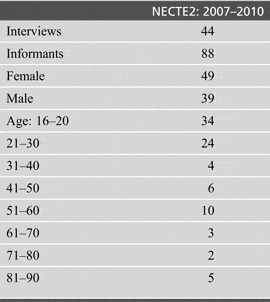
DECTE is a diachronic corpus of text transcriptions and audio files of interviews with a wide variety of people from the North East of England, dating from 1960 up to and including 2010. In total, DECTE currently contains 99 interviews, recording 160 speakers who generated 804,266 words of text. The interviews come from three different research projects carried out at Newcastle University: (i) the Tyneside Linguistic Survey (TLS) of the 1960s–1970s; (ii) the Phonological Variation and Change in Contemporary Spoken English (PVC) project of the 1990s and (iii) NECTE2, from 2007–2010. It is this third sub-corpus that we focus on in our analysis of stative possessives (see Table 1).Footnote 9
The DECTE data-set used in our analysis

4.2 Data collection and analysis
Initially, all occurrences of have and have got were collected, and then, in order to ensure that the context in which these cases occurred actually allowed for variation, exclusions were made. Have was thus excluded: (i) in non-present contexts; (ii) when it had dynamic rather than stative meaning; e.g. have a drink; or (iii) when it formed a lexical unit, e.g. have an impact. Got was similarly excluded as the past participle of get. This left us with a total of 804 tokens.
Each occurrence was categorized for the internal constraints discussed in 3.2 above. In addition, each participant was categorized as male vs. female and by their age range (16–29, 30–59, 60–90). Speakers were also selected in accordance with their educational history: those with secondary education versus those with post-secondary education, following Tagliamonte et al. (2010).Footnote 10
5. Results and discussion
As our intention is to compare our findings with those of previous research, such as Yoshizumi (Reference Yoshizumi2008) and Tagliamonte (Reference Tagliamonte, Rohdenburg and Mondorf2003, Reference Tagliamonte2013), we have used the same statistical tools as these studies, namely Goldvarb, which has been the bedrock of the quantitative paradigm for some time now.Footnote 11
5.1 Frequency of have versus have got
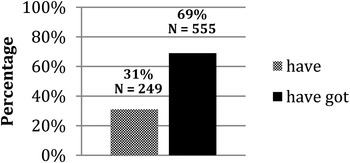
A preliminary investigation of the frequency of the competing forms shows that have got dominates, at 69% (Figure 1).
Frequency rate of have versus have got

If we compare this to Yoshizumi's (Reference Yoshizumi2008) analysis of earlier DECTE data, however, we see a fluctuation in the frequency of usage. Yoshizumi reports that have got was favoured by 58% of speakers in the 1960s/1970s and then there was a dramatic rise to 81% in 1991–1994. Such a development might lead one to propose that have got is taking over from have as a marker of stative possession. Yoshizumi (Reference Yoshizumi2008: 25) suggests that, because the increase in the use of have got was led by the younger speakers in the 1990s, we can see this as an indication of linguistic change in progress.
Our results from 2007–2010 demonstrate, however, that this does not, in fact, appear to be the case. Although have got is still more frequent than have, the difference is not as great as it was in the 1990s. Indeed, these data are interesting in that they demonstrate how distinct populations of speakers (in this case, varying across real time) can have differing usage preferences. As Milroy (Reference Milroy1992: 162) points out, “variation, when subjected to fine-grained analysis, may at a given time appear to be moving in a particular direction, but the direction may change, and the realizations may all drift back again to where they started off”.
5.2 Internal constraints
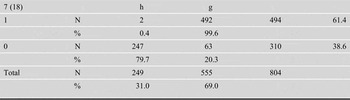
As noted earlier, Crowell's (Reference Crowell1959) hypothesis that the increasing tendency to contract have to‘ve or ‘s led to the insertion of got predicts that there will be a strong correlation between the use of have got and the contraction of have. Indeed, this is corroborated by our findings. In Table 2 we see that the contracted ‘ve or ‘s form (marked by ‘1’ here) significantly correlates with the use of got (chi-square: 559.88, d.f. = 1, p = 0.000). Got is used in 99.6% of the cases with a contracted form of have and in only 20.3% of cases when have is not contracted (i.e. ‘0’ here).
Contraction of have ('ve, 's)

However, the assumption that pronoun subjects will correlate more strongly with have got because, historically, contraction began with pronouns and then later spread to NPs, is not borne out in our data.Footnote 12Table 3 shows that NP subjects (marked as ‘1’) occur more often with have got (at 64.4%) than with have (35.6%), which is also the case for pronoun subjects, and there is no significant difference between subject types (chi-square: 0.64, d.f. = 1, p = 0.425).
NP versus pronoun subjects

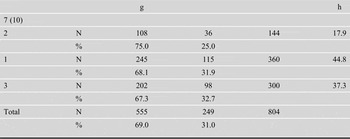
Tagliamonte et al. (Reference Tagliamonte, D'Arcy and Jankowski2010) observed that the person form of a subject played a role in determining the distribution of have and have got in their Canadian data, with the second and the third person singular forms favouring have got. A similar effect was also found in our DECTE data, where the second person appears to favour have got more than the first or third.Footnote 13Table 4 shows that second person subjects (marked as ‘2’) occurred in 75% of the cases with have got while have was used in these contexts only 25% of the time. The difference between this distribution and that in first (marked ‘1) and third person (marked ‘3) contexts comes out as significant in a Goldvarb analysis but is not significant according to a chi-square test (GV: FG10 PERSON Group # 7 – 2: 0.830, 1: 0.376, 3: 0.462; chi-square: 2.96, d.f. = 2, p = 0.2).
Grammatical person

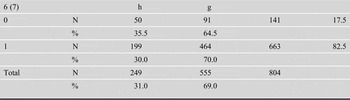
In accordance with Jespersen's (Reference Jespersen1961: 51) observation on generic versus specific subjects, our results show a tendency for specific subjects to co-occur more frequently with have got more than generic subjects do (an effect reported for other dialects of British and Canadian English, as noted by Tagliamonte, Reference Tagliamonte, Rohdenburg and Mondorf2003 and Tagliamonte et al., Reference Tagliamonte, D'Arcy and Jankowski2010, respectively). Table 5 demonstrates that specific subjects (marked as ‘1’) co-occur with have got in 70% of the cases, as opposed to 64.5% with generic subjects (marked ‘0’). This difference is not particularly great and does not reach significance in a chi-square test (i.e. chi-square: 1.61, d.f. = 1, p = 0.204). However, it does come out as significant in our Goldvarb analysis (GV: FG7 SPECIFIC Group # 5 – 0: 0.297, 1: 0.546).Footnote 14
Specific versus generic subjects

Yoshizumi (Reference Yoshizumi2008) also notes a stronger preference for have got with specific rather than generic subjects in the 1991–1994 DECTE data, although she states that there was no such effect in the 1960s/1970s sub-corpus.
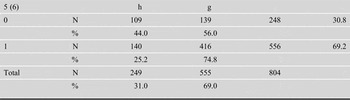
Similarly, we found a significant effect of object type on the choice of variant, with concrete objects favouring have got. This supports Jespersen's (Reference Jespersen1961) theory of grammaticalization, namely, that the origin of have got is due to the reanalysis of the past tense form got, meaning ‘acquired.’ The fact that, in our data, have got occurs quite regularly with abstract objects demonstrates that it is highly grammaticalized. However, the tendency for have got to be favoured more by concrete objects than abstract ones suggests that some degree of persistence still exists (Hopper Reference Hopper and Closs1991). Table 6 shows that concrete objects (marked by ‘1’) occur with have got in 74.8% of the cases, whereas abstract objects (marked ‘0’) differ significantly in that they appear with have got only 56% of the time in these contexts (chi-square: 28.27, d.f. = 1, p = 0.000).
Concrete versus abstract objects

Similarly, Yoshizumi (Reference Yoshizumi2008) also found a preference for have got with concrete objects in her 1991–1994 sub-corpus of DECTE.
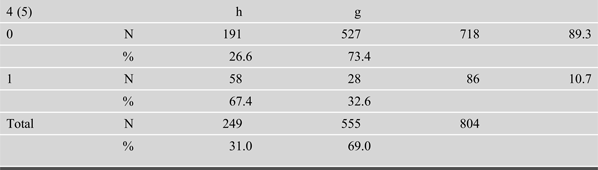
The strongest effect in our data appears to be that of sentence type, with negative sentences significantly favouring have. Table 7 reveals that have occurs in 67.4% of negative contexts (marked as ‘1’) as opposed to only 32.6% have got in these same contexts, despite the fact that, overall, have got is the most frequently used form in our data. The difference between negative and affirmative (marked ‘0’) contexts with regard to the distribution of have and have got is significant (chi-square: 59.92, d.f. = 1, p = 0.000).
Negative versus affirmative sentences
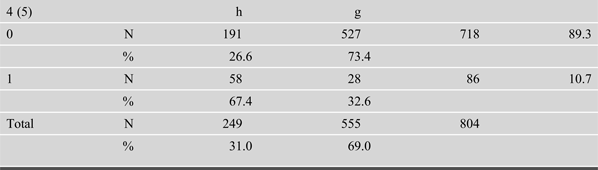
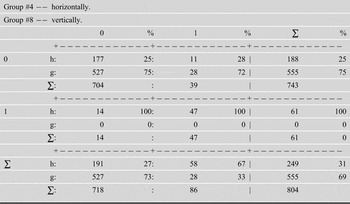
This is in direct contrast to Noble's (Reference Noble1985) findings, from British plays of the 18th to the early 20th century, that have got is actually favoured in negative contexts: a result which led Kroch (Reference Kroch1989: 207–10) to suggest that the use of have got in negatives is part of a more general tendency to eschew the use of do-support with the lexical verb have. Tagliamonte (Reference Tagliamonte, Rohdenburg and Mondorf2003, Reference Tagliamonte2013) observes that, in her British dialect data, it is actually have that is favoured in negative contexts, which ties in nicely with our findings. However, there is one important difference between Tagliamonte's 20th century data and our DECTE sub-corpus from the 21st. Tagliamonte (Reference Tagliamonte2013: 151) observes that do-support is limited in most dialects (she reports ‘only a smattering’, except in Cumnock in Scotland, where it appears 33% of the time). In our DECTE sub-corpus, however, negative sentences are regularly formed with do-support, as Table 8 demonstrates (where ‘0’ marks affirmatives, ‘1’ negatives without do-support and ∑ do-support negatives). Out of a total of 86 negative sentences, just over half are formed with do-support (N47), which forces use of have:
Do-support across different sentence types

By contrast, in negative sentences without do-support, have got dominates (N28 have got versus N11 have out of a total of 39 negative sentences without do-support).
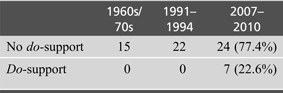
The relatively infrequent use of do-support in Tagliamonte's dialects could be due to a number of reasons including the relic nature of some of the dialects in her study contra urban Tyneside English or that the nature of the discourse event captured in her data-set differs somewhat from that which obtains in our DECTE sub-corpus. Indeed, our analysis of this feature in the earlier sub-corpora of DECTE displayed in Table 9 shows that do-support in negative sentences did increase dramatically between the end of the 20th and the beginning of the 21st century.
The rise of do-support in negative sentences in DECTE

Interestingly, Yoshizumi (Reference Yoshizumi2008) reports that negative contexts have no significant effect on the choice of have versus have got between the 1960s and 1990s, which suggests that the favouring of have from 2007 onwards is (at least partly) driven by the increase of do-support.Footnote 15 In this regard, the DECTE data appear to be moving in the same direction as North American English. In their study of the Longman Corpus of Spoken and Written English, Biber et al. (Reference Biber, Johansson, Leech, Conrad and Finegan1999: 163) note that the use of do-support in American English accounts for 90% of negative contexts (with an accompanying definite NP).Footnote 16
Similarly, we undertook an analysis of interrogative contexts over the three time periods of DECTE which revealed an increase in the frequency of do-support (see Table 10).
The rise of do-support in interrogative sentences in DECTE

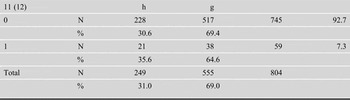
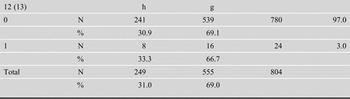
When analysing the distribution of have and have got in interrogative contexts, however, no significant differences were found. Table 11 shows that have and have got are distributed in a similar way in both interrogative contexts (marked as ‘1’) and declarative contexts (marked as ‘0’) (chi-square: 0.06, d.f. = 1, p = 0.799). It should be noted, however, that the number of interrogative contexts in our data is very low (only 24 tokens out of a total of 804), which is probably a relevant factor.
Interrogative versus declarative sentences

Thus, it appears, at least in this corpus of British English, that do-support is on the increase in possessive stative contexts. The strong favouring of have got in Noble's (Reference Noble1985) negative and interrogative contexts might be due to the fact that his data stop in 1935 and it is therefore difficult to fully compare the data-sets.
Returning to the observation that have got appears to be on the increase in DECTE between the 1960s and the 1990s, and then falls again in 2007–2010 (58% to 81% reported by Yoshizumi (Reference Yoshizumi2008) and then decreasing to 69% in our analysis), it is possible that this can be explained in terms of the interaction between do-support in negative (and perhaps interrogative) contexts and the use of have. Do-support forces the use of have, as *do have got is ungrammatical, so any increase in do-support will be mirrored by an increased use of have. Having said that, if we remove all negative and interrogative contexts from our data-set, the rate of have got is still less than Yoshizumi's (Reference Yoshizumi2008) figure of 81% (have got = 73.7% (N = 512), have = 26.3% (N = 183)), therefore it appears that have is gaining some (albeit small) ground in the 21st century sub-corpus.
5.3 External constraints
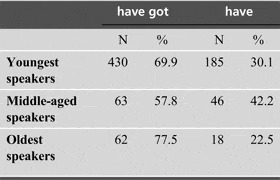
Table 12 shows that have got is favoured most strongly by the oldest and the youngest groups of speakers. The middle-aged group also favour have got but less strongly (chi-square: 9.34, d.f. = 2, p = 0.009).Footnote 17
Age of speaker

Again, this distribution demonstrates that distinct generations of speakers can have quite different preferences (Milroy Reference Milroy1992: 162) and contrasts with Yoshizumi's earlier findings that the relative frequency of have got increases when moving from the older to the younger age groups.
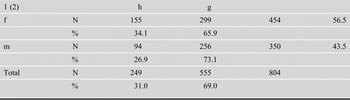
More interestingly, perhaps, Table 13 demonstrates that male speakers favour have got more than female speakers do. Males use have got in 73% of the cases, as opposed to 65% for females, which is a significant difference (chi-square: 4.90, d.f. = 1, p = 0.027; GV FG2 GENDER Group # 1 – f: 0.451, m: 0.563).
Sex of speaker

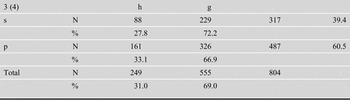
As noted earlier, it is often the case that sociolinguistic research finds that women tend to favour forms that are closer to the standard language and have more prestige whereas men often prefer non-standard forms (Labov, Reference Labov2001: 293). Tagliamonte et al. (Reference Tagliamonte, D'Arcy and Jankowski2010) demonstrate that have is being favoured by young women in Canada, and Tagliamonte et al. (Reference Tagliamonte, D'Arcy and Jankowski2010: 167) argue that this particular social group appears to be leading the change towards have. Our results from DECTE reveal that, although have got is the favoured form overall, which distinguishes our data from the Canadian findings, women in Tyneside also tend to use a smaller proportion of have got than men do.Footnote 18 However, we cannot interpret these findings in the same way as Tagliamonte et al. (Reference Tagliamonte, D'Arcy and Jankowski2010) did for their Canadian data. They argue that have is the more prestigious form, owing to the long history in American grammatical tradition of stigmatizing have got. By contrast, there is no such prescription reported for British English as far as we are aware and there is no evidence that have got is stigmatized in Britain (see Tagliamonte et al., Reference Tagliamonte, D'Arcy and Jankowski2010: 171). Indeed, our DECTE data reveal that educated speakers use have got as frequently as the less educated speakers do. Table 14 shows that speakers with a post secondary education (marked as ‘p’ below) use have got in 66.9% of their sample data. For speakers with only secondary education (‘s’ in the table) the figure is 72.2%, which is not a significant difference (chi-square: 2.52, d.f. = 1, p = 0.112; GV FG4 SCHOOL Group # 2 – s: 0.558, p: 0.462).
Education

Thus, the fact that a speaker's education has no effect on the choice of variant suggests that have is no more ‘standard’ than have got in Tyneside. This contrasts with Tagliamonte et al.'s (2010) Canadian results, which reveal that have is consistently favoured by speakers with post-secondary education, at least in the older generations.
Furthermore, our findings contrast sharply with Yoshizumi's (Reference Yoshizumi2008) results for the 1991–1994 DECTE data. She reports that female speakers in this sub-corpus favour have got significantly more than male speakers do, although in the 1960s/1970s it was the male speakers who preferred have got. This result is presented as somewhat surprising: Yoshizumi points out that the tendency for females to favour have got has not been observed before in other varieties of Northern British English (2008). In New Zealand, however, the favouring of have got by females has been reported by Quinn (Reference Quinn2004, Reference Quinn, Crisma and Longobardi2009), although no sociological explanation for this was given. Thus, it appears that the preference found by Yoshizumi for females to favour have got in 1991–1994 is not necessarily a sign that women are leading the way in a change towards have got in Tyneside but could simply be a manifestation of fluctuation in the data which can only be detected by ongoing longitudinal research. We have already noted that the greater use of have in our 21st century sub-corpus appears to be closely linked with a recent increase in do-support, particularly in negative contexts. Correlations of do-support and sex reveal interesting patterns: women use significantly more do-support than men in this data-set (chi-square: 5.112, d.f. = 1, p = 0.02). Given the interrelationship between have and do in interrogative and negative constructions, such a result is not unexpected. If these are removed from the analysis, however, female speakers still show a slight preference for have by comparison to their male peers. That being said, the difference between gender categories is no longer significant (chi-square: 2.059, d.f. = 1, p = 0.51) as Table 15 indicates.
Do-support and sex in DECTE

As do-support is a common feature of the 2007–2010 data but very rare in the 1960s and 1990s sub-corpora, one might argue that women are, in fact, innovating with respect to this variable, which ties in with Labov's (Reference Labov2001: 293) observations that this social group often introduce innovative (non-stigmatized) forms.
6. Conclusion
Three theoretical stances have been taken in previous research to explain the dynamics of have vs. have got introduced in §1. Two of these (specifically, the contraction argument put forward by Crowell, Reference Crowell1959 and the grammaticalization approach of Jespersen, Reference Jespersen1961) have both found support in our 21st century sub-corpus of DECTE. The very strong correlation observed in our data-sets between have-contraction and the use of have got supports the former, while the favouring of have got with concrete rather than abstract objects corroborates the latter.
As regards the syntactic explanation for the dynamics of have vs. have got, the argument discussed in Kroch (Reference Kroch1989: 207–10) that the latter is favoured in order to avoid using do-support, is not evidenced in our sub-corpus. In fact, we find that do-support is on the increase, particularly in negative contexts, and this has risen sharply in the 21st century. As do-support forces the use of have, we see that have is significantly favoured in negative contexts, a result which was not found by Yoshizumi (Reference Yoshizumi2008) for the earlier sub-corpora of DECTE. It is clear, therefore, that syntactic structure does play an important role in determining the choice of variant – though our data appear to suggest a different syntactic reason for the change than that described by Kroch. Since do-support appears to have increased between the 20th and 21st centuries, it is possible that have may eventually become the specialized marker in negative (and probably also interrogative) contexts, creating a sharp contrast between these and affirmative declaratives, which strongly prefer have got.
With regard to extralinguistic constraints, the gender patterns in the sub-corpora we examined reveal interesting differences between our data and those of the earlier stages of DECTE. Yoshizumi (Reference Yoshizumi2008) found that in the early 1990s, women showed a strong preference for have got, but our investigation of the 2007–2010 data demonstrates that this is no longer the case. Although the results are not significant when interrogatives and negatives are omitted from the analysis, women do have a tendency to use have more frequently than men. Moreover, the rise of have tokens in negative and interrogative constructions used by this cohort is likely to be a result of the significant gender difference in the use of do-support as a strategy. It would be interesting in future research, therefore, to pursue this line of inquiry with a view to establishing whether this trend is indeed indicative of sociolinguistic change in real time or whether it is the result of the potentially divergent nature of male versus female talk in interaction.
Acknowledgements
We are grateful to the Centre for Research in Linguistics and Language Sciences at Newcastle University for an award to assist with the completion of this project from their SDF Fund for Research Collaboration and Infrastructure.
Carol Fehringer is Senior Lecturer in Germanic Linguistics at Newcastle University, UK. Her main area of focus is morphology/morphosyntax and she has published research on variation in German and Dutch, as well as English.
Dr Carol Fehringer, School of Modern Languages, Newcastle University, NE1 7RU. UK.
Karen Corrigan is Professor of Linguistics and English Language at Newcastle University, UK. She has conducted research on historical and current language change in dialects of the British Isles with a particular focus on Northern Ireland and North East England.
Professor Karen P. Corrigan, School of English Language, Literature and Linguistics, Newcastle University, NE1 7RU. UK.