INTRODUCTION
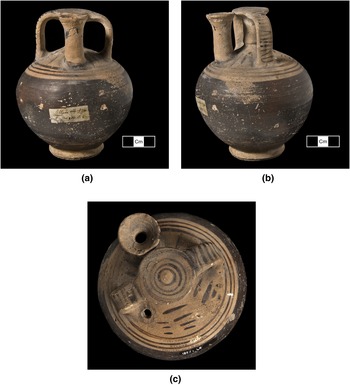
Among the objects in the prehistoric collection from Greece in the Pitt Rivers Museum in Oxford (henceforth PRM) is a stirrup jar from Athens (1887.1.48: Figs. 1a–c). As part of the project Characterizing the World Archaeology Collections of the Pitt Rivers Museum it was possible to study in detail the object published here.Footnote 1 This article presents and assesses the complex and most surprising biography of the stirrup jar in question.
(a)–(c). The stirrup jar (PRM 1887.1.48). © Pitt Rivers Museum, University of Oxford.

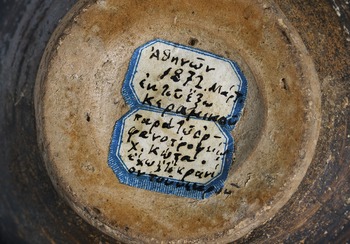
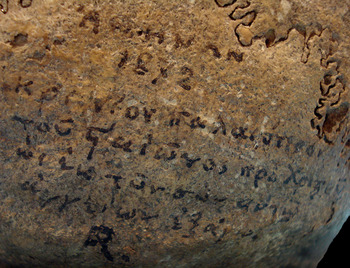
Until early in 2010 no record existed in the PRM regarding the provenance and purchase details of the stirrup jar, except that it had been transferred from the Oxford University Museum of Natural History, where it was first deposited in 1874, to the PRM in 1886. Preserved intact, the pot has two blue-rimmed stickers stuck on its underside written in Greek (Fig. 2). The text translates: ‘From Athens, 1872, March. From the Outer Kerameikos by the Ch.Kosta [Chatziko(n)sta] orphanage.Footnote 2 I also have the skull of the deceased.’
The two labels on the underside of the stirrup jar. © Pitt Rivers Museum, University of Oxford.

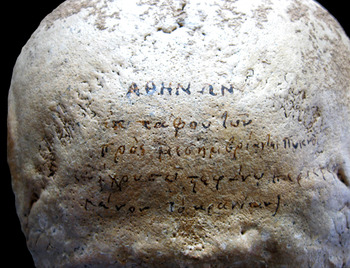
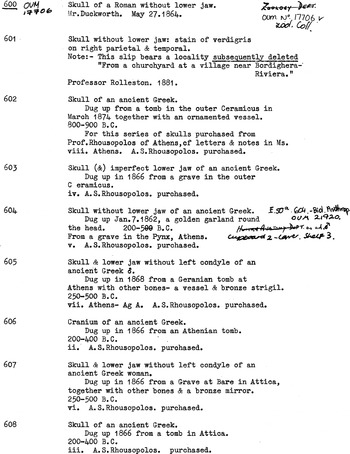
Puzzled by the last line, I decided to contact the Oxford University Museum of Natural History (henceforth OUMNH) to see whether any skulls from ancient Athens were still stored there. Małgosia Nowak-Kemp, collections manager in the OUMNH, showed me the only skull from ancient Athens (no. 604) still in their collection.Footnote 3 Surprisingly, skull no. 604 also bears a label upon it written in GreekFootnote 4 with the same handwriting as that on the underside of the PRM stirrup jar (Fig. 3). This discovery led to a closer inspection of the OUMNH catalogue of crania reconstructed in the 1960s.Footnote 5 The catalogue records that skull no. 604 was originally one of seven skulls from ancient Athens in the collection of the Anatomical Department (Fig. 4).Footnote 6
The label on skull no. 604, from a Late Classical/Hellenistic grave at Pnyx (Athens). © Oxford University Museum of Natural History.

A page from the Oxford University Museum of Natural History catalogue of crania listing the skulls purchased by George Rolleston from Athanasios Rhousopoulos (nos. 602–8). © Oxford University Museum of Natural History.

More importantly, the catalogue of crania revealed that the original purchase involved not only skulls and bones but also a few archaeological objects and that this assemblage was purchased from Athanasios Rhousopoulos (1823–98), a university professor in Athens, prolific art dealer and notable collector of antiquities (Galanakis Reference Galanakis, Kurtz, Meyer, Saunders, Tsingarida and Harris2008; Galanakis and Nowak-Kemp Reference Galanakis and Nowak-Kemp2011). In addition, the entry for skull no. 602 proved particularly illuminating: ‘Skull of an ancient Greek. Dug up from a tomb in the Outer Ceramicus in March 1874, together with an ornamented vessel. 800–900 B.C.’
Two more ‘labels’ on the body of the stirrup jar helped to clarify the date of discovery (1872 rather than 1874 as recorded in the OUMNH catalogue of crania)Footnote 7 and confirm that this pot was by the time of its arrival in England associated with skull no. 602.Footnote 8 As the stirrup jar was presented to the OUMNH in 1874, the only person who could have purchased the skull and pot from Rhousopoulos on behalf of the Museum was Dr George Rolleston (1829–81), the first Linacre Professor of Anatomy and Physiology in Oxford University (1860–81) and curator of the Anatomical Department of the OUMNH.
The OUMNH catalogue of crania also recorded the existence of letters and notes documenting the purchase of ancient specimens and objects. A search in the Rolleston Archive in Oxford (Ashmolean Museum, on loan at the time to the OUMNH) brought to light a remarkable correspondence between Rhousopoulos and Rolleston (Nowak-Kemp and Galanakis Reference Nowak-Kemp and Galanakis2011; Galanakis and Nowak-Kemp Reference Galanakis and Nowak-Kemp2011; on Rolleston see also Gosden and Larson Reference Gosden, Larson and Petch2007, 159–60). The letters, written in Greek,Footnote 9 reveal an amicable correspondence between the two men from the summer of 1871 until the summer of 1874, during which time Rolleston visited Rhousopoulos in Athens and the latter visited the former in Oxford. Based on the handwriting of the sender, the letters also identify Rhousopoulos as the man who wrote the labels upon the skulls and the ancient objects (see also Swindler Reference Swindler1916, 336).
A discussion of the relevant Rhousopoulos–Rolleston letters (part I) is followed by a presentation of the early Outer Kerameikos excavations, focusing especially on the 1871–2 archaeological activities (parts II and III). A search for the possible findspot of the stirrup jar published here necessitates the re-examination of the known Late Bronze Age graves in the area of the Outer Kerameikos (part IV). The article concludes with a note on private excavations and the trade in antiquities in nineteenth-century Athens (part V) and a brief presentation of the stirrup jar and the skull associated with it (Appendix). It is hoped that the result of this study will offer the opportunity to assess the strategies and attitudes involved in the marketing, collection, use and perception of antiquities in late nineteenth-century Greece.
I. THE LETTERS
George Rolleston had already bought seven skulls and a few archaeological objects associated with them from Rhousopoulos in the summer of 1871 (Galanakis and Nowak-Kemp Reference Galanakis and Nowak-Kemp2011). Rhousopoulos continued to write to Rolleston keeping him informed about ancient skeletal specimens for sale as well as metal and stone tools.
Rhousopoulos' collection comprised primarily coins, gems, vases, metal and stone vessels, jewellery, sculpture and inscriptions, metal and clay figurines, tools and utensils, and several other artefactual categories of all periods. From his correspondence with Rolleston we are also informed that he kept a few skulls and bones for sale.
Rhousopoulos was also a well-respected citizen with a wide network of friends in Greece and abroad and was a point of contact for notable foreigners in Athens (Galanakis and Nowak-Kemp Reference Galanakis and Nowak-Kemp2011; on his illustrious family see also Rhousopoulou-Matey Reference Rhousopoulou-Matey1980; Enepekides Reference Enepekides1984, 273–94; Petrakos Reference Petrakos2008). Numerous travellers who visited his house and admired his collection of antiquities offer vivid descriptions of this extraordinary assemblage of objects (Wieseler Reference Wieseler1874, 38–41; Farrer Reference Farrer1882, 71–2; von Gerold Reference Gerold1885, 151–2; von Warsberg Reference von Warsberg1892, 123–9, summarised by Müller Reference Müller1984, 24–5; see also Mahaffy Reference Mahaffy1892, 46, 51–2, 169; Beazley Reference Beazley1920, 33, 45, 53, 55, 61, 89, 96; Greifenhagen Reference Greifenhagen1965, 236–7 and n. 29, 248 n. 107, 251 n. 133, and letters 28–9, 108–9, 127–30; Tsingarida Reference Tsingarida, Kurtz and Tsingarida2002; von Steuben Reference Steuben2004, 19, 101, 118–9).
Rhousopoulos, who was also an adept art dealer, soon realised that Rolleston's main interest was in skulls from very early contexts. In his letter to Rolleston of 22 April/4 May 1872 he mentioned an excavation to the north of Athens in the area of the Outer Kerameikos about 200 paces (300 m) away from the city's ancient walls, ‘where lately … tombs very unusual and didactic’ had come to light; they were unusual and didactic according to Rhousopoulos ‘because they belonged to every era’ (Galanakis and Nowak-Kemp Reference Galanakis and Nowak-Kemp2011, online Appendix II, letter no. 4). The lowermost tombs reached a depth of 5 m, making them the ‘oldest tombs in Attica’, and the ‘oldest in Greece in general’ (the latter from his letter to Rolleston of 17 May 1874: Galanakis and Nowak-Kemp Reference Galanakis and Nowak-Kemp2011, online Appendix II, letter no. 13). Rhousopoulos came to this conclusion primarily on the basis of pots found in the tombs which were ‘monochrome and bear various ornaments and animals and shapes as the Assyrian and Egyptian’. This pottery is best identified as Late Geometric and/or Archaic, especially of the ‘Orientalising’ style as defined at the time (Conze Reference Conze1870; Coulié Reference Coulié2005, 263 n. 44). According to Rhousopoulos no inscriptions were found on them, but amongst them were kantharoi decorated with ‘symbols and Asian animals’ as well as gold bands decorated with ornaments and animals.Footnote 10
Based on the excavated material, to which Rhousopoulos appears to have had good access, he dated the finds to before the sixth century bc. ‘Since the excavation is private’ he was able to buy a number of unusual objects and pots, as well as a number of skulls and bones. From the 400 tombs opened, only five or six skulls were preserved intact, along with one complete skeleton. From the earliest tombs, those of the ‘seventh and earlier century’, only one skull was found intact and this was atypical because its ‘facial angle is sharper than usual and its appearance is different from the others’. Rhousopoulos purchased this particular skull along with ‘an unusual pot, which was found with it and two long bronze pins, which were in the same tomb’, interpreted by him as ‘surgical tools’, almost certainly in an attempt to whet the appetite of his client, the medical doctor George Rolleston.
On 7 June 1873 Rhousopoulos sent another letter to Rolleston in which he listed skulls available for sale. Among them was a skull dated to the ‘8–9th century before Christ’, as Rhousopoulos was able to deduce based on ‘the date of the pot with which it was found and from the other graves in the Kerameikos of Athens’ (Galanakis and Nowak-Kemp Reference Galanakis and Nowak-Kemp2011, online Appendix II, letter no. 5). This skull is almost certainly the same as that mentioned by Rhousopoulos to Rolleston in his previous letter. The price for it, along with an iron tool, was 125 francs (or £5) at a time when a state archaeologist in Greece earned 240 francs per month (Petrakos Reference Petrakos1982, 64).Footnote 11
In the same letter he listed two more skulls and a complete skeleton from the Kerameikos excavations (all dated to the sixth–fifth century bc). One of the fifth century bc skulls was associated with fine and valuable pots which ‘were not purchased’; for the skull alone Rhousopoulos was asking 80 francs (or £3.20). Another fine skull, also for sale, was associated with two skyphoi (100 francs or £4), while a complete skeleton of fine quality ‘from an Attic grave in the Kerameikos with two white[-ground] lekythoi’ was on sale for 200 francs (or £8). Rhousopoulos probably valued the objects primarily on the basis of their condition and overall appearance: their aesthetic appeal rather than their archaeological rarity (see e.g. Dumont Reference Dumont1874, 33 n. 1; Wright Reference Wright1886, 396–7; Six Reference Six1888, 200, no. 12, pl. 29, 5). From all this material put on sale by Rhousopoulos, Rolleston decided to purchase on 3 July 1873 the very early skull which was finally dispatched to him on 22 January 1874 (Galanakis and Nowak-Kemp Reference Galanakis and Nowak-Kemp2011, letters no. 6, 11, 12).Footnote 12
Another letter from Rhousopoulos to Rolleston, dated 17 May 1874, shows that the latter needed assurance that the dispatched skull was indeed among the earliest known from ancient Athens (Galanakis and Nowak-Kemp Reference Galanakis and Nowak-Kemp2011, letter no. 13). He needed this assurance as he was interested in identifying ‘purer populations’, before, as he thought, any significant intermixing had taken place (in more detail see Nowak-Kemp and Galanakis Reference Nowak-Kemp and Galanakis2011). Rhousopoulos confirmed to Rolleston that this skull did indeed come from the earliest stratum (known at the time) in Athens. In the same letter, he explained to Rolleston that he was able to date the skull based on the ‘pots with which it was found’, despite the fact that in his earlier letter he had made clear that the skull was associated only with one pot. Nevertheless, he deduced the date based on the depth of the tomb, the superimposed (and thus most recent) graves and the material assemblage found in it, showing good archaeological skills.
Apart from the revised date and the number of pots associated with this skull, Rhousopoulos also altered in the letter of 17 May 1874 the depth of the grave: instead of 5 m, mentioned in his letter to Rolleston of 22 April/4 May 1872, Rhousopoulos now informed Rolleston that this tomb was actually found at a depth of 6–7 m and that for this reason it must have been older than the seventh century bc. Since the pots with which it was found were the oldest in Athens,Footnote 13 Rhousopoulos decided to date the skull to the ninth–eighth century bc, suggesting (quite correctly) that it may have been even older (and we now know that he was right, given that the stirrup jar dates from around 1100–1050 bc). Rhousopoulos concluded his letter to Rolleston by reiterating the place and date of discovery: the Outer Kerameikos in 1872.
Rhousopoulos also claims to have sent a pin to Rolleston, said to have been found in the same grave as the stirrup jar. The whereabouts of the pin are currently unknown, as it is not listed among the Rolleston material transferred from the OUMNH to the PRM.Footnote 14 In the letter of 2/14 June 1874 Rhousopoulos admitted that he might have previously described the object as made of bronze by mistake; however, he re-assured Rolleston that this object was broken into two parts during transit and that it was, ‘as I remember’, made of iron (Galanakis and Nowak-Kemp Reference Galanakis and Nowak-Kemp2011, online Appendix II, letter no. 14). We thus get the impression that the object was not preserved in good condition. Rhousopoulos' repeated assurance of sending the object makes one speculate that the pin(s) may have never reached the destination: George Rolleston of Oxford.
The inconsistencies regarding the date and depth of the tomb as well as the number of pots and the material of the pin(s) may advise us to be extra cautious when associating together material based on the sale of antiquities in nineteenth-century Greece. Assemblages were often split up and objects were occasionally mixed up or sold separately by various art dealers in an attempt to maximise their profit (see e.g. the ‘Kapros D assemblage’ said to be from a tomb on Amorgos: Sherratt Reference Sherratt2000, 25–31; Galanakis, forthcoming). In addition Rhousopoulos' confusion may stem from the fact that more than one tomb of a similar early date had come to light or because by 22 April 1872 excavations were still in progress. Whatever the truth behind Rhousopoulos' inconsistencies and (mis)information, as we shall see below, most of the details given by him appear to be correct, also verified by most recent excavations in the area. It is to his credit that he was able to date more or less accurately (‘as of the 9th century bc or even earlier’) the stirrup jar found in this Attic grave, at a time when almost nothing was known about pots of this shape (Galanakis and Nowak-Kemp Reference Galanakis and Nowak-Kemp2011, online Appendix II, letter no. 13).Footnote 15
II. THE OUTER KERAMEIKOS PRIVATE EXCAVATIONS
Rhousopoulos is the first modern excavator of the Athenian Kerameikos, the most prominent funeral ground in ancient Athens. He excavated there from 1863 to 1867 on behalf of the Athens Archaeological Society.Footnote 16 Despite the Society's efforts to excavate the site systematically, numerous uncontrolled activities appear to have taken place in the broader area, certainly on private land and often in relation to the construction or development of private properties in this fast-growing area of Athens. By 1920 the area of the Outer Kerameikos had become the second most populous neighbourhood in Athens (after Neapolis) with a population of 19,587 and within an area of 0.65 km2 (Skiadas Reference Skiadas2001, 145)
It has long been known that excavations in 1871 in the area of Plateia (Square) Eleutherias had yielded very significant finds. Plateia Eleutherias (earlier known as Place Louis and later as Plateia Koumoundourou) is situated about 300 m north-northeast of the Kerameikos (the same distance as the 200 paces given by Rhousopoulos in his letter to Rolleston). Among the finds associated with these excavations around the square, the former orphanageFootnote 17 and especially the Sapountzakis plot (Petrakos Reference Petrakos1987, 54; Kavvadias and Lagia Reference Kavvadias, Lagia, Oakley and Palagia2009), are some of the most notable examples of Middle and Late Geometric pottery (800–700 bc) now adorning the first gallery of the permanent vase collection of the National Archaeological Museum in Athens as well as the Dipylon oinochoe (NMA 192), which was not identified as bearing an inscription until April 1880 (Koumanoudis Reference Koumanoudis1880).Footnote 18 In an attempt to prevent the exportation of these important finds abroad, the Archaeological Society of Athens bought a number of them from the ‘1871 excavations’ and deposited them in the Society's Museum at the Varvakeion.Footnote 19
Everything we know about this excavation comes from secondary sources: there are no primary excavation notebooks, plans or other notes. The very limited information available to reconstruct this excavation comes primarily from three secondary sources: the acquisition details in museum registers that associate certain objects with this particular excavation or more generally with archaeological activities in the area early in the 1870s; the scanty details provided by the General Ephor of Antiquities (Eustratiades Archive, Athens Archaeological Society); and any other source, such as the letters sent by Rhousopoulos to Rolleston, that can shed additional light on this excavation, hitherto little understood yet very important for the history of scholarship.
III. IOANNIS PALAIOLOGOS
Rhousopoulos' correspondence with Rolleston and a search in the daybooks of Panagiotis Eustratiades, the General Ephor of Antiquities in Greece at the time (between 1863 and 1884), help to clarify a number of obscure issues associated with the Outer Kerameikos excavations early in the 1870s.
The Outer Kerameikos excavations in the area of Plateia Eleutherias were conducted by Ioannis Palaiologos, a Greek art dealer involved in the sale of antiquities. Palaiologos is said to have thoroughly excavated (κατέσκαψε) the square and the area around it (Kavvadias and Lagia Reference Kavvadias, Lagia, Oakley and Palagia2009, 74; Arnott Reference Arnott1990, 4 and 7–8).Footnote 20 Very little is otherwise known about him. His name is mentioned in the Greek press in relation to his skilled mending of a beautifully decorated vase from Cleonae in Corinthia in 1866 as well as to his antiquities business.Footnote 21 We also know that Palaiologos had a small coin collection and that he occasionally presented coins to the Numismatic Museum in Athens.Footnote 22
The earliest reference to Ioannis Palaiologos that I was able to find is made by Kyriakos Pittakis (1798–1863), General Ephor of Antiquities between 1848 and 1863, in the Εφημερίς Αρχαιολογική where, in the issue of May–June 1853, he mentions that the son of Spyridon Palaiologos, known as ‘Tzingaras’, moved an inscription from its findspot to his house (Pittakis Reference Pittakis1853, 909). From the Eustratiades Archive it becomes clear that this ‘Tzingaras’ is indeed Ioannis Palaiologos (Eustratiades Archive, 22 May 1872, no. 1289; 15 January 1875, no. 1720). The nickname Tzingaras was given pejoratively to the Palaiologos family, one of the oldest in Athens, by the Benizelos family, another important Athenian family and with close relations (through intermarriages) to the Palaiologoi (Christomanos Reference Christomanos and Kambouroglou1892, especially 258–9). The nickname probably derives from the Italian ‘Zingaro’ meaning gypsy (‘tzigane’).
Palaiologos appears several times in the Archive of Panagiotis Eustratiades (1815–88), the successor of Pittakis to the directorship of the Antiquities Service. Eustratiades bought finds from Palaiologos and gave him permission to excavate; when, in his eagerness to discover antiquities, Palaiologos acted without authorisation, Eustratiades tried to stop him (e.g. Eustratiades Archive, 23 December 1864, no. 122; January 1865, page 22; 29 March 1865; 9 October 1872, no. 1341).
Since the archaeological service was at the time literally led by one man, the General Ephor himself, Eustratiades wanted to keep good relations with the Athenian art dealers, who, after all, were the most productive excavators – more so than the Athens Archaeological Society. The finds from these excavations were regularly – but not always and/or in their entirety – presented for sale to the Greek state. Eustratiades certainly tried to prevent unauthorised excavations and made efforts to stop the smuggling of antiquities abroad, to the extent that this was possible given the limited financial means available.
From the Eustratiades Archive, it becomes clear that Palaiologos was active throughout Athens and Attica. An interesting detail is that Palaiologos was the discoverer of the Menidi tholos, one of the four Mycenaean tholoi known in Attica and among the few intact Aegean tholoi. In December 1872, while he was looking for ancient graves in the area, Palaiologos stumbled upon the Menidi tholos (first reported on 8/20 December 1872; see also Eustratiades Archive, 14 December 1872, no. 1372). Interestingly, just two months earlier Palaiologos had been arrested while digging without authorisation in the Menidi area (Eustratiades Archive, 9 October 1872, no. 1341).
Palaiologos also conducted excavations in the Cyclades: he excavated at Kapros on the island of Amorgos (Vasilikou Reference Vasilikou2006, 45–46, letter no. 25; Mercouri Reference Mercouri and Marthari2002, especially 47–9), and probably on other sites within the island, and on Kythnos upon invitation (Eustratiades Archive, 1 August 1873, no. 5916).Footnote 23 Although from the Eustratiades Archive we learn about many other Athens art dealers conducting excavations on the islands – legally and illegally – in order to fill their antiquities shops in Athens with new ‘acquisitions’, Palaiologos appears to have been one of the most active and highly mobile people in the trade.
An important piece of information regarding Palaiologos comes from a letter written by John Marshall, archaeologist and long-standing collaborator of the prolific collector Edward Perry Warren, to the Director of the Boston Museum of Fine Arts, Edward Robinson, sent from Berlin on 21 June 1905. In the letter Marshall gives information to Robinson regarding the findspot of five red-figure vases, now in Boston (98.934, 98.935, 98.936, 01.8254, 01.8255), said to have been found in the Dexileos precinct in the Kerameikos during Rhousopoulos' excavation on behalf of the Athens Archaeological Society in 1863. From the letter we learn that the vase fragments were found by Rhousopoulos, who then sent ‘Palaiologos to shift the rest of the earth carefully … Palaiologos told me the same tale’ (Vermeule Reference Vermeule1971, 94).Footnote 24 This information is important not only because it helps to establish a clear link between Rhousopoulos and Palaiologos, but also because one could argue that the latter was trained by the former. In addition, Palaiologos' activity in Athens (1853–99) covers more or less the same period as Rhousopoulos' presence and activities in the city (1855–98).
Palaiologos and the 1871–2 private excavations in the Outer Kerameikos
It is thanks to the Eustratiades Archive (22 May 1872, no. 1289) that we are able to establish that Palaiologos' excavations on the fields opposite the Chatzikosta orphanage started late in 1871 and were completed in mid-1872 (between 13 December and 13 May: five months).Footnote 25 These excavations were conducted with permission from the General Ephor, who reported in his daybook the discovery by Palaiologos of numerous tombs and archaic pots of various shapes. It is less clear from Eustratiades' daybook to what extent the General Ephor was able to observe these excavations, as his reference to them is very general and less detailed, for example, than the description given by Rhousopoulos to Rolleston.
According to the Eustratiades Archive (19 April 1871, no. 1093) the plots opposite the orphanage belonged at the time to the families of Nikolopoulos and Vikelas. On 19 April the discovery of an inscription (Kirchner Reference Kirchner1940, no. 12373) is mentioned from the Nikolopoulos plot, exactly on the southwest corner of the field opposite the orphanage (what is now the corner of Dipylou and Ag. Asomaton Streets). The discovery was made by Anastasios Erneris (or Erneros), who also found pots and sherds belonging to ‘the beginnings of the Attic ceramic production’. The date is given as 31 March 1871 by Conze (Reference Conze1893, 96). This discovery may have sparked Palaiologos' interest in these particular plots. These plots had been split into two parts by the time of Kaupert's 1875 map (Curtius and Kaupert Reference Curtius and Kaupert1878, Bl. II). The one on the east side was later known by the family who owned it as the ‘Sapountzakis plot’. Erneris is the only art dealer, to my knowledge, operating in the area at the same time as Palaiologos (see below, for example, for his possible involvement in the discovery of the ‘Exekias plaques’ from the area behind the orphanage).
The French archaeologist Olivier Rayet (1847–87), who had dealings with Palaiologos and probably knew him quite well, describes him in the 1880s as ‘un des chercheurs d'antiques les plus expérimentés d'Athènes’ (Rayet and Collignon Reference Rayet and Collignon1888, 23–4, based on Hirschfeld Reference Hirschfeld1872).Footnote 26 The same source, copying information provided by the German archaeologist Gustav Hirschfeld (1845–95), mentions that the Palaiologos excavations took place ‘sur un terrain situé du côté sud de la rue du Pirée, presque à l'angle de la place Louis et en face de l'orphelinat Katzi-Kostas, c'est-à-dire dans la partie de l'ancien Céramique extérieur située juste sous le mur de la ville, au nord-est du Dipylon’, i.e. outside the zone of the Society's excavations (Rayet and Collignon Reference Rayet and Collignon1888, 23; Hirschfeld Reference Hirschfeld1872, 135), in the same area as that described by Eustratiades in his daybook. Hirschfeld, who published some of the finds from the ‘1871 excavations’ (Hirschfeld Reference Hirschfeld1872), is occasionally quoted as co-excavator with Palaiologos (Cook Reference Cook1972, 299; Boehlau et al. Reference Boehlau, Habich, Gercke and Löwe1996, 92 n. 3).Footnote 27 He also mentions that three or four layers of tombs from different periods were found during these excavations (Hirschfeld Reference Hirschfeld1872, 135; repeated by Thovez Reference Thovez1903, 13 and 21).
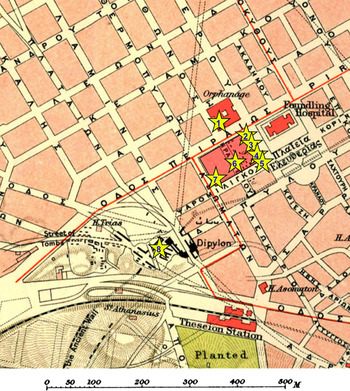
This area of Athens, today densely built up, is surrounded by Piraeus Street to the north (now known as Panagi Tsaldari), Psaromilingou Street to the south, Samouil Kalogerou to the west (formerly known as Vassileos Herakleiou) and Kriezi Street and Plateia Eleutherias to the east (Fig. 5). A number of graves with important finds, as already mentioned, were excavated in the plots opposite the orphanage in 1871–2 by Palaiologos and in 1891 by the Athens Archaeological Society (Brückner and Pernice Reference Brückner and Pernice1893, 74–5 and pl. VI; Kavvadias and Lagia Reference Kavvadias, Lagia, Oakley and Palagia2009).
A map showing Late Bronze Age findspots between Kerameikos and the Chatzikosta orphanage (adapted by the author from Murray's Handbook for Travellers in Greece, Reference Murray1896 [6th edition], Athens Map, section 3). 1) Sub-Mycenaean stirrup jar from the orphanage now in the National Museum in Athens; Late Helladic IIIB fragments (3 kylikes and a jar); a Late Helladic IIIA2-B stirrup jar possibly from the orphanage. 2) Possible location of the Palaiologos Mycenaean grave as described by Brückner and Pernice (Reference Brückner and Pernice1893). 3) One sub-Mycenaean tomb in Kriezi Street (construction works). 4) Eleven sub-Mycenaean graves at 23–24 Kriezi Street. 5) Fragment of a sub-Mycenaean stirrup jar from a Classical deposit in the plot at the corner of 22 Kriezi and Psaromilingou Streets. 6) Tombs marked by Judeich from the 1891 excavations. 7) The findspot where the art dealer Erneris discovered an inscription on 31 March 1871 (Kirchner Reference Kirchner1940, no. 12373). 8) The Athenian Kerameikos: Pompeion sub-Mycenaean cemetery. The area to the south of the orphanage is the plot where Ioannis Palaiologos conducted his private excavations in 1871–2. The Heidelberg (Late Helladic IIIC late), Athens (Late Helladic IIIA2-B and sub-Mycenaean) and PRM stirrup jars may have come from either the area of nos. 1–2 or from grave(s), most likely, on the east side of the plot.

A rare reference to Palaiologos' excavations is probably made by Robert Grant Watson, the author of Murray's fourth edition of the Handbook for Travellers in Greece. Watson mentions that ‘in October 1871, several tombs were discovered at a considerable interval from the Dipylon gate in the direction of the Academy’ (Watson Reference Watson1872, 202 – this information is not reproduced in subsequent editions of Murray's Handbook). A secretary of the British Legation in Athens, Watson was a close acquaintance of Rhousopoulos,Footnote 28 who might have actually been his source on Palaiologos' excavations. The discrepancy in the date (October instead of December) is interesting as it could suggest that Palaiologos' activities might have extended beyond the dates given by Eustratiades (i.e. not dissimilar to Palaiologos' explorations in the Menidi area already mentioned above).
The 1909 supplement to the Century Dictionary gives the following interesting information:
Dipylon vases: a name especially applied to a series of Greek vases in the geometric style discovered in 1871, in excavations carried on by Joannis Paleologos, in the outer Ceramicus, to the northeast of the Dipylon gate at Athens. In each of the graves excavated was found, broken, a large vase of good manufacture and decorated with characteristic geometric patterns. Pottery which resembles these vases has taken the name ‘Dipylon’ (Whitney Reference Whitney and Smith1909, 1415).
Many years later, Cook made a similar statement by remarking that for the study of Geometric pottery ‘more directly important was the Geometric cemetery near the Dipylon Gate of Athens, where J. Palaiologos and G. Hirschfeld delved in 1871–2' (Cook Reference Cook1972, 299). Thus, Palaiologos’ explorations in the Outer Kerameikos were apparently well known in certain circles, but his name is infrequently mentioned and details concerning this excavation are rather obscure and are scarcely provided.
Palaiologos' discoveries in the Outer Kerameikos helped to consolidate the definition of ‘Geometric art’, delineated as a style in Greek art by Alexander Conze (1831–1914) and supported further by Hirschfeld, but not yet known in 1871–2 by this name; the ‘Dipylon vases’ became a stylistic sub-category of the Geometric (Conze Reference Conze1862; Reference Conze1870, where he defined the ‘orientalising art’; Coulié Reference Coulié2005, 263 n. 44; also Hirschfeld Reference Hirschfeld1872 and Conze Reference Conze1873). The term ‘stile Geometrico’ is used by Wolfgang Helbig (Reference Helbig1875) and then by Conze (Reference Conze1877) in their debate over the ‘origins’ (European or oriental) of Geometric art (also Dumont Reference Dumont1883; Furtwängler Reference Furtwängler1886; for a review of early attempts to define the ‘Geometric’ style see Cook Reference Cook1972, 299–303; on Conze in particular see Borbein Reference Borbein, Lullies and Schiering1988; Donohue Reference Donohue2005, 77 n. 170). The term ‘Dipylon’ was at the beginning almost interchangeably used with the term ‘Geometric’ and it was not until the end of the nineteenth century and the beginning of the twentieth century that it became a sub-group of Geometric pottery (see e.g. Savage Reference Savage1882; Walters Reference Walters1905, 277–92; Poulsen Reference Poulsen1905).
Interestingly, most of these early ‘Dipylon vases’ were not found at Dipylon itself, i.e. in the area of the Dipylon Gate – a common misunderstanding in earlier archaeological literature – but, as already mentioned, in the area of Plateia Eleutherias, about 300 m north-northeast of the Kerameikos and the Dipylon Gate. The confusion stemmed largely from the fact that at the same time the Athens Archaeological Society was also conducting excavations, mainly in the area that is now the fenced archaeological site of the Kerameikos (see e.g. Koumanoudis Reference Koumanoudis1872; Petrakos Reference Petrakos1998, 127–32 and 178–9; Kavvadias and Lagia Reference Kavvadias, Lagia, Oakley and Palagia2009).
In this respect, the information from Rhousopoulos' letters and the Eustratiades Archive helps clarify an important aspect of the excavation in the Outer Kerameikos: that Palaiologos' activity started late in 1871 and continued almost until the middle of 1872. It is during these excavations that the stirrup jar published here was found, in March 1872, and purchased by Rhousopoulos via his close acquaintance Ioannis Palaiologos. It is also worth remarking that Rhousopoulos' account of this excavation sent to Rolleston, dated 22 April/4 May 1872, clearly suggests that objects from this excavation were being sold while it was still in progress since, according to Eustratiades' notes, Palaiologos' work was officially completed on 13 May that year. Furthermore, the 1871–2 Outer Kerameikos material now in the National Museum in Copenhagen was bought from both Palaiologos and Rhousopoulos (B. Bundgaard Rasmussen, pers. comm.). This point reinforces further the close collaboration of the two men.
IV. THE FINDSPOT
Alfred Brückner (1861–1936) and Erich Pernice (1864–1945) of the German Archaeological Institute published some of the finds from the Archaeological Society's 1891 excavations. Based on personal communication with ‘Herrn J. Paläologos’, they provide valuable information on the archaeology of the area to the northeast of the Dipylon Gate (Brückner and Pernice Reference Brückner and Pernice1893, 77–8). Palaiologos' precise description mentions the discovery of a ‘Mycenaean’ stirrup jar found in a cist grave buried deep in the groundFootnote 29 near ‘Ludwigsplatze’ (Plateia Eleutherias); this isolated discovery suggested to Brückner and Pernice the use of space in that area for burial(s) from Mycenaean down to Geometric and even later times.Footnote 30
Brückner and Pernice mention only one stirrup jar excavated by Palaiologos. Recently, Gauss and Ruppenstein published a sketch by the archaeologist Franz Winter dating from 1890 and now kept in the German Archaeological Institute in Athens. The drawing illustrates a Late Helladic IIIC late stirrup jar under the label ‘Palaeologos’. Although this stirrup jar, now in the collection of the Antikenmuseum of the University of Heidelberg (M 16),Footnote 31 was originally identified as coming from Amorgos,Footnote 32 Gauss and Ruppenstein correctly re-assigned it to Athens based on Winter's notes that accompanied the sketch: ‘aus Athen … 2 Meter Tiefer als die Dipylongräber, enger tiefe Schacht, nach der Beschreibung von Palaeologos den tombe a pozzo ähnlich’ (Gauss and Ruppenstein Reference Gauss and Ruppenstein2001). Based on this information Gauss and Ruppenstein identified the Heidelberg stirrup jar with that mentioned by Brückner and Pernice.Footnote 33
There are two main objections to this identification. First, Brückner and Pernice explicitly mention that their ‘stirrup jar’ was found in a cist tomb, while Winter's own notes on the sketch make clear that the Heidelberg jar was found in a pit grave (‘tombe a pozzo’). Both tomb types are well attested among Late Helladic IIIC late and sub-Mycenaean tombs in the area (Styrenius Reference Styrenius1967; Ruppenstein Reference Ruppenstein2007). Second, the existence of the Pitt Rivers stirrup jar, also ‘by [the area of] the Orphanage’, suggests that more than one stirrup jar was known from the neighbourhood. This second point is already made clear from Gauss and Ruppenstein's own publication which lists two more stirrup jars, now in Athens, as coming from the same area: a sub-Mycenaean example from the ‘Orphanage’ and possibly also a Late Helladic IIIA2–B stirrup jar. The Late Helladic IIIA2–B stirrup jar suggests that this area was indeed occupied as early as the thirteenth century bc, a point also supported by excavations in the 1960s. Excavations by the Greek archaeological service following the demolition of the Chatzikosta orphanage (1963–5) brought to light, apart from a number of post-Geometric tombs, three kylikes and fragments of a jar from a pit 6 m deep (Late Helladic IIIB: 1300–1200 bc: Pantelidou Gofa Reference Pantelidou Gofa1975, 154 n. 4; see also Andreiomenou Reference Andreiomenou1966).
Gauss and Ruppenstein are of the opinion that the description given by Sam Wide, the first to properly publish this Late Helladic IIIA2–B jar, is unclear regarding the jar's findspot. Yet the Swedish archaeologist made clear in his report that the Late Helladic IIIA2–B stirrup jar probably came ‘from the first excavations undertaken by Palaiologos at the Dipylon cemetery’ (Wide Reference Wide1910, 33–4, no. 1 and n. 1, who also pointed out that this jar [NMA 2812] was not found with ‘Dipylonvasen’ as first suggested by Ferdinand Dümmler, a close acquaintance of Palaiologos; see also Gauss and Ruppenstein Reference Gauss and Ruppenstein2001, 163 n. 11). Wide's comment suggests that Palaiologos had indeed discovered more than one Late Bronze Age stirrup jar during his excavations in the area of the Outer Kerameikos.
All in all, by the time of Brückner and Pernice's article in 1893, at least four stirrup jars (including the example at the PRM) were associated with the 1871–2 excavations in the area, which probably brought to light more than one grave of this very late stage of the Late Bronze Age (possibly including a cist tomb and a pit grave). In addition to these tomb(s), we now have at least a dozen more sub-Mycenaean graves in the west side of Plateia Eleutherias (Kriezis Street: Alexandri Reference Alexandri1967; Reference Alexandri1968). It is safe to conclude that the Pitt Rivers and Athens stirrup jars are associated with the Plateia Eleutherias–orphanage gravesFootnote 34 in use from at least the Late Helladic IIIC late to sub-Mycenaean and beyond – if not the Late Helladic IIIA2-B as suggested by Wide's stirrup jar, which, in turn, would hint that this area received burials earlier than the Kerameikos Pompeion cemetery.
Admittedly hitherto only the Heidelberg and Wide's stirrup jars have been directly associated with Palaiologos; for the former, Gauss and Ruppenstein assumed its date of discovery based on their association of this jar with that mentioned by Brückner and Pernice (as coming from the 1871 excavations); for the latter, Wide believed that it came from the early Palaiologos excavations. We now know that the PRM stirrup jar is also associated with the same Palaiologos excavations in 1871–2 in the plots immediately to the west of Plateia Eleutherias.
It thus becomes clear that not one but many stirrup jars were discovered during Palaiologos' private excavations in the area. That he mentioned only one stirrup jar to Brückner and Pernice is not surprising given the dispersal of this material and the time elapsed between his excavations and Brückner and Pernice's research in the Outer Kerameikos. As an art dealer, Palaiologos would primarily have tried to sell the ancient objects in his possession. The (Heidelberg) stirrup jar, sold to Robert Zahn in 1896, might have been the last of at least four stirrup jars found in this area of Plateia Eleutherias in 1871–2. In addition, Palaiologos may have tried to highlight how unique this find was rather than accurately inform Brückner and Pernice on his explorations in the Outer Kerameikos.
In 1967 Alexandri discovered eleven sub-Mycenaean tombs on 23–24 Kriezi Street (Kallinoglou plot). Another one was excavated by Alexandri in 1968 during road works for a water pipe, also on Kriezi Street.Footnote 35 These sub-Mycenaean tombs were found at a depth ranging from 3.25 to 4.41 m (Alexandri Reference Alexandri1968). The depth (5 m) given in Rhousopoulos' first letter to Rolleston (where he announces the discovery of the Outer Kerameikos graves) might thus well be accurate. Rhousopoulos later informed Rolleston that the grave was found at a depth of 6–7 m, certainly in an attempt to convince Rolleston of the very early date of the skull on sale. Either 5 or 6 m would be an accurate depth given the area's sloping ground and the fact that Pantelidou Gofa (Reference Pantelidou Gofa1975, 154 n. 4) mentions that the Late Helladic IIIB potsherds (i.e. earlier than the stirrup jar published here) found during the excavation of the orphanage plot (slightly to the north of the presumed findspot for the PRM stirrup jar) came from a pit 6 m deep.
During Alexandri's excavation within an area of about 600 m2 a total of 111 graves came to light, dating from sub-Mycenaean to Late Classical (Alexandri Reference Alexandri1968). The number of tombs associated with Palaiologos' research in the area (400 tombs) is more appropriate for excavations in a private plot, rather than roadworks. Based on Alexandri's excavation, the 400 tombs mentioned by Rhousopoulos might have been discovered in an area occupying about 2500 m2 (that is similar in size to the habitation plots surrounding the orphanage, which, based on contemporary maps, were not yet densely built up in 1871–2: Watson Reference Watson1872, plan of modern Athens; also Kaupert's 1875 map in Curtius and Kaupert Reference Curtius and Kaupert1878, pl. 2). If one compares von Strantz's map of 1862 (Curtius Reference Curtius1868, pl. 3) and Kaupert's 1875 map, it becomes clear that the area in front of the orphanage and the plots to the west and behind the orphanage show considerable building activity; Palaiologos' excavations may be related to this activity (for the maps see also Matton Reference Matton and R.1963, figs. 21 and 24). It thus comes as no surprise to hear that from the broader area of the Kerameikos 6000 tombs have come to light over the years (Stroszeck Reference Stroszeck and Valavanis2007, 67).
The small number of skulls recovered intact from these early tombs is also compatible with information acquired from more recent excavations. On the other hand, it is no longer possible to ascertain the number of pots originally associated with the PRM stirrup jar or the number or material of the long pin(s) supposedly found in the same context (see also the Appendix). Bronze pins are more frequently attested in sub-Mycenaean graves than iron ones, often in pairs, with some examples surpassing 30 cm in length (Ruppenstein Reference Ruppenstein2007, 221–8). The iron pins listed by Ruppenstein come from graves dated by him to ‘group IV’ or around 1050–1000 bc. Rolleston describes a pin in his notes; the pin mentioned there may well be the one from the Outer Kerameikos. Rolleston states that this pin had ‘no eye’ (e.g. like a needle), ‘only a groove’ (see Galanakis and Nowak-Kemp Reference Galanakis and Nowak-Kemp2011, online Appendix II, letter no. 15, no. iv).
Finally, with regard to the exact findspot of the PRM stirrup jar the only information available today stems from the adverb ‘by’ (παρά) used by Rhousopoulos on the label stuck on the underside of the jar (Fig. 2). In this case it could mean ‘in the area of’ or ‘at the side of’ the Chatzikosta orphanage. It is indeed worth noting that Rhousopoulos did not specify the findspot as ‘opposite’ (καταντικρύ) or ‘behind’ (όπισθεν) the orphanage, despite the fact that there was space on the label for either preposition to be written. However, given the date (March 1872) and the depth of the grave (certainly ≥ 5 m), a plausible findspot would be the plots opposite the Chatzikosta orphanage.
The only other indication of excavations in 1872 in the area comes from the Exekias painted plaques, a number of which were bought by the Berlin Antiquarium in 1875 (Collignon Reference Collignon1888, 225; Wolters Reference Wolters1888, 180; Mommsen Reference Mommsen1997, 3). The plaques were probably discovered in the area immediately behind the Chatzikosta orphanage, 300 m north-northeast of the Dipylon Gate. Boardman (Reference Boardman1955, 63–4 n. 91) identified the findspot with modern Plataion Street; however, this location is neither to the north-northeast of the Kerameikos (it is actually to the north-northwest) nor behind the orphanage. In addition, 300 m from the Dipylon Gate would place the findspot somewhere at the junction of either Kerameikou and Plataion or Granikou and Plataion Streets, about 250 m to the northwest of the orphanage. In this respect, Agesilaou, the street at the back of the orphanage, would make a more suitable candidate for the findspot of the Exekias plaques (Kavvadias and Lagia Reference Kavvadias, Lagia, Oakley and Palagia2009, 74).
V. A NOTE ON PRIVATE EXCAVATIONS AND THE TRADE IN ANTIQUITIES IN NINETEENTH-CENTURY ATHENS
Although some scholars may opt to use the term ‘illicit’ in order to describe the activities in Athens in the 1870s, primarily referring to private excavations not directly supervised by the state, it is not always easy to define these activities from a legal perspective (for a brief overview of the history of ‘antiquity looting’ in nineteenth-century Greece see Kokkou Reference Kokkou1977, 122–6).
The Greek Archaeological Law of 10/22 May 1834 was pioneering in setting limits and regulating the excavation, documentation and preservation of antiquities. It was also loosely interpreted and even more loosely enforced, as is clearly highlighted by the numerous ‘uncontrolled’ activities in central Athens. These excavations were often supported, supervised and at times even conducted by the art dealers themselves, who were eager to satisfy their customers (for some examples related to Rhousopoulos see Galanakis Reference Galanakis, Kurtz, Meyer, Saunders, Tsingarida and Harris2008; Galanakis and Skaltsa, forthcoming).
To illustrate this point further it is worth quoting Baedeker's classic guides for travellers and the section on the purchase of antiquities in Athens: in the 1873 edition it is happily announced that ‘many [antiquities] are still found annually in the classic soil of the city and its environs’ (Baedeker Reference Baedeker1873, 341).Footnote 36 Another passage records how the greater number of graves located a quarter of a mile to the south of Agios Ioannis (today in the municipality of Daphni) and extending almost uninterruptedly to the suburb of Vari have ‘provided the Athenian dealers in antiquities with copious supplies of vases’ (Baedeker Reference Baedeker1894, 134).
According to the 1834 law all antiquities discovered on private land could remain in the possession of the ‘private owners’. The ownership of these antiquities was shared between the private owners and the state (articles 63–4). This shared ownership created numerous problems for several decades until it was finally abolished in 1899 with the second archaeological law (no. 2646).
Although the 1834 law clearly stated that all antiquities found in Greece could not be exported without permission from the state authorities (article 76),Footnote 37 it soon proved difficult to fully enforce the law and supervise every activity, often due to a lack of means (both of money and of people) and, perhaps above all, of political determination associated with both internal and external politics (on the latter see particularly Kalpaxis Reference Kalpaxis1990; Reference Kalpaxis1993).
The sale and circulation of antiquities within Greece was permitted. However, if the private owner decided to put on sale antiquities found on his land he had to advertise the sale and give the state prior right to buy them. Yet if the owner was not satisfied with the price set by the authorities, he had the right to sell them to the highest bidder, often the Athens Archaeological Society but most frequently an art dealer and/or collector of antiquities. In this case the owner had to give half of the purchase price to the archaeological fund. Only if an object was rendered ‘so unimportant’ (τόσον ασήμαντον) that the government felt that it was not right to bid for it or the General Ephor of Antiquities confirmed this view in writing, then the private owner had the right to do whatever he wanted with the object without the obligation of giving half of the price to the state (articles 79–80).
Although Ephors (superintendents) had to assess and report any purchases to the General Ephor (according to article 81), it is unclear to what extent this was followed in any great detail, not least because of lack of personnel: the number of superintendents increased from two in 1875 to three in 1878, five in 1882, eight in 1887 and ten in 1900 (Kokkou Reference Kokkou1977, 118).
The sale of antiquities within Greece gave the right to influential figures of Athenian society, such as Rhousopoulos, to build up a significant collection. Rhousopoulos' eagerness to buy antiquities may at first look rather generous, as the Archaeological Society, which was buying numerous objects every year in an attempt to prevent their exportation abroad, did not have the means to purchase every single antiquity available on the market. However, Rhousopoulos was a registered art dealerFootnote 38 until 1893 and purchased antiquities directly from the source (the art dealers and tomb-diggers), possibly with the pretence of expanding his private collection. The first archaeological law did not thoroughly regulate private collections and the sale of objects stemming from them: article 84 refers to private collections, the objects of which are declared as belonging to the Greek nation according to article 61; yet articles 64, 65 and 80 partially regulated the circulation of objects found on private lands rather than of objects in private collections. The introduction of a number of articles in the second archaeological law (1899) helped to regulate and supervise these private ‘archaeological collections’ (articles 23–34). This discrepancy allowed Rhousopoulos and other ‘collectors’ to buy objects and then sell them to interested parties in Greece and abroad. In this respect Rhousopoulos' collection was almost identical to an art dealer's shop, in the sense that a number of pieces would have changed hands regularly, not because he exchanged them (common among collectors of the time) but because he sold them.
One of the most important, and rarely discussed, aspects of the 1834 law was the right given to private owners, or anyone who could prove that he was operating under the proprietor's consent, to conduct authorised excavations by permission (article nos. 100, 103). An exact description of the excavation site had to be provided (article 104) and the General Ephor and the archaeological committee had the right to inspect the site (articles 65–75, 105). Any finds had to be reported to the local authorities within three days of discovery. When important finds were discovered, they had to be accompanied by a detailed list prepared by the person who conducted the excavations (article 67); otherwise a fine was issued. Two copies of this object list had to be made: one for the owner of the land; the other for the state authorities. If the owners decided to sell any of the objects, they had to report the sale and provide an exact list to the authorities of the objects they intended to sell (articles 69–70). The General Ephor (article 73) also had the right to inspect and compile the catalogue of finds for sale. Although this practice is often attested in archaeological excavations of the foreign schools (e.g. at Olympia and Delphi), it is less clear to what extent it was closely monitored between the 1830s and 1870s, especially in relation to the ‘private’ excavations of the Athens art dealers. I hope to clarify this issue further in the near future as part of my research in the Eustratiades Archive.
Although the law made an effort to regulate and control these excavations (article nos. 104–8), often by issuing additional circulars,Footnote 39 in an attempt to restrict these largely uncontrolled, and often illicit, excavations, little progress was made until 1899, when the new archaeological law was enforced (for some vivid descriptions of the situation prior to the enforcement of the 1899 law see Reinach Reference Reinach1883; Capps Reference Capps1899, 88–9; Smith Reference Smith1896–7, 1–4; Droop Reference Droop1905–6, 80–92; also Petrakos Reference Petrakos1982; Simopoulos Reference Simopoulos1993, 384–401 and Sherratt Reference Sherratt2000, 5–6 n. 14). With this second archaeological law all objects of antiquity were now declared exclusively property of the stateFootnote 40 (articles 1, 5, 9, 10, 13, 14, 17), while excavations could now be conducted only by state archaeologists. At the same time more trained superintendents and guards were to be employed and significant penalties were introduced, including imprisonment from one month to two years and deprivation of civil rights for up to five years for all those who attempted illicit excavations (article 15) or failed to announce promptly the discovery of ancient remains or attempted to export antiquities (articles 19–23; articles 24–28 and 32–34 referring to the registration and reporting of private collections). It is with the 1899 law that the illicit excavation and trafficking of antiquities became a serious criminal offence.
An article in a Greek newspaper in 1888 entitled ‘Τυμβωρύχοι και Αρχαιοκάπηλοι’ (Tomb-Diggers and Antiquities Looters) describes vividly the trafficking of antiquities in Greece and the inadequacies of the 1834 archaeological law (Akropolis 2072, 17 February 1888, 1). The article mentions that it was mainly smaller objects that were being exported, such as vases, figurines, jewellery and bronze objects; sculpted marbles were rarer on the market and generally small (such as heads or reliefs). Most of them were hidden in the luggage of the person carrying them or even in their cardigans and jackets at a time when customs officers were regularly bribed.
The 1888 article also focused on private excavations and especially the shared ownership of any antiquities discovered. Since no serious charges could be brought forward based on the 1834 law against those who illicitly excavated tombs, tomb-diggers often preferred not to report their excavations. However, when they did so, they showed their resourcefulness by giving some finds to the state authorities and keeping the rest for the art dealers or private collectors who were generally willing to pay more. In addition, the article criticises the slow reaction of the authorities who, if (and when) they decided to intervene, took such a long time to prosecute the tomb-diggers that when they appeared in court, often long after their illicit excavations had taken place, the accusations against them were usually dropped because of lack of evidence and the time elapsed.
The author of the 1888 article praised the efforts of the Archaeological Society and stressed the difficulties often faced by the archaeologists of the Society and of the state in trying to excavate on private land, since, by law, the authorisation of the private owner was obligatory. Even if the private owner conducted illicit excavations, he could argue in the court that these took place without his knowledge or permission and could thus be acquitted; in addition the fine placed on the tomb-digger was too small to deter him from similar activities in the future. The need to reinforce the archaeological service with more trained archaeologists, better paid and better protected by the law in their archaeological explorations was clearly needed, along with political determination, if the state seriously wanted to regulate uncontrolled archaeological activities and minimise the illicit exportation of antiquities.
It was not until 1893 that a special law (2167, 18/2/1893) gave, for the first time, the right to the Greek state to expropriate private land for the conservation of or search for antiquities (updated by two additional laws of 2 and 7/3/1896). However, this law entailed a lengthy bureaucratic process mainly due to the fact that only for purposes of ‘public exigency’ could the state authorise a forced expropriation for the conduct of archaeological excavations; and the term ‘public exigency’ was often open to interpretation and debate (Kalpaxis Reference Kalpaxis1993, 43). This situation resulted in the private owners often experiencing prolonged difficulty in obtaining compensations due to them from the state. Cecil Harcourt Smith (1896–7, 1–4), the director of the British School at Athens at the time, offers a good overview of this issue which led private owners to swiftly sell the objects found in their land in order to protect it from being expropriated. Subsequently, as Smith noted, this often led to the falsification of information regarding the provenance of objects.
The 1871–2 excavation of Palaiologos in the area of the Outer Kerameikos constituted a private enterprise. The General Ephor was aware of this excavation, for which he had also granted permission. What the state authorities may not have been entirely aware of was the quality and quantity of the discovered finds, which highlights that the main problem was supervising and controlling these excavations rather than having knowledge of their existence. As was common practice, some of the finds were indeed put up for sale and a number of them were bought by the Athens Archaeological Society and the state authorities. These pieces, some of the finest known to date, are now in the National Archaeological Museum in Athens.Footnote 41 The presence of two stirrup jars in the Varvakeion collection, said to have been found in the area of the orphanage, adds further support to the idea that a selection was indeed made even for less ‘significant’ objects, perhaps in this case based on rarity and preservation.
From the 1871–2 excavations mainly fragments (later beautifully restored) were sold and subsequently exported, such as the Geometric amphora and krater in the Louvre (A516–517: Coulié Reference Coulié2010), probably under the pretext that better examples already existed in the Greek museums (such as vases NMA 804–806 and 990). Yet we now know that from the 1871–2 excavations in the area of the Outer Kerameikos a few valuable objects were also sold and later exported abroad, such as the Geometric/Archaic gold bands already mentioned above, now in collections in Berlin, Paris, London, Amsterdam, Copenhagen, and Budapest, to name but the major ones.Footnote 42
If the prices for the objects put on sale to the authorities were considered exorbitant by the committee of three officials appointed by the state to evaluate the finds on sale, then the committee usually tried to lower the price. When they failed to do so, the committee advised the state not to proceed with the purchase, knowing that if they did so prices could go higher and then control over the market would easily be lost. Yet the committee and the state authorities were also fully aware that, if the authorities rejected the objects, the art dealer was probably going to sell them to someone in Greece (a collector, another art dealer or one of the agents of the big European museums) and through the intervention of this individual these objects would end up abroad.
A record in the Eustratiades Archive in the Archaeological Society at Athens is highly illuminating (31 December 1873, no. 1554, p. 211). Eustratiades records that ‘two or three plaques’ found to the north of the orphanage and bought by the art dealer Anastasios Erneris, most probably because they came from private excavations, were presented to the state authorities for sale (these plaques form part of the ‘Exekias plaques’ already mentioned above). A committee of three officials (in this case Koumanoudis, Phintikles and Eustratiades) found the price set by Erneris exaggeratedly high (2000 dr.) and offered less than half (800 dr.). This price did not satisfy Erneris, who then decided to sell them to Gustav Hirschfeld. Eustratiades records the exportation of the plaques, illegal in this instance since no exportation permit was requested from the authorities. Eustratiades was fully aware of Hirschfeld's intentions: on 18 January 1873 he noted that ‘Hirschfeld came back from Germany to Greece, clearly with the same order from his government to purchase something and export it’.
What is perhaps surprising is that even when the state authorities knew that certain objects were illegally exported abroad, they did very little to confront the big European museums in the 1860s and 1870s and ask for the return of smuggled objects, although on a number of occasions, especially in the 1880s and 1890s, they were able to stop the smuggled antiquities from reaching their final destination by confiscating them in the customs houses (e.g. at Marseilles).Footnote 43 The repatriation of antiquities was certainly a nascent concept in the late nineteenth century. In addition, the authorities probably acknowledged the inadequacies of the first archaeological law and waited for more drastic political actions and decisions to be taken.
Rhousopoulos and the exportation of antiquities
The stirrup jar published here could easily have been exported abroad, if an export licence had been applied for, again under the pretext of it being ‘worthless’ to the Greek collections. It would not be impossible to envisage in this case a similar situation to that described in the aforementioned newspaper article, in which the tomb-digger presented part of the finds to the authorities, while keeping a number of antiquities unreported for exportation abroad, most likely without state authorisation. There is nothing in the Eustratiades Archive to suggest that Rhousopoulos asked permission to export the stirrup jar, or any other object for that matter between 1863 and 1884, clearly because he did not wish his activities to become publicly known, despite the fact that these were not really ‘secret’ in Athenian circles.
These transactions probably took place under the protection of powerful and well-connected individuals. Rhousopoulos was certainly one of them. By acquiring objects for his collection/art dealer's shop, he was then able to sell them abroad. His name was occasionally implicated in the illicit sales of antiquities (Svoronos Reference Svoronos and Svoronos1896, especially pages λ–λα).Footnote 44 Because of his dealings in the sale of antiquities, Rhousopoulos was struck off from membership of the Athens Archaeological Society in the 1870s (Petrakos Reference Petrakos1995, 197 n. 2; Matthaiou Reference Matthaiou2010, 234–5 n. 184).
Murray's Handbook for Travellers in Greece advised that travellers ‘desiring to purchase antiquities of value should obtain the advice of some resident in Athens, as there is a superior class of collectors, who, while not ostensibly dealers in antiquities, are very willing to dispose of their possessions when a good opportunity occurs’ (Murray Reference Murray1884, 161).Footnote 45 The only collector mentioned in relation to the above is ‘M. Rhoussopoulos, Professor of Archaeology in the University of Athens’, who has ‘an interesting collection of vases, terracottas, coins, gems, etc. … [which he is] always willing to show to travellers’. The traveller is informed that ‘although the more important specimens are seldom for sale, he also has a number of miscellaneous antiquities to dispose of. His charges are moderate, and the traveller may have the satisfaction of knowing that anything purchased is undoubtedly genuine.’Footnote 46
Rhousopoulos' name appears several times in Murray's 1872 Handbook, where he is portrayed as an authority in Classical archaeology (Watson Reference Watson1872, v). His collection of ‘Coins, Gems, Vases, etc.’ is also listed under the Museums and Collections worth visiting while in Athens, at a time when the National Archaeological Museum was still under construction. We are informed by the travel guide books of the time that Rhousopoulos' collection in Lycabettus Street could be viewed by admission by card daily from 2 to 5 pm (Murray Reference Murray1884, 189; Isambert Reference Isambert1881, 1046; see also Galanakis and Nowak-Kemp Reference Galanakis and Nowak-Kemp2011, online Appendix II, letter no. 10).
The ‘superior class of collectors’ did not only ‘protect’ potential buyers from buying forgeries ‘now very abundant’ in the ‘common dealers’ according to Murray's Handbook Footnote 47 but, perhaps more importantly, acted as the necessary guarantee for the exportation of antiquities outside Greece: ‘It is also necessary to remind intending purchasers that a law exists prohibiting the removal of all objects of antiquity (however insignificant) from the kingdom, under penalty of fine and confiscation. Travellers who have antiquities with them should, therefore, consult some person in Athens as to the safest course to pursue’ (Murray Reference Murray1884, 161). Rhousopoulos was certainly among those who gave advice as to the ‘safest course’ that a potential buyer had to pursue in order to export antiquities (on this subject see also Galanakis and Nowak-Kemp Reference Galanakis and Nowak-Kemp2011).
CONCLUDING REMARKS
The stirrup jar published here and the Rhousopoulos letters to Rolleston referring to the excavations in the Outer Kerameikos help to clarify a number of issues related to the activities in this archaeologically rich area of Athens early in the 1870s.
The letters offer a rare testimony of the excavations, which were conducted by Ioannis Palaiologos from late in 1871 until May 1872. In the course of this private excavation more than 400 tombs (to a depth of about 5–7 m) came to light about 300 m from the Dipylon Gate, in the broader area of the Chatzikosta orphanage, which at the time was the most famous landmark. These tombs were extraordinary, according to Rhousopoulos, as they covered every period – and, as we now know, they date from at least Late Helladic IIIC late and sub-Mycenaean through Geometric to the Archaic, Classical and possibly later periods. The area around the Chatzikosta orphanage appears to have constituted a burial ground reserved for the elite, especially from the Geometric down to Classical times. This burial ground appears to have stood alongside a major route that connected Athens with its northwestern suburbs (the old Academy road; see most recently Arrington Reference Arrington2010, 506–7, 513, fig. 4).
The stirrup jar and the skull, now in Oxford and London respectively, support the existing view that objects from these excavations were immediately dispersed abroad ‘per tutte le parti del mondo’, according to Hirschfeld (Reference Hirschfeld1872, 147). Most of them could have easily been classified as ‘unworthy’ by the Greek authorities based on the legislation in use at the time. Yet, more valuable objects, such as the Geometric gold bands mentioned in Rhousopoulos' letter to Rolleston, would probably have been turned down for exportation by the Greek authorities had they known of their existence.
The modern biography of the stirrup jar has also clarified the picture regarding the presence of Late Bronze Age graves in the area: despite the fact that Palaiologos informed Brückner and Pernice of only one stirrup jar originating from his excavations – probably still unsold and in his possession – at least four were known at the time of Winter's 1890 sketch of the ‘Palaeologos’ stirrup jar now in Heidelberg. It does not appear to be accidental that this ‘one’ stirrup jar mentioned by Brückner and Pernice was purchased, most likely from Palaiologos himself, by Zahn in 1896 and subsequently presented to the Antikenmuseum in the University of Heidelberg. As I hope to have clearly demonstrated, the other stirrup jars – in Athens and Oxford – also came from Palaiologos' excavations in the Outer Kerameikos in 1871–2.
Despite Eustratiades' remarkable efforts to control and regulate excavations and especially the trafficking of antiquities, the lack of means, both financial and of personnel, as well as a lack of political determination meant that his task was impossible to achieve. Art dealers, private collectors and the agents of the big European museums soon realised the inadequacies of the first archaeological law and tried to gain from it as long as it lasted. The activities of the Athenian art dealers ranged from lawful to quasi-lawful and unlawful.
The protection of cultural heritage was embedded in the minds of certain individuals, such as the General Ephor of Antiquities and the Archaeological Society of Athens (e.g. Stephanos Koumanoudis), yet a number of individuals, such as Rhousopoulos and numerous art dealers, saw a great opportunity arising from the trafficking of antiquities. After the events at Tanagra, early in the 1870s, where more than 10,000 tombs are said to have been looted within a radius of up to 12 km from the site of the ancient city, a larger segment of the population and the Greek press started more systematically to become engaged in the repercussions of the trafficking of antiquities and develop an extra level of interest in the protection of cultural heritage from being looted and illegally smuggled out of the country.
Thanks to the Rhousopoulos–Rolleston correspondence and the Eustratiades Archive, we are now in a slightly better position to piece the available evidence together and reconstruct, to some extent, the area of action during the 1871–2 private excavations as well as to understand the marketing, collection, use and perception of antiquities in late nineteenth-century Athens. It can only be hoped that future research can help reconstruct more assemblages than currently known from these very important early ‘private’ excavations and highlight further the operation and organisation of the Greek art dealers in trafficking antiquities abroad.
APPENDIX
The Pitt Rivers stirrup jar, PRM 1887.1.48 (Figs. 1 a–c)
The stirrup jar is preserved intact with only chips missing and the spout only slightly damaged. It has a globular body and can be classified as Furumark shape 177 (Furumark Reference Furumark1941, 614). Both perpendicular handles and spout are in place and there are no visible signs of restoration. The spout touches the edge of the false mouth, the top of which has a low conical protrusion. Many sub-Mycenaean stirrup jars have a high cone on top of the false spout, a feature already present in LH IIIC middle examples (Mountjoy Reference Mountjoy and Hankey1988). The spout is straight and its mouth tapers upwards.
A post-firing hole (air-hole) has been drilled on the shoulder of the vessel near one of the handles and on the opposite side from that of the spout. These air-holes on sub-Mycenaean stirrup jars are common (Desborough Reference Desborough1972, 37, 52, 60). Mountjoy argues, based on the Perati examples, that they already appear on LH IIIC middle stirrup jars around 1150 bc (Mountjoy 1988, 8 n. 22). Perhaps the air-hole was drilled to facilitate the pouring of some viscous substance, possibly more viscous than that used in earlier stirrup jars.
The body is three-quarters covered in monochrome (black to brown, and at places orange-brown) paint. The remaining body is decorated with three roughly parallel lines running around the circumference of the vessel. The lines have a distance between them of about 1 mm (on the side opposite the spout); the line in the middle almost converges with the top line around the base of the spout. The base of the spout is decorated with another line which touches the top of the three lines just mentioned. There is another line running around the neck and one more around the rim of the spout (on the outside). Four concentric circles decorate the top of the false spout; about fifteen horizontal lines (strokes), some even linked together, decorate each handle on the outside, while three groups of lines decorate the shoulder of the vessel, on the side opposite the spout; one group, next to the air-hole, has three horizontal lines, while the other two groups have four horizontal lines each. More lines appear on the shoulder of the vessel, in the area between the spout and the handles: two vertical ones on the left side and three on the right side as one looks at the vessel (two of them joined together forming an Λ–shaped pattern, not dissimilar to that of the handles but in this case vertical rather than horizontal). These lines look like a degenerate tassel pattern (Furumark motif 72: Furumark Reference Furumark1941, 408–9, fig. 71), but they are best seen as simple lines. The foot is unpainted and has a ring base with an oblique profile. The overall execution of the jar is hasty and crude (including the neck of the false spout and the application of the painted decoration on the surface of the vessel).
Although several of the features mentioned above are already attested in earlier periods, the overall appearance of the pot (shape and decoration) would date the stirrup jar stylistically to the latest examples of the Late Bronze Age. It can be classified as Late Helladic IIIC late or most likely as a sub-Mycenaean example (1100–1050 bc) which could also be regarded as very late Late Helladic IIIC, depending on whether one accepts that the sub-Mycenaean style represents a distinct chronological phase, as argued by Mountjoy (1988) and Ruppenstein (Reference Ruppenstein2007), especially for Attica, or whether is it best considered a style within Late Helladic IIIC (Rutter Reference Rutter1978).
Although the tomb type is not described, the stirrup jar suggests an 1100–1050 bc date for this burial. Given Rhousopoulos' inconsistency regarding the number of vessels associated with this burial, it would not be difficult to envisage a larger number of pots; sub-Mycenaean burials are usually accompanied by a small number of pots, most frequently between one and four (Ruppenstein Reference Ruppenstein2007).
Measurements: Height: 14.3 cm; body diameter: 10.9 cm; foot diameter: 5.4 cm; height of spout: 3.9 cm; spout diameter: 2.15 cm; distance from either end (handles): 7 cm; height of foot: 0.25 cm; foot raised on the underside by about 0.05 cm; weight: 341.9 g.
Comparanda: Shape (Ruppenstein Reference Ruppenstein2007, Gr. 127/2, Beilage 7 and Gr. 130/2, Beilage 9 [in both cases not identical]); foot shape closer to Ruppenstein Reference Ruppenstein2007, Gr. 131/2, Beilage 9; decoration on handles, cone and spout (Ruppenstein Reference Ruppenstein2007, Gr. 127/2, Beilage 7); shoulder: horizontal lines (one group in Gr. 127/3, Beilage 7); vertical lines (similar to Gr. 121/3, Beilage 5).
Skull no. 602, Natural History Museum, London (Figs. 6, 7a–b)
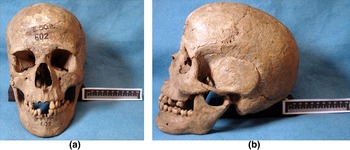
Skull no. 602,Footnote 48 associated by Rhousopoulos with the stirrup jar published here, was identified by Rolleston as belonging to a young man. The mandible is preserved (14 teeth are still in place; the two teeth missing constitute post-mortem loss). The upper jaw has eight teeth in place; all the other missing teeth constitute post-mortem loss. The teeth show signs of caries and malnutrition. There is no indication of trauma on the skull. Rhousopoulos' reference to the ‘facial angle’ being sharper is probably best associated with the pointed mental protuberance (chin).
The label on skull no. 602. © Natural History Museum, London.

(a)–(b). Front and left side views of skull no. 602 (E.50.a) associated with the Pitt Rivers stirrup jar. © Natural History Museum, London.

Caution is needed as to whether this association between skull and stirrup jar is indeed original. What is more certain is that by the time they reached England skull and stirrup jar had become associated. Rhousopoulos wrote upon the skull a note for Rolleston: ‘Αθηνών. 1872. κρανίον παλαιότερον του ζ΄ αιώνος προ Χριστού ως εκ των συν αυτώ αγγείων εξάγω. R.’ (Athens. 1872. skull older than the 7th century before Christ as I infer based on the pots found with it. R.)