Thousands of American children are at risk for negative outcomes because of maternal substance abuse. Estimates are that as many as four million American women regularly use illicit drugs (SAMHSA, Office of Applied Studies, National Survey on Drug Use and Health, 2002/2003); about 80% of these women are likely to be mothers of at least one child (National Center on Addiction and Substance Abuse, 1996). Drug abusing mothers show elevated levels of psychiatric disturbance—particularly depression and anxiety—as well as significant problems with child rearing (Beckwith, Rozga, & Sigman, 2002; Luthar, Cushing, Merikangas, & Rounsaville, 1998; Najavits, Weiss, & Shaw, 1997; Singer et al., 1997). It is not surprising that their children also display several difficulties, with as many as 65% manifesting a psychiatric disorder by the teen years (Luthar et al., 1998).
Although their multiple vulnerabilities indicate that addicted mothers need multifaceted therapeutic interventions, drug treatment programs traditionally have entailed scant attention to their personal and parenting needs (Luthar & Suchman, 2000a). These programs were originally developed for men and then used with women as well, with little consideration of the unique challenges and needs of the latter, particular in terms of their roles as mothers (cf. Hogan, 1998; Millar & Stermac, 2000; Westermeyer & Boedicker, 2000). In the last 2 decades, however, there have been several efforts to develop and test such multipronged programs (Camp & Finkelstein, 1997; Catalano, Gainey, Fleming, Haggerty, & Johnson, 1999). In this paper, we focus on one such intervention, which showed promise in early pilot testing (Luthar & Suchman, 2000a), the Relational Psychotherapy Mothers' Group (RPMG), with the goal of assessing effectiveness relative to alternative forms of treatment.
Developed for heroin-addicted mothers with children up to 16 years of age, RPMG is a supportive psychotherapy aimed at facilitating optimal parenting among at-risk mothers, and it is offered over 24 weekly group sessions that supplement standard methadone treatment. Conceptually, the treatment was developed within the scaffolding of the literature on risk and resilience, with (a) consideration of processes operating at multiple levels, related to the individual, family, and community, and (b) a focus on both positive and negative forces among at-risk groups (Luthar & Cicchetti, 2000).
At the individual level, the RPMG intervention is grounded in the view that attention to addicted mothers' personal distress levels is critical to improve their parenting behaviors. At the same time, the treatment entails deliberate attempts to harness mothers' tendencies toward guilt (regret at their past “errors”) as catalysts for change toward optimal parenting. Thus, the first half of the 24 sessions in this treatment are directly focused on the women's own functioning, addressing topics such as coping with anger, depression, and the constructive use of guilt.
Vulnerability factors at the familial level span multiple forms of dysfunctional parenting that many of these women experienced as children, ranging from inadequate nurturance to physical or sexual abuse (El-Bassel, Gilbert, Schilling, & Wada, 2000; Harmer, Sanderson, & Mertin, 1999; Hogan, 1998; Najavits et al., 1997). Obviously, these experiences pose risks for their own parenting. Salient among the protective forces conversely, is concern about the well-being of their children along with both the desire and potential to benefit from supportive parenting interventions (Hogan, 1998; Luthar & Suchman, 2000a). Accordingly, the second 12 of the 24 RPMG sessions are focused on specific parenting issues, such as alternatives to physical punishment, age-appropriate limits in discipline, and warmth in parenting.
At the level of the community, a pronounced risk is exposure to stigma (El-Bassel et al., 2000; Eliason & Skinstad, 1995; Hogan, 1998; Luthar et al., 1998; Najavits et al., 1995); in clinical settings, the fallout of such stigmas is wariness of strictly didactic treatment approaches that seem to emphasize addicted women's deficits as parents (Levy & Rutter, 1992). The effort in RPMG, therefore, is to discuss child-rearing issues in the context of nonjudgmental, supportive experiences using insight-oriented therapy. A second community-level risk is dysfunctional social networks: isolation is a serious problem, and close relationships that do exist reflect various difficulties such as domestic violence (Amaro & Hardy-Fanta, 1995; Brunswick & Titus, 1998; El-Bassel et al., 2000; Harmer et al., 1999; Hogan, 1998; Wald, Harvey, & Hibbard, 1995). Accordingly, RPMG was developed as a supportive treatment, with the use of a group format designed to help women develop their interpersonal skills, to perceive the universality of dilemmas pertaining to roles as women and mothers (e.g., Yalom, 1985), and to benefit from mutually supportive interpersonal networks.
In terms of therapeutic characteristics, four features define RPMG as an intervention. The first is a supportive therapists' stance. Encompassing the Rogerian constructs of acceptance, empathy, and genuineness, this is essential to foster a strong therapeutic alliance and to meet mothers' unmet developmental needs (e.g., trust vs. mistrust in relationships). The second is an interpersonal, relational focus (see Klerman, Weissman, Rounsaville, & Chevron, 1984), a component addressing the interpersonal isolation and stress figuring prominently in addicted women's lives. The third feature is discovery-based, insight-oriented parenting skill facilitation. Rather than “instructing” mothers about appropriate parenting, role plays and brainstorming exercises are used to encourage them to explore their own parenting strategies and to guide them toward optimal approaches (for further description of the RPMG intervention, see Luthar & Suchman, 1999, 2000a).
With regard to features as a group treatment, RPMG is restricted to mothers and to female therapists to optimize women's comfort in discussing sensitive issues such as their own victimization. To accommodate the frequently chaotic schedules of patients in methadone treatment, group membership is open or rotating. Although closed-group membership can promote group cohesion and trust, open enrollment provides the opportunity to engage women in treatment when each of them is highly motivated to join. Sessions are led by a graduate level clinician with expertise in working with families as well as addiction-related issues.1
In the pilot study, RPMG groups had been led by a trained clinician from outside the clinic along with a coleader: a drug counselor from the methadone clinic. Involving an on-site drug counselor was seen as useful to promote both recruitment and retention of patients in groups. However, across the project, some difficulties became apparent, for example, in terms of subtle “status hierarchies” emerging between the outside psychologist and the local drug counselor. In the interest of (a) averting associated tensions in groups, (b) minimizing costs of the treatment, and (c) maintaining uniformity across both conditions in this study, we therefore used a single appropriately trained and qualified therapist in both RPMG and RT groups.
With regard to children's age span, the group intervention was intentionally designed to accommodate mothers of children birth to 16 years for the following reasons. First, a broad age span allowed mothers a natural context within which to share experience and provide guidance to one another, to ask each other questions about upcoming developmental stages, and to share advice with newer mothers about earlier phases of development. Second, our aim was to provide parental guidance that could apply broadly to parenting across different phases of development rather than focusing more specifically on any one stage of child development. For example, although limit setting strategies vary with children's age, limit setting can be more generally understood and applied as a means to maintaining a calm family environment in which the parent maintains control and order. Our aim was to discuss themes such as this one that were more or less universal to all stages of parenting so that mothers could adopt new views about the parent–child relationship and apply them broadly with all children in their families. In contrast to behavioral parent training programs that aim to teach parents to manage children's misbehavior (see, e.g., Catalano et al., 1999; Kumpfer, 1998), this approach aimed to promote mothers' understanding of their children's needs more broadly, including the need for support, nurturance, structure, limits, emotional regulation and security.
The Pilot Study
The RPMG treatment was originally designed, manualized, and tested as part of a 3-year psychotherapy development project (Luthar & Suchman, 2000a). Opioid abusing women who received this intervention along with standard treatment in methadone programs were compared with those receiving standard treatment alone. Standard treatment entailed participation in weekly, 1-hr counseling groups and periodic meetings with case managers to secure basic needs (e.g., housing or welfare benefits). The counseling groups were led by certified drug clinicians and focused on information on the unfolding of addictions and pitfalls of addictive behaviors.
Effects of the RPMG intervention were evaluated in terms of the women's functioning as parents, their psychological functioning, and adjustment of their children. The single most critical domain was the mother's risk for maltreating behaviors, a serious problem among addicted parents (Ammerman, Kolko, Kirisci, Blackson, & Dawes, 1999; Dore & Doris, 1998; Dunn et al., 2002; Rogosch, Cicchetti, Shields, & Toth, 1995); this was assessed via the women's own reports and also by children's reports for children over 7 years of age. Also assessed were women's positive parenting behaviors in terms of the affective quality of the relationship: involvement and communication with their children. The women's psychosocial adjustment was assessed in terms of satisfaction in their roles as mothers as well as depressive symptoms, and their children's psychosocial functioning (e.g., internalizing, externalizing, and clinical, school, and personal maladjustment) were evaluated by both mothers' and children's reports. Finally, data on the women's drug use were also examined, as improvements in addicted women's psychosocial functioning can carry over to their substance use as well (e.g., Najavits, Weiss, Shaw, & Muenz, 1998).
In addition to testing effectiveness, also examined in the pilot study was whether RPMG did, in fact, provide therapeutic components distinct from those in standard drug counseling. A Therapist Adherence Rating Scale was developed, with items based on the defining features of each of the two interventions (RPMG and standard drug counseling).
Results showed that at the end of the 24-week treatment, mothers receiving RPMG demonstrated lower risk for child maltreatment (by mothers' and children's reports), greater involvement with children, and more positive psychosocial adjustment, than women who received methadone counseling alone. Small to moderate effect sizes for group differences were also found for mothers' and children's reports of child maladjustment. Notably, urinalyses indicated that RPMG mothers showed greater improvements in opioid use over time than comparison mothers. At 6 months posttreatment, RPMG recipients continued to be at an advantage, although the magnitude of group differences was lower. Finally, the Therapist Adherence Scale had good psychometric properties and did discriminate between the treatments.
The Current Study
This study extended the pilot assessment of RPMG in four critical ways. First, comparisons were not with women receiving treatment as usual in the methadone clinic but with another “add-on” condition that provided an equivalent dose of adjunct intervention: recovery training (RT). Like the RPMG sessions, RT groups were conducted by professional clinicians with expertise in substance abuse treatment; they were supervised weekly by a licensed clinical psychologist with expertise in both group and substance abuse treatment. RT sessions were also manual guided, using treatment manuals widely accepted by substance abuse interventionists (Mercer, Carpenter, Daley, Patterson, & Vopicelli, 1994; Zackon, McAuliffe, & Ch'ien, 1994). Unlike RPMG, the RT sessions focused on the processes of addiction and recovery and reinforcing the skills of relapse prevention (e.g., identifying triggers, avoiding dangerous situations, adopting a drug-free lifestyle, coping with cravings).
A second difference was that effectiveness was evaluated both in terms of the intention-to-treat sample as well as in terms of the sample who received the treatment (McCall & Green, 2004; Nich & Carroll, 2001), whereas in the pilot study, only the latter was considered. Third, in addition to reports from mothers and their children, we obtained ratings of mothers' functioning from clinicians in the methadone clinics; these individuals were blind to group membership of the women. Fourth, whereas the pilot study involved three assessments of mothers (pre- and posttreatment, and 6 month follow-up) in this study, we conducted assessments every 8 weeks. This was done to prevent attrition across the study (Carroll, 1995) and to ensure sufficient data points for estimating values for missing data points with random effects regression (Gibbons et al., 1993; Laird & Ware, 1982).
Major outcome variables assessed were similar to those evaluated in the pilot project, with maternal child maltreatment, again, considered to be especially important. Also seen as highly important, in this case, were three sets of ratings by respondents other than the women themselves (which did not carry any biases inherent in mothers' self-reports): the children's reports on their psychological functioning, clinicians' reports on the mothers' functioning, and urine toxicology results. Accordingly, major hypotheses were that in comparison with RT mothers, RPMG mothers would show greater improvement on these central dimensions.
As in the previous study, we also considered women's self-reports on depressive symptoms and on positive parenting dimensions of affective quality and instrumental aspects of the mother–child relationship. As secondary hypotheses, we expected that RMPG mothers would show greater improvement on these indicators than RT mothers.
In sum, the purpose of this study was to test the efficacy of the adjunct RPMG group intervention in comparison with an adjunct relapse prevention group intervention that served as a dose control. Interested and eligible mothers were randomized to one of the two interventions (RPMG or RT), in addition to the standard treatment at the methadone clinic. Each treatment lasted 6 months, followed by a 6-month follow-up period. Critical outcomes included child maltreatment (mothers' and children's reports), clinicians' reports of mothers' functioning, children's reports of their own functioning, and urine toxicology reports. All mothers randomized to treatment were followed regardless of whether they continued treatment. In addition to assessing treatment outcomes, we assessed group leaders' adherence to intervention approaches (RPMG vs. RT) using scales developed during the Stage I study.
Methods
Overview of procedures
Heroin-addicted mothers interested in participating in parenting groups were recruited at three methadone clinics in New Haven, CT. Recruitment occurred via referrals by counselors, visits made by research assistants to counseling groups and medication lines, and referrals from mothers who had already participated in the study. To be eligible for inclusion, mothers had to (a) have at least one child under 16 years of age in their care and (b) report problems with parenting. Exclusion criteria included conditions that would impede ability to benefit from group therapy such as cognitive deficits, psychotic thought processes, suicidality, and homicidality.
All eligible mothers who expressed interest in the study met with a research assistant who explained the nature of the study as a randomized trial and completed consent procedures with mothers (procedures were approved by the Human Investigations Committee, Yale School of Medicine). Initial assessments were scheduled with those who expressed interest in participating. After mothers and children completed the baseline assessment, they were scheduled for a second meeting, during which they were randomized to either RPMG or comparison condition.
The RPMG and RT conditions each entailed weekly group meetings in addition to standard treatment at the clinic. Group size in each condition ranged from three to eight with, on average, five mothers attending each week. Mothers were enrolled in their respective interventions for 24 weeks and in the study for 1 year. Mothers and children completed assessments about the mothers' parenting as well as mothers' and children's psychosocial adjustment seven times during the year at 8-week intervals (Weeks 0, 8, 16, 32, 40, and 48). We scheduled seven assessments to (a) keep the mothers in regular contact with the researchers (i.e., assessments were conducted in 2-month intervals) and (b) maximize the likelihood that data representing multiple data points would be available for statistical analysis. To compensate mothers for time spent in assessments, a staggered reimbursement schedule was used, such that mothers were paid $20 at the baseline visit; $25 at Weeks 8, 16, 24, and 32; $30 at Week 40; and $40 at Week 48. At each visit, children under 13 years of age received a $20 gift certificate to local merchants (e.g., toy or music store) and children 13 and older received $20 in cash. Mothers and children received bonus payments of $5 for completing their assessments on time.
Across the study, the RPMG intervention was conducted by six masters- and doctoral-level therapists (one therapist per group), and RT was conducted by two staff drug counselors at the clinics (one counselor per group). All clinicians received weekly supervision from licensed clinical psychologists with expertise in their respective intervention approach. Clinical supervision involved reviewing videotaped sessions, providing individual feedback, and reviewing treatment approaches.
Sample
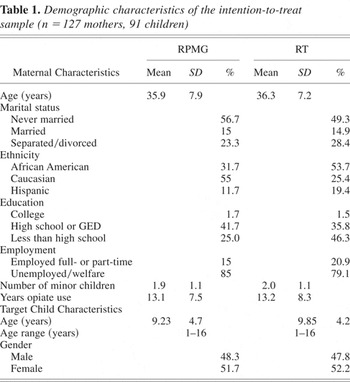
A total of 182 mothers who expressed interest in the study were screened and found eligible for the study and completed baseline assessments. Of these 182 mothers, 127 mothers attended subsequent meetings with the research assistant and were randomized to either RPMG or RT, using URN Randomization Program procedures to balance groups for maternal characteristics including age, ethnicity, socioeconomic status (SES), IQ, years of drug use, recent drug use, level of motivation for change, and sensation seeking, and for child age and gender. The remaining 55 mothers (30%) dropped out of the study prior to randomization. Demographic characteristics of the sample are reported in Table 1. There were no significant group differences in demographic variables.
Demographic characteristics of the intention-to-treat sample (n = 127 mothers, 91 children)

Of the 127 mothers randomized to treatment, 91 (42 RPMG, 49 RT) had a biological child between the ages of 7 and 16 in their custody who was eligible to participate in the completion of assessments. Of the 91 eligible children, 71(78%) completed the baseline assessment and were included in the intention to treat sample and 63 (69%) remained in the study through the end of the follow-up. The mean age of children who completed assessments was 11.25 (SD = 2.69) and the age range was 8 to 16. Of the 28 children who did not remain in the study through week 48, reasons for discontinuing included change in custody status, relocation, incarceration, illness, and mother or child refusal. Of the 36 mothers who had biological children under 7 years of age, 12 (6 RPMG, 6 RT) had children under 4 years of age whose psychosocial functioning was not evaluated.
Of the 127 mothers randomized to treatment, 108 (85%), remained in the study through the follow-up phase. Of the 60 mothers assigned to RPMG, 50 (75%) remained through the follow-up, and of the 67 mothers assigned to RT, 58 (87%) remained. Retention rates were not significantly different across groups (χ2 = .08, p = .77).
To be considered a treatment completer, mothers had to attend at least half of the 24 sessions, and miss no more than 2 consecutive sessions. Of the 60 mothers randomized to RPMG, 35 (58%) completed treatment, and of the 67 RT mothers, 42 (63%) completed treatment. Again, completion rates were not different across groups (χ2 = .90, p = .34). Of the mothers who did not complete treatment, reasons for discontinuing included death, medical problems, incarceration, relocation, work schedule conflict, housing problems, daycare problems, and interpersonal conflicts with other patients.
Measures
Child maltreatment risk
The Parental Acceptance/Rejection Questionnaire (PARQ; Rohner, 1991), a 60-item measure rated on a 4-point scale, was used to assess child maltreatment risk in the mother–child relationship. Parallel versions of the PARQ assess the mothers' and children's perceptions of maternal behaviors. The PARQ yields a composite child maltreatment risk score based on four subscales: aggression/hostility (e.g., “I punish my child when I am angry”), neglect/indifference (e.g., “I forget events that my child thinks I should remember,” undifferentiated rejection (e.g, “I tell my child he/she gets on my nerves”), and low expressed warmth/acceptance (e.g., “I treat my child gently and kindly”—reverse scored). Scores on the composite scale between 90 and 110 for both mother and child reports are considered within normal limits, whereas scores above 110 are considered to represent risk for child abuse and neglect (Rohner, 2000, personal communication). Adequate psychometric properties have been documented for the PARQ (Rohner, 1991). In this sample, the Cronbach α coefficients for the four subscales ranged between .62 and .90 (median = .76) for the mothers and between .74 and .91 (median = .77) for the children.
Affective quality of parenting
The Parent–Child Relationship Inventory (PCRI; Gerard, 1994), a 78-item measure rated on a 4-point scale, was used to assess the affective quality of the mother–child relationship. The PCRI consists of six subscales, including communication, involvement, limit setting, autonomy, satisfaction and support. As in the pilot study (Luthar & Suchman, 2000a), the communication (capacity to talk/empathize with children, e.g., “My child would say that I'm a good listener”) and involvement (expressed interest in children's activities, e.g., “My child rarely talks to me unless he or she wants something”—reverse scored) subscales were used to assess the affective quality of the mother–child relationship (as in the previous study, these were highly correlated, r = .72, and thus combined). Adequate psychometric properties have been established for the PCRI (Gerard, 1994), and for this sample of mothers, the Cronbach α coefficients were .73 for communication and .82 for involvement.
Maternal psychosocial adjustment
Maternal psychosocial adjustment was assessed using the Beck Depression Inventory (BDI; Beck, Steer, & Brown, 1996), a widely used 21-item questionnaire rated on a 4-point scale. The BDI yields a total score between 0 and 63 with scores between 20 and 28 indicating moderate levels and between 29 and 63 indicating severe levels of depression (Beck et al., 1996). In this sample, Cronbach α was .93. Maternal psychosocial adjustment was also assessed by each mother's primary clinician at the methadone clinics. The Clinician Assessment of Functioning (CAF; Luthar & Suchman, 2000b) is a 61-item measure rated on a 4-point scale that was designed specifically for this study. The CAF has two subscales: overall functioning (e.g., coping skills, lifestyle, self-efficacy, treatment compliance) and interpersonal efficacy (e.g., interpersonal functioning and affective style). The overall functioning subscale used to assess psychosocial adjustment yielded a Cronbach α coefficient of .96 in this sample. Maternal adjustment in the parenting role was assessed with the Satisfaction (enjoyment derived from parenting) subscale from the PCRI. The Cronbach α coefficient for this sample was .77.
Child psychosocial adjustment
Children's psychosocial adjustment levels were assessed via the Behavioral Assessment System for Children (BASC; Reynolds & Kamphaus, 1992), with the Parent Rating Scale (PRS) administered to the mothers and the Self-Report Scale (SRP) to their children. Separate PRS forms are available for different age groups of children: preschool (ages 4–5), child (ages 6–11), and adolescent (ages 12–18) versions, with 131, 138, and 126 items, respectively, all rated on 4-point scales. The SRP Child (ages 6–11) and Adolescent (ages 12–18) Forms have 152 and 186 items, respectively, each rated on a 2-point (true/false) scale. The T scores for the composite scales (the Behavior Symptom Index [BSI] from the PRS, and the Emotional Symptom Index [ESI] from the SRP) served as measures of children's adaptation, as these composite scores are intended to be used as measures of overall functioning. Specifically, the BSI is a global measure of problem behavior and is composed of the following six scales: Hyperactivity, Aggression, Anxiety, Depression, Atypical Behavior, and Attention Problems. The ESI is a global indicator of emotional disturbance, particularly internalizing disorders, and is composed of the following six scales: Social Stress, Anxiety, Interpersonal Relations, Self-Esteem, Depression, and Sense of Inadequacy. Any T scores at or above 60 on all scales are considered clinically significant (Reynolds & Kamphaus, 1992). Excellent psychometric properties for the BASC have been documented (Reynolds & Kamphaus, 1992). Within this sample, the Cronbach α coefficients for the PRS-BSI subscale ranged from .91 to .94 across the three forms and for the SRP-ESI subscale was .93 for both forms.
Children's depression level was assessed with the Children's Depression Inventory (CDI; Kovacs, 1992). The CDI is a 27-item questionnaire rated on a 3-point scale designed for school-aged and adolescent children. The CDI yields a total score between 0 and 54; a score of 12 or above is the most conservative cutoff indicating clinical significance (Kovacs, 1992).
Maternal substance use
Results of urine toxicology screens indicating the presence versus absence of opiates and cocaine were conducted for all mothers at their methadone clinic and obtained, with mothers' written permission, by the researchers to examine mothers' use of illicit opiates and cocaine during the 1-year study period.
Sensation seeking
The Sensation Seeking Scale, Form V (SSS-V; Zuckerman, 1984) is a 40-item questionnaire that was used to measure maternal levels of stimulation and arousal. The SSS-V consists of four subscales: thrill and adventure seeking (desire to partake in activities involving physical danger), experience seeking (desire to seek new experiences through mind and senses), disinhibition (need to disinhibit behavior in the social sphere), and boredom susceptibility (aversion to repetitive experience of any kind). A composite score derived from the sum of the subscale scores was used to measure overall arousal. Good psychometric properties have been reported for this measure (see Zuckerman, 1994). Internal consistency was adequate for this sample (Cronbach α = .74). For use in URN randomization procedures, scores were categorized into three levels representing low (≤6), medium (≥6, and ≤17) and high (>17) scores.
Maternal intelligence. The Kaufman Brief Intelligence Test (K-BIT; Kaufman & Kaufman, 1990) is a brief individually administered measure of verbal and nonverbal intelligence that was used to assess maternal IQ. The K-BIT is a reliable and normed assessment that can be administered by trained research assistants. The K-BIT IQ composite, comprised of vocabulary and matrices scores, served as the measure of maternal IQ. For use in URN randomization procedures, scores were categorized into three levels representing low (≤85), medium (≥85, and ≤115) and high (>115) scores.
Readiness for change. The University of Rhode Island Change Assessment Scale (URICA; McConnaughy, DiClemente, Prochaska, & Velicer, 1989) is a 32-item scale used to assess an individual's stage of readiness to address a specific problem. The URICA was originally designed for use with psychotherapy clients and yields four summary scores: precontemplation (e.g., “As far as I'm concerned, I don't have any problems that need changing”), contemplation (e.g., “I've been thinking that I might want to change something about myself”), action (e.g., “I am finally doing some work on my problem”), and maintenance (e.g., “It worries me that I might slip back on a problem that I have already changed, so I am here to seek help”), that corresponding to stages of change. The readiness for change score is computed by subtracting the precontemplation score from the sum of the latter three scores. For use in URN randomization procedures, scores were categorized into three levels representing low (≤75), medium (≥75 and ≤93) and high (>93) scores. Psychometric properties have been reported as adequate (see Carey, Purnine, Maisto, & Carey, 1999). For this sample, internal consistency was adequate (Cronbach α range = .77–.92 for the four scales).
Therapist adherence
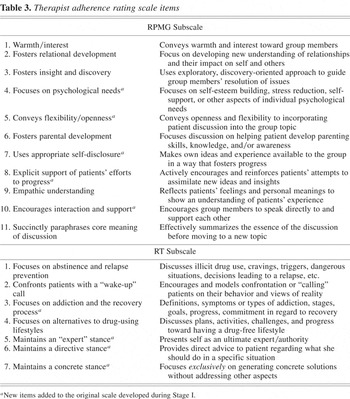
The Therapist Adherence Rating Scale used at the outset of the study contained 21 items representing essential therapeutic components for RPMG (11 items) that were explicitly not components of RT, and essential components or RT that were explicitly not components of RPMG (10 items). Each item is rated on a 5-point scale representing the frequency and intensity with which the therapist used the technique, ranging from 0 (not at all) to 4 (extensively). We retained the original pool of 12 reliable items developed during Stage I and added 9 new items representing essential features of the Revised RPMG and Recovery Training Manuals. The Adherence Rating Scale Scoring Manual was also appended with detailed scoring instructions for coding the new items. At the beginning of the study, two experienced clinicians who were blind to the research hypotheses were trained to rate videotapes of therapists conducting their respective interventions. The raters then independently rated batches of 15–20 therapy sessions and met monthly with the Project Director (N.E.S.) to review their reliability. Across 69 sessions coded by both raters, interclass correlations (with rater considered as a fixed factor) were above the .55 cutoff on 18 of the 21 items. The three items for which intraclass correlations were below .55 were considered unreliable and omitted from the scale. The retained 18 items (11 RPMG, 7 RT) are displayed in Table 3. A total of 397 sessions (244 RPMG, 153 RT) were rated by the two raters.
Therapist adherence rating scale items

Results
Descriptive data
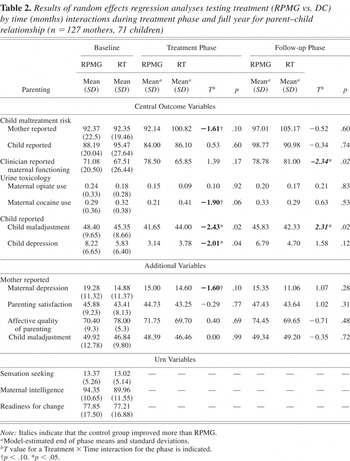
Means and standard deviations on all outcome variables measured at baseline are presented in Table 2 separately for women enrolled in RPMG and RT. There were no significant group differences for any baseline variables.
Results of random effects regression analyses testing treatment (RPMG vs. DC) by time (months) interactions during treatment phase and full year for parent–child relationship (n = 127 mothers, 71 children)
Random effects regression analyses testing group differences in response to treatment
Treatment group differences on all outcomes over time were examined using a random effects regression model. This analysis was considered most appropriate given the capacity to model data across multiple time points, even with incomplete data for some subjects (e.g., due to missed appointments) and uneven gaps between points representing time intervals (see Hedeker & Mermelstein, 1996). For all continuous outcomes, analyses were conducted using the SAS PROC MIXED program (Littell, Milliken, Stroup, & Wolfinger, 1996) with time defined as the calendar week during which the assessment was completed, considered as a random factor. For the seven time points considered (baseline and six subsequent 8-week intervals), data were available, on average, for a total of six points among women in the sample, five points among children in the sample, and five points among clinicians reporting on women's psychosocial adjustment. For each outcome variable, we were most interested in testing for significant Treatment × Time interactions that represented group differences in rates of response to RPMG versus RT.
For binary opiate and cocaine toxicology results, separate random effects logistic regression analyses were conducted using the SAS %GLIMMIX macro with the SAS PROC MIXED program with time, defined as the calendar month during which the screens were completed, considered a random factor. For each binary outcome (probability of use), we were most interested in testing for significant Treatment × Time interactions that represented group differences in rates of response to RPMG versus RT. Because we did not expect within-subject variable scores to vary systematically across time, we used an unstructured covariance matrix for all analyses. For the 13 time points considered in the analyses (baseline and 12 subsequent 1-month intervals), data on average, were available for a total of 7 points among women in the sample.
Results for the treatment phase
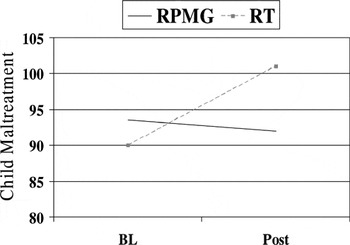
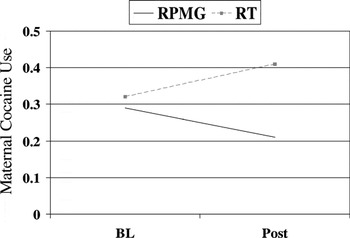
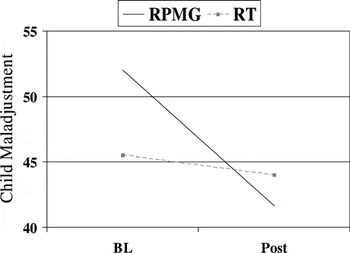
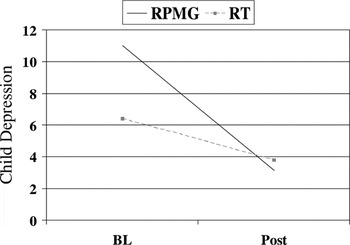
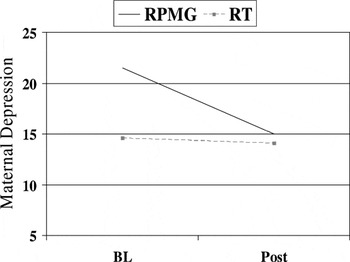
Results of random effects regression analyses testing for Treatment × Time interactions are shown in Table 2 and Figures 1, 2, 3, 4, and 5. Interactions significant at p < .05 were considered significant and at p < .10 were considered marginally significant. As shown in Figure 1, a marginally significant (p < .10) Treatment × Time interactions for child maltreatment risk (mothers' report) indicates a marginal group difference in slope; RPMG mothers remained at the same level across the treatment phase, whereas RT mothers' levels of child maltreatment increased. In analyses of maternal drug use, RPMG mothers' cocaine use decreased over the course of treatment whereas RT mothers' cocaine use increased (Figure 2). In terms of child maladjustment, children's self-reported BASC Emotional Symptoms Index scores improved at a significantly greater rate for children whose mothers received RPMG (Figure 3). Children's self-reported depression scores also decreased more rapidly among children whose mothers received RPMG (see Figure 4), as did mothers' self-reported depression (Figure 5). On the rest of the indices, there were no significant differences in rates of change between RPMG versus RT mothers.

The Treatment × Time interaction for child maltreatment (mothers' report) during the treatment phase.

The Treatment × Time interaction for cocaine use (urine toxicology screens) during the treatment phase.

The Treatment × Time interaction for child maladjustment (self-report) during the treatment phase.

The Treatment × Time interaction for child depression (self-report) during the treatment phase.

The Treatment × Time interaction for maternal depression (self-report) during the treatment phase.
Results for the follow-up phase
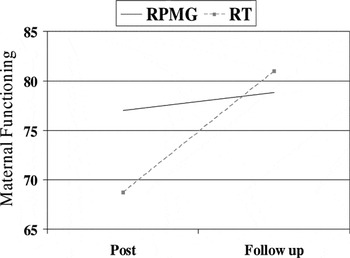
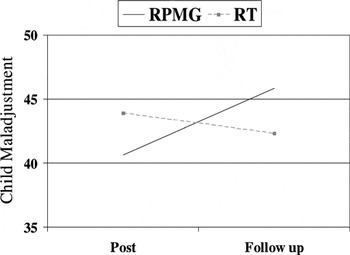
In examining group differences in rates of change between baseline and follow-up assessments (6 months after treatment completion), only two group differences were found, and in both cases, the RT group fared better than the RPMG group. Rate of improvement in overall functioning by clinician's reports was higher for RT than for RPMG mother (see Figure 6). Similarly, RPMG children's levels of maladjustment increased whereas RT children's levels declined during the follow-up period (although both groups' estimated mean scores remained within normal limits at the end of the follow up period; see Figure 7).2
The graph figures may not correspond exactly to the data in Table 2 because (a) the baseline data reported in Table 2 are actual baseline means whereas (b) posttreatment and follow-up data reported in Table 2 and Figures 1, 2, 3, 4, 5, 6, and 7 are estimated means generated for the specific model being tested. The estimated means generated for each model vary slightly from actual means and from means generated in other models because there are small variations in dates at which the assessments were completed that each model takes into account.

The Treatment × Time interaction for maternal functioning during the follow-up phase.

The Treatment × Time interaction for child maladjustment (self-report) during the follow-up phase.
Therapist adherence and treatment discriminability
Test of the factor structure of the Therapist Adherence Scale
To test the hypothesized factor structure of the 18-item Therapist Adherence Scale, we conducted a confirmatory factor analysis. We hypothesized that the two latent factors, RPMG and RT, represented respectively by the 11 RPMG and 7 RT scale items or indicators, would be orthogonal. For the model tested, χ2 = 848.74 (df = 134, p = .0000), indicating the model differed significantly from the null matrix model. Because the chi-square statistic fluctuates based on sample size, we also used goodness of fit (GF) statistics, effect size type estimates that are not sensitive to sample size, to test the model. As there is no significance test for GF statistics, a conventional cutoff of >.90 is used, indicating that the model explains at least 90% of the variance in the data. Adjusted for degrees of freedom, the nonnormed fit index was .90, and root mean square error of approximation = 0.07 (90% confidence interval = .05–.09) indicating an acceptable fit.
RPMG and RT therapist adherence
To determine RPMG and RT therapists' adherence to their respective intervention approaches, we computed mean scores for each of the five RPMG therapists and two RT drug counselors for each subscale (RPMG and RT). Scores for each subscale were derived by summing item scores and dividing by the number of subscale items, for subscales to be scored on the same scale (i.e., 0–4). Therapists' mean scores on each scale were then computed to determine adherence to each approach. RPMG therapists were considered adherent if they received a mean score of 4 or higher on the RPMG subscale, and a mean score of 2 or lower on the RT subscale. The inverse applied to RT therapists. Among the six RPMG therapists, the RPMG/RT mean subscale scores were 2.8/1.6 for Therapist 1, 3.2/0.8 for Therapist 2, 3.3/0.8 for Therapist 3, 3.0/0.7 for Therapist 4, 3.3/0.6 for Therapist 5, and 3.3/0.5 for Therapist 6. In other words, each of the RPMG therapists, on average, scored in the “considerable” range for RPMG items, and in the “minimal” range for RT items. Among the two RT therapists, the RPMG/RT mean subscale scores were 1.4/2.8 for Drug Counselor 1, and 1.5/3.0 for Drug Counselor 2. Thus, each RT therapist, on average, scored in the minimal–moderate range for RPMG items, and in the considerable range for RT items.
Discussion
Results of this study showed that at completion of 6 months of treatment, women receiving the RPMG intervention manifested somewhat greater improvements in functioning than did comparison mothers in the RT groups across diverse domains. Statistically significant differences in change rates favoring RPMG were seen in children's reports of their depressive symptoms and their overall psychopathology, and marginally significant differences in change rates favoring RPMG were seen in mothers' reports of child maltreatment risk, depressive symptoms, and urine toxicology reports of mothers' cocaine use. By 6 months posttreatment, however, benefits conferred by RPMG had disappeared and in two instances, reversed. On clinicians' reports of mothers' overall functioning and children's reports of their maladjustment, the RPMG group showed greater deterioration in functioning compared to the RT group.
Posttreatment gains
Overall, findings of this study showed that at treatment completion, women receiving RPMG did fare better than did their counterparts receiving RT. Seven indices had been targeted as critical outcome variables in this study: child maltreatment risk (both mother- and child-reported), children's self-reported depression and overall symptoms, clinicians' reports of mothers' functioning, and urine toxicologies of cocaine and opioid use. Significant Treatment × Time interactions were found for children's self-reported maladjustment on both dimensions, with effects of marginal statistical significance for maternal self-reported child maltreatment risk and for urine toxicology reports on cocaine use. In all four instances, results favored the RPMG group. On the remaining four variables assessed (mothers' reports on their own depression, their children's adjustment, and their affective quality of mother–child interactions) another marginal effect was found: on maternal depressive symptoms the RPMG mothers again reported more improvement than did their RT counterparts.
Although these findings on RPMG are modest in overall magnitude, they are encouraging in terms of the preventive potential for children. Ultimately, the objective of parenting interventions for at-risk groups is generally to avert the disturbance that children are likely to experience with prolonged exposure to unabated intrafamilial risk processes (Lieberman, Silverman, & Pawl, 2000; Webster-Stratton & Hammond, 1999). The significant benefits apparent to RPMG mothers' children, as per their own reports of subjectively experienced distress, suggest that the intervention did achieve some preventive success, at the point that treatment was completed.
The findings also are encouraging when viewed in terms of the relatively limited success that has been achieved by prior intervention studies in this area. During the last 10 years, a wide range of parenting programs for drug dependent mothers have been developed, encompassing diverse approaches in terms of format, intensity, and targeted outcomes (see Black et al., 1994; Camp & Finkelstein, 1997; Catalano et al., 1999; Ernst, Grant, & Streissguth, 1999; Huebner, 2002; Kumpfer, 1998; Schuler, Nair, & Black, 2002). In general, the treatment outcomes have shown improvements in parental psychosocial adjustment (e.g., maternal drug abuse, self-reported parenting stress, coping skills) but relatively little improvement in the mother–child relationship or children's psychosocial adjustment.
Along with improvements in their children's functioning, RPMG mothers in this study showed modest improvement in urine toxicology results relative to those of RT partici-pants.3
Clinicians' reports of mothers' overall functioning, although not significant at posttreatment (p = .17), also showed a trend toward improvement for RPMG mothers and decline for RT mothers.
Follow-up results
Juxtaposed with these positive findings at treatment completion are the troubling findings that at 6 months follow-up, RPMG treatment gains not only dissipated but in two cases, even appeared to have reversed. Children of RPMG mothers reported significant increases in overall maladjustment unlike those of RT mothers. Similarly, clinicians' reported that RPMG mothers manifested fewer improvements in overall functioning over time than did RT mothers.
The dissipation of RPMG benefits during the follow-up phase might partly reflect the negative effects of abruptly discontinuing a therapeutically beneficial treatment. As noted in the introduction to this paper, RPMG is an intervention strongly oriented toward providing substance-abusing mothers—who, in general, are sorely lacking in supportive interpersonal networks (Harmer et al., 1999; Hogan, 1998; Millar & Stermac, 2000)—a safe, supportive environment within which to address their personal and parenting concerns. By all accounts, RPMG therapists were successful in conveying these elements, as seen by outside observers' ratings of their overall adherence to the major treatment components of empathy, support, and warmth. Thus, the withdrawal of this supportive environment, for a group of women who had come to consistently experience it over a period of 6 months, could have led to heightened awareness of what was missing in their own everyday lives outside of this treatment, and consequently, to increased levels of distress.
By contrast, the RT group experienced considerable continuity of care even after treatment ceased. This is not only because counselors from their own clinics served as therapists for the RT groups (whereas RPMG therapists were often from the outside), but also because the therapeutic components of RT are entirely consistent with the relapse prevention approaches prevalent in most methadone clinics, including those sampled here (Luthar & Suchman, 2000a). Moreover, RT mothers may have continued to encounter their RT clinicians at the clinic and therefore received informal “booster sessions,” whereas RPMG mothers were less likely to see their RPMG therapists after they completed the intervention.
Considered collectively, our findings with the RPMG intervention suggest the need for some continuity of the therapeutic care offered by this type of supportive intervention past its formal completion. This could possibly be accomplished by using counselors from the methadone clinics not only to provide this group treatment but also to provide treatment completers with follow-up booster sessions on a regular basis, as part of the clinic's regular treatment regime (e.g., with RPMG groups taking the place of one of the regular weekly relapse prevention groups every month or so). Prior research on interpersonal therapy (IPT) has shown that “maintenance IPT,” administered monthly, on average, following weekly IPT sessions for the acute phases of therapy, is helpful in preventing the recurrence of symptoms (as opposed to their remission, as is the goal of IPT in the acute phase; see Harkness et al., 2002). In parallel fashion, it would be useful to ascertain, in the future, if the provision of such booster sessions of RPMG could help to sustain some of the critical gains that were found to be achieved at the end of treatment within this study.4
Although the training level of RPMG versus RT therapists differed in this study, it is notable that one of the RPMG therapists was a masters-level social worker who was employed as a drug counselor at the methadone clinic who ran RPMG groups for approximately 2 years. Drug treatment programs are being increasingly staffed by masters-level clinicians who are trained therapists, a trend that bodes well for training drug treatment clinicians to conduct RPMG.
Limitations, Implications, and Conclusions
Limitations of this study include the absence of information on children under 6 years of age and lack of observational data on interactions between participating children and their mothers (recommended, although rarely used in assessing parenting interventions, see Catalano et al., 1999; Mayes, 1995; Webster-Stratton & Hammond, 1999). Observational assessments were logistically difficult here due to the wide age span of the mothers' children, a deliberate decision in designing the intervention (see Luthar & Suchman, 2000a). Moreover, the absence of observational data must be weighed against the evidence obtained from other sources outside of women's self-reports, including data from their children, their clinicians, and urine toxicologies.
Reliance on self-report measures from mothers and children is a second limitation. Mothers and children may feel pressure to underreport problems in the mother–child relationship. Mothers may have had some concern about losing child custody, and children may have been concerned about reporting on negative aspects of the mother–child relationship. However, scores on indices of response validity for two measures (e.g., the PCRI, BASC) did not indicate gross distortions of response.
A third related limitation is the absence of corroboration of reports of child maltreatment risk. Because women entering substance abuse treatment often perceive their clinicians as part of the same system as child welfare and can experience them as a threat, we elected not to ask their permission to review their records from the Department of Children and Families (which were not accessible without a signed release).
In terms of implications, findings of this study are informative for theoretical conceptualizations of the syndrome of drug addiction among women (see Aikins, Hazlett-Stevens, & Craske, 2001). When therapeutic interventions do eventuate in improvements, then the contents of the intervention can be informative with regard to the nature of the original problems (Cicchetti & Cohen, 1995). RPMG provides concerted attention to the mothers' personal distress and interpersonal aloneness, along with confusion and stress regarding parenting, and improvements observed in this study, across mothers and children's functioning, attests to the likely significance of these as salient problems in the constellation of disturbances documented among addicted mothers. By the same token, the deterioration in functioning that we found upon withdrawal of these therapeutic components (although troubling from the standpoint of endurance of treatment gains) provides additional support for the salience of the adjustment domains in question.
For future interventions, results of this study corroborate prior suggestions that in treatments for substance abusing mothers, there is value in focusing on the “whole parent,” with attention to multiple adversities (as well as strengths), rather than remaining overwhelmingly focused on just issues of relapse prevention. Without question, managing addiction is of critical importance for maintaining gains in other spheres, but there must also be concerted attention to the stressors that heroin-using women contend with on an ongoing basis. Individuals attending substance abuse clinics are often seriously constrained in being able to access mental health treatment in other service delivery systems, due to limited economic resources, lack of child care and transportation facilities, diverse institutional barriers, and often, negative stereotyping by professionals with a limited understanding of drug abuse (Knitzer, Yoshikawa, Cauthen, & Aber, 2000; McMahon & Luthar, 1998). If drug abuse treatment providers were to provide direct and more sustained attention to these women's psychological and parenting concerns, this could not only improve the mothers' personal functioning, including refractory problems of substance abuse, but could also serve preventive functions for many vulnerable children over the long term.