INTRODUCTION
Parasites are an integral part of every ecosystem, representing a major factor in global biodiversity. Among the vertebrates, fish have the highest rates of parasitic infection, which is facilitated by the aquatic environment in relation to their dispersal, reproduction and life cycle, among other factors relevant to the survival of parasites (Eiras, Reference Eiras1994; Palm, Reference Palm1997). Few species of parasites are considered to cause health problems for marine fish (Padovani & Gomes, Reference Padovani and Gomes2007). Fish parasites are of public concern if they are found in food products that are intended for human consumption. Some species of nematodes and digeneans are potentially pathogenic to man since they are found in the fish muscles. Threat to public health may be associated with the consumption of raw or lightly preserved fish with the presence of biological agents that can cause zoonotic infections (Eiras Reference Eiras1994; Perez et al., Reference Perez, Neiva, Neto, Mantovani and Silveira2004; Cavalcanti, Reference Cavalcanti2010).
The Serra Spanish mackerel, Scomberomorus brasiliensis Collette, Russo and Zavala-Camin, Reference Collette, Russo and Zavala-Camin1978 (Osteichthyes: Perciformes: Scombridae) occurs in the western Atlantic, along the Caribbean Sea on central Atlantic coasts and the south-west Atlantic from Belize to Rio Grande do Sul, Brazil (Collette et al., Reference Collette, Russo and Zavala-Camin1978). It is an important fishery resource of the Atlantic Ocean and is a major component of artisanal fisheries in northern and north-eastern Brazil (Chellappa et al., Reference Chellappa, Lima, Araújo and Chellappa2010). The largehead hairtail, Trichiurus lepturus Linnaeus, 1758 (Osteichthyes: Perciformes: Trichiuridae) occurs throughout tropical and subtropical waters of the world. The present study investigated the metazoan parasites of S. brasiliensis and T. lepturus from the coastal waters of Rio Grande do Norte, Brazil, aiming to report on parasites with zoonotic potential in these commercially important marine fish.
MATERIALS AND METHODS
Sampling was performed in the coastal waters of Rio Grande do Norte (geographical coordinates 05°47′42″S and 35°12′24″W) of north-eastern Brazil. A total of 15 specimens of S. brasiliensis and three of T. lepturus were captured during January to April 2008, with the help of local fishermen, using motor boats and beach-seines of 150 m in length, made of nylon multifilament, with mesh size between 20 and 40 mm. Fish collected were numbered, the total body length (in centimetres) and body mass (in grams) of fish were registered. Samples of whole fish were used for morphometric analysis to confirm the taxonomic identification of the species (Suzuki, Reference Suzuki1983; Szpilman, Reference Szpilman2000).
The body surface and gill chambers of each fish was checked for the presence of parasites and when detected they were carefully removed and observed under a stereoscope, processed and quantified. The fish were necropsied and dissected out to examine the gonads and digestive tract. The parasites found were removed carefully, quantified and were fixed in hot 4% formaldehyde solution in physiological saline and cleared in Amann lactophenol for microscopic examination (Eiras et al., Reference Eiras, Takemoto and Pavanelli2006). Parasitic ecological indices were calculated and expressed as per Bush et al. (Reference Bush, Latterfty, Lotz and Shostak1997). The identification of the specimens of nematode parasites was carried out according to Vicente & Pinto (Reference Vicente and Pinto1999) and Moravec (Reference Moravec1998). Other parasites were identified using Williams & Bunkley-Williams (Reference Williams and Bunkley-Williams1996).
RESULTS
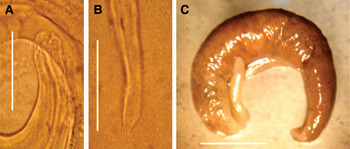
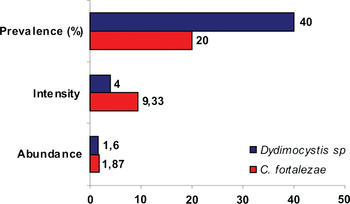
In the 15 samples of S. brasiliensis 28 specimens of nematodes Contracaecum fortalezae were found (Figure 1A & B), 23 of them were located in the gill chambers and five in the gonads. The prevalence (P) was 20%, mean intensity (MI) was 9.33 and mean abundance (MA) was 1.86 of parasites per fish sampled. A total of 24 specimens of the digenean parasite Didymocystys sp. (Figure 1C) were found, one in the tegument, five in the gill chambers and 18 in the muscles. The P was 40%, MI of 4 and MA of 1.6 parasites per fish sampled (Figure 2).
Contracaecum fortalezae (A) anterior region and (B) posterior region (scale: 0.05 mm) found in the gill chamber and gonads of Scomberomorus brasiliensis, Dydimocystis sp (C) (scale: 2 mm) found in the integument, in the gill chamber and in the muscle of S. brasiliensis

Values of prevalence, mean intensity and mean abundance of Contracaecum fortalezae and Dydimocystis sp. in Scomberomorus brasiliensis.

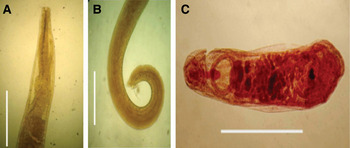
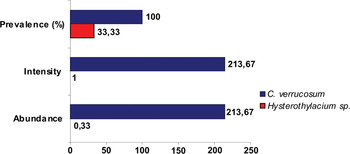
In the three specimens of T. lepturus one species of nematode Hysterothylacium sp. (Figure 3A & B) was found, located in the intestine, with a P of 33.33%, MI of 1 and MA of 0.33 parasites per fish sampled (Figure 4). Besides another 641 digenetic specimens of Catarinatrema verrucosum (Figure 3C) were found, of which 164 were located in the tegument, 97 in the gill chambers and 380 in the stomach, with a P of 100%, MI of 213.67 and MA of 213.67 parasites per fish sampled (Figure 4).
Hysterothylacium sp. (A) anterior region end (B) posterior region (scale: 0.05 mm) found in the intestine and (C) Catarinatrema verrucosum (scale: 1 mm) found in the integument, gill chamber and in the stomach of Trichiurus lepturus.

Values of prevalence, mean intensity and mean abundance of Hysterothylacium sp. and Contracaecum verrucosum in Trichiurus lepturus.

DISCUSSION
Fishing activities of north-eastern Brazil are generally restricted to a small-scale artisanal fishery, which is conducted from small coastal villages. Most of the catch is consumed directly by the fishermen and their families, and a part is sold at local markets. Although fish is of primary importance, the local distribution of the fishery products often produces only minor interest and consequently with limited fisheries research. The growing importance of fish as a protein resource, and the interest in exporting fishery products to markets with high quality standards, requires knowledge of fish health in exploited stocks (Palm, Reference Palm1997). The present study documents the occurrence of metazoan parasites of S. brasiliensis and T. lepturus from the coastal waters of north-eastern Brazil, reporting on parasites with zoonotic potential.
Novak (Reference Novak1997) found several species of commercially important fish infected by nematodes pertaining to the family Anisakidae of the genera Contracaecum, Phocanema and Anisakis found in mackerel, Scomber japonicus; salmon, Salmo salar, tuna, Thyrsites atun and Atlantic cutlassfish, T. lepturus. The present work registers the presence of a nematode C. fortalezae in S. brasiliensis.
Alves & Luque (Reference Alves and Luque2006) while investigating the community ecology of metazoan parasites of five species of scombroid fish from the coast of Rio de Janeiro, Brazil, reported on the presence of two digenean, two cestodes and one nematode parasite in S. brasiliensis. However, the present work reports on the presence of a nematode Hysterothylacium sp. and a trematode species Didymocystys sp. in S. brasiliensis.
The anisakidean larvae are found in teleost fish and cephalopods the world over and they are all considered as sources of infection for human beings (Ferrer, Reference Ferrer2001). The tuna nematode Hysterothylacium cornutum was found parasitizing the Atlantic cod Gadus morhua, with a prevalence of 0.77%, average intensity of 3.5 and mean abundance of 0.03 (Mackenzie et al., Reference Mackenzie, Hemmingsen, Jansen, Sterud and Haugen2009). This genus also parasitizes sardines on the south and west coasts of Spain, with a prevalence of 11.85%, mean intensity and mean abundance of 2.14 to 0.25 (Rello et al., Reference Rello, Adroher and Valero2008). Larvae of Hysterothylacium sp. (Nematoda: Anisakidae) were registered in the sole Paralichthys isosceles from the south-east coast of Brazil with a prevalence of 100%, mean intensity of 30.3 and mean abundance of 32 (Felizardo et al., Reference Felizardo, Menezes, Tortelly, Knoff, Pinto and Gomes2009). The present work registers lower values of prevalence, mean intensity and mean abundance for the nematode Hysterothylacium sp. in T. lepturus. However, Knoff et al. (Reference Knoff, São Clemente, Gomes and Podovani2004), registered Anisakidae parasites of pink cusk, Genypterus brasiliensis in Rio de Janeiro, Brazil, and recorded the presence of Hysterothylacium sp. with a prevalence of 2.7%, mean intensity of 2 and mean abundance 0.05.
Travassos et al. (Reference Travassos, Artigas and Pereira1928) made the first record of the nematode Contracaecum sp. in the freshwater fish of Brazil. Later the presence of Contracaecum sp. was recorded in the viscera and mesentery of Hoplias malabaricus, with a prevalence of 64.4% and average intensity of 5.3 (Fabio, Reference Fabio1982). Contracaecum fortalezae was found parasitizing in the stomach, small and large intestines of S. cavalla and S. maculatus (Klein, Reference Klein1973) and Harengula clupeola (Guimarães & Cristofaro, Reference Guimarães and Cristofaro1974). The presence of a nematode parasite C. fortalezae registered in this study in the branchial chamber of S. brasiliensis could be explained by the fact that these fish use stomach eversion as an escape strategy (Moura et al., Reference Moura, Marques and Nogueira2008) and consequently the parasite gets lodged in the gills.
In this study, the digenean Didymocystis sp. was found in several locations in the host S. brasiliensis, with low prevalence and abundance. This can be attributed to dietary habits, trophic level and geographical distribution of S. brasiliensis (Alves & Luque, Reference Alves and Luque2006). Didymozoids (Digenea: Didymozoidae) are extremely abundant and diverse digeneans in pelagic fish and can be found encysted in gill tissue and cartilage, the nostrils, oral and gill cavities, digestive organs, kidneys, gonads, skin and fins (Williams & Bunkley-Williams, Reference Williams and Bunkley-Williams1996). In Atlantic bluefin tuna, Thunnus thynnus, this parasite was found encapsulated in gill filaments, with a prevalence of 61.75% and abundance of 28.91 (Mladineo & Bocina, Reference Mladineo and Bocina2009).
Kamegai (Reference Kamegai1971) reported on the presence of didymozoid adults in the muscle of marine fish in Japan, and later eggs of this parasite were identified in human faeces. This transmission possibly occurred by the consumption of this fish. Chung & Cross (Reference Chung and Cross1975) found didymozoid eggs in faeces of 41% of children from a school located on the coast of Taiwan, which were probably acquired by consumption of marine fish. Carney et al. (Reference Carney, Nocum, Vergel, Pagaran, Mercado and Cross1987) and Cross et al. (Reference Cross, Zaraspe, Alquizia and Ranoa1989) found didymozoid eggs among other helminths in human faeces in the Philippines. This study confirmed the findings of Pascual et al. (Reference Pascual, Abollo and Azevedo2006) who reported on various aggregations of didymozoids encysted in muscles of Scomber scombrus. They also suggest that massive infection by this parasite may reduce the commercial value of fish due to changes in the appearance of their muscles.
In the present study, the digenean C. verrucosum was found in several locations of T. lepturus with high values of prevalence, mean intensity and mean abundance. However, the results here differ from the findings of Freitas & Santos (Reference Freitas and Santos1971) and Vicente & Santos (Reference Vicente and Santos1974) wherein the parasite was found only in the stomach contents with low intensity and mean abundance.
This paper records the occurrence of Didymocystys sp. and C. fortalezae in S. brasiliensis and Hysterothylacium sp. and C. verrucosum in T. lepturus from the coastal waters of Rio Grande do Norte, north-east of Brazil. The occurrence of the parasites of the family Anisakidae and the digenetic trematodes of the families Hemuridae and Didymozoidae have zoonotic potential and are related to public health since the fish hosts are of commercial importance. For these reasons, the increasing consumption of raw or uncooked fish in Brazil, associated with the occurrence of these parasites may represent a to humans.
ACKNOWLEDGEMENTS
We thank CAPES (Post Graduate Federal Agency of the Ministry of Education, Brazil) for the financial support awarded during the study period to the first author. This study was supported by the National Council for Scientific and Technological Development of Brazil (CNPq) in the form of Research grants.