Introduction
World War II was one of the most dreadful episodes in the modern history of Europe, but when it came to an end the first postwar years could be viewed as a time of social revolution, especially for the societies in Central and Eastern Europe. While the postwar years in the history of Poland are mainly viewed – because of their association with later Stalinization (1948–1953) – as a dark time of terror and new occupation, my thesis is that this narrative is incomplete, as during the very early postwar years it was not fully known in which direction and with what force the political system would develop. In fact, the case of Poland demonstrates that sovietization did not mean unification of Central and Eastern Europe around a universal model most completely introduced in the USSR, as many scholars have claimed (Okey Reference Okey1986; Rupnik Reference Rupnik1989; Schopflin Reference Schopflin1993). The contexts and history in particular countries, as John Connelly noted, resulted in different trajectories of the sovietization of science (Connelly Reference Connelly2000). According to Connelly's research, in Poland the construction of a new elite was much more difficult than in other countries, and intellectuals seemed to hold a stronger position than those in the German Democratic Republic (GDR) or Czechoslovakia; therefore, the reforms were more intensively contested and thus were implemented in a more specific, responsive manner.
In Polish historiography the term “gentle revolution” is often used to describe the early postwar years. There was a lot of hope and energy aimed at shaping the world anew, especially on the part of the leftist intellectuals, many of whom viewed the postwar reality as a very special and unique historical moment that offered a chance for rapid modernization, for the implementation of utopian projects, and for reforming the social order by, inter alia, creating a new type of university – democratic, egalitarian, and free. For this progressive group of intellectuals (mainly liberals and leftists) inter-war Poland (1918–1939) was less associated with the idyllic manor houses of the nobility than with rising authoritarian tendencies, censorship, poverty, economic stagnation, and mass anti-Semitism. These intellectuals wanted to build a new Poland in opposition to those pathologies, an egalitarian and modern state. And immediately following the end of the war they got a chance to try.
In this context, it quickly became apparent that the dreams and visions for “modernizing” the university varied, and in this respect a split developed between the radical and moderate factions. And although they couldn't know or predict the future course of events, there was not much time to act, since from 1948, the universities in soviet-dependent countries began to be transformed into important places and were assigned a key role in building a new communist state, in which they were expected to produce and shape a national history, ideology, and a future elite. Almost imperceptibly, many visions for modernization started to become intertwined with strengthening the ideological offensive of the communist state. The “scientific” engagement started to become inseparable from the political order.
Along with the variety of “sovietization” models in different countries, further differences appeared at the level of particular universities. In this paper I would like to focus on a case of one Polish university – the University of Łódź, newly established in a workers city. This case focuses through a lens of macrostructural political and social processes and patterns of intellectual biographies after the War. It traces the dreams and ideas of modernization for science and for a new model of university – processes that were universal for the whole region. This article focuses on the University of Łódź as a case study for examining the processes and trends in the development of science in postwar Poland. In particular, it aims to shed light on a theme that has not yet been adequately explored – the fate of the leftist academicians in the immediate postwar period and their almost tragic confrontation with political changes, and the historical trajectory when their leftist ideals were used against them.
It also touches upon two more universal questions. The first universal question concerns the processes of democratization of universities forced by modernity, which found its articulation in 1920s Soviet Russia and later in postwar Poland and the whole of Central Europe, creating many different reform programs and rearrangements of university models. Western Europe waited till the 1960s to deal with this issue (Rüegg Reference Rüegg2011). The second universal question concerns the political agency of intellectuals in this change and focuses on individual actors in the historical processes. It should be noted that the field of the analysis is located at the microstructural level tracing actions of individuals in a macrostructural context, and on a discursive level, on which singular articulations shape social reality through the language and creation of concepts.
The location of the case study is important and strengthens the processes described above. In 1945, more than 70 per cent of Łódź's pre-war population was missing (Rosset Reference Rosset1965), but owing to its incorporation into the Third Reich as a “German” city its material structure was relatively well preserved, and as a result it became the temporary unofficial capital of Poland and the most vivid center of social experiments. For a number of reasons Łódź became a magnet for leftist intellectuals (Connelly Reference Connelly, Mackrakis and Hoffman1999). First, despite the fact that it was the second largest city in Poland (after Warsaw), it had no previous academic structures to be reproduced, there having been no public institutions of higher education in Łódź. Only from 1928 was Łódź home to one local department of a non-public university from Warsaw – the Free Polish University (Wolna Wszechnica Polska). In addition, it was also considered a “red” city with its tradition of the Revolution of 1905, its labor movements, and the fact that it had been portrayed as a kind of figure of the “Other” in Polish culture. In addition it was centrally located within Poland's new borders. All in all, it seemed the ideal place to build a university for the new times.
As can be deduced from the above, the topic is quite complex, involving many individual actors, institutions, and policies. Hence in this article I focus mainly on two important individuals, the first and second Rectors (officially the second and the third since the first Rector died before assuming his duties) of the University of Łódź, one a philosopher and the other a sociologist. Both were leftists, but outsiders to political structures; both focused on university reforms; both were highly reflexive about and involved in social change; and finally both, as high officials, had some agency power to implement their ideas. Those two persons are Tadeusz Kotarbiński (Rector from 1945–1949) and Józef Chałasiński (Rector from 1949–1952). Both presented their respective visions of the university: “the liberal university” of Kotarbiński and “the socialized university” of Chałasiński.Footnote 1 Chałasiński's vision was to become somehow kidnapped – not without an active role by Chałasiński himself – by the government during the intensifying Stalinization, the end result of which was the total victory of the central command policy over rank-and-file academic projects and initiatives. This paper focuses on those two models – the liberal university and the socialized university – and, in particular, the trajectory of the socialized university in confrontation with, and later a form of cooperation with, the political system. Chałasiński can be seen as an example of a leftist intellectual hoping to create a new egalitarian university, involved in the modernization of a backward country. Chałasiński himself serves as an example of the dilemmas and vicissitudes of leftist intellectuals in Central Europe. He and his model of a university serve to trace the postwar visions of science's modernization – in their social and political context, indescribable in factual descriptions.
Chałasiński's programmatic articles about the social, the socialistic, and as a counterpoint to these, the liberal university, offer an understanding of the dynamics of the battle for hegemony in public debate, the battle for setting new norms of dispute, and last but not least the battle for becoming a subject, not an object of the social change. The figure of Kotarbiński serves as a counterpoint to Chałasiński, the former a symbol of a more traditional university in opposition to a modern one. However, as we shall see, such a summary statement is an oversimplification. To achieve the purposes of this article, I consulted the press and the archives, and carried out almost thirty biographical interviews with retired professors from the University of Łódz. In addition many historical monographs based on careful historical workshops constituted important support for my work, all of which are discussed below.
The existing literature in the field refers mainly to the history of science policies: in particular Piotr Hübner's careful reconstructions of the postwar political organization of science on the national level (Hübner Reference Hübner1983, Reference Hübner1992, and Reference Hübner1994); and one of his articles about the conflict between Kotarbiński and Chałasiński that was a leading source of inspiration (Hübner Reference Hübner2011). In the history of Polish science little attention has been paid to the topics covered in this paper (Chodakowska Reference Chodakowska1981; Krasiewicz Reference Krasiewicz1976), with most available works focused on describing the conditions of the chosen scientific disciplines of that time, taking into account the ideological pressure on academia, as reflected for example in the works of Rafał Stobiecki on the Stalinization of Polish history (Stobiecki Reference Stobiecki1993). It also should be noted that the comparative works of the above-mentioned John Connelly concerning the restructuring of the higher education systems in East Germany, Poland, and Czechoslovakia were influential and informative for the present study (Connelly Reference Connelly, Mackrakis and Hoffman1999 and Reference Connelly2000). With respect to the Polish background, the works closest to the area of my interest are the historical books and the collection of sources published by Bohdan Baranowski (B. Baranowski Reference Baranowski1985; B. Baranowski and K. Baranowski Reference Baranowski and Baranowski1990; K. Baranowski Reference Baranowski1993), as well as interesting monographs dedicated to Chałasiński (Kaleta Reference Kaleta1980; Wincławski Reference Wincławski1989; Gryko Reference Gryko1989; Kłoskowska Reference Kłoskowska1992; Kaleta Reference Kaleta1996; Gryko Reference Gryko2007) and Kotarbiński (Jaworski Reference Jaworski1971; Choroszy Reference Choroszy1997; Dudek Reference Dudek1997). However, the problem I would like bring to light is only marginally treated in these works. The hopes raised in connection with authentic reform of the university, the independent projects of intellectuals, and their failure connected with their paradoxical inclusion into the Stalinization of Polish science remains a topic still in need of exploration.
Academic Topography of Poland
During the Second Republic of Poland (1918–1939) there were five public universities in the country: in Warsaw, Poznań, Lvov (Jan Kazimierz University), Vilnius (Stefan Batory University), and Cracow (Jagiellonian University), as well as the non-public Catholic University in Lublin and the Free Polish University in Warsaw, with a local branch in Łódź. Including technical universities or academies, over thirty colleges were in operation before World War II, but for the purposes of this paper the history of universities is crucial. The prevailing conditions of interwar academia were not satisfying; one of the main obstacles to be overcome was the lack of funding, which strongly affected the experimental sciences and blocked the academic careers of many young scholars. From the 1930s onward political and social problems arose – first following the Higher Education Act of 1933, which strengthened the state's control over academia; and second anti-Semitism, which reached universities, where nationalistic youth launched brawls which became an element of the last interwar years (Natkowska Reference Natkowska1999). Generally the universities had a rather conservative profile with respect to both methodological and political aspects. At the same time nationwide processes were not fortuitous: anti-Semitism at universities was just one element of increasingly dangerous ethnic tensions that spread throughout the entire country, reflected in the “reforms” of 1933 and the strengthening of the authoritarian regime known as Sanacja (which can be translated roughly as “national moral regeneration”). Many interwar leftist intellectuals could not find a place for themselves, although some managed to circulate around public universities or research institutes, some involved themselves in more progressive projects like the Free Polish University, while others – more radical and politically active – ended up in the Bereza Kartuska Prison.
The six years of devastating war meant the collapse of the old world. In writing about postwar Poland, Michael Fleming and Padraic Kenney describe it as a dual revolution: a social and economic one which lasted until 1947, and a political one between 1948–1950 (Fleming Reference Fleming2010; Kenney Reference Kenney2012). In turn, Krystyna Kersten and more recently Andrzej Leder see it as a single, rather social, revolution that lasted from 1939 to 1956 (Kersten Reference Kersten1991; Leder Reference Leder2014). The war years reshaped, in a brutal fashion, the social, political, and economic structure of the Polish state and society. However, after the war the social revolution was not based on destruction alone, but rather focused on construction/re-construction. In recalling the terror and the millions of victims of Soviet-style modernization, it is often overlooked that it was nonetheless a time of great social experiment.
The postwar map of Polish governmental universities was split into two. There were the academic centers reconstructed following pre-war traditions, reproducing the older social structure of departments and the scientific environment (Connelly Reference Connelly, Mackrakis and Hoffman1999 and Reference Connelly2000). These included the universities in Cracow and Poznań, and later Warsaw, as well as some that found themselves outside Poland's new borders and re-located to new cities in the so-called “Regained Territories,” i.e., the Jan Kazimierz University, which was relocated to Wrocław, and the transfer of Vilnius's academic tradition which came to be used as the foundation of a new institution in Toruń. As J. Connelly notes, these actions constitute proof of the temporary political weakness of Polish communists, who were not yet strong enough to risk more radical actions and hold back this reproduction of pre-war Polish traditions (Connelly Reference Connelly, Mackrakis and Hoffman1999). Then there were universities that were established from scratch, often with a clear political background: like the University of Lublin, established to neutralize the influence of the Catholic University of Lublin, and the University of Łódź, aimed at giving “historical justice” to a hitherto intellectually neglected city of workers.
The “Red City” and the University
During its 110 years of development, when it was the second largest city of Poland (Congress Poland, 1815–1918) and the Second Republic of Poland (1918–1939), Łódź had not managed to create a vivid intellectual community, nor a tradition of higher education. Despite the fact that initiatives to establish a technical university had begun as early as the 1860s, they were never successful owing to the working character of the city – it was too dangerous to combine labor movements with any intellectual centers. The history of interwar academic Łódź is limited to the short period of the establishment in Łódź of a local branch of the Free Polish University in Warsaw. This non-governmental humanistic university, with its leftist-liberal profile (K. Baranowski Reference Baranowski2001), became a key foundation for future institutions and constituted an important link between academic circles in Łódź and those in Warsaw. Partly because of this, after World War II the intellectuals who decided to move to Łódź were mainly from Warsaw.
As has been mentioned, in 1945 Łódź became one of the main centers of Polish science, partly owing to practical considerations: its material structure was not destroyed, the living conditions in Łódź were bearable, and it was both centrally located and close to Warsaw (120 kilometers distant, with a reliable railway connection). However one should not lose sight of the fact that political considerations also played an important role. The focus on a “workers city” had symbolic meaning in terms of historical justice and compensation for the grievances suffered through the decades when it was considered too radical and too proletarian for Polish academia and the Sanacja regime. Łódź was rising as a leftist center, as reflected in its “Red University” nickname; its leftist publishing houses of Kuźnica,Footnote 2Myśl Współczesna,Footnote 3 and Wieś;Footnote 4 the establishment of its “Klub Demokratyczny”;Footnote 5 and the activities of such important intellectuals as Natalia Gąsiorowska, Stanisław and Maria Ossowski, Nina Assorodobraj, Witold Kula, Stefan Żółkiewski, Adam Schaff, and Jan Kott. The latter recalled the period as follows:
We were sure that we were changing history by the writing of it, as if it belonged to us. All that time we engaged in this “Hegelian bite” – although we did not know this term at that time nor that it was we who were biting history, like mad, demiurges of a post-war time, breathlessly. It seemed to us that one could mold everything, like from clay. (Kott Reference Kott1990, 213)
At the same time the government – in the person of the Vice-minister of Education Władysław Bieńkowski – was promoting the concept of the so-called “representative Polish university.” During the official inauguration ceremony of the first postwar academic year, in January 1946, the Vice-minister said:
The opening of the University of Lodz has a symbolic range. Łódź, a great city and, today, after destruction of Warsaw, the biggest in Poland, was unable to obtain a normal academic school before 1939. . . . Today, the day of inauguration of the University of Łódź, symbolizes an act of historical justice, and the desire of Polish Democracy to open its doors wide to higher education for the working masses; it symbolizes the convergence of knowledge and work, and the cooperation between workers and scientists. (Bieńkowski Reference Bieńkowski1946)
The Liberal University
In such an atmosphere the University of Łódź was created. The decree of its establishment was issued on 24 May 1945. The conditions were difficult: lectures took place in cinemas or professors’ flats (if they had one, as many lived in hotels or in their friends’ flats), the books were looted from the Regained Territories, and charity collections for starving students were organized. As many as ten new colleges were established and the number of citizens was greater than in Warsaw, which meant that Łódź at that time was the biggest Polish city (Żelazko Reference Żelazko2008) and the University of Łódź was the second largest after Jagiellonian University (Cracow). Following the tragic death of the first Rector – Tadeusz Vieweger, a well-respected philosopher from the University of Warsaw who died just two days before officially assuming his chair – Tadeusz Kotarbiński was appointed Rector. The philosopher from Warsaw was well-known for his tolerance, anti-capitalistic views, sensitivity to social injustice, and reformist approach (and as an opponent of revolutionary changes) (Choroszy Reference Choroszy1997). To some Kotarbiński's nomination seemed to be a sign that Łódź was going to assume the central functions of Warsaw (Baranowski Reference Baranowski1985, 32). Although he was considered to be a leftist and was a controversial choice by some interwar academics, his election was rather an attempt to reconcile the radical and conservative groups.
He introduced the concept of the liberal university, based on the ideals and structure of the interwar period and the nineteenth-century German model, which at that time were a doxa for academicians. He proposed that the university be reformed mainly with respect to three points: accessibility based on individual skills, liberal content of teaching, and democratic management. At the Inauguration of the first academic year he declared:
The University of Łódź wants to be accessible for working class children, it wants to be truly innovative . . ., it wants to be assertively secular, it wants autonomy from all inflexible systems: ideological, historiosophical and others. It wants to serve the truth in the best understanding of every scholar and teacher. Let the truth arise from thorough and free discussion. (Dziennik Ludowy 1946)
From his point of view, the university as an institution was supposed to be apolitical and its social role was to create proper conditions for free academic discussion, including disputes. The social background of students or the production of university structures were mentioned, but treated generally. He was not enthusiastic about the implementation of a preparatory course or an initial year, ideas designed to help students without secondary school certificates, mostly workers’ and peasants’ children, to enroll in the university. His actions, despite their wide range of management competence, were concentrated on the scientific field, and organizational functions were ceded to the vice-rectors. He was also engaged in building democratic structures, including students’ representation in the University's management. At the same time he was an opponent of such tools of democratization of science such as the initial year or preparatory courses, claiming they unjustly treated skilled students (Kotarbiński Reference Kotarbiński1946). He proposed to solve the problem of enrollment by a system of scholarship burses, and donated dormitories. Generally, his aim was to preserve a traditional model of higher education, while avoiding the pathologies of the interwar period.
“The Democratic Populist”
At that time, Kotarbiński's main opponent was his vice-rector Józef Chałasiński, who was younger and more radical, especially in his opinion about the intelligentsia and interwar academia. However, both of them were committed democrats and had some common notions, like the need to preserve the university's autonomy and freedom of expression. Where they mainly differed was in their attitude to interwar academia and their assumptions about the postwar reality. While Kotarbiński could be described as a reformer who was at the same time sensitive to historical continuity, Chałasiński was rather a revolutionary, trying to disassociate from interwar academia.
Chalasiński's notions were consistent and coherent from the very beginning of his academic career in the 1920s in Poznań, under the supervision of Florian Znaniecki. He became widely known after publishing a four-volume work about the peasant youth generation, Młode pokolenie chłopów [Young Generation of Peasants] (Chałasiński Reference Chałasiński1938). He was of peasant origin himself, not well-suited to interwar academia, politically radical, active in the peasant popular movement and highly critical of social relations in interwar Poland. He later recalled his ambivalent role in academic structures as follows: “I was not able to find root in the university's intelligentsia, nor did they want me. Besides I was already a professor with thick books, so neither was I attracted to them. I was not able to love science only for the sake of giving lectures and writing books” (Kłoskowska Reference Kłoskowska1992, 39).
Chałasiński's views about social inequalities were widely known before World War II, and during the War he wrote a book entitled Chłopi i Panowie [Peasants and Masters], more sharp in its critique than all his previous works about interwar Poland and its social structure. The manuscript was lost during the war, but some ideas from it were used in his famous speech, given as a vice-rector under Kotarbiński's rectorship, at the inauguration ceremony of the 1946/47 academic year.Footnote 6 One can find there radical statements (although toned down in comparison to those from the book) such as: “Here every generation of intelligentsia starts its work anew and always in the same manner. Always the same phraseology about rescuing Western culture in Poland, always the same Poland – the Bulwark of Christianity. Always the same idleness, sacred by any hackneyed, grandiloquent phrase” (Chałasiński Reference Chałasiński1947a).
In his book published just a year later, summarizing his lost manuscript and latest thoughts, he reverted back to sharper language, writing: “The intelligentsia ghetto was a huge force, reactionary, social, and parasitic upon Polish cultural life” (ibid., 88); and “The Polish intelligentsia in its structure is related to the underdevelopment of Polish civilization in technical and economic terms” (ibid., 54).
Taking into consideration his notion of the “intelligentsia ghetto,” it is hardly surprising that Chałasiński was not keen to support any project that aimed at reforming the interwar model of the university, thereby, in his opinion, reproducing its pathologies. To him the university's main predicament was that an academic ivory tower, detached from reality and social needs, would, in the long-term perspective, only provide for the further isolation of science from society and the further backwardness of Poland. Thus he was convinced that there was no way to modernize older forms, but that the new reality and the opportunities it offered begged for the construction of a completely new project. Chałasiński was both critical and radical, even for the governmental discourse or the Polish Workers Party's rhetoric of that time. Not surprisingly the “Marxist” label, which followed him from the interwar period, was strengthened, despite the fact that the label was not accurate. A more accurate term was proposed many years later by his favorite pupil, sociologist of culture Antonina Kłoskowska, whose attitudes towards that time were highly critical. She described him as a “democratic populist” (Kłoskowska Reference Kłoskowska1992, 15). And probably the best example of this democratic populism was indeed his vision of university restructuring during the years 1945–48 – his vision of the socialized university.
The Place for an Experiment
The conflict between Kotarbiński and Chałasiński, which began at the inception of their cooperation, was from the very beginning over the issue of policy. Based on Chałasiński's criticism of the intelligentsia ghetto, Kotarbiński's vision of the liberal university did not, to his way of thinking, meet the needs of the postwar period. In Chałasiński's opinion, the “modernized academism” of Kotarbiński only seemed to be progressive, while in fact reproducing the model of the university as an ivory tower, out of touch with society's needs. Chałasiński recognized political changes and claimed that the preservation of traditional academia in the form of a liberal university would lead to the decline of Polish science, and by extension the whole of Polish society. This divide between science and reality, i.e. between academia and political, social, and cultural life, would cause the further isolation of academia and its colonization by bureaucratic discourse. The apolitical ideals of the university, paradoxically, could lead to it its politicization. The university as an institution could no longer remain passive and neutral, as sooner or later confrontations with political structures were bound to arise.
Therefore, from Chałasiński's perspective, the university was obliged to fight for its controlling role in the forthcoming historical changes, to produce its own ideas for its existence, and not to become only an object of governmental reforms. For Chałasiński, who was probably more realistic about the political future of Poland, it was clear that the general role of the university in the postwar reality was at stake, and it was high time to act, which meant presenting a vision elaborated in a public debate in academic society, in anticipation of the attempts at its colonization by political and bureaucratic discourses. In this spirit his most explicit statement can be found in an article he published in Kuźnica, entitled “O społeczny sens reformy uniwersytetów” [About the Social Sense of University Reform] (Chałasiński Reference Chałasiński1947b).
This text can be seen as a manifestation of the second model of a university – propagated in opposition to governmental ideas and to the liberal university – the model of the socialized university. Beginning with the same assumption as Kotarbiński, Chałasiński saw his project in the framework of the unquestionable autonomy of universities and the democratic order. Furthermore, he believed at that time in a kind of deliberative democracy, based on developed public opinion (which he termed using the synonym “intellectual opinion”). In Poland, he argued, the self-governance of citizens was very weak, therefore it was crucial for its further modernization to build strong public opinion, as a guarantee of democracy. Only via discussion and the confrontation of multiple opinions would the construction of a People's Republic be possible.
In a similar vein, he claimed that universities are obliged to take responsibility for building and shaping this public opinion. Thus, he repeatedly stressed the special role of culture (and science) as autonomous spheres of social life, the autonomy of which should even “rise with nationalization of economic life” (ibid., 3). He claimed that “from the point of view of democracy, the stronger the tendencies to nationalize other fields, the more indispensable is the full and comprehensive autonomy of science and culture” (ibid., 4). This was also a clear message to the government, which was already preparing the central reform of higher education. Chałasiński warned that the academic field was not a place for any revolutionary moves like the Land Reform in the field of agriculture. He advised that universities should be reformed in an experimental manner, and the place for such a social experiment was Łódź.
The first component of the socialized university was, then, its autonomy. The second was its social utility. However scientific aims were basic and should be preserved as a prior domain of its activity. There was another set of aims to be achieved as well, that is, to become an independent center of public opinion formation and a foundation of democratic order. This was precisely the social dimension of the university. As such a center, the university should be engaged in the process of social change, not by the “dogmatic propaganda of one scientific theory,” but by the “critical method of scientific thinking.” At the socialized university there was no place for cliques and people devoted to their social groups or individual interests. On the contrary, everyone had an obligation to be devoted to society as a whole and to democracy. This was a delicate critique of Kotarbiński's notion of scholars’ individualism.
The years 1945–1947 were propitious for utopian thinkers, as everything seemed to be subject to and ready for action and change. Chałasiński's article, however, created a lot of trouble for him, which was just one of many signs of the forthcoming Stalinization – that the so-called “gentle revolution” was coming to an end (Herczyński Reference Herczyński2008). In the same edition of Kuźnica, but on the first page, ahead of Chałasiński's programmatic paper, a polemical article was printed. Its title said enough: “A fight for freedom of science, or preservation of the old order?” Chałasiński knew that time was running out and that the room for independent thought was shrinking, but he probably still believed that it was possible to benefit from the forthcoming changes. Just a few months later he published another paper, entitled “Współczesne reformy szkolne a idea narodu i socjalizmu” [Modern School Reform and the Idea of Nation and Socialism], which turned out to be a mere paean on the Soviet model of education. It was a kind of apology for criticism of the government, and by it Chałasiński managed to regain his position and some political agency (Chałasiński Reference Chałasiński1947c).
By that time Kotarbiński had paled in significance. His philosophic notions had much in common with Marxism, but he never recognized the latter as a scientific theory. A declared humanist and individualist, he did not feel suited to the new times and its holistic solutions. He defended the values of truth and free discussion (Kotarbiński Reference Kotarbiński1958, 678).
Vision and Practice
In 1949 Chałasiński was appointed Rector of the University of Łódź. From the beginning, he was deeply devoted to the project of academia in a workers city. Once again he opened an academic year (1949/1950) with a significant speech:
Workers and leaders, professors and employees of the University of Lodz, youth, citizens! . . . It is not a coincidence that our ceremony takes place outside the walls of the university, in an open and public space. We want to emphasize that we are breaking with the tradition of social isolation of the university with full consciousness, in this manner we declare that creative scientific ideas are going to engage in a powerful stream of transformation of our Polish life, in all its areas. With this manifestation of breaking down the isolation of the university we are opening the new academic year! (Chałasiński Reference Chałasiński1950b)
Although it is impossible to reconstruct exactly when and on which levels the interplay between Chałasiński and the Party took place, for sure it was already advanced when he took the Rector's chair. The academic year 1949/1950 was crucial for University of Łódź not only because of the person who was the new Rector, but also because of the forthcoming central reform of Polish science. Łódź itself was losing its vitality, and many intellectuals were going back to rebuild Warsaw. The University of Warsaw was now fighting vigorously for its proud title of “the most politically active university” in the People's Republic (Baranowski and Baranowski Reference Baranowski and Baranowski1990). Chałasiński, finally holding the reins of power, tried to put into practice his idea of the socialized university. Of course it was no longer a good time for an “independent public opinion center,” but still he was trying to force a bottom-up reform of the University of Łódź. Unfortunately, as he himself noted earlier, many years were needed to develop a socialized university, and he was running out of time. Central Reform, inspired by what the radical communist philosopher Adam Schaff called “The N Operation” (“N” for nauka – “science” in Polish), was about to be implemented.
The central reform of higher education in 1950 was aimed at transforming universities into one of many tools for implementation of the Six-Year Plan – “By Industrialization to Socialism!” The newly established Ministry of Higher Education and Science – among many other reforms – announced a new typology of universities. Every group was given strictly assigned enrollment limits and a defined range of courses, based on the following:
1. The main scientific center – The Great University, which was of course the University of Warsaw;
2. The group of big universities, chosen by their geographical location, were to serve as local growth centers: Cracow, Poznań, and Wrocław;
3. A group of small universities fulfilled provincial functions: Lublin, Toruń, and Łódź.
To each group the enrollment limits were assigned as well as faculty quotas – the highly specialized one being only Warsaw University. Science was parameterized and the universities were obliged to respect assigned quotas of students and graduates. Courses became obligatory, and in opposition to the so-called aristocratic manner of studying, students were supposed to work on the basis of rules similar to workers in the factory, with almost eight hours per day of classes, roll-call, and supervision of their efficiency. The first three years of study were designed to prepare students for practical tasks, and the additional two years to give them more advanced skills and the Magister (M.A.) Degree. Students were encouraged to contact a future workplace during their studies in order to obtain work experience in a factory or public institution. Universities were thus to become part of a production process aimed at training skilled specialists.
In addition to the University of Łódź being demoted to a provincial university, the further consequences of the reform were even more catastrophic than the outflow of professors that had been carried out in previous months. The number of students decreased by 46 per cent (partly because of the secession of medical universities); and only three out of fourteen humanities programs were preserved, and then only after protests of well-known professors. History was kept, but sociology – most important for Chałasiński – was closed (Baranowski and Baranowski Reference Baranowski and Baranowski1990). While departments were still operating, didactics and recruitment was stopped. During the last months of 1948, along with the rebuilding of Warsaw a general emigration of intellectuals to the “real capital” began. Many who, during years of chaos stayed “in transit,” were returning home (Bołtuc-Staszewska Reference Bołtuc-Staszewska1964).
“Reserve of Monuments”
During this period, so rich with rapid changes and with such an uncertain future, Chałasiński's main statement was delivered in his speech at the fifth anniversary of the establishment of the University of Łódź, in 1950 entitled: “From a liberal to a socialistic idea of the university.” On some levels this message has much in common with his previous statements, but a radical change of language and the disappearance of words such as “independent” or “autonomous” in the context of the university can be observed. It should be noted that it was no longer a “socialized” university, but an outright “socialistic” one. Once again Chałasiński's strong criticism of the interwar university provided his main point of reference, but he added a much stronger criticism of the traditional university in general, and by implication Kotarbiński's liberal university. In addition he engaged in self-criticism, popular at that time, of his previous writings, criticizing them as too liberal and seduced by Kotarbiński.
The first part of his speech was an elaborate and systematic criticism of the traditional model of the university as a place for reproducing an intelligentsia ghetto, where science is treated in a utilitarian manner, either as source of profit or as a form of aristocratic game (i.e., the university as “kindergarten for wealthy youth”). He criticized the policy of his predecessor, Rector Kotarbiński, who was present at the event (Kłoskowska Reference Kłoskowska1992, 15). Responding to Kotarbiński's slogan “Truth and Liberty,” he pointed out:
Seeking the truth and enjoying the freedom of the individual was never neutral, but always associated with a positive interest in a specific historical direction. . . . The University of Lodz is historical nonsense, if it is to be understood as a liberal improvement of the pre-war University of Warsaw, moved to Lodz. . . . The University not only stands on the field of class struggle, but is involved in it. Awareness of this fact is essential to ensure that universities are not reserves of monuments any longer, but are becoming centers of socialist intellectual culture! (Chałasiński Reference Chałasiński1950a, 537)
He concluded that freedom of discussion had become a slogan of capitalistic freedom and could lead to a convenient agreement for scientific nonsense and poorly understood tolerance. It was not enough to raise a voice in discussion. Society would not shape itself, especially not a socialistic society, which needed “head management centers for public opinion in all fields, science included” (ibid.). Science could not be private property; it needed to focus on public functions, and for that, central planning and management were necessary. The difference between his statements and his former notion about public opinion and freedom of expression was striking. He underlined the need to put an end to the concept of science as private property, to allow it to regain its public functions. New institutional frameworks were needed “on the one hand to lead the intellectuals’ free discussion, . . . on the other to inform society about the agreed-upon view of scholars and the subject of controversy among them” (ibid., 538). Freedom not controlled by the state might lead to anarchy. An important shift was also visible in Chałasiński's attitude to the democratization of science – he stressed that such a process could not take the form of popularizing the culture of higher classes, but should be focused on creating a completely new type of culture, responding to the aims and experiences of the working masses. Earlier he had been rather interested in the creation of new types of institutions, supporting the democratization of culture, which seemed to be – along with pluralism and democracy – universal.
An even more ideological tone was visible in Chałasiński's speech a few months later, at the inauguration of the academic year 1950/51. In the newspeak, he underlined the special role of science in the Six-Year Plan and its strict and close relationship on the path to industrialization and a socialist society. At the same time, in the second part of the speech, he tried to argue for the humanities as also indispensable in these processes (irreplaceable for promoting Marxism and Leninism). This was one of many attempts to restore sociology to its place at the university. Chałasiński wrote: “Awareness of the irreversibility of the historical process that leads to socialism pervades our universities more and more; more and more young people of working-class or peasant origin are undertaking studies, and for all of them workplaces in agriculture, industry and culture are waiting.” The involvement of universities in the Six-year Plan “is not limited to the technical and economic foundations of the socialist system based on modern science, but it affects the whole social and cultural relations of the nation. In the same way as the reconstruction of the economy and class structure was proceeding, so too the same renovation of culture and mentality had to proceed” (Chałasiński Reference Chałasiński1950b).
But “Operation N” was too advanced and the social sciences – with sociology at the head, was abandoned as a “bourgeois science” (Herczyński Reference Herczyński2008, 116). To demonstrate his disappointment, Chałasiński pleaded with the Minister of Higher Education and Science for permission to resign from the Rector's chair (Chałasiński Reference Chałasiński1951), but his request was rejected. The convening of the First Congress for Polish Science (in July of 1951) was a clear message to the academic community that the period of freedom had come to an end. The centralization, parametrization, and control intensified. International contacts became subject to strict control, the publishing market was nationalized and centralized by creation of the Polish Scientific Publisher (PWN), and the Polish Academy of Sciences was created. Chałasiński became a part of the “old guard,” inadequate for the new times. He maintained his position as Rector until 1952, playing the role of an enthusiast for governmental reforms, reforms leading to the subjection of science to the state bureaucracy. In the same year he went on the attack (Chałasiński Reference Chałasiński1952) and – although he never joined the Polish United Worker's Party – he wrote a few propaganda papers (Chałasiński Reference Chałasiński1953). At the same time Kotarbiński remained on the margins – too liberal and individualistic for the new times. In a response to Chałasiński, he warned that it is very easy to change progress into regress (Kotarbiński Reference Kotarbiński1958, 207)
The first of the two rectors had chosen a silent path of margins, the second a risky path of action. Based on the later memories of that time, Chałasiński's engagement does not seem to be related – as in many other cases – with conformism, but rather was a cruel exercise of his “democratic populism,” with him believing in the possibility of social change and persuading himself of the rationality and necessity of Stalinism. In describing that period in the 1960s, he wrote that he was not only the “revolutionist of humanistic socialism,” but also the “altar boy of an established order – a cult of Stalin” which he became because of “having a habit of acting with real results, a habit of working in any order only – for myself and the liberal university community – to not accept stagnation or contemplation of being faithful to one's spiritual beauty, but to participate in an ongoing social revolution” (Bołtuc-Staszewska Reference Bołtuc-Staszewska1964, 79).
Once he was called “the regime's decoration” (Jordan Reference Jordan1955), to earn another nickname, “the Claudius of sociology,” the Caesar preparing in secret the re-establishment of the republic (Jordan Reference Jordan1957) just two years later! This example shows how difficult it is to evaluate Chłasiński's choices. He was quite convincingly compared to a farmer who rescues his own inventory from a flood (Tobera Reference Tobera1996, 89), acting like a peasant, not an honorable nobleman, too proud to get his hands dirty. His later engagement in the Polish Thaw and criticism of the Stalinist Period helped to repair his reputation.
Who had the recipe for progress? Which step could lead to the country's modernization? The Land Reform was widely supported, the nationalization of industry less so, but still for many the democratization of education was an absolute must. Postwar debates had shown the complexity of the issue, but the “countless steps of society” (Baczko Reference Baczko1951) left Kotarbiński, Chałasiński, and hundreds of other progressive intellectuals far behind.
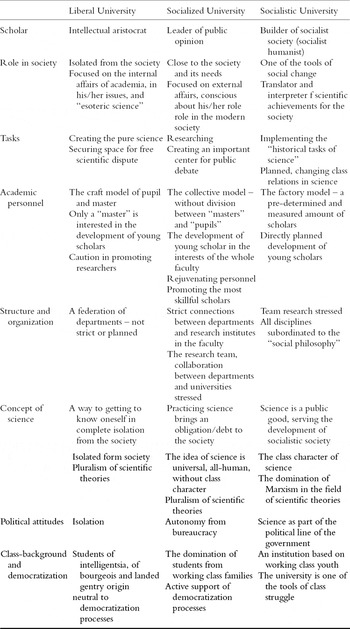
The three models of the university, based on Chałasiński's main articles (1945–1950)

Final Remarks
The rethinking of academia that took place in postwar Poland was framed by the dichotomy between the two models of a university, the traditional and the modern. The strivings of both rectors can be seen as an attempt to mediate between the two poles: the former reality of interwar academia with its pathologies (such as preservation of the elite or anti-Semitism) at one pole, and the forthcoming Sovietization of science at the other pole. On a symbolic level, the traditional model was based on Humboldt's idea, universitas, the imperative autonomy of science and its elitist character. This was combined with the option of bringing high culture to the masses by providing access to higher education for the most skilled youth from all social strata – simply avoiding the direct reproduction of intelligentsia. In contrast, the modern model aimed at the massive and rapid production of skilled workers. According to this modern model, the university was rendered rather as a tool, a measure, and a component of the industrialization of Poland and the strong egalitarian impulse to democratize Polish academia. It was thought that in this way it would play the role of a new type of university, closer to meeting the social and economic needs of workers, open to as many people as were needed to build a socialist welfare state.
The question of whether to bring high culture to the lower classes or to create a new type of egalitarian culture was framed and articulated not only in the local debates mentioned above. The main framework for the debate about the democratization of higher education was also taking place in the Soviet Union. The issue, so widely discussed in Pravda from 1922 on (Biggart Reference Biggart1987; Sochor Reference Sochor1988; Gleason et al. Reference Gleason, Kenez and Stites1989; Rosenberg Reference Rosenberg1990) was not how to provide reforms, but rather what was the basic meaning of modernization and the democratization of science/culture? On the one hand, cultural revolutionists and the avant-garde opted for the creation of a completely new model of society; while on the other hand more moderate communists wanted to bring former high culture to the masses, and popularize “old values” as universal. That was the crucial division in understanding the sense of modernization and social change.
In this light, the case study discussed in this paper can be seen as a local articulation of the universal debate about the university in modernity, where modernity serves both as a reference point and a general frame – in the spirit of “multiple modernities theory” (Eisenstadt [2000] Reference Eisenstadt2002). On the one hand, “communism as a modernization project” influenced Polish academia at the political and institutional level, bringing a pattern of uniformity to a whole region. On the other hand, the local specifics of Poland – a relative liberalism, deep-rooted anti-Russian attitudes, or strong intelligentsia ethos – show less obvious aspects of the change. Especially in the case of the city of leftist intellectuals and working classes, which becomes a melting pot of Polishness, reformists’ spirits, and sovietization.
Apart from modernization and its discontents, the case presented here could also contribute to explaining the intersection of individual agencies and institutional trajectories. Where there is power, so the story goes, there is resistance as well. No administrative or policy reform is done solely in the air. It is always constituted and put into practice by various institutional changes, going down through different scales where it is contested, reestablished, reciprocally induced through conjoining and differentials, thus re-articulated. When power, however ruthless and forceful, “hits the ground,” it is met with various interactive dynamics and reshaped along different structural and personal vectors. No other way was a share of Stalinization of science. Here, the reconstitution of forced imperatives was made through people personally involved in benign projects of radical democratization and modernization of science. They were too close to the main line of forces to directly discredit and reject it. However, they were firmly grounded and established enough so as not to perform just passive implementation from above.

Moreover, a university is a specific domain of practices, done in situ with a high degree of reflexivity. At the same time it is saturated with habitual immersion and inertia to prevent any systemic imperatives to be embodied in practice day by day; therefore, the revolutionary ideas of reformers and government generally failed. Nevertheless, this aforementioned relative closeness acted in Chałasiński's case as a Trojan horse as well, injecting the new rationality into the thoughts and practices of the leftist visionaries. Consequently, they acted on behalf of the new logic, betraying their own dreams. On the contrary, however, the moral authority and the leftist radicalism of intellectuals were used consciously to protect the remnants of independence and the benign institutional efforts that they had sacrificially made. This demonstrates the tragic stakes of institutional re-articulations of Stalinism made by particular people in particular places. Such conjuncture of the institutional and the personal is probably a fair share of every man of letters pursuing his or her goals in the actually existing society, be it socialist or capitalist. Personal navigation in such circumstances is always a tragic choice. Its outcomes always easily fall prey to post festum criticism of the unstained, the morally superior, and de facto the passive.
All in all, the social experiments at University of Łódź did not last very long. Most of the leftist intellectuals began to leave Łódź from 1948. After his dismissal, Kotarbiński moved to Warsaw as well, where he played a notable, but neutral, role in academic life. Chałasiński, after many highs and lows, also moved to Warsaw in 1952 to take his chair at the Polish Academy of Sciences. His further vicissitudes with the Party constitute another chapter in the history of Polish academia. Both projects – the liberal university and the socialized university (in its former meaning) – are important for tracing the ideas and visions that existed during this (short) period of hope, in an atmosphere of social revolution. Even if they were present mainly at the discourse level only, they are still important manifestations of an attempt to try and change the world, an attempt to act in an unstable period, at a time when fortune did not favor the brave.
Acknowledgments
I would like to thank Science in Context anonymous reviewers and Wiktor Marzec and Kamil Piskała for useful and insightful comments and critique at various stages of my work on the paper. The work on this article was part of a research project realized at University of Łódź, Poland, financed by the Polish National Science Centre, research grant Preludium 2 contracted as UMO-2011/03/N/HS6/01948.