By the last quarter of the thirteenth century at the latest, the hexachordal system had acquired the shape and terminology familiar to modern scholars. It was a complex, meticulously constructed edifice. Theorists of that time charted in detail the yoking of each letter of the gamut with one, two or three solmisation syllables, and identified the specific portions of the gamut where the six syllables ut re mi fa sol la could be located, namely, the major sixths C–a (proprietas naturalis or proprium cantum), G–e (proprietas per b quadratum, or b durum), and F–d with b flat (proprietas per b rotundum, or b molle). Roughly coeval with the introduction of the hexachordal proprietates is the practice of listing all the possible mutations from one six-fold segment to the next. By around 1300, letters, syllables, proprietates and the basic principles of the system as a tool of musical instruction were often mapped on the left hand to facilitate memorisation and instruction.
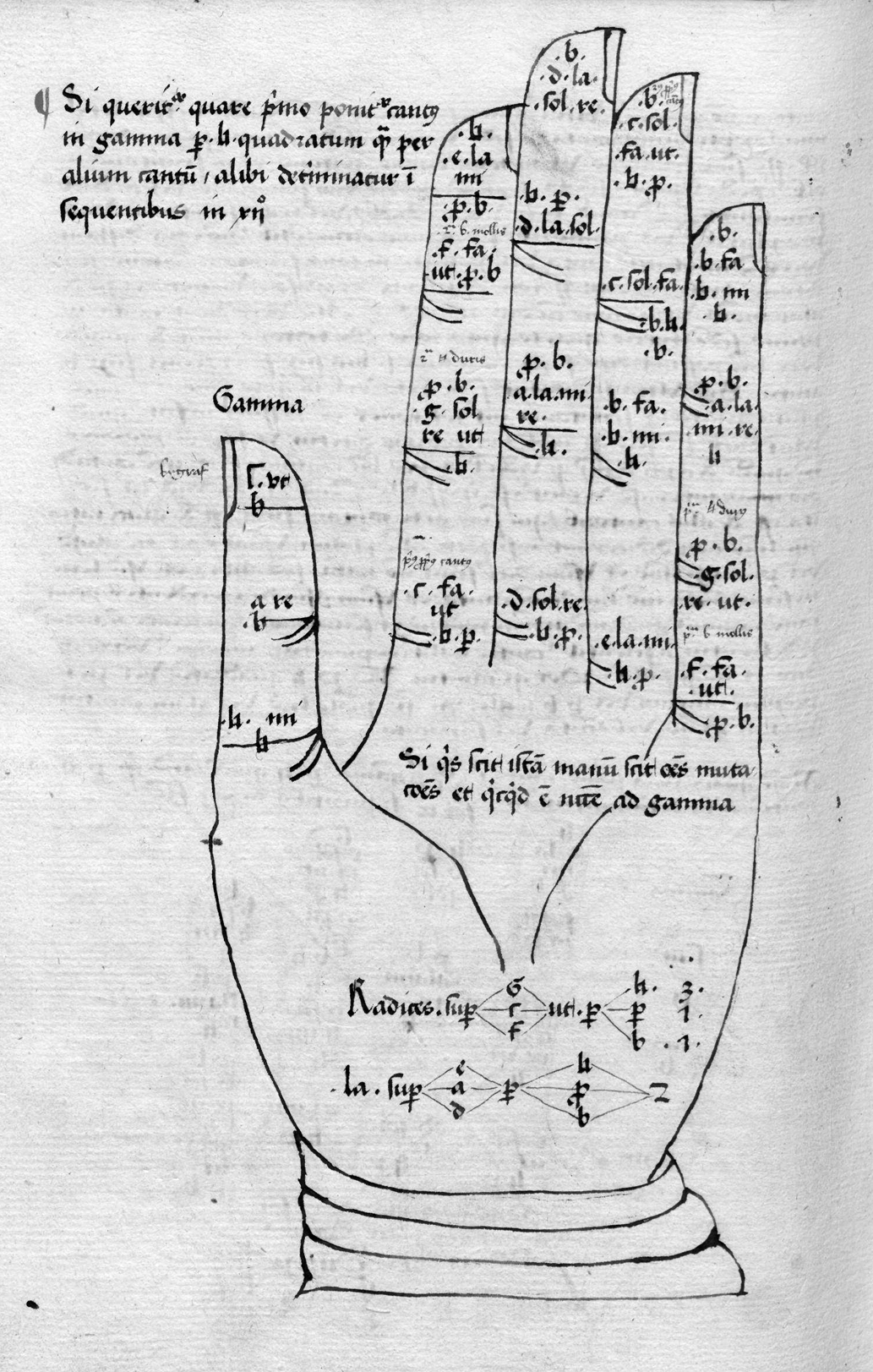
Fig. 1, for instance, shows the musical hand accompanying the Practica artis musice by Amerus, written c.1271.Footnote 1 The proprietates are indicated by three symbols, ‘bequadro’ (‘hard’), ‘bemolle’ (‘soft’) and ‘p’ (‘properchant’, Amerus's term for proprietas naturalis). The inscription at the bottom of the palm signals the mnemonic function of the hand: it provides short rules for positioning the syllables ut and la against the litterae of the gamut – respectively G, C and F, and E, A and D – in addition to numbering the seven proprietates of musica recta (three by ‘B durus’ and two by ‘properchant’ and ‘bemolle’). The upper caption introduces the hand as a sine qua non for navigating the gamut (that is to say, for singing): ‘Si quis scit istam manum scit omnes mutaciones et quicquid est necesse ad gamma’ [emphasis mine].Footnote 2
A ‘Guidonian Hand’, part of Amerus's Practica artis musicae (1271) from Trier, Seminary Library, Hs. 44, f. 319v (fifteenth century; origin unknown).

Yet the method also had its detractors. Writing several generations after Amerus, Johannes Ciconia would derogatorily refer to the complex musical mnemotechnics of the hand as the ‘computus Guidonistarum’, which he considered less desirable than the monochord in musical instruction.Footnote 3 Half a century later, Johannes Gallicus reminded his readers that a person without hands would still be able to learn how to sing.Footnote 4 As this article will seek to demonstrate, there is more than one reason for regarding hexachordal solmisation as a pedagogical option for medieval and Renaissance singers, rather than as a foundational principle of the medieval tone-system.
The relatively late historical origin of the hexachordal system raises a host of questions about its significance and function in the context of late medieval musical theory and practice. One set of questions has to do with the state of chant theory and practice in the roughly two hundred years that separated the emergence of the hexachordal system from the earliest known mention of the method of solmisation in Guido's Epistola ad Michahelem. To wit: what was the impact of the syllables in musical practice during that period, which may perhaps be viewed as the ‘pre-historic phase’ of the hexachordal system? More precisely, what specific function did the syllables play in the new era of staff notation, and in the context of pre-existing methods of pitch designation based on the letters of the alphabet? Finally, to what extent, if at all, did the six syllables impose their ‘sixth-ness’ on the medieval perception of diatonic space and, if so, when and how did this momentous redefinition of the diatonic space become a shared convention, or even a musical reality of sorts?
A second set of questions, which will be addressed only tangentially in the present study, pertains to the historical circumstances that led to the introduction and gradual acceptance of a full-fledged system around the middle of the thirteenth century. What particular historical forces (pedagogical, intellectual, etc.) led to such result at that particular time? To what extent was the rise of hexachordal theory an answer to specific musical problems or needs, as opposed to a product of interdisciplinary exchanges with other branches of knowledge, or even of theory for theory's sake? Last but not least, what does the formulation of the hexachordal system reveal about the relationship between music theory and musical practice in the late Middle Ages?
These questions are worth investigating not only because they impinge directly on important aspects of day-to-day musical practice in the Middle Ages, but also, and more importantly, because they may yield precious insights on deeper historical issues that are of vital import to our efforts at reconstructing the medieval tonal consciousness, both in and of itself, and in relation to that of different ages. To explore the significance of the six syllables to that tonal consciousness is to investigate their precise role towards shaping the musical mindset (however homogeneous or changeable) of the musicians who presumably relied on them on a daily basis.
This article is concerned primarily with the changing perception of the ut–la syllables as a semiotic link between notation and performance in relation to the seven letters (A–G). If the six syllables indeed shaped the medieval musical mindset from the ground up, then they must have acted as a key signifying agent for singers in the act of translating notated sounds into audible ones, so that by solmising a melody they would have understood its constituent pitches and intervals as operating within a hexachordal framework. It soon becomes clear, then, that to test the hypothesis of hexachord-based diatonicism in the Middle Ages is to test the very possibility for modern listeners – steeped in radically different notions of musical space – to make aural sense of medieval music.
The topic of the semiotic function of the syllables is sometimes openly discussed, and at other times addressed indirectly in a number of music theory treatises from the eleventh century to c.1500. Analyses of a select number of these texts, offered below, reveal that the six syllables were ostensibly described more and more as an essential notational signifier beginning around the second half of the thirteenth century. At the same time, however, the treatises of that period consistently recognised the seven litterae as the building blocks of the gamut, implicitly characterising the hexachordal system as a ‘soft’ superstructure laid over the heptachordal hardware of the tone system. Paradoxical as this may seem, a contextual reading of the relevant sources supports the argument that the development of the hexachordal parsing of the gamut in the late thirteenth century did not amount to a radical rethinking of the structure of the tone system, much less of the semiotics of notation set forth with the adoption of the A–G letters and of the musical staff in the first decades of the eleventh century.
The guiding thesis of this study, in other words, is that the ascribed semiotic weight of the syllables increased with the formulation of the hexachordal system in the thirteenth century, partly as a result of the renewed attention placed on the syllables in their new, systemic guise, and partly because the complex machinery of the new system took on a life of its own, so that a number of authors portrayed the basic elements of that system (i.e. the six syllables) as the prime agents and as the fundamental building blocks of diatonic space. The apparent ‘hexachordalisation’ of diatonic space in music theory after c.1250 marked the beginning of a broadly influential interpretation of the Guidonian syllables that has tended to overemphasise both their practical value and their significance as a link in the semiotic chain from notated to audible sound and vice versa. Yet the inner workings of the new hexachordal system in the end only confirmed the heptachordal nature of the underlying diatonic order, defined by the recurring cycle of the seven litterae that had been set into place at the turn of the second millennium. The long pre-systemic phase of the six syllables provides a unique opportunity for a critical reassessment of the relationship between the uneven sets of litterae and voces in the Middle Ages, and it is by taking a close look at the treatises of that period that my inquiry begins.
In both content and title, the present contribution harks back to Jacques Handschin's observation that ‘the six pitches [of solmisation] imply the seventh one’.Footnote 5 To Richard Crocker, Handschin's insistence on the centrality of the heptachordal model in medieval theory was a methodological liability in that it amounted to studying musical practice ‘sub specie aeternitatis’ (i.e. from the perspective of speculative theory).Footnote 6 Crocker's conclusion that ‘the hexachord … remained the central concept for both chant and polyphony up through the 16th century’ reflected his larger methodological goal of reading Latin music theory as the response to the interests and constraints of a praxis that was by definition historically contingent.Footnote 7
The normative role of the octave in medieval music, however, greatly exceeded the domain of speculative theory: it was the starting point of medieval presentations of the diatonic intervals, the theory of the consonant species, and the related theory and practice of counterpoint, to name only a few examples. The very notion of the diatonic system as a cycle, marked by the recurring set of seven letters introduced around the year 1000 by Pseudo-Odo's Dialogus, was grounded on the aural experience, not just the theoretical rationalisation, of octave equivalence (more on this below). Thus, to assess the theoretical significance of hexachordal solmisation against the heptachordal mapping of diatonic space is not to evaluate musical practice from an ahistorical standpoint taken a priori; rather, it is to deepen our inquiry on how the two ‘competing’ representations of the tone system, both firmly rooted in musical practice, happily coexisted for centuries.
The resistible rise of the six syllables in the post-Guidonian era
The ut–la syllables entered medieval music theory through the back door. Guido of Arezzo himself dedicated no more than a relatively short paragraph of his Epistola to them, reverting to the A–G letters (without syllables) in the later sections on the modes and the diatonic affinities.Footnote 8 The other three treatises by Guido, all written at earlier times, make no mention of the ut–la syllables.
For their part, theorists of the immediate post-Guidonian era followed suit: the overwhelming majority of them completely disregarded the topic of six-syllable solmisation, while only a handful integrated them into their graphs and tables surreptitiously, offering no explanation for their specific place and function within the diatonic system. In some cases the syllables might be later insertions. The impression is that the ut–la syllables, in this early phase, were used in a thoroughly pragmatic and unsystematic manner, in a way that is closely reminiscent of Guido's Epistola. In other words, for many generations after Guido the six syllables were apparently perceived as carrying no structural or foundational weight whatsoever; such weight was instead attributed to the seven litterae monochordi.
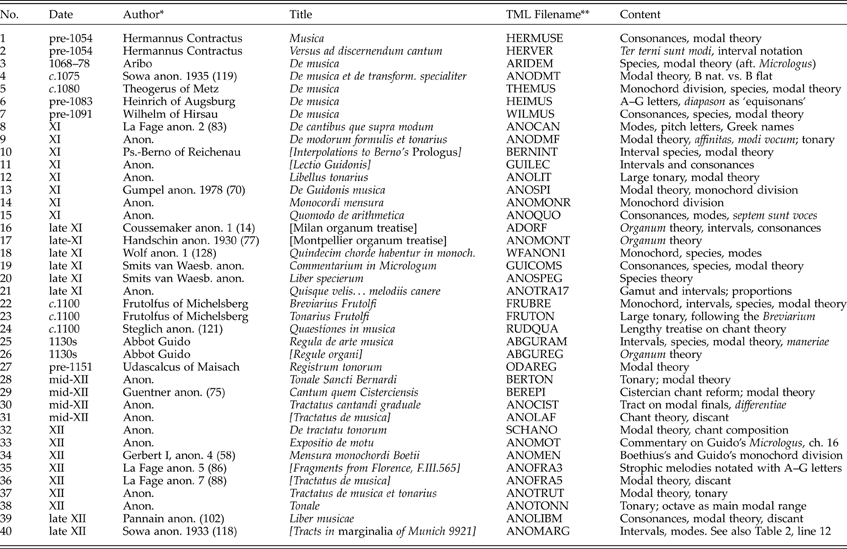
While there is evidence that six-syllable solmisation had already been adopted in limited areas shortly after Guido, a survey of music theory texts from c.1050 to 1200 indicates that those areas were more the exception than the rule. Table 1 lists a significant number of treatises from that period that do not mention the syllables. Significantly, the table includes widely influential texts, such as those of the Reichenau School, the treatises of the Cistercian chant reform of the twelfth century, as well as many other treatises of both practical and more speculative orientations. The conclusion seems inescapable that the presumed hexachordal understanding of the diatonic space was foreign to the process of consolidation of the ‘critical nexus’ of tone-system, mode and notation that took place in the two centuries after Guido.Footnote 9
Chant theory without references to the ut-la syllables (c.1050–1200)
* The editors' names and catalogue numbers (in parenthesis) used in this column refer to C. Matthew Balensuela, ‘Anonymous theoretical writings’, Grove Music Online. Oxford Music Online (Oxford University Press; accessed 7 August 2013), www.oxfordmusiconline.com.proxy.lib.umich.edu/subscriber/article/grove/music/00969.
** TML: Thesaurus musicarum latinarum, www.chmtl.indiana.edu/tml/start.html (accessed 7 August 2013).
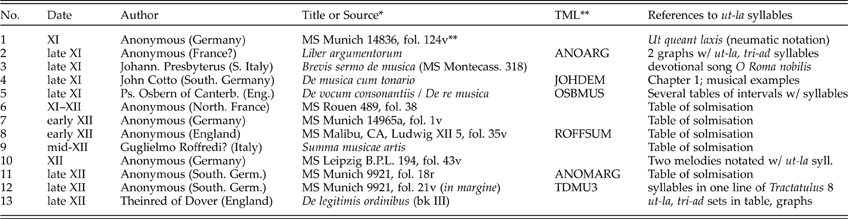
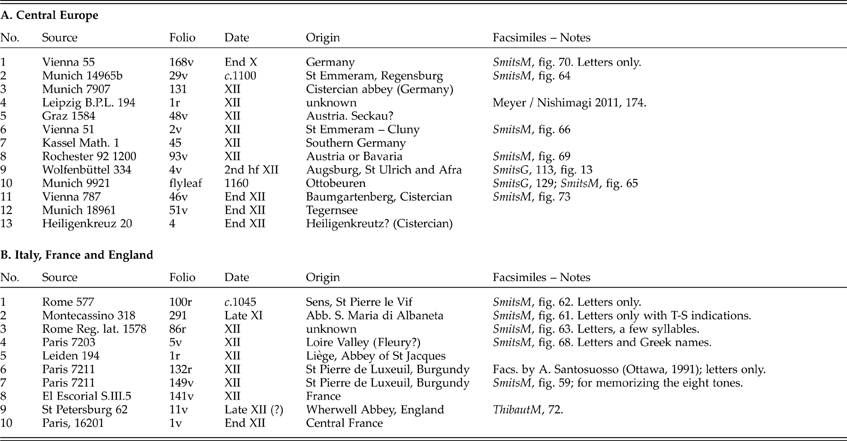
In contrast, Table 2 itemises the treatises from the same period (c.1050–1200) that mention the Guidonian syllables (again, the list does not pretend to be exhaustive; rather, it is only indicative of a general state of affairs). It consists almost exclusively of solmisation tables and didactic examples that were typically not described any further in the main text of the ‘host’ tract or treatise. The exception confirming the rule is John of Afflighem's Musica (also known as John Cotto; Table 2, no. 4), in which the author singles out the syllables and the hand as essential tools for learning the rudiments of singing, and offers tantalising information on the spread of syllabic solmisation across Europe.Footnote 10 John's explicit and, for its time, apparently unique recommendation of the solmisation syllables is consistent, however, with the significant number of ‘Guidonian’ hands originating from southern Germany, the primary area of circulation of John's treatise (see Table 3a). Although Table 2 is incomplete, in its present form it points to northern Europe, rather than Italy, as the region where the method of solmisation initially took root and perhaps even originated. By contrast, Italian theorists appear to have been notably uninterested in developing the technique.
Chant theory with references to the ut-la syllables (c.1050–1200)
* For information on the manuscript sources in this list, see the Répertoire International des Sources Musicales (RISM), Series B/III: ‘The Theory of Music. Manuscripts from the Carolingian Era up to c.1500. Descriptive catalogue’, vols. 1–6 (Munich, 1961–2003); Christian Meyer and Shin Nishimagi, Tractatuli, excerpta et fragmenta de musica, s. XI et XII (Brepols, 2011); and the Lexikon musicum Latinum (LmL) published by the Bayerische Akademie der Wissenschaftern, www.lml.badw.de/info/index.htm (accessed 7 August 2013).
** TML: Thesaurus musicarum latinarum, www.chmtl.indiana.edu/tml/start.html (accessed 7 August 2013).
The key observation about the tables and the examples listed in Table 2 is that in them the six syllables did not function as members of overarching hexachordal segments, as will be the case in later times. Rather, in this early, ‘unincorporated’ phase, they possessed all the characteristics of nomina vocum, as some later theorists would call them. The seven litterae were themselves nomina vocum, of course, though with the crucial distinction that the litterae identified the essential diatonic steps of the gamut originating from monochordal divisions that, in turn, followed the immutable law of numerical proportions. In addition, the seven litterae conveyed the centrality of the octave span (diapason: ‘through all’) within the continuous series of discrete sounds that constituted the gamut. There is evidence that the diatonic equivalence of musical sounds an octave apart already informed musical listening in the days of Hucbald and the Dialogus.Footnote 11 In this sense, the divisions of the monochord may be regarded both as a speculative activity and as providing a rationale for a basic principle of music cognition that arguably even preceded the introduction of the A–G letters around the year 1000. In short, it can be argued that the litterae, though very similar to the syllabae in semiotic function, were one step closer to the perceived reality of the tone system.Footnote 12
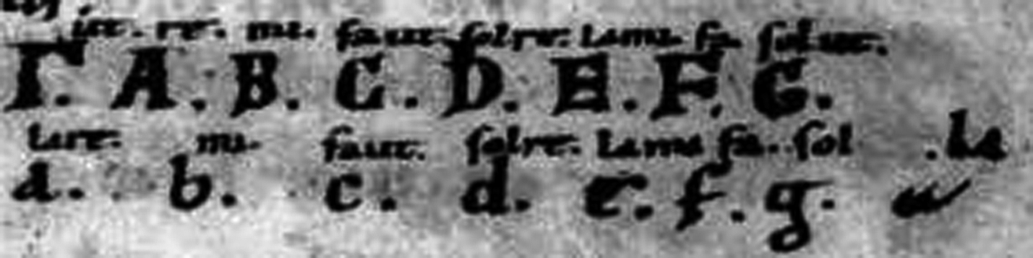
The arrangement of letters and syllables in the solmisation table found in Munich 9921, fol. 18r (Table 2, no. 11), provides additional support for this conclusion (see Fig. 2). Far from imposing a hexachordal footprint on the litterae, the syllabae in the table have all the appearance of a decorative, accidental element, like tiny sparrows perched atop massive monuments. Contrariwise, the letters are neatly lined up to highlight the double-octave span of the gamut (though the lower octave is notated above the higher one).
Early solmisation table (Munich, Bayerische Staatsbibliothek, Clm 9921, fol. 18r, copied at the monastery of Ottobeuren in 1160).
The musical hands listed in Table 3 also point to the ‘soft’ interpretation of the syllables proposed here. Perhaps the most startling conclusion to emerge from the list – again, to be taken as merely indicative, pending a more thorough examination of the sources – is the virtual absence of hands with syllables originating in Italy, France and England before c.1200. Central European areas, however, appear to have enthusiastically embraced the method. Even making allowances for the loss of many musical hands from that period, this statistical information suggests (barring contrary evidence) that in large areas of twelfth-century Europe basic musical instruction was routinely conducted without the help of the ut–la syllables.Footnote 13
Musical hands in music theory manuscripts (c.1050–1200)
Legend:
SmitsG: J. Smits van Waesberghe, De musico-pedagogico et theoretico Guidone Aretino eiusque vita et moribus (Florence, 1953).
SmitsM: J. Smits van Waesberghe, Musikerziehung. Lehre und Theorie der Musik im Mittelalter, Musikgeschichte in Bildern, ed. Heinrich Besseler and Werner Bachmann, vol. III/3 (Leipzig, 1969).
ThibautM: J.-B. Thibaut, Monuments de la Notation Ekphonétique et Neumatique de l'Eglise Latine (St Petersburg 1912, reprint Hildesheim, 1984).
Against this view, one might argue that the unenthusiastic reception of the six syllables in chant theory of the immediate post-Guidonian era may tell only part of the story, as the new method of solmisation may have travelled primarily in an oral fashion, through word of mouth from the magistri to the singing pueri, without leaving much of a trace in writing. Although this is a legitimate argument, surely the negative evidence of the treatises is significant, as it suggests that the six syllables were simply not a factor in the process of consolidation of the ecclesiastical modal system and of staff notation that took place in the eleventh and twelfth centuries. Conversely, the written sources indicate that the determining factor in that process, if there was one, was the universal acceptance of the A–G letters as an intuitive method for designating the steps of the gamut for all practical purposes.Footnote 14 If the introduction of the six syllables had caused a radical reconceptualisation of the gamut, as a number of scholars have argued or implied, it is difficult to imagine that contemporaneous theorists would not have left behind a sizable paper trail documenting such a momentous transition.Footnote 15
The ‘hexachordalisation’ of musical space in the thirteenth century
Given the remarkably scant presence of the six syllables in chant theory in the two centuries after Guido, the rapid emergence of a full-fledged hexachordal system in the mid-thirteenth century can only be described as a watershed in the history of Western music theory. As I hope the following discussion will demonstrate, the impetus for systemising hexachordal theory did not originate from the world of musical practice, as taught in cathedral schools and monasteries, but rather from a new generation of university-trained authors who were interested less in proposing more effective techniques for sight-singing, than in understanding the combinatorial process by which the building blocks of music related to one another. A predominantly intellectual and speculative pursuit replaced the pragmatic attitude of the cantus tradition of music theory.Footnote 16
A case in point is the treatise Introductio musicae planae secundum magistrum Johannem de Garlandia, which may have been penned by a student of Garlandia.Footnote 17 When the subject turns to Guido's six syllables in the initial pages of the treatise, one senses that Garlandia does not approach Guido's syllables as a mnemonic aid, but rather as a self-standing diatonic set that is worthy of an intellectual investigation for its own sake. For instance, Garlandia writes that:
The first syllable ut does not lead back to the remaining ones – re, mi, fa, sol, la – but rather re mi fa sol la are referred back to the first syllable by virtue of its special status. This is so because, as the philosopher says, all things of nature, both the integral wholes and the subjective parts, have a foundation to which everything reverts, and for this reason it is said that everything is referred back to that foundation and not to other parts, but rather those other parts to it, as I have said before.Footnote 18
A couple of centuries later, in his Expositio manus (c.1472–73), Johannes Tinctoris would propose the argument that ut was the vox radicalis of the hexachordal deductio by virtue of being the first syllable of the set.Footnote 19 But the appeal to the doctrine of fundamentum misses the point here: the syllable ut did not possess a higher hierarchical status than the others for the simple reason of being the first syllable; it was, in other words, quite different from the finalis of a church mode. Indeed, ut may have been less utilised than other syllables in the practice of solmisation precisely because it lies at the extreme end of the syllabic set. Far more important to the technique of solmisation was, rather, the identification in any given melodic context of the position of the semitone mi–fa, which could then serve as a momentary point of reference for allocating the adjacent pitches to the remaining syllables. In short, the notion of vox radicalis seems to herald the advent of a more speculative and less practical approach to solmisation that implicitly confers theoretical significance and structural weight to the syllables.
In line with this interpretation, the thirteenth-century ‘hexachordalisation’ of the gamut involved a decisive shift in the meaning of two crucial terms of Carolingian and Guidonian chant theory, namely proprietas and vox. As it is well known, in his writings Guido repeatedly invites singers to familiarise themselves with the proprietas of the seven basic diatonic steps, by which he meant the intervallic context surrounding the position of each pitch of the gamut, indicated by a letter of the alphabet. In his view, singers would be able to sing with ease after becoming aware of the characteristic proprietates of the seven letters compared with one another. While it is true that Guido often describes the proprietas of the pitch letters as spanning the range of a major sixth, it should be recognised that with this strategy he merely meant to emphasise the similarity of modus vocis between pitches a fourth apart – the property of diatonic affinity that constitutes the foundation of the method of solmisation.Footnote 20 But there is no affinity without a measure of divergence: the proprietates of C and G share the span of a major sixth ascending, but they also differ on the seventh step (descending semitone from C, descending whole tone from G) – the very reason why, after all, the two pitches were named with different letters of the alphabet.Footnote 21 The practice of solmisation cleverly disregards that difference (for instance, every time it places ut on both C and G to solmise an ascending melodic line), but it also acknowledges the break in affinitas – ergo, the reality of heptachordal space – when it places fa on C and sol on G in descending melodies. All pairs of pitches a fourth or fifth apart exhibit this diatonic discrepancy on a different diatonic step, beyond which the common span of the major sixth resumes.Footnote 22
The Guidonian notion of proprietas as characteristic to each of the seven pitches emerges also in the crucial section of the Epistola dedicated to the ut–la syllables. After introducing the hymn Ut queant laxis, Guido explains:
And thus do you see that this melody begins in each of its six phrases with six different pitches? If someone, thus trained, knows the beginning of every phrase so that he can without hesitation immediately begin any phrase he chooses, he will easily be able to sing the same six pitches according to their properties wherever they appear.Footnote 23
A singer familiar with the hymn will have committed to memory the proprietates of the pitches from C to a that are found at the beginning of each phrase so that, when singing an unknown chant, the corresponding syllables ut–la will remind him of the exact intervals surrounding each letter. Did Guido implicity omit pitch B in this context because he meant to establish the hexachord as a normative diatonic segment? Dolores Pesce's answer, in substantial agreement with Crocker's, is ultimately affirmative, though carefully nuanced: ‘The Epistola does not explicitly link the didactic tool “Ut queant laxis” (grounded in six syllables) with the two similar six-note pitch segments G–e and C–a. But the concept of an underlying sixth with fixed interval relationships is also fundamental to the ut–la tool.’Footnote 24
Implicit in Pesce's argument is the conclusion that the ut–la tool also affects the deeper structural level of the underlying letters, so that the hexachordal proprietas in the end emerges as the normative yardstick of the post-Guidonian gamut. In line with this view, Pesce points out that ‘choosing six-note segments related to a broader intent on Guido's part – understanding the construction of the gamut’.Footnote 25 However, the suggestion that the ‘ut–la tool’ ipso facto establishes the underlying sixth C–a as the regulative segment of the gamut disregards the fact that the medieval construction of the gamut, rationally obtained through a series of monochordal divisions, was grounded rather on the principle of octave equivalence, as confirmed by the introduction of the A–G letters around the year 1000. Consequently, the major sixth underlying the ut–la syllables may be characterised as a diatonic yardstick only for the specific purpose of solmisation, not as the overriding constructive principle of the gamut. One may easily concede that the ut–la tool was designed as a mnemonic paradigm, without going as far as to posit that the diatonic default had to be structured likewise hexachordally. For the ut–la tool to be an effective medium for sight-singing, the only requirement is that the underlying diatonic system be amenable to hexachordal parsing with relatively few overlaps, as it was indeed the case with the seven-step gamut.
Ut queant laxis, at any rate, needs to be placed in the context of Guido's writings. It is especially revealing that immediately after introducing the ut–la syllables Guido introduces another didactic exercise consisting of seven chant formulae, the first one beginning with the words Alme rector, each preceded by captions such as ‘A et D concordant in elevatione’, ‘B et E concordant in depositione partim in elevatione’, etc.Footnote 26 Pesce has recently characterised these formulae as a ‘more abstract, systematic exercise to complement the associative learning of a tone's property as offered by Ut queant laxis’.Footnote 27 Whether Alme rector fosters a more ‘abstract’ learning of the proprietates than Ut queant laxis is debatable, as the ultimate goal of both exercises is to imprint mnemonic associations in the singer's mind between the pitches of the scale and the intervals surrounding them. More importantly, Alme rector subsumes Ut queant laxis, rather than simply complementing it, by exploring the proprietates of all septem discrimina vocum in ascent and in descent, and by illustrating the extent of the diatonic affinity – thus, by implication, of the discrepancy as well – of pitches a fourth apart. That Guido did not mention the ut–la syllables in the captions of Alme rector suggests that, to him, Ut queant laxis offered a simplified, if rudimentary point of entry for singers into the workings of the diatonic system, a method soon to be phased out by a more thorough and systematic assimilation of the proprietates of each of the seven pitch letters.
To summarise, the Guidonian proprietas was a flexible, letter-centred concept that accounted for the diatonic particularities of each of the seven voces, as well as for the commonalities between them. Later theorists such as Garlandia and Amerus, however, abandoned the letter-centred notion of proprietas, which they came to conceive rather as a fixed and transposable range, that is, as a scale of sorts, possessing paradigmatic value. In Garlandia's words:
In every melody there are three properties [C–a, G–e, and F–d with B flat], which suffice to demonstrate and clarify all songs. The reason why they are called properties is that they deliver to us, rightfully and truthfully, the proper information for singing tones and semitones.Footnote 28
It is one thing to observe (in the spirit, if not in the letter, of Guido's Epistola) that the ut–la syllables may be attached to diatonic pitches a fourth away from each other in a gamut unequivocally described as octave-based. But it is quite another to consider the major sixth underlying the ut–la syllables as a self-standing segment, to refer to it with a designated term (proprietas) and to categorically state that in its threefold variety that diatonic unit ‘suffices to demonstrate and to clarify all songs’. Implicit in the latter position is the suggestion that the ut–la syllables somehow impose their ‘sixth-ness’ onto the seven letters, ipso facto defining the resulting hexachordal segments as a diatonic paradigm shaping musical space from the ground up.Footnote 29
Especially noteworthy in the citation above is the suggestion that the proprietates are essential signifiers that convey vital information to anyone who is reading musical notation. Presumably, a singer would not be able to extract the notitia canendi, that is to say, ‘the proper information about tones and semitones’, without a clear understanding of the proprietates. Thus we are not surprised when, several paragraphs later, Garlandia states that ‘each property contains and encompasses six letters and six syllables’ (‘Et sic quaelibet proprietas sex litteras et sex voces continet et comprehendit’).Footnote 30 Such a wording seems to imply that the seven letters themselves are unable to signify intervallic distances until yoked to the six syllables. By a kind of reverse logic, the part has acquired more structural significance than the whole: the subset of six letters, because of its association with the syllables, is ascribed a higher normative role than the entire set of seven letters.
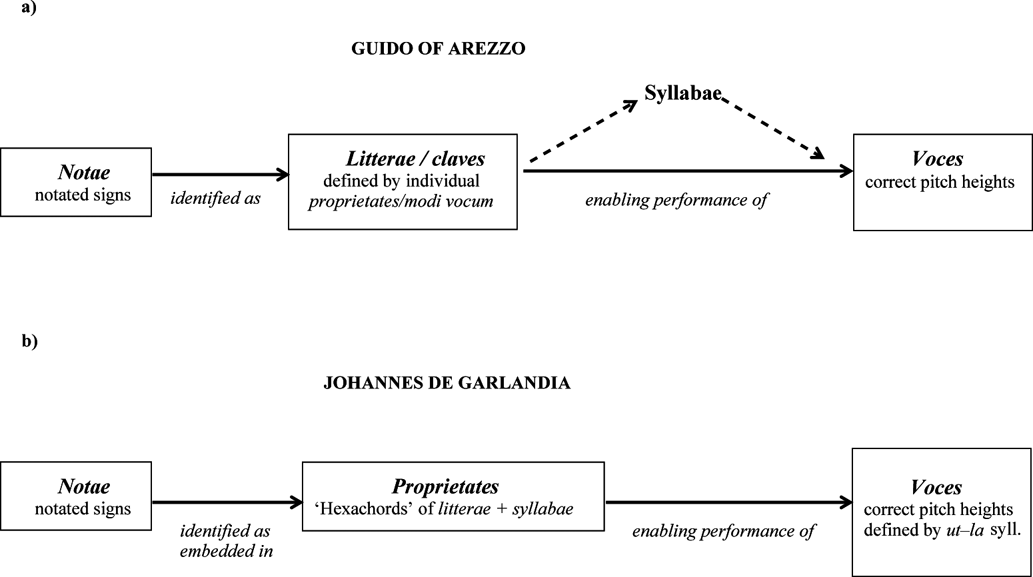
Garlandia and his contemporaries, in other words, subverted the semiotic chain of nota, littera and vox, which had been one of the most notable achievements of Carolingian and Guidonian theory. Key to that model was the littera, a lexeme (dictio) that was capable of marking – thus, of signifying – a particular sound (vox) within the diatonic continuum. On the written front, the new device of staff notation allowed the graphic representation of the voces as notae, which could again be identified as litterae by means of reference points called claves or ‘keys’, themselves litterae in graphic form. To sight-sing a melody was to proceed from nota to littera to vox, whereas to notate a melody from memory or from listening implied the opposite trajectory (see Fig. 3a). In this scenario, the ut–la syllables were recognised as a useful aid for beginners in the act of converting litterae into actual sounds or voces. They played, however, no indispensable role.
The semiotics of notation in Guido of Arezzo and Johannes de Garlandia.
However, in the new understanding of staff notation that accompanied the ‘hexachordalisation’ of the gamut, the proprietates – redefined as hexachordal segments – replaced the individual litterae as the central element enabling the flow of information from the staff to the singer's mind (see Fig. 3b). The result is nothing short of a semiotic revolution, a complete reversal of the Guidonian model. Although at the bottom the proprietates still consist of litterae, as shown by Garlandia's own text, it is clear that the range and the form of the proprietates are ultimately dictated by the six syllables (the deductio) that are always implicitly overlaid onto them. In practice, it is the various combinations of syllabae and litterae – the loci that beginners were used to mapping on their left hand – that now provide ‘the proper information for singing tones and semitones’ to the singers.
Again, interpreted along these lines, Garlandia's theory of the proprietates appears to diverge in crucial respects from its Carolingian and Guidonian antecedents. At a closer evaluation, however, one may conclude that it simply needs to be read in the proper context. Like Guido in the Epistola, Garlandia relegates hexachordal theory to the margin once he moves on to discuss the diatonic intervals and the modes. In that lengthy section of the Introductio, the pitches are indicated exclusively by means of the litterae, save for a pair of references to ‘gamma ut’, and even the term vox resumes the Guidonian meaning of ‘pitch’ in sentences such as: ‘[Quartus tonus] deponitur vero a finem duobus tonis ad terciam [C] aut ad secundam [B] et primam [A] quia ad suum finem [E] secunda dyatesseron [B–E] et prima dyapente [A–E] consonancia reddit fiuntque voces decem per tonos et semitones. Forma quarti toni: a b c d e f g a b c.’Footnote 31
Garlandia may have modelled his modal theory on a much older treatise, that is, the Pseudo-Odonian Dialogus de musica.Footnote 32 Even so, it is significant that Garlandia did not feel the need to update his model to reflect the parsing of the diatonic space imposed by the hexachordal system that he presents in so much detail only a few chapters earlier. After emphatically claiming that the three proprietates ‘suffice to cover and to justify all songs’, why does the author not adjust his modal theory to highlight the role of those proprietates towards shaping the structure of each mode? One possible answer has to be that Garlandia, while he described the hexachordal system in a notably ‘foundational’ rhetoric, ultimately saw it as a ‘soft’ superimposition over the underlying layer of the seven litterae.
The discussion of the use of B flat in each of the eight modes offers yet another striking indication of the limited function of the theory of the proprietates within Garlandia's musica plana. The author explains that in particular contexts a notated B natural has to be understood (and sung) as B flat:
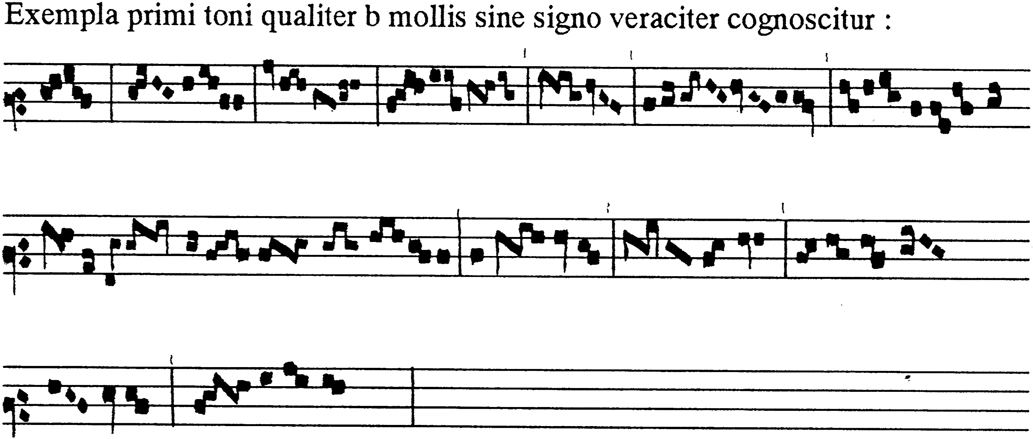
Although the first mode is sung naturally by B flat according to Guido, there is an infallible and excellent reason for this that cannot be contradicted – namely, the diatessaron showing that there a B flat is located. This diatessaron, which consists of two tones and a semitone, is embedded in every mode, as shown below, and may be conjunct or disjunct. When it begins on F, conjunct or divided by short or long leaps, there a B flat without the flat sign is located.Footnote 33
Garlandia's examples are given in Fig. 4.
Johannes de Garlandia's examples of unnotated B flats in protus melodies. From Christian Meyer, ed., Musica plana Johannis de Garlandia (Baden-Baden and Bouxwiller, 1998), 90. The original caption reads: ‘Examples of the first mode [showing] how B flat without the flat sign is accurately recognized.’
The salient observation here is that ‘b mol’ is a pitch, a point in the diatonic continuum, not the proprietas per b molle and not even the syllable fa, neither of which apparently has any role to play when identifying unnotated B flats. The deciding factor in that process is rather the diatessaron, which Garlandia repeatedly describes as a constituent element of the modes. Quite remarkable also is the appearance of the verb ‘cognoscitur’ in this particular context. As I have observed, in earlier chapters Garlandia had placed on the proprietates the burden of transmitting the information on tones and semitones. In this particular passage, however, Garlandia appears to be saying that such information may be gleaned simply by considering the outer boundaries of the modal tetrachord understood as litterae, that is to say, in blissful disregard of the hexachordal proprietates. No doubt a literal case of the right hand not knowing what the (musical) left hand is doing, though there is no real contradiction in this strategy. Garlandia can think ‘hexachordally’ when discussing the method of singing, and ‘heptachordally’ when presenting the modes, because of the functional and hierarchical relationships that tie together the two diatonic models.
In light of these considerations, it may be incorrect to read Garlandia's earlier wording (‘In every melody there are three properties’) as implying per se a hexachordal understanding of the tone system. All the sentence means is that a singer will be able to solmise each and every pitch of musica recta by means of those three properties, if he chooses to do so. Garlandia is also technically correct when he claims that his proprietates ‘provide the proper information for singing tones and semitones’. Guido's syllables, after all, would be useless if they did not convey just that information. The problem is, in the end, one of ‘rhetorical’ emphasis: Garlandia's presentation of the hexachordal system loses sight of – or, perhaps, simply takes for granted – the accessorial function of the syllabae, which could indeed remind singers of the intervallic distances between the pitches of the gamut, without however determining those distances in the first place.Footnote 34
Letters and syllables as ‘equal partners’
If the term proprietas underwent a momentous change in the thirteenth century, so did the related term, vox. Prior to that time, vox indicated a ‘discreet sound’, eventually identified with one of the seven main pitches of the gamut. Virgil's description of Orpheus playing his lyre with the ‘seven distinctions of pitches’ (septem discrimina vocum) was cited countless times in medieval and Renaissance music treatises to support the idea of the seven constitutive steps of gamut marked by the litterae and corresponding to particular positions on the monochord.Footnote 35 In Guido of Arezzo's writings, a vox is not surprisingly a musical sound expressed by one of the seven letters, or more simply one of the seven pitch letters themselves.Footnote 36 After c.1250, however, vox became the term of choice for indicating a Guidonian syllable, even though the old meaning of vox as a musical pitch marked by a letter never completely disappeared. The ambiguous use of the term vox in the late Middle Ages betrays a growing confusion on the basic relationship between res and verba, that is to say, between the pitches of the gamut, their notation on the staff, and the labelling systems set up to designate them.
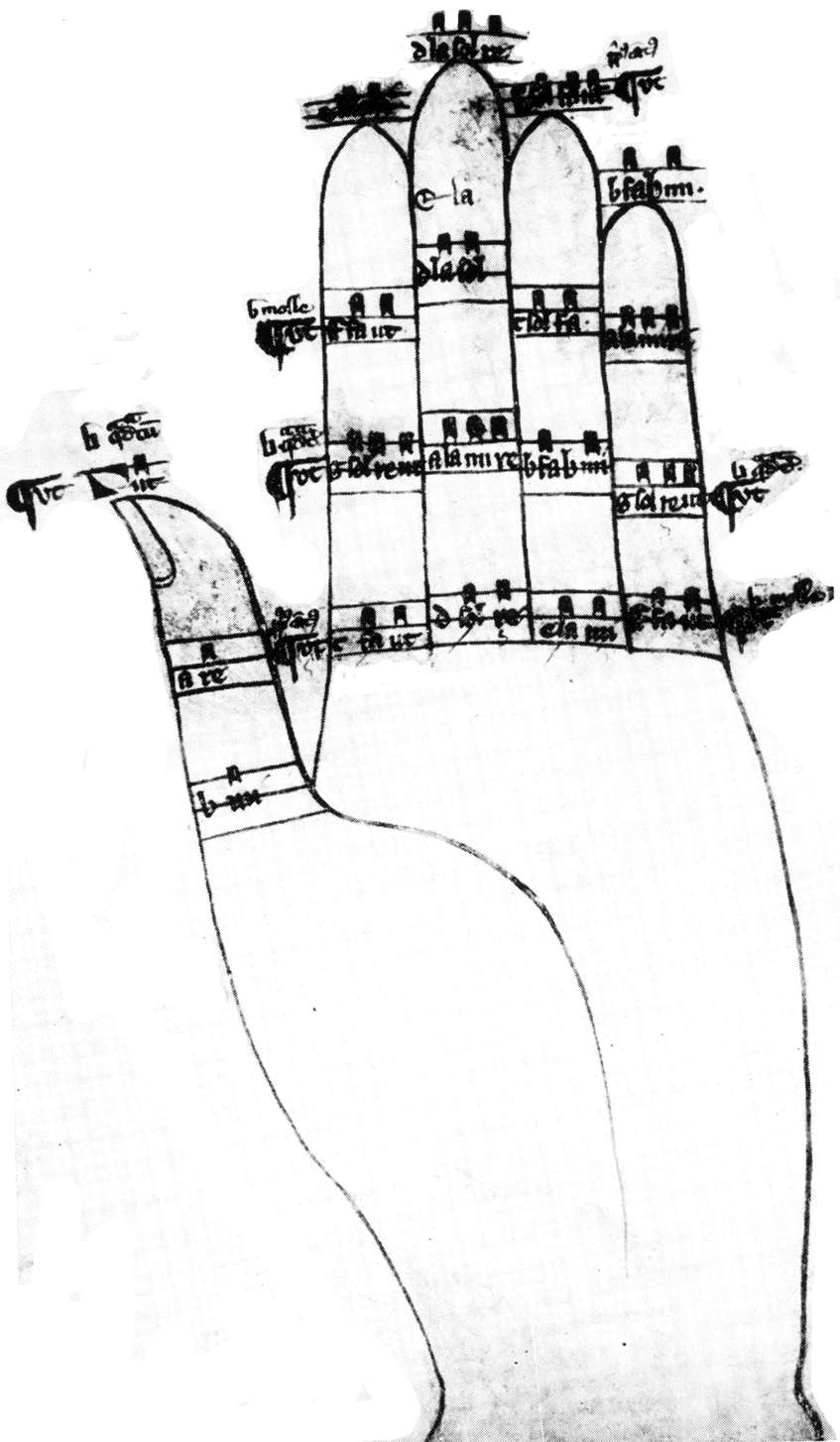
The conceptual shift in the meaning of vox roughly coincided with the novel practice of indicating on the musical hand not just the loci marked by letters and syllables, but also the position of each pitch on the musical staff using square notation (for an example, see Fig. 5).Footnote 37 Typically, the hands belonging to this group did not indicate one square note per pitch (or for every vox, in Guido's understanding of the term), but as many square notes as the number of syllables corresponding to that locus, that is to say, as the number of vocabula vocum (or of voces in the general thirteenth-century use of the term). This kind of representation proposes a misleading semiotic path, in that it attributes to the voces a musical weight that they were not designed to carry. It is not that each vox, conceived as a Guidonian syllable, corresponded to a square note on the page, as suggested by these images. Rather, the same square note could be labelled with different Guidonian syllables in the practice of solmisation – a mental association, however, that Western notation has consistently chosen to disregard.Footnote 38 Again, the problem is one of mistaking verba for res.
The Guidonian Hand in MS London, British Library, Royal 12.C VI, fol. 52v (England, late thirteenth century). Each syllable has been made to correspond to a nota in square notation.
Late medieval proponents of the ‘strong’ view of solmisation, who portrayed either the syllables or the hexachordal proprietates underlying them as an indispensable step for reading musical notation, implicitly embraced a ‘weak’ view of the litterae, in the sense that they presented the litterae as unable to unequivocally ‘signify’ pitches and intervals without the critical help of the syllables. In a nutshell, to many medieval theorists the litterae and the Guidonian syllabae were equal partners, so that one could not signify without the other. Those writers embracing this novel semiotic model inevitably lost sight of the functional relationships between the various components of the system, often limiting themselves to listing all the possible ways in which those components could be combined with one another (we often read that the system featured twenty loci, forty-two voces, seven proprietates and deductiones, etc.). The new system was a triumph of ars combinatoria for its own sake that had little in common with Guido's guidelines for sight-singing, even when it did not openly contradict those guidelines.
The syllables-centred approach to musical notation appears to have been predominant through the fifteenth and sixteenth centuries, save for the notable exceptions of prominent magistri such as Johannes Ciconia and Johannes Gallicus, who strictly proposed a semiotic of notation based on the litterae, banishing proprietates and mutationes altogether.Footnote 39 For a representative example of the fifteenth-century understanding of the semiotics of notation, however, we may conveniently turn to Gregor Reisch's Margarita philosophica, an introduction to the liberal arts cast in the form of a dialogue between a discipulus and a magister that was first published in Freiburg im Breisgau in 1503 and reprinted many times in the first half of the sixteenth century.Footnote 40
The first petal of Reisch's philosophical daisy is grammar, portrayed as the unavoidable entry point to the other disciplines in line with a centuries-old pedagogical tradition. When the author comes to discussing the elements of ‘Musica plana’, in Book V, treatise 2, he uses a terminology that is clearly appropriated from grammar. In chapter 3 (‘De vocibus et clavibus signandis’) Reisch speaks, for instance, of the seven claves as the yoking of the basic discrete sounds of the monochord and the first seven litterae grammaticae and as the ‘keys’ to unlocking the secrets of music.Footnote 41 The discussion then turns to the syllables (‘voces’) ut re mi fa sol la, ‘by which every melody progresses’ (per quas sepius repetitas omnis cantus progreditur).Footnote 42 Singers do not specifically pronounce those syllables when they sing, Reisch explains. Rather, they utter ‘the sounds that are signified by the syllables. Thus, the signs of the syllables are the notes, positioned either on the staff lines or away from them, as shown below. And these notes denote the sounds that we utter when we sing’ (nec tamen eas canendo exprimimus; sed sonos potius per illas significatos. Unde vocum signa sunt notae, quaedam in [lineas] vel extra lineas in hunc modum positae. Et haec note rursus sonos denotant: quos canendo exprimimus).Footnote 43
If so, the discipulus wonders, what is the role of claves? (Sed quomodo dicte claues has voces reserando manifestant?) The magister replies with the following explanation:
It is this: one or more syllables are superimposed onto the individual keys, as demonstrated in the description of the monochord above. One key corresponds with one note on the staff; it is not, however, yoked to any syllable whatsoever, but only with that syllable that is joined to it as necessary for signification to occur.Footnote 44
With this answer, the magister recognises the semiotic function of the claves, even though he insists that those claves become meaningful only after they have been yoked to the syllables. Still not satisfied, the discipulus asks for a concrete example, at which point the magister offers the notational snippet given in Fig. 6.
Example of staff notation showing the F clavis and a nota in Gregorius Reisch, Margarita philosophica nova, intro. Lucia Andreini, Analecta Cartusiana 179 (Salzburg, 2002), 235.

The magister explains: ‘The note positioned on the line does not indicate re, mi or sol, but rather fa or ut, which are yoked with the low F notated here’ (Hec nota in linea posita non vocem re mi vel sol: sed fa vel ut designat: que cum F graui hic signato iuncte sunt).Footnote 45 Such an answer contradicts the earlier claim that the claves become meaningful only after they have been yoked to the syllables, as it acknowledges that the notated clavis – itself a littera – is perfectly sufficient for recognising the following nota as a low F, and at the same time the relative distances between that nota and all the other positions on the staff. Only after making that initial recognition is the singer able to associate that littera with the appropriate vox.
Placing this discussion in a broader perspective, one may observe that if Reisch's magister were correct in his claim that the vox is essential for defining the diatonic position of the note F, then staff notation as proposed by Guido in the Prologus in antiphonarium would have been utterly useless prior to the introduction of the ut–la syllables in the Epistola. The common medieval definition of the clavis as the ‘key for unlocking the notated song’ did not imply an understanding of vox as its equal partner.Footnote 46 On the contrary, the correct vox may be associated with any given nota only after the diatonic context of that nota has been unequivocally disclosed, or ‘opened’, by the ‘key’. Gregory Reisch's explanation of the workings of staff notation, then, ultimately fall back to Guidonian semiotics, in which the litterae alone are perfectly capable of signifying the diatonic intervals to the singer, with the syllabae acting on the sideline as an optional mnemonic tool.
Conclusions
The method of solmisation was undoubtedly a prominent aspect of musical practice for the greater part of the pre-modern era. For this very reason it seems plausible to regard it as a reliable indicator of the ‘tonal mindset’ of medieval and Renaissance musicians. If most performers and theorists from that time were trained to use the same label (vox) to name both a musical sound and a Guidonian syllable, then it seems a short step to conclude that they also understood musical space tout court to be structured hexachordally, along the lines of the thirteenth-century theory of proprietas and mutatio. At the same time, according to this interpretation, the octave was a diatonic paradigm only in the speculative tradition of musical mathematics, conventionally adopted for locating pitches on the monochord, yet far less significant than the hexachord for all practical purposes.
The history of Guidonian solmisation in the Middle Ages, however, supports a different reading, as it continues to highlight the seven litterae as the critical link in the semiotics of musical notation from Guido of Arezzo onwards. To the centrality of the litterae in the theory and practice of musica plana (and of polyphony as well) point not only the treatises written before the creation of the hexachordal system c.1250, but also the post-1250 musical sources, despite the great emphasis they place on the syllables as a sine qua non for singing. The mid-thirteenth-century ‘hexachordalisation’ of musical space, and the remarkable proliferation of terminology that went with it, complemented the semiotic and structural primacy of the seven letters in the medieval gamut, rather than calling it into question.
Ironically, the increasing presence of the syllables after c.1250 may be described as the product of a speculative turn in the history of Guidonian solmisation, at least in the sense that the hexachordal system was promoted by a group of learned magistri who were less interested in studying the method as an aid to sight-singing than in exploring it in its purely formal aspects, as a combinatorial game of uneven sets of letters and syllables.Footnote 47 It should come as no surprise that such intellectual ethos could lead to the overhauling of a key chapter of musica plana in the direction of recalibrating the relative semiotic weights of letters and syllables, ultimately losing sight of their specific functions as diatonic markers. Yet we can correctly evaluate the theoretical implications of the new hexachordal paradigm by reading it in the context of the early days of solmisation, of the standard conventions of musical notation, and of other chapters of thirteenth-century chant theory. Viewed along those lines, the hexachordal system emerges as an imposing edifice built on the solid heptachordal basis laid down about two centuries earlier.