Introduction
The dissemination of human immunodeficiency virus (HIV) throughout the world has had a terrible impact on children. It is estimated that 2.2 million children (i.e. aged less than 15 years) are infected, according to data collected by Joint United Nations Programme on HIV/AIDS (UNAIDS) and the World Health Organizaion in 2004.1 In Brazil, to December 2004, 13 786 cases of HIV-positive children below the age of 13 years had been recorded by the Ministry of Health.2 The development of new antiretroviral drugs, especially protease inhibitors, has substantially reduced mortality and increased life expectancy for these children.Reference Hoare3, Reference Gortmaker, Hughes, Cervia, Brady, Johnson and Seage4 Many of the initial signs and symptoms of HIV infection are otorhinolaryngological, and the condition has brought a large number of patients to be assessed by otorhinolaryngologists.Reference Hoare3, Reference Miziara, Valentini, Romano and Miniti5
Otitis media is a common disease in childhood and is the most frequent acute disease seen by paediatricians.Reference Shapiro and Novelli6 The prevalence of otitis media in children with HIV may reach 80 per cent,Reference Williams7 and seropositive children are more prone to the condition (and are affected more severely) than immunocompetent children.Reference Rinaldo, Brandwein, Devaney and Ferlito8 Moreover, in HIV immunoimpaired children, otorhinolaryngologists should consider the potential complications secondary to middle-ear disease,Reference Barnett, Klein, Pelton and Lunginbuhl9 such as otomastoiditis and central nervous system impairment.
In 1987, the nucleoside reverse transcriptase inhibitor zidovudine was developed, and it became the first drug for the management of acquired immunodeficiency syndrome (AIDS). Non-nucleoside reverse transcriptase inhibitors were subsequently developed. In 1996, new antiretroviral drugs, protease inhibitors, were introduced.Reference Hoare3 The combination of these new classes of drugs (normally as two nucleoside reverse transcriptase inhibitors plus one protease inhibitor, or as one nucleoside reverse transcriptase inhibitor plus one non-nucleoside reverse transcriptase inhibitor plus one protease inhibitor) began to be referred to as highly active antiretroviral therapy.
Despite the high prevalence of otitis media in HIV-infected children, little data were available on changes in the paediatric prevalence of this disease following introduction of highly active antiretroviral therapy.
Thus, the main purpose of this study was to assess changes in the prevalence of different types of otitis media, associated with the use of highly active antiretroviral therapy, in a population of Brazilian HIV-infected children.
Materials and method
Cohort
We retrospectively reviewed the charts of 471 children with a previous diagnosis of HIV infection, aged from zero years to 12 years 11 months, who were seen in the HIV/AIDS out-patients clinic of the division of clinical otorhinolaryngology at the Hospital das Clínicas, University of Sao Paulo Medical School, between January 1990 and December 2004.
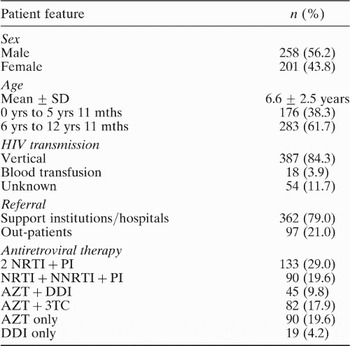
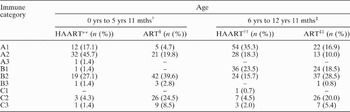
Patients were allocated sequentially to standard antiretroviral therapy or highly active antiretroviral therapy groups (with the latter therapy superseding the former). We excluded from the sample population 12 children who were receiving antiretroviral drugs. The 459 children included in the study had been treated with at least one antiretroviral drug for a minimum of five months: 236 had been using standard antiretroviral therapy without protease inhibitors and 223 had been using highly active antiretroviral therapy. The mean period of treatment for patients using standard antiretroviral therapy was 14±4 months and for patients using highly active antiretroviral therapy was 9±2 months. Table I presents demographical data for the 459 children (i.e. age, gender, referral and HIV infection route), as well as their antiretroviral regimens. Patients’ immune classification data were also recorded in a protocol based on the 1994 Center for Disease Control revised classification system for HIV infection in children less than 13 years of age,Reference Caldwell, Oxtoby, Simonds, Lindegren and Rogers10 and are presented in Table II.
Demographical data and antiretroviral regimens*

* For 459 human immunodeficiency virus (HIV) infected children. SD=standard deviation; yrs=years; mths=months; NRTI=nucleoside reverse transcriptase inhibitor; PI=protease inhibitor (i.e. indinavir, ritonavir, saquinavir or nelfinavir); NNRTI=non-nucleoside reverse transcriptase inhibitor (i.e. nevirapine or efavirenz); AZT=zidovudine; DDI=didanosine; 3TC=lamivudine
Immune category classification by age range and therapy type*

* For 459 human immunodeficiency virus infected children. †n=176; ‡n=283. **n=70; §n=106; ††n=153; ‡‡n=130. Yrs=years; mths=months; HAART=highly active antiretroviral therapy; ART=(standard) antiretroviral therapy; A1=mild signs and symptoms with no evidence of immunosuppression; A2=mild signs and symptoms with evidence of moderate immunosuppression; A3=mild signs and symptoms with severe immunosuppression; B1=moderate signs and symptoms with no evidence of immunosuppression; B2=moderate signs and symptoms with evidence of moderate immunosuppression; B3=moderate signs and symptoms with severe immunosuppression; C1=severe signs and symptoms with no evidence of immunosuppression; C2=severe signs and symptoms with evidence of moderate immunosuppression; C3=severe signs and symptoms with severe immunosuppression
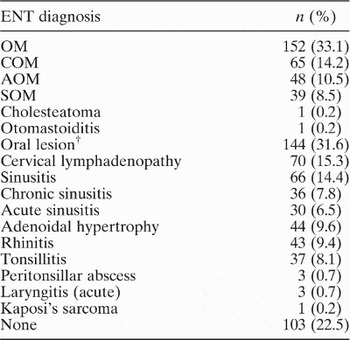
During the first out-patients clinic visit, a complete ENT physical examination was performed, always by the same consultant (IDM), an otorhinolaryngologist with 10 years’ clinical experience at the start of the study (1990). Table III shows the ENT conditions diagnosed in the 459 children studied. Otitis media was the most frequent ENT disease (presenting in 33.1 per cent of the children). Less than one-fourth of the children (22.5 per cent) had no ENT disease.
ENT diseases*

* For 459 human immunodeficiency virus infected children. †Including parotid enlargement. OM=otitis media; COM=chronic otitis media; AOM=acute otitis media; SOM=serous otitis media
Methods
In order to classify and diagnose otitis media as acute, chronic or serous, we followed the criteria below.
The diagnosis of acute otitis media was based on clinical data (i.e. fever and otalgia, or sudden irritability for less than one week) and pneumatic otoscopy findings (i.e. hyperaemia or opacity of the intact tympanic membrane, followed by bulging or loss of mobility).Reference Shapiro and Novelli6, Reference Marchisio, Principi, Sorella, Sala and Tornaghi11
The diagnosis of chronic otitis media was made based on the presence of chronic inflammation of the middle ear and mucosa of the mastoid, with a non-intact tympanic membrane and/or purulent otorrhoea, in the presence of a normal external auditory canal, for a period of longer than six weeks.Reference Shapiro and Novelli6, Reference Roland12–Reference Bernaldez, Morales and Hernandez14
The diagnosis of serous otitis media was based on evidence of sero-purulent effusion in the middle ear, with an intact tympanic membrane and without active infection,Reference Shapiro and Novelli6, Reference Bluestone15 and the presence of an air–bone gap in the audiogram and a type B tympanometric curve.
On the same day as the first visit, a blood sample was collected to determine the serum cluster of differentiation four glycoprotein T lymphocyte count.
Statistical analysis
The analysis data from the 459 children was stratified according to age. The children were divided into two groups: those aged from zero years to five years 11 months, and those aged from six years to 12 years 11 months. In each age range, we calculated the prevalence of otitis media and the serum cluster of differentiation four glycoprotein T lymphocyte count, comparing children treated with standard antiretroviral therapy with those treated with highly active antiretroviral therapy.
We used the Pearson chi-square test and the Fisher exact test for categorical variables and the non-parametric Mann–Whitney test for continuous variables. We considered p values below 0.05 to be statistically significant. Data were analysed with the Statistical Package for Social Sciences software (SPSS® for Windows 10.0; SPSS Inc, Chicago, Illinois, USA).
The study was approved by the research ethics committee of the hospital.
Results
Of the 459 children, 152 (33.1 per cent) presented with some type of otitis media. The chronic form was the most prevalent type in both age ranges, being present in 65 children (14.2 per cent). Serous otitis media was more prevalent in children younger than five years 11 months (14.8 per cent) than in those aged over six years (4.6 per cent) (p<0.001). The prevalence of the different types of otitis media and their distribution according to the children's ages and therapy types are shown in Table IV.
Prevalence of otitis media by age and HAART*

* For 459 human immunodeficiency virus infected children. †n=70; ‡n=106; **n=153; §n=130. Yrs=years; mths=months; HAART=highly active antiretroviral therapy; ART=(standard) antiretroviral therapy; SOM=serous otitis media; AOM=acute otitis media; COM=chronic otitis media
In the younger age group, there was not a statistically significant difference between the prevalence of the different types of otitis media in children receiving standard antiretroviral therapy versus those receiving highly active antiretroviral therapy. However, in this younger age group, the prevalence of acute otitis media was significantly greater in children receiving highly active antiretroviral therapy (p=0.02), whereas the prevalence of chronic otitis media was significantly lower in the same group (p=0.02). In children aged less than five years 11 months and using highly active antiretroviral therapy, the relative risks of presenting with acute or chronic otitis media were respectively 1.7 (95 per cent confidence interval (CI): 1.2–2.5) and 0.4 (95 per cent CI: 0.2–0.9) times that of those children receiving standard antiretroviral therapy.
Only one child (0.2 per cent), aged seven years and not receiving highly active antiretroviral therapy, presented with acute otitis media complicated with otomastoiditis. This child's serum cluster of differentiation four glycoprotein lymphocyte count was 397×10−9 cell/l, and treatment with intravenous antibiotics was effective in curing the disease.
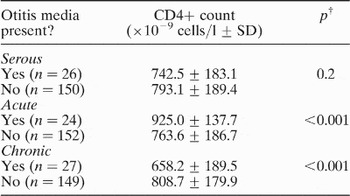
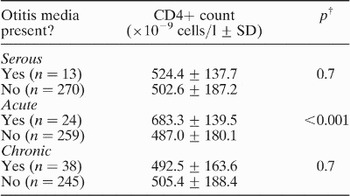
The mean serum cluster of differentiation four glycoprotein T lymphocyte counts for each age group are presented in Tables V and VI. In children aged from zero years to five years 11 months, those with acute otitis media presented a mean serum cluster of differentiation four glycoprotein lymphocyte count which was 161.4±32×10−9 cells/l greater than the mean count of those with chronic and serous otitis media (p<0.001). Conversely, in the same group, children with chronic otitis media had an average serum cluster of differentiation four glycoprotein T lymphocyte count which was 150.5±38×10−9 cell/l less than that of children without chronic otitis media (p<0.001).
Serum CD4+ T lymphocyte count by presence of otitis media, 0 yrs to 5 yrs 11 mths group*

* n=176. †Comparing patients with and without otitis media. CD4+=cluster of differentiation 4 glycoprotein; SD=standard deviation
Serum CD4+ T lymphocyte count by presence of otitis media, 6 yrs to 12 yrs 11 mths group*

* n=283. †Comparing patients with and without otitis media. CD4+=cluster of differentiation 4 glycoprotein; SD=standard deviation
In children aged from six years to 12 years 11 months, those with acute otitis media presented with a serum cluster of differentiation four glycoprotein lymphocyte mean count which was 196.4±38×10−9 cells/l above that of those of the same age without acute otitis media (p<0.001). There was no statistically significant difference between the lymphocyte counts of children with and without chronic otitis media, and with and without serous otitis media.
Children receiving highly active antiretroviral therapy had a mean cluster of differentiation four glycoprotein T lymphocyte count which was above that of those receiving standard antiretroviral therapy, regardless of age range, and this difference was statistically significant (p<0.001; Table VII).
CD4+ lymphocyte count by age and HAART

* n=176; †n=283. ‡Comparing highly active antiretroviral therapy (HAART) with antiretroviral therapy (ART).
Discussion
Otological diseases are common in HIV-infected children and are one of the main causes for ENT referral.Reference Chen, Ohlms, Stewart and Kline16 In addition, HIV-infected children suffer otitis media episodes which are more frequent and more severe, compared with immunocompetent children.Reference Rinaldo, Brandwein, Devaney and Ferlito8 However, literature reports of otological infections in HIV-infected children treated with highly active antiretroviral therapy are still very rare.
Some would question why there was no true control group in our study. It is important to emphasise that the purpose of the study was not to compare the prevalences of otitis media in HIV seropositive and non-HIV seropositive Brazilian children. Our aim was to compare the effects of two different HIV therapeutic regimens (i.e. standard antiretroviral therapy and highly active antiretroviral therapy) on the prevalence of paediatric otitis media.
Our single selection criteria was the use of antiretroviral therapy, and patients were entered into the study sequentially. It is also important to state that, since 1990, the Brazilian government has begun to freely distribute zidovudine to HIV-infected patients. Furthermore, since 1996, according to law 9313/96, all HIV-infected patients have been guaranteed free access to antiretroviral therapy, including protease inhibitors.
In our sample, otitis media was the most prevalent ENT disease. It is important to emphasise that all patients included in the study were being treated with antiretroviral medication, albeit with heterogeneous regimens.
The prevalence of chronic or acute otitis media in HIV-positive children is variable. Chen et al. found a prevalence of recurrent otitis media of 44 per cent in their sample.Reference Chen, Ohlms, Stewart and Kline16 More recently, in South America, Bernaldez et al. found an incidence of suppurative chronic otitis media of 13.2 per cent.Reference Bernaldez, Morales and Hernandez14 Chandrasekhar et al. reported the presence of otorrhoea in 5 per cent of their HIV-infected patients.Reference Chandrasekhar, Connelly, Brambhatt, Shah, Kloser and Baredes17 Chaloryoo et al. found a general prevalence of otitis media of 18.4 per cent in a group of 250 infected Thai children.Reference Chaloryoo, Chotpitayasunondh and Chiengmai18 Singh et al. observed a prevalence of 24 per cent in a group of 107 children in London.Reference Singh, Georgalas, Patel and Papesch19 Hadfield et al., observing 66 children for a period of eight years, observed a prevalence of acute otitis media of 26 per cent and of chronic otitis media of 7.5 per cent.Reference Hadfield, Birchall, Novelli and Bailey20 These findings are similar to our own; we found prevalences of 10.5 per cent for acute otitis media, 14.2 per cent for chronic otitis media and 8.5 per cent for serous otitis media.
Regarding the influence of antiretroviral therapy on the prevalence of otitis media in HIV-positive patients, Zuccotti et al. did not find any statistically significant differences between the number of acute otitis media episodes in children receiving or not receiving antiretroviral therapy.Reference Zuccotti, D'Auria, Torcoletti, Lodi, Bernardo and Riva21 In our study, conversely, highly active antiretroviral therapy was associated with a lower prevalence of chronic otitis media and a higher prevalence of acute otitis media in HIV-positive children aged from zero years to five years 11 months. However, regarding serous otitis media, there were no statistically significant differences in either age range, comparing highly active antiretroviral therapy with standard antiretroviral therapy.
As for acute otitis media, the actual prevalence may be higher than that detected in our study, given that our data were based on visits to a tertiary level hospital and did not take account of visits to primary care centres.
Acute otitis media was more prevalent in children receiving highly active antiretroviral therapy than in those receiving standard antiretroviral therapy. This makes us wonder whether the former group could have immune behaviour similar to that of non-immunosuppressed children, with a good response to current therapies.
Alternatively, another study, which compared HIV-positive children and immunocompetent children and which analysed not only the frequency but also the proportion of children who presented with acute otitis media in both groups, showed that HIV infection per se did not appear to facilitate the occurrence of acute otitis media, but rather, predisposed to recurrences.Reference Makokha, Ogolla, Orago, Koech, Mpoke and Esamai22 A further, Brazilian, study compared 20 seroconverter children with 20 HIV-positive children and did not show any difference between the prevalence of acute otitis media in both groups.Reference Gondim, Zonta, Fortkamp and Schmeling23
The correlation between HIV clinical stage, serum cluster of differentiation four glycoprotein lymphocyte count and otitis media has been addressed by many authors. Chen et al. found a higher risk of otitis media development as children progressed to more advanced clinical and immunodeficient stages of the disease.Reference Chen, Ohlms, Stewart and Kline16 Makokha et al., in Kenya, demonstrated that the presence of acute otitis media in HIV-infected children was associated with a reduction in the serum cluster of differentiation four glycoprotein lymphocyte count.Reference Makokha, Ogolla, Orago, Koech, Mpoke and Esamai22 These findings conflict with our own; in our sample, children using highly active antiretroviral therapy, with a higher serum cluster of differentiation four glycoprotein lymphocyte count, had a higher prevalence of acute otitis media.
As for chronic otitis media, Barnett et al. had already noted that children with a low serum cluster of differentiation four glycoprotein lymphocyte count were at higher risk of recurrent otitis media and tended to convert to the chronic form of the infection.Reference Barnett, Klein, Pelton and Lunginbuhl9 However, the pathogenesis of chronic otitis media is multifactorial; environmental factors and genetically determined factors, as well as anatomical and functional characteristics of the eustachian tube, are all involved.Reference Verhoeff, van der Veen, Rovers and Schilder13 Immunoglobulins G and A are very important defences against mucosal infections such as chronic otitis media. There seems to be evidence that serum cluster of differentiation four glycoprotein lymphocytes and interleukins two and four play a regulating role in the conversion of acute otitis media to chronic otitis media, especially in cases of serous otitis media.Reference Marchisio, Principi, Sorella, Sala and Tornaghi11, Reference Smirnova, Birchall and Pearson24, Reference Skotnicka, Stasiak-Barmuta, Hassmann-Poznanska and Kasprzycka25
In our study, the use of highly active antiretroviral therapy seemed to enable better cell immunity, probably owing to the observed significant increase in the serum cluster of differentiation four glycoprotein lymphocyte count, in both age ranges. This fact has been observed by other authors.Reference Gortmaker, Hughes, Cervia, Brady, Johnson and Seage4, Reference Miziara, Valentini, Romano and Miniti5, Reference Granados, Amador, Miguel, Tomé, Conejo and Vivas26, Reference Kline27 Moreover, 62.8 per cent of the children aged below six years who were receiving highly active antiretroviral therapy were clinically and immunologically classified into categories A1 (i.e. mild signs and symptoms, with no evidence of immunosuppression) and A2 (i.e. mild signs and symptoms, with moderate evidence of immunosuppression) (Table II). This might have been one of the factors contributing to the lower incidence of chronic otitis media in children aged below six years and receiving highly active antiretroviral therapy.
Another important finding from our study was that only one child presented with complications secondary to otitis media (i.e. otomastoiditis). The literature states that otitis media tends to be more severe in the immunosuppressed population, with higher rates of complications, especially bacteraemia.Reference Shapiro and Novelli6, Reference Barnett, Klein, Pelton and Lunginbuhl9, Reference Marchisio, Principi, Sorella, Sala and Tornaghi11, Reference Chen, Ohlms, Stewart and Kline16, Reference Principi28 It is possible that this reduced incidence of otitis media complications was secondary to improved immunocompetence due to the use of antiretroviral drugs in all our patients.
Finally, we found a similar prevalence of serous otitis media in both treatment groups (i.e. those receiving highly active antiretroviral therapy or those receiving standard antiretroviral therapy). This suggests that the development of this type of middle-ear infection depends on other factors additional to the degree of immunosuppression, such as the number of acute otitis media relapses, nasopharynx lymphoid tissue hypertrophy and eustachian tube dysfunction.Reference Hoare3
• The development of new antiretroviral drugs, especially protease inhibitors, has substantially reduced mortality and increased life expectancy for children with human immunodeficiency virus (HIV)
• The prevalence of otitis media in children with HIV may reach 80 per cent. Seropositive children are more prone to otitis media than immunocompetent ones
• In HIV immunoimpaired children, otorhinolaryngologists should consider the potential complications secondary to middle-ear disease
• The use of highly active antiretroviral therapy in Brazilian HIV-infected children was associated with a lower prevalence of chronic otitis media
Ours was a transversal study based on one single assessment of patients; as such, the main limitation was that the data associations defined did not necessarily represent causality correlations. Another possible limitation was the fact that we did not control data related to patients’ HIV-1 ribonucleic acid levels (i.e. viral load); this data was not available for all patients.
Conclusion
Based on the presented data, we conclude that the use of highly active antiretroviral therapy in Brazilian HIV-infected children aged less than six years was associated with a lower prevalence of chronic otitis media. This probably resulted from the therapeutically increased serum cluster of differentiation four glycoprotein T lymphocyte count.