Introduction
The first Global Burden of Disease study (GBD 1990) found that a large, previously under-recognised proportion of premature mortality and disability, aggregated as disability-adjusted life years (DALYs) was attributable to neuropsychiatric disorders. This grouping of disorders, comprising mental, neurological and substance use disorders, accounted for more than 8.5% of the entire global burden (DALYs) in 1990 and more than one-quarter of all years lived with disability (YLD) (World Bank, 1993; Murray & Lopez, Reference Murray and Lopez1996). These findings were highly influential, leading to increased attention to mental disorders on the global health agenda (Whiteford, Reference Whiteford1999; World Health Organization, 2001) and a renewed impetus for mental health research (Kessler & Ustun, Reference Kessler and Ustun2008). Estimates for selected mental disorders were revised in the early 2000s by the World Health Organization using updated epidemiological evidence and, for some disorders, modified health states and disability weights (Mathers et al. Reference Mathers, Stein, Ma Fat, Rao, Inoue, Tomijima, Bernard, Lopez and Murray2002; World Health Organization, 2008).
The GBD approach to assessing health loss has evoked considerable debate, around both methodological aspects of the burden calculations and concerns specific to particular disease groups, including mental disorders. The empirical data available in 1990 to inform mental disorder epidemiology was limited (Brhlikova et al. Reference Brhlikova, Pollock and Manners2010). Some of the more common mental disorders (e.g., generalised anxiety disorder (GAD) and social phobia), those associated with premature mortality (e.g., anorexia nervosa) and disorders which typically commence in childhood (e.g., autism spectrum disorders) were noticeably absent (Andrews et al. Reference Andrews, Sanderson, Slade and Issakidis2000; Vos, Reference Vos2006). Disability estimates were reliant on expert judgement rather than representative of community beliefs (Andrews et al. Reference Andrews, Sanderson, Slade and Issakidis2000; Kessler & Greenberg, Reference Kessler, Greenberg, Davis, Charney, Coyle and Nemeroff2002). Many considered the use of other social value choices such as age-weighting and discounting to be inequitable (Anand & Hanson, Reference Anand and Hanson1998; Williams, Reference Williams1999; Arnesen & Kapiriri, Reference Arnesen and Kapiriri2004).
In 2007, a new study (GBD 2010) was launched. This was a comprehensive re-analysis of burden for 291 causes, 20 age-groups, for males and females separately in 187 countries, across 21 world regions for 1990, 2005 and 2010 (Murray et al. Reference Murray, Vos, Lozano, Naghavi, Flaxman, Michaud, Ezzati, Shibuya, Salomon, Abdalla, Aboyans, Abraham, Ackerman, Aggarwal, Ahn, Ali, Alvarado, Anderson, Anderson, Andrews, Atkinson, Baddour, Bahalim, Barker-Collo, Barrero, Bartels, Basáñez, Baxter, Bell, Benjamin, Bennett, Bernabé, Bhalla, Bhandari, Bikbov, Abdulhak, Birbeck, Black, Blencowe, Blore, Blyth, Bolliger, Bonaventure, Boufous, Bourne, Boussinesq, Braithwaite, Brayne, Bridgett, Brooker, Brooks, Brugha, Bryan-Hancock, Bucello, Buchbinder, Buckle, Budke, Burch, Burney, Burstein, Calabria, Campbell, Canter, Carabin, Carapetis, Carmona, Cella, Charlson, Chen, Cheng, Chou, Chugh, Coffeng, Colan, Colquhoun, Colson, Condon, Connor, Cooper, Corriere, Cortinovis, de Vaccaro, Couser, Cowie, Criqui, Cross, Dabhadkar, Dahiya, Dahodwala, Damsere-Derry, Danaei, Davis, Leo, Degenhardt, Dellavalle, Delossantos, Denenberg, Derrett, Des Jarlais, Dharmaratne, Dherani, Diaz-Torne, Dolk, Dorsey, Driscoll, Duber, Ebel, Edmond, Elbaz, Ali, Erskine, Erwin, Espindola, Ewoigbokhan, Farzadfar, Feigin, Felson, Ferrari, Ferri, Fèvre, Finucane, Flaxman, Flood, Foreman, Forouzanfar, Fowkes, Fransen, Freeman, Gabbe, Gabriel, Gakidou, Ganatra, Garcia, Gaspari, Gillum, Gmel, Gonzalez-Medina, Gosselin, Grainger, Grant, Groeger, Guillemin, Gunnell, Gupta, Haagsma, Hagan, Halasa, Hall, Haring, Haro, Harrison, Havmoeller, Hay, Higashi, Hill, Hoen, Hoffman, Hotez, Hoy, Huang, Ibeanusi, Jacobsen, James, Jarvis, Jasrasaria, Jayaraman, Johns, Jonas, Karthikeyan, Kassebaum, Kawakami, Keren, Khoo, King, Knowlton, Kobusingye, Koranteng, Krishnamurthi, Laden, Lalloo, Laslett, Lathlean, Leasher, Lee, Leigh, Levinson, Lim, Limb, Lin, Lipnick, Lipshultz, Liu, Loane, Ohno, Lyons, Mabweijano, MacIntyre, Malekzadeh, Mallinger, Manivannan, Marcenes, March, Margolis, Marks, Marks, Matsumori, Matzopoulos, Mayosi, McAnulty, McDermott, McGill, McGrath, Medina-Mora, Meltzer, Mensah, Merriman, Meyer, Miglioli, Miller, Miller, Mitchell, Mock, Mocumbi, Moffitt, Mokdad, Monasta, Montico, Moradi-Lakeh, Moran, Morawska, Mori, Murdoch, Mwaniki, Naidoo, Nair, Naldi, Narayan, Nelson, Nelson, Nevitt, Newton, Nolte, Norman, Norman, O'Donnell, O'Hanlon, Olives, Omer, Ortblad, Osborne, Ozgediz, Page, Pahari, Pandian, Rivero, Patten, Pearce, Padilla, Perez-Ruiz, Perico, Pesudovs, Phillips, Phillips, Pierce, Pion, Polanczyk, Polinder, Pope III, Popova, Porrini, Pourmalek, Prince, Pullan, Ramaiah, Ranganathan, Razavi, Regan, Rehm, Rein, Remuzzi, Richardson, Rivara, Roberts, Robinson, De Leòn, Ronfani, Room, Rosenfeld, Rushton, Sacco, Saha, Sampson, Sanchez-Riera, Sanman, Schwebel, Scott, Segui-Gomez, Shahraz, Shepard, Shin, Shivakoti, Singh, Singh, Singh, Singleton, Sleet, Sliwa, Smith, Smith, Stapelberg, Steer, Steiner, Stolk, Stovner, Sudfeld, Syed, Tamburlini, Tavakkoli, Taylor, Taylor, Taylor, Thomas, Thomson, Thurston, Tleyjeh, Tonelli, Towbin, Truelsen, Tsilimbaris, Ubeda, Undurraga, van der Werf, van Os, Vavilala, Venketasubramanian, Wang, Wang, Watt, Weatherall, Weinstock, Weintraub, Weisskopf, Weissman, White, Whiteford, Wiebe, Wiersma, Wilkinson, Williams, Williams, Witt, Wolfe, Woolf, Wulf, Yeh, Zaidi, Zheng, Zonies, Lopez, AlMazroa and Memish2012). New burden estimates from the GBD 2010 study have been published for mental disorders (Whiteford et al. Reference Whiteford, Degenhardt, Rehm, Baxter, Ferrari, Erskine, Charlson, Norman, Flaxman, Johns, Burstein, Murray and Vos2013a) and illicit drug use disorders (Degenhardt et al. Reference Degenhardt, Whiteford, Ferrari, Baxter, Charlson, Hall, Freedman, Burstein, Johns, Engell, Flaxman, Murray and Vos2013), showing that, together, mental and substance use disorders account for 7.4% of all burden worldwide. It is natural to draw comparisons between the findings of the first GBD study, subsequent updates and those produced for GBD 2010. However, there have been major conceptual and methodological changes to calculating burden estimates in GBD 2010 and this prevents the comparison of GBD 2010 burden estimates with previous studies. This paper describes some of the major methodological advances in GBD 2010 and the implications of these changes with respect to burden estimates for the mental and substance use disorders.
Mental disorders in GBD 1990 and GBD 2010
In GBD 1990, burden estimates were presented for ‘neuropsychiatric disorders’ which included neurological disorders (comprising epilepsy, dementia, Parkinson disease and multiple sclerosis), substance use disorders (comprising alcohol use and illicit drug use disorders) and mental disorders comprising affective disorders (unipolar depression and bipolar disorder), anxiety disorders (panic disorder, obsessive compulsive disorder and post-traumatic stress disorder) and schizophrenia (Murray & Lopez, Reference Murray and Lopez1996). The absolute number of DALYs attributed to neuropsychiatric disorders in 1990 was 145 million, 12% of which was attributed to neurological disorders, 17% substance use disorders and 71% mental disorders (unadjusted for comorbidity) (Murray & Lopez, Reference Murray and Lopez1996). Two additional disorders (primary insomnia and migraine) were included in revised estimates for 2000–2004, and the effect this had was to increase the proportion of total disease burden attributable to neuropsychiatric disorders from 10.5 to 13.1% (World Health Organization, 2008).
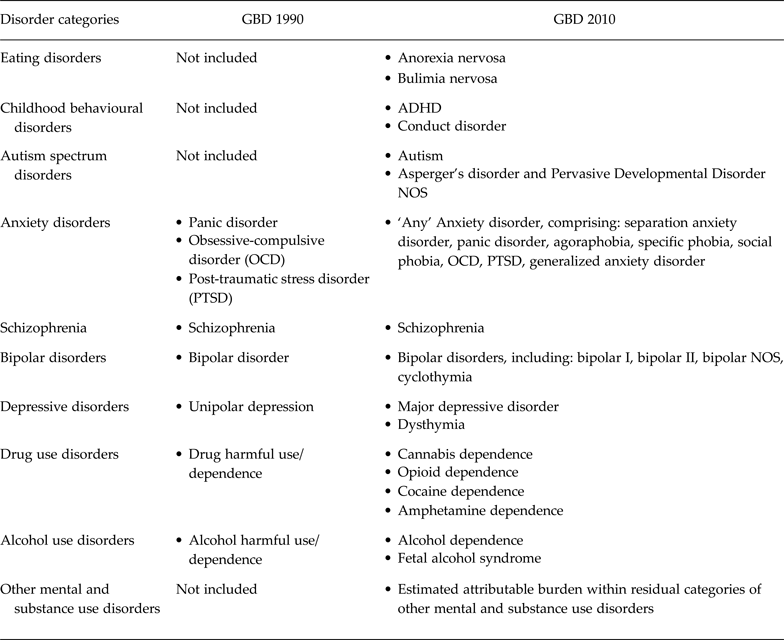
In GBD 2010, neuropsychiatric disorders were disaggregated into two separate groups: (a) neurological disorders and (b) mental and behavioural disorders, which included substance use disorders. Together, these categories captured a more comprehensive list of disorders than what was included in previous iterations. The specific mental disorders (including substance use disorders) captured in GBD 1990 and GBD 2010 are described in Table 1 (note that neurological disorders are not detailed here). To account for variation in burden within depressive disorders, separate burden estimates were calculated for major depressive disorder (MDD) and dysthymia in GBD 2010. For the same reason, burden was estimated for cannabis, amphetamine, cocaine, opioid and alcohol dependence separately rather than a combined estimate made up of harmful use and dependence of selected disorder types as previously reported. Instead of only three individual anxiety disorders, GBD 2010 captured estimates for ‘any’ anxiety disorder to account for the high co-occurrence of specific disorders. Furthermore, burden estimates were made for eating disorders (anorexia nervosa and bulimia nervosa) and childhood mental disorders, including pervasive developmental disorders (autism and Asperger's disorder) and childhood behavioural disorders (attention-deficit/hyperactivity disorder (ADHD) and conduct disorders).
Comparison of mental and substance use disorders included in the GBD 1990 and GBD 2010 studies*

*Neurological disorders are not included.
NOS, not otherwise specified.
Changes to the categorisation and inclusion of disorders in GDB 2010 mean that the new burden estimates reflect a more accurate representation of overall health loss caused by mental and substance use disorders and provides a wealth of information on the relative burden at different ages. The inclusion of childhood disorders is a particularly important advancement in GBD 2010 given that in regions such as Africa, children constitute up to 40% of the total population (United Nations, 2011). Together, burden for these early onset disorders accounted for almost 10% of the DALYs attributable to mental disorders. Hence, the exclusion of disorders commencing predominantly in childhood would miss a substantial component of the population burden in these regions.
Epidemiological data
Burden of disease calculations are based on meta-synthesis of available epidemiological data (Murray & Lopez, Reference Murray and Lopez1996), and as such, accuracy of burden estimates rely on the quantity and quality of the data identified. There is limited information about the empirical input for mental disorders in GBD 1990 (Vos & Mathers, Reference Vos and Mathers2000). In the 2000–2004 revisions, information on prevalence and incidence were ascertained through literature reviews and correspondence with researchers (Mathers et al. Reference Mathers, Stein, Ma Fat, Rao, Inoue, Tomijima, Bernard, Lopez and Murray2002) and were included if based on population-based studies with sample sizes greater than 1000, and used a random or national/regional sampling frame (Ayuso-Mateos, Reference Ayuso-Mateos2006).
The empirical data used in GBD 1990 and subsequent updates reflected the state of the literature at the time, exposing limitations in the epidemiological data for mental disorders. Due to lack of data available for unipolar depression for example, expert advice rather than empirical data was used to determine disorder duration and studies with sub-optimal representativeness, response rates and case definitions were included for other parameters (Brhlikova et al. Reference Brhlikova, Pollock and Manners2010). To provide the best possible data for GBD 2010 epidemiological input was collated by over 50 expert groups through systematic reviews of the literature. The Mental and Substance Use Disorder Expert Group oversaw searches for studies reporting population-representative data for prevalence, incidence, remission/duration and excess all-cause mortality. The protocol and results of these reviews have been described in detail elsewhere (Ferrari et al. Reference Ferrari, Baxter and Whiteford2010, Reference Ferrari, Somerville, Baxter, Norman, Patten, Vos and Whiteford2013; Degenhardt et al. Reference Degenhardt, Bucello, Calabria, Nelson, Roberts, Hall, Lynskey and Wiessing2011; Baxter et al. Reference Baxter, Scott, Vos and Whiteford2013b; Charlson et al. Reference Charlson, Ferrari, Flaxman and Whiteford2013; Erskine et al. Reference Erskine, Ferrari, Nelson, Polanczyk, Flaxman, Vos, Whiteford and Scott2013; Whiteford et al. Reference Whiteford, Ferrari, Baxter, Charlson and Degenhardt2013b; Baxter et al. Reference Baxter, Vos, Scott, Ferrari and Whiteford2014). In brief, epidemiological estimates for mental and substance use disorders were identified and extracted from a diverse range of studies, including national mental health surveys, more geographically limited regional and community surveys, health screenings in communities and schools, birth cohort studies and for disorders with higher treatment rates: psychiatric registry data and clinical records.
The final data sources that underpinned GBD 2010 estimates were drawn from 78 countries in 19 of the 21 GBD world regions. In comparison to previous GBD studies these data provided much greater representation of non-western populations, hence regional estimates for disease frequency (e.g., Africa, Central and Eastern Europe, South America and Asia) were more strongly based on empirical data with less reliance on extrapolation from West European, Australasian and North American data. Whilst the data still reflects a degree of incompleteness and methodological limitations (Baxter et al. Reference Baxter, Patton, Degenhardt, Scott and Whiteford2013a), the improved evidence-base for epidemiological estimates in GBD 2010 is reflected in the improved confidence intervals for regions where empirical data were identified.
Disease modelling
Given that epidemiological data (e.g., prevalence and incidence estimates) used in the estimation of non-fatal burden are variable for those countries and regions where data are available, and absent for many countries and age groups, GBD developed disease-specific statistical models to first reconcile limitations arising from the data before YLDs were estimated. A generic disease modelling tool known as DisMod was developed for GBD 1990 to force consistency on the available data and to supplement missing data (Barendregt et al. Reference Barendregt, van Oortmarssen, Vos and Murray2003). Linear differential equations were applied to describe the transitions between major health states ‘healthy’, ‘diseased’ and ‘dead’ based on the transition rates incidence, recovery (remission) and excess mortality (Barendregt et al. Reference Barendregt, van Oortmarssen, Vos and Murray2003). Second-generation DisMod modelling (DisMod II) used in the GBD 2000–2004 revisions allowed a wider range of empirical data inputs to be included in the estimation of burden (including prevalence, remission and relative-risk of premature mortality), and was able to apportion different weighting and smoothing algorithms to the various inputs (Barendregt et al. Reference Barendregt, van Oortmarssen, Vos and Murray2003; Global Burden of Disease, 2009).
Disease modelling in GDB 2010 was based on a new Bayesian meta-regression tool, called DisMod-MR (Vos et al. Reference Vos, Flaxman, Naghavi, Lozano, Michaud, Ezzati, Shibuya, Salomon, Abdalla, Aboyans, Abraham, Ackerman, Aggarwal, Ahn, Ali, Alvarado, Anderson, Anderson, Andrews, Atkinson, Baddour, Bahalim, Barker-Collo, Barrero, Bartels, Basáñez, Baxter, Bell, Benjamin, Bennett, Bernabé, Bhalla, Bhandari, Bikbov, Abdulhak, Birbeck, Black, Blencowe, Blore, Blyth, Bolliger, Bonaventure, Boufous, Bourne, Boussinesq, Braithwaite, Brayne, Bridgett, Brooker, Brooks, Brugha, Bryan-Hancock, Bucello, Buchbinder, Buckle, Budke, Burch, Burney, Burstein, Calabria, Campbell, Canter, Carabin, Carapetis, Carmona, Cella, Charlson, Chen, Cheng, Chou, Chugh, Coffeng, Colan, Colquhoun, Colson, Condon, Connor, Cooper, Corriere, Cortinovis, de Vaccaro, Couser, Cowie, Criqui, Cross, Dabhadkar, Dahiya, Dahodwala, Damsere-Derry, Danaei, Davis, De Leo, Degenhardt, Dellavalle, Delossantos, Denenberg, Derrett, Des Jarlais, Dharmaratne, Dherani, Diaz-Torne, Dolk, Dorsey, Driscoll, Duber, Ebel, Edmond, Elbaz, Ali, Erskine, Erwin, Espindola, Ewoigbokhan, Farzadfar, Feigin, Felson, Ferrari, Ferri, Fèvre, Finucane, Flaxman, Flood, Foreman, Forouzanfar, Fowkes, Franklin, Fransen, Freeman, Gabbe, Gabriel, Gakidou, Ganatra, Garcia, Gaspari, Gillum, Gmel, Gosselin, Grainger, Groeger, Guillemin, Gunnell, Gupta, Haagsma, Hagan, Halasa, Hall, Haring, Haro, Harrison, Havmoeller, Hay, Higashi, Hill, Hoen, Hoffman, Hotez, Hoy, Huang, Ibeanusi, Jacobsen, James, Jarvis, Jasrasaria, Jayaraman, Johns, Jonas, Karthikeyan, Kassebaum, Kawakami, Keren, Khoo, King, Knowlton, Kobusingye, Koranteng, Krishnamurthi, Lalloo, Laslett, Lathlean, Leasher, Lee, Leigh, Lim, Limb, Lin, Lipnick, Lipshultz, Liu, Loane, Ohno, Lyons, Ma, Mabweijano, MacIntyre, Malekzadeh, Mallinger, Manivannan, Marcenes, March, Margolis, Marks, Marks, Matsumori, Matzopoulos, Mayosi, McAnulty, McDermott, McGill, McGrath, Medina-Mora, Meltzer, Mensah, Merriman, Meyer, Miglioli, Miller, Miller, Mitchell, Mocumbi, Moffitt, Mokdad, Monasta, Montico, Moradi-Lakeh, Moran, Morawska, Mori, Murdoch, Mwaniki, Naidoo, Nair, Naldi, Narayan, Nelson, Nelson, Nevitt, Newton, Nolte, Norman, Norman, O'Donnell, O'Hanlon, Olives, Omer, Ortblad, Osborne, Ozgediz, Page, Pahari, Pandian, Rivero, Patten, Pearce, Padilla, Perez-Ruiz, Perico, Pesudovs, Phillips, Phillips, Pierce, Pion, Polanczyk, Polinder, Pope III, Popova, Porrini, Pourmalek, Prince, Pullan, Ramaiah, Ranganathan, Razavi, Regan, Rehm, Rein, Remuzzi, Richardson, Rivara, Roberts, Robinson, De Leòn, Ronfani, Room, Rosenfeld, Rushton, Sacco, Saha, Sampson, Sanchez-Riera, Sanman, Schwebel, Scott, Segui-Gomez, Shahraz, Shepard, Shin, Shivakoti, Singh, Singh, Singh, Singleton, Sleet, Sliwa, Smith, Smith, Stapelberg, Steer, Steiner, Stolk, Stovner, Sudfeld, Syed, Tamburlini, Tavakkoli, Taylor, Taylor, Taylor, Thomas, Thomson, Thurston, Tleyjeh, Tonelli, Towbin, Truelsen, Tsilimbaris, Ubeda, Undurraga, van der Werf, van Os, Vavilala, Venketasubramanian, Wang, Wang, Watt, Weatherall, Weinstock, Weintraub, Weisskopf, Weissman, White, Whiteford, Wiersma, Wilkinson, Williams, Williams, Witt, Wolfe, Woolf, Wulf, Yeh, Zaidi, Zheng, Zonies, Lopez, Murray, AlMazroa and Memish2012). This built upon the Incidence–Prevalence–Mortality disease model used in DisMod and DisMod-II and was able to estimate prevalence, incidence, remission, duration and excess mortality for 187 countries, 21 regions, 3 time points, males and females and 20 age groups. A generalised negative binomial model was estimated for all epidemiological data using super-region, region and country random effects as well as two sets of covariates: study level covariates which adjusted for variability in the empirical data arising from differences in the methodology used between studies; and country level covariates, which supplemented the predictive power of the model by adjusting for ecological effects in the data. For example, given the established association between conflict and mental disorders such as depression and anxiety disorder, a conflict-based covariate could be used to impute the prevalence of these disorders in populations exposed to wide-spread conflict. An important improvement in GBD 2010 was the ability for DisMod-MR to also estimate 95% ranges of uncertainty around all modelled epidemiological estimates. This was done by propagating uncertainty from the raw epidemiological data (as standard errors or 95% confidence intervals) and prior model settings through to the final model-derived estimates. Thus users of the burden estimates can identify where there is broad uncertainty around a regional estimate due to limited empirical input.
Prevalent burden v. incident burden
Burden of disease has traditionally been viewed from the perspective of incident cases, based on the premise that deaths are an incident occurrence (World Bank, 1993). This approach was said to be ‘forward looking’ as it focused on the future burden arising from new cases in a given year (World Bank, 1993; Global Burden of Disease, 2009). Previous GBD estimates are therefore considered incident as burden, within the context of YLD, were based on incident cases.
In GBD 2010, YLDs (and consequently DALYs) are considered prevalent. This means that the estimate reflects the burden for a specific year (e.g., 2010), regardless of when the disease commenced. Prevalent YLD calculations reflect the current disability in a population, which is particularly relevant for chronic disorders as the onset of many of these disorders occurred years earlier (Garcia-Fulgueiras et al. Reference Garcia-Fulgueiras, Garcia-Pina, Morant, de Larrea-Baz and Alvarez2011). Moreover, prevalent YLD are more sensitive to time-trends, such as changes over time due to policy changes or new interventions. For example, incident cases of cervical cancers are predicted to fall over time due to the advent of the human papillomavirus (HPV) vaccine (Munoz et al. Reference Munoz, Kjaer, Sigurdsson, Iversen, Hernandez-Avila, Wheeler, Perez, Brown, Koutsky, Tay, Garcia, Ault, Garland, Leodolter, Olsson, Tang, Ferris, Paavonen, Steben, Bosch, Dillner, Huh, Joura, Kurman, Majewski, Myers, Villa, Taddeo, Roberts, Tadesse, Bryan, Lupinacci, Giacoletti, Sings, James, Hesley, Barr and Haupt2010) However, prevalence reduction will take longer due to the number of people who already have the virus. As such, it is vital not to overlook these already present cases when considering health-care priorities.
An additional benefit of prevalent YLDs is the greater availability and arguably better accuracy of data available for prevalence v. incidence in mental disorders (Hoek & van Hoeken, Reference Hoek and van Hoeken2003). This is apparent in low and middle income countries (LMIC) where cohort studies are rare. To illustrate, prevalence data for anorexia nervosa were identified from 22 studies in 15 countries, whereas only five studies in the same number of countries, all high income (HI) countries, reported incidence. For ADHD there were no nationally comparable incidence studies found.
The use of prevalent, as opposed to incident, YLDs will therefore better represent burden attributable to mental and substance use disorders. The consideration of current disability means that disorders which often begin early in life and take a chronic course, such as depression, will not be under-represented by only considering incident cases. Furthermore, the use of prevalence data will allow more accurate burden estimations to be made given that this is the most available type of data particularly in LMICs where the cost and resources required for incidence studies are often prohibitive.
Disability weights
Beyond the epidemiological issues in compiling burden estimates, methods for estimating the extent of health loss, or disability have been controversial (Williams, Reference Williams1999; Sanderson & Andrews, Reference Sanderson and Andrews2001; Mont, Reference Mont2007). Disability weights used in the GBD 1990 study were derived by an international group of health care providers by calculating weightings for 22 indicator conditions using the person-trade off method (Murray & Lopez, Reference Murray and Lopez1996). These weights were then used to define seven disability classes ranging from perfect health to death and group consensus then determined distribution of the remaining conditions across the seven classes using the indicator conditions in each class as markers. The 2004 revision largely used the same disability weights, except for a few disorders (e.g., MDD) where weights from the Netherlands disability weights study were conducted (Stouthard et al. Reference Stouthard, Essink-Bot and Bonsel1997; World Health Organization, 2008).
In response to increasing literature and debate on the definition and measurement of disability (Salomon et al. Reference Salomon, Murray, Ustun, Chatterji, Murray and Evans2003; Mont, Reference Mont2007; Salomon, Reference Salomon2010) certain aspects of the methodology used to generate previous disability weights were refined in the GBD 2010 study: (1) disability weights were estimated for a more comprehensive group of indicator conditions (230 health states); (2) multiple disability weights were allocated to schizophrenia, bipolar disorder, MDD and anxiety disorders to more accurately represent variability in severity and disability throughout the course of the disorder; and (3) rather than using an expert panel to derive disability weights, community representative surveys were used (Global Burden of Disease, 2009; Salomon, Reference Salomon2010; Ferrari et al. Reference Ferrari, Saha, McGrath, Norman, Baxter, Vos and Whiteford2012).
To derive the disability weights face-to-face surveys were administered in Bangladesh, Indonesia, Peru, Tanzania and telephone surveys were conducted in the USA. In addition an online (open-access web-based survey) was conducted (Salomon et al. Reference Salomon, Vos, Hogan, Gagnon, Naghavi, Mokdad, Begum, Shah, Karyana, Kosen, Farje, Moncada, Dutta, Sazawal, Dyer, Seiler, Aboyans, Baker, Baxter, Benjamin, Bhalla, Abdulhak, Blyth, Bourne, Braithwaite, Brooks, Brugha, Bryan-Hancock, Buchbinder, Burney, Calabria, Chen, Chugh, Cooley, Criqui, Cross, Dabhadkar, Dahodwala, Davis, Degenhardt, Díaz-Torné, Dorsey, Driscoll, Edmond, Elbaz, Ezzati, Feigin, Ferri, Flaxman, Flood, Fransen, Fuse, Gabbe, Gillum, Haagsma, Harrison, Havmoeller, Hay, Hel-Baqui, Hoek, Hoffman, Hogeland, Hoy, Jarvis, Karthikeyan, Knowlton, Lathlean, Leasher, Lim, Lipshultz, Lopez, Lozano, Lyons, Malekzadeh, Marcenes, March, Margolis, McGill, McGrath, Mensah, Meyer, Michaud, Moran, Mori, Murdoch, Naldi, Newton, Norman, Omer, Osborne, Pearce, Perez-Ruiz, Perico, Pesudovs, Phillips, Pourmalek, Prince, Rehm, Remuzzi, Richardson, Room, Saha, Sampson, Sanchez-Riera, Segui-Gomez, Shahraz, Shibuya, Singh, Sliwa, Smith, Soerjomataram, Steiner, Stolk, Stovner, Sudfeld, Taylor, Tleyjeh, van der Werf, Watson, Weatherall, Weintraub, Weisskopf, Whiteford, Wilkinson, Woolf, Zheng, Murray and Jonas2012). There were over 30 000 responses to questions in which participants were asked to nominate which vignette of a health state they deemed ‘the healthier’. This required respondents to choose for instance whether a person who was deaf was in a less or more healthy state than a person with severe depression. Different combinations of health states were used for every participant. The pair-wise comparison responses were converted into discrete values and anchored between 0, representing perfect health, and 1 representing death (Salomon et al. Reference Salomon, Vos, Hogan, Gagnon, Naghavi, Mokdad, Begum, Shah, Karyana, Kosen, Farje, Moncada, Dutta, Sazawal, Dyer, Seiler, Aboyans, Baker, Baxter, Benjamin, Bhalla, Abdulhak, Blyth, Bourne, Braithwaite, Brooks, Brugha, Bryan-Hancock, Buchbinder, Burney, Calabria, Chen, Chugh, Cooley, Criqui, Cross, Dabhadkar, Dahodwala, Davis, Degenhardt, Díaz-Torné, Dorsey, Driscoll, Edmond, Elbaz, Ezzati, Feigin, Ferri, Flaxman, Flood, Fransen, Fuse, Gabbe, Gillum, Haagsma, Harrison, Havmoeller, Hay, Hel-Baqui, Hoek, Hoffman, Hogeland, Hoy, Jarvis, Karthikeyan, Knowlton, Lathlean, Leasher, Lim, Lipshultz, Lopez, Lozano, Lyons, Malekzadeh, Marcenes, March, Margolis, McGill, McGrath, Mensah, Meyer, Michaud, Moran, Mori, Murdoch, Naldi, Newton, Norman, Omer, Osborne, Pearce, Perez-Ruiz, Perico, Pesudovs, Phillips, Pourmalek, Prince, Rehm, Remuzzi, Richardson, Room, Saha, Sampson, Sanchez-Riera, Segui-Gomez, Shahraz, Shibuya, Singh, Sliwa, Smith, Soerjomataram, Steiner, Stolk, Stovner, Sudfeld, Taylor, Tleyjeh, van der Werf, Watson, Weatherall, Weintraub, Weisskopf, Whiteford, Wilkinson, Woolf, Zheng, Murray and Jonas2012). Some disorders had several health states (e.g., mild, moderate and severe) designed to capture the difference in severity of symptoms associated with the disorder. The disability weights attributed to symptomatic health states have been published (Salomon et al. Reference Salomon, Vos, Hogan, Gagnon, Naghavi, Mokdad, Begum, Shah, Karyana, Kosen, Farje, Moncada, Dutta, Sazawal, Dyer, Seiler, Aboyans, Baker, Baxter, Benjamin, Bhalla, Abdulhak, Blyth, Bourne, Braithwaite, Brooks, Brugha, Bryan-Hancock, Buchbinder, Burney, Calabria, Chen, Chugh, Cooley, Criqui, Cross, Dabhadkar, Dahodwala, Davis, Degenhardt, Díaz-Torné, Dorsey, Driscoll, Edmond, Elbaz, Ezzati, Feigin, Ferri, Flaxman, Flood, Fransen, Fuse, Gabbe, Gillum, Haagsma, Harrison, Havmoeller, Hay, Hel-Baqui, Hoek, Hoffman, Hogeland, Hoy, Jarvis, Karthikeyan, Knowlton, Lathlean, Leasher, Lim, Lipshultz, Lopez, Lozano, Lyons, Malekzadeh, Marcenes, March, Margolis, McGill, McGrath, Mensah, Meyer, Michaud, Moran, Mori, Murdoch, Naldi, Newton, Norman, Omer, Osborne, Pearce, Perez-Ruiz, Perico, Pesudovs, Phillips, Pourmalek, Prince, Rehm, Remuzzi, Richardson, Room, Saha, Sampson, Sanchez-Riera, Segui-Gomez, Shahraz, Shibuya, Singh, Sliwa, Smith, Soerjomataram, Steiner, Stolk, Stovner, Sudfeld, Taylor, Tleyjeh, van der Werf, Watson, Weatherall, Weintraub, Weisskopf, Whiteford, Wilkinson, Woolf, Zheng, Murray and Jonas2012). The health state specific disability weights were aggregated into an overall disability weight taking into account the proportion of cases in each health state. Capturing the complexity of health states in lay descriptions and the extent to which the loss of health attributable to mental and substance use disorders was communicated in these descriptions is one field of research that requires further consideration.
The highest disability weighting given to health states in GBD 2010 was that for acute schizophrenia (Salomon et al. Reference Salomon, Vos, Hogan, Gagnon, Naghavi, Mokdad, Begum, Shah, Karyana, Kosen, Farje, Moncada, Dutta, Sazawal, Dyer, Seiler, Aboyans, Baker, Baxter, Benjamin, Bhalla, Abdulhak, Blyth, Bourne, Braithwaite, Brooks, Brugha, Bryan-Hancock, Buchbinder, Burney, Calabria, Chen, Chugh, Cooley, Criqui, Cross, Dabhadkar, Dahodwala, Davis, Degenhardt, Díaz-Torné, Dorsey, Driscoll, Edmond, Elbaz, Ezzati, Feigin, Ferri, Flaxman, Flood, Fransen, Fuse, Gabbe, Gillum, Haagsma, Harrison, Havmoeller, Hay, Hel-Baqui, Hoek, Hoffman, Hogeland, Hoy, Jarvis, Karthikeyan, Knowlton, Lathlean, Leasher, Lim, Lipshultz, Lopez, Lozano, Lyons, Malekzadeh, Marcenes, March, Margolis, McGill, McGrath, Mensah, Meyer, Michaud, Moran, Mori, Murdoch, Naldi, Newton, Norman, Omer, Osborne, Pearce, Perez-Ruiz, Perico, Pesudovs, Phillips, Pourmalek, Prince, Rehm, Remuzzi, Richardson, Room, Saha, Sampson, Sanchez-Riera, Segui-Gomez, Shahraz, Shibuya, Singh, Sliwa, Smith, Soerjomataram, Steiner, Stolk, Stovner, Sudfeld, Taylor, Tleyjeh, van der Werf, Watson, Weatherall, Weintraub, Weisskopf, Whiteford, Wilkinson, Woolf, Zheng, Murray and Jonas2012). Some of the new mental disorder weights were unexpected. For example, anorexia nervosa and bulimia nervosa were given the same disability weighting (0.223) while autism was considered less disabling than cannabis dependence (0.259 and 0.329, respectively).
Given the high comorbidity between mental and substance use disorders (and other health conditions) GBD 2010 made adjustments for independent comorbidity using microsimulation methods which are described separately (Whiteford et al. Reference Whiteford, Degenhardt, Rehm, Baxter, Ferrari, Erskine, Charlson, Norman, Flaxman, Johns, Burstein, Murray and Vos2013a).
Discounting and age-weighting
Given that the DALY is a generic metric that can be calculated across all disease and injuries, it has important applications for comparative cost-effectiveness analyses between different health conditions (i.e., dollar per DALY averted) and this provides valuable input to decision-making in health service planning. Traditionally economic models have used a discounting method that reflects societal preference for a year of life now compared to a year of life at some time in the future. In previous GBD studies, DALYs were discounted at 3% in line with recommendations from the Panel on Cost-Effectiveness in Health and Medicine (Weinstein et al. Reference Weinstein, Siegel, Gold, Kamlet and Russell1996) and as used by the World Bank (Jamison et al. Reference Jamison, Modley, Measham and Bobadilla1993). Results of sensitivity analyses from GBD 1990 suggest that use of different discount rates did have an effect on non-fatal burden, in terms of the proportion of total burden due to disability and the age distribution of burden (Murray & Lopez, Reference Murray and Lopez1996). The higher the discount rate is set, the greater the weighting given to YLDs. Murray and Lopez found that, with zero discounting, YLDs accounted for less than 25% of all disease burden whereas using a discounting rate of 10% resulted in YLDs making up more than 40% of all burden (Murray & Lopez, Reference Murray and Lopez1996). If a discount rate of zero were applied, the importance of burden in children less than 4 years of age was emphasised while a high discounting rate enhanced the importance of burden in groups over the age of 45 years.
A second adjustment common in cost-effectiveness analyses is age-weighting. Intended to capture the greater social responsibility of people in young and mid-adult life, its use results in a higher weighting and time lost due to premature mortality or disability between the ages of 9–55 years (Murray & Lopez, Reference Murray and Lopez1996). Use of age-weighting enhances the importance of disability (as opposed to mortality) because the majority of disability occurs in adulthood for which age-weights are greatest (Murray & Lopez, Reference Murray and Lopez1996). The important implication of age-weighting in burden of disease analyses is that it places greater emphasis on long-term chronic disabilities at younger ages, and ultimately, increases the proportion of burden due to YLDs.
Following GBD 1990, there was extensive debate about the use of these value choices (Anand & Hanson, Reference Anand and Hanson1998; Williams, Reference Williams1999; Arnesen & Kapiriri, Reference Arnesen and Kapiriri2004). Use of discounting in GBD 1990 was disputed on two counts: first, that the willingness of a community to sacrifice health now for the sake of future health differs between populations, for instance if a community believe their material life is likely to be better in the future they require less inducement to make sacrifices now for future gain (Murray & Acharya, Reference Murray and Acharya1997; Williams, Reference Williams1999). Hence, the discounting rate should vary between populations depending on economic conditions within each country. Secondly, discounting can result in an underestimate of burden due to mortality and morbidity in childhood (Anand & Hanson, Reference Anand and Hanson1998; Arnesen & Kapiriri, Reference Arnesen and Kapiriri2004). Given that age-weighting is intended to reflect the differential social value of people at different ages, this too led to criticism of inequitable burden estimates at different stages of life, with disability in childhood being assigned a lower level of burden, compared to that in adulthood, while conversely mortality in childhood was assigned a higher burden compared with that in adults (Anand & Hanson, Reference Anand and Hanson1998; Arnesen & Kapiriri, Reference Arnesen and Kapiriri2004). The combined effect of discounting and age-weighting was that disease burden attributed to younger age groups and to communicable disease was thought to be under-estimated in GBD 1990 (Anand & Hanson, Reference Anand and Hanson1998; Arnesen & Kapiriri, Reference Arnesen and Kapiriri2004).
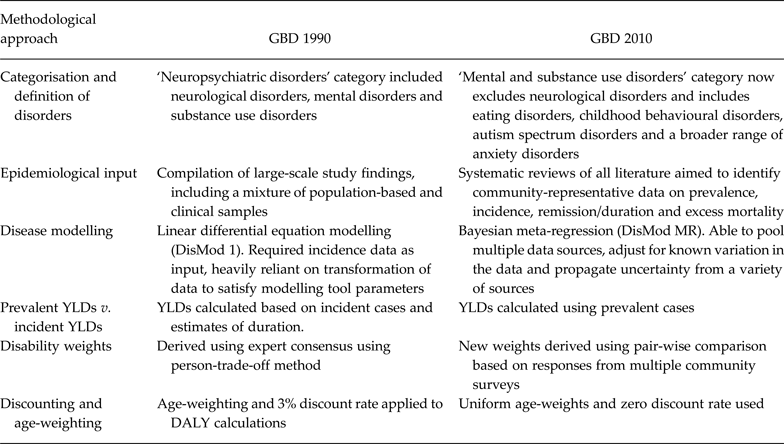
Given the concerns raised around the inequity of such social value choices, age-weighting and discounting were not used in the GBD 2010 study (Table 2). The effect of this decision was not trivial for mental and substance use disorders. For example, had age-weighting and discounting not been used in the GBD 1990, burden estimates for these disorders were estimated to have been about 30% lower (Vos & Mathers, Reference Vos and Mathers2000). It is likely that this change has resulted in lower burden estimates for mental and substance use disorders in GBD 2010.
Summary of important changes to calculating YLDs for mental and substance use disorders
Discussion
GBD 2010 confirmed the findings of GBD 1990; mental and substance use disorders are major contributors to the global burden of disease, accounting for 7·4% of disease burden worldwide, a greater proportion of the overall global burden than that attributed to HIV/AIDS and tuberculosis (5.3%), diabetes (2%) or, transport injuries (3.3%). The number of DALYs caused by mental and behavioural disorders increased by 37·6% between 1990 and 2010. As there was little change in per capita DALYs, the increase of mental disorders was almost entirely attributable to population growth and ageing. Given the rise in life expectancy, one implication of the demographic change is that more individuals will be living with mental and substance use disorders for a longer period of time. For substance use disorders however, the increased burden of alcohol, opioid, and cocaine dependence, between 1990 and 2010 was driven by increasing prevalence of these disorders and less so by demographic transitions (Degenhardt et al. Reference Degenhardt, Whiteford, Ferrari, Baxter, Charlson, Hall, Freedman, Burstein, Johns, Engell, Flaxman, Murray and Vos2013).
While GBD 2010 provides the most comprehensive current picture of health loss caused by mental and substance use disorders, some limitations remain to be addressed in future GBD iterations. The limited contribution of YLLs to mental disorder burden, with many deaths coded to the physical cause of death and suicide coded to injuries under self-harm, deserves further consideration. This could be reflected in the comparative risk assessment of the GBD (Lim et al. Reference Lim, Vos, Flaxman, Danaei, Shibuya, Adair-Rohani, Amann, Anderson, Andrews, Aryee, Atkinson, Bacchus, Bahalim, Balakrishnan, Balmes, Barker-Collo, Baxter, Bell, Blore, Blyth, Bonner, Borges, Bourne, Boussinesq, Brauer, Brooks, Bruce, Brunekreef, Bryan-Hancock, Bucello, Buchbinder, Bull, Burnett, Byers, Calabria, Carapetis, Carnahan, Chafe, Charlson, Chen, Chen, Cheng, Child, Cohen, Colson, Cowie, Darby, Darling, Davis, Degenhardt, Dentener, Des Jarlais, Devries, Dherani, Ding, Dorsey, Driscoll, Edmond, Ali, Engell, Erwin, Fahimi, Falder, Farzadfar, Ferrari, Finucane, Flaxman, Fowkes, Freedman, Freeman, Gakidou, Ghosh, Giovannucci, Gmel, Graham, Grainger, Grant, Gunnell, Gutierrez, Hall, Hoek, Hogan, Hosgood, Hoy, Hu, Hubbell, Hutchings, Ibeanusi, Jacklyn, Jasrasaria, Jonas, Kan, Kanis, Kassebaum, Kawakami, Khang, Khatibzadeh, Khoo, Kok, Laden, Lalloo, Lan, Lathlean, Leasher, Leigh, Li, Lin, Lipshultz, London, Lozano, Lu, Mak, Malekzadeh, Mallinger, Marcenes, March, Marks, Martin, McGale, McGrath, Mehta, Mensah, Merriman, Micha, Michaud, Mishra, Mohd Hanafiah, Mokdad, Morawska, Mozaffarian, Murphy, Naghavi, Neal, Nelson, Nolla, Norman, Olives, Omer, Orchard, Osborne, Ostro, Page, Pandey, Parry, Passmore, Patra, Pearce, Pelizzari, Petzold, Phillips, Pope, Pope III, Powles, Rao, Razavi, Rehfuess, Rehm, Ritz, Rivara, Roberts, Robinson, Rodriguez-Portales, Romieu, Room, Rosenfeld, Roy, Rushton, Salomon, Sampson, Sanchez-Riera, Sanman, Sapkota, Seedat, Shi, Shield, Shivakoti, Singh, Sleet, Smith, Smith, Stapelberg, Steenland, Stöckl, Stovner, Straif, Straney, Thurston, Tran, Van Dingenen, van Donkelaar, Veerman, Vijayakumar, Weintraub, Weissman, White, Whiteford, Wiersma, Wilkinson, Williams, Williams, Wilson, Woolf, Yip, Zielinski, Lopez, Murray, Ezzati, AlMazroa and Memish2012), which has not been discussed in this paper.
Another limitation is the way in which disability is measured and how weights were estimated. Disability as used within GBD is limited to ‘within the skin’ health loss, which emphasises physical pain and loss of sensory perception rather than the cognitive and emotional impact which is prominent in mental disorders (Salomon et al. Reference Salomon, Vos, Hogan, Gagnon, Naghavi, Mokdad, Begum, Shah, Karyana, Kosen, Farje, Moncada, Dutta, Sazawal, Dyer, Seiler, Aboyans, Baker, Baxter, Benjamin, Bhalla, Abdulhak, Blyth, Bourne, Braithwaite, Brooks, Brugha, Bryan-Hancock, Buchbinder, Burney, Calabria, Chen, Chugh, Cooley, Criqui, Cross, Dabhadkar, Dahodwala, Davis, Degenhardt, Díaz-Torné, Dorsey, Driscoll, Edmond, Elbaz, Ezzati, Feigin, Ferri, Flaxman, Flood, Fransen, Fuse, Gabbe, Gillum, Haagsma, Harrison, Havmoeller, Hay, Hel-Baqui, Hoek, Hoffman, Hogeland, Hoy, Jarvis, Karthikeyan, Knowlton, Lathlean, Leasher, Lim, Lipshultz, Lopez, Lozano, Lyons, Malekzadeh, Marcenes, March, Margolis, McGill, McGrath, Mensah, Meyer, Michaud, Moran, Mori, Murdoch, Naldi, Newton, Norman, Omer, Osborne, Pearce, Perez-Ruiz, Perico, Pesudovs, Phillips, Pourmalek, Prince, Rehm, Remuzzi, Richardson, Room, Saha, Sampson, Sanchez-Riera, Segui-Gomez, Shahraz, Shibuya, Singh, Sliwa, Smith, Soerjomataram, Steiner, Stolk, Stovner, Sudfeld, Taylor, Tleyjeh, van der Werf, Watson, Weatherall, Weintraub, Weisskopf, Whiteford, Wilkinson, Woolf, Zheng, Murray and Jonas2012). In addition welfare loss, both current and future, is not captured by GBD. This is particularly significant for mental and substance use disorders which often impact on an individual's economic, social and academic functioning as well as that of their family. The method used for estimating disability weights required pairwise comparisons of lay vignettes no more than 35 words in length. While rankings were relatively consistent across different countries, it is possible that stigma and other factors may have influenced which conditions were seen as more ‘unhealthy’.
With the continued evolution of the GBD framework, and the proposed annual updates of GBD estimates by the Institute of Health Metrics and Evaluation, there is an imperative to advance the evidence-base that underpins the quantification of the impact of mental and substance use disorders. This will allow the most accurate description of the contribution of these historically neglected disorders and highlight their importance in global public health.
Financial Support
HW, AB, AF, FC and HE are supported by the Queensland Centre for Mental Health Research which receives funding from the Queensland Department of Health and the National Health and Medical Research Council of Australia. HW is supported in part by an endowment to the University of Queensland from the Kratzmann Family. LD is supported by the National Drug and Alcohol Research Centre at the University of New South Wales, the Australian Government under the Substance Misuse Prevention and Service Improvements Grants Fund and an Australian National Health and Medical Research Council Principal Research Fellowship.
Conflict of Interest
None.
Ethical Standard
This research did not involve human and/or animal experimentation.