Introduction
The spotted-wing drosophila, Drosophila suzukii Matsumura (Diptera: Drosophilidae), has rapidly become a major pest of berries and stone fruits since it invaded Europe and America in 2008 (Walsh et al. Reference Walsh, Bolda, Goodhue, Dreves, Lee and Bruck2011). Unlike other fruit flies (Drosophila Fallén), females have the ability to lay eggs in healthy, ripening fruits, causing both increasing production costs and revenue losses: for example, $US 39.8 million to California, United States of America raspberry (Rubus Linnaeus; Rosaceae) production between 2009 and 2014 (Farnsworth et al. Reference Farnsworth, Hamby, Bolda, Goodhue, Williams and Zalom2016). The industry relies mainly on chemical management of D. suzukii populations, thereby increasing probabilities of insecticide pest resistance (Gress and Zalom Reference Gress and Zalom2018), mortality of beneficial insects, public health issues, and damages to the environment (National Research Council 2000). Potential alternatives to insecticides mainly include biological control (Chabert et al. Reference Chabert, Allemand, Poyet, Eslin and Gibert2012; Cuthbertson et al. Reference Cuthbertson, Blackburn and Audsley2014; Cuthbertson and Audsley Reference Cuthbertson and Audsley2016; Daane et al. Reference Daane, Wang, Biondi, Miller, Miller and Riedl2016; Guerrieri et al. Reference Guerrieri, Giorgini, Cascone, Carpenito and Van Achterberg2016; Knoll et al. Reference Knoll, Ellenbroek, Romeis and Collatz2017; Stacconi et al. Reference Stacconi, Grassi, Ioriatti and Anfora2019), physical control with exclusion nets (Cormier et al. Reference Cormier, Veilleux and Firlej2015), and the sterile insect technique (Lanouette et al. Reference Lanouette, Brodeur, Fournier, Martel, Vreysen, Cáceres and Firlej2017; Nikolouli et al. Reference Nikolouli, Colinet, Renault, Enriquez, Mouton and Gibert2018; Krüger et al. Reference Krüger, Schlesener, Martins, Wollmann, Deprá and Garcia2019).
The sterile insect technique consists of mass-rearing the pest species, exposing individuals to radiation to induce sterility, and releasing overwhelming numbers of sterile insects in the environment. The released sterile males are then expected to seek and mate with wild females, preventing them to produce viable progeny, while the released sterile females will not produce any progeny (Klassen Reference Klassen2005). The releases of sterile males over a number of generations allow the reduction of the pest population under an acceptable threshold. Several pest species, including Tephritidae (Diptera) fruit flies, have been successfully controlled with sterile insect technique worldwide (Klassen Reference Klassen2005).
The success of a sterile insect technique depends greatly on the capacity of producing sterile males with suitable overall reproductive performance, from mate finding and copulation (Pérez-Staples et al. Reference Pérez-Staples, Shelly and Yuval2013) to competitiveness (Lance and McInnis Reference Lance and McInnis2005). While other factors (e.g., continuous laboratory rearing, high population density, artificial diets, handling conditions) can also have a negative impact on male quality in sterile insect technique programmes, the irradiation process itself can directly induce decrease in reproductive success, including a competitiveness loss: both reproductive cells and somatic cells are irradiated and can undergo mutations (Robinson Reference Robinson2002). This is why irradiation is generally performed at late-pupal or adult stage, when reproductive cells are the main cells multiplying and subjected to malformations (Lance and McInnis Reference Lance and McInnis2005).
A research initiative has recently been launched to examine the feasibility of using sterile insect technique to control D. suzukii populations in berry fruit production. As a first step, Lanouette et al. (Reference Lanouette, Brodeur, Fournier, Martel, Vreysen, Cáceres and Firlej2017) reported that a suitable level of sterilisation of four-day-old pupae can be achieved using gamma irradiation at a dose of 120 Gy, without inducing any morphological deformations in males. The next step is thus to evaluate the mating capacity of irradiated males under situations where they have to compete or not with nonirradiated control males. When release rates of irradiated males are high, the ratio between sterile and wild males would be high, leading to noncompetitive situations. However, when wild males remain abundant in the field, competition for mates is likely to occur, and for sterile insect technique to be successful, released sterile males should display similar courtship behaviour and overall competitiveness as wild males.
Sexual behaviour varies greatly among Drosophila species (Markow and O’Grady Reference Markow and O’Grady2008). In D. suzukii, Revadi et al. (Reference Revadi, Lebreton, Witzgall, Anfora, Dekker and Becher2015) showed under laboratory conditions that although mating can occur any time during the day, the highest copulation rate was observed in the morning, within the first 30 minutes following the onset of the photoperiod. Drosophila suzukii females do not release a sex pheromone as observed in many species from the D. melanogaster Meigen species group (Dekker et al. Reference Dekker, Revadi, Mansourian, Ramasamy, Lebreton and Becher2015), but they produce a cuticular hydrocarbon used by males for mate recognition (Revadi et al. Reference Revadi, Lebreton, Witzgall, Anfora, Dekker and Becher2015). Male Drosophila suzukii courtship behaviour includes substrate-borne vibrations produced by abdominal quivering while males remain motionless or as “toots” while pursuing females (Mazzoni et al. Reference Mazzoni, Anfora and Virant-Doberlet2013). Furthermore, D. suzukii males have black spots on their wings that can be visually displayed by wing extension during courtship (Walsh et al. Reference Walsh, Bolda, Goodhue, Dreves, Lee and Bruck2011) and wing vibration is also a part of courtship (Fuyama Reference Fuyama1979; Mazzoni et al. Reference Mazzoni, Anfora and Virant-Doberlet2013; Revadi et al. Reference Revadi, Lebreton, Witzgall, Anfora, Dekker and Becher2015).
Another aspect to consider in a sterile insect technique programme is the remating propensity of females: if females first mated by irradiated males are inclined to remate, wild males might transfer fertile sperm to already mated wild females (Barclay Reference Barclay2005). For example, the receptivity of Ceratitis capitata Wiedemann (Diptera: Tephritidae) females is higher when mated by an irradiated, sterile male than by a wild male (Kraaijeveld and Chapman Reference Kraaijeveld and Chapman2004). For D. suzukii, polyandry was observed by Revadi et al. (Reference Revadi, Lebreton, Witzgall, Anfora, Dekker and Becher2015) but not investigated further. According to Markow (Reference Markow2002), Drosophila species displaying a sexual dimorphism, such as D. suzukii where males have black spots on their wings, tend to be monoandrous. Drosophila males may invest in external morphological characters when sexual selection occurs before mating, or in ejaculate features, such as sperm gigantism, when sexual selection occurs after mating (overlapping ejaculates, remating polyandry) (Markow Reference Markow2002). All Drosophila species from the D. melanogaster species group – the group containing D. suzukii (Hauser Reference Hauser2011) – share the evolutionary feature of infrequent female remating.
The objectives of this study were to (i) determine the mating capacity of irradiated males, (ii) compare mating success of irradiated males versus control males under competition, and (iii) explore female receptivity following a first mating with irradiated or control males in D. suzukii at a dose of 120 Gy, that is, the dose previously identified sufficient to induce suitable sterilisation without morphological deformations (Lanouette et al. Reference Lanouette, Brodeur, Fournier, Martel, Vreysen, Cáceres and Firlej2017).
Material and methods
All experiments took place at the Institut de Recherche et de Développement en Agroenvironnement (St-Bruno-de-Montarville, Québec, Canada) using an Italian strain of D. suzukii collected from wine grapes in 2012 in Trentino region and reared at Institut de Recherche et de Développement en Agroenvironnement since February 2016. Rearing procedures and methods of egg laying and extraction of pupae from the artificial diets are described in Lanouette et al. (Reference Lanouette, Brodeur, Fournier, Martel, Vreysen, Cáceres and Firlej2017). Tests were performed under controlled conditions at 23 ± 1 °C, 50 ± 10% relative humidity, and a photoperiod of 16:8 light:dark hours. Voucher specimens have been deposited at the Ouellet-Robert entomological collection (Université de Montréal, Montréal, Québec, Canada).
Irradiation
Four-day-old D. suzukii pupae (12–24 hours before emergence) were irradiated at the Centre de Recherche du Centre Hospitalier de l’Université de Montréal (Montréal, Québec, Canada) in a Gammacell 3000 (Best Theratronics, Kanata, Ontario, Canada) with 137Caesium source. Pupae for irradiation and control pupae were brought in a thermal bag to the irradiation centre and were thus exposed to the same temperature and humidity conditions. Pupae from a given rearing cohort were assigned randomly to each treatment.
Pupae were isolated after irradiation and individuals sexed on the day of emergence. They were separated in one 5-L box (116.0 cm × 147.6 cm × 147.6 cm) according to their sex, treatment, and day of emergence. Adults were provided with sucrose, yeast (3:1), a piece of banana diet (Chabert et al. Reference Chabert, Allemand, Poyet, Eslin and Gibert2012), and water. For all experiments, three-day-old unmated adult males and five-day-old unmated adult females were used to ensure sexual maturity and high levels of mating (G.L., unpublished data).
Mating capacity
We first compared the mating capacity of irradiated D. suzukii males and control males in the absence of competition. Each male was placed in a Petri dish (ø = 100 mm) with 10 females (not irradiated) and a small piece of banana (Musa Linnaeus; Musaceae) diet. After 24 hours, the male was removed from the Petri dish and females were kept alive at 8 ± 2 °C for zero to three days until dissection to detect stored sperm and assess the number of females inseminated by each male. The spermatheca and seminal receptacle were taken out of the female abdomen by pulling on the ovipositor. The organs were put on a slide with a drop of 1% saline solution, covered with a coverslip. As the brown colour of the spermatheca prevents from observing the presence of sperm, a light pressure was applied to break the spermatheca and release the spermatozoa. Immediate observation of all structures was performed using a microscope at 400 magnification to score the presence/absence and location of spermatozoa in three different storage organs: spermatheca, spermathecal tubes, and seminal receptacle.
This experiment was conducted using five irradiated males and five control males per irradiation cohort and repeated four times (total of 20 males per treatment). The number of mated females per male and the presence/absence of spermatozoa in each storage organ per mated female were compared using generalised linear mixed-effects model with binomial distribution. Male treatment was used as a factor and cohort as random factor. All data analyses were performed using R 3.3.2 (R Development Core Team 2016).
Competitiveness
The competitiveness of irradiated versus control males was assessed by scoring mating success in Petri dish (ø = 47 mm) containing three virgin D. suzukii: one irradiated male, one control male, and one control female. The behaviour of D. suzukii was recorded using a camera (Dino-Lite, London, Ontario, Canada, Digital microscope Model AM4012NZT with 720 × 576 pixels resolution and 25 pictures/second) placed above the experimental arena. Filming started when D. suzukii were introduced in the Petri dish and ended following the first mating, for a maximum of three hours in case of no mating. Males were introduced first in the arena, alternating the sequence between irradiated and control individuals; the female was always introduced last. Because D. suzukii under laboratory conditions mate mostly in the first half-hour after start of photophase (Revadi et al. Reference Revadi, Lebreton, Witzgall, Anfora, Dekker and Becher2015), tested D. suzukii were introduced in the arena under darkness conditions, at the end of the scotophase, using a red light. Low level of activity was observed in darkness and, in a few cases, mating occurred; D. suzukii were then discarded. A small piece of banana diet was also put inside the arena prior to the D. suzukii to provide a substrate for vibrations during courtship (Mazzoni et al. Reference Mazzoni, Anfora and Virant-Doberlet2013). A total of 60 arenas were set up with 48 mating events being recorded.
Videos were watched with video player Kinovea (open source) using the slide-by-slide tool when necessary. Sequences were analysed with CowLog (Hänninen and Pastell Reference Hänninen and Pastell2009) to quantify the frequency (and duration when relevant) of the following behaviours: resting (including grooming), walking and courtship, number of rejections by the female (decamping, kicking, spinning, or abdominal depression following a mating attempt, Revadi et al. Reference Revadi, Lebreton, Witzgall, Anfora, Dekker and Becher2015), latency period (i.e., time between light on and beginning of mating), mating duration, and identity of the successful male.
Percentage of time allocated to different behaviours was calculated for both types of males and compared with a nonparametric Kruskal–Wallis test. Number of female rejections for each type of males was compared using a generalised linear mixed model with Poisson distribution according to male treatment. Proportion of females mating with irradiated versus control males was compared using exact test of goodness of fit. All data analyses were performed using R 3.3.2 (R Development Core Team 2016).
Female remating
We examined the propensity of D. suzukii females to remate following a first mating with either an irradiated or control male. Twenty irradiated males and 20 control males were put individually in Petri dishes (ø = 47 mm) with a small piece of banana diet. As a first step, each of them was provided with one virgin female until mating, for a maximum of two hours. Drosophila suzukii were introduced in the experimental arena following the method described above. The observer noted the beginning and ending of mating, if it occurred, and calculated the latency period and mating duration. After two hours, males and virgin females were discarded. Mated females were kept individually in a small cup (ø = 30 mm) with banana diet to allow oviposition. As a second step, two days after the first mating, each female was provided with a new male, once again for two hours at light on. The same observations were done. Females that did not remate during this second encounter were provided with a third male from the same treatment as the second male four days after the first mating under the same conditions. The following four treatments were tested:
1. Mated first with an irradiated male, then access to an irradiated male (n = 20)
2. Mated first with an irradiated male, then access to a control male (n = 20)
3. Mated first with a control male, then access to a control male (n = 20)
4. Mated first with a control male, then access to an irradiated male (n = 20)
Damaged flies and those that were not active during the test were not included in the analysis (total of six flies eliminated).
Mating success of irradiated and control males with virgin females was compared using a binomial generalised linear model with the following factors: treatment of the first mate (irradiated or control), treatment of the second male, first mating duration, and time since the first mating (two or four days).
Latency and mating duration were compared between male treatments (irradiated or control) and between mating conditions (competitive versus noncompetitive – in this case using results from the competitiveness experience) using an analysis of variance. Latency indicates the efficacy of the males to find, courtship, and be accepted by the females, knowing that in a sterile insect technique context, males will have to find the females over a much larger arena. Mating duration is positively correlated to the ejaculate investment of the males and to a higher probability of its sperm being used in a polyandry context (Bretman et al. Reference Bretman, Fricke and Chapman2009). All data analyses were performed using R 3.3.2 (R Development Core Team 2016).
Results
Mating capacity
There was no significant difference in the mating capacity of irradiated and control males (F = 0.53, df = 1, P = 0.469) during the 24-hour period; they respectively mated a mean of 6.9 ± 2.0 and 6.4 ± 1.9 females.
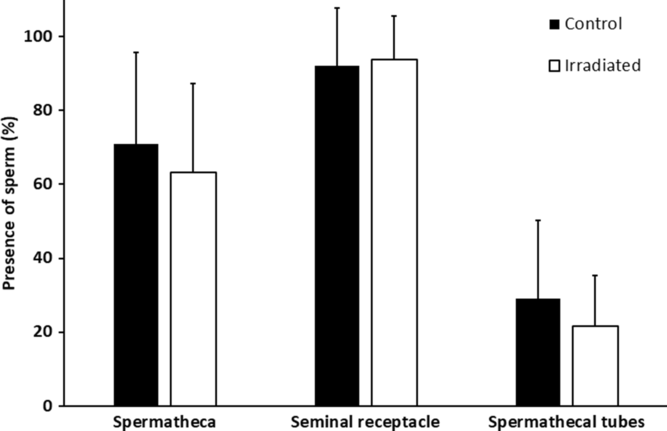
Male irradiation had no effect on sperm storage in female reproductive organs. Sperm occurrence was observed in similar proportions in the spermatheca (F = 0.85, df = 1, P = 0.393), spermathecal tubes (F = 1.56, df = 1, P = 0.262), and seminal receptacle (F = 0.16, df = 1, P = 0.687) following mating with irradiated or control males (Fig. 1).
Effect of gamma irradiation (dose of 120 Gy) at the pupal stage of males Drosophila suzukii on sperm storage in the reproductive organs of females (mean ± SD). No statistical significance was observed with a generalised linear model (P > 0.05).

Competitiveness
Irradiated D. suzukii males were as successful as control males with a mean of 37.5% of females mated compared to 62.5% for control males (95% confidence interval = 0.240–0.527, P = 0.111).
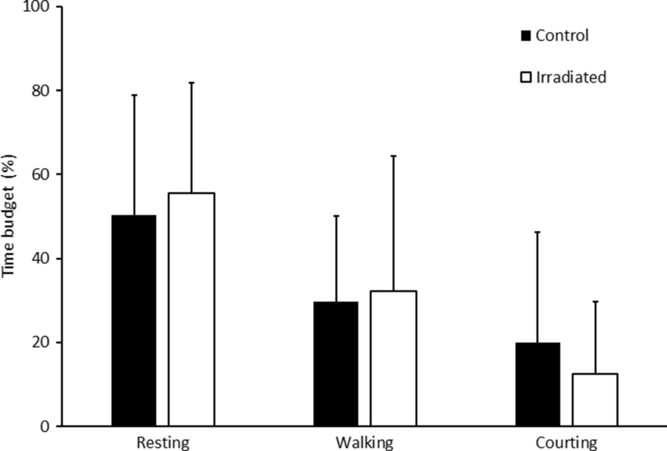
Irradiation had no effect on the amount of time males spent resting, walking without interacting with females, or courting the female (Kruskal–Wallis: X 2 = 0.475, df = 1, P = 0.491; X 2 = 0.409, df = 1, P = 0.5223; X 2 = 2.895, df = 1, P = 0.089; respectively) (Fig. 2). Mean number of rejections made by females before accepting a mate did not vary between irradiated (1.4 ± 2.7) and control (1.4 ± 2.2) males (generalised linear model: Z = 0.475; df = 1, P = 0.635).
Effect of gamma irradiation (dose of 120 Gy) at the pupal stage on males Drosophila suzukii time budget (mean ± standard deviation) when irradiated males were in competition with nonirradiated males. No statistical significance was observed with Kruskal–Wallis tests (P > 0.05).

Female remating
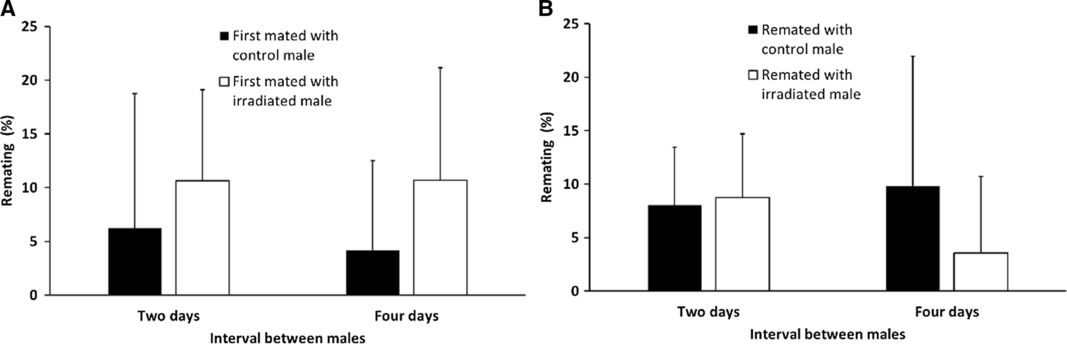
During the first mating period (two hours), irradiated males (59.8%) were more successful in mating with virgin females than control males (40.8%) (Z = 0.789, df = 1, P = 0.017). Remating occurred uncommonly after two (8.1%) and four (7.7%) days, either for females previously mated with irradiated (18.8%) or control (7.4%) males. None of the tested variables had a significant impact on remating: treatment of the first mate (Z = 1.212, df = 1, P = 0.223), treatment of the second mate (Z = −0.666, df = 1, P = 0.505), mean duration of the first mating (Z = 0.969, df = 139, P = 0.333), or mean interval between mating (Z = −0.066, df = 1, P = 0.947) (Fig. 3).
Effect of gamma irradiation (dose of 120 Gy) at the pupal stage on Drosophila suzukii female remating propensity (mean ± standard deviation). A, If her first mate has been irradiated; B, if the second male presented to her has been irradiated. No statistical significance was observed with a generalised linear model (P > 0.05).

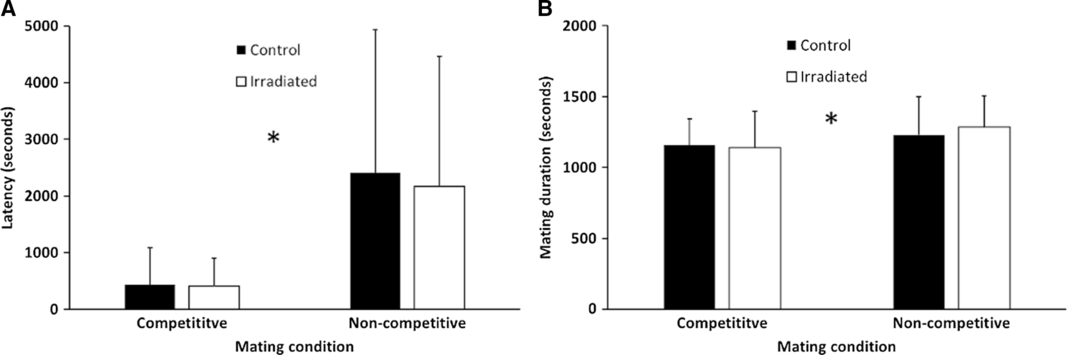
Mean latency before mating was shorter when males were under competitive conditions compared to when alone (analysis of variance: F = 27.042, df = 1, P < 0.0001), but latency was not affected by irradiation (F = 0.208, df = 1, P = 0.448) (Fig. 4). Similarly, mean mating duration was shortened when males were in competition (analysis of variance, F = 7.306, df = 1, P = 0.008), but it was not affected by male irradiation (F = 0.379, df = 1, P = 0.539) (Fig. 4).
Effect of gamma irradiation (dose of 120 Gy) at the pupal stage of Drosophila suzukii males on mating. A, Latency; B, duration (mean ± standard deviation). Asterisks indicate significant differences (P < 0.05) between competitive and noncompetitive conditions using analysis of variance.

Discussion
The objective of the study was to compare mating capacities of D. suzukii males irradiated at 120 Gy and control males under noncompetitive and competitive conditions and to measure the female propensity to remate depending on the male status of her first mate. We observed no difference in the number of mates within a 24-hour period between irradiated and control males in noncompetitive conditions.
When males were competing for a female, the performance of irradiated males did not significantly differ from control males. This result is interesting in the context of a sterile insect technique programme, as reduction of mating capacity should be avoided in irradiated males. Similar results have been observed in other species. In Anastrepha fraterculus Wiedemann (Diptera: Tephritidae), Allinghi et al. (Reference Allinghi, Calcagno, Petit-Marty, Gómez Cendra, Segura and Vera2007) found no difference in the competitiveness of males irradiated at three different doses (40, 70, and 100 Gy) and control males in field cages. In contrast, for Ceratitis capitata Wiedemann (Diptera: Tephritidae), although a low dose of irradiation (35 Gy) did not affect the competitiveness of males, higher doses (70 and 140 Gy) reduced its ability to mate with a virgin female under noncompetitive conditions (Lux et al. Reference Lux, Vilardi, Liedo, Gaggl, Calcagno and Munyiri2002). For Anastrepha obliqua Macquart (Diptera: Tephritidae), the competitiveness of irradiated males, estimated as the proportion of sterile eggs laid by females, decreased with the augmentation of the irradiation dose (40, 60, and 80 Gy) (Toledo et al. Reference Toledo, Rull, Oropeza, Hernández and Liedo2004).
Although competitiveness was not reduced in irradiated D. suzukii males at 120 Gy, male performance needs to be monitored further during the implementation of a sterile insect technique programme. We only tested one age in D. suzukii, but competitiveness of males in D. melanogaster has been showed to improve with age from two to eight-day-old (Long et al. Reference Long, Markow and Yaeger1980). Considering that irradiated D. suzukii in laboratory can live until 36 days (Lanouette et al. Reference Lanouette, Brodeur, Fournier, Martel, Vreysen, Cáceres and Firlej2017) and in average 18 days, this suggests that competitiveness of irradiated could be better with older males. But if occurring, lower competitiveness of irradiated males could (i) be compensated for by using high ratios of irradiated to wild males in sterile insect technique releases and multiple release, (ii) be avoided by reducing the irradiation dose (Parker and Mehta Reference Parker and Mehta2007), or (iii) be compensated by increasing irradiated male size when mass-produced. Size has also been associated with higher irradiated males competitiveness in Anastrepha obliqua (Artiaga-López et al. Reference Artiaga-López, Hernández, Domínguez-Gordillo, Moreno and Orozco-Dávila2004) and with greater lifetime mating success in the congeneric D. melanogaster (Partridge and Farquhar Reference Partridge and Farquhar1983).
We observed infrequent female remating two and four days after the first mating. The occurrence of remating was not influenced by the treatment (irradiated or control) of the first and the second partner, or by the duration of the first mating. Krüger et al. (Reference Krüger, Schlesener, Martins, Wollmann, Deprá and Garcia2019) also observed low remating frequency in presence of irradiated D. suzukii males (at 200 Gy) as well as control males. Knowledge on D. melanogaster reproduction could be partially transposed to D. suzukii to discuss elements of our observations (Bloch Qazi et al. Reference Bloch Qazi, Heifetz and Wolfner2003). In D. melanogaster, sperm transfer decreases female receptivity from 6–10 hours postmating and females can be unreceptive for up to 1.5 weeks (Manning Reference Manning1962; Gromko et al. Reference Gromko, Newport and Kortier1984). Receptivity of D. melanogaster female is restored after multiple use of stored sperm when egg laying (Manning Reference Manning1962; Gromko et al. Reference Gromko, Newport and Kortier1984; Newport and Gromko Reference Newport and Gromko1984). Our observations suggest that D. suzukii females have a similar reproductive physiology as D. melanogaster; remating being not influenced by whether the female was first inseminated by an irradiated or a control male. Sperm of D. suzukii male was stored both in seminal receptacle and spermatheca like in D. melanogaster (Lefebvre and Jonsson Reference Lefebvre and Jonsson1962). Irradiation can decrease the sperm ejaculate size as observed in Bactrocera tryoni (Froggatt) (Diptera: Tephritidae) and Anopheles arabiensis Patton (Diptera: Culicidae) (Harmer et al. Reference Harmer, Radhakrishnan and Taylor2006; Helinski and Knols Reference Helinski and Knols2009), but the absence of differential sperm storage in D. suzukii following mating with irradiated versus control males suggests that size of sperm ejaculate of irradiated male is enough to fill the storage organs of females.
Knowledge of the reproductive ecology of D. suzukii, more specifically the factors influencing remating and male sperm prevalence, would bring valuable knowledge for sterile insect technique development and success. Even if the cost of multiple mating has probably driven the behaviour of Drosophila species toward infrequent remating (Fowler and Partridge Reference Fowler and Partridge1989; Chapman et al. Reference Chapman, Liddle, Kalb, Wolfner and Partridge1995), it remains possible that Drosophila females mate with more than one male in natural environment (Ochando et al. Reference Ochando, Reyes and Ayala1996; Imhof et al. Reference Imhof, Harr, Brem and Schlötterer1998). In D. melanogaster, 80% of the progeny can originate from the last mating (last male sperm precedence; Lefebvre and Jonsson Reference Lefebvre and Jonsson1962; Gromko et al. Reference Gromko, Newport and Kortier1984), but the female can also choose among sperm of different males for egg fertilisation (Price Reference Price1997). For D. suzukii, insituations of male competition between irradiated and control males, it is important to evaluate how egg laying influences the duration of the female refractory period as well as sperm precedence.
Mating with an irradiated male did not affect the mating duration and female mating latency in D. suzukii. This suggests that irradiated males have a normal mating behaviour and are suitable candidates in a sterile insect technique programme. Similar findings have been observed by Krüger et al. (Reference Krüger, Schlesener, Martins, Wollmann, Deprá and Garcia2019) with an irradiation dose of 200 Gy. However, irradiation has been shown to influence the latency and the duration of mating of many fly species: latency was longer for irradiated C. capitata, shorter for irradiated B. tryoni, and similar for irradiated A. fraterculus, while mating duration was similar for irradiated C. capitata and B. tryoni and shorter for irradiated A. fraterculus (Lux et al. Reference Lux, Vilardi, Liedo, Gaggl, Calcagno and Munyiri2002; Allinghi et al. Reference Allinghi, Calcagno, Petit-Marty, Gómez Cendra, Segura and Vera2007; Radhakrishnan et al. Reference Radhakrishnan, Pérez-Staples, Weldon and Taylor2009). Interestingly, we observed that mating occurring under competitive conditions happened more rapidly and was shorter for both control and irradiated males. Having two males in the experimental arena likely increases the probability of encounter with the female, and interference by the second male during mating results in shorter mating duration. It was previously observed that D. melanogaster naïve males use olfactory and acoustic signals to detect the presence of competitors (Bretman et al. Reference Bretman, Fricke and Chapman2009). Reducing mating duration is not adaptive considering the last male sperm precedence rule in Drosophila species, but it can benefit naïve males that escape competitor harassment or females when better potential males are detected in proximity (Garbaczewska et al. Reference Garbaczewska, Billeter and Devine2013).
Overall, we observed that an irradiation dose of 120 Gy applied to four-day old pupae does not affect male mating performance under both noncompetitive and competitive conditions. Irradiated males have the capacity to mate with a similar number of females as control males in absence of competition and have similar mating latency and mating duration as control males. Furthermore, the experiments took place in constrained artificial arena (Petri dishes) where interactions between males and females were “forced”. The copulation rates obtained this way can be higher than what would be observed in the field.
This study of irradiation effects on D. suzukii behaviour represents an important step in the development of a sterile insect technique programme against this pest. Other aspects still need to be studied to allow a better evaluation of the optimal irradiation dose. We suggest the investigation be continued by obtaining the Fried competitiveness index (Fried Reference Fried1971) of males irradiated at higher doses to obtain better sterility considering the risk imposed by D. suzukii. This index represents the proportion of nonfecund eggs laid in a population where females, wild males, and irradiated males cohabit. It can be obtained from semi-field cage experiments, but should also be continuously measured from wild flies during a sterile insect technique programme to assess its performance (Vreysen Reference Vreysen2005).
Acknowledgements
The authors are grateful to Marianne Gousy-Leblanc and Maxence Jacquot-Atuyer for technical assistance, to Guy Boivin (Centre de recherche et de développement en horticulture) for advices and to Michelle Grenier (Institut de Recherche et de Développement en Agroenvironnement) for statistical expertise. This research was supported by the Programme Innov’action agroalimentaire from the agreement Cultivons l’avenir 2 concluded between the Ministère de l’Agriculture, des Pêcheries et de l’Alimentation du Québec and Agriculture and Agri-food Canada.