Introduction
The prevalence of undernourishment in sub-Saharan Africa is increasing and affects more than 20% of the population, impacting both their health and their life expectancy (FAO et al., 2018). Fruits and vegetables are major sources of vitamins and micronutrients and play a key role in reducing food insecurity. Year-round access to vegetables is challenged by the sensitivity of the crops to climatic conditions and pests, as well as their perishability, which is responsible for significant post-harvest losses and worsened by the lack of storage facilities. So far, the control of vegetable pests in sub-Saharan Africa (SSA) mainly relies on the use of pesticides (De Bon et al., Reference De Bon, Huat, Parrot, Sinzogan, Martin, Malézieux and Vayssières2014). Resistance to pesticides in several major insect pests of vegetable crops (e.g. whiteflies and Lepidoptera) has been reported in Africa thereby reducing their efficiency (Agboyi et al., Reference Agboyi, Ketoh, Martin, Glitho and Tamo2016; Houndété et al., Reference Houndété, Kétoh, Hema, Brévault, Glitho and Martin2010; Martin et al., Reference Martin, Chandre, Ochou, Vaissayre and Fournier2002; Grzywacz et al., Reference Grzywacz, Rossbach, Rauf, Russell, Srinivasan and Shelton2010). Inappropriate use of pesticides threatens not only the environment but also the health of producers and consumers, as reported in numerous studies revealing pesticide residues beyond maximum residue limits in fruits and vegetables sold in local markets in SSA (Bempah et al., Reference Bempah, Buah-Kwofie, Enimil, Blewu and Agyei-Martey2012; Amoah et al., Reference Amoah, Drechsel, Abaidoo and Ntow2006; Ahouangninou et al., Reference Ahouangninou, Martin, Edorh, Bio-Bangana, Onil, St-Laurent, Dion and Fayomi2012; Lehmann et al., Reference Lehmann, Turrero, Kolia, Konaté and De Alencastro2017; Diop et al., Reference Diop, Diop, Thiaré, Cazier, Sarr, Kasprowiak, Landy and Delattre2016).
Replacing the use of pesticides by netting to protect vegetable crops from insect pests has been the subject of several studies in SSA (Nordey et al., Reference Nordey, Basset-Mens, De Bon, Martin, Déletré, Simon, Parrot, Despretz, Huat and Biard2017). Many reports indicated that the use of insect-proof nets increased yield and prevented infestation by the largest pests in size, that is, Lepidoptera and Diptera, of several vegetable crops, including French beans (Gogo et al., Reference Gogo, Saidi, Ochieng, Martin, Baird and Ngouajio2014), tomato (Saidi et al., Reference Saidi, Gogo, Itulya, Martin and Ngouajio2013), and cabbage (Kiptoo et al., Reference Kiptoo, Kasina, Wanjala, Kipyab, Wasilwa, Ngouajio and Martin2015; Simon et al., Reference Simon, Komlan, Adjaïto, Mensah, Coffi, Ngouajio and Martin2014; Martin et al., Reference Martin, Assogba-Komlan, Houndete, Hougard and Chandre2006). However, the use of netting by producers in the tropics is hindered by the resulting increase in temperature in the tunnels that can be detrimental to crop development (Simon et al., Reference Simon, Komlan, Adjaïto, Mensah, Coffi, Ngouajio and Martin2014; Nordey et al., Reference Nordey, Basset-Mens, De Bon, Martin, Déletré, Simon, Parrot, Despretz, Huat and Biard2017).
In regions with high solar radiation, shade nets are placed over crops to reduce incoming radiation and to reduce the temperature of the air, soil, and plants (Stamps, Reference Stamps2009). Several experiments have demonstrated the advantage of using nets that provide up to 50% shading to increase the yield and quality of vegetable crops (Baliyan, Reference Baliyan2014; Kittas et al., Reference Kittas, Katsoulas, Rigakis, Bartzanas and Kitta2012)
In the present study, we investigated the interest of using insect-proof nets with similar mesh sizes (0.7 × 0.9 mm) but providing different degrees of shading (17.2% and 50.1%) to cover low closed tunnels. Cabbage was used as a model since it is one of the main vegetable crops in SSA and because of its sensitivity to insect pests and climatic conditions. The effects of insect-proof nets on yields, climatic conditions, crop development, and changes in insect pest populations were assessed. A cost–benefit analysis was also performed to assess the profitability of the technique.
Material and Methods
Experimental site
An experiment lasting two seasons, the rainy season from January to March 2018, and the dry season from May to August 2018, was set up at the ‘World Vegetable Center Eastern and Southern Africa’ in Arusha, Tanzania (latitude: −3.3753, longitude: 36.805). The site was 1250 m above sea level and has a temperate climate (Cwb, temperate subtropical highland climate) (Peel et al., Reference Peel, Finlayson and McMahon2007).
Experimental design and treatments
A randomized complete block design was used with three treatments, cultivation in (1) an open field, under fully closed low tunnels (2) covered with silver nets or (3) with white nets, with five replications of each treatment. Each experimental unit measured 2 × 10 m (20 m2) and was separated by a walk space 2.5 m wide. Locally collected bamboo poles were used to construct low tunnels 0.75 m high, 2 m wide, and 10 m long. The tunnels were covered with silver nets (transmittance of 49.9% for global solar radiation (GR) and 52.4% for photosynthetically active radiation (PAR)) or white nets (transmittance 82.8% for GR and 81.1% for PAR), with similar mesh size (0.7 × 0.9 mm) (AtoZ Textile Mills Ltd., Arusha, Tanzania), that were tied, stretched with ropes, and buried to a depth of 30 cm in the soil. An opening was made in the top of the tunnels to allow access to the crops for management and data collection.
Crop management
Four-week-old seedlings of a hybrid cabbage variety (Brassica oleracea var. capitata) (Tsavorite F1, HM Clause, Portes les Valence, France) were grown in a nursery before being transplanted. After plowing, the soil was covered with a silver plastic mulch (Silver C802; Ginegar Plastic Products Ltd, Kibbutz Ginegar, Israël), and a drip irrigation system was installed for all treatments. Sixty-six cabbage seedlings were transplanted in each experimental unit in three rows of 22 plants with an inter-row space of 40 cm and with a 60-cm space between rows, giving a density of 3.6 plants/m2. Cabbages were planted at a distance of 40 cm from the sides of the tunnel so the leaves did not touch the nets since previous studies showed that some insect pests lay their eggs through the netting (Simon et al., Reference Simon, Komlan, Adjaïto, Mensah, Coffi, Ngouajio and Martin2014).
Ten grams of a complete fertilizer (17% nitrogen, 17% phosphorus, and 17% potassium) was applied (370 kg ha−1) to each plant 1 week after transplanting, followed by 10 g of urea, (46% nitrogen, 740 kg ha−1) 3 and 5 weeks after transplanting. Weeding was done and irrigation water provided in the individual plots as needed. Chemical treatments to control pests (insect pests and fungal diseases) were applied at the plot scale based on scouting. In keeping with local recommendations, treatments were applied when first insects or symptoms were observed. Lambda-cyhalothrin (Karate 5EC and Ninja 5EC; Syngenta, Bâle, Switzerland) was used to control sucking insects, (whiteflies and aphids) and chewing insects, (diamondback moth) consistent with the locally available and widely used pesticides (Ngowi et al., Reference Ngowi, Mbise, Ijani, London and Ajayi2007). Mefenoxam and Mancozeb (Ridomil Gold; Syngenta, Bâle, Switzerland) were used to control fungal diseases, that is, black rot, based on scouting. Two fungicide treatments were applied in the first season and one in the second season in all treatments. Pesticide treatments were applied in the late afternoon when the climatic conditions were suitable (on clear days with little wind) using a 16-L capacity backpack sprayer (Jacto PJH, Jacto, Pompéia, Brazil).
Data collection
Climate conditions
GR, temperature, rainfall, and air relative humidity were recorded by a full weather station (Vantage PRO2; Davis Instruments, Hayward, CA, USA) over the two seasons and the data are summarized in Table 1. Climate conditions recorded by the weather station were used to describe climatic conditions in the open field. Inside the tunnels, the air temperature and the relative humidity were recorded at 1-minute intervals and averaged every 30 minutes using data loggers with an accuracy of ±0.21 °C over the 0–50 °C temperature range and for air relative humidity, of ±2.5% over the range 10–90% (HOBO Pro v2 U23–001; Onset Computer Corporation, Bourne, MA, USA). One data logger was placed in the middle of each low tunnel above the cabbages (0.7 m above the ground) positioned in a perforated bell-shaped white plastic shelter 30 cm in diameter, to minimize direct solar radiation. The temperature of the plant surface was assessed weekly using a compact thermal infrared camera (Flirt C2; FLIR Systems, Wilsonville, Oregon, USA). Four pictures were taken at midday to minimize the effect of shade in each plot. The surface temperature of the crops was assessed by randomly selecting individual pixels from 10 plants per picture. The light transmittance of nets was used to estimate GR under tunnels from GR measured with the weather station.
Comparison of climate conditions, minimum, maximum, and average temperature (in °C), total rainfall (in mm), average air relative humidity (%), and average daily global solar radiation (in MJ m-2) in the two seasons

Pest monitoring and crop development
In each plot, 10 plants were randomly selected in the central row for weekly monitoring of major insect pests by visual counting and for weekly assessment of the vegetative growth of the plants. Measurements were made on the whole plant early in the morning when insects were less active. Insects were recorded first, before taking measurements was likely to disturb them. For aphids, all instars were recorded, for whiteflies, only adults were recorded, and for Lepidoptera, only larvae were recorded. To monitor adult whiteflies, the cabbage leaves were very gently lifted to enable observation while preventing the insects from escaping. Insects were collected throughout the experiment and identified by an experienced entomologist.
The diameter of the cabbages was measured after the insects were monitored. At harvest, all cabbages were weighed and sorted into two grades, marketable and non-marketable cabbages, according to local market standards, that is, weight higher than 1.5 kg and absence of visible defects. Five marketable cabbages were then randomly selected from each plot to assess their dry matter content by chopping them into smaller pieces and drying them in an oven at 100 °C for 12 h and then weighing the result.
Cost–benefit analysis
A cost–benefit analysis was conducted for each cultivation method tested (in the open field and under the two types of low tunnels) using data recorded over the two seasons. The profits were computed by subtracting the sum of variable and fixed costs from the total revenue. Variable costs were those directly associated with cabbage production including labor and inputs (seeds, fertilizers, and pesticides). The quantity and cost of all the inputs and of the labor required for the management of each experimental unit were recorded for the two seasons. The cost of labor was estimated using the average daily cost of a casual field worker, US$4 per day. The cost of the inputs (seeds, growing medium for the seedlings, fertilizers, and pesticides) and of the equipment (seedling trays, watering can, sprayer, hand hoe, drip irrigation lines, plastic mulch, insect-proof nets, and bamboo poles) were recorded from local suppliers. Only the depreciation of the equipment was considered in the calculation of the fixed costs. Equipment depreciation was calculated according to their respective life span and the potential number of crop cycles per year, which is three for cabbage. The life span of the equipment was estimated at 2 years for the seedling trays, 10 years for the watering can, sprayer, and hand hoe, 3 years for the drip irrigation equipment, 2 years for the plastic mulch, 4 years for the insect-proof nets, 2 years for the bamboo poles, and 1 year for the ropes.
Income from sales was estimated according to yield and selling prices at the farm gate and in local markets recorded over the two seasons. In Tanzania, most cabbage growers sell their produce per plot to middlemen who collect and transport the produce from the villages to the market where they sell it to retailers (De Putter et al., Reference De Putter, Van Koesveld and De Visser2007). Surveys of farmers in the vicinity showed that price per hectare varied between US$560 and US$1010 depending on the season and on the plot, that is, planting density, crop losses. Based on our estimations, the average unit price of marketable cabbage purchased by middlemen was US$0.08.
We also assumed that a small proportion of farmers, under 20% according to a previous study in Tanzania (De Putter et al., Reference De Putter, Van Koesveld and De Visser2007), sell their cabbages directly on local markets where they can negotiate prices with consumers based on weight. A survey of prices at the local markets in Arusha indicated that the average price of a cabbage weighing 1.5 to 2.5 kg was US$0.23 and US$0.34 for bigger cabbages. A cost–benefit analysis was performed based on selling prices obtained by farmers from middlemen and from final consumers in local markets. A sensitivity analysis was performed by increasing pesticide costs and prices of the materials used for the construction of low tunnels by 50%.
Statistical analysis
Analyses of variance (ANOVA) were used to assess significant differences between measurement data between treatments on data collected to describe climatic conditions (temperature and air relative humidity), vegetative development (cabbage diameter), and yields (marketable and non-marketable yields) of the crops since they followed a normal distribution. The block effect was considered as a random factor when ANOVA revealed no significant effect at p < 0.05. Post hoc analyses were performed to compare treatments when significant differences were identified by Tukey’s test. Kruskal Wallis tests were used on the data collected to describe insect pest populations (number of insect pests per plant) since they did not follow the normal distribution. When significant differences were established using Dunn’s test and the Holm method to adjust the P-value, post hoc analyses were performed to compare treatments. All statistical analyses were performed using R software (R Development Core Team, 2012) with the agricolae package (De Mendiburu, Reference De Mendiburu2014).
Results
Impacts of insect-proof netting on climate conditions in the tunnels
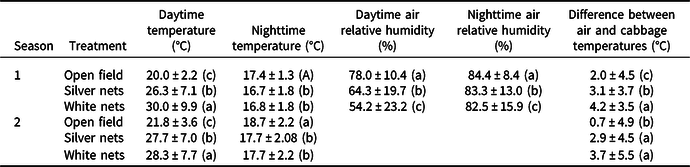
The second season was slightly warmer than the first with less rainfall and higher GR (Table 1). The average daytime temperature was 10.0 °C higher under white netting and 6.3 °C higher under silver netting than in the open field in the first season and, respectively, 6.5 °C and 5.9 °C higher in the second season (Table 2). In contrast, slightly lower temperatures were measured under the tunnels at night than in the open field, regardless of the nets and seasons. Measurements indicated that the air relative humidity was lower under the nets than in the open field during daytime but little difference was found during the night. Data on the air relative humidity are only given for the first season because parametrization problems with the data loggers prevented us from obtaining proper data in the second season.
Comparison of climatic conditions recorded at 30-minute intervals over the two seasons, in the day (from sunrise to sunset) and at night (from sunset to sunrise) average air temperature (in °C) and average air relative humidity (%), and average difference between air temperature and cabbage temperature assessed weekly at midday in the open field and in tunnels covered with silver or white nets. Data are means (±standard deviation). Different letters in the same column mean that data differ significantly at P < 0.05 (according to Tukey’s multiple comparison test) between treatments, that is, open field, white and silver nets, in each season

Average daily GR was deduced from GR measured by the weather station (Table 1) and the transmissivity of nets (49.9% and 82.8% for silver and white nets, respectively) was 9.1 and 9.9 MJ m−2 inside the white tunnels in the first and the second season, respectively, versus respectively, 5.3 and 5.7 MJ m−2 inside the silver tunnels.
Analyses of thermal images showed that the temperature of cabbages at midday in open field and under silver and white tunnels were 2.0 °C, 3.1 °C, and 4.2 °C higher than the air temperature, respectively, in the first season, and 0.7 °C, 2.9 °C, and 3.7 °C higher than the air temperature in the second season (Table 2).
Impact of nets on insect pest populations
The populations of insect pests were relatively low in both seasons, but the populations of aphids and whiteflies were higher in the second season (Table 3). Cabbage crops were mainly infested by aphids (Myzus persicae and Brevicoryne brassicae), whiteflies (Bemisia tabaci and Trialeurodes vaporariorum), and Lepidoptera. Among Lepidoptera, the diamondback moth (Plutella xylostella (L.) (Lepidoptera: Plutellidae)) was most frequently observed and Hellula undalis, Helicoverpae armigera, and Spodoptera litura were also occasionally observed.
Comparison of insect pest populations per plant, aphids (M. persicae and B. brassicae), whiteflies (B. tabaci and T. vaporariorum), and lepidoptera (P. xylostella, H. undalis, H. armigera, and S. litura) in the open field and in tunnels covered by nets in the first and second seasons. Data are means (±standard error, N = 50) of the sum of insects counted per plant at weekly intervals throughout the season. Different letters in the same column mean that data differ significantly at P < 0.05 between treatments, that is, in the open field, in tunnels covered with white or silver nets, in each season

The nets significantly reduced crop infestation by insect pests regardless of the degree of shading they provided. Although no difference was found in the first season, in the second season populations of aphids and Lepidopterans were smaller under silver nets than under white nets (Table 3). The number of insecticide treatments (lambda-cyhalothrin) applied under silver and white nets were reduced from 9 to 4 in the first season and from 9 to 3 in the second season compared to the plots in the open field.
Impact of netting on crop development, yield, and harvest quality
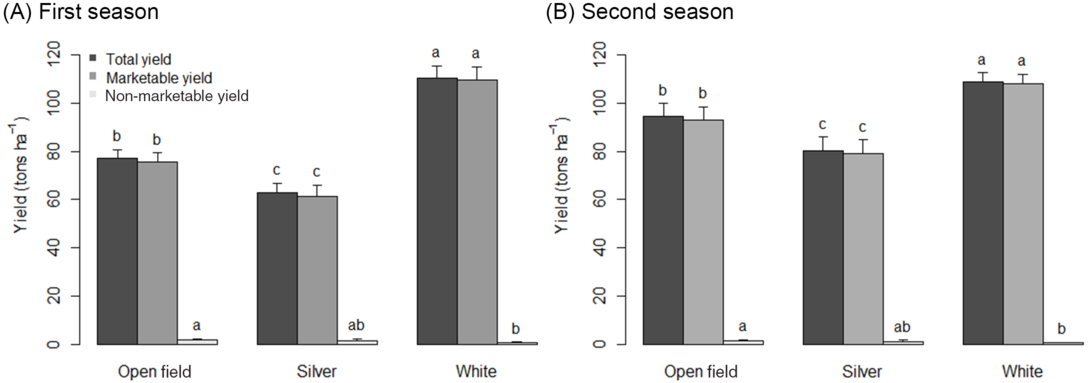
Measurements indicated that cabbage grew faster under the white nets than under the silver nets and in the open field, regardless of the season (Figure 1). No difference in the number of marketable cabbages harvested was found between treatments, regardless of the season. The average fresh weight of marketable cabbages was 38.1% higher in the white tunnels and 20.6% lower in the silver tunnels than in the open field in the first season (average 2.5 kg), and 10.3% higher and 16.8% lower than in the open field (average 3.1 kg), in the second season. Marketable yield, expressed in tons per hectare, was 45.4% and 16.4% higher under white nets in the first and second seasons than in the open field, but decreased by 18.6% and 15.0% under the silver nets (Figure 2). No significant differences were found in the dry matter content of marketable cabbages (average 77.4%) between treatments or seasons (data not shown).
Increase in cabbage diameter during the first (A) and second seasons (B) in the open field and in tunnels covered with white and silver nets. Data are means (±standard deviation). ‘NS’ and ‘*’ indicate whether non-significant or significant differences (P < 0.05), respectively, were established between treatments at each date.

Comparison of total, marketable, and non-marketable yields (t ha−1), obtained in the first (A) and second seasons (B) in the open field and in tunnels covered with white and silver nets. Data are means (±standard deviation). Different lowercase letters mean that data differ significantly at P < 0.05 (according to Tukey’s multiple comparison test) between treatments, that is, in the open field, under white and silver nets.

Cost–benefit analysis
No cost–benefits analysis of growing cabbage under silver nets was performed since yields were lower than in the open field, in contrast to under the white nets (Figure 2).
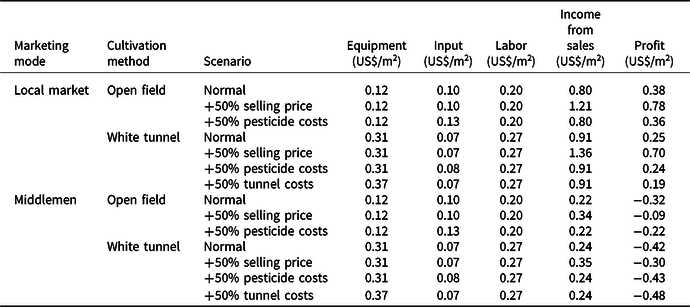
The use of the tunnels more than doubled equipment costs (Table 4). Investment costs for the low tunnels were US$2.50 m−2 but decreased to US$0.19 m−2 per crop cycle when depreciation, that is 12 crop cycles, was taken into account. Our results showed that labor increased by more than a third in the plot with nets because of the construction of the tunnels. The use of low tunnels reduced the cost of inputs by a third, from US$0.10 to US$0.07 m−2, because of the reduction in the use of pesticides. Income from sales varied considerably depending on how the product was sold. Estimated incomes from sales using selling prices on the local market were, respectively, US$0.80 m−2 and US$0.91 m−2 for cultivation in the open field and under white nets, versus US$0.22 m−2 and US$0.24 m−2 for cultivation in the open field and under nets, respectively, when the price paid by the middlemen was taken into account.
Average costs and profits of two seasons of cabbage cultivated in open plots and under tunnels covered with white nets based on different marketing modes, that is, in local markets and using middlemen, and different scenarios, that is, 50% increase in the selling price, in pesticide costs, and in tunnels costs

Negative profits were estimated when the purchase prices paid by the middlemen were used, regardless of the treatment. Profits of US$0.38 m−2 and US$0.25 m−2 were calculated for cabbages grown in the open field and under nets when the selling price at the local market was used. It is worth noting that the profits of selling cabbages grown in the open field and grown under white tunnels directly to local markets were of the same order of magnitude, US$0.78 m−2 versus US$0.70 m−2, when an increase of 50% in the selling price was considered.
Our results showed that an increase of 50% in pesticide costs had no significant impact on the profits in contrast to a 50% increase in tunnel costs that reduced profits by 24.0% for cabbages grown under nets.
Discussion
Our results showed the advantage of using nets to protect cabbage crops from insect pests, thereby reducing pesticide treatments from nine to four during the first season and from nine to three treatments in the second season of our experiment. Insect pests were found under the nets but at much lower densities than in the open fields, even small species.
These findings agree with those of previous studies showing the advantages of growing cabbages in low tunnels to protect the crop from Lepidoptera (P. xylostella, H. undalis, H. armigera, and S. litura) and aphids (M. persicae, Lipaphis erysimi, and B. brassicae) (Martin et al., Reference Martin, Assogba-Komlan, Houndete, Hougard and Chandre2006; Kiptoo et al., Reference Kiptoo, Kasina, Wanjala, Kipyab, Wasilwa, Ngouajio and Martin2015). In the present study, pesticide treatments were based on scouting of individual plots, whereas most vegetable producers in Tanzania apply pesticides on a weekly basis as preventive treatments. Previous studies reported that Tanzanian smallholder farmers frequently have health issues because of the misuse of pesticides (Ngowi et al., Reference Ngowi, Mbise, Ijani, London and Ajayi2007). Applications of lambda-cyhalothrin did not succeed in fully controlling aphid and whitefly populations, probably because the insecticide did not reach the underside of leaves where aphid and whitefly colonies are mostly established. Indeed, the insecticide used was not translaminar and spraying with a common knapsack sprayer does not ensure the pesticide reaches the underside of the cabbage leaves. This failure could also be because according to previous studies aphids (Aphis gossypii) (Carletto et al., Reference Carletto, Martin, Vanlerberghe-Masutti and Brévault2010) and whiteflies (Houndété et al., Reference Houndété, Kétoh, Hema, Brévault, Glitho and Martin2010) are becoming less sensitive to pyrethroids in West Africa, although no study has provided clear evidence of such resistance in East Africa to date.
In contrast to our study, Simon et al. (Reference Simon, Komlan, Adjaïto, Mensah, Coffi, Ngouajio and Martin2014), who used similar white insect-proof nets (0.7 × 0.9 mm mesh size; AtoZ), reported that the use of netting might favor the development of small insect pests such as aphids, L. erysimi. This difference is probably explained by the fact that these authors did not spray any pesticides in their study thus allowing the outbreak of pests, even starting from a few individuals, as they were protected from most natural enemies.
In our study, the populations of insect pests found under the silver nets were smaller than those found under the white nets in the second season, although no difference was observed during the first season. Differences observed between nets in the present experiment can be also attributed to the difference in climate conditions and in crop development. A previous study (Latigo-Ogenga et al., Reference Latigo-Ogenga, Baliddawa and Ampofo1993) showed that the infestation of aphids (Aphis fabae) on beans significantly decreased with shading. In addition to the quantity of light, difference in the impact of the nets on the light spectrum could also explain the differences in insect pest populations observed under the white and silver nets. A previous study by Ben-Yakir et al. (Reference Ben-Yakir, Antignus, Offir and Shahak2012) showed that the color of the shade nets had an impact on infestations of aphids, that is, M. persicae and Aphis gossypii, and whiteflies on tomato crops. These potential explanations need to be disentangled in future laboratory experiments.
The use of white nets significantly increased marketable yields by 45.4% in the first season and by 15.0% in the second, compared with yields in the open field. Similar results have been obtained in cabbage under temperate climate conditions (Csb warm-summer Mediterranean climate) in the Kenyan highlands, with an 81% increase in yield under white insect-proof nets (Muleke et al., Reference Muleke, Saidi, Itulya, Martin and Ngouajio2014). Previous authors also succeeded in doubling cabbage yield in Benin by protecting crops with mosquito nets (Martin et al., Reference Martin, Assogba-Komlan, Houndete, Hougard and Chandre2006). As previously reported (Saidi et al., Reference Saidi, Gogo, Itulya, Martin and Ngouajio2013; Gogo et al., Reference Gogo, Saidi, Itulya, Martin and Ngouajio2012), our results showed that climate conditions were significantly modified by insect-proof nets. Under the temperate climate conditions of our experiment, the greenhouse effect was beneficial for cabbage development (Figure 1) and resulted in significantly higher yields than in the open field (Figure 2). However, under warmer climates, an increase in temperature under covers would have detrimental impacts on cabbage yield, as reported by Simon et al. (Reference Simon, Komlan, Adjaïto, Mensah, Coffi, Ngouajio and Martin2014) in Benin. Increasing shading from 17.2% to 50.1% by using silver nets instead of white nets significantly reduced the increase in the temperature of the air and of the cabbages inside the low tunnels. Previous studies also reported the interest of using shade nets to reduce plant temperature and transpiration in regions with high solar radiation (Ntsoane et al., Reference Ntsoane, Soundy, Jifon and Sivakumar2016; Selahle et al., Reference Selahle, Sivakumar, Jifon and Soundy2015; Ilić et al., Reference Ilić, Milenković, Šunić and Fallik2015; Baliyan, Reference Baliyan2014; Stamps, Reference Stamps2009). Kittas et al. (Reference Kittas, Katsoulas, Rigakis, Bartzanas and Kitta2012) reported that the use of nets providing 49% shading increased yields of tomato, but the results obtained in the present study on cabbage were the reverse, since marketable yield was reduced by more than 15% with silver nets. Light requirements, expressed as daily light integral, of vegetable crops vary considerably with the species and the development stage (Dorais, Reference Dorais2003; Song et al., Reference Song, Tan and Tan2018). Assuming that the light requirements of cabbage are of the same order of magnitude as that of Chinese cabbage (Brassica rapa L subsp pekinensis), this crop requires daily exposure to GR of 8.5 MJ m−2 day−1. Estimations of daily GR average inside the tunnels, that is, 9.1 and 9.9 MJ m−2 in the white tunnels, and 5.3 and 5.7 MJ m−2 in the silver tunnels in the first and second seasons, respectively, suggest that the excessive shade provided by the silver nets failed to allow the crop light requirements to be fulfilled, thereby reducing the yield in the present experiment. Our experiment thus provides evidence that a trade-off needs to be found between the shade provided by the cover to improve local climatic conditions in tunnels at the same time as allowing crop light requirements to be fulfilled.
The simple economic analysis proposed in this study raises some concerns about the profitability of using insect-proof nets for cabbage cultivation in our study region. Our results underlined the significant difference in profitability depending on the marketing modes considered, that is, middlemen versus direct sales at the local market. These marketing modes have a significant effect on the added value in the selling price linked to the quality of the produce. In contrast to direct sales, negative gross margins were calculated regardless of the method of cultivation when the purchase price paid by the middlemen was included. This is partly explained by the cost of the equipment used in the present experiment, that is plastic mulch and drip irrigation, which are not used by most farmers in the study area. Negative margins were also explained by the fact that the higher planting density and the higher fresh weight of cabbages harvested were not taken into account to estimate the selling prices. This result confirms the concerns of producers in the region on the profitability of cabbage cultivation in recent years who have shifted away from this crop.
Even when better prices obtained by direct sales were considered, our results showed that investment costs for netting are not offset by the increase in yield and the reduction of pesticide use. It is worth noticing that indirect costs related to the use of pesticides such as their potential impacts on the environment and on the health of producers and consumers were not taken into account in the present study.
Similar profits to those obtained in the open field were only simulated by increasing the selling price by 50%. This confirmed a previous cost–benefit analysis conducted in Benin showing that the profitability of low tunnels for cabbage cultivation relies on the capacity to value the quality of products on the market (Vidogbéna et al., Reference Vidogbéna, Adégbidi, Assogba-Komlan, Martin, Ngouajio, Simon, Tossou and Parrot2015a; Vidogbéna et al., Reference Vidogbéna, Adégbidi, Tossou, Assogba-Komlan, Martin, Ngouajio, Simon, Parrot and Zander2015b). The higher profitability of the use of low tunnels reported in that study was also explained by higher insecticide costs, US$0.31 m−2 in the previous study versus US$0.05 m−2 in the present study, and higher selling prices, US$ 0.9 in the previous study versus US$0.23 in the present study per cabbage weighing 1.5 to 2.5 kg.
Consequently, when promoting the use of insect-proof nets to reduce the use of pesticides in a global health perspective (producers’ and consumers’ health, environmental health), measures are needed to improve the economic balance in favor of added market value for safer products.
Conclusions
Our results showed that the use of low tunnels protects vegetable crops from insects thereby reducing the use of pesticides. The silver nets that provide 50.1% shade reduced the temperature in the tunnels but also reduced the yield compared with the yield obtained with white nets that provided less shade since with the former, the light requirement of the crop was not fulfilled. The increased investment costs associated with the lack of premium prices on local markets for safer vegetables are obstacles to the profitability of vegetable cultivation under nets and to the adoption of this practice by smallholder farmers.
Acknowledgements
The authors gratefully acknowledge Mr. Elias Shem and Mr. Robert Mwashimaha (The World Vegetable Center ESA, Arusha) for technical assistance during the field experiments.
Financial support
This research was financially supported by the multi-year meta-program GloFoodS (Transitions to global food security) and core donors to the World Vegetable Center: Republic of China, UK Department for International Development, US Agency for International Development, Australian Centre for International Agricultural Research, Germany, Thailand, Philippines, Korea, and Japan.