INTRODUCTION
As a primary component of a biofilm or a microperiphyton community, biofilm-dwelling protozoa play an important role in the functioning of microbial food webs by transferring carbon and energy flux from surrounding water to the benthos in aquatic ecosystems (Kathol et al., Reference Kathol, Norf, Arndt and Weitere2009; Norf et al., Reference Norf, Arndt and Weitere2009a; Zhang et al., Reference Zhang, Xu, Jiang, Zhu and Al-Reshaid2012a; Xu et al., Reference Xu, Zhang, Jiang and Yang2014c). Protozoa respond rapidly to changes of environmental conditions, and are easily collected for spatial/temporal comparisons, and thus have been widely used as a bioindicator of water quality in aquatic ecosystems (Morin et al., Reference Morin, Pesce, Tlili, Coste and Montuelle2010; Xu et al., Reference Xu, Zhang, Jiang and Yang2014c). Based on our previous studies, biofilm-dwelling protozoa represent a feasible indicator of water quality status in marine ecosystems (Xu et al., Reference Xu, Zhong, Wang and Xu2014a, Reference Xu, Zhang and Jiangb, Reference Xu, Zhang, Jiang and Yangc, Reference Xu, Zhang and Xu2015a, Reference Xu, Zhang and Xub, Reference Xu, Zhao, Zhang and Xuc, Reference Xu, Zhong, Wang and Xud).
As an inherent function, body-size spectrum analysis has been considered as an ecological trait to summarize the functioning of a community (Sheldon et al., Reference Sheldon, Prakash and Sutcliffe1972; San Martin et al., Reference San Martin, Harris and Irigoien2006; Kamenir et al., Reference Kamenir, Dubinsky and Harris2010; Jiang et al., Reference Jiang, Xu, Zhang, Zhu and Al-Rasheid2012; Xu et al., Reference Xu, Jiang, Zhang, Zhu, Al-Rasheid and Warren2013). So far, many investigations on monitoring works using body-size spectra of taxa such as phytoplankton, zooplankton and nematodes have been carried out in both aquatic and soil ecosystems (Krupica et al., Reference Krupica, Sprules and Herman2012; Dolbeth et al., Reference Dolbeth, Raffaelli and Pardal2014; George & Lindo, Reference George and Lindo2015; Liu et al., Reference Liu, Guo, Ran, Whalem and Li2015). In recent years, such studies on protozoa have also demonstrated the feasibility of body-size spectra for discriminating water quality status in marine ecosystems (Jiang et al., Reference Jiang, Xu, Zhang, Zhu and Al-Rasheid2012; Xu et al., Reference Xu, Jiang, Zhang, Zhu, Al-Rasheid and Warren2013). However, with regard to the colonization dynamics in body-size spectra of a community during colonization period, little information has been reported.
In this study, the temporal variation in body-size spectrum of biofilm-dwelling protozoa during colonization period was investigated based on a 1-month baseline survey in coastal waters of the Yellow Sea, northern China (May to June 2015). Our aims of this study were to reveal the colonization dynamics in body-size spectra of the protozoa and provide necessary information for ecological research and monitoring programmes using biofilm-dwelling protozoa in marine ecosystems.
MATERIALS AND METHODS
Data collection
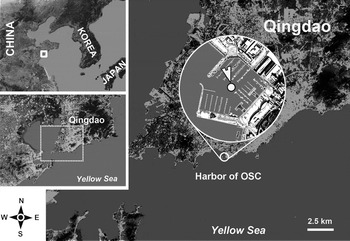
The study station was located in the harbour of the Olympic Sailing Centre at Qingdao, northern China (Figure 1). This is a typical coastal area of the Yellow Sea with an average depth of ~8 m and an average tidal range of 3 m. The glass slide systems were designed, deployed, anchored and sampled as described by Xu et al. (Reference Xu, Zhang, Jiang, Zhu, Al-Rasheid, Warren and Song2011).
Sampling station, which was located in the harbour of the Olympic Sailing Centre (OSC) at Qingdao, on the Yellow Sea coast of northern China.

A total of 280 microscopy glass slides were used to collect the biofilm-dwelling protozoa at depths of 1 and 3 m below the water surface. For each depth, 140 slides were submerged in seven PVC frames, 20 of which were randomly collected from each PVC frame at the time interval of 1, 3, 7, 10, 14, 21 and 28 days. At both depths, samples were collected simultaneously (Xu et al., Reference Xu, Zhang, Jiang, Zhu, Al-Rasheid, Warren and Song2011).
Identification and enumeration of the protozoan species were conducted following the microscopy methods described by Xu et al. (Reference Xu, Zhang, Jiang, Zhu, Al-Rasheid, Warren and Song2011). Taxonomic classification of ciliated protozoa was according to published references such as Song et al. (Reference Song, Warren and Hu2009). The enumeration was performed in vivo at 100× magnification under an inverted microscope within 24 h (Xu et al., Reference Xu, Zhang, Jiang, Zhu and Al-Resheid2012; Zhang et al., Reference Zhang, Xu, Jiang, Zhu and Al-Reshaid2012b). The cell numbers were calculated to confirm the average abundance of the ciliate individuals (ind. cm−2). It should be noted that although the glass slide substrates used in this study also collect bacteria, fungi, algae, flagellates and some metazoa, we have restricted our taxonomic analyses to ciliated protozoa.
Equivalent spherical diameter (ESD) was used to analyse the body-size spectrum of the protozoa. Biovolumes of the protozoan individuals were calculated by measurements of their linear dimensions according to the volume equations of appropriate geometric shapes (Winberg, Reference Winberg1971; Jiang et al., Reference Jiang, Xu, Zhang, Zhu and Al-Rasheid2012; Xu et al., Reference Xu, Jiang, Zhang, Zhu, Al-Rasheid and Warren2013).
Data analyses
For discrimination of body-size ranks, we defined a matrix of resemblances based on Euclidean distance on log-transformed species ESD values.
The increase of individual abundance of each body-size rank over total experimental phase was tested to ascertain whether it fitted to the logistic model:
 $$N_t = {\rm} N_{{\rm max}} /[1{\rm} + {\rm} e^{(a-rt)} ]$$
where N t = the individual carbon biomass at time t; N max = the carrying capacity of individual abundance (maximum abundance); r = the growth rate constant; and a = the coefficient constant of initial individual abundance; T 50% = the time to 50% N max. All parameters (e.g. N max and T 50%) were estimated using the SIGMAPLOT. Fitness tests were to determine whether the individual abundance recorded at each time interval fitted with the logistic model at the 0.05 significance level (Zhang et al., Reference Zhang, Xu, Jiang, Zhu and Al-Reshaid2012a).
All multivariate analyses were conducted using PRIMER v7.0.10 and the PERMANOVA+ for PRIMER (Anderson et al., Reference Anderson, Gorley and Clarke2008; Clarke & Gorley, Reference Clarke and Gorley2015). The Euclidean distance and Bray–Curtis similarity matrices were computed on log-transformed BSD data and fourth root-transformed species abundance data, respectively. The separate clusters of samples were assigned by routine metric multidimensional scaling (mMDS). PERMANOVA test was used to signify the difference in body-size spectra of the protozoan communities.
RESULTS
Body-size ranks and temporal variation in abundance
Based on the trait resemblance, we defined the 75 species as seven ranks (S1–S7) in size: S1 (13–17 µm), S2 (19–27 µm), S3 (28–36 µm), S4 (37–50 µm), S5 (53–71 µm), S6 (76–94 µm) and S7 (109–157 µm) (Figure S1). The ciliate individual abundances over 1–28 days at each body-size ranks are summarized in Table S1.
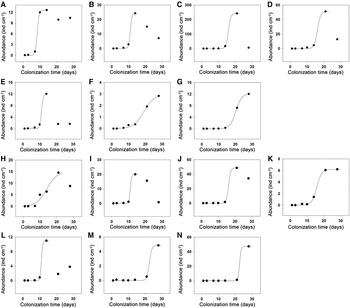
The temporal variations in abundance of the protozoan communities with colonization ages of 1, 3, 7, 10, 14, 21 and 28 day at depths of 1 and 3 m during the study period are summarized in Figure 2. At a depth of 1 m, the time to the maximum abundance of small size ranks were shorter than those of large size ranks, for example those of three (S1, S2 and S5), two (S3 and S4) and two (S6 and S7) ranks peaked at day 14, 21 and the day after 28 (Figure 2A–G). At a depth of 3 m, however, abundances of small size ranks S1 and S3 peaked later than large size ranks S2 and S5, respectively (Figure 2H, I, J & L).
Temporal variations in abundance of each body-size rank of the ciliates at depths of 1 m (A–G) and 3 m (H–N) during the colonization period. S1–S7 (A–G and H–N), ranks S1–S7 of body sizes.

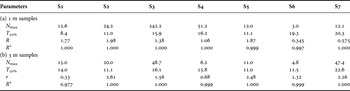
Regression analyses demonstrated that all seven body-size ranks were well fitted with the logistic model equation (P < 0.05) (Figure 2; Table 1). At a depth of 1 m, the growth rates of small size ranks were generally high compared with large size ranks, while, at a depth of 3 m, such a decreasing trend was not found with growth rates from small to large size ranks (Table 1). It should be noted that the time to 50% maximum abundance (T 50%) was similar between two depths except ranks S1 and S6 (Table 1).
Parameters of increase in curves of abundance to the logistic model for each body-size rank of biofilm-dwelling protozoa at depths of 1 and 3 m in coastal waters of the Yellow Sea.

N max, the carrying capacity of individual abundance (maximum abundance, ind cm−2); T 50% (d), the days to 50%; N max, r, growth rate; R 2, coefficient of determination.
Temporal variations in body-size spectra
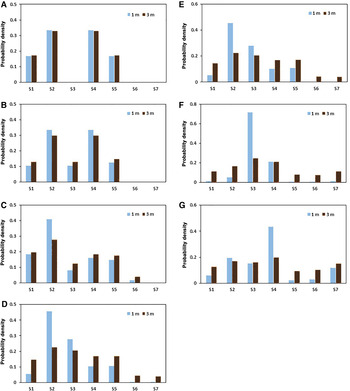
The body-size spectra of the protozoa in probability density at both depths are shown in Figure 3. At both depths, the body-size patterns represented a similar power spectrum. In the young sample (1, 3 and 7 days), a bimodal pattern was found, compared with the case of a hump-shaped model in the mature samples (10–28 days).
Body-size spectra of biofilm-dwelling protozoan communities with 1–28 (A–G) day ages at depths of 1 and 3 m in coastal waters of the Yellow Sea.

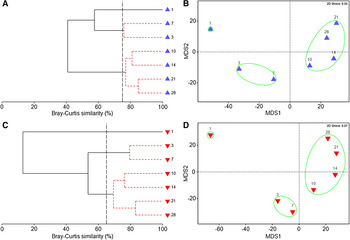
The clustering and mMDS ordination analyses revealed that the temporal dynamics in body-size spectra of the protozoa may be divided into initial (1 day), transitional (3–7 days) and stable (10–28 days) stages during the colonization period (Figure 4).
Cluster analyses (A, C) and nMDS ordinations (B, D) for body-size-based community patterns of biofilm-dwelling protozoa at depths of 1 (A, B) and 3 m (C, D) during the colonization period.

DISCUSSION
The protozoan colonization of a new substratum generally follows the succession: vagile bacterivores with small size (e.g. amoebae and ciliates) were the early immigrants, followed by larger grazers with a broad feeding spectrum and sessile feeders (Railkin, Reference Railkin1995; Franco et al., Reference Franco, Esteban and Téllez1998; Zhang et al., Reference Zhang, Xu, Jiang, Zhu and Al-Reshaid2012a). Since the body size of protozoan grazers is commonly associated with their food type, the body-size spectrum may represent significant changes during the colonization period due to the food supply (Kiørboe et al., Reference Kiørboe, Grossart, Ploug, Tang and Auer2004; Norf et al., Reference Norf, Arndt and Weitere2009a, Reference Norf, Arndt and Weitereb; Wey et al., Reference Wey, Norf, Arndt and Weitere2009; Früh et al., Reference Früh, Norf and Weitere2011). In this study, seven body-size ranks were identified based on a trait hierarchy. The body-size spectra showed a clear variation in probability density over whole colonization times at both depths.
Our previous reports have demonstrated that, during the colonization period, the community structures of biofilm-dwelling protozoa can be discriminated into initial (1–3 day), transitional (7 days) and stable (10–28 days) stages (Zhang et al., Reference Zhang, Xu, Jiang, Zhu and Al-Reshaid2012a). Based on this study, the community patterns in body-size spectra showed a similar variability with the taxon-based matrices reported previously by Zhang et al. (Reference Zhang, Xu, Jiang, Zhu and Al-Reshaid2012a). Otherwise, in the present study, the growth curve of each body-size rank was well fitted to the logistic model equation. This implies that the protozoan individuals may represent similar population dynamics within each body-size rank during the colonization periods.
It should be noted that the growth rates of individual abundance in each body-size rank did not represent such a clear increasing trend at a depth of 3 m as that at 1 m with a decrease of body sizes. The possible reason may be the fact that the sunlight and food supply conditions were different at a depth of 3 m from those at a depth of 1 m due to a transparency of ~3 m, i.e. weak sunlight and less food supply may limit protozoan population growth.
In summary, the individual abundance of the protozoa at each body-size rank was well fitted to the logistic model equation. The body-size spectra showed a clear shift in probability density during the colonization period at both depths. The multivariate approach demonstrated that the temporal dynamics in body-size spectra of the protozoa may be divided into initial, transitional and stable stages during the colonization period. These results provide useful information for ecological research and monitoring programmes using biofilm-dwelling protozoa in marine ecosystems.
SUPPLEMENTARY MATERIAL
To view supplementary material for this article, please visit http://dx.doi.org/10.1017/S0025315416000278
FINANCIAL SUPPORT
This work was supported by ‘The Natural Science Foundation of China’ (project number: 41076089), and Scholarship Award for Excellent Doctoral Student granted by Chinese Ministry of Education.