Infections cause up to 7% and 17% of deaths after autologous and allogeneic hematopoietic stem cell transplantation (HSCT).Reference Pasquini and Zhu 1 To prevent infection, antimicrobial prophylaxesReference Piret and Boivin 2 – Reference Trifilio, Singhal and Williams 4 are complemented by environmental practices, such as HEPA-filtered rooms, personal protective equipment, and hand hygiene.Reference McCann, Byrne and Rovira 5 However, there is variability in the implementation of infection control (IC) practices after HSCT.Reference Kruger, Hornung and Hertenstein 6 , Reference Hicheri, Einsele, Martino, Cesaro, Ljungman and Cordonnier 7 In 2009, recommendations for IC strategies after HSCT were published.Reference Yokoe, Casper and Dubberke 8 – Reference Tomblyn, Chiller and Einsele 10 To assess the current state of IC strategies, a survey was performed of the members of the American Society of Transplantation Infectious Disease Community of Practice (AST IDCOP).
METHODS
A survey was sent to AST IDCOP in November 2014 and February 2015 inquiring about IC practices. In the survey, AST IDCOP members were asked to consult with their Infection Control personnel. The data were analyzed using descriptive statistics. One survey response was analyzed per center.
RESULTS
A total of 38 providers from 28 HSCT centers in North America (n=26) and Europe and Asia (n=2) responded. All US responses were from university-based HSCT centers. No significant change was observed in the results when analysis was limited to US centers.
Protective Environment
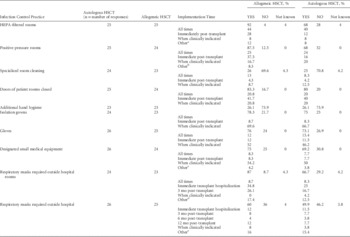
For allogeneic HSCT recipients, most HSCT centers that responded to the survey provide HEPA-filtered rooms (23 of 25; 92%) and positive-pressure rooms (21 of 25, 87.5%). In contrast, for autologous HSCT recipients, the use of HEPA-filtered rooms is 68% (17 of 25); ~32% of HSCT centers (8 of 25) do not provide positive-pressure rooms for these patients (Table 1).
Infection Prevention and Control Practices among Hematopoietic Stem Cell Transplant Centers

a While neutropenic (ie, ANC <1500); entire hospital is HEPA filtered; ICU patients.
b Leukemic patients during induction; while neutropenic.
c While neutropenic.
d While neutropenic; at least 1 year, guided by immunosuppression; >3 mo; while neutropenic.
e While in waiting area of hospital/medical center; while neutropenic; while in public crowded area; at hospital appointments; with respiratory symptoms from graft-versus-host disease.
Approximately 80% of HSCT centers responded that they require doors to patient rooms to be closed. Most centers utilize standard measures for cleaning rooms. However, in ~25% of responding HSCT centers, additional measures are routinely implemented, including use of bleach, ultraviolet light therapy, environmental antiseptics, and additional cleaning steps such as drape laundering. Some centers employ these measures in rooms occupied by patients with Clostridium difficile.
Hand Hygiene, Isolation, and Barrier Precautions
Approximately 26% of HSCT centers require providers to perform additional measures beyond standard hand hygiene. Gloves are used at all times when caring for allogeneic transplant recipients in 12% of HSCT centers, and in 15.4% of HSCT centers for autologous transplant recipients. Conversely, 25% of responding centers do not require glove use at any time.
Between 65% and 70% of HSCT centers require the use of gowns only when clinically indicated; while, ~20% of allogeneic and 25% of autologous HSCT centers do not require isolation gowns at any time. The use of respiratory masks by patients when they leave their hospital room or when they are dismissed from the hospital is variable (Table 1).
Miscellaneous Practices
Approximately 70% of responding HSCT centers use small equipment (ie, stethoscopes) dedicated for allogeneic and autologous HSCT recipients; however, this equipment is used only when clinically indicated. A few HSCT centers have dedicated equipment for use for individual patients at all times.
None of HSCT centers surveyed allow plants and flowers. Most centers allow personal belongings such as blankets and pillows during hospitalization (62.5% for allogeneic HSCT, 73.1% for autologous HSCT). Conversely, a few centers prohibit these items altogether (12.5% for allogeneic HSCT, 11.5% for autologous HSCT) or during the immediate post-transplant period (12.5% for allogeneic HSCT, 3.8% for autologous HSCT).
Most HSCT centers do not allow entry of animals into transplant units (81.8% for allogeneic HSCT, 80% for autologous HSCT). A minority allows pets (dogs, cats) or service animals. Visitor age restriction was variable, limiting visitors <5 years to <15 years; ~33% of responding HSCT centers enforce age restriction at all times (29.6% for allogeneic HSCT, 32% for autologous HSCT). Some centers include temperature measurement as a screening tool for visitors, nursing evaluation of visitors, and other practices during respiratory outbreaks.
DISCUSSION
This survey demonstrates a few overlapping areas among common IC practices, such as restriction of plants and flowers after HSCT. Importantly, the survey results highlight variability in the implementation of several practices, from the use of protective environment to the use of personal protective equipment, and others such as visitor and animal restrictions.
The 2009 guidelines strongly recommend a protective environment for HSCT recipients to reduce infection, including single rooms, HEPA-filtered rooms, and ≥12 air exchanges per hour (level of evidence per IDSA grading system, AIII). Additionally, the guidelines recommend directed air flow, consistent positive air pressure (≥2.5 Pa) between patient rooms and the hallway, and self-closing doors (level of evidence per IDSA grading system, BIII).Reference Yokoe, Casper and Dubberke 8 Our survey shows that most HSCT centers provide HEPA-filtered and positive pressure rooms, but at variable times. This variability may reflect hospital resources or room availability. The guidelines suggest that preference be given to more vulnerable patients, likely explaining higher compliance after allogeneic HSCT. Compared with the European Group for Blood and Marrow Transplantation survey (63% and 52% compliance with HEPA-filtered rooms after allogenic and autologous HSCT), we noted better compliance with the 2009 recommendation.Reference Hicheri, Einsele, Martino, Cesaro, Ljungman and Cordonnier 7 This could be due to increased adaptation of the guidelines in recent years or potential regional practice differences between European centers and our responders (ie, predominantly North American HSCT centers). The 2009 guidelines recommend, at minimum, daily cleaning of patient rooms, with general measures for dust control, including lack of carpeting and wet dusting (to prevent aerosolization of spores) (BIII).Reference Yokoe, Casper and Dubberke 8 Our survey results indicate that some centers provide additional measures (bleach for terminal cleaning and use of ultraviolet light). The minimum recommendation is for standard precautions for all contact with HSCT recipients (AIII). Approximately 26% of responders reported that hand hygiene is supplemented by additional measures. Standard precautions may include personal protective equipment (eg, gloves, gowns, and eye and face protection) to further reduce the risk of transmitting infection; however, there is insufficient data to support the recommendation on a larger scale. In our survey, isolation gowns are available in the majority of centers, but used only when clinically indicated. Surprisingly, between 20% and 25% of centers do not use isolation gowns at any time.
HSCT recipients may benefit from wearing respiratory masks during the pre-engraftment period (level of evidence per IDSA grading system, CIII).Reference Yokoe, Casper and Dubberke 8 The results of our survey indicate that respiratory masks are more commonly used after allogeneic HSCT than after autologous HSCT and in inpatient rather than outpatient settings. These differences could reflect the degree of immunosuppression and differences in practice settings. Accordingly, use of respiratory masks is more common during the first 3 months after transplantation, when patients are cared for mostly in the hospital.
All centers do not allow flowers, which is in compliance with the recommendations (level of evidence per IDSA grading system, DIII).Reference Yokoe, Casper and Dubberke 8 Although the guidelines do not have specific age restriction for visitors, they provide recommendations for visitor screenings (BIII). In our survey, some centers do not allow visitors below a certain age, while others screen visitors for infectious symptoms on a daily basis. The majority do not allow animals into the units, although a few allowed pets and service animals.
This study is limited by the low number of participants, with a majority from North America. The survey was conducted among AST IDCOP members, including many who do not care for HSCT recipients, and we only requested 1 response per institution, likely explaining the small number of responders. We noted several “I do not know” answers, despite our attempt to minimize this response by asking responders to consult with IC personnel. Additionally, some strategies are not included in this survey, such as the approach to vaccination in healthcare workers and visitors, and whether HSCTs are primarily an inpatient or outpatient setting. Despite these limitations, our results highlight variability in IC practices. This could be influenced by local epidemiology of infections. For example, centers with higher rates of multidrug-resistant pathogens may implement more aggressive measures. In addition, it could be a reflection of the limited evidence to support some guideline recommendations. This study emphasizes the need to perform additional studies that provide strong evidence to support future recommendations on IC and prevention after HSCT.
ACKNOWLEDGMENTS
We acknowledge all of the AST IDCOP leadership and members who supported and participated in this survey.
Financial support: No financial support was provided relevant to this article.
Potential conflicts of interest: All authors report no conflicts of interest relevant to this article.