Introduction
Many adults and children experience otic barotrauma during flight, particularly as an aircraft descends;Reference Armstrong and Heim1, Reference King2 indeed, otic barotrauma is the most common medical condition during flight.Reference Mirza and Richardson3 About 46 per cent of adults and 65 per cent of children who fly have experienced ear pain or discomfort at some point,Reference Stangerup, Tjernstrom, Harcourt, Klokker and Stokholm4, Reference Buchanan, Hoagland and Fischer5 and on a single flight the incidence of otic barotrauma in children may be as high as 26–55 per cent.Reference Stangerup, Tjernstrom, Harcourt, Klokker and Stokholm4, Reference Buchanan, Hoagland and Fischer5 The typical symptoms of otic barotrauma are fullness in the ears, ear pain and conductive hearing loss.Reference Mirza and Richardson3 As it progresses, negative middle-ear pressure during descent can cause the build-up of serous fluid within the middle ear or intratympanic membrane haemorrhage. Further progression uncommonly results in haemotympanum or tympanic membrane perforation; whilst inner-ear barotrauma is fortunately very rare, it can lead to inner-ear haemorrhage, labyrinthine membrane tears and perilymphatic fistulae.Reference Goto, Ogawa, Kunihiro, Kurashima, Kobayashi and Kanzaki6
The build-up of negative pressure in the middle ear can often be relieved by movements that cause the Eustachian tube to open; for example, yawning, swallowing or sucking a sweet. Other deliberate actions, such as performing the Valsalva's manoeuvre, the Frenzel manoeuvre and the Toynbee manoeuvre, can also be successful.Reference Harding7 Many children, however, and some adults, are unable to use these methods. Various methods have been investigated to prevent otic barotrauma in these individuals; for example, nasal balloon inflation, the use of decongestants such as pseudoephedrine, or pressure-equalising ear plugs.Reference Mirza and Richardson3, Reference Mitchell-Innes, Young, Vasiljevic and Rashid8 Nasal balloon inflation can be effective at relieving middle-ear pressure,Reference Stangerup, Klokker, Vesterhauge, Jayaraj, Rea and Harcourt9 but its use is ungainly and not suitable for young infants. Moreover, not all methods have been found to be effective. In a double-blind, placebo-controlled study, Klokker et al. showed that pressure-equalising ear plugs are ineffective.Reference Klokker, Vesterhauge and Jansen10 Similarly, in another double-blind, placebo-controlled study, Buchanan et al. showed that pseudoephedrine is ineffective.Reference Buchanan, Hoagland and Fischer5
Buchanan et al. also note that the application of a warm wet towel over the external ear has been commonly advocated to prevent or alleviate otic barotrauma.Reference Buchanan, Hoagland and Fischer5 In particular, some flight attendants attempt to relieve the symptoms of otic barotrauma in passengers by placing moistened napkins or cotton wool into a cup and then placing it over the affected ear,11, Reference Fairechild12 and this method has been recommended on the travel advice websites of some mainstream newspapers and magazines.13–15 The previous reports suggested that the water should be very hot, but the use of hot water to treat otic barotrauma has led to at least one court case as a result of scalding.16
We were made aware of the flight attendants’ claims by the managing director of Aerbuddies (Dudley, UK; a company focused on aircraft passenger comfort), who was seeking to commercialise the approach using cold water; in his experience with his two sons, who were both under 10 years old and who regularly experienced pain during flight, the effect was substantial and immediate when cold water was used in the cups.
Whilst mindful that the reported relief might have arisen solely from a placebo effect, we considered that there might be a physiological basis for this approach. The air inside the cabin of commercial aircraft is extremely dry because the bleed air from modern jet engines, which is used to maintain cabin pressure, has a relative humidity of 0.5–1 per cent,Reference Space, Johnson, Rankin, Nagda and Nagda17, Reference Spengler and Wilson18 whilst most of the moisture within the cabin is provided by the passengers.Reference Malmfors, Thornburn and Westlin19, Reference O'Donnell, Donnini and Nguyen20 At cruise altitudes, the cabin humidity is typically 5–20 per cent, but can be as low as 2 per cent.Reference Backman and Haghighat21, Reference Wieslander, Lindgren, Norbäck and Venge22 In contrast, the optimal relative humidity for personal comfort in any location is 40–70 per cent,Reference Rayman23 and the American Society of Heating, Refrigerating, and Air-Conditioning Engineers’ standard for buildings suggests a minimum relative humidity of 20 per cent.24
Using tympanometry, we have previously shown that low humidity during flight is associated with a decrease in the peak compensated static admittance (‘admittance’) of the tympanic membrane;Reference Morse25 we found a linear relationship between the admittance of the ear and relative humidity, with a constant of proportionality of 0.00315 mmho / per cent relative humidity. Even though the aircraft cabin in that study was unusually humid (the lowest relative humidity was 22.7 per cent, whilst levels between 5 and 20 per cent are more typical),Reference Backman and Haghighat21, Reference Wieslander, Lindgren, Norbäck and Venge22 we nonetheless observed a mean decrease in admittance of about 20 per cent. The decrease in tympanic membrane admittance during flight might affect the passive buffering capacity of the ear.Reference Morse25
There is also physiological evidence of active regulation mechanisms. Unilateral electric stimulation of the tympanic nerve in monkeys has been shown to evoke bilateral electromyographic responses from Eustachian tube muscles.Reference Eden, Laitman and Gannon26 Moreover, Rockley and Hawke,Reference Rockley and Hawke27 and Sakata et al.,Reference Sakata, Esaki, Yamano, Sueta, Nakagawa and Kato28 have shown that the application of lidocaine hydrochloride to anaesthetise the human tympanic membrane substantially increases the behavioural threshold for detecting pressure changes across the tympanic membrane. Sakata et al. also showed that decreasing the admittance of the pars tensa, by attaching Micropore™ tape to it, increased the threshold for perceiving a change in pressure.Reference Sakata, Esaki, Yamano, Sueta, Nakagawa and Kato28 Without the tape, the mean admittance of 10 participants was 0.88 mmho, and the thresholds for perceiving negative and positive pressure changes were −29 daPa and 30 daPa, respectively. The application of one layer of tape decreased the mean admittance to 0.69 mmho, and increased the negative and positive detection thresholds to −55 daPa and 57 daPa respectively. A 22 per cent decrease in the admittance was therefore associated with nearly a 100 per cent increase in the pressure-detection threshold.
Given that this decrease in admittance is similar to the 20 per cent decrease we observed on an aircraft, the effect of low humidity on the tympanic membrane during flight might be expected to directly affect the automatic regulation of middle-ear pressure. For relative humidities more typically observed in flight, the detection threshold might exceed the 80 mmHg (106 daPa) at which the Eustachian tube normally locks and cannot be opened by Valsalva's manoeuvre, or similar techniques.Reference Mirza and Richardson3 Consequently, during descent, the differential pressure may lock the Eustachian tube before a passenger is aware that they should use a preventative method to relieve otic barotrauma. This might particularly be a problem for passengers with weak tubal dilator muscles, whose Eustachian tube would be expected to lock at lower differential pressures.Reference Mirza and Richardson3
We considered that the action of applying a wet towel to the ear, or applying a cup containing moist napkins over the ear, may moisturise the tympanic membrane and restore any deficiency in passive or active pressure regulation. Moreover, irrespective of the mechanism, we considered investigation of the flight attendants’ method worthwhile given the high incidence of otic barotrauma and the purported simple solution.
Here, we report the results of a double-blind, placebo-controlled trial of this method on the incidence and severity of otic barotrauma in participants who were heavily predisposed to otic barotrauma. Although it reduced the generality of this preliminary study, we considered it necessary to recruit participants who were heavily predisposed to otic barotrauma to maximise the power of the study for a given cohort size (assuming that any treatment effect is independent of the incidence rate); moreover, if the treatment effect was negligible for this group, then commercialisation would be speculative.
The study protocol was approved in advance by the Aston University Ethics Committee.
Materials and methods
The experiments were conducted on two British Midland Airways flights with the permission of the airline and pilot; the aircraft was a Boeing 737 (300/500 series) on both flights. The first flight was from Birmingham International in the UK to Malaga in Spain (take-off at 06:00 GMT) and lasted 1 hour and 55 minutes. The participants stayed the day in Malaga and then returned to Birmingham International (take-off 16:10 GMT); the return flight lasted 2 hours and 5 minutes.
Eight participants (six women and two men; mean age of 38 years (range, 20–56 years)) were purposively recruited by an internal email sent to all Aston University staff stating that we were seeking participants who suffered otic barotrauma on virtually every flight. The participants were examined by a qualified audiologist (Ms Emma Wilson) before the first flight. To ensure the wellbeing of the participants, they had to meet the following criteria: (1) they had never had any surgery on their ears, apart from grommets as a child; (2) their tympanic membrane had never perforated as a result of flying; (3) any pain they experienced through flying went away within a few hours after landing; (4) they flew regularly despite their predisposition to otic barotrauma; and (5) they considered any pain during flight to be tolerable.
Pre-flight hearing thresholds were measured and tympanometry performed using a GSI 61 Clinical Audiometer (Grason-Stadler, Eden Prairie, Minnesota, USA) and a portable Otowave 102-1 tympanometer (Amplivox, Eden Prairie, Minnesota, USA), respectively. Normative values for tympanometry, such as those for middle-ear pressure, were taken from British Society of Audiology recommendations.29
Moisture was applied to the external ear canals using modified ear defenders that resembled circumaural headphones. The foam from inside each ear defender was removed and replaced with a wet cotton wool pad; this was covered by a plastic sheet with small holes such that the moisture was easily able to pass through, but the cotton wool pad could not be seen. Our tests before the flights showed that the relative humidity inside each ear defender was over 95 per cent, as measured using a Digitron 2080R hygrometer (Digitron, Port Talbot, Wales, UK). The placebo device was identical except that the cotton wool pad was dry. The weight difference between the active and placebo devices was negligible.
Each set of ear defenders was labelled with a random number, which was used in the random allocation of participants to one of two groups. On the outward flight, one group of four participants had the active device (participant numbers 1, 2, 3 and 4) and the other group had the placebo device; on the return flight, the groups were switched such that those who wore the active device on the outward flight wore the placebo device on the return flight, and vice versa. The experiment was double-blinded in that the participants did not know whether they had an active or a placebo device on each flight and neither did the on-board audiologist. The numbered ear defenders were allocated based on a random number table.
The participants were informed that on one flight they would be wearing a device that might decrease the incidence and severity of barotrauma, and on the other flight they would be wearing a dummy device. Participants were also informed that if they had the dummy ear defenders, or if the active device did not work, they may suffer otic barotrauma given their predisposition. The information was first given to the participants in writing before consent was obtained; the information was repeated verbally by the audiologist on the day of the flight. In case of incident, the first author was present on the flights to ensure randomisation could be revealed. This was not necessary and the first author did not take part in the running of the experiment on board the aircraft, and sat away from the audiologist and participants.
The participants were encouraged to be fully hydrated before and during each flight, and bottled water was provided. Apart from regular swallowing, participants were asked to refrain from using any of their usual methods of avoiding or reducing otic barotrauma; for example, using decongestants, sucking a sweet, performing Valsalva's manoeuvre and so forth.
Ten minutes before the aircraft started to descend, the audiologist handed out the devices to the participants, who were asked to wear the modified ear defenders immediately and not to inspect them. The audiologist instructed participants that they should wear the device they were given for the remainder of the flight if they did not experience barotrauma. They were informed, however, that if they did suffer noticeable and increasing ear discomfort, they should tell the audiologist immediately who would then give them an active set of modified ear defenders and record the time at which the switch occurred.
Participants knew that, depending on which type of device they were first given, they might be switching from a placebo device to an active device, or from an active device to another active device; the nature of their original device, however, was not revealed. This meant that on the return flight, the participants were still blind to their experimental condition, even if they had switched devices on the outward flight. The participants were informed that if they did choose to switch devices, then there was no guarantee that the active ear defenders would alleviate otic barotrauma; they were instructed that on changing devices they could do whatever they normally did to alleviate the discomfort of otic barotrauma.
The participants were asked to rate the level of discomfort in each ear immediately before and after a switch on a scale of 0 to 100, where 0 represented no discomfort and 100 represented the most pain they had ever experienced. This method, in which all participants with otic barotrauma were switched to the active device, ensured that participants were not deprived of a potential way to relieve otic barotrauma. It also provided an outcome measure in terms of a switch time; this time was normalised such that a value of 0 indicated a switch at the start of descent and a 1 indicated that the modified ear defenders, whether active or placebo, where worn until landing. For the outward flight, the descent lasted 29 minutes and for the return flight it lasted 27 minutes.
The audiologist visually inspected the participants’ ears before and after each flight using otoscopy. They also rated the degree of redness from vascular congestion on an interval scale from 0 to 5, where 0 indicated no sign of redness and 5 indicated redness of the whole tympanic membrane; a value of 5 is equivalent to Teed's grade 2 level of barotrauma.Reference Teed30
Results
All participants had a hearing loss of less than 20 dB HL at 0.5, 1, 2 and 4 kHz, as measured using a GSI 61 Clinical Audiometer (Grason-Stadler). Regarding the tympanometry measures, ear-canal volume, admittance and middle-ear pressure values were mostly within the normal ranges, as recorded using a portable Otowave 102-1 tympanometer (Amplivox). The British Society of Audiology defines the normal ranges as: 0.63–1.46 cm3 for ear-canal volume, 0.3–1.6 mmho for admittance and −50–50 daPa for middle-ear pressure.29 All participants had negative middle-ear pressure in each ear (mean = −28.8 daPa, standard deviation = 20.8 daPa), and two participants (participant numbers 4 and 8) had values outside the normative range (−51 daPa and −76 daPa respectively). All patients had normal tympanic membrane admittance, except participant number 5 (1.7 mmho in the left ear and 2.8 mmho in the right ear). This is not a contraindication for flying, however, and so the audiologist considered their participation to be safe.
On the outward flight, six of the eight participants switched from their allocated device (active or passive) to the active device; of the two participants who did not switch, one started with the placebo device (participant number 8) and the other (participant number 2) started with the active device. On the return flight, five of the eight participants switched from their allotted device to the active device; of the three participants who did not switch (participant numbers 1, 2 and 3), all had the placebo device.
For the participants who did switch, the normalised switch time and the level of discomfort immediately before and after the switch were pooled (Figure 1). Wearing the active device decreased the normalised switch time (median = 0.79) compared with that for the placebo device (median = 0.57), but a Wilcoxon signed rank test showed that the difference was not significant (z = −1.690, p = 0.109). Switching to the active device from either the placebo or another active device had a slight tendency to reduce the perceived level of discomfort (median before = 75, median after = 70); a Wilcoxon signed rank test, however, showed that this effect was also not significant (z = − 0.169, p = 0.866). For those participants whose level of discomfort decreased, six started with the active device and five with the placebo device.
Effect of device (active or placebo) on the onset and severity of otic barotrauma. Data are pooled for the outward and return flights. (a) Comparison of the normalised switch time for the placebo and active devices for the eight participants (participant (‘P’) numbers 1 to 8); the time was normalised such that a value of 0 indicates a switch at the start of descent and a 1 indicates that the modified ear defenders, whether active or placebo, where worn until landing. Points above the dashed line indicate a benefit with the active device compared with the placebo. (b) Level of discomfort in each ear immediately before and after switching devices to an active device. Some participants rated the discomfort in their left and right ears to be equal, and this is shown by overlapping upward pointing and downward pointing triangles. Note that not all participants switched devices, as shown by a normalised switch time of 1 in (a): data are shown for 11 switches, including 5 overlapping data points. Points below the dashed indicate a benefit from switching devices.

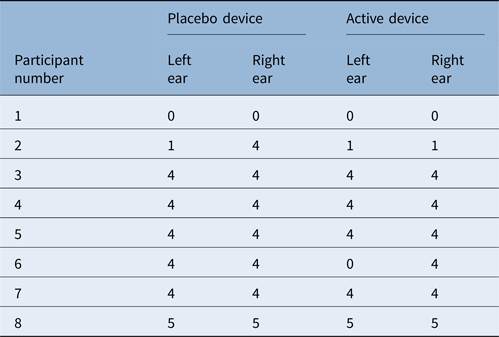
All participants except participant number 1 had visible signs of barotrauma after the outward flight, as graded by the audiologist using otoscopy (Table 1); participant number 1, who had the active device, nonetheless reported right ear discomfort and switched devices. Similarly, on the return flight, all participants except participant number 1 had visible signs of barotrauma; on the return flight, however, participant number 1 (who then had the placebo device) reported no discomfort in either ear and did not switch devices. Wearing the active device made a negligible difference to the severity of tympanic membrane haematoma; this was confirmed by Wilcoxon signed rank tests for both the left and right ears, for both groups (z = −1.000, p = 1.000).
Degree of redness from vascular congestion immediately after landing with placebo or active device

Placebo and active classification is on an intention to treat basis (i.e. on the allocated device before any switch). The degree of redness from vascular congestion was graded on an interval scale: 0 indicates no redness and 5 indicates redness of the whole tympanic membrane; a value of 5 is equivalent to Teed's grade 2 level of barotrauma.Reference Teed30
From otoscopy, it was clear that one participant (participant number 8) had extensive barotrauma on the outward flight (with a placebo device), but nonetheless did not switch devices, despite the instructions. Discussion between the participant and the audiologist revealed that the participant had suffered moderate discomfort, but had been reluctant to switch for unknown reasons. Before the return flight, the instructions for the experiment were therefore reiterated to all participants by the audiologist. This participant did switch devices on the return flight, and it is possible that their criterion for switching differed between the two flights.
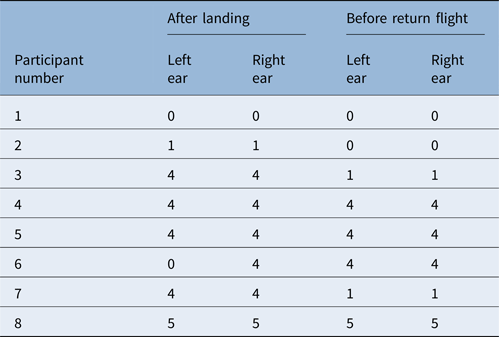
The otoscopic signs of barotrauma were re-evaluated immediately before the return flight, and were unchanged for participant numbers 4, 5 and 8 (Table 2). For participant number 6, the appearance of the left ear deteriorated during the day; participant numbers 3 and 7 showed mild recovery, and participant number 2 showed complete recovery. The funding available for the experiment prevented an extended stay in Malaga and the opportunity for ears to fully recover before the second flight.
Degree of redness from vascular congestion immediately after landing and immediately before return flight departure

See Table 1 for rating scale
Discussion
Based on otoscopy, all except one participant (participant number 1) suffered otic barotrauma on the outward flight, and five out of eight participants also suffered it on the return flight. As a whole, the participant group were therefore heavily predisposed to otic barotrauma, as intended. For these participants, wearing the active ear defenders with the wet cotton wool had a negligible effect on the onset time of otic barotrauma or the severity, as graded using otoscopy. Although the treatment groups were balanced, there was the potential for order effects given that both flights were on the same day. (As indicated above, the cost of overnight stays precluded having a longer interval.) Nonetheless, no order effect was apparent in the end-of-flight data.
There was a non-significant tendency for participants to perceive a reduction in discomfort when they switched to the active device from either another active device or a placebo. This tendency might be the result of participants using their normal way of relieving otic barotrauma, evidence of regression to the mean (if discomfort was most intense at its onset) or evidence of a mild placebo effect.
The findings here do not exclude the possibility that previous reports of efficacy for the flight attendants’ method with cold water are genuine, but result solely from a pronounced placebo effect. In this study, it was explicitly made known to the adult participants that they would be receiving a placebo device on one flight, whereas in general use passengers (typically children) are always encouraged to believe that they are being given an effective treatment. It has been shown that knowing the probability of receiving a placebo can affect the level of the placebo response, with lower probabilities associated with higher responses.Reference Papakosta and Fava31 A greater placebo response might therefore be expected in general use because passengers are not expecting a placebo. The level of placebo response is generally higher in children than in adults.Reference Weimer, Gulewitsch, Schlarb, Schwille-Kiuntke, Klosterhalfen and Enck32 Placebos can also operate by producing changes in how the parent behaves towards their child, which in turn can lead to behavioural changes in the child – so called ‘placebo by proxy’.
As described in the Introduction, we have recently shown that the admittance of the middle ear is correlated to the relative humidity in the aircraft cabin.Reference Morse25 In order to control for confounding effects, we also investigated the effect of humidity on middle-ear admittance in an environmental chamber. We found that changes in admittance occurred well within the first 30 minutes; moreover, pilot experiments on the first author within the chamber (unpublished data) indicated that the application of humidity appeared to increase admittance by 0.1 mmho within about 5 minutes. Therefore, although it is possible that the active device might be more effective if worn longer before descent, the difference would not be expected to be substantial. Moreover, in general use the flight attendants’ method is used only during descent, so the timescales here are similar to normal practice. The active devices were checked after each flight and there was no evidence that the cotton wool pads had dried during descent.
In the method referred to by Buchanan et al.,Reference Buchanan, Hoagland and Fischer5 a warm wet towel is placed over the ears, but in the present study the cotton wool pads were at the ambient temperature of the aircraft cabin. It may be that a higher temperature is required for the method to be successful. Our studies on the effect of humidity on admittance in an environmental chamber were carried out at 23°C, which is typical of the temperature in an aircraft cabin.Reference O'Donnell, Donnini and Nguyen20, Reference Grün, Trimmel and Holm33 If temperature is critical for success, the underlying physiological mechanism is unlikely to be the admittance of the tympanic membrane alone.
The participants in the study were adults who suffered otic barotrauma on nearly every flight. For this group, our study shows that any improvement in pressure regulation which may be provided by restoring the admittance of the tympanic membrane is insufficient to prevent barotrauma or reduce its severity. It is possible that Eustachian tube function and therefore pressure regulation for this population, who all had negative middle-ear pressure in both ears before the first flight, is permanently impaired. Diseases associated with negative ear pressure, such as acute otitis media with effusion, are known to cause morphological changes to the tympanic membrane, including thickening of the epithelial layer and a thinning of the lamina propria.Reference Knutsson, Bagger-Sjöbäck and von Unge34, Reference Tos and Poulsen35 Given that encapsulated nerve endings thought to be involved in pressure sensing are found in these layers,Reference Nagai and Tono36 prolonged negative middle-ear pressure may damage these nerve endings. Adults who have had traumatic tympanic membrane perforation, and therefore suffered substantial damage to the nerve endings, have higher thresholds for pressure detection than the normal population.Reference Sakata, Esaki, Yamano, Sueta, Nakagawa and Kato28 It would be interesting to determine whether adults who have a disposition to otic barotrauma also have higher thresholds, and whether changes in humidity affect the threshold. Determining the effect of humidity on the pressure-detection threshold in children predisposed to otic barotrauma would also be of value.
• Many individuals experience otic barotrauma during flight, particularly descent, because of pressure changes in the middle ear
• It can cause significant morbidity, including otalgia, tympanic membrane perforation and perilymphatic fistulae
• Although it can be alleviated by movements that open the Eustachian tube, many are unable to use these methods effectively
• Some flight attendants attempt to relieve symptoms by placing napkins moistened with hot water into a cup placed over the ear, but this can lead to scalding
• It was considered that the benefit might arise from moisture alone rather than the heat
• This study tested the effect of moisture in a double-blind study, but found no benefit in passengers predisposed to otic barotrauma
For more typical adult passengers, who suffer barotrauma only occasionally, the effect of applying moisture might be more successful. The flight attendants’ method may still therefore warrant further scientific investigation. Verification of this hypothesis during flight, however, would require a larger pool of participants than in this study because the lower incidence of barotrauma would reduce the power of the experiment.
Acknowledgements
We thank the participants who took part in the experiment. We would also like to thank British Midland Airways for giving permission to perform the experiment, and for the assistance of the pilots and flight attendants during the study. We gratefully acknowledge the support from Mr Ian Bailey (Aerbuddies Ltd), and from Ms Emma Wilson, who was the on-board audiologist. The study was funded by Aerbuddies. (The authors alone were responsible for the content and writing of this paper.)
Competing interests
The authors did not receive any direct or indirect payment for performing these experiments, and have no financial stake in the publication of the results.