Significant outcomes
-
Adjunctive minocycline compared with placebo did not alter IL-6, LBP or BDNF levels
-
Higher IL-6 at baseline is potentially associated with greater improvement in Hamilton Anxiety Rating Scale (HAMA) scores following minocycline treatment.
-
IL-6 is potentially associated with the HAMA response regardless of treatment group.
Limitations
-
Small sample size may limit identifying the mechanism of action of minocycline in depression.
-
Demographic factors such as BMI added further complexity to understanding the inflammatory mechanisms of action of adjunctive minocycline.
Introduction
Mood disorders including major depressive disorder (MDD) are amongst the most prevalent psychiatric disorders, afflicting approximately one in five individuals within their lifetime (Kessler et al., Reference Kessler, Angermeyer, Anthony, D.E.G., Demyttenaere, Gasquet, D.E.G., Gluzman, Gureje, Haro, Kawakami, Karam, Levinson, Medina Mora, Oakley Browne, Posada-Villa, Stein, Adley Tsang, Aguilar-Gaxiola, Alonso, Lee, Heeringa, Pennell, Berglund, Gruber, Petukhova, Chatterji and Ustun2007). Low remission rates and limited efficacy of antidepressants reflect that our current understanding of the biological mechanisms for MDD is still far from complete (Malhi & Mann, Reference Malhi and Mann2018).
There is accumulating evidence of elevated levels of pro-inflammatory cytokines in MDD, suggesting that activation of immune-inflammatory systems might be associated with the pathophysiology of the disorder (Pape et al., Reference Pape, Tamouza, Leboyer and Zipp2019). Elevations of central and peripheral interleukin (IL-) 1β, IL-6 and tumour necrosis factor alpha have been observed in MDD (Köhler et al., Reference Köhler, Freitas, Maes, de Andrade, Liu, Fernandes, Stubbs, Solmi, Veronese, Herrmann, Raison, Miller, Lanctôt and Carvalho2017; Osimo et al., Reference Osimo, Pillinger, Rodriguez, Khandaker, Pariante and Howes2020). Moreover, recent meta-analyses reported that some antidepressant treatments, such as selective serotonin reuptake inhibitors (SSRI), may reduce levels of elevated pro-inflammatory cytokines (Köhler et al., Reference Köhler, Freitas, Maes, de Andrade, Liu, Fernandes, Stubbs, Solmi, Veronese, Herrmann, Raison, Miller, Lanctôt and Carvalho2017, Reference Köhler, Freitas, Stubbs, Maes, Solmi, Veronese, de Andrade, Morris, Fernandes, Brunoni, Herrmann, Raison, Miller, Lanctôt and Carvalho2018; Wiedlocha et al., Reference Wiedlocha, Marcinowicz, Krupa, Janoska-Jazdzik, Janus, Debowska, Mosiolek, Waszkiewicz and Szulc2018). This suggests that there may be some therapeutic benefit to reducing inflammation in depression.
Minocycline is a broad-spectrum tetracycline antibiotic that is active against a wide range of aerobic and anaerobic gram-negative and gram-positive bacteria (Garrido-Mesa et al., Reference Garrido-Mesa, Zarzuelo and Galvez2013). Importantly, minocycline has a pleiotropic range of non-microbial effects that might be relevant to the pathophysiology of MDD. It readily crosses the blood–brain barrier and inhibits microglial activation (Pae et al., Reference Pae, Marks, Han and Patkar2008). Minocycline ameliorates depressive-like behaviour observed in various animal models of MDD (Henry et al., Reference Henry, Huang, Wynne, Hanke, Himler, Bailey, Sheridan and Godbout2008; Liu et al., Reference Liu, Peng, Liu, Wu, Zhang, Lian, Yang, Kelley, Jiang and Wang2015; Majidi et al., Reference Majidi, Kosari-Nasab and Salari2016) at least in part via its anti-inflammatory effects as an inhibitor of microglial activation (Möller et al., Reference Möller, Bard, Bhattacharya, Biber, Campbell, Dale, Eder, Gan, Garden, Hughes, Pearse, Staal, Sayed, Wes and Boddeke2016). These findings suggest that minocycline has effects on immune cells in the central nervous system through inhibition of the synthesis of pro-inflammatory cytokines and that these anti-inflammatory effects may alter mood state (Pape et al., Reference Pape, Tamouza, Leboyer and Zipp2019).
Three randomised placebo-controlled trials have been completed investigating 12 weeks of adjunctive minocycline (200 mg/day) for adults experiencing moderate to severe MDD. The first trial (n = 71) conducted by Dean et al. provides the basis for the current study. This trial found that over the 12 weeks of treatment, 200 mg/day of adjunctive minocycline (in addition to any usual treatment) did not significantly separate from the placebo group on the primary outcome (Montgomery−Åsberg Depression Rating Scale, MADRS); however, significant improvements were observed in all secondary outcomes including global clinical impression, anxiety, functioning and quality of life (Dean et al., Reference Dean, Kanchanatawan, Ashton, Mohebbi, Ng, Maes, Berk, Sughondhabirom, Tangwongchai, Singh, Mckenzie, Smith, Malhi, Dowling and Berk2017). The trial by Husain et al. (Reference Husain, Chaudhry, Rahman, Hamirani, Qurashi, Khoso, Deakin, Husain and Young2015) (n = 41) found significant improvements in primary depressive symptoms (Hamilton Depression Rating Scale) and global clinical impression over 12 weeks with 200 mg/day of adjunctive minocycline, compared with placebo. Nettis et al. (Reference Nettis, Lombardo, Hastings, Zajkowska, Mariani, Nikkheslat, Wprrell, Enache, Mclaughlin, Kose, Sforzini, Bogdanova, Cleare, Young, Pariante and Mondelli2021) used an a priori C-reactive protein (CRP) cut-off (≥1 µg/l) to include participants in a recent trial of 200 mg/day of adjunctive minocycline for MDD. The overall result was not significant, but when further stratification was conducted (CRP ≥ 3 µg/l) significant symptom improvements were seen in the minocycline group above those seen in the placebo group. Minocycline’s potential for the adjunctive treatment of depression has since been further supported by a pooled analysis of two of the reported trials (Zazula et al., Reference Zazula, Husain, Mohebbi, Walker, Chaudhry, Khoso, Ashton, Agustini, Husain, Deakin, Young, Berk, Kanchanatawan, Ng, Maes, Berk, Singh, Malhi and Dean2020) and two systematic review and meta-analyses (Rosenblat & McIntyre, Reference Rosenblat and Mcintyre2018; Cai et al., Reference Cai, Zheng, Zhang, Ng, Ungvari, Huang and Xiang2020).
The current study investigates peripheral markers measured at baseline and the end of the 12-week treatment phase of a previous study (Dean et al., Reference Dean, Kanchanatawan, Ashton, Mohebbi, Ng, Maes, Berk, Sughondhabirom, Tangwongchai, Singh, Mckenzie, Smith, Malhi, Dowling and Berk2017). The aim was to explore whether adjunctive minocycline treatment led to changes in the serum levels of IL-6, lipopolysaccharide-binding protein (LBP) and brain-derived neurotrophic factor (BDNF) of participants with MDD (compared with the placebo group). Additional exploratory analysis was conducted to explore whether these markers were associated with changes in symptoms, functioning and quality of life.
Methods
Participants
Participants were recruited between August 2013 and August 2015 from three sites. Two sites were in Australia (Barwon Health and The Geelong Clinic, and The Melbourne Clinic in Victoria) and one in Thailand (Chulalongkorn University, Bangkok). This was a collaborative study between Deakin University, Barwon Health, The University of Melbourne, Healthscope and Chulalongkorn University. The study was sponsored by the Mental Health Research Institute (now part of the Florey Institute of Neuroscience and Mental Health). All participants provided informed written consent, and the study was conducted in accordance with Good Clinical Practice guidelines. The trial was registered on the Australian and New Zealand Clinical Trials Registry (ACTRN12612000283875) and approved by the relevant Human Research Ethics Committees. The full trial design, demographic data and clinical outcomes for this trial have been previously published (Dean et al., Reference Dean, Kanchanatawan, Ashton, Mohebbi, Ng, Maes, Berk, Sughondhabirom, Tangwongchai, Singh, Mckenzie, Smith, Malhi, Dowling and Berk2017). The demographic information relevant to the current paper is outlined below.
Eligibility to be included in the trial required that participants fulfilled the criteria for MDD (based on Diagnostic and Statistical Manual of Mental Disorders-Fourth Edition) and Mini International Neuropsychiatric Interview Plus, scored ≥ 25 on the MADRS and, if currently receiving any antidepressant therapy, this had been stable for at least 2 weeks before randomisation (participants were not required to be undergoing any therapy to take part). Exclusion criteria were as follows: a concurrent diagnosis of bipolar disorder I, II or not otherwise specified; a failure in three or more adequate trials of an antidepressant or electroconvulsive therapy for the current major depressive episode; presence of a known or suspected clinically unstable systemic medical disorder; using the contraceptive pill without additional contraceptive measures; being pregnant or breastfeeding; had tetracycline use in the 2 months prior to the study; current users of >5 mg beta carotene or >300 µg retinol equivalent, isotretinoin or etretinate, anticoagulants other than aspirin, methoxyflurane or penicillin; or being enrolled in another clinical trial.
Participants were randomly and sequentially allocated to minocycline or placebo groups in a double-blind manner. The treatment group received minocycline, 100 mg capsules twice daily (total of 200 mg/day) in addition to existing treatment for their MDD. Matching placebo capsules were also made. The clinical trial endpoints were at the end of the treatment phase (week 12) and at four weeks post-treatment discontinuation (week 16 – washout). Blood samples were collected at baseline and the end of treatment (week 12) (Dean et al., Reference Dean, Kanchanatawan, Ashton, Mohebbi, Ng, Maes, Berk, Sughondhabirom, Tangwongchai, Singh, Mckenzie, Smith, Malhi, Dowling and Berk2017). In the current study, the primary outcomes were effects of adjunctive minocycline intervention on levels of an inflammatory marker (IL-6), a microbial translocation marker (LBP) and BDNF. Baseline biological status was used as a predictor variable for clinical outcomes at both end of treatment (week 12) and washout (week 16).
Biological assay methodology (IL-6, LBP and BDNF)
BD Vacutainer® SST™ Tubes (BD; Becton, Dickinson and Company, Franklin Lakes, NJ, USA) were used for blood collection and processing. Samples were centrifuged at 1006×g, and serum was extracted and stored in aliquots at −80°C until testing. Serum LBP concentrations were determined using an enzyme-linked immunosorbent assay (ELISA) (Human LBP DuoSet ELISA, R&D Systems, Minneapolis, MN, USA). Serum concentrations of IL-6 were measured using a high-sensitivity ELISA (R&D Systems). Serum BDNF concentrations were measured using a human BDNF Quantikine ELISA (R&D Systems). All assays were carried out in duplicate and in accordance with the manufacturer’s instructions. Samples with ≥ 20% variability between duplicates were repeated.
Statistical Analyses
All statistical analyses were carried out using IBM SPSS Statistics for Windows, Version 25.0 (IBM Corp., Armonk, NY, USA). Statistical significance was assumed at an alpha level of 0.05. The original trial analyses were based on a modified intention-to-treat model that included participants who have at least one post-baseline data point (Dean et al., Reference Dean, Kanchanatawan, Ashton, Mohebbi, Ng, Maes, Berk, Sughondhabirom, Tangwongchai, Singh, Mckenzie, Smith, Malhi, Dowling and Berk2017). To evaluate the effects of adjunctive minocycline treatment on levels of IL-6, BDNF and LBP, independent samples t-tests were used to compare means of biological factors at baseline and at the week 12 time point separately. To investigate longitudinal changes in IL-6, LBP and BDNF, and their impacts on MADRS, Hamilton Anxiety Rating Scale (HAMA), Quality of Life Enjoyment and Satisfaction Questionnaire Short Form (Q-LES-Q-SF), Range of Impaired Functioning Tool (LIFE-RIFT), Patient Global Impression (PGI), Clinical Global Impression-improvement (CGI-I) scores, generalised estimation equation (GEE) models for continuous outcomes with identity link were used. The GEEs accounted for within-participant autocorrelation using an unstructured working correlation matrix with a robust variance estimator to handle any potential misspecification of the correlation structure. We first re-ran the original trial analysis by including treatment allocation group as a nominal factor, log of follow-up time as a continuous covariate and the two-way interaction between log (time) and treatment arms. The two-way interaction between treatment allocation and log (time) estimates the intervention effect in this setting. We then included each marker as a continuous independent variable (in a separate model) to evaluate if it was a predictor of outcomes. Baseline-only biological marker measurements were evaluated to identify potential effect modifiers and time-varying marker measurements at baseline and week 12 (i.e. marker change) to explore the association between biomarkers change from baseline and clinical outcomes. These analyses contained treatment allocation group as a nominal factor, log of follow-up time as a covariate, continuous marker of interest, all possible two-way interactions and the three-way interaction between treatment group, log of follow-up time and the marker. For moderation effects, the three-way interaction of baseline (time invariant) biological markers, treatment group and log of follow-up time were examined. Benjamini–Hochberg correction for multiple comparisons was used to account for the false discovery rate. The three-way interaction will examine the impact of these markers on treatment for investigated clinical outcomes (Kraemer et al., Reference Kraemer, Wilson, Fairburn and Agras2002). Where the change in score was analysed, only those with complete biological data (i.e. samples at baseline and week 12) were included in the analysis (therefore considered per protocol). For the change in score analyses, the three-way interaction of treatment group, log of follow-up time and the time-varying marker were primarily evaluated.
For responder analyses, response was defined as a reduction of more than or equal to 50% of MADRS score from baseline to treatment endpoint (week 12) (Hasebe et al., Reference Hasebe, Gray, Bortolasci, Panizzutti, Mohebbi, Kidnapillai, Spolding, Walder, Berk, Malhi, Dodd and Dean2017). For remitters analyses, remission was defined as less than or equal to MADRS score of 7 at treatment endpoint and washout (week 12 and 16) (Hasebe et al., Reference Hasebe, Gray, Bortolasci, Panizzutti, Mohebbi, Kidnapillai, Spolding, Walder, Berk, Malhi, Dodd and Dean2017). Logistic regression models were implemented to explore the relationship between levels of IL-6, LBP and BDNF at baseline (moderator effect) and the change in IL-6, LBP and BDNF (exploratory associations) in MADRS responders and remitters at week 12. To examine the moderator effect of the biological markers, the logistic model included baseline levels of the biological marker as a continuous measurement, treatment allocation as a factor and the two-way interaction between biological marker measure and treatment allocation.
Non-specific effects of biological markers (IL-6, LBP and BDNF) on clinical outcomes (MADRS, PGI, CGI-I, HAMA, LIFE-RIFT and Q-LES-Q-SF) were evaluated by using a GEE model. Main effects of longitudinal changes in biological markers and their impacts on clinical outcomes regardless of treatment arms were analysed by the model.
Results
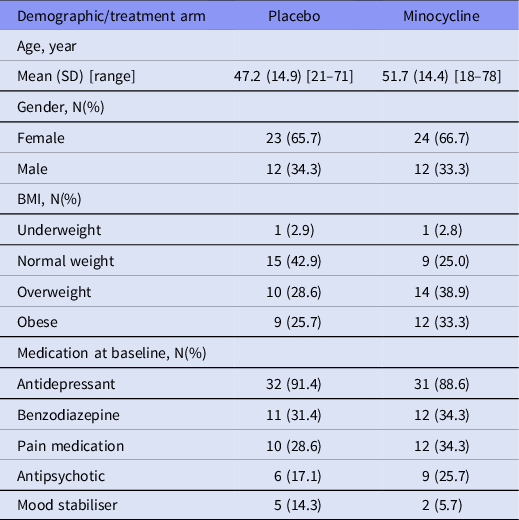
Baseline characteristics of the sample are outlined in Table 1. The minocycline and placebo groups did not significantly differ on baseline demographic variables, clinical characteristics or body mass index. Of the total number of participants in the clinical trial (n = 71), we obtained baseline serum BDNF, IL-6 and LBP for 35 participants in the placebo group and 36 participants in the minocycline group. At treatment endpoint (week 12), serum BDNF, IL-6 and LBP were measured in 30 participants in the minocycline treatment group and 27 participants in the placebo group. Missing samples were due to withdrawal from the primary clinical trial or non-attendance for pathology collection, which was an optional component of the primary clinical trial (Dean et al., Reference Dean, Kanchanatawan, Ashton, Mohebbi, Ng, Maes, Berk, Sughondhabirom, Tangwongchai, Singh, Mckenzie, Smith, Malhi, Dowling and Berk2017).
Selected baseline demographic and clinical characteristics*

BMI, body mass index. BMI was categorised as <18.50 = underweight; 18.50 to < 25.00 = normal weight; 25.00 to <30.00 = overweight; >= 30.00 = Obese.
* A subset of demographic information is included here. All demographic information has been previously published (Dean et al., Reference Dean, Kanchanatawan, Ashton, Mohebbi, Ng, Maes, Berk, Sughondhabirom, Tangwongchai, Singh, Mckenzie, Smith, Malhi, Dowling and Berk2017).
Evaluation of biological markers between minocycline and placebo groups
An independent samples t-test compared mean biological markers at baseline and endpoint (week 12) in placebo and minocycline groups (Fig. 1; Supplementary Table 1). There were no significant differences in baseline mean levels of IL-6 (placebo 2.09 ± 1.97 pg/ml; minocycline 1.68 ± 0.97 pg/ml; t(50) = 1.114; p = 0.271), LBP (placebo 3.88 ± 0.99 µg/ml; minocycline 4.01 ± 1.26 µg/ml; t(67) = −0.499; p = 0.62) or BDNF (placebo 25.90 ± 6.84 ng/ml; minocycline 25.21 ± 4.89 µg/ml; t(67) = 0.485; p = 0.629). Mean differences in baseline IL-6, LBP and BDNF between groups were 0.42, −0.14 and 0.70, respectively. Also, there were no significant differences at week 12 in mean levels of IL-6 (placebo 2.06 ± 1.35 pg/ml; minocycline 1.77 ± 0.79 pg/ml; t(47) = 1.012; p = 0.317), LBP (placebo 3.74 ± 0.95 µg/ml; minocycline 3.93 ± 1.33 µg/ml; t(56) = −0.64; p = 0.525) or BDNF (placebo 24.28 ± 6.69 ng/ml; minocycline 26.56 ± 5.45 ng/ml; t(56) = −1.419; p = 0.161). Mean differences at week 12 in levels of IL-6, LBP and BDNF between groups were 0.29, −0.19 and −2.28, respectively.
Mean (±SD) levels of serum IL-6 (a), LBP (b) and BDNF (c) at baseline and Week 12.

Potential modification effects on clinical measurements by biological markers (BDNF, IL-6 and LBP)
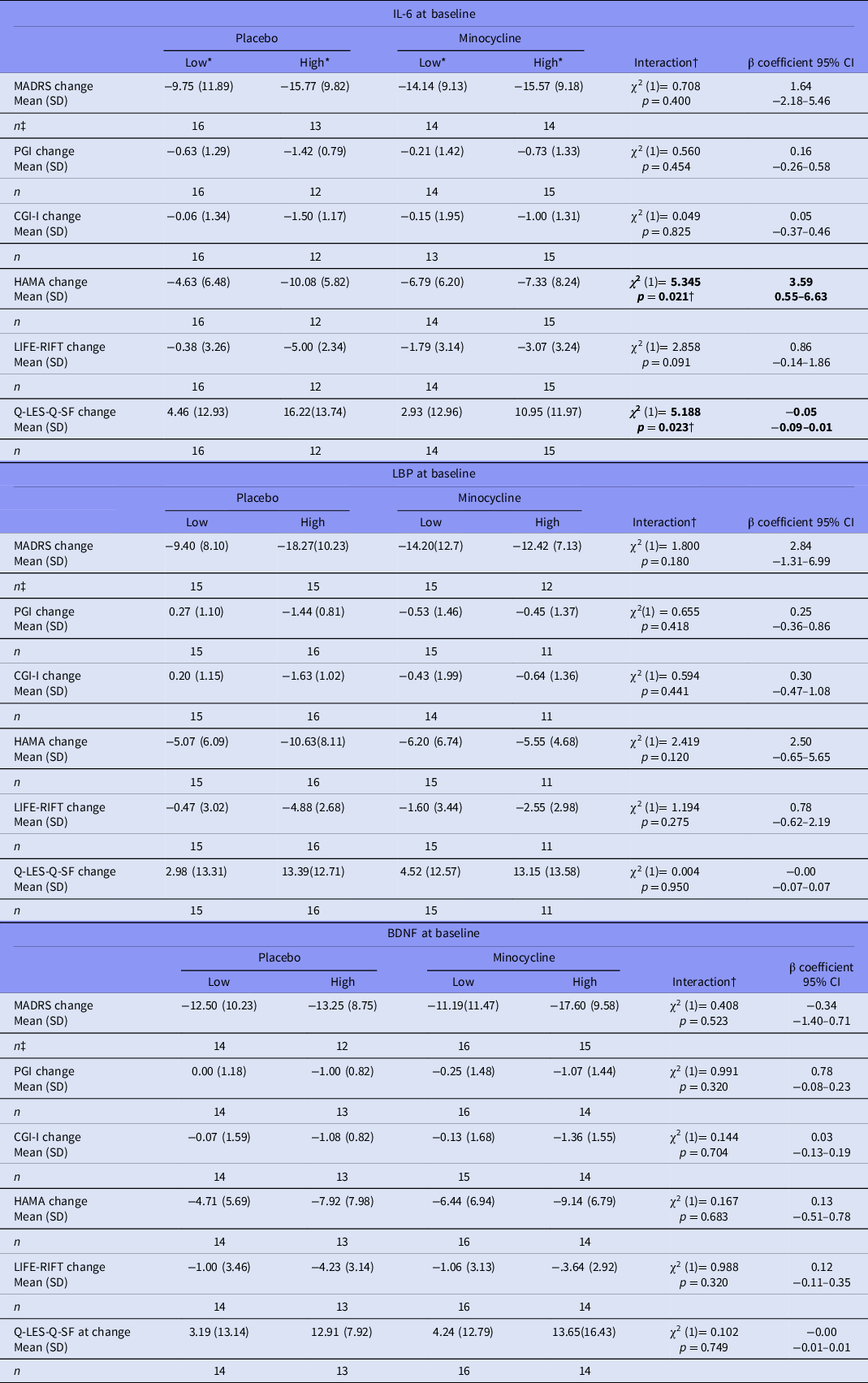
We also explored whether these biological markers could modify the clinical outcomes. A significant three-way interaction of baseline levels of IL-6, minocycline treatment and changes in HAMA from baseline to week 12 was found (χ2 = 5.345, p = 0.021, B = 3.589, 95% CI [0.549–6.631]; Table 2). The GEE model beta coefficient from the three-way interaction indicated that baseline IL-6 values predicted improvement of HAMA outcome in response to minocycline treatment. For every one unit increase in baseline IL-6 levels, HAMA in the minocycline group additionally improved by 3.59 units (a 3.59 unit reduction of HAMA score). Furthermore, the GEE model indicated that the levels of IL-6 at baseline also predicted additional improvement in the Q-LES-Q-SF measure in response to minocycline treatment (χ2 = 5.188, p = 0.023, β = −0.047, 95% CI [−0.087–0.006]; Table 2). That is, for every one unit increase in baseline IL-6 levels, Q-LES-Q-SF scores in the minocycline treated group additionally decreased by −0.047 units. These significant findings were not significant after correcting for multiple comparisons. No significant interactions were observed when exploring moderation by LBP or BDNF levels.
Evaluating potential moderator effects of biological factors (i.e. factor measurements at baseline) on clinical response to adjunctive minocycline treatment

BDNF, brain-derived neurotrophic factor; CGI-I, Clinical Global Impression-Improvement; HAMA, Hamilton Anxiety Rating Scale; LBP, lipopolysaccharide-binding protein; LIFE-RIFT, Range of Impaired Functioning Tool; MADRS, Montgomery–Åsberg Depression Rating Scale; PGI, Patient Global Impression; Q-LES-Q-SF, Quality of Life Enjoyment and Satisfaction Questionnaire.
* Low and High indicate the data wERE dichotomised as low and high based on median for descriptive purposes only. All biological markers were considered continuous for modelling.
† Three-way interaction between potential predictor (baseline at levels of biomarkers), changes in clinical measurement and treatment group.
‡ Differential sample sizes reflect the entire cohort (intention-to-treat) compared to those who provided complete biological data (per protocol). The boldface values indicate statistical significance, p<0.05.
Exploring the association between change in clinical measurements by biological markers change (BDNF, IL-6 and LBP)
Associations between change in clinical outcomes with biomarker changes were evaluated by exploring the interactions between treatment group as a nominal factor, log of follow-up time as a continuous covariate and the time-varying biological markers as mediators using the GEE model. A significant three-way interaction was observed between HAMA, change in IL-6 levels and treatment allocation group from baseline to week 12 (χ2 = 4.527, p = 0.033, β = 3.75, 95% CI [0.3–7.2]; Supplementary Table 2a). The GEE model regression coefficient from the three-way interaction indicated that a one unit decrease in IL-6 between baseline and week 12 was associated with an additional 3.7 units of improvement in HAMA score in the intervention group compared with placebo. IL-6 did not show a significant association with change in any other clinical outcome measures. Changes in the levels of LBP and BDNF did not interact with any clinical outcome measures (Supplementary Table 2a).
Further, we explored any non-specific effects of the biological factors on clinical measurements. A significant main effect of baseline BDNF levels on LIFE-RIFT scores was found (χ2 = 9.109, p = 0.003, β = −0.11, 95% CI [−0.18 to −0.04]; Supplementary Table 2b). This finding indicates that baseline BDNF levels had a predictive value and for each one unit increase in baseline BDNF levels, LIFE-RIFT scores improved by 0.11 units, regardless of treatment allocation.
Responders and remitters analyses
Comparing responders to non-responders in both minocycline and placebo groups, there were moderation effects of biological markers. Biological factors also did not interact with treatment allocation on remission status (MADRS < 7) in this sample (data not shown).
Discussion
This study investigated serum markers associated with immune-inflammatory and neurotrophic pathways in a randomised clinical trial of adjunctive minocycline treatment (200 mg/day), compared with placebo for MDD. The study also explored potential relationships between these markers and clinical outcomes. We measured serum levels of IL-6, LBP and BDNF as these factors are hypothesised to be linked with the underlying mechanisms of depressive mood and potentially with treatment response. However, no significant differences in the levels of these markers were observed between participants receiving minocycline or placebo.
Previous research has suggested that both traditional antidepressants (e.g. SSRIs) (Lindqvist et al., Reference Lindqvist, Dhabhar, James, Hough, Jain, Bersani, Reus, Verhoeven, Epel, Mahan, Rosser, Wolkowitz and Mellon2017) and adjunctive anti-inflammatory treatments (e.g. celecoxib) alter IL-6 levels (Abbasi et al., Reference Abbasi, Hosseini, Modabbernia, Ashrafi and Akhondzadeh2012), although this was not found in the current study. However, the results are consistent with other adjunctive therapies, such as N-acetylcysteine (that has multifaceted mechanisms of action including inflammation) (Hasebe et al., Reference Hasebe, Gray, Bortolasci, Panizzutti, Mohebbi, Kidnapillai, Spolding, Walder, Berk, Malhi, Dodd and Dean2017). Our findings also align with the outcomes of the other trial of adjunctive minocycline that reported no significant change in CRP or erythrocyte sedimentation levels (Husain et al., Reference Husain, Chaudhry, Husain, Khoso, Rahman, Hamirani, Hodsoll, Qurashi, Deakin and Young2017). It is possible that the negative findings are a consequence of the small sample size (type II error), small biological effects of minocycline and/or the heterogeneous sample, and/or the chronicity or staging of the illness (entry criteria included moderate to severe depression). There is evidence to suggest that cytokines, microbial and neurotrophic factors are altered in different ways, depending on the stage of illness (Rogers et al., Reference Rogers, Keating, Young, Wong, Licinio and Wesselingh2016; Himmerich et al., Reference Himmerich, Patsalos, Lichtblau, Ibrahim and Dalton2019). This is believed to be, in part, due to neuroprogression that may occur with repeated episodes of illness and may also be partly attributed to antidepressant medications (Bakunina et al., Reference Bakunina, Pariante and Zunszain2015, Miller & Raison, Reference Miller and Raison2015).
Baseline IL-6 levels predicted treatment response (regardless of treatment allocation). Baseline IL-6 was also associated with improvements on both the Q-LES-Q-SF and HAMA following minocycline treatment, and changes in IL-6 levels may mediate changes in HAMA improvements. Further, there may be specific roles of cytokines for mediating anxiety symptoms in people with MDD, and this may explain discrepancies with other studies, where comorbid anxiety may be less prominent. Notably, of the current sample, 44% of participants also had a comorbid anxiety disorder. This finding speaks to the heterogeneity of MDD and the resulting difficulty in identifying efficacious novel therapies. A recent trial recruited those with underlying inflammation as an a priori inclusion criteria for trial participant selection to target those who may benefit most from adjunctive anti-inflammatory treatment. The Nettis et al. (Reference Nettis, Lombardo, Hastings, Zajkowska, Mariani, Nikkheslat, Wprrell, Enache, Mclaughlin, Kose, Sforzini, Bogdanova, Cleare, Young, Pariante and Mondelli2021) trial explored 4 weeks of adjunctive minocycline (200 mg/day) compared to placebo (n = 39) in participants selected based on a CRP value of ≥1 mg/l. However, both groups improved with no difference in depression symptoms score change. However, when further analysed stratifying for a CRP of ≥3 mg/l additional benefit was seen with adjunctive minocycline treatment over that seen in the placebo group. Given the variability of findings with individual markers, including IL-6, future trials may consider enrichment of recruitment by identifying several markers or a panel of factors to better represent an inflammatory phenotype, similar to that conducted by McIntyre et al. (Reference Mcintyre, Subramaniapillai, Lee, Pan, Carmona, Shekotikhina, Rosenblat, Brietzke, Soczynska, Cosgrove, Miller, Fisher, Kramer, Dunlap, Suppes and Mansur2019). To date, such an approach has unfortunately yielded mixed results (Berk et al., Reference Berk, Walker and Nierenberg2019).
In contrast to our findings regarding IL-6, we did not find any association between levels of BDNF and LBP and clinical measures. Minocycline is a broad-spectrum antibiotic, and therefore, LBP was selected to index microbial signals in relation to changes in depressive/anxiety symptoms. The human gut microbiome is a complex and dynamic system and could be affected by numerous environmental factors such as diets and medications, in addition to minocycline treatment (Gonzalez-Quintela et al., Reference Gonzalez-Quintela, Alonso, Campos, Vizcaino, Loidi and Gude2013). Baseline BDNF levels were associated with a non-specific improvement of LIFE-RIFT scores which measures functional impairments. In the original study, Dean et al. (Reference Dean, Kanchanatawan, Ashton, Mohebbi, Ng, Maes, Berk, Sughondhabirom, Tangwongchai, Singh, Mckenzie, Smith, Malhi, Dowling and Berk2017) found a significant interaction between minocycline and LIFE-RIFT score. It appears that while peripheral BDNF (and IL-6) may not be displaying significant differences between minocycline and placebo groups, there may be therapeutic benefit from both inflammation and neurotrophic factors in the treatment response to minocycline in MDD.
Because the overarching trial was powered based on the clinical outcomes, this study is limited in its sample size and thus relative power to detect differences. A post hoc power analysis for modelling biomarker modification effects (when dichotomising biomarkers to high and low according to the median for MADRS primary outcome) showed there was 61–86% power to detect adjusted mean differences of three units or higher.
In conclusion, the current study identified a tentative link between minocycline, IL-6 levels and anxiety symptoms (HAMA scores). Similarly, BDNF may be a non-specific predictor of treatment response. It is likely that a broader array of markers and/or algorithms will be needed for theragnostics in the future. Minocycline may be a useful adjunctive treatment, but more research is required to identify subgroups that may best benefit from this treatment, particularly exploring anxiety symptoms or disorders.
Supplementary material
The supplementary material for this article can be found at https://doi.org/10.1017/neu.2021.44
Acknowledgements
The authors would like to acknowledge the Brain and Behavior Foundation for providing the overarching funding for the pilot trial. The authors would further like to acknowledge the Australasian Society for Bipolar and Depressive Disorders and Servier for a grant that was provided to conduct the biological analyses. The authors would like to thank the National Health and Medical Research Council (NHMRC) and Trisno Family Fellowship for supporting OD, MB and AJW. The authors acknowledge the contribution of the Community and Research Network in providing consumer insight into the protocol for the overarching trial. Finally, the authors would like to thank the service providers and the participants for taking part in the study.
Authors contributions
KH was involved in protocol development, experimental studies, analysis, statistical analysis and manuscript preparation. MM was involved in protocol development statistical analysis, manuscript preparation. LG was involved in protocol development, analysis and editing manuscript. AJW contributed to experimental studies, manuscript review. CB contributed to experimental studies, manuscript editing. AT contributed to experimental studies and manuscript review. MB was involved in protocol development and manuscript editing. KW was involved in protocol development, statistical analysis and manuscript editing. MM was involved in protocol development and manuscript editing. BK was involved in protocol development and manuscript editing. MMA contributed to experimental studies, manuscript review. LB contributed to experimental studies, manuscript review. CHN contributed to provision of clinical trial data and manuscript editing. GM contributed to provision of clinical trial data and manuscript editing. ABS was involved in protocol development and manuscript review. OMD was involved in protocol development, analyses and manuscript preparation.
Declaration of interest
CB is supported by an Alfred Deakin Postdoctoral Research Fellowship. AJW is supported by a Trisno Family Fellowship. MB is supported by a National Health and Medical Research Council (NHMRC) Senior Principal Research Fellowship (1059660 and 1156072). MB has received Grant/Research Support from the NIH, Cooperative Research Centre, Simons Autism Foundation, Cancer Council of Victoria, Stanley Medical Research Foundation, Medical Benefits Fund, National Health and Medical Research Council, Medical Research Futures Fund, Beyond Blue, Rotary Health, A2 milk company, Meat and Livestock Board, Woolworths, Avant and the Harry Windsor Foundation, has been a speaker for Astra Zeneca, Lundbeck, Merck, Pfizer, and served as a consultant to Allergan, Astra Zeneca, Bioadvantex, Bionomics, Collaborative Medicinal Development, Lundbeck Merck, Pfizer and Servier. CN had served as a consultant for Lundbeck, Grunbiotics, Servier, Janssen-Cilag, Wyeth and Eli Lilly, received research grant support from Wyeth and Lundbeck, and speaker honoraria from Servier, Lundbeck, Bristol-Myers Squibb, Organon, Eli Lilly, GlaxoSmithKline, Janssen-Cilag, Astra-Zenaca, Wyeth, and Pfizer. MMA has received grant/research support from Deakin University, Australasian Society for Bipolar Depressive Disorders, Lundbeck, Australian Rotary Health, Ian Parker Bipolar Research Fund and Cooperative Research Centre for Mental Health and PDG Geoff and Betty Betts Award from Rotary Club of Geelong. LB has received grant/research support from Deakin University, ASBDD/Servier, and NHMRC. OMD is a R.D. Wright NHMRC Biomedical Career Development Fellow (APP1145634) and has received grant support from the Brain and Behavior Foundation, Simons Autism Foundation, Stanley Medical Research Institute, Deakin University, Lilly, NHMRC and ASBDD/Servier. She has also received in-kind support from BioMedica Nutraceuticals, NutritionCare and Bioceuticals.
Ethical standards
All participants provided informed written consent and the study was conducted according to Good Clinical Practice guidelines. The trial was registered on the Australian and New Zealand Clinical Registry (ACTRN12612000283875) and was approved by the relevant Human Research Ethics Committees. The authors assert that all procedures contributing to this work comply with the ethical standards of the relevant national and institutional committees on human experimentation and with the Helsinki Declaration of 1975, as revised in 2008.