Background
Kawasaki disease is an acute, self-limiting febrile vasculitis, most common in infants aged 6 months–2 years. It is challenging to make a diagnosis of incomplete Kawasaki disease, particularly in infants younger than 6 months with fewer clinical manifestations. Reference Uysal, Bostan, Celebi, Uysal, Hamitoglu and Cil1 Various neurologic complications have been described to occur in 1–30% of patients with Kawasaki disease, Reference Gallagher2 but facial nerve palsy secondary to Kawasaki disease is an extremely rare (0.9%) and atypical presentation. Reference Alves, Magalhaes, Almeida Rde, Santos, Gandolfi and Pratesi3 Patients with Kawasaki disease and facial palsy tend to be under 6 months old, and there is a higher association with coronary artery aneurysm in such patients compared to those without facial palsy who never received treatment. Reference Yeo, Kim and Ha4 Kawasaki disease associated with facial nerve palsy may indicate increased inflammatory burden, and patients may require additional anti-inflammatory agents and more vigilant echocardiography. Herein, we describe a 4-month-old female who presented with unilateral facial nerve palsy in the acute phase of incomplete Kawasaki disease, in which the diagnosis was delayed until day 10 of the illness.
Case Presentation
A 4-month-old female presented with fever, irritability, and reduced mobility of the right side of the face, in addition to an inability to close the right eye and epiphora for 3 days before admission. The onset of the disease, with fever and a slight cough, was 10 days before admission. Therefore, she was thought to have a respiratory tract infection and was admitted to a regional hospital where she was treated with antibiotics and antipyretics, but there was no improvement. On day 7 of illness, the patient developed a right facial droop, false right ptosis secondary to the inability to raise her right eyebrow, and decreased movement of the right aspect of her mouth. Her personal history revealed a 10-day episode of persistent fever and conjunctival injection that resolved spontaneously 5 days earlier. She also presented with generalised cracking and reddening of the lips and was transferred to our clinic with suspected Kawasaki disease.
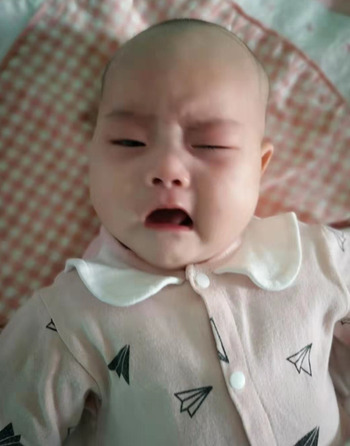
Physical examination revealed fever (39°C), cracking and reddened lips, and extreme irritability. On examination, she was noted to have right painless cervical lymphadenopathy, left-sided deviation of the labial commissure, obliteration of the right nasolabial fold, and incomplete closure of the right eye, suggesting a right-sided infranuclear facial nerve palsy (Fig 1). A detailed neurologic assessment did not reveal any more defects. The remainder of the physical examination was unremarkable.
Photograph of the patient showing right-sided facial nerve palsy at presentation.

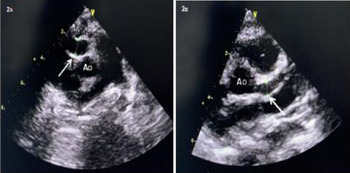
The laboratory tests on the day of admission revealed leukocytosis (36,590/µl) with neutrophilia (29,720/µl), anemia (Hb: 7.8 g/dl), thrombocytosis (1155,000/µl), hypo-albuminemia (2.59 g/dl), elevated N-terminal of the prohormone brain natriuretic peptide level (1130 pg/mL), elevated CRP (139 mg/l), and elevated erythrocyte sedimentation rate (65 mm/h). An echocardiogram was performed showing normal left ventricular function, mild pericardial effusion, and mitral regurgitation, in addition to aneurysms of the right main coronary artery (maximum diameter of 8.5 mm; Z-score 11.62), left main coronary artery (maximum diameter of 5.1 mm; Z-score 6.97), left anterior descending coronary artery (maximum diameter of 3.3 mm; Z-score 4.26), and left circumflex coronary artery (maximum diameter of 2.2 mm; Z-score 3.01), thus confirming the diagnosis of incomplete Kawasaki disease (Fig 2). The electrocardiogram demonstrated sinus tachycardia, and the chest X-ray and cerebral magnetic resonance imaging were normal. Blood, urine, cerebrospinal fluid, and stool cultures were sterile. Throat and fecal cultures were negative for bacterial and viral pathogens.
Two-dimensional Doppler echocardiogram. Parasternal short axis plane showing a large-size aneurysm of the left main coronary artery (2A: RMCA; maximum diameter of 8.5 mm; Z-score 11.62), and a small-size aneurysm of the right main coronary artery (2B: LMCA; maximum diameter of 5.1 mm; Z-score 6.97). Ao = aortic root.

Based on the patient’s medical history, the physical and laboratory findings were compatible with incomplete Kawasaki disease. She received intravenous immunoglobulin (2 g/kg/16 hours), and acetyl salicylic acid (50 mg/kg/d) was started on the 10th day of illness. The patient’s fever and facial nerve palsy resolved within 48 hours after intravenous immunoglobulin treatment. An echocardiogram performed on day 5 of admission revealed similar coronary findings. Enoxaparin was stopped, and anticoagulation was continued with a combination of warfarin and low-dose acetyl salicylic acid after the 2nd week of the treatment.
The patient’s inflammatory markers all improved to normal or near-normal levels prior to discharge; all infectious studies returned to negative. Her right facial weakness was unappreciable on the day of discharge (20 days after onset). At the 3-month follow-up after discharge, the right-sided facial nerve palsy had resolved completely, and echocardiography showed improvement in the right coronary artery aneurysms, left coronary artery and left anterior descending coronary artery, and normal left circumflex coronary arteries. The pericardial effusion and mitral regurgitation disappeared completely.
Discussion
Coronary artery aneurysms are the most important and life-threatening complication of Kawasaki disease. Coronary artery complications were significantly more common in infants than in children older than 1 year. It is challenging to make a diagnosis of incomplete Kawasaki disease, particularly in infants younger than 6 months with fewer clinical manifestations. Moreover, the rate of incomplete Kawasaki disease was also higher in infants aged 6 months. Chang et al Reference Chang, Hwang, Chen, Lee, Meng and Lu5 showed a higher rate of incomplete Kawasaki disease and coronary complications in Kawasaki disease patients <6 months than in older patients, and Rosenfeld et al Reference Rosenfeld, Corydon and Shulman6 noted that Kawasaki disease patients younger than 6 months had a higher risk of developing coronary artery aneurysm. Many of these patients were outside the expected age range for Kawasaki disease, and diagnosis and treatment were often delayed.
The neurological complications of Kawasaki disease have been well described, but apart from extreme irritability, they are quite rare. Reference Newburger, Takahashi and Gerber7 However, it has been reported that facial nerve palsy in these patients may be associated with more severe clinical progression and a higher incidence of coronary aneurysms. It is of great concern that >50% of patients with Kawasaki disease and facial nerve palsy develop coronary artery aneurysm. Reference Stowe8 We speculate that facial nerve palsy may be an indicator for evaluating the severity of Kawasaki disease. The mechanism of facial nerve palsy in Kawasaki disease remains unclear, but it may be considered to be a part of the spectrum of immune activation consequences in Kawasaki disease. It is likely that both ischemic vasculitis of the arteries supplying the facial nerve and immunologic mechanisms contribute to facial nerve dysfunction. Reference Wright, Waddington, Geddes, Newburger and Burgner9,Reference Poon, Lun and Ng10
Facial nerve palsy usually presents in females (female:male ratio 1.4:1) and infants <18 months of age (86%), Reference Stowe8,Reference Wright, Waddington, Geddes, Newburger and Burgner9 which is consistent with our report. Most reported cases are unilateral left-sided facial nerve palsys (60%), occurring during the convalescent phase (median onset is day 16 of illness); however, the case we reported was a unilateral right-sided facial nerve palsy and occurred on day 7 of the course of disease. Although facial nerve palsys resolved spontaneously within 1 week–3 months, intravenous immunoglobulin therapy seems to have shortened the time to full recovery. Reference Poon, Lun and Ng10
Conclusion
This case highlights that a Kawasaki disease diagnosis should be suspected in any child with prolonged unexplained fever, even with incomplete diagnostic features; moreover, physicians need to be aware of unusual manifestations such as facial nerve palsy. Atypical cases such as this may indicate an increased risk of coronary artery aneurysm because of the delayed diagnosis and greater inflammatory burden; thus, a more aggressive treatment (intravenous immunoglobulin plus steroids) may be necessary.
Acknowledgements
None.
Financial Support
This study was funded by the grants from Natural Science Foundation of Jilin Province (No.20200201617JC to Lu Na).
Conflicts of Interest
None.