Native speakers are often able to guess what comes next in a sentence (Kimball, Reference Kimball and Kimball1975). For example, given a sequence such as will you pass me. . ., one can be confident that a transferrable direct-object noun phrase (NP) will come next (e.g., the salt; as in will you pass me the salt?). In other words, we are able to predict upcoming words on the basis of what has been processed so far. Adult monolingual processing research shows how this predictive behavior makes comprehension fast and efficient (Altmann & Kamide, Reference Altmann and Kamide1999; Federmeier, Reference Federmeier2007; Lau, Stroud, Plesch & Phillips, Reference Lau, Stroud, Plesch and Phillips2006; Staub & Clifton, Reference Staub and Clifton2006), and how verb information plays an important role in predictive processing (MacDonald, Pearlmutter & Seidenberg, Reference MacDonald, Pearlmutter and Seidenberg1994; McRae, Spivey-Knowlton & Tanenhaus, Reference McRae, Spivey-Knowlton and Tanenhaus1998; Sedivy, Tanenhaus, Chambers & Carlson, Reference Sedivy, Tanenhaus, Chambers and Carlson1999; Tanenhaus & Trueswell, Reference Tanenhaus, Trueswell, Clifton, Frazier and Ryner1994). Verb-driven processing strategies do not apply to Japanese because of its head-finality. However, Japanese provides clearly recognizable postpositions to mark basic syntactic roles. Studies have shown that native speakers of Japanese rely heavily on these case markers for thematic role assignments (Miyamoto, Reference Miyamoto2002; Yamashita, Reference Yamashita1997), and that they use the combination of the lexical semantics of an NP and its case markers to anticipate upcoming arguments without waiting for the arrival of the verb (Kamide, Altmann & Haywood, Reference Kamide, Altmann and Haywood2003).
The relevant question in this article is whether second language (L2) learners of Japanese resemble native speakers with respect to case-marker-driven predictive processing. Several L2 studies have suggested that learners do not anticipate to the same extent as native speakers do, although this may depend on their proficiency level and on the type of linguistic structure in question (Dussias, Valdés Kroff, Guzzardo Tamargo & Gerfen, Reference Dussias, Valdés Kroff, Guzzardo Tamargo and Gerfen2013; Grüter, Lew-Williams & Fernald, Reference Grüter, Lew-Williams and Fernald2012; Hopp, Reference Hopp2013). Kaan and colleagues (Kaan, Reference Kaan2014; Kaan, Dallas & Wijnen, Reference Kaan, Dallas, Wijnen, Jan-Wouter and de Vries2010) have proposed that the ability to generate predictions may be a key element that differentiates native and nonnative processing, and that this can account for some previously observed differences between native and nonnative morphosyntactic processing (Clahsen & Felser, Reference Clahsen and Felser2006). The question remains as to what are the conditions under which nonnative speakers have the greatest difficulty in achieving predictive processing. In addressing this question, we must examine the specific L2 structures that facilitate predictive processing and the cues that trigger this processing.
The present study continues this line of research by examining case-marker cues for predictive processing in L2 Japanese, an area in which the effects of prediction have not yet been investigated. Specifically, we examine the processing of the monotransitive or accusative construction (e.g., The teacher teased the student) and the ditransitive construction (e.g., The teacher gave the student the test). In Japanese, all arguments canonically appear before the verb. Therefore, the prediction of possible grammatical arguments cannot depend on information contained in the verb itself. However, preverbal NPs can be placed into various noncanonical word orders, while still keeping the meaning of the sentence constant. As a result, the configuration of case-marked NPs can be used as a cue to the prediction of what will follow. Using the visual-world eye-tracking paradigm, we sought to determine whether learners employ information in case-marked NPs to generate predictions of upcoming linguistic items in the sentence. The results that we will present indicate that these cues are used by native speakers, but not by nonnative speakers.
Anticipatory processing
In the field of adult monolingual sentence processing, studies have shown that comprehenders not only integrate each word into a syntactic structure immediately, but also predict upcoming information before it appears in the input (Altmann & Kamide, Reference Altmann and Kamide1999; Federmeier, Reference Federmeier2007; Lau et al., Reference Lau, Stroud, Plesch and Phillips2006; Staub & Clifton, Reference Staub and Clifton2006). Much of the research has been focused on verb subcategorization bias (Clifton, Frazier & Connine, Reference Clifton, Frazier and Connine1984; Garnsey, Pearlmutter, Myers & Lotocky, Reference Garnsey, Pearlmutter, Myers and Lotocky1997; Holmes, Stowe & Cupples, Reference Holmes, Stowe and Cupples1989). These studies presented data suggesting that the frequency with which a verb appears with a direct object or with a sentence complement affects the analysis of a postverbal NP. Garnsey and colleagues (Reference Garnsey, Pearlmutter, Myers and Lotocky1997) found that people slowed down when reading sentences in which optionally transitive verbs (e.g., remember) were followed by sentential complements, which conflict with these verbs’ dominant usage. This pattern of results suggests that verb argument structures are activated at the verb itself, before the comprehender encounters the subsequent material. Additional evidence for predictive processing comes from research on long-distance wh-dependencies. Comprehenders have been shown to actively predict syntactic structure when processing filler–gap dependencies (for a review, see Phillips & Wagers, Reference Phillips, Wagers and Gaskell2007). It is argued that, having identified a filler, the processor posits a gap at the first position that satisfies the filler's thematic requirements. Stowe (Reference Stowe1986) observed a temporal disruption in reading (i.e., filled-gap effects) when comprehenders encountered an NP in which a gap had been expected (e.g., at the word us in My brother wanted to know who Ruth will bring us home to at Christmas). Studies have shown that dependencies are constructed immediately at the verb and that the search for a filler is initiated incrementally (Kaan, Harris, Gibson & Holcomb, Reference Kaan, Harris, Gibson and Holcomb2000; Pickering & Barry, Reference Pickering and Barry1991; Traxler & Pickering, Reference Traxler and Pickering1996).
Recent experimental paradigms, such as eye-tracking and electrophysiology, have allowed researchers to directly investigate expectation-driven processing mechanisms (Altmann & Kamide, Reference Altmann and Kamide1999; Chambers, Tanenhaus, Eberhard, Filip & Carlson, Reference Chambers, Tanenhaus, Eberhard, Filip and Carlson2002; Neville, Nicol, Barss, Forster & Garrett, Reference Neville, Nicol, Barss, Forster and Garrett1991). These studies have examined the types of linguistic and nonlinguistic information used to generate prediction. For instance, Altmann and Kamide (Reference Altmann and Kamide1999) reported a visual-world paradigm study in which participants’ eye movements were compared when they heard sentence fragments such as the boy will eat . . . and the boy will move . . . as they were presented with a scene containing a cake and some inedible objects before they heard the word cake. When the participants heard the verb eat, they moved their eyes to the picture of the cake more often than when they heard the verb move. These results demonstrate that native speakers can also use semantic and pragmatic information associated with verbs to predict upcoming items.
Because English subject–verb–object word order places the verb early in the sentence, verb information plays an important role in predicting the type of syntactic frame and in forming long-distance dependencies. However, such verb-based processing strategies do not apply to head-final languages, such as Japanese. Studies on Japanese processing play a crucial role in understanding how predictive processing is instantiated despite substantial linguistic differences. In the next section, we lay out key features of the structure and processing of Japanese.
The structure and processing of Japanese
The Japanese language is head-final, with an otherwise flexible word order. In Japanese, all of the verb arguments precede the matrix verb, including clausal arguments (Shibatani, Reference Shibatani1990). In the ditransitive construction, the structure in question in the present study, there are three case-marked NPs prior the verb. Because postpositional case markers provide clear cues for thematic role assignments, Japanese allows the reordering of major constituents while keeping the meaning of the sentence constant (Kuno, Reference Kuno1973; Tsujimura, Reference Tsujimura1999). It exhibits the phenomenon often referred to as scrambling (Ross, Reference Ross1967). The following examples demonstrate a canonically ordered ditransitive sentence and its scrambled counterpart.Footnote 1
-
(1) [IP John-ga [VPMary-ni [V′ hon-o ageta]]]
John-NOM Mary-DAT book-ACC gave
“John gave Mary a book.”
-
(2) [IP Mary i -ni [IP John-ga [VP ti [V′ hon-o ageta]]]]
Mary-DAT John-NOM book-ACC gave
As is shown in (1), the canonical order of the ditransitive construction in Japanese is nominative, dative, accusative, verb (Hoji, Reference Hoji1985). In (2), the dative NP moves from its original position to a sentence-initial position, creating a gap in the original position. Because of the additional IP node created by the gap, the scrambled sentence shown in (2) is syntactically more complex than its canonical counterpart in (1) (Nemoto, Reference Nemoto and Tsujimura1999). Psycholinguists typically operationalize syntactic complexities in term of increasing reaction times at the gap position (the scrambling effect).
Although dislocating constituents is possible, scrambled sentences are fairly infrequent in Japanese. Kuno (Reference Kuno1973) found that for monotransitives, canonically ordered sentences are 17 times more likely to occur than scrambled sentences in written texts. Similarly, Yamashita (Reference Yamashita2002) examined naturally occurring scrambled sentences and their surrounding contexts in various types of texts. She found that there were only 19 instances of scrambling out of 2635 sentences. Yamashita (Reference Yamashita2002) further investigated whether there is a relationship between information structure and the variation of constituent ordering, which provides useful cues to the listener for optimizing comprehension. She did not find that either the principle of given before new or topic status account for the occurrence of scrambled sentences, which she interpreted as evidence that Japanese scrambling might be driven more by a production factor. These results indicate that Japanese listeners must pay attention to morphosyntactic information for successful processing, because information structure and context are not sufficiently constraining.
Because scrambling increases syntactic complexity and the variations of constituent ordering, early models of sentence processing assumed that sentential arguments were temporarily stored for later integration in Japanese (Pritchett, Reference Pritchett1991). However, such delayed processing models became difficult to reconcile with converging evidence for incremental processing driven by case markers (Kamide et al., Reference Kamide, Altmann and Haywood2003; Miyamoto, Reference Miyamoto2002; Miyamoto, Gibson, Pearlmutter, Aikawa & Miyagawa, Reference Miyamoto, Gibson, Pearlmutter, Aikawa and Miyagawa1999; Yamashita, Reference Yamashita1997). Yamashita (Reference Yamashita1997) investigated whether Japanese comprehenders rely on surface word order or on case-marking information, comparing canonically ordered ditransitive sentences with their noncanonical counterparts. Yamashita (Reference Yamashita1997) did not find a significant difference in reading times as a function of the word-order type; the Japanese native speakers processed scrambled sentences as readily as their canonical counterparts by keeping track of the information contained in the case markers.
Coming at this issue from a slightly different perspective, Kamide and colleagues (Reference Kamide, Altmann and Haywood2003) investigated the extent to which the word-by-word analysis of a sentence leads to the assignment of thematic roles before the linguistic input where that assignment is clearly presented. Using the visual-world paradigm (Tanenhaus, Spivey-Knowlton, Eberhard & Sedivy, Reference Tanenhaus, Spivey-Knowlton, Eberhard and Sedivy1995), Kamide and colleagues (Reference Kamide, Altmann and Haywood2003) investigated how readers interactively use lexical semantic information and case markers to anticipate the type of the matrix verb. Pairs of structures such as (3) and (4) were examined.
-
(3) The ditransitive condition
weitoresu-ga kyaku-ni tanoshigeni hanbaagaa-o hakonda.
waitress-NOM customer-DAT merrily hamburger-ACC brought
“The waitress merrily brought the hamburger to the customer.”
-
(4) The accusative condition
weiroresu-ga kyaku-o tanoshigeni karakatta.
waitress-NOM customer-ACC merrily teased
“The waitress merrily teased the customer.”
Kamide and colleagues (Reference Kamide, Altmann and Haywood2003) argued that a sequence of NP-NOM and NP-DAT, such as that in (3), signals that the sentence will involve the ditransitive construction and that the yet-to-be-mentioned third NP will be marked in the accusative case. Consequently, comprehenders can anticipate an upcoming verb that will express transfer from an agent to a goal and a theme that will represent whatever is transferrable. However, in the accusative condition illustrated in (4), comprehenders will assume that the sequence of NP-NOM and NP-ACC is a part of the monotransitive construction, because a Japanese clause may contain only one accusative NP (Harada, Reference Harada1973), and therefore, there is no linguistic constraint guiding comprehenders to expect another accusative-marked NP. In accord with this analysis, Japanese speakers demonstrated more looks toward an image of hamburger in the ditransitive condition than in the accusative condition before they heard the fourth constituent (hamburger or teased). These results suggest that comprehenders anticipate the properties of the theme as they are parsing on the basis of the morphosyntactic and lexical semantic constraints extracted from preverbal NPs in the absence of the verb. This indicates that case-marked NPs can facilitate word-by-word incremental structure building and enable the anticipation of upcoming arguments.
Previous work on L2 processing
Native speakers use different types of linguistic information to anticipate upcoming arguments, but L2 studies suggest that L2 learners may be limited in generating predictions, even though they have the relevant L2 knowledge. One area that has attracted much attention among second language acquisition (SLA) researchers who have directly tested predictive processing is the use of the gender information on the determiner. Studies have shown that congruent gender marking (e.g., le bateau “the-MASC boat”) will increase the processing speed of the noun (bateau) relative to a neutral control (e.g., leur bateau “their boat”) for native speakers of French but not for L2 learners (Colé & Segui, Reference Colé and Segui1994; Dahan, Swingley, Tanenhaus & Magnuson, Reference Dahan, Swingley, Tanenhaus and Magnuson2000; Guillelmon & Grosjean, Reference Guillelmon and Grosjean2001). Grüter, Lew-Williams, and Fernald (Reference Grüter, Lew-Williams and Fernald2012) proposed that one important inherent difference between first-language (L1) and L2 processing is the strength of associations between nouns and gender nodes in the mental lexicon. However, in some studies, nativelike predictive processing has been observed in highly proficient L2 learners (Dowens, Vergara, Barber & Carreiras, Reference Dowens, Vergara, Barber and Carreiras2010; Dussias et al., Reference Dussias, Valdés Kroff, Guzzardo Tamargo and Gerfen2013; Foote, Reference Foote2010; Hopp, Reference Hopp2013; Keating, Reference Keating2009). These findings suggest that L2 learners can use adjacent dependency information in a predictive manner, if they are adequately proficient.
In the area of syntactic processing, a growing number of studies have investigated incremental processing by L2 learners (for reviews, see Frenck-Mestre, Reference Frenck-Mestre2005; Papadopoulou, Reference Papadopoulou2005). The findings to date are mixed; some studies have revealed nativelike strategies in L2 processing, whereas others have shown that L2 learners’ incremental processing is inherently different from that of native speakers (Dussias, Reference Dussias2003; Dussias & Sagarra, Reference Dussias and Sagarra2007; Felser, Roberts, Marinis & Gross, Reference Felser, Roberts, Marinis and Gross2003; Frenck-Mestre & Pynte, Reference Frenck-Mestre and Pynte1997; Jackson, Reference Jackson2008; Marinis, Roberts, Felser & Clahsen, Reference Marinis, Roberts, Felser and Clahsen2005; Papadopoulou, Reference Papadopoulou2005). These mixed results suggest that L2 learners’ ability to use linguistic information for online processing can depend on the proficiency level of the learner, the type of linguistic structure in question, and the extent of overlap between L1 and L2. Evidence for L2 learners’ nativelike processing comes from studies on verb subcategorization information (Dussias & Cramer Scaltz, Reference Dussias and Cramer Scaltz2008; Frenck-Mestre & Pynte, Reference Frenck-Mestre and Pynte1997; Lee, Lu & Garnsey, Reference Lee, Lu and Garnsey2013). Dussias and Cramer Scaltz (Reference Dussias and Cramer Scaltz2008) demonstrated that L2 learners with L1 Spanish were able to use English subcategorization information to overcome temporary ambiguity when processing garden-path sentences (e.g., The CEO accepted/admitted the mistake might have affected the reputation of his company). A successful use of verb bias has also been observed even though it is an L2-specific strategy. Lee and colleagues (Reference Lee, Lu and Garnsey2013) showed that, although their learners’ L1 had a subject-object-verb order – and, therefore, verb-driven predictions would not be useful – L2 learners with advanced proficiency were able to use verb-based information to predict upcoming sentence structure in a nativelike manner.
Studies examining the processing of syntactically complex sentences shed more light on L2 learners’ ability to use verb information in incremental processing (Felser, Cunnings, Batterham & Clahsen, Reference Felser, Cunnings, Batterham and Clahsen2012; Omaki & Schulz, Reference Omaki and Schulz2011; Williams, Möbius & Kim, Reference Williams, Möbius and Kim2001). For example, Omaki and Schulz (Reference Omaki and Schulz2011) examined whether highly proficient L2 learners of English use the island constraint in constructing filler–gap dependencies. Following Traxler and Pickering (Reference Traxler and Pickering1996), Omaki and Schulz (Reference Omaki and Schulz2011) demonstrated that learners demonstrated increased reading times (i.e., a plausibility mismatch effect) at the verb wrote when processing a sentence with an implausible filler (e.g., We like the city that the author wrote unceasingly and with great dedication about ____while waiting for a contract) compared with the sentence with a plausible filler (i.e., We like the book that the author wrote unceasingly and with great dedication about ____while waiting for a contract). Omaki and Schulz's (Reference Omaki and Schulz2011) results indicate that as soon as the verb is processed, it activates the subsequent argument structure, including abstract structural representations, through the creation of a gap and analysis of the filler, which underscores the verb-driven nature of incremental and predictive processing.
Unlike English, in which verb information plays an important role for predictive processing, head-final languages rely largely on case-marking information. Contrary to evidence for L2 learners’ nativelike verb-driven processing in English (e.g., Dussias & Cramer Scaltz, Reference Dussias and Cramer Scaltz2008; Lee et al., Reference Lee, Lu and Garnsey2013; Omaki & Schulz, Reference Omaki and Schulz2011), L2 learners may have difficulty integrating case-marking information during online processing in head-final languages, such as German and Dutch (Havik, Roberts, Van Hout, Schreuder & Haverkort, Reference Havik, Roberts, Van Hout, Schreuder and Haverkort2009; Hopp, Reference Hopp2006; Jackson, Reference Jackson2008). For instance, Jackson (Reference Jackson2008) examined how intermediate L2 learners processed temporarily ambiguous wh-questions.
-
(5) Welche Ingenieurin traf den Chemiker gestern Nachmittag?
Which-NOM/ACC engineer-FEM met the-ACC chemist-MASC yesterday afternoon?
‘Which engineer met the chemist yesterday afternoon?’ (Subject-first, simple past)
-
(6) Welche Ingenieurin hat den Chemiker gestern Nachmittag getroffen?
Which-NOM/ACC engineer-FEM met the-ACC chemist-MASC yesterday afternoon?
‘Which engineer met the chemist yesterday afternoon?’ (Subject-first, present perfect)
German native speakers exhibited a processing preference for subject-first sentences, regardless of the location of the lexical verb (Bader & Meng, Reference Bader and Meng1999). However, L2 learners demonstrated a preference for the subject-first order only in simple past tense sentences such as (5) but not in those such as (6). In another self-paced reading study examining L2 learners’ online use of German case markers, Hopp (Reference Hopp2006) found that, even when learners exhibited nativelike comprehension accuracy, they did not demonstrate the same degree of online subject-first preference as did native speakers. More recent studies have shown that highly proficient learners of German are sensitive to case-marking information. However, this nativelike processing preference has been observed only when highly advanced L2 learners were presented sentences in a larger discourse context (Hopp, Reference Hopp2009) or in sentences in which the initial wh-word immediately and unambiguously coded whether it was the subject (wer, “who”) or the direct object (wen, “whom”) of the complement clause (Jackson & Dussias, 2009). These studies with German indicate that L2 learners can demonstrate sensitivity to case markers under these conditions. However, their processing is more effortful and less optimal, and it is influenced by various factors, such as the location of lexical verbs, the presence of a discourse context, and the absence of ambiguity. The need for more research on L2 case-marker processing is clear, especially using non-Germanic languages with postpositional case markers.
Processing studies in Japanese have shown that native Japanese speakers rely on case markers to achieve incremental and predictive processing (Kamide et al., Reference Kamide, Altmann and Haywood2003; Miyamoto, Reference Miyamoto2002; Yamashita, Reference Yamashita1997). However, we do not yet know whether learners of Japanese can use case markers in the same ways as native speakers. Certain L2 grammatical structures appear to be relatively easy for L2 learners to acquire, whereas other structures present greater challenges (DeKeyser, Reference DeKeyser2005). The Japanese case-marking system is known to be one such structure that is difficult to master (Iwasaki, Reference Iwasaki and Karimi2008). Within the competition model framework (MacWhinney, Reference MacWhinney1987), the acquisition of case-marker, animacy, and word-order cues in Japanese have been investigated in a number of studies (Kilborn & Ito, Reference Kilborn, Ito, MacWhinney and Bates1989; Rounds & Kanagy, Reference Rounds and Kanagy1998; Sasaki, Reference Sasaki1991). These studies have shown that L2 learners – particularly, those with L1 English – demonstrate a strong reliance on word order for thematic role assignment (see Sasaki & MacWhinney, Reference Sasaki, MacWhinney, Nakayama, Mazuka and Shirai2006, for a review). For example, Kilborn and Ito (Reference Kilborn, Ito, MacWhinney and Bates1989) showed that L2 learners with L1 English did not use case information and relied predominately on word-order cues, choosing the first noun as the agent. Using self-paced reading tasks, Mitsugi and MacWhinney (Reference Mitsugi, MacWhinney, VanPatten and Jegerski2010) examined whether L2 learners of Japanese assign thematic roles in an incremental fashion aided by case markers. The participants read ditransitive sentences with canonical word order (S–IO–DO–V) or one of three types of scrambling (IO–S–DO–V, DO–S–IO–V, IO–DO–S–V).Footnote 2 No statistically significant difference was found in reading times among the four conditions, which was interpreted as evidence that the learners incrementally assigned thematic roles on the basis of the case markers. However, the study did not address the anticipation of properties that will be discussed in the present study.
To summarize, previous L2 processing studies have shown that proficient learners can perform at the level of native speakers in incremental processing in verb-based and adjacent relation processing, but we do not yet know whether this will also be true for learners of Japanese. The current study is designed to address this issue.
The present study
This study seeks to expand the results from Kamide and colleagues (Reference Kamide, Altmann and Haywood2003) on native Japanese comprehenders’ predictive processing to L2 learners of Japanese. In particular, we compared sentences under three word-order conditions: canonical, scrambled, and accusative. Example sentences for these three conditions are given in (7a)–(8).
-
(7) Canonical ditransitive:
gakkou-de majimena gakusei-ga kibishii sensei-ni shizukani tesuto-o watashita.
school-LOC serious student-NOM strict teacher-DAT quietly exam-ACC handed over
“At the school, the serious student quietly handed over the exam to the strict teacher.”
-
(8) Scrambled ditransitive:
gakkou-de kibishii sensei-ni majimena gakusei-ga shizukani tesuto-o watashita.
school-LOC strict teacher-DAT serious student-NOM quietly exam-ACC handed over
-
(9) Accusative:
gakkou-de majimena gakusei-ga kibishii sensei-o shizukani karakatta.
school-LOC serious student-NOM strict teacher-ACC quietly teased
“At the school, the serious student quietly teased the strict teacher.”
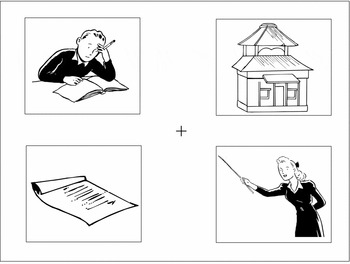
To measure processing, we relied on the visual world methodology of Tanenhaus et al. (Reference Tanenhaus, Spivey-Knowlton, Eberhard and Sedivy1995). While listening to spoken sentences, participants saw a visual display containing images of four objects: an agent, a recipient, a theme, and a distractor. The agent and recipient images were of animate beings; the theme and the distractor images were of inanimate objects. The distractor, which was not mentioned in the sentence, was always implausible as an indirect object of the ditransitive verb. The participants’ eye movements were monitored as the referents were mentioned in the audio stimuli. This technique allows us to time lock each eye movement across the visual scene to a corresponding segment in the auditory input and to investigate the incremental processes through a sensitive, natural, and uninterrupted way (Tanenhaus, Reference Tanenhaus and Gaskell2007).
A sequence of NP-NOM and NP-DAT indicates that an NP-ACC is likely to followFootnote 3 , whereas a sequence of NP-NOM and NP-ACC is likely to be followed by a sentence-final verb (Kamide et al., Reference Kamide, Altmann and Haywood2003). If the information provided by these case-marked NPs can be accessed and used as soon as it is processed, we would expect participants to predict a theme object in the canonical and scrambled conditions, but not in the accusative condition. Therefore, we expected the participants to make anticipatory eye movements toward the theme image (i.e., the image of an exam in Figure 1) after hearing a sequence of NP-NOM and NP-DAT, but not after hearing NP-NOM and NP-ACC. The scrambled condition, shown in (7b), allows us to test whether comprehenders make such anticipations on the basis of a combination of NPs, even when the arguments are scrambled. Specifically, we predicted that the participants would look at the theme in the scrambled conditions as often as in the canonical condition. On the contrary, if the participants did not make predictions using case-marking information, they would initially extract identical information from the sets of case-marked NPs, ignoring the thematic role information given by the case markers. Therefore, there should not be any difference in their eye movements across conditions. Furthermore, we predicted that looks to the theme image would increase over time when the participants started to hear the theme in the spoken input in the ditransitive conditions but not in the accusative condition. In summary, the study was guided by two principal research questions: Do native speakers of Japanese and L2 learners of Japanese show predictive effects of case-marked NPs on the identification of subsequent linguistic items when processing sentences involving the monotransitive and ditransitive constructions? And is the predictive effect present when case-marked NPs are sequenced in a noncanonical order?
An example of a visual scene used in the experiment.

Participants
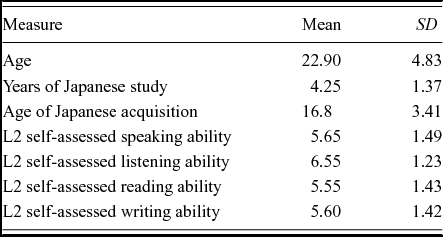
Two groups of participants took part in this study: 33 native speakers of Japanese, who served as native controls, and 27 L2 learners of Japanese with an L1 English background.Footnote 4 They all received monetary compensation for their participation (US$10). The L2 learner participants were undergraduate and graduate students at an American university, and the native speaker participants were also recruited from the university community. The learners were enrolled in or had completed third- and fourth-year Japanese courses. Their exposure to Japanese was primarily through approximately 450–600 hours of formal classroom instruction. The L2 learner participants also filled out a language background questionnaire. Table 1 provides the relevant parts of the questionnaire results from 20 L2 participants whose data points were included in the eye-tracking analysis.
Language background questionnaire data from L2 learners of English.

Note. Reading, writing, listening, and speaking ability were rated on a 10-point scale, where 1 indicates the lowest and 10 indicates the highest level of ability. There were 11 male and 9 female participants.
Materials
Grammar task
For the L2 learner participants, knowledge of case markers was assessed via the use of a paper-and-pencil grammar task. The task used a fill-in-the-gap format and covered, but not limited to case markers that are relevant to the present study. An example sentence is given in (9).
-
(9) シカゴ( )どのくらい日本人( )
いる( )知っていますか
。
Shikago ( ) dono kurai nihonjin ( ) iru ( ) shitteimasuka.
Chicago- case___ how many Japanese people- case___ exist- case___ know-Q.
“Do you know how many Japanese people reside in Chicago?”
This grammar task included 90 items. Of these, 11.1% tested the use of the nominative case marker (-ga); 18.8% tested the use of the accusative case marker (-o); 6.6% tested -ni used as the dative case marker; and 22.2% tested -ni in other usages, such as location, direction, and purpose. Sentences with topicalization and with various word orders were included. We used a dichotomous scoring method, giving one point for each correct response. We used this task to ensure that the L2 learners had sufficient offline knowledge about case markers to process the grammatical constructions under investigation.
Eye-tracking task
We constructed 48 experimental sentences based on the three patterns illustrated in (7a)–(8) with 16 sentences per condition. These sentences were distributed across two lists in such a way that a list contained ditransitive sentences in either the canonical or the scrambled order. The accusative condition sentences were divided and distributed to each list.
The vocabulary items were drawn from the textbooks used in the first- to third-semester Japanese courses at the institution where the study was conducted, in order to ensure lexical familiarity. We also created 16 visual scenes, which could be described by any of the three sentence types described in (7a)–(8). The four types of object image contained two animate referents and two inanimate referents. We created visual scenes using commercially available clip art packages and presented them on the eye-tracking monitor at a resolution of 640 × 480 pixels.
The prerecorded spoken sentences were randomly assigned to two versions of the stimulus set. Each stimulus list comprised 24 items with 8 items per experimental condition, and these experimental sentences were combined with 32 filler sentences. The participants saw 8 of the 56 visual scenes twice. While comprehending these filler sentences, the participants were required to keep track of case markers in order to identify thematic roles. The filler sentences had lengths similar to those of the experimental sentences. The picture scenes and recorded spoken sentences were presented in a random order determined by the stimulus presentation system E-Prime (Schneider, Eschman & Zuccolotto, Reference Schneider, Eschman and Zuccolotto2002). We also counterbalanced the presentational locations of image objects such that each image appeared in each of the four locations across different trials.
A female native speaker with a Tokyo accent recorded each experimental sentence at a comfortable speaking rate, using Audacity and a sampling rate of 44,100 Hz. The sentences were produced using standard intonation. To analyze eye movements with reference to the corresponding spoken sentences, we used Audacity to place markers on the recorded stimuli. We manually marked the onset and offset of the adjective phrase modifying NP2, NP2 itself (in the canonical condition: sensei-ni, “teacher-DAT”; in the scrambled condition: gakusei-ga, “student-NOM”; and in the accusative condition: sensei-o, “teacher-ACC”), the adverbial phrase (shizukani, “quietly”), the theme in the canonical and scrambled conditions, and the verb in the accusative condition in each target sentence. Table 2 shows the mean durations of the tagged words and the mean total duration of the experimental sentences.
Mean duration of sentence regions by condition.

Note. Standard deviations are in parentheses. a Accusative verb.
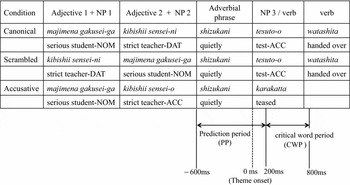
Figure 2 provides a visual demonstration of the periods of interest. The analyses were conducted on the looks to the theme objects when the participants were listening to the adverbial phrase in order to investigate the anticipatory effect. Hereafter, we call this period the prediction period (PP). We set the PP to be 800 ms, which approximately corresponds to the mean duration of the adverbial phrase period, including the mean duration of the intervals between the offset of NP2 and the onset of the adverbial phrase. We then offset the PP by 200 ms in order to take into account the latency in planning and regulating eye movements (Matin, Shao & Boff, Reference Matin, Shao and Boff1993). As a result, the PP was from −600 to 200 ms, with the theme onset at 0 ms. The other period of interest occurred during the auditory presentation of the theme in the canonical and scrambled conditions and during that of the verb in the accusative condition. This period is called the critical word period (CWP). The start of the analysis window was 200 ms after the theme onset, to account for the time to regulate eye movements. The duration of the analysis window was set to 600 ms, which was the average auditory duration of the theme in the canonical and scrambled conditions and the average duration of the verb in the accusative condition. In the CWP, we compared the words by their parts of speech across conditions (i.e., NP-ACC in the canonical and scrambled conditions and accusative verbs in the accusative condition). The precise nature of processing in this period may differ across conditions. However, our intention for the analysis of fixations during the CWP was to examine whether the participants would eventually look at the theme in the canonical and scrambled conditions and to show the time course of change in the proportion of looks to the theme.
The periods of interest tagged in the audio stimuli.

Procedure
The participants’ eye movements were recorded using a Tobii T60 remote eye-tracking system. The eye tracker was connected to a computer that recorded the eye-tracking data and that also controlled the presentation of the experimental stimuli sent from E-prime (Schneider et al., Reference Schneider, Eschman and Zuccolotto2002). The eye tracker's sampling rate was 60 Hz, and the spatial resolution of the tracker was approximately 0.5 degrees visual angle.
The participants performed the eye-tracking task individually. They sat in front of the eye-tracking monitor with a viewing distance of 55–65 cm. The participants’ eye positions were calibrated at the beginning of the experimental session and whenever it was necessary thereafter, using a standard nine-point calibration procedure. The calibration was for visual acuity below 0.5 degrees and was repeated in the course of the experiment if that was necessary.
After the initial physical setup, the participants were instructed to investigate the scene and to determine whether the sentence that they heard could apply to it. At the beginning of each trial, the participants viewed a fixation cross at the center of the screen. The cross disappeared automatically after 2000 ms, and then a trial started. A visual scene with four images appeared on the screen, and a sentence was played simultaneously in which an event including the referents in the images was described (i.e., a visual scene was presented at the onset of the experimental sentence). The visual scene automatically disappeared 2000 ms after the offset of the audio stimulus (i.e., after the offset of the sentence-final verb). Subsequently, a comprehension question appeared. The comprehension questions were targeted at various parts of the sentence but were not limited to thematic role assignment. For example, the participants heard the following sentence presented aurally in Japanese: “At the contest, the demanding director happily gave the actress flowers,” and they looked at a visual scene consisting of a director, an actress, a flower, and a theater stage. The types of questions asked were Did the director give flowers to the actress?, Was it at the contest?, or Did she receive flowers happily? The comprehension questions were asked in English so as not to allow the participants to develop strategies for case markers. No feedback was given. Three practice sentences preceded the experimental items. The session lasted approximately 20 minutes. After completing the eye-tracking experiment, the L2 participants completed the grammar task and then the language history questionnaire.
Results
Offline results
The L2 learners’ performances on the grammar task were tallied, and mean scores were calculated for the 20 L2 participants whose data were included for the eye-tracking analysis after the data trimming. Their relatively high score on this grammar test indicated that the L2 learners possessed good knowledge of the use of case markers (M = 77.85 points (86.5%), SD = 4.38).Footnote 5
We also calculated response accuracy for the comprehension questions, which were asked after each sentence was read in the eye-tracking task. The L2 learner group again demonstrated highly accurate performance on the comprehension questions (M = 89.4%, SD = 5.8), which suggests that they were able to comprehend the sentences given aurally in the eye-tracking session (for the native speaker group, M = 90.7%, SD = 4.7).
Eye-tracking study
Data trimming
We excluded the data from 3 participants whose accuracy rates on the grammar task were below 75% (68 out of 90 items), which was determined by subtracting 2 SDs from the mean. The data from two L2 participants were removed because of recording difficulties. We excluded data from any participants who did not answer the comprehension questions following each sentence in the eye-tracking study with at least 75% accuracy. The data from 2 native speaker participants and 2 L2 learner participants were removed because of their low comprehension accuracy. For each participant, we analyzed only the eye-tracking data of sentences for which they had answered the comprehension questions correctly. This process led to the exclusion of 9.4% of the native speaker data and 10.1% of the L2 learner data. Finally, we excluded experimental trials that did not have any fixations in the region of interest for the target word (Allopenna, Magnuson & Tanenhaus, Reference Allopenna, Magnuson and Tanenhaus1998). This resulted in the exclusion of 5.6% of the native speaker data and 7.3% of the L2 learner participant data. The total percentage of data reduction that all exclusions together let to was 15% for native speakers and 17.4% for L2 learners. The remaining data from 31 native speakers of Japanese and 20 L2 learners of Japanese were submitted to statistical analysis.
Analysis procedure
The analyses were conducted on the participants’ empirical logit of fixation probabilities to the theme, following the transformation procedure discussed in Barr (Reference Barr2008). A logit of 0 means that the participants are equally likely to look at the target as to look elsewhere. A logit value greater than 0 indicates that the participants’ look to the target is more likely to occur than not; a value less than 0 indicates that the look to the target is less likely to occur than not. Logit values are unbounded; therefore, they are more appropriate to be modeled with a normal distribution than fixation probabilities and are preferred for an analysis using linear models (Barr, Reference Barr2008).
We conducted statistical analyses using linear mixed-effects models on the participants’ (logit-transformed) proportions of fixation to the theme compared with that to other objects (Baayen, Reference Baayen2008; Baayen, Davidson & Bates, Reference Baayen, Davidson and Bates2008). These analyses were performed using the lme4 package in the statistical software environment R (Bates, Maechler, Bolker & Walker, Reference Bates, Maechler, Bolker and Walker2014). Linear mixed models have several advantages over repeated-measures ANOVA. One is that the model allows by-item and by-participant variance to be taken into account simultaneously (Baayen, Reference Baayen2008). Another advantage is that the model allows us to analyze the change in fixation probabilities during the analysis period.
This time-dependent model is characterized by the linear equation η = π0 + π1 t, where η represents the estimated log-odds of fixating the target for a given frame and t represents the time relative to the onset of the analysis window (following Barr, Reference Barr2008). The variables π0 and π1 are estimated by the regression analysis; π0 captures any anticipatory effect at the onset of the time window, and π1 captures such an effect modulated by time. Specifically, π1 captures the changes in the anticipatory effect during the periods of interest. For the analysis, we counted the fixations to each object in the visual scene in 100-ms bins, for the overall duration of 800 ms for the PP and 600 ms for the CWP.
Our model for the PP includes fixed effects for the sentence condition and time and includes the maximum random effect structure justified by our design (Barr, Levy, Scheepers & Tily, Reference Barr, Levy, Scheepers and Tily2013). Specifically, the model includes the slopes for time, the sentence condition, and the combination of those two. The accusative condition was treated as a baseline with which the canonical and scrambled conditions were compared. That is, we used a treatment-coding scheme for the predictor variables for the sentence conditions. As for the random effects, we included the by-subject random intercept, as well as the by-subject random slopes for the sentence condition and time. We also included by-item random intercepts, as well as by-item random slope for time. This conforms to the “keep it maximal” approach advocated by Barr and colleagues (Reference Barr, Levy, Scheepers and Tily2013) and avoids a spurious impression of a treatment effect.Footnote 6 Furthermore, we checked whether the model requires by-subject and by-item random slopes for time with a forward-selection approach. The model that included both of these random slopes provided a significantly improved fit over the model containing only the fixed effects and random effects for the sentence condition (native speakers, χ2(2) = 6.07, p = .048; L2 learners, χ2(2) = 17.42, p < .001). For the CWP, we omitted the by-subject and by-item random slopes for time, because these effects were not shown to improve the fit. The resulting model includes the fixed effects for time and sentence condition and the remaining random effects (native speakers, χ2(5) = 71.79, p < .001; L2 learners, χ2(5) = 54.32, p < .001).
Native speaker group
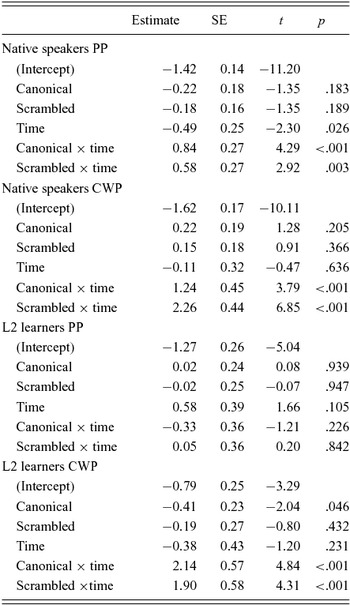
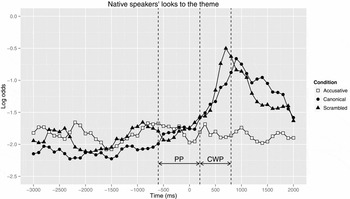
First, we analyzed the native Japanese speaker participants’ looks to the theme during the PP. For the intercept term, we did not observe a significant main effect of the canonical condition (the intercept in the canonical condition compared with the intercept in the accusative condition; estimate = −0.22, SE = 0.18, t(38) = −1.35, p = .183) or that of the scrambled condition (estimate = −0.18, SE = 0.16, t(42) = −1.33, p = .189). These results indicate that there was no difference in looks toward the theme among the sentence condition at the onset of the PP. A summary of the results is shown in Table 3. Figure 3 plots the empirical logits of the native speaker participants’ looks to the theme aggregated by condition in each 100-ms time bin.
Analysis of empirical logits to the theme for the prediction period (PP) and the critical word period (CWP).

The Japanese native speakers’ logit-transformed proportions of fixation to the theme aggregated by condition in each 100-ms time bin for the prediction period (PP) and for the critical word period (CWP).

For the slope term, there was a significant effect of time, suggesting that there was a tendency for the participants to look at the theme progressively less over the course of time in the accusative condition (the baseline; estimate = −0.49, SE = 0.25, t(50) = −2.30, p = .026).
More important, the interaction of the canonical condition and time (estimate = 0.84, SE = 0.27, t(9387) = 4.29, p < .001) and the interaction between the scrambled condition and time (estimate = 0.58, SE = 0.27, t(9157) = 2.92, p = .003) were both significant. That is, the slopes in the canonical condition and the scrambled conditions were higher than the slope in the baseline accusative condition. These results suggest that the Japanese native speaker participants looked progressively more at the theme in the canonical and scrambled conditions over the course of processing during the PP. According to a visual inspection of Figure 3 and the estimated slope values, the rate at which the participants looked at the theme in the accusative condition went in the opposite direction of those in the canonical condition and the scrambled condition. Specifically, the participants looked at the theme 0.35 logits (−0.49 + 0.84) per second more in the canonical condition and 0.09 logits (−0.49 + 0.58) per second more in the scrambled condition, whereas they looked at the theme 0.47 logits per second less in the accusative condition.
In order to examine whether the participants would eventually look more at the theme in the canonical and scrambled conditions than in the accusative condition, we conducted a separate analysis of the time window of the CWP, starting from 200 ms from the onset of the theme over 600 ms using the same model. For the intercept, there was no significant difference between the canonical and accusative conditions (estimate = 0.22, SE = 0.19, t(49) = 1.28, p = .205) or between the scrambled and accusative conditions (estimate = 0.15, SE = 0.18, t(47) = 0.91, p = .366). As for the slope term, the main effect of time was not significant, which suggests that the rate at which the participants looked at the theme in the accusative condition became flat. However, we observed clear effects of time in the canonical condition (estimate = 1.24, SE = 0.45, t(7636) = 3.79, p < .001) and in the scrambled condition (estimate = 2.26, SE = 0.44, t(7636) = 6.85, p < .001). The participants increased their look duration to the theme at the rate of 1.13 logits per second in the canonical condition and 2.15 logits per second in the scrambled condition.
L2 learner group
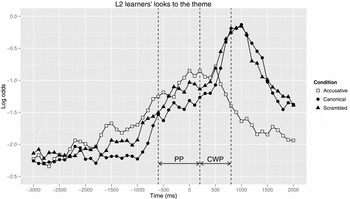
Next, we conducted an analysis based on the logit-transformed proportion of fixation to the theme by the L2 learner group. The results from the L2 learners are summarized in Table 3. Figure 4 plots the logits of the L2 learner participants' looks to the theme. For the intercept, there was no significant difference between the canonical and accusative conditions (estimate = 0.02, SE = 0.24, t(37) = 0.08, p = .939) or between the scrambled condition and the accusative condition (estimate = −0.02, SE = 0.25, t(18) = −0.07, p = .947). Therefore, at the onset of the PP, there was no difference in looks across conditions.
For the slope term, there was no main effect of time (using the accusative condition as the baseline, estimate = 0.58, SE = 0.39, t(40) = 1.66, p = .105). Neither the effect of time in the canonical condition (estimate = −0.33, SE = 0.36, t(6199) = −1.21, p = .226) nor that in the scrambled condition (estimate = 0.05, SE = 0.36, t(6932) = 0.20, p = .842) was significant. The absence of differences in the slope term was the crucial difference between the native speaker group and the L2 learner group. From an inspection of Figure 4, we also see that the L2 learner participants regulated their attention to the theme in the PP regardless of the sentence condition.
The L2 learners’ logit-transformed proportions of fixation to the theme aggregated by condition in each 100-ms time bin for the prediction period (PP) and for the critical word period (CWP).

Next, we conducted an analysis of the time window of the CWP. The analysis reveals that at the onset of the CWP, the L2 learner participants looked at the theme less in the canonical condition than in the accusative condition, but the difference was only marginal (estimate = −0.41, SE = 0.23, t(2865) = −2.04, p = .046). However, as is shown by the slope term, they looked at the theme at a significantly higher rate in both the canonical (estimate = 2.14, SE = 0.57, t(2865) = 4.84, p < .001) and the scrambled (estimate = 1.90, SE = 0.58, t(2863) = 4.31, p < .001) conditions than in the accusative condition as the speech unfolded. These results suggest that the L2 learners did not generate predictions during the PP; and that they looked at the theme more in the ditransive conditions than in the accusative condition only after the target words were mentioned.
Discussion
In the present study, we assessed the role of case-marked preverbal NPs as determinants of predictive processing in Japanese. We investigated whether learners can deploy their knowledge of the Japanese case system for generating predictions of upcoming linguistic items in a manner similar to that of native speakers. We addressed two research questions. First, do native speakers of Japanese and L2 learners of Japanese show predictive effects of case-marked preverbal NPs on the identification of subsequent linguistic items when processing sentences involving the monotransitive and ditransitive constructions? Second, is the anticipatory effect present when these case-marked NPs are sequenced in a noncanonical order?
In line with a previous study on adult native speakers of Japanese (Kamide et al., Reference Kamide, Altmann and Haywood2003), the results showed that native speakers can use case marking predictively. When they were presented a sequence of NP-NOM and NP-DAT, the native speakers used the information posed by the case markers and the semantics of these NPs to predict that the theme would follow. When a sequence of NP-NOM and NP-ACC was presented, the native speakers used the information in the case-marked NPs to predict that no other NP would follow before the verb. The Japanese native speakers looked progressively more at the theme in the canonical and scrambled conditions over the course of processing during the PP. The significant slope effect of time reflects the gradual increase in fixation to the theme, up to and including the CWP.
We also examined whether prediction occurs when preverbal NPs are placed in a noncanonical order. This manipulation focused on examining whether prediction will still arise for noncanonical orders. We found that Japanese native speakers anticipated upcoming linguistic items, even when preverbal NPs were in a noncanonical order. For the native Japanese speakers, the thematic role information in the case markers and the lexical semantics of preverbal NPs were sufficient to eliminate unlikely interpretations. These processing strategies help native speakers commit to real-time structure building in an extremely local fashion. This observation is congruent with the theory of cue-based processing, which claims that the information from the local cues is used optimally for immediate thematic assignments (MacWhinney, Reference MacWhinney and Robinson2001). This is not to say that Japanese scrambling imposes no additional processing cost (Mazuka, Itoh & Kondo, Reference Mazuka, Itoh, Kondo and Nakayama2002; Nakano, Felser & Clahsen, Reference Nakano, Felser and Clahsen2002). However, there may also be prosodic cues facilitating the comprehension of scrambled sentences (Hirotani, Reference Hirotani2007).
Turning to the L2 learner data, the results demonstrated a different processing pattern from that of the Japanese native speakers. If the L2 learners had predicted the theme being mentioned in the audio, we should have expected more fixations to the theme in the canonical and scrambled conditions than in the accusative condition. However, we observed no significant difference in the proportion of fixations to the theme among the experimental conditions. Although the L2 participants demonstrated good knowledge of case markers on the grammar task and a high accuracy rate for the comprehension questions, they did not use such knowledge to systematically generate online predictions for upcoming linguistic items. The absence of an ability to predict upcoming argument assignments seems to be a key difference between L1 and L2 processing for these structures.
The analysis of the PP shows that L2 learners looked at the theme in the accusative condition as often as in the ditransitive conditions. One possible explanation of what may be happening in the accusative condition is that L2 learners’ attention may have been modulated by the visual scenes. From an inspection of Figure 4, we see that the L2 participants started to look at the theme as early as 1000 ms before the PP in the accusative condition. From that point to the midpoint in the CWP, they increasingly looked at the theme in the accusative condition in a manner similar to that in the ditransitive conditions. This pattern of fixation suggests that the L2 participants did not fully use the lexical and syntactic constraints to narrow the scope of reference. Instead, they made erroneous fixations to the theme in the accusative condition, presumably guided by visual information. The presence of the themes in the scenes implies that there is another referent that has not been mentioned yet, and this fact induces the nonnative speakers to consider a ditransitive analysis. Adult processing research indicates that visual contexts can be so salient that they can sometimes override countervailing linguistic evidence that would otherwise guide the parser toward a different interpretation (Spivey, Tanenhaus, Eberhard & Sedivy, Reference Spivey, Tanenhaus, Eberhard and Sedivy2002). Along these same lines, Altmann and Kamide (Reference Altmann and Kamide2007) argued that comprehenders often make overtly detailed predictions, if they are guided by extra visual information when processing sentences in their L1. The pattern of our result from the L2 participants indicated that, in the accusative condition, there was a cue conflict between the linguistic constraints and the visuocontextual evidence; the former guides L2 learners to the accusative analysis, and the latter guides them to the ditransitive analysis by implying that the theme object might be named because of its presence in the scene. L2 learners have knowledge of the case system in Japanese, but their grammatical knowledge may not be readily accessible for generating predictions. It is possible that the salient and reliable nature of the visuocontextual evidence dominates over L2 learners’ rather weak morphosyntactic knowledge.
It is important to compare the results of the present study with those of previous self-paced reading studies in German, which had demonstrated that proficient L2 learners can indeed use case-marking information predictively (Hopp, Reference Hopp2009; Jackson & Dussias, Reference Jackson and Dussias2009). We argue that the nature of prediction generation required in the present study is fundamentally different from that involved in the German studies. For example, when processing the German subject- and object-extracted wh-questions (Who do you think admired the athlete after the game? or Who do you think the athlete admired after the game?) employed in the Jackson and Dussias (Reference Jackson and Dussias2009) study, participants could immediately and unambiguously predict the thematic role of the upcoming NP based on the case marking of the initial wh-word (wer or wen). In this task, the information used for the prediction involves a single unambiguous source, and the outcome of the prediction is dichotomous (i.e., the upcoming NP is either nominative or accusative). However, in the present study, the participants were required to attend to the joint cues of information posed by the first two NPs (NP-NOM, NP-DAT; NP-NOM, NP-ACC), to anticipate a third NP or the possible absence of a third NP. This process involves the anticipation of the thematic role and the lexical semantics of a third NP before the point in the linguistic input at which that assignment is clearly signaled. The nature of prediction required here is more complicated than assigning a thematic role to either a nominative or an accusative NP aided by a single unambiguous cue.
In addition, the period that allows learners to compute prediction was virtually one word (i.e., an adverbial phrase) in the present study, and, therefore, delayed processing decisions inevitably result in the absence of prediction. However, structures, such as wh-questions in German (Hopp, Reference Hopp2006; Jackson & Dussias, Reference Jackson and Dussias2009) and long-distance filler-gap dependencies in English (e.g., Omaki & Schulz, Reference Omaki and Schulz2011, Williams et al., Reference Williams, Möbius and Kim2001) allow learners to have more time to integrate linguistic information, which might compensate for L2 speakers’ slower retrieval and deployment of morphosyntactic cues in online processing. Currently, this interpretation remains speculative; however, in future research, it would be helpful to investigate the nature of predictive processing on the basis of immediacy of the predictive cue used, the types of linguistic outcome predicted, and the length of temporal buffer in generating a prediction in order to distinguish successful cases of predictive processing from cases of nonnativelike processing.
Another important determinant of predictive processing is the effect of proficiency. In previous studies, predictive processing was typically observed among highly proficient L2 speakers or balanced bilinguals with decades of L2 learning (e.g., Hopp, Reference Hopp2009; Jackson & Dussias, Reference Jackson and Dussias2009). However, the L2 learners in the present study were at intermediate level of proficiency and were still in the process of learning. Our learner participants’ average language learning history was much shorter (an average of 4.28 years) than those in previous studies. It is possible that the pattern of results found here may be limited to a particular proficiency level. It would be ideal to further investigate the issue with L2 learners at different levels of proficiency to understand whether differences that we observe when comparing the predictive processing mechanisms of native speakers and those of L2 subside with increasing proficiency. In this regard, studies in which the growth of L2 morphosyntactic processing is examined longitudinally are much needed. We already have a good collection of diverse languages, predicative cues, learner levels, and methodologies, and the present study contributed to this collection. Future studies should investigate whether learners can eventually acquire nativelike real-time processing either through passive natural learning or instructed learning.
Conclusions
We investigated whether L2 learners of Japanese generate predictions regarding syntactic outcomes. We demonstrated that L1 and L2 processing are different with respect to the predictive processing driven by case markers in Japanese. Our results show that, unlike native Japanese speakers, who predict upcoming theme referents in the ditransitive construction, L2 learners of Japanese do not accurately anticipate this referent. The lack of predictive processing suggests that, although L2 learners have knowledge of case morphology, it may not be easily accessible for generating predictions during real-time processing. These results highlight one of the factors that distinguishes native and nonnative morphosyntactic processing.