Introduction
The securitisation approach has been hailed as one of the most sophisticated and productive attempt at reconceptualising security.Footnote 1 The Copenhagen School of security,Footnote 2 best represented by the works of Barry Buzan and Ole Wæver, is argued to have tackled the problem of broadening the security agenda to include non-traditional security threats and referents of security other than the state when analysing security, while maintaining a degree of analytical coherence. By focusing on the ‘speech act’, the securitisation framework attempts to analyse how certain issues are raised to the status of security, by whom and what are the consequences of such moves. Therefore, rather than viewing security as an objective value to be achieved, the analysts view it as a construction of a certain discourse around existential threats and referent objects.Footnote 3 The securitisation framework is innovative and unique in this conceptualisation of security, and has offered useful insights into the practice of security.
The problem arises when the framework is applied outside of the European context within which it has developed. Here, it becomes less capable of producing a comprehensive and empirically consistent security analysis which includes non-traditional security issues. The Copenhagen school remains constrained by the ‘Westphalian straitjacket’ which ‘manifests itself in the assumption that the … Euro-American model of the state and the accompanying political culture is valid globally’.Footnote 4 When analysing security in developing states and regions, these assumptions work to produce a security picture which does not take into account the local socio-political context and security actors other than the state. State-society relations and politics differ significantly in developing countries from their manifestations in developed countries of the West. In particular, despite opening up the security agenda to consider security actors other than the state, the conditionality embedded within the securitisation framework around who can securitise, what constitutes a securitising move, and the need for a sufficient audience to accept the securitising move for a successful securitisation to occur, all effectively work towards limiting the role of securitising actor to the state. The ambiguity around the notion of what or who constitutes a ‘sufficient audience’ is a further impediment to the securitisation approach's analytical capabilities in such contexts.
The Copenhagen School's inherent bias for the role of the state as the securitising actor means it overlooks the role of non-state actors such as NGOs, research organisations and civil society groups as possible securitising actors. The resulting analysis replicates the state security agenda rather than also considering security threats perceived by other actors. The framework also abandons the idea of any objective or ‘real’ security issues ‘out there’, thereby eliminating the possibility of being able to identify a threat which may exist independently outside the securitisation process, posing a real and imminent danger to the survival of a referent group or leading to political violence (for example, a hurricane threatening to destroy coastal communities, or the systematic exclusion of an ethnic minority community from electoral lists respectively). Its reliance on the speech act by an actor with social capital and political authority restricts the consideration of threats which for one reason or another cannot – or are not – being articulated by someone in such a position.
This article analyses the ability of the securitisation framework to consider the role of non-state actors as securitising actors in a developing socio-political context. Following a critical analysis of the framework, it undertakes a case study of three newspapers in Bangladesh – The Daily Star, New Age and The Bangladesh Today – and their attempts to raise ‘misgovernance’ as a threat to Bangladeshi society. Is the securitisation framework able to perceive these attempts as securitising moves, and treat the newspapers in question as valid securitising actors? If so, to what extent can these moves be viewed as successful? In conclusion, the article argues that the securitisation framework is restricted in its outlook when analysing security in socio-political contexts which vary from that of Western democracies. By opening up its framework to consider non-state actors in securitising roles, the Copenhagen school can offer a more comprehensive security analysis, particularly when examining security in such contexts.
The great security debate and the securitisation approach
The debate around the concept of security and what it should mean took centre-stage in IR at the end of the Cold War. The key argument has been that for too long the field has been dominated by a traditional, state and military-centric understanding of security. Consequently, a number of conceptualisations have emerged around the need to ‘broaden’ and ‘deepen’ the meaning of security to include other referent objects (ranging from the individual, communities and societies to the environment and economy) from military as well as non-military threats.Footnote 5
In recent years, the securitisation approach has emerged as one of the most systemic and comprehensive attempts to unpack the logic of security and to reveal its constitutive function. As mentioned earlier, the Copenhagen School is best represented by Buzan and Wæver, who are together the prime developers of the concept of societal security and the securitisation framework.Footnote 6 The Copenhagen School insists that security must be viewed in its dual form, for instance, state security and societal security.Footnote 7 While the former is concerned with sovereignty, the latter is ‘about identity, the self-conception of communities and of individuals identifying themselves as members of a community’.Footnote 8 The authors argue that while ‘[international] security is about survival […] “social security” concerns questions of “entitlement and social justice”’.Footnote 9 Therefore, societal security ‘refers to the level of collective identities and action taken to defend such ‘we identities’.Footnote 10 For the Copenhagen school, threats to societal security are those which threaten society as a collective, rather than ‘threats primarily to individuals (threats in society); only if they threaten the breakdown of society do they become societal security issues’Footnote 11 Embedded within these conceptualisations is the idea that security is ‘not only about survival, it is, as a general rule, about collective survival …’Footnote 12
The securitisation framework developed alongside this notion of societal security. The Copenhagen School proposes that ‘securitisation studies aims to gain an increasingly precise understanding of who securitises, on what issues (threats), for whom … why, with what results, and, not least, under what conditions […]’Footnote 13 The authors adopt a sectoral approach by breaking the analysis down into military, political, economic, societal and environmental sectors. They contend that:
The way to study securitization is to study discourse and political constellations: When does an argument with this particular rhetorical and semiotic structure achieve sufficient effect to make an audience tolerate violations of rules that would otherwise have to be obeyed? If by means of an argument about the priority and urgency of an existential threat the securitizing actor has managed to break free of procedures and rules he and she would otherwise be bound by, we are witnessing a case of securitization.Footnote 14
While the speech act is central to the securitisation framework, its authors clarify that the discursive act of presenting something as an existential threat to a referent object does not in itself constitute a securitisation. This is simply a ‘securitising move’, and actual securitisation requires the acceptanceFootnote 15 of this move, and thereby the status of a threat as existential to a referent object, by an audience. The ‘securitising actor’ is the one who actually carries out the speech act. Although this may be an individual, he or she usually represents a larger collective which ultimately decides on the action which needs to be taken.Footnote 16 The securitisation framework in principle accepts non-state referent objects, though it suggests that ‘middle scale limited collectives’ such as states, nations and civilizations are more open to securitisation.Footnote 17
Key critiques
Before investigating the securitisation framework's ability to perceive securitising moves made by non-state actors in a context such as Bangladesh, it is useful to briefly consider its key critiques. The Copenhagen School has been criticized mainly on its theorizing around the subjectivity versus objectivity of threats,Footnote 18 its treatment of ‘society’ and ‘identity’,Footnote 19 and the concept of audience and the analyst's roleFootnote 20 from within the ‘critical’ group of theorists as well as from traditional security analysts.
Knudsen has pointed out the Copenhagen School only considers threats as fears expressed by actors, ‘or from what happens when the fears of individuals turn to paranoid political action’, thereby abandoning the idea of a real threat existing ‘out there’ in favour of threats as socio-politically constructed entities.Footnote 21 He argues that with this move, the authors eliminate the possibility of being able to identify a threat which may exist independently outside the securitisation process, posing a real and imminent danger to the survival of a referent object.Footnote 22 Balzacq supports this argument, and suggests that ‘language does not construct reality; at best, it shapes our perception of it’.Footnote 23
Gromes and Bonacker point out that the Copenhagen School may respond to this criticism by claiming ‘their approach is about how political units construct and process threats. Whether people try to protect themselves against [a real-world threat] … depends on their perception or non-perception of it’.Footnote 24 It remains however that Knudsen's argument for threats to be considered ‘both in terms of perceptions and in terms of the phenomena which are perceived to be threatening’Footnote 25 is compelling, particularly when it comes to analysing what may constitute a security threat in developing states. Communities living in these countries continue to suffer from existential threats which have been or are being dealt with successfully in developed countries, such as ethnic discrimination, gender-based violence, ill-planned developmental projects and so on.Footnote 26 Moreover, the instance of political violence is extremely high in developing societies, leading often to severe damage to or loss of life and livelihood. It poses a real threat to certain communities, and the exclusion of this phenomenon as a threat restricts the securitisation framework from identifying a key security issue in such a context.
McSweeney has extensively critiqued the Copenhagen school's conceptualisation of society and identity. He argues that the analysts reify the two as objective entities, take for granted the existence of ‘collective identity as a social fact’ and ignore the normative nature of identities.Footnote 27 For him, identity cannot exist independent of discourse, and in order to grapple with identity issues objectively, one must first acknowledge the need to interpret perceptions and claims around identity. Huysmans has also pointed out that defining societal security in terms of identity, ‘risks concretizing identity, radicalizing the issue, and legitimizing violence against migrants’.Footnote 28 Buzan and Wæver have responded that McSweeney's call for the Copenhagen school to be more objective in determining identity claims while criticizing them for being too objective in their approach to collective identity is self-contradictory.Footnote 29 They ultimately defend their approach by arguing that over time social practices can ‘petrify and become relatively constant elements to be reckoned with’.Footnote 30 In the context of this study, the Copenhagen school's view on societal security and identity is key as the investigation focuses on the threat of misgovernance to the security of the people of Bangladesh, that is, Bangladeshi society at large. While the Copenhagen school dislikes the idea of the security of an entire population of a country as societal security,Footnote 31 it nonetheless argues that societal security is about collective identities. It is true that within the wider Bangladeshi society there are many communities or ‘societal units’. However, if these communities share perceptions of a threat to their collective identity as the Bangladeshi people, arising from the failings of the state itself in fulfilling its social contract with its citizens, then the limited definition of what constitutes ‘societal’ especially in relation to identity claims needs to be reconsidered.
The Copenhagen School’s reliance on the speech act has also come under critical scrutiny. Lene Hansen argues that problems of ‘security by silence’ and ‘subsuming security’ bar the framework from considering gender-based threats.Footnote 32 By the first, she means that the securitisation approach’s heavy reliance on the speech act theory presumes that it is possible to speak about a problem. Thus, it automatically overlooks incidences where it is not, and where doing so may actually have the opposite effect of further aggravating the threat in question. ‘Subsuming security’ issues are those which appear ‘when gendered security problems often involve an intimate inter-linkage between the subject’s gendered identity and other aspects of the subject’s identity, for example national and religious’.Footnote 33 In this case, the gendered identity is subsumed by the other identities, and fails to produce ‘the kind of collective, self-contained referent object required by the Copenhagen School, and to the extent that gender is included it is mostly as an individual – and less important – security problem’.Footnote 34
Michael Williams has also critiqued the Copenhagen School's reliance on the speech act as the sole means to securitise.Footnote 35 According to Williams, words, images and actions are all key considerations when analysing security discourses in any socio-political context. He argues that political communication today uses a far wider platform to communicate than is allowed by mere words, and increasingly uses media images to convey key messages.Footnote 36 Moreover, he questions the extent to which focusing on the speech act is helpful in analysing security in countries where not everyone has a voice in terms of representation in politics and society, and where the print medium may not be accessible to all. In the context of developing countries, these issues are particularly relevant.
This investigation focuses on the hurdles the securitisation framework faces in providing a comprehensive picture of security, particularly in developing socio-political settings such as in weak democracies or non-democratic systems of governance. These mainly revolve around the Copenhagen school's understanding of the state and society through a Western lens (which takes for granted freedom of speech and democratic institutions of governance), its lack of consideration of threats existing outside their social construction, its overemphasis on the speech act and an ambiguous approach towards the nature of the audience of a securitising move.
Because Buzan and Wæver do not tackle the nature of security itself, they are unable to make causal linkages between why certain issues raise security concerns as opposed to others, and how they come to be framed as security issues. The Copenhagen school is only interested in analysing how these concerns are raised and framed using certain rhetoric. Therefore, in their framework there is no consideration given to how the socio-political structures within which these practices take place, are created and sustained. The questions which need to be raised here are – why do certain issues raise security concerns, while others do not?Footnote 37 What motivates the actors who raise these concerns? The absence of such questions focuses the analyst's attention on following a pattern of behaviour of those with social capital and political authority, and on explaining how their actions unfold within the given socio-political framework.
Buzan and Wæver's work is implicit in its assumptions that the security analysis revolves around states which are democratic in nature. It assumes that western liberal values which are the hallmark of western states and societies exist unhindered in other parts of the world without considering local socio-political contexts. For example, when writing about how to analyse the practice of security, the authors argue that ‘In a democracy, at some point it must be argued in the public sphere why a situation constitutes security and therefore can legitimately be handled differently’.Footnote 38 As Riefqi Muna argues in the context of securitisation in Indonesia, when applying the securitisation framework analysts need to consider the socio-political environment within which it is taking place, that is, whether the state is democratic or not, as this has an impact on what gets securitised and what does not.Footnote 39 Claire Wilkinson points out that in non-Western countries where freedom of speech is not guaranteed, authoritarian rule presides and political opposition to the regime in power is discouraged and even punished, and yet the securitisation framework overlooks these factors. In such contexts, large sections of the population may not be able to articulate ‘societal security concerns actively (censorship, imprisonment, threats) or passively (political/social disenfranchisement)’ and where existential threat perceptions may be expressed and countered by communities via migration or protest.Footnote 40
The Copenhagen School admits that their analysis of social relations contributes ‘to the reproduction of things are they are … to the taking for granted’ of existing socio-political structures.Footnote 41 Consequently, when applied to developing countries and regions, the analysis produced is a picture of securitisations which may well have been ‘vetted’ by the power that be, and one which may not have any resonance to what some analysts claim are the ‘real situations of urgency’ in these parts of the world today. In developing countries like Bangladesh, the regimes in power often focus their securitisations on threats to their own security rather than societal security. Societies in such countries often lack the freedom of speech and scope for political opposition to the regime in power, which means they are often unable to articulate their fears without endangering their own lives.
The Copenhagen School insists that in order for a successful securitisation to take place, an audience must accept the relevant securitising move. This means a successful securitisation can take place without the actual mobilisation of emergency measures. This logic in the framework is problematic on several counts. Firstly, it places significant emphasis on the speech act of the securitising actor, focusing on what is being said, rather than on what is being done. For example, a state agency or a non-state disaster-relief organisation may argue that the threat of an approaching cyclone is a matter of security for the state or a particular community, yet neither may take any specific measures to provide the referent groups in question the necessary protection from the threat of devastation as a direct consequence of the cyclone. It therefore poses the question – should the study of security not include an analysis of how practices of security are played out in the socio-political realm? As mentioned previously, the Copenhagen School argues that securitisation studies is concerned with ‘who securitizes, on what issues (threats), for whom […] why, with what results, and, not least, under what conditions […]’Footnote 42 However, if it does not go beyond the speech act to consider whether or not the act led to the mobilisation of emergency measures, then this analysis is incomplete as it cannot delve into why a particular securitising move in a given context effectively led to such measures being implemented, while another did not.
Secondly, there is no clear delineation of how the analyst determines whether or not a securitising move has been accepted by an audience in the first place. The authors use the term ‘a sufficient audience’, which by itself is ambiguous.Footnote 43 What are the parameters of ‘sufficient’ here, and how are they to be measured? Moreover, who constitutes this audience? Is it anyone who listens, or is it the group towards which the securitisation is targeted in order to generate a particular response from them? To take this idea further, is it in fact the group which is in control of the emergency measures? This would seem to be a logical assumption, except Buzan and Wæver propose that a securitisation is successful even without the mobilization of emergency measures, as long as it is accepted by a sufficient audience. In such a scenario, where an appeal or a series of appeals is made to treat an issue as an existential threat to a referent group but results in no concrete action in terms of measures adopted to deal with the issue, it becomes very difficult to ascertain whether or not a successful securitisation has occurred. It may be argued here that instead of looking for a formal acceptance by a target audience, the success of a securitising move could be judged by whether it as led to a general cognisance of the threat in question and acceptance of the security discourse around it. It remains however that it would still be equally difficult to establish whether a securitising move has earned cognisance without knowing who the audience in question is, and from what efforts this awareness has come about. It may well be that a community, for example, has accepted discourse around an issue as an existential threat not because of one or a series of securitising moves by one or more securitising actors, but rather based on their own experience of devastation as a consequence of the phenomenon. Moreover, the argument does little to answer the question of security ‘by whom’ and ‘with what results’.
Securitising misgovernance in Bangladesh – can the Copenhagen School perceive securitising moves by non-state actors?
Misgovernance or ‘bad’ governanceFootnote 44 has been at the forefront of the development debate in South Asia in recent decades. The idea of misgovernance relates to, among other things, a breakdown and decay in oversights functions of the government, a weak power-participation interface, lack of institutional capacity, corruption and lack of transparency within government institutions. More recently, it has become a key concern of security analysts in the region and elsewhere.Footnote 45 Their observations and conclusions around misgovernance as a threat to security draw upon the work of a wide variety of actors in the region, from NGOs and civil society groups to political groups, journalists, academics and local communities and societies. It is argued that misgovernance is a threat to a range of referent groups (for example, states, societies, nations, ethnic and gendered communities, as well as individuals) in regions such as South Asia, and manifests itself at all levels (that is, local, national and regional), cutting across state boundaries in its impact.
With an increasing number of voices arguing for misgovernance to be considered as a threat to societal security in Bangladesh,Footnote 46 the question arises – is the securitisation framework able to capture attempts to securitise misgovernance by different actors in Bangladesh? This section explores briefly the meaning of misgovernance and places it in the context of being perceived as a societal threat in Bangladesh. It then analyses whether the securitisation framework can perceive attempts to raise misgovernance as a security issue by The Daily Star, New Age and The Bangladesh Today as securitising moves. It explores whether an expansion of the framework to include non-state actors as security actors and the threat of political violence as a ‘real’ concern, would make the framework more efficient in capturing the security dynamics which exist on the ground.
Contextualising misgovernance in Bangladesh
Given the lack of consensus over a single definition of governance, an ‘ideal type’Footnote 47 model of governance is adopted for the purpose of this analysis.Footnote 48 In the broad South Asian scenario, the ideal type model of governance considers the following issues:Footnote 49
Public institutions through which a government exercises its powers and functions (accountability, legitimacy and transparency)
The authority and functioning of the judiciary
The administrative system and culture
The role of civil society and its relationship with the government
Underlying socio-political dynamics which influence the functioning of the above.
According to Rehman Sobhan, ‘the character of the Bangladesh state is a society which is not so much over or misgoverned but is barely governed at all’.Footnote 50 Since the end of colonial rule in the Indian subcontinent, the country has been struggling with endemic political instability.Footnote 51 Bangladesh gained independence from Pakistan in 1971. With only four years as a young parliamentary democracy, it succumbed to military rule via a coup in 1975, which brought General Ziaur Rahman to power. Thus, principles of democratic governance were cast aside well before they had any real chance of flourishing and becoming entrenched in Bangladesh’s state institutions and agencies, and within its political culture.
Military rule lasted 15 years in Bangladesh, and ended in December 1990 following a mass political campaign backed by the public. The campaign was a manifestation of Bangladeshi society’s anger and resentment of the corrupt military regime, and was characterised by general strikes, public rallies, student protests and a breakdown in the law and order situation in the country.Footnote 52
The turn of events signified the power of the two main political parties of Bangladesh, the Awami League (led by Sheikh Hasina) and the Bangladesh Nationalist Party (BNP, led by Begum Khaleda Zia) who were crucial in spearheading the campaign. By this time however, the culture of corrupt governance and criminal politics had become too far entrenched in Bangladeshi politics, and it is under consecutive regimes led by these two parties in turn since 1990 that Bangladesh fell even deeper into the abyss of misgovernance. The huge mistrust between the two parties and its leaders has led to Parliament being suspended on many occasions as the opposition party staged walkouts. Bangladesh's unique caretaker administration system is a reflection of the deep rifts and levels of mistrust which exist amongst the country's main political parties and towards them within the public. The system, adopted in 1996, allows the incumbent government to hand over power to a non-party caretaker government (CTG) while elections take place.Footnote 53 While the system worked during elections in 1996 and again in 2001, it failed to succeed a third time as Bangladesh succumbed to political upheaval at the heels of violent demonstrations and protests by opposition parties accusing the incumbent government of corruption and demanding reforms for elections due in January 2007.Footnote 54 The army was deployed onto the streets,Footnote 55and the CTG declared a state of emergency in the country.Footnote 56 It was not until almost two years later in December 2008 that the CTG lifted the state of emergency to allow elections to take place at the end of the month.Footnote 57 The verdict was a landslide victory for an alliance led by Hasina, making her the Prime Minister for a second time.Footnote 58 Typical to Bangladeshi electoral politics, the losing alliance led by the BNP's Zia rejected the results immediately, and filed a complaint with the Election Commission accusing the winners of ballot-rigging and forgery at 220 ballot stations.Footnote 59 By early January 2009 however, the opposition had agreed to give the new Hasina administration a chance to govern the country and pledged its support to the government.Footnote 60 It remains to be seen how long this uneasy truce lasts in a deeply divided electorate where corruption and violence have proved to be lasting political legacies.
Key problems of misgovernance in Bangladesh
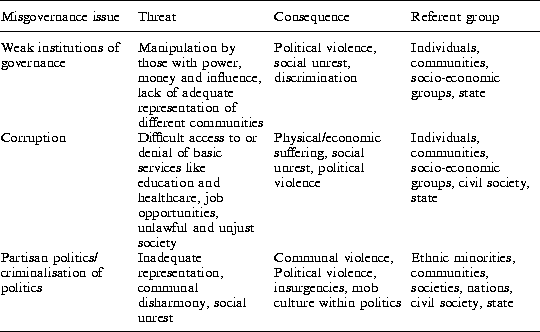
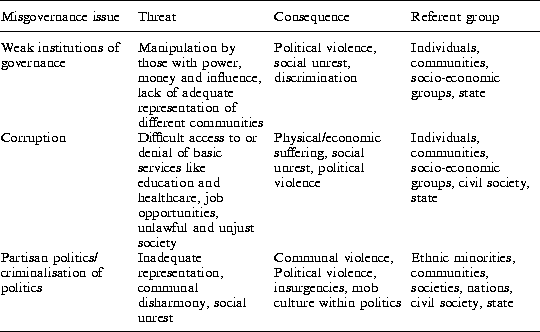
A growing number of voices in Bangladesh and the wider region are now focusing on misgovernance particularly in the form of weak government institutions, corruption and a politicised judiciary as the core causes of insecurity (see Table. 1).Footnote 61 According to Mohsin, Bangladesh today is ‘one of the most violent and polarised societies in South Asia’ as a direct consequence of the state's failure to provide its people with basic services, endemic corruption and ‘appropriation of State resources by the regimes in power and the opposition, weak political institutions, lack of democratic spirit in the party in power and in the Opposition’.Footnote 62
Threats and referent groups in relation to misgovernance
The Islamisation of politics in Bangladesh began soon after the country adopted its constitution after independence in 1972.Footnote 63 ‘A highly nationalist and undemocratic document’, the constitution emphasised ‘Bangali nationalism’ which was premised on the priority of the Bangali language and culture over all others within the borders of the newly-found state.Footnote 64 This was done at the cost of leaving no space whatsoever for other ethnic nations – numbering around 40 groups – which exist within these boundaries, thus laying the ground for institutional ethnic discrimination.
In 1977, General Ziaur Rahman amended the constitution to emphasise and promote the Islamic identity of the majority of Bangladeshis.Footnote 65 He removed the word ‘secularism’ as well as an article which banned communal politics, and inserted Islamic references at the beginning of the constitution.Footnote 66 While this appealed to the Muslim majority, around 85 per cent of the Bangladeshi population,Footnote 67 it effectively made the Bangali Hindus, the Chakmas and other ethnic groups into minorities in the country.Footnote 68 Historically, these ethnic minorities have been widely discriminated against through practices such as prejudiced land laws, lack of representation in Parliament, not being allowed to vote or having their names taken off electoral lists. The insurgency in the Chittagong Hill Tracts (CHT) in the south-west of the country since the 1970s is a key example where such ‘ethnocultural factors [and] … faulty nation-building’ combined with ‘strategies undertaken by past and present governments, and inappropriate development projects’ resulted in a violent crisis.Footnote 69 Although the insurgency ended when a peace treaty was signed between the government and the insurgents in 1997, the local hill people of CHT continue to be largely administered by the army, which is accused of widespread human rights violations. Refugees returning to CHT have been unable to reclaim land which was theirs, and the indigenous people continue to suffer discrimination and physical attacks from the Bangali community which has been systematically settled into the area over the decades.Footnote 70
Despite having around 100 political parties, politics in Bangladesh has been dominated by its two main political parties, the BNP and the Awami League. Over the years, domestic politics became increasingly polarised around the leaders of these parties rather than ideologies, fuelled by the intense contempt and dislike each had for the other.Footnote 71 Forming government soon became a ‘winner takes all’ situation, and as one party would come to power, the other would take its place in opposition with the sole purpose of bringing the government down.Footnote 72 Money and muscle power became increasingly the tools to winning elections, yielding a corrupt and power-obsessed political and governance climate. Consequently, political violence has become a common form not only for those in power to flex their muscles and for the opposition to create trouble for the government, but also for the public to express grievances and demand attention from those who rule.
According to Subhash Kashyap, a key problem of governance in Bangladesh has been ‘the inability to develop sustainable representative institutions that can provide a democratic and yet reasonable stable government’. With every government has come the breaking down of institutions to rebuild them to suit the political needs of the new regime.Footnote 73 Additionally, recurring governments have done little to change the corrupt nature of these institutions as it has provided them with means to further their own interests and agendas. The judiciary in Bangladesh has historically been exceptionally weak and unable to function as a non-partisan institution,Footnote 74 and years of corrupt governance have led to it being highly politicised.Footnote 75
In its 2005 report, German watchdog Transparency International ranked Bangladesh as the world's most corrupt country for the firth consecutive year.Footnote 76 Within Bangladesh, it is widely acknowledged that corruption is rife and ‘its roots lie deep in bureaucratic, business and political institutions’.Footnote 77 Bangladesh receives large amounts of international aid towards development and poverty-eradicating programmes annually. However, 30 per cent of this aid is skimmed off by ‘the country's politicians, bureaucrats, commission agents, consultants and construction contractors … The poor, who are the main target group of the aid, get only 25 per cent of the funds’.Footnote 78 The electoral process in Bangladesh is also riddled with corruption, influenced ‘not by the free will of the people, but by the manipulation of elections through money and muscle’.Footnote 79 Over half the seats in Parliament are occupied by business peopleFootnote 80 in a country where half the population lives below the poverty line, creating a glaring case of lack of representation. Moreover, although ethnic and religious minorities have faced added challenges to the right to cast their votes, those who were critics and opponents of the ruling parties also faced harassment and impediments to exercising their franchise.Footnote 81 While corruption in Bangladesh affects the most vulnerable, that is, those individuals and groups who are poor and do not have adequate political representation in the government,Footnote 82 it is cited as a national problem and is not limited to the individual level.Footnote 83
The Daily Star, New Age and The Bangladesh Today as securitising actors
Despite having suffered from the phenomenon of misgovernance for decades, Bangladesh has had an active media which has flourished over the last few decades. It has been key in offering an outlet for civil society to express its grievances and challenge the state in its actions. It played a significant part in the mass movement of the people and the opposition in 1990 which brought down Bangladesh's last military ruler, General Ershad. Today, it continues to be bold and vigorous in its attempts to create public awareness and act as a forum for important debates around the country’s future.Footnote 84
Before examining the role of The Daily Star, New Age and The Bangladesh Today as securitising actors around the issue of misgovernance, it is important to establish what kind of power a non-state actor such as a newspaper may hold in Bangladeshi society. This is because the securitisation framework argues that a key facilitating condition for a successful securitisation is the ‘social capital of the enunciator … who must be in a position of authority, although this should not be defined as official authority’.Footnote 85
Colin Hay has suggested that power should be understood as both direct and indirect power.Footnote 86 In this formulation, direct power refers to power as ‘conduct-shaping’, which is ‘immediate, visible and behavioural, and is manifest in such practices as physical and psychological coercion, persuasion or blackmail’. Alternatively, indirect power refers to power which is ‘context-shaping’, and where power is ‘mediated by, and instantiated in, structures … Indirect power is evidenced in the capacity of a government, say, to pass legislation’.Footnote 87 Political communication analysts insist it is this form of power which the media can be most identified with.Footnote 88 For newspapers, a key means to influence public opinion is through ‘editorials’ which are projections of their own political identity and perspectives on current affairs. Editorials also ‘[seek] to articulate what the newspaper's editors believe to be the collective voice of its readers’. Thus, ‘newspapers use their power as information disseminators to influence the policy-making environment; to move their readers in certain directions if they can, and to put pressure on decision-makers in government’.Footnote 89
This context is useful in ascertaining the power a newspaper may have in Bangladesh's socio-political setting. The Daily Star, New Age, and The Bangladesh Today are three of the most popular and influential English-language daily newspaper in Bangladesh. According to a number of Bangladeshi journalists, academics and policy analysts both at home and abroad, they are also among the best-informed. The Daily Star's sister publication in Bangla, called Prothom Alo (meaning ‘first light’) is also the number one vernacular daily in the country. The editorials in The Daily Star are therefore considered a useful source of information and analyses with insights into the current socio-political mood in Bangladesh.Footnote 90 Over the last few years, the newspaper has consistently reported on activities in the academic and civil-society spheres around the notion of good governance and human security.Footnote 91 Similarly, New Age and The Bangladesh Today are known as newspapers with their fingers firmly on the pulse of Bangladeshi politics and society, and are reputed as well-informed and influential press.
The ideas embedded within the concepts of misgovernance, state, societal and human security, and the links between them have been underlying themes in editorials published in all these three publications in recent years. Beginning with an examination of recent editorials in The Daily Star, the newspaper's assistant editor Zafar Sobhan has written a series of editorials in the last few years which carry a consistent underlying message of misgovernance (with all its aspects of corruption, a weak judiciary and government institutions, and criminal and violent politics) being a key cause of insecurity for Bangladeshi society.
On 25 February 2005, for example, Sobhan's column ‘Straight Talk’ focused on the socio-political situation in the currently in light of the events of preceding months.Footnote 92 In the editorial, he argues:
[…] we no longer enjoy the most fundamental of freedoms – the freedom from fear. If you cannot even go to campaign in your constituency without fear for your security – if you cannot hold a political rally for fear of death – then where can you go and what kind of politics can you engage in?Footnote 93
Sobhan makes a direct links between recent terrorist attacks in Bangladesh and an unravelling of the democratic process in the country. He suggests that the collapse of ‘meaningful participatory democracy’ in Bangladesh has become a key threat to the security of the Bangladeshi state and society:
To my mind there is no greater threat to both our short and long-term stability and security than that the democratic process seems to be breaking down and that the respect for democracy that has sustained and enriched us for the past decade and a half seems to be in retreat. To my mind this is the prism through which our choices should be viewed.Footnote 94
Thus, Sobhan clearly frames the deteriorating state of governance and democracy in the country as a threat to society as well as the state, as exemplified by the bomb blasts which rocked the country in August 2004.Footnote 95 He cites a lack of freedom from fear as both a cause as well as a fall-out of this breakdown in meaningful participatory democracy in Bangladesh.
More recently, Sobhan wrote an editorial titled ‘Freedom from Fear’ in the same column in The Daily Star.Footnote 96 At the time the article was published, the most recent state of emergency was four months old, and a CTG was in place. The editorial focused specifically on the state of governance in Bangladesh in previous decades and what kind of security Bangladeshis should expect and demand from their government in the coming times. In his own answer to the question, he related:
The security that we will not be killed in cross-fire. The security that we will not be subjected to any extra-judicial punishment. The security that we will not be subject to arbitrary arrest. The security that we will not have to worry about being disappeared … Footnote 97
Here, Sobhan once again implies a direct link between governance institutions and the way they operate and the physical (and psychological) security of the people. He continues further to argue that ‘freedom from fear’ is the most crucial freedoms a society can have. He frames his argument around the importance of freedom from fear not just in terms of fear of physical harm or death from violent conflict, but also in terms of fear from the threat of being persecuted unjustly, from the threat of a corrupt policing institution and from the threat of criminal politics. Sobhan's editorials have evoked strong responses from readers, some of which translated into letters to the editor, while the rest were received in other communications to Sobhan directly and indirectly.Footnote 98
Aspects of misgovernance or the phenomenon itself as a security challenge facing the Bangladeshi state and society also crop up frequently in recent editorials in the New Age.Footnote 99 In a January 2005 editorial, for example, on ‘People's freedoms and development in Bangladesh’, Qazi Kholiquzzaman Ahmad highlights that ‘Governance in Bangladesh remains extremely poor, characterized by pervasive corruption, wastefulness, bureaucratic procrastination, lack of coordination, favouritism, and politically motivated decisions’.Footnote 100 This has led to little or no transparency and accountability, and ‘ … the country is being run by a system which may be best described as ‘democratic autocracy’ or ‘autocratic democracy’… excluding the people at large’. Ahmad concludes by asking ‘how to ensure that freedoms are actually enjoyed by the people of Bangladesh, whose unfreedoms and adversities are overwhelming … ’Footnote 101 While Ahmed does not make an explicit link between security and misgovernance, he indicated that his editorial is inspired by Amartya Sen, co-Chair of the Commission on Human Security, and his linking of human security with freedoms such as freedom from want and freedom from fear.Footnote 102
Another example is ‘Democracy and state security’, an uncredited editorial on 28 January 2007 commenting on a report on human development in South Asia.Footnote 103 The writer argues that in the context of Bangladesh (as in other developing countries), ‘injustice and disempowerment are the cause of conflict as much as its effect’.Footnote 104 The author urges that Bangladeshi society and state need to take the cited report, which points to aspects of misgovernance as key causes of conflict and economic and political instability in South Asian states, as a warning. The editorial insists that in the context of Bangladesh, ‘democracy with its electivity must be restored within the shortest possible time preparatory to making democracy more mature, inclusive and sensitised’. This key task is described as a ‘human need, security need as well’.Footnote 105
Thus, writing only days after a state of emergency was imposed in Bangladesh in January 2007, the author urgently calls for dealing with misgovernance issues such as lack of representation, corruption and criminal politics through a democratic system which is inclusive, representative and corruption-free for the security of Bangladeshi state as well as society.
On the first anniversary of this state of emergency, The Bangladesh Today published an editorial titled ‘Where is the emergency leading us?’Footnote 106 In the article, the writer accuses the interim CTG of plunging the country further into socio-political chaos since its inception. He argues that key elements within Bangladesh society, including the majority of the ‘media, educationists, economists and the common citizenry’ are of the opinion that the CTG has not only failed to deliver a safe and conducive environment for holding free and fair elections, ‘it has in fact aggravated and accelerated the breakdown of our already fragile economic and social systems’. In dramatic language, he creates a link between the CTG's failings and the danger of socio-political tensions in the country exploding into political violence:
We have a deteriorating economy imposing unending hardships on the people, pushing people particularly the poorest section, to the limits of their physical and psychological endurance. As people reach those limits, they will invariably burst out, in frustration and blind anger, in waves of protests suffused with violence and like a bursting dam, they will destroy a state which has not been able to provide them with the minimum requisites for survival as human beings.Footnote 107
Thus, the author warns that unless the CTG improves its performance to provide the Bangladeshi people the level and quality of governance they so desperately require, the country and society at large face the stark threat of political violence erupting on its streets, with the potential to destroy lives and property on a wide scale.
Do editorials in the Daily Star, New Age and The Bangladesh Today fit within the framework laid out for a securitisation by Buzan and Wæver?
From one perspective, the above editorials written by the newspapers' own columnists or assistant editors should be able to fit into the securitisation framework with ease in order to be considered a securitising move. The author of each editorial is an individual, but they are representing a much larger organisation, that is, the newspaper in which their argument was published. While as an individual the writer may not wield enough social and political power at the national level, the newspaper could claim to have a degree of political and social influence, by virtue of the indirect power the media in general holds to influence public opinion and set agendas. In the Bangladeshi context, it is important however to note that adult literacy stands at 43 per cent,Footnote 108 and among the literate, the vast majority are so in the vernacular. The readers of these dailies, therefore, are those who are middle and upper middle class and elites of the country.Footnote 109 However, despite the limited reach of these newspapers as an English-language dailies, the fact remains that they are some of the most important newspapers in the country and readers include the government, the research and analysis community and the NGO sector. Moreover, the fact that Prothom Alo, The Daily Star's sister publication is the number one Bangla daily in the country supports The Daily Star's status as an influential and significant newspaper, read not least by those who are in power, those who wish to be and those in civil society who see it as their voice. Prothom Alo is known to carry reports and editorials which are in the same political and editorial vein as those which are published in The Daily Star. In fact, the former is considered by some to push the governance agenda even more vigorously than its sister publication.Footnote 110
In terms of determining the audience at which the authors of these editorials target their arguments, this is largely implicit in their articles. For example, throughout his editorials cited in The Daily Star, Sobhan makes direct appeals to the citizens of Bangladesh, identifying himself as one of them. He uses terms such as ‘our choices’,Footnote 111 ‘our security and freeing us from fear’, and ‘we […] as a nation’.Footnote 112 Similarly, the writer of the editorial in The Bangladesh Today argues, ‘Now that the entire nation has watched […] we can all get down to the business of surviving as individuals and as a collectivity … ’Footnote 113 In the second New Age editorial, the author urges in the context of the human development report, ‘this is a warning bell for us’. Thus, it can be concluded that he or she, as a member of civil society, is referring to the citizens of Bangladesh.
The problem arises in determining what constitutes a successful securitisation. According to the Copenhagen school:
If by means of an argument about the priority and urgency of an existential threat the securitizing actor has managed to break free of procedures and rules he and she would otherwise be bound by, we are witnessing a case of securitization.Footnote 114
However, in the next breath the authors add that:
The security act is negotiated between the securitizer and the audience – that is internally between the unit – thereby the securitizing agent can obtain permission to override rules that would otherwise bind it.Footnote 115
This raises several questions about the Copenhagen school's conceptualisation of a successful securitisation. First, the authors insist that a securitisation is evident only when by making a relevant argument the securitising actor breaks free of normal rules and procedures and takes extraordinary measures to tackle a threat, although the latter is not a necessary condition. Next, the authors also argue that it is the acceptance of a securitising move by a sufficient audience which allows the securitising agent to break free of normal rules and procedures, thereby creating a successful securitisation. It is unclear whether a securitising actor (that is, one who makes the securitising move) is the same in this context as the securitising agent (that is, the one who ‘does’ security, and has the authority and power to legitimise breaking normal rules and procedures). The idea of both being the same is problematic as in a socio-political context it is usually the ruling authority which holds the power and legitimacy to break normal rules and procedures. This effectively means that only state agencies have the power to make a securitising move. If indeed the above is the case, then an actor such as The Daily Star cannot have the power to securitise, as it is not ultimately the securitising agent in this scenario who can break normal rules and procedures to enforce better governance.
If the securitising agent and securitising actor are in fact two different actors, then presumably the audience reacts to the securitising move made by the securitising actor, which then gives or withholds legitimacy to the securitising agent to break normal rules and procedures. In the case of the cited editorials, there are no concrete means to measure the audience response, except perhaps in terms of the nature of the ‘letters to the editor’ which followed publication. If the need for such a formal acceptance is not necessary, and it is sufficient for the idea of misgovernance as a threat to Bangladeshi people to gain cognisance amongst them, this would not require evidence in terms of such letters but evidence that such a discourse has indeed found roots within society. Nonetheless, it would still be difficult to ascertain what part, if any, these editorials played in created and sustaining such discourse, and how.
In light of the above, it appears that within the securitisation framework as outlined by the Copenhagen school, it is unlikely that The Daily Star, New Age or The Bangladesh Today would be identified as securitising actors, and their attempts to raise the issue of misgovernance as a threat to the security of Bangladeshi society would not appear in the security analysis it produces. In the context of misgovernance, it seems that the securitisation framework allows only the state to potentially qualify as a securitising actor as it is only those with political authority in government who would be able to raise the issue out of ‘normal politics’ and, if necessary, enforce emergency measures to deal with the threat it poses.
Expanding the framework
By recognising the role of non-state actors like NGOs, civil society groups and the media in identifying key threats to the security of different referent groups at the sub-state level, the securitisation framework can break free from its exclusive focus on these security issues favoured by state actors alone. Such a move would enhance the framework’s ability to produce an analysis which reflects a wider, more comprehensive view of security in any given context. The conditionality embedded within the securitisation framework around the need to break normal rules and procedures when making a securitising move is of key impediment to this end.
By expanding the framework to consider securitising moves which do not necessarily include the breaking of normal rules and procedures (if only for the fact that the securitising actor – while carrying the specialist knowledge and evidence in support of an issue posing a threat to a referent group – is not socially and politically powerful enough to do so) the securitisation framework immediately becomes more perceptive to security threats at the sub-state level which are non-traditional in nature, that is, they do not necessarily revolve around the security of state structures but around the insecurities of sub-state referent groups. It may be argued here that such a move would effectively open the floodgates to what is or is not security. However, the counter-argument here would be that in a socio-political context such as in Bangladesh, to rely on this condition of breaking normal rules and procedures for the task alone of getting a threat to be considered as a security issue is untenable. In a situation where only those at the helm of power can take such measures, it systematically restricts those less powerful (in terms of direct power) but equally if not better informed, to influence the allocation of resources to tackle those issues which fundamentally challenge the lives of millions. Therefore, for the securitisation framework to be more insightful in its security analysis when applied to such contexts, it needs to better accommodate non-state actors and their articulations particularly around societal security.
Conclusion
As Huysmans has pointed out, the work of the Copenhagen school evolved in response to the European security problematique, particularly in the post-Cold War years. The collapse of the superpower rivalry was followed by ‘the emergence of a large number of new bilateral and multilateral security institutions … [organised around] systems of rule through which state and non-state actors can organise their common and competing interests in individual, national, regional and global security’.Footnote 116 The practice of security through these institutions relied on a particular security regime, that is, a set of ‘principles, rules, and norms that permit nations to be restrained in their behaviour in the belief that others will reciprocate’.Footnote 117 Consequently, ‘the Copenhagen project has emerged within a typically European security landscape which has given its work an explicitly European flavour … [and] has difficulties in including social challenges to their understanding of the logic to security itself’.Footnote 118
Having been developed in the socio-political context of a strong, democratic state, the securitisation approach inevitably focuses on the securitising moves made by state actors when analysing the security practices in any given political context. In its inherent commitment to the state as the ultimate security actor, it is less accommodating of socio-political contexts where the state is failing as the guarantor of security for its own people and the societies within its borders. In turn, it does not make room for non-actors who may be attempting securitisations or have successfully securitised threats around particular referent groups, particularly in the absence of such action by state actors. The conditionalities embedded within the securitisation framework around who securitises and how, ensure this. Consequently, the analysis by default focuses exclusively on state actors and dismisses non-state actors such as NGOs, civil society groups and the media, and threats which are not these perceived and articulated by state actors.
In a developing, weak democracy such as Bangladesh, the securitisation framework is problematic on two key counts: one, it is unable to recognize the threat of misgovernance as a threat to Bangladeshi society, as it's conceptualisation of ‘societal’ does not consider the population of a country as a referent group for societal security. Here, ‘societal security is about large, self-sustaining identity groups’ and to designate the term ‘societal’ to a state population would be a misunderstanding of its use within the securitisation approach.Footnote 119 Second, it does not capture securitising moves made by actors such as The Daily Star, New Age and The Bangladesh Today who are reflecting public fears and perceptions around the threat of misgovernance and raising the issue as an existential threat to Bangladeshi society. Within the securitisation framework, these actors do not fit the bill as security actors and therefore their securitising moves are not valid. Moreover, since the framework rejects the idea of an objective threats existing outside the securitisation process, unless the threat is articulated by an actor with social capital and political authority, it does not exist. This further excludes from the security analysis issues such as misgovernance which may be perceived as existential threats by non-state actors but for one reason or another cannot – or are not – being articulated by someone in a position of political authority.
How can the securitisation approach be adapted so that it becomes more sensitive to the nuances of security in developing countries where the political ruling elite often have their own security agenda, are in charge of ‘emergency measures’ and can withhold them even in the process of a ‘successful’ securitisation by another securitising actor? The above analysis shows that as it stands, the securitisation framework is limited in its ability to look outside the statist realm of security practices. Because it prefers to focus on the actions of the socially and politically powerful, it automatically excludes a host of actors who sit outside the realm of traditional power but have the insight, data and experience to identify threats which have ‘real world’ consequences for people on the ground and to some extent can speak on their behalf. The exclusion also of the idea of a ‘real’ tangible threat in favour of a constructed discourse around an issue as an existential threat is also problematic when it comes to socio-political contexts where security cannot be spoken. The lack of consideration given to the incidence of political violence is particularly significant in the context of countries such as Bangladesh, as it has been raised by many as a key cause of insecurity in civil society. In order to have a more universal applicability, the Copenhagen School needs to consider these factors seriously and incorporate them into the framework to an extent where the analysis which emerges moves away from being a replication of the state security agenda and closer to how security is perceived by those who are living within state boundaries.