





1. Introduction
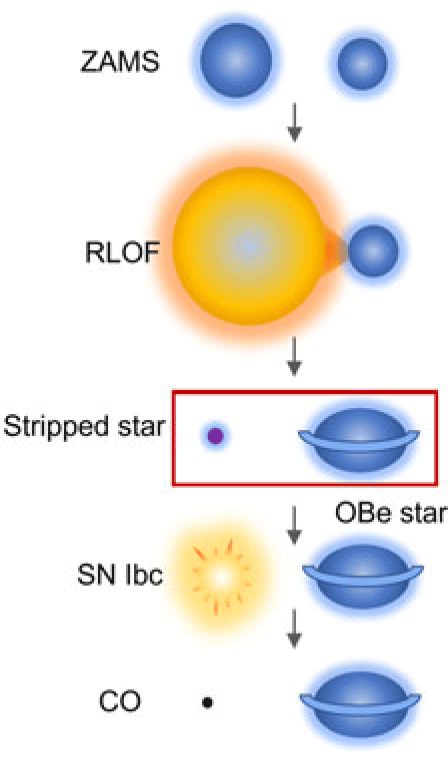
The evolution of massive stars is profoundly influenced by binary interactions. A significant fraction of massive stars exchange mass with a companion, leading to different evolutionary pathways (Sana et al. Reference Sana, de Mink, de Koter, Langer, Evans, Gieles, Gosset, Izzard, Le Bouquin and Schneider2012). One of the outcomes of such interactions is the formation of stripped-envelope stars, where the hydrogen-rich outer layers of a star are transferred to its companion via Roche Lobe overflow (RLOF). This process creates a diverse family of objects, whose final properties are dictated by the initial mass of the donor and the efficiency of the mass transfer (see Figure 1). These objects range from low-mass subdwarfs to massive Wolf-Rayet (WR) stars, which are the progenitors of stripped envelope supernovae.
A schematic illustrating the evolutionary pathway to stripped stars. The initial mass of the primary determines its fate as a subdwarf, a stripped He star, or a Wolf-Rayet star. The mass gainer often spins up to become an Oe/Be star. The stripped star subsequently evolves to a compact object after a stripped-envelope supernova.

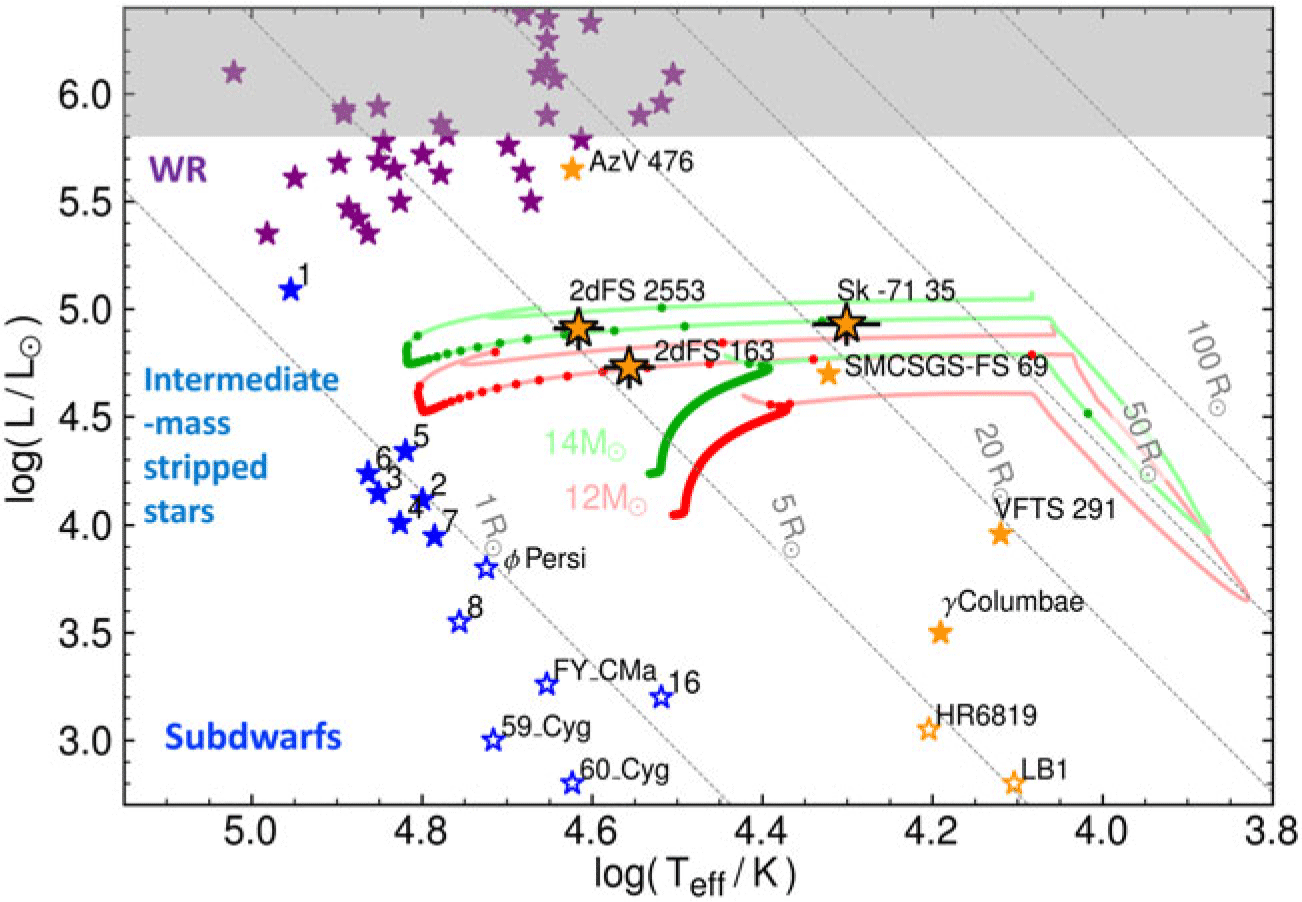
This paper focuses on the intermediate class of stripped stars, specifically partially stripped stars. These are post-mass transfer donors that have been stripped of most, but not all, of their hydrogen envelope. Unlike their fully stripped counterparts (Helium stars), which are typically very hot ( $T_{\mathrm{eff}} \gtrsim 50$ kK) and compact, partially stripped stars retain a residual H-rich envelope. This results in cooler effective temperatures (
 $T_{\mathrm{eff}} \approx 10-40$ kK) and significantly inflated radii (see Figure 2). While this evolutionary phase is relatively short-lived, expected to be only about 10% of the star’s total helium-burning lifetime, their large radii and corresponding high optical brightness make them detectable even when orbiting a massive, luminous companion, such as an Oe or Be star.
Observed stripped stars in the HR diagram. The partially stripped phase (inflated radius, cooler  $T_{\mathrm{eff}}$) is contrasted with the hotter, more compact, fully stripped (He-burning) phase. WRs are marked in purple (Shenar et al. Reference Shenar, Hainich, Todt, Sander, Hamann, Moffat, Eldridge, Pablo, Oskinova and Richardson2016; Shenar et al. Reference Shenar, Sablowski, Hainich, Todt, Moffat, Oskinova, Ramachandran, Sana, Sander, Schnurr, St-Louis, Vanbeveren, Götberg and Hamann2019), and subdwarfs in Be binaries are marked in open blue stars(Schootemeijer et al. Reference Schootemeijer, Götberg, de Mink, Gies and Zapartas2018; Wang et al. Reference Wang, Gies, Peters, Götberg, Chojnowski, Lester and Howell2021). Intermediate-mass He stars in the Magellanic Clouds are marked with filled blue stars (Götberg et al. Reference Götberg, Drout, Ji, Groh, Ludwig, Crowther, Smith, de Koter and de Mink2023). Partially stripped stars are marked with orange stars, with filled symbols representing intermediate mass systems and open symbols representing lower mass systems (Ramachandran et al. Reference Ramachandran, Klencki, Sander, Pauli, Shenar, Oskinova and Hamann2023; Ramachandran et al. Reference Ramachandran, Sander, Pauli, Klencki, Backs, Tramper, Bernini-Peron, Crowther, Hamann, Ignace, Kuiper, Oey, Oskinova, Shenar, Todt, Vink, Wang and Wofford2024; Villaseñor et al. Reference Villaseñor, Lennon, Picco, Shenar, Marchant, Langer, Dufton, Nardini, Evans, Bodensteiner, de Mink, Götberg, Soszyński, Taylor and Sana2023; Irrgang et al. Reference Irrgang, Przybilla and Meynet2022; Bodensteiner et al. Reference Bodensteiner, Shenar, Mahy, Fabry, Marchant, Abdul-Masih, Banyard, Bowman, Dsilva, Frost, Hawcroft, Reggiani and Sana2020; Shenar et al. Reference Shenar, Bodensteiner, Abdul-Masih, Fabry, Mahy, Marchant, Banyard, Bowman, Dsilva, Hawcroft, Reggiani and Sana2020). The evolutionary tracks in the background are adopted from (Ramachandran et al. Reference Ramachandran, Sander, Pauli, Klencki, Backs, Tramper, Bernini-Peron, Crowther, Hamann, Ignace, Kuiper, Oey, Oskinova, Shenar, Todt, Vink, Wang and Wofford2024).

The first observational detections of such objects came from suspected Be-star + black hole (BH) binaries. Systems like LB-1 (Liu et al. Reference Liu, Zhang, Howard, Bai, Lu, Soria, Justham, Li, Zheng, Wang, Belczynski, Casares, Zhang, Yuan, Dong, Lei, Isaacson, Wang, Bai, Shao, Gao, Wang, Niu, Cui, Zheng, Mu, Zhang, Wang, Heger, Qi, Liao, Lattanzi, Gu, Wang, Wu, Shao, Shen, Wang, Bregman, Di Stefano, Liu, Han, Zhang, Wang, Ren, Zhang, Zhang, Wang, Cabrera-Lavers, Corradi, Rebolo, Zhao, Zhao, Chu and Cui2019) and HR 6819 (Rivinius et al. Reference Rivinius, Baade, Hadrava, Heida and Klement2020) were initially thought to host quiescent black holes based on the orbital motion of the visible B-type star. However, subsequent detailed spectroscopic analyses revealed that these systems were, in fact, composed of a rapidly rotating Be-type secondary and a low-mass  $\lt1\,M_{\odot}$, bloated, partially stripped primary (Shenar et al. Reference Shenar, Bodensteiner, Abdul-Masih, Fabry, Mahy, Marchant, Banyard, Bowman, Dsilva, Hawcroft, Reggiani and Sana2020; Irrgang et al. Reference Irrgang, Geier, Kreuzer, Pelisoli and Heber2020; Bodensteiner et al. Reference Bodensteiner, Shenar, Mahy, Fabry, Marchant, Abdul-Masih, Banyard, Bowman, Dsilva, Frost, Hawcroft, Reggiani and Sana2020). These discoveries highlighted a new, important stage in the binary evolution and established this class of objects as “black hole impostors.”
2. Observations and spectroscopic analysis of partially stripped stars in binaries
Identifying and characterizing partially stripped stars is a challenging task that requires a multi-faceted approach, combining multi-epoch, high-resolution spectroscopy across multiple wavelength regimes.
2.1. Observational Signatures
Partially stripped stars in Be binaries exhibit several key observational features in their composite spectra, which arise from both stellar components:
• Broad and narrow components: The spectra are characterized by the presence of both narrow absorption lines, originating from the slowly rotating and often bloated stripped primary, and broad absorption or emission lines from the rapidly rotating Be companion.
-
• Radial Velocity (RV) Variations: Multi-epoch observations reveal anti-correlated RV variations. The narrow lines of the stripped star move in opposition to the broad lines and disk emission features of the Be star, providing proof of binarity.
-
• Chemical Peculiarities: The spectra of the stripped component are distinguished by the presence of strong nitrogen lines and weak or absent carbon and oxygen lines. This is a clear sign of CNO-processed material being exposed on the stellar surface.
-
• Disk Emission: The fast-rotating secondary star often shows prominent disk emission features, particularly in the Balmer series lines (e.g., H
 $\alpha$, H$\beta$) and in infrared.


2.2. Orbital Analysis
Using multi-epoch high-resolution spectra, we can derive RV curves for both components. For e.g., by fitting Gaussians to the associated narrow and broad lines of individual components. This allows for a full orbital solution, providing dynamical mass constraints ( $M \sin^3 i$) for both stars. A common and crucial finding is that the mass-gaining B/Be secondary is significantly more massive than the partially stripped primary donor, confirming that these are post-mass-transfer binary systems (see, e.g., Shenar et al. Reference Shenar, Bodensteiner, Abdul-Masih, Fabry, Mahy, Marchant, Banyard, Bowman, Dsilva, Hawcroft, Reggiani and Sana2020; Bodensteiner et al. Reference Bodensteiner, Shenar, Mahy, Fabry, Marchant, Abdul-Masih, Banyard, Bowman, Dsilva, Frost, Hawcroft, Reggiani and Sana2020; Villaseñor et al. Reference Villaseñor, Lennon, Picco, Shenar, Marchant, Langer, Dufton, Nardini, Evans, Bodensteiner, de Mink, Götberg, Soszyński, Taylor and Sana2023).
2.3. Spectral Analysis
To determine the fundamental stellar parameters of stripped stars, a quantitative spectral analysis using non-LTE stellar atmosphere codes needs to be performed. If several epochs of observations are available, then one can disentangle the composite spectra into the intrinsic spectra of the stellar components. Subsequently, fitting the disentangled spectrum of the individual components would give parameters of both primary and secondary. For e.g., Bodensteiner et al. (Reference Bodensteiner, Shenar, Mahy, Fabry, Marchant, Abdul-Masih, Banyard, Bowman, Dsilva, Frost, Hawcroft, Reggiani and Sana2020); Villaseñor et al. (Reference Villaseñor, Lennon, Picco, Shenar, Marchant, Langer, Dufton, Nardini, Evans, Bodensteiner, de Mink, Götberg, Soszyński, Taylor and Sana2023) used this approach to derive parameters of the cool partially stripped stars using TLUSTY models.
If there are not enough epochs to disentangle the composite spectra, one can instead do a composite spectral analysis. By simultaneously modeling the optical spectra and the full spectral energy distribution (SED) from the UV to the infrared, we can disentangle the contributions of both stars. For eg. (Ramachandran et al. Reference Ramachandran, Klencki, Sander, Pauli, Shenar, Oskinova and Hamann2023; Ramachandran et al. Reference Ramachandran, Sander, Pauli, Klencki, Backs, Tramper, Bernini-Peron, Crowther, Hamann, Ignace, Kuiper, Oey, Oskinova, Shenar, Todt, Vink, Wang and Wofford2024) used this approach to derive parameters of hot and cool partially stripped stars using the Potsdam Wolf-Rayet (PoWR) model atmosphere code. In general, spectral analysis allows us to robustly derive their effective temperatures ( $T_{\mathrm{eff}}$), surface gravities (
 $\log g$), radii (R), luminosities (L), and surface chemical abundances.
3. Physical properties of partially stripped stars
Systematic analyses of a growing sample of partially stripped star systems have revealed their fundamental properties that characterize their evolutionary status.
3.1. Mass-Luminosity Relation
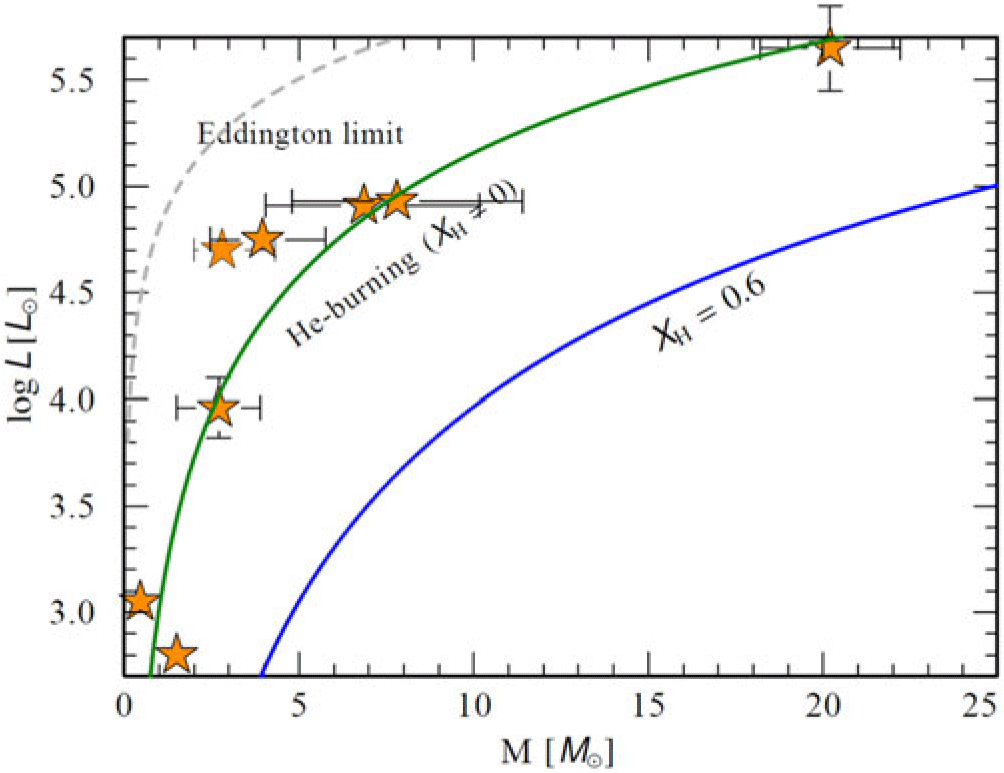
These stars are found to be systematically overluminous for their current dynamical/ spectroscopic mass when compared to normal main-sequence stars. Their position on the mass-luminosity diagram aligns well with theoretical predictions for core-helium burning stars, with an additional luminosity contribution from hydrogen-shell burning in their residual envelope (see Figure 3). This property is a key hallmark of post-mass-transfer objects.
The mass-luminosity relation for partially stripped stars. Partially stripped stars (orange stars) are over-luminous for their current mass compared to the main-sequence relation (60% surface hydrogen, blue curve). They align with the relation for He-burning stars (zero surface hydrogen, green curve). The curves are based on (Gräfener et al. Reference Gräfener, Vink, de Koter and Langer2011).

3.2. Surface Abundances
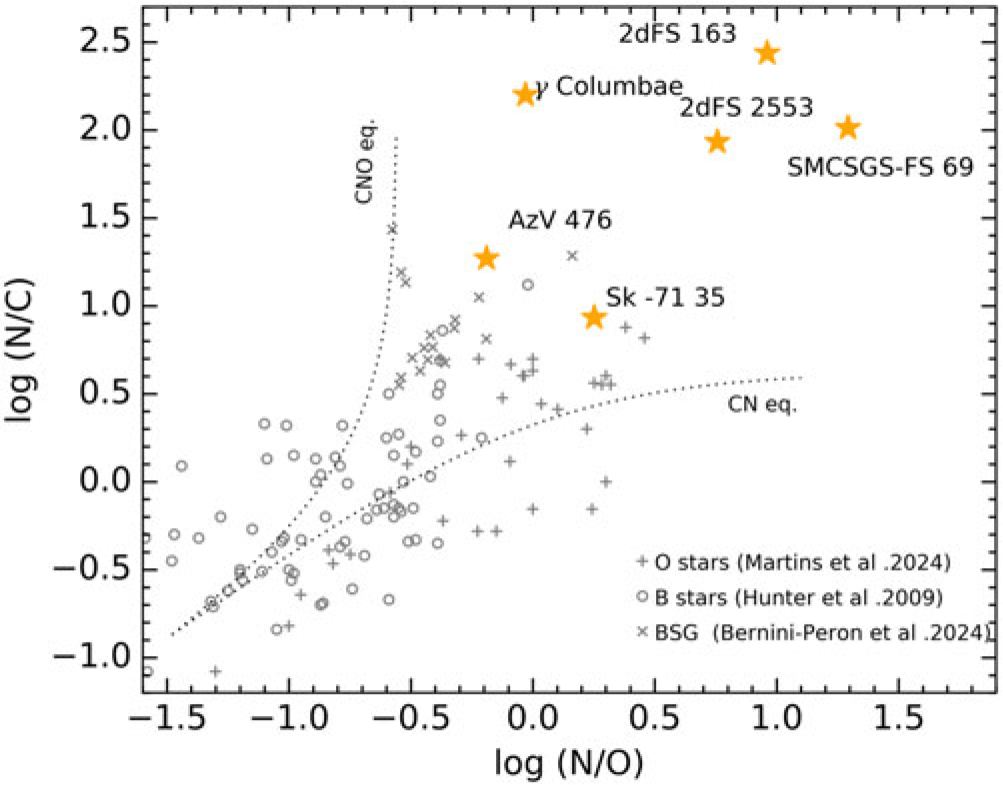
The surfaces of partially stripped stars are found to be heavily enriched with nitrogen and correspondingly depleted in carbon and oxygen (see Figure 4). This is a direct consequence of the RLOF process, which has stripped away the outer envelope layers and exposed the deeper, CNO-processed interior of the star. Some objects also show significant helium enrichment on their surface, indicating a very advanced stage of stripping.
log(N/C) vs. log(N/O) diagram for partially stripped stars. Partially stripped stars (large orange stars) have surface abundances inconsistent with CNO-equilibrium, unlike normal O and B stars (grey points).

3.3. Stellar Winds and Mass Loss
Far-ultraviolet (FUV) spectroscopy is crucial for studying the powerful stellar winds of these objects. X-Shooting ULLYSES (XShootU) campaign offered an opportunity to constrain wind parameters of partially stripped stars using optical and FUV spectra (Ramachandran et al. Reference Ramachandran, Sander, Pauli, Klencki, Backs, Tramper, Bernini-Peron, Crowther, Hamann, Ignace, Kuiper, Oey, Oskinova, Shenar, Todt, Vink, Wang and Wofford2024). FUV spectra reveals strong, classic P-Cygni profiles in resonance lines such as N V  $\lambda 1240$, Si IV
 $\lambda 1400$, and C IV
 $\lambda 1550$. These profiles are unambiguous indicators of strong, fast-flowing stellar winds.
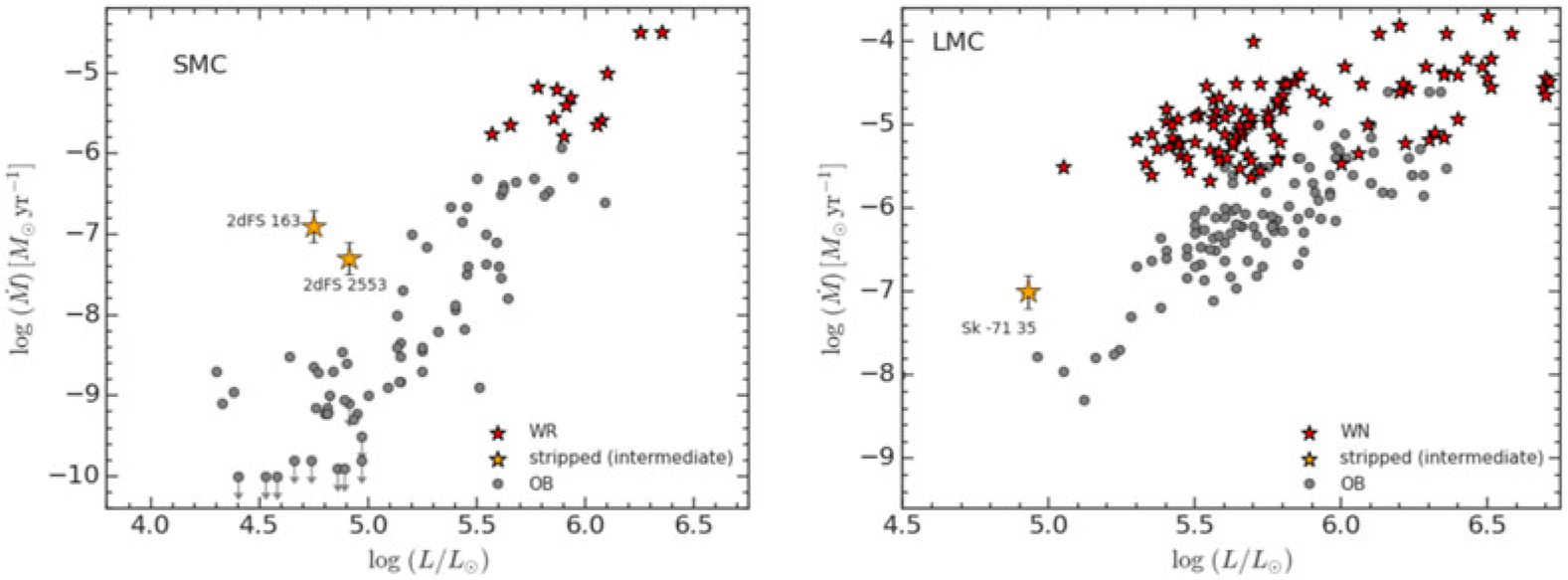
The derived mass-loss rates ( $\dot{M}$) are significantly higher (by orders of magnitude) than those of normal OB stars of similar luminosity 5. When we compare these empirical rates to theoretical mass-loss recipes typically used in stellar evolution codes, we find that commonly used prescriptions drastically under- or overestimate the observed
 $\dot{M}$ (Ramachandran et al. Reference Ramachandran, Sander, Pauli, Klencki, Backs, Tramper, Bernini-Peron, Crowther, Hamann, Ignace, Kuiper, Oey, Oskinova, Shenar, Todt, Vink, Wang and Wofford2024). However, prescriptions developed specifically for stripped stars, such as that of Vink (Reference Vink2017), provide a much better match to the empirical values. This highlights the need to use appropriate mass-loss recipes for these objects in evolutionary models.
Empirical mass-loss rate vs. luminosity relation for stripped stars in the SMC (left) and LMC (right). Wind mass-loss rates of partially stripped stars (large orange stars) are significantly higher than OB stars (grey circles) of the same luminosity and lower than that of WRs (red stars).

4. A hot intermediate-mass stripped star in the Galactic Be binary MWC 656
MWC 656, was identified as the first Galactic Be + BH binary candidate (Casares et al. Reference Casares, Negueruela, Ribó, Ribas, Paredes, Herrero and Simón-Daz2014). However, our re-analysis using high-resolution, multi-epoch optical spectra challenges this interpretation (Muller-Horn, Ramachandran, et al., in prep). Our revised orbital solution yields a companion mass of  $1.1 \lt M_2 \lt 2 \, M_{\odot}$, which strongly disfavors a black hole companion.
Crucial clues to the companion’s nature came from HST/STIS FUV spectra, which show high-ionization lines (e.g., N V, He II) that cannot be produced by the cool Be star alone. A full, simultaneous UV+optical spectral analysis reveals that the companion is, in fact, a very hot ( $T_{\mathrm{eff}} \approx 85$ kK), luminous (
 $\log(L/L_{\odot}) \approx 4.04$), and compact (
 $R \approx 0.5 R_{\odot}$) stripped star. From the UV spectra, we constrained the wind mass-loss rate of the striped star, which is also found to agree with Vink (Reference Vink2017) like partially stripped stars.
MWC 656 is thus another BH impostor, and its discovery demonstrates the unique power of UV spectroscopy in identifying these hidden, hot companions. The discovery of such a hot stripped star in the Milky Way, compared to the somewhat cooler ones found in low-metallicity environments like the Magellanic Clouds, may have important implications for how stripping efficiency depends on metallicity.
5. Summary and Conclusions
The identification of partially stripped stars in Be binaries has opened a new and exciting window into the physics of binary evolution. These objects frequently masquerade as black holes in spectroscopic binaries, and their correct identification requires detailed, multi-wavelength spectroscopic analysis. Recent observational campaigns and spectral analyses revealed their key properties: Although they have similar temperatures to those of OB stars, they are overluminous for their mass, shows CNO-processed material on the surface, and drive powerful stellar winds compared to normal OB stars. The growing sample of such systems provides crucial constraints for binary evolution models, particularly regarding the efficiency of mass transfer and its dependence on metallicity. Looking forward, larger systematic surveys are needed to uncover the full population of these objects, which will in turn refine our understanding of binary evolution, stellar feedback, the formation of binary compact objects, etc.

 Teff

 Open access

