The deposition of nitrogen compounds on the surface of the Earth has increased exponentially over the last century because of human activities, and this increased deposition is now causing environmental problems. One of these problems is nitrogen saturation in forest ecosystems where plants are receiving more nitrogen than they demand. High concentrations of nitrate ions have been detected in river networks around forests (Tietema et al., Reference Tietema, De Boer, Riemer and Verstraten1992; Tabayashi & Yamamuro, Reference Tabayashi and Yamamuro2012; Sase et al., Reference Sase, Takahashi, Matsuda, Yamashita, Tsunogai and Nakagawa2022). Nitrate leaching from farmlands is another serious problem as it is associated with reduced environmental quality and human health (Liu et al., Reference Liu, Wu and Zhang2005; Hansen et al., Reference Hansen, Thorling, Schullehner, Termansen and Dalgaard2017). Excessive agricultural use of nitrogen and dairy fertilizers beyond required plant uptake has led to the elution of nitrate from farmlands, polluting the groundwater and surface water in tropical, humid and temperate regions (Ersahin, Reference Ersahin2001; Burt et al., Reference Burt, Howden, Worrall, Whelan and Bieroza2010).
Adsorption is an environmentally friendly method of water treatment that is more advantageous and used more widely than other methods due to its simplicity of design and application (Donia et al., Reference Donia, Atia, Al-Amrani and El-nahas2009; An et al., Reference An, Zhang, Liu, Zhong, Hu and Shao2021; Mahi et al., Reference Mahi, Khaldi, Belardja, Belmokhtar and Benyoucef2021). Among the several methods that have been employed for the purification of contaminated water, adsorption is a straightforward and inexpensive technique (Garcia-Montano et al., Reference García-Montano, Pérez-Estrada, Oller, Maldonado, Torrades and Peral2008; Nezamzadeh-Ejhieh & Shahriari, Reference Nezamzadeh-Ejhieh and Shahriari2011). Ion-exchange reactions in soils are important for controlling the dynamics of nitrates and dissolved nutrients in agricultural fields. Andosols, which are derived from volcanic ash, are known to have nitrate-retention properties due to their surface charge and variable positive and negative charges depending on the pH and ionic strength of the solution (Wada, Reference Wada, Dixon and Weed1989; Yokobe et al., Reference Yokobe, Hyodo and Tokuchi2020). The presence of particular allophane-like amorphous minerals (semi-crystalline aluminium silicates) in Andosols has been suggested as a factor that could increase the immobilization of nitrates (Tani et al., Reference Tani, Okuten, Koike, Kuramochi and Kondo2002; Anda & Dahlgren, Reference Anda and Dahlgren2020). Therefore, these quasi-amorphous minerals could be useful in many technical fields due to their ion-exchange capacity and adsorption properties stemming from their surface characteristics (Johan et al., Reference Johan, Matsue and Henmi1999; Arai et al., Reference Arai, Sparks and Davis2005; Nishikiori et al., Reference Nishikiori, Kanada, Setiawan, Morita, Teshima and Fujii2015; Deng et al., Reference Deng, Du, Yu, Yuan, Annabi-Bergaya, Liu and Zhou2019).
The purpose of the present study is to develop a highly efficient nitrate adsorbent utilizing synthesized allophane-related materials that have environmentally friendly properties. The study is focused on investigating the nitrate adsorption capacity and the factors affecting nitrate retention in synthesized allophane-related materials with various chemical compositions.
Experimental
Materials and methods
Allophane-related materials were synthesized according to a previously developed method with modifications as follows: 100 mmol L–1 sodium orthosilicate (Na4SiO4, Wako) and 100 mmol L–1 aluminium chloride hexahydrate (AlCl3⋅6H2O, Wako) were prepared as separate starting solutions (Ohashi et al., Reference Ohashi, Wada, Suzuki, Maeda and Tomura2002). Both Si- and Al-source solutions were weighed (atomic ratio of Si/Al = 0.35–0.75), mixed rapidly with the addition of 1 mol L–1 NaOH for pH adjustment and stirred at ambient temperature for 1 h to prepare aluminium silicate precursors. After removing sodium chloride as the by-product by centrifugation, the precursors were autoclaved at 100°C for 48 h. The resulting specimens were washed repeatedly with deionized water and then dried at 40°C. The natural allophane used as a reference material was from Moka, Tochigi, Japan.
Characterization
The identification of the structure of the synthesized materials was performed using powder X-ray diffraction (XRD) with a RINT-2100V/PC diffractometer (Rigaku) using Ni-filtered Cu-Kα radiation at 30 mA and 40 kV. The chemical compositions of the synthesized specimens were determined using energy-dispersive X-ray spectroscopic analysis (EDX) with an EDX-8000 device (Shimadzu). The Brunauer–Emmett–Teller (BET) specific surface area, pore volume and pore-size distribution were determined using the nitrogen adsorption method with a Quadrasorb EVO analyser (Anton Paar). Nitrate adsorption tests were performed in batch experiments using a pseudo-groundwater. The pseudo-contaminated groundwater mixed solution was prepared by mixing 20 mgN L–1 HNO3 and 40 mgCl L–1 HCl. In addition, a 1400 mgN L–1 solution of NaNO3 at pH 2 was prepared. The units ‘mgN L–1’ and ‘mgCl L–1’ indicate the mass of nitrogen and chlorine per litre (JIS K 0102, 2016). Then, 0.2 g of a synthesized sample was added to 50 mL of the mixed solution, and the solution was collected at regular intervals to measure the nitrate concentration. The nitrate concentration was determined using an ultraviolet–visible (UV–Vis) spectrophotometer DPM-MTSP (Kyoritsu Chemical) after reduction and red emission (539, 580 nm) with N-(1-Naphthyl)ethylenediamine dihydrochloride.
Results and discussion
Characterization of materials
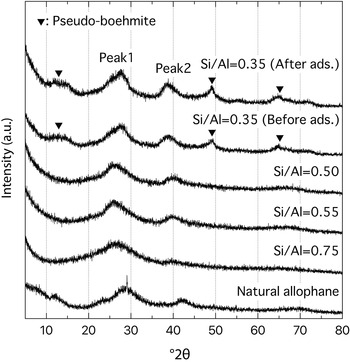
Figure 1 shows the XRD traces of the synthesized allophanes and natural allophane used as a reference. The synthesized specimens showed broad diffraction maxima centred at 0.34 and 0.23 nm. These values are close to the reported d-spacing values for allophane (0.330 and 0.225 nm; Wada & Yoshinaga, Reference Wada and Yoshinaga1969). The peak at 0.34 nm corresponds to interference from adjacent SiO4 tetrahedra (Henmi et al., Reference Henmi, Tange, Minagawa and Yoshinaga1981). The diffraction peak of the silica gel composed of polymerized SiO4 tetrahedra appears at ~0.39 nm. Thus, it is suggested that the synthesized allophanes have a structure that is different from that of silica gel (Henmi, Reference Henmi1987). The diffraction bands of 0.34 and 0.23 nm are also present in the XRD trace of imogolite, and they are assigned to the Miller index values kl = 42 and 63, respectively (Cradwick et al., Reference Cradwick, Farmer, Russell, Masson, Wada and Yoshinaga1972). This suggests that the synthetic specimens have a chemical structure that is similar to that of imogolite locally. Gibbsite and boehmite were not confirmed as by-products in experiments with Si/Al ratios ≥0.50.
XRD traces of the synthesized and the natural allophanes. Peaks 1 and 2 are at 0.34 and 0.23 nm, respectively. ads. = adsorption.
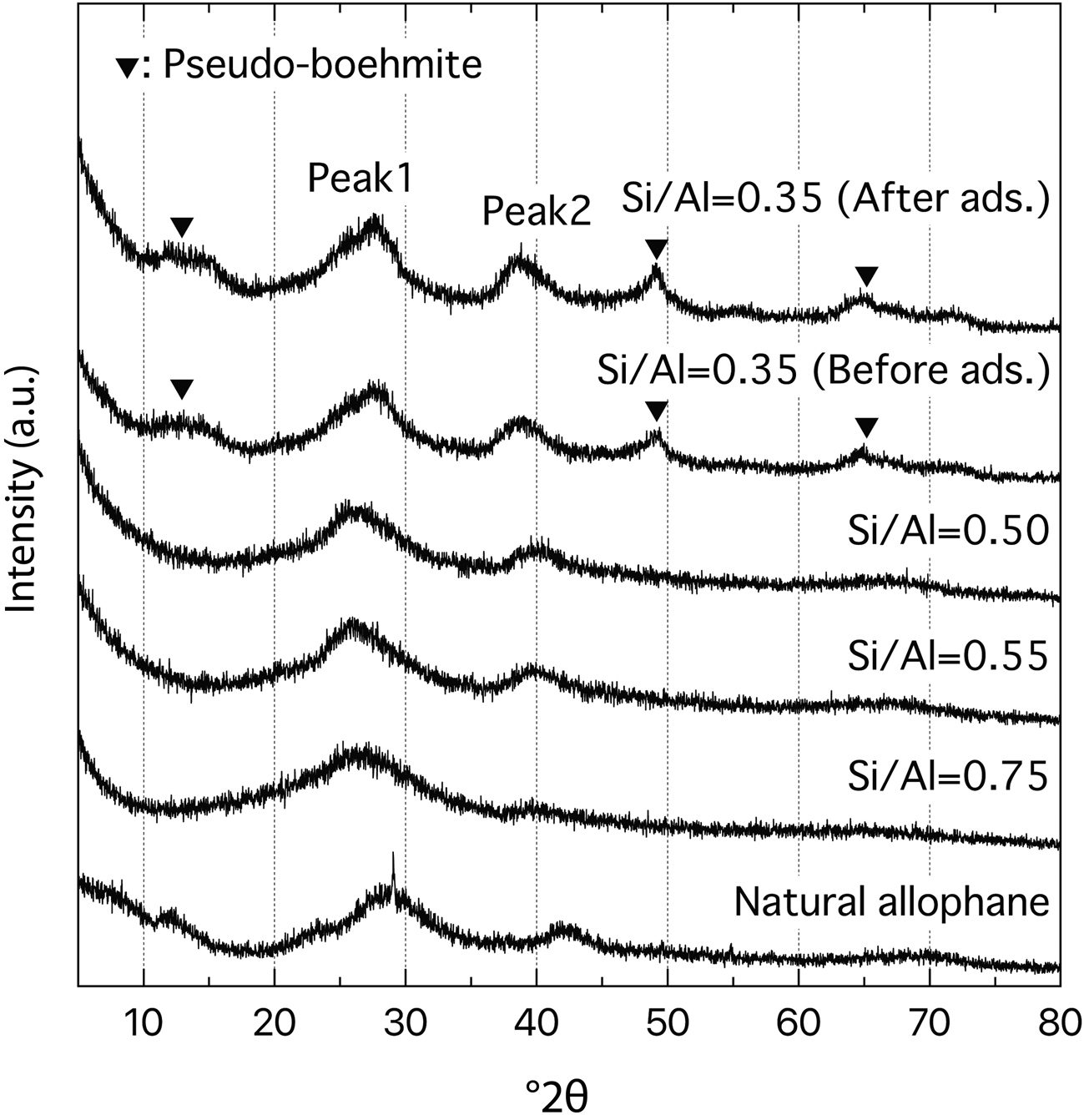
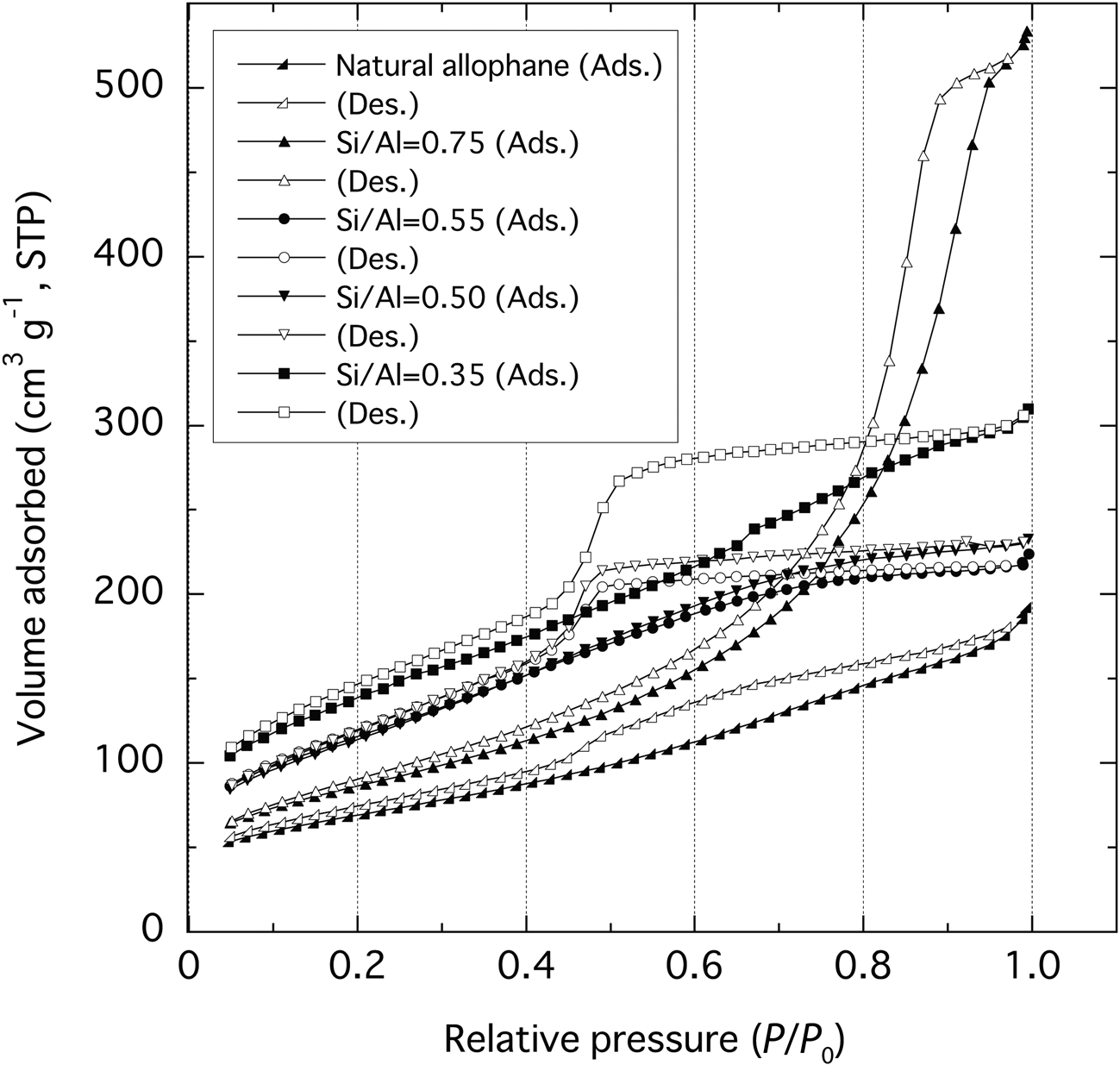
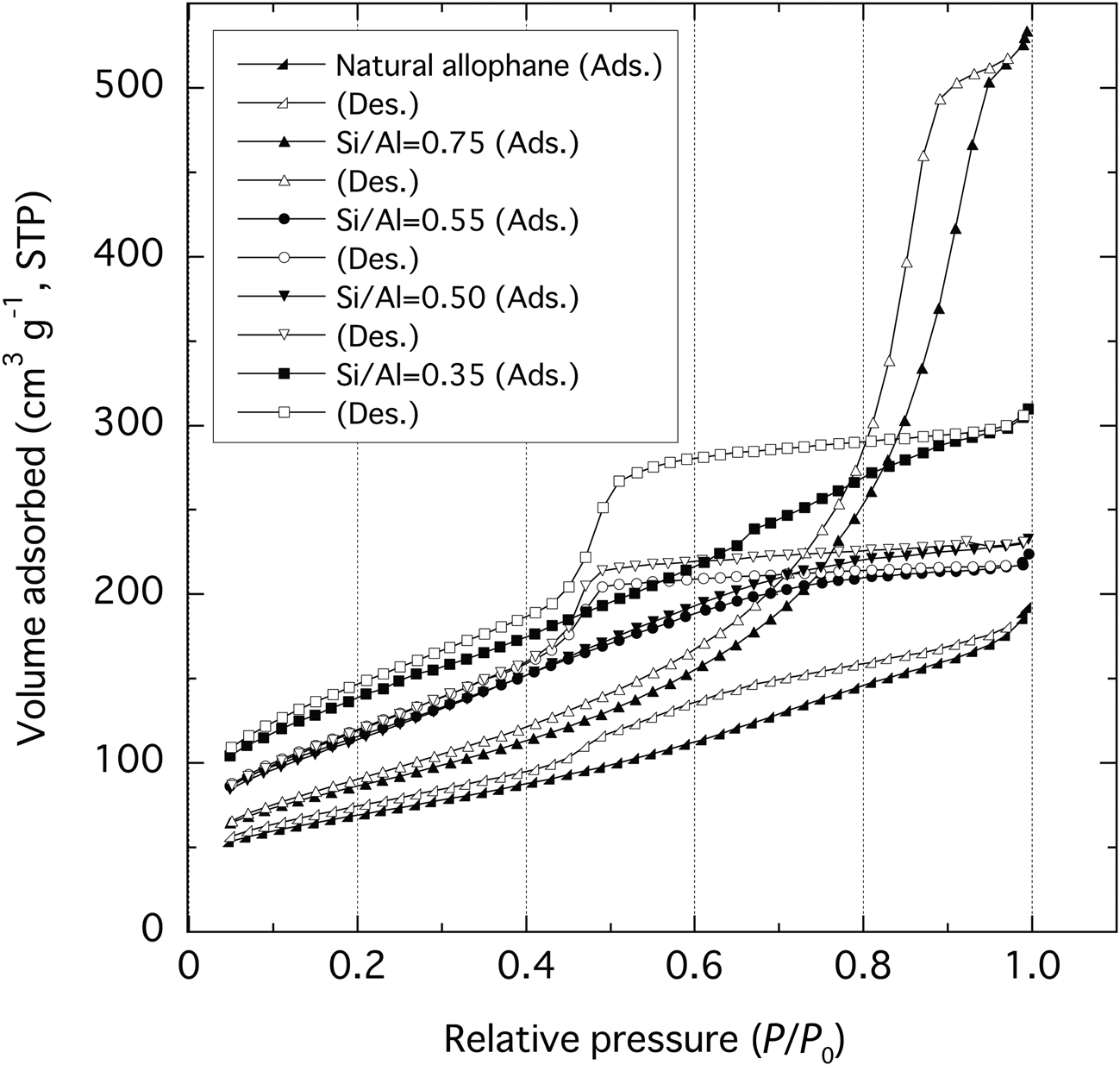
Figure 2 displays the nitrogen adsorption–desorption isotherms obtained at –196°C for the synthesized allophanes and the reference sample. The natural allophane showed a type-II isotherm (International Union of Pure and Applied Chemistry (IUPAC) classification) with a H3 hysteresis loop, while the Si/Al = 0.75 specimen exhibited a type-IV isotherm with a H1 hysteresis loop. This difference in the isotherms is attributed to the aggregation state of the particles and the associated mesopore formation. The H3 hysteresis loop suggests that plate-like particles aggregated and formed slit-shaped pores. The H1 hysteresis loop reflects a fairly uniform arrangement of agglomerates or spherical particles, indicating relatively high pore-size uniformity and facile pore connectivity (Sing et al., Reference Sing, Everett, Haul, Moscou, Pierotti, Rouquerol and Siemieniewska1985, Reference Sing and Williams2004). In contrast, a type-IV isotherm (which is not a typical shape) and a H2 hysteresis loop were observed in the synthesized allophanes with Si/Al ratios <0.55. Many porous materials tend to give H2 hysteresis loops, but in such a system the distributions of pore size and shape are not well-defined. The interpretation of a H2 hysteresis loop is particularly difficult and has been attributed to differences in the mechanisms of the condensation and evaporation processes that occur in pores with narrow necks and wide bodies (often referred to as ‘ink bottle’ pores). However, it is now recognized that this is an oversimplification, and the role of pore-network effect needs to be considered (Sing et al., Reference Sing, Everett, Haul, Moscou, Pierotti, Rouquerol and Siemieniewska1985). Regarding capillary condensation, the existence of cavities as well as the conventional pore-blocking effect have been clarified. Rasmussen et al. (Reference Rasmussen, Vishnyakov, Thommes, Smarsly, Kleitz and Neimark2010) and Monson (Reference Monson2012) have proposed that the condensed liquid in the narrow neck becomes unstable when the neck size is ~5 nm or less (N2 at –196°C), thus generating bubbles in the cage to be desorbed as gas molecules through the neck (i.e. cavitation process). To confirm whether the cause of hysteresis is due to the pore-blocking effect or the cavitation process, it is necessary to measure the adsorption isotherm using two types of gas (nitrogen and argon). In the case of a cavitation process, the desorption pressure depends on the characteristics of the adsorbed gas. Therefore, after changing the gas, the pore-size distribution curve becomes different from that produced due to the pore-blocking effect (Thommes et al., Reference Thommes, Kaneko, Neimark, Olivier, Rodriguez-Reinoso, Rouquerol and Sing2015). From these results, the samples with Si/Al ≤ 0.55 could have a structure with narrow-necked and wide-bodied pores. Therefore, it was necessary to obtain detailed adsorption–desorption isotherm measurements using two different gases.
Nitrogen adsorption–desorption isotherms of the synthesized and natural allophanes. Ads. = adsorption; Des. = desorption; STP = standard temperature and pressure.
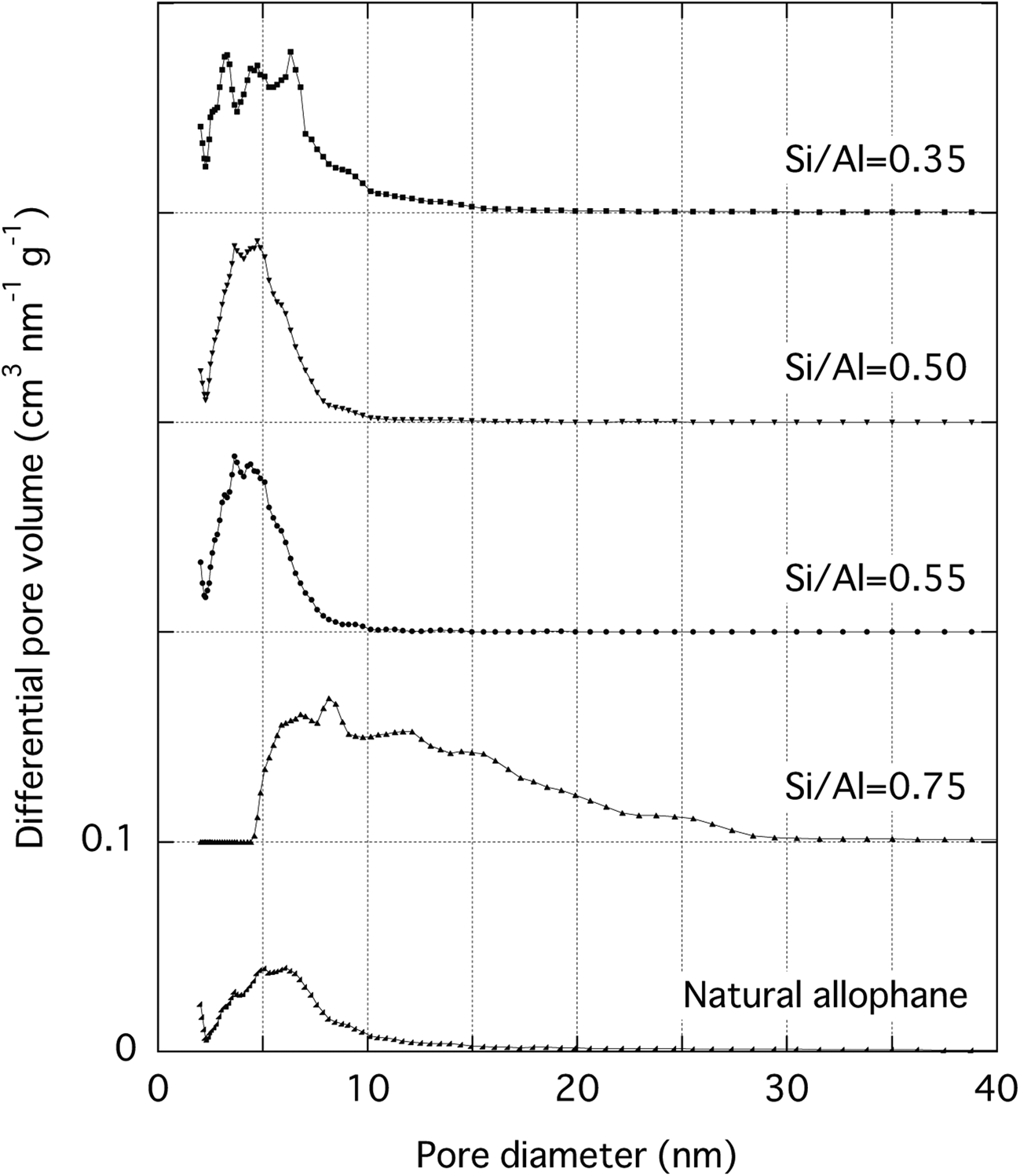
The pore-size distribution curves of the synthesized allophanes and the reference were calculated using the non-local density functional theory method (N2, silica at –196°C; Fig. 3). The curves of three specimens (Si/Al = 0.55, 0.50 and 0.35) are similar and almost overlap when superimposed, showing a large peak at a pore diameter of ~4 nm, which is narrower and sharper than that of the specimen with Si/Al = 0.75. In addition, the differential pore volumes of the three specimens tended to be greater than that of the specimen with Si/Al = 0.75 at this large peak.
Pore-size distribution curves of the synthesized and natural allophanes (non-local density functional theory method, each grid on the y-axis represents the volume from 0 to 0.1 cm3 nm–1 g–1).
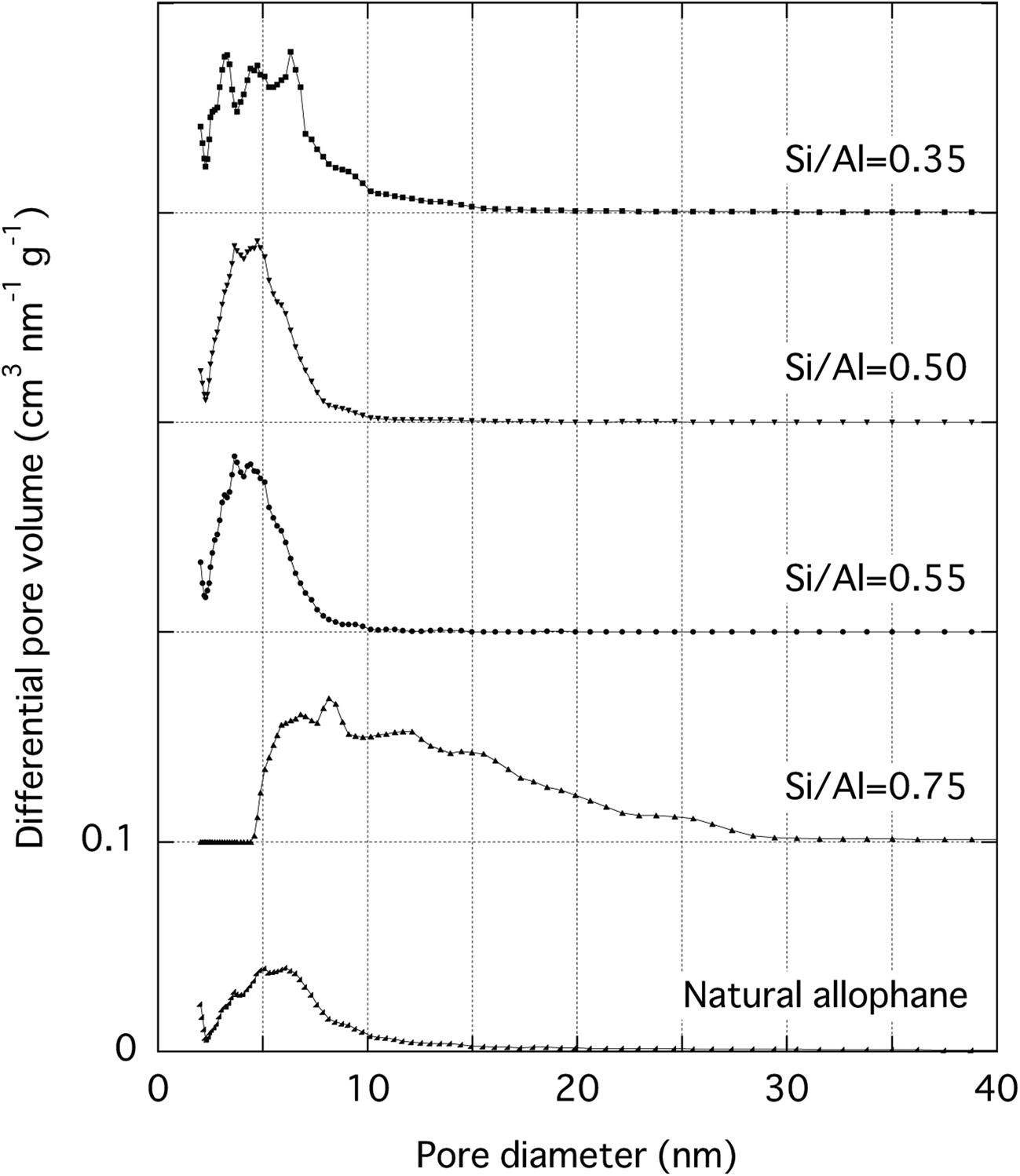
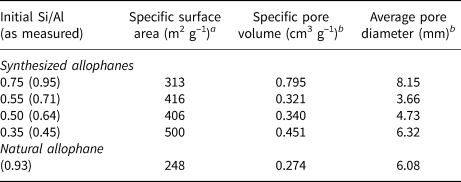
Table 1 shows the characteristic data from the nitrogen adsorption isotherms of the natural and synthesized allophanes. The BET specific surface area tended to increase as the Si/Al ratio decreased. These results indicate that all synthesized allophanes had greater specific surface areas and pore volumes than the natural allophane. Furthermore, changing the chemical composition of the synthesized allophanes could change the aggregation and alignment of the primary particles and affect the pore-size distributions (Du et al., Reference Du, Wang, Yuan, Liu, Liu and Guo2022). The EDX measurements demonstrate that the Si/Al ratio of the obtained synthesized materials was greater than the initial preparation ratio. This is because silicic acid polymerizes easily when the initial concentration of the starting solution exceeds 2 mmol L–1 (Wada et al., Reference Wada, Eto and Wada1979). These differences in Si/Al analysis values of the synthesized allophanes could be further confirmed from X-ray fluorescence and/or inductively coupled plasma-atomic emission spectroscopy measurements (Du et al., Reference Du, Yuan, Liu, Wang, Song and Guo2018, Reference Du, Wang, Yuan, Liu, Liu and Guo2022).
Characteristic data of the synthesized and the natural allophanes.
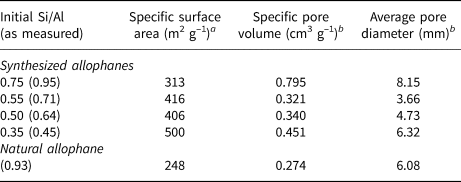
a Calculated using the Brunauer–Emmett–Teller (BET) method (0.05 < P/P 0 < 0.35).
b Non-local density functional theory method adsorption.
Nitrate adsorption properties
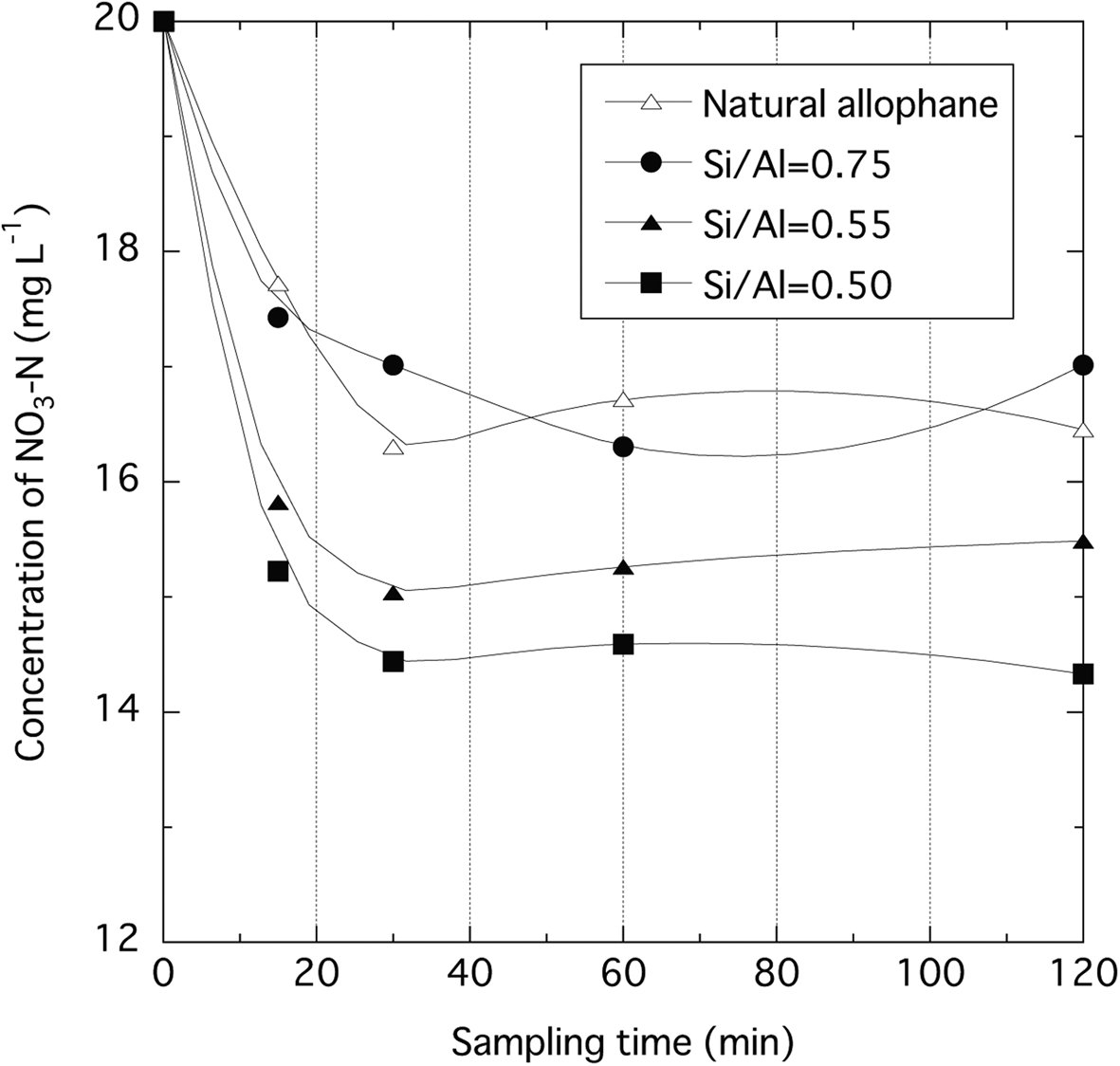
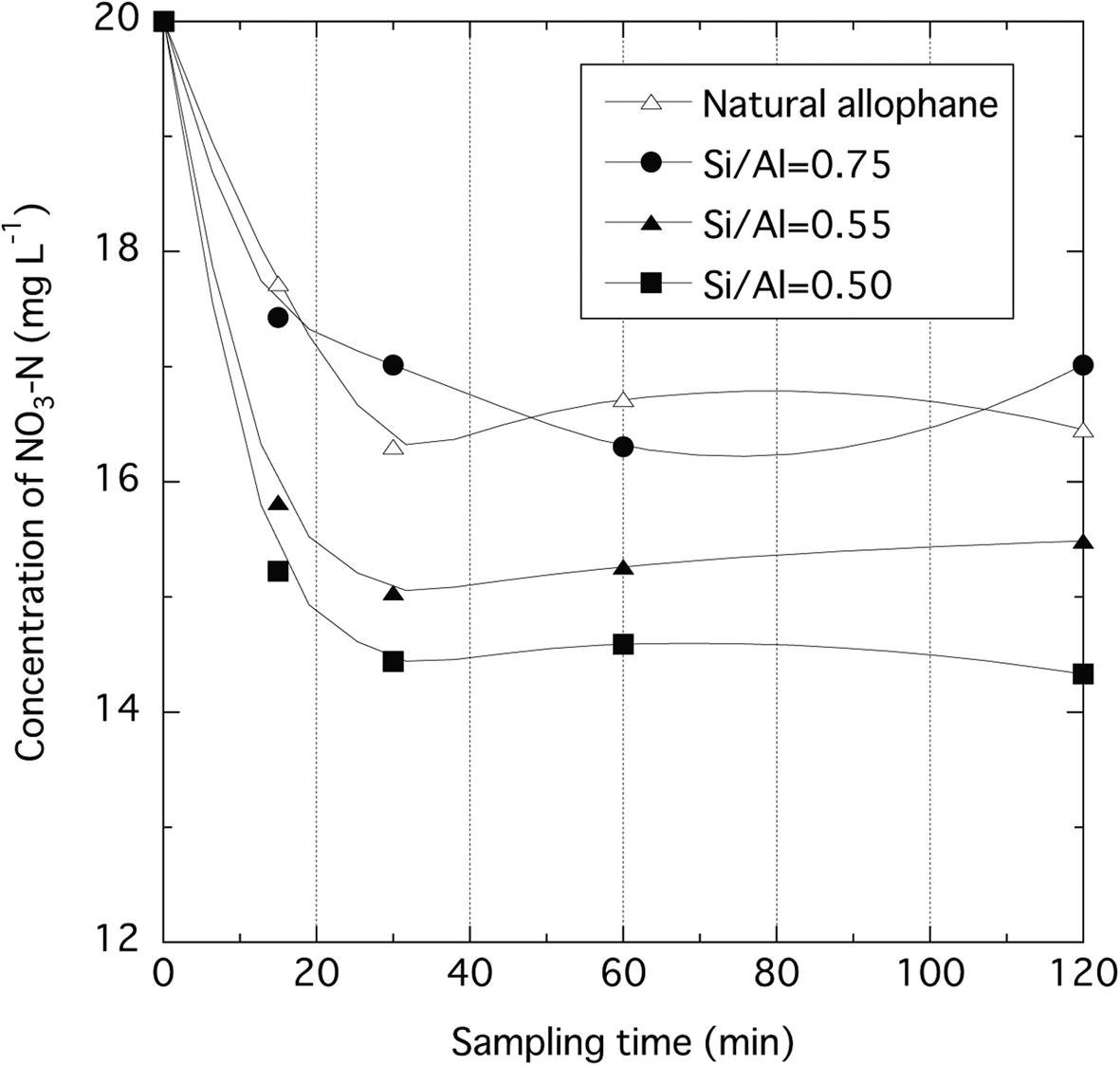
Figure 4 shows the results of the nitrate adsorption test of each sample using the simulated groundwater. The nitrate adsorption of the sample with Si/Al = 0.75 showed behaviour similar to that of the natural allophane. In addition, as the Si/Al ratio of the specimens decreased, the amount of adsorbed nitrate tended to increase. For both Si/Al = 0.55 and Si/Al = 0.50 specimens, the nitrate adsorption was maximized after 30 min. The allophane-like minerals with a naturally occurring imogolite structure have a Si/Al ratio of ~0.5–1.0 (Henmi & Wada, Reference Henmi and Wada1976). Based on these results, experiments were performed to synthesize a material with a lower Si/Al ratio, with the aim of improving NO3– adsorption performance. Therefore, a sample with a Si/Al ratio of 0.35 was synthesized using the same method as described above, which contained a small amount of pseudo-boehmite. An additional experiment was conducted using this specimen. The XRD trace of this specimen is shown in Fig. 1. The nitrogen adsorption isotherms, the pore-size distribution curve and the characteristic data are displayed in Figs 2 & 3 & Table 1, respectively. Although a small amount of pseudo-boehmite formation was detected using XRD analysis, the specific surface area and pore volume showed excellent values of 500 m2 g–1 and 0.451 cm3 g–1, respectively. According to the EDX measurement, the Si/Al ratio was 0.45.
Nitrate-adsorption properties of the synthesized and natural allophanes.
The amount of nitrate adsorbed by allophane-rich soils increases significantly when the concentration of nitrate in the aqueous phase increases (Padilla et al., Reference Padilla, Matsue and Henmi2002); hence, this sample was used in a nitrate adsorption test using a highly concentrated nitrate solution. The adsorption test was carried out for 24 h using 1400 mgN L–1 NaNO3 solution adjusted to pH 2. Even in a highly concentrated environment, this specimen adsorbed 2.07 mmol g–1 nitrate, which exceeded the adsorbed amount of a layered double hydroxide (LDH) of 1.72 mmol g–1 (Kamimoto et al., Reference Kamimoto, Okamoto, Hagio, Yong-Jun, Deevanhxay and Ichino2019). In addition, the XRD analysis was performed after the abovementioned nitrate adsorption to evaluate the structural stability of the synthesized allophane (Si/Al = 0.35). The XRD trace after the adsorption indicated that the diffraction maxima attributed to allophane and those of pseudo-boehmite remained unaffected (Fig. 1). As a result, it was clarified that the synthesized allophane exhibited resistance to acids because its structure was maintained even after being immersed in an acidic solution. It has been reported that measurement using a solid-state magic angle spinning nuclear magnetic resonance (MAS NMR) is appropriate for verifying the structural stability of allophanes (Wang et al., Reference Wang, Du, Yuan, Liu, Song, Zhou, Deng and Liu2020). This is an issue to be investigated in the future to confirm the structural modifications of the synthesized allophanes before and after nitrate adsorption.
In a report on the removal of Zn(II) by nano-lignocellulose Mg–Al silicate polymer gels, adsorption mechanisms were investigated and adsorption kinetics and isothermal modelling analysis were performed to achieve the optimal adsorption of Zn(II) (An et al., Reference An, Zhang, Liu, Zhong, Hu and Shao2021). The presence of hydroxyl and carboxyl groups at the activated sites on the surface of the polymer gel revealed that they formed new chemical bonds with Zn(II). The main adsorption process was chemisorption, although ion exchange and electrostatic attraction could also occur during the adsorption (An et al., Reference An, Zhang, Liu, Zhong, Hu and Shao2021). Regarding the superior nitrate adsorption characteristics and the mechanism of the synthesized allophane, it is considered that the cation- and anion-exchange capacities of soil allophane depend on the pH of the solution, which is interpreted as the development of negative and positive charges resulting from the dissociation and uptake of H+ through the edge OH groups bonded to Si and Al (Wada, Reference Wada1967).
Recently, the removal of Orange-G (OG) dye by hybrid adsorbents (polyaniline reinforced Opuntia Ficus Indica activated with NaOH) has been reported as a method for removing toxic compounds from aqueous solutions. The adsorption of OG is dependent on adsorption time, solution pH and initial concentration of OG (Mahi et al., Reference Mahi, Khaldi, Belardja, Belmokhtar and Benyoucef2021). It follows that when the pH of the solution is lowered below of the isoelectric point of allophane or imogolite, the Al-OH on the surface of the synthetic specimen with an imogolite-like structure changes to Al-OH2+, which increases the adsorbed amount of NO3– (Horikawa, Reference Horikawa1975; Harsh et al., Reference Harsh, Traina, Boyle and Yang1992). In general, the formation of pseudo-boehmite is carried out by dehydration of amorphous aluminium hydroxide through condensation and polymerization, in which water is released from a highly hydrated gel. The formation of crystalline aluminium hydroxides by dissolution and precipitation from amorphous compounds under hydrothermal conditions suggests less energy consumption during crystallization due to the absence of long-range order in the arrangement of atoms of the amorphous phase (Mukhamed'yarova et al., Reference Mukhamed'yarova, Gareev, Nurgaliev, Aliev and Vakhin2021). It is suggested that the pseudo-boehmite, in whose crystal structure Al-OH2+ is present, may have been deposited on the surface of the synthesized allophane domains (primary floccules) and may have contributed to the increased nitrate adsorption (Kloprogge et al., Reference Kloprogge, Duong, Wood and Frost2006). Natural allophane does not exist as single-unit particles even in dilute dispersion, except as domains with a size of several hundred nanometres because of strong interactions between the unit particles (Karube, Reference Karube1982; Karube et al., Reference Karube, Nakaishi, Sugimoto and Fujihira1996). The synthesized allophane is composed of a basic unit of single-unit particles, forming aggregate domains in the submicron to micron range. Therefore, it is possible to suggest that the pseudo-boehmite was deposited on the surface of these domains.
This mechanism also enables the recovery of the NO3– on the surface of the adsorbent simply by washing the adsorbing medium with a solution of greater pH. Utilizing this process, NO3– recovery can be achieved using less energy than the recovery of anion-exchange materials such as LDH. As for the formation of pseudo-boehmite in the synthesized sample, the effect of this on the surface properties has not been clarified; thus, further investigation is required. Although additional experiments are necessary to elucidate the detailed adsorption mechanism, it has become clear that the effective use of Al-OH on an imogolite-like surface has the potential to produce a new material with adsorption properties that are different from those of existing ion-exchange materials. It is suggested that this study makes it possible to design a new type of anion adsorbent with surface hydroxyl groups as active sites, which is different from anion-exchange materials such as LDH. The above results suggest the possibility of developing a new material with advantageous properties in the future. Allophane with a controlled composition may be applied advantageously to nitrogen recycling and environmental purification as an environmentally friendly material.
Conclusions
Allophane-type aluminium silicates with various chemical compositions were synthesized using a hydrothermal technique in inorganic solutions. The synthesized allophanes showed broad XRD peaks characteristic of amorphous materials and had a partially imogolite-like structure. Elemental analysis and nitrogen adsorption measurements indicated that the specific surface area and the pore volume tended to increase with increasing Al content of the synthesized allophanes. The increase in the Al content of the synthesized allophanes resulted in increased nitrate adsorption. By controlling the Si/Al ratio precisely, it was possible to synthesize a material that exceeded the NO3– adsorption capacity of LDHs. This adsorption is attributed to the charge properties of the aluminium silicate surface at low pH values below the isoelectric point: the weak interaction of NO3– with the positively charged Al-OH2+ active sites on the surface.
Conflict of interest
The author declares no potential conflicts of interest with respect to the research, authorship and publication of this article.