Surgical site infection (SSI) is a global problem associated with increased mortality, hospital length of stay, hospital readmissions, and costs.Reference Kirkland, Briggs, Trivette, Wilkinson and Sexton1–Reference Graf, Ott and Vonberg5 In the United States, SSIs added >1 million patient days and $1.6 billion in costs in 2005.Reference de Lissovoy, Fraeman, Hutchins, Murphy, Song and Vaughn6 In Europe, between 2013 and 2014, SSIs varied by surgical procedure from 0.6% to 9.5% per 100 procedures.7 In low- and middle-income countries (LMICs), SSIs are the most frequent healthcare-associated infection (HAI).Reference Allegranzi, Bagheri Nejad and Combescure4 Compelling evidence shows that several effective interventions prevent SSIs, and both the World Health Organization (WHO) and the US Centers for Disease Control and Prevention (CDC) recently issued guidelines outlining the most appropriate prevention measures.Reference Berrios-Torres, Umscheid and Bratzler8–12 However, evidence-based recommendations are often not delivered at the bedside.Reference Davis, Evans and Jadad13–Reference Leaper, Tanner, Kiernan, Assadian and Edmiston15 One possible explanation is limited guidance on translating evidence-based recommendations into routine practice.
Several approaches have been described to improve adherence with evidence-based interventions.Reference Grol16, Reference Gagliardi, Brouwers, Palda, Lemieux-Charles and Grimshaw17 One practical implementation model used to translate evidence into practice is known as the “Four Es”: engage, educate, execute, and evaluate.Reference Pronovost, Berenholtz and Needham18 Use of this model has been associated with significant and sustained reductions in HAIs, including state and national collaborative programs.Reference Pronovost, Needham and Berenholtz19–Reference Berenholtz, Lubomski and Weeks23 This model also has been used in initiatives to prevent thromboembolic events and to increase early mobility practices among hospitalized patients.Reference Streiff, Carolan and Hobson24, Reference Needham, Korupolu and Zanni25 This model focuses on administrative and clinical stakeholders and has technical and adaptive (cultural) work to foster the translation of evidence into bedside practice. Finally, the Four Es model was recently incorporated into expert guidance documents to support efforts to translate recommendations for HAI prevention into practice and accelerate improvement efforts.Reference Septimus, Yokoe, Weinstein, Perl, Maragakis and Berenholtz26
We conducted a systematic review of the literature to identify studies describing implementation strategies to improve adherence with evidence-based SSI-prevention interventions. Our objective was to summarize implementation strategies using the Four-E framework and highlight the adaptation of these strategies in LMICs.
Methods
Data sources and search strategy
We searched the following databases: PubMed, EMBASE, CINAHL, Cochrane Library, and WHO Regional databases, including AFROLIB and Africa-wide information on EBSCO for articles published from January 1, 1990, through December 31, 2015. We used a comprehensive database-specific combination of terms, including medical subject headings (MeSH) related to SSI and prevention measures (Appendix 1).
Inclusion and exclusion criteria
Eligible studies described strategies to increase adherence with evidence-based interventions known to reduce SSI during the study period and reported SSI outcomes. For the purpose of our analysis, we used the 1988–2009 CDC guidelines for the prevention of SSI and the 2009 WHO guidelines for safe surgery.12, Reference Mangram, Horan, Pearson, Silver and Jarvis27 We included experimental, observational studies, randomized controlled trials (RCT), controlled before-and-after (CBA) studies, interrupted time series (ITS) studies, and quality improvement (QI) initiatives. All surgical patient populations and settings (inpatient or outpatient), and patients of all age groups were included. We excluded systematic reviews, meta-analyses, case reports, editorials or commentaries, and conference proceedings. In addition, we restricted the search to studies written in English, French, and Spanish.
Study selection and data extraction
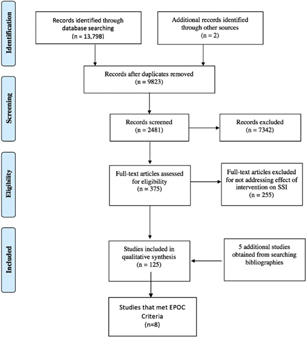
Articles were selected in several phases (Fig. 1). First, 6 reviewers independently screened titles and generated a list of potential abstracts for inclusion. Second, 4 authors (P.A., V.R., B.A., and B.Z.) independently reviewed the abstracts, identified articles for full-text review, and read the articles for eligibility. Data extracted from each study included author, study year and country, income level of country (low-middle or high, as defined by the World Bank28), setting, patient population (pediatric or adult, inpatient or outpatient), surgical specialty, infection prevention measures, compliance data, and SSI outcomes. Study quality was appraised with the Effective Practice and Organization of Care (EPOC) criteria, which considers RCTs, non-RCTs, CBA, and ITS as acceptable quality.29
Systematic review study flow diagram. Note. SSI, surgical site infection; EPOC, Effective Practice and Organization of Care.

Analysis of implementation strategies
We summarized implementation strategies according to 1 of the Four Es framework categories (ie, engage, educate, execute, or evaluate). These categories were not always mutually exclusive; reviewers decided on the best fit through group consensus. We extracted key stakeholders and compared studies that did and did not demonstrate a decrease in SSI to highlight some differences in implementation approaches.Reference Toor, Farooka, Ayyaz, Sarwar, Malik and Shabbir30–Reference Wilson, Hodgson and Liu32
Results
We identified 13,798 records in our initial search and 2 articles from reference lists of the identified studies (Fig. 1). After removing duplicates, 9,823 unique titles remained, of which 7,342 were excluded because inclusion criteria were not met. Of the remaining 2,481 records, 2,106 were excluded because our study objective was not met or an abstract was not provided. The remaining 375 studies underwent full-text review. Of those, 255 were excluded because SSI rates were not reported, leaving 120 studies in our final analysis. An additional 5 studies were identified from another search of systematic reviews, providing 125 studies in our final analysis. The analysis included 124 cohort studies and 1 RCT.
Demographic characteristics
Overall, 105 studies (84%) were conducted in high-income countries and 20 (16%) in LMICs (Appendix 2). Also, 14 studies (12%) evaluated a pediatric population, Reference Adler, Martin and Cohen33–Reference Woodward, Son, Taylor and Husain46 and 111 (88%) evaluated an adult, mixed (adult and pediatric), or undefined population. We quantified the studies by surgical specialty: 21 cardiothoracic,Reference Adler, Martin and Cohen33, Reference Izquierdo-Blasco, Campins-Marti and Soler-Palacin36, Reference Jenkins, Castaneda and Cherian37, Reference Murray, Corda, Turcotte, Bacha, Saiman and Krishnamurthy39, Reference Nayar, Kennedy and Pappas40, Reference Woodward, Son, Taylor and Husain46–Reference Jog, Cunningham and Cooper61 22 orthopedic,Reference Ballard, Miller, Nyquist, Elise, Baulesh and Erickson34, Reference Ryan, Sen, Staggers, Luerssen and Jea41, Reference Ryckman, Schoettker and Hays42, Reference Acklin, Widmer, Renner, Frei and Gross62–Reference Kim, Spencer and Davidson80 13 obstetrics and gynecology,Reference Brisibe, Ordinioha and Gbeneolol81–Reference Wu, Sun and Shyr93 23 gastrointestinal,Reference Aguilar-Nascimento, Caporossi, Bicudo, Silva, Santos and Cardoso94–Reference Bull, Wilson and Worth116 3 neurosurgery,Reference Hover, Sistrunk and Cavagnol117–Reference Lepanluoma, Rahi, Takala, Loyttyniemi and Ikonen119 2 plastic surgery,Reference Schonmeyr, Restrepo, Wendby, Gillenwater and Campbell44, Reference Biskup, Workman, Kutzner, Adetayo and Gupta120 28 multiple specialities,Reference Toor, Farooka, Ayyaz, Sarwar, Malik and Shabbir30–Reference Wilson, Hodgson and Liu32, Reference Toltzis, O’Riordan and Cunningham45, Reference Schweizer, Chiang and Septimus59, Reference Aiken, Wanyoro, Mwangi, Juma, Mugoya and Scott121–Reference Yegge, Gase, Hopkins-Broyles, Leone, Trovillion and Babcock143 and 13 undefined speciality.Reference Kelly, Wenger, Horton, Nuss, Croitoru and Pestian38, Reference Schaffzin, Harte and Marquette43, Reference Barchitta, Matranga and Quattrocchi144–Reference Takahashi, Takesue and Nakajima154
Adherence to SSI prevention measures
Of the 70 studies (56%) that provided data on adherence with SSI preventive measures, 95% reported an increase in compliance with prevention measures. However, 37 studies (28%) did not statistically evaluate the impact of interventions on SSI rates. Of the remaining 88 studies, 61 (69%) reported significant decreases in SSIs,Reference Toor, Farooka, Ayyaz, Sarwar, Malik and Shabbir30, Reference Wilson, Hodgson and Liu32, Reference Adler, Martin and Cohen33, Reference Izquierdo-Blasco, Campins-Marti and Soler-Palacin36, Reference Jenkins, Castaneda and Cherian37, Reference Ryan, Sen, Staggers, Luerssen and Jea41, Reference Chien, Lin and Hsu47–Reference Hogle, Cohen, Hyman, Larson and Fowler50, Reference Miyahara, Matsuura, Takemura, Mizutani, Saito and Toyama54, Reference Singh, Kumar, Sundaram, Kanjilal and Nair56, Reference Trussell, Gerkin and Coates57, Reference Schweizer, Chiang and Septimus59–Reference Acklin, Widmer, Renner, Frei and Gross62, Reference Johnson, Starks, Bancroft and Roberts66, Reference Kawamura, Matsumoto and Shigemi68–Reference Mejia, Williams and Long70, Reference Sanchez-Hernandez, Saez-Lopez, Paniagua-Tejo and Valverde-Garcia74, Reference Sechriest, Carney, Kuskowski, Haffner, Mullen and Covey75, Reference Rao, Cannella, Crossett, Yates, McGough and Hamilton78, Reference Kim, Spencer and Davidson80, Reference Corcoran, Jackson, Coulter-Smith, Loughrey, McKenna and Cafferkey83–Reference Hickson, Harris and Brett85, Reference Rauk87–Reference Weinberg, Fuentes and Ruiz91, Reference Aguilar-Nascimento, Caporossi, Bicudo, Silva, Santos and Cardoso94, Reference de Aguilar-Nascimento, Bicudo-Salomao, Caporossi, Silva, Cardoso and Santos95, Reference Connolly, Foppa, Kazi, Denoya and Bergamaschi97, Reference Hedrick, Heckman, Smith, Sawyer, Friel and Foley102, Reference Keenan, Speicher and Nussbaum105, Reference Lavu, Klinge and Nowcid108, Reference Perez-Blanco, Garcia-Olmo, Maseda-Garrido, Najera-Santos and Garcia-Caballero110, Reference Waits, Fritze and Banerjee112, Reference Wick, Galante and Hobson113, Reference Cima, Dankbar and Lovely115, Reference Hover, Sistrunk and Cavagnol117, Reference Le, Guppy and Axelrod118, Reference Aiken, Wanyoro, Mwangi, Juma, Mugoya and Scott121, Reference Brandt, Sohr, Behnke, Daschner, Ruden and Gastmeier124, Reference El Mhamdi, Letaief, Cherif, Bouanene, Kallel and Hamdi126, Reference Geubbels, Bakker and Houtman127, Reference Gomez, Acosta-Gnass, Mosqueda-Barboza and Basualdo129, Reference Kim, Kwakye and Kwok132, Reference Kwok, Funk and Baltaga134, Reference Liau, Aung and Chua135, Reference Suchitra and Lakshmidevi138, Reference Thompson, Oldenburg, Deschamps, Rupp and Smith139, Reference Barchitta, Matranga and Quattrocchi144, Reference Everett, Sitton and Wilson145, Reference Marchi, Pan and Gagliotti148, Reference Prospero, Barbadoro, Marigliano, Martini and D’Errico150, Reference Starling, Couto and Pinheiro152, Reference Takahashi, Takesue and Nakajima154 and 21 (24%) reported no change or no statistical decrease in SSIs.Reference van Kasteren, Mannien and Kullberg31, Reference Ballard, Miller, Nyquist, Elise, Baulesh and Erickson34, Reference Murray, Corda, Turcotte, Bacha, Saiman and Krishnamurthy39, Reference Woodward, Son, Taylor and Husain46, Reference Rao, Schilling, Rice, Ridenour, Mook and Santa55, Reference Usry, Johnson, Weems and Blackhurst58, Reference Schweizer, Chiang and Septimus59, Reference Boaz, Bermant and Ezri77, Reference Hadley, Immerman, Hutzler, Slover and Bosco79, Reference Brisibe, Ordinioha and Gbeneolol81, Reference Hill, Holubar, Garfield Legare, Luurtsema and Barth99, Reference Forbes, Stephen and Harper100, Reference Hedrick, Heckman, Smith, Sawyer, Friel and Foley102, Reference Larochelle, Hyman, Gruppi and Osler107, Reference Miller, Thacker and White109, Reference Biskup, Workman, Kutzner, Adetayo and Gupta120, Reference Askarian, Kouchak and Palenik123, Reference Dimopoulou, Kourlaba, Psarris, Coffin, Spoulou and Zaoutis125, Reference Neumayer, Mastin, Vanderhoof and Hinson136, Reference Tillman, Wehbe-Janek, Hodges, Smythe and Papaconstantinou140, Reference Yang, Zhao and Wang142 However, 2 studies (2%), including 1 RCT, reported increased SSIs.Reference Anthony, Murray and Sum-Ping96, Reference Koch, Nilsen, Dalheim, Cox and Harthug133
Overall, 103 studies (82%) used multifaceted strategies to promote adherence to prevention measures. The most common measure was appropriate use of surgical antibiotic prophylaxis, which was reported in 86 of the 125 studies (68%) and in 14 of the 20 (70%) studies conducted in LMICs.Reference Toor, Farooka, Ayyaz, Sarwar, Malik and Shabbir30, Reference Jenkins, Castaneda and Cherian37, Reference Weinberg, Fuentes and Ruiz91, Reference Khan, Rao, Rao and Rodrigues106, Reference Aiken, Wanyoro, Mwangi, Juma, Mugoya and Scott121–Reference Askarian, Kouchak and Palenik123, Reference El Mhamdi, Letaief, Cherif, Bouanene, Kallel and Hamdi126, Reference Gomez, Acosta-Gnass, Mosqueda-Barboza and Basualdo129, Reference Kim, Kwakye and Kwok132, Reference Kwok, Funk and Baltaga134, Reference Suchitra and Lakshmidevi138, Reference Yang, Zhao and Wang142, Reference Starling, Couto and Pinheiro152 Other common prevention measures were surgical site preparation (31%), hair removal techniques (25%), normothermia (20%), glycemic control (18%), wound care (17%), preoperative bathing (16%), operating room discipline/traffic (14%), instrument sterilization (13%), hand hygiene (11%), preoperative cleansing (14%), and gloving techniques (8%) (Table 1).
Common Infection Prevention Measures

Note. IPC, infection prevention and control; OR, operating room.
Implementation of SSI prevention strategies using the Four Es framework
Most studies used multifaceted strategies to improve adherence with evidence-based SSI prevention measures. Moreover, 76 studies (63%) described efforts to engage frontline staff as an important strategy to improve adherence with prevention measures. Also, 65 studies (54%) used some form of education to introduce the measures to frontline staff, compared to only 11% of studies that focused on patient education. Execution strategies to improve adherence were described by 108 studies (86%). In addition, 74 studies (59%) described evaluation activities. Overall, only 8 studies (6%) met the EPOC criteria, which limited our ability to identify best practices in the remaining 117 studies.
Engagement
Among all of the studies, 76 (63%) described efforts to engage frontline staff as an implementation strategy, largely by forming multidisciplinary teams. The range of disciplines included surgeons, anesthesia providers, perioperative nurses, pharmacists, and infection prevention control specialists. Multidisciplinary teams reviewed existing SSI prevention practices and identified opportunities for improvement, developed interventions, measured progress, and gave feedback to hospital staff.Reference Adler, Martin and Cohen33, Reference Thompson, Oldenburg, Deschamps, Rupp and Smith139, Reference van der Slegt, van der Laan, Veen, Hendriks, Romme and Kluytmans155 In 7 studies, the role of team champions in SSI improvement efforts was described.Reference Jenkins, Castaneda and Cherian37, Reference Ryckman, Schoettker and Hays42, Reference Hogle, Cohen, Hyman, Larson and Fowler50, Reference Rovaldi and King73, Reference Dimopoulou, Kourlaba, Psarris, Coffin, Spoulou and Zaoutis125, Reference Horst, Rubinfeld and Mlynarek130, Reference Kanter, Connelly and Fitzgerald131 Team champions were enthusiastic individuals identified across the institution. They included frontline staff such as surgeons, anesthesiologists, nurses, and team members in leadership positions, including administrators and hospital executives. They often provided important leadership to engage and coach teams and managed resources to foster the desired change.Reference Rovaldi and King73, Reference Forbes, Stephen and Harper100, Reference Dimopoulou, Kourlaba, Psarris, Coffin, Spoulou and Zaoutis125, Reference Wick, Hobson and Bennett156
Also, 15 studies highlighted the importance of partnering multidisciplinary teams with senior leaders.Reference Toltzis, O’Riordan and Cunningham45, Reference Kles, Murrah, Smith, Baugus-Wellmeier, Hurry and Morris51, Reference Mejia, Williams and Long70, Reference Sechriest, Carney, Kuskowski, Haffner, Mullen and Covey75, Reference Brisibe, Ordinioha and Gbeneolol81, Reference Dyrkorn, Kristoffersen and Walberg84, Reference Weinberg, Fuentes and Ruiz91, Reference Reames, Krell, Campbell and Dimick111, Reference Wick, Galante and Hobson113, Reference Hover, Sistrunk and Cavagnol117, Reference Horst, Rubinfeld and Mlynarek130, Reference Ng and Awad137, Reference Thompson, Oldenburg, Deschamps, Rupp and Smith139, Reference Joyce, Cioffi, Petriwsky and Robinson147, Reference Wick, Hobson and Bennett156 Hospital leadership communicated to clinical staff the goals and expectations to decrease SSIs, and in some studies a designated hospital executive was engaged in the work, met with improvement teams, provided resources, and helped teams overcome organizational barriers.Reference Ryckman, Schoettker and Hays42, Reference Horst, Rubinfeld and Mlynarek130, Reference Wick, Hobson and Bennett156
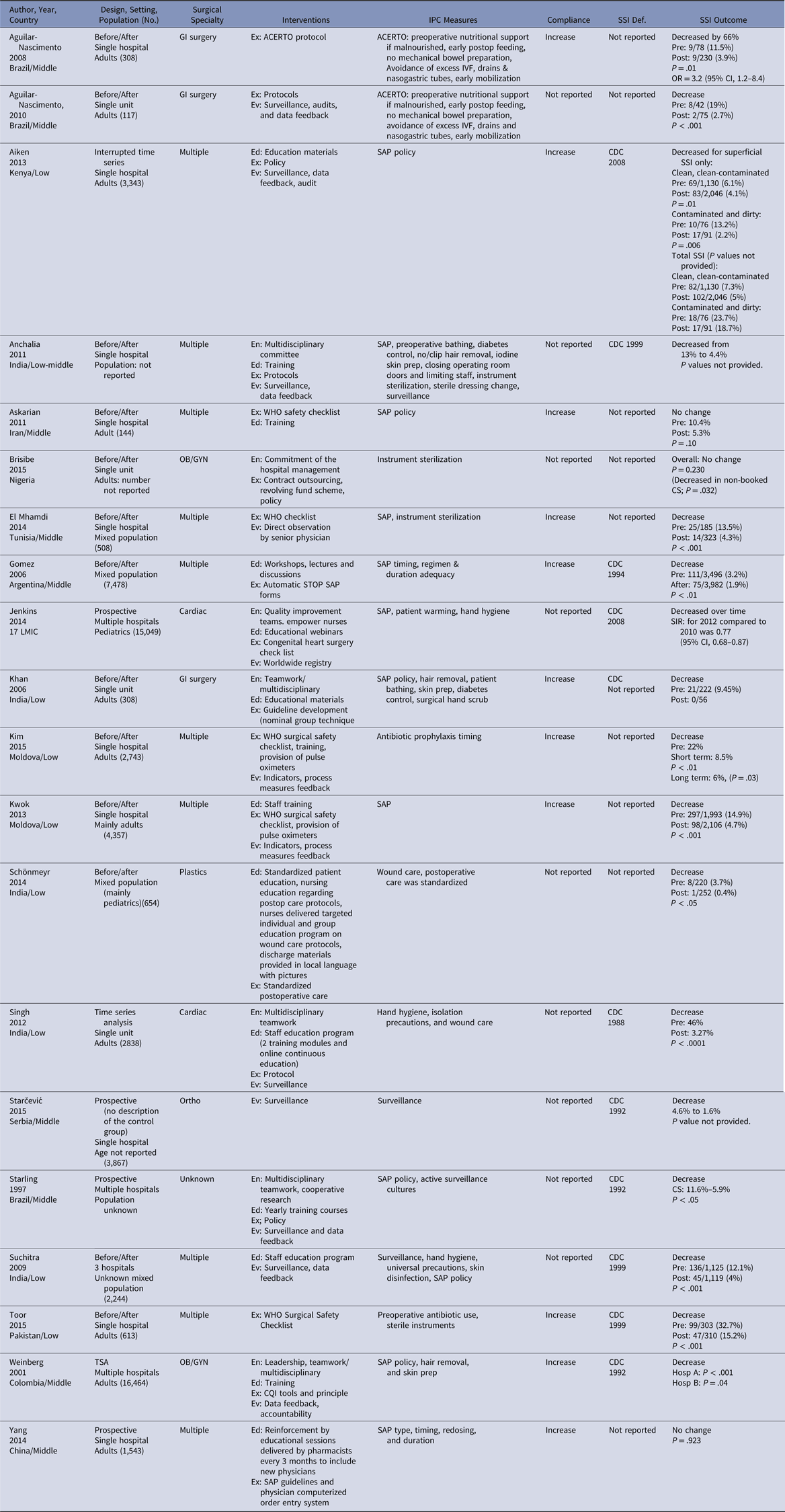
Studies in LMICs frequently described multidisciplinary and multidepartmental efforts to prevent SSIs, fostering buy-in and input from providers and encouraging local ownership of the process. These QI initiatives were led and motivated by various groups, including the department of surgery,Reference Weinberg, Fuentes and Ruiz91, Reference Aguilar-Nascimento, Caporossi, Bicudo, Silva, Santos and Cardoso94, Reference de Aguilar-Nascimento, Bicudo-Salomao, Caporossi, Silva, Cardoso and Santos95, Reference Khan, Rao, Rao and Rodrigues106 clinical staff and clinical epidemiologists,Reference Aiken, Wanyoro, Mwangi, Juma, Mugoya and Scott121 hospital management,Reference Brisibe, Ordinioha and Gbeneolol81 infection prevention control specialists,Reference Singh, Kumar, Sundaram, Kanjilal and Nair56, Reference Gomez, Acosta-Gnass, Mosqueda-Barboza and Basualdo129 pharmacists,Reference Yang, Zhao and Wang142 local investigators and clinical researchers (Table 2).Reference Toor, Farooka, Ayyaz, Sarwar, Malik and Shabbir30, Reference Jenkins, Castaneda and Cherian37, Reference Schonmeyr, Restrepo, Wendby, Gillenwater and Campbell44, Reference Starčević, Munitlak, Mijović, Mikić and Suljagić76, Reference Kwok, Funk and Baltaga134, Reference Suchitra and Lakshmidevi138, Reference Starling, Couto and Pinheiro152 Of 20 LMIC studies, 8 (40%) implemented local teams comprising multiple clinical specialties, administrators, and leadership.Reference Jenkins, Castaneda and Cherian37, Reference Singh, Kumar, Sundaram, Kanjilal and Nair56, Reference Brisibe, Ordinioha and Gbeneolol81, Reference Weinberg, Fuentes and Ruiz91, Reference Khan, Rao, Rao and Rodrigues106, Reference Anchalia and D’Ambruoso122, Reference Kim, Kwakye and Kwok132, Reference Starling, Couto and Pinheiro152 Also, 2 studies noted that government involvement (Iran and Moldova) from their ministry of health was crucial to uptake of the 2009 WHO checklist.Reference Askarian, Kouchak and Palenik123, Reference Kwok, Funk and Baltaga134 Brisibe et alReference Brisibe, Ordinioha and Gbeneolol81 described a written commitment from hospital management to ensure that the Nigerian teaching hospital received a steady supply of sterile medical supplies.
Included Studies from Low-Middle Income Countries (LMICs)

IPC, infection prevention control; SSI, surgical site infection; Ortho, orthopedic; Ed, educate; Ex, execute; Ev, evaluate; SAP, surgical antimicrobial prophylaxis; CDC, Centers for Disease Control; US, United States; En, engage; CHG, chlorhexidine; GI, gastrointestinal (abdominal); ACERTO, Accelerating the Total Recovery; IVF, intravascular fluid; OR, odds ratio; CI, confidence interval; RCT, randomized controlled trial; WHO, World Health Organization; UK, United Kingdom; OB/GYN, obstetrics and gynecology; BMI, body mass index; HPA, Health Protection Agency of United Kingdom; SWI, sternal wound infection; MRSA, methicillin-resistant Staphylococcus aureus; CTSW, cardiothoracic surgery sternal wounds; TKA, total knee arthroplasty; SF, spinal fusion; SIR, standardized infection ratio; ACS, American College of Surgeons; TSA, time-series analysis; CS, cesarean section; CQI, continuous quality improvement.
Education
In total, 65 studies (54%) used some form of staff education as an implementation strategy. Traditional teaching methods included large-group workshops, didactics, and grand rounds.Reference Ballard, Miller, Nyquist, Elise, Baulesh and Erickson34, Reference Hogle, Cohen, Hyman, Larson and Fowler50, Reference Garcia-Paris, Cohena-Jimenez, Montano-Jimenez and Cordoba-Fernandez64, Reference Horst, Rubinfeld and Mlynarek130, Reference Kanter, Connelly and Fitzgerald131 Other methods included peer education, role playing, briefing and debriefing sessions, webinars, and live simulations.Reference Izquierdo-Blasco, Campins-Marti and Soler-Palacin36, Reference Jenkins, Castaneda and Cherian37, Reference Schaffzin, Harte and Marquette43, Reference Haycock, Laser and Keuth48, Reference Garcia-Paris, Cohena-Jimenez, Montano-Jimenez and Cordoba-Fernandez64, Reference Forbes, Stephen and Harper100, Reference Reames, Krell, Campbell and Dimick111 Haycock et alReference Haycock, Laser and Keuth48 implemented an intensive education program that led to an 86% SSI reduction among cardiac surgery patients. Horst et alReference Horst, Rubinfeld and Mlynarek130 had clinical nurse specialists and pharmacists teach the glycemic control protocol to nurses at the bedside. Two studies provided more intensive training, spanning months before intervention implementation.Reference Hannan, O’ullivan and Higgins49, Reference Miller, Thacker and White109 Education was reinforced via refresher courses, online videos, and webinars, and brochures allowed for quick reference.Reference Izquierdo-Blasco, Campins-Marti and Soler-Palacin36–Reference Kelly, Wenger, Horton, Nuss, Croitoru and Pestian38, Reference Schaffzin, Harte and Marquette43, Reference Salim, Braverman, Berkovic, Suliman, Teitler and Shalev89, Reference Aiken, Wanyoro, Mwangi, Juma, Mugoya and Scott121, Reference Geubbels, Bakker and Houtman127, Reference Kanter, Connelly and Fitzgerald131, Reference Barchitta, Matranga and Quattrocchi144 Singh et alReference Singh, Kumar, Sundaram, Kanjilal and Nair56 conducted before-and-after test comparisons to evaluate the success of their education.
Of 125 studies, 15 (11%) focused on patient education and their shared responsibility for infection prevention.Reference Schonmeyr, Restrepo, Wendby, Gillenwater and Campbell44, Reference McDonald, Clark, Landauer and Kuxhaus69, Reference Mori71, Reference Sechriest, Carney, Kuskowski, Haffner, Mullen and Covey75, Reference Rao, Cannella, Crossett, Yates, McGough and Hamilton78, Reference Kim, Spencer and Davidson80, Reference Bullough, Wilkinson, Burns and Wan82, Reference Hickson, Harris and Brett85, Reference Ng, Brown and Alexander86, Reference Riley, Suda, Tabsh, Flood and Pegues88, Reference Hechenbleikner, Hobson, Bennett and Wick101, Reference Wick, Galante and Hobson113, Reference Cima, Dankbar and Lovely115, Reference Hover, Sistrunk and Cavagnol117, Reference John, Nimeri and Ellahham146 Riley et alReference Riley, Suda, Tabsh, Flood and Pegues88 gave patients reading material on skin preparation with presurgery instructions. Aiken et alReference Aiken, Wanyoro, Mwangi, Juma, Mugoya and Scott121 used posters to educate patients about the importance of receiving antibiotics before incision and prompt discontinuation after surgery. Also, 2 studies used a preoperative checklist to educate and prepare patients for surgery.Reference McDonald, Clark, Landauer and Kuxhaus69, Reference Mori71
Of 20 studies with LMIC programs, 12 (60%) used staff education to reduce SSI rates.Reference Jenkins, Castaneda and Cherian37, Reference Schonmeyr, Restrepo, Wendby, Gillenwater and Campbell44, Reference Singh, Kumar, Sundaram, Kanjilal and Nair56, Reference Weinberg, Fuentes and Ruiz91, Reference Khan, Rao, Rao and Rodrigues106, Reference Aiken, Wanyoro, Mwangi, Juma, Mugoya and Scott121–Reference Askarian, Kouchak and Palenik123, Reference Gomez, Acosta-Gnass, Mosqueda-Barboza and Basualdo129, Reference Kim, Kwakye and Kwok132, Reference Yang, Zhao and Wang142, Reference Starling, Couto and Pinheiro152 A project in Kenya took ∼600 hours of staff meeting time to develop and implement antibiotic best practices.Reference Aiken, Wanyoro, Mwangi, Juma, Mugoya and Scott121 Jenkins et alReference Jenkins, Castaneda and Cherian37 delivered monthly webinars over a 2-year period in 17 LMICs to decrease SSIs among pediatric congenital heart surgery patients. Day-long seminars, Reference de Aguilar-Nascimento, Bicudo-Salomao, Caporossi, Silva, Cardoso and Santos95 one-on-one physician training,Reference Gomez, Acosta-Gnass, Mosqueda-Barboza and Basualdo129 and online modules designed for both existing and new staff were also described,Reference Singh, Kumar, Sundaram, Kanjilal and Nair56 all leading to decreases in SSIs. In 1 LMIC study, Reference Schonmeyr, Restrepo, Wendby, Gillenwater and Campbell44 educating patients on wound care by providing illustrated discharge instructions reduced SSIs among patients undergoing cleft lip and palate repair in India.
Execution
Execution strategies were described by 108 of the 125 studies (86%). Execution often focused on streamlining interventions by simplifying and standardizing the care delivery process and creating verification checks. Furthermore, 57 studies (46%) implemented protocols, pathways, and policies to improve adoption of prevention measures.Reference van Kasteren, Mannien and Kullberg31, Reference Ballard, Miller, Nyquist, Elise, Baulesh and Erickson34, Reference Murray, Corda, Turcotte, Bacha, Saiman and Krishnamurthy39–Reference Ryan, Sen, Staggers, Luerssen and Jea41, Reference Schaffzin, Harte and Marquette43, Reference Woodward, Son, Taylor and Husain46, Reference Lutarewych, Morgan and Hall53, Reference Rao, Schilling, Rice, Ridenour, Mook and Santa55–Reference Usry, Johnson, Weems and Blackhurst58, Reference Jog, Cunningham and Cooper61, Reference Hutzler, Kraemer, Iaboni, Berger and Bosco65, Reference McDonald, Clark, Landauer and Kuxhaus69, Reference Sanchez-Hernandez, Saez-Lopez, Paniagua-Tejo and Valverde-Garcia74, Reference Sechriest, Carney, Kuskowski, Haffner, Mullen and Covey75, Reference Rao, Cannella, Crossett, Yates, McGough and Hamilton78, Reference Hadley, Immerman, Hutzler, Slover and Bosco79, Reference Brisibe, Ordinioha and Gbeneolol81, Reference Corcoran, Jackson, Coulter-Smith, Loughrey, McKenna and Cafferkey83, Reference Hickson, Harris and Brett85, Reference Rauk87, Reference Salim, Braverman, Berkovic, Suliman, Teitler and Shalev89, Reference Aguilar-Nascimento, Caporossi, Bicudo, Silva, Santos and Cardoso94, Reference de Aguilar-Nascimento, Bicudo-Salomao, Caporossi, Silva, Cardoso and Santos95, Reference Forbes, Stephen and Harper100, Reference Hedrick, Heckman, Smith, Sawyer, Friel and Foley102–Reference Hernández-Navarrete, Arribas-Llorente and Solano Bernad104, Reference Larochelle, Hyman, Gruppi and Osler107, Reference Miller, Thacker and White109, Reference Wick, Galante and Hobson113, Reference Aiken, Wanyoro, Mwangi, Juma, Mugoya and Scott121–Reference Askarian, Kouchak and Palenik123, Reference Geubbels, Bakker and Houtman127, Reference Horst, Rubinfeld and Mlynarek130, Reference Kanter, Connelly and Fitzgerald131, Reference Neumayer, Mastin, Vanderhoof and Hinson136, Reference Yegge, Gase, Hopkins-Broyles, Leone, Trovillion and Babcock143–Reference Everett, Sitton and Wilson145, Reference Prospero, Barbadoro, Marigliano, Martini and D’Errico150–Reference Starling, Couto and Pinheiro152, Reference Takahashi, Takesue and Nakajima154 In addition, 43 studies combined measures into a “bundle” of care practices.Reference Adler, Martin and Cohen33, Reference Nayar, Kennedy and Pappas40, Reference Ryckman, Schoettker and Hays42, Reference Schaffzin, Harte and Marquette43, Reference Woodward, Son, Taylor and Husain46, Reference Chien, Lin and Hsu47, Reference Lutarewych, Morgan and Hall53, Reference Miyahara, Matsuura, Takemura, Mizutani, Saito and Toyama54, Reference Schweizer, Chiang and Septimus59, Reference Jog, Cunningham and Cooper61, Reference Johnson, Starks, Bancroft and Roberts66, Reference Kawamura, Matsumoto and Shigemi68, Reference McDonald, Clark, Landauer and Kuxhaus69, Reference Sechriest, Carney, Kuskowski, Haffner, Mullen and Covey75, Reference Rao, Cannella, Crossett, Yates, McGough and Hamilton78, Reference Hadley, Immerman, Hutzler, Slover and Bosco79, Reference Corcoran, Jackson, Coulter-Smith, Loughrey, McKenna and Cafferkey83–Reference Rauk87, Reference Anthony, Murray and Sum-Ping96, Reference Crolla, van der Laan, Veen, Hendriks, van Schendel and Kluytmans98–Reference Forbes, Stephen and Harper100, Reference Keenan, Speicher and Nussbaum105, Reference Larochelle, Hyman, Gruppi and Osler107, Reference Lavu, Klinge and Nowcid108, Reference Perez-Blanco, Garcia-Olmo, Maseda-Garrido, Najera-Santos and Garcia-Caballero110, Reference Waits, Fritze and Banerjee112, Reference Wick, Galante and Hobson113, Reference Cima, Dankbar and Lovely115, Reference Bull, Wilson and Worth116, Reference Le, Guppy and Axelrod118, Reference Aiken, Wanyoro, Mwangi, Juma, Mugoya and Scott121, Reference Liau, Aung and Chua135, Reference Ng and Awad137, Reference Thompson, Oldenburg, Deschamps, Rupp and Smith139, Reference Tillman, Wehbe-Janek, Hodges, Smythe and Papaconstantinou140, Reference John, Nimeri and Ellahham146, Reference van der Slegt, van der Laan, Veen, Hendriks, Romme and Kluytmans155 In 1 study, SSI were reduced rates by serially introducing a care bundle for cesarean section at a large community hospital.Reference Ng, Brown and Alexander86 A study involving 24 hospitals in Michigan showed a dose response in which increased bundle compliance resulted in decreased SSIs, suggesting synergy among prevention measures in the bundle.Reference Waits, Fritze and Banerjee112
Among the 125 studies, 26 (21%) used checklists to improve the adoption of evidence-based interventions.Reference Toor, Farooka, Ayyaz, Sarwar, Malik and Shabbir30, Reference Izquierdo-Blasco, Campins-Marti and Soler-Palacin36, Reference Lindblom, Lytsy and Sandstrom52, Reference Garcia-Paris, Cohena-Jimenez, Montano-Jimenez and Cordoba-Fernandez64, Reference Johnson, Starks, Bancroft and Roberts66, Reference McDonald, Clark, Landauer and Kuxhaus69, Reference Mori71, Reference Sechriest, Carney, Kuskowski, Haffner, Mullen and Covey75, Reference Boaz, Bermant and Ezri77, Reference Ng, Brown and Alexander86, Reference Connolly, Foppa, Kazi, Denoya and Bergamaschi97, Reference Reames, Krell, Campbell and Dimick111, Reference Wick, Galante and Hobson113, Reference Biskup, Workman, Kutzner, Adetayo and Gupta120, Reference Askarian, Kouchak and Palenik123, Reference El Mhamdi, Letaief, Cherif, Bouanene, Kallel and Hamdi126, Reference Kim, Kwakye and Kwok132, Reference Kwok, Funk and Baltaga134, Reference Tillman, Wehbe-Janek, Hodges, Smythe and Papaconstantinou140, Reference Yegge, Gase, Hopkins-Broyles, Leone, Trovillion and Babcock143, Reference Everett, Sitton and Wilson145, Reference John, Nimeri and Ellahham146, Reference Lepanluoma, Takala, Kotkansalo, Rahi and Ikonen157 Other studies used order sets,Reference Sechriest, Carney, Kuskowski, Haffner, Mullen and Covey75, Reference Hedrick, Turrentine and Smith103, Reference Pegues149 electronic reminders,Reference Hechenbleikner, Hobson, Bennett and Wick101, Reference Cima, Dankbar and Lovely115 and automatic stops for antibioticsReference Gomez, Acosta-Gnass, Mosqueda-Barboza and Basualdo129 to create verification checks and to improve adherence.
Many of the LMIC studies adapted the 2009 WHO Surgical Safety Checklist to local needs, Reference Izquierdo-Blasco, Campins-Marti and Soler-Palacin36, Reference Askarian, Kouchak and Palenik123, Reference El Mhamdi, Letaief, Cherif, Bouanene, Kallel and Hamdi126, Reference Kim, Kwakye and Kwok132, Reference Kwok, Funk and Baltaga134 protocols,Reference Aguilar-Nascimento, Caporossi, Bicudo, Silva, Santos and Cardoso94, Reference de Aguilar-Nascimento, Bicudo-Salomao, Caporossi, Silva, Cardoso and Santos95, Reference Anchalia and D’Ambruoso122 and policiesReference Brisibe, Ordinioha and Gbeneolol81, Reference Aiken, Wanyoro, Mwangi, Juma, Mugoya and Scott121 to simplify and standardize care. In a study conducted in Moldova, local ownership and buy-in were promoted by developing an anesthesia preoperative evaluation template that included several SSI prevention interventions to improve workflow.Reference Kim, Kwakye and Kwok132 An Argentinean study described an automatic-stop prophylaxis form that empowered pharmacists to stop prolonged postoperative antimicrobials.Reference Gomez, Acosta-Gnass, Mosqueda-Barboza and Basualdo129 Both studies showed significantly decreased SSI rates.
Evaluation
Of 125 studies, 74 studies (59%) described evaluation activities, with a general focus on giving feedback to key stakeholders to support improvement efforts. Some studies used a benchmark approach to compare performance among peers.Reference Wilson, Hodgson and Liu32, Reference Usry, Johnson, Weems and Blackhurst58, Reference Larochelle, Hyman, Gruppi and Osler107, Reference Aiken, Wanyoro, Mwangi, Juma, Mugoya and Scott121 Another strategy reported feedback to the frontline providers and hospital leadership.Reference Wick, Galante and Hobson113 In that study, providing feedback using a dashboard to compare local data to national benchmarks was associated with a significant decrease in SSI rates and improvement in patient outcomes, including SSI, length of stay, and patient satisfaction. One study posted hospital-based newsletters in public places, such as waiting rooms and elevators, to celebrate staff contributions to decreasing SSIs, Reference Joyce, Cioffi, Petriwsky and Robinson147 and another displayed scorecards of infection rates in patient care areas.Reference Thompson, Oldenburg, Deschamps, Rupp and Smith139
In addition, 5 studies implemented prospective SSI surveillance and performance feedback to surgeons as an unimodal implementation strategy.Reference Wilson, Hodgson and Liu32, Reference Starčević, Munitlak, Mijović, Mikić and Suljagić76, Reference Brandt, Sohr, Behnke, Daschner, Ruden and Gastmeier124, Reference Marchi, Pan and Gagliotti148, Reference Staszewicz, Eisenring, Bettschart, Harbarth and Troillet153 In 1 multicenter study, 34 hospitals participating in a Dutch surveillance network collected SSI data and provided feedback exhibited significant decreases in SSI rates over 5 years.Reference Geubbels, Nagelkerke, Mintjes-De, Vandenbroucke-Grauls, Grobbee and De Boer128 Other studies similarly showed that raising awareness among surgeons about infection rates could lead to practice change and improvements in outcomes.Reference Wilson, Hodgson and Liu32, Reference Taylor, Buchanan-Chell, Kirkland, McKenzie, Sutherland and Wiens158
Of 20 LMIC studies, 11 (55%) emphasized evaluation and feedback as an implementation strategy.Reference Jenkins, Castaneda and Cherian37, Reference Starčević, Munitlak, Mijović, Mikić and Suljagić76, Reference Weinberg, Fuentes and Ruiz91, Reference Aguilar-Nascimento, Caporossi, Bicudo, Silva, Santos and Cardoso94, Reference Aiken, Wanyoro, Mwangi, Juma, Mugoya and Scott121, Reference Anchalia and D’Ambruoso122, Reference El Mhamdi, Letaief, Cherif, Bouanene, Kallel and Hamdi126, Reference Kim, Kwakye and Kwok132, Reference Kwok, Funk and Baltaga134, Reference Suchitra and Lakshmidevi138, Reference Starling, Couto and Pinheiro152 In Brazil, the National Nosocomial Infection Surveillance System was used to evaluate performance and provide feedback to providers.Reference Starling, Couto and Pinheiro152 Other evaluation methods included direct observation and immediate feedback of clinical performance to create a sense of accountability and motivation for improvement.Reference Kwok, Funk and Baltaga134, Reference Starling, Couto and Pinheiro152 For instance, a tool called the “infectometer” was used in clinical areas to report weekly and monthly HAI rates compared to the expected incidence of infection.Reference Starling, Couto and Pinheiro152 In Belgrade, active surveillance with feedback alone resulted in a decrease in SSIs among orthopedic patients.Reference Starčević, Munitlak, Mijović, Mikić and Suljagić76
Application of EPOC criteria
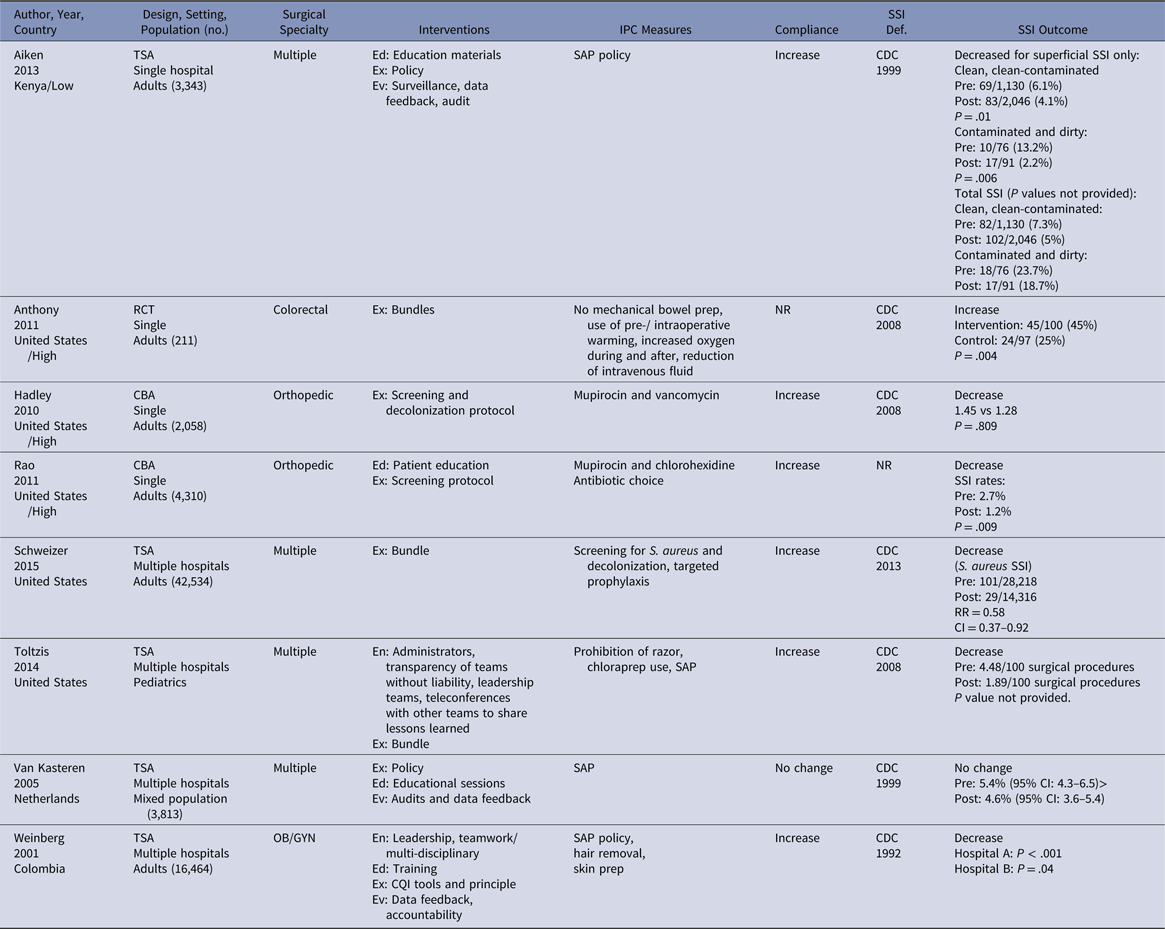
Only 8 studies met EPOC criteria for inclusion in our analysis (Fig. 1). Overall, we observed no clear differences in implementation strategies between studies that met the EPOC criteria and those that did not. Most of these studies described a multifaceted approach that included efforts to define a common goal for improvement, to engage and educate multidisciplinary teams and senior leaders, to simplify and standardize care (bundles, protocols, policies, and briefings), to collect data and offer performance feedback, and to provide opportunities for shared learning.Reference van Kasteren, Mannien and Kullberg31, Reference Toltzis, O’Riordan and Cunningham45, Reference Schweizer, Chiang and Septimus59, Reference Weinberg, Fuentes and Ruiz91, Reference Aiken, Wanyoro, Mwangi, Juma, Mugoya and Scott121 Many studies specifically commented on the importance of several important factors when implementing best practices (1) senior leadership support, (2) engaging and educating multidisciplinary teams, (3) locally relevant education materials, and (4) an “enabling infrastructure” to collect data, analyze, and provide feedback.Reference Schweizer, Chiang and Septimus59, Reference Weinberg, Fuentes and Ruiz91, Reference Aiken, Wanyoro, Mwangi, Juma, Mugoya and Scott121 The remaining 3 studies described efforts to standardize care (ie, bundles, protocols, and policies) but provided little to no information about additional implementation strategies (Table 3).Reference Rao, Cannella, Crossett, Yates, McGough and Hamilton78, Reference Hadley, Immerman, Hutzler, Slover and Bosco79, Reference Anthony, Murray and Sum-Ping96
Evidence of Included Studies that Met EPOC Criteria (n=8)

Note. EPOC, Effective Practice and Organization of Care; IPC, infection prevention control; SSI, surgical site infection; Def, definition; TSA, time-series analysis; Ed, educate; Ex, execute; Ev, evaluate; SAP, surgical antimicrobial prophylaxis; CDC, Centers for Disease Control; RCT, randomized controlled trial; NR, not reported; CBA, controlled before-after; CI, confidence interval; En, engage; OB/GYN, Obstetrics and Gynecology; CQI, continuous quality improvement.
Discussion
In this systematic review, we identified 125 studies that described implementation strategies to increase the adoption of evidence-based SSI prevention measures and categorized the strategies according to the Four E framework.Reference Pronovost, Needham and Berenholtz19, Reference DePalo, McNicoll, Cornell, Rocha, Adams and Pronovost20, Reference Berenholtz, Pham and Thompson22, Reference Berenholtz, Lubomski and Weeks23, Reference Pronovost, Watson, Goeschel, Hyzy and Berenholtz159 Most of the studies used a multifaceted approach and addressed change at multiple levels within their healthcare organization. These strategies aimed (1) to build and encourage multidisciplinary teamwork, (2) to obtain leadership buy-in, (3) to increase staff and patient awareness and knowledge about SSIs and prevention practices, (4) to standardize and simplify clinical processes, (5) to create verification procedures, and (6) to provide timely feedback to stakeholders to support improvement efforts. Although strategies varied among studies and we were not able to identify the best approach, lessons learned from successful HAI prevention efforts highlighted the importance of employing multifaceted strategies, including engagement, education, execution, and evaluation.Reference Pronovost, Weaver and Berenholtz160
Globally, SSI prevention is a priority.3, Reference Allegranzi, Bagheri Nejad and Combescure4, Reference Berrios-Torres, Umscheid and Bratzler8, 9, 12 Unfortunately, effective and reliable SSI prevention measures are not consistently implemented in practice, leading to variable success in reducing these infections.Reference Serra-Aracil, Garcia-Domingo and Pares161–Reference Arriaga, Lancaster and Berry163 Several themes emerged from our systematic review.
First, successful strategies often engaged multidisciplinary perioperative staff in leading SSI improvement efforts, highlighting the influential role different specialties have in improving care. Second, leadership participation to champion and support improvement efforts were invaluable and contributed to success. Leadership included senior executives and hospital administrators and sometimes extended to government officials, especially in LMICs.Reference Pronovost, Weaver and Berenholtz160, Reference Saint, Kowalski, Banaszak-Holl, Forman, Damschroder and Krein164, Reference Henderson, Staiger and Peterson165 Although specific leadership actions were poorly described, successful HAI prevention efforts require leadership support to identify and remove implementation barriers, including the adaptive challenges of changing people’s priorities, beliefs, habits, and loyalties.Reference Pronovost166
Third, most studies included education to increase knowledge of best practices. Insufficient knowledge of evidence-based recommendations is a significant barrier to adoption of clinical practice guidelines.Reference Cabana, Rand and Powe167 In addition to traditional learning-based teaching methods, some studies reinforced education by using real-life simulations, Reference Garcia-Paris, Cohena-Jimenez, Montano-Jimenez and Cordoba-Fernandez64 monthly coaching calls,Reference Toltzis, O’Riordan and Cunningham45, Reference Reames, Krell, Campbell and Dimick111 and yearly training courses.Reference Starling, Couto and Pinheiro152 The role of the surgical patient as an important stakeholder in SSI prevention was highlighted in a few studies and is gaining increasing recognition. An expert panel recently published practical ways to engage and educate patients, including educational leaflets translated into multiple languages.Reference Tartari, Weterings and Gastmeier168
Fourth, most studies used protocols, care bundles, and checklists to simplify and standardize evidence-based interventions as part of their multifaceted approach. Several studies, for example, used checklists to summarize recommended practices. In LMICs, the most common method was to adapt the 2009 WHO surgical safety checklist based on local resources and culture.Reference Toor, Farooka, Ayyaz, Sarwar, Malik and Shabbir30, Reference Askarian, Kouchak and Palenik123, Reference El Mhamdi, Letaief, Cherif, Bouanene, Kallel and Hamdi126, Reference Kim, Kwakye and Kwok132, Reference Kwok, Funk and Baltaga134 Local ownership of interventions and implementation strategies were especially important in these settings. Nevertheless, protocols and checklists are tools that only work if staff think they add value. Successful implementation requires significant staff engagement that taps into the intrinsic motivation of professionals and uses peer learning to change behaviors and shift social norms.Reference Dixon-Woods, Bosk, Aveling, Goeschel and Pronovost169
Finally, almost all studies incorporated an evaluation strategy to monitor performance and provide feedback to frontline staff. Monitoring and feedback can heighten the sense of urgency, promote accountability, and show clinicians how they are performing. For example, in 1 study, patients were surveyed post discharge for SSI, direct feedback was given to the responsible surgeon, and a 31% decrease in the odds of an SSI was achieved.Reference Wilson, Hodgson and Liu32 In addition to monitoring outcomes, monitoring process measures and providing feedback may identify additional opportunities to improve.Reference Wick, Galante and Hobson113
Feedback can also be used to reframe SSI as a social problem, to foster ownership among staff, and to generate friendly competition.Reference Jordan, Goldstein, Michels, Hutzler, Slover and Bosco67 Two studies provided peer-to-peer performance comparisons, Reference Hutzler, Kraemer, Iaboni, Berger and Bosco65, Reference Thompson, Oldenburg, Deschamps, Rupp and Smith139 whereas others made team-to-team and interhospital comparisons within hospital networks.Reference Schaffzin, Harte and Marquette43, Reference Geubbels, Nagelkerke, Mintjes-De, Vandenbroucke-Grauls, Grobbee and De Boer128, Reference Joyce, Cioffi, Petriwsky and Robinson147 An important lesson, however, was that monitoring and feedback of outcomes alone may not be sufficient to change behaviors or practices.Reference Pronovost, Berenholtz and Needham18
Several studies did not reduce SSI rates (Appendix 2). Though it was challenging to understand causality, most of these studies did not describe strategies to address 1 or more of the Four Es (ie, engage, educate, execute, and evaluate). For example, some studies implemented the 2009 WHO surgical safety checklist without describing strategies to engage, educate, evaluate, or provide feedback to staff.Reference Boaz, Bermant and Ezri77, Reference Biskup, Workman, Kutzner, Adetayo and Gupta120 In the study by Reames et alReference Reames, Krell, Campbell and Dimick111 the investigators implemented a checklist-based initiative to decrease SSI; however, participating organizations lacked the infrastructure to collect data. As a result, improvement teams did not receive feedback on performance or SSI rates. Finally, in the RCT by Anthony et alReference Anthony, Murray and Sum-Ping96 the authors expressed concerns about the validity of the intervention bundle, as did other commentaries.Reference Anthony, Murray and Sum-Ping96, Reference Hunt and Hopf170
We acknowledge several limitations of this review. First, most of the studies implemented multifaceted strategies, making it impossible to identify the relative importance of individual strategies or the most effective implementation strategies. Furthermore, our approach to summarizing strategies may be at risk for observer bias. Nevertheless, we identified a broad range of implementation strategies that can be adapted based on local culture and resources and we provide an extensive list of references that hospitals can access for more detailed information. Second, it was sometimes challenging to differentiate between studies designed to evaluate the effectiveness of a clinical intervention (eg, does decolonization improve outcomes?) and studies designed to increase compliance with evidence-based interventions. In addition, our analysis included studies conducted prior to the most recent CDC and WHO SSI prevention guidelines. As such, our review will need to be updated as new guidelines, including updated prevention measures are published. Third, we limited our search to studies published in English, Spanish, and French and may have missed important studies published in other languages. Nevertheless, the studies we did identify represented a wide geographic distribution, a variety of surgical procedures, and a range of SSI prevention measures, making our results applicable in diverse settings. Finally, only 8 studies Reference van Kasteren, Mannien and Kullberg31, Reference Toltzis, O’Riordan and Cunningham45, Reference Schweizer, Chiang and Septimus59, Reference Rao, Cannella, Crossett, Yates, McGough and Hamilton78, Reference Hadley, Immerman, Hutzler, Slover and Bosco79, Reference Weinberg, Fuentes and Ruiz91, Reference Anthony, Murray and Sum-Ping96, Reference Aiken, Wanyoro, Mwangi, Juma, Mugoya and Scott121 met the EPOC criteria of an acceptable-quality study design, limiting our ability to draw causal inferences or definitive conclusions.
Despite these limitations, we believe this review complements clinical practice guidelines and fills an important gap in the existing SSI literature by organizing a broad range of strategies into a practical framework that can be used to enhance the adoption of evidence-based practices and accelerate efforts to reduce SSI.
Supplementary material
To view supplementary material for this article, please visit https://doi.org/10.1017/ice.2018.355.
Author ORCIDs
Promise Ariyo, 0000-0002-7518-3492
Acknowledgements
The authors wish to thank Christine Holzmueller, BLA, and Claire Levine, MS, ELS, for their editorial help, as well as Tomas Allen (WHO Headquarters Library) for advice on the systematic review search strategy.
Financial support
This review was conducted for the purpose of informing the development of implementation resources associated with the World Health Organization (WHO) Global Guidelines for the Prevention of Surgical Site Infections. We received no funding to perform this research.
Conflicts of interest
All authors report no conflicts of interest relevant to this article.