





1. Introduction
In aerospace design, the need for absolute safety coexists with the pressure to create highly efficient, weight-sensitive, high-performing products (Frangopol & Maute Reference Frangopol and Maute2003; Johansson, Derelöv, & Ölvander Reference Johansson, Derelöv and Ölvander2017). Beyond achieving the functional and non-functional requirements, designs must also consider broader socio-economic and political factors, lifecycle considerations, processes and resources (Mavris & Pinon Reference Mavris, Pinon, Hammami, Krob and Voirin2012). To manage the uncertainties arising, aerospace designers frequently handle trade-offs by creating and using margins, which we define, following Brahma and Wynn (Reference Brahma and Wynn2020), as overspecification with respect to the minimum required. In other words, a margin exists when the actual value or capability provided by a design exceeds the minimum value or capability needed to satisfy a requirement (Eckert, Isaksson, & Earl Reference Eckert, Isaksson and Earl2019). Yet many of these margins remain insufficiently visible throughout the design process, thereby introducing additional uncertainty. Our core hypothesis is that margins and uncertainties are fundamentally interlinked; different types of uncertainties may require different margin strategies and vice versa, while still satisfying stringent product safety requirements (SAE International 2017). We explore this relationship through an interview study with aerospace engineers at a large Swedish aerospace component design and manufacturing firm. The firm develops highly complex and safety-critical aerospace products in a specialised field, making it a suitable context for studying how organisational and cultural factors shape the handling of margins and uncertainties by engineers. The contribution of this paper is to provide empirical insight into how engineers in a safety-critical aerospace context understand uncertainties and translate them into margin practices. While prior empirical studies on margins have highlighted tacit knowledge, poor documentation and margin accumulation, this paper focuses specifically on the link between uncertainty characterisation and margin use. In doing so, it makes explicit how uncertainty types, organisational practices and margin decisions interact in design.
In the aerospace context, designers need to consider important trade-offs when balancing competing objectives with regulatory and operational constraints (O’Neill Reference O’Neill2013). They also need to account for the cascading impact of decisions across the entire product lifecycle and aspects of the product (Panarotto et al. Reference Panarotto, Bertoni and Johansson2019), all without compromising safety requirements. This complexity is further amplified by evolving technologies, market demands and emerging risks, all of which contribute to the uncertainties in the design process (Snape et al. Reference Snape, Whittle, Sen, Rajabally, Samuel and Lewis2005; Thunnissen Reference Thunnissen2005). Margins are often considered the key “space” where these negotiations happen (Austin-Breneman, Yu, & Yang Reference Austin-Breneman, Yu and Yang2016; Eckert et al. Reference Eckert, Isaksson and Earl2019) and are described as the difference between a design parameter’s minimum required value to ensure functionality and its actual capability (Eckert et al. Reference Eckert, Isaksson, Lebjioui, Earl and Edlund2020).
Although the role and importance of margins in engineering design are well recognised by engineering practitioners and researchers, its understanding often remains informal and tacit (Eckert, Isaksson, & Earl Reference Eckert, Isaksson and Earl2012). This lack of explicit understanding contributes to inconsistencies in how margins are interpreted and communicated within organisations, particularly in the development of complex products (Eckert et al. Reference Eckert, Isaksson and Earl2019). Moreover, different companies, domains and research communities have developed their own definitions and interpretations of margin-related concepts (Brahma & Wynn Reference Brahma and Wynn2020; Eckert et al. Reference Eckert, Isaksson, Lebjioui, Earl and Edlund2020), resulting in a wide variety of terminology in the literature. Despite this conceptual diversity, only a limited number of empirical studies have examined how organisations actually understand and use margins in practice.
The next section outlines the current state of the art and introduces key concepts relevant to understanding margins. Section 3 presents the study’s methodological approach, followed by Sections 4 and 5, which provide the interview-based analysis. Section 6 discusses the findings, and Section 7 offers concluding remarks.
2. Theoretical background and industrial practices
Both uncertainty and margins are intuitive concepts in engineering design, yet they carry significant nuances. Uncertainty has long been recognised as a critical challenge evident from the extensive research on its classification and management. Research on margins, on the other hand, is relatively new despite its widespread use in practice. This section introduces key ideas on uncertainty to set the context of the topics.
2.1. Uncertainty management in engineering design
Uncertainty is a well-recognised and inevitable part of the design process (Earl, Johnson, & Eckert Reference Earl, Johnson and Eckert2005), which leads to risks of various kinds (de Weck, Eckert, & Clarkson Reference de Weck, Eckert and Clarkson2007). Uncertainty may arise from both inherent variability (aleatoric) and gaps in knowledge (epistemic) (Oberkampf, Helton, & Sentz Reference Oberkampf, Helton and Sentz2001; Thunnissen Reference Thunnissen2004), which has a profound effect on modelling strategies. Epistemic uncertainties can be mitigated, i.e. are reducible by gaining more knowledge, while aleatoric uncertainties are typically not reducible (Kiureghian & Ditlevsen Reference Kiureghian and Ditlevsen2009). Based on their source, uncertainties could be endogenous or exogenous (de Weck et al. Reference de Weck, Eckert and Clarkson2007). Although these classifications are well established in the literature, they are rarely explicitly reflected in industry practice. Engineers often acknowledge uncertainty but do not categorise it formally, relying instead on heuristics and experience.
Several approaches exist that broadly address various aspects of uncertainty quantification and management in engineering design; see Zhang, Yin, and Wang (Reference Zhang, Yin and Wang2020); Shi et al. (Reference Shi, Wei, Feng, Feng and Beer2025) for a review and details. Robust design, for example, aims to manage sensitivity to variation, combining parameter design and tolerance allocation to maintain performance (Juul-Nyholm & Eifler Reference Juul-Nyholm and Eifler2023). Risk- and reliability-related approaches, for example, FMEA/FMECA (Stamatis Reference Stamatis2003), reliability-based design (Breneman, Sahay, & Lewis Reference Breneman, Sahay and Lewis2022) and uncertainty quantification (Pilch, Trucano, & Helton Reference Pilch, Trucano and Helton2011), identify failure modes, prioritise risk and determine margins (Frangopol & Maute Reference Frangopol and Maute2003; Thunnissen Reference Thunnissen2004). However, industrial adoption remains uneven and often constrained by data, effort, product complexity and workflow integration-related challenges. Further, there are very few empirical studies examining how engineers actually understand, classify and manage uncertainties in real design settings, despite the extensive theoretical frameworks available.
2.2. Margins in engineering design
Historically, margins evolved from safety factors and as a way to reconcile the gap between theoretical understanding of a physical phenomenon and practical challenges of application (Randall Reference Randall1976; Zipay, Modlin, & Larsen Reference Zipay, Modlin and Larsen2016). Recent literature on margins, however, provides a more nuanced perspective and sees margins as absorbers of various kinds of risks (Brahma & Wynn Reference Brahma and Wynn2020), a space for negotiations between teams (Thunnissen & Tsuyuki Reference Thunnissen and Tsuyuki2004) and a means for achieving various design objectives such as adaptability and flexibility (Jacobson & Ferguson Reference Jacobson and Ferguson2023) and circularity and sustainability (Brahma et al. Reference Brahma, Hallstedt, Wynn and Isaksson2024).
Conceptually, margins can be decomposed into two parts: buffer, which is intended to absorb uncertainty and excess, which can be repurposed for other objectives (Eckert et al. Reference Eckert, Isaksson, Lebjioui, Earl and Edlund2020). Margins may be deliberately added to address particular design objectives, such as safety, reliability and changeability, among others. Inadvertently included margins arise unintentionally in the design, for example, because of sub-optimisation or the use of off-the-shelf components, with their own margins (Brahma & Wynn Reference Brahma and Wynn2020).
Several methods have been proposed to model margins and manage their trade-offs. For example, probabilistic approaches define margins as the separation between load and capacity distributions (Pagani Reference Pagani2004). The Quantification of Margins and Uncertainty (QMU) framework extends probabilistic approaches by linking margin size to uncertainty absorption capability and introducing confidence metrics based on the ratio of available margin to uncertainty (Helton Reference Helton2011; Urbina, Mahadevan, & Paez Reference Urbina, Mahadevan and Paez2011). Among analytical approaches, which aim to do trade-off studies on margins, the margin value method (MVM), by Brahma and Wynn (Reference Brahma and Wynn2020), evaluates a margin’s impact on performance and compares it with its ability to absorb specification changes without propagation. The relative valuation of margins enables comparison and, therefore, a trade-off between its desirable and undesirable effects, in relative terms. Similarly, Guenov et al. (Reference Guenov, Chen, Molina-Cristóbal, Riaz, van Heerden and Padulo2018) introduce the concept of a margin space, enabling trade-offs between margins and design parameters. Finally, optimisation-based strategies integrate margin allocation with performance objectives using multi-disciplinary optimisation methods (Takamatsu, Hashimoto, & Shioya Reference Takamatsu, Hashimoto and Shioya1974; Tan Reference Tan2017). For a more detailed review of the methods and approaches surrounding margins, readers are directed to a recent review by Brahma et al. (Reference Brahma, Ferguson, Eckert and Isaksson2023).
Tolerancing provides a useful comparison for understanding margins and uncertainty. Tolerances can be seen as a special case of margins that manage uncertainty in manufacturing and assembly (Söderberg, Lindkvist, & Dahlström Reference Söderberg, Lindkvist and Dahlström2006), but unlike design margins, they define an allowable range around a nominal value rather than as a surplus capability above a requirement (Brahma et al. Reference Brahma, Ferguson, Eckert and Isaksson2023). Tolerance management has developed mature methods for analysing stack-up effects and has achieved practical industrial utility (Morse et al. Reference Morse, Dantan, Anwer, Söderberg, Moroni, Qureshi, Jiang and Mathieu2018; Brahma et al. Reference Brahma, Ferguson, Eckert and Isaksson2023). This contrasts with broader design margins, such as those related to loads, material behaviour, fatigue life, model assumptions or cross-disciplinary integration, which may remain less explicitly documented and less systematically communicated.
2.3. Empirical studies on margins
While the number of research publications on methods and approaches surrounding margins has increased in recent years, empirical research on margins remains limited. A series of early interview-based studies by Eckert, Isaksson, and Earl (Reference Eckert, Isaksson and Earl2014); Eckert and Isaksson (Reference Eckert and Isaksson2017); Eckert et al. (Reference Eckert, Isaksson and Earl2019, Reference Eckert, Isaksson, Lebjioui, Earl and Edlund2020) revealed that margin decisions are often tacit, experience-driven and poorly documented. These studies highlighted recurring issues such as stack-up of margins, where independent teams add margins without visibility of system-level implications and the absence of systematic methods for tracking or reducing margins as more knowledge is gained throughout the design process. These studies focused on both the aerospace and automotive sectors and found many issues common to both sectors. Jones, Eckert, and Gericke (Reference Jones, Eckert, Gericke, Marjanović, Štorga, Škec, Bojčetić and Pavković2018) and Jones, Eckert, and Garthwaite (Reference Jones, Eckert and Garthwaite2020) conducted case studies in building services, specifically in several UK hospitals. The researchers showed that duplicated margins and opaque rationale often led to over-capacity and high inefficiencies. The empirical studies discussed earlier indicated a few common insights. They suggest that the challenges of managing margins were not domain-specific. Further, the issues were not unidimensional and stemmed from a multitude of factors, ranging from organisational culture to the lack of common terminology among engineers. These issues were also observed in the thesis of Lebjioui (Reference Lebjioui2018), who also looked into the aerospace and automotive sectors.
2.4. Summary and research gap
While uncertainty is recognised as the main driver of margins, the nature of this coupling has not been investigated in detail. To understand how margins are used, we need to understand how companies handle uncertainty, because depending on the nature of the uncertainty, the type of margin required varies. This paper addresses this gap through an integrated empirical study of margins and uncertainty. Despite the corpus of work on theoretical classifications of uncertainty and some empirical work on margins, no studies have examined the intersection of the two: how engineers understand uncertainties, how they act on them and how these behaviours translate into margin decisions. While practitioners demonstrate awareness of both uncertainties and margins, the link between them remains largely implicit and poorly articulated. This paper provides empirical insight into this missing connection.
3. Research method
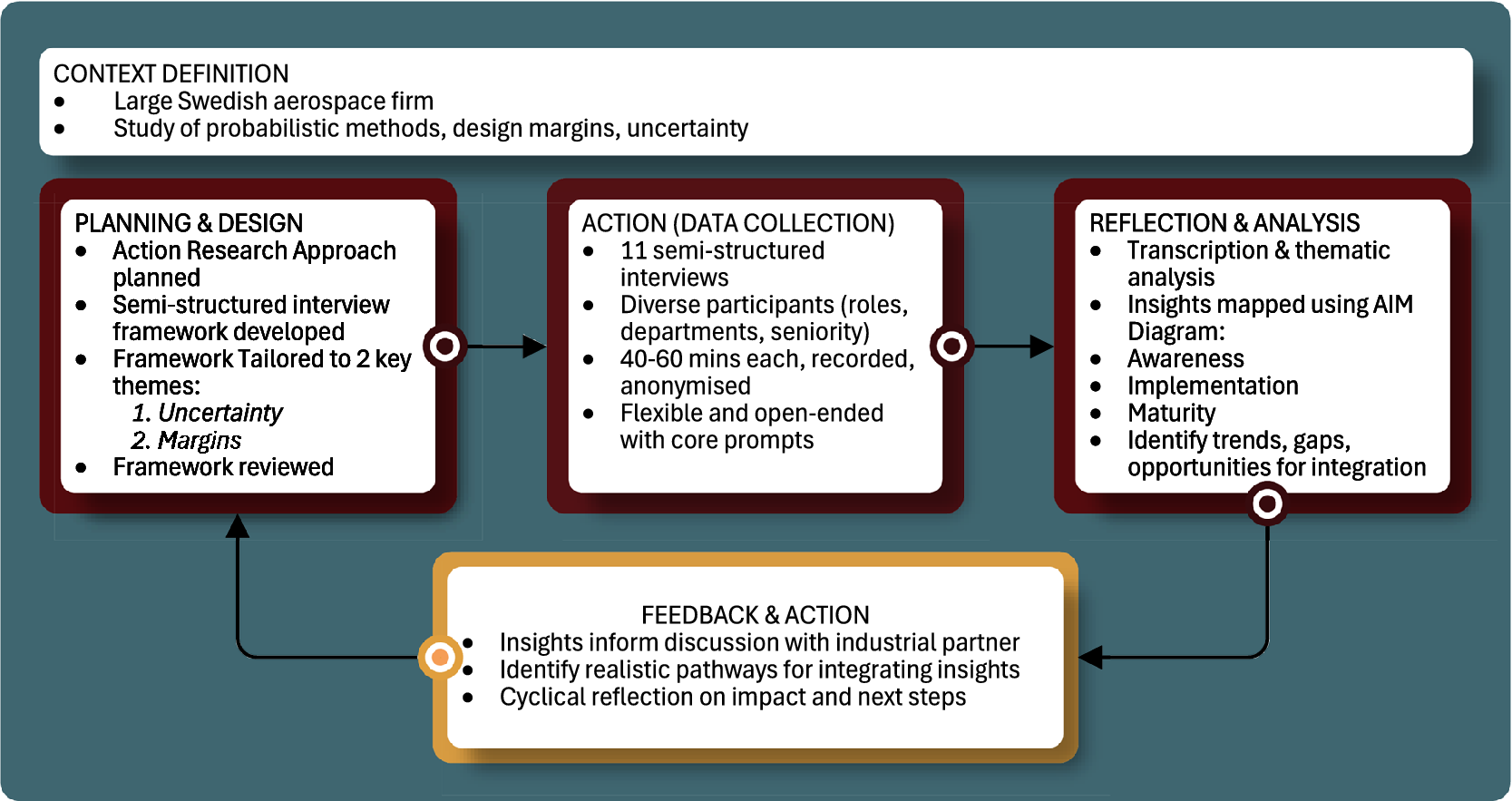
This article reports on a six-month study conducted in 2025 at a large-scale Swedish firm that designs and manufactures aerospace components, as part of a project that also addressed the current use of probabilistic methods and their potential deployment in design workflow planning (Ref removed to preserve anonymity during the peer review process). The overall process of the study follows the action research approach (Avison et al. Reference Avison, Lau, Myers and Nielsen1999). Figure 1 gives an overview of the individual steps and core activities.
Research methodology used in this paper, based on the action research framework.

Figure 1. Long description
The flowchart is organized into three horizontal levels.
At the top is a wide box titled CONTEXT DEFINITION. It contains two bullet points:
* Large Swedish aerospace firm
* Study of probabilistic methods, design margins, uncertainty
The middle row contains three sequential boxes connected by right-pointing arrows:
1. PLANNING AND DESIGN: Includes planning the Action Research Approach, developing a semi-structured interview framework tailored to Uncertainty and Margins, and reviewing the framework.
2. ACTION (DATA COLLECTION): Details 11 semi-structured interviews with diverse participants, lasting 40 to 60 minutes each, recorded and anonymized, using flexible and open-ended core prompts.
3. REFLECTION AND ANALYSIS: Covers transcription and thematic analysis, mapping insights using the A I M Diagram (Awareness, Implementation, Maturity), and identifying trends, gaps, and opportunities for integration.
At the bottom is a single box titled FEEDBACK AND ACTION, which is connected to the Reflection stage by a downward arrow and loops back to the Planning stage with an upward arrow. It includes:
* Insights inform discussion with industrial partner
* Identify realistic pathways for integrating insights
* Cyclical reflection on impact and next steps
3.1. Practitioner interviews
The study drew on a conceptual framework from the margins and uncertainty literature, which guided both the interview design and the analysis. The notion of uncertainty was investigated, focusing on identifying challenges designers face and their relation to the types, sources and management of uncertainties in design. It probed the current understanding of the participants around the nature of uncertainties and their communication between teams. The use of design margins was examined, particularly in the context of mitigating uncertainties. However, how the margins are defined, applied and communicated was also investigated. The questions also probed challenges common to the industry in the effective use of margins, including the themes of excessive conservatism, lack of transparency and challenges emerging from interdisciplinary and inter-domain coordination.
Eleven semi-structured interviews were conducted by the third and sixth authors with engineers from various departments of the organisation. The study aimed to gather real-world insights from various projects and organisational work practices in general. The interviewees, as shown in Table 1, comprised design engineers, stress analysts, team leads and method experts from various functional departments.
List of interviewees and their organisational designation

Table 1. Long description
The table consists of two columns: Interviewee and Role.
* Row 1: I 1, Technical authority – analysis.
* Row 2: I 2, Senior analysis engineer.
* Row 3: I 3, Senior analysis engineer.
* Row 4: I 4, Senior research engineer.
* Row 5: I 5, Principal research engineer.
* Row 6: I 6, Technology project manager.
* Row 7: I 7, Technical authority – analysis.
* Row 8: I 8, Principal engineer – analysis.
* Row 9: I 9, Principal engineer – material and process.
* Row 10: I 10, Principal engineer – analysis.
* Row 11: I 11, Technical authority – analysis.
Each interview session was initiated with a brief overview of the goals of the project and the purpose of conducting the interviews to set the context. All conversations were held with confidentiality in mind and, therefore, anonymised for reporting. The interviews lasted between 40 and 60 mins with the option to follow up for clarification as needed (Adams Reference Adams, Newcomer, Hatry and Wholey2015). The interview framework was reviewed internally before interviews to ensure that the phrasing of the questions was clear, non-leading, unbiased and tailored to participants, who might not be familiar with academic terminology.
3.2. Data analysis
After the interviews concluded, the recordings were transcribed and discarded to preserve anonymity. The transcripts were then studied in detail to extract statements that were relevant to the objectives of this paper. A total of 130 quotes were identified, which were then used as the starting point for the codification process. The codification process started by classifying the quotes into one or more of the predefined themes. These initial themes were informed by the literature on uncertainty and margins, while the grouping was refined inductively as recurring issues emerged from the interview material. In the second round, the second author grouped the quotes into themes. The resulting groupings were then compared and combined. To maintain traceability, each quote is assigned to at least one theme number. To validate the completeness, the first author and the third author reviewed the emergent themes independently against the transcripts. Where interpretations differed, the authors discussed the relevant quote in relation to its original transcript context and the objectives of the study. The purpose was to reduce reliance on a single interpretation and improve traceability between the data, codes and reported themes. This helped ensure that the reported themes were grounded in the interview material rather than in isolated statements or a single person’s interpretation. In the initial round of coding, some of the categories showed overlap and led to repeated observations. These categories were subsequently reclassified to ensure they were analytically distinct, after which the quotes were regrouped into a set of broader themes. This refinement step helped avoid repetition and provided a clearer structure for synthesising the interview findings.
4. Uncertainty
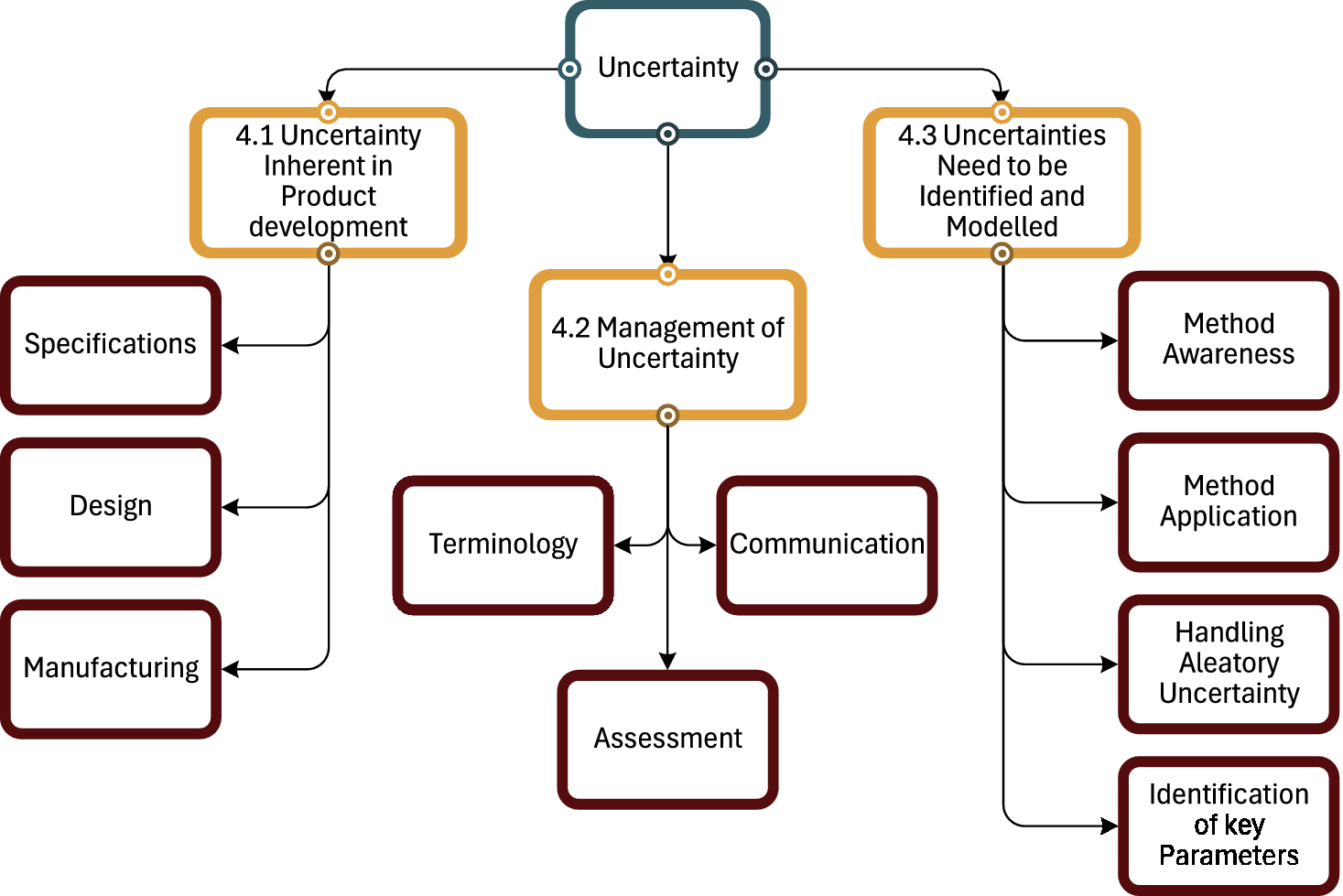
This paper is premised on the assumption that margins are a response to uncertainty. This section starts by analysing comments in terms of where they arise, starting with those that are inherent in product development, issues that arise from the management of uncertainty and those that arise from the challenges of identifying, modelling, assessing and managing uncertainty in general. As the case study component designs and builds highly optimised incrementally developed components, they have a multitude of mathematical models and theoretical methods that they deploy. However, challenges remain around how and where these can be deployed (Figure 2).
Spread of quotes in themes on uncertainty.

Figure 2. Long description
A flowchart with a central top node labeled Uncertainty. Three arrows originate from this node leading to three secondary yellow-bordered boxes.
1. The left branch is labeled 4.1 Uncertainty Inherent in Product development. Three arrows point from this box to dark red sub-nodes on the far left: Specifications, Design, and Manufacturing.
2. The center branch is labeled 4.2 Management of Uncertainty. A vertical arrow leads down to a split path pointing to Terminology on the left and Communication on the right. The vertical path continues downward to a final node labeled Assessment.
3. The right branch is labeled 4.3 Uncertainties Need to be Identified and Modelled. Four arrows point from this box to dark red sub-nodes on the far right: Method Awareness, Method Application, Handling Aleatory Uncertainty, and Identification of key Parameters.
4.1. Uncertainty inherent in product development
The aerospace industry is highly safety-conscious with well-established practices and stringent certification standards. Any new product or technology must demonstrate that key uncertainties have been sufficiently understood and addressed before it can be accepted for operation. Uncertainties can arise from the specification or new technology in the product or the manufacturing process.
4.1.1. Specifications
Much of the uncertainty early in the design process is exogenous, coming from the customer who is still defining their own product, or due to the long development time, regulation changes. One participant described this challenge: “Some requirements are unclear from the partners. That can happen, or we’re lacking loads, or we don’t have enough information about material data” (I4.4).
In the case study organisation, the critical parameter is the “…the load, it could be mechanical load, pressure, flow, thermal load, vibrations and the other major input for us, we need to structure integrity calculations, is the property of the material, how the material is going to behave”(I1.4).
To deal with this, engineers make assumptions to handle missing load cases, insufficient material data and vague specifications from customers, which increases the risk of rework and change propagation due to design changes later. One engineer summarised this as: “Some of them we actually get some minimum-maximum values. That’s so that we can build something. That many other loads we don’t know. Can just assume something” (I6.4).
4.1.2. Design
Although information does gradually appear, reducing the uncertainty, the risk of future modifications and rework remains. As a senior engineer cautioned: “You should be aware [of] early information in our programme, especially if it’s something new, then it’s most probable that it will change” (I11.15).
Requirements from the customer are also subject to interpretation during the product development process, as exemplified by this comment: “The life very much depends on external factors like the crosswind…claiming a very wide range of life depending on what you say. The unbalanced load, the arbitrary vibrations and the crosswind” (I5.7).
Customers try to update requirements as soon as possible, but the timing is not clear in advance, and consequently, it is not clear if particular design actions make sense. As one engineer explained: “The problem is if you optimise it too much and you’re too early, loads tend to shift and the global engine design tends to shift and suddenly what you thought was the healthy margin is not” (I8.6).
Changes in requirements can lead to very substantial issues such as costly redesign, which, as one engineer put it, “we have done it, you know, in the past. We have more or less redesigned most of the things we have designed due to different changes” (I11.1).
4.1.3. Manufacturing
Manufacturing processes which are new to an organisation, such as additive manufacturing, also introduce risks that cannot be addressed using traditional assumptions or historical data. The lack of precedence increases the complexity of design decisions and risk assessments multifold. As one engineer put it: “Now we have with this new material AM coming in. We have another animal to take care of and that is, uh, it’s not easy” (I10.4). Even conventional manufacturing processes bring uncertainties, for example, machining processes affect product properties (e.g. fatigue behaviour) and the company might not know “the consequence of this rough machining on the initiation life” (I2.5). The company also needs to maintain consistent baseline data and “keep [material data] to that day after day, year after year, millennium after millennium” (I10.2).
4.2. Management of uncertainty
While it is well recognised that systematic and consistent methods for managing uncertainty in engineering design are important, they are difficult to implement in practice. While some engineers adopt advanced techniques or account for uncertainties explicitly, others rely on simpler heuristics or past experience. Further, these practices are usually context-dependent, often lacking consistency. “There are specific examples where not only do we consider the variation of the input parameters, but also the uncertainties with the model that you are using to predict things” (I1.5).
4.2.1. Terminology
Effective management of uncertainty begins with its recognition and clear description. However, a lack of shared terminology and formal frameworks makes it difficult to articulate uncertainty consistently and to apply systematic approaches. So, in practice, many simple, heuristic methods are used to quantify uncertainties with mixed outcomes, which were described as using “whatever practice we have followed before, unless there is a major failure, we think that has been a success…” (I1.3). As a result, engineers often rely on experience and intuition rather than formalised methods. Further, in designing an incremental product, organisations often use legacy models, “if this has been working well in the past, use that particular standard parameter…” (I3.11). However, this could affect how sources of uncertainty are interpreted. The engineers are well aware of the limitations of this approach: “sometimes these past experiences may not be very representative of what the future will be, but we do not really have anything else to stand on” (I2.3).
4.2.2. Communication
A part of the challenge in managing uncertainties, especially across large interdisciplinary teams, also lies in how they are communicated within and across teams. Often, the notion of uncertainty (or the resulting risk) is subjective or domain-specific, with each functional team interpreting uncertainties according to its scope. One engineer phrased this as “usually they are only concerned with our area. I do not think that there has been any systematic communication about this” (I2.6). The participants were well aware that uncertainties originating in one domain often propagate to others, leading to secondary hidden effects, and called for cross-functional collaboration; a participant, while discussing a particular method used in the organisation, stated, “it should be done in a group. Let’s say you have experts in each field. It’s really great for discussion” (I5.13). However, information about uncertainties from other teams is often assessed in an ad hoc manner, often relying on informal networks, which might be challenging to access. As one engineer put it, “[…] sometimes you can access them… And sometimes you can’t access them, but most of [the time] not. Or not easily? Never easy actually” (I8.1).
Organisational structure can also pose barriers against effective communication, for example, due to commercial sensitivities or intellectual property issues. This has the potential for hidden uncertainties to go unnoticed and therefore not be considered in the modelling process. “So I work in military and most of the things or all the things I need to know are given. So if I need some inputs for any analysis… I ask, and I get the approved data” (I3.5).
4.2.3. Assessment
Established tools for uncertainty management, such as FMEA and FMECA, are typically used at the programme level at fixed stages of process rather than day-to-day engineering analyses unless there is a recognised need “…but if you are facing a real situation where something has gone wrong, you need a more refined analysis” (I1.14). Although structured methods like FMEA and FMECA could facilitate cross-functional discussions and improve transparency, they are often perceived as time-consuming and therefore underutilised. As one interviewee reflected, “I think all are transparent within a project in that way, but from my understanding and experience working with the FMEA or FMECA is really time-consuming” (I7.6).
Another vital factor affecting the adoption of uncertainty management methods is the lack of standardisation across the industry and constraints imposed by customers. As one engineer noted, “In the other commercial products, there is a lot of work that is in collaboration with other OEMs. There are things in [methods] that are not in their standard methods, so if you want to do something different, you need a lot of buy-in from them” (I1.11). Introducing alternative approaches is hence predicated upon consensus across organisational boundaries, limiting the practical flexibility even when their potential value is recognised internally.
“It is not a requirement from the customer, but we say it is a requirement internally. They are not going to do it because they don’t have time for it”(I9.6).
4.3. Uncertainties need to be identified and modelled
The first challenge for any organisation is to identify the uncertainties it needs to handle. As explained in Section 2.1, some uncertainties are epistemic, i.e. related to what can be known, and others are aleatoric, i.e. arise from the random nature of events. To identify these, the engineers need to be aware of the tools and methods they have available to assess uncertainty. There is considerable knowledge of uncertainty methods in the organisation, as this quote illustrates, “we could do better… but I wouldn’t say it’s badly handled” (I4.10).
4.3.1. Method awareness
However, method and tool use is not only a matter of awareness that they exist but of being engaged and understanding the fundamental theory and knowing how to apply it effectively in a complex design context, as exemplified by this quote: “The mathematical part, that’s not where we need expertise. I think the expertise is needed in how to use the tool. If you don’t know how to make a proper input file and how to see whether the results make sense, then it’s not useful” (I1.13).
4.3.2. Method application
By method application, we refer to the practical ability to translate an uncertainty-related method into engineering decision-making, rather than merely knowing that the method exists or understanding its mathematical basis. This includes formulating appropriate inputs, relating statistical descriptions of uncertainty to the relevant physical phenomena, judging whether the outputs are meaningful and incorporating the method correctly within routine design work. This gap between theoretical knowledge and practical application is particularly evident when engineers synthesise concepts from various domains that are somewhat different, such as statistics and physics, to inform their decisions. The challenge of translating an abstract concept/source of uncertainty into a quantifiable physical effect was a recurring theme. One engineer described this difficulty as follows: “Sometimes it is difficult… you know there is an uncertainty or some noise which could affect it. But you don’t [know] how will this uncertainty… So that is something where your statistics knowledge and the physics come into picture. That for me is challenging” (I3.2).
While the engineers may be aware of certain methods, they need to be willing to integrate them into their routine work practices; “You don’t need to be an expert, but you understand it. You need to put some effort in it” (I8.8). For adoption to occur, the methods must be formally integrated into the workflow, because as another participant put it, the motivation is low if it is “just additional work that you can’t even report to anyone…”(I6.11).
4.3.3. Handling aleatory uncertainty
Due to the very high safety and quality standards of the aerospace industry, the case study organisation is particularly subject to aleatory uncertainty. Aleatory uncertainties are especially challenging because they concern inherent variability that persists despite controlled design, manufacturing and testing conditions. In the case study context, this includes variability in material behaviour, fatigue life, manufacturing outcomes and operational loading. The inherent variability of materials means that even under tightly controlled conditions, outcomes are not guaranteed. The challenge is therefore not only that a quantitative aleatory model may be unavailable but also that available data and models must be interpreted and translated into design assumptions, uncertainty characterisations or margins. As one participant explained: “You have the same testing parameters, same dimension of test specimens, same load, same temperatures, same everything. If you have 10 test specimens, they will all produce different life numbers in them…” (I9.1). This requires engineers to work with wide uncertainty bands as a baseline for analysis. As one participant noted, a prediction that is off by a factor of two is often considered a practical success: “Life prediction is such that… If you have a normal life, you’re happy if you can test this 50 to 200% predictive life”(I5.4). This often forces engineers to accept the limits of their analytical tools, as one reflected: “Maybe it’s not possible anyway to create something that is general and can deal with everything?” (I6.5). Even when engineers have access to advanced analytical tools, the practical implementation of uncertainty analysis presents significant challenges. A primary challenge is defining realistic input parameters that are accurate. For probabilistic models, this task can be more difficult than the mathematical execution of the analysis itself. As one participant described in the context of quantification of the impact of a specific load: “I am designing a part with a certain load, and the load means I am assuming the pilot is flying in a certain way. But how do I know whether that is going to be 30%, 40%, 50%, or 100% off? The information is a bigger challenge than the mathematical backbone that is there in [the tool]” (I1.10).
4.3.4. Identification of key parameters
A related difficulty lies in identifying the parameters that are important, or the model is sensitive to, and the magnitude of the sensitivity itself. The process of identification is often non-trivial and could be counterintuitive, making it harder to build confidence in the model’s focus. As a couple of engineers explained in the context of running sensitivity studies: “Of course it could give you some insight into what parameters that really affect. Sometimes it’s not so obvious which ones that are the most important ones, so we [assume] that we’re good” (I6.9) and “…now we have some parameters in the [method] that we are thinking, should it really be there?”(I9.5).
There is a constant trade-off between increasing model fidelity by including more sources of variation and the time and resource constraints for the organisation. Adding complexity does not always lead to a clear benefit, leading engineers to question the value of increasing the comprehensiveness of the analysis. This trade-off was highlighted by participants who noted that “if you include more variation, you would expect more variation in the output” (I8.10).
This is particularly important as increasing the fidelity is also no guarantee of increased accuracy: “The model that combined all the different ratios and I think temperatures and… After doing that, you could see that the scatter was more or less the same for forging and castings… The model error perhaps dominating over the error you have from the material itself” (I10.3).
4.4. Summary
The interviews show that engineers face diverse and sometimes poorly defined uncertainties across specifications, modelling, manufacturing and communication. These are handled in uneven ways, often relying on experience rather than systematic methods. As a result, uncertainty remains difficult to manage consistently across the organisation. Margins, therefore, become an important practical tool for coping with these challenges. The next section examines how margins are used in practice.
5. Mitigating uncertainties using margins
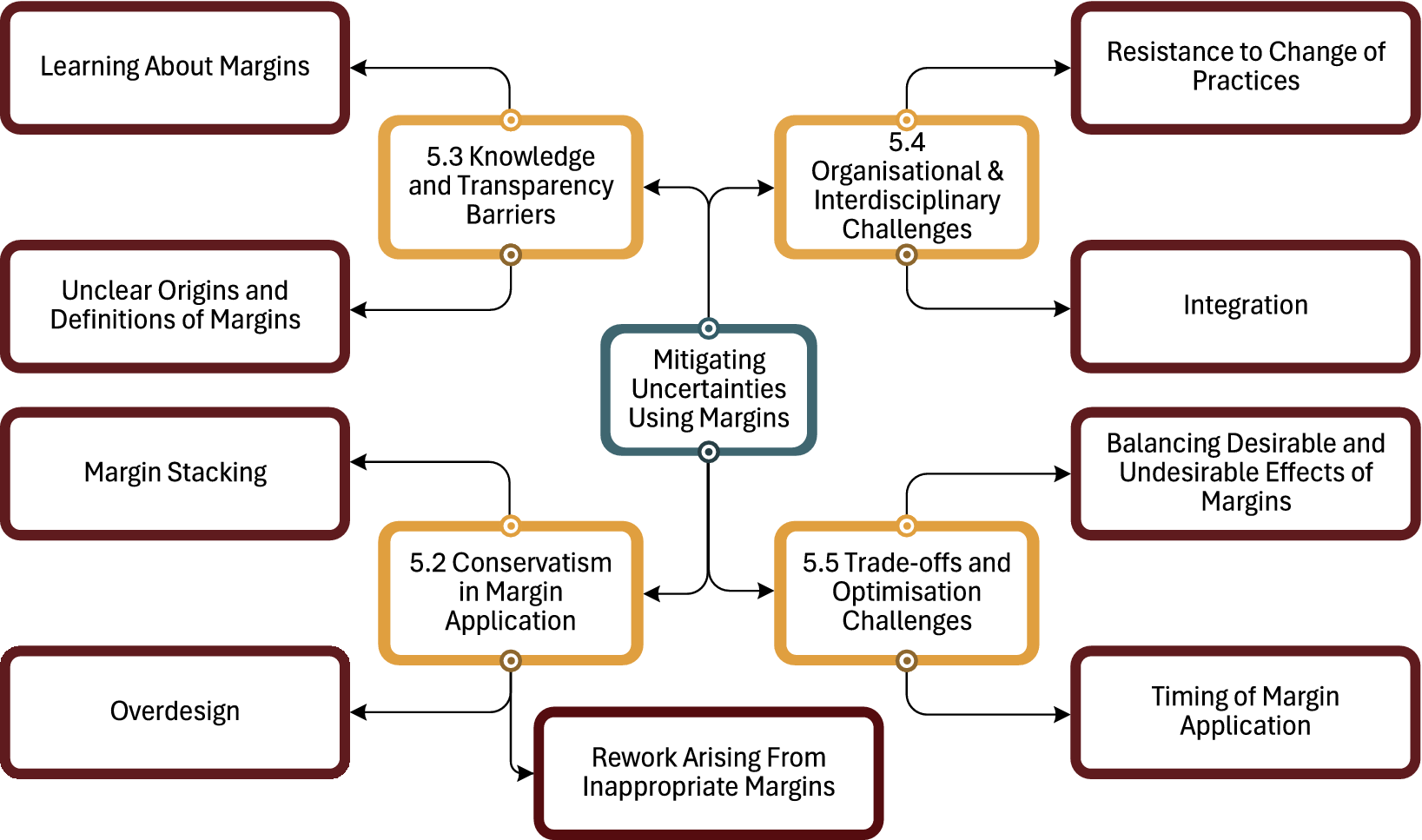
One of the key strategies used for addressing the uncertainties identified in the previous section is margins. While margins provide a buffer against risks, their application introduces its own set of barriers and challenges. These challenges relate to organisational practices, knowledge gaps and often contradicting priorities. Figure 3 illustrates the distribution of quotes across these themes, emphasising recurring patterns in how engineers perceive and apply the concept of margins in practice.
Spread of quotes in themes on the use of margins.

Figure 3. Long description
At the center of the diagram is a blue-bordered box titled Mitigating Uncertainties Using Margins. Four arrows radiate outward from this core to four yellow-bordered thematic nodes.
Moving clockwise from the top-left yellow node:
1. 5.3 Knowledge and Transparency Barriers. This node points to two dark red boxes on the far left: Learning About Margins and Unclear Origins and Definitions of Margins.
2. 5.4 Organisational and Interdisciplinary Challenges. This node points to two dark red boxes on the far right: Resistance to Change of Practices and Integration.
3. 5.5 Trade-offs and Optimisation Challenges. This node points to two dark red boxes on the far right: Balancing Desirable and Undesirable Effects of Margins and Timing of Margin Application.
4. 5.2 Conservatism in Margin Application. This node points to three dark red boxes: Margin Stacking and Overdesign on the left, and Rework Arising From Inappropriate Margins at the bottom center.
5.1. Margins in the case study organisation
Margins are openly discussed in the aerospace industry, and the case study organisation works with margins in various parts of the design process. However, the extent to which margins are documented or tracked varies across teams and projects, and there is currently no holistic and systematic approach. Individual engineers can often quantify margins through analyses such as virtual testing, but this information is typically managed at the local team or project level and is not always shared systematically across the organisation. Margins are usually introduced early in the design process and may be gradually consumed as the design evolves, although the visibility of the remaining margin can differ depending on the tools, practices and disciplines involved. Engineers generally have insight into which components or aspects are approaching critical limits within their own domain, but this knowledge is not always captured in structured representations. The following section discusses several observed practices related to how margins are used as a way of handling uncertainty.
5.2. Conservatism in margin application
While it is common to apply margins to mitigate uncertainty, they are often applied heuristically or based on tacit knowledge, leading to overdesigned artefacts. Engineers often want to “err on the side of caution,” leading to unintentional stacking of margins, their non-transparent use, inadvertent inclusion and so on. Design work with worst-case assumptions in mind, which creates further challenges: “I think it becomes too conservative when you have a lot of stuff that contributes to the margin. And you put everything as minimum, taking safety factors to a lot of loads, etcetera. Then it’s too conservative” (I6.6).
5.2.1. Margin stacking
A common challenge is the accumulation of excess margins on the same parameter or component from various sources. Participants noted that margins are sometimes added at various layers without accounting for their interactions, leading to amplified results. For instance, one engineer described: “Sometimes we will be combining both of these to be extremely conservative. Sometimes we would be doing the related uncertainty somewhere” (I2.8). This can lead to highly conservative designs “obviously, there is some occasions when you stack them on top of each other. Which you may think of it being a conservative or maybe a bit too conservative in this case” (I8.5). This stack-up has different reasons, such as a lack of transparency or communication between teams or the use of off-the-shelf parts. The teams work with incomplete information and aim to mitigate their own risks, which lie within the bounds of their scope. When the parts are finally integrated, margins overlap or compound at the system level. For example, one team may use conservative load assumptions, while another uses conservative material properties. If both address the same underlying risk, the margins can overlap without being visible. The lack of transparent margin tracking methods across the lifecycle of an artefact and holistically on the system level often adds to this challenge.
5.2.2. Overdesign
Excess margins can result in a performance deterioration in components, which is a significant challenge, especially in the aerospace industry, which is very risk-averse. It can also lead to increased material consumption, higher weights and subsequent performance deteriorations. For example, oversizing a component to cover uncertain loads may increase its mass, which can, in turn, affect fuel consumption or require changes to neighbouring components. One participant explained, “Because of these uncertainties, we may be actually using more material than we should be using. The margins that we put tend to be really high” (I2.7). One of their colleagues pointed out that this has “not only financial, but also environmental cost, because if we make things heavier. Then there is a negative effect on the environment. And it’s just inefficiency in the whole system” (I1.7). As overdesign makes systems heavier, it has an impact on competitiveness, as summarised. “Yeah, we will not be competitive… at least when we’re trying to win new businesses, or they’re closed on it, if we’re too heavy, we’re out of business”(I7.7). However, the engineers need to actively think through the implications of overdesign, as this engineer pointed out: “Assessment of how much fuel you burn through a lifetime of it was so much money. If you like, so it’s really important. I didn’t realise that until I saw the calculation” (I5.9). Heavier than necessary components also affect the behaviour of other parts of the system, as the following comment illustrates “…if you need more fuel, you will get a higher thrust from the engine, so it’s a spiral” (I9.3).
5.2.3. Rework arising from inappropriate margins
Margin allocation also needs to be done carefully. Allocation of margins in the wrong places makes them counterproductive and can lead to deterioration of performance in the artefact, which can, in turn, lead to extensive and expensive rework. For instance, one engineer explained: “if you add more margin than needed, the loads will be so high that you either fail or won’t satisfy requirements. You would be oversizing components with too large margins” (I4.6). This oversizing may trigger a cycle of redesigns to bring the performance back within the intended envelope (or within regulatory constraints). Equally undersizing can cause problems: “Sometimes it’s not possible to get positive margins, so you have to do some kind of redesign. Maybe not necessary at all actually, so. That, I think, is quite bad” (I6.8). Resolving these issues often needs prolonged discussions: “we also spend a lot of time with meetings with the customers and analysis, different sensitivities that I think totally waste sometimes” (I6.8).
Excessive margins, although intended to mitigate uncertainty, may counterproductively lead to inefficiencies that propagate through the design process. This, in turn, increases the costs and delays project timelines. The addition of margins unscrupulously, therefore, can often have counterintuitive results.
5.3. Knowledge and transparency barriers
Engineers often rely on tacit knowledge, drawing from experience when defining or identifying margins. Further, the lack of clear documentation or shared terminology of margin within an organisation adds to the challenges. Knowledge of margins may also be specific to an organisation, with localised norms surrounding the application of margins. Formal training on margins is also often limited (there is currently no book, specifically on this topic), and critical knowledge is often acquired informally and unsystematically over time, leading to inconsistencies and inefficiencies in its use. The reliance on engineering judgement in decision-making makes the amount of margin subjective to the engineer: “it’s based on testing plus engineering judgment of which is the worst condition that you could think of. And then we tried to go for that” (I10.5).
5.3.1. Learning about margins
One engineer described the gradual process of learning about margins: “I guess when you learn how the design system works […], then slowly you try and get to understand what are these different margins. It is not possible to have somebody instruct me about all the margin the first day I come to office” (I1.8). Further, rather than being systematically documented or shared, margin-related information is often provided only on demand. As one participant noted: “if it’s a margin information that I need, I get it, even if it’s not initially there. When I inquire about it, I get it. But there is no way to provide you all the information that you do not need” (I1.9). This was interpreted to mean that margin information is available when requested but is not proactively structured or shared. The problem is that engineers may not know in advance which margin assumptions are relevant or which questions to ask. Such ad hoc approaches create knowledge gaps, ultimately delaying decision-making and increasing risks such as margin stacking and accumulation.
Further, organisations and the people in it gradually build confidence in working with each other, which leads to the practices surrounding margins evolving over time, as the confidence in the capabilities grows. As one participant recalled: “in the beginning, when not everything was well set up between [the company] and [another company], the margins changed over time. At first, margins were dropped by 10% after some years of experience working together” (I4.8). Such changes, without a clear documentation of the rationale, make it difficult to learn or maintain a shared understanding.
5.3.2. Unclear origins and definitions of margins
It is frequently not clear to engineers whether margins have been deliberately applied or included inadvertently. The rationale for deliberate margins is often underdocumented. Inadvertent margins remain hidden within the design without any use. The complex interdependencies of a design also prevent engineers from tracing why specific margins are applied or how they relate to uncertainties and other design objectives, such as reliability or flexibility. This leads to further fuzziness and potential errors in application and decision-making surrounding margins. For instance, one engineer expressed difficulty in relating margins to specific uncertainties: “What are the margins considered in your work in connection to failure mode/uncertainties? ‘Cause I’m trying to relate it to current work. It’s difficult to answer this” (I3.8). Uncertainty about the statistical basis of margins was also evident. The lack of clarity about whether margins are based on extreme statistical thresholds or other criteria adds to the confusion. “Is it −3 Sigma properties or is it 95/99? Or is that also with the margin that is not really 100% clear?” (I5.8). Engineers often lack insight into why certain margins are required. For example, margins mandated in codes and standards are often ad hoc, without sufficient rationale or empirical basis provided: “when it comes to the loads and things, then yeah. I know. But in many cases, I do not know why people would want us marking down by this much”(I2.9).
5.4. Organisational and interdisciplinary challenges
Complex organisations are prone to organisational inertia, which creates resistance to leaving tried and tested ways of working behind and adopting new approaches. Contemporary complex products typically require interdisciplinary activity with multiple teams working on a wide variety of product and process aspects in parallel, which later integrate them. Margins can be a space where negotiations between teams can happen, if utilised properly.
5.4.1. Resistance to change of practices
A risk-averse culture, rigid customer requirements and industry norms and well-established workflows are reasons why new methods and approaches regarding margins are difficult to implement. Engineers indicated that introducing changes to margin practices frequently meets opposition: “Whenever you’re trying to bring a change, there will be some resistance, right?” (I3.9). The reluctance to change is particularly evident when attempting to relax conservative margins or requirements. A participant mentioned this in terms of the rigidity of the requirement document. “But the requirement document that we have. They are not very willing to release on requirements or margins” (I6.7). The engineers are, however, aware that this rigidity constrains flexibility, as one participant highlighted: “some degree you are kind of stuck because your customer tells it that this is how it looks and you can or should use it” (I11.3).
5.4.2. Integration
Margins originate from disparate sources and at different levels of detail, both in the product and development process domains. Some margins may originate at the system level, while others may originate at the part level. Margins also originate across disciplines, e.g. from stress engineering or the electrical domain, but may affect a margin in another. One engineer emphasised the interdisciplinary nature of margins: “margins come from different worlds, different disciplines. I cannot know everything, so I’m not aware of all the factors and where they come from. We need to work in teams” (I4.7). Designers may add margins independently and for different reasons at different points of the development process to mitigate the risks of iterations or change propagation: “They are usually from different nature, you know. It’s like one that is taking into account for regulation, and there is another one for material knockdown. So they have nothing to do with each other in that sense” (I8.7). The complex interactions create a significant challenge when it comes to the effective integration of various aspects of a product, as engineers struggle to coordinate and align margin strategies in complex and multi-disciplinary projects. Collaborative teamwork and coordination are vital but often constrained by epistemic barriers, which are more pronounced at the start of the project, where not a lot of information might be available, as illustrated by this quote: “We are a little in the beginning of the process. We, of course, get something from the [parent] system, and we give it away for different strengths analysis” (I11.16).
5.5. Trade-offs and optimisation challenges
Design margins to mitigate uncertainties introduce important trade-offs, especially in aerospace engineering. While margins are essential for ensuring safety, reliability, flexibility, etc., their overuse leads to undesirable effects, such as increased component weight and performance deterioration, which conflict with the industry’s demand for lightweight systems. Besides performance trade-offs, there are also trade-offs between advancing design processes through timely decisions and delaying design processes through rework.
5.5.1. Balancing desirable and undesirable effects of margins
The pressure to balance these contradictory needs is often a fundamental challenge. One engineer highlighted this contradiction: “If you have enough margin, maybe you should be more lightweight, more optimised. And then you have a contradiction” (I11.4). The pressure to reduce weight while maintaining safety margins can increase risks, as illustrated by this quote, where the term safety factor is used for margins in general, “With continuous demand for low weight and low weight normal drives, the safety factor is somehow affected. In the worst case, you have multiple locations of fatigue. And then you can say examples are not in the manual, for instance, you have multiple fatigue or very limited loads. And makes the complete win in unsafe” (I5.1). However, there are no clear guidelines or frameworks which can help teams work towards balancing the desirable and undesirable effects of margins: “so there’s no exact number that we should have this kind of margin. Sometimes it’s a balance and optimisation” (I11.9). The lack of clear guidelines and frameworks leads to engineers relying on experience, which can lead to inconsistent design outcomes and potentially overdesigned products. At the same time, engineers know that too optimised components give them little room to manoeuvre: “We didn’t really know if it should make it because it was so optimised with no margin”(I11.5).
5.5.2. Timing of margin application
Early in the design process, engineers need to make assumptions, which, if not correct, can later render margins inadequate. This can lead to increased iteration costs or even major redesigns. One participant noted the risks of mistiming the margin optimisation efforts: “the problem is if you optimise it too much and you’re too early, loads tend to shift, and the [parent system] design tends to shift and suddenly what you thought was the healthy margin is not”(I8.6). The iterative nature of design requires the engineer to anticipate evolving requirements. This complicates margin allocation and highlights the need for adaptive processes to manage margins dynamically throughout the product development process.
6. Discussion
The case study organisation is subject to the same types of uncertainties commonly encountered in engineering design, but several of these are particularly pronounced due to the incremental, highly safety-critical nature of aerospace development.
However, despite the centrality of uncertainty in engineering decision-making, so far only a few case studies have addressed how practising engineers handle uncertainty in their day-to-day work. While some papers like Thunnissen and Tsuyuki (Reference Thunnissen and Tsuyuki2004) include empirical cases, their primary focus is on developing methods for analysing and quantifying uncertainties, rather than on exploring engineers’ experience of working with them. This stands in contrast to the extensive theoretical literature on uncertainty in decision-making, for example, by Gurnani and Lewis (Reference Gurnani and Lewis2005); Li and Zhao (Reference Li and Zhao2014); Renzi, Leali, and Angelo (Reference Renzi, Leali and Angelo2017), which spans both uncertainty modelling frameworks in general, for example, by Zimmermann et al. (Reference Zimmermann, Königs, Niemeyer, Fender, Zeherbauer, Vitale and Wahle2017), or for context-specific cases (Frangopol & Maute Reference Frangopol and Maute2003; Apley, Liu, & Chen Reference Apley, Liu and Chen2005; Refsgaard et al. Reference Refsgaard, van der Sluijs, Højberg and Vanrolleghem2007). Empirical studies on margins also exist, for example, Eckert et al. (Reference Eckert, Isaksson, Lebjioui, Earl and Edlund2020), but they do not examine how uncertainties and margins are connected in practice. This paper contributes by analysing how engineers practically interpret and handle uncertainties in a complex industrial setting.
This research showed that the understanding of uncertainties is deeply situated in the practical working context of the individual engineers, who have limited visibility over the wider process. Uncertainty is both the cause and the result of other issues in the product development process. For example, Maier, Eckert and Clarkson (Reference Maier, Eckert and Clarkson2021) list similar factors affecting communication, as this paper found affecting understanding of uncertainty, which, in turn, is caused by issues of overview and communication. There was evidence for many different types of uncertainty in the organisation. There was a clear awareness that different types of uncertainty require different responses. For instance, engineers recognised the implications of aleatory uncertainty (see Section 4.3) and described established measures for addressing inherent variability. However, epistemic uncertainty was less consistently articulated, and participants reported fewer systematic strategies for addressing it.
While margins are widely used as a means of mitigating uncertainty, the interviews revealed that the link between specific uncertainties and the particular margins introduced to address them was not always explicit in practice. Engineers were generally aware of the potential benefits of margins, both for absorbing variability and for supporting flexibility, but margin-related decisions often remained confined within disciplinary silos. As a result, margins were not always used to their full potential at the system level. A recurring challenge was the identification, terminology, modelling and assessment of both uncertainties and margins. Similar to findings in the automotive sector by Eckert et al. (Reference Eckert, Isaksson, Lebjioui, Earl and Edlund2020), engineers used diverse terms to refer to margins, and distinctions between margins for design, process margins and safety margins were often blurred (Brahma et al. Reference Brahma, Hallstedt, Wynn and Isaksson2024). In addition, many participants expressed limited confidence in applying analytical methods for establishing margins and reported little systematic tracking of how margins were defined or consumed throughout the design process.
Further, based on the detailed analysis of the interview material, we identified a number of recurring challenges related to both uncertainty and the use of margins in engineering practice. Rather than treating these challenges in isolation, we examined how they interact in day-to-day decision-making and how engineers experience their combined effects. This allowed us to identify the following challenges:
-
• Due to the lack of accessible or systematic methods to formally quantify and model uncertainties, engineers are often forced to rely on tacit knowledge, experience or “rules of thumb,” without a solid rationale.
-
• The rationale behind applied margins remains underdocumented, as the underlying uncertainty was never formally characterised. Many of these decisions are subjective and non-transparent, further making them difficult to communicate and manage systematically.
-
• Margins are used as a mitigation strategy to poorly understood uncertainties, resulting in overdesign or generally overspecified products; they are at least highly conservative margin strategies. For example, the introduction of novel manufacturing methods like additive manufacturing or new suppliers brings significant uncertainties that engineers have to mitigate (Brahma et al. Reference Brahma, Hajali, Mallalieu and Isaksson2025). Since the uncertainties are often hidden, large margins are used.
-
• As teams work in organisational silos, uncertainties are often not communicated across functional boundaries, and teams often end up adding margins independently to mitigate local uncertainties, leading to duplication or stack-up of margins, especially resulting in system-level overdesigns.
-
• Timing of design decisions under uncertainty can lead to undesirable margin outcomes and complicate trade-offs. Optimising margins too early in the design process against poorly characterised uncertainties may lead to inadequate margins later. This can lead to larger-than-desired rework, cost escalations and a general lack of space for trade-offs. On the other hand, optimising margins too late in the design process leads to accumulated uncertainties, making margins difficult to adjust as product complexity also increases.
The analysis of margin practices provides insight into product properties that may remain hidden when design decisions are viewed through a reductionist decision-making lens. Engineers sometimes expressed discomfort when working with uncertainties that they could not fully characterise, yet also described feeling limited in their ability to refine these uncertainties or establish precise values. One contributing factor is the perceived risk of delaying the development process: engineers aim to avoid additional iteration cycles that may arise if their components cannot accommodate downstream changes or if unexpected issues are uncovered (Wynn & Eckert Reference Wynn and Eckert2016). Although the case study organisation’s testing processes are effective at identifying faults, these issues still introduce additional costs and schedule impacts. In the absence of systematic margin management, such pressures can contribute to margin accumulation across teams, leading to designs that are heavier, more material-intensive and consequently more costly and less sustainable than intended. This dynamic illustrates the trade-off between development time and product performance, in which organisations must weigh the benefits of additional design effort against potential gains in efficiency or material savings. While clearer processes and decision-making criteria may help reduce the uncertainty-related discomfort experienced by individual engineers, achieving such consistency in complex product development environments, where many teams and specialists contribute in parallel, remains challenging.
The interviews also show how past practice can become a strong reference point for current decisions. In safety-critical design, this is both necessary and valuable, since proven solutions and accumulated experience provide confidence in decisions made under uncertainty. However, the absence of failure can also become an implicit indicator that previous assumptions were appropriate, making it difficult to distinguish between margins that remain necessary and margins that persist because the underlying assumptions have not been revisited. Over time, this may preserve or accumulate more margin than is needed, contributing to overdesign, increased weight or cost and other forms of performance deterioration. The strong dependence on tacit knowledge and heuristics in margin decisions underscores the need for systematic frameworks that explicitly link margins to the uncertainties they mitigate, with traceability to document rationale and consumption over time (Helton Reference Helton2011; Eckert et al. Reference Eckert, Isaksson, Lebjioui, Earl and Edlund2020, Reference Eckert, Isaksson and Earl2019; Brahma et al. Reference Brahma, Ferguson, Eckert and Isaksson2023). Without such structure, organisations risk hidden or mis-sized margins, overdesign and inconsistent risk mitigation Eckert et al. (Reference Eckert, Isaksson, Lebjioui, Earl and Edlund2020, Reference Eckert, Isaksson and Earl2019). Our findings indicate that the management of margins cannot be separated from the characterisation of uncertainty: poorly specified uncertainties tend to inflate margins, while inadequate margins can amplify the effects of residual uncertainty; hence, both should be studied in tandem (Helton Reference Helton2011; Eckert et al. Reference Eckert, Isaksson and Earl2019; Brahma et al. Reference Brahma, Hallstedt, Wynn and Isaksson2024).
Interviewees reported low confidence in interpreting, justifying and communicating margins with respect to specific uncertainties; in the absence of shared rules or explicit guidance, conservative choices often become a pragmatic way to manage accountability and downstream rework risk, consistent with prior empirical observations of opaque rationales, risk-averse cultures and siloed practices (Eckert et al. Reference Eckert, Isaksson, Lebjioui, Earl and Edlund2020). Recent empirical work also shows that design trade-offs, including those involving margins, are shaped by contextual ambiguity, evolving assumptions and organisational constraints, rather than purely analytical optimisation; in particular, assumption-driven change has been linked directly to margin allocation and trade-offs (Nickel, Hurst, & Duimering Reference Nickel, Hurst and Duimering2021; El Fassi et al. Reference El Fassi, Chen, Riaz, Guenov, van Heerden and Altelarrea2023). While empirical work on margins exists, relatively few studies examine the cognitive aspects of how engineers reason about margins in everyday work; much of the literature either characterises practice and terminology or provides methods/frameworks, a gap this study addresses (Lebjioui Reference Lebjioui2018; Eckert et al. Reference Eckert, Isaksson, Lebjioui, Earl and Edlund2020; Brahma et al. Reference Brahma, Hallstedt, Wynn and Isaksson2024).
The work also points to practical steps that engineering teams could take to improve the visibility and management of margins. At present, margins are often not communicated systematically (Ferguson et al. Reference Ferguson, Brahma, Eckert and Isaksson2024). Although individual engineers may tacitly understand the margins relevant to their own work, this knowledge is not always shared across teams or preserved for later decision-making. As an initial step, engineers could make critical margins more visible, for example by annotating models, recording them in design-review material or explicitly raising them in cross-disciplinary discussions. In the longer term, organisations may benefit from more systematic approaches for tracking and recording margins throughout the development process (El Fassi, Guenov, & Riaz Reference El Fassi, Guenov and Riaz2020; Jacobson & Ferguson Reference Jacobson and Ferguson2023).
Such approaches could develop along two related directions. First, margins could be modelled more explicitly by linking requirements management with CAD models, functional models or other engineering representations. This is likely to be a significant undertaking, but related modelling approaches are already well developed in the tolerancing community (Söderberg et al. Reference Söderberg, Lindkvist, Wärmefjord and Carlson2016), where allowable variation is explicitly represented and analysed even when realised outcomes vary. These approaches may provide useful inspiration for capturing the ranges of flexibility available in a design. Second, the rationale for deliberately added margins could be recorded more explicitly. Research on design rationale capture may therefore provide useful concepts and tools for documenting why margins were introduced, what uncertainty they address and under what conditions they may be reconsidered (Bracewell et al. Reference Bracewell, Wallace, Moss and Knott2009).
A key challenge is to avoid overburdening engineers with unnecessary documentation while still making relevant margin information available when it is needed. The case study organisation provides a useful setting for investigating this balance further, because it operates within a specialised engineering domain involving highly complex and safety-critical aerospace products with substantial existing documentation. Current company efforts directed at modelling margins in existing components may therefore provide a practical starting point for exploring how margin visibility, rationale capture and uncertainty management can be integrated into existing engineering workflows.
The study also has limitations with respect to generalisability. Since the interviews were focused on a single organisation, the findings should be interpreted in light of the study context. However, several of the challenges identified, including tacit margin rationale, limited documentation, siloed communication and margin accumulation, are consistent with prior empirical studies on margins in other engineering contexts. The findings may therefore be most relevant to organisations developing complex, safety-critical or highly optimised products, while further studies are needed to examine how the uncertainty–margin relationship differs across sectors and organisational settings.
7. Conclusion
This paper reports on an empirical study on the topic of uncertainty and its mitigation using margins, involving 11 in-depth interviews with experienced engineers and managers at an aerospace company. The analysis revealed that while margins are quite widely used as a mitigating strategy against various kinds of uncertainties, their application is often tacit and based on heuristics. Further, there is a disconnect between the margins and the uncertainties that they mitigate. The core insight is that for effective application of margin, the understanding of uncertainties is essential. Not all uncertainties are the same, and particular kinds of uncertainties need particular types of margins.
The study contributes to the literature by demonstrating that the challenges in margin management are not always purely technical; they are also organisational and cultural. Addressing these challenges will require linking margins to the underlying uncertainties that they are supposed to mitigate.
Future research should focus on developing and validating margin management frameworks that consider multiple levels of hierarchy of a product/system. Further, focus should also be on exploring strategies that can support organisations to adopt such frameworks and ultimately move away from ad hoc practices towards more rigorous model-based approaches of uncertainty and margin management in complex systems.
Acknowledgements
The authors would like to sincerely thank all interviewees who generously shared their time, experiences and insights. Their contributions were invaluable to this study.


 Open access

